

Submitted:
05 April 2025
Posted:
08 April 2025
You are already at the latest version
Abstract
The integration of blockchain technology into supply chain management presents a transformative opportunity to enhance sustainability practices across various industries. This paper explores the multifaceted benefits of adopting blockchain as a foundational framework for supply chains, emphasizing its potential to improve transparency, traceability, and accountability. By providing an immutable ledger, blockchain enables stakeholders to track the provenance of goods, ensuring ethical sourcing and reducing fraud. Additionally, the decentralized nature of blockchain fosters collaboration among supply chain participants, facilitating the sharing of critical information that can lead to more efficient resource utilization and waste reduction. Through case studies and empirical analysis, this paper illustrates how blockchain can mitigate environmental impacts, promote social responsibility, and ultimately drive sustainable practices within supply chains. The findings underscore the necessity for organizations to embrace this innovative technology as a critical component in their sustainability strategies, paving the way for a more resilient and responsible future in global commerce.
Keywords:
Blockchain technology
; supply chain transparency
; sustainability
; traceability
; accountability
; environmental stewardship
; information flow
; stakeholder collaboration
; real-time tracking
; ethical consumerism
; immutable ledger
; compliance
; environmental regulations
; process optimization
; waste minimization
; responsible business practices
1. Introduction
The adoption and integration of blockchain technology within the intricate domain of supply chain management is progressively being recognized as a critically essential strategy that significantly contributes to the enhancement and promotion of sustainable practices across a broad spectrum of diverse industries and sectors [1]. As organizations and enterprises worldwide encounter escalating pressures to function in a manner that is both transparent and ethically responsible, blockchain technology offers a robust and innovative framework that effectively meets these urgent demands by markedly enhancing visibility, traceability, and accountability throughout the entire supply chain process [2].
This transformative technology provides an immutable ledger that enables various stakeholders to meticulously monitor the origin of goods and products, thereby ensuring ethical sourcing practices while concurrently alleviating numerous risks associated with fraud, inefficiency, and other adverse factors [3]. The inherently decentralized characteristic of blockchain cultivates a collaborative environment among all participants within the supply chain, thereby facilitating the seamless and efficient dissemination of critical information that can ultimately lead to improved resource utilization, substantial waste reduction, and overall operational enhancement [4].
This scholarly paper thoroughly investigates the multifaceted and numerous advantages that emerge from the incorporation of blockchain technology into supply chain operations, which are further substantiated by empirical analysis and persuasive case studies derived from leading organizations and industry pioneers such as Walmart and De Beers. Through this comprehensive examination, the undeniable imperative for businesses to fully adopt blockchain technology as a fundamental component of their sustainability strategies becomes increasingly apparent, ultimately paving the way for a more resilient, accountable, and sustainable future in the arena of global commerce and trade.
2. Blockchain Technology Overview
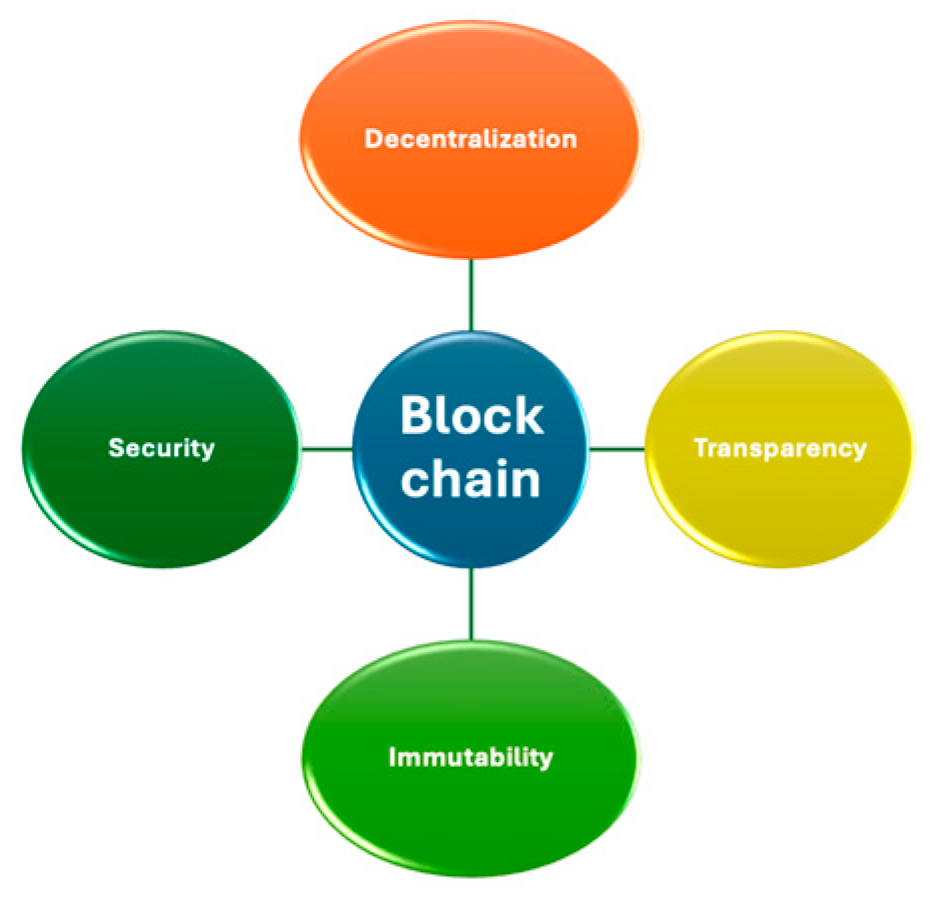
This section explores the core principles of blockchain technology, emphasizing its decentralized characteristics and cryptographic security measures that guarantee data integrity and transparency[5]. Grasping these essential elements is vital for organizations looking to utilize blockchain technology effectively, as it enables them to enhance their operations while upholding trust and accountability in their transactions.
Figure 1.
Key Features for Blockchain Technology Overview.
- 1.
- Decentralization
With Blockchain as its foundation, decentralized ledger technology changes the landscape of transaction documentation and validation among a network of computer systems. This decentralization is crucial, as it bolsters the system's strength and resilience against failures and attacks [6].
- 2.
- Transparency
A prominent feature of blockchain is its built-in transparency. All transactions are logged in a public ledger, which can be viewed by every participant within the network. This transparency nurtures trust among users, as they can independently verify transactions without depending on a central authority. [7]
- 3.
- Immutability
After a transaction is logged and confirmed on the blockchain, changing or removing it is nearly unfeasible. This permanence is accomplished through cryptographic hashing and consensus mechanisms, which ensure that any effort to alter the data would necessitate the agreement of the majority of network participants. [8].
- 4.
- Security
Security plays a vital role in blockchain technology, as it employs advanced cryptographic methods to safeguard data. Moreover, the decentralized architecture of the network substantially reduces the probability of fraud and unauthorized access, as there exists no singular point of failure that can be exploited by malevolent entities [9].
3. Importance of Supply Chain Transparency and Sustainability
Supply chain transparency signifies the thorough visibility and comprehension of each process, transaction, and movement of goods within the supply chain. It offers the capability to follow products from their origin across all phases of production, distribution, and delivery [10]. On the other hand, sustainability emphasizes the essential need to mitigate the ecological footprint of supply chain processes while encouraging ethical conduct throughout the complete supply chain framework [11].
- Improved Consumer Trust: Customers are progressively more concerned about the origins of the products they choose to buy, and the ethical implications tied to their decisions. Transparent supply chains empower businesses to showcase their dedication to ethical sourcing and responsible practices, thereby bolstering brand loyalty and consumer trust [12].
- Enhanced Regulatory Compliance: As governments and regulatory agencies around the globe enforce stricter regulations regarding environmental standards and ethical labor practices [13]. By maintaining organized records and being transparent about supply chain operations, organizations can more effectively navigate the intricacies of regulatory frameworks, minimizing the risk of legal complications and penalties.
- Reduced Environmental Impact: Sustainability initiatives within the supply chain aim to minimize waste, decrease carbon emissions, and improve resource efficiency. By embracing transparent practices, companies can pinpoint areas for enhancement and implement strategies that aid in environmental preservation [14].
- Boosted Operational Efficiency: Insight into supply chain processes empowers organizations to detect bottlenecks, inefficiencies, and potential cost-saving opportunities. By having a complete perspective on the entire supply chain, companies can refine operations, advance inventory management, and increase overall productivity. [15].
4. Blockchain in Supply Chain Management
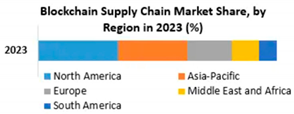
The global blockchain supply chain market size was estimated at USD 2.26 billion in 2023 and is expected to grow at a CAGR of 90.2% from 2024 to 20301. North America dominates the blockchain technology market with a share of 37.41% in 20242. The global blockchain in supply chain market size was USD 249.6 million in 2022 and is projected to touch USD 3595.69 million by 2031, at a CAGR of 34.5% during the forecast period3. The global Blockchain Supply Chain Market size was worth approximately $253 million in 2020 and is poised to generate a revenue around $3,272 million by the end of 2026, presenting a CAGR of 53.2% during the forecast period4. By geography, North America held 38.67% of market share in 2023 and is expected to keep its dominance over the forecast period [16,17,18,19]
Figure 2.
Blockchain in Supply Chain Management Market Trend.
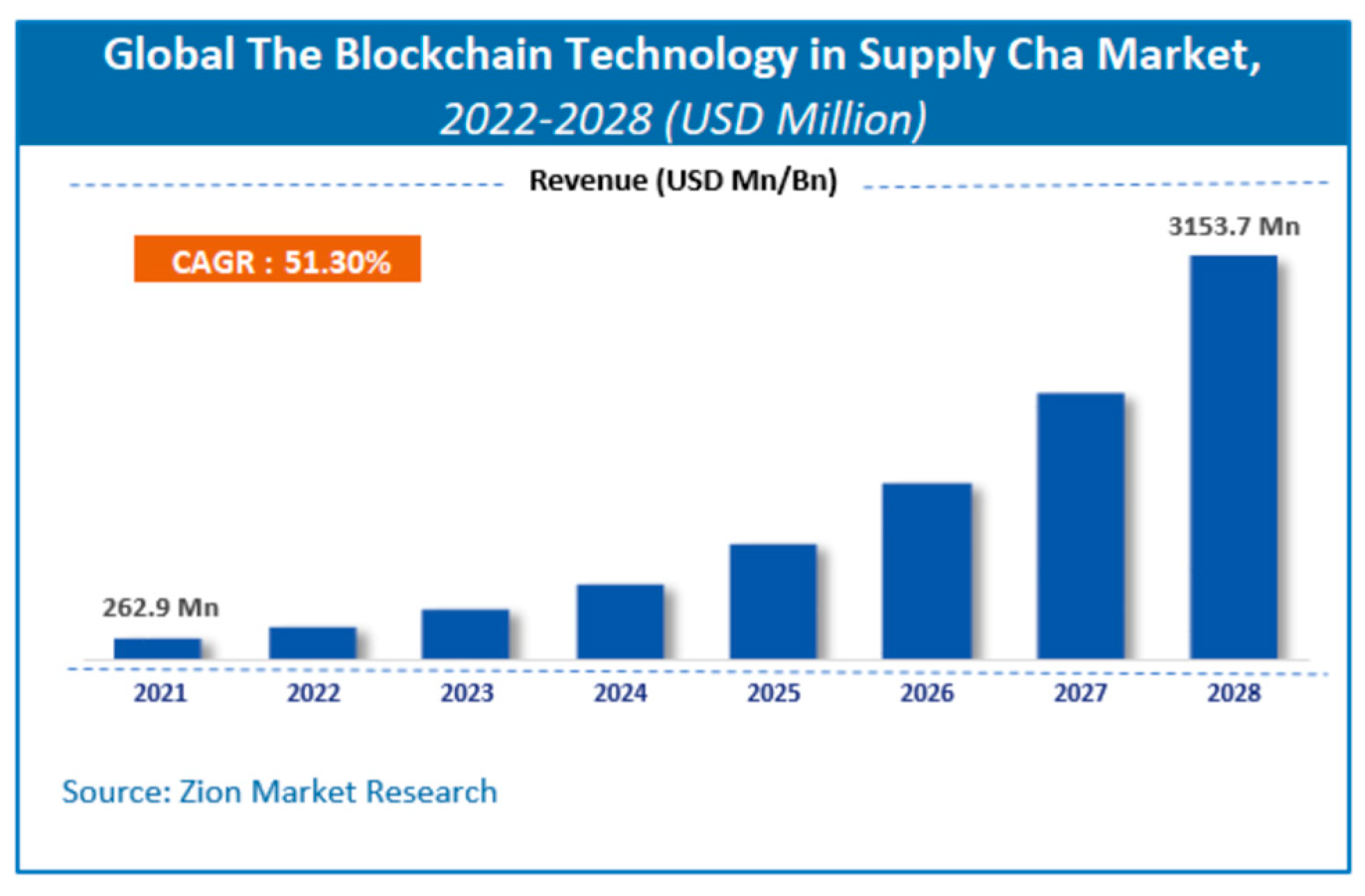

Table 1.
Key Players in the Blockchain Supply Chain Market and country wise share.
| Key Players | Market Share |
|
 |
5. Case Studies
5.1. Case Study 1: Walmart and IBM's Food Trust Blockchain
Walmart partnered with IBM to create the Food Trust blockchain platform, enhancing food safety and traceability in its supply chain. This platform uses distributed ledger technology to track food products from farms to store shelves, providing real-time access to product provenance for stakeholders. The implementation involved extensive testing and collaboration with supply chain partners for effective integration.
Key results include a significant reduction in tracing time from days to seconds, improving food safety by enabling quick responses to contamination issues and reducing food waste. This collaboration sets a new standard for food safety and supply chain management in the industry.
5.2. Case Study 2: De Beers' Tracr Blockchain for Diamond Supply Chain
De Beers, a leader in the diamond industry, developed the Tracr blockchain platform to enhance transparency and traceability in response to consumer concerns about ethical sourcing.
Implementation: Tracr tracks diamonds from the mine to retail, recording every transaction on an immutable ledger. This system ensures data security and authenticity, confirming that diamonds are ethically sourced and conflict-free. It incorporates smart contracts and digital certificates for improved communication among stakeholders.
Results: Tracr has significantly reduced fraud in the diamond market. It has enhanced consumer trust by providing verifiable information on diamond sourcing. The platform promotes responsible practices and contributes to a more sustainable diamond supply chain, positioning De Beers as a technology pioneer in the industry.
5.3. Case Study 3: Provenance and Sustainable Fashion
Background: Provenance is a blockchain-based platform aimed at enhancing transparency and sustainability in the fashion supply chain. It addresses consumer concerns about ethical purchasing by providing a solution for informed decision-making. The platform documents the entire lifecycle of fashion products, verifying their authenticity and sustainability.
Implementation: Provenance was integrated with various fashion brands to track and document product journeys. Key data captured includes material origins, supplier ethics, and production environmental impacts. Blockchain technology ensures the information is immutable and accessible, allowing easy verification of sustainability claims. Brands can communicate their sustainability efforts directly to consumer.
Results: The introduction of Provenance increased consumer trust as shoppers favored brands demonstrating sustainable practices. Enhanced transparency in the supply chain encouraged brands to adopt responsible sourcing and manufacturing. This shift has led to a broader movement towards sustainability in the fashion industry.
6. Proposed Framework for Bloackchain Technology Adoption in Sustainable Supply Chain Management
Below is a framework which can be used to guide companies in implementing effective transparency strategies, focusing on key areas such as supply chain visibility, stakeholder engagement, and measurable sustainability goals [20]. By adopting this framework, companies can not only enhance their credibility but also create meaningful dialogues with consumers that reflect shared values and commitments to sustainability.
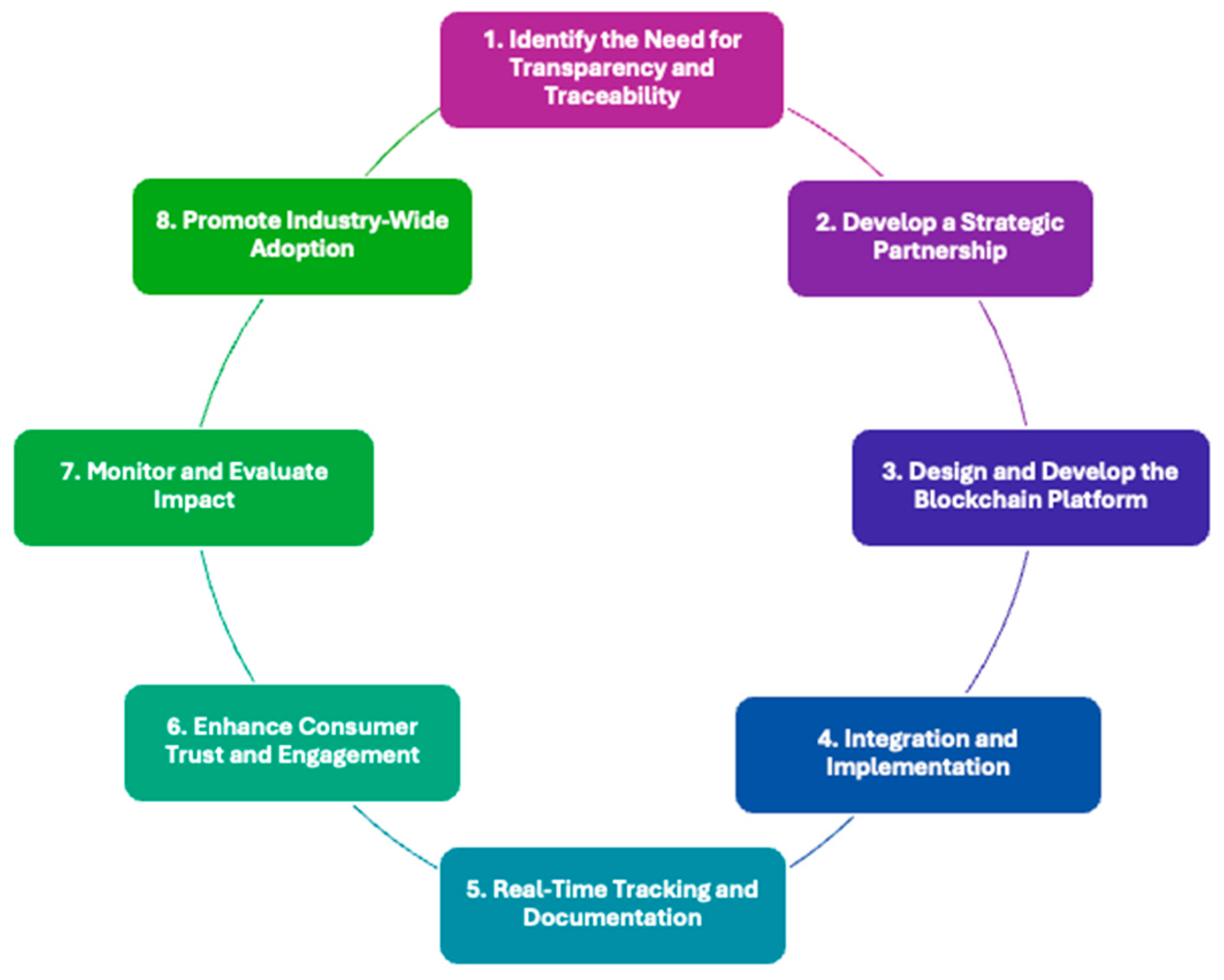
- 1.
-
Identify the Need for Transparency and Traceability
- →
- Assessment: Conduct a thorough assessment to identify the specific areas within the supply chain that require enhanced transparency and traceability [21]
- →
- Stakeholder Analysis: Engage with key stakeholders, including consumers, suppliers, and regulatory bodies, to understand their concerns and requirements for transparency [22]
- 2.
-
Develop a Strategic Partnership
- →
- Technology Partner: Collaborate with a technology partner experienced in blockchain solutions. For example, Walmart partnered with IBM, and De Beers developed Tracr [23].
- →
- Industry Collaboration: Work with industry peers and supply chain partners to ensure broad adoption and standardization of the blockchain platform [24].
- 3.
-
Design and Develop the Blockchain Platform
- →
- Platform Architecture: Design a blockchain platform tailored to the specific needs of the supply chain. This includes defining the data structure, consensus mechanisms, and security protocols [25].
- →
- Smart Contracts: Implement smart contracts to automate and enforce compliance with ethical and sustainability standards [26].
- →
- Digital Certificates: Utilize digital certificates to verify the authenticity and ethical sourcing of products [27].
- 4.
-
Integration and Implementation
- →
- Pilot Testing: Conduct rigorous pilot testing with selected supply chain partners to ensure the system works seamlessly. [27].
- →
- Data Integration: Integrate the blockchain platform with existing supply chain management systems to capture and record data at every stage of the product journey [28].
- →
- Training and Onboarding: Provide training and support to all stakeholders to facilitate smooth adoption and usage of the blockchain platform [24].
- 5.
-
Real-Time Tracking and Documentation
- →
- Immutable Ledger: Use blockchain’s immutable ledger to document every transaction and movement of goods, ensuring data security and integrity [29].
- →
- Provenance Tracking: Enable real-time tracking of products from their origin to the destination, providing detailed information about the provenance of products [30].
- 6.
-
Enhance Consumer Trust and Engagement
- →
- Transparency: Provide consumers with access to verifiable information about the origins and ethical practices associated with their purchases [31]
- →
- Communication Tools: Develop tools and platforms to communicate sustainability efforts directly to consumers, fostering a deeper connection and understanding of the brand’s values [32].
- 7.
-
Monitor and Evaluate Impact
- →
- Performance Metrics: Establish key performance indicators (KPIs) to measure the impact of blockchain implementation on supply chain transparency, efficiency, and sustainability [33].
- →
- Continuous Improvement: Regularly review and refine the blockchain platform based on feedback and performance data to ensure continuous improvement and adaptation to evolving industry standards [34].
- 8.
-
Promote Industry-Wide Adoption
- →
- Advocacy: Advocate for industry-wide adoption of blockchain technology to promote standardization and collective action towards sustainability [35].
- →
- Collaboration: Collaborate with industry bodies, regulatory agencies, and other stakeholders to develop and promote best practices for blockchain implementation in supply chain management [36].
7. Challenges and Limitations Undermining Sustainability Efforts in Supply Chain Management Addressed by Blockchain
As organizations navigate the complexities of blockchain adoption, they must also confront the challenges associated with integrating this technology into existing systems [27]. Additionally, the necessity for ongoing education about blockchain's capabilities cannot be overlooked; stakeholders need to understand not only how to use the technology but also its implications for ethical sourcing and sustainability practices [37].
Blockchain can address several challenges in the sustainability context, including:
- Fraud Prevention: By implementing robust measures to secure both transactions and sensitive data, blockchain technology effectively diminishes the potential risks of fraudulent activities related to sustainability claims, thereby ensuring that certifications, such as those for organic produce or fair-trade goods, hold genuine legitimacy and credibility in the eyes of consumers and regulatory bodies [38].
- Decentralization: The decentralized nature of blockchain technology significantly lessens the dependence on centralized authorities, thereby empowering local producers and communities to take control of their resources, which can subsequently lead to the adoption of more sustainable practices and a more equitable distribution of resources among various stakeholders in the community [39].
- Supply Chain Efficiency: Through the process of streamlining various operations and substantially reducing the amount of paperwork involved, blockchain technology has the potential to greatly enhance the overall efficiency of supply chains, which in turn minimizes waste and reduces the consumption of valuable resources that are often overutilized in traditional supply chain systems [40].
- Incentivizing Sustainable Practices: The utilization of smart contracts within the blockchain framework can be strategically employed to design and implement incentives for companies that successfully meet specific sustainability criteria, thereby promoting and encouraging the adoption of environmentally friendly practices that contribute positively to the health of our planet [41].
- Carbon Credit Tracking: The application of blockchain technology can significantly enhance the processes involved in trading and meticulously tracking carbon credits, ensuring that all reductions in emissions are accurately reported, verified, and transparently documented to provide an accountable framework for evaluating environmental impact [42].
- Waste Reduction: The enhancement of data sharing and improved coordination among all participants in the supply chain can lead to a remarkably more efficient utilization of resources, which ultimately results in a significant reduction of waste generated throughout the entire supply chain process, thereby benefiting both the environment and the economy [43].
8. Conlcusions
In conclusion, the integration of blockchain technology into supply chain management represents a significant advancement in the pursuit of sustainable practices across various industries. This research highlights the multifaceted benefits that blockchain offers, including enhanced transparency, traceability, and accountability, which are essential for fostering ethical sourcing and reducing fraud. Through empirical analysis and case studies, it becomes evident that blockchain not only mitigates environmental impacts but also promotes social responsibility, thereby driving sustainable practices within supply chains. As organizations increasingly face pressures to operate transparently and ethically, the adoption of blockchain technology emerges as a critical component of their sustainability strategies. This transformative approach not only enhances operational efficiency but also aligns with evolving consumer expectations for corporate responsibility. Ultimately, embracing blockchain technology paves the way for a more resilient and responsible future in global commerce, where sustainability is at the forefront of supply chain management practices.
References
- Okito, A. (2023). Blockchain Supply Chain Management and Supply Chain Sustainability Management for Professionals. [CrossRef]
- Gaur, N. A. (2022).Blockchain for Supply Chain Management. [CrossRef]
- Application of Blockchain in Trusted Data Provenance. (2022, December 1). [CrossRef]
- Enhancing Supply Chain Efficiency Through Blockchain Integration. (2023).Advances in Logistics, Operations, and Management Science Book Series. [CrossRef]
- Attaran, M., & Gunasekaran, A. (2019).Blockchain Principles, Qualities, and Business Applications. [CrossRef]
- Witte, J. H. (2016). The Blockchain: A Gentle Introduction.Social Science Research Network. [CrossRef]
- Kshetri, N. (2021).Blockchain Technology for Improving Transparency and Citizen’s Trust. [CrossRef]
- Xu, Y., Ren, J., Zhang, Y., Zhang, C., Shen, B., & Zhang, Y. (2020). Blockchain Empowered Arbitrable Data Auditing Scheme for Network Storage as a Service.IEEE Transactions on Services Computing. [CrossRef]
- Ziegeldorf, J. H., Matzutt, R., Henze, M., Grossmann, F., & Wehrle, K. (2018). Secure and anonymous decentralized Bitcoin mixing.Future Generation Computer Systems. [CrossRef]
- Egels-Zandén, N., & Hansson, N. (2016). Supply Chain Transparency as a Consumer or Corporate Tool: The Case of Nudie Jeans Co.Journal of Consumer Policy. [CrossRef]
- Arruñada, B., Arruñada, B., Garicano, L., & Garicano, L. (2018). Blockchain: The birth of decentralized governance.Social Science Research Network. [CrossRef]
- Ghali, Z. (2021). Motives of ethical consumption: a study of ethical products’ consumption in Tunisia.Environment, Development and Sustainability. [CrossRef]
- The ethical contribution of the EUs ESG disclosure regime. (2022). [CrossRef]
- Manavalan, E., Thanigai Arasu, M., & Kandasamy, J. (2021).Sustainable supply chain management in manufacturing industries. [CrossRef]
- Jaiswal, V., Balaji, M., & Bhargava, S. (2019). The role of supply chain in achieving competitive advantage.International Journal of Advance Research, Ideas and Innovations in Technology.
- Available online: https://www.grandviewresearch.com/industry-analysis/blockchain-supply-chain-market-report.
- Available online: https://www.businessresearchinsights.com/market-reports/blockchain-in-supply-chain-market-102924.
- Available online: https://www.marketsandmarkets.com/Market-Reports/blockchain-supply-chain-market-90851499.html.
- Available online: https://www.maximizemarketresearch.com/market-report/global-blockchain-supply-chain-market/63534/.
- Hansen, E. R., Lissandrini, M., Ghose, A., Løkke, S., Thomsen, C., & Hose, K. (2020).Transparent Integration and Sharing of Life Cycle Sustainability Data with Provenance. [CrossRef]
- Garcia-Torres, S., Rey-García, M., Sáenz, J., & Seuring, S. (2021). Traceability and transparency for sustainable fashion-apparel supply chains.Journal of Fashion Marketing and Management. [CrossRef]
- Aravendan, M. (2023). Impacts of Transparency and Traceability on Fashion Supply Chain System.Intelligent Information Management. [CrossRef]
- Fraser, E. D. H., & Ven, H. van der. (2022). Increasing Transparency in Global Supply Chains: The Case of the Fast Fashion Industry.Sustainability. [CrossRef]
- Heim, H. (2022).Digital Fashion Revolutions: Supply Chain Transparency, Digitalization and the Non-Disclosure Paradox. [CrossRef]
- Applications of Blockchain Technology in Sustainable Fashion Supply Chains: Operational Transparency and Environmental Efforts. (2023).IEEE Transactions on Engineering Management. [CrossRef]
- Bernards, N., Campbell-Verduyn, M., & Rodima-Taylor, D. (2022). The veil of transparency: Blockchain and sustainability governance in global supply chains.Environment And Planning C: Politics And Space. [CrossRef]
- Munir, M. A., Habib, M. S., Hussain, A., Shahbaz, M., Qamar, A., Masood, T., Sultan, M., Mujtaba, M., Imran, S., Hasan, M., Akhtar, M. S., Ayub, H. M. U., & Salman, C. A. (2022). Blockchain Adoption for Sustainable Supply Chain Management: Economic, Environmental, and Social Perspectives.Frontiers in Energy Research. [CrossRef]
- Gazzola, P., Pavione, E., & Fassio, F. (2023). Using the Transparency of Supply Chain Powered by Blockchain to Improve Sustainability Relationships with Stakeholders in the Food Sector: The Case Study of Lavazza.Sustainability. [CrossRef]
- Hellani, H., Sliman, L., Samhat, A. E., & Exposito, E. (2021).On Blockchain Integration with Supply Chain: Overview on Data Transparency. [CrossRef]
- Pi, X. (2022). Blockchain-enabled Sustainability Labeling in the Fashion Industry.Procedia Computer Science. [CrossRef]
- Sunmola, F. T., & Burgess, P. R. (2023). Transparency by Design for Blockchain-Based Supply Chains.Procedia Computer Science. [CrossRef]
- Lenge, J., Musumbu, K., Wanuku, G., & Sungu, P. (2022, February 24). Blockchain Technology as A Guarantee of Transparency in The Supply Chain of Commercial Enterprises.Asia Service Sciences and Software Engineering Conference. [CrossRef]
- An Approach of Blockchain to Enhance Supply Chain Transparency. (2023, March 3). [CrossRef]
- Venkatesh, V. G., Kang, K., Wang, B., Zhong, R. Y., Zhang, A., & Zhang, A. (2020). System architecture for blockchain based transparency of supply chain social sustainability.Robotics and Computer-Integrated Manufacturing. [CrossRef]
- Najjar, M. (2021).Blockchain Technology for Reinforcing Sustainability Practices Across Complex Multi-tier Supply Networks. [CrossRef]
- Singh, A. K., Kumar, V. R. P., Irfan, M., Mohandes, S. R., & Awan, U. (2023). Revealing the Barriers of Blockchain Technology for Supply Chain Transparency and Sustainability in the Construction Industry: An Application of Pythagorean FAHP Methods.Sustainability. [CrossRef]
- Rejeb, A., & Rejeb, K. (2020).Blockchain and supply chain sustainability. [CrossRef]
- Prajapati, S., Sawant, T., & Solanki, S. (2023, March 14).Strengthening Supply Chain Integrity with Blockchain-based Anti-Counterfeiting Measures. [CrossRef]
- Decentralized Governance and Energy Carbon Footprint: Opportunity for Re-Empowering People?(2022, December 2). [CrossRef]
- Natraj, N. A., Hallur, G. G., & Aslekar, A. (2023, March 23).An Investigative Analysis of Blockchain in the Supply Chain Management. [CrossRef]
- Cheng, M., Chong, H.-Y., & Xu, Y. (2023). Blockchain-smart contracts for sustainable project performance: bibliometric and content analyses.Environment, Development and Sustainability. [CrossRef]
- Application of Blockchain and IoT in Cap and Trade of Carbon Emissions. (2023, April 19). [CrossRef]
- Ramanujapuram, A., & Malemarpuram, C. K. (2020, June 15).Enabling sustainable behaviors of data recording and use in low-resource supply chains. [CrossRef]
Disclaimer/Publisher’s Note: The statements, opinions and data contained in all publications are solely those of the individual author(s) and contributor(s) and not of MDPI and/or the editor(s). MDPI and/or the editor(s) disclaim responsibility for any injury to people or property resulting from any ideas, methods, instructions or products referred to in the content. |
© 2025 by the authors. Licensee MDPI, Basel, Switzerland. This article is an open access article distributed under the terms and conditions of the Creative Commons Attribution (CC BY) license (http://creativecommons.org/licenses/by/4.0/).
Copyright: This open access article is published under a Creative Commons CC BY 4.0 license, which permit the free download, distribution, and reuse, provided that the author and preprint are cited in any reuse.


