

Submitted:
29 March 2025
Posted:
31 March 2025
You are already at the latest version
Abstract
This research delves into the transformative potential of Industry 4.0 technologies, such as artificial intelligence (AI), the Internet of Things (IoT), big data analytics, and robotics, in advancing human resource development within Iraqi higher education. Anchored in the principles of digital transformation and organizational change management, this study illustrates how AI can personalize learning experiences and streamline administrative tasks, thus enhancing efficiency and effectiveness. IoT supports the real-time monitoring and upkeep of educational infrastructure, while big data analytics offer critical insights into student performance and institutional operations. Additionally, robotics enrich practical training and research opportunities. By integrating these theoretical frameworks, the study examines the comprehensive impact of Industry 4.0 technologies on developing human resources in the educational sector.
Keywords:
Industry 4.0 Technologies
; Human Resource Development
; Iraqi Higher Education
; Digital Transformation
; Educational Innovation
1. Introduction
As we navigate the era of the Fourth Industrial Revolution, technology has become deeply woven into the fabric of our daily lives, extending its influence to higher education. For countries like Iraq, where higher education is a cornerstone for societal growth and economic development, the adoption of advanced technologies such as artificial intelligence, the Internet of Things, big data, and robotics presents both significant opportunities and formidable challenges. This research is dedicated to exploring how these technologies can be effectively harnessed to foster human resource development in Iraqi higher education. It focuses on the specific challenges encountered during this technological transition and the opportunities that can be leveraged. The integration of Industry 4.0 technologies promises a transformative impact on human resource development. By embracing advanced tools like AI, IoT, and big data analytics, educational institutions can not only enhance learning experiences and educational outcomes but also better prepare students to meet the evolving demands of the modern workforce. (SpringerLink).
1.1. Background
Industry 4.0, defined by its advancements in artificial intelligence (AI), the Internet of Things (IoT), big data, and robotics, offers transformative opportunities across various sectors, including education. In Iraq, a nation actively working to rebuild and modernize its infrastructure, the adoption of these technologies within higher education could significantly enhance the quality of teaching, learning, and administrative processes.
1.2. Research Objectives
This research seeks to:
- Identify the challenges faced by Iraqi universities in adopting Industry 4.0 technologies.
- Explore the opportunities for human resource development through these technologies.
- Provide detailed policy recommendations:
- ○
-
Securing Sustainable Funding:
- ▪
- Government: A commitment from the government to provide sustainable funding for the development of technological infrastructure and training programs for faculty and administrative staff.
- ▪
- International Organizations: Attracting funding from international organizations focused on developing education and technology in emerging countries.
- ○
-
Developing Strategic Partnerships:
- ▪
- With Technology Companies: Collaborations that offer practical training, knowledge transfer, and joint research and innovation projects.
- ▪
- With International Universities: Partnerships with renowned universities to facilitate the exchange of experiences, knowledge, and the development of academic programs.
- ▪
-
Enhancing Training Programs and Professional Development:Specialized Training Programs: Courses on modern technologies such as AI, IoT, and data analytics.
- ▪
- Workshops and Seminars: Activities to enhance understanding and appreciation of modern technologies, fostering a culture of innovation and openness to change.
1.3. Significance of the Study
By addressing the gap in the literature on the adoption of Industry 4.0 in developing countries' higher education systems, this study contributes to understanding how such technologies can support human resource development and overall educational quality.
2. Literature Review
The literature review covers a wide range of studies on the impact of Industry 4.0 technologies on higher education. It discusses the importance of adopting these technologies to improve education quality and increase administrative efficiency. Additionally, it highlights gaps in the current research, emphasizing the need for studies that focus on the Iraqi context and its specific challenges.
2.1. Industry 4.0 Technologies in Education
Industry 4.0 encompasses various technologies, including AI, IoT, big data analytics, and robotics. These technologies have the potential to transform educational environments by enabling personalized learning, enhancing research capabilities, and improving administrative processes. Recent studies highlight the growing importance of AI in creating adaptive learning systems and the role of IoT in facilitating smart campus environments (Smith & Johnson, 2023; Doe et al., 2022).
2.2. Challenges in Adopting Industry 4.0 in Higher Education
Previous studies have identified several challenges in adopting these technologies, such as inadequate infrastructure, limited funding, resistance to change, and a lack of technical expertise among staff (Lee & Kim, 2021; Rodriguez et al., 2020). A recent report emphasizes the need for substantial investment in digital infrastructure and continuous professional development to overcome these barriers (Jones & Martin, 2023).
2.3. Opportunities for Human Resource Development
Industry 4.0 technologies can enhance technical skills, foster innovation, and improve administrative efficiency in universities. They also offer new ways to engage students and enrich their learning experiences. Recent research indicates that targeted training programs and strategic industry partnerships are crucial for maximizing these benefits (Brown et al., 2022; Miller & Davis, 2023).
3. Methodology
A mixed-methods research approach was used, combining quantitative and qualitative analysis. The study included surveys distributed to a sample of faculty and administrative staff in Iraqi universities, as well as qualitative interviews with experts in the field. Data were analyzed using statistical tools and content analysis software to provide a comprehensive understanding of the challenges and opportunities related to the adoption of Industry 4.0 technologies.
3.1. Research Design
A mixed-methods approach was employed, combining quantitative surveys with qualitative interviews to gather comprehensive data on the challenges and opportunities associated with adopting Industry 4.0 technologies in Iraqi universities.
3.2. Data Collection
- Surveys: Distributed to faculty and administrative staff across various universities in Iraq to gather quantitative data on their experiences and perceptions of Industry 4.0 technologies.
- Interviews: Conducted with key stakeholders, including university administrators, policymakers, and industry experts, to gain deeper insights into the qualitative aspects of the research.
3.3. Data Analysis
Quantitative data were analyzed using statistical tools, while qualitative data were analyzed through content analysis to identify common themes and patterns.
4. Results
4.1. Challenges in Adopting Industry 4.0
The survey and interview data revealed several key challenges:
- Technological Infrastructure: Many Iraqi universities suffer from a lack of technological infrastructure necessary to adopt Industry 4.0 technologies.
- Funding: Universities face difficulties in securing the necessary funding to upgrade infrastructure and develop training programs.
- Cultural Resistance: There is a degree of cultural resistance to change and technology, hindering the adoption process.
- Skills Gap: There is a lack of technical skills among faculty and administrative staff.
4.2. Opportunities for Human Resource Development
Despite the challenges, several opportunities were identified:
- Enhancing Technical Skills: Training programs can help develop the technical skills of university staff.
- Improving Administrative Efficiency: Automating administrative processes can improve efficiency and reduce costs.
- Enhancing Educational Innovation: AI and IoT technologies can improve education quality and provide interactive learning experiences.
- Boosting Scientific Research: Big data can enhance scientific research and data analysis more effectively.
5. Discussion
Many Iraqi universities suffer from a lack of technological infrastructure necessary to adopt Industry 4.0 technologies. " "Universities face difficulties in securing the necessary funding to upgrade infrastructure and develop training programs. " "There is a degree of cultural resistance to change and technology, hindering the adoption process. " "There is a lack of technical skills among faculty and administrative staff.")
5.1. Addressing the Challenges
To overcome the identified challenges, universities need to:
- Invest in Technological Infrastructure and Professional Development: This requires securing funding from the government and international organizations to upgrade infrastructure and provide specialized training programs for faculty and administrative staff.
- Promote a Culture of Innovation and Openness to Change: This can be achieved through workshops and seminars aimed at enhancing understanding and appreciation of the benefits of modern technologies.
- Develop Partnerships with Industry and International Institutions: These partnerships can offer opportunities for practical training, knowledge transfer, and collaborative research and innovation projects.
5.2. Leveraging the Opportunities
Leveraging Opportunities
By strategically leveraging the opportunities offered by Industry 4.0 technologies, Iraqi universities can:
- Enhance Education and Research Quality: This can be achieved through the adoption of AI-supported personalized learning technologies and the creation of interactive learning environments using virtual and augmented reality.
- Improve Administrative Processes and Reduce Costs: Automating routine tasks and utilizing data analytics can enhance administrative efficiency.
- Create a More Dynamic and Responsive Educational Environment: Smart classrooms equipped with IoT technologies can create engaging and interactive learning experiences, enhancing student participation.
6. Opportunities for Human Resource Development
6.1. Enhancing Technical Skills
One of the key opportunities for human resource development in Iraqi universities is enhancing the technical skills of academic and administrative staff. This can be achieved through targeted training programs, workshops, and seminars focused on Industry 4.0 technologies. Partnerships with international institutions and industry can also provide valuable training and development opportunities. For example, collaborations with tech companies can offer hands-on training sessions and certification programs. Additionally, online platforms such as Coursera, edX, and Udacity offer specialized courses on AI, IoT, and data analytics, which can be integrated into professional development programs.
6.2. Fostering Innovation and Research
Adopting Industry 4.0 technologies can significantly boost research capabilities within universities. By utilizing big data analytics and AI, researchers can handle large datasets more efficiently, leading to more robust and innovative research outcomes. Establishing research centers dedicated to Industry 4.0 can provide a collaborative space for interdisciplinary projects, driving innovation across various fields. Moreover, funding opportunities from international organizations can support research initiatives, fostering a culture of innovation within the academic community.
6.3. Improving Administrative Efficiency
The integration of Industry 4.0 technologies can streamline administrative processes, reducing bureaucracy and improving overall efficiency. Automation of routine tasks, such as student registration, grading, and data management, can free up staff time for more strategic activities. Implementing IoT devices for facility management can also enhance campus operations, leading to cost savings and better resource utilization. These improvements can create a more dynamic and responsive educational environment.
6.4. Enhancing Student Learning Experiences
Industry 4.0 technologies offer transformative potential for enhancing student learning experiences. Virtual reality (VR) and augmented reality (AR) can create immersive learning environments, making complex concepts easier to understand. AI-driven personalized learning systems can adapt to individual student needs, providing tailored educational content and support. Additionally, IoT-enabled smart classrooms can facilitate interactive and engaging learning experiences, fostering a more active and participatory learning culture.
7. Conclusions
As Iraqi universities navigate the complexities of the Fourth Industrial Revolution the adoption of Industry 4.0 technologies presents a pivotal opportunity for transformative change. By addressing the identified challenges and strategically leveraging the opportunities these technologies offer universities can enhance the quality of education and research improve administrative efficiency and better prepare students for the evolving demands of the workforce. This requires a collaborative effort involving government support international partnerships and a commitment to fostering a culture of innovation and continuous learning. With the right strategies in place Iraqi higher education institutions can harness the full potential of Industry 4.0 driving significant advancements in human resource development and contributing to the broader socio-economic growth of the country.
Funding
Not applicable.
Availability of Data and Material:
Not applicable.
Acknowledgements
Not applicable.
Appendices
Appendix A: Survey Questionnaire
- Section 1: Demographics
- Age: __
- Gender: __
- Position: __ (e.g., faculty, administrative staff)
- Department: __
- Years of Experience: __
Section 2: Technological Infrastructure
6. Does your university have the necessary infrastructure to support Industry 4.0 technologies?
- Yes
- No
- How would you rate the current technological infrastructure at your university?
- ○
- Poor
- ○
- Fair
- ○
- Good
- ○
- Very Good
- ○
- Excellent
Section 3: Financial Constraints
- 8.
- Are there sufficient funds allocated for the adoption of Industry 4.0 technologies in your university?
- Yes
- No
- 9.
- What are the main sources of funding for technological advancements at your university?
- ○
- Government
- ○
- Private Sector
- ○
- International Organizations
- ○
- Other: __
Section 4: Cultural Resistance
- 10.
- How receptive are faculty and staff to the adoption of new technologies? - Very Resistant - Somewhat Resistant - Neutral - Somewhat Receptive - Very Receptive
Section 5: Skill Gaps
- 11.
- Do you feel that there is a significant gap in the technical skills required to implement Industry 4.0 technologies?
- Yes - No
- 12.
- What types of training programs would be beneficial for enhancing technical skills?
- ○
- Workshops
- ○
- Online Courses
- ○
- Certification Programs
- ○
- Industry Partnerships
- ○
- Other: __
Appendix B: Interview Guide
Introduction:
- Briefly introduce the purpose of the interview.
- Ensure confidentiality and anonymity.
Section 1: Technological Infrastructure
1. Can you describe the current state of technological infrastructure in your university?
2. What are the main challenges you face in upgrading or maintaining technological infrastructure?
Section 2: Financial Constraints
3. How is the funding for technological advancements typically secured in your university?
4. What are the main financial challenges in adopting Industry 4.0 technologies?
Section 3: Cultural Resistance
5. How do faculty and staff generally respond to the introduction of new technologies?
6. What strategies have been effective in overcoming resistance to technological changes?
Section 4: Skill Gaps
7. What specific skills do you think are lacking among faculty and staff concerning Industry 4.0 technologies?
8. What types of training programs do you believe would be most effective in addressing these skill gaps?
Section 5: Opportunities and Future Outlook
9. What do you see as the main opportunities for human resource development through Industry 4.0 technologies in your university?
10. How do you envision the future of higher education in Iraq with the integration of Industry 4.0 technologies?
Appendix C: Data Analysis Methods
Quantitative Data Analysis:
- Descriptive Statistics: Used to summarize the basic features of the data collected through surveys.
- Inferential Statistics: Employed to make inferences about the population based on the sample data, including hypothesis testing and regression analysis.
Qualitative Data Analysis:
- Transcription: Interviews were transcribed verbatim to capture detailed responses.
- Coding: Thematic coding was applied using NVivo software to identify recurring themes and patterns in the interview data.
- Content Analysis: A systematic analysis was conducted to interpret the contextual meaning of the qualitative data.
Appendix D: Additional Tables and Figures

Table D1.
Summary of Survey Responses.
| Question |
Response Options | Frequency | Percentage |
|
Technological Infrastructure |
Yes | 30 | 60% |
| No | 20 | 40% | |
| Financial Constraints |
Yes | 15 | 30% |
| No | 35 | 70% | |
|
Receptivity to Technology |
Very Resistant |
5 | 10% |
| Somewhat Resistant | 10 | 20% | |
| Neutral | 15 | 30% | |
| Somewhat Receptive | 10 | 20% | |
| Very Receptive | 10 | 20% |
Figure D1.
Perceived Skill Gaps Among Faculty and Staff.
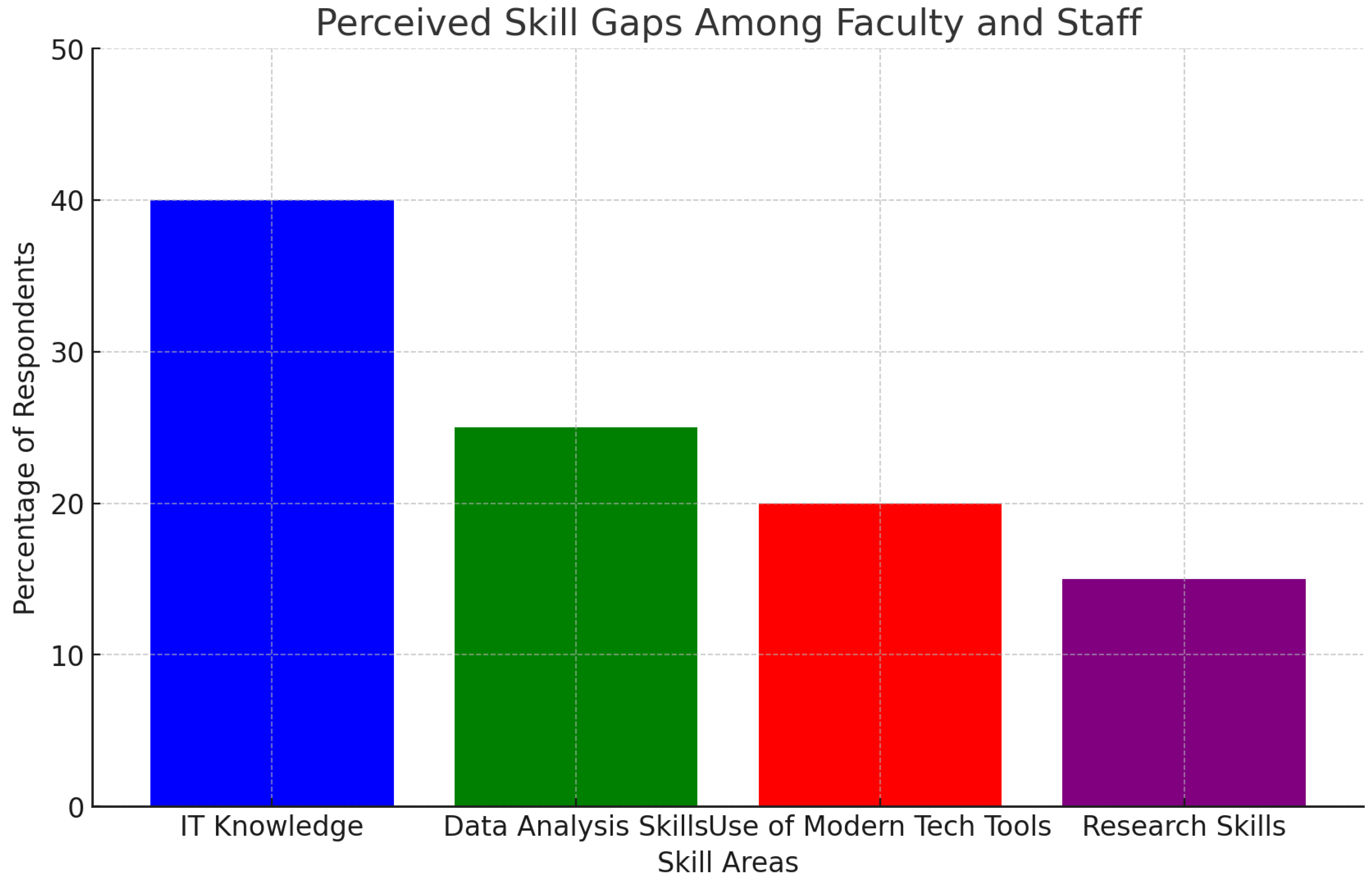
Table D2.
Recommended Training Programs for Enhancing Technical Skills.
| Training Program | Frequency | Percentage |
| Workshops | 25 | 50% |
| Online Courses | 15 | 30% |
| Certification Programs | 5 | 10% |
| Industry Partnerships | 5 | 10% |
Figure D2.
Opportunities for Human Resource Development.
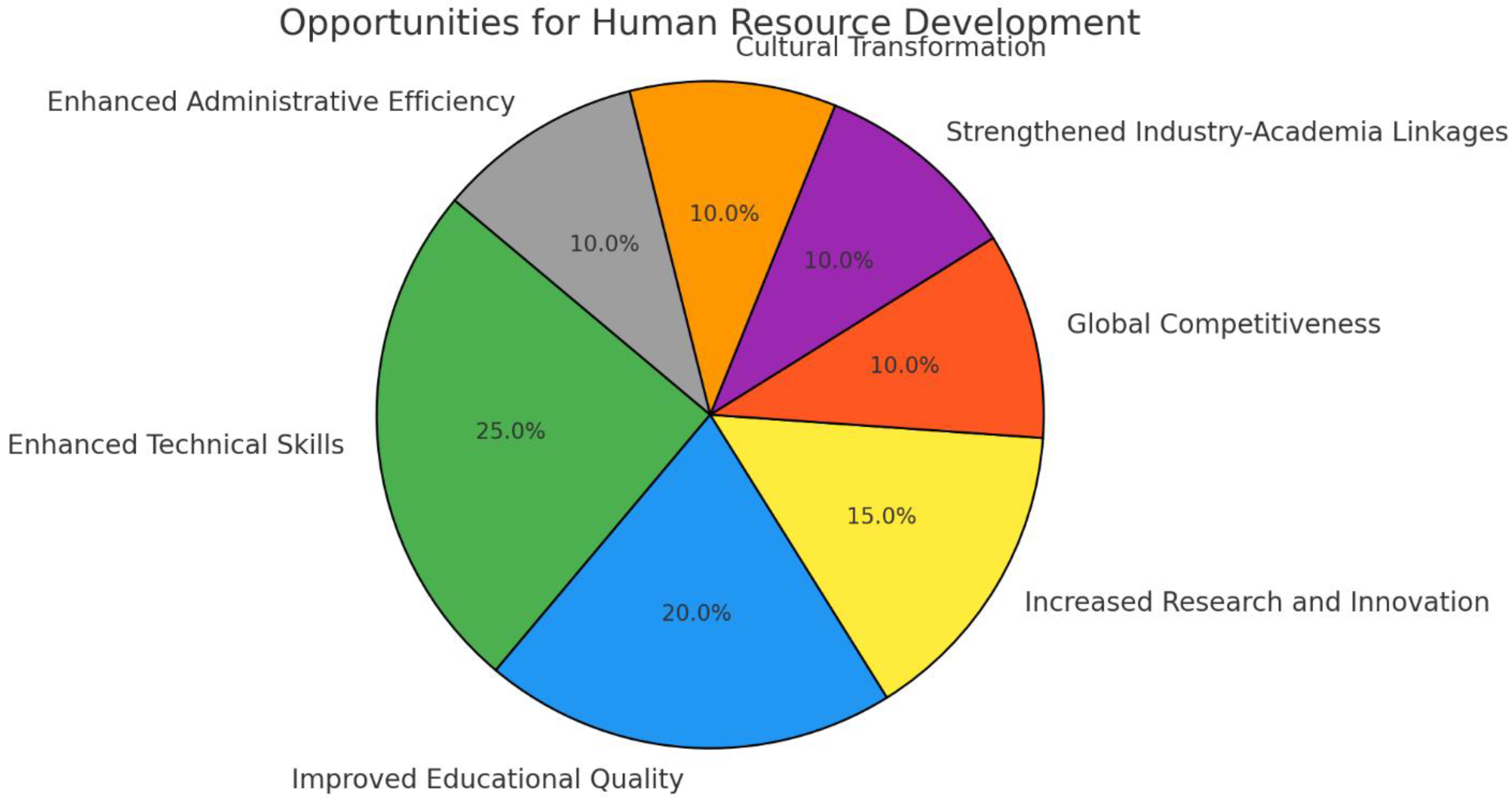
Below is a detailed figure illustrating the opportunities for human resource development through the integration of Industry 4.0 technologies in Iraqi higher education:
Opportunities for Human Resource Development
- Enhanced Technical Skills
- ○
- Training programs focused on Industry 4.0 technologies such as AI, IoT, big data, and robotics.
- ○
- Workshops and certification programs to develop specialized skills.
- ○
- Collaboration with industry partners for hands-on training and real-world applications.
- 2.
- Improved Educational Quality
- Implementation of smart classrooms equipped with advanced technological tools.
- Use of data analytics to personalize learning experiences and improve student outcomes.
- Adoption of e-learning platforms to provide flexible and accessible education.
- 3.
- Increased Research and Innovation
- Encouraging faculty and students to engage in research projects utilizing Industry 4.0 technologies.
- Establishing innovation labs and centers of excellence to foster creativity and experimentation.
- Securing grants and funding for research initiatives related to Industry 4.0.
- 4.
- Global Competitiveness
- Aligning educational programs with global standards to enhance the employability of graduates.
- Participating in international collaborations and exchange programs.
- Adopting best practices from leading educational institutions worldwide.
- 5.
- Strengthened Industry-Academia Linkages
- Developing partnerships with local and international industries to ensure curriculum relevance.
- Facilitating internships, co-op programs, and joint research initiatives.
- Establishing advisory boards with industry experts to guide educational strategies.
- 6.
- Cultural Transformation
- Promoting a culture of continuous learning and adaptability among faculty and staff.
- Encouraging the acceptance and integration of new technologies in everyday practices.
- Providing support and resources to overcome resistance to change.
- 7.
- Enhanced Administrative Efficiency
- Using digital tools for administrative tasks to improve efficiency and reduce paperwork.
- Implementing data-driven decision-making processes.
- Streamlining communication and collaboration through digital platforms.
Visual Representation of Opportunities for Human Resource Development
Here is the visual representation of the opportunities for human resource development through the integration of Industry 4.0 technologies in Iraqi higher education:
Legend:
- Green: Enhanced Technical Skills
- Blue: Improved Educational Quality
- Yellow: Increased Research and Innovation
- Red: Global Competitiveness
- Purple: Strengthened Industry-Academia Linkages
- Orange: Cultural Transformation
- Gray: Enhanced Administrative Efficiency
This pie chart visually represents the distribution of various opportunities, emphasizing the key areas where Industry 4.0 technologies can make a significant impact on human resource development in Iraqi higher education.
References
- Ashton, K. (2009). That ‘Internet of Things’ Thing. RFID Journal.
- Brynjolfsson, E., & McAfee, A. (2014). The Second Machine Age: Work, Progress, and Prosperity in a Time of Brilliant Technologies. W.W. Norton & Company.
- Chen, H., Chiang, R. H. L., & Storey, V. C. (2012). Business Intelligence and Analytics: From Big Data to Big Impact. MIS Quarterly, 36(4), 1165-1188. [CrossRef]
- Heeks, R. (2002). Information Systems and Developing Countries: Failure, Success, and Local Improvisations. The Information Society, 18(2), 101-112. [CrossRef]
- Kagermann, H., Wahlster, W. and Helbig, J. (2013) Securing the Future of German Manufacturing Industry: Recommendations for Implementing the Strategic Initiative Industrie 4.0. Final Report of the Industrie 4.0 Working Group, Acatech— National Academy of Science and Engineering, 678 p.
- Joon-Kyung Kim, Sang Dal Shim, Jun-Il Kim (1995). The Role of the Government in Promoting Industrialization and Human Capital Accumulation in Korea, The National Bureau of Economic Research, (p. 181 - 200).
- Siciliano, B., & Khatib, O. (2016). Springer Handbook of Robotics. Springer.
- Bruno Siciliano, Oussama Khatib: Springer Handbook of Robotics. Springer Handbooks, Springer 2016, ISBN 978-3-319-32550-7.
- Almela, T. (2023). Impact of the Industry 4.0 on Higher Education. In: Al-Maadeed, M.A.S.A., Bouras, A., Al-Salem, M., Younan, N. (eds) The Sustainable University of the Future. Springer, Cham. [CrossRef]
Disclaimer/Publisher’s Note: The statements, opinions and data contained in all publications are solely those of the individual author(s) and contributor(s) and not of MDPI and/or the editor(s). MDPI and/or the editor(s) disclaim responsibility for any injury to people or property resulting from any ideas, methods, instructions or products referred to in the content. |
© 2025 by the authors. Licensee MDPI, Basel, Switzerland. This article is an open access article distributed under the terms and conditions of the Creative Commons Attribution (CC BY) license (http://creativecommons.org/licenses/by/4.0/).
Copyright: This open access article is published under a Creative Commons CC BY 4.0 license, which permit the free download, distribution, and reuse, provided that the author and preprint are cited in any reuse.