

Submitted:
29 March 2025
Posted:
31 March 2025
You are already at the latest version
Preprints on COVID-19 and SARS-CoV-2
Abstract
Background: Optimal health requires self-direction for exercise regime consistency. Yet, boredom with constancy may result in abandoning regular exercise. Productive conservation of an exercise practice regards experiencing psychological flow, a concept originated by psychologist Csikszentmihalyi. A scoping review of post-2020 publications investigates the research range on this topic. This review differs from and adds to others investigating flow in exercise alone by focusing on continuing the exercise program for optimal health regarding boredom aversion. Method: Searched following the PRISMA guidelines for scoping reviews are “Csikszentmihalyi, flow, exercise, boredom”. Excluded are reviews, books, reports missing any keywords, non-English reports, reports not based on research studies, and research published before 2020. Results: The results of the primary database searches (and their final returns) are OVID (3), ProQuest (0), PubMed (0), Scopus (0), and Web of Science (0). The search of Google Scholar (8) is as a supplementary database. Included are research studies containing all the keywords. Conclusions: Boredom is found impossible when experiencing psychological flow in an exercise program and can lead to changes in the exercise program to create an evolution of flow commensurate with the participant’s skill level. In the case of COVID-19, the required adjustments involved a successful consideration of imposed limitations. The exercise regime must be neither excessive nor extreme to promote optimal health while accounting for differences in skill level and gender. Future scoping research should involve a research team, and future studies should include the date and location of the research to permit more accurate comparisons.
Keywords:
optimal health
; self-direction
; exercise regime
; boredom
; Csikszentmihalyi psychological flow
; COVID-19
1. Introduction
The definition of optimal health is comprehensive, including several factors. Some are a healthy diet [1], sufficient [2] and consistently timed sleep [3], meeting a variety of social determinants (including food stability, education, income, safety, housing, access to care, and a fair legal system) [4], lacking each of early childhood adversity, toxic stress, and racism [5], and satisfaction with body weight [6]. The majority of these ingredients for optimal health are outside the control of the individual and depend on a stable and supportive social structure for the realization of optimal health—something recognized by the US Advisory Committee on National Health Promotion and Disease Prevention Objectives for 2030 focus on eliminating health inequity [7]. Yet, three of the parameters are directly modifiable by the individual. These are diet, sleep, and perception of body weight, although social inequalities remain regarding each [8,9,10]. However, whether the individual can successfully modify these aspects is questionable as diet and body weight perception correspond [11] in their effect on optimal health and are difficult to disentangle. Also, a combined association of diet, sleep, and perception of body weight is required for effectiveness in an approach to optimal health [12]. As such, although each of diet, sleep, and body weight perception are potentially modifiable by the individual to achieve optimal health, because of their interdependence and a lack of understanding of how to attend to each concomitantly, in practice, the individual has less control than desirable in achieving optimal health [13] regarding these parameters. This result is problematic as the dependence of optimal health on self-direction is recognized [14].
Self-direction is the degree to which one can formulate goals and learn from previous experiences [15] in making decisions free from external control [16]. For optimal health, one as yet unmentioned determinant can be affected by self-direction to a significant extent. Physical activity is an ingredient of optimal health for which the individual has control when permitted to explore, discover, and adapt [17]. Defined in 1985 as “any bodily movement produced by skeletal muscles that results in energy expenditure” [18], the definition of physical activity recently expanded to recognize it as inherently cerebral and depending on a cognitive and emotional aspect [19]. Consequently, physical activity must involve more than expending energy to produce optimal health [15]. It must also connect with the thoughts and emotions of the individual in being freely chosen, inherently social, spatially situated, and political [20]. As an experience, it must be enjoyed and connected with all significant aspects of the individual for the physical activity to promote optimal physical health. Yet, as the fourth leading risk factor for global mortality [21], physical inactivity is not equivalent to a lack of exercise. Exercise is a subset of physical activity requiring the following: (1) an ability to tolerate physical activity without physical discomfort or compromise, (2) a safe place to perform the physical activity, and (3) the motivation to engage in the physical activity [20]. As such, exercise is a self-directed physical activity [16] requiring stability in an individual’s life beyond what is necessary for physical activity [22], with self-regulation as a crucial component that can be learned [23].
Perhaps the most formidable barrier to individual success in achieving optimal health through exercise is a lack of consistency in maintaining an exercise regime, given that consistency has a wide discrepancy [24]. The complex, multidimensional process that represents exercise is seen as the challenge in assessing consistency in exercise [25]. In meeting the challenge, the individual developing exercise habits—regular, cue-triggered routines—is essential [26]. Consistency in this regard includes adherence to several variables: (1) a program, (2) the length of each exercise, and (3) maintaining a designed scheme [27] that supports the frequency, intensity, duration, and type of exercise [28] necessary to counteract physical inactivity [29], dependent on mental fitness [30]. Boredom with the program can be the factor that halts an exercise regime, particularly for some age groups [31,32,33,34] and various forms of ill-health [35,36]. A link between retaining the exercise habit and relieving boredom has been found in the individual engaging in goal adjustment [37] commensurate with their activity level [38].
A negative emotion for which the individual cannot attend to the moment or find meaning defines boredom; yet, in moderation, boredom is adaptive in promoting creativity [39]. As boredom represents an emotion, a psychological framework like flow theory is relevant regarding boredom. Beyond Boredom and Anxiety [40]—the seminal work introducing the concept of flow—recognizes alleviating the negative aspects of boredom as an essential purpose of flow. Unlike boredom, psychological flow represents complete engagement through a positive evaluation of personal efforts regarding the challenge of a task [41].
The basis of psychological flow theory pioneered by psychologist Mihaly Csikszentmihalyi (1934–2021 [42]) is an analysis of experiences judged as enjoyable [43] by individuals participating in various activities he described as “play-forms” including athletic pursuits, among others [44]. However, regarding enjoyment, the focus is the conditions under which challenging activities are sustainable. According to Csikszentmihalyi, “flow makes us feel better in the moment, enabling us to experience the remarkable potential of the body and mind fully functioning in harmony. But what makes flow an even more significant tool is its ability to improve the quality of life in the long run” [45](p. 63). This concentration by Csikszentmihalyi on a continuing improvement process presents why flow theory is valuable regarding the sustainability of an exercise regime and is particularly relevant for attenuating boredom [40]. Flow is a theory recognized as one of the most significant in contemporary psychology [46], directing an extensive amount of research [47] in numerous disciplines [48]. What identifies flow in an activity is that it is a self and goal-directed process for meeting challenges guided by an individual’s interests. It depends on several elements to be optimal: (1) clear goals; (2) instantaneous feedback; (3) skills required are equal to the challenge; (4) awareness and action are integrated; (5) distractions are ignored; (6) failure is not an option; (7) no self-consciousness is involved; (8) there is a distortion of time; and (9) the engaged activity is the desired end [49].
A scoping review—following PRISMA guidelines [50] to investigate the range of studies published since 2020 demonstrating the significance of flow for maintaining an exercise regime, particularly in alleviating the boredom that instigates abandoning the habit of exercise—is the aim of this study. Although following PRISMA guidelines, this study is not a systematic review and meta-analysis. A scoping review is selected in contrast to a systematic review as the search and analysis method because the intent is to find the range and depth of research on this subject since 2020 rather than to examine the PICO (population, intervention, comparison, and outcome) of the studies [51], as would be the aim of a systematic review and meta-analysis. Since 2020, flow regarding exercise has been the topic of several systematic reviews [52,53,54,55]. What remains lacking is the relevance of flow to boredom reduction. This scoping review is significant because boredom aversion is required for sustaining a self-directed exercise regime, leading to optimal health.
2. Materials and Methods
The most comprehensive examination of scoping reviews in response to the Preferred Reporting Items for Systematic Reviews (PRISMA) Statement extension to scoping reviews—the PRISMA-ScR—is the seminal research by Tricco et al. [56], published in 2018. Peters et al. updated this work in 2020 [57]. The current study follows the 2020 PRISMA guidelines for scoping reviews [58]. Pre-registration of the review protocol for this study is at osf.io/g6m7k.
Although there is no requirement for the number of databases to search for a scoping review, those searched should be limited to literature relevant to the review—a point noted in the most recent comments published in 2022 regarding scoping reviews [59]. Yet, there is a distinction between primary databases, which consistently return the same results, and those considered supplementary databases, where the search results depend on the particular search [60]. The primary databases used in this search are OVID, ProQuest, PubMed, Scopus, and Web of Science. Their selection pertains to the topic searched and their high regard as databases [60]. A search of Google Scholar—a supplementary database because the results are particular to the search date [61]—extrapolated the reach of the returns. This database is recognized to outperform the coverage of either Scopus or Web of Science [61], providing the reason for its inclusion as a database to search. Figure 1 represents the PRISMA flow of information chart.
October 15, 2024, the OVID search included the following Health Sciences databases: Embase Classic+Embase 1947 to 2024 October 14, APA PsycInfo 1806 to October 2024 Week 2, Ovid Healthstar 1966 to August 2024, AMED (Allied and Complementary Medicine) 1985 to September 2024, JBI EBP Database Current to October 02, 2024, Health and Psychosocial Instruments 1985 to July 2024, Journals@Ovid Full Text October 14, 2024, Ovid MEDLINE(R) ALL 1946 to October 14, 2024 (Supplementary 1). All returns were from Journals@Ovid Full Text, except the first one, originating from APA Psychinfo. The search criteria were “Csikszentmihalyi and flow and exercise and boredom”, “English language”, and “2020-2025”. There were 21 returns. The records removed before screening were one duplicate, ten literature reviews, one dissertation, and two reports that did not involve a research study. The reports excluded were two that had irrelevant information on flow, another irrelevant information about exercise, and another with irrelevant information concerning boredom. Three represents the number of reports included for assessment. Following the requirements for PRISMA reporting [58], some details specific to OVID are not noted in the PRISMA flow of information chart (Figure 1).
The ProQuest search followed on October 15, 2024. The search parameters initially were “Csikszentmihalyi and flow and exercise and boredom”. The addition of “English”, “2020–“, “Peer reviewed”, “APA PsycArticles®”, and “NOT (test construction AND job performance)” resulted after noting that the first returns were primarily irrelevant. With these added parameters, the returns numbered 17. The records removed before screening included three duplicates, two literature reviews, and one report that was not a research study. There was an exclusion of nine reports lacking exercise and two that did not mention boredom. There is no inclusion of reports specific to ProQuest. All the returns considered are in Supplementary 1. The relevant details of this search regarding PRISMA are in Figure 1.
PubMed was the final search of October 15, 2024. The parameters searched were “Csikszentmihalyi and flow and exercise and boredom”. The keywords lacked additional parameters because the initial search did not produce returns. Consequently, PubMed lacks inclusion in the supplementary file.
Scopus was the first search of October 18, 2024. The search parameters were “Csikszentmihalyi and flow and exercise and boredom”, “2020-2024”, “Psychology”, “Article”, English”, Flow experience”, “Boredom”, “Flow state”, “Journal”, and “Final publication stage”. The initial returns were mainly irrelevant, requiring additional parameters comparable with ProQuest. The final result was 33 returns. Yet, even with the additional keywords to narrow the search, 28 of the returns did not include exercise in the text (only in the reference list), as was the case for five returns regarding boredom. There was no inclusion of Scopus reports. These details are provided fully in Supplementary 1. According to PRISMA guidelines, there is a report of fewer details regarding Scopus in the flow chart of Figure 1.
Also searched on October 18, 2024, was Web of Science. Similar to the PubMed search of three days earlier, there was no need to apply parameters additional to “Csikszentmihalyi and flow and exercise and boredom” to reduce irrelevant returns as the number of returns from the initial search equaled zero.
The final search was of the Google Scholar database on October 22, 2024. Unlike the other database searches returning few results, the returns were extensive. The addition of “since 2020” and “exclude citations” to the search of “Csikszentmihalyi, flow, exercise, boredom” improved accuracy. The result was 5,270 returns. As a crawler-based web search engine, the most relevant reports are returned first for Google Scholar [58]. The examination was until a page of 10 did not include a report of relevance. This process took until page 16, equaling 160 records. There was a removal of 5110 records appearing after page 16 before the screening. Also removed before screening were one not in English, six lacking peer review, 20 literature reviews, four dissertations, and 16 presenting no research study. Once screening began, removal was of records lacking keywords in the text: flow—4, exercise—61, boredom—30. Reports not retrieved equaled one. Of the remaining reports, one included irrelevant exercise information and seven irrelevant information on boredom. The result is eight included reports. These details are in Supplementary 1, with the general outline of the search process in Figure 1.
Thus, of the 5,341 returns from all searches, materials included for assessment are from OVID (3) and Google Scholar (8).
3. Results
The results of the 11 studies included for consideration—three from the OVID search and eight from that of Google Scholar—are presented in three tables. The first, Table 1, provides the bibliographic details of each report. It includes the citation number, the title of the report, the authors, and the publication date. The years of publication and their number are 2024—one, 2023—two, 2022—three, and 2021—five. There is no repetition in the authors.
Table 2 provides the relevant particulars regarding the information on the study in each of the included returns. The studies investigating expert participants in a particular sport represent seven of the eleven, while four studied participants without expertise. Together, there are 3,270 participants in these studies. The number of participants in qualitative studies is 45, with 3,225 participants in quantitative studies. Four studies reported the dates of the investigation—seven did not. There is a report of the country in every study except one. The USA represents the most studies at three, with 1,887 participants. The other countries reported (and their participants) are England (6, and some unspecified number of 30), Turkey (532), New Zealand (some unspecified number of 30), Tunisia (94), Italy (1281), Germany (113), China (404).
Table 3 presents the relevant content of the included reports regarding flow, exercise, and boredom for the parameters searched, identified by citation number. “Csikszentmihalyi” is not included for consideration as the name of this psychologist is a keyword searched to differentiate flow as a psychological theory rather than one concerning flow in fluid dynamics [73]. What these reports relate about the psychologist personally is irrelevant to this study.
3.1. Flow
Regarding flow, there is agreement in the results of all studies included for assessment that flow is desirable and attainable for an exercise practice—even with limitations imposed on the regime from the 2020-2023 COVID-19 pandemic [70,72]. One study directly measured the relationship among flow, exercise, sports, and exceptional performance, finding that all were positively related [67]. How they are correlated entails several factors: a challenge/skill balance, action plus awareness merging, the participant receiving unambiguous feedback while displaying concentration on task along with a sense of control—notable is that there are no significant gender differences [69]. This importance of challenge to an exercise program producing flow is a relevant feature of two other studies [62,63]. One study stresses that some physical activities have a greater propensity for flow—martial arts being the most prominent example in this study [66]. What identifies a physical activity as more likely to produce flow is the commitment level of the participants to the type of exercise, with those engaged in activities they find rewarding as having the most substantial inclination for flow [72]. The relationship of flow to a dedicated exercise practice is so ensconced in professional dance that those dancers participating in a study viewed flow as a vital component of their practice [65]. Similar to the requirements of excellence in dancing, three separate reports of one study considered flow to require: the will to seek our information for improvement, a motivation to reengage when difficulties arise, persistence to reach a goal, self-regulation in meeting the goal, and the physical activity must be valued for the exercise program to be maintained [64]. Yet, flow is not exclusive to high-performance athletes—as one study finds flow is attainable by athletes of various levels of ability and frequency of their exercise schedules [71].
3.2. Exercise
The COVID-19 pandemic was recognized to have a significant effect on exercise programs if they were to have the possibility of producing flow, as many exercises had to be performed at home, often in city apartments [70], or modified when the required exercise regime was outdoors in public [72]. One type of exercise regime that gained popularity during COVID-19 was the exergame [74], played by self-direction in following exercise instructions provided on a screen. The finding was that these exergames had longer engagement times and were more likely than traditional exercises to produce flow [62]. Several things were imperative for an exercise regime to promote flow. The first is that the participant must commit regarding their interest in the exercise [64,66]. The second for professional athletes is that the flow felt during competition can only be sustained in the exercise regime if it is considered immediately relevant [63], including the acceptance of warm-up and team building as essential to the practice [65]. As such, maintaining these exercises by professional athletes requires adjusting the type of exercise by season and gender [69]. Flow is maintainable, and boredom is reduced [71] by self-directing sensitive adjustments into the exercise program while accounting for participant enjoyment [68]—supporting previous research [37,38]. However, the results of one study give reason for caution in modifying an exercise regime since when the changes are extreme or in excess, this can lead to anxiety, decreasing the wellness perception of the participant [67].
3.3. Boredom
It was typical to experience boredom during COVID-19 concerning maintaining an exercise regime [75]. Although helpful in this regard to produce flow, because many of the moves are repetitive, boredom was seen to result with exergames when there was a lack of freedom to modify the exergame [62]. The finding was that freedom and dedication to create adaptive modifications in the structure and contents of flow-promoting activities were essential to avert boredom in a COVID-19 exercise [70]. However, during COVID-19, when poor weather, injuries, or lack of a running partner altered plans, even high-performance athletes experienced boredom [72], although the more extreme the athletic pursuit, the less likely participants were to experience boredom in their exercise routine [71]. This result may be because boredom is correlated negatively with perceived wellness [67], and extreme athletes view themselves as achieving wellness [76]. Yet, regardless of the level of expertise, a common theme regarding boredom in considering its relationship to flow in exercise routines is that it is avertable with increasing levels of challenge [63,65,68] commensurate with the skill level of the participant [66] such that boredom is found predictable with one measure [64]. Boredom is often a catalyst for creativity to instigate change [77]. As such, it produces a better quality of experience in certain athletes than apathy or anxiety states and is considered a psychological antecedent of flow [69]—a finding supporting earlier research [39].
4. Discussion
This study examines the significance of flow in averting boredom to maintain a self-directed exercise program by considering the most recent literature regarding a search of “Csikszentmihalyi, flow, exercise, boredom” of relevant databases. These searches returned eleven studies with thirteen reports, as one study included three reports. The only databases to produce included returns were OVID and Google Scholar. To be related are the implications and limitations of the results.
The studies included are various regarding the level of expertise in exercise, the countries of investigation, the number of participants, and the type of studies. Given this variety, it is notable that there was no disagreement regarding the results of these reports. The most salient features were the following. (1) Flow relates to boredom regarding exercise as, if experiencing flow, participants cannot simultaneously be bored [78]. However, boredom is not the opposite of flow based on the results of [69], which found either apathy or anxiety the opposite of flow. Instead, boredom is a precursor to change that may instigate flow, a point recognized in 2018 [79] and more recently [39]. (2) Boredom results from a lack of challenges [63,65,68] relevant to the skill level of the self-directed exercise participant [66]. As such, flow remains in a self-directed exercise regime that involves continually increasing challenges of interest to the participant—with interest in the exercise challenge being crucial to flow maintenance [64,66]. (3) Although COVID-19 hampered the usual exercise regimes of participants, with modifications to the routine, not only were participants able to maintain regular exercise, but they could also experience flow in doing so [70,72]. This ability to achieve flow was aided by the increased use of exergames during the pandemic [62]. Given the focus of this search on publications since 2020, when the pandemic began, and beyond when the pandemic ended in 2023, this study is additionally novel in considering flow, exercise, and boredom from the perspective of COVID-19. (4) The importance of exercise being a physical activity that connects with the thoughts and emotions of the individual in being freely chosen, inherently social, spatially situated, and political [20] for it to produce optimal health was further confirmed with the necessity of post-professional game exercise [63] and the connections developed in warm-up and team-building routines [65]. These results are in contrast to individual exercise routines that lack optimal health because they become extreme or in excess, leading to anxiety and decreasing wellness perception [67]. (5) As noted in earlier studies [80,81], the ability to engage in flow is again identified as unaffected by gender, although the types of exercises that lead to flow and diminish boredom differ [69]. That exercises and levels of expertise can differ and still lead to flow is relevant [71] and is noted elsewhere [82].
Limitations regard the analysis conducted and the type of results returned. One researcher alone completed it. Conducting research without a team may lead to cognitive bias [83]. Two steps counteract possible cognitive bias. (1) PRISMA procedures for scoping review [56] were followed, including completing the Preferred Reporting Items for Systematic reviews and Meta-Analyses extension for Scoping Reviews (PRISMA-ScR) Checklist as required for scoping reviews [50] added as non-published material. (2) A supplementary file of all searches that produced returns was created. This file is Supplementary 1. Detailed information is regarding all the returns for the primary databases having returns of more than zero—OVID, ProQuest, and Scopus. These details concern the 160 returns initially included for assessment for Google Scholar. However, the full particulars regard only the final sixteen articles assessed before exclusions from the reports for eligibility. That detailed information on all 160 reports not included in the supplementary file is an additional limitation. As this is a scoping review, not a systematic review, the consideration was that this limitation is acceptable. A further limitation concerns the quality of the assessed studies. Although all studies reported were published in peer-reviewed journals and provided sufficient details on the number of participants plus the methods employed, seven studies do not include information on when the study was conducted [62,63,64,65,66,67,68]. Although the data is determinable of one of these studies as a result of information concerning the ethics approval date [67], five of the others include no details of the ethics approval date [63,64,65,66,68], and one of the studies assessed gained its ethics approval in 2013 [62]. As a result, the completion date of this study within the last ten years is unknown. This same study is also remiss in not stating the country of the research.
5. Conclusions
Psychological flow, as originated in the theory of Csikszentmihalyi, is negatively associated with boredom regarding self-direction in maintaining an exercise regime. The connection is two-fold. It is impossible to be bored when experiencing flow in an exercise program, and when the participant is bored, the boredom can lead to changes in the exercise program to create flow. The necessary alterations relate to incorporating challenges commensurate with skill level. In the case of COVID-19, these included imposed limitations. The exercise regime must be neither excessive nor extreme to promote optimal health while accounting for differences in skill level and gender. These findings were particular to the last five years; however, they support earlier research regarding flow, exercise, and boredom. Future research in this area should involve working in research teams to ensure no cognitive bias in the assessment of the literature in scoping or systematic reviews, and future research studies must include information on the location and date of the research. This advice is specifically relevant when limitations may produce different results than the norm, as they did during COVID-19.
Supplementary Materials
The following supporting information can be downloaded at the website of this paper posted on Preprints.org, Supplementary 1: Title of report, database returning the report, date of the report, and either reason for exclusion or citation number.
Funding
This research received no external funding.
Institutional Review Board Statement
Not applicable.
Informed Consent Statement
Not applicable.
Data Availability Statement
No new data were created.
Conflicts of Interest
The author declares no conflicts of interest.
References
- Cena, H.; Calder, P.C. Defining a Healthy Diet: Evidence for the Role of Contemporary Dietary Patterns in Health and Disease. Nutrients 2020, 12, 334. [Google Scholar] [CrossRef] [PubMed]
- Ramar, K.; Malhotra, R.K.; Carden, K.A.; Martin, J.L.; Abbasi-Feinberg, F.; Aurora, R.N.; Kapur, V.K.; Olson, E.J.; Rosen, C.L.; Rowley, J.A.; et al. Sleep Is Essential to Health: An American Academy of Sleep Medicine Position Statement. Journal of Clinical Sleep Medicine 2021, 17, 2115–2119. [Google Scholar] [CrossRef]
- Chaput, J.-P.; Dutil, C.; Featherstone, R.; Ross, R.; Giangregorio, L.; Saunders, T.J.; Janssen, I.; Poitras, V.J.; Kho, M.E.; Ross-White, A.; et al. Sleep Timing, Sleep Consistency, and Health in Adults: A Systematic Review. Appl. Physiol. Nutr. Metab. 2020, 45, S232–S247. [Google Scholar] [CrossRef] [PubMed]
- Crear-Perry, J.; Correa-de-Araujo, R.; Lewis Johnson, T.; McLemore, M.R.; Neilson, E.; Wallace, M. Social and Structural Determinants of Health Inequities in Maternal Health. Journal of Women’s Health 2021, 30, 230–235. [Google Scholar] [CrossRef]
- Shonkoff, J.P.; Slopen, N.; Williams, D.R. Early Childhood Adversity, Toxic Stress, and the Impacts of Racism on the Foundations of Health. Annu. Rev. Public Health 2021, 42, 115–134. [Google Scholar] [CrossRef]
- Baldursdottir, K.; McNamee, P.; Norton, E.; Asgeirsdóttir, T.L. Life Satisfaction and Body Mass Index: Estimating the Monetary Value of Achieving Optimal Body Weight; National Bureau of Economic Research: Cambridge, MA, 2021; p. w2 8791.
- Gómez, C.A.; Kleinman, D.V.; Pronk, N.; Wrenn Gordon, G.L.; Ochiai, E.; Blakey, C.; Johnson, A.; Brewer, K.H. Addressing Health Equity and Social Determinants of Health Through Healthy People 2030. Journal of Public Health Management and Practice 2021, 27, S249–S257. [Google Scholar] [CrossRef] [PubMed]
- Adams, J. Addressing Socioeconomic Inequalities in Obesity: Democratising Access to Resources for Achieving and Maintaining a Healthy Weight. PLoS Med 2020, 17, e1003243. [Google Scholar] [CrossRef] [PubMed]
- Løvhaug, A.L.; Granheim, S.I.; Djojosoeparto, S.K.; Harrington, J.M.; Kamphuis, C.B.M.; Poelman, M.P.; Roos, G.; Sawyer, A.; Stronks, K.; Torheim, L.E.; et al. The Potential of Food Environment Policies to Reduce Socioeconomic Inequalities in Diets and to Improve Healthy Diets among Lower Socioeconomic Groups: An Umbrella Review. BMC Public Health 2022, 22, 433. [Google Scholar] [CrossRef]
- Billings, M.E.; Cohen, R.T.; Baldwin, C.M.; Johnson, D.A.; Palen, B.N.; Parthasarathy, S.; Patel, S.R.; Russell, M.; Tapia, I.E.; Williamson, A.A.; et al. Disparities in Sleep Health and Potential Intervention Models. Chest 2021, 159, 1232–1240. [Google Scholar] [CrossRef]
- Jiménez-Loaisa, A.; Beltrán-Carrillo, V.J.; González-Cutre, D.; Jennings, G. Healthism and the Experiences of Social, Healthcare and Self-Stigma of Women with Higher-Weight. Soc Theory Health 2020, 18, 410–424. [Google Scholar] [CrossRef]
- Geiker, N.R.W.; Astrup, A.; Hjorth, M.F.; Sjödin, A.; Pijls, L.; Markus, C.R. Does Stress Influence Sleep Patterns, Food Intake, Weight Gain, Abdominal Obesity and Weight Loss Interventions and Vice Versa? Obesity Reviews 2018, 19, 81–97. [Google Scholar] [CrossRef]
- Papatriantafyllou, E.; Efthymiou, D.; Zoumbaneas, E.; Popescu, C.A.; Vassilopoulou, E. Sleep Deprivation: Effects on Weight Loss and Weight Loss Maintenance. Nutrients 2022, 14, 1549. [Google Scholar] [CrossRef] [PubMed]
- Bradley, V.J.; Fenton, M.H.; Mahoney, K.J. Self-Direction: A Revolution in Human Services; State University of New York Press: Albany, 2021; ISBN 978-1-4384-8344-3. [Google Scholar]
- Kooiman, T.J.M.; Dijkstra, A.; Kooy, A.; Dotinga, A.; Van Der Schans, C.P.; De Groot, M. The Role of Self-Regulation in the Effect of Self-Tracking of Physical Activity and Weight on BMI. J. technol. behav. sci. 2020, 5, 206–214. [Google Scholar] [CrossRef]
- Lemmetty, S.; Collin, K. Self-Direction. In The Palgrave Encyclopedia of the Possible; Glăveanu, V.P., Ed.; Springer International Publishing: Cham, 2022; ISBN 978-3-030-90912-3. [Google Scholar]
- Rudd, J.R.; Pesce, C.; Strafford, B.W.; Davids, K. Physical Literacy - A Journey of Individual Enrichment: An Ecological Dynamics Rationale for Enhancing Performance and Physical Activity in All. Front. Psychol. 2020, 11, 1904. [Google Scholar] [CrossRef] [PubMed]
- Caspersen, C.J.; Powell, K.E.; Christenson, G.M. Physical Activity, Exercise, and Physical Fitness: Definitions and Distinctions for Health-Related Research. Public Health Reports (1974-) 1985, 100, 126–131. [Google Scholar]
- Piggin, J. What Is Physical Activity? A Holistic Definition for Teachers, Researchers and Policy Makers. Front. Sports Act. Living 2020, 2, 72. [Google Scholar] [CrossRef]
- Dasso, N.A. How Is Exercise Different from Physical Activity? A Concept Analysis: DASSO. Nurs Forum 2019, 54, 45–52. [Google Scholar] [CrossRef]
- Cunningham, C.; O’ Sullivan, R.; Caserotti, P.; Tully, M.A. Consequences of Physical Inactivity in Older Adults: A Systematic Review of Reviews and Meta-analyses. Scandinavian Med Sci Sports 2020, 30, 816–827. [Google Scholar] [CrossRef]
- Hagger, M.S. Habit and Physical Activity: Theoretical Advances, Practical Implications, and Agenda for Future Research. Psychology of Sport and Exercise 2019, 42, 118–129. [Google Scholar] [CrossRef]
- Staller, T.; Kirschke, C. Drive. In Personality Assessment with ID37; Springer International Publishing: Cham, 2021; ISBN 978-3-030-53920-7. [Google Scholar]
- Denton, F.; Power, S.; Waddell, A.; Birkett, S.; Duncan, M.; Harwood, A.; McGregor, G.; Rowley, N.; Broom, D. Is It Really Home-Based? A Commentary on the Necessity for Accurate Definitions across Exercise and Physical Activity Programmes. IJERPH 2021, 18, 9244. [Google Scholar] [CrossRef] [PubMed]
- Qiu, Y.; Fernández-García, B.; Lehmann, H.I.; Li, G.; Kroemer, G.; López-Otín, C.; Xiao, J. Exercise Sustains the Hallmarks of Health. Journal of Sport and Health Science 2023, 12, 8–35. [Google Scholar] [CrossRef]
- Beshears, J.; Lee, H.N.; Milkman, K.L.; Mislavsky, R.; Wisdom, J. Creating Exercise Habits Using Incentives: The Trade-off Between Flexibility and Routinization. Management Science 2021, 67, 4139–4171. [Google Scholar] [CrossRef] [PubMed]
- Schumacher, L.M.; Thomas, J.G.; Raynor, H.A.; Rhodes, R.E.; O’Leary, K.C.; Wing, R.R.; Bond, D.S. Relationship of Consistency in Timing of Exercise Performance and Exercise Levels Among Successful Weight Loss Maintainers. Obesity 2019, 27, 1285–1291. [Google Scholar] [CrossRef]
- MacIntosh, B.R.; Murias, J.M.; Keir, D.A.; Weir, J.M. What Is Moderate to Vigorous Exercise Intensity? Front. Physiol. 2021, 12, 682233. [Google Scholar] [CrossRef]
- Furtado, G.E.; Letieri, R.V.; Caldo-Silva, A.; Sardão, V.A.; Teixeira, A.M.; De Barros, M.P.; Vieira, R.P.; Bachi, A.L.L. Sustaining Efficient Immune Functions with Regular Physical Exercise in the COVID-19 Era and Beyond. Eur J Clin Investigation 2021, 51, e13485. [Google Scholar] [CrossRef]
- Fossati, C.; Torre, G.; Vasta, S.; Giombini, A.; Quaranta, F.; Papalia, R.; Pigozzi, F. Physical Exercise and Mental Health: The Routes of a Reciprocal Relation. IJERPH 2021, 18, 12364. [Google Scholar] [CrossRef] [PubMed]
- Rai, R.; Jongenelis, M.I.; Jackson, B.; Newton, R.U.; Pettigrew, S. Factors Influencing Physical Activity Participation among Older People with Low Activity Levels. Ageing and Society 2020, 40, 2593–2613. [Google Scholar] [CrossRef]
- McCurdy, A.; Stearns, J.A.; Rhodes, R.E.; Hopkins, D.; Mummery, K.; Spence, J.C. Relationships Between Physical Activity, Boredom Proneness, and Subjective Well-Being Among U.K. Adults During the COVID-19 Pandemic. Journal of Sport & Exercise Psychology 2022, 44, 189–197. [Google Scholar] [CrossRef]
- Bösselmann, V.; Amatriain-Fernández, S.; Gronwald, T.; Murillo-Rodríguez, E.; Machado, S.; Budde, H. Physical Activity, Boredom and Fear of COVID-19 Among Adolescents in Germany. Front. Psychol. 2021, 12, 624206. [Google Scholar] [CrossRef]
- Baños, R.; Fuentesal, J.; Conte, L.; Ortiz-Camacho, M.D.M.; Zamarripa, J. Satisfaction, Enjoyment and Boredom with Physical Education as Mediator between Autonomy Support and Academic Performance in Physical Education. IJERPH 2020, 17, 8898. [Google Scholar] [CrossRef] [PubMed]
- Feig, E.H.; Harnedy, L.E.; Golden, J.; Thorndike, A.N.; Huffman, J.C.; Psaros, C. A Qualitative Examination of Emotional Experiences During Physical Activity Post-Metabolic/Bariatric Surgery. OBES SURG 2022, 32, 660–670. [Google Scholar] [CrossRef] [PubMed]
- Thorsen, I.K.; Kayser, L.; Teglgaard Lyk–Jensen, H.; Rossen, S.; Ried-Larsen, M.; Midtgaard, J. “ <i>I Tried Forcing Myself to Do It, but Then It Becomes a Boring Chore”</i> : Understanding (Dis)Engagement in Physical Activity Among Individuals With Type 2 Diabetes Using a Practice Theory Approach. Qual Health Res 2022, 32, 520–530. [Google Scholar] [CrossRef] [PubMed]
- Bieleke, M.; Wolff, W.; Keller, L. Getting Trapped in a Dead End? Trait Self-Control and Boredom Are Linked to Goal Adjustment. Motiv Emot 2022, 46, 837–851. [Google Scholar] [CrossRef]
- Swann, C.; Rosenbaum, S.; Lawrence, A.; Vella, S.A.; McEwan, D.; Ekkekakis, P. Updating Goal-Setting Theory in Physical Activity Promotion: A Critical Conceptual Review. Health Psychology Review 2021, 15, 34–50. [Google Scholar] [CrossRef]
- Westgate, E.C.; Steidle, B. Lost by Definition: Why Boredom Matters for Psychology and Society. Social & Personality Psych 2020, 14, e12562. [CrossRef]
- Csíkszentmihályi, M. Beyond Boredom and Anxiety: Experiencing Flow in Work and Play; Jossey-Bass: San Francisco (Calif.), 2000; ISBN 978-0-7879-5140-5. [Google Scholar]
- Thissen, B.A.K.; Oettingen, G. How Optimal Is the “Optimal Experience”? Toward a More Nuanced Understanding of the Relationship between Flow States, Attentional Performance, and Perceived Effort. Psychology of Consciousness: Theory, Research, and Practice. [CrossRef]
- Zuzanek, J. Tribute to Mihaly Csikszentmihalyi (1934–2021). Loisir et Société / Society and Leisure 2022, 45, 445–447. [Google Scholar] [CrossRef]
- Abuhamdeh, S. On the Relationship Between Flow and Enjoyment. In Advances in Flow Research; Peifer, C., Engeser, S., Eds.; Springer International Publishing: Cham, 2021; ISBN 978-3-030-53467-7. [Google Scholar]
- Csikszentmihalyi, M. Play and Intrinsic Rewards. Journal of Humanistic Psychology 1975, 15, 41–63. [Google Scholar] [CrossRef]
- Csikszentmihalyi, M. Good Business: Leadership, Flow, and the Making of Meaning; Viking: New York, 2003; ISBN 978-0-670-03196-2. [Google Scholar]
- Heutte, J.; Fenouillet, F.; Martin-Krumm, C.; Gute, G.; Raes, A.; Gute, D.; Bachelet, R.; Csikszentmihalyi, M. Optimal Experience in Adult Learning: Conception and Validation of the Flow in Education Scale (EduFlow-2). Front. Psychol. 2021, 12, 828027. [Google Scholar] [CrossRef]
- Abuhamdeh, S. Investigating the “Flow” Experience: Key Conceptual and Operational Issues. Front. Psychol. 2020, 11, 158. [Google Scholar] [CrossRef]
- Zhang, Y.; Wang, F. Developments and Trends in Flow Research Over 40 Years: A Bibliometric Analysis. Collabra: Psychology 2024, 10, 92948. [Google Scholar] [CrossRef]
- Csikszentmihalyi, M. Creativity: Flow and the Psychology of Discovery and Invention; 1st ed.; HarperCollinsPublishers: New York, 1996; ISBN 978-0-06-017133-9. [Google Scholar]
- PRISMA PRISMA for Scoping Reviews (PRISMA-ScR). PRISMA 2020 2024. Available online: https://www.prisma-statement.org/scoping (accessed on 7 September 2024).
- Smith, S.A.; Duncan, A.A. Systematic and Scoping Reviews: A Comparison and Overview. Seminars in Vascular Surgery 2022, 35, 464–469. [Google Scholar] [CrossRef]
- Jackman, P.C.; Dargue, E.J.; Johnston, J.P.; Hawkins, R.M. Flow in Youth Sport, Physical Activity, and Physical Education: A Systematic Review. Psychology of Sport and Exercise 2021, 53, 101852. [Google Scholar] [CrossRef]
- Boudreau, P.; Mackenzie, S.H.; Hodge, K. Flow States in Adventure Recreation: A Systematic Review and Thematic Synthesis. Psychology of Sport and Exercise 2020, 46, 101611. [Google Scholar] [CrossRef]
- Goddard, S.G.; Stevens, C.J.; Jackman, P.C.; Swann, C. A Systematic Review of Flow Interventions in Sport and Exercise. International Review of Sport and Exercise Psychology 2023, 16, 657–692. [Google Scholar] [CrossRef]
- Harris, D.J.; Allen, K.L.; Vine, S.J.; Wilson, M.R. A Systematic Review and Meta-Analysis of the Relationship between Flow States and Performance. International Review of Sport and Exercise Psychology 2023, 16, 693–721. [Google Scholar] [CrossRef]
- Tricco, A.C.; Lillie, E.; Zarin, W.; O’Brien, K.K.; Colquhoun, H.; Levac, D.; Moher, D.; Peters, M.D.J.; Horsley, T.; Weeks, L.; et al. PRISMA Extension for Scoping Reviews (PRISMA-ScR): Checklist and Explanation. Ann Intern Med 2018, 169, 467–473. [Google Scholar] [CrossRef]
- Peters, M.D.J.; Marnie, C.; Tricco, A.C.; Pollock, D.; Munn, Z.; Alexander, L.; McInerney, P.; Godfrey, C.M.; Khalil, H. Updated Methodological Guidance for the Conduct of Scoping Reviews. JBI Evidence Synthesis 2020, 18, 2119–2126. [Google Scholar] [CrossRef]
- Page, M.J.; McKenzie, J.E.; Bossuyt, P.M.; Boutron, I.; Hoffmann, T.C.; Mulrow, C.D.; Shamseer, L.; Tetzlaff, J.M.; Akl, E.A.; Brennan, S.E.; et al. The PRISMA 2020 Statement: An Updated Guideline for Reporting Systematic Reviews. BMJ 2021, n71. [Google Scholar] [CrossRef]
- Peters, M.D.J.; Godfrey, C.; McInerney, P.; Khalil, H.; Larsen, P.; Marnie, C.; Pollock, D.; Tricco, A.C.; Munn, Z. Best Practice Guidance and Reporting Items for the Development of Scoping Review Protocols. JBI Evidence Synthesis 2022, 20, 953–968. [Google Scholar] [CrossRef]
- Gusenbauer, M.; Haddaway, N.R. Which Academic Search Systems Are Suitable for Systematic Reviews or Meta-analyses? Evaluating Retrieval Qualities of Google Scholar, PubMed, and 26 Other Resources. Research Synthesis Methods 2020, 11, 181–217. [Google Scholar] [CrossRef]
- Gusenbauer, M. Google Scholar to Overshadow Them All? Comparing the Sizes of 12 Academic Search Engines and Bibliographic Databases. Scientometrics 2019, 118, 177–214. [Google Scholar] [CrossRef]
- Soltani, P.; Figueiredo, P.; Vilas-Boas, J.P. Does Exergaming Drive Future Physical Activity and Sport Intentions? J Health Psychol 2021, 26, 2173–2185. [Google Scholar] [CrossRef] [PubMed]
- Senecal, G. The Aftermath of Peak Experiences: Difficult Transitions for Contact Sport Athletes. The Humanistic Psychologist 2021, 49, 295–313. [Google Scholar] [CrossRef]
- Boeder, J.D.; Postlewaite, E.L.; Renninger, K.A.; Hidi, S.E. Construction and Validation of the Interest Development Scale. Motivation Science 2021, 7, 68–82. [Google Scholar] [CrossRef]
- Łucznik, K.; May, J.; Redding, E. A Qualitative Investigation of Flow Experience in Group Creativity. Research in Dance Education 2021, 22, 190–209. [Google Scholar] [CrossRef]
- Pritikin, J.N.; Schmidt, K.M. Physical Activity Flow Propensity: Scale Development Using Exploratory Factor Analysis with Paired Comparison Indicators. Int J Appl Posit Psychol 2022, 7, 327–354. [Google Scholar] [CrossRef]
- Dilmaç, E.; Tezcan, N. The Impact Of The Recreational Flow Experience On The Perception Of Wellness Among Individuals Engaged In Extreme Sports. Journal of Basic and Clinical Health Sciences 2024, 8, 734–749. [Google Scholar] [CrossRef]
- Taylor, S.; Carr, A. ‘Living in the Moment’: Mountain Bikers’ Search for Flow. Annals of Leisure Research 2023, 26, 285–299. [Google Scholar] [CrossRef]
- Mouelhi-Guizani, S.; Guinoubi, S.; Chtara, M.; Crespo, M. Relationships between Flow State and Motivation in Junior Elite Tennis Players: Differences by Gender. International Journal of Sports Science & Coaching 2023, 18, 490–499. [Google Scholar] [CrossRef]
- Mangialavori, S.; Bassi, M.; Delle Fave, A. Finding Flow in Pandemic Times: Leisure Opportunities for Optimal Experience and Positive Mental Health among Italian University Students. Journal of Leisure Research 2024, 55, 662–685. [Google Scholar] [CrossRef]
- Weich, C.; Schüler, J.; Wolff, W. 24 Hours on the Run—Does Boredom Matter for Ultra-Endurance Athletes’ Crises? IJERPH 2022, 19, 6859. [Google Scholar] [CrossRef] [PubMed]
- Tian, H.; Zhou, W.; Qiu, Y.; Zou, Z. The Role of Recreation Specialization and Self-Efficacy on Life Satisfaction: The Mediating Effect of Flow Experience. IJERPH 2022, 19, 3243. [Google Scholar] [CrossRef]
- Panton, R.L. Incompressible Flow; Fifth edition.; Wiley: Hoboken, New Jersey, 2024; ISBN 978-1-119-98441-2. [Google Scholar]
- O’Loughlin, E.K.; Sabiston, C.M.; O’Rourke, R.H.; Bélanger, M.; Sylvestre, M.-P.; O’Loughlin, J.L. The Change in Exergaming From Before to During the COVID-19 Pandemic Among Young Adults: Longitudinal Study. JMIR Serious Games 2023, 11, e41553. [Google Scholar] [CrossRef]
- Matias, T.; Dominski, F.H.; Marks, D.F. Human Needs in COVID-19 Isolation. J Health Psychol 2020, 25, 871–882. [Google Scholar] [CrossRef]
- Kerr, J.H.; Houge Mackenzie, S. ‘I Don’t Want to Die. That’s Not Why I Do It at All’: Multifaceted Motivation, Psychological Health, and Personal Development in BASE Jumping. Annals of Leisure Research 2020, 23, 223–242. [Google Scholar] [CrossRef]
- The Routledge International Handbook of Boredom; Bieleke, M. , Wolff, W., Martarelli, C.S., Eds.; Routledge international handbooks; Routledge: London New York, NY, 2024; ISBN 978-1-00-327153-6. [Google Scholar]
- Wolff, W.; Radtke, V.C.; Martarelli, C.S. Same Same but Different. In The Routledge International Handbook of Boredom; Routledge: London, 2024; ISBN 978-1-00-327153-6. [Google Scholar]
- Elpidorou, A. The Bored Mind Is a Guiding Mind: Toward a Regulatory Theory of Boredom. Phenom Cogn Sci 2018, 17, 455–484. [Google Scholar] [CrossRef]
- Mao, Y.; Roberts, S.; Pagliaro, S.; Csikszentmihalyi, M.; Bonaiuto, M. Optimal Experience and Optimal Identity: A Multinational Study of the Associations Between Flow and Social Identity. Front. Psychol. 2016, 7. [Google Scholar] [CrossRef]
- Murcia, J.A.M.; Gimeno, E.C.; Coll, D.G.-C. Relationships among Goal Orientations, Motivational Climate and Flow in Adolescent Athletes: Differences by Gender. Span. J. Psychol. 2008, 11, 181–191. [Google Scholar] [CrossRef]
- Stoll, O.; Ufer, M. Flow in Sports and Exercise: A Historical Overview. In Advances in Flow Research; Peifer, C., Engeser, S., Eds.; Springer International Publishing: Cham, 2021; ISBN 978-3-030-53467-7. [Google Scholar]
- Neal, T.M.S.; Lienert, P.; Denne, E.; Singh, J.P. A General Model of Cognitive Bias in Human Judgment and Systematic Review Specific to Forensic Mental Health. Law and Human Behavior 2022, 46, 99–120. [Google Scholar] [CrossRef]
Figure 1.
The PRISMA flow of information chart [58] for a search of the parameter containing the keywords “Csikszentmihalyi, flow, exercise, boredom” of the primary databases (with reports included): OVID (3), ProQuest (0), PubMed (0), Scopus (0), and Web of Science (0), and the supplementary database, Google Scholar (8) for searches conducted between 15 October 2024 and 22 October 2024 providing 11 studies. One OVID study was of three reports, equaling 13 reports of included studies.
Figure 1.
The PRISMA flow of information chart [58] for a search of the parameter containing the keywords “Csikszentmihalyi, flow, exercise, boredom” of the primary databases (with reports included): OVID (3), ProQuest (0), PubMed (0), Scopus (0), and Web of Science (0), and the supplementary database, Google Scholar (8) for searches conducted between 15 October 2024 and 22 October 2024 providing 11 studies. One OVID study was of three reports, equaling 13 reports of included studies.
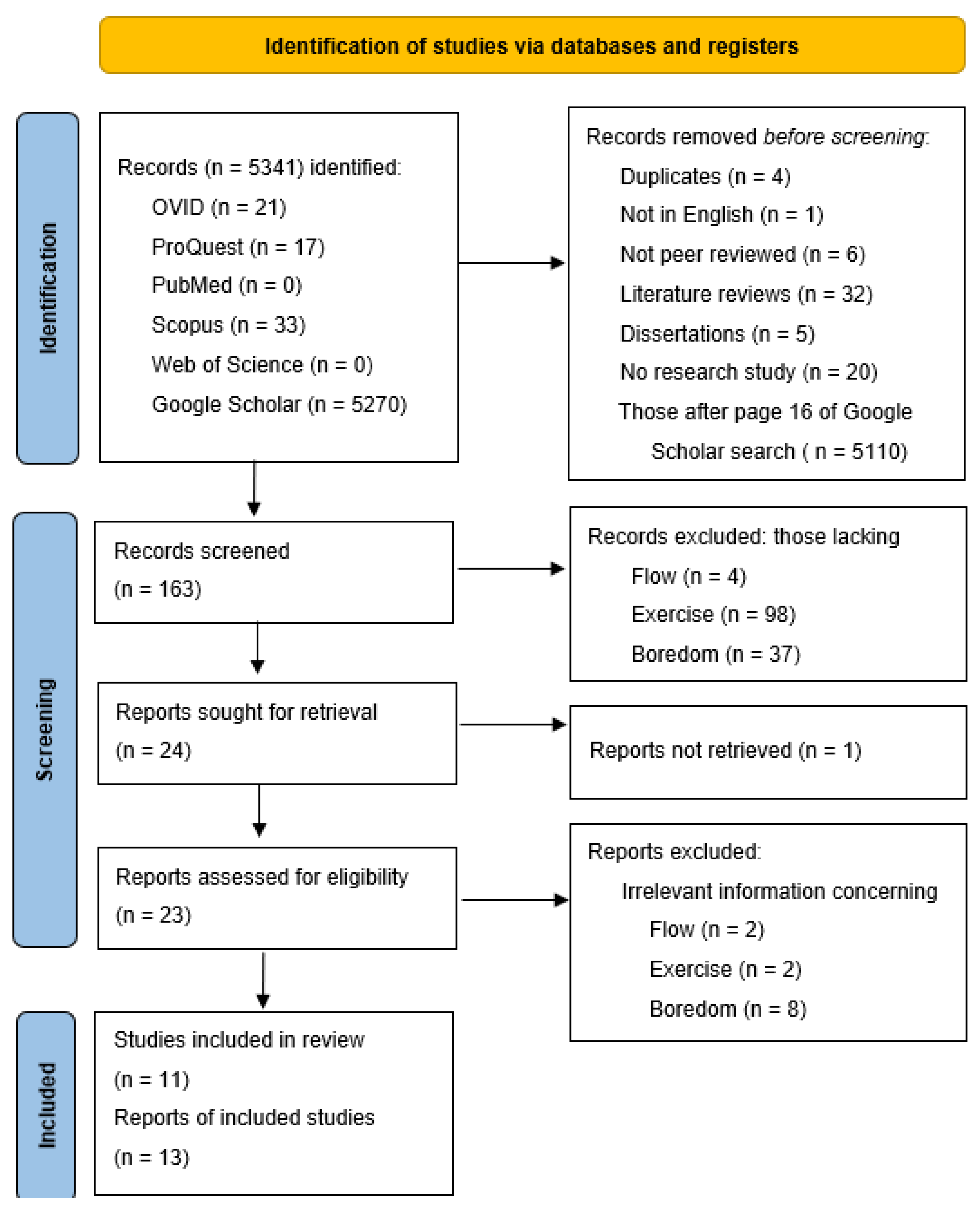

Table 1.
Bibliographic details of the studies from a 15 October 2024 search of OVID as the first three presented in the order returned, with those of a 22 October search of Google Scholar following as the last eight for searches regarding “Csikszentmihalyi, flow, exercise, boredom”.
Table 1.
Bibliographic details of the studies from a 15 October 2024 search of OVID as the first three presented in the order returned, with those of a 22 October search of Google Scholar following as the last eight for searches regarding “Csikszentmihalyi, flow, exercise, boredom”.
| # | Title | Authors | Year |
| [62] | Does exergaming drive future physical activity and sport intentions? | Soltani, P; Figueiredo, P; Vilas-Boas, JP | 2021 |
| [63] | The Aftermath of Peak Experiences: Difficult Transitions for Contact Sport Athletes | Senecal, G | 2021 |
| [64] | Construction and Validation of the Interest Development Scale | Boeder, JD; Postlewaite, EL; Renninger, KA; Hidi, SE | 2021 |
| [65] | A qualitative investigation of flow experience in group creativity | Łucznik, K; May, J; Redding, E | 2021 |
| [66] | Physical Activity Flow Propensity: Scale Development using Exploratory Factor Analysis with Paired Comparison Indicators | Pritikin, JN; Schmidt, KM | 2022 |
| [67] | The Impact Of The Recreational Flow Experience On The Perception Of Wellness Among Individuals Engaged In Extreme Sports | Dilmaç, E; Tezcan, N | 2021 |
| [68] | 'Living in the moment': mountain bikers' search for flow | Taylor, S; Carr, A | 2023 |
| [69] | Relationships between flow state and motivation in junior elite tennis players: Differences by gender | Mouelhi-Guizani, S; Guinoubi, S; … | 2023 |
| [70] | Finding flow in pandemic times: Leisure opportunities for optimal experience and positive mental health among Italian university students | Mangialavori, S; Bassi, M … | 2024 |
| [71] | 24 hours on the Run—Does boredom matter for ultra-endurance Athletes' Crises? | Weich, C; Schüler, J; Wolff, W | 2022 |
| [72] | The role of recreation specialization and self-efficacy on life satisfaction: the mediating effect of flow experience | Röglin, L; Ketelhut, S; Ketelhut, K; Kircher E; … | 2021 |
Table 2.
Citation number of the eleven studies (and 13 reports) of three returns from OVID and eight from Google Scholar for searches regarding “Csikszentmihalyi, flow, exercise, boredom”, the aim of the study, number of participants, and the date of the research along with its geographic location.
Table 2.
Citation number of the eleven studies (and 13 reports) of three returns from OVID and eight from Google Scholar for searches regarding “Csikszentmihalyi, flow, exercise, boredom”, the aim of the study, number of participants, and the date of the research along with its geographic location.
| # | Aim | Participants | Date—Location |
| [62] | Examining how the usability and playability of sport exergames affects the future intentions of participation in physical activity or actual sport | 76 healthy university students | Date not reported, ethics approval January 2013—country not reported |
| [63] | Examine peak experiences in sport and how such experiences in an athletic career affect the athlete’s career transition | Nine semistructured interviews with former male team-contact sport athletes | Date not reported nor ethics approval information—USA |
| [64] | Assess adult interest as a variable that can develop | Three studies: 304 individuals, 484 respondents, 103 respondents | Dates not reported nor ethics approval information—USA |
| [65] | Investigating the role of flow experience in a group creativity task, contemporary dance improvisation | Six dancers | Date not reported nor ethics approval information—England |
| [66] | Investigating the flow propensity of physical activities | 987 participants | Date not reported nor ethics approval information—USA |
| [67] | Determine the impact of recreational flow experience on perceived wellness among extreme sports participants | 532 extreme sports participants |
Date not reported, ethics approval 10 March 2023—Turkey |
| [68] | Understanding if experienced mountain bikers actively search for flow experiences | 30 mountain bikers | Date not reported nor ethics approval information—New Zealand and England |
| [69] | Examine relationships between differing types of motivation and the flow state and possible gender differences | 94 junior elite tennis players | Experiences provided regarding the qualifying tournament for the Arabic Championships from 26 July 2019 to 3 August 2019— Tunisia |
| [70] | Flow-promoting activities during COVID-19—with specific attention to leisure—were investigated | 1281 Italian university students attending courses in Health Sciences and Humanities, Social and Political Sciences | 15 April 2020 and 15 May 2020—Italy |
| [71] | Examining the role of boredom in people who participate in ultra-endurance competitions | 113 competitors | 12 June 2021–13 June 2021—Germany |
| [72] | Examining the relationship between recreation specialization, self-efficacy, flow experience, and life satisfaction | 404 long-distance Chinese runners | 13 December to 21 December 2021—China |
Table 3.
Citation number of the eleven studies (and 13 reports) of three returns from OVID and eight from Google Scholar for searches regarding “Csikszentmihalyi, flow, exercise, boredom”, and the cumulative research findings for each of flow, exercise, and boredom.
Table 3.
Citation number of the eleven studies (and 13 reports) of three returns from OVID and eight from Google Scholar for searches regarding “Csikszentmihalyi, flow, exercise, boredom”, and the cumulative research findings for each of flow, exercise, and boredom.
| # | Flow | Exercise | Boredom |
| [62] | Associated with challenge and deep concentration, not enjoyment, in exergames | Exergames promote longer engagement times than traditional forms | With many of the movements in exergames repetitive, this is a possible result |
| [63] | A skills rise is proportionate to the increase in the challenge required to experience it for professionals | Promoted to ensure a continuation of flow experience following professional games | Without an increase in challenges, this is the result, proportionate to the decrease in flow |
| [64] | Concomitant with information seeking, motivation to reengage, persistence, self-regulation, and value | Effectiveness in promoting flow is determined by participant interest level | The Individual Interest Questionnaire predicts boredom, among other factors |
| [65] | Identified as a vital component of a dancer’s practice | Warm-up and team-building essential for flow | Require adequate challenge, otherwise experienced |
| [66] | Some activities offer more or less propensity for it— martial arts have the highest propensity | There must be interest and commitment to induce flow | Results when activity demands exceed skills or skills exceed demands |
| [67] | Found positively related to sports, exercise, and exceptional performance | When extreme or in excess can lead to anxiety, decreasing wellness perception | Negatively correlated with perceived wellness |
| [68] | Requires relatively smooth surfaces that allow and encourage the rider to achieve speed and momentum | Along with contemplation and nature experience, the most important motivations for bikers to achieve flow | Experienced most often when lacking challenge |
| [69] | Correlated with challenge/skill balance, action/awareness merging, unambiguous feedback, concentration on task, and sense of control with no significant gender differences | Should be modified to the tennis season and by gender | Produces a better quality of experience in tennis players than those in apathy or anxiety states as a psychological antecedent of flow |
| [70] | Possible during pandemic-related quarantine | Practiced within the limited spaces of city apartments | Resulted from inadaptive modifications in structure and contents of flow-promoting activities |
| [71] | Athletes can differ in their ability and frequency of exercise in this state | At a competitive level, reduced boredom with it, likely as a result of self-regulated regular training | Very extreme athletes report significantly lower sport-specific traits of this than other athletes |
| [72] | Those engaging in rewarding, specialized physical activities are more likely to experience it | There was an effect on the daily routines of runners by COVID-19 | Chinese runners become this with poor weather, injuries, or lack of a running partner |
Disclaimer/Publisher’s Note: The statements, opinions and data contained in all publications are solely those of the individual author(s) and contributor(s) and not of MDPI and/or the editor(s). MDPI and/or the editor(s) disclaim responsibility for any injury to people or property resulting from any ideas, methods, instructions or products referred to in the content. |
© 2025 by the authors. Licensee MDPI, Basel, Switzerland. This article is an open access article distributed under the terms and conditions of the Creative Commons Attribution (CC BY) license (http://creativecommons.org/licenses/by/4.0/).
Copyright: This open access article is published under a Creative Commons CC BY 4.0 license, which permit the free download, distribution, and reuse, provided that the author and preprint are cited in any reuse.


