

Submitted:
25 March 2025
Posted:
26 March 2025
You are already at the latest version
Abstract
Everything as a Service (XaaS) is commonly understood as the general tendency to replace sale contracts with service contracts. The literature points to many advantages of XaaS. It could be strategies improving customers’ expense model, servitization strategies, customer feedback, mass customisation, and machine learning. However, we do not find contributions considering the relationship between XaaS and economies of scale. When sales contracts are replaced by service contracts, ownership is elevated from the customer to the provider. Thus, possible benefits from economies of scale linked to the ownership of products is then also elevated from the customer to the provider. In this article we consider the claim that economies of scale may be an underlying driver of the XaaS trend. A review of 140 firms shows that the products with the greatest potential for economies of scale are the ones most frequently provided as a service. This suggests that economies of scale linked to ownership is an underlying driver of XaaS. Thus, ownership related economies of scale may be a predictor of XaaS.
Keywords:
Everything as a Service
; XaaS
; economies of scale
; durable goods
; supply chains
1. Introduction
Everything as a service (XaaS) refers to cases where contracts for the sale of products are substituted by service contracts. Suppliers retain ownership when products are rented, leased, or licensed to customers1. This trend originated in the software industry in three variants at the start of the century. After the introduction of broadband and cloud computing, we saw the emergence of “Software as a Service” (SaaS) in 1999 (Fryer, 2020). Then “Infrastructure as a Service” (IaaS) and “Platforms as a Service” (PaaS) appeared around 2010 (Ipacs, 2023)2. According to Fortune Business Insights (2023), the global XaaS market will experience a CAGR of 24,4% between 2022 (market size; USD 560 bill.) and 2030 (market size; USD 3,200 bill.). Similar growth rates are estimated by The Business Research Company (2025).
The literature on XaaS refer to several drivers of this growth. However, no contribution is found considering economies of scale as a driver of XaaS. Economies of scale appear when the cost of producing an additional unit of output of a product decreases as the volume of output increases. (e.g., Linux Information Project, 2022). We will consider whether economies of scale may be involved in the transition from a owner economy to XaaS. This refers to a change where the ownership of a product is elevated from the customer level to the provider. Ownership advantages linked to economies of scale at the customer level may be multiplied when suppliers retain ownership given the hierarchical structure of most supply chains.
XaaS is distinguished from the Product Service-Systems (PSS) where suppliers “incorporate additional services” (Baines et al., 2007) or “generate new value streams to gain closer contact with customers not reachable by mere hardware improvements” (Bertoni et al., 2017:289). In PSS this change is not limited to adding services, or “servitization”, it includes an integration of the value streams generated by the product and services supporting the product (Van Ostaeyen, 2013). However, PSS does not necessarily involve the transfer of ownership as in the case of XaaS.
When the transformation from buying products to renting products started to be observed outside of the domain of the software industry, it was referred to as “selling performance” versus “selling goods” (Stahel, 1982/2010, Svensson & Funck, 2019). It was also referred to as “Product as a Service” (Generes, 2020) or as “Everything as a Service” (XaaS) (Banerjee et al., 2011, Deloitte, 2017, Ryan, 2019, and Systemiq, 2021). Transactions are increasingly about a right to dispose of within an agreed, or open-ended, period3. Examples of tangible products affected by XaaS are copy machines (e.g., London Printer Rentals, 2023), entrance mats (e.g., Moore, 2019), drink dispensers at the workplace (e.g., Ong, 2021), tires for automobiles (e.g., Vries, 2020), jet engines for airplanes (e.g., Hunt, 2015), and antibiotics (Jaczynska et al., 2015 and Moon et al., 2022). Lately, we even see manufacturers offering “preinstalled functionality as a service”. Functionality which is already present in the product is unlocked when customers pay subscription fees. This is described in a case study of BMW by Dehebar (2023).
This article starts by considering the general advantages linked to XaaS in the literature. Then we take a closer look at the possible role of economies of scale as a driver of XaaS and possible reasons for omitting economies of scale as a driver in the literature. A review of 140 firms within the NACE codes that appeared most frequent in the literature review, support the thesis that economies of scale linked to ownership is an underlying driver of XaaS. Finally, implications from this finding is considered.
2. The Literature on XaaS
2.1. Advantages of XaaS
For more than 40 years, consultants and researchers of business strategy have argued that suppliers in the software sector should offer their products as a service. (Stahel, 1982/2010, Banerjee et al., 2011, Deloitte, 2017, and Forbes Insights, 2018). This trend has spread to material products being offered as a service as well4. The academic literature points to at least nine advantages of offering products as a service (the XaaS trend) (see Table 1).
An immediate effect of providing a product as a service that was formerly sold, is that it may improve the expense model. No major investment is required for the customer. The initial costs are equivalent to the running costs linked to maintenance, training and upgrading (e.g., Stahel, 1982, Lin et al., 2009, Benlian & Hess, 2011, Janssen & Joha, 2011). The XaaS trend is often associated with the deployment of sensors allowing suppliers to monitor the usage and status of products they offer to customers (e.g., Chen et al., 2014, Iqbal & Butt, 2019). This is an advantage for both the provider and the customer because it reduces risks and allows the provider to predict the need for services.
We see studies showing that servitization boosts sales and XaaS is a boost for servitization. A number of studies show that servitization benefit the suppliers’ interactions with customers and thereby increase revenues of product suppliers (e.g., Vandermerwe & Rada, 1988, Neely et al., 2011, Forbes Insights, 2018, Raddats et al., 2019, Han et al., 2020, Systemiq, 2021).
Offering a product as a service makes it easier to put in place a system for customer and product feedback, allowing companies to learn from customers and retain their loyalty over time. This may benefit innovation because some of the feedback will point to improvements or the need for new products or services (e.g., Rabetino-et-al., 2017, Krancher et al., 2018).
We also see that authors for decades have pointed to mass customisation as one of the advantages when products are transformed from items sold, to items offered as a service (e.g., Goldhar & Jelinek, 1983, Pine, 1993, Pine et al., 1993).
To implement machine learning and AI, one needs feedback from large volumes of information linked to the experiences of both machines (sensors) and humans over time. This is easier to accomplish when products are offered as a service (e.g., Chui et al., 2016, Forbes Insights, 2018, Halleberg & Martinac, 2020, Cognite, 2021, Sousa et al., 2021, Kunz & Wirtz, 2023).
We see that XaaS is associated with increasing cost flexibility for users. XaaS allows users to tailor their demand for services because the costs of upscaling or downscaling are relatively low when capital expenditures are not involved. (Stahel, 2010, Ardagna et al., 2012z, Manvi & Shyam, 2014, Tsai et al., 2014).
When products are offered as a service, suppliers have an incentive to produce higher quality products that lasts longer. The suppliers’ business model benefit from increasing user time of the product (e.g., Banerjee et al., 2011, Deloitte, 2017, Migliorato, L., 2018, Forbes Insights, 2018).
Products offered as a service allow for a more time-efficient use when costs of the end-user are linked to usage time. This reduces the consumption of resources and stands in contrast to the one-time investment linked to ownership of products (e.g., Ellen Macarthur Foundation, 2013, Schulze, 2016, Aboulamer, 2017).
We also see that offering products as services include incentives for prolonging the life-cycle of products. There is a marginal cost linked to usage time, maintenance and repair work compared to the present value calculation used when purchasers invest in new products and dispose of their products (Ellen Macarthur Foundation, 2013, Baumgartner & Rauter, 2017, and Vermunt et al., 2019).
There are also disadvantages linked to the XaaS. One frequently mentioned in the literature is that contract regulations for services typically are more complicated than contract regulations for sales contracts. More uncertainty related to the contracts’ rights and obligations is associated with increasing transaction costs (Perzanowski & Schultz, 2016).
2.2. Economies of Scale Linked to Ownership
Among the nine advantages of XaaS identified in the literature (Figure 1), the seven first concern potential synergies between the provider and the customer. There are commercial gains to be obtained for both parties from a new expense model, servitization, customer feedback, mass customisation, machine learning and AI, and from risk reduction. The last two of the advantages (8-9 in Figure 1) are predominantly in the interest of the provider. Thus, the literature has identified many advantages of XaaS, but no peer-reviewed article has been found that points to ownership related economies of scale as a driver of the XaaS trend. This finding is also based on searches in SCOPUS. No matches where found of articles linking “economies of scale“ to XaaS on SCOPUS5.
Azcarate-Aguerre et al. (2022) defines the “total value of ownership” (TVO) as the net present value (NPV) of five elements over a specific time frame (see Table 2). These elements are similar to the elements included in the present value calculations in the LCC literature and the PSS literature (e.g., Davis, 2005 and Bertoni et al., 2017).
The five value elements included in the calculation of “total value of ownership” (Table 2) are relevant for durable goods, but not for disposable goods or consumer goods. “Durable goods” refer to products with a life span of at least three years (Cooper, 1994, Waldman, 2003, Ingham, 2018), in contrast to “disposable goods” with shorter life-times (McCollough, 2006, Stahel, 2010). Users of durable good will demand product-related services needed to realize the advantages of XaaS listed in Table 1. The thesis in this article is that the underlying driver behind this demand is economies of scale.
Alfred D. Chandler (1977) describes how organizations historically have adopted new technologies and contributed to significant economies of scale, which in turn led to mass distribution and mass production. We saw the emergence of the ‘managerial’ and multinational enterprises at the end of the 19th century, when industries exploited lower unit costs in materials, in services, and in administration.
Many contributions of economists, including the classic contributions of Coase (1937) and Baumol (1972), describe how the institutional development and growth of business organizations are related to scalable market transactions. There is a trade-off between maximising profits by exploiting lower fixed costs per produced unit in the market, and the disadvantage of becoming too large, triggering diseconomies of scale (Oliver Williamson, 1985 and Canbäck et al., 2006). The diseconomies of scale may be linked to both internal and external costs. Canbäck et al. (2006) refer to four internal cost elements related to large organisations. First, employees have a hard time understanding the purpose of corporate activities. Second, managers may be less accountable to the lower ranks of the organisation. Third, the impact of management incentives may be weaker. Fourth, due to the cognitive limitations of managers, we see the need to compensate by developing internal hierarchies. However, diseconomies of scale may also trigger dilemmas related to the external environment of the firm. Capturing economies of scale can in many cases involve investments with disproportionate transaction costs, or they can lead to negative externalities damaging the firm’s reputation and brand value.
The literature distinguishes between internal and external economies of scale. Advantages linked to the material product and production process are typically associated with internal economies of scale, while external economies of scale are typically associated with advantages linked to infrastructures and inter-firm services (Economiesonline, 2022). This article focuses mostly on internal economies of scale as the aim is to consider competitive advantages of firms that offer their products as a service.
When products for sale are transformed into rental services the ownership role moves one step up in the supply chain. This is what we refer to as the “XaaS trend”. Accordingly, whatever potential of economies of scale we see inked to ownership for a given product, is then elevated and multiplied to the level of the provider, given the hierarchical structure of most supply chains.
The advantages in these cases are typically less related to the scalability of the production process than to advantages related to “repeatable processes”, as we find in the definition of economies of scale in Rao (2012):
Economies of scale are the advantages that can result when repeatable processes are used to deliver large volumes of identical products or service instances.
According to Rao (2012), the textbook definition of economies of scale, which focuses to falling unit costs, is really only the effect of successfully achieving economies of scale by applying repeatable processes.
The advantages of the XaaS trend, may be explained by “repeatable processes”. It could be by handling similar categories of transactions, similar service propositions, or similar TVO calculations. The advantages (1-7) in Table 1 can be strengthened by economies of scale, but they themselves are not examples of economies of scale. Mass customisation, machine learning, and other advantages of XaaS can be introduced without realizing significant economies of scale. It is when these advantages are combined with scaling that they generates an economic advantage. This suggests that ownership related economies of scale may be an underlying driver of XaaS.
The XaaS trend relies on the ubiquitous broadband connectivity that allow suppliers to monitor the status of products at a low cost (Goldman Sachs, 2018, Systemiq, 2021, and Deloitte, 2021). Before we look into empirical evidence of economies of scale driving XaaS, we shall therefore consider how digital technology influences economies of scale in general.
Many scholars point to evidence that digitalization and new business models are now reducing the importance of economies of scale in many industries and business processes. According to recent literature covering additive manufacturing and cyber-physical production, economies of scale will play a lesser role due to the demand for customised products and the capacity of artificial intelligence to help businesses adapt to particular contexts within a given set of criteria (e.g., Fogliatto, et al., 2012; Choudary, 2015; Taneja & Maney, 2018; and Beltrametti & Gasparre, 2018; Manavalan & Jayakrishna, 2019; Kunz & Wirtz, 2023). According to Taneja and Maney (2018) the economies of scale is eroded by two complementary market forces; the emergence of platform models and the technologies that allow products to be rented whenever needed. Taneja & Maney focus on how the XaaS affects the customer but does not take into account how the transfer of ownership affects the provider of products. They refer to this as “the economics of unscaling”. However, the prospects of AI-robots delivering customer services, point in the opposite direction, according to Kunz and Wirtz (2023). They claim that AI in customer service enables “enormous economies of scale”. But none of the above-mentioned authors consider how XaaS is affected by economies of scale at different levels of the supply chain.
Today, scalability is no longer achieved purely through the accumulation of labour and corporate resources (Haldi & Whitcomb, 1967); it is achieved by exploiting market power (Chandler, 1977), or by the ability to handle a great number of interdependent relationships in a complicated ecosystem, referred to as “network effects” (Choudary, 2015). Several authors believe the network effect is behind the market success of the platform model (Van Alstyne et al., 2016; Srnicek, 2017). Choudary (2015) focuses on the new network structures and the decreasing transaction costs, allowing small value transactions triggered by smart technology. But these authors do not consider the economies of scale linked to the shift of ownership as a possible driver of XaaS.
Some scholars argue that digital technologies boost economies of scale for larger companies by utilising big data analytics, while they may reduce economies of scale for microfactories because digital technologies allow them to customise products in ways previously reserved for large companies (Montes and Olleros, 2019). Similar claims of a split between advantages and disadvantages of economies of scale is found with reference to additive manufacturing (Baumers et al., 2016) and Industry 4.0 (Büchi et al., 2018).
In summary, we observe that much of the recent literature is commenting on how digital technologies seem to reduce the importance of scale, and highlighting how networks are becoming more prominent. We find no contribution arguing that economies of scale may be the driver of XaaS. A possible explanation may be that the origin of XaaS was Software as a service (SaaS). In the software industry products are immaterial. According to a survey of 600 IT managers in the US, the advantages of XaaS is linked to the improved operability and functionality for both customers and providers (Deloitte Insights, 2021), and there are minimal costs linked to ownership of software. This is true both when the software is purchased and when it is licensed by the customer. But for material products, someone must bear the costs related to delivery, maintenance, training, upgrading, and the disposal of the product. Thus, there may be economies of scale linked to ownership for the provider of material products that are unattainable for owners of immaterial products.
3. Methodology
To consider the drivers of the XaaS trend empirically, we follow two research steps, illustrated in Figure 1.
Research Step 1
The aim in step 1 is to analyse a sufficient number of articles to identify the typical industries and products affected by the XaaS trend. The search engine Scopus was applied to conduct a systematic literature review for articles published in 2020 or after, that were offering products as a service. The search string6 included the subject area “Business Management and Accounting”, the quote “as a service”, and the exclusion of articles mentioning “cloud” and “software”. Articles registered under the subject area “Computer Science” was also excluded. This resulted in 137 articles. When articles not covering XaaS and/or not covering material products were excluded, there were 55 matching articles. For each article, the dominant product category (NACE code) in the article was determined7. Fourteen NACE codes were found to cover the dominant product in the articles (see Figure 1).
Research Step 2
Step two include a search for Norwegian firms fulfilling two criteria (see Figure 1). These are firms situated in a relatively homogeneous legal and cultural environment. Two requirements was made: They should be active in at least one of the 14 NACE codes identified in step “1” and they should be mentioned in texts together with the phrase; “as a service”8. The main business of the matching firms should be to rent out products.
- -
- The first criterion is examined by using the search engine “proff.no”. This search engine is linked to the Norwegian government’s official company register where NACE codes are included as search criteria9. Here we identify the ten largest employers10 among the limited liability companies registered within each of the 14 NACE codes identified in research step 1 (140 firms in total).
- -
- The second criterion is included by conducting a Google search on any text mentioning <name of firm> and the text <“as a service”>. We count how many qualified matches there are per product category (NACE code). Google is in this text not used to assess research results, or to consider specific claims, but to compare the relative number of matches in searches for “as a service” and a particular firm name. If there is a bias in the data or weights that Google relies on, we would not assume that this would create a systematic bias among the NACE codes in our sample.
Larger firms have more references on the web (receive more matches in Google searches) than small firms. This is mitigated by only including the ten largest employers within each of the fourteen NACE codes. This ensures that firms that are offering products as a service are well known and mentioned by third parties on the web. We also see that firms with more matches in Table 3 are not distinguished by having more employees in average than the firms with fewer matches11. Thus, the Google search is considered a reliable source for comparing firms with “as a service” hits among firms covered by the 14 NACE codes identified at Research step 1.
The Validity of This Design
To be able to analyse the variation of XaaS practices involves samples with different properties. The validity of this design relies on the assumption that the frequency of the expression “as a service” mentioned on websites that also has a reference to the name of a Norwegian employer within 14 NACE codes, may be seen as a proxy for “the degree of reliance on XaaS”. The English expression “as a service” is used regularly among Norwegian businesses and by those representing, advising, and regulating them. The expression does not have any other meaning than as a reference to business practices where goods are offered as a service. When we exclude non-material goods we should be left with occurrences where firms are involved in XaaS.
The selection of NACE codes representing the business areas where XaaS is most relevant, is based on a global (SCOPUS) search for peer review articles. It is assumed that these NACE codes are valid representations of the most XaaS relevant NACE codes in Norway. Though the global NACE distribution of XaaS practices will not be equivalent to the distribution in Norway, there is no reason to believe that the difference will be significant, particularly not among the large employers selected, which typically have international trading partners and sales markets.
4. Results
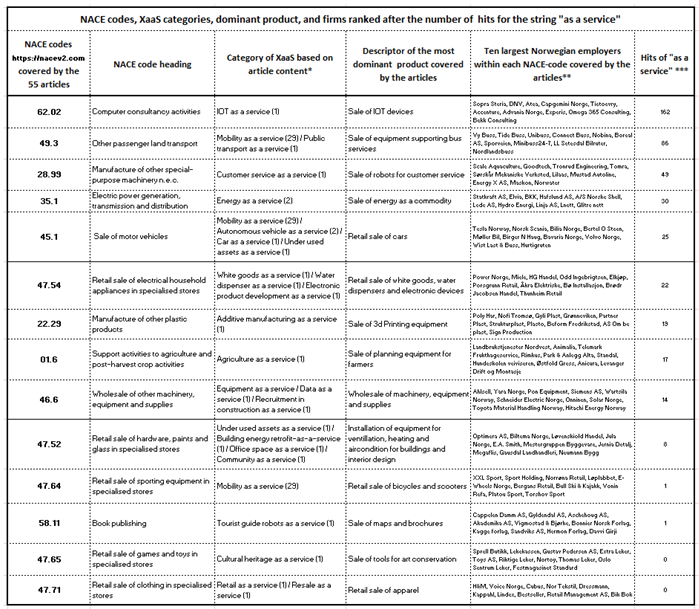
An overview of all the matches for articles and firms is included in Appendix A. The 55 peer-reviewed articles in the sample cover 14 product groups (NACE codes). The NACE code of the most dominant product in each article was then recorded (Table 3, column 1 and 2) and the “as a service”-category and a descriptor was registered (Table 3, column 3 and 4). Thereafter, a search on proff.no was conducted to find the ten largest firms (by number of employees) registered on each of these NACE codes (Table 3, column 5). Finally, a general web search for <firm name> and the string “as a service” was conducted. Matches for each firm varied from 0 to 162 with a median of 18 (Table 3, column 6).
The NACE code with the most frequent mentioning of “as a service” was “IOT as a service”. The 14 XaaS-categories cover both business-to-business transactions and business-to-customer transactions. The categories also cover products provided by both the public and the private sector.
The data supports the assumption that the XaaS trend is mostly affecting durable goods. More than 95 percent of the articles in our systematic literature review cover products with a typical life span exceeding three years (Table 3). Only three articles did not refer to durable goods. These articles concerned
- -
- Energy as a service / Sale of energy as a commodity,
- -
- Equipment as a service / Wholesale of machinery, equipment, and supplies
- -
- Tourist guide robots as a service / Sale of maps and brochures
It should not be of any surprise that XaaS focuses on durable goods, given that XaaS refers to an offering of a good for rent over time. We now consider the drivers of the XaaS trend for durable goods.
Figure 2 shows that the products with the highest number of hits “as a service” are
- high value products, demanding maintenance, or
- allowing real-time monitoring.
The products with the lowest number mentioning of “as a service“ are products with
- either low value products, or
- moderate or no maintenance demand, or
- products where real-time monitoring is difficult.
The maintenance costs and monitoring capabilities for the products on the left side of Figure 2 are very much influenced by economies of scale. TVO (see Table 2) includes the maintenance costs and monitoring capabilities that allows the provider to design an optimal hiring model, which in turn optimize capital expenditures. Only the products at the left side of Figure 2 have the potential to minimize these ownership costs. Thus, the products most frequently associated with the XaaS trend (the left side) have the most evident scalability advantages. This supports the thesis that economies of scale linked to ownership may be an underlying driver of the XaaS trend.
5. Discussion
We find further empirical evidence pointing towards economies of scale as a driver of XaaS when we consider the “total value of ownership”. This is illustrated by Azcarate-Aguerre et al. (2022), which compares two different financing models related to energy renovation of buildings. The PSS model is compared with a model based on traditional contracts where building owners purchase the products they need. The comparison showed that when tangible products like heating systems and windows, as well as soft value elements such as “comfort” and “risk perception” were included, PSS-financing was more favourable than ownership based financing for the building owners (see Figure 3).
Azcarate-Aguerre et al. (2022) show that building owners most often would benefit from PSS financing, but did not highlight how PSS affects suppliers. The ownership financing model is based on suppliers selling products and services, while the PSS-financing model is based on suppliers providing products and services while retaining ownership, and is illustrated in Figure 4.
When a supplier of products chooses to retain the ownership of products, ownership costs and revenues that would otherwise be carried by customers, is carried by the supplier. The supplier will exploit the potential for economies of scale in these areas.
The NPV calculations by Azcarate-Aguerre et al. (2022) show that the PSS-financing model is preferable to the ownership-financing model for building owners. But if the advantages (1-7) of XaaS in Table 1 really are synergies, as we have argued above, then the PSS-finance model should be the most advantageous model for building owners and suppliers. Given that the advantages for the suppliers are accumulated TVO elements otherwise accrued to customers, they must be scalable. Thus, the results in Azcarate-Aguerre et al. (2022) not only provide building owners with a rationale for choosing a PSS-model, the rationale also include suppliers as well and suggests that they are valid in other industries as well. This further supports the thesis that ownership related economies of scale may be an underlying driver of the XaaS trend.
6. Conclusion
This article examines the drivers of Everything as a service (XaaS) where sale contracts for durable products are substituted by service contracts. We see strong growth in rental markets, and many studies are referring to advantages driving the transition from sales contracts to rental contracts. In this transition product ownership is elevated from the customer level to the provider. We would expect that whatever economies of scale there is at the customer level, would then be strengthened at the aggregate level of the supplier, given the hierarchical structure of supply chains. Thus, economies of scale may be a driver of XaaS. However, no peer-review articles have been found that links growth of XaaS to economies of scale.
Our study of 140 firms finds that economies of scale appear to be an underlying driver the XaaS trend through repeatable processes that contribute to falling unit costs. This suggests that ownership related economies of scale may be a predictor of XaaS. We should expect XaaS among durable goods where there is a strong potential for economies of scale.
The identification of indicators to quantify the XaaS trend was not within the scope of this article. Two perspectives would be of particular interest in this area. At the firm level we may identify products and markets with a strong potential for ownership related economies of scale linked to the transition from sales contracts to service contracts. At the macro level, we may focus on generic features of markets and products associated with economies of scale in different sectors and industries. Such studies would enhance our understanding of the XaaS trend. In light of the findings in this article, it would also be interesting to consider how government policies and regulations influence the XaaS trend.
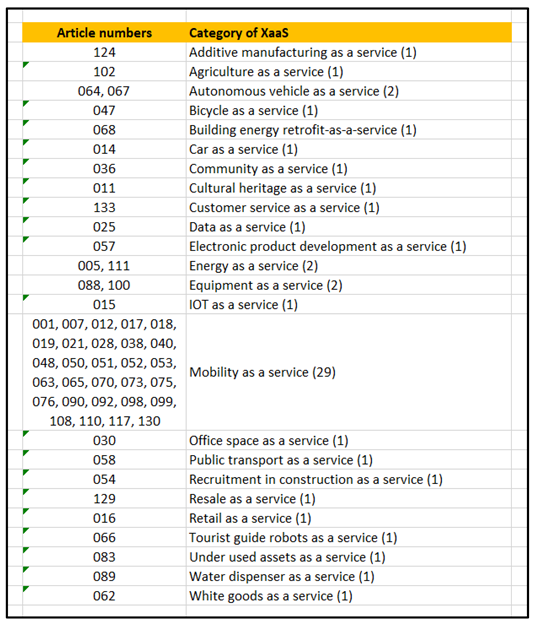
Appendix A. The XaaS Categories Included in the Scopus Search Result of Peer Reviewed
ARTICLES MENTIONING “AS A SERVICE” AFTER 1ST OF JANUARY 2021.

Table A1.
The category XaaS included in the Scopus research result for peer-reviewed articles and the corresponding article numbers. (55 articles).
Table A1.
The category XaaS included in the Scopus research result for peer-reviewed articles and the corresponding article numbers. (55 articles).
 |
External appendixes:
A full reference to the 137 articles (the 55 articles including the 82 excluded articles) from the Scopus search is available here12.
Table 3, including a column with the URLs to all the proff.no searches for firms matching the NACE codes here13.
A full reference to the search for <company name> + “as a service” is available here14.
| 1 | Based on the description of the concepts in Merriam Webster dictionary and Wikipedia, we may distinguish between three service models: To ”rent” something refers to a customer possessing a good in return for a periodic payment. To “lease” something may cover a rent agreement but is typically used when there are additional conditions to be fulfilled and/or when the customer has an option to purchase the good after a given period. To “license” something is to receive a formal permission – often granted by a public authority – to utilise or control a good for a given period. |
| 2 | In SaaS vendors manage all tasks linked to the customer’s access and upgrading of software. In IaaS vendors provide and operate the hardware their customers need. In “platforms as a service”, vendors provide the hardware and the operating system used by the customer’s developer (e.g. Waters, 2005 and Chai, 2022). |
| 3 | The reference; “Right of disposal“ is here understood in the meaning of Merriam Webster; “authority to make use of as one chooses“. |
| 4 | Business services are also being included a spart oft he XaaS economy in some texts. Goldman and Sachs describe companies that facilitate outsourcing as “servicer companies“ (Goldman Sachs, 2018). |
| 5 | The SCOPUS search used the following search string; “(TITLE-ABS-KEY ("economies of scale") OR TITLE-ABS-KEY ("economy of scale")) AND (TITLE-ABS-KEY ("everything as a service") OR TITLE-ABS-KEY ("XaaS") OR TITLE-ABS-KEY ("servitization") OR TITLE-ABS-KEY ("product service-system"))“ |
| 6 | The search string used in Scopus: TITLE-ABS-KEY ("as a service" ) AND PUBYEAR > 2020 AND DOCTYPE ( ar ) AND SUBJAREA ( busi ) AND NOT TITLE-ABS-KEY ( "cloud" ) AND NOT TITLE-ABS-KEY ( "software" ) AND NOT SUBJAREA ( comp ) |
| 7 | The coding of most dominant NACE code was done with the assistance of Chat GPT-4. Chat GPT-4 was given access to the NACE nomenclature (four digits) and then a prompt, including the dominant product in the peer-review article was submitted. Chat GPT-4 returned the most relevant NACE codes. All results were checked and confirmed manually to prevent any mistakes or misunderstandings. Finally, the researcher determined the dominant NACE code/product in each article. |
| 8 | This phrase is common in Norway and has no exact equivalent in Norwegian. |
| 9 | ”Proff” is a brand for the Norwegian market owned by the Finish company Enento. Proff relies on several public databases in Norway: https://innsikt.proff.no/kilder/
|
| 10 | The number of employees was chosen as a criterion because alternatives such as turnover, or market value, could be linked to funds or accumulated turnover in holding companies with firm names that are not relevant for the debate on management strategies and contract models. |
| 11 | This is shown in the the data file including the results from the search on proff.no. (See link in the appendix.) |
| 12 | Link to the full list of articles: https://docs.google.com/document/d/1LoDBgJZGDo_i3Gwo4nKGY6TmtLpR3oHV/edit
|
| 13 |
Link to Table 4, including the column with the URLS to all the proff.no searches:
|
| 14 |
Link to the overview of all Google searches for firms and “as a service”:
|
References
- Aboulamer, A. Adopting a circular business model improves market equity value. Thunderbird International Business Review 2017, 60, 765–769. [Google Scholar] [CrossRef]
- Ardagna, C.A.; Damiani, E.; Frati, F.; Rebeccani, D.; Ughetti, M. Scalability patterns for platform-as-a-service. In 2012 IEEE Fifth International Conference on Cloud Computing, 2012; pp. 718–725. [CrossRef]
- Azcarate-Aguerre, J.F.; Conci, M.; Zils, M.; Hopkinson, P.; Klein, T. Building energy retrofit-as-a-service: A Total Value of Ownership assessment methodology to support whole life-cycle building circularity and decarbonisation. Construction Management and Economics 2022, 40, 676–689. [Google Scholar] [CrossRef]
- Baines, T.S.; Lightfoot, H.W.; Evans, S.; Neely, A.; Greenough, R.; Peppard, J.; Roy, R.; Shehab, E.; Braganza, A.; Wilson, H.; et al. State-of-the-art in product-service systems. Proceedings of the Institution of Mechanical Engineers, Part B: Journal of engineering manufacture 2007, 221, 1543–1552. [Google Scholar] [CrossRef]
- Banerjee, P.; Friedrich, R.; Bash, C.; Goldsack, P.; Huberman, B.; Manley, J.; Patel, C.; Ranganathan, P.; Veitch, A. Everything as a Service: Powering the New Information Economy. Computer 2011, 44, 36–43. [Google Scholar] [CrossRef]
- Baumers, M.; Dickens, P.; Tuck, C.; Hague, R. The cost of additive manufacturing: Machine productivity, economies of scale and technology-push. Technological forecasting and social change 2016, 102, 193–201. [Google Scholar] [CrossRef]
- Baumgartner, R.J.; Rauter, R. Strategic perspectives of corporate sustainability management to develop a sustainable organisation. Journal of Cleaner Production 2017, 140, 81–92. [Google Scholar] [CrossRef]
- Baumol, W.J. On taxation and the control of externalities. The American Economic Review 1972, 62, 307–322. [Google Scholar]
- Benlian, A.; Hess, T. Opportunities and risks of software-as-a-service: Findings from a survey of IT executives. Decision support systems 2011, 52, 232–246. [Google Scholar] [CrossRef]
- Bertoni, M.; Rondini, A.; Pezzotta, G. A systematic review of value metrics for PSS design. Procedia CIRP 2017, 64, 289–294. [Google Scholar] [CrossRef]
- Büchi, G.; Cugno, M.; Castagnoli, R. Economies of Scale and Network Economies in Industry 4.0. Symphonya. 0. Symphonya. Emerging Issues in Management 2018, (2), 66–76. [Google Scholar]
- Canback, S.; Samouel, P.; Price, D. Do diseconomies of scale impact firm size and performance? A theoretical and empirical overview. ICFAI Journal of Managerial Economics 2006, 4, 27–70. [Google Scholar]
- Chai, W. Software as a Service (SaaS). Text on TechTarget.com. 2022. Downloaded, February 2025. Available online: https://www.techtarget.com/searchcloudcomputing/definition/Software-as-a-Service?vgnextfmt=print.
- Chandler, A.D. The visible hand. The Managerial Revolution in American Business; The Belknap Press of Harvard University Press. 1977.
- Chen, S.L.; Chen, Y.Y.; Hsu, C. A new approach to integrate internet-of-things and software-as-a-service model for logistic systems: A case study. Sensors 2014, 14, 6144–6164. [Google Scholar] [CrossRef] [PubMed]
- Choudary, S.P. “An introduction to interaction-first businesses”. Chapter one in Chourday, S.P. (ed.) Platform Scale: How an emerging business model helps startups build large empires with minimum investment. Platform Thinking Labs. 2015.
- Chui, M.; Manyika, J.; Miremadi, M. Where machines could replace humans-and where they can’t (yet). McKinsey Quarterly 2016. [Google Scholar]
- Coase, R.H. The Nature of the Firm/Coase Ronald H. Economics 1937, 4, 386–405. [Google Scholar]
- Cognite, A.S. “The digital twin: The evolution of a key concept of industry 4.0.”. Blog article. 2021. Downloaded, February 2025. Available online: https://www.cognite.com/en/blog/digital-twin-evolution-1.
- Cooper, T. The durability of consumer durables. Business Strategy and the Environment 1994, 3, 23–30. [Google Scholar] [CrossRef]
- Davis, M.; Coony, R.; Gould, S.; Daly, A. “Guidelines for life cycle cost analysis”. Published by Stanford University in October 2005. 2005.
- Dhebar, A. Preinstalled functionality as a service. Business Horizons 2023, 66, 643–653. [Google Scholar] [CrossRef]
- Deloitte. “Everything-as-a-service. Modernising the core through a service lens”. Deloitte University Press Update. 2017. Downloaded, February 2025. Available online: https://www2.deloitte.com/us/en/insights/focus/tech-trends/2017/everything-as-a-service.html.
- Deloitte Insights. “Enterprise IT: Thriving in disruptive times with cloud and as-a-service. Deloitte Everything-as-a-Service Study, 2021 edition.” 2021. Downloaded, February 2025. Available online: https://www2.deloitte.com/us/en/insights/industry/technology/enterprise-it-as-a-service.html.
- Economicsonline.co.uk. Website on economics. Posted article: “Economies of scale”. 2022. Downloaded, February 2025. Available online: https://www.economicsonline.co.uk/business_economics/economies_of_scale.html/.
- Ellen Macarthur Foundation. Towards the Circular Economy. Report. 2013. Downloaded, February 2025. Available online: https://www.ellenmacarthurfoundation.org/assets/downloads/publications/Ellen-MacArthur-Foundation-Towards-the-Circular-Economy-vol.1.pdf.
- Fallahi, S.; Mellquist, A.C.; Mogren, O.; Listo Zec, E.; Algurén, P.; Hallquist, L. Financing solutions for circular business models: Exploring the role of business ecosystems and artificial intelligence. Business Strategy and the Environment 2022, 32, 3233–3248. [Google Scholar] [CrossRef]
- Fogliatto, F.S.; Da Silveira, G.J.; Borenstein, D. The mass scustomisation decade: An updated review of the literature. International Journal of production economics 2012, 138, 14–25. [Google Scholar] [CrossRef]
- Forbes Insights. The Big Promise of Everything-As-A-Service: Ongoing Revenue, Smarter Services. AI Issue 2, published 21st of September 2018. 2018. Downloaded, February 2025. Available online: https://www.forbes.com/sites/insights-intelai/2018/09/21/the-big-promise-of-everything-as-a-service-ongoing-revenue-smarter-services/.
- Fortune Business Insights. Everything as a Service Market Size. 2023. Downloaded text from website, August 2024. Available online: https://www.fortunebusinessinsights.com/everything-as-a-service-xaas-market-102096.
- Fryer, V. “The History of SaaS: From Emerging Technology to Ubiquity.” 2020. Blog article posted on bigcommerce.com. Downloaded, August 2025. Available online: https://www.bigcommerce.com/blog/history-of-saas/.
- Generes, T.O. Get Ready For The Product-As-AService Revolution. 2020. Article in Forbes October 15, 2020. Downloaded, February 2025. Available online: https://www.forbes.com/sites/servicenow/2020/10/15/get-ready-for-theproduct-as-a-service-revolution/?sh=1b720e3f4226.
- Goldhar, J.D.; Jelinek, M. Plan for economies of scope. Harvard Business Review 1983, 61, 141–148. [Google Scholar]
- Goldman Sachs. “The Everything-as-a-service economy”. 2017. Report (92 pages) published by The Goldman Sachs Group, Inc. Downloaded in October 2025. Available online: https://knowen-production.s3.amazonaws.com/uploads/attachment/file/5276/Global%2BMarkets%2BInstitute_%2BThe%2BEverything-as-a-Service%2BEconomy%2B.pdf.
- Häckel, B.; Karnebogen, P.; Ritter, C. AI-based industrial full-service offerings: A model for payment structure selection considering predictive power. Decision Support Systems 2022, 152, 113653. [Google Scholar] [CrossRef]
- Haldi, J.; Whitcomb, D. Economies of scale in industrial plants. Journal of Political Economy 1967, 75, 373–385. [Google Scholar] [CrossRef]
- Halleberg, D.; Martinac, I. Indoor Climate as a Service: A sdigitalised approach to building performance management. In IOP Conference Series: Earth and Environmental Science (Vol. 588, No. 3, p. 032013). IOP Publishing. 2020.
- Han, J.; Heshmati, A.; Rashidghalam, M. Circular economy business models with a focus on servitisation. Sustainability 2020, 12, 8799. [Google Scholar] [CrossRef]
- Hunt, K. Text published on Linkedin. Rolls-Royce & Jet Propulsion-as-a-Service. 2015. Downloaded, August 2025. Available online: https://www.linkedin.com/pulse/rolls-royce-jet-propulsion-as-a-service-kristofer-hunt.
- Ipacs, D. “The History of Cloud Computing: Tracing Its Evolution and Impact”. 2023. Text posted on the website of bluebirdinternational.com. Downloaded, August 2025. Available online: https://bluebirdinternational.com/history-of-cloud-computing/.
- Ingham, S. “public good”. Encyclopedia Britannica. 2018. Downloaded, February 2025. Available online: https://www.britannica.com/topic/public-good-economics.
- Iqbal, R.; Butt, T.A. Safe farming as a service of blockchain-based supply chain management for improved transparency. Cluster Computing 2020, 23, 2139–2150. [Google Scholar] [CrossRef]
- Jaczynska, E.; Outterson, K.; Mestre-Ferrandiz, J. Business Model Options for Antibiotics: Learning from Other Industries. Boston Univ. School of Law, Public Law Research Paper No. 15-05. 2015.
- Janssen, M.; Joha, A. Challenges for adopting cloud-based software as a service (saas) in the public sector. ECIS 2011 Proceedings. 80. 2011. Downloaded March 2025. Available online: https://aisel.aisnet.org/ecis2011/80/.
- Krancher, O.; Luther, P.; Jost, M. Key affordances of platform-as-a-service: Self-sorganisation and continuous feedback. Journal of Management Information Systems 2018, 35, 776–812. [Google Scholar] [CrossRef]
- Kunz, W.H.; Wirtz, J. AI in Customer Service – A Service Revolution in the Making. In Artificial Intelligence in Customer Service: Next Frontier for the Global World; Sheth, J., Jain, V., Mogaji, E., Ambika, A., Eds.; McMillan: Basingstoke, UK, 2023. [Google Scholar]
- Lacy, P.; Keeble, J.; McNamara, R. Circular advantage: Innovative business models and technologies to create value in a world without limits to growth. Accenture Strategy. 2014. Downloaded in October 2024. Available online: https://webunwto.s3.eu-west-1.amazonaws.com/s3fs-public/2022-02/Accenture-Circular-Advantage-Innovative-Business-Models-Technologies-Value-Growth.pdf.
- Lacy, P.; Rutqvist, J. Waste to wealth: The circular economy advantage; Palgrave Macmillan: London, 2015; Volume 91. [Google Scholar]
- Lin, G.; Fu, D.; Zhu, J.; Dasmalchi, G. Cloud computing: IT as a service. IT professional 2009, 11, 10–13. [Google Scholar]
- Linux Information Project (linfo.org). “Economies of scale definition”. Downloaded, February 2025. Available online: http://www.linfo.org/economies_of_scale.html.
- London Printer Rentals. Article on their website: Photocopier Leasing & Photocopier Rental. 2023. Downloaded in August 2024. Available online: https://www.londonprinterrentals.com/printer-rental-photocopier-leasing/photocopier-leasing-photocopier-rental/.
- Manavalan, E.; Jayakrishna, K. A review of Internet of Things (IoT) embedded sustainable supply chain for industry 4.0 requirements. Computers & Industrial Engineering 2019, 127, 925–953. [Google Scholar]
- Manvi, S.S.; Shyam, G.K. Resource management for Infrastructure as a Service (IaaS) in cloud computing: A survey. Journal of network and computer applications 2014, 41, 424–440. [Google Scholar] [CrossRef]
- McCollough, J. The effect of income growth on the mix of purchases between disposable goods and reusable goods. International Journal of Consumer Studies 2007, 31, 213–219. [Google Scholar] [CrossRef]
- Migliorato, L. “Beyond the asset: The future of the product as a service”. 2018. Article in Leasing Life. Downloaded, February 2025. Available online: https://www.dllgroup.com/us/en-us/-/media/Project/Dll/United-States/Images/New-Blogs/Product-as-a-service-new-normal-for-equipment-manufacturers/2018LeasingLifeAprilEditionProductasaService.pdf.
- Montes, J.O.; Olleros, F.X. Microfactories and the new economies of scale and scope. Journal of Manufacturing Technology Management 2019, 31, 72–90. [Google Scholar] [CrossRef]
- Moon, S.; Vieira, M.; Ruiz, A.A.; Navarro, D. New business models for pharmaceutical research and development as a global public good: Considerations for the WHO European Region. Oslo Medicines Initiative technical report. Copenhagen: WHO Regional Office for Europe; 2022. Licence: CC BY-NC-SA 3.0 IGO. Downloaded March 2025. Available online: https://repository.graduateinstitute.ch/record/300339?v=pdf.
- Moore, J. Article on corporate website. The Steps Of Installing An Entrance Mat. 2019. Downloaded in August 2024. Available online: https://www.thehouseidreamof.com/the-steps-of-installing-an-entrance-mat/.
- Neely, A.; Benedettini, O.; Visnjic, I. The servitisation of manufacturing: Further evidence. In “18th European operations management association conference (Vol. 1)”. 2011.
- Ong, O. Corporate newsletter. The Top 10 Bottleless Water Cooler Manufacturers In The USA. 2021. Downloaded in August 2023. Available online: https://www.sourcifychina.com/top-water-cooler-manufacturing-compare/.
- Perzanowski, A.; Schultz, J. The end of ownership: Personal property in the digital economy; MIT Press: Cambridge, Massachusetts, 2016. [Google Scholar]
- Pine, B.J., II. Mass Customisation: The New Frontier in Business Competition; Harvard Business School Press: Boston, Massachusetts, 1993. [Google Scholar]
- Pine, B.J.; Victor, B.; Boynton, A.C. Making mass customisation work. Harvard business review 1993, 71, 108–111. [Google Scholar]
- Rabetino, R.; Kohtamäki, M.; Gebauer, H. Strategy map of servitisation. International Journal of Production Economics 2017, 192, 144–156. [Google Scholar] [CrossRef]
- Raddats, C.; Kowalkowski, C.; Benedettini, O.; Burton, J.; Gebauer, H. Servitisation: A contemporary thematic review of four major research streams. Industrial Marketing Management 2019, 83, 207–223. [Google Scholar] [CrossRef]
- Rao, V. “Economies of Scale, Economies of Scope.”. 2012. Published on Ribbonfarm.com. Downloaded, February 2025. Available online: https://www.ribbonfarm.com/2012/10/15/economies-of-scale-economies-of-scope/.
- Ryan, S. “EaaS, Everything as a service”. 2019. Article published in Medium.com. Downloaded, February 2025. Available online: https://medium.com/swlh/eaas-everything-as-a-service-5c12484b0b4e.
- Santa-Maria, T.; Vermeulen, W.J.; Baumgartner, R.J. How do incumbent firms innovate their business models for the circular economy? Identifying micro-foundations of dynamic capabilities. Business Strategy and the Environment 2022, 31, 1308–1333. [Google Scholar] [CrossRef]
- Schulze, G. Growth Within: A Circular Economy Vision for a Competitive Europe. Ellen MacArthur Foundation and the McKinsey Center for Business and Environment 2016, 1-22. Downloaded, February 2025. Available online: https://www.ellenmacarthurfoundation.org/assets/downloads/publications/EllenMacArthurFoundation_Growth-Within_July15.pdf.
- Sousa, B.; Arieiro, M.; Pereira, V.; Correia, J.; Lourenço, N.; Cruz, T. ELEGANT: Security of Critical Infrastructures With Digital Twins. IEEE Access 2021, 9, 107574–107588. [Google Scholar] [CrossRef]
- Srnicek, N. Platform capitalism; Polity Press: Cambridge, UK, 2017. [Google Scholar]
- Stahel, W.R. The product life factor. An Inquiry into the Nature of Sustainable Societies: The Role of the Private Sector. Series: Mitchell Prize Papers, NARC. 1982.
- Stahel, W.R. The Performance Economy. Second edition. Palgrave Macmillan. 2010.
- Svensson, N.; Funck, E.K. Management control in circular economy. Exploring and theorising the adaptation of management control to circular business models. Journal of Cleaner Production 2019, 233, 390–398. [Google Scholar] [CrossRef]
- Systemiq. «Everything as a service”. 2021. Report published on website. Downloaded, February 2025. Available online: https://www.systemiq.earth/wp-content/uploads/2021/11/XaaS-MainReport.pdf.
- Taneja, H. The end of scale. MIT Sloan Management Review 2018, 59, 67–72. [Google Scholar]
- The Business Research Company. Everything as a Service Market Set to Reach $1660.21 Billion by 2029 with 21% Yearly Growth. 2025. Statistics published on openpr.com. Downloaded March 2025. Available online: https://www.openpr.com/news/3888699/everything-as-a-service-market-set-to-reach-1660-21-billion.
- Tsai, W.; Bai, X.; Huang, Y. Software-as-a-service (SaaS): Perspectives and challenges. Science China Information Sciences 2014, 57, 1–15. [Google Scholar] [CrossRef]
- Tukker, A. Eight types of product–service system: Eight ways to sustainability? Experiences from usProNet. Business strategy and the environment 2004, 13, 246–260. [Google Scholar] [CrossRef]
- Van Alstyne, M.W.; Parker, G.G.; Choudary, S.P. Pipelines, platforms, and the new rules of strategy. Harvard business review 2016, 94, 54–62. [Google Scholar]
- Van Ostaeyen, J.; Van Horenbeek, A.; Pintelon, L.; Duflou, J.R. A refined typology of product–service systems based on functional hierarchy modeling. Journal of Cleaner Production 2013, 51, 261–276. [Google Scholar] [CrossRef]
- Vandermerwe, S.; Rada, J. Servitization of business: Adding value by adding services. European management journal 1988, 6, 314–324. [Google Scholar] [CrossRef]
- Vermunt, D.A.; Negro, S.O.; Verweij, P.A.; Kuppens, D.V.; Hekkert, M.P. Exploring barriers to implementing different circular business models. Journal of Cleaner Production 2019, 222, 891–902. [Google Scholar] [CrossRef]
- De Vries, T. Text published on Linkedin. Why Tires-as-a-Service will become more important (TaaS). 2020. Downloaded, August 2024. Available online: https://www.linkedin.com/pulse/why-tires-as-a-service-become-more-important-taas-theo-de-vries-1c/.
- Waldman, M. Durable goods theory for real world markets. Journal of Economic Perspectives 2003, 17, 131–154. [Google Scholar] [CrossRef]
- Waters, B. Software as a service: A look at the customer benefits. Journal of Digital Asset Management 2005, 1, 32–39. [Google Scholar] [CrossRef]
- Williamson, O.E. The Economic Institutions of Capitalism; The Free Press: New York, 1985. [Google Scholar]
Figure 1.
Illustration of the design of the empirical study in step 1 and 2.
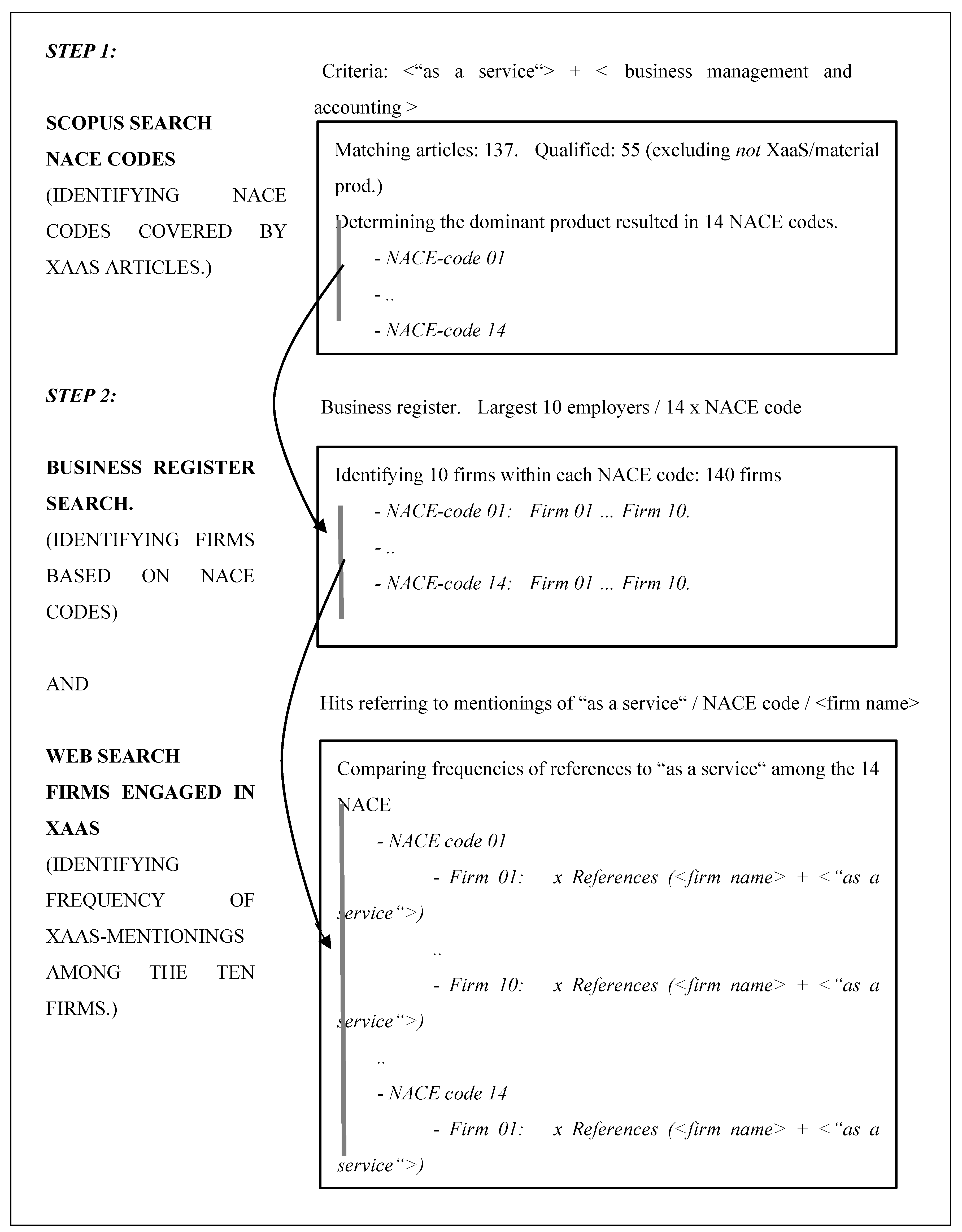
Figure 2.
Based on Table 3. Ranking number of hits for (<company name> + “as a service”).
Figure 2.
Based on Table 3. Ranking number of hits for (<company name> + “as a service”).
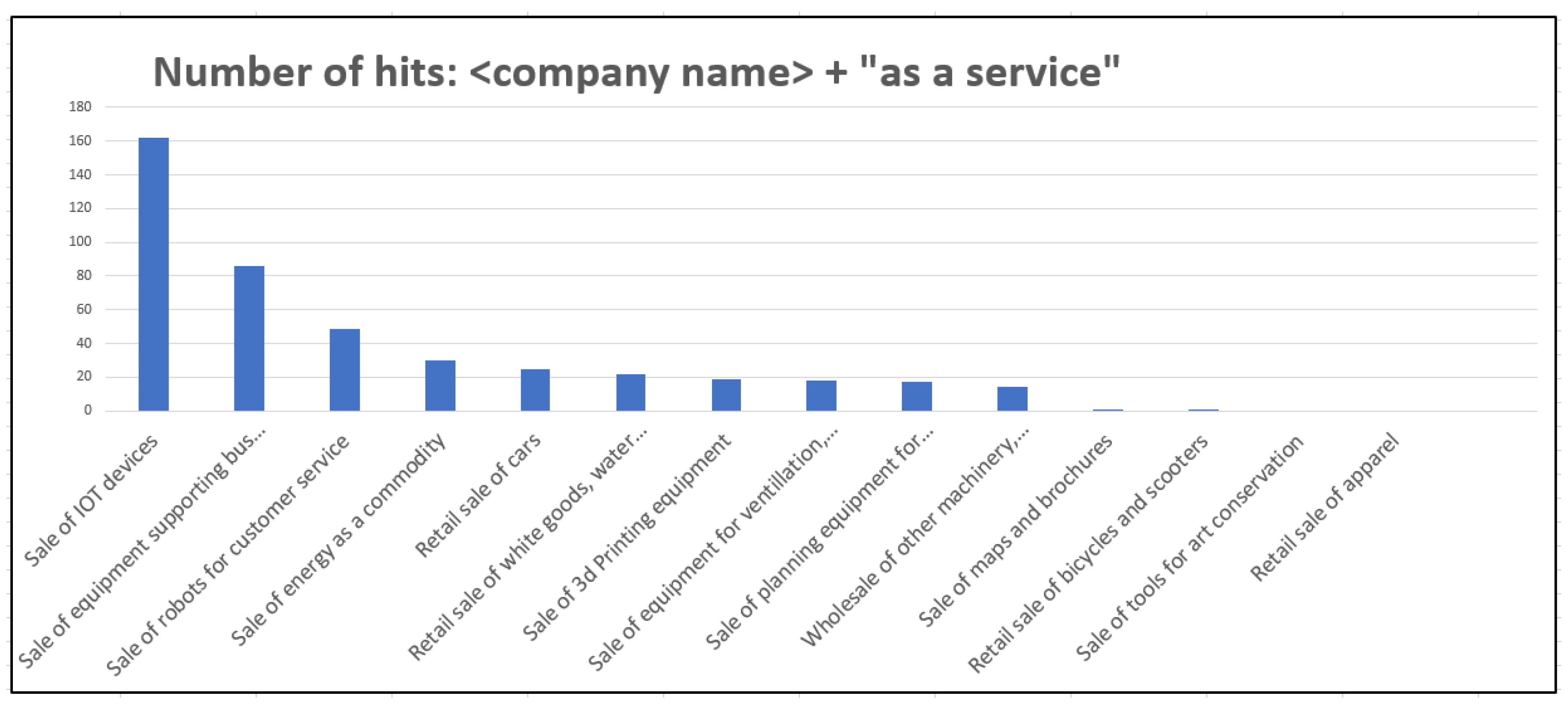
Figure 3.
Simplified illustration of the comparison in Azcarate-Aguerre of Ownership-financing and Product-Service Systems (PSS)-financing based on the five elements of Total Value of Ownership (TVO), based on Azcarate-Aguerre et al. (2022).
Figure 3.
Simplified illustration of the comparison in Azcarate-Aguerre of Ownership-financing and Product-Service Systems (PSS)-financing based on the five elements of Total Value of Ownership (TVO), based on Azcarate-Aguerre et al. (2022).
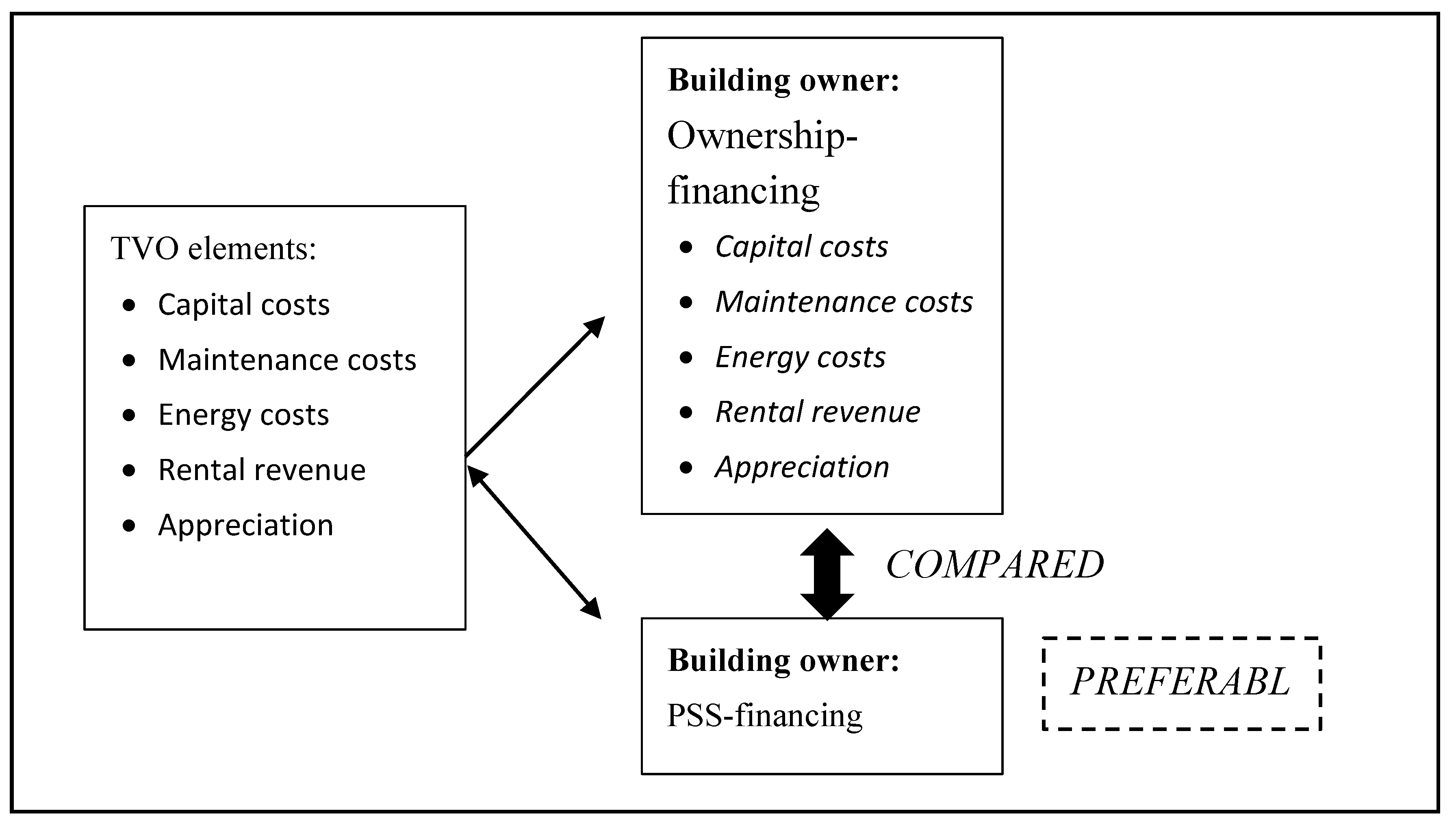
Figure 4.
Ownership-financing and Product-Service Systems (PSS)-financing compared along the supply chain. Based on Azcarate-Aguerro et al. (2022).
Figure 4.
Ownership-financing and Product-Service Systems (PSS)-financing compared along the supply chain. Based on Azcarate-Aguerro et al. (2022).
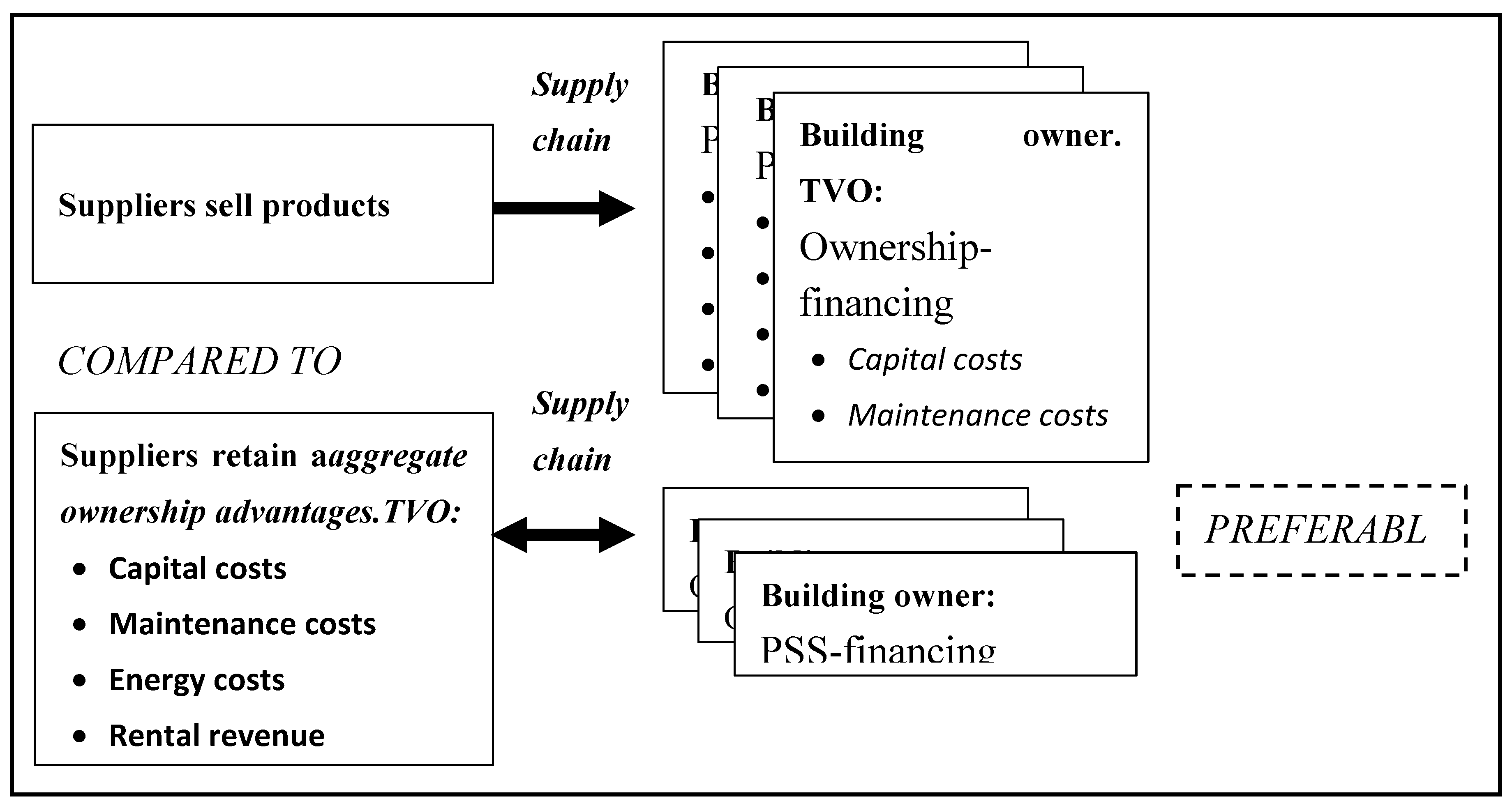
Table 1.
Nine advantages of XaaS mentioned in the literature.
| ADVANTAGES OF EVERYTHING AS A SERVICE (XAAS) IN THE LITERATURE | ||
| Advantages | Authors | |
| 1 | Improves customers’ expense model | Stahel (1982), Lin et al. (2009), Benlian & Hess (2011), Janssen & Joha (2011) |
| 2 | XaaS is well adapted to servitization which may boost sales | Vandermerwe & Rada (1988), Neely et al., (2011), Forbes Insights (2018), Raddats et al. (2019), Han et al. (2020), Systemiq, (2021) |
| 3 | Systems for customer and product feedback is easier to implement | Rabetino-et-al. (2017), Krancher et al. (2018) |
| 4 | Mass customisation is easier to implement. | Goldhar & Jelinek (1983), Pine (1993), Pine et al. (1993) |
| 5 | XaaS is well adapted for implementing machine learning and AI | Chui et al. (2016), Cognite (2021), Halleberg & Martinac (2020), Sousa et al. (2021), Kunz & Wirtz (2023) |
| 6 | Increasing flexibility and reduces risks | Stahel (2010), Ardagna et al. (2012), Manvi & Shyam (2014), Tsai et al., (2014) |
| 7 | The suppliers have an incentive to produce higher quality products | Banerjee et al. (2011), Collins et al. (2017), Migliorato, L. (2018), Forbes Insights (2018) |
| 8 | More time-efficient use of products | Ellen Macarthur Foundation (2013), Schulze (2016), Aboulamer (2017) |
| 9 | Incentives for prolonging the life cycle of products | Ellen Macarthur Foundation (2013), Baumgartner & Rauter (2017), Aboulamer (2017), Google (2019) |
Table 2.
The five elements of Total Value of Ownership (TVO) based on Ascarate-Aguerre et al. (2022).
Table 2.
The five elements of Total Value of Ownership (TVO) based on Ascarate-Aguerre et al. (2022).
| The five elements of Total Value of Ownership (TVO) |
|---|
| 1. Capital costs linked to the initial investment and to project specific investment costs. |
| 2. Maintenance costs, costs of product upgrading, and training of both people and AI machines. |
| 3. Energy costs |
| 4. Value of operating revenue, including rental revenue and revenues from licensing and leasing |
| 5. Value of property appreciation |
Table 3.
The 14 NACE codes covered by the sample of 55 peer-reviewed articles, the corresponding XaaS categories and products, the Norwegian firms and the hits for <firm name> and “as a service”. * The number of corresponding peer reviewed articles is in brackets. ** The search for companies was limited to listed and non-listed limited liability companies. The ten largest Norwegian employers were included in each NACE code. *** The number is the sum of hits for the ten firms for the Google search: <Firm name>+(“as a service”). The matches were limited to Norwegian hits by including (“site:.no”). Hits were not counted if “as a service” was not referring to the XaaS trend or did not refer to the activities of the firm.
Table 3.
The 14 NACE codes covered by the sample of 55 peer-reviewed articles, the corresponding XaaS categories and products, the Norwegian firms and the hits for <firm name> and “as a service”. * The number of corresponding peer reviewed articles is in brackets. ** The search for companies was limited to listed and non-listed limited liability companies. The ten largest Norwegian employers were included in each NACE code. *** The number is the sum of hits for the ten firms for the Google search: <Firm name>+(“as a service”). The matches were limited to Norwegian hits by including (“site:.no”). Hits were not counted if “as a service” was not referring to the XaaS trend or did not refer to the activities of the firm.
 |
Disclaimer/Publisher’s Note: The statements, opinions and data contained in all publications are solely those of the individual author(s) and contributor(s) and not of MDPI and/or the editor(s). MDPI and/or the editor(s) disclaim responsibility for any injury to people or property resulting from any ideas, methods, instructions or products referred to in the content. |
© 2025 by the authors. Licensee MDPI, Basel, Switzerland. This article is an open access article distributed under the terms and conditions of the Creative Commons Attribution (CC BY) license (http://creativecommons.org/licenses/by/4.0/).
Copyright: This open access article is published under a Creative Commons CC BY 4.0 license, which permit the free download, distribution, and reuse, provided that the author and preprint are cited in any reuse.


