

Submitted:
25 March 2025
Posted:
26 March 2025
You are already at the latest version
Abstract
Microglia are the primary target and reservoir of HIV infection in the central nervous system (CNS) which contribute to HIV-associated neurocognitive disorder (HAND). However, studying HIV infection of microglia has been challenged by limited availability of primary human microglial cells. To overcome this issue, investigators have developed various microglial models for HIV studies, including immortalized human microglial cell lines, HIV latently infected microglial clone, peripheral blood monocyte-derived microglia (MMG), induced pluripotent stem cell (iPSC)-derived microglia (iMg) and microglia containing cerebral organoids (MCOs) from iPSC. Though these models have been used in many laboratories, the published data about their expression of the specific human microglia markers and the HIV entry receptors is conflicting. In addition, there is limited information about their feasibility and applicability as a suitable model for acute and/or latent HIV infection. This review provides a concise summary of the currently used human microglial models with a focus on their suitability for NeuroHIV research.
Keywords:
HIV
; microglia
; peripheral blood monocyte‐derived microglia (MMG)
; induced pluripotent stem cell (iPSC)‐derived microglia (iMg)
; microglia containing cerebral organoids (MCOs) from iPSC
1. Introduction
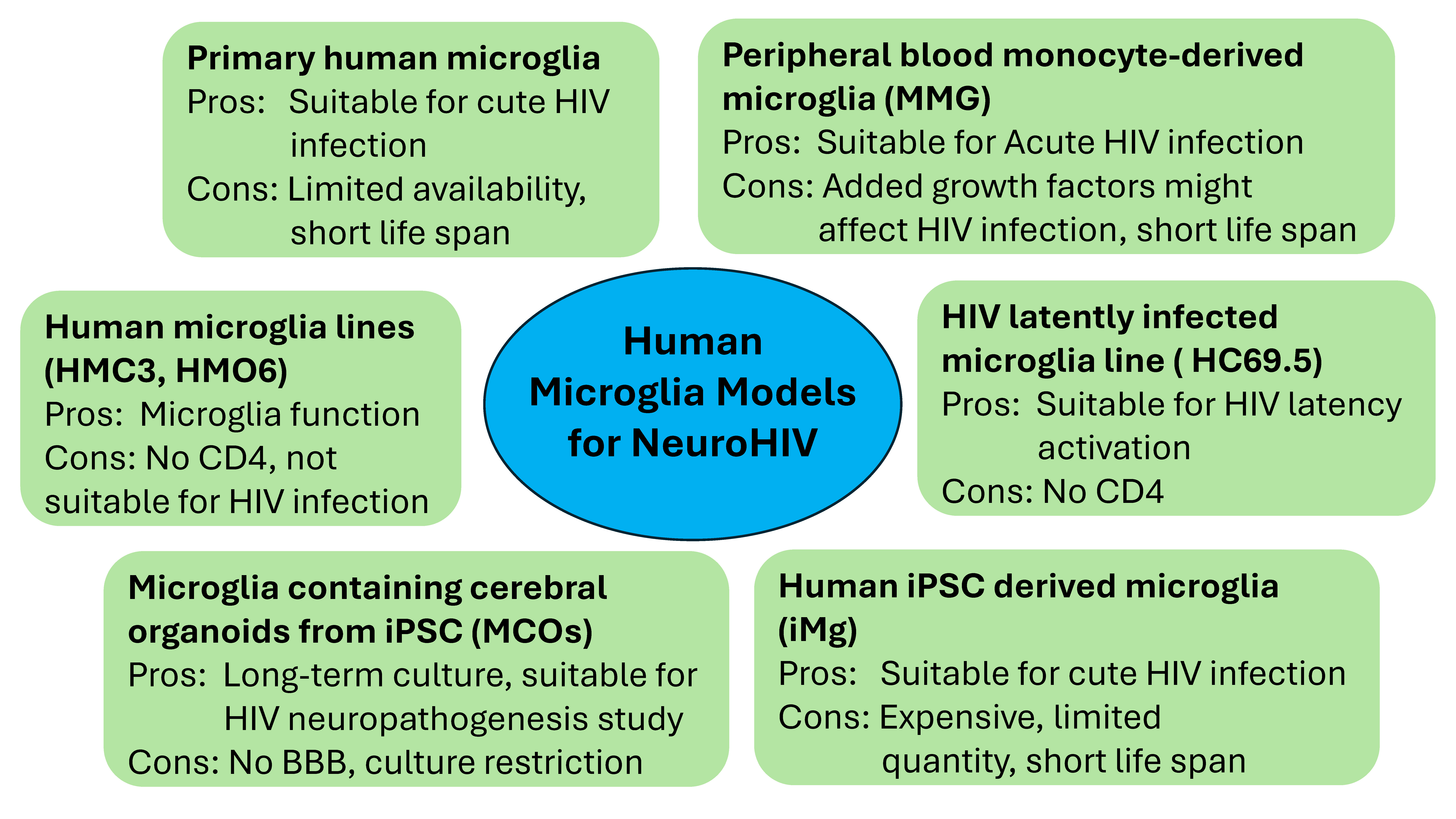
As the primary immune cells in the brain, microglia play a crucial role in the brain's immunity against viral infections, including HIV [1]. However, because microglia express the HIV entry receptors (CD4, CCR5 and CXCR4), they also serve as a major target for both productive and latent HIV infection in the brain [2,3,4]. Importantly, HIV-infected microglia can produce cytokines, reactive oxygen species, and the viral products which create an inflammatory environment in the brain, leading to neurodegeneration and HIV-associated neurocognitive disorder (HAND) [5]. Therefore, it is essential to understand the role of microglia in the immunopathogenesis of HIV infection in the brain. However, studies with primary human microglia have been hampered by the difficulties of obtaining surgical human brain specimens, isolating high quality/quantity of microglia and the cells’ short lifespan in culture. To overcome these issues, researchers have developed various human microglial culture models for NeuroHIV studies (Table 1). This review focuses on these models that have been commonly used by different laboratories, including primary human microglia, microglial cell lines, peripheral blood monocyte-derived microglia (MMG) or MMG-like cells, HIV-latently infected microglial cell line, human induced pluripotent stem cell (iPSC)-derived microglia (iMg), and microglia containing cerebral organoids (MCOs) from iPSC.
2. Primary Human Microglia
Primary human microglia can be isolated from the brain tissue of a deceased person and cultured for several weeks under microglia-specific enrichment conditions [6,7]. Other sources of primary human microglia are fetal brain tissues following abortions and patients undergoing surgery for brain tumors or epilepsy [8,9,10]. The technique protocols for such isolation have been well-established [7,11,12,13]. Like primary human macrophages derived from peripheral blood monocytes, in vitro cultured microglia are highly susceptible to HIV infection [14], and infected cells produce inflammatory cytokines [2,15]. However, obtaining fresh human brain tissue to isolate large quantities of viable microglia is extremely challenging. Additionally, the heterogeneity of samples, obtained from different brain regions of different donors (differing in age, sex, health condition, etc) can result in many confounding variables for experiments with primary human microglia. Therefore, it is crucial to develop alternative in vitro human microglia models for HIV studies.
3. Microglial Cell Lines (HMC3 and HMO6)
HMC3 resembles the adhering characteristics of primary human microglia but has low phagocytic activity [16]. The cells express some of the microglial markers and antigenic molecules such as IBA-1, CXCR1, CXCR3, NSE, and MHC-II/IFN-ɣ. However, they do not express CD14, CD68/Ki-M6, CD11c and P2RY12 [17,18,19]. Importantly, HMC3 does not express the major HIV entry receptor CD4 and is not permissive for productive HIV infection/replication. Studies of HIV infection with HMC3 are only limited to the experiments with the pseudo-typed viruses [17,18]. Moreover, it has been reported that these cells could be of Rat origin [20,21]. Nagai et al., developed another immortalized microglial cell line, named HMO6. Although HMO6 expresses the microglial markers (CD11b, CD68, CD86, HLA-ABC, HLA-DR, and RCA-1 Lectin), these cells have a less diverse profile of secreted soluble inflammatory mediators than primary human microglia [22]. Like HMC3 cells, HMO6 lacks the expression of microglial markers (CD14 and CD11c) and CD4 receptor [23], and thus their use for HIV studies is limited [6,22,23,24].
4. Microglial Cell Line for Latent HIV Infection (C20 and H69.5)
Garcia-Mesa et al. [21] developed an immortalized microglial cell line (C20) for HIV studies. C20 was generated from primary glia isolated from human adult brain tissues and frozen glial cells. The cells have microglia-like morphology and express the key microglial markers (CD11b, TGFβR, and P2RY12). Importantly, their RNA expression profiles have similar characteristics of primary human microglial cells. C20 expresses CCR5 but has extremely low level of CD4 receptor expression which decreases with increasing cell passages. Therefore, the cells are not suitable for productive HIV infection [21]. However, David Alvarez-Carbonell et al. [25] used C20 as the parental cell line to establish HIV latently infected cell line (HC69.5). Briefly, HC69.5 was developed by immortalizing C20 cell line with simian virus 40 large T antigen/human telomerase reverse transcriptase [25]. These immortalized cells were then transfected with a vesicular stomatitis virus G envelope pseudo-typed lentiviral vector with a green fluorescent protein as a reporter [25]. HC69.5 expresses the specific microglial markers (P2RY12 and CD11b) and the macrophage lineage marker (CD14). Importantly, HC69.5 cells express the HIV RNAs, and the viral proteins (Tat, Rev, Env, Vpu and Nef), but lack HIV gag [21,26]. HC69.5 has been widely used as a latently infected HIV microglia model which could be significantly activated by TNF-α [27,28]. Studies show that these cells express low levels of HIV (1-6%), but TNF -α induction for 16h could significantly induce HIV replication in 90% of the cell population [25]. Additionally, autocrine expression of TNF-α can spontaneously reactivate HIV in HC69.5 cells, which can be blocked by the treatment of glucocorticoid receptor agonist, dexamethasone [27,28].
5. Human Peripheral Blood Monocyte-Derived Microglia (MMG)
Rawat et al. developed a protocol for generating peripheral blood monocyte-derived microglia (MMG) [29], which was based on the early work MMG-like cells by Leone et al. [30], they demonstrated that human peripheral blood monocytes cultured in serum-free medium with M-CSF, GM-CSF, NGF, and CCL2 could differentiate into MMG. These cells are different in morphology, phenotype, and function from freshly isolated monocytes. They resemble primary human microglia and express microglia markers, including CD11b, CD11c, CD14, CD45, CD195, CD80, P2RY12, IBA-1, CD14, and CD45. MMG also express low levels of HLA-DR, and CD86. Importantly, MMG expresses the key HIV entry receptors (CD4, CCR5, and CXCR4) [18] and could be productively infected with HIV, and support long-term infection while continuously releasing virions into the culture media [18,29].
The reported protocols for generating MMG are relatively simple, feasible and reliable. Ohgidani et al. showed that the addition of microglial-growth factors (GM-CSF and IL-34) to the human monocyte cultures for 2 weeks, can convert monocytes to microglia like cells, which express CD11b high/CD45low and CX3CR1high/CCR2low [31]. These cells released pro-inflammatory/ anti-inflammatory cytokines and can perform phagocytosis [31]. Subsequent studies on MMG showed that additional factors, such as M-CSF, nerve growth factor (NGF)-β, and CC chemokine ligand 2 (CCL2), were suitable for HIV infection [29,32]. Sheridan et al. adapted this protocol for differentiating microglia from umbilical cord blood-derived mononuclear cells [33]. While MMG have been widely used as a microglial model for HIV studies, there is a concern about whether the added growth factors and the cytokines could interfere with the study outcomes, because some of these factors are known to be implicated in HIV infection.
6. Human Induced Pluripotent Stem Cells (iPSC)-Derived Microglia (iMg)
The discovery of induced pluripotent stem cells (iPSCs) has provided a platform for the generation of a wide variety of brain cell types, including human microglial cells (iMg) [34,35,36,37]. iMg are like primary human microglia in morphology, gene expression, and cytokine release profile. They are distinct from other tissue macrophages as they display a profile of neuronal-co-culture-specific expression and inflammatory response. The iMg model has been utilized to study neurological diseases [38], such as Alzheimer’s disease [39], Parkinson’s disease [40], amyotrophic lateral sclerosis, and frontotemporal dementia [41]. Additionally, iMg can be infected by Zika and dengue virus [42]. Importantly, iMg expresses the microglial markers (P2RY12 and TMEM119) and the HIV entry receptors (CD4, CCR5 and CXCR4) [18]. Several groups have reported that iMg could be productively infected with HIV, particularly with CCR5 tropic strains [6,18,43]. We recently reported that iMg possess immunologically functional toll like receptor 3 (TLR3) which could be activated by Ploy (I:C) and produce the antiviral cellular factors against HIV [44]. Although iMg has been successfully used in HIV infection studies, there is little information on establishing persistent/latent HIV infection in these cells, which is likely due to their short in vitro lifespan. The protocols for generating human iMg have been well established [45]. Mcquade et al. published a simplified protocol for establishing iMg [46]. Additionally, several companies have now provided detailed protocols, the culture media and iMg cells originated from different donors (Table 2).
7. Microglia-Containing Cerebral Organoids (MCOs) Derived from Human iPSCs
In the in vivo microenvironment, microglial functions significantly depend on their direct and/or indirect contact with other brain cell types such as neurons and astrocytes. Therefore, it is clinically important to develop a microglia-containing cellular model with other key brain cells. In 2013, Lancaster et al. [47] reported the development of cerebral organoids (COs) from the iPSC. Since then, the field of iPSC-derived COs has been significantly advanced [48,49,50,51,52]. The major advantage of COs is that the cultured cells can self-organize into 3D structures and differentiate into the key major brain cell types, which recapitulate the layered structure, cellular diversity, and synaptic connectivity of the human brain [53,54]. Recently, human iPSC-derived COs have been increasingly used as a brain model for studying various neurological disorders and neurotropic virus infections. Importantly, it has been documented that iPSC-derived COs can be cultured for many months, and the longest duration of maintaining COs in culture was 800 days [55]. This feature of COs allows long-term studies on neurodevelopment or disease progression, which is particularly important for studying latent HIV infection.
Although iPSC-derived COs recapitulates some key features of human brain development, many of the currently used COs are derived from neuroectodermal progenitors and only contain neurons and astrocytes. They do not have microglia which arise from mesodermal progenitors. Therefore, the absence of microglia in COs substantially limits their value and applicability for brain research, particularly HIV studies. As resident immune cells in the brain, microglia are crucial not only for the brain immunity but also for neurogenesis and neuroinflammation. More importantly, microglia are the primary target and reservoir for HIV infection. Park et al. developed microglia-sufficient brain organoids by co-culturing COs with primitive-like macrophages generated from the human iPSC (56). They demonstrated that iPSC-derived microglia promote organoid maturation via cholesterol transfer [56]. We and others have developed the protocol to generate microglia containing cerebral organoids (MCOs) [50,57,58,59], demonstrating that MCOs express microglial markers (P2RY12 and TMEM112) and the major HIV entry receptors (CD4 and CCR5).
HIV infection of the MCOs model was first reported by Dos reis et al [60]. They incorporated HIV-infected primary human microglia or the microglial cell-line (HMC3) into COs. They demonstrated that this model supported low levels of HIV replication and that the HIV-infected microglia can produce inflammatory factors in COs (60). Another group, Gumbs et al. [6] demonstrated that both MCOs and isolated organoid-derived microglia could be productively infected with replication-competent HIV-Bal reporter viruses. They found that the susceptibility of organoids to HIV infection was associated with the expression of the microglia marker (AIF1) and the HIV entry receptors (CD4 and CCR5) regardless of organoid maturation. Other groups also reported that productive HIV infection was only observed in microglial cells which was dependent on the co-expression of microglia-specific markers and the CD4/CCR5 receptors [18,61,62]. More recently, Donadoni et al. showed that HIV replication in MCOs could be inhibited by cART [61]. We have also observed that the MCOs from some human iPSC lines could be acutely infected by live HIV Bal strain (unpublished data). In addition, in agreement with the study by Gumbs [6], we found the significant variability between organoids from the same batch and across iPSC lines in terms of susceptibility to HIV infection. Furthermore, there has been no data showing that MCOs support persistent/latent HIV infection (Table 3). These issues highlight an important limitation of the brain organoid model for HIV infection study.
8. Discussion: Pros and Cons of the Human Microglia Models
In Table 4, we summarize the advantages (pros) and disadvantages (cons) of the human microglia models focusing their feasibility and applicability to HIV acute and persistent infection. Generally, while the immortalized cell lines are readily available and resemble some aspects of the human primary microglia, their usage particularly for HIV infection is limited because they do not express the primary HIV entry receptor, CD4 (Table 1 and Table 4). Among the immortalized cell lines, only HC69.5 has been used as a human microglia model for studying HIV latency [26,27]. In addition to the microglial cell lines, human peripheral blood monocyte-derived microglia (MMG) have been used as a microglia model for HIV infection. However, there is concern about whether the addition of the microglial growth factors and cytokines to the cultures can introduce variables that affect the study outcomes. Some of these factors are known to be implicated in regulating HIV infection/replication and the innate immune function of these cells. Recently, iPSC-derived microglia (iMg) model has gained great attention from investigators because like primary human microglia iMg can be productively infected with HIV [6,18,44]. However, both MMG and iMg are fully differentiated cells with limited lifespan, which is an obstacle for establishing persistent and latent HIV infection. When compared with 2D cultures of the microglia models, 3D brains organoid model, particularly MCOs, is a more advanced in vitro model for studying HIV brain infection and infection-mediated neuropathogenesis. Various groups (Table 3) have shown that MCOs could be productively infected by HIV and produced inflammatory cytokines. However, while MCOs have a significantly longer in vitro lifespan than iMg, there is little information about whether MCOs support persistent/latent HIV infection (Table 4). In addition, both COs and MCOs do not contain the blood-brain barrier (BBB) and the perivascular macrophages, another major target of HIV in the brain. Moreover, the shape, size, and maturing time point of MCOs vary among iPSC line donors and culture batches. During the long-term cultures, the core of COs or MCOs cannot obtain sufficient nutrients/oxygen, resulting in cell death within organoids. Therefore, overcoming these limitations [52] is essential for further improving the brain organoid models for NeuroHIV studies.
Author Contributions
Conceptualization, W.Z. H; writing—original draft preparation, P.S.; writing—review and editing, P.S. and X.W.; Writing – Review, X. W, J.Z., W.H. and W-Z. H; supervision and funding acquisition, W.Z. H. All authors have read and agreed to the published version of the manuscript.
Funding
This research was funded by the National Institutes of Health (grant number DA051893, DA058536 and MH134402).
Conflicts of Interest
The authors declare no conflicts of interest.
Abbreviations
The following abbreviations are used in this manuscript:
| CNS | Central Nervous System |
| HIV | Human Immunodeficiency Virus |
| HAND | HIV-Associated Neurocognitive Disorder |
| MMG | Monocyte-derived Microglia |
| iPSC | induced Pluripotent Stem Cell |
| iMg | induced Pluripotent Stem Cell (iPSC)-derived Microglia |
| MCOs | Microglia containing Cerebral Organoids |
| NGF-β | Nerve Growth Factor -β |
| CCL2 | C-C Chemokine Ligand 2 |
| COs | Cerebral Organoids |
| BBB | Blood-Brain Barrier |
| CXCR4 | C-X-C Chemokine Receptor 4 |
| CD4 | Cluster of Differentiation 4 |
| CCR5 | C-C Chemokine Receptor type 5 |
| M-CSF | Macrophage Colony-Stimulating Factor |
| P2RY12 | Purinergic Receptor P2Y12 |
| IBA1 | Ionized calcium Binding Adaptor molecule 1 |
| hBORG | Human brain organoid model |
| MG-hBORG | Microglia incorporated into hBORG |
| NPC | Neuro Progenitor Cells |
| NSC | Neural Stem Cells |
| o-MG | Organoid derived microglia |
| ChP | Choroid Plexus |
References
- O’Brien, C.A.; Bennett, F.C.; Bennett, M.L. Microglia in Antiviral Immunity of the Brain and Spinal Cord. Semin. Immunol. 2022, 60, 101650. [Google Scholar] [CrossRef] [PubMed]
- Borrajo, A.; Spuch, C.; Penedo, M.A.; Olivares, J.M.; Agís-Balboa, R.C. Important Role of Microglia in HIV-1 Associated Neurocognitive Disorders and the Molecular Pathways Implicated in Its Pathogenesis. Ann. Med. 2021, 53, 43–69. [Google Scholar] [CrossRef] [PubMed]
- Cosenza, M.A.; Zhao, M.-L.; Si, Q.; Lee, S.C. Human Brain Parenchymal Microglia Express CD14 and CD45 and Are Productively Infected by HIV-1 in HIV-1 Encephalitis. Brain Pathol. 2006, 12, 442–455. [Google Scholar] [CrossRef] [PubMed]
- Schlachetzki, J.C.M.; Zhou, Y.; Glass, C.K. Human Microglia Phenotypes in the Brain Associated with HIV Infection. Curr. Opin. Neurobiol. 2022, 77, 102637. [Google Scholar] [CrossRef]
- Wahl, A.; Al-Harthi, L. HIV Infection of Non-Classical Cells in the Brain. Retrovirology 2023, 20, 1. [Google Scholar] [CrossRef]
- Gumbs, S.B.H.; Kübler, R.; Gharu, L.; Schipper, P.J.; Borst, A.L.; Snijders, G.J.L.J.; Ormel, P.R.; Van Berlekom, A.B.; Wensing, A.M.J.; De Witte, L.D.; et al. Human Microglial Models to Study HIV Infection and Neuropathogenesis: A Literature Overview and Comparative Analyses. J Neurovirol 2022, 28, 64–91. [Google Scholar] [CrossRef]
- Mizee, M.R.; Miedema, S.S.M.; Van Der Poel, M.; Adelia; Schuurman, K. G.; Van Strien, M.E.; Melief, J.; Smolders, J.; Hendrickx, D.A.; Heutinck, K.M.; et al. Isolation of Primary Microglia from the Human Post-Mortem Brain: Effects of Ante- and Post-Mortem Variables. Acta Neuropathol Commun 2017, 5, 16. [Google Scholar] [CrossRef]
- Moore, C.S.; Ase, A.R.; Kinsara, A.; Rao, V.T.S.; Michell-Robinson, M.; Leong, S.Y.; Butovsky, O.; Ludwin, S.K.; Séguéla, P.; Bar-Or, A.; et al. P2Y12 Expression and Function in Alternatively Activated Human Microglia. Neurol Neuroimmunol Neuroinflamm 2015, 2, e80. [Google Scholar] [CrossRef]
- Ghorpade, A.; Nukuna, A.; Che, M.; Haggerty, S.; Persidsky, Y.; Carter, E.; Carhart, L.; Shafer, L.; Gendelman, H.E. Human Immunodeficiency Virus Neurotropism: An Analysis of Viral Replication and Cytopathicity for Divergent Strains in Monocytes and Microglia. J Virol 1998, 72, 3340–3350. [Google Scholar] [CrossRef]
- Borgmann, K.; Gendelman, H.E.; Ghorpade, A. Isolation and HIV-1 Infection of Primary Human Microglia From Fetal and Adult Tissue. In Human Retrovirus Protocols; Humana Press: New Jersey, 2005; Volume 304, pp. 049–070. ISBN 978-1-59259-907-3. [Google Scholar]
- Olah, M.; Raj, D.; Brouwer, N.; De Haas, A.H.; Eggen, B.J.L.; Den Dunnen, W.F.A.; Biber, K.P.H.; Boddeke, H.W.G.M. An Optimized Protocol for the Acute Isolation of Human Microglia from Autopsy Brain Samples. Glia 2012, 60, 96–111. [Google Scholar] [CrossRef]
- Rustenhoven, J.; Park, T.I.-H.; Schweder, P.; Scotter, J.; Correia, J.; Smith, A.M.; Gibbons, H.M.; Oldfield, R.L.; Bergin, P.S.; Mee, E.W.; et al. Isolation of Highly Enriched Primary Human Microglia for Functional Studies. Sci Rep 2016, 6, 19371. [Google Scholar] [CrossRef] [PubMed]
- Zhang, Y.; Sloan, S.A.; Clarke, L.E.; Caneda, C.; Plaza, C.A.; Blumenthal, P.D.; Vogel, H.; Steinberg, G.K.; Edwards, M.S.B.; Li, G.; et al. Purification and Characterization of Progenitor and Mature Human Astrocytes Reveals Transcriptional and Functional Differences with Mouse. Neuron 2016, 89, 37–53. [Google Scholar] [CrossRef] [PubMed]
- Wang, X.; Douglas, S.D.; Song, L.; Wang, Y.-J.; Ho, W.-Z. Neurokinin-1 Receptor Antagonist (Aprepitant) Suppresses HIV-1 Infection of Microglia/Macrophages. J. Neuroimmune Pharmacol. 2008, 3, 257–264. [Google Scholar] [CrossRef]
- Cenker, J.J.; Stultz, R.D.; McDonald, D. Brain Microglial Cells Are Highly Susceptible to HIV-1 Infection and Spread. AIDS Res. Hum. Retroviruses 2017, 33, 1155–1165. [Google Scholar] [CrossRef]
- Janabi, N.; Peudenier, S.; Héron, B.; Ng, K.H.; Tardieu, M. Establishment of Human Microglial Cell Lines after Transfection of Primary Cultures of Embryonic Microglial Cells with the SV40 Large T Antigen. Neurosci. Lett. 1995, 195, 105–108. [Google Scholar] [CrossRef]
- Flynn, G.; Maru, S.; Loughlin, J.; Romero, I.A.; Male, D. Regulation of Chemokine Receptor Expression in Human Microglia and Astrocytes. J. Neuroimmunol. 2003, 136, 84–93. [Google Scholar] [CrossRef]
- Rai, M.A.; Hammonds, J.; Pujato, M.; Mayhew, C.; Roskin, K.; Spearman, P. Comparative Analysis of Human Microglial Models for Studies of HIV Replication and Pathogenesis. Retrovirology 2020, 17, 35. [Google Scholar] [CrossRef] [PubMed]
- Dello Russo, C.; Cappoli, N.; Coletta, I.; Mezzogori, D.; Paciello, F.; Pozzoli, G.; Navarra, P.; Battaglia, A. The Human Microglial HMC3 Cell Line: Where Do We Stand? A Systematic Literature Review. J. Neuroinflammation 2018, 15, 259. [Google Scholar] [CrossRef]
- Timmerman, R.; Burm, S.M.; Bajramovic, J.J. An Overview of in Vitro Methods to Study Microglia. Front Cell Neurosci 2018, 12, 242. [Google Scholar] [CrossRef]
- Garcia-Mesa, Y.; Jay, T.R.; Checkley, M.A.; Luttge, B.; Dobrowolski, C.; Valadkhan, S.; Landreth, G.E.; Karn, J.; Alvarez-Carbonell, D. Immortalization of Primary Microglia: A New Platform to Study HIV Regulation in the Central Nervous System. J Neurovirol 2017, 23, 47–66. [Google Scholar] [CrossRef]
- Nagai, A.; Nakagawa, E.; Hatori, K.; Choi, H.B.; McLarnon, J.G.; Lee, M.A.; Kim, S.U. Generation and Characterization of Immortalized Human Microglial Cell Lines: Expression of Cytokines and Chemokines. Neurobiol. Dis. 2001, 8, 1057–1068. [Google Scholar] [CrossRef] [PubMed]
- Nagai, A.; Mishima, S.; Ishida, Y.; Ishikura, H.; Harada, T.; Kobayashi, S.; Kim, S.U. Immortalized Human Microglial Cell Line: Phenotypic Expression. J Neurosci Res 2005, 81, 342–348. [Google Scholar] [CrossRef]
- Lee, Y.B.; Nagai, A.; Kim, S.U. Cytokines, Chemokines, and Cytokine Receptors in Human Microglia. J Neurosci Res 2002, 69, 94–103. [Google Scholar] [CrossRef] [PubMed]
- Alvarez-Carbonell, D.; Garcia-Mesa, Y.; Milne, S.; Das, B.; Dobrowolski, C.; Rojas, R.; Karn, J. Toll-like Receptor 3 Activation Selectively Reverses HIV Latency in Microglial Cells. Retrovirology 2017, 14, 9. [Google Scholar] [CrossRef] [PubMed]
- Liu, H.; Zhou, R.-H.; Liu, Y.; Guo, L.; Wang, X.; Hu, W.-H.; Ho, W.-Z. HIV Infection Suppresses TLR3 Activation-Mediated Antiviral Immunity in Microglia and Macrophages. Immunology 2020, 160, 269–279. [Google Scholar] [CrossRef]
- Alvarez-Carbonell, D.; Ye, F.; Ramanath, N.; Garcia-Mesa, Y.; Knapp, P.E.; Hauser, K.F.; Karn, J. Cross-Talk between Microglia and Neurons Regulates HIV Latency. PLoS Pathog 2019, 15, e1008249. [Google Scholar] [CrossRef]
- Alvarez-Carbonell, D.; Ye, F.; Ramanath, N.; Dobrowolski, C.; Karn, J. The Glucocorticoid Receptor Is a Critical Regulator of HIV Latency in Human Microglial Cells. J. Neuroimmune Pharmacol. 2019, 14, 94–109. [Google Scholar] [CrossRef]
- Rawat, P.; Spector, S.A. Development and Characterization of a Human Microglia Cell Model of HIV-1 Infection. J Neurovirol 2017, 23, 33–46. [Google Scholar] [CrossRef]
- Leone, C.; Le Pavec, G.; Même, W.; Porcheray, F.; Samah, B.; Dormont, D.; Gras, G. Characterization of Human Monocyte-Derived Microglia-like Cells. Glia 2006, 54, 183–192. [Google Scholar] [CrossRef]
- Ohgidani, M.; Kato, T.A.; Setoyama, D.; Sagata, N.; Hashimoto, R.; Shigenobu, K.; Yoshida, T.; Hayakawa, K.; Shimokawa, N.; Miura, D.; et al. Direct Induction of Ramified Microglia-like Cells from Human Monocytes: Dynamic Microglial Dysfunction in Nasu-Hakola Disease. Sci. Rep. 2014, 4, 4957. [Google Scholar] [CrossRef]
- Akiyama, H.; Jalloh, S.; Park, S.; Lei, M.; Mostoslavsky, G.; Gummuluru, S. Expression of HIV-1 Intron-Containing RNA in Microglia Induces Inflammatory Responses. J. Virol. 2021, 95, e01386-20. [Google Scholar] [CrossRef] [PubMed]
- Sheridan, S.D.; Thanos, J.M.; De Guzman, R.M.; McCrea, L.T.; Horng, J.E.; Fu, T.; Sellgren, C.M.; Perlis, R.H.; Edlow, A.G. Umbilical Cord Blood-Derived Microglia-like Cells to Model COVID-19 Exposure. Transl. Psychiatry 2021, 11, 179. [Google Scholar] [CrossRef]
- Muffat, J.; Li, Y.; Yuan, B.; Mitalipova, M.; Omer, A.; Corcoran, S.; Bakiasi, G.; Tsai, L.-H.; Aubourg, P.; Ransohoff, R.M.; et al. Efficient Derivation of Microglia-like Cells from Human Pluripotent Stem Cells. Nat Med 2016, 22, 1358–1367. [Google Scholar] [CrossRef]
- Haenseler, W.; Sansom, S.N.; Buchrieser, J.; Newey, S.E.; Moore, C.S.; Nicholls, F.J.; Chintawar, S.; Schnell, C.; Antel, J.P.; Allen, N.D.; et al. A Highly Efficient Human Pluripotent Stem Cell Microglia Model Displays a Neuronal-Co-Culture-Specific Expression Profile and Inflammatory Response. Stem Cell Rep. 2017, 8, 1727–1742. [Google Scholar] [CrossRef]
- Douvaras, P.; Sun, B.; Wang, M.; Kruglikov, I.; Lallos, G.; Zimmer, M.; Terrenoire, C.; Zhang, B.; Gandy, S.; Schadt, E.; et al. Directed Differentiation of Human Pluripotent Stem Cells to Microglia. Stem Cell Rep. 2017, 8, 1516–1524. [Google Scholar] [CrossRef] [PubMed]
- Pandya, H.; Shen, M.J.; Ichikawa, D.M.; Sedlock, A.B.; Choi, Y.; Johnson, K.R.; Kim, G.; Brown, M.A.; Elkahloun, A.G.; Maric, D.; et al. Differentiation of Human and Murine Induced Pluripotent Stem Cells to Microglia-like Cells. Nat. Neurosci. 2017, 20, 753–759. [Google Scholar] [CrossRef] [PubMed]
- Abud, E.M.; Ramirez, R.N.; Martinez, E.S.; Healy, L.M.; Nguyen, C.H.H.; Newman, S.A.; Yeromin, A.V.; Scarfone, V.M.; Marsh, S.E.; Fimbres, C.; et al. iPSC-Derived Human Microglia-like Cells to Study Neurological Diseases. Neuron 2017, 94, 278–293.e9. [Google Scholar] [CrossRef]
- Ihnatovych, I.; Birkaya, B.; Notari, E.; Szigeti, K. iPSC-Derived Microglia for Modeling Human-Specific DAMP and PAMP Responses in the Context of Alzheimer’s Disease. Int. J. Mol. Sci. 2020, 21, 9668. [Google Scholar] [CrossRef]
- Badanjak, K.; Mulica, P.; Smajic, S.; Delcambre, S.; Tranchevent, L.-C.; Diederich, N.; Rauen, T.; Schwamborn, J.C.; Glaab, E.; Cowley, S.A.; et al. iPSC-Derived Microglia as a Model to Study Inflammation in Idiopathic Parkinson’s Disease. Front. Cell Dev. Biol. 2021, 9, 740758. [Google Scholar] [CrossRef]
- Almeida, S.; Zhang, Z.; Coppola, G.; Mao, W.; Futai, K.; Karydas, A.; Geschwind, M.D.; Tartaglia, M.C.; Gao, F.; Gianni, D.; et al. Induced Pluripotent Stem Cell Models of Progranulin-Deficient Frontotemporal Dementia Uncover Specific Reversible Neuronal Defects. Cell Rep. 2012, 2, 789–798. [Google Scholar] [CrossRef] [PubMed]
- McMillan, R.E.; Wang, E.; Carlin, A.F.; Coufal, N.G. Human Microglial Models to Study Host–Virus Interactions. Exp. Neurol. 2023, 363, 114375. [Google Scholar] [CrossRef]
- Ryan, S.K.; Gonzalez, M.V.; Garifallou, J.P.; Bennett, F.C.; Williams, K.S.; Sotuyo, N.P.; Mironets, E.; Cook, K.; Hakonarson, H.; Anderson, S.A.; et al. Neuroinflammation and EIF2 Signaling Persist despite Antiretroviral Treatment in an hiPSC Tri-Culture Model of HIV Infection. Stem Cell Rep. 2020, 14, 703–716. [Google Scholar] [CrossRef]
- Wang, P.; Liu, J.; Wang, X.; Meng, F.; Xiao, Q.; Liu, L.; Zhu, J.; Hu, W.; Ho, W. Activation of Toll-like Receptor 3 Inhibits HIV Infection of Human iPSC-derived Microglia. J. Med. Virol. 2023, 95, e29217. [Google Scholar] [CrossRef] [PubMed]
- Ryan, S.K.; Jordan-Sciutto, K.L.; Anderson, S.A. Protocol for Tri-Culture of hiPSC-Derived Neurons, Astrocytes, and Microglia. STAR Protoc. 2020, 1, 100190. [Google Scholar] [CrossRef] [PubMed]
- McQuade, A.; Coburn, M.; Tu, C.H.; Hasselmann, J.; Davtyan, H.; Blurton-Jones, M. Development and Validation of a Simplified Method to Generate Human Microglia from Pluripotent Stem Cells. Mol Neurodegener. 2018, 13, 67. [Google Scholar] [CrossRef]
- Lancaster, M.A.; Renner, M.; Martin, C.-A.; Wenzel, D.; Bicknell, L.S.; Hurles, M.E.; Homfray, T.; Penninger, J.M.; Jackson, A.P.; Knoblich, J.A. Cerebral Organoids Model Human Brain Development and Microcephaly. Nature 2013, 501, 373–379. [Google Scholar] [CrossRef]
- Abreu, C.M.; Gama, L.; Krasemann, S.; Chesnut, M.; Odwin-Dacosta, S.; Hogberg, H.T.; Hartung, T.; Pamies, D. Microglia Increase Inflammatory Responses in iPSC-Derived Human BrainSpheres. Front Microbiol 2018, 9, 2766. [Google Scholar] [CrossRef] [PubMed]
- Barak, M.; Fedorova, V.; Pospisilova, V.; Raska, J.; Vochyanova, S.; Sedmik, J.; Hribkova, H.; Klimova, H.; Vanova, T.; Bohaciakova, D. Human iPSC-Derived Neural Models for Studying Alzheimer’s Disease: From Neural Stem Cells to Cerebral Organoids. Stem Cell Rev. Rep. 2022, 18, 792–820. [Google Scholar] [CrossRef]
- Bodnar, B.; Zhang, Y.; Liu, J.; Lin, Y.; Wang, P.; Wei, Z.; Saribas, S.; Zhu, Y.; Li, F.; Wang, X.; et al. Novel Scalable and Simplified System to Generate Microglia-Containing Cerebral Organoids From Human Induced Pluripotent Stem Cells. Front Cell Neurosci 2021, 15, 682272. [Google Scholar] [CrossRef]
- Bershteyn, M.; Nowakowski, T.J.; Pollen, A.A.; Di Lullo, E.; Nene, A.; Wynshaw-Boris, A.; Kriegstein, A.R. Human iPSC-Derived Cerebral Organoids Model Cellular Features of Lissencephaly and Reveal Prolonged Mitosis of Outer Radial Glia. Cell Stem Cell 2017, 20, 435–449.e4. [Google Scholar] [CrossRef]
- Wei, Z.; Bodnar, B.; Zhao, R.-T.; Xiao, Q.; Saribas, S.; Wang, X.; Ho, W.-Z.; Hu, W. Human iPSC-Derived Brain Organoids: A 3D Mini-Brain Model for Studying HIV Infection. Exp. Neurol. 2023, 364, 114386. [Google Scholar] [CrossRef] [PubMed]
- Amiri, A.; Coppola, G.; Scuderi, S.; Wu, F.; Roychowdhury, T.; Liu, F.; Pochareddy, S.; Shin, Y.; Safi, A.; Song, L.; et al. Transcriptome and Epigenome Landscape of Human Cortical Development Modeled in Organoids. Science 2018, 362, eaat6720. [Google Scholar] [CrossRef] [PubMed]
- Velasco, S.; Kedaigle, A.J.; Simmons, S.K.; Nash, A.; Rocha, M.; Quadrato, G.; Paulsen, B.; Nguyen, L.; Adiconis, X.; Regev, A.; et al. Individual Brain Organoids Reproducibly Form Cell Diversity of the Human Cerebral Cortex. Nature 2019, 570, 523–527. [Google Scholar] [CrossRef]
- Marx, V. Reality Check for Organoids in Neuroscience. Nat. Methods 2020, 17, 961–964. [Google Scholar] [CrossRef] [PubMed]
- Park, D.S.; Kozaki, T.; Tiwari, S.K.; Moreira, M.; Khalilnezhad, A.; Torta, F.; Olivié, N.; Thiam, C.H.; Liani, O.; Silvin, A.; et al. iPS-Cell-Derived Microglia Promote Brain Organoid Maturation via Cholesterol Transfer. Nature 2023, 623, 397–405. [Google Scholar] [CrossRef]
- Ormel, P.R.; Vieira De Sá, R.; Van Bodegraven, E.J.; Karst, H.; Harschnitz, O.; Sneeboer, M.A.M.; Johansen, L.E.; Van Dijk, R.E.; Scheefhals, N.; Berdenis Van Berlekom, A.; et al. Microglia Innately Develop within Cerebral Organoids. Nat Commun 2018, 9, 4167. [Google Scholar] [CrossRef]
- Premeaux, T.A.; Mediouni, S.; Leda, A.; Furler, R.L.; Valente, S.T.; Fine, H.A.; Nixon, D.F.; Ndhlovu, L.C. Next-Generation Human Cerebral Organoids as Powerful Tools To Advance NeuroHIV Research. mBio 2021, 12, e00680–21. [Google Scholar] [CrossRef]
- Zhang, W.; Jiang, J.; Xu, Z.; Yan, H.; Tang, B.; Liu, C.; Chen, C.; Meng, Q. Microglia-Containing Human Brain Organoids for the Study of Brain Development and Pathology. Mol. Psychiatry 2023, 28, 96–107. [Google Scholar] [CrossRef]
- Dos Reis, R.S.; Sant, S.; Keeney, H.; Wagner, M.C.E.; Ayyavoo, V. Modeling HIV-1 Neuropathogenesis Using Three-Dimensional Human Brain Organoids (hBORGs) with HIV-1 Infected Microglia. Sci Rep 2020, 10, 15209. [Google Scholar] [CrossRef]
- Donadoni, M.; Cakir, S.; Bellizzi, A.; Swingler, M.; Sariyer, I.K. Modeling HIV-1 Infection and NeuroHIV in hiPSCs-Derived Cerebral Organoid Cultures. J. Neurovirol. 2024. [Google Scholar] [CrossRef]
- Gumbs, S.B.H.; Berdenis Van Berlekom, A.; Kübler, R.; Schipper, P.J.; Gharu, L.; Boks, M.P.; Ormel, P.R.; Wensing, A.M.J.; De Witte, L.D.; Nijhuis, M. Characterization of HIV-1 Infection in Microglia-Containing Human Cerebral Organoids. Viruses 2022, 14, 829. [Google Scholar] [CrossRef] [PubMed]

Table 1.
An overview of Microglia Model Development.
 |
| N/A: Data not available. |
Table 2.
Commercial availability of Human iPSC- derived microglia.
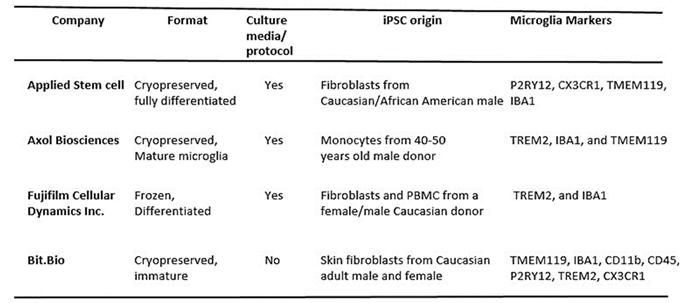 |
Table 3.
HIV infection of iPSC-derived Brain Organoids.
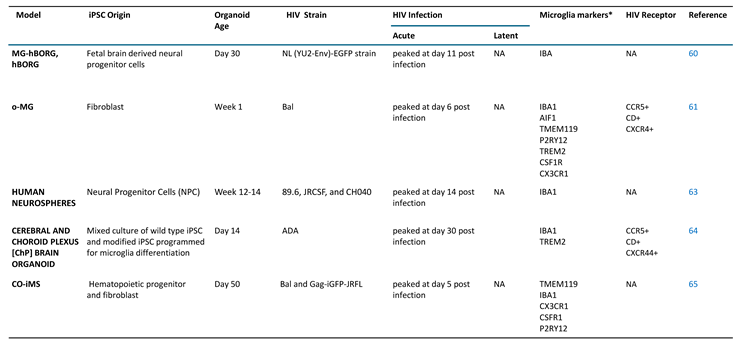 |
| * * Microglia markers : mRNA and/or protein expression. NA: Information Not Available. |
Table 4.
Microglia models for HIV.
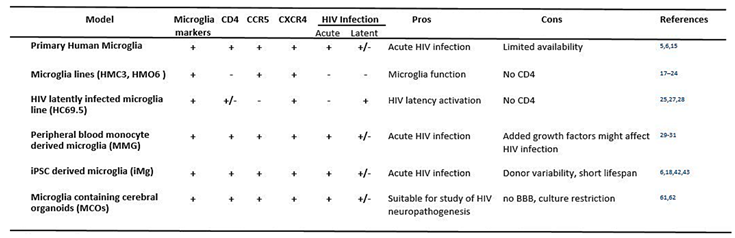 |
| +/-: It is unclear. |
Disclaimer/Publisher’s Note: The statements, opinions and data contained in all publications are solely those of the individual author(s) and contributor(s) and not of MDPI and/or the editor(s). MDPI and/or the editor(s) disclaim responsibility for any injury to people or property resulting from any ideas, methods, instructions or products referred to in the content. |
© 2025 by the authors. Licensee MDPI, Basel, Switzerland. This article is an open access article distributed under the terms and conditions of the Creative Commons Attribution (CC BY) license (http://creativecommons.org/licenses/by/4.0/).
Copyright: This open access article is published under a Creative Commons CC BY 4.0 license, which permit the free download, distribution, and reuse, provided that the author and preprint are cited in any reuse.


