

Submitted:
24 March 2025
Posted:
25 March 2025
You are already at the latest version
Abstract
Water scarcity is a growing global challenge, with agriculture being the largest consumer of freshwater resources. The increasing demand for food production necessitates innovative approaches to enhance water efficiency while ensuring sustainability. This review critically examines sustainable agricultural practices and the application of linear programming (LP) in optimizing the agricultural water footprint. Key aspects such as crop selection, land allocation, irrigation strategies, and water resource management are analyzed to assess their impact on water use efficiency. By synthesizing findings from recent studies, this paper highlights how LP-based optimization models can improve water conservation, maximize crop yields, and promote environmentally sustainable agricultural systems. The review also identifies existing gaps in research and underscores the need for integrated, data-driven solutions to address water resource challenges. The findings emphasize the transformative potential of combining sustainable practices with mathematical modeling to enhance agricultural resilience and ensure long-term food security in water-scarce regions.
Keywords:
Water Footprint
; Water Resource Optimization
; Agriculture
; Linear Programming
; Sustainable Irrigation
1. Introduction
Agriculture constitutes the primary consumer of blue water resources, with irrigation playing a significant role in freshwater depletion. The increasing pressure on water resources due to population growth and shifting dietary preferences highlights the urgent need for sustainable water management strategies. Additionally, irregular rainfall and prolonged droughts significantly impact both blue and green water resources (Rosa, Chiarelli, Rulli, Dell’Angelo, & D’Odorico, 2020). Addressing these challenges requires a comprehensive approach to water resource optimization, integrating innovative irrigation techniques and advanced computational models.
The use of irrigation to compensate for deficiencies in soil moisture has significantly increased agricultural productivity across most parts of the world. However, freshwater resources are increasingly under pressure due to rising global irrigation demands. The world's population is projected to grow to 11.2 billion by 2050, and shifting nutritional preferences toward diets higher in animal protein will necessitate a 60–110% increase in food and feed production (Mekonnen & Hoekstra, 2020). Therefore, increasing global crop productivity sustainably, while minimizing adverse effects on ecosystems and societies, represents one of humanity's greatest challenges in the coming decades.
Sustainable management of water resources is essential for ensuring the future of life on Earth. Hydraulic constraints, stochastic variations in water availability, and the non-linear dynamics of water systems present significant challenges for environmental management in the context of sustainable development. Effective water resource management is a critical component of development processes and requires enhancing water-use efficiency and improving decision-making processes based on robust and comprehensive datasets. These efforts are essential for effective planning and the establishment of water management policies (Xiang, Li, Khan, & Khalaf, 2021). Achieving water resource sustainability is imperative to overcome water scarcity, which can be achieved through the development of strategic approaches for water resource management that integrate planned and optimized water use (Yerli & Sahin, 2021).
To address water pressure and inefficiency in farming, a quantitative assessment of the scale and geographical extent of unsustainable and inefficient water use in crop production is needed. Recent studies have aimed to estimate global water use for crop production at high spatial resolution (Fader et al., 2011; Hanasaki, Inuzuka, Kanae, & Oki, 2010; Hoekstra & Chapagain, 2011). Multiple studies have indicated that agricultural production plays a critical role in exacerbating water scarcity in many regions. However, these studies often fail to establish a causal relationship between site-specific water scarcity and the water use associated with individual crops. Furthermore, they fall short in assessing the sustainability of specific crop production systems.
Evaluating agricultural efficiency is a critical element in water management (Ridoutt & Pfister, 2010) and is essential to achieving the United Nations Sustainable Development Goals (SDGs) for 2030. The concept of the water footprint, introduced by Hoekstra (2003), has become a key metric for evaluating freshwater consumption. It measures all direct and indirect freshwater use within a product's, service's, or production process's supply chain(Aldaya, Chapagain, Hoekstra, Mekonnen, & Journal, 2011). A significant portion of water footprint research focuses on agriculture, with approximately 30% of water footprint studies conducted between 2002 and 2018 dedicated to agricultural water footprints (Feng et al., 2021). Accurate quantification of the water footprint is foundational for regional agricultural water resource management. Factors such as soil type, climate, and water management practices greatly influence the spatial and temporal variability of water footprints (L Zhuo, Mekonnen, Hoekstra, & sciences, 2014).
Recently, optimization has been widely applied in groundwater planning and management models. Linear programming (LP) has emerged as a powerful tool for identifying optimal solutions by maximizing or minimizing linear objective functions under a set of constraints. This method has outperformed traditional trial-and-error approaches and is now widely used in agriculture for tasks such as optimizing crop patterns, crop rotation plans, water and land resource allocations, fertilizer applications, and agricultural product transformations. Linear programming provides a systematic and efficient means to address complex challenges, making it a critical tool for modern agricultural management (Alotaibi, Nadeem, & Business, 2021).
The primary advantages of using linear programming models in agriculture include increasing profitability, achieving food security, optimizing environmental resource use, and reducing uncertainty in decision-making processes through the application of supplementary constraints and conditions (Jain, Ramesh, & Bhattacharya, 2021).
The ultimate goal of optimization is to achieve the best possible outcome under given conditions, either by maximizing benefits or minimizing efforts. Optimization involves determining the parameters that yield the maximum or minimum value of a function (Jaslam, Joseph, Lazarus, & Rakhi, 2018). In the context of agriculture, optimization entails selecting the most suitable crops, determining land allocation, and identifying the optimal combination of inputs to maximize agricultural output while efficiently using limited resources.
Despite the growing body of research on water footprints and agricultural optimization, there is a notable gap in studies that explicitly review the application of linear programming to water footprint modeling. This study aims to fill this gap by reviewing the most prominent modern agricultural practices, with a focus on linear programming, to improve water footprint management and irrigation processes. The study also examines the impact of other agricultural activities, such as crop rotation, land allocation, and cropping patterns, and identifies the methodologies used to model water footprints. By addressing these issues, this research seeks to enhance productivity, conserve water resources, and promote sustainability in the agricultural sector.
2. Linear Programming Optimization
Recent studies demonstrate that LP-based models can significantly enhance water-use efficiency, leading to improved profitability and reduced environmental impact. Mathematical programming models are influential in studying the allocation of limited resources to provide required needs or improve the value of a particular objective function. A variety of perspectives discuss the development of models to include the analysis of irrigation water management and water use in agriculture in general, as it is concerned with changing crop patterns, profit maximization, scheduling of irrigation, and water allocation amongst numerous crops in a definite zone (Nazer et al., 2011).
Simulation models can be categorized as resource allocation built on their approach. Some models employ a rule-based or ad hoc approach to allocation and the other types are those that use mathematical programming or optimization to contribute to modelling water allocation in the resource net at a separately time steps (Tomlinson, Arnott, Harou, & Software, 2020). Programming models were commonly used to address optimization problems in multiple fields and areas related to water and agriculture. Such as crop selection, planting techniques, fertilization, irrigation, pest control, and harvesting. In order to optimize agricultural revenue in this area, farmers need assistance and direction on a range of farming techniques (Amjad Mizyed, Mogheir, Hamada, & Development, 2024). Appropriate resource allocation is crucial for planning equipment usage, as well as for effectively allocating economic, social, and developmental resources. To achieve best agricultural production, it is also important to optimize the planting pattern and make efficient use of the land, crops, soil, and water resources. However, because agriculture is such a complex industry, farmers frequently find it difficult to make well-informed decisions, such as selecting what to cultivate and when to do so given the limited resources at their disposal so determining the optimal mix of activities is therefore crucial(Amjad Mizyed, Moghier, & Hamada, 2024)
Varma, Nath, and Regikumar (2012) offer technical assistance in improving productivity in Kerala, India by employing mathematical optimization principles and scientific data on different crops. The aim is to achieve a higher yield, make better use of water and land resources, and ultimately maximize overall profits within a specific timeframe.
Jaslam, Joseph, Lazarus, and Rakhi (2018) explored how the agricultural sector's contribution can be increased through effective crop planning. A linear programming technique was utilized to develop an optimal model. The analysis included constraints such as whole area, intercropped zone, population of each enterprise project, and investment amount. The optimal model demonstrated a potential improvement of 22.83 percent in net return compared to the current plan.
Quantitative techniques like Linear Programming (LP) greatly influence the resolution of various challenges encountered by farmers in today's era of smart agriculture. Linear Programming aims to assist farmers in effectively planning and deciding how to achieve and maximize efficiency in production planning and resource distribution. This entails efficiently managing available farm resources, such as labor, fertilizers, seeds, energy, and more, with the goal of maximizing profits (Amjad Mizyed, Mogheir, Hamada, & Management, 2025).
Linear programming was used in multiple aspects, and appropriate solutions were presented based on quantitative analysis. One of the most prominent and widespread of these applications in the agricultural sector, it included is the optimizing crop patterns, crop rotation Plan, land allocation and optimization, and irrigation water.
2.1. Optimizing Crops Pattern
Linear programming (LP) can be utilized to determine the most favourable arrangement of crops and production planning for food crops, ultimately leading to increased profits for farmers' companies.
In a study conducted by(Mahak Bhatia & Rana, 2020), The LP tool was employed to identify the optimal value for different combinations of crops. The first approach involved determining the best allocation of land for peas, wheat, and livestock, while the second approach focused on mustard, grams, wheat, and pigs. The study findings indicated a 68 percent increase in farm 1 and a 16.5 percent rise in farm 2 with the implementation of LP, suggesting that the utilization of LP positively impacts farm yields. Furthermore, the researchers concluded that incorporating livestock into farming practices can reduce costs of production by using natural fertilizers and amending soil fertility.
(M Bhatia & Bhat, 2020) Employing the LP technique, farmers have been able to enhance productivity on their farms by efficiently determining the optimal crop combination within a given constraint. By replacing a mixture of wheat, grape, and mustard with peas, one farmer has achieved a substantial benefit of 15,6499 Rs.
In the study of Osama, Elkholy, and Kansoh (2017), the authors employed linear programming (LP) to determine the most effective arrangement of crops that would generate the highest possible sales in the region. The model took into consideration factors such as water availability, crop self-sufficiency, and land area limitations for growing multiple crops throughout the different seasons of the year. When comparing the optimized results to the existing unit, it was found that the overall net return increased from 37,374 to 39,683 after optimization.
It can be noted that agricultural patterns can affect production and increase profits through improving soil fertility saving water, and helping in choosing the most effective crops.
2.2. Land Allocation and Optimization
The distribution of land among various crops aims to maximize the overall profit of a company. This process determines which crops are more advantageous and determines how much land should be allocated to each crop in order to increase profits Linear programming (LP) was employed to find the most efficient land distribution for various crops.
Sofi, Ahmed, Ahmad, and Bhat (2015) utilized the Simplex method to optimize land allocation for Wheat, Rice, Pulses, Maize, and other crops. Initially, 2409 acres were utilized, but after applying the simplex method, the total allocated area was increased to 2752.56 acres to maximize profits.
In the study mentioned in Wankhade, Lunge, and Research (2012) the LP model was employed to determine the optimum allocation for the ten main crops in the specified study area. The solution was derived using Simplex algorithms and Push-Pull algorithms. The comparison between the two algorithms was based on several required iterations to reach the correct decision. The next algorithm took twenty iterations, whereas the first algorithm took 11 iterations to arrive at the correct answer.
Sharma (2016) utilized Fuzzy goal programming (FGP) to determine the optimal distribution of cultivated land. The goal programming methodology was chosen due to the limitations of the linear programming approach in addressing multiple objectives like net income, water availability, and labor supply. Moreover, all these criteria were expressed in a fuzzy manner. The findings illustrated that the majority of the allocations successfully fulfilled the requirements for crop production, net income, labor, and water. Thus, the researchers concluded that this approach is valuable for allocating land for various crops.
2.3. Crop Rotation Plan
Crop rotation is a system in which plants are grown on the same piece of land. Several factors, including weather and market conditions, can influence the choice of crops. These factors impact the timing of planting throughout the year and ultimately affect the farm's productivity. Linear programming (LP) is a method used to determine the most suitable crop rotation plan in order to achieve the best results. Furthermore, LP is utilized to enhance productivity, increase income, and make efficient use of available resources.
For instance, Al-Nassr (2019) utilized linear programming (LP) to maximize productivity at the Al-Rasheed-Hamorabi farm in Baghdad. They effectively utilized available resources and implemented agricultural rotation to maintain soil fertility. By comparing the revenue generated from the current agricultural strategy, which was based on data collected between 2015 and 2016, with the LP-derived plan, the farm received a significantly higher revenue of 3093023 thousand dinars, all while using fewer resources than the original design. Consequently, the optimal plans resulted in higher income despite having restricted resources.
(Dury, Schaller, Garcia, Reynaud, & Bergez, 2012) shown in certain situations, particularly when a farm has multiple objectives, using linear programming (LP) alone may not be sufficient to increase income. Therefore, a combination of LP and weighted goal programming (WGP) can produce more favourable outcomes. Various experts have created a model that incorporates both LP and WGP to achieve advanced average revenue, reduce costs per crop rotation, and address certain challenges. This study's findings suggest that using LP in conjunction with WGP can optimize crop rotation and allow agriculturalists to expand their revenue.
A model was created using the mixed-integer linear programming (MILP) model to establish a schedule for a four-year cycle of crop rotation, taking into account various constraints like irrigation patterns, crop yield, and market demand. The farm directors expressed their satisfaction with this model as it successfully met the business demand and ensured that no planting rules were breached throughout the specified period(Forrester & Rodriguez, 2018). Crop rotation is a crucial practice in agriculture, particularly in organic farming, as it aids in maintaining soil health without the need for chemical fertilizers or pesticides.
3. Irrigation Techniques and Strategies
(Rosa, Chiarelli, Tu, Rulli, & D’Odorico, 2019) demonstrated that 51% of irrigation water used for crop growth is unsustainable and goes against environmental flow conditions, contrary to a study by Jägermeyr, Pastor, Biemans, and Gerten (2017) that found 41% of irrigation water intake violate the environmental flow conditions. These studies also highlight the main crops and nations with the highest unsustainable water demand worldwide.
Several previous papers have examined the influences of management practices on the irrigation water consumption, drainage, evapotranspiration (ET), and yield. Management practices comprehend the mulching practices, irrigation methods and irrigation strategies. Significant benefits can be achieved in agricultural production through higher yields and lower water losses. Focused on reducing field evapotranspiration (ET) during the growing season per unit yield (Y), referred to as a water footprint used (Anstalt, 2013; Perry, Steduto, Allen, & Burt, 2009).
Rashidi and Keshavarzpour (2011) display the impact of management performs in Iran for a specific crop, viewing yield is at its best in drip irrigation with mulching then it decreases in the case of drip irrigation and less than in the case of surface irrigation likewise in Oman (Al-Said et al., 2012) compare the effect of sprinkler against drip irrigation on vegetable yield, displaying the yield per unit for drip irrigation is higher than sprinkler irrigation.
Research on irrigation techniques, including supplementary and deficit irrigation, reveals that, in comparison to full irrigation, the deficit irrigation strategy uses less consumptive water per unit of yield. In order to combat droughts, supplemental irrigation is another tactic. It boosts yield in comparison to rain-fed conditions without significantly increasing evapotranspiration. Moreover mulching enhances the loses of moisture through evaporation so it decreases evapotranspiration per unit yield in crop production (Qiu & Meng, 2013; Tadayon, Ebrahimi, & Tadayyon, 2012).
Chukalla, Krol, Hoekstra, and sciences (2015) conducted the initial model study analyzing the result of field management performs on green and blue yield and ET to water footprint under a diversity conditions. It included four irrigation systems: furrow, sprinkler, drip, and subsurface drip with the Soil Water Balance model in addition, Three irrigation approaches full, deficit, and supplementary irrigation; and rainfed formulated by (AquaCrop) model likewise three mulching practices: no mulching, organic mulching, and synthetic mulching.
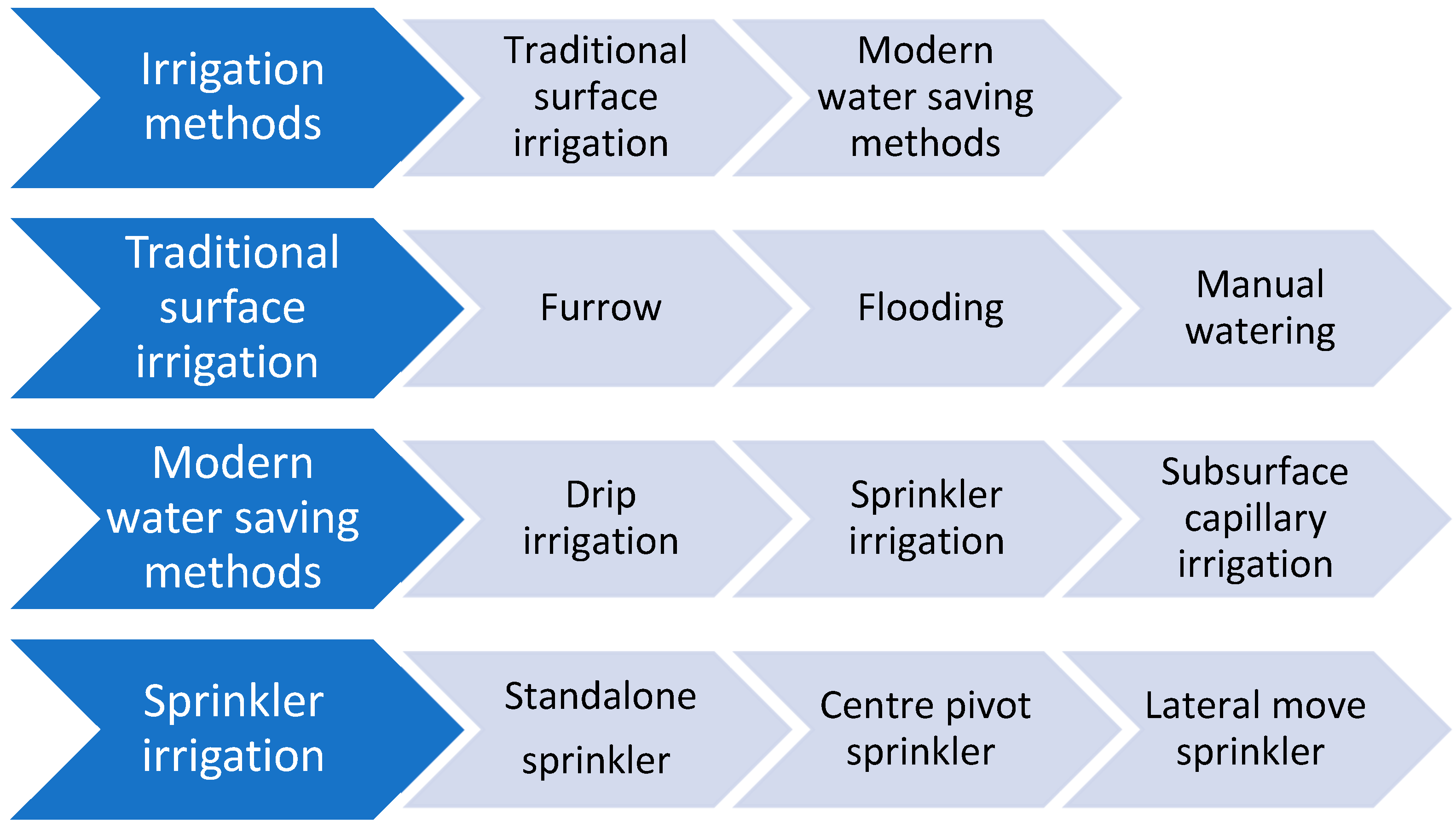
In a classification of irrigation methods, Abioye et al. (2020), showed that traditional surface irrigation methods commonly used by peasant farmers such as furrow, flooding, and manual watering, and demonstrated how old techniques have a limited ability to save water because of possible water losses, whereas contemporary techniques, which fall into two categories: surface (sprinkler or drip irrigation) and subsurface (capillary), have been shown to deliver greater yield and water savings. A type of subsurface irrigation known as subsurface capillary irrigation uses a capillary media to progressively feed water from a source that is directly linked to the root. The most often utilized media in this technique include porous ceramics, wicks, mats, and ebbs.
Elshaikh, Jiao, and Yang (2018) presented the optimization approaches and performance appraisal of irrigation plans. The extension of predictive models for agricultural control and its future challenges are described in (Ding, Wang, Li, Li, & Agriculture, 2018). The concept of precision irrigation as a first-rate water-saving practice to take full advantage of yield is carried out by Abioye et al. (2020) who discussed the innovative strategies for controlling and monitoring a precision irrigation system with a compination of irrigation monitoring procedures.
It can be recommended that the development of Irrigation methods and the development of related strategies mentioned here, and adopting the most effective ones, work to achieve a clear improvement in studies, and also work to increase the productivity of the water unit.
An example by Anwar, Clarke, and engineering (2001) was provided where water delivery to various farm outlets is scheduled in order to minimize water loss at a definite time for each farmer. The process of scheduling is based on the MILP model, using two different methods: the single-period model and the multi-period model. In the single-period model, a specific starting time is set for water discharge at the beginning of the irrigation period. Users are given importance in the multi-period model to plan their actual start timings, based on target start times, for every irrigation period. The irrigation pattern that will reduce demand at the channel's head can be found with the help of these two schedules.
According to a study conducted by (Tafteh, Babazadeh, Ebrahimipak, Kaveh, & drainage, 2014), a proposal was made to effectively distribute irrigation water and determine the best pattern for planting in order to maximize net income and improve water productivity (WP). The study revealed that the linear optimization approach when aiming for maximum benefit, resulted in the lowest water productivity. To enhance WP, the researchers employed the modelling to generate alternatives (MGA) technique, which proved to be more effective than linear and integer programming. They found that when using MGA, the best water productivity was attained with an average water deficit of 30–35% and a variance of 10% when comparing the results of the genetic algorithm with linear and integer programming.
The researchers in the study (Amini Fasakhodi, Nouri, & Amini, 2010) employed a multi-objective linear programming tool to evaluate the sustainability of water resources in rural farming. They used fractional programming models to analyse two metrics: "net income/water usage" and "labor/water usage." The goal was to optimize water usage and crop patterns. The results showed that the fractional programming models were more effective in evaluating sustainability metrics compared to linear programming models.
4. Water Footprint Optimization
The concept of the water footprint has become a key metric in assessing agricultural sustainability. Accurate quantification of the water footprint enables better water management and policy formulation. The calculation of water footprint for crops has been clearly introduced within the Water Footprint Assessment Manual (Hoekstra, 2011). Methods for measuring the crop water footprint are constantly evolving (AG Mizyed, 2024). The key methods that used crop water models otherwise hydrological models to modelling water footprint at crop fields, included CROPWAT as in the study (Hoekstra & Hung, 2005), Environmental Policy Integrated Climate (EPIC) model as presented in the study (Siebert & Döll, 2010) also, AquaCrop model as mentioned in (Chukalla et al., 2015)in addition, the GIS-based EPIC model (GEPIC) as presented in (Liu & Software, 2009). As shown in Table 1, Approaches of water footprint quantification for crop production can be classified into five sorts: the first is the field crop water requirement (FCWR), the second is field soil water balance (FSWB), the third is regional water balance (RWB), the fourth is remote sensing (RS), and the last is field measured water balance (FMWB).
The Soil and Water Assessment Tool (SWAT) is a model that simulates soil and water hydrology and dynamics over everyday time period. It is a biophysical process that is continuous over time and based on processes(Tuo, Duan, Disse, & Chiogna, 2016). In both large and small catchment regions, it is commonly used to mimic the effects of climate, water, and agricultural activities on hydrology, vegetation development, and related biophysical processes. Numerous large-scale and regional studies have made use of SWAT (Faramarzi et al., 2017; Shrestha, Chapagain, & Babel, 2017).
Elbeltagi, Deng, Wang, and Hong (2020) make A survey that of studies that focused on utilizing crop simulation models, such as Crop Water Use Model (CWUModel), Agricultural Production Systems siMulator (APSIM), HYDRUS (2D/3D), SALTMED, Decision Support System for Agrotechnology Transfer (DSSAT), Cropping Systems Simulation model (CropSyst), Danish Simulation Model (DAISY), and Soil-Water-Atmosphere-Plant/WOrld FOad STudies (SWAP/WOFOST), to calculate WF at the field scale. Then, a decision-making technique based on artificial intelligence (ANN) was used to model green and blue WFs using limited metrological data and assess how well they performed using reference data.
A genetic algorithm model was built to discover the ideal combination of the management scenarios for the Palestinian water authority plan. MATLAB R2011b is used for both the design and execution of the optimization code. The goal function lowers costs and raises benefits associated with using a variety of water sources. A relatively small population is used as the basis for the initial selection in a genetic algorithm. In the parameter space, each population represents a potential solution. Based on that set of factors, the estimated value of the goal function determines each person's appropriateness (Ghabayen, Madi, Qahman, Sirdah, & Technology, 2016).
The tools used to improve linear programming models are several, the most prominent are Excel Solver, LINDO, LINGO, and MILP. Table 2 summarizes these applications and displayed the purposes of utilizing the linear programming model built on previous research in addition to the software employed to accomplish their suggested goals.
5. Conclusion
This review highlights the crucial role of sustainable agricultural practices and linear programming in optimizing the agricultural water footprint.The continued depletion of fresh water sources opens the way for further research and scrutiny to explore means and methodologies to fill these gaps. This paper presented a critical review of the most prominent agricultural practices to optimize the water footprint in the agricultural sector, due to the urgent need to rationalize water consumption. The study concluded the importance of expanding water footprint studies as a significant water indicator and the great feasibility of improving crop patterns and reducing irrigation water using computerized models to determine the crop water needs. As well as allocating suitable land, and rotating crops to take into account the fertility of the land, with the use of linear optimization. This opens horizons to study other factors that affect in raising agricultural productivity and improving the water footprint. Applying the water footprint index in agricultural management opens up angles of view that did not exist previously, and emphasizes the importance of adopting this index in environmental, water, and agricultural studies.
Figure 1.
Classification of Irrigation Methods.
References
- Abioye, E.A.; Abidin, M.S.Z.; Mahmud, M.S.A.; Buyamin, S.; Ishak, M.H.I.; Rahman, M.K.I.A.; Otuoze, A.O.; Onotu, P. A review on monitoring and advanced control strategies for precision irrigation. Comput. Electron. Agric. 2020, 173. [CrossRef]
- Al-Nassr, R. S. M. J. I. J. o. A. S. (2019). The optimal crop rotation of AI-Rasheed District farms using linear programming technique. 50(Special).
- Al-Said, F.A.; Ashfaq, M.; Al-Barhi, M.; Hanjra, M.A.; Khan, I.A. WATER PRODUCTIVITY OF VEGETABLES UNDER MODERN IRRIGATION METHODS IN OMAN. Irrig. Drain. 2012, 61, 477–489. [CrossRef]
- Aldaya, M. M., Chapagain, A., Hoekstra, A., Mekonnen, M. J. S., & Journal, E. A. (2011). The water footprint assessment manual: Setting the global standard.
- Alotaibi, A.; Nadeem, F. A Review of Applications of LinearProgramming to Optimize Agricultural Solutions. Int. J. Inf. Eng. Electron. Business(IJIEEB) 2021, 13, 11–21. [CrossRef]
- Fasakhodi, A.A.; Nouri, S.H.; Amini, M. Water Resources Sustainability and Optimal Cropping Pattern in Farming Systems; A Multi-Objective Fractional Goal Programming Approach. Water Resour. Manag. 2010, 24, 4639–4657. [CrossRef]
- Anstalt, S. V. (2013). Food and agriculture organization of the United Nations.
- Anwar, A.A.; Clarke, D. Irrigation Scheduling Using Mixed-Integer Linear Programming. J. Irrig. Drain. Eng. 2001, 127, 63–69. [CrossRef]
- Bhatia, M., & Bhat, G. J. J. E. T. I. R. (2020). Linear Programming Approach-Application in Agriculture,‖. 6(5), 155-157.
- Bhatia, M.; Rana, A. A Mathematical Approach to Optimize Crop Allocation – A Linear Programming Model. Int. J. Des. Nat. Ecodynamics 2020, 15, 245–252. [CrossRef]
- Chukalla, A.D.; Krol, M.S.; Hoekstra, A.Y. Green and blue water footprint reduction in irrigated agriculture: effect of irrigation techniques, irrigation strategies and mulching. Hydrol. Earth Syst. Sci. 2015, 19, 4877–4891. [CrossRef]
- Ding, Y.; Wang, L.; Li, Y.; Li, D. Model predictive control and its application in agriculture: A review. Comput. Electron. Agric. 2018, 151, 104–117. [CrossRef]
- Dury, J.; Schaller, N.; Garcia, F.; Reynaud, A.; Bergez, J.E. Models to support cropping plan and crop rotation decisions. A review. Agron. Sustain. Dev. 2011, 32, 567–580. [CrossRef]
- Elbeltagi, A.; Deng, J.; Wang, K.; Hong, Y. Crop Water footprint estimation and modeling using an artificial neural network approach in the Nile Delta, Egypt. Agric. Water Manag. 2020, 235. [CrossRef]
- Elshaikh, A.E.; Xiyun, J.; Shi-hong, Y. Performance evaluation of irrigation projects: Theories, methods, and techniques. Agric. Water Manag. 2018, 203, 87–96.
- Fader, M.; Gerten, D.; Thammer, M.; Heinke, J.; Lotze-Campen, H.; Lucht, W.; Cramer, W. Internal and external green-blue agricultural water footprints of nations, and related water and land savings through trade. Hydrol. Earth Syst. Sci. 2011, 15, 1641–1660. [CrossRef]
- Faramarzi, M.; Abbaspour, K.C.; Adamowicz, W.(.; Lu, W.; Fennell, J.; Zehnder, A.J.; Goss, G.G. Uncertainty based assessment of dynamic freshwater scarcity in semi-arid watersheds of Alberta, Canada. J. Hydrol. Reg. Stud. 2017, 9, 48–68. [CrossRef]
- Feng, B.; Zhuo, L.; Xie, D.; Mao, Y.; Gao, J.; Xie, P.; Wu, P. A quantitative review of water footprint accounting and simulation for crop production based on publications during 2002–2018. Ecol. Indic. 2021, 120. [CrossRef]
- Forrester, R., & Rodriguez, M. J. U. J. (2018). An Integer Programming Approach to Crop Rotation Planning at an Organic Farm. 39(1).
- Ghabayen, S. M., Madi, I. M., Qahman, K. A., Sirdah, B. I. J. J. o. E. R., & Technology. (2016). Genetic algorithm model to optimize water resources allocation in Gaza Strip. 1(1).
- Hanasaki, N.; Inuzuka, T.; Kanae, S.; Oki, T. An estimation of global virtual water flow and sources of water withdrawal for major crops and livestock products using a global hydrological model. J. Hydrol. 2010, 384, 232–244. [CrossRef]
- Hoekstra, A. Y. (2011). The water footprint assessment manual: Setting the global standard: Routledge.
- Hoekstra, A. Y., & Chapagain, A. K. (2011). Globalization of water: Sharing the planet's freshwater resources: John Wiley & Sons.
- Hoekstra, A.; Hung, P. Globalisation of water resources: international virtual water flows in relation to crop trade. Glob. Environ. Chang. 2005, 15, 45–56. [CrossRef]
- Jägermeyr, J.; Pastor, A.; Biemans, H.; Gerten, D. Reconciling irrigated food production with environmental flows for Sustainable Development Goals implementation. Nat. Commun. 2017, 8, 15900–15900. [CrossRef]
- Jain, S.; Ramesh, D.; Bhattacharya, D. A multi-objective algorithm for crop pattern optimization in agriculture. Appl. Soft Comput. 2021, 112. [CrossRef]
- Jaslam, P.K.M.; Joseph, B.; Lazarus, T.P.; Rakhi, T. Determination of optimum crop mix for crop cultivation in Kerala homesteads. Indian J. Agric. Res. 2018. [CrossRef]
- Liu, J. A GIS-based tool for modelling large-scale crop-water relations. Environ. Model. Softw. 2008, 24, 411–422. [CrossRef]
- Madugundu, R.; Al-Gaadi, K.A.; Tola, E.; Hassaballa, A.A.; Kayad, A.G. Utilization of Landsat-8 data for the estimation of carrot and maize crop water footprint under the arid climate of Saudi Arabia. PLOS ONE 2018, 13, e0192830. [CrossRef]
- Mekonnen, M.M.; Hoekstra, A.Y. Sustainability of the blue water footprint of crops. Adv. Water Resour. 2020, 143. [CrossRef]
- Mizyed, A. (2024). Applying Water Footprint Theory to estimate the Various Water Consumption of Livestock in the Gaza Strip. Paper presented at the. International Conference on Science, Innovations and Global Solutions. https://futurity-publishing.com/internationalconference-on-science-innovations-and-global-solutions-archive/.
- Mizyed, A.; Mogheir, Y.; Hamada, M. Assessment of blue and green agricultural water footprint in the Gaza Strip, Palestine. Integr. Environ. Assess. Manag. 2025, 21, 326–334. [CrossRef]
- Mizyed, A.; Mogheir, Y.; Hamada, M. Optimising the grey water footprint of crops to enhance the environmental integrity in the Gaza Strip, Palestine. J. Water Land Dev. 2024, 120–129. [CrossRef]
- Mizyed, A.; Moghier, Y.; Hamada, M. Employing the agricultural water footprint concept to enhance the sustainable management of water resources: a review. Water Pr. Technol. 2024, 19, 4435–4452. [CrossRef]
- Osama, S.; Elkholy, M.; Kansoh, R.M. Optimization of the cropping pattern in Egypt. Alex. Eng. J. 2017, 56, 557–566. [CrossRef]
- Perry, C.; Steduto, P.; Allen, R.G.; Burt, C.M. Increasing productivity in irrigated agriculture: Agronomic constraints and hydrological realities. Agric. Water Manag. 2009, 96, 1517–1524. [CrossRef]
- Prišenk, J.; Turk, J.; Rozman, Č.; Borec, A.; Zrakić, M.; Pažek, K. Advantages of combining linear programming and weighted goal programming for agriculture application. Oper. Res. 2014, 14, 253–260. [CrossRef]
- Qiu, Y.-F., & Meng, G. (2013). The Effect of water saving and production increment by drip Irrigation schedules. Paper presented at the 2013 Third International Conference on Intelligent System Design and Engineering Applications.
- Rashidi, M., & Keshavarzpour, F. J. W. A. S. J. (2011). Effect of different irrigation methods on crop yield and yield components of cantaloupe in the arid lands of Iran. 15(6), 873-876.
- Ridoutt, B.G.; Pfister, S. A revised approach to water footprinting to make transparent the impacts of consumption and production on global freshwater scarcity. Glob. Environ. Chang. 2010, 20, 113–120. [CrossRef]
- Rosa, L.; Chiarelli, D.D.; Rulli, M.C.; Dell’angelo, J.; D’odorico, P. Global agricultural economic water scarcity. Sci. Adv. 2020, 6, eaaz6031. [CrossRef]
- Rosa, L.; Chiarelli, D.D.; Tu, C.; Rulli, M.C.; D’odorico, P. Global unsustainable virtual water flows in agricultural trade. Environ. Res. Lett. 2019, 14, 114001. [CrossRef]
- Sharma, D.; Jana, R.; Gaur, A. Fuzzy goal programming for agricultural land allocation problems. 2007, 17, 31–42. [CrossRef]
- Shrestha, S.; Chapagain, R.; Babel, M.S. Quantifying the impact of climate change on crop yield and water footprint of rice in the Nam Oon Irrigation Project, Thailand. Sci. Total. Environ. 2017, 599-600, 689–699. [CrossRef]
- Siebert, S.; Döll, P. Quantifying blue and green virtual water contents in global crop production as well as potential production losses without irrigation. J. Hydrol. 2010, 384, 198–217. [CrossRef]
- Sofi, N., Ahmed, A., Ahmad, M., & Bhat, B. J. I. j. o. m. m. s. (2015). Decision making in agriculture: A linear programming approach. 13(2), 160-169.
- Sun, S.; Liu, J.; Wu, P.; Wang, Y.; Zhao, X.; Zhang, X. Comprehensive evaluation of water use in agricultural production: a case study in Hetao Irrigation District, China. J. Clean. Prod. 2016, 112, 4569–4575. [CrossRef]
- Tadayon, M., Ebrahimi, R., & Tadayyon, A. (2012). Increased water productivity of wheat under supplemental irrigation and nitrogen application in a semi-arid region.
- Tafteh, A.; Babazadeh, H.; Ebrahimipak, N.A.; Kaveh, F. OPTIMIZATION OF IRRIGATION WATER DISTRIBUTION USING THE MGA METHOD AND COMPARISON WITH A LINEAR PROGRAMMING METHOD. Irrig. Drain. 2014, 63, 590–598. [CrossRef]
- Tomlinson, J.; Arnott, J.; Harou, J. A water resource simulator in Python. Environ. Model. Softw. 2020, 126. [CrossRef]
- Tuo, Y.; Duan, Z.; Disse, M.; Chiogna, G. Evaluation of precipitation input for SWAT modeling in Alpine catchment: A case study in the Adige river basin (Italy). Sci. Total Environ. 2016, 573, 66–82. [CrossRef]
- Varma, A., Nath, A. S., & Regikumar, V. (2012). An agricultural resources optimization model. Paper presented at the 2012 Annual IEEE India Conference (INDICON).
- Wankhade, M., Lunge, H. J. I. J. o. S., & Research, T. (2012). Allocation of agricultural land to the major crops of saline track by linear programming approach: a case study. 1(9), 21-25.
- Xiang, X.; Li, Q.; Khan, S.; Khalaf, O.I. Urban water resource management for sustainable environment planning using artificial intelligence techniques. Environ. Impact Assess. Rev. 2021, 86. [CrossRef]
- Xinchun, C.; Mengyang, W.; Rui, S.; La, Z.; Dan, C.; Guangcheng, S.; Xiangping, G.; Weiguang, W.; Shuhai, T. Water footprint assessment for crop production based on field measurements: A case study of irrigated paddy rice in East China. Sci. Total. Environ. 2018, 610-611, 84–93. [CrossRef]
- Yerli, C.; Sahin, U. An assessment of the urban water footprint and blue water scarcity: A case study for Van (Turkey). Braz. J. Biol. 2022, 82, e249745. [CrossRef]
- Zhuo, L.; Mekonnen, M.M.; Hoekstra, A.Y. Sensitivity and uncertainty in crop water footprint accounting: a case study for the Yellow River basin. Hydrol. Earth Syst. Sci. 2014, 18, 2219–2234. [CrossRef]
- Zhuo, L., Mekonnen, M. M., & Hoekstra, A. Y. J. W. r. (2016). The effect of inter-annual variability of consumption, production, trade and climate on crop-related green and blue water footprints and inter-regional virtual water trade: A study for China (1978–2008). 94, 73-85.

Table 1.
Comparison of Five Water Footprint Quantitative Approaches of Crop production (Feng et al., 2021).
Table 1.
Comparison of Five Water Footprint Quantitative Approaches of Crop production (Feng et al., 2021).
| Item | Field Crop Water Requirement (FCWR) |
Field Soil Water Balance (FSWB) |
Regional Water Balance (RWB) |
Remote Sensing (RS) |
Field Measured Water Balance (FMWB) |
|---|---|---|---|---|---|
| Explanation | Dividing the crop water requirement by crop yield | Actual ET divided by crop yield | depends on the ET of crops in the field; irrigation water losses during the delivery procedure are is taken into account | By utilizing remote sensing images united with the remark of surface meteorological, vegetation, and soil components |
utilizing field water balancing techniques and comprehensive field observations of the water |
| Models Used | CROPWAT, CERES-Maize | Aqua Crop, CROPWAT, EPIC, GEPIC, H08 | RS images | Equations | difficult to upscale |
| Features | The easily available required data /quantification approach is not complex. | In addition to agriculture—climatic resource grant—applying provincial soil data to govern actual crop water withdrawal based on soil water balance can correctly reflect field-scale water usage competency. | By taking into account field crop ET and water loss during crop production, this technique may accurately reflect the peculiarities of regional water use and the endowment of agroclimatic resources. | The method offers a higher geographical and temporal resolution and accounts for ET at both the field and regional scales. | With this method, WF can be evaluated more precisely and the dynamic changing process of field crop ET can be directly measured. |
| Restrictions | Crop ET equals crop water requirement, which might not match the real circumstances. If these data are further evaluated, deviations could be transmitted. There is less spatial resolution and a larger computational unit. | The outcomes can reflect the water use efficiency only at the field scale. | Numerous types of data are required, and obtaining certain basic data—like irrigation water efficiency, field application efficiency, and canal system water use efficiency—can be challenging. In addition, there are a lot of unknowns. | Images from remote sensing are susceptible to cloud constraints. There are differences in the temporal and spatial resolution of image data obtained from various sources. The demands of the research cannot be satisfied by a single remote sensing data set, and it is challenging to combine data from multiple remote sensing sources. | The findings of the measurements only reflect crop ET at particular field places; a wider area cannot be studied. Moreover, it has boundary effects and is not representative. |
| Demonstrative Studies | (Hoekstra & Hung, 2005) | (Siebert & Döll, 2010; La Zhuo, Mekonnen, & Hoekstra, 2016) | (Sun et al., 2016; L Zhuo et al., 2014) | (Madugundu, Al-Gaadi, Tola, Hassaballa, & Kayad, 2018) | (Xinchun et al., 2018) |
Table 2.
Different Applications of Liner Programming in Different Areas.
| Application Track | Problem | Result | Software Used | Studies |
|---|---|---|---|---|
| Optimizing Crop Pattern | The challenge for the farmers was to decide what to plant. How do you plant? When you want to maximize your profit? | Following optimization, the farm's net returns increased. Because they improved soil fertility and provided natural fertilizers, livestock reduced agricultural expenses. |
LINGO, MS Office Excel, LINDO software | (Mahak Bhatia & Rana, 2020) (M Bhatia & Bhat, 2020) |
| Land allocation and optimization | No optimal land distribution to improve cropping | As the overall space allotted increases, so do the profits. | LINGO software | (Prišenk et al., 2014; Sharma, 2016; Sofi et al., 2015; Wankhade et al., 2012) |
| Crop Rotation Plan | How to make better use of the resources at hand and generate more revenue | a higher revenue with inadequate resources. Maintaining soil fertility can be aided by agricultural rotation. |
MS Office Excel, Xpress optimizer software | (Al-Nassr, 2019; Dury et al., 2012) |
| Irrigation water | Cropping patterns must be planned using a complicated set of social and economic reasons. | Evolute the sustainability of water resources based on different metrics. | MOFGP LINDO software |
(Amini Fasakhodi et al., 2010; Tafteh et al., 2014) |
Disclaimer/Publisher’s Note: The statements, opinions and data contained in all publications are solely those of the individual author(s) and contributor(s) and not of MDPI and/or the editor(s). MDPI and/or the editor(s) disclaim responsibility for any injury to people or property resulting from any ideas, methods, instructions or products referred to in the content. |
© 2025 by the authors. Licensee MDPI, Basel, Switzerland. This article is an open access article distributed under the terms and conditions of the Creative Commons Attribution (CC BY) license (http://creativecommons.org/licenses/by/4.0/).
Copyright: This open access article is published under a Creative Commons CC BY 4.0 license, which permit the free download, distribution, and reuse, provided that the author and preprint are cited in any reuse.


