

Submitted:
21 March 2025
Posted:
24 March 2025
You are already at the latest version
Abstract
The COVID-19 pandemic is rapidly proliferating through Thailand and globally. Therefore, implementing an effective surveillance and prevention system operated by Village Health Volunteers (VHVs) would greatly help effective control of this crisis. Background/Objectives: This study aimed to explore the evolution of Community Medical Sciences (CMS), and predict the correlations with Emerging Infectious Disease Solving (EIDS) of the population under the ongoing emerging infectious disease. Methods: This survey study and surveillance of 1,550 VHVs, data were collected using a questionnaire with a reliability score of 0.915. Data were analyzed by descriptive statistics, path analysis. Results: revealed that the CMS of VHVs was good level of 76.70% (mean = 139.70±4.82). The path coefficients showed that quarantine commitment (β =.172), full lockdown measures (β =.020), social support (β= -.604), Health Literacy (HL) (β= -.707), and CMS of VHVs (β = 0.206). They were the largest direct effect on emerging infectious disease. Conclusions: The full lockdown measures, health literacy (HL), and CMS of VHVs have the largest direct effect to COVID-19 infections. In addition, the CMS competency of VHVs proved effective and appropriate in providing health care support, and surveillance for protection against EID.
Keywords:
community medical sciences (CMS)
; emerging infectious disease (EID)
; village health volunteer (VHVs)
; path analysis
; prevention and control
1. Introduction
The World Health Organization (WHO) has declared an international health emergency, followed by confirmation of a global pandemic that includes Thailand [1,2]. Severely affected COVID-19 patients had high levels of proinflammatory cytokines and acute respiratory failure, and they frequently required ventilation [3,4]. Therefore, many countries should engage public health, to become aware of this situation and develop support strategies to mitigate the effects. This research was needed on how to mitigate the environmental health consequences during and after COVID-19 pandemic [5,6]. Thailand has responded effectively to the COVID-19 pandemic by focusing on primary health care and intersectoral collaboration with effective, and open communication of impactful health messages. Several epidemiological models have been proposed to study the evolution of the COVID-19 pandemic. For example, the model to analyze the COVID-19 spreading, that model is validated by comparing its near-future forecast capabilities with other epidemiological models and exploring different scenario analyses [7], modeling the potential for face mask use by the general public to curtail the COVID-19 pandemic, e.g. [8,9].
This article focuses on the central role of Village Health Volunteer (VHV) and their significant contribution to disease control [10]. In particular, the expertise of VHVs in terms of consumer protection, as they help prevent disease and also strengthen the immune system through the selection of herbs and safe health products [11]. In Germany, more than 1.5 million people have contracted diseases caused by eating chemically and microbially contaminated food [12]. More and more different Chemicals in Products (CiPs), while our understanding of their routes of exposure and associated risks to human health still lags [13]. In Thailand, chemical contamination in health products is likely to increase every year [14]. Data were collected by the Department of Medical Sciences and the Ministry of Public Health show that there were 6 types of contamination from substances besieged by formalin bleach and pesticides 98.20%. In Thailand, 41.60% of fresh food from restaurant stalls was found to be contaminated according to standardized criteria, and 1.3% of community health was equivalent to 10.50% [15]. In the light rural district, others found fungal contamination 8.60% and protectors of 19.20% found anabolic steroid contamination in traditional medicine and health products 2.40% [16]. In addition, Thailand has the Hazard Analysis and Critical Control Point (HACCP) quality management system to control the production process to obtain food that is free from harmful microorganisms, chemicals, and foreign objects such as broken glass and metal. The Ministry of Health has trained HVs to monitor food, medicines, and health products for people in the region [17,18]. VHVs’ outreach to the Community Medical Sciences (CMS) was discouraging monitoring obligations food, medicines, and health products, by taking measures to reduce the cost in the medical community caused by consumer health products with harmful substances in the future [19,20].
Therefore, the study of factors related to the effectiveness of the operations of health consumer protection judgment was discouraging VHVs for the community medical science to be able to learn skills, focus on the characteristics used in the operation to bring the result from the study for planning operations and extend the results to the health promotion hospital and other logged to lead citizens to good health continuously [21]. The sudden enforcement of lockdown by the government affects the implementation of public health, and the use of village health volunteers for surveillance and protection, health promotion, and family medicine activities [22].
Health literacy (HL) plays a crucial role during the COVID-19 pandemic, aiding individuals in understanding health advice, navigating information, and countering misinformation [23,24].
Studies have shown that factors such as education level, family support, information sources, and gender significantly influence COVID-19-related health literacy among people in rural areas, with males, highly educated individuals, media users, and those with adequate family support exhibiting better HL [25]. The pandemic has highlighted the necessity to address health literacy as a priority in public health, emphasizing the need for improved public health communication to meet the diverse literacy needs of populations [26].
Furthermore, the infodemic surrounding COVID-19 underscored the importance of critical health literacy in empowering individuals to assess and apply information effectively to protect their health, despite the challenges posed by misinformation and disinformation. Efforts to enhance health literacy can empower individuals, build resilience against infodemics, and contribute to better public health outcomes during and beyond the COVID-19 crisis [27].
The shared responsibility of Sub-District Health Center (SDHC) staff in collaboration with VHVs includes maternal and child health, immunization programs, substance abuse, common infectious diseases such as dengue hemorrhagic fever, leptospirosis, malaria, HIV, and non-communicable diseases such as diabetes mellitus, hypertension, stroke, cardiovascular disease, and chronic kidney disease. During the pandemic and the limitation of information sources, people’s behavior can change in a short time. Therefore, there is a group of VHVs in Thailand who are involved in disease surveillance, control and prevention. VHVs and SDHC staff could efficiently contribute to the prevention and control of COVID-19 in Thailand. VHVs usually receive social recognition from the local community, especially the Thai royal family, and the World Health Organization [28,29].
Due to the lack of studies and new evidence on CMS competence and the surveillance COVID-19 pandemic of VHVs. Therefore, path analysis has also been used widely in the medical field, this identification is important for developing effective criteria, and plans to reduce the spread of the COVID-19 pandemic, and can guide national authorities to reduce mitigation measures. In addition, spreading awareness of the important factors that contribute to the propagation of the disease. Therefore, we used path analysis to assess factors related to solve an emerging infectious disease of people, through the CMS and surveillance processes.
2. Materials and Methods
This mixed-methods study comprised both quantitative and qualitative research. Beginning with an analytical survey study that included 1,550 VHVs infectious disease outbreak control personnel in the rural community, during and after the COVID-19 Outbreak. in Udon Thani and SaKon Nakhon Province, the Northeast of Thailand.
A simple random sampling was used in order to get the complete address of the respondents. Minimum total sample based on the Lemeshow formula [30]. N = [Z21 − α × (p) × (1 − p)]/d2, assuming the proportion of the VHVs coverage rate as 50% with a precision level of 0.05. Inclusion criteria were the participants who were VHVs and living in Udon Thani and SaKon Nakhon province, Thailand, and had previous control role of SARS-CoV-2 infections, and participants’ overall perception about having had long COVID was also assessed.
Exclusion criteria were (1) The sample group withdraws from the research study in compliance with the ethical principle of regard for humans, or human dignity, which is a fundamental component of human research ethics. (2) The volunteer has problems during the data gathering procedure to the extent that they are unable to give precise data. In this study, questionnaire construction and administration are used to assess individual opinion of surveys. The instrument, consisted of 24 items dealing with various aspects of surveys on a five-point Likert scale from strongly disagree (1) to strongly agree (5). The Cronbach’s α of questionnaire was over 0.95. The items covered five subscales to investigate various individual cognitive.
COVID-19 health literacy (CHL-Q) items included in the COSMO-WHO survey tool, was a short, adequate, and reliable instrument and provides valid data to measure the level of COVID-19-related HL in the general population [31]. Data were gathered before, during, and after the COVID-19 pandemic between November 2022 and August 2024.
2.1. Statistical Analysis
All data were analyzed by descriptive statistics: Nominal variables were presented as numbers and/or percentages. Continuous variables were presented as means ± standard deviations (S.D.). Inferential statistic: Pearson Correlation to analyze the relationship between variables, such as the demographic background information included in the questionnaire were age, sex, income per month, underlying diseases, knowledge, Leadership and participation, social support, and effectiveness on the operations of HVs to solve an emerging infectious disease of the population. The differences were considered significant at the 95% confidence level (p < 0.05), the relationship between the variables is described in the form of structural equations.
The structural equations are constructed by calculating the direct effects (DE), indirect effects (IE), and the total effect (TE) between the variables. This study used Path analysis was comprised of four stages: (1) model specification: statement of the theoretical model in terms of equations or a diagram; (2) model identification and parameter estimate: the theoretical model can be estimated with observed data. The model's parameters were statistically estimated from the data. (3) model fit: the estimated model parameters were used to predict the correlations or covariances between measured variables and the predicted correlations or covariances are compared to the observed correlations or covariances; (4) model modification: the model was respecified by adding or removing a significant or a non-significant parameter estimate depending on its P-value and the change of the chi-square of the model. The final process of the path analysis is the resulting identification of the effects of independent variables on the dependent variable.
3. Results
3.1. Socio Demographics
The results showed that the majority of samples were males of 56.67% [an average age of 48.87 (S.D. = 7.46)], level of education: primary graduate of 42.50%, and marital status of 96.70%. They were farmers of 80.00%, and the average income was 6,506.67 baht/month (30 dollar). The average family income was 13,833.33 baht/month (63 dollar) and underlying diseases of 41.20%. The internal and external factors about competency in CMS of VHVs, during COVID-19 outbreak were knowledge at good level of 50.0% (28.93 ± 1.89), followed by social support of 46.70% (85.93 ± 5.12), and leadership of 43.30% (65.23 ± 3.65) respectively. See Table 1.
According to the overview, the level of CMS competency and surveillance of HVs to solve emerging infectious disease during and after the COVID-19 outbreak was a good level of 76.70% (139.70 ± 4.82), family medicine at moderate level of 70.0% (40.56 ± 3.08), follow-up by telemedicine and application of 60.0% (39.44 ± 2.16), for the emerging infectious diseases surveillance, mainly the 43.3% (39.69 ± 2.11), and health promotion of 56.70% (25.06 ± 1.44). See Table 2.
The findings of a community survey carried out by HVs who visited patients by door-knocking method, as well as important discoveries regarding extended COVID-19 symptoms both during and after the epidemic. A document analysis of reports from local health organizations was also used to support the primary data. It showed that the physical problem of the population during and post-COVID-19 outbreak were fever, headache of 76.20%, cough, sore throat of 75.40%, and joint pained of 67.40%. In addition, the mental health problem was depression or anxiety of 73.60%, and insomnia of 24.80%. See Table 3.
3.2. The Factors Associated with Emerging Infectious Disease Solving (EIDs)
There was a correlation (p = 0.05) between knowledge, quarantine commitment, and emerging infectious disease protection of the populace during and after the COVID-19 outbreak. In addition, full lockdown measures, leadership and participation, social support, Health Literacy (HL), and CMS of HVs were all strongly associated with the prevention of emerging infectious diseases with statistically significant (p = 0.01). See Table 4.
The path analysis model was conducted to measure the associations of social support, CMS of HVs, knowledge, quarantine commitment, full lockdown measure, leadership and participation, Health Literacy (HL), and the emerging infectious diseases solving of population. Characteristics were entered as covariates in the model to control for the potential effect of predictors in the analysis. Overall fitness of the path model was acceptable (χ2 = 0.072, p > 0.05; RMSEA = 0.000; GFI = .925; AGFI = 0.921; RMR = 0.00). Standardized regression coefficients of the hypothesized model are depicted in Figure 2, and Table 5 demonstrates the mediation results.
lockdown measures, Health Literacy (HL), Community Medical Sciences (CMS) of VHVs, and COVID-19 infections. All the coefficients are standardized.
Figure 1.
The path analysis was the resulting identification of the effects of independent variables on the dependent variable.
Figure 1.
The path analysis was the resulting identification of the effects of independent variables on the dependent variable.
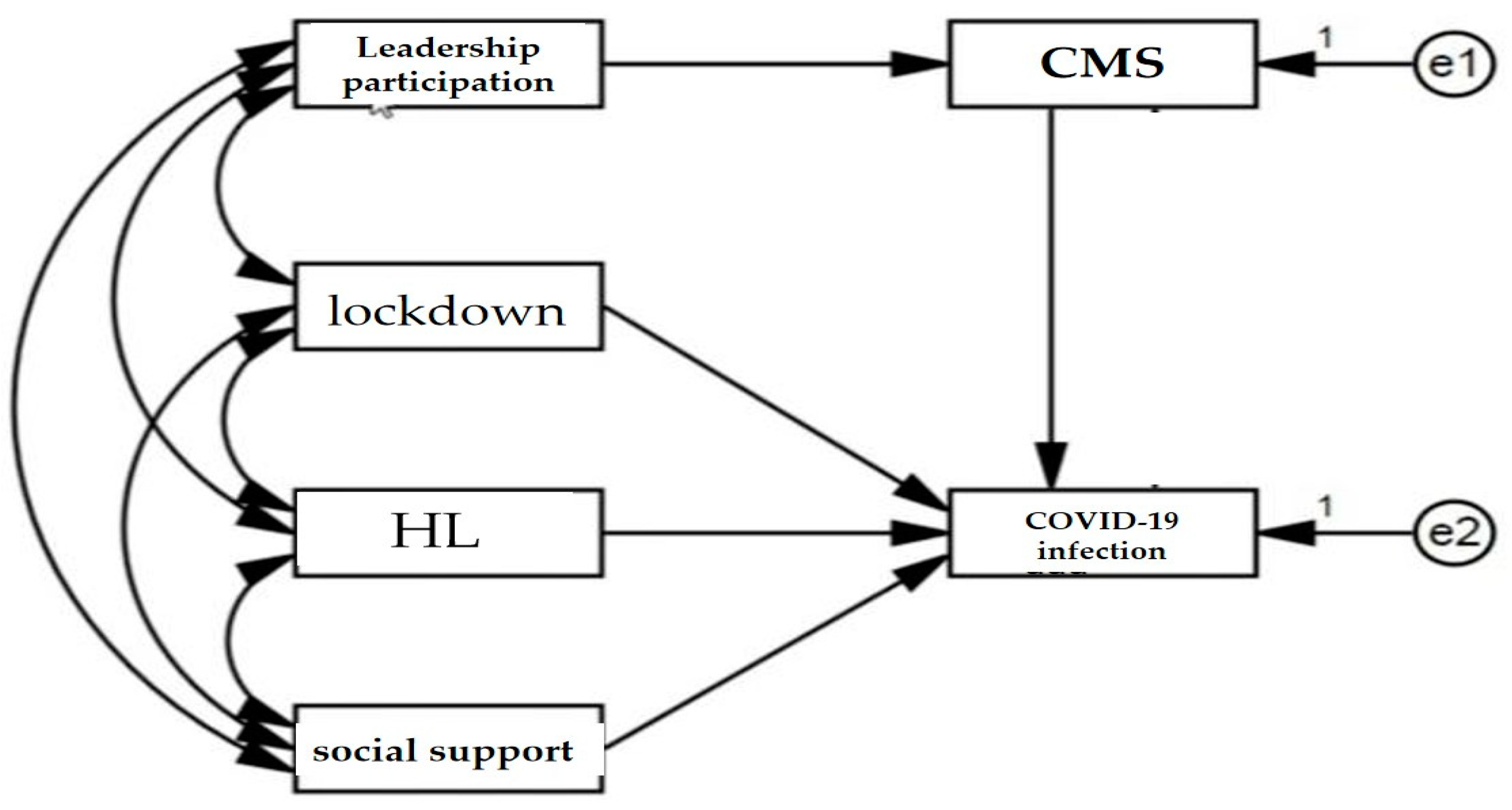

Table 5.
Concordance statistical values of the social support, full lockdown measures, HL, Community Medical Sciences (CMS) of VHVs, Leadership and participation, with COVID-19 infections model.
Table 5.
Concordance statistical values of the social support, full lockdown measures, HL, Community Medical Sciences (CMS) of VHVs, Leadership and participation, with COVID-19 infections model.
| Statistics | Standard | Statistics value | Results |
|---|---|---|---|
| P-value of χ2 | >0.05 | 0.072 | Passed |
| Goodness-of-Fit Index (GFI) | >0.90 | 0.925 | Passed |
| Adjust Goodness of Fit Index (AGFI) | >0.90 | 0.921 | Passed |
| Resting Metabolic Rate (RMR) | <0.05 | 0.00 | passed |
| Standardized RMR | <0.08 | 0.000 | passed |
| Root Mean Squared Error of Approximation (RMSEA) | <0.06 | 0.000 | passed |
In the mediation Pathway1 from social support, HL, and lockdown to COVID-19 infection. The social support was negatively related to COVID-19 infection (β = -.604, p = 0.000), which HL negatively related to COVID-19 infection (β = -.707, p = 0.000), and full lockdown measure was positively related to COVID-19 infection (β = .020, p = 0.000).
In Pathway2 from Leadership and participation to CMS (β = 0.141, p = 0.000) and to COVID-19 infection (β = 0.206, p = 0.000).
Summary of the path coefficients show that full lockdown measures, health literacy (HL), and CMS of HVs have the largest direct effect to COVID-19 infections of the population during and post COVID-19 Outbreak.
The results also showed that leadership and participation have indirect effects on the COVID-19 infections. See Table 6.
4. Discussion
This study found that the CMS competencies of VHVs were at a good level. Most of factors were related to a previous study found that village health volunteers and sub-district health center staff had a good understanding of local community dynamics and can contribute efficiently to the prevention and control of COVID-19 in Thailand [28]. Moreover, this result showed that knowledge, leadership, participation, social support, and CMS of VHVs were highly associated with physical and mental health of the population during and post COVID-19 outbreak. Then, VHVs trained to provide basic hygiene education to people, produced face masks and personal protective equipment, proactively identify cases, monitor migration in and out of the community, and ensure compliance with mandatory quarantine could be supported to enable rapid and effective implementation of infectious disease prevention and control at the national level [33].
Daily COVID-19 infections were associated with the social and economic situation in each country and with the level of each individual's participation in society. Commitment to mitigation measures might have an impact as well. The framework for predicting daily COVID-19 cases was wide. A previous study showed that the number of diagnostic tests conducted positively effects the confirmed daily cases of COVID-19. Moreover, a path analysis was done on geographical determinants of COVID-19 daily infections in the U.S. [34].
This path coefficients showed that quarantine commitment and full lockdown measure had the largest direct effect on COVID-19 daily infections. It was consistent with other research models, including: the result had indirect effects on daily COVID-19 infections. That could solve physical and mental health of the population during and post COVID-19 outbreak. It daily infections directly decreased with complete lockdown measures, quarantine commitment, wearing masks, and social distancing. In addition, COVID-19 daily cases were indirectly associated with population density, special events, previous experience, the technology used, economic resources, and medical resources [33,35].
The important expertise in EID surveillance and prevention of HVs. During the COVIC-19 pandemic, everyone in the HVs group not only worked hard but also acted in the form of community disease control organizations. They had a structure of directors and a role and responsibility for 10 households per one VHVs, coordinated with government organizations [36,37].
They usually operate according to a surveillance system consisting of data collection, consolidation and reporting, analysis and interpretation of data, and dissemination of information. After the COVID-19 outbreak, they played an important role in combating the disease [38,39,40].
The solve emerging infectious diseases of the population can be affected by several factors, such as; CMS of HVs, HL, social support, only 49% reported adequate HL, and 57% found DHL tasks easy overall. DHL did not vary by HL level. In multivariable models, both HL and DHL were independently associated with overall compliance with basic preventive practices. Higher DHL, but not HL, was significantly associated with greater willingness to get a COVID-19 vaccine and the belief that acquiring the disease would negatively impact their life [41,42].
The SEM model analysis showed that negative problem orientation, impulsive/careless style, avoidant style, positive problem orientation, and Covid-19 fear explained%32 of the academic motivation. The rational full lockdown measures, health literacy (HL), and CMS of HVs have to solve an emerging infectious disease of people [43,44].
Although, community areas are currently and soon to be confronted with newly emerging infectious diseases, such as dengue fever, influenza, and JN.1 newly dominant COVID-19. However, it is evident from the lessons learnt from the "OSOMO and CMS model" that it can be applied to address epidemic-related issues. Since, it is a system that actively and continuously tracks illness and has involvement from all spheres of society [45,46].
The synthesis and development of prevention and control models for emerging diseases involve various approaches. Mathematical models play a crucial role in understanding disease transmission patterns and aiding in control measures. Systems-oriented methods, such as system dynamics approaches, are utilized to comprehend the complex elements of a system and offer solutions for preventing and controlling emerging infectious diseases. Furthermore, reforming global prevention and control systems, enhancing the role of Centers for Disease Prevention and Control (CDCs), and promoting collaboration through a joint prevention mechanism are vital steps [47]. By integrating systems-oriented methods, improving data quality and timeliness, and focusing on early identification and response strategies, the global community can better prevent and control emerging infectious diseases [48]. Additionally, incorporating human behavioral factors, advanced mathematical modeling, and machine learning can optimize response efforts to major outbreaks in real-time, aiding medical professionals and policymakers in preventing, monitoring, and predicting future epidemics [49,50].
Path analysis can be utilized to examine the relationship between social support, full lockdown measures, healthcare logistics (HL), compliance with mitigation strategies (CMS) of healthcare workers (HVs), and COVID-19 infections. Studies have shown that social support can mitigate anxiety during quarantine periods [51], and that quarantine commitment and full lockdown measures have a direct impact on reducing daily COVID-19 infections [52]. Additionally, the influence of social support on psychological distress and biological rhythm disorders during the pandemic has been highlighted, especially among women [53]. Moreover, the importance of institutional support and teacher support on academic satisfaction has been emphasized in educational settings. [54] By incorporating these findings, a comprehensive path analysis model can be constructed to understand the intricate relationships between these variables in the context of COVID-19 infections.
Emerging infectious diseases (EIDs) pose significant challenges globally [55,56]. In vulnerable mountain communities like Sebei, Uganda, community-based surveillance by village health teams (VHTs) is crucial for monitoring public health hazards [57,58]. VHTs in Sebei lack adequate resources for surveillance, such as transport and mobile phone usage, hindering their effectiveness in disease monitoring [59,60]. However, in Thailand, during the COVID-19 pandemic, existing village health volunteers were trained to recognize symptoms, educate communities, and conduct surveillance, showcasing the importance of leveraging local resources in disease control. The mobilization of trained volunteers in Thailand led to the identification and monitoring of a large number of returnees, contributing significantly to the country's robust response to the pandemic [61]. Therefore, a village health volunteer model from this research will be a model for application to support changing world situations in the future. Especially able to support the spread of emerging diseases, Influenza a viruses, including H1N1, H3N2, and NHPV contribute significantly to the seasonal disease burden, with variations in impact by season and age group [62].
5. Conclusions
The full lockdown measures, health literacy (HL), and CMS of VHVs have the largest direct effect to COVID-19 infections. In addition, the CMS competency of VHVs proved effective and appropriate in providing health care support, and surveillance for protection against EID. through cooperation and dynamics. That can efficiently contribute to the prevention and control of EID in Thailand.
Supplementary Materials
The following supporting information can be downloaded at the website of this paper posted on Preprints.org, Figure S1: The path analysis was the resulting identification of the effects of independent variables on the dependent variable; Table S1: Internal and external factors about competency in community medical sciences and surveillance of VHVs, during and post COVID-19 outbreak; Table S2: The competency in Community Medical Sciences (CMS) and surveillance of VHVs, during and post COVID-19 outbreak; Table S3: The Long COVID-19 symptoms during and after the pandemic; Table S4: Bivariate analysis of the variables relating to the emerging infectious diseases solving, pre- and post-COVID-19 outbreak; Table S5: Concordance statistical values of the social support, full lockdown measures, HL, Community Medical Sciences (CMS) of VHVs, Leadership and participation, with COVID-19 infections model; Table S6: Direct, indirect, predictive values of variables that can predict COVID-19 infection of the population during and post COVID-19 Outbreak.
Author Contributions
Conceptualization, Phakdeekul, W., Phoosuwan, N. and Kedthongma, W.; methodology, Phakdeekul, W.; software, Boonmatoon, P.; validation, Phakdeekul, W., Phoosuwan, N. and Kedthongma, W.; formal analysis, Phakdeekul, W., and Kedthongma, W.; investigation, Nuanchum, K.; resources, Boonmatoon, P.; data curation, Boonmatoon, P. and Nuanchum K.; writing—original draft preparation, Phakdeekul, W., and Kedthongma, W.; writing—review and editing, Phoosuwan, N.; visualization, Phakdeekul, W., and Kedthongma, W.; supervision, Phakdeekul, W., and Kedthongma, W.; project administration, Phakdeekul, W., and Kedthongma, W.; funding acquisition, Phakdeekul, W., and Kedthongma, W. All authors have read and agreed to the published version of the manuscript.
Funding
This research received no external funding.
Institutional Review Board Statement
This study was conducted by the Declaration of Helsinki [32]. All the participants provided informed consent before participating in the study. In addition, this study was approved by Udon Thani Provincial Public Health Office ethics committee for research involving human subjects, approval number: UDREC-1865, and Kasetsart University Chalermphrakiat Sakon Nakhon Province Campus, Thailand: No. KUREC-CSC65-007.
Informed Consent Statement
Informed consent was obtained from all subjects involved in the study. All participants received written and oral information before signing a written consent form. The information emphasized the freedom to partake in the study or not and that participants were fully entitled to withdraw at any time. None of the authors was involved in the care of any of the participants.
Data Availability Statement
The datasets generated and/or analysed during the current study are not publicly available but are available from the corresponding author on reasonable request.
Acknowledgments
The researcher is very grateful to the research team, and the authors would like to express who strongly and many thank the Health Volunteers in rural of Thailand to answer the interviews and provide information. This research was supported by Kasetsart University Research and Development Institute (KURDI), and the National Research Council of Thailand (NRCT).
Conflicts of Interest
The authors declare no conflicts of interest. The funders had no role in the design of the study; in the collection, analyses, or interpretation of data; in the writing of the manuscript; or in the decision to publish the results.
Abbreviations
The following abbreviations are used in this manuscript:
| CMS | Community Medical Sciences |
| EID | Emerging Infectious Disease |
| VHVs | Village Health Volunteer |
| CiPs | Chemicals in Products |
| HL | Health literacy |
| SDHC | Sub-District Health Center |
| DE | Direct effects |
| IE | Indirect effects |
| TE | Total effect |
| S.D. | Standard deviations |
References
- World Health Organization. Timeline of WHO’s Response to COVID-19; Available online: https://www.who.int/news-room/detail/29-06-2020-COVID (accessed on 2 May 2022)World Health Organization. Naming the coronavirus disease (COVID-19) and the virus that causes it. Available online: https://www.who.int/emergencies/diseases/novelcoronavirus-2019/technical-guidance/naming-the-coronavirus-disease-(covid-2019)-and-the-virus-that-causes-it (accessed on 2 May 2022).
- Motallebi, S.; Cheung, R.C.; Mohit, B.; Shahabi, S.; Tabriz, A.A.; Moattari, S. Modeling COVID-19 mortality across 44 countries: face covering may reduce deaths. American Journal of Preventive Medicine 2022, 62, 483–491, https://doi.org/10.1016/j.amepre.2021.09.019. PMID: 35305777. Gathani, T.; Clayton, G.; MacInnes, E.; Horgan, K. The COVID-19 pandemic and impact on breast cancer diagnoses: what happened in England in the first half of 2020. British journal of cancer2021, 124, 710–712. https://doi.org/10.1038/s41416-020-01182-z. PMID: 33250510. [Google Scholar]
- Heneka, M.T.; Golenbock, D.; Latz, E.; Morgan, D.; Brown, R. Immediate and long-term consequences of COVID-19 infections for the development of neurological disease. Alzheimer's research & therapy 2020, 12, 1–3. [Google Scholar] [CrossRef]
- Heneka, M.T.; Golenbock, D.; Latz, E.; Morgan, D.; Brown, R. Immediate and long-term consequences of COVID-19 infections for the development of neurological disease. Alzheimer's research & therapy 2020, 12, 1–3. [Google Scholar] [CrossRef]
- Bove, M.; Fogacci, F.; Quattrocchi, S.; Veronesi, M.; Cicero, A.F. Effect of Synaid on cognitive functions and mood in elderly subjects with self-perceived loss of memory after COVID-19 infection. Archives of Medical Science: AMS 2021, 17, 1797–1799. [Google Scholar] [CrossRef] [PubMed]
- Chang, S.L.; Harding, N.; Zachreson, C.; Cliff, O.M.; Prokopenko, M. Modelling transmission and control of the COVID-19 pandemic in Australia. Nature communications 2020, 11, 5710. [Google Scholar] [CrossRef]
- Espi, M.; Charmetant, X.; Barba, T.; Mathieu, C.; Pelletier, C.; Koppe, L.; Chalencon, E.; Kalbacher, E.; Mathias, V.; Ovize, A.; et al. A prospective observational study for justification, safety, and efficacy of a third dose of mRNA vaccine in patients receiving maintenance hemodialysis. Kidney international 2022, 101, 390–402. [Google Scholar] [CrossRef]
- Ngonghala, C.N.; Iboi, E.; Eikenberry, S.; Scotch, M.; MacIntyre, C.R.; Bonds, M.H.; Gumel, A.B. Mathematical assessment of the impact of non-pharmaceutical interventions on curtailing the 2019 novel Coronavirus. Mathematical biosciences 2020, 325, 108364. [Google Scholar] [CrossRef]
- Espi, M.; Charmetant, X.; Barba, T.; Mathieu, C.; Pelletier, C.; Koppe, L.; Chalencon, E.; Kalbacher, E.; Mathias, V.; Ovize, A.; et al. A prospective observational study for justification, safety, and efficacy of a third dose of mRNA vaccine in patients receiving maintenance hemodialysis. Kidney International 2022, 101, 390–402. [Google Scholar] [CrossRef]
- Kedthongma, W.; Phakdeekul, W. The Intellectually Developed Model for Community Participatory Management of Child Care Centers during the COVID-19 Outbreak. European journal of contemporary education 2022, 11, 81–88. [Google Scholar] [CrossRef]
- Tejativaddhana, P.; Suriyawongpaisal, W.; Kasemsup, V.; Suksaroj, T. The roles of village health volunteers: COVID-19 prevention and control in Thailand. Asia Pacific Journal of Health Management 2020, 15, 18–22. [Google Scholar] [CrossRef]
- Phakdeekul, W.; Kedthongma, W. Management system for a quality and outcome framework in the area of the National Health Security Office in Region 8, Thailand. Linguistica antverpiensia 2021, 3, 2415–2427. [Google Scholar]
- Department of Health Services Support Training Course. Refresh the knowledge of Village Health Volunteers (VHV) the year 1997. Rally agricultural cooperatives of Thailand. Department of Health Services Support Training Course: Bangkok, Thailand, 2014; UpToDate. [Google Scholar]
- Singh, D.; Cumming, R.; Mohajer, N.; Negin, J. Motivation of Community Health Volunteers in rural Uganda: the interconnectedness of knowledge, relationship and action. Public Health 2016, 136, 166–171. [Google Scholar] [CrossRef] [PubMed]
- Lanham-New, S.A.; Webb, A.R.; Cashman, K.D.; Buttriss, J.L.; Fallowfield, J.L.; Masud, T.; Hewison, M.; Mathers, J.C.; Kiely, M.; Welch, A.A.; et al. Vitamin D and SARS-CoV-2 virus/COVID-19 disease. BMJ Nutrition, Prevention & Health 2020, 3, 106. [Google Scholar] [CrossRef]
- Phakdeekul, W.; Kedthongma, W. Effectiveness of Bacopa herb for solving dementia in the elderly. Systematic Reviews in Pharmacy 2021, 12, 548–553. [Google Scholar]
- Chaiyapet, C.; Phakdeekul, W.; Kedthongma, W. Risk factors of severity of road accident injury incidence at Kut Bak district Sakon Nakhon province, Thailand. Res Militaris 2022, 12, 835–845. [Google Scholar]
- Phakdeekul, W.; Kedthongma, W. Factors Related to Preventive Behavior towards COVID-19 among People in Rural Area of Thailand. NeuroQuantology 2023, 21, 246. [Google Scholar]
- Calafat, A.M.; Valentin-Blasini, L.; Ye, X. Trends in exposure to chemicals in personal care and consumer products. Current environmental health reports 2015, 2, 348–355. [Google Scholar] [CrossRef]
- Lee, S.M.; Lee, D. Healthcare wearable devices: an analysis of key factors for continuous use intention. Service Business 2020, 14, 503–531. [Google Scholar] [CrossRef]
- Okan, O.; Messer, M.; Levin-Zamir, D.; Dadaczynski, K.; Paakkari, L.; Schaeffer, D.; Sorensen, K. Health literacy action framework for health emergencies and infodemics. Information Services and Use 2023, 43, 115–130. [Google Scholar] [CrossRef]
- Sutawardana, J.H.; Desfiani, Y.R.; Widayati, N. Health literacy and post-vaccination COVID-19 prevention behavior in the community: a crosssectional study in Indonesia. Jurnal Ners. 2023, 18, 54. [Google Scholar] [CrossRef]
- McCaffery, K.J.; Ayre, J.; Dodd, R.; Pickles, K.; Copp, T.; Muscat, D.M.; Nickel, B.; Cvejic, E.; Zhang, M.; Mac, O.; et al. Disparities in public understanding, attitudes, and intentions during the COVID-19 pandemic: The role of health literacy. Information Services & Use 2023, 43, 101–113. [Google Scholar] [CrossRef]
- Yan, L.; Pu, C.; Rastogi, S.; Choudhury, R.; Shekar, M.K.; Talukdar, G. Evaluating the influence of health literacy and health-promoting COVID-19 protective behaviors on the spread of infection during the COVID-19 pandemic: a meta-analysis. Advances in Clinical and Experimental Medicine 2023, 32, 1357–1368. [Google Scholar] [CrossRef] [PubMed]
- Burkle, F.M.; Khorram-Manesh, A.; Goniewicz, K. COVID-19 and beyond: The pivotal role of health literacy in pandemic preparedness. Prehospital and Disaster Medicine 2023, 38, 285–286. [Google Scholar] [CrossRef]
- Guénette, L.; Maheu, A.; Vanier, M.C.; Dugré, N.; Rouleau, L.; Lalonde, L. Pharmacists practising in family medicine groups: what are their activities and needs? Journal of Clinical Pharmacy and Therapeutics 2020, 45, 105–114. [Google Scholar] [CrossRef]
- Krassanairawiwong, T.; Suvannit, C.; Pongpirul, K.; Tungsanga, K. Roles of subdistrict health office personnel and village health volunteers in Thailand during the COVID-19 pandemic. BMJ Case Reports CP. 2021, 14, e244765. [Google Scholar] [CrossRef]
- World Medical Association. World Medical Association Declaration of Helsinki. Ethical principles for medical research involving human subjects. Bulletin of the world health organization 2001, 79, 373. [Google Scholar]
- World Health Organization. World health statistics 2016: monitoring health for the SDGs sustainable development goals. World Health Organization: Geneva, Switzerland, 2016. [Google Scholar]
- Elashoff, J.D.; Lemeshow, S. Sample size determination in epidemiologic studies. In Handbook of epidemiology; Springer: Berlin Heidelberg, 2005; pp. 559–594. [Google Scholar] [CrossRef]
- Instituto de Salud Carlos III. Equipo COVID-19. RENAVE. CNE. CNM (ISCIII): Report nº 38. Situation of COVID-19 in Spain. Cases diagnosed as of May 10. 2020. [Google Scholar]
- Sriboonruang, P.; Rodpothong, S.; Natakuatoong, O. A Blended Knowledge Sharing Model Using AIC Approach to Enhance Building Shared Vision Skills of Young FDA Leaders. International Journal of Learning. 2010, 17. [Google Scholar] [CrossRef]
- Stephen, K.; Robin, M. Participatory action research: Communicative action and the public sphere. In Handbook of qualitative research, 3rd ed.; Denzin, N., Lincoln, Y., Eds.; Sage: Beverley Hills, CA, USA, 2005. [Google Scholar]
- Falcón, M.; Rodríguez-Blázquez, C.; Fernández-Gutiérrez, M.; Romay-Barja, M.; Bas-Sarmiento, P.; Forjaz, M.J. Measuring COVID-19 health literacy: validation of the COVID-19 HL questionnaire in Spain. Health and Quality of Life Outcomes 2022, 20, 138. [Google Scholar] [CrossRef]
- Doğan, N.Ö.; Varol, Y.; Köktürk, N.; Aksay, E.; Alpaydın, A.Ö.; Çorbacıoğlu, Ş.K.; Polatlı, M. Guideline for the management of COPD exacerbations: Emergency Medicine Association of Turkey (EMAT)/Turkish Thoracic Society (TTS) clinical practice guideline task force. Turkish Journal of Emergency Medicine 2021, 2, 137–176, Curran, M.A. (Ed.) Life cycle assessment handbook: a guide for environmentally sustainable products. John Wiley & Sons, 2012. [Google Scholar] [CrossRef]
- McCallum, M.; Carver, J.; Dupere, D.; Ganong, S.; Henderson, J.D.; McKim, A.; McNeil-Campbell, L.; Richardson, H.; Simpson, J.; Tschupruk, C.; Jewers, H. Developing a palliative care competency framework for health professionals and volunteers: The Nova Scotian experience. Journal of Palliative Medicine 2018, 21, 947–955. [Google Scholar] [CrossRef]
- Kedthongma, W.; Phakdeekul, W. Oral Health and Well-being of Elderly During and Post COVID-19 Outbrake. Journal of International Dental and Medical Research 2022, 15, 1672–1677. [Google Scholar]
- Seesanor, T.; Phakdeekul, W.; Kedthongma, W. Factors Related to Hemoglobin Levels among Infants Aged 6-12 Months after the COVID-19 Outbreak. International Journal of Membrane Science and Technology 2023, 10, 968–976. [Google Scholar] [CrossRef]
- Goswami, G.G.; Ali, A.M.; Islam, S. A panel path analysis approach to the determinants of coronavirus disease 2019 transmission: does testing matter for confirmed cases? Journal of Economic Studies 2021, 48, 1624–1648. [Google Scholar] [CrossRef]
- Liu, W.; Zhang, Q.I.; Chen, J.; Xiang, R.; Song, H.; Shu, S.; Chen, L.; Liang, L.; Zhou, J.; You, L.; et al. Detection of Covid-19 in children in early January 2020 in Wuhan, China. New England Journal of Medicine 2020, 382, 1370–1371. [Google Scholar] [CrossRef] [PubMed]
- Manesh, R.S.; Fallahzadeh, S.; Panah MS, E.; Koochehbiuki, N.; Arabi, A.; Sahami, M.A. The effectiveness of assertiveness training on social anxiety of health volunteers of Yazd. Psychology 2015, 6, 782. [Google Scholar] [CrossRef]
- Patil, U.; Kostareva, U.; Hadley, M.; Manganello, J.A.; Okan, O.; Dadaczynski, K.; Massey, P.M.; Agner, J.; Sentell, T. Health literacy, digital health literacy, and COVID-19 pandemic attitudes and behaviors in US college students: implications for interventions. International Journal of Environmental Research and Public Health 2021, 18, 3301. [Google Scholar] [CrossRef]
- Günaydın, H.D. The impact of social problem skills on academic motivation by means of Covid-19 fear: A SEM Model: Social Problem Solving, Covid-19, Academic Motivation. Current Psychology 2022, 41, 427–436. [Google Scholar] [CrossRef]
- Luo, M.; Gong, F.; Wang, J.; Gong, Z. The priority for prevention and control of infectious diseases: Reform of the Centers for Disease Prevention and Control– Occasioned by" the WHO chief declares end to COVID-19 as a global health emergency". BioScience Trends 2023, 17, 239–244. [Google Scholar] [CrossRef]
- Hewison, K. The Monarchy and Succession, Routledge Handbook of Contemporary Thailand. Routledge, 2020; pp. 118–133. [Google Scholar]
- Chuayruksa, N.; Phakdeekul, W.; Kedthongma, W. Oral Rinse, Nasal Irrigation, and Risk Factor of COVID-19 Screening. Journal of International Dental and Medical Research 2023, 16, 1227–1233. [Google Scholar]
- Mansouri, M.A.; Garcia, L.; Kee, F.; Bradley, D.T. Systems-oriented modelling methods in preventing and controlling emerging infectious diseases in the context of healthcare policy: A scoping review. Systems 2022, 10, 182. [Google Scholar] [CrossRef]
- Favero, M.; Scalia Tomba, G.; Britton, T. Modelling preventive measures and their effect on generation times in emerging epidemics. Journal of The Royal Society Interface 2022, 19, 20220128. [Google Scholar] [CrossRef] [PubMed]
- Khaddaj, S.; Chrief, H. Prevention and Control of Emerging Infectious Diseases in Human Populations. In Proceedings of the 2020 19th International Symposium on Distributed Computing and Applications for Business Engineering and Science (DCABES); pp. 336–339. [CrossRef]
- Rong, N.; Liu, J. Development of animal models for emerging infectious diseases by breaking the barrier of species susceptibility to human pathogens. Emerging Microbes & Infections 2023, 12, 2178242. [Google Scholar] [CrossRef]
- Metcalf, C.J.E.; Lessler, J. Opportunities and challenges in modeling emerging infectious diseases. Science 2017, 357, 149–152. [Google Scholar] [CrossRef]
- Awogbemi, C.A.; Alagbe, S.A.; Oloda, F.S.S. On the path analysis techniques and decomposition of correlation coefficients. Asian Journal of Probability and Statistics 2022, 20, 208–219. [Google Scholar] [CrossRef]
- Li, Y.; Peng, J.; Tao, Y. Relationship between social support, coping strategy against COVID-19, and anxiety among home-quarantined Chinese university students: A path analysis modeling approach. Current Psychology 2023, 42, 10629–10644. [Google Scholar] [CrossRef]
- Dou, Y.; Fan, H.; Yang, X.; Du, Y.; Wang, Y.; Wang, M.; Zhang, Z.; Qi, X.; Luo, Y.; Luo, R.; Ma, X. Impact of the COVID-19 pandemic on psychological distress and biological rhythm in China’s general population: A path analysis model. Plos one 2022, 17, e0271285. [Google Scholar] [CrossRef] [PubMed]
- Yammine, E.; Rammal, A. Path Analysis to Assess Socio-Economic and Mitigation Measure Determinants for Daily Coronavirus Infections. International Journal of Environmental Research and Public Health 2021, 18, 10071. [Google Scholar] [CrossRef]
- Patil, U.; Kostareva, U.; Hadley, M.; Manganello, J.A.; Okan, O.; Dadaczynski, K.; Sentell, T. Health literacy, digital health literacy, and COVID-19 pandemic attitudes and behaviors in US college students: implications for interventions. International Journal of Environmental Research and Public Health 2021, 18, 3301. [Google Scholar] [CrossRef] [PubMed]
- Günaydın, H.D. The impact of social problem skills on academic motivation by means of Covid-19 fear: A SEM Model: Social Problem Solving, Covid-19, Academic Motivation. Current Psychology 2022, 41, 427–436. [Google Scholar] [CrossRef]
- Delfraissy, J.F. French research organization on emerging infectious diseases: From REACTing to ANRS emerging infectious diseases. Bulletin de L'academie Nationale de Medecine 2023, 207, 287–294. [Google Scholar] [CrossRef]
- Chen, K.T. Emerging Infectious Diseases and One Health: Implication for Public Health. International Journal of Environmental Research and Public Health 2022, 19, 9081. [Google Scholar] [CrossRef] [PubMed]
- Sangwijit, C.; Abdulsalam, F.I.; Phoosuwan, N. Health and safety in hair salons during the Covid-19 situation: A cross-sectional study in a semi-urban district in Thailand. Public Health in Practice 2024, 7, 100472. [Google Scholar] [CrossRef] [PubMed]
- Dorlohtahe, S.; Kedthongma, W.; Phakdeekul, W. Criminal Enforcement against Illegal Cosmetic and Risk Factors for Herbal Product Legislation. Pakistan Journal of Criminology 2024, 16, 1325–1336. [Google Scholar] [CrossRef]
- Ahmadi, K.; Gharibi, Z.; Gorgi, R.; Gouklani, H. High Prevalence of Influenza A (H1N1 and H3N2) Infection in South Iran. Disease and diagnosis 2023, 12, 156–160. [Google Scholar] [CrossRef]
Table 1.
Internal and external factors about competency in community medical sciences and surveillance of VHVs, during and post COVID-9 outbreak (n = 1,550).
Table 1.
Internal and external factors about competency in community medical sciences and surveillance of VHVs, during and post COVID-9 outbreak (n = 1,550).
| Factors | Low | Moderate | Good |
|---|---|---|---|
| Percentage | Percentage | Percentage | |
| (mean ± S.D.) | (mean ± S.D.) | (mean ± S.D.) | |
| knowledge | 16.70 (25.10 ± 2.01) | 33.30 (23.51 ± 2.10) | 50.00 (28.93 ± 1.89) |
| social support | 23.30 (52.0 ± 8.10) | 30.00 (70.0 ± 3.73) | 46.70 (85.93 ± 5.12) |
| leadership | 16.70 (38.6 ± 4.88) | 40.00 (57.75 ± 2.11) | 43.30 (65.23 ± 3.65) |
| participation | 18.50 (36.45 ± 8.25) | 41.50 (58.82 ± 14.25) | 57.10 (75.20 ± 6.65) |
Table 2.
The competency in Community Medical Sciences (CMS) and surveillance of VHVs, during and post COVID-19 outbreak (n = 1,550).
Table 2.
The competency in Community Medical Sciences (CMS) and surveillance of VHVs, during and post COVID-19 outbreak (n = 1,550).
| Activity in CMS and surveillance | CMS and surveillance level of HVs | ||
|---|---|---|---|
| Low | Moderate | Good | |
| Percentage | Percentage | Percentage | |
| (mean ± S.D.) | (mean ± S.D.) | (mean ± S.D.) | |
| Family medicine | 10.00 | 70.00 | 20.00 |
| (32.25 ± 5.48) | (40.56 ± 3.08) | (40.38 ± 2.54) | |
| Emerging infectious diseases surveillance | 16.70 | 40.00 | 43.30 |
| (22.6 ± 2.95) | (32.58 ± 1.57) | (39.69 ± 2.11) | |
| Health promotion | 16.70 | 26.70 | 56.70 |
| (13.60 ± 2.87) | (19.13 ± 1.19) | (25.06 ± 1.44) | |
| Telemedicine and application | 13.30 | 60.00 | 26.70 |
| (27.75 ± 1.34) | (39.44 ± 2.16) | (65.23 ± 2.37) | |
| Total | 10.00 | 13.30 | 76.70 |
| (99.33 ± 3.93) | (128.75 ± 2.86) | (139.70 ± 4.82) | |
Table 3.
The Long COVID-19 symptoms during and after the pandemic (n = 1,550).
| Long COVID-19 symptoms | Percentage |
|---|---|
| Weakness | 35.40 |
| Dyspnea | 27.60 |
| Palpitations | 21.50 |
| attention Deficit | 13.20 |
| fever, headache | 76.20 |
| cough, sore throat | 75.40 |
| no taste or smell less | 30.50 |
| joint pained | 67.40 |
| Insomnia | 24.80 |
| Dizziness | 48.20 |
| abdominal pained, diarrhea, loss of appetite | 39.50 |
| exanthematous (morbilliform) | 52.60 |
| depression or anxiety | 73.60 |
Table 4.
Bivariate analysis of the variables relating to the emerging infectious diseases solving, pre- and post-COVID-19 outbreak (n = 1,550).
Table 4.
Bivariate analysis of the variables relating to the emerging infectious diseases solving, pre- and post-COVID-19 outbreak (n = 1,550).
| Factors | The Emerging Infectious Diseases solving (EIDs) | |
|---|---|---|
| r | (p-value) | |
| Knowledge | 0.64 | 0.002 * |
| Quarantine Commitment | 0.68 | 0.004 * |
| Full Lockdown Measures | 0.73 | 0.001 ** |
| Leadership and Participation | 0.76 | 0.001 ** |
| Social Support | 0.78 | 0.001 ** |
| Health Literacy (HL) | 0.81 | 0.001 ** |
| Community Medical Sciences CMS) of VHVs | 0.82 | 0.001 ** |
* statistically significant at .05 level. ** statistically significant at .01 level.
Table 6.
Direct, indirect, predictive values of variables that can predict COVID-19 infection of the population during and post COVID-19 Outbreak.
Table 6.
Direct, indirect, predictive values of variables that can predict COVID-19 infection of the population during and post COVID-19 Outbreak.
| Observe variable | Beta | Direct effect | Indirect effect | Total effect |
|---|---|---|---|---|
| Community Medical Sciences (CMS) of Health Volunteers (HVs) | .172 | .197 | 0.000 | .197 |
| Full Lockdown Measure | .020 | .011 | 0.000 | .011 |
| Health Literacy (HL) | -.707 | -.894 | 0.000 | -.894 |
| Leadership and Participation | -.802 | -.794 | 0.000 | -.794 |
| Social Support | -.604 | -.632 | 0.000 | -.632 |
Disclaimer/Publisher’s Note: The statements, opinions and data contained in all publications are solely those of the individual author(s) and contributor(s) and not of MDPI and/or the editor(s). MDPI and/or the editor(s) disclaim responsibility for any injury to people or property resulting from any ideas, methods, instructions or products referred to in the content. |
© 2025 by the authors. Licensee MDPI, Basel, Switzerland. This article is an open access article distributed under the terms and conditions of the Creative Commons Attribution (CC BY) license (http://creativecommons.org/licenses/by/4.0/).
Copyright: This open access article is published under a Creative Commons CC BY 4.0 license, which permit the free download, distribution, and reuse, provided that the author and preprint are cited in any reuse.


