

Submitted:
20 March 2025
Posted:
21 March 2025
You are already at the latest version
Abstract
Rapid digitalization has dramatically altered many ways in which educational resources are accessed, shared, and consumed. This paper reports on the design and implementation of a new Educational Resource Sharing Platform that aims at collaboration and equitable access to educational materials. By taking its cues from the Vite.js build tool that is optimized for efficiency, the platform is developed to provide a friendly and intuitive User- Interface. The architectural design capitalizes on the dynamic functionalities of JavaScript to facilitate modular scalability and the smooth incorporation of interactive elements. This platform empowers users to efficiently share, discover, and utilize a wide array of educational resources, thereby fostering a community-oriented approach to learning. Notable characteristics encompass a lightweight, rapid-loading interface, as well as the prospective integration of machine learning models that could provide personalized content recommendations aligned with user preferences and behaviors. Preliminary study results show that the platform possesses capacity for reducing redundancy in resources, opportunities for collaborative learning, and an inclusive environment for sharing knowledge. Thus, this study contributes to closing educational disparities by responding to growing demand for accessible educational resources. Follow-up studies are going to be able to integrate advanced analytics and machine learning techniques in order to better optimize what content is delivered and experienced by the user.
Keywords:
Educational resource sharing
; collaborative learning
; web development
; knowledge exchange
; personalized content recommendation
; digital education
I. INTRODUCTION
The rise of the digital era has significantly affected how people acquire and access information, especially during learning. Because most digital resources are now widely used in helping transcend geographical barriers, people can easily access quality learning resources around the world. However, provision of education content is still an emergent problem as redundancy, lack of personalization, and scalability limitations reduce the overall effectiveness of digital education efforts. Overcoming these challenges requires new kinds of platforms that aggregate resources and facilitate collaboration, as well as seamless, efficient, and scalable solutions.
EduShare presents a learning material sharing platform that promotes equality in learning resources and fosters collaboration. It is developed using advanced web technologies, such as Vite.js, that focus on offering the smoothness of streamlined speed combined with rapidity and engagement for users. It aims to come up with a space wherein educational resources shared, accessed, and managed comfortably by educators, students, and enthusiasts. Through the usage of Vite.js and JavaScript, EduShare architecture represents modular scalability-a form that allows for ease in implementing upgrades and feature integration.
Many sites provide similar content but do not provide sufficient tools to help organize or tailor resources to better fit individual needs. Redundancy can overwhelm the user and reduce the overall effectiveness of resource sharing. To counter this problem, EduShare uses design principles and technologies that focus upon user-centric functionality, effective organization, and scalable solutions. Its module structure also ensures that advanced features like recommendations based on machine learning are integrable for improving personalization of the user experience.
The platform uses the capabilities of Vite.js as the fast and efficient tool for building, thereby improving web development processes. Being different from the traditional bundlers, Vite.js uses a modern approach to dramatically reduce build times and further optimize application performance. This technology is the basis to develop a responsive user interface that makes it efficient to interact with EduShare in any way. The decision to develop using Vite.js reflects a commitment to apply the latest methodologies, which promise to favor speed, scalability, and simplicity of use. EduShare meets the need of growing shared experiences in education with its capabilities that support the collective submission and curation of resources, thus imparting a more communal feel to an understanding of community and shared goals. Adopting features that are community-friendly, EduShare ends up extending beyond simple curation of content and supports a platform for interaction, communication, and innovation.
In this paper, the technical basis, implementation strategy, and essential characteristics of EduShare are described. The paper also discusses the consequences of applying new web technologies for educational resources dissemination and some possible future directions. Preliminary experiments show that EduShare can contribute to better accessibility, lower redundancy, and a more inclusive learning environment.
We discuss in the next sections EduShare architecture, technologies used and problems encountered during its development. The research outlines several possible directions: analytics and ML models to be used for recommending individual educational materials. In the end, this research brings up transformative opportunities associated with the application of modern web technologies to resolve world-wide education problems and advocate lifelong learning.
II. LITERATURE SURVEY
Over the past few years, internet-based education platforms have become an important area of study, exploring how advanced technology could be used to overcome obstacles in access, usability, and scale. The growing need for online educational resources has led to numerous studies aimed at finding innovative approaches that improve the effectiveness and accessibility of digital environments for learning. This section discusses in great detail current research literature, focusing on key issues relevant to EduShare's development. These issues include front-end architecture, dynamic content rendering, interactivity, modular design, responsive design, and resource linking.
- A.
- Front-End-Centric Architectures
Recent trends in web applications have been for front-end-centric architectures; front-end-centric approaches have become extremely popular, even though traditional methodologies for server-side rendering did work well during their time, showing inefficiencies when dealing with dynamic and highly interactive content. With tooling such as Vite.js behind it, front-end-centric approaches have gained popularity because they can provide a much faster experience for users. The literature itself also highlights the benefits of leveraging tools like Vite.js, known for their ability to optimize development workflows through the support of features like hot module replacement (HMR) and incremental builds. Such tools, it is observed, benefit developers by optimizing productivity while minimizing load times for end users, thus significantly more than standard bundlers [14].
The adaptation to front-end architectures presupposes the requirement of scalability for web applications. Architectures, which are designed in a modular front-end framework, can be scaled more suitably for the addition of new features and for keeping abreast with expanding user demographics. This approach tends to be directly compatible with agile development principles whereby improvements and updates are carried out incrementally [15]. In educational portal development, wherein content and user requirements might change very rapidly, these flexible front-end-oriented architectures are most beneficial.
- B.
- Dynamic Content Generation
Dynamic content rendering is one of the core features of modern web applications: It enables the user interface to update themselves without requiring a full page reload. In educational web services, where users often view a constant and wide variety of formats - text, images, videos, and interactive content-at all times, this function has been especially emphasized. JavaScript has been regarded as the most suitable technology for the context of dynamic rendering of content, especially because it supports asynchronous processing with well-integrated browser support [15].
The use of JavaScript modules significantly improves the rendering of dynamic content as it simply allows developers to create reusable and maintainable parts. Modular JavaScript coding has been demonstrated in research to make code management easier, allowing developers to focus on creating particular features without introducing unnecessary complexity into the application as a whole [14,16]. In educational websites, functionalities like resource browsing, searching, and recommending often involve real-time interaction with the user interface.
- C.
- Interactivity and User Engagement
Interactivity is considered one of the fundamental features of effective teaching environments. Studies have always shown that interactive applications boost user interest and retention to a major extent as they provide an engaging participatory learning experience [16]. Some common examples of interactivity in web-based applications are buttons, counters, form inputs, and drag-and-drop interfaces that let the users interact with the content.
As part of the EduShare architecture, a counter button is an excellent implementation of interactivity. Even though these examples seem to be pretty straightforward, they show the attractiveness of dynamic end-user participation through event-driven updates. Studies have shown that even simple interaction components increase user participation if combined with feedback mechanisms that update immediately [17]. Applying listeners based on JavaScript events enables web platforms to implement an interactive and engaging user interface leading to active participation.
- D.
- Modular Development and Scalability
Modular development methodologies are widely studied in the literature as the best practices for developing scalable and maintainable web applications. For example, with the help of JavaScript modules, a particular functionality can be isolated in separate parts of the application so that one can later reuse it wherever needed in the application. This in turn reduces redundancy, eases maintenance activities, and provides room for future additions [12].
This concept is seen very well in the setupCounter function of EduShare using modular architecture. This separate module holds the logic of counters, thus making sure that the functionality of the counters may be easily changed or reused without impacting other parts of the codebase. Studies conducted in academics reveal that modular development is in line with the principles that define good software engineering practices, like separation of concerns and single responsibility; thus, it is considered an integral approach toward developing scalable applications [13].
- E.
- Responsive Design and Access
This proliferation in devices to access web applications has made responsive design a key requirement. Studies indicate that it becomes crucial to create layouts and components that adapt smoothly according to the dimensions of different screens, therefore ensuring similar user experience across desktop machines, tablets, and mobile devices [9]. CSS is a fundamental tool that helps to achieve responsive design, where programmers will be able to create fluid layouts as well as media queries that adapt styles based on the parameters of the device used by the visitor.
To practice using EduShare, a style-specific stylesheet called style.css has to be included, which confirms the designer's allegiance to responsive design principles. Studies using responsive design have shown that it enhances usability and expands access to web applications from as many devices as possible [17]. Such sites are highly valued in education, as they are generally accessed by diverse groups of students, teachers, and lifelong learners. Adhering to the same principles, EduShare demonstrates the capacity to overcome various problems associated with the traditional educational systems while using modern web technologies to supply a robust, user-centric experience.
The knowledge that is derived from the current literature provides a good foundation for further development and enhancement of the platform, which can include the potential implementation of advanced functionalities such as content personalization recommendations and analytics.
III. MATERIALS AND METHODS
This section elaborates further on the tools and methodologies used in designing EduShare, specifically front-end architecture, development process, core functionalities, and development tools used.
- A.
- System Architecture
EduShare architecture is front-end oriented and can be focused on optimizing the performance of the user interface by using modern tools and technologies. And client-side implementation relies upon Vite.js-fast build tool and development server, which is called the feature of hot module replacement-a real in-place update that does not demand full-page reloads-and a lightweight build process for enabling better efficiency. The static structure of the application is set in index.html - essentially, a bottom of static content that will have dynamic updates through the modules in the JavaScript files. Those modules then generate and manage content across the site dynamically, allowing for a smooth and adaptive user experience.
- B.
- Front-End Development
EduShare Implements basis web technologies that integrate an harmonic, scalable design for the front-end. The index.html is the entry point of all the JavaScript modules and describes the structure of the container for the dynamic rendering contained in< div id="root">. The style.css takes care of the styling, so it will always be responsive on any given device, and the main functionality is contained in the file main.js, dynamically creating aspects like logos, the button, the text of instructions.
Additional interactivity in the counter setup function is also made possible by updating the press of a counter button in real-time through event listeners. Such modularity provides for reusability and clean code management.
- C.
- Elementary Operations
The platform uses core functionalities towards further optimizing the resource access of the user and enhancing user interaction. Dynamic Content Rendering enables dynamic modules functioning with JavaScript to render within the <div id="app">, which provides flexibility in managing the interface. Such elements as the counter button have shown that it is indeed possible dynamically update the user interaction based on events. Finally, Resource Linking provides some external links out to resources like Vite.js and JavaScript documentation to give users learning materials about the technologies that power this platform.
- D.
- Development Tools
EduShare uses the features that Vite.js allows in the creation for quick recompilation and clean code handling for development. In addition to having a modular platform, JavaScript modules also support it; thus, complex functionalities such as the setupCounter logic are separated and kept reusable. This makes it maintainable and scalable as the platform continues to develop.
IV. Results and Discussion
Web Technology is a tried and tested technology in the technology world, yet new advancements are continuously being introduced for effective services and better user experience. This section dives into the results we achieved in the making of this project.
- A.
- Results
After careful compilation of different web technologies into this project, EduShare came out as user-friendly, resource sharing platform with smooth and efficient workflow. The user interface is as follows:
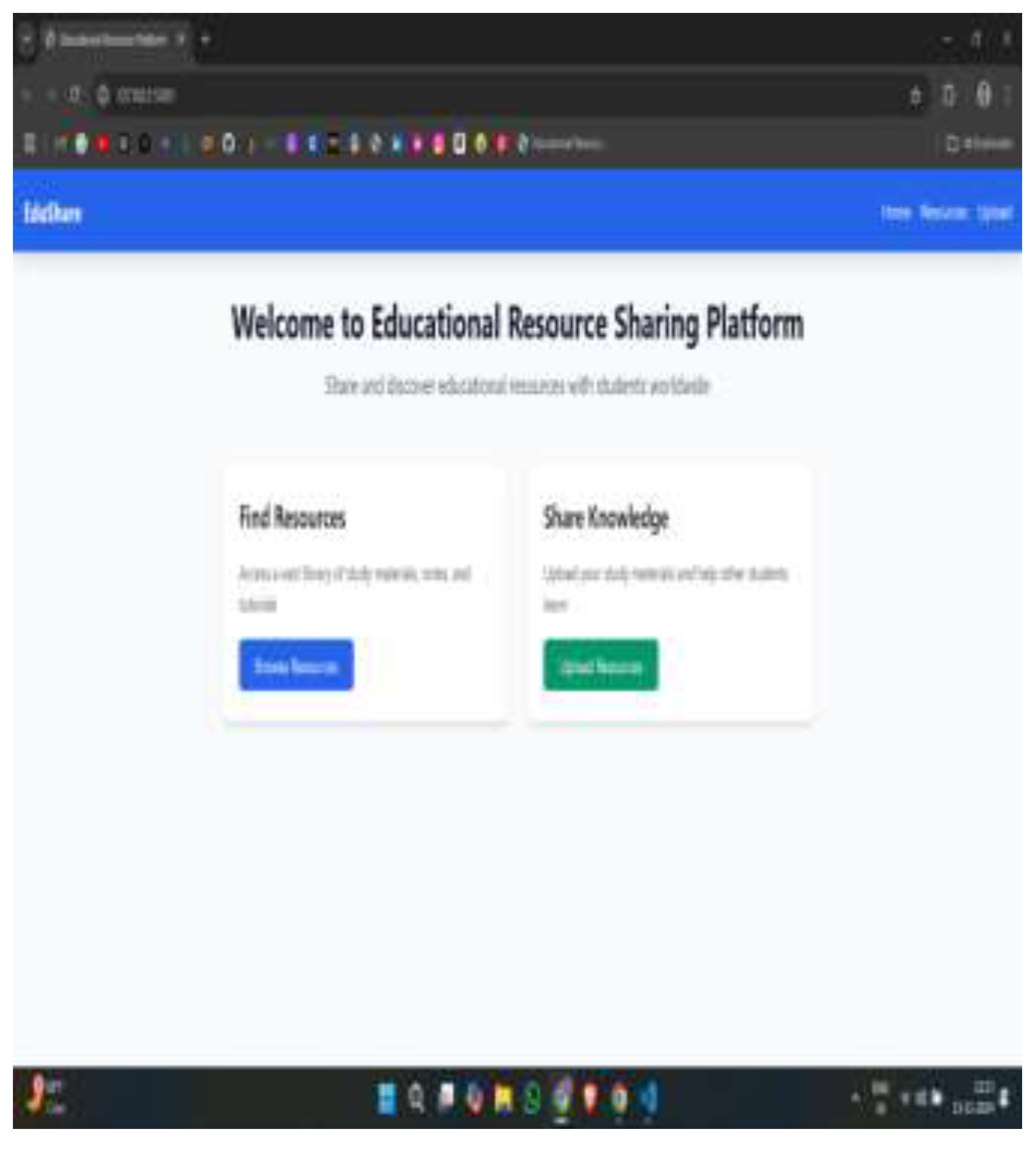
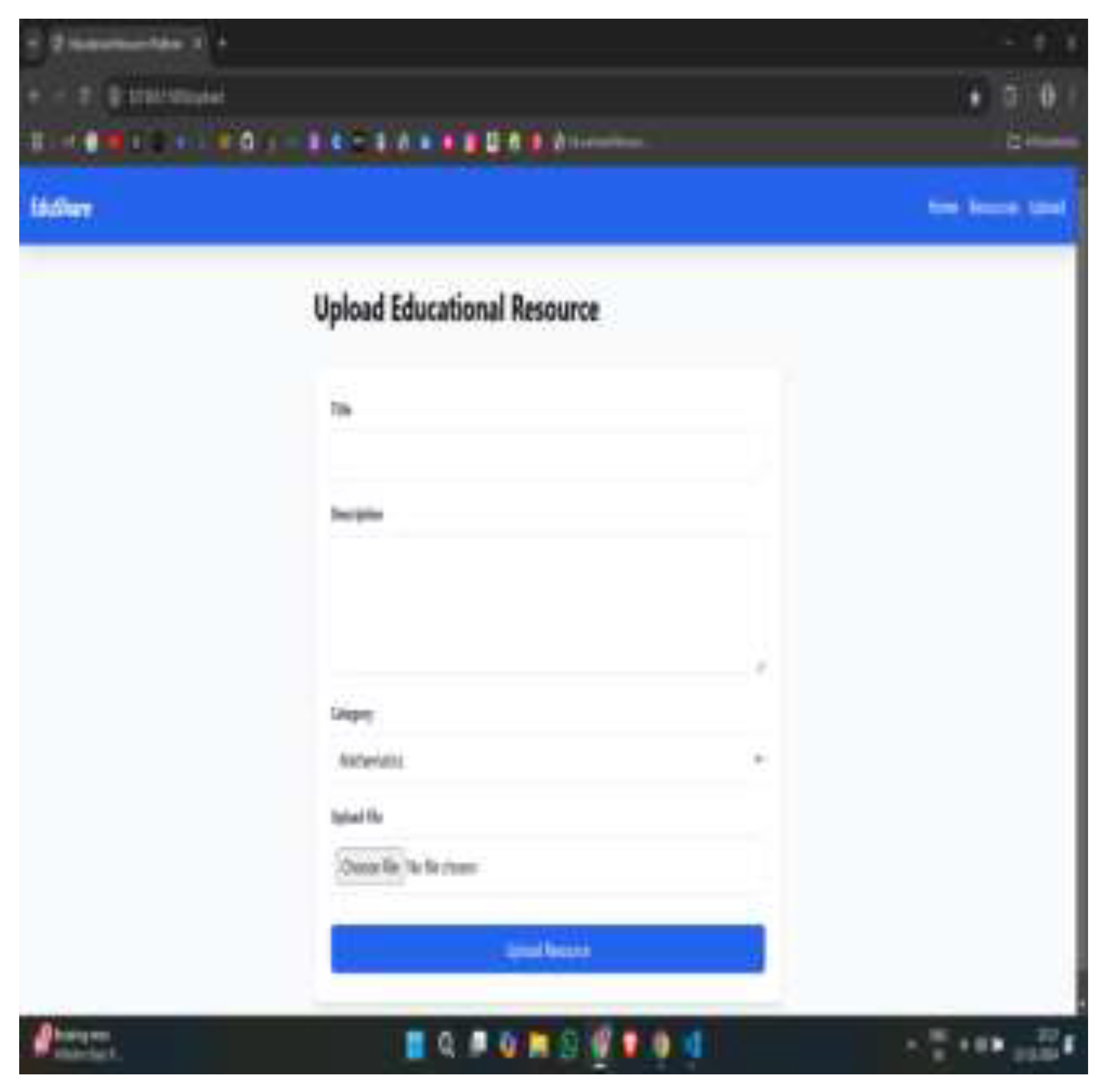
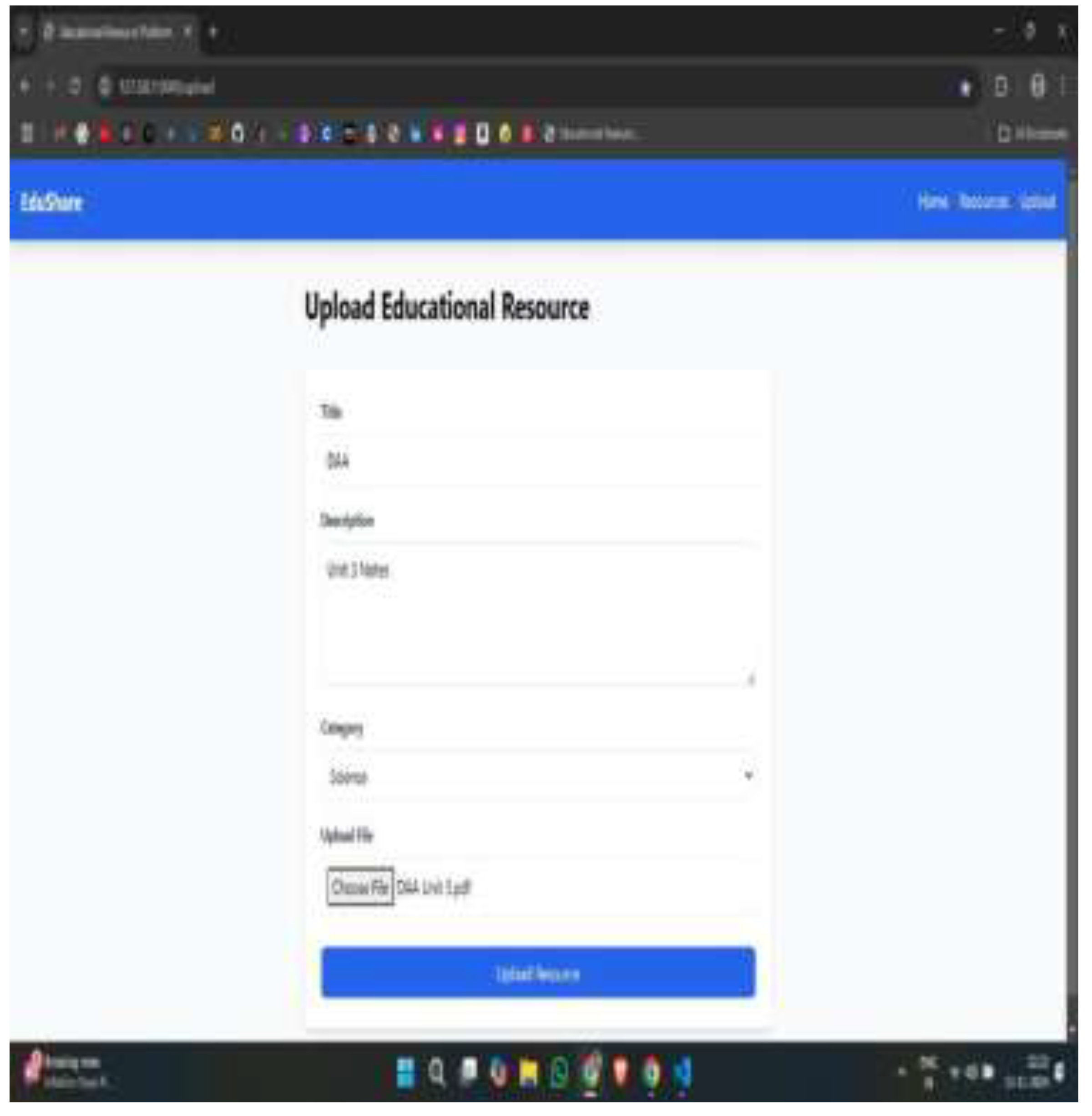
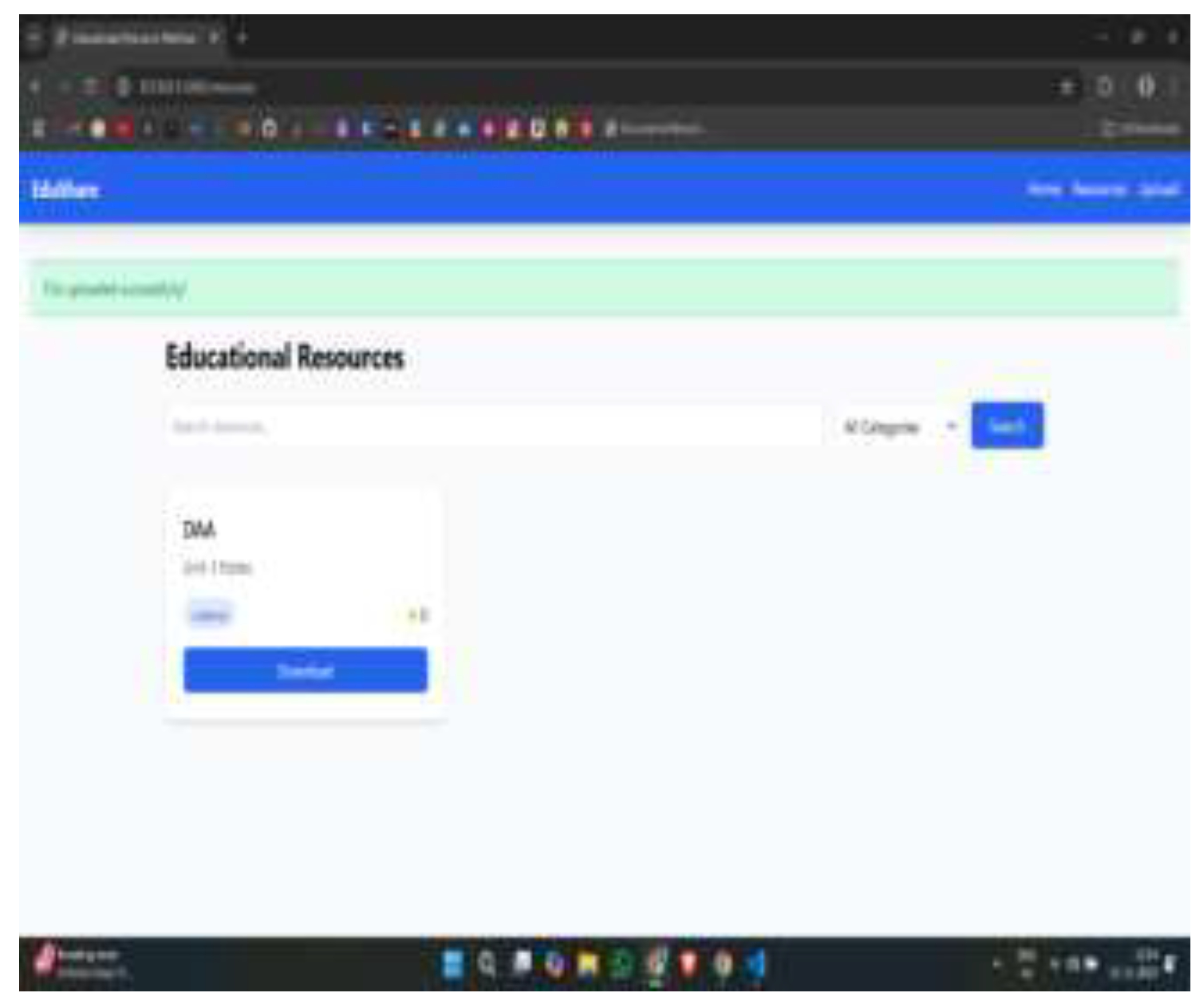
Figure 1.
Home Page.
Figure 2.
Educational Resource Upload Page.
Figure 3.
Educational Resource Upload Page.
Figure 4.
Educational Resource Download Page.
- B.
- Challenges and Limitations
- Platform Functionality - The Educational Resource Sharing Platform was thus designed to share academic resources in an accessible and efficient way. Vite was there, the build tool, which had proved quite effective in achieving fast load times as well as a seamless user experience-it was particularly streamlined in asset bundling and dependency management.
- User Interaction Interactivity - An element that stands at the heart of the design is presented through dynamic JavaScript components that all point to interaction with users. Modular JavaScript was employed to be able to have interactive elements; this will serve as a core in complex activities for the future of users. It will enable the platform to scale its interactive features efficiently, supporting collaborative functions and live resource sharing in versions to be developed, thus allowing utility to students as well as teachers.
- User Comment and Experience - Initial user testing sessions produced very encouraging comments concerning responsiveness and clarity of service. People liked an intuitively created layout without such surplus design elements in reducing targeted educative material, which actually reduces distractions and provides for a smoother experience of browsing. The approach to user experience directly coincides with functional requirements of an education platform while forming a good basis for further extension into more features towards easy adaptation of users toward additions of those features.
- C.
- Future Work
The Educational Resource Sharing Platform is able to show its potential to facilitate collaborative and accessible sharing of educational content; however, several key developments will actually further improve functionalities, scalability, and usability. For example, further development will focus on implementing server-side capabilities and advanced interactivity as well as the refinement of user experience.
- Backend Integration for Persistent Data and Scalability - Backend infrastructure would include much stress on the persistence of data and handling large users. A robust backend would assist in user authorization, save content and account resource libraries; thus, enable safe storage of resources recalled by users. This system could then apply an integrated scalable database specially intended for handling larger volumes of user data, uploading resources, and educational content.
- Support for the backend would open the path for more complex features such as recommending user-specific content, hence further enhancing personalisation. Scaling this backend architecture will be fundamental in ensuring that the system offers stable and efficient operations as users increase.
- Better security and privacy features - Such a platform will be developed having all the features of user authentication with encryption, secure storage, and settings for privacies to protect users and their resources. Security protocols like the use of two-factor authentications, role-based access control, and secure data encryption ensure safe resource sharing in an institutional setting, which also calls for data protection. It is also very appealing to schools, universities, and other education organizations needing data security along with the following establishment of privacy-compliant protocols. These enable a trusted environment where sensitive or proprietary education can be shared.
- Advanced collaboration tools - The most vital step toward this conversion would be the addition of real-time collaboration tools into the platform. Shared document editing, interactive whiteboards, and in-platform messaging would then enable educators and their students to collaborate synchronously within an enriched teaching-learning environment. The dynamic use of the environment for group projects, live study sessions, as well as educator-led discussions would thus be supported through such integration into the existing content-sharing infrastructure. Commenting and highlights would be asynchronous, allowing students to make use of flexible means of interactive resource interaction in collaboration with others.
- Personalization and Recommendation Systems - It will make it a much better experience if contents are tailored to every individual based on their learning needs and preferences. Using machine algorithms, the platform can recommend resources based on past interactions, ratings assigned for resources, or preferred courses. This would make the platform very intuitive and user friendly in discovering relevant materials quickly. Future work may include collaboration filtering or content-based filtering techniques that support more optimization of the recommendations to make it even more user-specific and engaging.
- Improvement in User Interface and User Experience - With the new feature addition, a streamlined and flexible UI will also contribute to this. UI features extended to let a user make their experience customized, in this case, and an ability to rearrange resource displays or organizing contents by subject or set of personal preference, will give a much more versatile platform. Other such features like dark mode, mobile-responsive designs, and accessibility options would also make the platform usable for more diverse audiences whose needs are rather different from one another. These improvements are going to be made nice and not too cluttered through user testing and user feedback.
V. Conclusions
The educational resources sharing platform, in the current project, is developed in a very readable and user-friendly approach with the help of front-end frameworks such as Vite to achieve efficiency and fast page loads while developing educational resources. Providing simplicity and responsiveness, the platform offers a natural intuitive interface through which users can interact with resources easily and with comfort, thus making it a very viable foundation for a digital educational hub. However, despite that, the platform has already achieved considerable functionality in its current state. Deficiencies remain, such as the lack of a backend to hold persistent data and more complex security protocols and less collaborative tools, which limit applications of the platform into larger, institutionally-related applications. These would be integrated in the form of backend support, advanced security measures, and interactive features. These are the needs that support scalable implementation, protection of data, and a collaborative educational experience. Future development will add these latest features and morph this platform into a holistic, customizable tool adapted to the range of users' needs from education. Upon persistent data storage, scalable architecture, and the accomplishment of real-time collaboration, the system can eventually be developed to become an educational resource center of power for both the individual learner and academic institutions. In a nutshell, the Educational Resource Sharing Platform has laid a strong and solid basis for accessible digital resource sharing, with great potential space for growth and enhancement. It is apparent that through focused future development, the platform will reach its full freedom as a dynamic and secure learning environment while clearly setting it up as one of the most valuable tools in the current learning landscape.
References
- Nor, H.; Wijaya, M.S. University Students’ Perception towards Online Learning: Synchronous and Asynchronous. SALEE: Study of Applied Linguistics and English Education 2023, 4, 236–248. [Google Scholar] [CrossRef]
- Wu, X. Construction of preschool education resource sharing platform based on matrix model. Applied Mathematics and Nonlinear Sciences.
- Adeleye, O.O.; Eden, C.A.; Adeniyi, I.S. Educational technology and the digital divide: A conceptual framework for technical literacy inclusion. 2024. [Google Scholar]
- Maphosa, V. Using the pandemic to accelerate 21st-century learning at a rural university in Zimbabwe. Advances in Research 2021, 22, 34–44. [Google Scholar] [CrossRef]
- Siqueira, S. W., BRaz, M. H. L. B., & Melo, R. N. (2003, September). Web technology for education and training. In 14th International Workshop on Database and Expert Systems Applications, 2003. Proceedings. (pp. 337-341). IEEE.
- Sutikno, T.; Aisyahrani AI, B. Non-fungible tokens, decentralized autonomous organizations, Web 3.0, and the metaverse in education: From university to metaversity. Journal of Education and Learning (EduLearn) 2023, 17, 1–15. [Google Scholar] [CrossRef]
- Sun, X. (2023, November). Construction of Business Administration Teaching Resource Sharing Platform under the Background of Internet+ Education. In Proceedings of the 4th International Conference on Modern Education and Information Management, ICMEIM 2023, September 8–10, 2023, Wuhan, China.
- Yanga, X.; Mab, R.; Gaoc, F. Design and implementation of college education resource sharing platform based on IPFS+ block chain dual database.
- Fu, Y. (2023, February). Resource Sharing Platform Based on Machine Learning and Data Fusion Technology. In 2023 IEEE International Conference on Integrated Circuits and Communication Systems (ICICACS) (pp. 1-5). IEEE.
- Gan, W. Gan, W., Ye, Z., Wan, S., & Yu, P. S. (2023, April). Web 3.0: The future of internet. In Companion Proceedings of the ACM Web Conference 2023 (pp. 1266-1275).
- Li, Z. (2023, June). The Construction of Online Learning System of Ideological and Political Education in Digital Electronic Technology Course Based on FLASK. In 2023 4th International Conference on Education, Knowledge and Information Management (ICEKIM 2023) (pp. 373-380). Atlantis Press.
- Sharma, M. , Khan, M. S., & Singh, J. (2024, January). Python & Django the Fastest Growing Web Development Technology. In 2024 IEEE 1st Karachi Section Humanitarian Technology Conference (KHI-HTC) (pp. 1-9). IEEE.
- Aslam, F.A.; Mohammed, H.N.; Lokhande, P.S. Efficient Way Of Web Development Using Python And Flask. International Journal of Advanced Research in Computer Science 2015, 6. [Google Scholar]
- Tong, J. , Jikson, R. R., & Gunawan, A. A. S. (2023, August). Comparative Performance Analysis of Javascript Frontend Web Frameworks. In 2023 3rd International Conference on Electronic and Electrical Engineering and Intelligent System (ICE3IS) (pp. 81-86). IEEE.
- Peguero, K. , N., & Cheng, X. (2018, April). An empirical study of the framework impact on the security of javascript web applications. In Companion Proceedings of the The Web Conference 2018 (pp.
- Wilson, D.; Hassan, S.U.; Aljohani, N.R.; Visvizi, A.; Nawaz, R. Demonstrating and negotiating the adoption of web design technologies: Cascading Style Sheets and the CSS Zen Garden. Internet Histories 2023, 7, 27–46. [Google Scholar] [CrossRef]
- Ndia, J.G.; Muketha, G.M.; Omieno, K.K. A survey of cascading style sheets complexity metrics. International Journal of Software Engineering & Applications (IJSEA) 2019, 10. [Google Scholar]
- Tabarés, R. HTML5 and the evolution of HTML; tracing the origins of digital platforms. Technology in Society 2021, 65, 101529. [Google Scholar] [CrossRef]
- Krause, J. , & Krause, J. HTML: hypertext markup language. Introducing Web Development 2016, 39–63. [Google Scholar]
- Demir, N., Urban, T., Wittek, K., & Pohlmann, N. (2021). Our (in) secure web: understanding update behavior of websites and its impact on security. In Passive and Active Measurement: 22nd International Conference, PAM 2021, Virtual Event, March 29–April 1, 2021, Proceedings 22 (pp. 76-92). Springer International Publishing.
Disclaimer/Publisher’s Note: The statements, opinions and data contained in all publications are solely those of the individual author(s) and contributor(s) and not of MDPI and/or the editor(s). MDPI and/or the editor(s) disclaim responsibility for any injury to people or property resulting from any ideas, methods, instructions or products referred to in the content. |
© 2025 by the authors. Licensee MDPI, Basel, Switzerland. This article is an open access article distributed under the terms and conditions of the Creative Commons Attribution (CC BY) license (http://creativecommons.org/licenses/by/4.0/).
Copyright: This open access article is published under a Creative Commons CC BY 4.0 license, which permit the free download, distribution, and reuse, provided that the author and preprint are cited in any reuse.


