

Submitted:
07 March 2025
Posted:
13 March 2025
You are already at the latest version
Abstract
Interactive media technologies such as (Mobile) Augmented Reality (MAR) are reshaping marketing by providing an immersive experience for the customer. Due to the new type of interaction, relevant content can be experienced virtually in the physical environment. This can support the decision-making process and, thus, an increased purchase intention. However, the question of which specific experiences influence this remains. Only a little research was conducted in this field. By applying MAR, this article provides insights into different experiences influencing purchase intention and brand attitude. We conducted a quantitative study evaluating the OpAR app by the German Opera on the Rhine, a leading German opera house German. The study applied the AR Virtual Experience Marketing Model (VEMM). A total of 254 study participants were collected. Concerning results, the measurement model was confirmed.
Keywords:
1. Introduction
2. Theoretical Foundation
2.1. Augmented Reality Marketing
"AR Marketing is defined as the strategic integration of AR experiences, alone or in combination with other media or brand-related cues, to achieve overarching marketing goals by creating value for the brand, its stakeholders, and societies at large while considering ethical implications. [9]"
2.2. Experience Marketing and Models
- (1) Sensory experience – (SENSE)
- (2) Affective experience – (FEEL)
- (3) Creative cognitive experience – (THINK)
- (4) Physical experience – (ACT)
- (5) Relate experience – (RELATE)
2.3. Related Work
3. Methodological Approach
3.1. Research Design and Data Collection
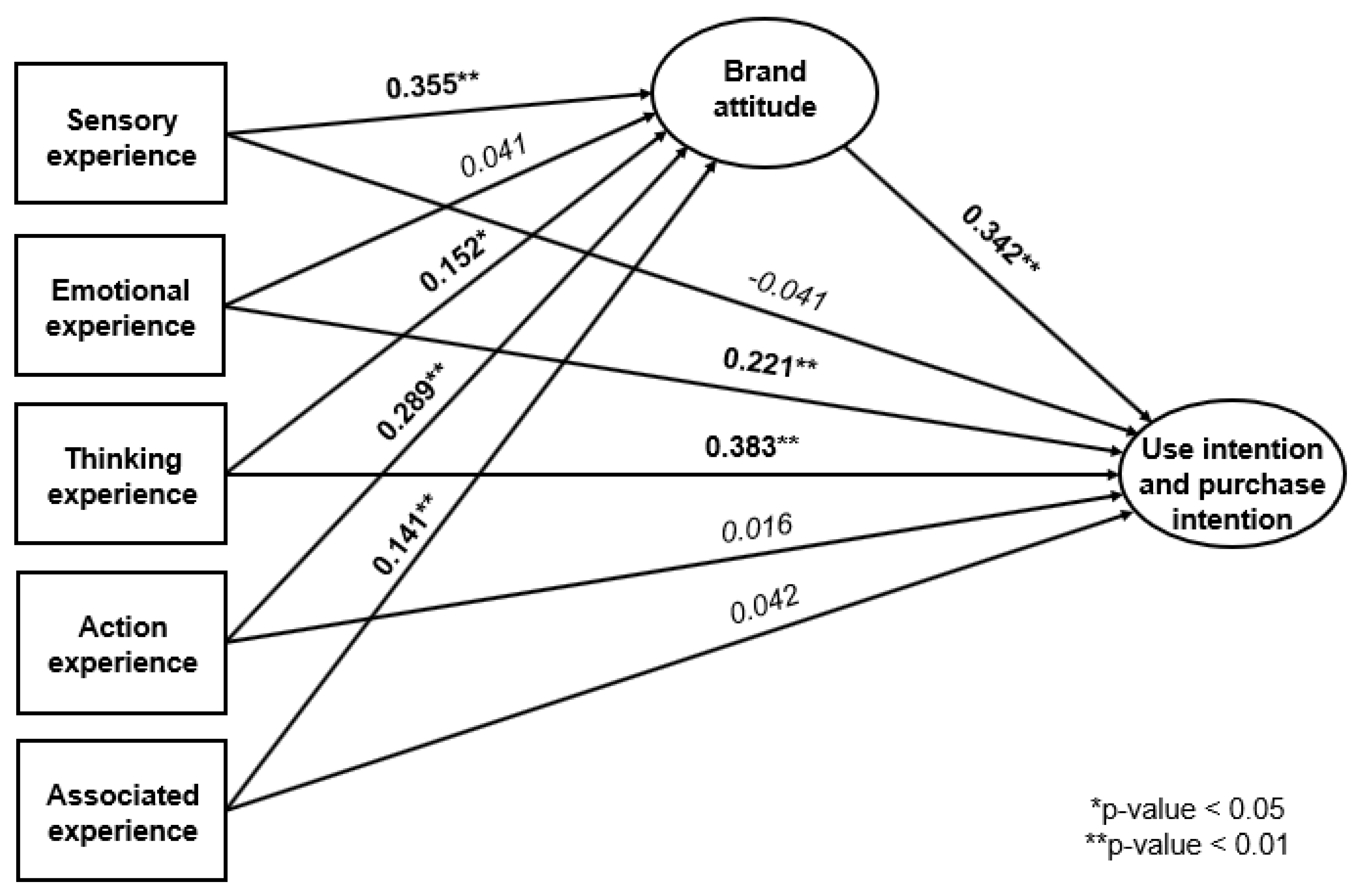
3.2. Research Model and Hypothesis
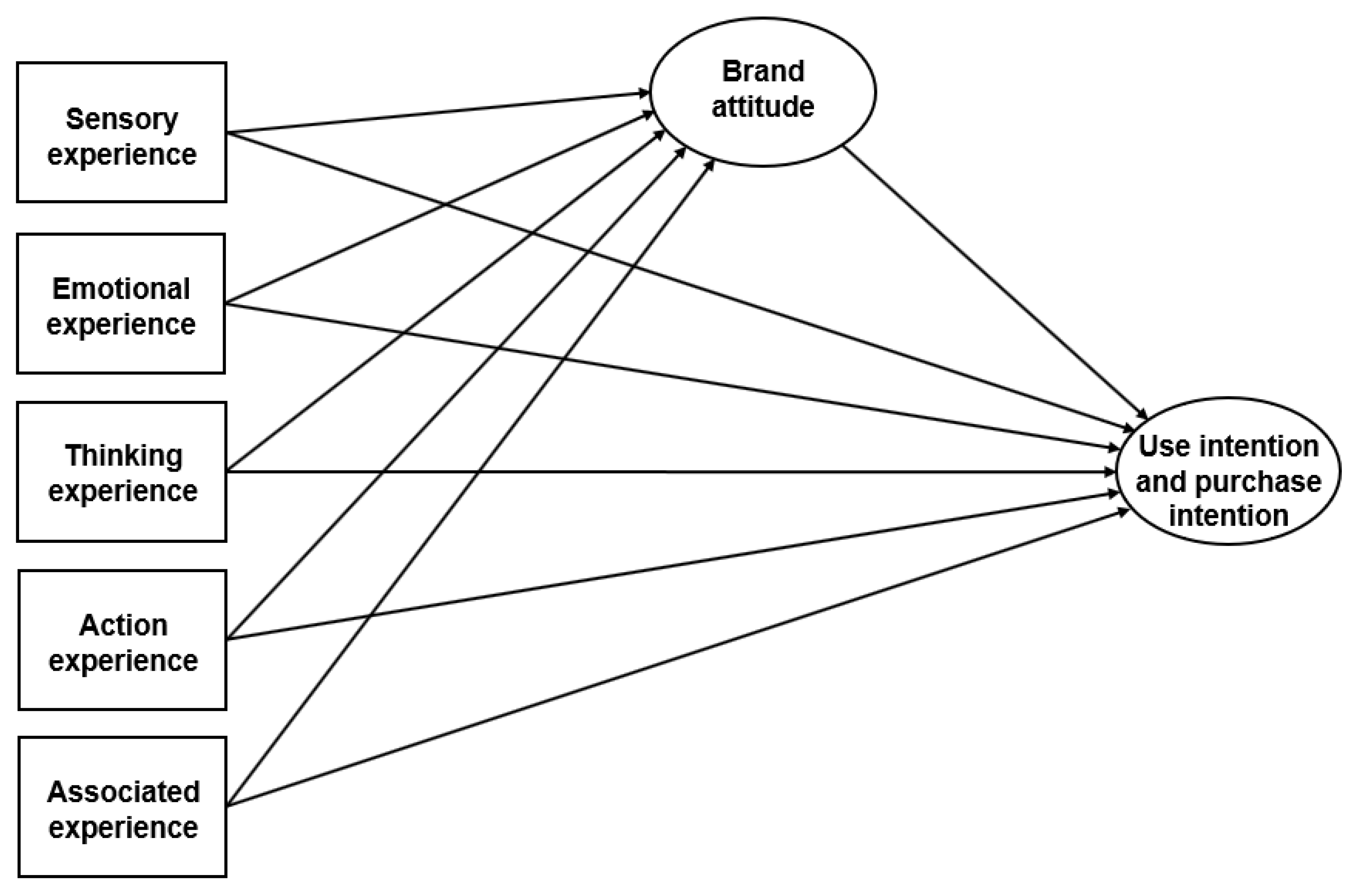
- Sensory experience (SE): SE refers to the perceptual experience generated by the user being stimulated by external senses. Indicators of sensory experiences are technical usability, sensory stimulation, and sensory immersion.
- Emotional experience (EE): EE describes the stimulation of the inner emotions of the users. This is generated by consistency between system information and users’ psychological state. Indicators are the interestingness of the application, emotional resonance, and positive emotions.
- Thinking experience (TE): Users are supported in making decisions by receiving product information, a profound understanding, and the reduction of uncertainty. Indicators for evaluating cognitive experience are the degree of information and usefulness, the triggers of thinking, and the retention of knowledge retention.
- Action experience (AcE): AcE aims to improve the feeling of involvement and the active establishment of the relationship between the brand and the user. Indicators are the form of immediate interaction, interaction form, and participation enthusiasm.
- Associated experience (AsE): Concerning the sociological dimension, AsE refers to the interaction between users and others as well as social networks. Moreover, the recommendation of the application is important.
4. Results
4.1. Demographics and Sample Characteristics
4.2. Empirical Validation
4.2.1. Measurement Model
- Indicator reliability (indicator loadings)
- Internal consistency (Cronbach’s Alpha, rho_a, and rho_c)
- Convergent validity (AVE)
- Discriminant validity (HTMT, Fornell-Larcker criterion, cross-loadings)
4.2.2. Structural Model
5. Conclusions
5.1. Limitations
5.2. Implications
5.3. Future Research
References
- Azuma, R.T. A survey of augmented reality 1997. 6, 355–385. [CrossRef]
- Milgram, P.; Takemura, H.; Utsumi, A.; Kishino, F. Augmented reality: A class of displays on the reality-virtuality continuum. Telemanipulator and Telepresence Technologies 1994, 2351. [CrossRef]
- Rauschnabel, P.A.; Babin, B.J.; tom Dieck, M.C.; Krey, N.; Jung, T. What is augmented reality marketing? Its definition, complexity, and future. Journal of Business Research 2022, 142, 1140–1150. [CrossRef]
- Graser, S.; Böhm, S. A systematic literature review on technology acceptance research on augmented reality in the field of training and education 2022. pp. 20 – 28.
- Prodea, B.; Constantin, C. The Role of Augmented Reality in Digital Marketing Strategy. Bulletin of the Transilvania University of Brasov. Series V: Economic Sciences 2023, 16(65), 39–46. [CrossRef]
- Barta, S.; Belanche, D.; Fernández, A.; Flavián, M. Influencer marketing on TikTok: The effectiveness of humor and followers’ hedonic experience. Journal of Retailing and Consumer Services 2023, 70, 103149. [CrossRef]
- Kumar, H.; Gupta, P.; Chauhan, S. Meta-analysis of augmented reality marketing. Marketing Intelligence & Planning 2022, pp. 110–123. [CrossRef]
- Zhu, Y.; Wang, C.; Mumtaz, S. Study on Virtual Experience Marketing Model Based on Augmented Reality: Museum Marketing (Example). Intell. Neuroscience 2022, 2022. [CrossRef]
- Rauschnabel, P.A.; Babin, B.J.; tom Dieck, M.C.; Krey, N.; Jung, T. What is augmented reality marketing? Its definition, complexity, and future, 2022.
- Rauschnabel, P.A.; Felix, R.; Hinsch, C. Augmented reality marketing: How mobile AR-apps can improve brands through inspiration. Journal of Retailing and Consumer Services 2019, 49, 43–53. [CrossRef]
- Brandão, T.K.; Wolfram, G. Digital Connection: Die bessere Customer Journey mit smarten Technologien – Strategie und Praxisbeispiele; Springer Gabler: Wiesbaden, 2018. [CrossRef]
- Qadri, S.B.; Mir, M.M.; Khan, M.A. Exploring the Impact of Augmented Reality on Customer Experiences and Attitudes: A Comparative Analysis with Websites. International Journal of Management Research and Emerging Sciences 2023, 13. [CrossRef]
- Steiner, P. Quick Guide Visuelles Marketing - Wie Sie mit visuellen Reizen Ihre Marke stärken; Wiesbaden: Springer Gabler, 2023. [CrossRef]
- Weinberg, P. Erlebnismarketing 1992.
- Lin, Y.H.; Fu, M.C.; Lin, P.H. Differences between Traditional and Augmented-Reality Experiential Marketing Campaigns. International Journal of Humanities and Social Science 2020, 10, 46–51. [CrossRef]
- Ghorbani, M.; Westermann, A. Integrierte Markenführung im digitalen Zeitalter: Bedeutung – Konzepte – Instrumente – Evaluation; Wiesbaden: Springer Gabler, 2023.
- Gilmore, J.H.; Pine, J. Welcome to the experience economy. Harvard business review 1998, 76 4, 97–105.
- Schmitt, B. Experiential Marketing. Journal of Marketing Management 1999, 15, 53–67. [CrossRef]
- Jung, T.H.; Bae, S.; Moorhouse, N.; Kwon, O. The impact of user perceptions of AR on purchase intention of location-based AR navigation systems. Journal of Retailing and Consumer Services 2021, 61, 102575. [CrossRef]
- Schmitt, B.H., Customer Experience Management; Gabler Verlag, 2009; pp. 697–711. [CrossRef]
- Schmitt, B., Customer Experience Management; Gabler Verlag, 2015; pp. 1–13. [CrossRef]
- Zeng, J.Y.; Xing, Y.; Jin, C.H. The Impact of VR/AR-Based Consumers’ Brand Experience on Consumer–Brand Relationships. Sustainability 2023, 15. [CrossRef]
- Hair, J.F.; Hult, G.T.M.; Ringle, C.M.; Sarstedt, M. A primer on partial least squares structural equation modeling (PLS-SEM), third edition ed.; SAGE: Los Angeles, 2022.

| # | Variables | Hypothesis |
|---|---|---|
| H1 | SE → BA | Sensory experience positively impacts brand attitude of users. |
| H2 | EE → BA | Emotional experience positively impacts brand attitude of users. |
| H3 | TE → BA | Thinking experience positively impacts brand attitude of users. |
| H4 | AcE → BA | Action experience positively impacts brand attitude of users. |
| H5 | AsE → BA | Association experience positively impacts brand attitude of users. |
| H6 | SE → UIPI | Sensory experience improves use intention and purchase intention of users. |
| H7 | EE → UIPI | Emotional experience improves use intention and purchase intention of users. |
| H8 | TE → UIPI | Thinking experience improves use intention and purchase intention of users. |
| H9 | AcE → UIPI | Action experience improves use intention and purchase intention of users. |
| H10 | AsE → UIPI | Association experience improves use intention and purchase intention of users. |
| H11 | BA → UIPI | Brand attitude of users impacts use intention and purchase intention of users. |
| Variable | Item | Indicator Loading | AVE | Cronbach’s Alpha | rho_a | rho_c | VIF |
|---|---|---|---|---|---|---|---|
| SE | SE_1 | 0.824 | 0.730 | 0.815 | 0.817 | 0.890 | 1.641 |
| SE_2 | 0.874 | 1.980 | |||||
| SE_3 | 0.865 | 1.876 | |||||
| EE | EE_1 | 0.878 | 0.756 | 0.839 | 0.851 | 0.903 | 1.946 |
| EE_2 | 0.854 | 2.050 | |||||
| EE_3 | 0.875 | 1.943 | |||||
| TE | TE_1 | 0.878 | 0.774 | 0.854 | 0.856 | 0.911 | 2.178 |
| TE_2 | 0.900 | 2.339 | |||||
| TE_3 | 0.861 | 1.923 | |||||
| AcE | AcE_1 | 0.756 | 0.673 | 0.754 | 0.755 | 0.860 | 1.288 |
| AcE_2 | 0.842 | 1.827 | |||||
| AcE_3 | 0.859 | 1.889 | |||||
| AsE | AsE_1 | 0.788 | 0.682 | 0.772 | 0.831 | 0.865 | 1.508 |
| AsE_2 | 0.798 | 1.618 | |||||
| AsE_3 | 0.889 | 1.648 | |||||
| BA | BA_1 | 0.881 | 0.696 | 0.779 | 0.789 | 0.872 | 2.133 |
| BA_2 | 0.875 | 2.167 | |||||
| BA_3 | 0.740 | 1.311 | |||||
| UIPI | UIPI_1 | 0.848 | 0.683 | 0.769 | 0.776 | 0.866 | 1.587 |
| UIPI_2 | 0.826 | 1.554 | |||||
| UIPI_3 | 0.806 | 1.565 |
| SE | EE | TE | AcE | AsE | BA | UIPI | |
|---|---|---|---|---|---|---|---|
| SE | 1 | ||||||
| EE | 0.822 | 1 | |||||
| TE | 0.771 | 0.722 | 1 | ||||
| AcE | 0.871 | 0.806 | 0.852 | 1 | |||
| AsE | 0.703 | 0.762 | 0.742 | 0.802 | 1 | ||
| BA | 0.947 | 0.800 | 0.843 | 0.979 | 0.810 | 1 | |
| UIPI | 0.823 | 0.855 | 0.940 | 0.888 | 0.785 | 0.983 | 1 |
| SE | EE | TE | AcE | AsE | BA | UIPI | |
|---|---|---|---|---|---|---|---|
| SE | 0.854 | ||||||
| EE | 0.689 | 0.869 | |||||
| TE | 0.643 | 0.624 | 0.880 | ||||
| AcE | 0.684 | 0.650 | 0.685 | 0.820 | |||
| AsE | 0.590 | 0.636 | 0.621 | 0.632 | 0.826 | ||
| BA | 0.762 | 0.658 | 0.653 | 0.752 | 0.653 | 0.835 | |
| UIPI | 0.655 | 0.695 | 0.769 | 0.679 | 0.631 | 0.761 | 0.827 |
| Item | SE | EE | TE | AcE | AsE | BA | UIPI |
|---|---|---|---|---|---|---|---|
| SE_1 | 0.824 | 0.510 | 0.520 | 0.525 | 0.390 | 0.635 | 0.513 |
| SE_2 | 0.874 | 0.679 | 0.578 | 0.596 | 0.536 | 0.647 | 0.583 |
| SE_3 | 0.865 | 0.572 | 0.549 | 0.629 | 0.579 | 0.671 | 0.580 |
| EE_1 | 0.599 | 0.878 | 0.623 | 0.563 | 0.575 | 0.608 | 0.658 |
| EE_2 | 0.500 | 0.854 | 0.387 | 0.462 | 0.488 | 0.467 | 0.508 |
| EE_3 | 0.678 | 0.875 | 0.584 | 0.651 | 0.583 | 0.620 | 0.626 |
| TE_1 | 0.576 | 0.555 | 0.878 | 0.562 | 0.526 | 0.578 | 0.660 |
| TE_2 | 0.589 | 0.564 | 0.900 | 0.647 | 0.571 | 0.670 | 0.681 |
| TE_3 | 0.531 | 0.528 | 0.861 | 0.596 | 0.541 | 0.572 | 0.688 |
| AcE_1 | 0.656 | 0.553 | 0.550 | 0.756 | 0.489 | 0.639 | 0.528 |
| AcE_2 | 0.497 | 0.446 | 0.560 | 0.842 | 0.507 | 0.595 | 0.562 |
| AcE_3 | 0.528 | 0.597 | 0.573 | 0.859 | 0.556 | 0.614 | 0.576 |
| AsE_1 | 0.397 | 0.470 | 0.459 | 0.536 | 0.788 | 0.452 | 0.449 |
| AsE_2 | 0.355 | 0.440 | 0.424 | 0.367 | 0.798 | 0.403 | 0.427 |
| AsE_3 | 0.641 | 0.628 | 0.617 | 0.621 | 0.889 | 0.696 | 0.640 |
| BA_1 | 0.771 | 0.622 | 0.664 | 0.697 | 0.577 | 0.881 | 0.642 |
| BA_2 | 0.649 | 0.545 | 0.541 | 0.613 | 0.468 | 0.875 | 0.638 |
| BA_3 | 0.465 | 0.470 | 0.515 | 0.563 | 0.594 | 0.740 | 0.628 |
| UIPI_1 | 0.548 | 0.577 | 0.724 | 0.555 | 0.584 | 0.679 | 0.848 |
| UIPI_2 | 0.595 | 0.588 | 0.643 | 0.622 | 0.517 | 0.624 | 0.826 |
| UIPI_3 | 0.475 | 0.559 | 0.522 | 0.501 | 0.452 | 0.578 | 0.806 |
| VIF | Path coefficients | t-values | p-values | Significance | |
|---|---|---|---|---|---|
| SE → BA | 2.567 | 0.355 | 5.969 | 0.000 | Yes** |
| EE → BA | 2.858 | 0.041 | 0.653 | 0.514 | No |
| TE → BA | 2.084 | 0.152 | 2.484 | 0.013 | Yes* |
| AcE → BA | 2.153 | 0.289 | 4.806 | 0.000 | Yes** |
| AsE → BA | 3.473 | 0.141 | 2.915 | 0.004 | Yes** |
| SE → UIPI | 2.411 | -0.041 | 0.710 | 0.478 | No |
| EE → UIPI | 2.417 | 0.221 | 3.796 | 0.000 | Yes** |
| TE → UIPI | 2.467 | 0.383 | 6.744 | 0.000 | Yes** |
| AcE → UIPI | 2.906 | 0.016 | 0.245 | 0.806 | No |
| AsE → UIPI | 2.320 | 0.042 | 0.836 | 0.403 | No |
| BA → UIPI | 2.399 | 0.342 | 4.977 | 0.000 | Yes** |
Disclaimer/Publisher’s Note: The statements, opinions and data contained in all publications are solely those of the individual author(s) and contributor(s) and not of MDPI and/or the editor(s). MDPI and/or the editor(s) disclaim responsibility for any injury to people or property resulting from any ideas, methods, instructions or products referred to in the content. |
© 2025 by the authors. Licensee MDPI, Basel, Switzerland. This article is an open access article distributed under the terms and conditions of the Creative Commons Attribution (CC BY) license (http://creativecommons.org/licenses/by/4.0/).