Preprint
Article

This version is not peer-reviewed.

A Multi-Model Ontological System for Intelligent Assistance in Laser Additive Processes

A peer-reviewed article of this preprint also exists.

Submitted:

12 March 2025

Posted:

13 March 2025

You are already at the latest version

Abstract

Obstacles that hinder the mass adoption of additive manufacturing (AM) processes for fabrication and processing of metal parts are discussed. The necessity of integrating an intelligent decision support system (DSS) into the professional activities of AM process engineers is proved. Advantages of applying a two-level ontological approach to the creation of semantic information for developing an ontology-based DSS are pointed out. Its key feature is that ontological models are clearly separated from data & knowledge bases formed on their basis. An ensemble of ontological models is presented, which is the basis for the intelligent DSS being developed. The ensemble includes ontologies for equipment and materials reference databases, a library of laser processing technological operation protocols, knowledge base of settings used for laser processing and for mathematical model database. The ensemble of ontological models is implemented at IACPaaS cloud platform. Ontologies, databases and knowledge base, as well as DSS, are part of the laser-based AM knowledge portal, which was created and is being developed on the platform. Knowledge and experience obtained by various technologists and accumulated in the portal will allow us to lessen a number of trial experiments for finding suitable settings and to reduce requirements to skills of users.

Keywords: 
;  ;  ;  ;  ;  

1. Introduction

Additive manufacturing (AM) technologies for metal parts have the following capabilities: manufacturing products of complex shapes, significantly reducing the weight of products and shortening the production time of prototypes, increasing the efficiency of using materials. In individual and small-scale production, AM techniques are an alternative to traditional methods of material processing (casting, forging, cutting, etc.). Their application in production processes opens up the possibility of creating, repairing and modifying complex structures with improved properties that previously could not be obtained due to technological limitations [1,2,3]. The trend for steady growth of the global market of additive technologies is stated today and forecasted in the future by many consulting companies (Frost & Sullivan, Precedence Research, Zion Market Research, etc.) [4].
The technological process DED-LB (Laser-Based Directed Energy Deposition – direct supply of laser energy and material) [5,6] is the most complex but promising AM process [7]. With its help, it is possible not only to manufacture large-sized metal objects, but also to repair damaged or worn-out parts, as well as their structural and functional modification [8].
Along with the advantages of introducing additive technologies, there are also barriers that make it difficult to use AM for fabrication of metal parts [9,10,11]. The main problem is the need to take into account the influence of a large number of factors and technological parameters of laser processing on the elemental composition and microstructure of the part material (formation of various types of defects: cracks, pores, delaminations, etc.) acting on the way to post-processing, as well as the physical and mechanical characteristics of the final product. Currently, the settings for laser processing of metallic materials are often identified by “trial and error” method. This approach to the design of additive manufacturing processes is resource- and time-consuming [9,12]. Taking into account the interdependence between the key parameters of the process requires interdisciplinary knowledge and professional cooperation of specialists. A consequence of this can be called a personnel problem related to the “high threshold of entry” into laser AM (LAM).
Against this background, there is an insufficient level of intellectual support for process engineers in designing AM processes [10,11,13], which is associated with the difficulty of scaling technological solutions in the manufacture of metal products by directed energy deposition (DED). There is a shortage of intelligent advising systems to assist designers, technologists and other specialists in defining the proper technological parameters. The complexity, timing and cost of maintaining such systems make AM processes unprofitable in many cases [14,15].
These problems determine the relevance of creating a viable [16] intelligent decision support system (DSS) for LAM process engineers [17,18]. At the design stage of the technological operation, the DSS develops recommendations on suitable operating modes of laser robotic equipment for developing control programs. A suitable mode is understood as a set of such values of the parameters of an additive technological process that make it possible to ensure that the resulting metal blanks and parts meet the required quality criteria in terms of elemental composition, geometric dimensions, the presence/absence of various defects, microstructure (specified in the requirements for the result of the technological operation).
One of the widespread approaches to the creation of software systems is the design and development of software based on ontologies (ontology-based (-driven) software engineering, OBSE/ODSE) [19]. This work is devoted to the description of an ensemble of ontological models (OM), which is the basis for an intelligent DSS for process engineers in the field of LAM of metal parts using DED-LB technology.

2. Materials and Methods

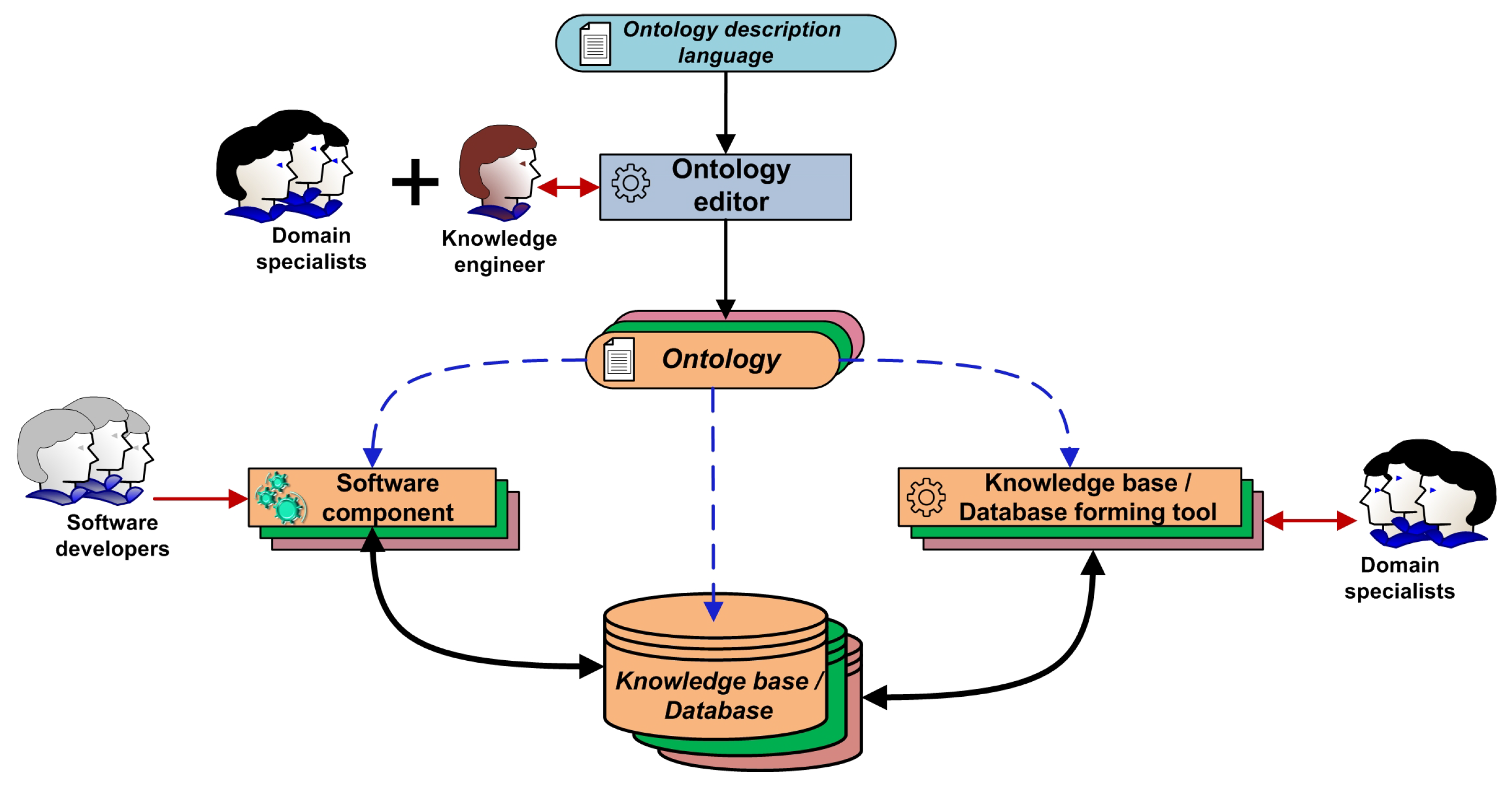
The development of a set of semantic information resources is based on an ontological two-level approach to the representation and formation of data and knowledge [20]. In this approach, OM is clearly separated from databases (DB) and knowledge bases (KB), and the ontology is the set of rules for the structured formation of subject information and its interpretation, but not the information itself [16]. At the same time, databases and knowledge bases (containing the domain knowledge) are clearly separated from software units that implement methods of their processing (knowledge about methods of problem solving). The linking, consistency and multiple use of these components are ensured at the ontology level (Figure 1).
This approach allows the development and further maintenance of domain knowledge and software units independently by different groups of specialists. The independence of software units from the database/knowledge base allows one to modify the latter without making changes to the program code (in most cases).
The ontologies created on their basis by DB/KB, as well as software components for their processing, have a common declarative semantic representation in the form of concept digraphs [21]. For the formal representation of ontologies, the ontology description language for a digraph connected two-level model of information units is used [22,23]. The language provides a means of specifying ontology models in the form of labeled root hierarchical binary digraphs. Semantic information generated on the basis of ontology models is represented by the same type of digraphs, except that they do not contain markup defining the rules for the formation of digraphs of target information.
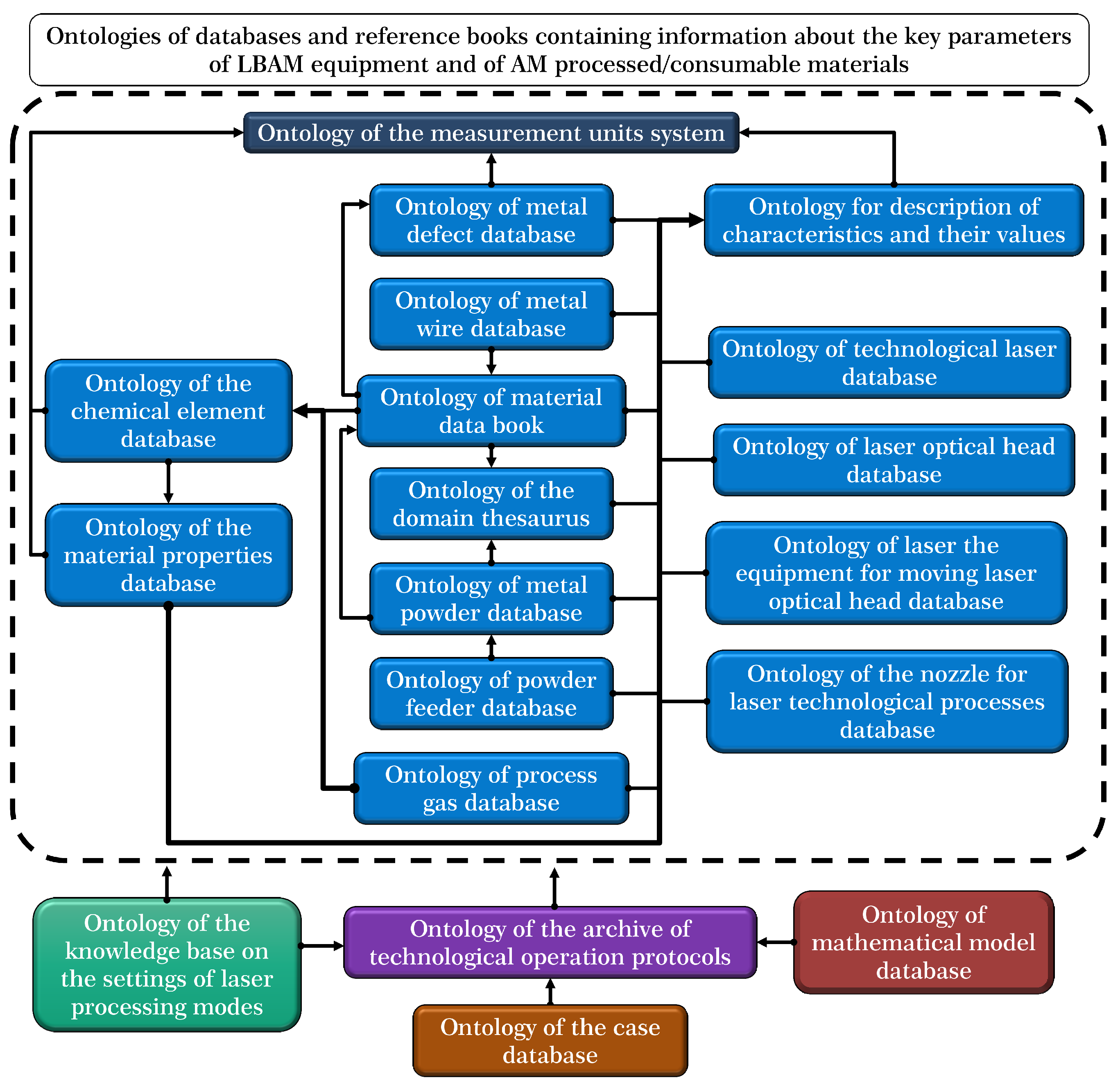
The composition of the ensemble of related OM is determined by the following factors. First of all, it is necessary to ensure the possibility of structuring and formalizing all necessary information about the technological operations (TO) of the LAM, as well as about the characteristics of the materials and equipment used. It should be possible to form a complex of related databases and reference books containing information on the characteristics materials processed in LAM, equipment used and on the protocols of the TO carried out. The LAM technological equipment includes: industrial technological lasers equipped with laser optical heads; devices that facilitate the movement of the heads relative to the surface to be processed and the positioning of parts (e.g., multi-axis industrial robots and positioners); powder feeders; material supply units in the melting/processing area, etc. Processed and consumable materials include: metal powders and wires prepared of various alloys; process gases used as carrier, shielding and auxiliary (shaping) agents. The OM ensemble includes ontologies of relevant databases and reference books, as well as the ontology of the archive (library) of laser processing protocols.
Approaches and methods that are proposed to be used to issue recommendations to process engineers on setting up maintenance modes include: deductive logical conclusion based on known formalized knowledge and facts; reasoning by analogy (case-based reasoning) using an accumulated database of cases (which are formalized protocols of performed TOs); numerical modeling of physical and chemical thermodynamic processes occurring in the field of interaction of focused laser beam with the processed material. In the formation and development of methods for predicting the qualitative characteristics of parts synthesized by DED-LB process, numerical modeling is reliable and relatively cheap [24]. The OM ensemble includes: the ontology of the KB on the settings of laser processing modes; the ontology of the case database and the ontology of the database of mathematical models of thermodynamic processes accompanying the DED-LB technology. The base of mathematical models is designed to store software implementations of calculations of parameter values of simulated processes. When forming knowledge and the library of laser processing protocols, the terms and contents of a set of related databases and reference books are used.
An important factor is to ensure greater modularity and multiple use of databases and reference books, as well as the possibility of their independent formation by different subject specialists (in laser physics, materials science, optics, etc.).
A set of such ontologies is described in [25]. Their approbation by specialists allowed us to identify the ways to improve the developed ontologies: clarifying and expanding their content, expanding the range of ontology models on the whole, further modification and development of individual models through their modularization.

3. Results

A systematic analysis, structuring and formalization of the field of professional activity of LAM process engineers related to the design of maintenance modes have been carried out. The characteristics of the components of the laser robotic equipment (as LAM machine), as well as processed and consumable materials that can influence the progress and result of the LAM technological process are clarified. The OM ensemble has been restructured and expanded to provide intelligent decision support by process engineers when designing maintenance modes. The list of ontology models included in the ensemble is shown in Figure 2.
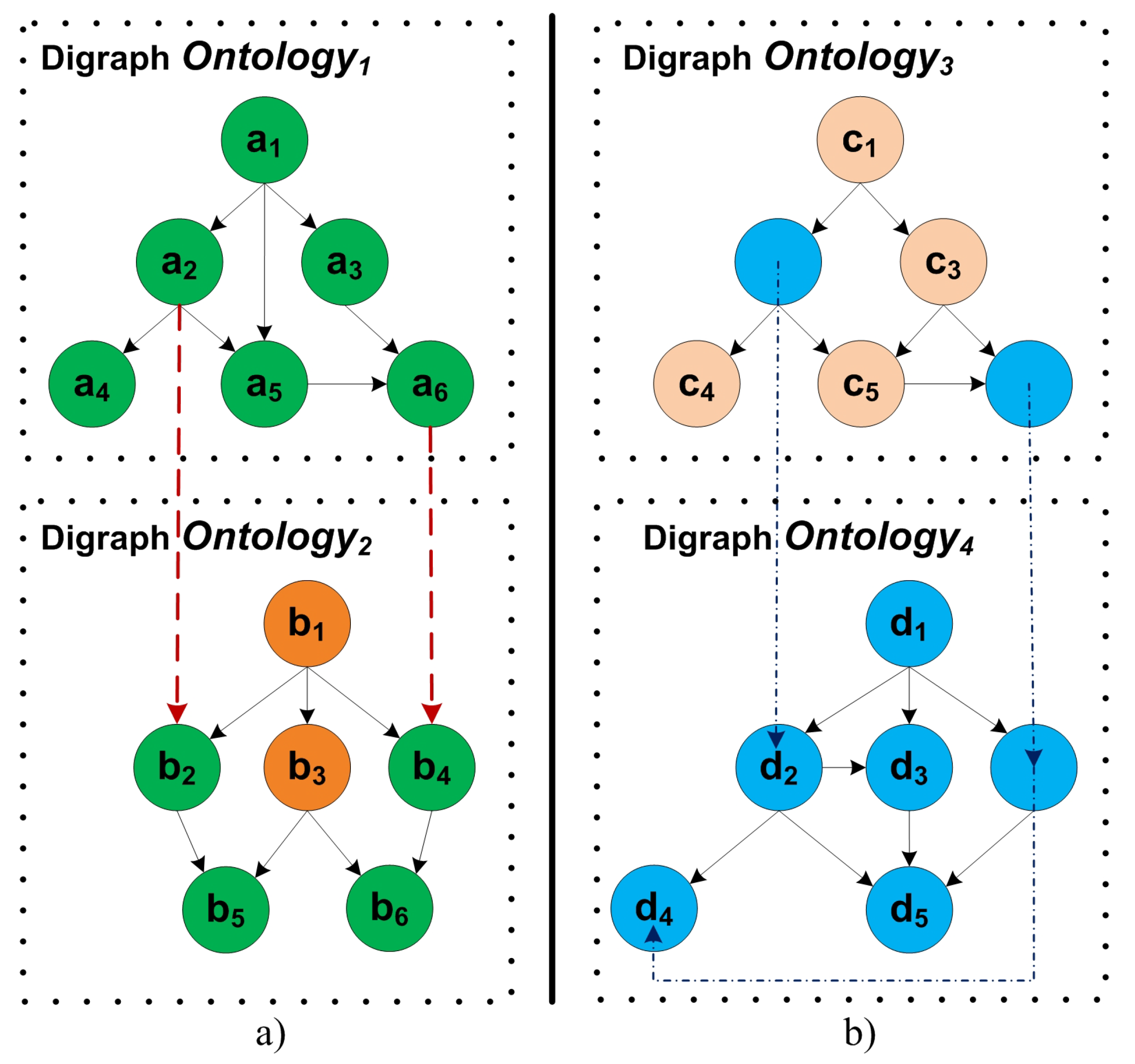
The arrows in Figure 2 reflect directed connections (relations) between ontologies. These connections (see Figure 31) can be of two types.
  • Structural coherence. The directed connections between the concepts of ontologies (arcs between vertices of corresponding ontology digraphs) determine the multiple use in some digraph of the ontology of subgraphs of digraphs of other ontologies. Such subgraphs can represent either a single terminal vertex or a digraph as a whole. In Figure 3a, connections of this type are represented by dotted arcs a 2 b 2 and a 6 b 4 . Vertices b 2 , b 4 , b 5 , b 6 belong to the digraph of the O n t o l o g y 2 , but they become attainable and thus logically included in the O n t o l o g y 1 digraph.
  • Terminological coherence. Such directed connections are set for labels of ontology concepts and determine the fact that labels are “borrowed” by some vertices of the digraph (which in this case do not have their own labels) from other vertices whose labels are their own. In Figure 3b, connections of this type are represented by dash-and-dot arrows coming out of vertices that do not have their own labels and entering vertices with their own labels – d 2 and d 4 , respectively.
The terminological coherence (Figure 3b) has the following features.
  • These are one-to-many relationships: the label of one vertex can be borrowed by many vertices other than it.
  • A vertex with its own label and vertices with borrowed labels from it can belong to different digraphs or to the same digraph. At the same time, there may be or may not be a path in the digraph between a vertex with its own label and a vertex that borrows this label.
  • The borrowing of a label can be both direct and indirect. In the first case, for a pair of vertices, one of them necessarily has its own label, and the other borrows it. This case is represented by a vertex with its own label d 2 and a vertex that is a direct descendant of vertex c 1 . In the second case, the vertex whose label is being borrowed may also have not its own label, but borrow the label of another vertex. This situation is iterative, and the condition for completion is the occurrence of the first case. The second case is represented by a two-step iteration, which ends in a situation where one of the vertices in the pair becomes a vertex labeled d 4 . The natural limitation here is that the sequence of such connections should not form a cycle.
Connections of the second type allow to ensure terminological consistency of ontologies. Two or more OM can have both types of connections between them. The ensemble of digraphs of target (subject) information formed on the basis of ontologies has the same type of connection, and their creation is regulated by marking the arcs of digraphs of ontologies [22,23].

3.1. Ontologies of Reference Databases on Equipment and Materials

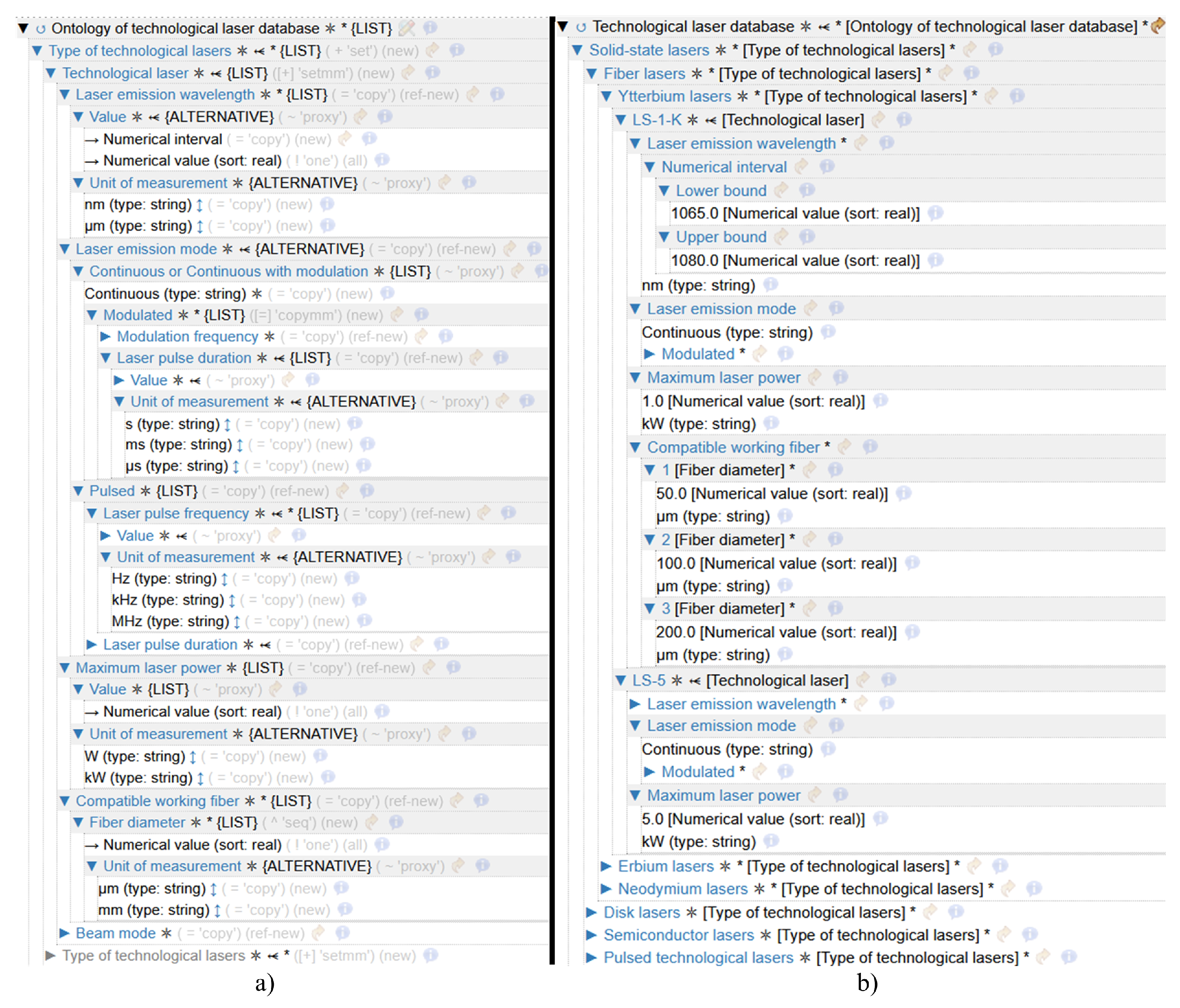
Let us refer to the set of linked ontologies of reference databases containing information about key characteristics of LAM equipment and materials, shown in Figure 2. Further, regarding the equipment we will consider such an important component of LAM machines as a technological (industrial) laser. A fragment of the Ontology of technological laser database and a fragment of the database (Technological laser database) formed on its basis are shown in Figure 42.
In this figure and similar figures below, the symbol → reflects the structural coherence between the digraphs of ontology models, and the symbol ↕ reflects the terminological coherence between the vertices of the digraphs of ontology models, as well as between the vertices of the digraphs of target information. The symbol ⋇ standing next to the vertex label means that this label is borrowed by some set of vertices. The symbol error indicates the fact that more than one arc enters the vertex next to the label of which it is displayed. The beginning vertex of such an arc can belong to either the same or another digraph. The markup present in the digraphs of ontology models is LIST, ALTERNATIVE, (= ’copy’), ([=] ’copymm’), (! ’one’), ([!] ’onemm’), (+ ’set’), ([=] ’setmm’), ( ’proxy’), (new), (ref), (clone), (all), etc. determines the rules for the formation of digraphs of target information databases and reference books. The semantics of this markup, as well as the rules of formation based on it, are described in [22,23].
The key characteristics for the components of the technological equipment and the materials of the LAM are those characteristics that are essential when they are used in technological processes. These characteristics include: the laser emission wavelength, the laser emission mode (continuous wave – CW, continuous with the possibility of modulation – quasi-continuous wave (QCW), pulsed), the maximum laser power; compatible working fiber, the key characteristic of which is the diameter. The key characteristics of pulsed and modulated (QCW) emission are the pulse repetition rate (modulation frequency, respectively) and the pulse duration.
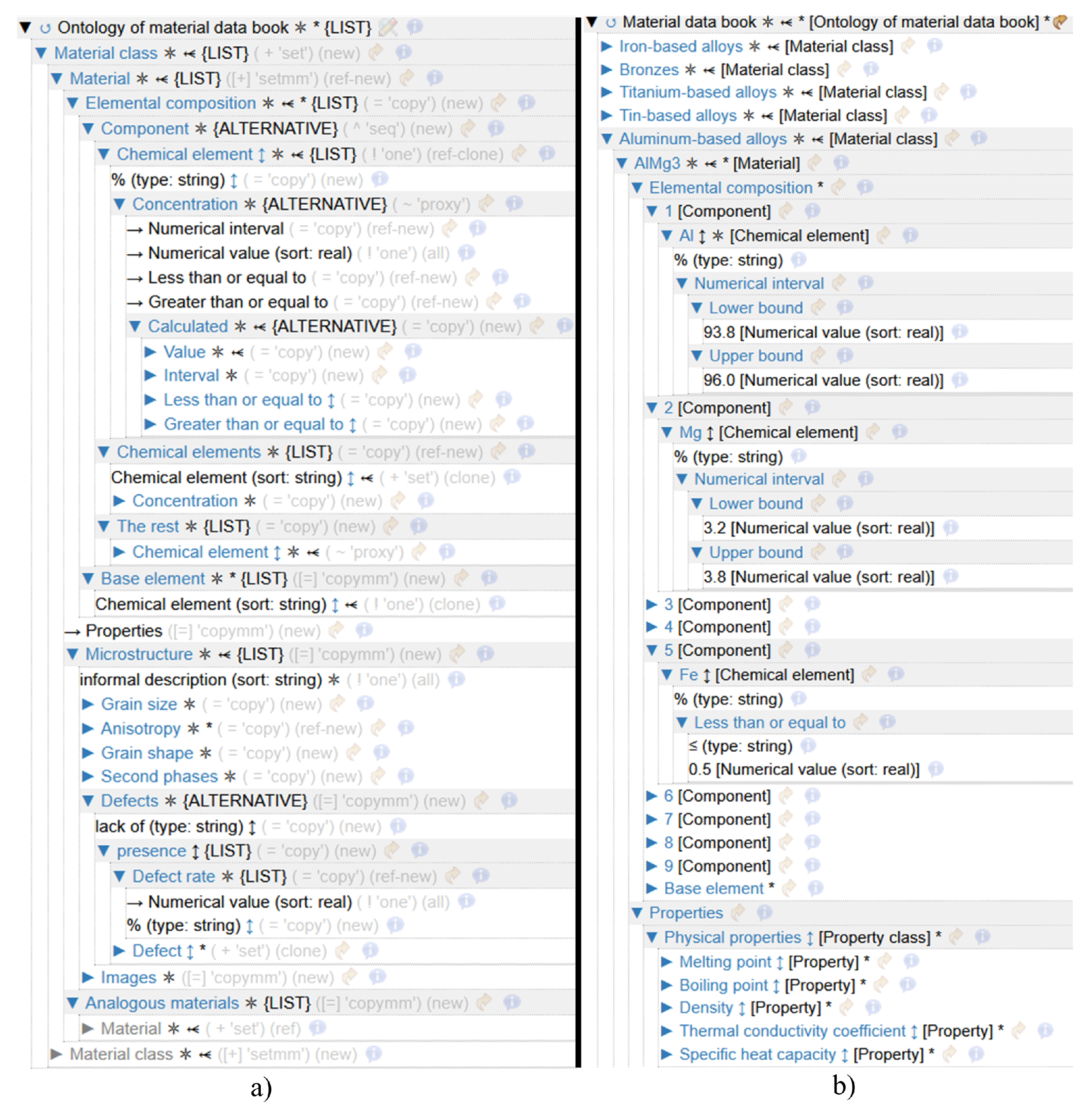
A fragment of the Ontology of the materials reference book and a fragment of the reference book (Materials reference book) formed on its basis are shown in Figure 5.
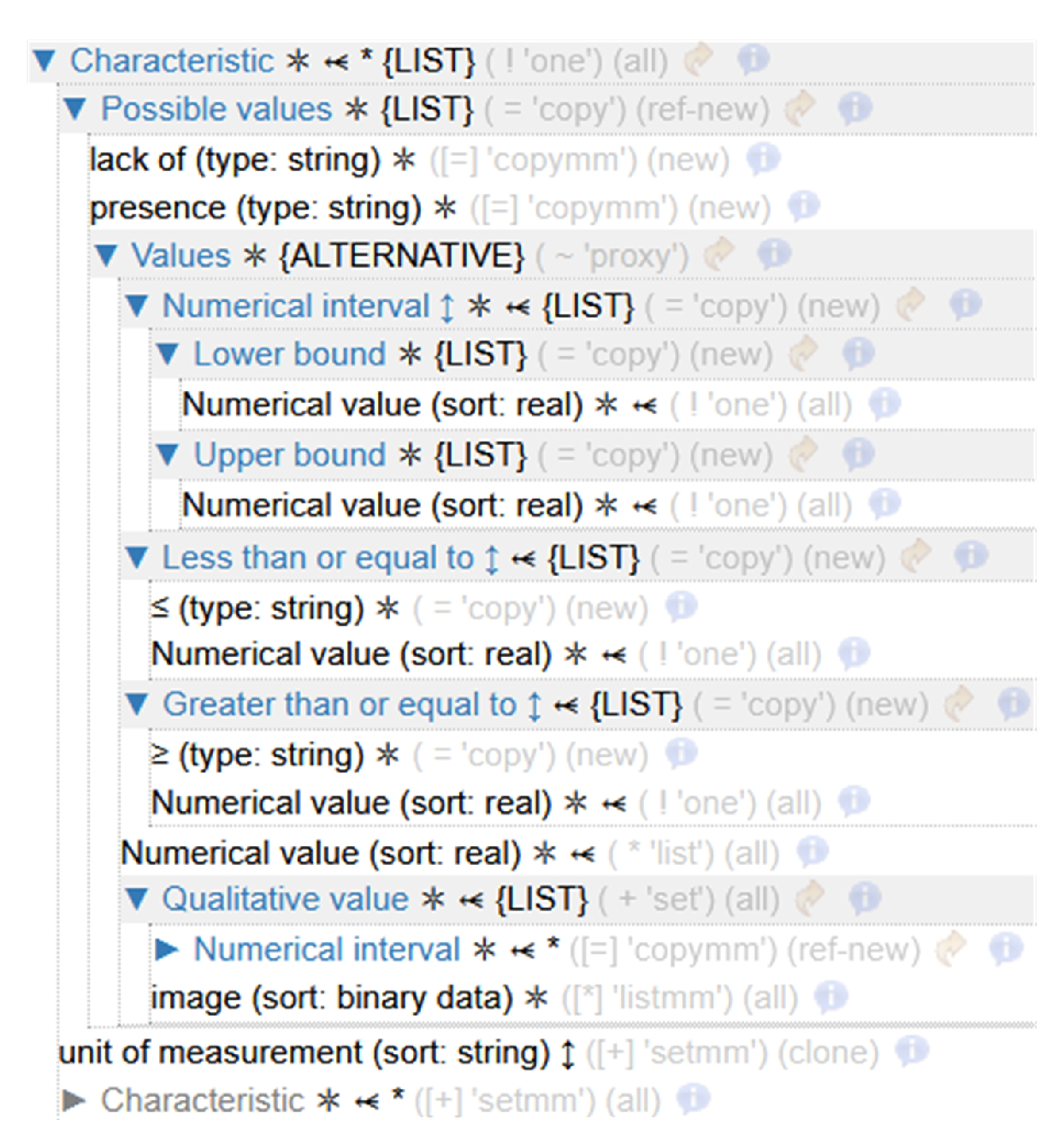
The material is characterized by its elemental (chemical) composition and the percentage of the components. The percentage can be specified not for one, but for a combination of chemical elements. The properties of the material (physical, thermal mechanical, etc.), as well as its microstructure, are of great importance. The property is characterized by its name, a range of possible values, may have synonymous names and a list of units of measurement. The value of a property can be numeric or qualitative, a set of values, or a numeric interval. A property can be simple or have many characteristics. Structurally, the characteristic is similar to a property and is recursive, i.e., it contains, possibly empty, a set of similar nested characteristics (Figure 6).
The microstructure is characterized by the size of the grains, their shape (polygonal, dendritic, polyhedral, spheroidal, etc.) and predominant orientation, the presence or absence of second phases, as well as the presence or absence of defects characteristic of the microstructure of the material. In case of the presence of the second phases, their percentage, shape and grain size are set. If there are defects, their total quantity is indicated as a percentage, and the structure of the description of each defect completely coincides with the structure of the description of the material property. For the microstructure, it is possible to store its images. Important information about the material is a list of its analogues, if such analogues are known.

3.2. The Ontology of the Case Database

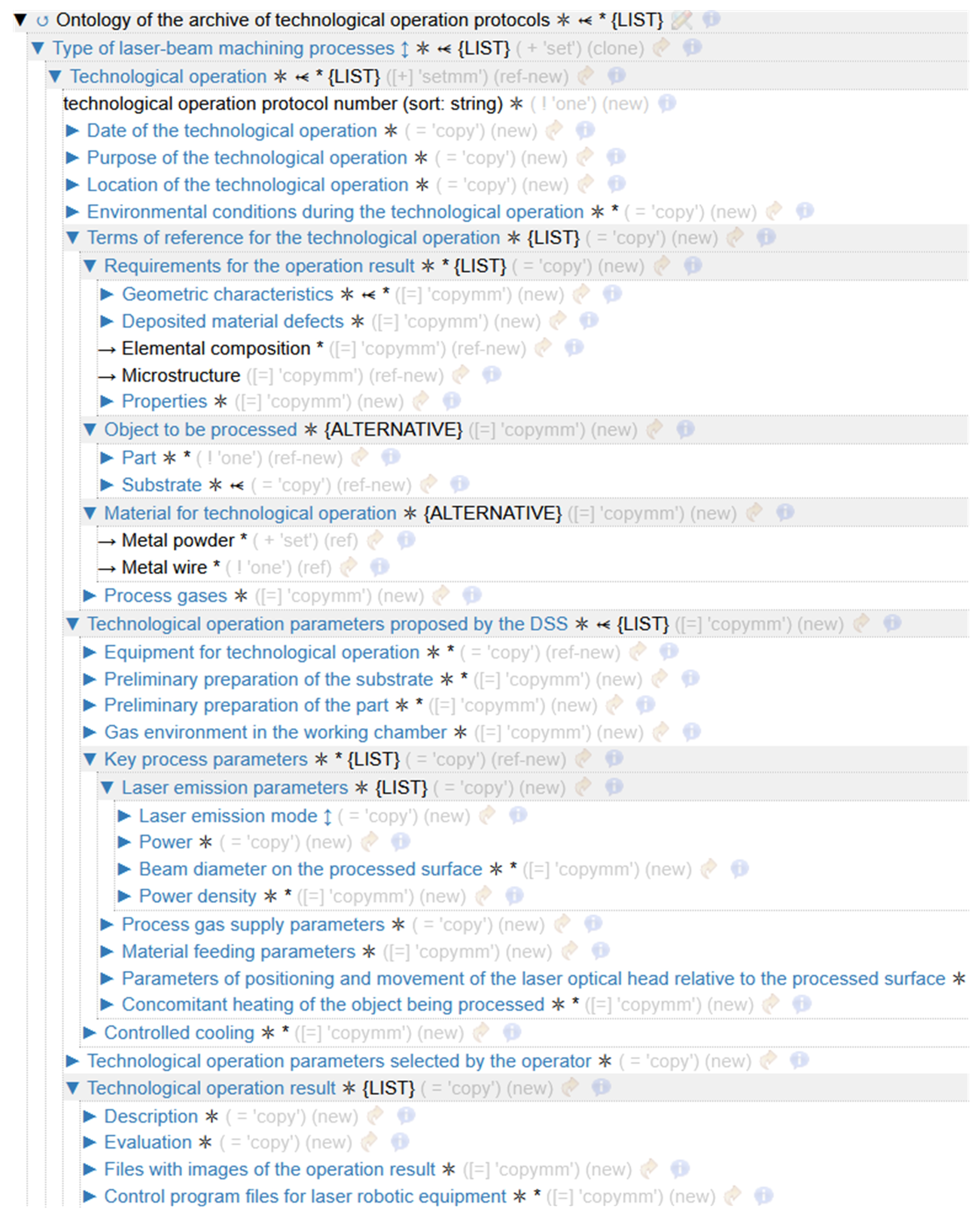
Basing on the results of the initial testing, the Ontology of the archive (library) of laser processing TO protocols (previously called ontology of technological operations) has been significantly revised and expanded [25]. This ontology uses fragments of ontologies of reference databases on equipment and materials (Figure 7).
The TO protocol includes the following sections: general information about the TO; environmental conditions when performing the TO; terms of reference for the TO; equipment for performing the TO; information about pre-treatment of the substrate or the part; the working gas environment created; key process parameters for performing the TO; possible controlled cooling of the part or the workpiece; and the result of the TO.
General information about the TO includes the name of the TO, the protocol number, the deadline, the purpose and the place of performing the TO. Environmental conditions include temperature, relative humidity and atmospheric pressure of the environment in which the TO has been performed. This information is significant because the technological equipment must be provided with conditions under which its operating temperature will be higher than the dew point of technological (process) gases.
The terms of reference for the TO includes the following sections: requirements for the result of the TO; the object to be processed which is a substrate or a part; the material for performing the TO which is metal powder (there may be more than one) or metal wire; process gases used for performing the TO.
The section with requirements for the result consists of the following subsections: geometric characteristics, defects, elemental composition, microstructure and properties of the deposited material.
These sections are filled in or may remain unfilled, depending on the task being performed. In accordance with ASTM F3413-19, there are four types of them: the manufacture of a new part/workpiece, the repair of a worn or damaged part, the application of a functional coating on the part/workpiece (surface modification), the build-up of functional or structural elements on the part/workpiece. A separate type of tasks to perform may include carrying out research works aimed at identifying and working out modes of the TO that are suitable for a specific practical application.
In the geometric characteristics section, a file describing the electronic (digital) geometric model of the part is placed (usually, in either the *.stl or *.amf format). Alternatively, depending on geometrical shape, a set of sizes of those geometrical characteristics of the target result, by which it needs to be evaluated, is specified. The defects section lists which defects (and their characteristics) are acceptable (and within which limits), and which should be absent. Porosity is a typical example of a defect that is permitted within certain constraints. In the elemental composition section, the user can specify the elemental (chemical) composition that is necessary/desirable to obtain as a result. In the microstructure section, the preferred microstructure of the applied material can be specified. The properties section can list the requirements for the characteristics (properties) that must be obtained as a result of performing the TO.
The markup specified in the ontology regulates that the names of chemical elements, defects, properties (and their values), etc., as well as their units of measurement, which should be selected from the appropriate reference databases while forming the protocol. Additional ontological agreements consist in the fact that the specified values for defects, properties, etc. should belong to the range of possible values that are defined for them in the relevant reference bases.
The essential characteristics of the substrate are the material from which it is made, its geometric characteristics and its weight. The same characteristics are essential for the part as for the substrate, but it should additionally be taken into account that the material of the working surface of the part may differ from the material of its base. The process gas can be either monogas or a multicomponent gas mixture.
In the equipment for performing the TO section, the equipment used for carrying out the operation is specified.
The preliminary preparation of the substrate section is filled in if the substrate (e.g., for some research work) is the object of processing, and not the part. If information about the substrate has already been set in the terms of reference, then it is not duplicated here, and if necessary (if the substrate should be heated to a certain temperature at a certain heating rate before starting the process), information about controlled heating of the substrate during processing is filled in. If the substrate has not been specified in the terms of reference, then the characteristics listed in the section of the terms of reference for performing the TO are specified here. Controlled heating is characterized by the temperature to which the substrate should be heated, as well as by the heating rate. The temperature value is usually the numerical range that needs to be maintained. If a part was specified as the processing object in the terms of reference, then information about controlled heating of the part can be specified in the preliminary preparation of the part section. Controlled heating is required, first of all, for massive parts with high thermal conductivity, in order to bring the crystal structure of the material to a certain energy state immediately before its processing with focused radiation.
The gas environment in the working chamber section is filled if, during performing the TO, a “global” (protective) gas environment was created in some working chamber – in addition to the shielding gas/gas mixture, which is delivered through the gas-powder mixture supply unit and forms a “local” protection in the area of the melt pool and of crystallizing metal. Information about the gas environment in the working chamber includes information about which filling process gas – monogas or a gas mixture – was used to create the environment, as well as parameters such as the volume flow rate, the pressure and the temperature of the gas. In the case of using a gas mixture, the percentage is indicated (i.e., the volume fraction of each monogas in it).
The key parameters of the TO section consists of four subsections: laser emission parameters; process gas supply parameters; material feeding parameters and parameters of positioning and movement of the laser optical head (relative to the surface processed). The key parameters of laser radiation include: the mode of radiation generation (continuous, modulated, pulsed), its power, and the diameter of the spot of the laser beam on the surface being processed. For modulated and pulse modes, the pulse duration and, accordingly, the modulation frequency of the output power/pulse frequency are also important characteristics.
The process gas supply parameters section consists of three subsections: parameters of the shielding gas environment (providing “local” protection of the melt pool and of crystallizing metal area), parameters of the carrier gas and parameters of the auxiliary (shaping) gas. The structure of the information for describing the shielding gas environment coincides with the structure of the information for describing the gas environment created in the working chamber. The carrier and auxiliary gases are monogas, their key parameters are also the volume flow rate, the pressure and the temperature.
The material feeding parameters section includes two alternative subsections: metal powder material and metal wire material. Specification of metal powder material includes information about which metal powder or composition of metal powders was used as a material for performing the TO, as well as parameters such as mass flow rate and, optionally, the number of revolutions of the dosing disk of the powder feeder. In case of using a metal powder composition, these parameters are set for each component. In this case, the metal powders are not mixed in one hopper of the powder feeder but are fed separately. Specification of metal wire material includes information about which wire was used as a material for performing the TO, as well as parameters such as the feed rate and the feed technique – central or lateral (in the second case, the feed angle is also specified).
The parameters of movement and positioning of the laser optical head include: the linear velocity of the laser beam movement over the surface; the angular velocity of rotation of the positioning device; the distance from the focus point of the laser radiation to the surface being processed; the step of displacement of the center of the focused laser beam (relative to the center of the pre-created bead); the tool path strategy, etc.
The controlled cooling section is filled if, after completion of the TO, the cooling of the part (workpiece) should be controlled, i.e., carried out to a certain temperature at a certain speed. Controlled delayed cooling can be used to prevent or reduce the possibility of forming various types of cladding (or welding) defects. The structure of this section coincides with the structure of the controlled heating section.
The result of the TO section includes a description of the result obtained and its evaluation. The description of the result contains the same subsections as the section with the requirements for the result – geometric characteristics, defects, elemental composition and microstructure of the applied material. In evaluating the overall result of the TO and the result of each of the listed sections (subsections), it is indicated whether it meets the requirements specified in the terms of reference and, if it does not, it is indicated whether to consider this result positive or negative. The conformity assessment of the properties is carried out after the completion of post-processing measures, which have a positive effect on the microstructure, as well as exclude or significantly reduce the possibility of defects forming in the deposited material. Such measures include various types of thermal, mechanical or chemical treatment. This section contains subsections in which files with images of the TO result and files of control programs for laser robotic equipment can be placed.
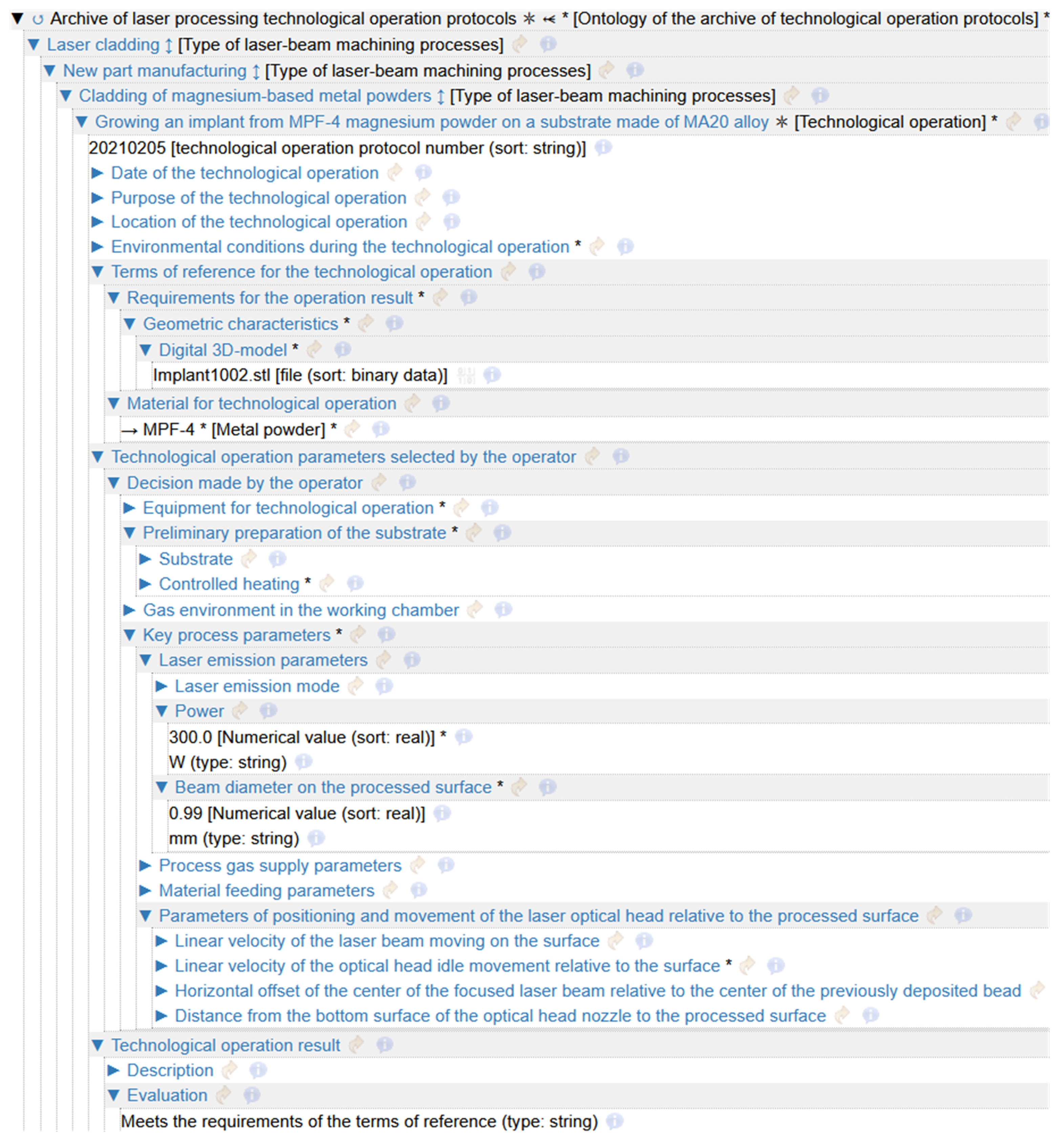
Figure 8 shows a fragment of the Archive of laser processing TO protocols, in particular, a fragment of the protocol “Growing an implant from MPF-4 magnesium powder on a substrate made of MA20 alloy”. Argon monogas was used as the filling process gas in the working chamber. Helium monogas was used as a shielding gas environment providing protection of the melt pool area and as a carrier gas. No auxiliary (shaping) gas was required, since a powder feed module 4W (four-stream with a circle of 2 mm diameter) was used to supply metal powder to the processing area.
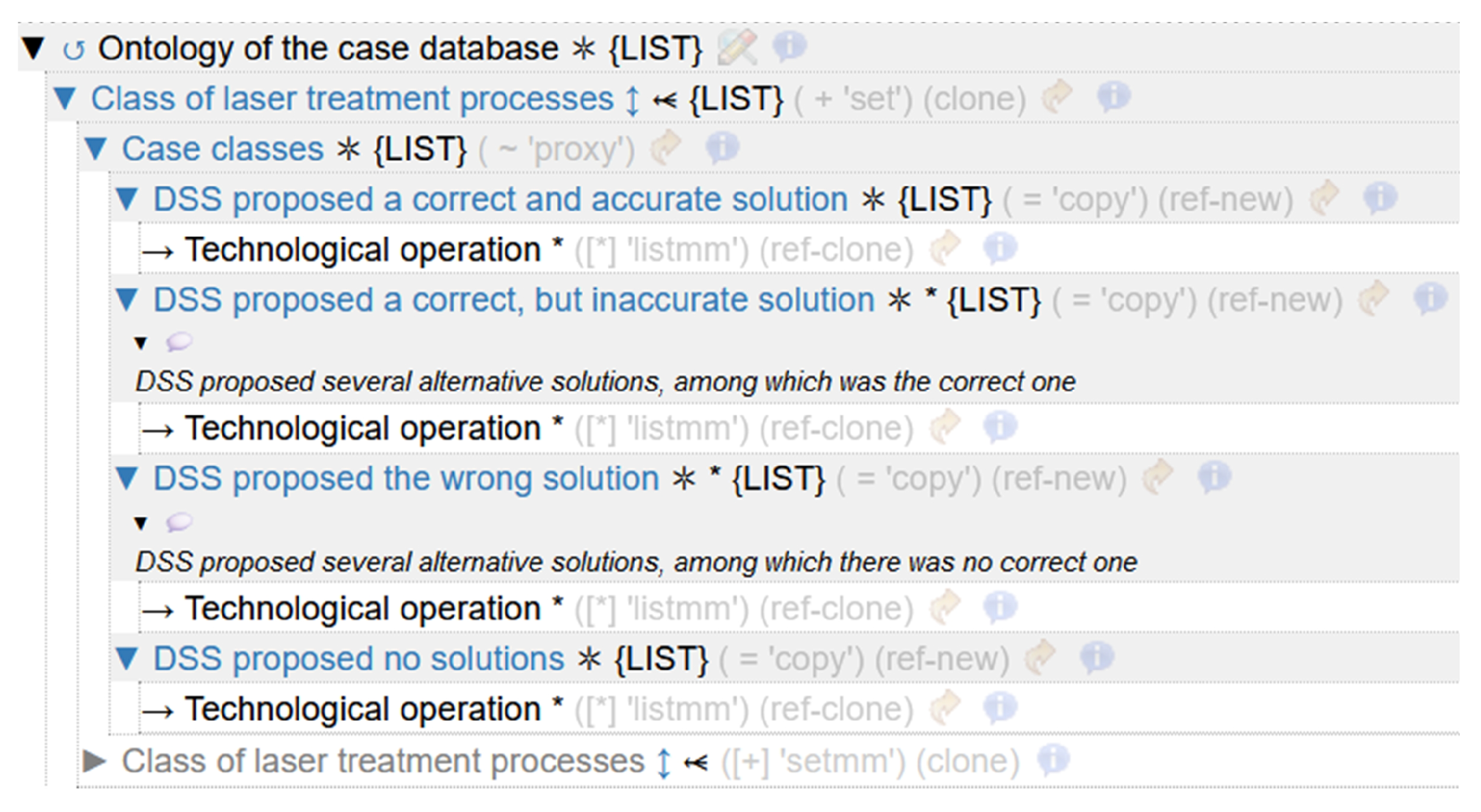
In accordance with the revised Ontology of the archive of laser processing protocols, the Ontology of the case database was also modified [25]. It defines the structuring of the case database – protocols of performed TO, hierarchically grouped by types of processed materials, types of task performed, as well as cases distributed by classes depending on three factors: the parameters proposed by the DSS for performing the TO, the parameters actually selected by the technologist (operator) for performing the TO and the result of performing the TO (Figure 9).

3.3. Ontology of the Knowledge Base

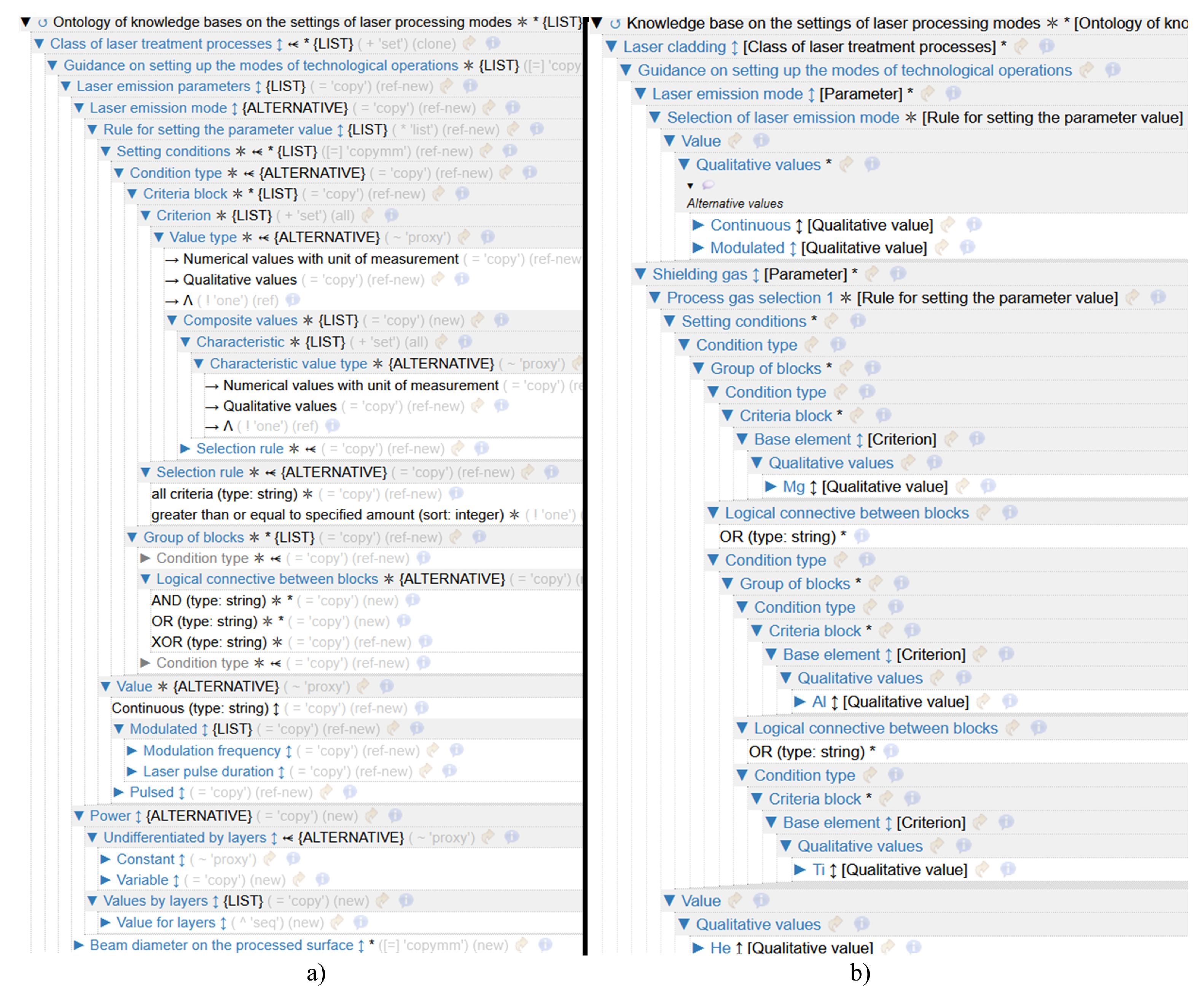
To form the knowledge (which is a basis for making decisions about practically suitable laser processing settings), the OM ensemble includes an Ontology of the knowledge base on the settings of laser processing modes. Figure 10 shows a fragment of this ontology, as well as a fragment of the knowledge base formed on its basis. The KB ontology reuses fragments of ontologies of reference databases on equipment and materials, as well as the Ontology of the archive of laser processing protocols.
By analogy with the principle of the structural organization of the library of protocols, the knowledge (guidance) on setting up TO modes is hierarchically structured according to the types of materials processed and the types of tasks performed (part manufacturing, part restoration, application of functional coating). Next, a multi-level complex of parameters determining the mode of the TO is set. This complex is formed in accordance with the set of parameters described in the Ontology of the archive of laser processing protocols. The names of the parameters in the KB ontology correspond to the names of the parameters described in the Ontology of the archive of laser processing protocols, due to the establishment of terminological coherence (the second type of connections) between them.
For each key parameter of the laser processing, there are many rules for setting its possible values. The antecedent of the production rules specifies the conditions that affect the setting of parameter values. Each condition is a list of criteria to be checked for matching with a certain selection rule, either “all criteria” or “not less than the specified number”. The criterion refers to any element from the laser processing protocol or from the reference databases on equipment and materials that affects the setting of the parameter value. The values of the criterion may have quantitative or qualitative values, including those representing elements of reference databases on equipment and materials. The value of the criterion may be composite: it may represent some characteristic or a block of nested characteristics (see subSection 3.1). Blocks of criteria may be combined into groups of blocks, which are sets of blocks of criteria that relate to each other by logical operators “AND”, “OR”, “EXCLUSIVE OR”.
The consequence of production rules specifies the possible values of the corresponding parameters. The parameter value belongs to the range of possible values of this parameter, defined in the Ontology of the archive of laser processing protocols.
To classify and verify solutions (obtained using AI methods), a methodology for interaction with software systems for numerical modeling of thermodynamic processes has been developed. The Wolfram Mathematica system is used as an example. The ontology of the mathematical model database, in which it is proposed to store software implementations (as well as some meta-information about them) of numerical calculations of the values of the parameters of the modelled processes is presented in [26].

3.4. Implementation of the OM Ensemble

The IACPaaS (Intelligent Applications, Control and Platform as a Service) cloud platform (https://iacpaas.dvo.ru) is used to implement the OM ensemble. It is developed for the creation, control and remote use of intelligent cloud services and thematic knowledge portals [27]. The platform’s technologies and tools provide support for full cycle developing graph knowledge bases, databases and data repositories, as well as DSS based on them as cloud services to which shared remote access can be organized. The toolkit takes into account the specifics of systems comprising KB (in particular, it is aimed at specialists of different types – domain experts, knowledge engineers, software developers), so it allows to simplify and automate the process of their development, reduce maintenance labor costs.
A portal of knowledge about LAM has been created and is being developed on the platform. The portal is intended to identify and investigate technological modes suitable for practical use [28]. The developed OM ensemble as well as the databases and knowledge bases formed on its basis are part of the information content of this portal.
To form the OM ensemble on the knowledge portal, the Digraph Editor platform tool is used. This tool is an interpreter of the ontology (metainformation) description language. The specification of this language is stored in the fund (structured repository) of the IACPaaS platform. This editor allows to simplify the development of ontology models, providing their interactive formation and saving developers from having to study the syntax of the ontology description language.
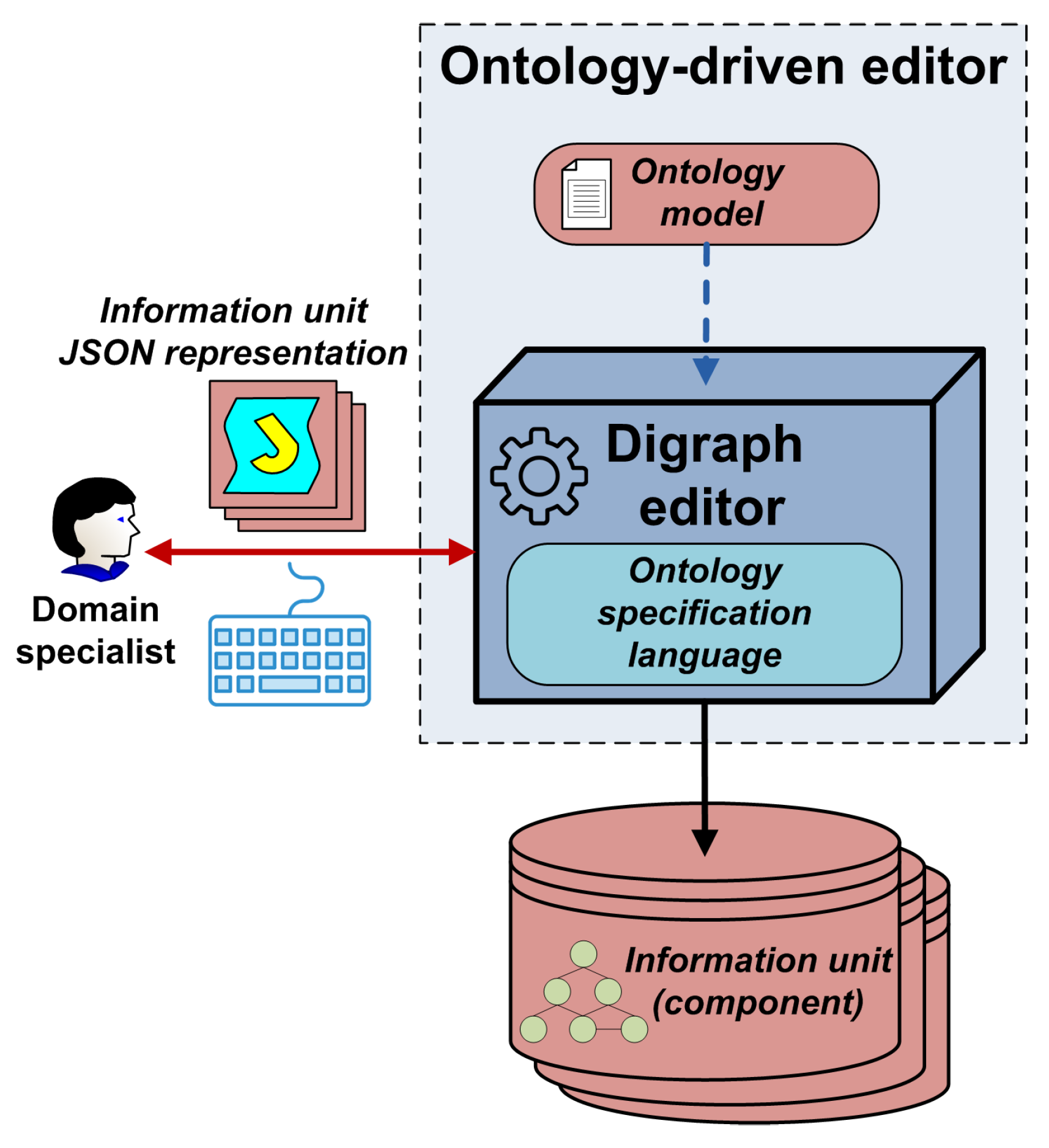
The formation and maintenance of all databases and knowledge bases on the portal is performed by domain experts using appropriate specialized ontology-driven editors. Each of these editors are obtained on the basis of the Digraph Editor, by connecting the appropriate ontology model (Figure 11).
All ontology-driven editors for the formation and maintenance of the database and knowledge base portal have the following features:
  • the editing process is controlled by the ontology model, and the user interface is generated basing on the ontology model;
  • when the ontology model is modified, the user interface and the editing process are adapted automatically (if necessary, all corresponding data or knowledge bases are also adjusted to match the modified ontology automatically).
Furthermore, along with the interactive formation of databases, knowledge bases and ontologies, they can also be exported and imported in JSON format with the use of platform tools and API.
To provide the internationalization of ontologies, databases and knowledge bases, special type information resources pre-formed on the portal (containing translations of ontology terms, as well as of terms of subject databases and knowledge bases) are connected to them. Currently, translations have been made into English. When viewing and editing some information component of the knowledge portal, its contents and the user interface of the corresponding ontology-driven editor are displayed in the language selected by the user on the IACPaaS platform website, in Russian or English.

4. Discussion and Future Work

The design and development of a DSS for LAM process engineers based on ontologies with a uniform declarative semantic representation allows us to achieve the following goals. Firstly, it is to establish a conceptual framework (foundation) that creates the possibility of structuring, unifying and standardizing specifications in the development of LAM models that can be integrated with each other. Secondly, it is to facilitate cross-disciplinary collaboration – the direct (without any intermediaries) coordinated participation of various domain specialists in this process, and not only software developers [28,29,30]. Finally, applying an ontological two-level approach to the formation of semantic information is aimed at ensuring:
  • the possibilities of creating databases and knowledge bases in a conceptual representation and terminology understandable to domain specialists;
  • scalability and operational extensibility of the DSS without the involvement of software developers. The emergence of new types of materials (alloys), laser and other technological equipment, the expansion of the range of processed parts, the expansion/modification of knowledge bases should not (in most cases) lead to changes in the developed ontology-oriented algorithms (being developed for interpreting subject databases) that perform reasoning based on concepts and relations specified in ontologies.
This ensures one of the key requirements for such software systems – their viability.
At the same time, one of the outstanding challenges within of the proposed approach is the continued reliance on manual creation of the library of protocols, databases and knowledge bases, which remains a rather time-consuming process. Currently, they are formed only using the appropriate ontology-driven editors. Therefore, one of the directions of future work is the use of natural language processing (NLP) methods to automatically perform text-to-knowledge graph transformations. We plan to extract relevant information from poorly structured and unstructured texts and form appropriate information resources of the LAM knowledge portal. Here, we are going to consider and compare two main approaches: rule-based and based on large language models (LLM-based). In both cases, the result of text analysis should be a JSON representation, the structure of which should correspond to the given ontology. For example, in the case of analyzing texts of TO protocols, this is the Ontology of the archive of laser processing protocols. Further, the obtained JSON representation can be imported using the IACPaaS platform tools into the corresponding information resource (e.g., Archive of laser processing TO protocols) of the LAM knowledge portal.
Another direction of further research is the creation of an OM for generating explanations for the recommendations issued by the DSS. This model should be integrated into the set of developed ontological models. A method for generating explanations based on this ontological model and the set of reference databases should also be developed. Such explanations should comply with the four principles of explainable AI formulated by the National Institute of Standards and Technology [31] and, together with the recommendations, can be used as a reasonable guide for helping process engineers to make decisions.
Additionally, we can consider yet another separate direction of the team’s work. This work is aimed at ensuring the possibility of reuse of ontologies and their further refining and generalization to other types of melting of metallic materials. In these processes, besides laser beam, the other sources of concentrated flows of energy are employed, such as electric arc, plasma, and electron beam.

5. Conclusions

The paper presents the ensemble of OMs, which is the basis for the intelligent DSS being developed for specialists involved in setting up the modes of performing laser-based additive technological processes of DED-LB category for manufacturing and processing of metal parts. A composition of the OM ensemble, as well as the purpose of its individual components and possible types of relations between them are substantiated and described in detail.
The IACPaaS cloud platform tools were used to implement the OM ensemble. All ontologies as well as databases and knowledge bases formed on their basis are part of the information content of the portal of knowledge about LAM, which was created and is being developed on this platform. The DSS is currently being developed as a part of the software content of the portal. In the long term, this portal, which allows us to accumulate and use knowledge and experience of different technologists, will make it possible to solve an important problem. Namely, to reduce the number of preliminary experiments aimed at identifying practically suitable technological modes, as well as to reduce the qualification requirements for industrial users of technological equipment.

Author Contributions

Conceptualization, V.G. and Yu.K.; methodology, V.G. and Yu.K.; software, A.B. and V.T.; validation, A.N., P.N. and I.Zh.; formal analysis, E.K. and I.Zh.; investigation, V.G. and V.T.; resources, Yu.K., A.N. and I.Zh.; data curation, A.N. and A.B.; writing—original draft preparation, P.N. and E.K.; writing—review and editing, V.G., A.N. and V.T.; visualization, V.T. and A.B.; supervision, V.G.; project administration, Yu.K.; funding acquisition, Yu.K. All authors have read and agreed to the published version of the manuscript.

Funding

Enhancement of ontological models of reference databases on equipment and material used in laser additive processing of metal parts was carried out within the state assignment of IACP FEB RAS on the Theme FWFW-2021-0004. Development of means for formalizing technological operations of metal parts laser additive processing was carried out within the state assignment of IACP FEB RAS on the Theme FWFW-2025-0004.

Institutional Review Board Statement

Not applicable.

Informed Consent Statement

Not applicable.

Data Availability Statement

The data used during the current study are available from the corresponding author upon reasonable request.

Conflicts of Interest

The authors declare no conflicts of interest.

References

  1. Inayathullah, S.; Buddala, R. Review of machine learning applications in additive manufacturing. Results in Engineering 2025, 25, 103676. [Google Scholar] [CrossRef]
  2. Sibisi, T.H.; Shongwe, M.B.; Tshabalala, L.C.; Mathoho, I. LAM additive manufacturing: a fundamental review on mechanical properties, common defects, dominant processing variables, and its applications. The International Journal of Advanced Manufacturing Technology 2023, 128, 2847–2861. [Google Scholar] [CrossRef]
  3. Svetlizky, D.; Zheng, B.; Vyatskikh, A.; Das, M.; Bose, S.; Bandyopadhyay, A.; Schoenung, J.M.; Lavernia, E.J.; Eliaz, N. Laser-based directed energy deposition (DED-LB) of advanced materials. Materials Science and Engineering: A 2022, 840, 142967. [Google Scholar] [CrossRef]
  4. Zoting, S.; Shivarkar, A. Additive Manufacturing Market Size, Share, and Trends 2025 to 2034. https://www.precedenceresearch.com/additive-manufacturing-market, 2025. (accessed on 18 Feb 2025).
  5. Wolff, S. Directed Energy Deposition. In Springer Handbook of Additive Manufacturing; Springer: Cham, 2023; pp. 459–474. [Google Scholar] [CrossRef]
  6. Piscopo, G.; Iuliano, L. Current research and industrial application of laser powder directed energy deposition. The International Journal of Advanced Manufacturing Technology 2022, 119, 6893–6917. [Google Scholar]
  7. Piscopo, G.; Atzeni, E.; Saboori, A.; Salmi, A. An Overview of the Process Mechanisms in the Laser Powder Directed Energy Deposition. Applied Sciences 2023, 13. [Google Scholar] [CrossRef]
  8. Blaha, R.; Hajnys, J.; Mesicek, J.; Mechali, A.; Krisak, D.; Pagac, M. Review of Directed Energy Deposition (DED) in Component Repair. In Proceedings of the From Smart City to Smart Factory for Sustainable Future: Conceptual Framework, Scenarios, and Multidiscipline Perspectives, Cham; 2024; pp. 197–205. [Google Scholar] [CrossRef]
  9. Klahn, C.; Butler, D.; Pei, E. Economics of Additive Manufacturing. In Springer Handbook of Additive Manufacturing; Springer: Cham, 2023; pp. 31–42. [Google Scholar] [CrossRef]
  10. Soori, M.; Jough, F.K.G.; Dastres, R.; Arezoo, B. Additive Manufacturing Modification by Artificial Intelligence, Machine Learning, and Deep Learning: A Review. Additive Manufacturing Frontiers 2025, 200198. [Google Scholar] [CrossRef]
  11. Ethiraj, N.; Sivabalan, T.; Sofia, J.; Harika, D.; Nikolova, M.P. A comprehensive review on application of machine intelligence in additive manufacturing. Turkish Journal of Engineering 2025, 9, 37–46. [Google Scholar] [CrossRef]
  12. Fan, H.l.; Liu, Y.b.; Wang, Z.w.; Han, R.h.; Zheng, M.j.; Qi, H.b. Analysis of powder flow from the nozzle to the substrate in multiangle laser cladding. Journal of Laser Applications 2024, 36, 042080. [Google Scholar] [CrossRef]
  13. Joshi, S.; Martukanitz, R.P.; Nassar, A.R.; Michaleris, P. Additive manufacturing with metals: Design, processes, materials, quality assurance, and applications; Springer: Cham, 2023. [Google Scholar] [CrossRef]
  14. Singh, C.; Sharma, N.; Kumar, N. Analysis Of Software Maintenance Cost Affecting Factors And Estimation Models. International Journal of Scientific & Technology Research 2019, 8, 276–281. [Google Scholar]
  15. Islam, M.; Farooqui, N.; Haleem, M.; Zaidi, S. An Efficient Framework For Software Maintenance Cost Estimation Using Genetic Hybrid Algorithm: OOPs Prospective. International Journal of Computing and Digital Systems 2023, 14, 933–943. [Google Scholar] [CrossRef]
  16. Gribova, V.V.; Shalfeeva, E.A. Ensuring of viability of systems based on knowledge. Information Technology 2019, 25, 738–746, (In Russ.). [Google Scholar] [CrossRef]
  17. Xiao, J.; Anwer, N.; Huang, H.; Bonnard, R.; Eynard, B.; Huang, C.; Pei, E. Information exchange and knowledge discovery for additive manufacturing digital thread: a comprehensive literature review. International Journal of Computer Integrated Manufacturing 2024, 1–26. [Google Scholar] [CrossRef]
  18. Chen, K.; Zhang, P.; Yan, H.; Chen, G.; Sun, T.; Lu, Q.; Chen, Y.; Shi, H. A review of machine learning in additive manufacturing: design and process. The International Journal of Advanced Manufacturing Technology 2024, 135, 1051–1087. [Google Scholar] [CrossRef]
  19. Beniwal, R.; Abhijeet, K.; Kumar, K.; Sagar, M. Ontology Driven Software Development for Better Understanding and Maintenance of Software System. In Proceedings of the Second International Conference on Sustainable Technologies for Computational Intelligence; Luhach, A.K., Poonia, R.C., Gao, X.Z., Singh Jat, D., Eds.; Singapore, 2022; pp. 73–81. [Google Scholar]
  20. Listl, F.G.; Fischer, J.; Sohr, A.; Grimm, S.; Weyrich, M. Ontological Architecture for Knowledge Graphs in Manufacturing and Simulation. In Proceedings of the 2022 IEEE 27th International Conference on Emerging Technologies and Factory Automation (ETFA). IEEE, 2022; pp. 1–8. [Google Scholar] [CrossRef]
  21. Meyers, B.; Vangheluwe, H.; Lietaert, P.; Vanderhulst, G.; Van Noten, J.; Schaffers, M.; Maes, D.; Gadeyne, K. Towards a knowledge graph framework for ad hoc analysis in manufacturing. Journal of Intelligent Manufacturing 2024, 35, 3731–3752. [Google Scholar] [CrossRef]
  22. Gribova, V.V.; Kleshchev, A.S.; Moskalenko, F.M.; Timchenko, V.A. A two-level model of information units with complex structure that correspond to the questioning metaphor. Automatic Documentation and Mathematical Linguistics 2015, 49, 172–181. [Google Scholar]
  23. Gribova, V.V.; Kleshchev, A.S.; Moskalenko, F.M.; Timchenko, V.A. A model for generation of directed graphs of information by the directed graph of metainformation for a two-level model of information units with a complex structure. Automatic Documentation and Mathematical Linguistics 2015, 49, 221–231. [Google Scholar] [CrossRef]
  24. Afrasiabi, M.; Bambach, M. Modelling and simulation of metal additive manufacturing processes with particle methods: A review. Virtual and Physical Prototyping 2023, 18, e2274494. [Google Scholar] [CrossRef]
  25. Gribova, V.; Kulchin, Y.; Nikitin, A.; Timchenko, V. The Concept of Support for Laser-Based Additive Manufacturing on the Basis of Artificial Intelligence Methods. Lecture Notes in Computer Science 2020, 12412, 403–415. [Google Scholar]
  26. Gribova, V.; Kulchin, Y.; Nikitin, A.; Velichko, A.; Basakin, A.; Timchenko, V. The Concept of Intelligent Support for Laser Additive Manufacturing Process Engineer. In Proceedings of the Studies in Systems, Decision and Control; Springer, 2023; Vol. 457, pp. 355–368. [Google Scholar] [CrossRef]
  27. Gribova, V.V.; Moskalenko, P.M.; Timchenko, V.A.; Shalfeeva, E.A. The IACPaaS Platform for Developing Systems Based on Ontologies: A Decade of Use. Scientific and Technical Information Processing 2023, 50, 406–413. [Google Scholar]
  28. Xiao, J.; Anwer, N.; Huang, H.; Bonnard, R.; Eynard, B.; Huang, C.; Pei, E. Information exchange and knowledge discovery for additive manufacturing digital thread: a comprehensive literature review. International Journal of Computer Integrated Manufacturing 2024, 1–26. [Google Scholar] [CrossRef]
  29. Gouttebroze, S.; Friis, J.; Hovig, E.W.; Boivie, K. Toward semantic standard and process ontology for Additive manufacturing. IOP Conference Series: Materials Science and Engineering 2023, 1281, 012014. [Google Scholar] [CrossRef]
  30. Huang, M.; Fan, B.; Chen, L.; Pan, Y.; Qin, Y. Selection of Additive Manufacturing Machines via Ontology-Supported Multi-Attribute Three-Way Decisions. Applied Sciences 2023, 13. [Google Scholar] [CrossRef]
  31. Phillips, P.J.; Hahn, C.A.; Fontana, P.C.; Yates, A.N.; Greene, K.; Broniatowski, D.A.; Przybocki, M.A. Four principles of explainable artificial intelligence, 2021. (accessed on 06 Feb 2025). [CrossRef]
1
The markup of the digraph arcs is not shown in the figure, in order not to complicate it with insignificant details in this case.
2
This figure, as well as Figure 5-10, show the user interface of the IACPaaS cloud platform tool (https://iacpaas.dvo.ru/) Digraph editor, which is used to create both ontologies and databases/knowledge bases in the platform’s storage.
Figure 1. An ontological two-level approach to the knowledge bases and databases creation: separation of domain knowledge from problem solving methods knowledge.
Preprints 152112 g001
Figure 2. A composition of the ontology model ensemble.
Preprints 152112 g002
Figure 3. Schematic representation of two types of coherences between ontology digraphs: structural coherence (a) and terminological one (b).
Preprints 152112 g003
Figure 4. A fragment of the technological laser database ontology (a) and a fragment of the database of technological lasers (b) formed on its basis.
Preprints 152112 g004
Figure 5. A fragment of the materials reference book ontology (a) and a fragment of the materials references book (b) formed on its basis.
Preprints 152112 g005
Figure 6. A fragment of the ontology for describing characteristics and their values: Characteristic section structure.
Preprints 152112 g006
Figure 7. A fragment of the ontology for the archive of laser processing technological operation protocols.
Preprints 152112 g007
Figure 8. A fragment of the archive of laser processing TO protocols (a fragment of the “Growing an implant from MPF-4 magnesium powder on a substrate made of MA20 alloy” TO protocol).
Preprints 152112 g008
Figure 9. An ontology of the structured case database.
Preprints 152112 g009
Figure 10. A fragment of the ontology of knowledge base on the settings of laser processing modes (a) and a fragment of the knowledge base (b) formed on its basis.
Preprints 152112 g010
Figure 11. A scheme of formation of the information unit based on its ontology.
Preprints 152112 g011
Disclaimer/Publisher’s Note: The statements, opinions and data contained in all publications are solely those of the individual author(s) and contributor(s) and not of MDPI and/or the editor(s). MDPI and/or the editor(s) disclaim responsibility for any injury to people or property resulting from any ideas, methods, instructions or products referred to in the content.
Copyright: This open access article is published under a Creative Commons CC BY 4.0 license, which permit the free download, distribution, and reuse, provided that the author and preprint are cited in any reuse.
Prerpints.org logo

Preprints.org is a free preprint server supported by MDPI in Basel, Switzerland.

Subscribe

Disclaimer

Terms of Use

Privacy Policy

Privacy Settings

© 2025 MDPI (Basel, Switzerland) unless otherwise stated