

Submitted:
11 March 2025
Posted:
11 March 2025
You are already at the latest version
Abstract
Utilizing underground space has become a means to address urban issues, however, heritage protection in underground development has become an unavoidable challenge. Whether to proceed with underground development in a heritage site requires a suitability study that considers various influencing factors to guide comprehensive protection planning. Therefore, conducting a suitability study for underground development in heritage sites is a critical issue that must be addressed before policy and planning decisions. Based on preliminary research, this study identifies and summarizes the influencing factors of underground heritage development suitability, innovatively constructs “Underground Resource Development Suitability Index System of Cultural Heritage, URDSIS-CH”, and employs the “Dependency Analytic Process, DAP” method for evaluation. It explores spatial development issues arising from underground heritage development and clarifies the relationship mechanisms between relevant influencing factors. The study seeks to resolve the contradiction between underground space development and cultural heritage protection through technological and methodological approaches, providing insights for a more scientific approach to underground heritage preservation and utilization.
Keywords:
1. Introduction
2. Methods
2.1. Establishment of Evaluation System
2.2. Establishment of Scoring Criteria
2.3. Comprehensive Evaluation
3. Research Area
4. Results
4.1. Underground Development of Pengcheng Subterranean Ruins
4.2. Underground Development of Hubu Mountain Ancient Architecture Complex
5. Discussion
6. Conclusions
Author Contributions
Funding
Data Availability Statement
Conflicts of Interest
References
- Tang, Y.Q.; Wang, M.W.; Wu, X.Z.; Wang, X.Y. Strategy and Layout of Underground Space Planning for Organic Renewal in Old Urban Areas. Planners 2022, 38, 134–139. [Google Scholar]
- F. Gibert, et al., translated by Cheng Yao. Town Design, B: State Engineering and Construction Press, 1983.
- Tang, Y.Q. Urban Underground Space Planning. China Architecture and Building Press: Beijing, China, 2019.
- Archer, C. Paris Underground. Mark Batty Publishers: Brooklyn, NY, USA, 2005.
- Varriale, R.; Parise, M.; Genovese, L.; Leo, M. Underground Built Heritage in Naples: From Knowledge to Monitoring and Enhancement. In Handbook of Cultural Heritage Analysis; D’Amico, S., Venuti, V., Eds.; Springer: Cham, 2022. [Google Scholar] [CrossRef]
- Salvarani, R.; Edizioni, R. CNR. Symbolic significance of the use and reuse of underground urban space, historical interpretation framework. Undergr Buildin Herit Val. 2021 Rome, Italy. Pp. 21-30.
- Hiroi Yū, Underground Street Disaster Prevention Research Society. Hidden Underground Streets. Kawade Shobō Shinsha, 2018.
- Giuseppe, M.; Gaspari, N.G.; Prathap, M. Underground tunneling to match social development and preservation of historical and cultural heritage: Bangalore metro line UG-1. Engineering Geology for Society and Territory. Preserv. Cult. Heri 2015, 8, 129–133. [Google Scholar]
- Bayraktar, S,; Student, M,; Kubat, A. S. Archaeological Parks and their Integration to Urban Layout of Istanbul. 2010.
- Varriale, R. ‘Underground Built Heritage’: A theoretical approach for the definition of an international class. Herit. 2021, 4, 1092–1118. [Google Scholar] [CrossRef]
- Li, P.Y.; Han, H.D.; Wang, D.H.; Wang, C.S. Current situation and development trends of suitability evaluation of urban underground space resources. Sediment. Geol. & Tethyan Geol. 2021, 41, 121–128. [Google Scholar]
- Tong, L.X.; Zhu, W.J. Evaluation and develop planning of urban underground space. China State Engineering and Construction Press: China, 2009.
- Jiang, X.; Wang, T.T.; Mu, J. Research on the Application of Suitability and Resources in Underground Space Development. Chin. J. Underground Space Eng. 2018, 14, 1145–1153. [Google Scholar]
- Xiong, F.; Li, X.; Liu, M.L.; Pang, S.D.; Guan, S.Y. Suitability Evaluation of Underground Space Exploitation: a Case Study of Changjiang New Town in Wuhan. Chin. J. Underground Space Eng. 2022, 18, 12–19. [Google Scholar]
- Duan, Y.Q.; Jie, Z.Q.; Lin, M.N.; Zuo, X.Q.; Hou, Z.Q. Suitability Evaluation of Underground Space Development Based on Index Scale-AHP. Chin. J. Underground Space Eng. 2021, 17, 8–15. [Google Scholar]
- Zhang, S. The Idea and Path of Establishing the Mechanism of Preserving the Urban Living Heritage: Shanghai’s Experience and Challenges in Historic Townscape Preservation. Urban Plan. Forum. 2021, 6, 100–108. [Google Scholar]
- Zhang, P.; Xiao, Y. Suitability evaluation method for historic relic underground space resource development. J. PLA Univ. Sci. Technol. (Nat. Sci. Ed.), 2014, 15, 203–208. [Google Scholar]
- Zhang, P.; Cheng, Z.L. Evaluation on the quality of Underground Space Resource in Historic District: A Case Study on Yangzhou old City. C. Plann. Rev. 2012, 0, 29–32. [Google Scholar]
- Yang, J.B. Research and practice on the influence of underground construction on historical buildings. Tongji University Press: Shanghai, China, 2019.
- Zhu. W. Rick Evaluation of Impact of Foundation Pit Excavation on Adjacent Historic Building Based on AHP. Building Construction. 2016, 38, 860–862. [Google Scholar]
- Wang, Q.; Yang, C.M.; Lu, J.G. Safety Risk Assessment of Adjacent Heritage Building under the Influence of Subway Construction. Sci. Technol. Eng. 2020, 20, 9615–9621. [Google Scholar]
- Huang, C.; Qiu, J.; Huang, T.M. Mode selection of post-earthquake recovery and reconstruction of traditional villages using dependency analytic process: Taking Xiluo-Buzi village in the 2022 M6.8 Luding earthquake as an example. Front. Public. Health. 2023, 11, 1240573. [Google Scholar] [CrossRef]
- Zhao, X.D.; Zhang, P.; Chen, Z.L. Fuzzy Synthesis Evaluation for Resource Quality of Underground Space in Historic and Cultural Blocks. Chin. J. Underground Space Eng. 2014, 10, 739–744. [Google Scholar]
- Zhu, Y.G.; Zhao, J.W.; Huang, Z.Y. Evaluation of Underground Space Development in Historical District Based on AHP. Chin. J. Underground Space Eng. 2018, 14, 1437–1444. [Google Scholar]
- Wang, Z.L. GIS-Based Suitability Assessment of Underground Space in Historic and Cultural Blocks: A Case Study of the Central Urban Area of Tianjin. Tianjin University, Tianjin, China, 2019.
- Liu, J.W.H. Method for Evaluating the Implementable Stock of Underground Space in Modern Historic and Cultural Blocks: A Case Study of Jiefang North Road Historic and Cultural Block, Hebei University of Engineering, 2019.
- Huang, C.; Qiu, J.; Tan, X.H. The Urban Heritage Protection Strategy of Seeking Space from Underground in Central City——Taking Xuzhou City as an Example. J. Southwest Jiaotong Univ. (Soc. Sci.), 2023, 24, 99–117. [Google Scholar]
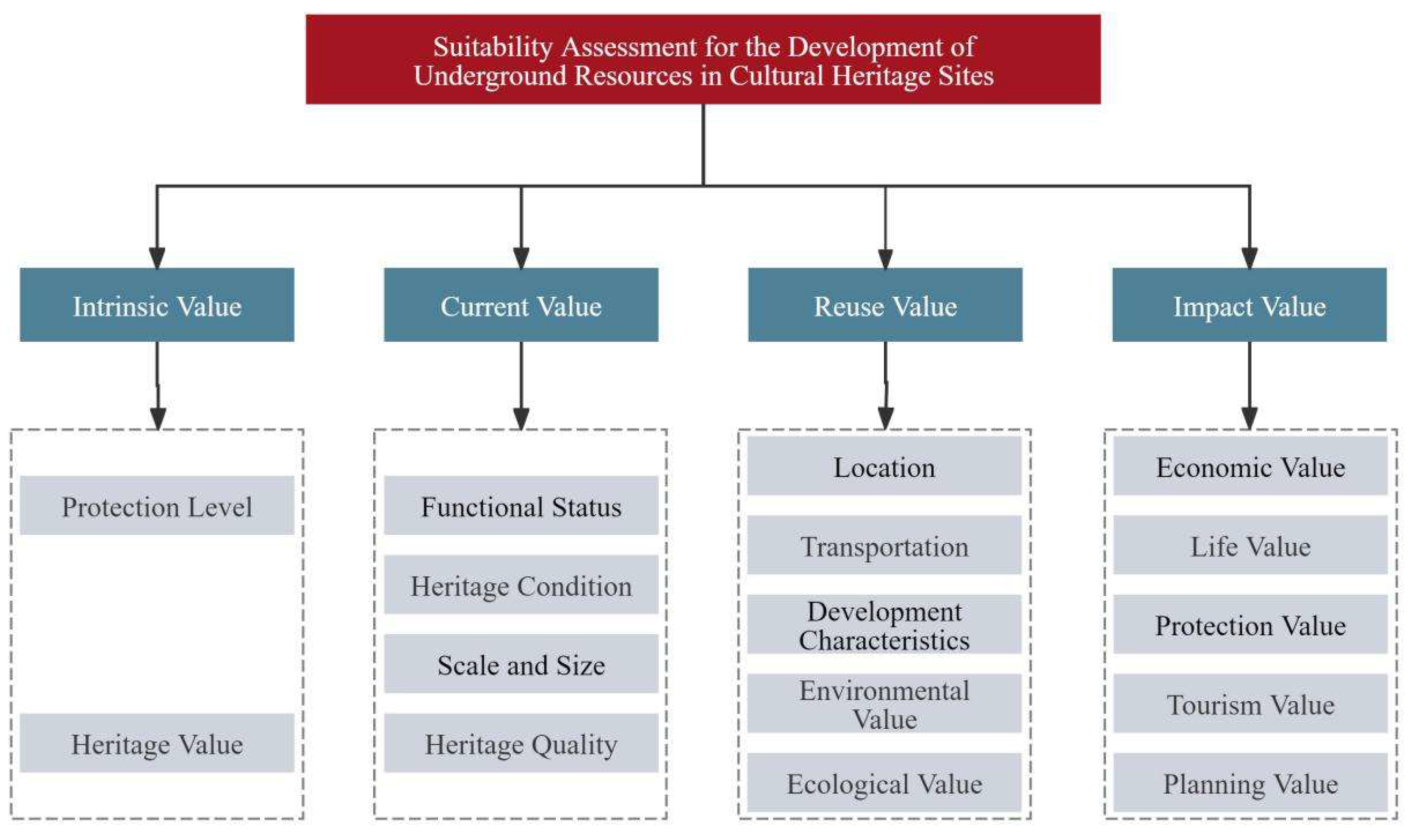

| Objective Layer | First-Level Indicator | Indicator Code | Second-Level Indicator |
|---|---|---|---|
| Suitability of Underground Resource Development of Cultural Heritage | Heritage Value (A) | A1 | Heritage Protection Level |
| A2 | Historical Value | ||
| A3 | Archaeological Value | ||
| Heritage Development Characteristics(B) | B1 | Heritage Building Density | |
| B2 | Heritage Control Zone | ||
| B3 | Heritage Protection Method | ||
| B4 | Heritage Quality | ||
| Heritage Environmental Condition(C) | C1 | Spatial Location | |
| C2 | Current Function of Underground Space | ||
| C3 | Accessibility of Underground Transportation | ||
| C4 | Ground Transportation Condition | ||
| C5 | Infrastructure facilities | ||
| Existing Construction Status of Heritage(D) | D1 | Height of Ground Buildings | |
| D2 | Scale of Heritage Site | ||
| D3 | Depth of Underground Development | ||
| D4 | Condition of Underground Remains | ||
| D5 | Underground Rail Transit Lines | ||
| Natural Conditions(E) | E1 | Geological Disasters | |
| E2 | Water Quality Conditions | ||
| E3 | Engineering Geological Conditions | ||
| Future Development Value(F) | F1 | Economic Status | |
| F2 | Commercial Economic Value | ||
| F3 | Sense of Identity Among User Groups | ||
| F4 | Rationality of Current Use of Heritage | ||
| F5 | Transportation Development (Urban Planning) Value |
| Evaluation Sub-Item Indicators | Scoring Criteria | ||||
|---|---|---|---|---|---|
| 5 | 4 | 3 | 2 | 1 | |
| A1 Heritage Protection Level |
Cultural Relics Protection Site | Municipal/County Level | Provincial Level | National Level | World Level |
| A2 Historical Value |
Above-Ground Sites | ||||
| No significant commemorative value and historical value is common nationwide | Minor historical research value | Certain historical value | Commemorates significant historical events and figures, with high historical value | Strongly associated with significant historical events and figures, high historical value | |
| Underground Sites | |||||
| Strongly associated with significant historical events and figures, high historical value | Commemorates significant historical events and figures, with Relatively high historical value | Certain historical value | Minor historical research value | No significant commemorative value and historical value is common nationwide | |
| A3 Archaeological Value | Highly related to significant historical information, high archaeological value | Relatively Highly related to significant historical information | Somewhat related to significant historical information | Low archaeological value | No significant archaeological value and common nationwide |
| B1 Heritage Building Density |
High density, requires underground space to supplement ground functions | Relatively high density | Moderate density | Low density | Square or open space |
| B2 Heritage Control Zone |
No zoning | Built-up area | Suitable construction area | Restricted construction area | Cautious construction area |
| B3 Heritage Protection Method |
No protection needed | Reconstruction category | Renovation category | Restoration category | Protection category |
| B4 Heritage Quality |
Abandoned, unusable | Dilapidated buildings | Average | Basically intact | Well-preserved |
| C1 Spatial Location |
City center | Sub-center | Some distance from city center | Deviates from city center | Far from city center |
| C2 Current Function of Underground Space |
Fully functional | Many functions but incomplete | Some functional spaces, with civil defense facilities | Sparse point-like underground spaces | None |
| C3 Accessibility of Underground Transportation |
Complete pedestrian, vehicular, and rail transit | Rail transit available | Pedestrian and vehicular underground transport available | Pedestrian underground transport available | None |
| C4 Ground Transportation Conditions |
High traffic volume, parking difficulties | Relatively high traffic volume, parking relatively difficulties | Moderate traffic volume and average parking | Low traffic volume, parking easier | Low traffic volume, easy parking |
| C5 Infrastructure Support for Heritage |
No supporting facilities, requires underground space to compensate for functional deficiencies | Few supporting facilities | Moderate supporting facilities, some impact on historical appearance | Many supporting facilities, some impact on historical appearance | Complete supporting facilities, no impact on ground historical appearance |
| D1 Height of Ground Buildings |
bungalow(<4.5m) | Low-rise(<9m) | Multi-story(9-18m) | Mid-rise(18-27m) | High-rise(>27m) |
| D2 Scale of Heritage Site |
Tomb clusters, city sites, etc. | Large sites | Historical and cultural districts | Individual historical buildings | Cultural relics protection sites |
| D3 Depth of Underground Development |
Shallow | Sub-shallow | Medium | Sub-deep | Deep |
| D4 Condition of Underground Remains |
None | Identified, with general historical value | Identified, with significant historical value | Unidentified but confirmed historical value | Unidentified but confirmed minor historical value |
| D5 Underground Rail Transit Lines |
Three or more subway transfer stations | Two subway transfer stations | Normal transfer station | No subway station | No subway |
| E1 Geological Disasters |
Almost no disasters | Rare disasters, earthquake magnitude <5 | Few disasters, earthquake magnitude 5-6 | Prone to disasters, earthquake magnitude 6-7 | Frequent disasters, earthquake magnitude >7 |
| E2 Water Quality Conditions |
Non-erosion zone | Weak decomposition zone | Weak decomposition erosion zone | Weak crystalline erosion zone | Weak crystalline decomposition composite zone |
| E3 Engineering Geological Conditions |
High soil bearing capacity, low compression | Relatively high soil bearing capacity | Moderate soil bearing capacity | Low soil bearing capacity | Soil does not meet development requirements |
| F1 Economic Status |
Good economic status, supports development | Relatively good economic status, supports development | Moderate economic status, supports limited development | Poor economic status, supports minimal development | Poor economic status, does not support development |
| F2 Commercial Economic Value | Enhances commercial value of the entire area | Significant impact on surrounding commercial value | Moderate impact on surrounding commercial value | Minor impact on surrounding commercial value | No impact |
| F3 Sense of Identity Among User Groups |
Significantly improves production and living environment | Relatively improves production and living environment | Improves basic production and living environment | Partially meets production and living needs | No impact |
| F4 Rationality of Current Use of Heritage |
Deteriorated appearance, requires overall improvement | Somewhat unreasonable use | Average functional utilization | Utilized but needs improvement | Reasonable function, harmonizes with surrounding appearance |
| F5 Transportation Development (Urban Planning) Value | Enhances overall city image and reputation, solves traffic congestion | Improves overall traffic and appearance of the area | Improves traffic and appearance of the heritage site | Solves traffic congestion at the heritage site | No significant improvement |
| Development Suitability | Score Range |
|---|---|
| Suitable for Development | > 4 |
| Developable | 3 ≤ < 4 |
| Cautious Development | 2 ≤ < 3 |
| Not Suitable for Development | 1 ≤ < 2 |
| Survey Item | Record Content |
|---|---|
| Heritage Overview | Protection level, heritage type, heritage quality, current use |
| Heritage Ownership | Control zones, protection methods, restrictions |
| Heritage Features | Heritage scale, spatial layout, feature characteristics |
| Historical Information | Heritage history, regional history, historical events |
| Location | Urban location, transportation conditions, infrastructure |
| Environmental Landscape | Surrounding environment, cultural characteristics, geographical conditions |
| Social Attributes | Economic status, commercial status, popularity, cultural sentiment |
| Objective Layer | First-Level Indicator | Indicator Code | Second-Level Indicator | score |
|---|---|---|---|---|
| Suitability of Underground Resource Development of Pengcheng Subterranean Ruins, Xuzhou City | Heritage Value (A) | A1 | Heritage Protection Level | 4 |
| A2 | Historical Value | 3 | ||
| A3 | Archaeological Value | 5 | ||
| Heritage Development Characteristics(B) | B1 | Heritage Building Density | 5 | |
| B2 | Heritage Control Zone | 1 | ||
| B3 | Heritage Protection Method | 1 | ||
| B4 | Heritage Quality | 3 | ||
| Heritage Environmental Condition(C) | C1 | Spatial Location | 5 | |
| C2 | Current Function of Underground Space | 5 | ||
| C3 | Accessibility of Underground Transportation | 4 | ||
| C4 | Ground Transportation Condition | 4 | ||
| C5 | Infrastructure facilities | 3 | ||
| Existing Construction Status of Heritage(D) | D1 | Height of Ground Buildings | 5 | |
| D2 | Scale of Heritage Site | 4 | ||
| D3 | Depth of Underground Development | 5 | ||
| D4 | Condition of Underground Remains | 3 | ||
| D5 | Underground Rail Transit Lines | 4 | ||
| Natural Conditions(E) | E1 | Geological Disasters | 3 | |
| E2 | Water Quality Conditions | 3 | ||
| E3 | Engineering Geological Conditions | 4 | ||
| Future Development Value(F) | F1 | Economic Status | 4 | |
| F2 | Commercial Economic Value | 5 | ||
| F3 | Sense of Identity Among User Groups | 5 | ||
| F4 | Rationality of Current Use of Heritage | 2 | ||
| F5 | Transportation Development (Urban Planning) Value | 5 |
| A1 | A2 | A3 | |
| A1 | 1 | 0.3 | 0.1 |
| A2 | 0.3 | 1 | 0.2 |
| A3 | 0.3 | 0.3 | 1 |
| A | B | C | D | E | F | |
| A | 1 | 0 | 0 | 0 | 0 | 0 |
| B | 0.3 | 1 | 0.1 | 0 | 0 | 0.1 |
| C | 0 | 0.1 | 1 | 0.2 | 0.2 | 0.2 |
| D | 0 | 0 | 0.2 | 1 | 0.2 | 0.1 |
| E | 0 | 0 | 0 | 0.1 | 1 | 0 |
| F | 0.3 | 0.2 | 0.1 | 0.2 | 0.1 | 1 |
| Objective Layer | First-Level Indicator | Indicator Code | Second-Level Indicator | score |
|---|---|---|---|---|
| Suitability of Underground Resource Development of Hubu Mountain Ancient Architecture Complex, Xuzhou City | Heritage Value (A) | A1 | Heritage Protection Level | 2 |
| A2 | Historical Value | 2 | ||
| A3 | Archaeological Value | 3 | ||
| Heritage Development Characteristics(B) | B1 | Heritage Building Density | 3 | |
| B2 | Heritage Control Zone | 1 | ||
| B3 | Heritage Protection Method | 2 | ||
| B4 | Heritage Quality | 1 | ||
| Heritage Environmental Condition(C) | C1 | Spatial Location | 4 | |
| C2 | Current Function of Underground Space | 2 | ||
| C3 | Accessibility of Underground Transportation | 1 | ||
| C4 | Ground Transportation Condition | 4 | ||
| C5 | Infrastructure facilities | 3 | ||
| Existing Construction Status of Heritage(D) | D1 | Height of Ground Buildings | 4 | |
| D2 | Scale of Heritage Site | 3 | ||
| D3 | Depth of Underground Development | 5 | ||
| D4 | Condition of Underground Remains | 5 | ||
| D5 | Underground Rail Transit Lines | 3 | ||
| Natural Conditions(E) | E1 | Geological Disasters | 3 | |
| E2 | Water Quality Conditions | 3 | ||
| E3 | Engineering Geological Conditions | 4 | ||
| Future Development Value(F) | F1 | Economic Status | 4 | |
| F2 | Commercial Economic Value | 4 | ||
| F3 | Sense of Identity Among User Groups | 2 | ||
| F4 | Rationality of Current Use of Heritage | 2 | ||
| F5 | Transportation Development (Urban Planning) Value | 3 |
Disclaimer/Publisher’s Note: The statements, opinions and data contained in all publications are solely those of the individual author(s) and contributor(s) and not of MDPI and/or the editor(s). MDPI and/or the editor(s) disclaim responsibility for any injury to people or property resulting from any ideas, methods, instructions or products referred to in the content. |
© 2025 by the authors. Licensee MDPI, Basel, Switzerland. This article is an open access article distributed under the terms and conditions of the Creative Commons Attribution (CC BY) license (http://creativecommons.org/licenses/by/4.0/).