

Submitted:
10 March 2025
Posted:
11 March 2025
You are already at the latest version
Abstract
This systematic literature review explores how Conflict Management Strategies (CMS) impact Supply Chain Performance (SCP), focusing on the mediating roles of Supply Chain Operational Processes (SCOP) and Customer-Centric Green Supply Chain Management (CCGSCM) within Jordan's food manufacturing sector. Framed within Smart City initiatives and sustainable development goals (SDGs 9, 11, and 12), this study addresses critical gaps identified in the literature, particularly the lack of integrated examination of CMS impacts in emerging markets like Jordan. Utilizing thematic analysis, this review consolidates key findings across relevant studies from 2010-2025 sourced from top-tier databases.The results reveal that collaboration emerges as the most effective CMS, enhancing stakeholder interactions, operational coordination, and resilience. SCOP significantly mediates CMS-SCP relationships, with logistics and inventory management notably vital in mitigating disruptions. Additionally, Customer-Centric Green Supply Chain Management (CCGSCM) is highlighted as pivotal for sustainability and operational efficiency, in post-COVID market conditions. The findings offer valuable insights for practitioners and policymakers, providing strategic recommendations for integrating technology-driven and relationship-focused CMS tailored to Jordan's unique socio-economic context, thereby aligning operational practices with global sustainability goals (SDGs 9, 11, and 12).
Keywords:
Conflict Management Strategies (CMS)
; Supply Chain Performance (SCP)
; Food Manufacturing
; Supply Chain Operational Processes (SCOP)
; Customer-Centric Green Supply Chain Management (CCGSCM)
; Sustainable Development Goals (SDGs)
; Smart City Initiatives
; Logistics
1. Introduction
Strategic industrial planning through Smart City initiatives is vital for sustainable infrastructure and production, aligning with SDGs 9, 11, and 12 (Oluyisola et al., 2022; Rossit et al., 2019; Usuga Cadavid et al., 2020). The sector faces significant challenges due to resource scarcity, fragmented regulations, and operational inefficiencies, resulting in frequent stakeholder conflicts (Bondigas, 2022; IMCO Software, 2023; World Bank, 2022).. Thus, effective Conflict Management Strategies (CMS) are crucial for enhancing collaboration, operational efficiency, and resilience against disruptions (Dubey et al., 2020).
While CMS have been widely explored within well-established markets (Durach et al., 2017; Ivanov, 2022) research specific to Jordan's socio-economic and geopolitical context remains limited (Al-Dmour et al., 2023; Jum’a, 2023). Additionally, previous studies have independently examined Supply Chain Operational Processes (SCOP) and Customer-Centric Green Supply Chain Management (CCGSCM), but have not investigated their combined mediating roles between CMS and Supply Chain Performance (SCP), especially within industries prioritizing sustainability (Almasri & Ying, 2024; Rahim, 2023).
Addressing this gap, this study leverages Stakeholder Theory (Freeman, 1984) and Conflict Management Theory (Rahim & Buntzman, 1989) to explore how CMS influence SCP through SCOP and CCGSCM mediation. Given recent reports highlighting significant operational inefficiencies from unresolved supply chain conflicts among Jordanian food manufacturers (Aloun, 2024), the urgency of this investigation is evident. Therefore, through a systematic integrative literature review, this paper aims to identify effective CMS practices, highlight the mediating influence of SCOP and CCGSCM, and offer valuable theoretical and practical insights tailored specifically to emerging markets like Jordan.
2. Methodology
This study employed a Systematic Literature Review (SLR) adopting an integrative thematic synthesis approach (Snyder, 2019; Whittemore & Knafl, 2005) to investigate the impact of Conflict Management Strategies (CMS) on Supply Chain Performance (SCP) mediated by Supply Chain Operational Processes (SCOP) and Customer-Centric Green Supply Chain Management (CCGSCM) within Jordan’s food manufacturing sector. Relevant literature was systematically searched from key databases including Scopus, Web of Science, IEEE Xplore, ScienceDirect, SpringerLink, Emerald Insight, and Google Scholar, supplemented by reputable institutional reports (e.g., World Bank, United Nations).
Search terms combined using Boolean logic ensured relevance and breadth, such as "Conflict management strategies," "Supply chain operational performance," "Jordanian industrial sector," and "Green supply chain management"(Gusenbauer & Haddaway, 2020). Studies were included based on clear criteria: peer-reviewed empirical research published between 2010-2025, explicit relevance to CMS in SCM, and methodological rigor. Non-English publications, unrelated topics, duplicates, and low-quality studies were excluded.
Data extraction involved structured thematic synthesis using NVivo software for qualitative analysis (Braun & Clarke, 2006), categorized into key themes: CMS impacts, mediating roles of SCOP and CCGSCM, and SCP outcomes. To ensure validity and reliability, studies were assessed using the Joanna Briggs Institute (JBI) and Mixed Methods Appraisal Tool (MMAT)(Demirel et al., 2018; Munn et al., 2020). Due to methodological heterogeneity, a meta-analysis was impractical; thus, thematic synthesis provided robust conceptual integration and minimized bias (Denyer & Tranfield, 2009; Hunter & Schmidt, 2004).
3. Literature Research and Result
3.1. Theoretical Background
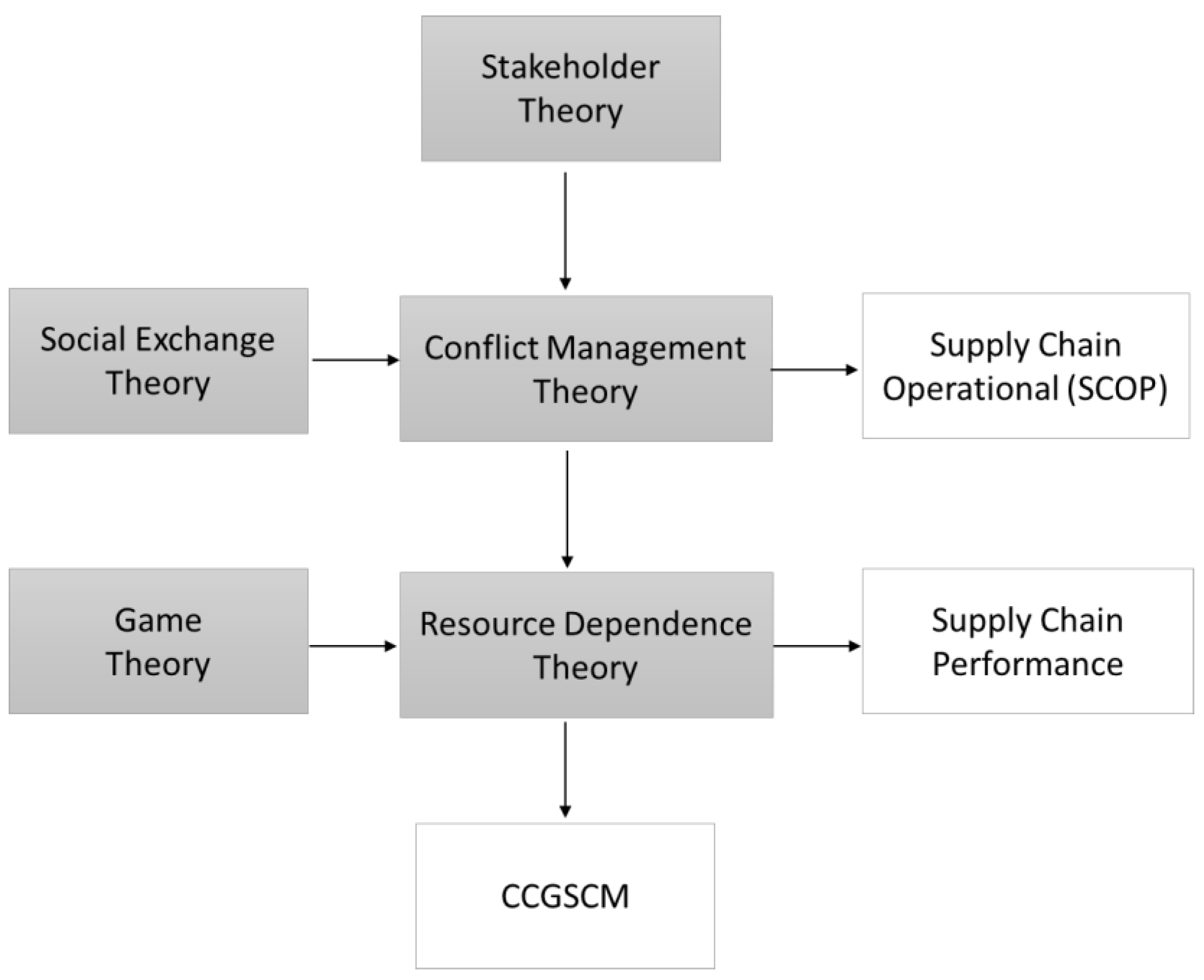
This study employs five theoretical lenses to analyze CMS in Jordan's food manufacturing. Social Exchange Theory (SET) (Blau, 1968; Emerson, 1977) highlights reciprocal trust, crucial for collaborative CMS in Jordan's relationship-focused market. Resource Dependence Theory (RDT) (Pfeffer & Salancik, 1978) helps manage Jordan's reliance on imported resources through strategic conflict resolution. Game Theory (Weintraub, 1992) provides insights into strategic interactions in Jordan's fragmented market. Conflict Theory (Coser, 1976; Güçlü, 2014; Marx & Engels, 1848) explains power dynamics and resource conflicts, showing how large stakeholders influence smaller manufacturers. Finally, Stakeholder Theory (Freeman, 1984; McGahan, 2021) stresses balancing diverse interests, vital in Jordan's complex regulatory environment. These theories collectively illuminate how CMS impacts supply chain operations and performance, fostering efficiency and resilience.
Figure 3.
Theoretical Framework Integration in Supply Chain Conflict Management.
3.2. Conflict Management Strategies (CMS) in Supply Chains
Conflict Management Strategies (CMS) strategically address and resolve disputes within supply chains to enhance operational efficiency, stability, and stakeholder relationships (Durugbo & Al-Balushi, 2023; Huo et al., 2023c). Within the Jordanian food manufacturing sector, characterized by geopolitical complexity, resource scarcity, stringent regulations, and market volatility, effective CMS are critical(Alshawabkeh et al., 2022; Saleheen & Habib, 2022). They support sustainable supply chain practices, optimize resource allocation, and ensure food security, directly aligning with national priorities and broader sustainability objectives. This study will examine specific five strategies.
Collaboration
Collaboration in Jordan's food manufacturing is essential due to resource scarcity and geopolitical influences (Alsaad et al., 2018). It involves joint resource and knowledge sharing to enhance resource utilization and supply stability (Baah et al., 2022; Sanjaya et al., 2022), building supply chain resilience through improved demand forecasting and production coordination (Cao & Zhang, 2011).
Accommodation
Accommodation is vital in Jordan's food sector for navigating relationships with diverse stakeholders, including governmental bodies and suppliers (Diab et al., 2022; Martins et al., 2020). It involves prioritizing others' concerns to maintain relational harmony, especially when dealing with regulatory compliance (B. Obeidat, 2022) and supplier needs (Obeidat & Hamadneh, 2022). ensuring operational stability.
Avoidance
Avoidance is crucial in Jordan's food sector for navigating socio-political and economic conflicts, buffering the supply chain from potential disruptions (Abdallah et al., 2014; Rahim, 2023). This strategy allows businesses to focus on operational efficiency by disengaging from non-essential conflicts that could destabilize the supply chain (Huo et al., 2023a; Min et al., 2020).
Compromise
Compromise is essential in Jordan's food sector due to the need to balance the interests of diverse stakeholders, such as farmers and producers (Macieira et al., 2021). It involves mutual concessions to reach acceptable solutions on issues like pricing and volumes vital (Behfar et al., 2008; Noermijati et al., 2019), safeguarding relationships and maintaining operational flow.
Competition
Competition in Jordan's food manufacturing can manifest in price negotiations and delivery prioritization (Rahim, 2023) (Boz Semerci, 2019). While it can drive efficiency, it can also cause conflicts when interests clash or resources are limited (Chen et al., 2017). Understanding its impact on stakeholder relationships is crucial for mitigating potential disruptions.
CMS in the Context of Jordan’s Food Manufacturing Sector
In Jordan's food sector, Conflict Management Strategies (CMS) are vital for navigating supply chain challenges arising from geopolitical, economic, and socio-cultural factors (Hundaileh & Fayad, 2019). Applying collaboration, accommodation, avoidance, compromise, and competition is crucial for managing conflicts among stakeholders over pricing, quality, and delivery (Al-Hamdan et al., 2019). Collaboration using smart technologies, like blockchain, supports Jordan’s Smart City initiatives and sustainability goals (SDG 11 & 12). Jordan's unique socio-economic and geopolitical context, including resource scarcity and regional instability, intensifies the need for effective CMS (Shareef et al., 2022; Wang et al., 2021).

Table 3-1.
Summary of Conflict Management Strategies Literature Review.
| Category | Description | Importance in Supply Chain | Relevance in Jordan's Food Manufacturing Sector | Citations |
|---|---|---|---|---|
| Introduction to CMS | Strategies pivotal for navigating supply chain complexities, enhancing efficiency, and improving stakeholder relationships. | Vital for resolving disagreements, improving operational processes, and boosting overall performance. | Essential for managing complexities and conflicts arising from internal and external factors, crucial for the sector's sustainability and growth. | Huo, He, & Tian, 2023; Durugbo & Al-Balushi, 2023; Murad et al., 2021; Alshawabkeh et al., 2022; Saleheen & Habib, 2022 |
| Collaboration | Parties work jointly, sharing resources, knowledge, and capabilities for mutually beneficial outcomes. | Mitigates risks, enhances efficiency, fosters innovation, and strengthens relationships. | Instrumental for facing challenges like resource scarcity, geopolitical influences, and global market fluctuations. Enhances resource utilization and risk mitigation. | Delak & Širok, 2022; Sanjaya, Suartama, & Suastika, 2022; Baah et al., 2022; Cheek & Hamrin, 2023; Alsaad, Yousif, & AlJedaiah, 2018; Cao & Zhang, 2011 |
| Accommodation | One side willingly compromises, prioritizing others' concerns and preferences. | Preserves harmonious relationships, where stakeholder dynamics are disparate, and conflicting issues are non-central to outcomes. | Vital for navigating various stakeholder expectations and regulatory frameworks, fortifying relationships, and ensuring a reliable supply chain. | A. L. Diab et al., 2022; Martins et al., 2020; Maiti & Choi, 2021; B. Obeidat, 2022; Obeidat & Hamadneh, 2022 |
| Avoidance | Deliberate disengagement from conflicts, neither addressing nor confronting the issue. | Practical for bypassing disruptions unrelated to core operations, preserving operational flow, and avoiding unnecessary strain. | Essential for maneuvering socio-political and economic conflicts, acting as a buffer against potential disruptions and maintaining consistent internal operations. | Huo et al., 2023; Min et al., 2020; Abdallah et al., 2014; Rahim, 2023 |
| Compromise | A mutual give-and-take approach to establish an acceptable solution, relinquishing certain stances. | Ensures smooth operations amidst disagreements, finding a middle ground in disputes essential for process continuity. | Prominent in managing diverse stakeholder interests, stabilizing supply chain segments, and maintaining operational flow without significant sacrifice. | Noermijati et al., 2019; Behfar, Peterson, Mannix, & Trochim, 2008; Macieira, Barbosa, & Teixeira, 2021 |
| Competition | High concern for one’s interests over others, potentially leading to win-lose outcomes. | Can drive efficiency and innovation but may lead to conflicts if not managed adeptly, especially when resources are scarce or objectives conflict. | Influences stakeholder negotiations and operational priorities, requiring adept management to prevent potential negative consequences like strained relationships. | Rahim, 2023; Boz Semerci, 2019; Chen et al., 2017 |
| CMS in Jordan's Food Sector | Essential for managing diverse challenges within the food sector's supply chain, influenced by various internal and external factors. | Critical for managing discrepancies in interests, objectives, and operational preferences among stakeholders. | Intensified need for adept CMS due to socio-economic and geopolitical challenges, ensuring stability and efficiency within the supply chain. | Hundaileh & Fayad, 2019; Al-Hamdan et al., 2019; Shareef et al., 2022; T. Wang et al., 2021 |
3.3. Comparative Discussion: CMS in Developed vs. Emerging Economies
Jordan's food manufacturing relies heavily on relationship-based CMS, emphasizing trust and informal negotiations (Almasri & Ying, 2024; Mohsen, 2024; Shaer et al., 2023), contrasting with developed markets that prioritize technology-driven solutions and formal agreements (Irfan & Wang, 2019) (Yin et al., 2022) (Huo et al., 2023b). This distinction is crucial for understanding SCP in Jordan, where socio-economic and geopolitical complexities necessitate collaborative strategies. The study highlights that while collaborative CMS enhances SCP through improved efficiency and stakeholder satisfaction, the reliance on personal connections in Jordan presents unique challenges compared to the data-driven approaches of developed economies. This reinforces the study's conclusion that adaptive, collaborative, and customer-centric green practices are vital, but must be tailored to Jordan's specific context, recognizing the limitations of solely relationship-focused methods and the potential for integrating appropriate technological advancements (see Tables 3-10 and 3-11).
Table 3-2.
CMS Strategies Across Global Contexts.
| CMS Strategy | Jordan (Emerging Market) | UAE (Advanced SCM Tech) | Singapore (Regulated SCM) |
|---|---|---|---|
| Collaboration | Relationship-based trust | AI-driven coordination | Government-mandated SCM rules |
| Avoidance | Conflict avoidance due to business risks | Rare due to strict compliance | Penalized under strict SCM policies |
| Competition | Dominant retailers enforce strict supplier terms | Strong government price controls | Competitive SCM innovation |
| Compromise | Informal negotiation tactics | Formalized dispute resolution | Arbitration frameworks exist |
| Accommodation | Supplier-driven flexibility due to power imbalances | Buyer-driven due to strict standards | Legally enforced SCM contracts |
Table 3-3.
CMS outcomes across Jordan, UAE, and Singapore, emphasizing key performance indicators.
| CMS Strategy | Jordan (Emerging Market) Outcomes | UAE Outcomes | Singapore Outcomes |
|---|---|---|---|
| Collaboration | Increased supplier loyalty, slower tech adoption Faster | Faster order fulfillment, AI-based collaboration | Highly efficient dispute resolution, regulatory enforcement |
| Avoidance | Supplier retention but higher supply risks | Risk minimization via tech-driven solutions | Conflict escalation prevention due to strict laws |
| Competition | Cost pressures on suppliers, market fragmentation | Government intervention, stabilized pricing | Competitive advantage through innovation |
| Compromise | Flexible but inconsistent SCM performance | Legal frameworks ensure enforceability | High compliance, standardized negotiations |
| Accommodation | Power imbalances, reactive | Balanced SCM relationships | Institutionalized supplier protection laws |
3.4. Supply Chain Operational Processes (SCOP)
Supply Chain Operational Processes (SCOP) are critical to the food manufacturing sector, ensuring efficient production, storage, and delivery, given product perishability and stringent quality standards (Saragih, Tarigan, Silalahi, et al., 2020). Globally, SCOP encompasses production planning, inventory management, and distribution, all essential for a seamless supply chain (Aung & Chang, 2014; Gupta & Jain, 2013) (Krajewski & Malhotra, 2022). These processes, impacted by technology, regulations, and market dynamics, directly influence supply chain operations (Mollenkopf et al., 2021). This study explores how SCOP mediates the relationship between conflict management strategies and supply chain performance, examining how effective production planning and inventory management, for example, mitigate conflicts and ensure operational efficiency.
Production Planning
Production planning, crucial for efficient food manufacturing, involves determining product volume and timing based on demand, resources, and capacity (Han et al., 2019). In Jordan, this planning is vital for navigating fluctuating demand and resource limitations (Jum’a et al., 2021). Effective planning optimizes resource use, reduces waste, and addresses supply chain conflicts, with resource constraints (Stadtler, 2014). Jordan's production planning is influenced by raw material availability and technological advancements, such as Industry 4.0 (Abu-Rumman et al., 2023; Jaber et al., 2019). This study examines how production planning, as a SCOP dimension, impacts the relationship between conflict management and supply chain performance, specifically how it mitigates conflicts and optimizes performance in Jordan’s food sector.
Inventory Management
Inventory management, crucial for balancing inventory costs and demand, is especially complex in Jordan's perishable food sector (Becerra et al., 2021; Diab et al., 2015). Effective inventory management, using techniques like JIT and EOQ, mitigates stakeholder disputes and controls costs (Pan & Nagi, 2010). However, Jordan faces unique challenges due to product perishability, demand fluctuations, and regional instability (Hiassat et al., 2017). Aligning inventory control with conflict resolution is vital for Jordanian firms, and analyzing local case studies reveals how inventory management enhances supply chain efficiency and reduces conflicts (Al-Hamdan et al., 2019).
Distribution
Distribution, a key SCOP element, ensures timely and accurate delivery of finished products, crucial in Jordan's food sector for maintaining product freshness and customer satisfaction (Dwivedi et al., 2020; Randrianarisoa & Gillen, 2022). Strategic distribution alignment with conflict management can mitigate stakeholder disputes by ensuring reliable and cost-effective delivery.
Logistics
Logistics, another vital SCOP component, manages the movement and storage of goods throughout the supply chain. In Jordan, logistics is essential for navigating geopolitical and market challenges (Gligor & Holcomb, 2012). Effective logistics, including transportation and warehousing, minimizes costs and ensures timely delivery, directly impacting supply chain performance. Integrating logistics with conflict management ensures reliability and efficiency for all stakeholders (Kim et al., 2020).
The Mediating Role of SCOP in CMS → SCP Relationship
Supply Chain Operational Processes (SCOP) act as a crucial link between Conflict Management Strategies (CMS) and Supply Chain Performance (SCP), translating conflict resolution into operational efficiency. However, the exact interplay between SCOP and CMS remains under-explored. This study addresses this gap by analyzing how four SCOP dimensions—Production Planning, Inventory Management, Distribution, and Logistics—interact with CMS.
Table 3-4.
SCOP Components and Their Role in Conflict Resolution.
| Supply Chain Operational Process | How It Mediates CMS → SCP | Examples of CMS Influence |
|---|---|---|
| Production Planning | Aligns production schedules with stakeholder expectations to reduce demand fluctuations | Collaboration CMS: Joint production planning enhances supply chain agility (Sarkis et al., 2022) |
| Inventory Management | Balances stock availability to mitigate supply chain disruptions | Avoidance CMS: Poor communication leads to stock shortages (Christopher & Holweg, 2017) |
| Distribution | Optimizes transportation and last-mile delivery, reducing delays | Competitive CMS: Power asymmetries increase lead times for smaller suppliers (Ketchen & Hult, 2021) |
| Logistics | Enhances resilience through technology-driven coordination | Compromise CMS: Shared logistics resources lower transportation costs (Prajogo et al., 2022) |
Jordan’s food manufacturing sector faces unique logistical, regulatory, and geopolitical constraints that impact SCOP effectiveness as a mediator between CMS and SCP. Complex customs regulations and import dependencies, coupled with a lack of standardized SCM regulations, create regulatory barriers (WorldBank, 2021). Geopolitical constraints, such as landlocked geography and regional conflicts, disrupt supply chain routes and increase costs (Haraguchi & Lall, 2015; WorldBank, 2021). Furthermore, technology limitations, like the limited adoption of AI and blockchain and a lack of integrated supply chain data, impede SCOP efficiency (Abaddi & AL-Shboul, 2023; Almasri & Ying, 2024). These constraints necessitate resilience-focused CMS strategies, refining SCOP as a structured mediator and providing a practical framework for optimizing SCM decisions in conflict-prone supply chains.
SCOP within Jordan’s Socio-Economic Context
Jordan's food manufacturing Supply Chain Operational Processes (SCOP) are significantly shaped by its complex socio-economic context, including geopolitical instability, resource scarcity, and economic fluctuations (Abu-Rumman et al., 2023). This sector requires resilient SCOP to navigate stringent regulations and market dynamics (Christoforidou et al., 2023; Hundaileh & Fayad, 2019). Integrating conflict management strategies is crucial for mitigating disruptions, in logistics, distribution, production planning, and inventory management, to meet fluctuating demands and stakeholder expectations (Huo et al., 2023a; Shareef et al., 2022). Jordan's economic stability, influenced by external factors, directly impacts resource availability and market demand, necessitating adaptive SCOP for sustainable supply chain performance (Qtaishat et al., 2023; Schuetze & Hussein, 2023).
Table 3-5.
Summary of Supply Chain Operational Processes Literature Review.
| Supply Chain Operational Process | Description | Key Points | Citations |
|---|---|---|---|
| Overview | The backbone of the food manufacturing sector, crucial for efficient and effective production, storage, and delivery to meet consumer demand. | - Nuanced due to perishable products. - Requires efficient strategies for production, inventory, distribution, and logistics. |
Saragih et al., 2020; Aung & Chang, 2014; Gupta & Jain, 2013; Krajewski & Malhotra, 2022; Mollenkopf, Ozanne, & Stolze, 2021 |
| Production Planning | Ensures items are created efficiently, deciding what to make, its volume, and production timing. Tackles challenges like changing demand and resource limits. | - Influences supply chain performance metrics. - Essential in resolving supply chain disagreements. |
Han, Lee, & Kim, 2019; Jum’a et al., 2021; Stadtler, 2014; Jaber, Marahleh, & Dalabeeh, 2019; Abu-Rumman et al., 2023 |
| Inventory Management | Oversight of non-capitalized assets, stock items, and inventory levels. Balances costs with the benefits of meeting demand. | - Linked to product quality and waste minimization. - Techniques like JIT and EOQ are crucial. |
Becerra et al., 2021; Diab, Al-Bourini, & Abu-Rumman, 2015; Pan & Nagi, 2020; Hiassat, Diabat, & Rahwan, 2017; Al-Hamdan et al., 2019 |
| Distribution | Strategic dissemination of products from manufacturers to consumers. Involves logistical and strategic endeavors affecting performance and relationships. | - Essential for maintaining product freshness and quality. - Mitigates stakeholder conflicts through reliable delivery. |
Dwivedi, Amin, & Vollala, 2020; Randrianarisoa & Gillen, 2022 |
| Logistics | Coordinated management of movement and storage of goods in the supply chain. Ensures seamless operation amidst various challenges. | - Minimizes costs, optimizes efficiency. - Influences performance and stakeholder satisfaction. |
Gligor & Holcomb, 2012; Kim et al., 2020 |
| SCOP in Jordan’s Context | Influenced by geopolitical, economic, and stakeholder complexities. Necessitates resilient processes for optimal performance. | - Integration with conflict management strategies is crucial. - Must be adaptive and aligned with socio-economic factors. |
Abu-Rumman et al., 2023; Christoforidou et al., 2023; Hundaileh & Fayad, 2019; Huo et al., 2023; Shareef et al., 2022; Schuetze & Hussein, 2023; Qtaishat et al., 2023 |
3.5. Customer-Centric Green Supply Chain Management (CCGSCM) as a Strategic Sustainability Mediator
Customer-centric green supply chain management (GSCM) contributes to the smart business concept by integrating sustainable practices with a focus on customer needs, enhancing resource efficiency, reducing environmental impact, and promoting circular economy principles, as evidenced by recent research (Chavez et al., 2016). In the current business landscape, smart business practices face a fundamental shift to-ward focusing on customer satisfaction while integrating environmental sustainability (Raoof, 2023). The primary objective of CCGSCM is not only to increase the efficiency and sustainability of supply chain practices, but also to consider customers’ expecta-tions. This aspect is relevant and preferred in today’s environmentally conscious market (Ye et al., 2023).
Previous studies have highlighted that aligning green supply chain management (GSCM) practices with customer expectations can significantly improve operational efficiency while simultaneously enhancing customer satisfaction (Laari et al., 2016, Jena, 2023). This dual focus on efficiency and satisfaction positions CCGSCM as a crit-ical strategy for businesses aiming to thrive in the modern marketplace.
This approach aligns supply chain practices with customer expectations for sus-tainability, especially in the post-COVID-19 era. The pandemic has further amplified the relevance and popularity of CCGSCM, changing consumers’ expectations, making them more proactive in seeking sustainable practices and expecting organizations to engage in and incorporate social responsibility and sustainable practices (Villar et al., 2023). This shift has developed unique opportunities for businesses to re-evaluate and enhance their strategies regarding GSCM. By emphasizing a customer-centric ap-proach and prioritizing environmental sustainability, businesses can better meet the evolving demands of the market (Kholaif et al., 2023).
3.6. Supply Chain Performance (SCP) Outcomes
Introduction to SCP Metrics and Importance
Supply Chain Performance (SCP) measures a supply chain's efficiency and effectiveness in meeting objectives, assessed through metrics like cost management, quality, and responsiveness (Gunasekaran et al., 2001; Ka et al., 2019). In food manufacturing, SCP is vital due to product perishability and stringent standards (Manzini & Accorsi, 2013) Efficient SCP enhances competitive advantage and customer satisfaction by ensuring timely delivery and quality (Christopher, 2022). In Jordan's food sector, SCP is complex due to geopolitical and socio-economic challenges, requiring resilience and adaptability to global market dynamics (Jum’a et al., 2021).
Detailed Exploration of Each Measure of SCP
- (1)
- Cost of Supply Chain
Cost management is a critical dimension of Supply Chain Performance (SCP) in food manufacturing, impacting profitability and competitiveness (Seuring & Müller, 2008). It encompasses production, logistics, inventory, and waste costs, requiring strategic planning due to product perishability and stringent regulations (Aung & Chang, 2014; Kittipanya-Ngam & Tan, 2020). In Jordan, cost management is influenced by political instability, resource scarcity, and global commodity prices, notably water scarcity and transportation costs (Beithou et al., 2022; Khan et al., 2021). Strategies like Just-In-Time (JIT) inventory and technologies like IoT and Blockchain can optimize costs (Kshetri, 2018; Pan & Nagi, 2010). Understanding cost structures in Jordan's food sector is vital for enhancing efficiency and profitability, especially when evaluating the impact of conflict management strategies on SCP.
- (2)
- Quality of Supply Chain
Quality is critical in food manufacturing SCP, encompassing safety, consistency, and standards compliance (Pham & Doan, 2020). It extends beyond product excellence to include process and relationship management, with practices like HACCP and GMP as essential (Babeker et al., 2021; Saragih, Tarigan, Pratama, et al., 2020). Jordan's food sector faces challenges adhering to standards like ISO 22000 while navigating geopolitical and resource constraints (Krampe, 2020; Mazzawi & Alawamleh, 2019). Quality management involves supplier relationships, where collaborative conflict management can enhance input quality (Caputo, 2018). This study explores how conflict management strategies impact quality practices in Jordan's food SCP, enhancing its competitive position.
- (3)
- Responsiveness in Supply Chain
Responsiveness in SCP is the supply chain's ability to promptly address market demands, critical in the perishable food sector (Gligor & Holcomb, 2012). In Jordan, regional tensions and resource limitations impact responsiveness (Jarrah, 2023). Conflict Management Strategies (CMS) significantly influence this; collaborative CMS enhance responsiveness through improved communication and decision-making (Rahim, 2023). Conversely, avoidance strategies can hinder it. Understanding how CMS affects responsiveness in Jordan's food sector is crucial for mitigating conflict-driven disruptions and meeting market demands (Mazzawi & Alawamleh, 2019).
- (4)
- Flexibility in Supply Chain
Flexibility in SCP is the supply chain's ability to adapt to variations and disruptions (Piprani et al., 2022). In food manufacturing, this is crucial due to volatile demand and regulatory standards. In Jordan, geopolitical factors and diverse market demands necessitate flexibility (Al-Hawary et al., 2017). Conflict Management Strategies (CMS) enhance flexibility by preventing conflicts from disrupting operations (Rahim, 2023). For example, compromise can facilitate adaptability. This study explores how CMS impact flexibility in Jordan's food sector, demonstrating how effective conflict management safeguards adaptability.
- (5)
- SCP in Jordan's Food Manufacturing Industry
Supply Chain Performance (SCP) is vital for Jordan's food manufacturing, impacting economic stability and food security (Jum’a, 2023). This industry, a GDP contributor, faces conflicts affecting performance due to its reliance on imported materials and diverse stakeholders (Abdallah et al., 2014; Abu Nimeh et al., 2018). Conflict Management Strategies (CMS) are crucial for navigating these conflicts, which impact costs, quality, responsiveness, and flexibility. This study examines how effective CMS enhance SCP in Jordan's food sector, providing practical insights for industry practitioners.
Table 3-6.
Summary of Supply Chain Performance Literature Review.
| Section | Summary | References |
|---|---|---|
| Introduction to SCP Metrics and Importance | SCP is critical for assessing supply chain efficiency and effectiveness, impacting competitive advantage and customer satisfaction. It's crucial in the food sector due to product perishability, quality standards, and logistical challenges. | Ka, Ab, & Lb, 2019; Christopher, 2022 |
| Cost of Supply Chain | Managing costs within the SCP is essential for profitability, requiring strategic planning, especially in food manufacturing. External factors like geopolitical issues and resource scarcity significantly influence cost management. | Seuring & Müller, 2008; Beithou et al., 2022; K. Khan et al., 2021 |
| Quality of Supply Chain | Quality in SCP goes beyond product excellence, requiring adherence to safety standards and consistent output, especially under geopolitical and resource challenges in regions like Jordan. | Pham & Doan, 2020; Mazzawi & Alawamleh, 2019 |
| Responsiveness in Supply Chain | Responsiveness in SCP involves meeting market demands promptly, crucial for customer loyalty and brand image, especially in conflict-prone regions. CMS impact on responsiveness is notable. | Gligor & Holcomb, 2012; Rahim, 2023 |
| Flexibility in Supply Chain | SCP flexibility refers to adapting to disruptions and market variations, vital in volatile sectors like food manufacturing in Jordan. CMS play a key role in maintaining operational adaptability. | Piprani et al., 2022; Al-Hawary et al., 2017 |
| SCP in Jordan's Food Manufacturing Industry | SCP's efficiency in Jordan's food sector is vital for national economic stability and food security, facing challenges due to reliance on imports and various conflicts. Effective CMS is essential for enhancing SCP amidst these challenges. | Jum’a, 2023; Abu Nimeh et al., 2018 |
3.7. Tactical Pillars for Constructing Green Supply Chain Resilience in Food Manufacturing
- (1)
- Relationship Characteristics – Power Dynamics
Power dynamics, characterized by the asymmetrical distribution of influence, significantly impact supply chain operations and conflict management, within Jordan's food manufacturing sector (Sharma et al., 2023). These dynamics, encompassing various power types like coercive and reward, influence conflict resolution strategies, with dominant players often enforcing their preferred approaches while smaller entities adopt conciliatory tactics (Ghosh & Eriksson, 2019; Li et al., 2020; Reimann & Ketchen Jr, 2017). Furthermore, power influences Supply Chain Operational Processes (SCOP) and Supply Chain Performance (SCP) by shaping production strategies, inventory management, and overall efficiency, with dominant firms dictating terms that affect costs, quality, and responsiveness (Chamanara et al., 2023; Li et al., 2020). In Jordan, where the food sector is crucial to the economy, power dynamics are shaped by market dominance, resource accessibility, and global presence, leading to significant influence by larger corporations over smaller suppliers and distributors, thus affecting both conflict resolution and operational strategies (Yoo & Seo, 2017).
- (2)
- Long-term Relationship and Conflict Intensity
Stakeholder relations in supply chains are significantly influenced by maintained affiliations and conflict intensity. Long-term relationships, characterized by cooperation and shared goals, foster trust and mitigate conflicts, encouraging collaborative and compromise-based conflict management strategies (Al-Omoush et al., 2022; A. M. Obeidat, 2022). Conversely, conflict intensity dictates the choice of conflict management, with high-intensity disputes requiring robust strategies like collaboration or competition, while low-intensity conflicts may be addressed through avoidance or accommodation (Jum’a, 2023; Yoo & Seo, 2017). In Jordan's food manufacturing sector, long-term relationships are crucial for stability, yet conflicts over pricing, delivery, and quality pose challenges. The Jordanian cultural preference for relationship preservation often leads to the adoption of compromise and accommodation to resolve disputes and maintain harmony (Al-Hyari, 2023; Zureiqat & Ostermeier, 2022).
Table 3-7.
Summary of Moderating Variables’ Literature Review.
| Section | Subsection | Description | Citation |
|---|---|---|---|
| Relationship Characteristics – Power Dynamics | Introduction to Power Dynamics in Supply Chains | Power dynamics refer to the asymmetrical influence among entities in supply chains, with some organizations having significant control over terms, decisions, and resources. | V. Sharma et al., 2023 |
| Types and Sources of Power in Supply Chains | Various types of power exist, including coercive, reward, legitimate, referent, and expert power, each arising from unique sources and affecting entities differently. | Reimann & Ketchen Jr, 2017 | |
| Relevance of Power Dynamics in Conflict Management | Power dynamics critically influence conflict management strategies in supply chains, with powerful entities enforcing strategies that can range from collaboration to competition. | Li et al., 2020; Ghosh & Eriksson, 2019 | |
| Relevance of Power Dynamics in SCOP and SCP | Power dynamics affect operational decisions in supply chains, such as production strategies and inventory management, thereby impacting overall productivity. | Chamanara, Goldstein, & Newell, 2023; Li et al., 2020 | |
| Power Dynamics in Jordan's Food Manufacturing Sector | In Jordan's food industry, power dynamics are influenced by factors like market dominance, resource control, and global reach, affecting pricing, quality, and delivery decisions. | Yoo & Seo, 2017; V. Sharma et al., 2023 | |
| Conflict Characteristics - Long-term Relationship and Conflict Intensity | Long-term Relationship and Conflict Intensity: An Overview | Long-standing relationships and conflict intensity are key in understanding stakeholder interactions within supply chains, involving elements of cooperation, shared benefits, and goal alignment. | Al-Omoush, Palacios-Marques, & Ulrich, 2022; Yoo & Seo, 2017 |
| Relevance of Long-term Relationships in Conflict Management | Long-term relationships contribute to a culture of trust and mutual reliance, reducing conflicts and encouraging collaborative problem-solving. | A. M. Obeidat, 2022 | |
| Conflict Intensity and Its Implications | The severity of conflicts influences the choice of management strategy, with high-intensity conflicts necessitating structured resolution methods. | Jum’a, 2023 | |
| Conflict Characteristics within Jordan's Food Manufacturing Sector | In Jordan, long-term partnerships are crucial for supply chain stability, whereas conflict intensity, influenced by various operational factors, requires careful management to preserve business relationships. | Zureiqat & Ostermeier, 2022; Al-Hyari, 2023 |
3.8. Accounting for Contextual Influences: The Role of Control Variables
To accurately assess the impact of CMS on SCP in Jordan’s food manufacturing, this study controlled for company size, industry segment, and location. Company size influences resource availability and CMS structure, with larger firms adopting structured strategies and smaller ones relying on agile approaches (Andreoni & Chang, 2019; Dang et al., 2018). The industry segment shapes operational practices and regulatory requirements, necessitating tailored CMS for challenges like perishable goods and market fluctuations (Christoforidou et al., 2023; Diab et al., 2015). Location impacts logistics and stakeholder interactions, requiring customized CMS like collaboration or compromise to mitigate location-specific risks (Huo et al., 2023b; Shishodia et al., 2023). These controls ensure the study’s robustness, isolating the direct relationship between CMS and SCP, and providing relevant strategic insights for diverse organizational contexts within Jordan.
4. Discussion
This systematic review synthesizes the relationships among Conflict Management Strategies (CMS), Supply Chain Operational Processes (SCOP), Customer-Centric Green Supply Chain Management (CCGSCM), and Supply Chain Performance (SCP) within Jordan's food manufacturing sector. A key finding is that CMS significantly enhances SCP, primarily through SCOP as a mediator, aligning with previous studies across various industries ((Behroozi et al., 2021; Huo et al., 2023b)). Notably, collaboration emerges as the most effective CMS dimension, significantly fostering stakeholder interactions, operational coordination, and resource efficiency, which is crucial in Jordan’s context characterized by resource scarcity and geopolitical instability ((Delak & Širok, 2022);(Sanjaya et al., 2022)).
The analysis underscores the relevance of other CMS dimensions, such as accommodation, in sectors with pronounced power asymmetries. Accommodation effectively manages stakeholder relationships, maintains stability, and minimizes conflicts in Jordanian SMEs, where smaller enterprises frequently navigate pressures from dominant stakeholders, including government bodies and major retailers ((Obeidat & Hamadneh, 2022);(Martins et al., 2020)). However, competitive and avoidance strategies exhibit mixed impacts—potentially beneficial in specific short-term scenarios but detrimental when persistent conflicts or responsiveness are required ((Rahim, 2023);(Jum’a, 2023)).
A key contribution is the detailed exploration of SCOP as a critical mediator, including production planning, inventory management, distribution, and logistics. These processes significantly mediate the impact of CMS on SCP, with logistics and inventory management vital for mitigating disruptions due to external challenges ((Becerra et al., 2021);(Hiassat et al., 2017);(Gligor & Holcomb, 2012)). Further, CCGSCM emerged as essential in aligning supply chain practices with evolving customer preferences for sustainability and responsibility, notably amplified post-COVID-19 ((Chavez et al., 2016);(Ye et al., 2023)).
The comparative analysis between Jordan and developed markets (e.g., UAE, Singapore) identifies disparities in technology adoption, regulatory structures, and CMS formalization. In developed economies, technology-driven, structured conflict resolution mechanisms contrast sharply with Jordan’s informal, relationship-driven practices. Understanding these differences provides nuanced insights for policymakers and industry leaders, emphasizing the strategic integration of CMS with technology and regulation tailored to Jordan’s specific needs and cultural practices ((Almasri & Ying, 2024);(Shaer et al., 2023);(Shaer et al., 2023)).
Linking Conflict Management to Smart and Green Cities and the SDGs Integrating Conflict Management Strategies (CMS) with Smart City and Green City principles offers significant potential to advance urban sustainability (SDG 11) by enabling efficient resource use, transparency, and collaborative problem-solving (SDG 17). In Jordan’s food manufacturing sector, technologies such as blockchain-driven supply chain platforms enhance transparency and operational efficiency, significantly reducing waste and ensuring responsible production (SDG 12). Table 3-9 explicitly with a new column linking CMS strategies to relevant SDGs and Smart City relevance.
| CMS Strategy | Smart City Relevance | Relevant SDGs |
| Collaboration | IoT-enabled transparency & coordination | SDG 9, SDG 11, SDG 17 |
| Accommodation | Technology-driven regulatory compliance | SDG 16, SDG 17 |
| Avoidance | Digital risk monitoring | SDG 9, SDG 12 |
| Compromise | Smart logistics sharing | SDG 11, SDG 17 |
| Competition | Blockchain-driven fair competition | SDG 9, SDG 12 |
5. Conclusion
This systematic review addresses critical research gaps concerning the interplay between Conflict Management Strategies and Supply Chain Performance in Jordan’s food manufacturing sector. Collaborative CMS strategies significantly enhance SCP by improving efficiency, resilience, and stakeholder satisfaction, which are essential in navigating Jordan’s socio-economic and geopolitical complexities. The mediation role of Supply Chain Operational Processes and Customer-Centric Green Supply Chain Management is crucial in transforming conflict management outcomes into practical performance enhancements.
Theoretically, integrating Stakeholder Theory, Conflict Management Theory, Social Exchange Theory, Resource Dependence Theory, and Game Theory into a comprehensive analytical framework provides significant insights and advancements in understanding SCM dynamics. Practically, this study offers vital guidance to policymakers and industry leaders, highlighting the strategic importance of adaptive, collaborative, and customer-centric green practices in supply chain management.
While the study provides robust findings, it acknowledges limitations such as the exclusion of non-English studies and its concentrated focus on Jordan. Future research is recommended to include longitudinal studies, further cross-cultural analyses, and the exploration of additional moderating variables, such as power dynamics and long-term relationships, to generalize these insights more broadly.
The subsequent chapter, (Chapter 4), delves deeper into these dynamics, exploring specific conflict management strategies and their direct and mediated impacts on SCP through CCGSCM in Jordan’s food manufacturing sector. This exploration aims to empirically validate the theoretical constructs identified here and offer actionable insights for practitioners seeking sustainable, customer-centric supply chain operations.
Ethics & Funding Statements
This systematic review did not involve human participants, personal data, tissues, or animals. Hence, ethical approval was not required.
Funding Statement
This research received no external funding.
References
- Abaddi, S.; AL-Shboul, M.d.A. “Revealing the hidden”–challenges facing early digital entrepreneurs in Jordan. Management & Sustainability: An Arab Review 2023.
- Abdallah, A.B.; Obeidat, B.Y.; Aqqad, N.O. The impact of supply chain management practices on supply chain performance in Jordan: The moderating effect of competitive intensity. Int. Bus. Res. 2014, 7, 13. [Google Scholar]
- Abu-Rumman, A.; AlSha’ar, H.; Alqhaiwi, L.A.; Al Shraah, A. Exploring the Challenges and Opportunities of Implementing Industry 4.0 in Jordan: Public Shareholding Manufacturing Companies Perspective. Wireless Personal Communications 2023, 1-19.
- Abu Nimeh, H.; Abdallah, A.B.; Sweis, R. Lean supply chain management practices and performance: empirical evidence from manufacturing companies. Int. J. Supply Chain Manag. 2018, 7, 1–15. [Google Scholar]
- Al-Dmour, H.; Al Hasan, R.; Thneibat, M.; Masa’deh, R.e.; Alkhadra, W.; Al-Dmour, R.; Alalwan, A. Integrated model for the factors determining the academic’s remote working productivity and engagement: Empirical study. Sage Open 2023, 13, 21582440231194393. [Google Scholar]
- Al-Hawary, S.I.S.; Mohammad, A.S.; Mohammad, A.A.S.; Alsarahni, A.H.H. Supply chain flexibility aspects and their impact on customers satisfaction of pharmaceutical industry in Jordan. Int. J. Bus. Perform. Supply Chain Model. 2017, 9, 326–343. [Google Scholar]
- Al-Hyari, K. The determinants of export performance of Jordanian SMEs: a comparative perspective. Int. J. Bus. Glob. 2023, 34, 174–203. [Google Scholar] [CrossRef]
- Al-Omoush, K.S.; Palacios-Marques, D.; Ulrich, K. The impact of intellectual capital on supply chain agility and collaborative knowledge creation in responding to unprecedented pandemic crises. Technol. Forecast. Soc. Change 2022, 178, 121603. [Google Scholar]
- Al-Hamdan, Z.; Adnan Al-Ta'amneh, I.; Rayan, A.; Bawadi, H. The impact of emotional intelligence on conflict management styles used by Jordanian nurse managers. J. Nurs. Manag. 2019, 27, 560–566. [Google Scholar]
- Almasri, A.; Ying, M. Adopting Circular Economy Principles: How Do Conflict Management Strategies Help Adopt Smart Technology in Jordanian SMEs? Sustainability 2024, 16, 9475. [Google Scholar] [CrossRef]
- Aloun, D.M. (2024). International Trade Standards in Jordanian Legislation.
- Alsaad, A.K.; Yousif, K.J.; AlJedaiah, M.N. Collaboration: the key to gain value from IT in supply chain. EuroMed J. Bus. 2018, 13, 214–235. [Google Scholar]
- Alshawabkeh, R.; AL-Awamleh, H.; Alkhawaldeh, M.; Kanaan, R.; Al-Hawary, S.; Mohammad, A.; Alkhawalda, R. The mediating role of supply chain management on the relationship between big data and supply chain performance using SCOR model. Uncertain Supply Chain Manag. 2022, 10, 729–736. [Google Scholar]
- Andreoni, A.; Chang, H.-J. The political economy of industrial policy: Structural interdependencies, policy alignment and conflict management. Struct. Change Econ. Dyn. 2019, 48, 136–150. [Google Scholar] [CrossRef]
- Aung, M.M.; Chang, Y.S. Traceability in a food supply chain: Safety and quality perspectives. Food Control 2014, 39, 172–184. [Google Scholar] [CrossRef]
- Baah, C.; Opoku Agyeman, D.; Acquah, I.S.K.; Agyabeng-Mensah, Y.; Afum, E.; Issau, K.; Ofori, D.; Faibil, D. Effect of information sharing in supply chains: understanding the roles of supply chain visibility, agility, collaboration on supply chain performance. Benchmarking: Int. J. 2022, 29, 434–455. [Google Scholar] [CrossRef]
- Babeker, A.; Ahmed, A.; Ahmed, A.; Ebrahiem, M. Assessment of the extent implementing the Good Manufacturing Practices (GMPs) and Hazard Analysis Critical Control Point System (HACCP) in Sudan sugar industry factories. J Agric Sc Food Technol 2021, 7, 368–373. [Google Scholar]
- Becerra, P.; Mula, J.; Sanchis, R. Green supply chain quantitative models for sustainable inventory management: A review. J. Clean. Prod. 2021, 328, 129544. [Google Scholar] [CrossRef]
- Behfar, K.J.; Peterson, R.S.; Mannix, E.A.; Trochim, W.M. The critical role of conflict resolution in teams: A close look at the links between conflict type, conflict management strategies, and team outcomes. J. Appl. Psychol. 2008, 93, 170. [Google Scholar] [PubMed]
- Behroozi, F.; Monfared, M.; Hosseini, S.M.H. Investigating the conflicts between different stakeholders’ preferences in a blood supply chain at emergencies: a trade-off between six objectives. Soft Comput. 2021, 25, 13389–13410. [Google Scholar] [CrossRef]
- Beithou, N.; Qandil, A.; Khalid, M.B.; Horvatinec, J.; Ondrasek, G. Review of Agricultural-Related Water Security in Water-Scarce Countries: Jordan Case Study. Agronomy 2022, 12, 1643. [Google Scholar] [CrossRef]
- Blau, P.M. Social exchange. Int. Encycl. Soc. Sci. 1968, 7, 452–457. [Google Scholar]
- Bondigas, A. (2022). The Importance of Project Planning in Industrial Settings. Chron. Retrieved 1 October from https://smallbusiness.chron.com/organizational-project-management-skills-78288.html.
- Boz Semerci, A. Examination of knowledge hiding with conflict, competition and personal values. Int. J. Confl. Manag. 2019, 30, 111–131. [Google Scholar] [CrossRef]
- Braun, V.; Clarke, V. Using thematic analysis in psychology. Qual. Res. Psychol. 2006, 3, 77–101. [Google Scholar] [CrossRef]
- Cao, M.; Zhang, Q. Supply chain collaboration: Impact on collaborative advantage and firm performance. J. Oper. Manag. 2011, 29, 163–180. [Google Scholar] [CrossRef]
- Caputo, A. Religious motivation, nepotism and conflict management in Jordan. Int. J. Confl. Manag. 2018, 29, 146–166. [Google Scholar]
- Chamanara, S.; Goldstein, B.P.; Newell, J.P. Power asymmetries in supply chains and implications for environmental governance: a study of the beef industry. Supply Chain Management: An International Journal 2023. [Google Scholar]
- Chavez, R.; Yu, W.; Feng, M.; Wiengarten, F. The effect of customer-centric green supply chain management on operational performance and customer satisfaction. Bus. Strategy Environ. 2016, 25, 205–220. [Google Scholar]
- Christoforidou, M.; Borghuis, G.; Seijger, C.; van Halsema, G.E.; Hellegers, P. Food security under water scarcity: a comparative analysis of Egypt and Jordan. Food Secur. 2023, 15, 171–185. [Google Scholar]
- Christopher, M. (2022). Logistics and supply chain management. Pearson Uk.
- Coser, L.A. Sociological theory from the Chicago dominance to 1965. Annu. Rev. Sociol. 1976, 2, 145–160. [Google Scholar]
- Dang, C.; Li, Z.F.; Yang, C. Measuring firm size in empirical corporate finance. J. Bank. Financ. 2018, 86, 159–176. [Google Scholar] [CrossRef]
- Delak, B.; Širok, K. Physician–nurse conflict resolution styles in primary health care. Nurs. Open 2022, 9, 1077–1085. [Google Scholar]
- Demirel, S.; Kapuscinski, R.; Yu, M. Strategic behavior of suppliers in the face of production disruptions [Article]. Manag. Sci. 2018, 64, 533–551. [Google Scholar] [CrossRef]
- Denyer, D.; Tranfield, D. (2009). Producing a systematic review.
- Diab, A.L.; Pabbajah, M.; Nurina Widyanti, R.; Muthalib, L.M.; Fajar Widyatmoko, W. Accommodation of local wisdom in conflict resolution of Indonesia’s urban society. Cogent Soc. Sci. 2022, 8, 2153413. [Google Scholar]
- Diab, S.M.; Al-Bourini, F.A.; Abu-Rumman, A.H. The impact of green supply chain management practices on organizational performance: a study of Jordanian food industries. J. Mgmt. Sustain. 2015, 5, 149. [Google Scholar] [CrossRef]
- Dubey, R.; Gunasekaran, A.; Bryde, D.J.; Dwivedi, Y.K.; Papadopoulos, T. Blockchain technology for enhancing swift-trust, collaboration and resilience within a humanitarian supply chain setting. Int. J. Prod. Res. 2020, 58, 3381–3398. [Google Scholar]
- Durach, C.F.; Glasen, P.C.; Straube, F. Disruption causes and disruption management in supply chains with Chinese suppliers: Managing cultural differences. International Journal of Physical Distribution Logistics Management 2017. [Google Scholar]
- Durugbo, C.M.; Al-Balushi, Z. Supply chain management in times of crisis: a systematic review. Manag. Rev. Q. 2023, 73, 1179–1235. [Google Scholar]
- Dwivedi, S.K.; Amin, R.; Vollala, S. Blockchain based secured information sharing protocol in supply chain management system with key distribution mechanism. J. Inf. Secur. Appl. 2020, 54, 102554. [Google Scholar]
- Emerson, R.M. (1977). Rational Choice and Social Exchange: A Critique of Exchange Theory. In: JSTOR.
- Freeman, R.E. (1984). Strategic management: A stakeholder approach. Cambridge university press.
- Ghosh, R.; Eriksson, M. Food waste due to retail power in supply chains: Evidence from Sweden. Glob. Food Secur. 2019, 20, 1–8. [Google Scholar]
- Gligor, D.M.; Holcomb, M.C. Understanding the role of logistics capabilities in achieving supply chain agility: a systematic literature review. Supply Chain Manag. : Int. J. 2012, 17, 438–453. [Google Scholar]
- Güçlü, İ. Karl Marx and Ralf Dahrendorf: A comparative perspective on class formation and conflict. Eskişehir Osman. Üniversitesi İktisadi Ve İdari Bilim. Derg. 2014, 9, 151–168. [Google Scholar]
- Gunasekaran, A.; Patel, C.; Tirtiroglu, E. Performance measures and metrics in a supply chain environment. Int. J. Oper. Prod. Manag. 2001, 21, 71–87. [Google Scholar]
- Gupta, S.; Jain, S.K. A literature review of lean manufacturing. Int. J. Manag. Sci. Eng. Manag. 2013, 8, 241–249. [Google Scholar] [CrossRef]
- Gusenbauer, M.; Haddaway, N.R. Which academic search systems are suitable for systematic reviews or meta-analyses? Evaluating retrieval qualities of Google Scholar, PubMed, and 26 other resources. Res. Synth. Methods 2020, 11, 181–217. [Google Scholar] [PubMed]
- Han, J.-H.; Lee, J.-Y.; Kim, Y.-D. Production planning in a two-level supply chain for production-time-dependent products with dynamic demands. Comput. Ind. Eng. 2019, 135, 1–9. [Google Scholar] [CrossRef]
- Haraguchi, M.; Lall, U. Flood risks and impacts: A case study of Thailand’s floods in 2011 and research questions for supply chain decision making. Int. J. Disaster Risk Reduct. 2015, 14, 256–272. [Google Scholar] [CrossRef]
- Hiassat, A.; Diabat, A.; Rahwan, I. A genetic algorithm approach for location-inventory-routing problem with perishable products. J. Manuf. Syst. 2017, 42, 93–103. [Google Scholar] [CrossRef]
- Hundaileh, L.; Fayad, F. (2019). Jordan’s Food Processing Sector Analysis and Strategy for Sectoral Improvement. Giz Jordan. Retrieved 2 October from https://www.giz.de/en/downloads/Jordan%20Food%20Processing%20Sector%20Analysis%20and%20Strategy%20for%20Sectoral%20Improvement.pdf.
- Hunter, J.E.; Schmidt, F.L. (2004). Methods of meta-analysis: Correcting error and bias in research findings. Sage.
- Huo, B.; He, H.; Tian, M. Conflict management strategies and their relationships with exchange performance in supply chains. Int. J. Phys. Distrib. Logist. Manag. 2023. [Google Scholar] [CrossRef]
- Huo, B.; He, H.; Tian, M. Conflict management strategies and their relationships with exchange performance in supply chains. Int. J. Phys. Distrib. Logist. Manag. 2023, 53, 1217–1239. [Google Scholar] [CrossRef]
- Huo, B.; He, H.; Tian, M. Conflict management strategies and their relationships with exchange performance in supply chains. Int. J. Phys. Distrib. Logist. Manag. 2023, 53, 1217–1239. [Google Scholar] [CrossRef]
- IMCO Software. (2023). The Importance of Long-Term Planning in Manufacturing. Imcosoftware. Retrieved 1 October from https://www.imcosoftware.com/the-importance-of-long-term-planning-in-manufacturing/.
- Irfan, M.; Wang, M. Data-driven capabilities, supply chain integration and competitive performance: Evidence from the food and beverages industry in Pakistan. Br. Food J. 2019, 121, 2708–2729. [Google Scholar]
- Ivanov, D. Lean resilience: AURA (Active Usage of Resilience Assets) framework for post-COVID-19 supply chain management. Int. J. Logist. Manag. 2022, 33, 1196–1217. [Google Scholar] [CrossRef]
- Jaber, J.O.; Marahleh, G.; Dalabeeh, A. Emissions reduction resulting from renewable energy projects in Jordan. J. Energy Technol. Policy 2019, 9, 42–51. [Google Scholar]
- Jarrah, M. Total quality management and the role in developing supply chain management in Jordan companies. Uncertain Supply Chain Manag. 2023, 11, 737–742. [Google Scholar]
- Jum’a, L. The role of blockchain-enabled supply chain applications in improving supply chain performance: the case of Jordanian manufacturing sector. Management Research Review 2023. [Google Scholar]
- Jum’a, L.; Zimon, D.; Ikram, M. A relationship between supply chain practices, environmental sustainability and financial performance: evidence from manufacturing companies in Jordan. Sustainability 2021, 13, 2152. [Google Scholar] [CrossRef]
- Ka, J.M.R.; Ab, N.R.; Lb, K. A review on supply chain performance measurement systems. Procedia Manuf 2019, 30, 40–47. [Google Scholar]
- Khan, K.; Su, C.-W.; Tao, R.; Umar, M. How do geopolitical risks affect oil prices and freight rates? Ocean Coastal Management 2021, 215, 105955. [Google Scholar] [CrossRef]
- Kim, S.T.; Lee, H.-H.; Hwang, T. Logistics integration in the supply chain: a resource dependence theory perspective. Int. J. Qual. Innov. 2020, 6, 1–14. [Google Scholar] [CrossRef]
- Kittipanya-Ngam, P.; Tan, K.H. A framework for food supply chain digitalization: lessons from Thailand. Prod. Plan. Control 2020, 31, 158–172. [Google Scholar]
- Krajewski, L.J.; Malhotra, M.K. (2022). Operations management: Processes and supply chains. Pearson.
- Krampe, E. Syria, Palestine, and Jordan: Case Studies in Water Scarcity, Conflict, and Migration. Maneto Undergraduate Research Journal 2020, 3. [Google Scholar]
- Kshetri, N. 1 Blockchain’s roles in meeting key supply chain management objectives. Int. J. Inf. Manag. 2018, 39, 80–89. [Google Scholar] [CrossRef]
- Li, H.; Shao, J.; Zhu, S.X. Impacts of power dynamics and gray markets on supply chains. Int. J. Prod. Econ. 2020, 222, 107488. [Google Scholar]
- Macieira, A.; Barbosa, J.; Teixeira, P. Food safety in local farming of fruits and vegetables. Int. J. Environ. Res. Public Health 2021, 18, 9733. [Google Scholar] [CrossRef]
- Manzini, R.; Accorsi, R. The new conceptual framework for food supply chain assessment. J. Food Eng. 2013, 115, 251–263. [Google Scholar]
- Martins, M.M.; Trindade, L. d. L.; Vandresen, L.; Amestoy, S.C.; Prata, A.P.; Vilela, C. Conflict management strategies used by Portuguese nurse managers. Revista brasileira de enfermagem 2020, 73. [Google Scholar]
- Marx, K.; Engels, F. (1848). TH E COMMUNIST MANIFESTO. Selected Works bu Karl Marx and Frederick Engels Neu York: International Publishers, 1363.
- Mazzawi, R.; Alawamleh, M. Managing quality within existing supply chains: case studies from Jordan. Int. J. Serv. Oper. Manag. 2019, 32, 44–66. [Google Scholar]
- McGahan, A.M. Integrating insights from the resource-based view of the firm into the new stakeholder theory. J. Manag. 2021, 47, 1734–1756. [Google Scholar]
- Min, J.; Iqbal, S.; Khan, M.A.S.; Akhtar, S.; Anwar, F.; Qalati, S.A. Impact of supervisory behavior on sustainable employee performance: Mediation of conflict management strategies using PLS-SEM. PloS One 2020, 15, e0236650. [Google Scholar]
- Mohsen, B.M. Ai-driven optimization of urban logistics in smart cities: Integrating autonomous vehicles and iot for efficient delivery systems. Sustainability 2024, 16, 11265. [Google Scholar] [CrossRef]
- Mollenkopf, D.A.; Ozanne, L.K.; Stolze, H.J. A transformative supply chain response to COVID-19. J. Serv. Manag. 2021, 32, 190–202. [Google Scholar]
- Munn, Z.; Barker, T.H.; Moola, S.; Tufanaru, C.; Stern, C.; McArthur, A.; Stephenson, M.; Aromataris, E. Methodological quality of case series studies: an introduction to the JBI critical appraisal tool. JBI Evid. Synth. 2020, 18, 2127–2133. [Google Scholar]
- Noermijati, N.; Sunaryo, S.; Ratri, I.K. The influence of emotional intelligence on employee performance mediated by cooperative conflict management style of integrating and compromising. J. Apl. Manaj. 2019, 17, 37–47. [Google Scholar] [CrossRef]
- Obeidat, A.M. The impact of business intelligence in crisis management: the strategic vigilance as an intermediary variable in Jordanian insurance companies. Int. J. Bus. Inf. Syst. 2022, 41, 342–359. [Google Scholar]
- Obeidat, B. Assessing agritourism potential in a Jordanian village based on farmer-specific and location-based factors. Cogent Eng. 2022, 9, 2119531. [Google Scholar] [CrossRef]
- Obeidat, B.; Hamadneh, A. Agritourism-A Sustainable Approach to the Development of Rural Settlements in Jordan: Al-Baqura Village as a Case Study. International Journal of Sustainable Development Planning 2022, 17. [Google Scholar] [CrossRef]
- Oluyisola, O.E.; Bhalla, S.; Sgarbossa, F.; Strandhagen, J.O. Designing and developing smart production planning and control systems in the industry 4.0 era: a methodology and case study. J. Intell. Manuf. 2022, 33, 311–332. [Google Scholar]
- Pan, F.; Nagi, R. Robust supply chain design under uncertain demand in agile manufacturing. Comput. Oper. Res. 2010, 37, 668–683. [Google Scholar] [CrossRef]
- Pfeffer, J.; Salancik, G.R. (1978). The external control of organizations: A resource dependence perspective. Stanford University Press.
- Pham, T.; Doan, T. Supply chain relationship quality, environmental uncertainty, supply chain performance and financial performance of high-tech agribusinesses in Vietnam. Uncertain Supply Chain Manag. 2020, 8, 663–674. [Google Scholar] [CrossRef]
- Piprani, A.Z.; Jaafar, N.I.; Ali, S.M.; Mubarik, M.S.; Shahbaz, M. Multi-dimensional supply chain flexibility and supply chain resilience: The role of supply chain risks exposure. Oper. Manag. Res. 2022, 15, 307–325. [Google Scholar] [CrossRef]
- Qtaishat, T.; El-Habbab, M.S.; Bumblauskas, D.P.; Tabieh, M. The impact of drought on food security and sustainability in Jordan. GeoJournal 2023, 88, 1389–1400. [Google Scholar]
- Rahim, M.A. (2023). Managing conflict in organizations. Routledge.
- Rahim, M.A.; Buntzman, G.F. Supervisory power bases, styles of handling conflict with subordinates, and subordinate compliance and satisfaction. J. Psychol. 1989, 123, 195–210. [Google Scholar]
- Randrianarisoa, L.M.; Gillen, D. Reducing emissions in international transport: A supply chain perspective. Transp. Res. Part D: Transp. Environ. 2022, 102, 103074. [Google Scholar]
- Reimann, F.; Ketchen Jr, D.J. Power in supply chain management. J. Supply Chain Manag. 2017, 53, 3–9. [Google Scholar]
- Rossit, D.A.; Tohmé, F.; Frutos, M. Industry 4.0: smart scheduling. Int. J. Prod. Res. 2019, 57, 3802–3813. [Google Scholar] [CrossRef]
- Saleheen, F.; Habib, M.M. Global supply chain disruption management post Covid 19. Am. J. Ind. Bus. Manag. 2022, 12, 376–389. [Google Scholar]
- Sanjaya, D.B.; Suartama, I.K.; Suastika, I.N. The Effect of the Conflict Resolution Learning Model and Portfolio Assessment on the Students' Learning Outcomes of Civic Education. Int. J. Instr. 2022, 15, 473–488. [Google Scholar]
- Saragih, J.; Tarigan, A.; Pratama, I.; Wardati, J.; Silalahi, E.F. The impact of total quality management, supply chain management practices and operations capability on firm performance. Pol. J. Manag. Stud. 2020, 21, 384–397. [Google Scholar]
- Saragih, J.; Tarigan, A.; Silalahi, E.F.; Wardati, J.; Pratama, I. Supply chain operational capability and supply chain operational performance: Does the supply chain management and supply chain integration matters. Int. J Sup. Chain. Mgt Vol 2020, 9, 1222–1229. [Google Scholar]
- Schuetze, B.; Hussein, H. The geopolitical economy of an undermined energy transition: The case of Jordan. Energy Policy 2023, 180, 113655. [Google Scholar]
- Seuring, S.; Müller, M. From a literature review to a conceptual framework for sustainable supply chain management. J. Clean. Prod. 2008, 16, 1699–1710. [Google Scholar]
- Shaer, S.; O’Neil, A.; Salem, F.; Akrout, Z.; Shibl, E. Advancing Artificial Intelligence Impact in Dubai: Future Directors Towards Strengthening the Digital Economy. Future of Government Series 2023. [Google Scholar]
- Shareef, M.A.; Dwivedi, Y.; Ahmed, J.U.; Kumar, U.; Mahmud, R. Stakeholders conflict and private–public partnership chain (PPPC): supply chain of perishable product. Int. J. Logist. Manag. 2022, 33, 1218–1245. [Google Scholar]
- Sharma, V.; Raj, A.; Chakraborty, A. Analysis of power dynamics in sustainable supply chain under non-linear demand setup. Oper. Manag. Res. 2023, 16, 18–32. [Google Scholar]
- Shishodia, A.; Sharma, R.; Rajesh, R.; Munim, Z.H. Supply chain resilience: A review, conceptual framework and future research. Int. J. Logist. Manag. 2023, 34, 879–908. [Google Scholar] [CrossRef]
- Snyder, H. Literature review as a research methodology: An overview and guidelines. J. Bus. Res. 2019, 104, 333–339. [Google Scholar]
- Stadtler, H. (2014). Supply chain management: An overview. Supply chain management and advanced planning: Concepts, models, software, and case studies, 3-28.
- Usuga Cadavid, J.P.; Lamouri, S.; Grabot, B.; Pellerin, R.; Fortin, A. Machine learning applied in production planning and control: a state-of-the-art in the era of industry 4.0. J. Intell. Manuf. 2020, 31, 1531–1558. [Google Scholar]
- Wang, T.; Wu, J.; Gu, J.; Hu, L. Impact of open innovation on organizational performance in different conflict management styles: based on resource dependence theory. Int. J. Confl. Manag. 2021, 32, 199–222. [Google Scholar] [CrossRef]
- Whittemore, R.; Knafl, K. The integrative review: updated methodology. J. Adv. Nurs. 2005, 52, 546–553. [Google Scholar]
- World Bank. (2022). Jordan: US$85 million for a New Industry Development Fund to Promote Investments and Exports. World Bank. Retrieved 1 October from https://www.worldbank.org/en/news/press-release/2022/05/16/jordan-us-85-million-for-a-new-industry-development-fund-to-promote-investments-and-exports.
- WorldBank. (2021). Jordan: Country Overview. https://www.worldbank.org/en/country/jordan/overview.
- Ye, Y.; Lau, K.H.; Teo, L. Alignment of green supply chain strategies and operations from a product perspective. The International Journal of Logistics Management 2023. [Google Scholar] [CrossRef]
- Yin, W.; Seo, J.; Kwon, A. Building resilient global value chains in the pandemic era: A conceptual framework and case studies of Singapore and Vietnam. Compet. Nations 2022, 1, 131–162. [Google Scholar]
- Yoo, S.H.; Seo, Y.W. Effect of supply chain structure and power dynamics on R&D and market performances. J. Bus. Econ. Manag. 2017, 18, 487–504. [Google Scholar]
- Zureiqat, G.; Ostermeier, M. (2022). Country Report for Jordan.
Disclaimer/Publisher’s Note: The statements, opinions and data contained in all publications are solely those of the individual author(s) and contributor(s) and not of MDPI and/or the editor(s). MDPI and/or the editor(s) disclaim responsibility for any injury to people or property resulting from any ideas, methods, instructions or products referred to in the content. |
© 2025 by the authors. Licensee MDPI, Basel, Switzerland. This article is an open access article distributed under the terms and conditions of the Creative Commons Attribution (CC BY) license (http://creativecommons.org/licenses/by/4.0/).
Copyright: This open access article is published under a Creative Commons CC BY 4.0 license, which permit the free download, distribution, and reuse, provided that the author and preprint are cited in any reuse.


