

Submitted:
10 March 2025
Posted:
10 March 2025
You are already at the latest version
Abstract
Introduction of alien species may pose enormous threat to indigenous flora and fauna. Among introduced animals probably the most destructive to the natural environment are mammals. This is true at least in regard to the Afrotropical Region (sub-Saharan Africa). The presented paper attempt to summarize our knowledge on alien mammals in this region and their impact on the indigenous vertebrate fauna. This review includes 56 mammal species belonging to 20 families introduced to sub-Saharan Africa in the last 2000 years. Most are representatives of the following orders: Artiodactyla Carnivora and Primates. Most species introduced to sub-Saharan Africa originated from the Oriental (n = 20) and Palearctic Region (n = 19). Two species, Mus musculus and Rattus rattus, have been introduced before 1400 (probably as early as 800 AD); three other were introduced between 1401 and 1700. The first half of the 17th century saw the highest number (n = 10) of introduced species. While during the years 1651 and 1850, only two species were introduced, in the following 175 years (1851-2025) as many as 24 species were introduced. Ten of the introduced mammal species, namely Sus scrofa, Capra hircus, Rattus rattus, R. norvegicus, Mus musculus, Felis catus, Canis familiaris, Viverricula indica, Urva auropunctata and Maccaca fuscicularis become invasive species. A total of 39 mammal species were relocated (mainly for hunting purpose) within sub-Saharan Africa. Most of them were representatives of the family Bovidae (76.9%). Relocations are not considered as introductions. Based on published records of impacts of alien mammals on the vertebrate fauna of the sub-Saharan Africa, the following mechanisms may be distinguished: predation, competition, hybridization, transmission of diseases and parasites; habitat destruction (grazing / herbivory / browsing). Most vertebrate species (79.4%) were affected through direct predation or predation and habitat destruction (7.1%) or predation and competition (1.4%). Alien mammals has caused habitat destruction for only 10 species (7.1%). Other effects (competition and genetic pollution) were marginal (3.5%). At least 144 vertebrate species represented by 52 families were affected by alien mammals in sub-Saharan Africa, 3 amphibian, 23 reptiles, 89 birds and 29 mammals. As result of mammal introduction, 65 species in sub-Saharan Africa became globally extinct, 45 are threatened (in RDB) and 31 other species are in decline, although not included in RDB. Most extinct birds were affected by introduced rats, mouse feral cats and dogs. In continental Africa, only seven vertebrate species are negatively affected by alien mammals. All the others affected vertebrates occur on islands. Especially high rate of extinction was recorded in the Mascarenes. In comparison with alien birds in sub-Saharan Africa, the number introduced mammals species is much lower, but their negative effect on vertebrate fauna much higher.
Keywords:
introduction
; invasive species
; distribution
; extinction
; biodiversity conservation
1. Introduction
Sub-Saharan Africa harbors the richest and most diverse mammal fauna in the world, especially in regard to larger mammals (ungulates, carnivores, primates). For long time the fauna was also best preserved. While in other regions of the world, most members of the mammal megafauna were decimated and went into extinction, in Africa most of them survived. The conservation status has however changed since the European penetration of this continent started in the 15th century by Portugal and latter also by the Netherlands, France, Belgium and Great Britain. For the first four centuries of European presence in sub-Saharan Africa, the African interior remained however almost untouched. The coast and small islands around the continent were however affected. However, even earlier, beginning with the 1st century AD, the fauna of the biggest African island, Madagascar, was negatively affected by Malayan-Polynesian (Austronesian) colonizers, who were in 9th century joined by Bantu people from East Africa (Michell 2022).
The European contacts with sub-Saharan Africa begun with the Portuguese penetration of the world at the beginning of the 15th century. Most of the small oceanic islands have systematically occupied by man and his domestic animals. The changes greatly accelerated both on the coast, islands and in the interior at the end of 19th century, mainly due to French and British colonizers of Africa. The 20th century saw dramatic devastations of the natural environment. Many animal species, especially the larger mammals, became threatened, to such an extent that a need for special protection in reserves and national parks arose. Fortunately, in many countries (e.g. South Africa Namibia, Botswana, Zimbabwe, Zambia, Tanzania, Kenya, Uganda), networks of extensive protected areas were established, often with more than 10% of a country surface area covered with national parks and reserves (Groom et al. 2006; King 2010).
Man negatively affected the nature in sub-Saharan Africa mainly through excessive hunting (mostly on vertebrates) and habitat destruction and pollutions. However, in the last centuries, beside the habitat destruction, alien species, directly or indirectly introduced by man, became one of the biggest threat to the fauna, not only in Africa, but throughout the world (Groom et al. 2006). This process become especially acute in the end of 20th and beginning of 21st century, with the increase of commers and tourism. In many regions of the world affords were undertaken to investigate and mitigate this negative process. In Africa, these affords concentrated in South Africa and some islands surrounding Africa, e.g. Cape Verde, São Tomé, Mauritius, Seychelles, Marion (King 2010).
Among the alien species, especially important appear to be mammals. Some species have been domesticated and brought to Africa as farm animals, some others have been introduced as highly valued game animals and other, like rodents, were introduced accidentally. In many regions of sub-Saharan Africa they become destructive to local biodiversity, especially to the vertebrate fauna. Reviews of such species and their impacts on the local fauna were subject of some regional reviews, e.g. South Africa (Bigalke & Pepler 1991; Measey et al. 2020) or western Indian Oceanic islands (Russel et al. 2016), but both the introduced mammal species and their impact on the vertebrate fauna in the whole sub-Saharan Africa have not been comprehensively reviewed to date. Such review are available for Europe (Genovesi et al. 2009), South America (Ballari et al. 2016; Rodriguez 2001) and Australia (Tooms et al. 2019). In this article, an attempt is undertaken to present a similar review for sub-Saharan Africa. It is done not only to facilitate intercontinental comparison, but to encourage researchers to further investigate this urgent conservation issue, so that it can be sufficiently controlled and mitigated and resolved.
2. Material and Methods
The review includes all mammal species ever introduced to Africa and its islands in the last 2000 years (since Madagascar was colonized by Austronesian people). The time is especially important in the case of islands, which were not occupied by man in earlier time. Species accounts are provided for those that have formed self-sustaining populations, including all stages up to full invasions.
Literature on mammalian introduction in Africa south of Sahara, was reviewed since 1950 onwards. All islands around this continent were also included, i.e. Cape Verde; São Tome e Principe, Bioko and Annobón of the Equatorial Guinea; Madagascar; small oceanic islands around Madagascar, i.e.: Mascarenes (Mauritius, Reunion, Rodrigues and other), Seychelles, Comoros; Mafia, Zanzibar, Pemba off Tanzania; Socotra in the Gulf of Aden; and two subantarctic islands: Marion and Prince Edward.
For searching relevant literature the Google Scholar bibliographic database (scholar. google.com) was used. The following key words were used: introduced mammals (or alien mammals) + Africa (or particular African country and island). As key words also particular mammal species (both common and scientific names) were used + Africa (or particular African country and island), e.g. Cervus dama + Africa, Fallow Deer + Zimbabwe, etc. For the impact of alien mammal on vertebrate fauna the following key words were used: extinct (or threatened or endangered) + mammal (or bird or reptile, or amphibian, or fish) + Africa (or particular African country or particular African island). Special web-sites dealing with introduced mammal species were also consulted through direct searching in internet.
Definitions related to introduction and invasive species follow those in Kopij (2025). Nomenclature and systematics of mammals follow Llobet et al. 2023, birds – Clements et al. 2018, reptiles – Midtgaard 2025, amphibians – ANMH 2025. The conservation status of each species was assessed according to IUCN Red List of Threatened Species.
3. The Introduced Species
3.1. Feral/Domestic Species
Prior to the arrival of Arabs and Europeans, sub-Saharan Africa was inhabited by peoples already using domestic animals, such as Sheep Ovis aries, Goats, Capra hircus, Cattle, Bos taurus and Dogs Canis familiaris that were all alien to the region. Many of these domestic animals became feral causing serious environmental problems. The feral Goats, Donkeys Equus asinus, Pigs and Cattle cause massive impacts through competition with native species for food, altering the structure and composition of plant communities by grazing and rooting (e.g. Kurdila 1998; Campbell and Donlan 2005). This has led to habitat loss, resulting in local extinction of some native species and accelerated soil erosion. Other feral species, such as dogs and cats Felis catus caused huge impacts on fauna through predation, causing extinctions of numerous animals, especially common in islands. In many of these islands, and in some places on the continent, the problem continues.
3.1.1. Feral Cat Felis Catus
It occurs worldwide, including many small oceanic islands. Together with the rat, it is the most invasive and destructive mammal species in the world. It often occurs in large numbers in urbanized landscapes. For example population densities of cats in Cape Town, South Africa, have been estimated as 80–300 exx./km2. In an urban conservancy in KwaZulu-Natal, South Africa, the density of cats was found to be between 23 and 40 exx./km2 (Tennent and Downs 2008).
Feral cat can cause major impacts through predation leading to population declines, and in some cases local extirpation, of native mammals, reptiles, and birds (Fitzgerald and Veitch 1985; Winter and Wallace 2006; Bonnington et al. 2013). In small oceanic islands they contributed to the global extinction of some endemic species. It is also known to hybridize with the African Wild Cat Felis sylvestris lybica (Le Roux et al. 2005). It is regarded as one of the 100 worst invasive species in the world (ICNC 2025).
In 1949, five cats were introduced to a subantarctic Marion Island, South Africa, to help in eradicating mouse (introduced to the island earlier). However, the cat also preyed on seabirds, especially burrowing petrels (Procellariidae), decreasing their breeding success, and in consequence population declines (Bester et al. 2002).The cats soon went out of control, and begun to reproduce in a fast rate, so that by the year 1975 the population was so high that that the cat became very destructive to marine birds breeding on the island. It was estimated that each year the cats were able to eliminate c. 450,000 petrels. Eradication scheme was implemented there in the 1980’s and by the end of that decade the cat has been eliminated from the island (Bester et al. 2002; Davies et al. 2020).
3.1.2. Feral Dog Canis familiaris
The domestication of dog began at least 14,000 BP and from there began an ever increasing problem of feral dogs which threaten the biodiversity (Doherty et al. 2017; Hughes & Macdonald 2013). Domestic dogs encompass feral and free-ranging animals to those owned and completely dependent on humans; all can interact with wildlife (Dohery et al. 2017). The dog population has expanded around the globe alongside the human population and, in 1993, the most recent global population estimate was made at 500 million dogs (Wandeler et al., 1993). Free-roaming dogs, those that are not permanently restrained or under human control may account for about 75% of the global dog population. In Africa, there are today about 100 million dogs (Knobell et al. 2005).
Feral dogs come from domestic dogs which escaped or were abandoned or born to feral animals. As a result, today, in smaller or larger numbers, they are present in each corners of the world. In most African islands they were present since European colonization started, e.g. in São Tomé since 16th century; Madagascar about c. 1000 BP. (Doherty et al. 2017; Merz et al. 2021).
Dogs can affect other vertebrates species by spreading serious diseases and parasites. They are considered as the main carriers/reservoirs of rabies. Species affected include lions Panthera leo, side-striped jackals Canis adustus, black-backed jackals Canis mesomelas, bat-eared foxes Otocyon megalotis, Ethiopian wolves Canis simensis, African wild dogs Lycaon pictus, spotted hyenas Crocuta crocuta, white-tailed mongoose Ichneumia albicauda and honey badgers Mellivora capensis. The dog may also transmit the Canine Distemper Virus (CDV), leishmaniasis and one on hydatid disease caused by the transmission of Echinococcus granulosus (Macpherson et al., 1983). However, 79% of dog impact on biodiversity is through predation (Dohery et al. 2017).
Doherty et al. (2017) listed 200 vertebrate species (96 mammal spp., 78 avian spp., 22 reptile and 3 amphibian) which populations suffer from feral dogs, with 11 EX, 30 CR, 71 EN and 87 VU. Especially bad was the impact of feral dogs on giant lemurs in Madagascar, after their introduction to the island about 1000 years ago. They have greatly contributed to the global extinctions of most of them. Today, in sub-Saharan Africa10-16 vertebrate species are affected by dogs (Dohery et al. 2017).
3.1.3. Feral Donkey Equus asinus
The feral donkeys are present in the following countries: South Africa, Namibia, São Tome e Principe and Socotra (Blench 2004). Aerial counts around Steinkopf and Leliefontein estimate that there are as many as 274 donkeys in this area (Muller and Bourne 2018).
In Namibia they occur mainly in the Orange River valley in the extreme south in 1837 and in the Cuvelai Drainage System in Ovamboland in the central-north, where they were brought in 1851 (Mwenya & Keib 2004). In 2000, there were about 100,000 donkeys in Ovamboland, with many them being actually feral. During prolonged drought they are destructive to vegetation and by overgrazing they may promote invasive plant species as for example the bitter bush Pechuel-Loeschea leubuitziae (Asteraceae) and bush encroachment (G. Kopij, own observ.).
The greatest threat the donkey pose is hybridization with other species of the family Equuidae, especially with the endangered Cape Mountain Zebra Equus zebra zebra (Brooke et al. 1986), producing so called ‘zonkey’. Around Paulshoek in the Karoo, South Africa, residents complained that donkeys were destructive towards vegetation (Hoffman et al. 1999).
3.1.4. Feral Horse Equus ferus caballus
There are three known wild horse populations in South Africa, Namibia and Ethiopia. In South Africa, the largest is a population of at least 200 occupying an area of about 170 km2 around Kaapsehoop in Mpumalanga province; and a population of more than100 feral horses in the Steinkopf area of the Northern Cape province (Muller and Bourne 2018).
In Namibia, feral horses occur in the Gaub Plains of the Namib Desert near Aus, Karas Region, southern Namibia. Today the area is included to the Namib-Naukluft National Park. In 1964-1984, the number of animals varied between 50 and 200 (in most years 140-160); in 1984 an aerial survey 168 animals were recrded. In the course of ground survey carried out in 1988 the population was estimated at 150-200. Between 1993 and 2005, the population numbered between 89 and 149 animals (Greyling 2005). The most likely ancestors of the horses are a mix of riding horses and cavalry horses from German, released from various farms and camps in the early 20th century, especially during World War I. Despite the fact that the horses are alien to this region, they are not removed from the park, due to their historical attest and tourist attraction. The endangered Hartmann's Mountain Zebras Equus zebra hartmannae also occur in Namib-Naukluft Park, but their range do not overlap with that of the feral horses, and hybridization between the two species has not been recorded (Goldbeck et al. 2011).
Feral horses from the Mount Kundudo in eastern Ethiopia may have come from the Abyssinian-Adal War (1528 to 1560). The population sharply declined in recent decades, so that in 2022, only 30 individuals were still alive. The Ethiopian government has a plan to protect them in a national park for historical attest and as a tourist attraction (Kafena & Dessie 2011).
3.1.5. Wild Boar/Feral Pig Sus scrofa
The pig was introduced to sub-Saharan Africa by Neolithic farmers about 9000 BC.
In South Africa, the Wild boar Sus scrofa was introduced for biological control against the Pine Tree Emperor larvae of Nudaurelia cytherea (Emperor Pine Moth; Lepidoptera: Sphingidae) in pine plantations of Tulbach (1926) and Franschhoek (1941) in the Western Cape (Picker and Griffiths 2011; Skead et al. 2011).
Feral pigs damage some critically endangered plants in the Western Cape, affecting succession and facilitating alien plant spread (Picker and Griffiths 2011). Eradicated from some areas, e.g. a total of 1209 feral pigs have been extirpated from the Kasteelberg area (van Wilgen and Wilson 2018). Also introduced to Gabon, Sudan, and Burkinia Fasso (Vercammen et al. 1993). Feral pigs are also present in Mafia and Pemba (Cuzin & Randi 2013).
3.1.6. Feral Goats Capra hircus
Apart from an established population on the Prince Edward Islands (Greve et al. 2020), feral populations are assumed to exist throughout SouthAfrica. Feral goats grazing has reduced the cover and density of endemic geophytes and succulents shrubs in thicket vegetation, and conservation of this endemic-rich flora is seriously threatened (Moolman and Cowling 1994). It is responsible for desertification in the Sahel zone and other arid regions of Africa. It is regarded as one of the 100 worst invasive species in the world (IUNC 2025).
3.1.7. Other Feral Mammals
Some feral animals like Cattle Bos taurus, Sheep Ovis aries and Dromedary Camelus dromedarius may cause habitat degradation, However, their negative affect on vertebrate species has not been evidenced so far.

Table 1.
Mammal species introduced in sub-Saharan Africa. Invasive species in bold case.
| Scientific species name | Common species name | Family | Original range | Distribution in Africa |
|---|---|---|---|---|
| Tenrec edacudaatus | Common Tenrec | Tenrecidae | Madagascar and Comoros | Mauritius <1970; Reunion, <1882; Aldabra Atoll |
| Suncus madagascariensis | Madagascan Pygmy Shrew | Soricidae | Madagascar | Socotra, >1967 |
| Suncus etruscus | Etruscan Shrew | Soricidae | Southern Palearctic | Socotra, <1967 |
| Suncus murinus | Asian House Shrew | Soricidae | SE Asia | E Afr. Coast, Madagascar<1960, well-est.; Comoros, Mauritius, Reunion, est.??; Zanzibar, Pemba <1950SA: Dyer Is. 1912; Aldabra Atoll |
| Eulemur mongoz | Mongoose Lemur | Lemuridae | Madagascar | Comoros, 1665; in 2000: 45 ind./km2, 2008: 10 ind./km2, 2019: 23 ind./km2 (L. J. Ormsby) |
| Cercopithecus aethiops | Green Monkey | Cercopithecidae | Africa | Cape Verde, 1960’s |
| Cercopithecus mona | Mona Monkey | Cercopithecidae | Africa | São Tome e Principe, 1700-1800 |
| Erythrocebus patas | Patas Monkey | Cercopithecidae | Africa | SA: KZN; 2000-2020; crop pest |
| Macaca irus | Long-tailed Macaque | Cercopithecidae | SE Asia | Mauritius Is. 1602; very invasive |
| Macaca fascicularis | Crab-eating Macaque | Cercopithecidae | SE Asia | Mauritius 1602; SA: W Cape |
| Ovis aries musiomn | Muflon | Bovidae | Palearctic | SA |
| Ammotragus lervia | Barbary Sheep | Bovidae | N Africa | SA: Tsolwana Game Reserve (E Cape, early 1980’s), N Cape, F St. Total popul.: c. 1000 ind. in 2015 (S.Brody) |
| Capra hircus | Feral Domestic Goat | Bovidae | Iran | SA: 1650, escape; Nam (Damaral., Namal.); Assumption Is., <1897, 1895: 300-400 exx., 1916: only few, c. 1940 extinct; Prince Edward Is.; Aldabra, 1878, est., <1968 extinct; Mauritius, 1512, 1950: c. 100, <1982 extinct; São Tome e Principe, 16th cen. |
| Hemitragus jemlahicus | Himalayan Tah | Bovidae | Himalayas; S Tibet, Nepal, India | SA 1930: Table Mts. (ornamental; 600 exx. 1974; 100 exx. 1981; 2000: 50-60 exx. eradicated), Cape Peninsula, Golden Gate, Free State. Vulnerable in India; but easy to keep in Zoos, reproduce efficiently |
| Boselaphus tragocamelus | Nilgai | Bovidae | India | SA: E. Cape, Free State |
| Addax nasomaculatus | Addax | Bovidae | N Africa | SA: FE, EC. |
| Bison bison | American Bison | Bovidae | N. America | SA: Ratelfontein near Richmond, Karoo,; 1990’s + |
| Bubalus bubalis | Asian Water Buffalo | Bovidae | SE Asia | Namibia |
| Bos frontalis | Gaur | Bovidae | SE Asia | SA |
| Antilope cervicapra | Indian Blackbuck | Bovidae | India | SA: EC (escapee), 1985? |
| Rusa unicolor | Malayan Sambar | Cervidae | SE Asia | SA 1880 (hunting): EC; Mauritius: 1639 by Dutch |
| Rusa timorensis | Sunda Sambar | Cervidae | Indonesia | SA: EC c.1890; Reunion |
| Cervus dama | Fallow Deer | Cervidae | S Palearctic | SA 1869 (escapee): WC, EC, G, KZN, FS; Madagascar, 1932, extinct before 1974; Angola, Uganda |
| Cervus axis | Axis Deer | Cervidae | SE Asia | SA: EC<1985; FS; crop and forest pest |
| Cervus nippon | Sika Deer | Cervidae | Japan, China, Taiwan | SA: Groot Schuur, 1897, 1937: 20 exx.; EC, FS, Limp.; Madagascar, 1932, now extinct ; forest pest |
| Cervus elaphus | Wapiti | Cervidae | North America | Fernando Poo Isl. 1 (Gulf of Guinea), 1954, established? SA: FS near Clocolan, 1895, 1930’s: 50 exx., Vereeniging (Transvaal), 1975; escapee |
| Cervus elaphus | Red Deer | Cervidae | Eurasia | SA: E Cape, Free State; escapee |
| Cervus timorensis | Rusa | Cervidae | SE Asia: Indonesia | Comoro Is., 1970; Madagascar, 1928, 1950’s widespread, 1990’s extinct; Mauritius, 1639, 1980’s: c. 3000 exx. |
| Cervus unicolor | Samba | Cervidae | SE Asia | SA: Groot Schuur, 1897, 1930’s: c. 50 exx.; 1990’s in a few enclosers in WC |
| Axis porcinus | Hog Deer | Cervidae | India | SA---; escapee |
| Elaphurus davidianus | Père David’s dee | Cervidae | China | SA: EC |
| Sus scrofa | Feral Domestic Pig | Suidae | Europe | SA 1926: W Cape, Zim, Tan. Ug, S Sud., Gabon, SE Chad; São Tome e Principe, 16th cen.; Mauritius 1606, Reunion 1629, Rodrigues c. 1792 |
| Potamochaerus porcus | Warthog | Suidae | Africa | Madagascar, <1962; Mayotte (Comoros), <1982 |
| Tayassus sp. | Peccari | Tayassuidae | South America | Gabon: Wonga-Wongue Pres. Res., <1986 |
| Camelus dromedarius | Dromedary Camel, feral | Camelidae | Asia | Socotra |
| Equus asinus | Feral Donkey | Equidae | C. Asia | SA: 1650, escape; Namib Desert and Ovamboland; Socotra; São Tome e Principe, 16th cen. |
| Equus ferus caballus | Feral Horse | Equidae | C. Asia | SA: 1650, escape; Gabon: W.P. Game Res.<1986; established?; São Tome e Principe, 16th cen. |
| Equus africanus | African Wild Ass, feral | Equidae | Africa | Socotra |
| Canis familiaris | Feral Dog | Canidae | Europe | Cape of Good Hope, <1970; São Tome e Principe, 16th cen.; Madagascar, c.1000 BP |
| Felis catus | Feral Domestic Cat | Felidae | Europe | SA: 1650, escape; Marion 1949 to control rats (1977: 3409 exx.), Mauritius c.1685, Reunion c.1685, Rodrigues c.1745, Seychelles; São Tome e Principe, 16th cen.; Mairon Isl. 1949 (+1991) |
| Civettictis civetta | African Civet | Viverridae | Africa | São Tome e Principe, 19th cen.? |
| Viverricula indica | Small Indian Civet | Viverridae | SE Asia | Socotra, <1608; Zanzibar and Pemba,<1950; Madagascar <1950 |
| Urva auropunctatus | Small Indian Mongoose | Herpestidae | SE Asia | Tanzania: Mafia, Zanzibar, Pemba, <1950; Mauritius<1985 (to control rats in sugar cane plantation) |
| Herpestes edwardsi | Grey Mongoose | Herpestidae | SE Asia | Mauritius, 1899 to control rats |
| Mustela nivalis | Weasel | Mustelidae | Europe | São Tome e Principe, 19th cen.? |
| Oryctolagus cuniculus | European Rabbit | Leporidae | Europe | Robben Is.: 1652 (escapee of domestic ex.); many islands around S. Africa and Madag. 1860, now+; Cape Verde c.1450, abundant, 1990’s+; Mauritius 1810, abundant, totally eradicated in 1987; Seychelles, 1980’s but not established; Aldabra Atoll |
| Lepus nigricollis | Black-naped Hare | Leporidae | India, Pakistan | Mauritius, late 19th cen., 1975: 650-1500 exx., 1982: 2450-2900 exx.; Cousin Is. (Seychelles): 1920’s, 1971: 120-170 exx.; Madagascar; Reunion |
| Mus musculus | House Mouse | Muridae | Middle East | SA: c.800, stowaway; 1500’s: Namibia, Zimbabwe, Kenya, DRC, Nigeria, Benin, Niger, Senegal, Mauritius, Marion, 1800’s; São Tome e Principe, 16th cen. |
| Rattus norvegicus | Brown Rat | Muridae | Far East | SA, 1650, stowaway; Mauritius 1735, Reunion 1735, Rodrigues <1874 |
| Rattus rattus | House Rat | Muridae | SE Asia | SA: c. 800, stowaway; Madagascar, c.300 BC; SA; Mad, Tan, Moz, Et, Benin, Niger, Mauritius <1598, Reunion 1672, Rodrigues <1691, Mayotte, Comoros; São Tome e Principe, 16th cen. |
| Rattus tanezumi | Asian House Rats | Muridae | SE Asia | Widespread in SA and Eswatini c. 2005 |
| Sciurus carolinensis | Grey Squirrel | Sciuridae | USA, Canada | Cape Town area: 1890‘s, 1920’s populated whole Cape Penis; Paarl: 1945; Ceres 1957; Swellendam: 1968 |
| Myocastor coypus | Coypu | Echymyidae | S. America | Hanynki (140 km N of Nairobi), c. 1940; Lake Naivasha: 1965; Lake Ol Bolossat, 1970; Tanz.; Zambia |
| Hydrochoerus hydrochaeris | Capybara | Caviidae | S. America | SA, c. 2020 |
Data from: Balleri et al. 2016, Bigalke & Pepler 1991, Brown et al. 1985, Crowford & Dyer 2000, De Villiers et al. 2010, Dobigny & Dalecky 2019, Dutton 1994, Feiler 1984, 1988, 2014, Frade 1958, Goodmann 2022, Greyling 2005, Goldbeck et al. 2011, Goodman 1995, Hinton & Dunn 11967, Hixton 2021, IUNC 2025, Jassat et al. 2013, Kafena, Dessie 2011, Kevley & Boshoffvan Wilgen et al. 2020, Kumschik & Nentwig 2010, Lever 1994, Nameer & Smith 2019, Nowak 1999, Picker & Griffiths 2011, 2017, Racamora & Henriette 2015, Russell et al. 2016, Ryan 2015, Sow & Duplantier 2023, Sussman & Tetrasell 1980, 1986, van Wilgen & Wilson 2018, van Wilgen et al. 2020.
3.2. Ungulates Introduced for Ranching and Hunting
3.2.1. Fallow Deer Cervus dama
It was introduced to South Africa to Cape Town in the 19th century and was slowly expanding around the city. By 1970 it occur all over the Western and Northern Cape (Skead et al. 2011). At the beginning of 21st, it occurs in all provinces of SA, except Limpopo (Picker and Griffiths 2011). Although the Fallow Deer is the most widely sold alien ungulate species in South Africa (Spear and Chown 2009a), only 11 game farms in this country are permitted to stock them (van Wilgen and Wilson 2018). Stable population occur also on Robben Island, South Africa.
3.2.2. Red Deer Cervus elaphus elaphus/Wapiti C. e. canadensis
Recently it was introduced to South Africa; earlier to Australia and New Zealand and to Argentina and Chile. It is regarded as one of the 100 worst invasive species in the world (IUCN 2025), but in sub-Saharan Africa it is not an invasive species
3.2.3. Sambar Deer Rusa unicolor
In the 1880’s, it was introduced to the C. Rhode’s Groote Schur estate in Cape Town, and from there it spread to Table Mountain in the Cape Peninsula (Picker and Griffiths 2011). Today it occurs in a woodlands of Orange Kloof and Twelve Apostles.
3.2.4. Himalayan Tahr Hemitragus jemlahicus
Himalayan Tahr are invasive on A small number of animals escaped from the Cape Town Zoo in the 1930s (Picker and Griffiths 2011) and invaded the Table Mountain section of Table Mountain National Park (Davies et al. 2020). The following numbers of the Himalayan Thar were recorded in the Table Mts., Western Cape: 1974: 600 animals, 1981: 100; 2000: c.40-50 (Walker 2001).
3.2.4. Other Species
The Muflon Ovis aries musiomn, Barbary Sheep Ammotragus lervia, Nilgai Boselaphus tragocamelus, American Bison Bison bison, Asian Water Buffalo Bubalus bubalis, Gaur Bos frontalis, Indian Blackbuck Antilope cervicapra, Addax Addax nasomaculatus, Sunda Sambar Rusa timorensis, Axis Deer Cervus axis, Sika Deer Cervus nippon have been introduced for hunting purposes and kept in enclosures, mostly in South Africa. Some of them may escape from the enclosers and disperse in natural habitats, but such incidental ‘introductions’ are unsuccessful in most cases.
3.3. Leporids
3.3.1. European Rabbit Oryctolagus cuniculus
In 1658, successful introduction to Robben Island. In 2009, the population on Robben Island was estimated to exceed 24,000 individuals (de Villiers et al. 2010). Rabbits have been introduced to all islands off the South African coast, and still occur on Jutten, Dassen, Vondeling, Schaapen, Bird and Seal Islands (Cooper and Brooke 1982). Brooke et al. (1986) suggested that rabbits remain unsuccessful on the mainland as there are too many natural predators. The rabbits on Schaapen Island are currently all albino, while by 1977 the rabbits on Meeuw Island had become extinct. (Cooper and Brooke 1982).
In 17th century introduced (and now present) to several small, not populated islands along the coast in South Africa and Namibia: Robben, Jutten, Schappen, Vondelling, Dassen near Cape Town; Bird near Port Elizabeth; Possession near Lüderitz. It was introduced also to several other small islands near Soth African coast, but now it is extinct there (Happold 2013e).
The rabbit is regarded as one of the 100 worst invasive species in the world (IUNC 2025). In 1996, it was successfully removed from Birds Island, Seychelles, and in 1998, from the Gunners Qouins. By the year 2019, about 13,000 rabbits were eliminated from the Robben Island (Davies et al. 2020).
3.3.2. Black-Footed Hare Lepus nigricollis
It is native to the Indian subcontinent. It has been introduced to Madagascar, Seychelles, Comoros, Mauritius, Reunion and Mayotte. Since its’ introduction to Mauritius it has become an agricultural pest (Owadally 1980). On Cousin Island their browsing prevent the regeneration of Casuarina equisetifolia, which provide staple food for some endemic terrestrial birds (Kirk and Racey 1992).
3.4. Rodents
European ships brought with early invaders, such as rats and mice, although there are evidences that rats Rattus spp. and mouse were present long before this contacts began. The increasing commerce of alien pets in South Africa (mainly rodents), causes increasing amounts of escapees in the wild (Measey et al. 2020).
It should be emphasized that the introduction of mice and rats has been followed in many instances by the introduction of cats to control them, and their impacts may become reinforced/amplificated.
Three alien murid rodent species, viz Black Rat, Brown and House Mouse have caused local extinctions of native species of invertebrates, birds, bats and rodents on several islands through predation, competition for food, and disease transmission (e.g. Steadman 1995; Courchamp et al. 2003; Harris 2009).
The focal species Black Rat Rattus rattus, Brown Rat (or Norway Rat) R. norvegicus, Pacific Rat R. exulans and House mouse Mus musculus are implicated in at least 11 extinctions. Today, over 80% of the world’s major island groups host at least one of the rat trio (R. rattus, R. norvegicus, R. exulans) reviewed here (Atkinson 1985; Russell et al. 2008). They pose a major threat to native biota throughout the world (reviewed in Atkinson 1985; Courchamp et al. 2003; Towns et al. 2006; Jones et al. 2008). It is interesting that the Black Rat is implicated in the majority of impacts. This may be explained by its extensive distribution and ecological plasticity.
3.4.1. House Mouse Mus musculus
On the mainland, its impact appears to be mostly socio-economic (moderate) (Hagen and Kumschick 2018), including spoiling of stored foods. The House Mouse was introduced also to many islands. Among others it was introduced accidentally to Marion Island (before 1818), as a stowaway on ships (Watkins and Cooper 1986). On the island, it preys on invertebrates (Jones and Ryan 2010; Dilley et al. 2016) and this changed the population densities, reproduction strategies and growth rates of some invertebrates on the island (Treasure and Chown 2014). Similarly, declines in albatross populations, and other colonially breeding marine birds, have been attributed to predation of eggs and chicks by the House Mouse (Dilley et al. 2016).
3.4.2. Black Rat (House Rat) Rattus rattus
The House Rat, called also Black Rat, could have been introduced to South Africa in pre-historical times (700–800 AD; Deacon 1986). House rats were reported to be abundant on Robben Island from 1614 (Crawford and Dyer 2000). It has invaded considerably into the African interior (Monadjem et al. 2015). Introduced by Arab and Europeans’ ships, and then by dispersed by rivers, railways and roads. It was recorded in Mombasa and Dar es Saalam in 1895, Tabora: 1895, Kisumu: 1901, Kampala: 1911, Serengeti: 1976, eastern DRC: 1950’s. It is very common in optimal habitats, but it is characterized by big seasonal and yearly variations in numbers. In Lagos, Nigeria, in 1931-34, the proportion of R. norvegicus to R. rattus was 5: 95. (Happold 2013b). Recently, it was recorded also in south-western Niger (Dobigny et al., 2011). The Black Rat has colonized, in fact, most of the world following ship-mediated trade. It is regarded as one of the 100 worst invasive species in the world (IUNC 2025).
3.4.3. Brown Rat Rattus norvegicus
It was introduced to South Africa via ship traffic between Asia and Europe in 16th century (Skead et al. 2011). It is a strongly commensal species occurring mostly on the coastal port and urban areas. Confined to coastal ports, Recorded in Bamako on the Niger River in 2000. Introduced mainly in 19th and 20th cent. (Happold 2013c). In sub-Saharan Africa, the Bown Rat is limited to coastal areas, while the Black Rat is more widely distributed but restricted by the drier areas (De Graaff 1981). The two rat species are widely regarded as pests. In South Africa, specifically, they damage infrastructure, contaminate foodstuffs, and act as reservoirs of zoonotic diseases (e.g. Jassat et al. 2013; Julius et al. 2018; Potgieter et al. 2020). The zoonotic diseases, such as plague (caused by the bacillus Yersinia pestis transmitted from rats via fleas to humans), leptospirosis, toxoplasmosis (Taylor et al. 2008). They also carry several co-invasive parasites (Julius et al. 2018a, b). Bartonella and Helicobacter were recorded in all three rat species in South Africa (van Helden et al. 2020).
3.4.4. Grey Squirrel Sciurus carolinensis
It was introduced from N. America via UK, in c. 1890 to Cape Twon (Smithers 1983). Today, it is confined to an area of c. 7000 km2 around Cape Town, Stellenbosch, Paarl, Eldin, Swellendam and Ceres. It inhabits urban, agricultural and afforested environment. It is fairly common, but no estimation of its population is available (Happold 2013a). The Grey Squirrel is indigenous to USA and Canada. It is regarded as one of the 100 worst invasive species in the world (IUNC 2025), but no damage is recorded in South Africa.
3.4.5. Asian House Rat Rattus tanezumi
In the recent decades, the Asian House Rat has been introduced in South Africa. Today, it appears to be widespread throughout both South Africa and Swaziland (Bastos et al. 2011).
3.4.6. Coypu Myocaster coypus
The Coypu has been introduced in Nanyuki, central Kenya in 1947; c. 1950 it was released / escaped and spread in the Central Highlands east of the Rift Valley. In 1960’s it has invaded the Lake Naivasha in the Rift Valley. It was released in 1960’s in Zambia, NE Tanzania, Botswana, Zimbabwe, South Africa. However, the introductions has failed (Happold 2013d).
3.4. Carnivores
Three Oriental small carnivores: Small Indian Civet Viverricula indica, Small Indian MongooseUrva auropunctatus and Grey Mongoose Herpestes edwardsi, were introduced to Tanzanian islands: Mafia, Zanzibar and Pemba. They may pose serious threat to the local herpetofauna, although these are no evidence of their negative role.
The Small Indian Mongoose has decimated partridges, quails and black-naped hares Lepus nigricollis (an introduced species), and has contributed to the extirpation of the Timor Deer that was introduced to Mauritius, and Reunion island in 1639 from Batavia (Hinton and Dunn 1967; Lever 1994). It is regarded as one of the 100 worst invasive species in the world (IUNC 2025).
There are also two carnivores in São Tomé, the African Civet Civettictis civetta and the Least Weasel Mustela nivalis (Bocage, 1904b; Frade, 1958) which are suspected to cause a decline of some endangered endemic species.
3.5. Primates
Four African primate species, the Mona Monkey Cercopithecus mona, Mongoose Lemur Eulemur mongoz, Green Monkey Cercopithecus aethiops, and Patas Monkey Erythrocebus patas; and two primate species from the Oriental Region, the Long-tailed Macaque Macaca irus, and Crab-eating Macaque Macaca fascicularis were introduced mainly to small oceanic islands, and to the southern and eastern Africa (Bocage, 1904a,b; Frade, 1958; Feiler, 1984, 1988; Feiler et al., 1993; Sussman 1980, 1986).
The impact of the Crab-Eating Macaque Macaca fascicularis is not well documented in South Africa As generalist feeder, it is highly adaptable species. It is suspected to negatively affect threatened birds by destroying their nests with eggs or chicks. They also may compete for fruits with some frugivorous bird species (Sussman 1980, 1986). It is listed among 100 worst invasive species of the world (IUCN 2025).
3.6. Insectivores
Two Suncus shrews, namely the Etruscan Shrew Suncus etruscus from southern Palearctic Region and Madagascan Pygmy Shrew Suncus madagascariensis from Madagascar were introduced to Socotra Island. Other species of this genus, the Asian House Shrew Suncus murinus from the Oriental Region was introduced to East Africa, Madagascar and surrounding islands. The Common Tenrec Tenrecus ecaudatus has been introduced to the Mascarenes. With the help of the introduced frog Rana mascariensis, tenrecs are reported to cause extinction of three endemic frogs, viz. Sooglossus thomasetti, Sooglossus sechellensis and Sechellophryne gardinieri on the Seychelles (Lever 1994).
3.7. General Characteristics of the Mammal Introductions in Sub-Saharan Africa
A total of 56 mammal species belonging to 20 families have been hitherto introduced to sub-Saharan Africa. Most were representatives of the following orders: Artiodactyla (n = 26, including Cervidae – 12 spp. and Bovidae – 9 spp.), Carnivora (n = 7) and Primates (n = 6).
Most species introduced to sub-Saharan Africa originated from the Oriental (n = 20) and Palearctic Region (n = 19). Also from other regions of Africa (n = 9), Nearctic (n = 3) and Neotropics (n = 3).
Only species, two House Mouse and Black Rat, have been introduced before 1400 (probably as early as 800 AD); five other were introduced between 1401 and 1700. The first half of the 17th century saw the highest number (n = 11) of introduced species. While during the years 1651 and 1850, only two species were introduced. In the following 175 years (1851-2025) as many as 24 species were introduced to sub-Saharan Africa and the trend is increasing (Figure 1).
Ten of the introduced mammal species, namely Sus scrofa, Capra hircus, Rattus rattus, R. norvegicus, Mus musculus, Felis catus, Canis familiaris, Viverricula indica, Urva auropunctata and Maccaca fuscicularis become invasive species in sub-Saharan Africa (van Wilgen and Wilson 2018).
4. Relocated Mammal Species in Sub-Saharan Africa
Some mammal species, especially representative of the game animals, were relocated within or close to their original range, usually within the same or similar vegetation type (e.g. within savanna). They are kept in enclosures and their numbers are strictly controlled. These animals were actually not introduced but relocated. Most of these relocations took place in South Africa and Namibia. A number of various mammal species were also relocated from Tanzanian interior to a small island Rubondo (240 km2), on the Lake Victoria. Most animals relocated there are representatives of the family Bovidae (Artiodactyla), with some species from the orders Perissodactyla and Primates, and single species from other orders.
A total of 39 mammal species were relocated within sub-Saharan Africa. Most of them were representatives of the family Bovidae (76.9%), and only 7.7% for each order Parissodactyla and Primates. The number may be even higher than listed in Table 2, as many of relocations may pass unrecorded. It should be mentioned that some of the relocated mammals may escape from enclosure or purposefully released and develop a viable population. In this way they may became introduced or even invasive species.
There is a striking disproportion in the composition of relocated versus introduced mammal species, while 46% introduced species belong to Artiodactyla, as many as 79% of relocated species belong to this order. No Rodentia and Eulypotyphla species were relocated, while they comprise 13% and 9% respectively of all introduced mammal species.
The main problem of relocated species is linked with gene pollution. Relocation may lead to hybridizations between two subspecies, which are often released to the same area, e.g. Hippotragus equinus, Kobus ellipsyprimnus, Aepyceros melampus, Equus zebra, Equus burchelli, Ceratotherium simum.
One of the most interesting mammal species relocated is the Roan Antelope Hippotragus equinus. It has been estimated that only 300 roan antelopes are living in the wild in South Africa, while the remainder (c. 3500) are stock on ranches (Havemann et al. 2016). Most of the ranched Roan Antelopes are now extralimital to the natural distribution of Hippotragus equinus equinus, in the northern part of the Limpopo province, South Africa (Kruger et al. 2016). The popularity of this species in the game industry has given rise to concerns for its genetic integrity, as imported Hippotragus equinus koba, from West Africa hybridize with native Hippotragus equinus equinus (Mathee and Robinson 1999; Castley et al. 2001; Alpers et al. 2004; van Wyk et al. 2019).
5. Impacts of Introduced Mammals on the Vertebrate Biodiversity
In sub-Saharan Africa, at least 144 vertebrate species represented by 52 families were affected by alien mammals, 3 amphibian, 23 reptiles, 89 birds and 29 mammals. No fish were recorded as negatively affected by alien mammas. Among reptiles the most speciose were Scincidae (n = 11) and Testudinidae (n = 6); among birds Procellariidae (n = 9), Columbidae (n = 9) and Rallidae (n = 9), while among mammals three lemur families: Palaeopropithecidae, Megalodapidae and Archeolemuridae (N = 11).
Based on published records of impacts exerted by alien mammals on the vertebrate fauna of the sub-Saharan Africa, the following mechanisms may be distinguished: predation, competition, hybridization, transmission of diseases and parasites; habitat destruction (grazing / herbivory / browsing).
Most vertebrate species (79.4%) were affected by alien mammals through direct predation. Alien mammals has caused habitat destruction for only 10 (7.1%) vertebrate species. Other effects (competition and genetic pollution) were marginal (3.5%). Predation by alien mammals affected 13 (72.2%) reptile species, 82 (92.1%) bird species, and 17 (54.8%) mammal species. Most affected species (83.0%) were endemic to small oceanic islands. Nineteen (13.5%) were marine bird species from 8 families (e.g. Procellariidae, Sulidae and Laridae) and only five affected mammal species (3.5%; including three species from the genus Equus) were not endemics.
As result of mammal introduction, 65 species in sub-Saharan Africa became globally extinct, 45 are threatened (included in Red Data Books) and 31 other species are in decline, although not included in Red Data Book/List. Among extinct species, 10 are reptiles, 37 birds and 18 mammals. Threatened species include 9 reptiles, 31 birds and 5 mammals. Most declining species are birds (n = 21), with few mammals (n = 6), reptiles (n = 4) and amphibians (n = 3). No fish species were found as affected negatively by alien mammals. It should be, however, emphasized that many of these species were affected negatively not only by alien mammal species, but often directly by man through excessive hunting and habitat destruction.
Most extinct birds were affected by introduced rats, mouse and feral cats (Figure 3). They affected other vertebrate species through predation, acting often together, as a kind of deadly trio. At least 25 bird species were affected in such a way, while additional 23 bird species – by both cats and rats, but without mouse. These three invasive species are especially destructive to the endemic vertebrate fauna on small oceanic islands. Among carnivores, very destructive are also feral dogs. They have affected at least 34 vertebrate species. Unlike rodents, feral dogs affect mainly mammals (n = 20 species). They were the ultimate cause of the global extinction of at least 14 giant lemurs in Madagascar. In some regions of Africa, the feral dog may transmit rabies to other carnivore species, especially the endangered Ethiopian Wolf Canis simensis, and other members of the family Canidae (Macpherson et al., 1983; Dohery et al. 2017). There only two wild carnivores introduced to sub-Saharan Africa: the Small Indian Mongoose and Small Indian Civet. The former species affect negatively at least six bird species, while the later one proved to be destructive to only one species, the vulnerable Socotra Bunting Emberiza socotrana.
Other group of introduced mammals affect negatively the sub-Saharan African vertebrate fauna mainly through habitat destruction. Three of them became especially destructive: the Feral Goat, Feral Pig, and European Rabbit. The Feral Pig may also affect some ground-dwelling species through direct predation. It was found especially destructive to land tortoises in Seychelles, causing global extinction of several species.
Effects: H – habitat destruction, P – predation, C – competition, G – hybridization; *** - the only cause, ** - additional main cause, * - additional minor cause. RDB: EX - extinct, CR – critically endangered, EN – endangered, VU – vulnerable, NT near-threatened. Endemicity: E – endemic, NE – near-endemic. Alien mammals: in bracket – additional, but often ultimate/final cause of extinction.
In continental Africa, only seven vertebrate species were negatively affected by alien mammals, including 3 extinct species (Bluebuck, Quagga Zebra and African Ass). All the others affected vertebrates occur on islands. However, while islands of the Atlantic Ocean witnessed only one extinction (Cape Verde), all the others died out on islands of the Indian Ocean. Especially high rate of extinction caused by alien mammals was recorded in the Mascarenes, mainly birds (35 species), few mammals (n = 7) and no amphibian and fish species. For the contrast, only 4 species (3 birds and one reptile) became extinct in Seychelles. It is probably because the Mascarens have been occupied and transformed by man much earlier than Seychelles. In Madagascar most extinct species were among mammals (n = 16), with three bird and one reptile species.
Figure 3.
Number of vertebrate species affected negatively by alien mammal species in sub-Saharan Africa. .
Figure 3.
Number of vertebrate species affected negatively by alien mammal species in sub-Saharan Africa. .
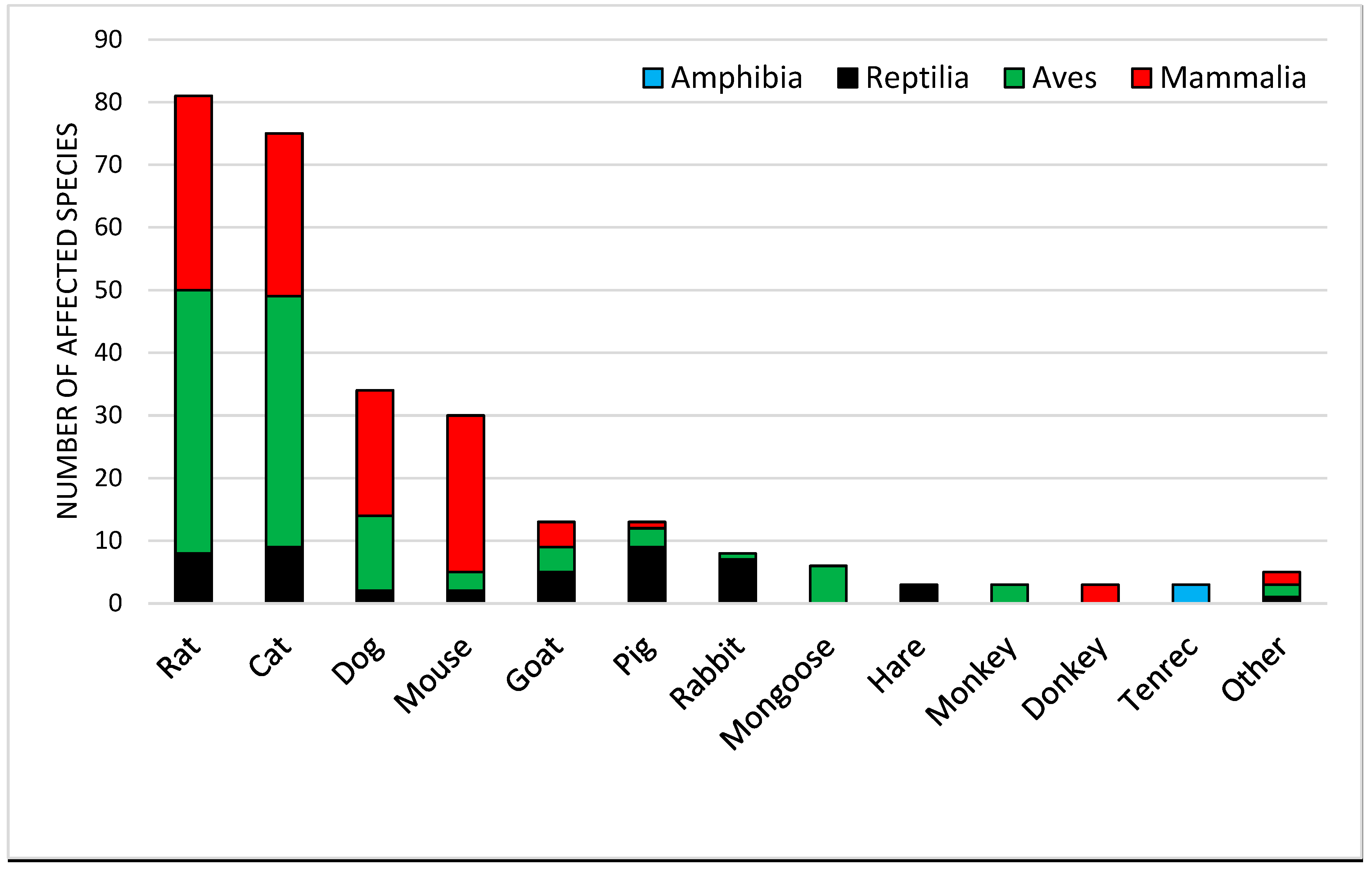
Table 4.
Familiar affinities of threatened species. Ex – extinct, En – threatened (in RDB), O – declining, rare etc., but not in RDB.
Table 4.
Familiar affinities of threatened species. Ex – extinct, En – threatened (in RDB), O – declining, rare etc., but not in RDB.
| Taxa | Ex | En | O | Total | |
|---|---|---|---|---|---|
| n | n | n | n | % | |
| PISCES | 0 | 0 | 0 | 3 | 2.1 |
| Sooglossidae | 3 | 0 | 0 | 3 | 0.0 |
| AMPHIBIA | 0 | 3 | 0 | 3 | 2.1 |
| REPTILIA | 10 | 9 | 4 | 23 | 16.0 |
| Bolyeriidae | 1 | 0 | 0 | 1 | 0.7 |
| Typhlopidae | 1 | 0 | 0 | 1 | 0.7 |
| Scincidae | 4 | 3 | 4 | 11 | 7.6 |
| Gekkonidae | 0 | 3 | 0 | 3 | 2.1 |
| Phyllodactylidae | 0 | 1 | 0 | 1 | 0.7 |
| Testudinidae | 4 | 2 | 0 | 6 | 4.2 |
| AVES | 37 | 31 | 21 | 89 | 61.8 |
| Aepyornithidae | 3 | 0 | 0 | 3 | 2.1 |
| Phaethontidae | 0 | 0 | 2 | 2 | 1.4 |
| Sulidae | 0 | 0 | 2 | 2 | 1.4 |
| Hydrobatidae | 0 | 1 | 0 | 1 | 0.7 |
| Procellariidae | 0 | 3 | 6 | 9 | 6.3 |
| Phalacrocoracidae | 1 | 2 | 0 | 3 | 2.1 |
| Diomedeidae | 0 | 5 | 0 | 5 | 3.5 |
| Laridae | 0 | 0 | 3 | 3 | 2.1 |
| Spheniscidae | 0 | 0 | 2 | 2 | 1.4 |
| Anatidae | 3 | 0 | 0 | 3 | 2.1 |
| Threskiornithidae | 1 | 1 | 0 | 2 | 1.4 |
| Ardeidae | 2 | 0 | 0 | 2 | 1.4 |
| Pelecanidae | 0 | 1 | 0 | 1 | 0.7 |
| Rallidae | 7 | 1 | 0 | 8 | 5.6 |
| Columbidae | 8 | 1 | 0 | 9 | 6.3 |
| Psittaculidae | 4 | 1 | 0 | 5 | 3.5 |
| Strigidae | 3 | 2 | 0 | 5 | 3.5 |
| Falconidae | 0 | 1 | 0 | 1 | 0.7 |
| Accipitridae | 0 | 1 | 0 | 1 | 0.7 |
| Hirundinidae | 0 | 1 | 0 | 1 | 0.7 |
| Monarchidae | 0 | 1 | 0 | 1 | 0.7 |
| Muscicapidae | 0 | 2 | 0 | 2 | 1.4 |
| Campephagidae | 0 | 1 | 0 | 1 | 0.7 |
| Zosteropidae | 1 | 2 | 0 | 3 | 2.1 |
| Acrocephalidae | 1 | 1 | 0 | 2 | 1.4 |
| Ploceidae | 1 | 2 | 0 | 3 | 2.1 |
| Sturnidae | 1 | 0 | 1 | 2 | 1.4 |
| Nectariniidae | 0 | 0 | 1 | 1 | 0.7 |
| Pycnonotidae | 1 | 0 | 0 | 1 | 0.7 |
| Cisticolidae | 0 | 0 | 2 | 2 | 1.4 |
| Passeridae | 0 | 0 | 1 | 1 | 0.7 |
| Emberizidae | 0 | 1 | 0 | 1 | 0.7 |
| Fringillidae | 0 | 0 | 1 | 1 | 0.7 |
| MAMMALIA | 18 | 5 | 6 | 29 | 20.1 |
| Nesomyidae | 0 | 0 | 5 | 5 | 3.5 |
| Lemuridae | 1 | 1 | 0 | 2 | 1.4 |
| Indrididae | 0 | 1 | 0 | 1 | 0.7 |
| Archeolemuridae | 3 | 0 | 0 | 3 | 2.1 |
| Megaladapidae | 3 | 0 | 0 | 3 | 2.1 |
| Palaeopropithecidae | 5 | 0 | 0 | 5 | 3.5 |
| Daubentonidae | 1 | 1 | 0 | 2 | 1.4 |
| Eupleridae | 0 | 1 | 0 | 1 | 0.7 |
| Felidae | 0 | 0 | 1 | 1 | 0.7 |
| Equidae | 1 | 1 | 0 | 2 | 1.4 |
| Hipopotamidae | 3 | 0 | 0 | 3 | 2.1 |
| Bovidae | 1 | 0 | 0 | 1 | 0.7 |
| Total # species | 65 | 45 | 31 | 144 | 100.0 |
Table 5.
Geographical distribution of the impacts. Ex – extinct, En – threatened (in RDB), O – declining, rare etc., but not in RDB.
Table 5.
Geographical distribution of the impacts. Ex – extinct, En – threatened (in RDB), O – declining, rare etc., but not in RDB.
| Places | Reptilia | Aves | Mammalia | Total | ||||||||
|---|---|---|---|---|---|---|---|---|---|---|---|---|
| Ex | En | O | Ex | En | O | Ex | En | O | Ex | En | O | |
| AFRICA: continent | 1 | 1 | 0 | 0 | 1 | 0 | 3 | 1 | 1 | 3 | 3 | 1 |
| Ethiopia/Eritrea | 0 | 0 | 0 | 0 | 0 | 0 | 1 | 0 | 0 | 1 | 0 | 0 |
| Southern Africa | 0 | 0 | 0 | 0 | 0 | 0 | 0 | 1 | 1 | 0 | 1 | 1 |
| South Africa | 0 | 1 | 0 | 0 | 1 | 0 | 2 | 0 | 0 | 2 | 2 | 0 |
| AFRICA: islands | 9 | 10 | 2 | 42 | 29 | 24 | 16 | 4 | 5 | 68 | 43 | 32 |
| Cape Verde | 1 | 1 | 0 | 0 | 3 | 5 | 0 | 0 | 0 | 1 | 4 | 5 |
| Gulf of Guinea islands | 0 | 0 | 0 | 0 | 1 | 0 | 0 | 0 | 0 | 0 | 1 | 0 |
| Marion Isl. | 0 | 0 | 0 | 0 | 6 | 4 | 0 | 0 | 0 | 0 | 6 | 4 |
| Madagascar | 1 | 0 | 0 | 3 | 1 | 0 | 16 | 4 | 5 | 20 | 5 | 5 |
| Mauritius | 3 | 9 | 0 | 11 | 7 | 2 | 0 | 0 | 0 | 14 | 16 | 2 |
| Reunion | 2 | 0 | 0 | 12 | 1 | 2 | 0 | 0 | 0 | 14 | 1 | 2 |
| Rodrigues | 2 | 0 | 0 | 12 | 1 | 0 | 0 | 0 | 0 | 14 | 1 | 1 |
| Other Mascarenes | 0 | 0 | 0 | 1 | 1 | 1 | 0 | 0 | 0 | 1 | 1 | 1 |
| Comoros | 0 | 0 | 1 | 0 | 3 | 0 | 0 | 0 | 0 | 0 | 3 | 1 |
| Seychelles | 1 | 0 | 0 | 3 | 5 | 3 | 0 | 0 | 0 | 4 | 5 | 3 |
| Socotra | 0 | 0 | 1 | 0 | 1 | 7 | 0 | 0 | 0 | 0 | 1 | 8 |
| Total | 10 | 11 | 2 | 42 | 30 | 24 | 19 | 5 | 6 | 71 | 46 | 33 |
6. Impact of Alien Mammals in Islands
6.1. Cape Verde
The archipelago Cape Verde (4033 km2, 538 thousands people) is a part of larger archipelago Macaronesia, which includes also the Canary Islands, Madeira and Azores. Cape Verde is an independent state which encompass 10 islands and 16 small islands. The vertebrate fauna includes 130 bird species (incl. 40 breeding), only 3 mammal species (all bats) and 15 reptiles (incl. 12 endemics) (https://en.wikipedia.org/wiki/Wildlife_of_Cape_Verde). There is only one, in addition invasive, fish species the Guppy Poecilia reticulata (Lucek & Lemoine 2012).
Islands worldwide have suffered seabird extinctions after the arrival of humans and the alien species they introduced. On Santa Luzia, an uninhabited island of 35 km2, the following maine bird species were extirpated: White-faced Storm Petrel Pelagodroma marina eadesorum, Boyd’s Shearwater Pufnus lherminieri boydi, Cape Verde Storm Petrel Hydrobates jabejabe, Cape Verde Shearwater Calonectris edwardsii. The recent extinction of these species on Santa Luzia might be consequent on the arrival of humans and their domestic animals (mainly cats) on the island (Alho et al. 2022).
Currently, the breeding seabird community in Cabo Verde is composed of Bulwer’s Petrel Bulweria bulwerii, White-faced Storm-petrel Pelagodroma marina aedesorum, Cape Verde Shearwater Calonectris edwardsii, Cape Verde Storm-petrel, Cape Verde Petrel, Boyd's Shearwater Puffinus lherminieri boydi, Brown Booby Sula leucogaster, and Red-billed Tropicbird Phaethon aethereus. One breeding species is currently extinct, the Magnificent Frigatebird Fregata magnificens (Semego et al. 2021). Cape Verde petrel is currently considered near threatened, and cats are the main problem (Miltao et al. 2017).
6.2. São Tomé e Principe and Other Islands in the Gulf of Guinea
There are four islands in the Gulf of Guinea in the Atlantic Ocean, south-west of Cameroon: two islands forming an independent state: São Tomé (854 km2, 193 thousands people in 2018) and Principe (136 km2, 5000 people in 2017), and two islands belonging to Equatorial Guinea: Bioko and (2017 km2, 335 thousands people in 2015) and Annabon (17 km2, 5,323 people in 2013). Most of the islands were not inhabited before the Portuguese conquest in 1493, while Bioko was occupied by Bantu people in 7th century.
The vertebrate fauna is composed of 143 bird species (incl. 23 endemics), 15 mammals (including 7 endemics), 14 reptiles (all endemics), 9 amphibians (all endemics), and 6 fish species (including one introduced, the Nile Tilapia Oreochromis niloticus niloticus).
This International Action Plan is designed for the conservation of the three Critically Endangered bird species, endemic to the island of São Tomé: the Dwarf Olive Ibis Bostrychia bocagei, the São Tomé Fiscal Lanius newtoni and the São Tomé Grosbeak Neospiza concolor (Hugulay 2014).
Predation of adults, juveniles and nests by introduced mammal species could be a potential threat for all the three species and in particular for the ibis, although there are no recorded predation events. Introduced Black Rat, Mona Monkey Cercopithecus mona, African Civet, cats and Least Weasel are all potential predators. Rats and the African Civets have both colonized primary forest or certainly the edges of it and are very likely to have had a deleterious effect upon nesting birds. However civets and weasels have been observed to prefer plantations. (Peet & Atkinson et al., 1994; Dutton, 1994).
6.3. Madagascar
It is the fourth largest island of the world (592,796 km2), with a population of 32 million in 2024 The island has been permanently colonized by Austronesians about 2000 years ago. It is a megadiverse country with about 90% of endemic fauna: 241 mammal species (99% endemics), 280 bird species (including 200 breeding spp., and c. 100 endemics), 280 reptile species (>90% endemics), 290 amphibian species (99% endemics) and 150 freshwater fish species (99% endemics) (https://en.wikipedia.org/wiki/Fauna_of_Madagascar).
By 600 AD, they began clearing the forests of the central highlands. About 1000 years ago they were joined by Batu people from eastern Africa, who brought zebu Bos taurus indicus and Sanga Bos taurus africanus cattle, and dogs Canis familiaris. The extinction event that wiped out much of the endemic megafauna on Madagascar, such as the two elephant birds, Giant Fossa Cryptoprocta spelea, and 17 species of giant lemurs and three hippopotamuses, followed the arrival of humans to Madagascar around 2000 years ago and dogs about 1000 years ago (Crowley 2010; Hansford & Turney 2018).
6.4. Mascarenes
An archipelago of an independent states – Mauritius (2040 km2, and 1.2 million people in 2020; including Rodrigues: 108 km2, Agalega: 24 km2 and St. Brandon: 1.3 km2) and few French dependencies, including Reunion (2511km2, settled in 17th century), Mayotte (374 km2; 257 thousand people in 2020). The dependencies include also uninhabited four small coral islands, named Iles esparses (Dispersed Islands) in Mozambique Chanel (Europa: 28 km2, Glorieuses: 7 km2, Juan de Nova: 5 km2 and Bassa da India: atoll 0.2 km2) and Tormeli Island (0.8 km2) east of Madagascar. They constitute a part of French Southern and Antarctic Territories.
Mascarenes fauna is threatened since 17th century, when human started to settle on the islands and transforming forests into cultivated fields and pastures. The domestic mammal species, such as cats, pigs, and also rats, monkeys and vervets further accelerated erosion of the local biodiversity. Especially severely were impacted Mauritius and Reunion. In Mauritius, 18 species became extinct in the course of 17th-20th centuries. In various islands of Mauritius, Rodrigues, Mayotte, and Seychelles, there were in 1990-2010, successful eradication of alien mammals, such as feral goat, rats, cats, Common Tenrec and House Mouse (Cheke 2013, Cheke & Hume 2008, Hume 2017).
6.5. Comoros
An archipelago (and independent state) of three islands, with a total surface are of 2,235km2. It was settled by Austronesian people at 9th century, and latter also by Arab, and Bantus people. There are 15 threatened bird species and 2 species of terrestrial mammals, viz. Common Brown Lemur Eulemur fulvus and Mongoose Lemur Eulemur mongoz (although it is here in the category ‘vulnerable’ it is an alien species, introduced to Comoros from Madagascar). Among birds two Otus owl species and Humbold’s Flycatcher Humboldia flavirostris are threatened by rats. The Comorian Skink Trachylepis comorensis is threatened by feral dogs.
6.6. Seychelles
An archipelago (and independent state) of 155 small islands, with a total surface area of only 457 km2 (the biggest: Mahe: 157 km2, Praslin: 39 km2 and La Digue: 10 km2) and population of 100,600 in 2022. Permanent settlements in the islands began with Portuguese colonization as late as in the 1770’s. The vertebrate fauna includes 285 bird species (11 extinct or extirpated, 14 endemic, 16 globally endangered), only 9 terrestrial mammals (6 species of bats and 3 introduced spp.), 14 amphibian (13 endemic) and 20 lizard (>3 endemic) and 3 snake (2 endemic) species (https://en.wikipedia.org). Rats and cats threaten several endemic species in Seychelles, namely: Seychelles Black Paradise Flycatcher Terpsiphone corvina, Seychelles Magpie Robin Copsychus sechellarum, Seychelles White-eye Zosterops modestus, Seychelles Warbler Acrocephalus seychellensis, Seychelles Fody Foudia sechellarum, Wedged-tailed Shearwater Ardenna pacifica, White-tailed Tropicbird Phaethon lepturus, Masked Booby Sula dactylatra (Rocamora and Henriette 2015). Six bird species extinct in Seychelles, e.g. Marianne white-eye, Seychelles parakeet, Aldabra brush warbler. In addition, the saltwater crocodile, most of the giant tortoises from the 40 granitic islands. However, the number of extinct species was by far much lower than in Mauritius, partly due to a shorter period of human occupation
6.7. Socotra
After Madagascar, it is the second largest African island, with a surface are of 3625 km2 and c. 60 thousands people. It is situated in the Gulf of Aden between the Horn of Africa and Arabian Peninsula. No latter than 2,000 years ago, the island was permanently settled by Arab and Indian people. Today it is administered by Yemen. Socotra is a home to 180 species of birds (41 breeding, and 10 endemic), 14 species of mammals, including domesticated species and the only indigenous mammals – bats, and 22 reptile species (including 19 endemic) (https://www.welcometosocotra.com/fauna-and-flora). Some vertebrate species are negatively affected by habitat destructed by feral mammals. One of the reptile species, Trachylepis socotrana, is threatened by invasive species (Damme & Banfield 2011).
6.8. Prince Edward Islands
These two uninhabited sub-Antarctic volcanic islands, Marion (279 km2) and Prince Edward (46 km2), harbor a wealth of sub-Antarctic seabirds and marine mammals. Both islands are administered by South Africa. The islands constitute breeding grounds of millions of seabirds from 29 species: four penguins, five albatrosses, two giant petrels, seven petrels, two prions, two diving-petrels, at least two storm-petrels, two terns and Brown Skua, Kelp Gull and Crozet Shag (Bester et al. 2002, Ryan 2015, Dilley et al. 2016). About 800,000 pairs King and Macaroni Penguins nest in colonies on the islands (William et al. 1979). The most abundant birds on the islands are burrow-nesting petrels. Numbers of burrowing petrels were greatly reduced by cats that roamed Marion Island from 1948 to 1991. The density of burrows on Marion Island is much lower than on the neighbouring Prince Edward Island, where there are no introduced mammals. The eradication of cats led to some recovery in petrel numbers, but this has been slower than expected due to predation by mice, introduced to the islands before the cats (Greve & Meden 2020).
References
- Alho, M.; Granadeiro, J.P.; Rando, J.C.; Geraldes, P.; Catry, P. Characterization of an extinct seabird colony on the island of Santa Luzia (Cabo Verde) and its potential for future recolonizations. J. Orn. 2022, 163, 301–313. [Google Scholar] [CrossRef]
- ANMH (American Museum of Natural History). Amphibian Species of the World 6.2, an Online Reference. https://amphibiansoftheworld.amnh.org/. Accessed on 03.03.2025.
- Angel, A.; Wanless, R.M.; Cooper, J. Review of impacts of the introduced house mouse on islands in the Southern Ocean: are mice equivalent to rats? Biol. Invas. 2009, 11, 1743–1754. [Google Scholar]
- Alpers, D.L.; van Vuuren, B.J.; Arctander, P.; Robinson, T.J. Population genetics of the roan antelope (Hippotragus equinus) with suggestions for conservation. Mol. Ecol. 2004, 13, 1771–1784. [Google Scholar] [CrossRef] [PubMed]
- Atkinson, I.A.E. 1985. The spread of commensal species of Rattus to oceanic islands and their effect on island avifaunas. In: Moors PJ (ed) Conservation of island birds. ICBP Technical Publication no.3, Cambridge, 1985.
- Ballari, S.A.; Anderson, C.B.; Valenzuela, A.E. Understanding trends in biological invasions by introduced mammals in southern South America: A review of research and management. Mam. Rev., 2016, 46, 229–240. [Google Scholar]
- Bastos, A.D.; Nair, D.; Taylor, P.J.; et al. Genetic monitoring detects an overlooked cryptic species and reveals the diversity and distribution of three invasive Rattus congeners in South Africa. BMCGenet 2011, 12, 26. [Google Scholar] [CrossRef]
- Bester, M.N.; Bloomer, J.P.; Van Aarde, R.J.; Erasmus, B.H.; Van Rensburg, P.J.J.; Skinner, J.D.; et al. A review of the successful eradication of feral cats from sub-Antarctic Marion Island, Southern Indian Ocean. S. Afr. J. Wildl. Res. 2002, 32, 65–73. [Google Scholar]
- Bigalke, R.C., & Pepler, D. Mammals introduced to the mediterranean region of South Africa. Biogeography of Mediterranean Invasions, 1991, 285-292.
- BirdLife International. IUCN Red List of Threatened Species. 2016, 1643. [CrossRef]
- BirdLife International (2018). IUCN Red List of Threatened,. [CrossRef]
- Blench, R. The history and spread of donkeys in Africa. Donkeys, people and development. A resource book of the Animal Traction Network for Eastern and Southern Africa (ATNESA). ACP-EU Technical Center for Agriculture and Rural Cooperation, Wageningen, 2004.
- Bloomer, J.P.; Bester, M.N. Control of feral cats on sub-Antarctic Marion Island, Indian Ocean. Biol. Conserv. 1992, 60, 211–219. [Google Scholar]
- Bocage, J.V.B. Contribution a la faune des quatre isles du Golfe du Guinee. 2. lie de Prince. J. Acad. Sci. Lisboa 1904, 7, 25–54. [Google Scholar]
- Bocage, J.V.B. Contribution a la faune des quatre isles du Golfe du Guinee. 4. Be de Sao Tome. J. Acad. Sci. Lisboa, 1904, 7, 65–96.
- Bonnington, C.; Gaston, K.J.; Evans, K.L. Fearing the feline: domestic cats reduce avian fecundity through trait-mediated indirect effects that increase nest predation by other species. J. appl. Ecol. 2013, 50, 15–24. [Google Scholar] [CrossRef]
- Bomer, M. Translocation of 7 Mammal Species to Rubondo Island National Park in Tanzania. Frankfurt Zoological Society Tanzania Wildlife Conservation Project ; Arusha (Tan.), 1988.
- Brooke, R.K.; Lloyd, P.H.; de Villiers, A.L. Alien and translocated terrestrial vertebrates in South Africa. In: Macdonald IAW, Kruger FJ, Ferrar AA (eds) The ecology and management of biological invasions in Southern Africa. Oxford University Press, Cape Town, pp 63–74, 1986.
- Brown, C.J.; Macdonald, I.A.W.; Brown, S.E. (eds) Invasive Alien Organisms in South West Africa/Narnibia. S. A. Natn. Sci. Progr. Rep. 1985, 119. [Google Scholar]
- Bullock, D.J.; North, S.G.; Dulloo, M.E.; Thorsen, M. The impact of rabbit and goat eradication on the ecology of Round Island, Mauritius. In Veitch, C.R.; Clout, M.N. (eds.), Turning the Tide: The Eradication of Invasive Species. IUCN, Gland, Switzerland, Cambridge, UK, pp. 53–63, 2002. [Google Scholar]
- Campbell, K.; Donlan, C.J. Feral goat eradications on islands. Conserv. Biol. 2005, 19, 1362–1374. [Google Scholar]
- Castley, J.G.; Boshoff, A.F.; Kerley, G.I.H. Compromising South Africa's natural biodiversity-inappropriate herbivore introductions. S. Afr. J. Sci., 2001, 97, 344–348. [Google Scholar]
- Cheke, A.S. Extinct birds of the Mascarenes and Seychelles–a review of the causes of extinction in the light of an important new publication on extinct birds. Phelsuma, 2013, 21, 4–19. [Google Scholar]
- Cheke, A.S.; Hume, J.P. Lost land of the dodo: an ecological history of Mauritius, Réunion & Rodrigues. A&C Black, 2008.
- Clements, J.F.; Schulenberg, T.S.; Iliff, M.J.; Roberson, D.; Fredericks, T.A.; et al. The eBird/Clements checklist of birds of the world, 2018. www.birds.cornell.edu/clementschecklist/download/ Accessed on 01.03.2015.
- Cole, N. 2021. Madatyphlops cariei. IUCN Red List of Threatened Species, 1669. [Google Scholar] [CrossRef]
- Cooper, R.K.; Brooke, R.K. Past and present distribution of the feral European rabbit, Oryctolagus cuniculus, on southern African offshore islands. S. Afr. J. Wildl. Res. 1982, 12, 71–75. [Google Scholar]
- Courchamp, F.; Chapuis, J.L.; Pascal, M. 2003. Mammal invaders on islands: impact, control and control impact. Biol. Rev. 2003, 78, 347–383. [Google Scholar]
- Crawford, R.J.M.; Dyer, B.M. Wildlife of Robben Island. Bright continent guide 1. Avian Demography Unit, Cape Town, 2000.
- Crawford, A.B.; Serventy, D.L. The birds of Marion Island, South Indian Ocean. Emu-Austral Ornithology 1952, 52, 73–85. [Google Scholar]
- Crowley, B.E. A refined chronology of prehistoric Madagascar and the demise of the megafauna. Quarter. Sci. Rev. 2010, 29, 2591–2603. [Google Scholar]
- Cuzin, F.; Randi, E. Sus scrofa Wild Boar. In: Kingdon, J.; Hoffmann, M. (eds.). Mammals of Africa. Vol. 6, p. 28-29.
- Damme, K.V.; Banfield, L. Past and present human impacts on the biodiversity of Socotra Island (Yemen): implications for future conservation. Zool. Middle East 2011, 54, 31–88. [Google Scholar] [CrossRef]
- Davies, S.J.; Jordaan, M.; Karsten, M.; et al. Experience and lessons from alien and invasive animal control projects in South Africa. In: van Wilgen, B.W.; Measey, J.; Richardson, D.M. et al (eds.) Biological invasions in South Africa. Springer, Berlin, pp 625–660, 2020. [CrossRef]
- Deacon, J. Human settlement in South Africa and archaeological evidence for alien plants and animals. In: Macdonald, I.A.W.; Kruger, F.J.; Ferrar, A.A. (eds.) The ecology and management of biological invasions in southern Africa. Oxford University Press, Cape Town, pp 3–19, 1986.
- De Villiers, M.S.; Mecenero, S.; Sherley, R.B.; Heinze, E.; Kieser, J.; Leshoro, T.M. , et al. Introduced European rabbits (Oryctolagus cuniculus) and domestic cats (Felis catus) on Robben Island: Population trends and management recommendations. S. Afr. J. Wildl. Res., 2010, 40, 139–148. [Google Scholar]
- Delgado, K.; Lopes, E.P.; Vasconcelos, R. . Cabo Verde giant gecko: how many units for conservation? Amphibia-Reptilia 2021, 42, 503–510. [Google Scholar]
- Dilley, B.J.; Schoombie, S.; Schoombie, J.; Ryan, P.G. ‘Scalping’of albatross fledglings by introduced mice spreads rapidly at Marion Island. Antarctic Sci. 2016, 28, 73–80. [Google Scholar]
- Dobigny, G.; Poirier, P.; Hima, K.; Cabaret, O.; Gauthier, P.; Tatard, C.; Costa, J.M.; Bretagne, S. Molecular survey of rodent-borne Trypanosoma in Niger with special emphasis on T. lewisi imported by invasive black rats. Acta Tropica 2011, 117, 183–188. [Google Scholar] [PubMed]
- Dobigny, G.; Dalecky, A. Native and Invasive Small Mammals in Urban Habitats along the Commercial Axis Connecting Benin and Niger, West Africa. Diversity 2019, 11, 238. [Google Scholar] [CrossRef]
- Doherty, T.S.; Dickman, C.R.; Glen, A.S.; Newsome, T.M.; Nimmo, D.G.; Ritchie, E.G.; et al. The global impacts of domestic dogs on threatened vertebrates. Biol. Conserv. 2017, 210, 56–59. [Google Scholar]
- Dutton, J. Introduced mammals in São Tomé and Príncipe: possible threats to biodiversity. Biodiv. Conserv. 1994, 3, 927–938. [Google Scholar] [CrossRef]
- Faith, J.T. 2014. Late Pleistocene and Holocene mammal extinctions on continental Africa. Earth-Science Rev. 2014, 128, 105–121. [Google Scholar]
- Feiler, A. Uber die Saiigetiere der Insel São Tome. Zool. Abh. Mus. Tierk. Dresden 1984, 40, 75–78. [Google Scholar]
- Feiler, A. Die Saugetiere der Inseln im Golf von Guinea und ihre Beziehungen zur Saugetierfauna der westafrikanischen Festlandes. Zool. Abh. Mus. Tierk. Dresden 1988, 44, 83–88. [Google Scholar]
- Feiler, A.; Haft, J.; Widmann, P. Beobachtungen und Untersuchungen an Saugetieren der Insel São Tome (Golf von Guinea) (Mammalia). Faun. Abh. Mus. Tierkd. Dresden 1993, 19, 21–35. [Google Scholar]
- Figueiredo, E.; Gascoigne, A. Conservation of pteridophytes in São Tomé e Príncipe (Gulf of Guinea). Biodiv. Conserv. 2001, 10, 45–68. [Google Scholar]
- Fitzgerald, B.M.; Veitch, C.R. The cats of Herekopare Island, New Zealand; their history, ecology and affects on birdlife. New Zeal. J. Zool., 1985, 12, 319–330. [Google Scholar]
- Frade, F. Aves e mammiferos das Ilhas de Sao Tome e do Principe - notas de sistematica e de proteccao a fauna. Conferencia International dos Africanistes Occidendais, Lisboa 1958, 4, 137–50. [Google Scholar]
- Freeland, W.J. Large herbivorous mammals: exotic species in northern Australia. J. Biogeogr.
- Genovesi, P.; Bacher, S.; Kobelt, M.; Pascal, M.; Scalera, R. Alien mammals of Europe. Handbook of alien species in Europe.
- Ghestemme, T.; Salamolard, M. L'échenilleur de La Réunion, Coracina newtoni, espèce endémique en danger. Ostrich 2007, 78, 255–258. [Google Scholar]
- Gippoliti, S.; Robovský, J.; Angelici, F.M. Taxonomy and Translocations of African Mammals: A Plea for a Cautionary Approach. Conservation 2021, 1, 121–136. [Google Scholar] [CrossRef]
- Godfrey, L.R.; Rasoazanabary, E. Demise of the Bet Hedgers: A Case Study of Human Impacts on Past and Present Lemurs of Madagascar. In Sodikoff; G.M (eds.). The Anthropology of Extinction: Essays on Culture and Species Death. Indiana University Press, 2011. [Google Scholar]
- Goodman, S.M. Rattus on Madagascar and the Dilemma of Protecting the Endemic Rodent Fauna. Conserv. Biol. 1995, 9, 450–453. [Google Scholar]
- Goodman, S.M. The New Natural History of Madagascar. Princeton University Press, 2022.
- Greyling, T. Factors affecting possible management strategies for the Namib feral horses (. Ph.D. Thesis, ). North-West University, Pochefstroom, 2005. [Google Scholar]
- Greve, M.; von der Meden, C.E.O.; Janion-Scheepers, C. Biological invasions in South Africa’s offshore sub-Antarctic territories. In: van Wilgen, B.W.; Measey, J.; Richardson, D.M. et al (eds.) Biological invasions in South Africa. Springer, Berlin, pp. 205–226, 2020. [CrossRef]
- Goldbeck, G. ; Greyling; Swilling, R. Wild horses in the Namib Desert: An Equine Biography. Windhoek, 2011. [Google Scholar]
- Godfrey, L.R.; Jungers, W.L.; Burney, D.A. Subfossil Lemurs of Madagascar. In: Werdelin, L.; Sanders, W.J (eds.). Cenozoic Mammals of Africa, 2010. [Google Scholar]
- Godfrey, L.R.; Jungers, W.L. Subfossil Lemurs. In: Goodman, S.M.; Benstead, J.P (eds.). The Natural History of Madagascar, 1247. [Google Scholar]
- Godfrey, L.R.; Jungers, W.L.; Burney, D.A. Subfossil lemurs of Madagascar. Cenozoic Mammals of Africa, 2010. [Google Scholar]
- Goodman, S.M. 1995. Rattus on Madagascar and the Dilemma of Protecting the Endemic Rodent Fauna. Conserv. Biol. 1995, 9, 450–453. [Google Scholar]
- Graaff, G. The Rodents of Southern Africa: Notes on Their Identification, Distribution, Ecology, and Taxonomy. Butterworths, Durban, 1981.
- Groom, M.J.; Meffe, G.K.; Carroll, C.R. Principals of Conservation Biology. 3rd ed. Sunderland (MA, U.S.A.), Sinauer Associates, 2006.
- Hagern, B.L.; Kumschick, S. The relevance of using various scoring schemes revealed by an impact assessment of feral mammals. NeoBiota 2018, 38, 37. [Google Scholar] [CrossRef]
- Hansford, J.P.; Turvey, S.T. (2018-09-26). Unexpected diversity within the extinct elephant birds (Aves: Aepyornithidae) and a new identity for the world's largest bird. Roy. Soc. Open Sci. 2018, 5, 181295. [Google Scholar] [CrossRef]
- Happold, D.C.D. Sciurus carolinensis Grey Squirrel. In: Happold, D.C.D. (ed.) Mammals of Africa. Vol. 3, p. 92-93, 2013.
- Happold, D.C.D. Rattus norvegicus Brown Rat. In: Happold, D.C.D. (ed.) Mammals of Africa. Vol. 3, p. 540-541, 2013.
- Happold, D.C.D. Rattus rattus Black Rat. In: Happold, D.C.D. (ed.) Mammals of Africa. Vol. 3, p. 541-543, 2013.
- Happold, D.C.D. Myocaster coypus Coypu. In: Happold, D.C.D. (ed.) Mammals of Africa. Vol. 3, p. 691-692, 2013.
- Happold, D.C.D. Oryctolagus cuniculus European Rabbit. In: Happold, D.C.D. (ed.) Mammals of Africa. Vol. 3, p. 708-710.
- Havemann, C.P.; Retief, T.A.; Tosh, C.A.; de Bruyn, P.J.N. Roan antelope Hippotragus equinus in Africa: a review of abundance, threats and ecology. Mammal Rev. 2016, 46, 144–158. [Google Scholar]
- Hinton, H.E.; Dunn, A.M.S. Mongooses, Their Natural History and Behaviour, Oliver & Boyd, 42s. Published online by Cambridge University Press, 1967.
- Hixon, S.W.; Douglass, K.G.; Godfrey, L.R.; Eccles, L.; Crowley, B.E.; Rakotozafy, L.M.A.; Clark, G.; Haberle, S.; Anderson, A.; Wright, H.T.; Kennett, D.J. Ecological Consequences of a Millennium of Introduced Dogs on Madagascar. Front. Ecol. Evol. 2021, 9, 689559. [Google Scholar] [CrossRef]
- Hockey, P.A.R.; Dean, W.R.J.; Ryan, P.G. (Eds.) . Roberts– Birds of Southern Africa, 7th edn. The Trustees of the John Voelcker Bird Book Fund, Cape Town, 2005.
- Hoffmann, K.L.; Wood, A.K.; Mccarthy, P.H.; Griffiths, K.A.; Evans, D.L.; Gill, R.W. Sonographic observations of the peripheral vasculature of the equine thoracic limb. Anat. Histol. Embryol. 1999, 28, 281–289. [Google Scholar] [PubMed]
- Hughes, J.; Macdonald, D.W. A review of the interactions between free-roaming domestic dogs and wildlife. Biol. Conserv. 2013, 157, 341–351. [Google Scholar]
- Hugulay, M.; Gascoigne, A.; De Deus, D.; De Lima, R.F. Notes on the breeding ecology and conservation of the Critically Endangered Dwarf Olive Ibis. Bul. ABC. 2014, 21, 202–205. [Google Scholar] [CrossRef]
- Hume, J.P. Extinct Birds. Bloomsbury Publishing, 2017.
- Huntley, B.J. Marion Island: Birds, Cats, Mice and Men. In Strategic Opportunism: What Works in Africa: Twelve Fundamentals for Conservation Success (p. 21-37). Cham, Springer Nature Switzerland, 2023.
- IUNC. 100 of the World's Worst Invasive Alien Species. Global Invasive Species Database, /: https, 2025.
- Jassat, W.; Naicker, N.; Naidoo, S.; Mathee, A. Rodent control in urban communities in Johannesburg, South Africa: From research to action. Int.J. Envir.Health Res. 2013, 23, 474–483. [Google Scholar]
- Jones, M.G.W.; Ryan, P.G. Evidence of mouse attacks on albatross chicks on sub-Antarctic Marion Island. Antarctic Sci., 2010, 22, 39–42. [Google Scholar]
- Jones, H.P.; Tershy, B.R.; Zavaleta, E.S.; Croll, D.A.; Keitt, B.S. , Finkelstein, M. E.; Howald, G.R. Severity of the effects of invasive rats on seabirds: A global review. Conservation Biology 2008, 22, 16–26. [Google Scholar] [CrossRef]
- Julius, R.S.; Schwan, E.V.; Chimimba, C.T. Helminth composition and prevalence of indigenous and invasive synanthropic murid rodents in urban areas of Gauteng Province, South Africa. J. Helminthol. 2018, 92, 445–454. [Google Scholar]
- Harris, D.B. Review of negative effects of introduced rodents on small mammals on islands. Biol Invas. 2009, 11, 1611–1630. [Google Scholar] [CrossRef]
- Kefena, E.; Dessie, T. The Kundido feral horses: Fugitives of the Abyssinian domestic horses. Vol. 25. Ethiopian Society of Animal Production (ESAP), 2011.
- Kehlmaier, C.; Graciá, E.; Ali, J.R.; Campbell, P.D.; Chapman, S.D.; Deepak, V.; Ihlow, F.; Jalil, N.-E.; Pierre-Huyet, L.; Samonds, K.E.; Vences, M.; Fritz, U. Ancient DNA elucidates the lost world of western Indian Ocean giant tortoises and reveals a new extinct species from Madagascar. Science Advances 2023, 9, eabq2574. [Google Scholar] [CrossRef]
- Kerley, G.; Boshoff, A. The introduction of alien mammals into the broader Western and Northern Cape Provinces of South Africa. Centre for African Conservation Ecology Nelson Mandela Metropolitan University, Port Elizabeth, 2015.
- Kimura, B.; Marshall, F.B.; Chen, S.; Rosenbom, S.; Moehlman, P.D.; Tuross, N.; et al. Ancient DNA from Nubian and Somali wild ass provides insights into donkey ancestry and domestication. Proc. Roy. Soc. B: Biol. Sci. 2011, 278, 50–57. [Google Scholar] [CrossRef] [PubMed]
- Kirk, D.A.; Racey, P.A. Effects of the introduced black-naped hare Lepus nigricollis nigricollis on the vegetation of Cousin Island, Seychelles and possible implications for avifauna. Biol. Conser. 1992, 61, 171–179. [Google Scholar] [CrossRef]
- Kikoti, I.A.; Mushi, R.F. Rubondo Island National Park: Overlooked World’s Largest Tropical Lake Island Protected Area in Tanzania. E. Afr. J. Envir. Nat. Res. 2025, 8, 85–106. [Google Scholar] [CrossRef]
- King, B. Conservation geographies in Sub-Saharan Africa: The politics of national parks, community conservation and peace parks. Geography Compass 2010, 4, 14–27. [Google Scholar] [CrossRef]
- Komdeur, J. 1996. Breeding of the Seychelles Magpie Robin Copsychus sechellarum and implications for its conservation. Ibis 1996, 138, 485–498. [Google Scholar] [CrossRef]
- Kopij, G. 2025. In perep.
- Kruger J, Parrini F, Koen J et al. A conservation assessment of Hippotragus equinus. In: Child, M.F.; Roxburgh, L.; Do Linh San, E.; Raimondo, D.; Davies-Mostert, H.T. (eds.). The Red List of Mammals of South Africa, Swaziland and Lesotho. South African National Biodiversity Institute and Endangered Wildlife Trust, Pretoria, 2016.
- Kurdila, J. The introduction of exotic species into the United States: there goes the neighborhood. BC Envtl. Aff. L. Rev., 1988, 16, 95. [Google Scholar]
- Le Corre, M.; Danckwerts, D.K.; Ringler, D.; Bastien, M.; Orlowski, S.; Morey-Rubio, C.; Pinaud, D.; Micol, T. Seabird recovery and vegetation dynamics after Norway Rat eradication at Tromelin Island, western Indian Ocean. Biol. Conserv. 2015, 185, 85–94. [Google Scholar] [CrossRef]
- Le Roux, J.J.; Foxcroft, L.C.; Herbst, M.; MacFadyen, S. Genetic analysis shows low levels of hybridization between African wildcats (Felis silvestris lybica) and domestic cats (F. s. catus)in South Africa. Ecol. Evol. 2015, 5, 288–299. [Google Scholar] [CrossRef]
- Lever, Naturalized Animals: the Ecology of Successfully Introduced Species. Poyser Natural History, London, 1994.
- Lewis, J.S.; Matthew, L.; Farnsworth, C.L.; Burdett, D.M.; Theobald, M.G.; Miller, R.S. Biotic and abiotic factors predicting the global distribution and population density of an invasive large mammal. Scientific Reports 2017, 7, 44152. [Google Scholar] [CrossRef]
- Lehtonen, J. Occurrence of the introduced black rat (Rattus rattus) and its potential effects on endemic rodents in southeastern Madagascar. Unpubl. academic thesis. Univ. Helsinki. 2013. [Google Scholar]
- Llobet, T.; Velikov, I.; Sogorb, L.; Peacock, F.; Jutglar, F.; Mascarell, A.; Blanca, M.; Rodríguez-Osorio, J. Allthe. Mammals of the World. Lynx Nature Books, Barcelona, 2023.
- Long, J.L. Introduced mammals of the world: their history, distribution and influence. CSIRO publishing, 2003.
- Lucek, K.; Lemoine, M. First record of freshwater fish on the Cape Verdean archipelago s. African Zoology, 47.
- Macpherson, C.N.L.; Karstad, L.; Stevenson, P.; Arundel, J.H. Hydatid disease in the Turkana District of Kenya. 3. The significance of wild animals in the transmission of Echinococcus granulosus, with particular reference to Turkana and Masailand in Kenya. Ann. Trop. Med. Parasitol. 1983, 77, 61–73. [Google Scholar]
- Mateo, J.A.; Barone, R.; Hernández-Acosta, C.N.; López-Jurado, L.F. La muerte anunciada de dos gigantes macaronésicos: el gran escinco caboverdiano, Chioninia coctei (Duméril & Bibron, 1839) y el lagarto de Salmor, Gallotia simonyi (Steindachner, 1889). Bol. Asoc. Herpetol. Esp. 2020, 31, 3–30. [Google Scholar]
- Matthee, C.A.; Robinson, T.J. Mitochondrial DNA population structure of roan and sable antelope: implications for the translocation and conservation of the species. Molecular Ecology 1999, 8, 227–238. [Google Scholar] [CrossRef] [PubMed]
- Measey, J.; Hui, C.; Somers, M.J. Terrestrial vertebrate invasions in South Africa. Biological Invasions in South Africa, v: In, 2020; 14. [Google Scholar] [CrossRef]
- Merz, L.; Kshirsagar, A.R.; Rafaliarison, R.R.; Rajaonarivelo, T.; Farris, Z.J.; Randriana, Z.; Valenta, K. Wildlife predation by dogs in Madagascar. Biotropica 2022, 54, 181–190. [Google Scholar] [CrossRef]
- Mitchell, P. Settling Madagascar: When Did People First Colonize the World's Largest Island? J. Isl. Coast. Archaeol. 2020, 15, 576–595. [Google Scholar] [CrossRef]
- Militão, T.; Dinis, H.A.; Zango, L.; Calabuig, P.; Stefan, L.M.; González-Solís, J. Population size, breeding biology and on-land threats of Cape Verde petrel (Pterodroma feae) in Fogo Island, Cape Verde. PLoS ONE 2017, 12, e0174803. [Google Scholar] [CrossRef]
- Miljutin, A.; Lehtonen, J.T. Probability of competition between introduced and native rodents in Madagascar: An estimation based on morphological traits Est. J. Ecol. 2008, 57, 2–133. [Google Scholar] [CrossRef]
- Midtgaard, R. RepFocus – A Survey of the Reptiles of the World, 2025. www.repfocus.dk. Accessed on 03.03. 2025. [Google Scholar]
- Mittermeier, R.A.; Louis, E.E.; Richardson, M.; Schwitzer, C.; et al. Lemurs of Madagascar. Conservation International, 3rd ed., 2010.
- Monadjem, A.; Taylor, P.J.; Denys, C.; Cotterill, F.P.D. Rodents of sub-Saharan Africa: a biogeographic and taxonomic synthesis. Walter de Gruyter, Berlin, 2015. [CrossRef]
- Moolman, H.J.; Cowling, R.M. The impact of elephant and goat grazing on the endemic flora of South African succulent thicket. Biol Conserv. 1994, 68, 53–61. [Google Scholar]
- Muller, H.; Bourne, A. Minimum population size and potential impact of feral and semi-feral donkeys and horses in an arid rangeland. Afr. Zool., 2018, 53, 139–144. [Google Scholar] [CrossRef]
- Muzaffar, S.B.; Benjamin, D.; Gubiani, R.E. The impact of fox and feral cat predation on the population viability of the threatened, endemic Socotra cormorant on Siniya Island, United Arab Emirates. Marine Orn. 2013, 41, 171–177. [Google Scholar]
- Mwenya, E.; Keib, G. History and utilisation of donkeys in Namibia. Donkeys, People and Development: a Resource Book for Eastern and Southern Africa, 2004. [Google Scholar]
- Nameer, P.O.; Smith, A.T. Lepus nigricollis. IUCN Red List of Threatened Species, 4518. [Google Scholar] [CrossRef]
- Nel, D.C.; Ryan, P.G.; Crawford, R.J.; Cooper, J.; Huyser, O.A. Population trends of albatrosses and petrels at sub-Antarctic Marion Island. Polar Biology 2002, 25, 81–89. [Google Scholar]
- Nowak, R.M. Walker’s Mammals of the World. T. 1. Johns Hopkins University Press, 1999, s. 1024–1025.
- Owadally, A.W. Some forest pests [animal and plant] and diseases [fungal and bacterial] in Mauritius. Revue Agricole et Sucriere de l'Ile Maurice (Mauritius).
- Peet, N.B.; Atkinson, P.W. The biodiversity and conservation of the birds of São Tomé and Príncipe. Biodiv. Conserv., 1994, 3, 851–867. [Google Scholar]
- Picker, M.D.; Griffiths, C.L. Alien and invasive animals: A South African perspective. Penguin Random House South Africa, Cape Town, 2011.
- Picker, M.D.; Griffiths, C.L. Alien animals in South Africa-composition, introduction history, origins and distribution patterns. Bothalia-African Biodiv. Conserv, 47. [CrossRef]
- Potgieter. L.; Douwes, E., Ed.; Gaertner, M. et al. Biological invasions in South Africa’s urban ecosystems: patterns, processes, impacts and management. In: van Wilgen, B.W.; Measey, J.; Richardson, D.M. et al (eds.) Biological invasions in South Africa. Springer, Berlin, pp 273–310, 2020. [Google Scholar] [CrossRef]
- Rhodin, A.G.J.; Pritchard, P.C.H.; van Dijk, P.P.; Saumure, R.A.; Buhlmann, K.A.; Iverson, J.B.; Mittermeier, R.A. (Eds.) . Conservation Biology of Freshwater Turtles and Tortoises: A Compilation Project of the IUCN/SSC Tortoise and Freshwater Turtle Specialist Group. Chelonian Research Monographs, 5, 2015.
- Rodríguez, P.J. Exotic species introductions into South America: an underestimated threat? Biodiv. Conserv. 2001, 10, 1983–1996. [Google Scholar]
- Rocamora, G.; Henriette, E. Invasive Alien Species in Seychelles: why and how to eliminate them. Identification and management of priority species. Collection Inventaires et Biodiversité. Biotope Éditions, Mèze; Muséum National d’Histoire Naturelle, Paris, 2015. 384.
- Russell, J.C.; Cole, N.C.; Zuël, N. Gérard Rocamora Introduced mammals on Western Indian Ocean islands. Global Ecol. Conserv. 2016, 6, 132–144. [Google Scholar]
- Russell, J.C.; Towns, D.R.; Clout, M.N. Review of rat invasion biology: implications for island biosecurity. Science for Conservation 286, Department of Conservation, Wellington, 2018.
- Ryan, P. Alein and islands. Quest 2015, 11, 26–30. [Google Scholar]
- Sánchez, E.S. How Cabo Verde is becoming a safe haven for seabirds. BirdLife Intern. https://www.birdlife.org/news/2020/11/05/how-cabo-verde-is-becoming-a-safe-haven-for-seabirds/ Accessed: 17.02.2025.
- Sanchez, M. Phelsuma borbonica. The IUCN red list of threatened species 2021: E. T17429273A17430906, 2021.
- Sanchez, M.; Caceres, S. Plan national d’actions en faveur des Geckos verts de La Réunion Phelsuma borbonica et Phelsuma inexpectata. Nature Océan Indien/Office Français de la Biodiversité, pour la Direction de l’Environnement, de l’Aménagement et du Logement de La Réunion,.
- Saraf, S. Preserving the perishing endangered natural biodiversity of Socotra Island. Open, J. Ecol. 2021, 11, 148–162. [Google Scholar]
- Sanchez, M. Leiolopisma ceciliae. IUCN Red List of Threatened Species, 2355. [Google Scholar] [CrossRef]
- Semedo, G.; Paiva, V.H.; Militão, T.; Rodrigues, I.; Dinis, H.A.; Pereira, J.; Matos, D.; Ceia, F.R.; Almeida, N.M.; Geraldes, P.; Saldanha, S.; Barbosa, N.; Hernández-Montero, M.; Fernandes, C.; González-Sólis, J.; Ramos, J.A. Distribution, abundance, and on-land threats to Cabo Verde seabirds. Bird Conservation International 2020. doi.org/10.1017/S0959270920000428.
- Shackelton, A. Diversity and Taxonomy of Malagasy Pygmy Hippopotamuses. MS thesis. Northern Illinois University, 2021.
- Shivambu, N.; Shivambu, T.C.; Downs, C.T. Assessing the potential impacts of non-native small mammals in the South African pet trade. NeoBiota 2020, 60, 1–18. [Google Scholar] [CrossRef]
- Shivambu, N.; Shivambu, T.C.; Downs, C.T. Non-native small mammal species in the South African pet trade. Mgmt. Biol. Inv. 2021, 12, 294–312. [Google Scholar] [CrossRef]
- Skead, C.J.; Boshoff, A.; Kerley, G.I.H.; Lloyd, P. Introduced (non-indigenous) species: a growing threat to biodiversity. In: Skead CJ, Boshoff A, GIH K, Lloyd P (eds) Historical incidence of the larger land mammals in the broader Northern and Western Cape. Port Elizabeth, South Africa. Centre for African Conservation Ecology, Nelson Mandela Metropolitan University, Port Elizabeth, 2011.
- Smithers, R.H.N. The mammals of the southern African subregion. University of Pretoria, Pretoria, 1983.
- Spear, D.; Chown, S.L. Taxonomic homogenization in ungulates: patterns and mechanisms at local and global scales. J. Biog. 2008, 35, 1962–1975. [Google Scholar] [CrossRef]
- Spear, D.; Chown, S.L. The extent and impacts of ungulate translocations: South Africa in a global context. Biol Conserv. [CrossRef]
- Spear, D.; Chown, S.L. Non-indigenous ungulates as a threat to biodiversity. J. Zool, 1: 279. [CrossRef]
- Sow, A.; Duplantier, J.M. Sharing space between native and invasive small mammals: Study of commensal communities in Senegal. Ecol. Evol. 2023, 13, e10539. [Google Scholar] [CrossRef]
- Steadman, D.W. Prehistoric extinctions of Pacific island birds: biodiversity meets zooarchaeology. Science, 1995, 267, 1123–1131. [Google Scholar] [CrossRef] [PubMed]
- Sufiyan, A. Kundudo feral horse: Trends, status and threats and implication for conservation. Global J. Zool., 2022, 7, 009–013. [Google Scholar] [CrossRef]
- Sussman, R.W.; Tattersall, I. A Preliminary Study of the Crab-eating Macaque Macaca fascicularis in Mauritius, Mauritius Inst. Bul. 1980, 9, 31–51. [Google Scholar]
- Sussman, R.W.; Tattersall, I. Distribution, Abundance, and Putative Ecological Strategy of Macaca fascicularis on the Island of Mauritius, Southwestern Indian Ocean, Folia Primatol. 1986, 46, 28–43. 46.
- Courchamp, F.; Chapuis, J.-L.; Pascal, M. Mammal Invaders on Islands: Impact, Control, and Control Impact, Biol. Rev. 2002, 78, 347–383. [Google Scholar]
- Taylor, P.J. , Arntzen, L., Hayter, M., Iles, M., Frean, J., & Belmain, S. Understanding and managing sanitary risks due to rodent zoonoses in an African city: beyond the Boston Model. Integrative Zool. 2008, 3, 38–50. [Google Scholar]
- Tennent, J.; Downs, C.T. Abundance and home ranges of feral cats in an urban conservancy where there is supplemental feeding: a case study from South Africa. Afr. Zool., 2008, 43, 218–229. [Google Scholar]
- Toomes, A.; García-Díaz, P.; Wittmann, T.A.; Virtue, J.; Cassey, P. New aliens in Australia: 18 years of vertebrate interceptions. Wildlife Res., 2019, 47, 55–67. [Google Scholar] [CrossRef]
- Towns, D.R.; Atkinson, I.A.E.; Daugherty, C.H. Have the harmful effects of introduced rats on islands been exaggerated? Biol. Invas. 2006, 8, 863–891. [Google Scholar]
- Treasure, A.M.; Chown, S.L. Antagonistic effects of biological invasion and temperature change on body size of island ectotherms. Divers.Distrib. 2014, 20, 202–213. [Google Scholar]
- Young, J.K.; Olson, K.A.; Reading, R.P.; Amgalanbaatar, S.; Berger, J. Is wildlife going to the dogs? Impacts of feral and free-roaming dogs on wildlife populations. BioScience 2011, 61, 125–132. [Google Scholar]
- van Helden, L.; van Helden, P.D.; Meiring, C. Pathogens of vertebrate animals as invasive species: Insights from South Africa. In: van Wilgen BW, Measey J, Richardson DM et al (eds) Biological invasions in South Africa. Springer, Berlin, pp 247–272, 2020. [CrossRef]
- Van Wyk, A.M.; Dalton, D.L.; Kotzé, A.; Grobler, J.P.; Mokgokong, P.S.; Kropff, A.S.; Jansen van Vuuren, B. Assessing introgressive hybridization in roan antelope (Hippotragus equinus): Lessons from South Africa. Plos one 2019, 14, e0213961. [Google Scholar]
- van Wilgen, B.W.; Measey, J.; Richardson, D.M.; et al. (Eds.) Biological invasions in South Africa. Springer, Berlin, pp 273–310, 2020. [CrossRef]
- van Wilgen, B.W.; Wilson, J.R. (Eds.) . The status of biological invasions and their management in South Africa in 2017. South African National Biodiversity Institute, Kirstenbosch and DST-NRF Centre of Excellence for Invasion Biology, Stellenbosch, 2018.
- van Wilgen, B.W.; Zengeya,T. A.; Richardson, D.M. A review of the impacts of biological invasions in South Africa. Biol. Invas. 2022, 24, 27–50. [Google Scholar] [CrossRef]
- Waker, S. 2001. Introducing a “New Species”: the South African Himalayan Tahr. Zoos Print 2001, 16, 21–22. [Google Scholar]
- Wandeler, A.I.; Matter, H.C.; Kappeler, A.; Budde, A. The ecology of dogs and canine rabies: a selective review. Revue sci. techn., 1993, 12, 51–71. [Google Scholar]
- Watkins, B.P.; Cooper, J. Introduction, present status and control of alien species at the Prince Edward Islands, Sub-Antarctic, 1986.
- Williams, A.J.; Siegfried, W.R.; Burger, A.E.; Berruti, A. The Prince Edward Islands: a sanctuary for seabirds in the Southern Ocean. Biological Conservation, 1979, 15, 59–71. [Google Scholar]
- Winter, L.; Wallace, G.E. Impacts of feral and free-ranging cats on bird species of conservation concern. Other Publications in Wildlife Management.
- World Conservation Monitoring Centre (1996). "Leiolopisma mauritiana". IUCN Red List of Threatened Species, 3277. [CrossRef]
Figure 1.
Known years of introduction of mammals in sub-Saharan Africa.
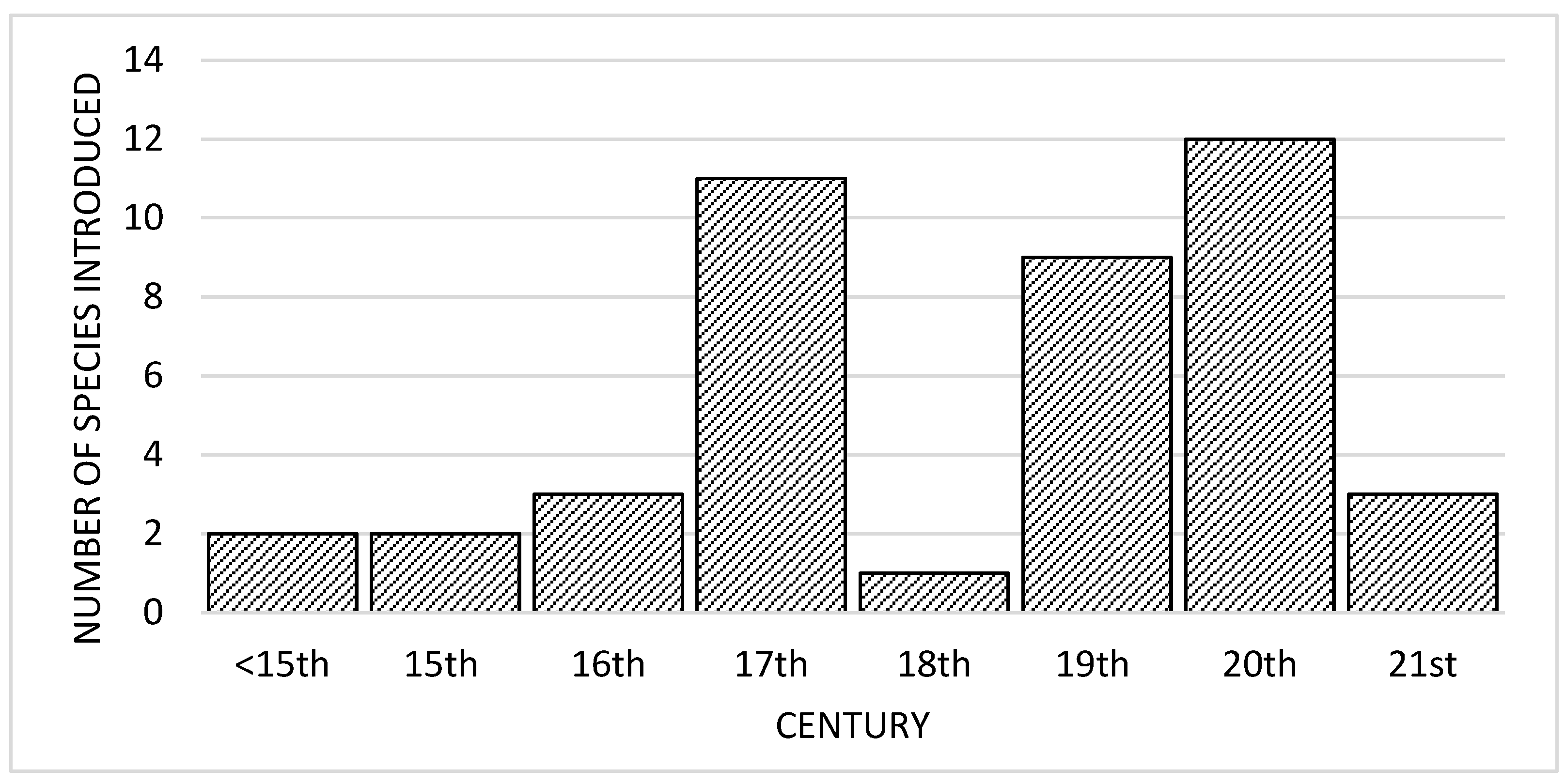
Figure 2.
Proportions of particular orders of relocated (n = 39 species) and introduced (n = 56 species) mammals in sub-Saharan Africa.
Figure 2.
Proportions of particular orders of relocated (n = 39 species) and introduced (n = 56 species) mammals in sub-Saharan Africa.
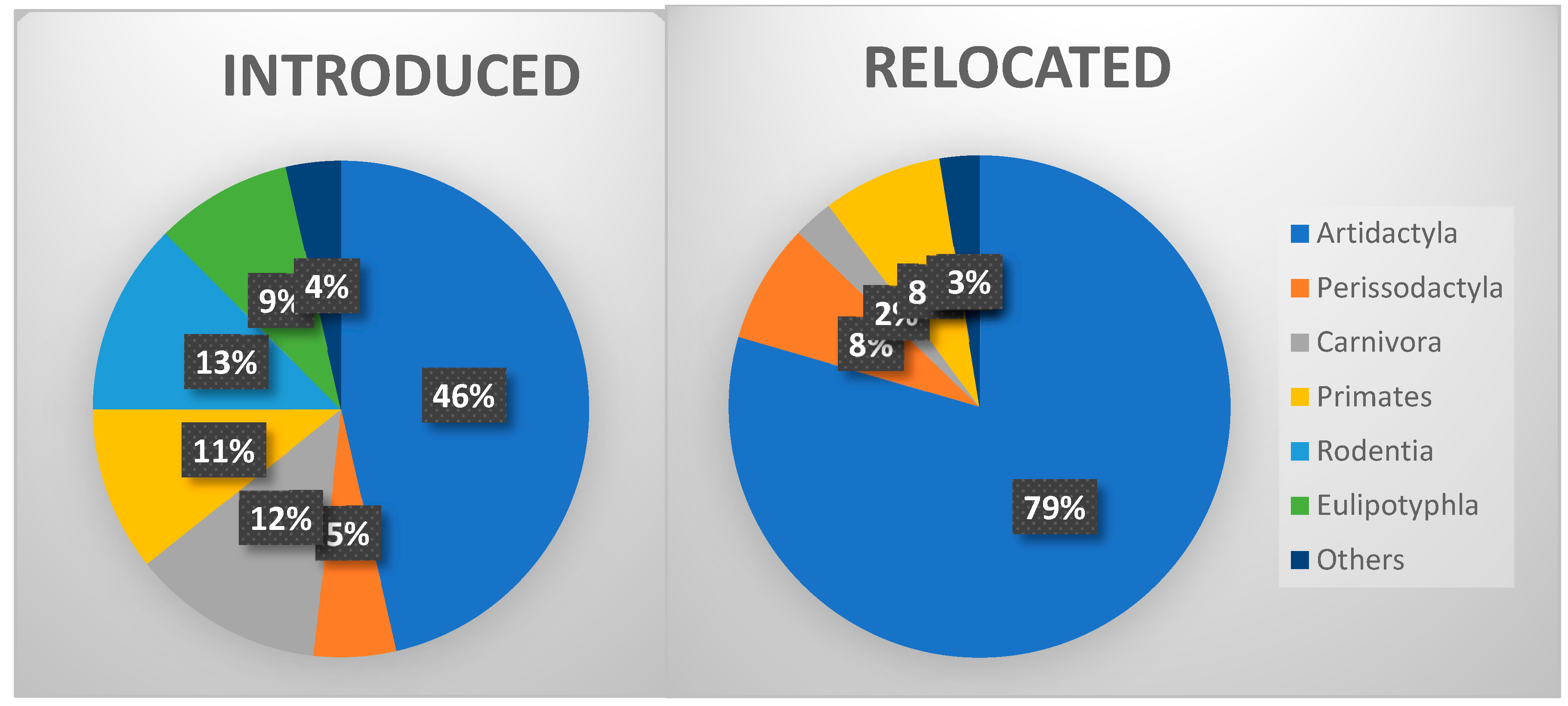
Table 2.
Introduced/translocated/escaped from captivity, did not established viable population, or established it but now regarded extinct.
Table 2.
Introduced/translocated/escaped from captivity, did not established viable population, or established it but now regarded extinct.
| Species scientific name | Species common name | Family | Original range | Translocated to |
|---|---|---|---|---|
| Kobus ellipsiprymnus ellipsiprymnus | Waterbuck | Bovidae | South Africa | Nam., Senegal |
| Kobus vardonii | Puku | Bovidae | South Africa | South Africa |
| Kobus leche | Lechwe | Bovidae | South Africa | South Africa |
| Syncerus caffer | African Savanna Buffalo | Bovidae | Africa | South Africa, Namibia |
| Aepyceros melampus petersi | Black-faced Impala | Bovidae | Namibia, Angola | Angola, Namibia |
| Antidorcas marsupialis | Springbok | Bovidae | South Africa | South Africa, Namibia |
| Redunca arundineum | Common Reedbuck | Bovidae | South Africa | Namibia |
| Redunca fulvorufula | Mountain Reedbuck | Bovidae | South Africa | Namibia |
| Pelea capreolus | Grey rhebok | Bovidae | South Africa | South Africa |
| Oryx dammah | Scimitar-horned Oryx | Bovidae | N Africa | South Africa |
| Oryx gazella gazella | Southern Oryx | Bovidae | South Africa | Senegal |
| Tragelaphus derbianus | Derby’s Eland | Bovidae | C and W Africa | South Africa |
| Tragelaphus euryceros | Bongo | Bovidae | Central Africa | South Africa |
| Tragelaphus imberbis | Lesser Kudu | Bovidae | NE Africa | South Africa |
| Tragelaphus scriptus | Greater Kudu | Bovidae | South Africa | South Africa; Tanzania: Rubondo (240 km2), Lake Victoria island |
| Tragelaphus angasi | Nyala | Bovidae | South Africa | Botswana, Namibia, Angola |
| Tragelaphus spekii | Sitatunga | Bovidae | Southern Africa | South Africa; Tanzania: Rubondo (240 km2), Lake Victoria island |
| Taurotragus oryx oryx | Common Eland | Bovidae | Southern Africa | Senegal |
| Cephalophus natalensis | Natal Duiker | Bovidae | South Africa | South Africa |
| Neotragus moschatus | Suni | Bovidae | South Africa | South Africa, Tanzania: Rubondo (240 km2), Lake Victoria island |
| Madoqua kirkii | Kirk’s Dik-dik | Bovidae | E Africa | South Africa |
| Capra ibex | Nubian Ibex | Bovidae | NE Africa | Namibia |
| Hippotragus niger | Sable Antelope | Bovidae | Botswana, Namibia, Angola | South Africa |
| Hippotragus equinus koba | Roan Antelope | Bovidae | West Africa | South Africa; Tanzania: Rubondo (240 km2), Lake Victoria island |
| Damaliscus pygargus dorcas | Bontebok | Bovidae | South Africa | South Africa |
| Damaliscus pygargus phillipsi | Blesbok | Bovidae | NE South Africa | SW South Africa, Botswana, Moz., Namibia, Zimbabwe, Angola |
| Beatragus hunteri | Hirola | Bovidae | SE Kenya | W Kenya (Tsavo) |
| Oreotragus oreotragus | Klipspringer | Bovidae | South Africa | South Africa |
| Connochaetes gnou | Black Wildebeest | Bovidae | Africa | Namibia |
| Connochaetes taurinus | Blue Wildebeest | Bovidae | Africa | Gabon: WW P.R., <1986, now?? |
| Giraffa camelopardalis | Giraffa | Giraffidae | South Africa | South Africa; Tanzania: Rubondo (240 km2), Lake Victoria island |
| Equus zebra hartmannae | Hartmann’s Mountain Zebra | Equidae | Namibia | South Africa: Western cape, Eastern Cape |
| Diceros bicornis michaeli | Black Rhinoceros | Rhinocerotidae | Kenya | South Africa; Tanzania: Rubondo (240 km2), Lake Victoria island |
| Ceratotherium simum simum | White Rhinoceros | Rhinocerotidae | South Africa, Kenya | Uganda, Kenya, Zambia |
| Loxodonta africana | African Elephant | Loxodontidae | Africa | Tanzania: Rubondo (240 km2), Lake Victoria island |
| Panthera leo melanochaita | African Lion | Felidae | South Africa | Rwanda |
| Colobus abyssinicus | Angola Pied Colobus | Cercopithecidae | Central Africa | Tanzania: Rubondo (240 km2), Lake Victoria island |
| Cercopithecus aethiops | Vervet Monkey | Cercopithecidae | Africa | Tanzania: Rubondo (240 km2), Lake Victoria island |
| Pan troglodytes | Chimpanzee | Hominidae | Cental Africa | Tanzania: Rubondo (240 km2), Lake Victoria island |
Data from: Bomer 1988, Gippoliti et al. 2021, Bromer 1988, Hoveman et al. 2016, Kikot & Nushi 2025, Shivumbu et al. 2021, Spear & Chown 2008, 2009a, 2009b, van Wyk et al. 2019. Invasives South Africa. https://invasives.org.za/national-list-of-invasive-mammal-species/ Accessed 19.02.2025.
Table 3.
Vertebrate species threatened by alien mammal species in sub-Saharan Africa.
| Species scientific name | Common scientific name | Family | RDB status | Effects | Place | Alien mammals | Source |
|---|---|---|---|---|---|---|---|
| AMPHIBIA | |||||||
| Sooglossus thomasetti | Thomasset's Seychelles Frog | Sooglossidae | E, CR | P** | Seychelles | Tenrecus ecaudatus | Lever 1994 |
| Sooglossus sechellensis | Seychelles Frog | Sooglossidae | E, EN | P** | Seychelles | Tenrecus ecaudatus | Lever 1994 |
| Sechellophryne gardinieri | Gardiner's Seychelles Frog | Sooglossidae | E. EX | P** | Seychelles | Tenrecus ecaudatus | Lever 1994 |
| REPTILIA | |||||||
| Casarea dussumieri | Round Island keel-scaled Boa | Bolyeriidae | E, EX 1975 | H*** | Mauritius: Round Island | Goat, rabbit, hare | Cheke and Hume (2008) |
| Madatyphlops cariei | Hoffstetter's worm snake | Typhlopidae | E, EX c.1800 | P*** | Mauritius | Cat, dog, other intr. carnivores | Cole 2021 |
| Chioninia coctei | Cape Verde Giant Skink | Scincidae | E, EX:1996 | P** | Cape Verde | (Dog, cat) | Mateo et al. 2020 |
| Gongylomophus bojeri | Bojer’s Skink | Scincidae | E, CR | H** | Mauritius: Round Island | Suncus murinus (goat, rabbit) | Cheke and Hume (2008) |
| Gongylomorphus fontenayi | Orange-tailed Skink | Scincidae | E, EN | P, H ** | Mauritius: Gunner’s Quoin | Rat, hare, rabbit | Cheke and Hume (2008) |
| Leiolopisma ceciliae | Reunion Giant Skink | Scincidae | E, EX c.1700 | P** | Reunion | Rats (intr.1670) | Sanchez et al. 2020 |
| Leiolopisma mauritiana | Mauritian Giant Skink | Scincidae | E, EX? | P** | Mauritius | Rats? | WCMC 1996 |
| Leiolopisma telfairii | Telfair’s Skink | Scincidae | E, VU | H* | Mauritius: Round Is., G. Quoin | Goat and rabbit | Cheke and Hume (2008) |
| Phelsuma gigas | Rodrigues giant day gecko | Scincidae | E, EX 1842 | P*** | Rodrigues, Frigate Is. | Brown Rat | WCMC 1996 |
| Trachylepis comorensis | Comorian Skink | Scincidae | E, LC | P*** | Comoros, Moz., Madagascar | Rats | Animalia.bio.comoros |
| Trachylepis socotrana | Socotra Skink | Scincidae | E, LC | P* | Socotra | Cat, Rat, Mouse | Animalia.bio.socotra |
| Nactus durrelli | Durrell’s Night gecko | Gekkonidae | E, VU | H** | Mauritius: Round Island | Goat, rabbit | Cheke and Hume (2008) |
| Nactus coindemirensis | Lesser Night Gecko | Gekkonidae | E, VU | P, H ** | Mauritius: Gunner’s quoin | Rat, hare, rabbit | Cheke and Hume (2008) |
| Phelsuma guentheri | Günther’s Gecko | Gekkonidae | E, EN | H** | Mauritius: Round Is., Il. Aigrettes | Goat, rabbit | Cheke and Hume (2008) |
| Tarentola gigas | Cape Verde Giant Gecko | Phyllodactyli-dae | E, EN | P*** | Cape Verde | Cats, rat, mouse | Delgado et al. 2021 |
| Psammobates geometricus | Geometric Tortoise | Testudinidae | E, CR | P* | SA: W. Cape | Feral pig, cat | Measey et al. 2020 |
| Aldabrachelys abrupta | Abrupt giant tortoise | Testudinidae | E, EX 1230-1315 | P* | Madagascar | Feral pig, cat | Kehlmaier et al. 2023 |
| Aldabrachelys gigantea daudinii | Daudin's giant tortoise | Testudinidae | E, EX c.1850 | P* | Seychelles: Mahe | Feral pig, cat | Rhodin et al. 2015 |
| Cylindraspis indica | Réunion giant tortoise | Testudinidae | E, EX c.1840 | P* | Reunion | Feral pig, cat | Rhodin et al. 2015 |
| Cylindraspis inept | Mauritius Giant Tortoise | Testudinidae | E, EX 1844 | P* | Mauritius | Feral pig, cat | Rhodin et al. 2015 |
| AVES | |||||||
| Hirundo atrocaerulea | Blue Swallow | Hirundinidae | E, EN | H* | SA: Mpumalanga | Feral Horse | Measey et al. 2020 |
| Terpsiphone corvina | Seychelles Black Parad. Flycatcher | Monarchidae | E, VU | P* | Seychelles: La Digue | Cat, rat | Rocamora and Henriette (2015) |
| Copsychus sechellarum | Seychelles Magpie Robin | Muscicapidae | E, EN | P* | Seychelles: Aride Denis, Frégate, | Cat, rat | Rocamora and Henriette (2015) |
| Humboldia flavirostris | Humbolt’s Flycatcher | Muscicapidae | E, VU | P, C* | Comoros | Black Rat, Com. Myna? | Animalia.bio.comoros |
| Coracina newtoni | Réunion Cuckooshrike | Campepha-gidae | E, CR | P, H* | Reunion | Rat, cat, (deer) | Ghestemme and Salamolard (2007) |
| Zosterops modestus | Seychelles White-eye | Zosteropidae | E, VU | P* | Seychelles | Cat, rat | Rocamora and Henriette (2015) |
| Zosterops chloronothos | Mauritius Olive White-eye | Zosteropidae | E, CR | P* | Mauritius: Ile aux Aigrettes | Rat, cat, mongoose | Cheke and Hume (2008) |
| Zosterops semiflavus | Marianne white-eye | Zosteropidae | E, EX 1892 | P** | Seychelles: Marianne Isl. | Blak rat | Hume 2017 |
| Acrocephalus seychellensis | Seychelles Warbler | Acrocephalidae | E, NT | P* | Seychelles | Cat, rat | Rocamora and Henriette (2015) |
| Nesillas aldabrana | Aldabra Brush Warbler | Acrocepha-lidae | E, EX 1994 | P, H ** | Seychelles: Aldabra | Rat, cat, goat | BL Int. 2016 |
| Foudia sechellarum | Seychelles Fody | Ploceidae | E, NT | P* | Seychelles: Denis | Cat, rat | Rocamora and Henriette (2015) |
| Foudia rubra | Mauritius Fody | Ploceidae | E, EN | P** | Mauritius: Ile aux Aigrettes | Rat, cat, mongoose | Cheke and Hume (2008) |
| Foudia delloni | Reunion Fody | Ploceidae | E, EX 1675-1680 | P* | Reunion | Rats | Cheke 2013 |
| Onychognathus frater | Socotra Starling | Sturnidae | E, LC | P* | Socotra | Cat | Animalia.bio.socotra |
| Necropsar rodericanus | Rodrigues Starling | Sturnidae | E, EX 1726 | P* | Rodrigues | Rat | Cheke 2013 |
| Fregilupus varius | Hoopoe Starling | Sturnidae | E, EX 1837 | P, H* | Reunion | Rat, cat, goat? | BL Int. 2016 |
| Chalcomitra balfouri | Socotra Sunbird | Nectariniidae | E, LC | P* | Socotra | Cat | Animalia.bio.socotra |
| Hypsipetes cowlesi | Rodrigues Bulbul | Pycnonotidae | E, EX+? | P* | Rodrigues | Rat? | Cheke 2013 |
| Cisticola haesitatus | Socotra Cisticola | Cisticolidae | E, LC | P* | Socotra | Cat | Animalia.bio.socotra |
| Incana incana | Socotra Warbler | Cisticolidae | E, LC | P* | Socotra | Cat | Animalia.bio.socotra |
| Passer insularis | Socotra Sparrow | Passeridae | E, LC | P* | Socotra | Cat | Animalia.bio.socotra |
| Rhynchostruthus socotranus | Socotra Golden-winged Grosbeak | Fringillidae | E, LC | P* | Socotra | Cat | Animalia.bio.socotra |
| Emberiza socotrana | Socotra Bunting | Emberizidae | E, VU | P** | Socotra | Cat, Rat, Indian Small Civet | Animalia.bio.socotra |
| Phaethon aethereus | Red-billed Tropicbird | Phaethonti-dae | LC | P** | Cape Verde | Cat, dog, rat, mouse | Sanchez 2020; Semedo et al. 2020 |
| Phaethon lepturus | White-tailed Tropicbird | Phaethonti-dae | LC | P* | Seychelles: Ile du Nord | Rat | Rocamora and Henriette (2015) |
| Sula dactylatra | Masked Booby | Sulidae | LC | P* | Seychelles: Grande Ile | Rat | Rocamora and Henriette (2015) |
| Sula leucogaster | Brown Booby | Sulidae | LC | P** | Tromelin Island | Cat, dog, rat, mouse | Semedo et al. 2020 |
| Papasula abbottii | Abbott’s Booby | Sulidae | EN | P** | Mascarenes, +c.1670 | (Monkey) | Cheke 2013 |
| Hydrobates jabejabe | Cape Verde Storm-petrel | Hydrobatidae | E, NT | P** | Cape Verde | Cat, dog, rat, mouse | Sanchez 2020; Semedo et al. 2020 |
| Pelagodroma marina | White-faced Storm-petrel | Procellariidae | LC | P** | Cape Verde | Cat, dog, rat, mouse | Sanchez 2020; Semedo et al. 2020 |
| Calonectris edwardsii | Cape Verde Shearwater | Procellariidae | E, NT | P** | Cape Verde | Cat, dog, rat, mouse | Sanchez 2020; Semedo et al. 2020 |
| Bulweria bulwerii | Bulwer’s Petrel | Procellariidae | LC | P** | Cape Verde | Cat, dog, rat, mouse | Sanchez 2020; Semedo et al. 2020 |
| Pterodroma feae | Cape Verde Petrel | Procellariidae | E, NT | P** | Cape Verde | Cat, dog, rat, mouse | Sanchez 2020; Semedo et al. 2020 |
| Puffinus lherminieri boydi | Boyd's Shearwater | Procellariidae | E, LC | P** | Cape Verde | Cat, dog, rat, mouse | Sanchez 2020; Semedo et al. 2020 |
| Fregata magnificens | Magnificent Frigatebird | Procellariidae | LC | P** | Cape Verde | Cat, dog, rat, mouse | Sanchez 2020; Semedo et al. 2020 |
| Ardenna pacifica | Wedged-tailed Shearwater | Procellariidae | LC | P* | Seychelles | Rat | Rocamora and Henriette (2015) |
| Ardenna pacifica | Wedged-tailed Shearwater | Procellariidae | LC | H* | Mauritius: Round Island | Goat, rabbit | Cheke and Hume (2008) |
| Pseudobulwaria aterrima | Mascarene Black Petrel | Procellariidae | E, CR | P* | Rodrigues | Cat? | Cheke 2013 |
| Leucocarbo melanogenis | Crozet Shag | Phalacrocoracidae | NE, CR | P** | Marion Islands | Mouse, cat | Bester et al. 2002; Dilley et al. 2016 |
| Phalacrocorax africanus | African Reed Cormorant | Phalacrocoracidae | LC | P* | Mascarenes, +1710 | Rat, feral cat, pigs | Cheke 2013 |
| Phalacrocorax nigrogularis | Socotra Cormorant | Phalacrocoracidae | E, VU | P* | Socotra | Cat | Muzaffat & Benjamin 2013 |
| Diomedea exulans | Wandering Albatross | Diomedeidae | VU | P** | Marion Islands | Mouse, cat | Bester et al. 2002; Dilley et al. 2016 |
| Thalassarche chrysostoma | Grey-headed Albatross | Diomedeidae | NE | P** | Marion Islands | Mouse, cat | Bester et al. 2002; Dilley et al. 2016 |
| Thalassarche carteri | Indian Yellow-nosed Albatross | Diomedeidae | EN | P** | Marion Islands | Mouse, cat | Bester et al. 2002; Dilley et al. 2016 |
| Phoebetria fusca | Sooty Albatross | Diomedeidae | NE, EN | P** | Marion Islands | Mouse, cat | Bester et al. 2002; Dilley et al. 2016 |
| Phoebetria palpebrata | Light-mantled Albatross | Diomedeidae | NT | P** | Marion Islands | Mouse, cat | Ryan 2015; Dilley et al. 2016 |
| Gygis alba | White Tern | Laridae | LC | P** | Tromelin Is. | Rat | Le Corre et al. (2015) |
| Larus dominicanus | Kelp Gull | Laridae | LC | P* | Marion Islands | Mouse, cat | Bester et al. 2002; Dilley et al. 2016 |
| Stercorarius antarcticus | Brown Skua | Laridae | LC | P* | Marion Islands | Mouse, cat | Bester et al. 2002; Dilley et al. 2016 |
| Aptenodytes patagonicus | King Penguin | Spheniscidae | LC | P* | Marion Islands | Mouse, cat | Bester et al. 2002; Dilley et al. 2016 |
| Eudyptes chrysolophus | Macaroni Penguin | Spheniscidae | LC | P* | Marion Islands | Mouse, cat | Bester et al. 2002; Dilley et al. 2016 |
| Alopochen mauritiana | Mauritius Sheldgoose | Anatidae | E, EX c.1695 | P* | Mauritius | Rat, feral cat, pig | Cheke 2013 |
| Alopochen kervazori | Reunion Sheldgoose | Anatidae | E, EX c.1700 | P** | Reunion | Rat, feral cat, pig | Cheke 2013 |
| Anas theodori | Mascarene Teal | Anatidae | E, EX c.1700 | P** | Mauritius | Rat, feral cat, pig | Cheke 2013 |
| Threskiornis solitarius | Reunion Ibis | Threskiorni-thidae | E, EX 1761 | P** | Reunion | Rat, feral cat, pig | Cheke 2013 |
| Bostrychia bocagei | São Tomé Ibis | Threskiorni-thidae | E, CR | P* | São Tomé Is. | Cat, Least Weasel, rat | Hugulay et al. 2014 |
| Nycticorax mauritianus | Mauritius Night Heron | Ardeidae | E, EX 1693 | P** | Reunion | Rat, feral cat, pig | Cheke 2013 |
| Nicticorax megacephalus | Rodrigues Night Heron | Ardeidae | E, EX 1726 | P** | Rodrigues | Rat, feral cat | Cheke 2013 |
| Pelecanus rufescens | Pink-backed Pelican | Pelecanidae | LC | P* | Madagascar +1960’s | Ras, cat? | Goodman 2022 |
| Aphanopteryx bonasia | Mauritius Reed Rail | Rallidae | E, EX c.1695 | P* | Mauritius | Monkey, pig, rat | Cheke 2013 |
| Dryolimnas augusi | Reunion Rail | Rallidae | E, EX 1675-1705 | P* | Reunion | Rat, feral cat, pig | Cheke 2013 |
| Dryolimnas cuveri abboti | Assumption White-thr. Rail | Rallidae | E, EX 1908 | P** | Seychelles: Assumption Isl. | Rats | Hume 2017 |
| Erythromachus leguati | Rodrigues Rail | Rallidae | E, EX c.1726 | P* | Rodrigues | Rat, feral cat, pig | Cheke 2013 |
| Porphyrio caerulescens | Reunion Blue Gallinule | Rallidae | E, EX c.1720 | P* | Reunion | Cat, rat | Cheke 2013 |
| Porphyrio sp. | Seychelles Swamphen | Rallidae | E, EX c.1730 | P* | Reunion | Cat | Hume 2017 |
| Fulica newtoni | Mascarene Coot | Rallidae | E, EX 1693 | P* | Mauritius, Reunion | Rat, pig, cat | Cheke 2013 |
| Raphus cucullatus | Dodo | Columbidae | E, EX 1640’s | P, H* | Mauritius | Black Rat, pig, goat | Cheke 2013 |
| Peziphaps solitarius | Rodrigue’s Solitaire | Columbidae | E, EX c.1770 | P* | Mascarenes | Cats | Cheke 2013 |
| Columba thiriouxi | Mauritius Wood Pigeon | Columbidae | E, EX | P* | Mauritius | Black Rat | Cheke 2013 |
| Nesoenas duboisi | Reunion Pink Pigeon | Columbidae | E, EX c.1700 | P** | Rodrigues | Cat | Cheke 2013 |
| Nesoenas rodericana | Rodrigues Turtle Dove | Columbidae | E, EX 1726-1761 | P** | Rodrigues | Rat, cat | Cheke 2013 |
| Nesoenas cicur | Mauritius Turtle Dove | Columbidae | E, EX c.1730 | P** | Mauritius | Rat, cat | Cheke 2013 |
| Nesoenas mayeri | Pink Pigeon | Columbidae | E, VU | P** | Mauritius: Ile aux Aigrettes | Rat, cat, mongoose | Cheke and Hume (2008) |
| Alectroenas nitidissima | Mauritius Blue Pigeon | Columbidae | E, EX 1826 | P* | Mauritius | Cats? | Cheke 2013 |
| Alectroenas payandeei | Rodrigues Blue Pigeon | Columbidae | E, EX <1691 | P* | Rodrigues | Rats? | Cheke 2013 |
| Mascarinus mascarinus | Mascarene Parrot | Psittaculidae | E, EX 1784 | P** | Reunion | Rats, cat | Cheke 2013 |
| Necropsittacus rodericanus | Rodrigues Parrot | Psittaculidae | E, EX c.1770 | P** | Rodrigues | Rat, cat | Cheke 2013 |
| Lophopsittacus mauritianus | Broad-billed Parrot | Psittaculidae | E, EX 1670’s? | P* | Mauritius | Monkey, rat | Cheke 2013 |
| Psittacula echo | Echo Parakeet | Psittaculidae | E, VU | P** | Mauritius: Mauritius | Rat, cat, mongoose | Cheke and Hume (2008) |
| Psittacula exsul | Newton’s Parakeet | Psittaculidae | E, EX 1875 | P** | Rodrigues | Rat, cat, mongoose? | Hume 2017 |
| Otus suazieri | Mauritius Scops Owl | Strigidae | E, EX 1837 | P* | Mauritius | Rat | Cheke 2013 |
| Otus grucheti | Reunion Scops Owl | Strigidae | E, EX 1700’s | P* | Reunion | Cat and rat | Cheke 2013 |
| Otus murivorus | Rodrigues Scops Owl | Strigidae | E, EX 1726-1761 | P* | Rodrigues | Rat | Cheke 2013 |
| Otus pauliani | Grande Comore Scops Owl | Strigidae | E, EN | P** | Comoros | Rat | Birdlife Datazone |
| Otus moheliensis | Moheli Scops Owl | Strigidae | E, EN | P* | Comoros | Black Rat? | Animalia.bio.comoros |
| Falco punctatus | Mauritius Kestrel | Falconidae | E, EN | P** | Mauritius: Mauritius | Rat, cat, mongoose | Cheke and Hume (2008) |
| Circus maillardi | Reunion Harrier | Accipitridae | E, EN | P* | Reunion, Mauritus+1606 | Rat, cat, mongoose? | Goodman 2022 |
| Aepyornis maximus | Elephant Bird | Aepyorni-thidae | E, EX 1100-700 BP | P* | Madagascar | Dog | Hansford & Turvey 2018 |
| Aepyornis hildebrandti | Hildebrand’s Elephant Bird | Aepyorni-thidae | E, EX 1040-1380 AD | P* | Madagascar | Dog | Hansford & Turvey 2018 |
| Mullerornis modestus | Elephant Bird | Aepyorni-thidae | E, EX 680-880 AD | P* | Madagascar | Dog | Hansford & Turvey 2018 |
| MAMMALIA | |||||||
| Gymnuromys robertsi | Voalavoanala | Nesomyidae | E, LC | C* | Madagascar | Black Rat? | Lehtonen 2013Goodman 1995 |
| Nesomys audeberti | White-bellied Nesomys | Nesomyidae | E, LC | C* | Madagascar | Black Rat? | Miljutin & Lehtonen 2008 |
| Nesomys rufus | Island Mouse | Nesomyidae | E, LC | C* | Madagascar | Black Rat? | Miljutin & Lehtonen 2008 |
| Eliurus tanala | Tanala Tufted-tailed Rat | Nesomyidae | E, LC | C* | Madagascar | Black Rat? | Miljutin & Lehtonen 2008 |
| Eliurub webbi | Webbie’s Tufted-tailed Rat | Nesomyidae | E, LC | C* | Madagascar | Black Rat? | Miljutin & Lehtonen 2008 |
| Pachylemur insignis | Giant Lemur | Lemuridae | E, EX c.1500 | P* | Madagascar | Dog | Godfrey & Jungers 2003 |
| Eulemur fulvus | Common Brow Lemur | Lemuridae | E, VU | P* | MadagascarMayotte (introd.) | Dog | Hixon et al. 2021 |
| Propithecus verreauxi | Verreaux’s Sifaka | Indridae | E, CR | P* | Madagascar | Dog | Hixon et al. 2021 |
| Archaeolemur majori | Baboon Lemur | Archaeolemuridae | E, EX 1100-700 BP | P* | Madagascar | Dog | Hixon et al. 2021 |
| Archeolemur edwardsi | Monkey Lemur | Archaeolemuridae | E, EX, 500 BP | P* | Madagascar | Dog) | Godfrey et al. 2009 |
| Hadropithecus stenognathus | Monkey Lemur | Archaeolemuridae | E, EX 444–772 | P, H** | Madagascar | Feral cattle, pig and dog | Godfrey et al. 2009 |
| Megaladapsis madagascariens. | Koala Lemur | Megaladapidae | E, EX 500-600BP | P* | Madagascar | Dog? | Godfrey et al. 2009 |
| Megaladapsis grandidieri | Koala Lemur | Megaladapidae | E, EX 500-600 BP | P* | Madagascar | Dog? | Godfrey et al. 2009 |
| Megaladapsis edwardsi | Koala Lemur | Megaladapidae | E, EX 500-600 BP | P* | Madagascar | Dog? | Godfrey et al. 2009 |
| Palaeopropithecus ingens | Sloth Lemur | Palaeopropi-thecidae | E, EX 1100-700 BP | P* | Madagascar | Dog | Hixon et al. 2021 |
| Mesopropithecus pithecoides | Sloth Lemur | Palaeopropi-thecidae | E, EX 570-679 CE | P* | Madagascar | Dog | Godfrey et al. 2009 |
| Mesopropithecusglobiceps | Sloth Lemur | Palaeopropi-thecidae | E, EX 570-679 CE | P* | Madagascar | Dog | Godfrey et al. 2009 |
| Mesopropithecusdolichobrachion | Sloth Lemur | Palaeopropi-thecidae | E, EX 570-679 CE | P* | Madagascar | Dog | Godfrey et al. 2009 |
| Babakotia radofilai | Sloth Lemur | Palaeopropi-thecidae | E, EX c.1000 BC | P* | Madagascar | Dog | Hixon et al. 2021 |
| Daubentonia robusta | Giant Aye-aye | Daubentonidae | E, EX 900-1150 CE | P* | Madagascar | Dog) | Crowley 2010 |
| Daubentonia madagascarensis | Aye-aye | Daubentoniidae | E, EN | P* | Madagascar | Black Rat? | Goodman 1995 |
| Cryptoprocta ferax | Fossa | Eupleridae | E, VU | P, C* | Madagascar | Dog | Hixon et al. 2021 |
| Felis silvestris lybica | African Wild Cat | Felidae | LC | P* | Namibia, Botswana, SA | Feral Cat | Measey et al. 2020 |
| Equus zebra | Mountain Zebra | Equidae | VU | H* | SA, N Cape; Namibia | Feral Donkey | Measey et al. 2020 |
| Equus quagga quagga | Quagga | Equidae | EX, c.1878 | G* | SA, Cape, Free State | Feral donkey? | Nowak 1999 |
| Equus africanus africanus | Nubian wild ass | Equidae | EX | G** | Ethiopia/Eritrea: Nubian Desert | Feral Donkey | Kimura et al. 2011 |
| Hippopotamus laloumena | Malagasy Hippo | Hippopotami-dae | E, EX 1670-1950 AD | P, H* | Madagascar | Dog, feral goat | Crowley et al. 1996; Shackelton 2021 |
| Hippopotamus lemerlei | Lemerle's Dwarf Hippopotamus | Hippopotami-dae | E, EX 670-836 AD | P, H* | Madagascar | Dog, feral goat? | Crowley et al. 1996; Shackelton 2021 |
| Hippopotamus madagascarie-nsis | Madagascar Dwarf Hippopotamus | Hippopotami-dae | E, EX 687-880 CE | P, H* | Madagascar | Dog, feral goat? | Crowley et al. 1996; Shackelton 2021 |
| Hippotragus leucophaeus | Bluebuck | Bovidae | EX c.1800 | H* | South Africa: Western Cape | Feral goat, deer | Faith 2014 |
Disclaimer/Publisher’s Note: The statements, opinions and data contained in all publications are solely those of the individual author(s) and contributor(s) and not of MDPI and/or the editor(s). MDPI and/or the editor(s) disclaim responsibility for any injury to people or property resulting from any ideas, methods, instructions or products referred to in the content. |
© 2025 by the authors. Licensee MDPI, Basel, Switzerland. This article is an open access article distributed under the terms and conditions of the Creative Commons Attribution (CC BY) license (http://creativecommons.org/licenses/by/4.0/).
Copyright: This open access article is published under a Creative Commons CC BY 4.0 license, which permit the free download, distribution, and reuse, provided that the author and preprint are cited in any reuse.


