

Submitted:
10 March 2025
Posted:
11 March 2025
You are already at the latest version
Abstract
This paper considers the difference equations with continuous time, piecewise linear delay functions, and oscillatory coefficients. We present new conditions on coefficients that provide the oscillatory property of solutions of the considered difference equation. The given criteria are compared to existing oscillatory conditions in literature through examples.
Keywords:
difference equation
; continuous time
; piecewise linear delay function
; oscillating coefficients
; oscillatory solutions
MSC: 39A21, 39A10
1. Introduction
The application and importance of delay difference equations with continuous time can be found in mechanical and electrical systems, as it is stated in [1], also in modeling of distributed chaos, as it is pointed out in [2,3]. Analysis of oscillatory properties of solutions of delay difference equations with continuous time have been the subject of papers [4,5,6,7,8,9,10,11,12,13]. Literature concerned with oscillatory properties of solutions of differential and discrete difference equations can be divided into two groups: one with nonnegative or positive coefficients and the other with oscillatory coefficients. Studies on oscillatory properties of solutions of differential equations with nonnegative coefficients can be found, for example, in papers [14,15,16], while with oscillating coefficients in [17,18]. For example, papers [15,19,20,21] and [22,23,24] are devoted to discrete difference equations with positive coefficients and oscillatory coefficients, respectively. Since many papers dealing with difference equations with continuous time analyze equations with positive or nonnegative coefficients (all mentioned above), but only (to the best of our knowledge) paper [25] considers oscillatory coefficients, our aim is to expand the set of known oscillatory conditions of solutions of delay difference equations with continuous time and oscillatory coefficients.
In this paper, we analyze the oscillatory property of the solutions of the delay difference equation
where , and . For , is a piecewise continuous and oscillatory function, but the delay argument is in the form
where the function is piecewise constant. Also, the delay arguments have the following properties:
and
We present two oscillatory criteria and compare them to oscillatory conditions in [25]. The comparison shows that there is a set of difference equations such that our new oscillatory criteria prove that their solutions oscillate, while the known criteria are not applicable to them.
A solution of the delay difference equation (1) is a real-valued function x defined on the interval , with
that satisfies Eq. (1). If a solution of (1) changes sign on the interval for any s, it is oscillatory. Otherwise, it is nonoscillatory. As in [8,26], for any bounded real-valued function defined on the interval there exists a unique solution x of (1) that satisfies the initial condition , , since it can be represented by
Standardly, for any , , and a real-valued function f,
and
2. The New Oscillation Criteria
We define a real-valued functions
and
These functions have the following properties:
For more details and illustrations by example see [25].
First we give the following lemma.
Lemma 1.
If there exists a sequence of disjoint intervals with properties: for every ,
and, for some ,
then there exists a sequence such that and
but
Proof.
Now we prove an auxiliary lemma.
Lemma 2.
Proof.
Due to the definition of limit inferior and (20), for arbitrary , so for ,
Hence,
and consequently,
Since , condition (19) ensures that for every and . Besides that, (18), (19), and (23) ensure that the sequence of intervals satisfies the conditions of Lemma 1 with . Therefore, there exists a sequence such that ,
By (22),
so, using (24), we obtain
Property (10) secures that .
Since x is a nonoscillatory solution of (1), without loss of generality, we can assume that
For every , property (11) ensures that, for every , , thus , so (1), (19), and (27) provide
i.e.,
Consequently,
Also, (11) ensures that for every . Therefore, (9) and (28) provide that
Summing up (1) from to , we obtain
Hence, by (25),
Similarly, summing up (1) from to , we obtain
Therefore, (26) implies
Combining inequalities (30) and (31), we get
i.e.,
Since ,
Using that and , we have
Consequently,
Since (32) holds for arbitrarily small , it implies (21). The proof of the lemma is complete. □
Now we are ready to formulate and prove a new criterion that provides that all solutions of the observed difference equation are oscillatory.
Theorem 1.
Proof.
As in the proof of the previous lemma, for , and denote the intervals and , respectively.
Supposing the opposite, let the function be a nonoscillatory solution of (1). Without loss of generality, we can assume that
Therefore (11), (1), (19), and (34) imply
Consequently, for every ,
Since (11) ensures that for every , (9) and (35) provide that
For any , summing up (1) from to , then using that and applying (19), (36), afterwards by (19), (10), and (35), we have
Dividing the obtained inequality by , that is positive, we obtain
i.e.,
Hence,
Applying (21) from Lemma 2, we have
which is a contradiction to condition (33). The proof of the theorem is complete. □
Due to the following corollary, the nonnegativity of the coefficients in the definition of and coefficients in condition (33) combined with property (10) yield to conclusion that for there is no need to check the condition (33).
Corollary 1.
Proof.
Notice that the oscillatory conditions in Theorem 1 and Corollary 1 require the nonnegativity of coefficients in the disjoint intervals and do not use the intervals where the coefficients are negative. Therefore, the presented oscillatory conditions can be applied to establishing the oscillatory property of solutions of difference equations in form (1) but with positive coefficients.
3. Examples and Comparisons
The following examples illustrate the presented conditions for oscillatory solutions of the observed difference equation. For first two examples, the oscillatory conditions from Theorem 1 are satisfied, but the oscillatory conditions from Corollary 1 and oscillatory conditions from [25] are not fulfilled. The last example shows the application of oscillatory conditions from Corollary 1 on delay difference equation with unbounded delays. Moreover, oscillatory conditions from [25] are not satisfied for that example either.
Theorem 2
([25, Theorem 2.2]). For the functions τ and defined by (6) and (7) respectively, assume that there exists a sequence of real numbers such that condition (17) holds and the intervals of the sequence are nonempty, disjoint, and contained in . If, in addition,
and
then all solutions of (1) are oscillatory.
Theorem 3
([25, , Theorem 2.3]). For the functions τ and defined by (6) and (7) respectively, assume that there exists a sequence of real numbers such that condition (17) holds and the intervals of the sequence are nonempty, disjoint, and contained in . If, moreover,
and there exists a real number such that
then all solutions of (1) are oscillatory.
Example 1.
Consider the difference equation
where functions and are periodic, with the basic period 10, such that
Here, and , thus and . Therefore, and . For the sequence of real numbers such that ,
so, for every ,
It means that conditions (17), (18), and (19) are satisfied with
Due to and
condition (33) is also fulfilled, thus all conditions of Theorem 1 are satisfied, and therefore all solutions of equation (43) are oscillatory.
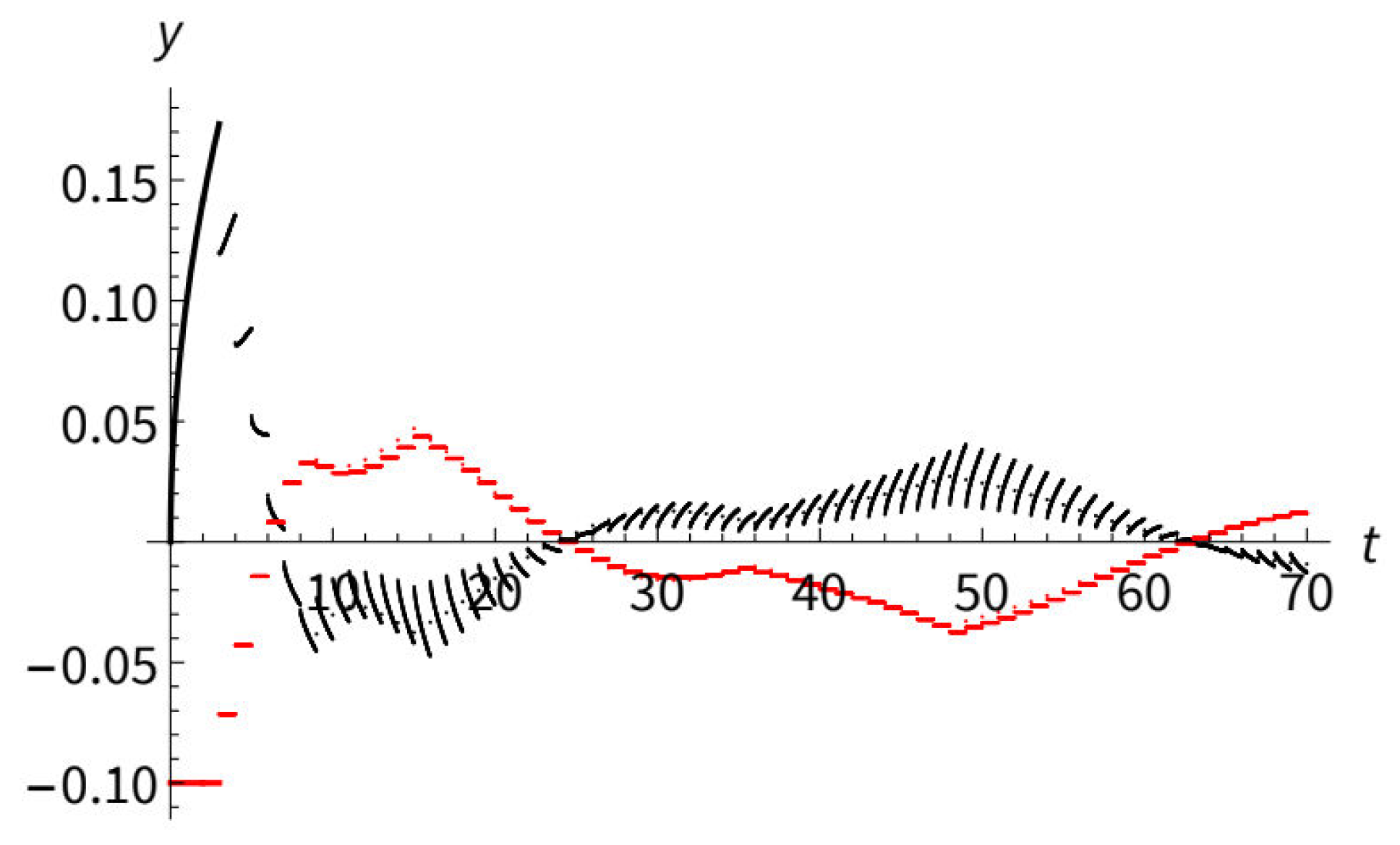
The graphs of the functions and , the intervals , and relevant points from conditions (20) and (33) are presented at Figure 1. Figure 2 shows the graphs of some solutions of Eq. (43).
Conditions of Theorem 3 cannot be fulfilled since the length of intervals of condition (41) are expanding as j increases, but the functions and are nonnegative only on the interval with length 7. Therefore, the oscillatory conditions of Theorem 3 cannot be satisfied.
Example 2.
Conditions of Theorem 1 are satisfied for equation
with
and
so all solutions of equation (44) are oscillatory.
Namely, and , thus and . Therefore, and . For every ,
For the sequence of real numbers such that ,
so, for ,
Hence, conditions (17), (18), and (19) are satisfied and
Since and
also condition (33) holds, so all conditions of Theorem 1 are fulfilled.
The graphs of the functions and , the intervals , and relevant points from conditions (20) and (33) are presented at Figure 3. Figure 4 shows the graphs of some solutions of Eq. (44).
Example 3.
Consider the difference equation
with
and
where denotes the integer part.
Delay functions, and , are unbounded, but satisfy conditions (3) and (4). and , thus, for the sequence of real numbers such that ,
Therefore,
so conditions (17), (18), and (19) are satisfied. Besides,
implying that
Hence,
Consequently, conditions of Corollary 1 are satisfied, so all solutions of Eq. (45) are oscillatory.
The graphs of the functions and , the intervals , and relevant points from condition (20) are presented at Figure 5. Figure 6 shows the graphs of some solutions of Eq. (45).
The oscillatory conditions of Theorem 2 cannot be satisfied since for any sequence of real numbers such that condition (39) is fulfilled, for some , so
Hence,
Using that ,
and therefore
Since the intervals of sequence are disjoint, implies that , so inequality (46) gives
Consequently, condition (40) cannot be fulfilled.
Conditions of Theorem 3 also cannot be fulfilled since there is no sequence of real numbers such that condition (41) is satisfied. Namely, by condition (41), there is a sequence of real numbers such that
for some . The length of interval are expanding as n increases and the length of interval is . Even for ,
so the length of interval is . Since for every , the condition (47) cannot be fulfilled for any integer and . Hence, the oscillatory conditions of Theorem 3 cannot be satisfied.
4. Conclusions
Our study of the oscillatory properties of the solutions of the first-order difference equations with continuous time, piecewise linear delay functions, and oscillatory coefficients has led us to the new condition that ensures the oscillatory solutions. By the proposed results, the oscillatory property of all solutions of the considered difference equation is ensured by sufficiently positive coefficients of the equation in the sense that the sum of the values of the coefficients defined by in (20) is in the interval . For , the oscillatory property of all solutions is ensured when condition (33) is fulfilled.
We have shown, through examples, that there are difference equations for which the previously known oscillatory conditions for the same type of difference equations are not applicable, but the proposed criteria are satisfied. Therefore, we have extended the set of difference equations with oscillatory coefficients for which conditions verifying their oscillatory properties exist.
Author Contributions
Conceptualization, G.E.C. and H.P.; methodology, H.P. and A.R.; investigation, H.P. and A.R.; writing—original draft preparation, A.R.; writing—review and editing, G.E.C., H.P. and A.R. All authors have read and agreed to the published version of the manuscript.
Funding
This research received no external funding.
Conflicts of Interest
The authors declare no conflicts of interest.
References
- Sharkovsky, A.N.; Maistrenko, Yu.L.; Romanenko, E.Yu. Difference Equations and Their Applications, Ser. Mathematics and Its Applications 250; Springer: Dordrecht, 1993. [Google Scholar] [CrossRef]
- Romanenko, O. Continuous-time difference equations and distributed chaos modelling. Math. Lett. 2022, 8, 11–21. [Google Scholar] [CrossRef]
- Sharkovsky, A.N. Chaos from a time-delayed Chua’s circuit. IEEE Trans. Circuits Syst. I. Fund. Theory Appl. 1993, 40, 781–783. [Google Scholar] [CrossRef]
- Braverman, E.; Johnson, W.T. On oscillation of difference equations with continuous time and variable delays. Appl. Math. Comput. 2019, 355, 449–457. [Google Scholar] [CrossRef]
- Chatzarakis, G.E.; Péics, H.; Rožnjik, A. Oscillations in difference equations with continuous time caused by several deviating arguments. Filomat 2020, 34, 2693–2704. [Google Scholar] [CrossRef]
- Karpuz, B.; Öcalan, Ö. Discrete approach on oscillation of difference equations with continuous variable. Adv. Dyn. Syst. Appl. 2008, 3, 283–290. [Google Scholar]
- Koplatadze, R.; Khachidze, N. Oscillation criteria for difference equations with several retarded arguments. J Math Sci 2020, 246, 384–393. [Google Scholar] [CrossRef]
- Ladas, G.; Pakula, L.; Wang, Z. Necessary and sufficient conditions for the oscillation of difference equations. Panamer. Math. J. 1992, 2, 17–26. [Google Scholar]
- Nowakowska, W.; Werbowski, J. Conditions for the oscillation of solutions of iterative equations. Abstr. Appl. Anal. 2004, 2004, 543–550. [Google Scholar]
- Rožnjik, A.; Péics, H.; Chatzarakis, G.E. Comparison of tests for oscillations in delay/advanced difference equations with continuous time. In Advances in Discrete Dynamical Systems, Difference Equations and Applications. ICDEA 2021. Springer Proceedings in Mathematics & Statistics, vol 416; Elaydi, S., Kulenović, M.R.S., Kalabušić, S., Eds.; Springer: Cham, 2023; pp. 419–438. [Google Scholar]
- Shen, J.; Stavroulakis, I.P. An oscillation criteria for second order functional equations. Acta Math. Sci . Ser. B Engl. Ed. 2002, 22, 56–62. [Google Scholar] [CrossRef]
- Zhang, B.G.; Choi, S.K. Oscillation and nonoscillation of a class of functional equations. Math. Nachr. 2001, 227, 159–169. [Google Scholar] [CrossRef]
- Zhang, B.G.; Yan, J.; Choi, S.K. Oscillation for difference equations with continuous variable. Comput. Math. Appl. 1998, 36, 11–18. [Google Scholar] [CrossRef]
- Attia, E.R.; El-Matary, B. New explicit oscillation criteria for first-order differential equations with several non-monotone delays. Mathematics 2023, 11, 64. [Google Scholar] [CrossRef]
- Braverman, E.; Karpuz, B. On oscillation of differential and difference equations with non-monotone delays. Appl. Math. Comput. 2011, 218, 3880–3887. [Google Scholar] [CrossRef]
- Kiliç, N.; Öcalan, Ö. A new oscillation result for nonlinear differential equations with nonmonotone delay. Miskolc Math. Notes 2023, 24, 841–854. [Google Scholar]
- Fugakai, N.; Kusano, T. Oscillation theory of first order functional-differential equations with deviating arguments. Ann. Mat. Pura Appl. 1984, 136, 95–117. [Google Scholar]
- Tang, X.H. Oscillation of first order delay differential equations with oscillating coefficients. Appl. Math. J. Chinese Univ. Ser. B 2000, 15, 252–258. [Google Scholar]
- Attia, E.R.; Alotaibi, S.M.; Chatzarakis, G.E. New oscillation criteria for first-order difference equations with several not necessarily monotonic delays. J. Appl. Math. Comput. 2024, 70, 1915–1936. [Google Scholar] [CrossRef]
- Chatzarakis, G.E.; Koplatadze, R.; Stavroulakis, I.P. Optimal oscillation criteria for first order difference equations with delay argument. Pacific J. Math. 2008, 235, 15–33. [Google Scholar] [CrossRef]
- Chatzarakis, G.E.; Shaikhet, L. Oscillation criteria for difference equations with non-monotone arguments. Adv. Difference Equ. 2017, 2017, 1–16. [Google Scholar] [CrossRef]
- Berezansky, L.; Chatzarakis, G.E.; Domoshnitsky, A.; Stavroulakis, I.P. Oscillations of difference equations with several oscillating coefficients. Abstr. Appl. Anal. 2014, 2014, 1–9. [Google Scholar] [CrossRef]
- Yan, W.; Yan, J. Comparison and oscillation results for delay difference equations with oscillating coefficients. Int. J. Math. Math. Sci. 1996, 19, 171–176. [Google Scholar] [CrossRef]
- Yu, J.S.; Tang, X.H. Sufficient conditions for the oscillation of linear delay difference equations with oscillating coefficients. J. Math. Anal. Appl. 2000, 250, 735–742. [Google Scholar] [CrossRef]
- Chatzarakis, G.E.; Péics, H.; Rožnjik, A. Oscillations of deviating difference equations with continuous time and oscillatory coefficients. J. Difference Equ. Appl. 2023, 29, 682–700. [Google Scholar] [CrossRef]
- Chatzarakis, G.E.; Györi, I.; Péics, H.; Stavroulakis, I.P. Existence of positive solutions of linear delay difference equations with continuous time. Electron. J. Qual. Theory Differ. Equ. 2015, 2015, 1–23. [Google Scholar] [CrossRef]
Figure 1.
The graphs of the functions and , the intervals , and the points from Example 1. The green and the dotted lines represent the values in sums from conditions (20) and (33), respectively.
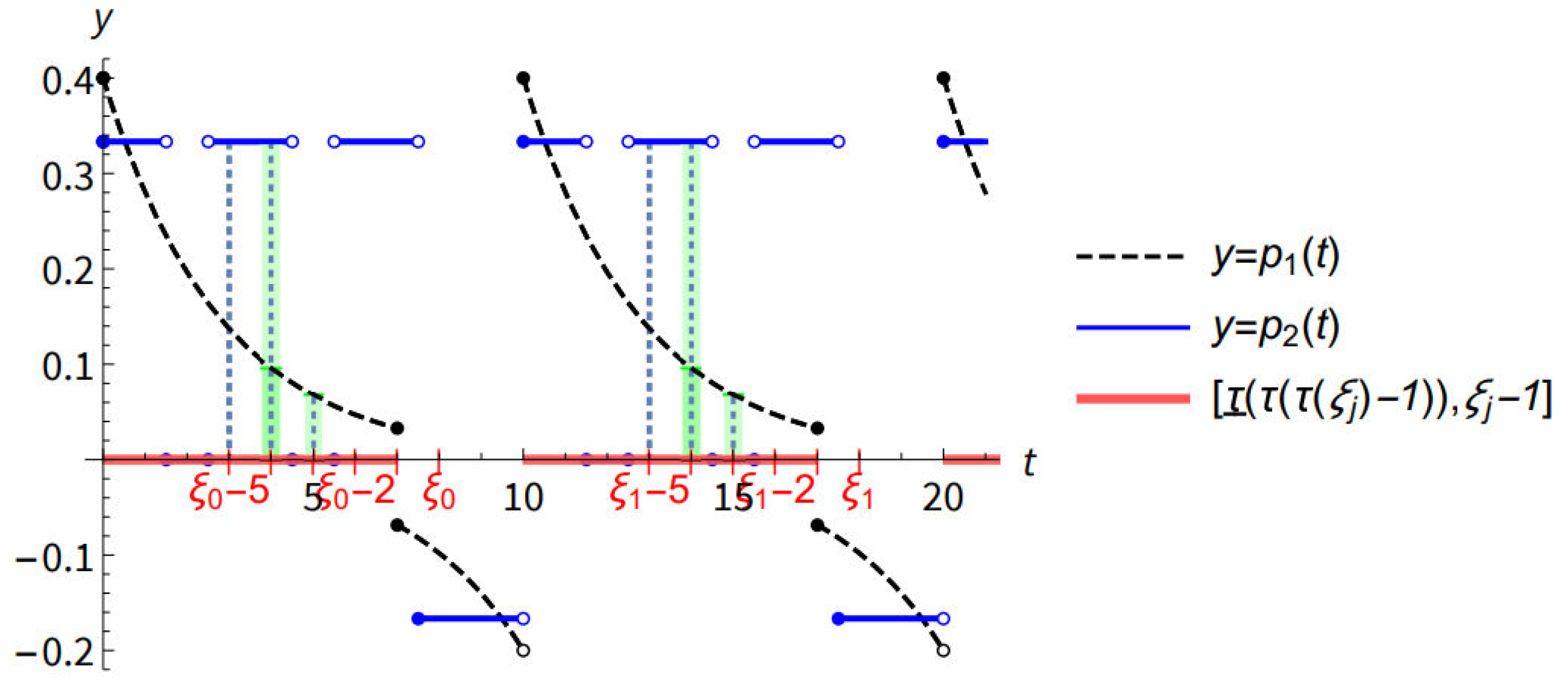
Figure 2.
The graphs of solutions of Eq. (43) with initial functions (black curve) and (red curve), .
Figure 2.
The graphs of solutions of Eq. (43) with initial functions (black curve) and (red curve), .
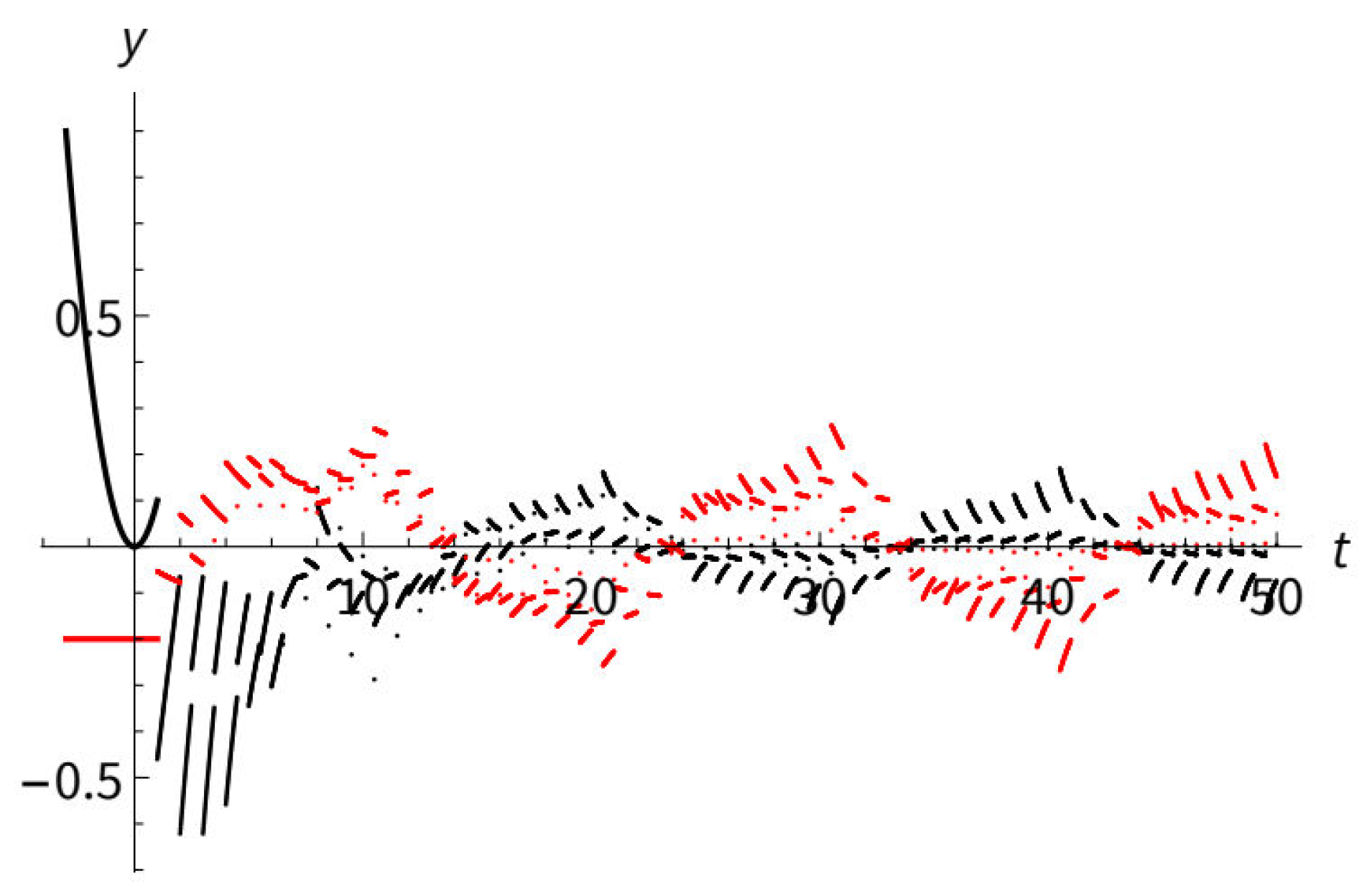
Figure 3.
The graphs of the functions and , the intervals , and the points from Example 2. The green and the dotted lines represent the values in sums from conditions (20) and (33), respectively.
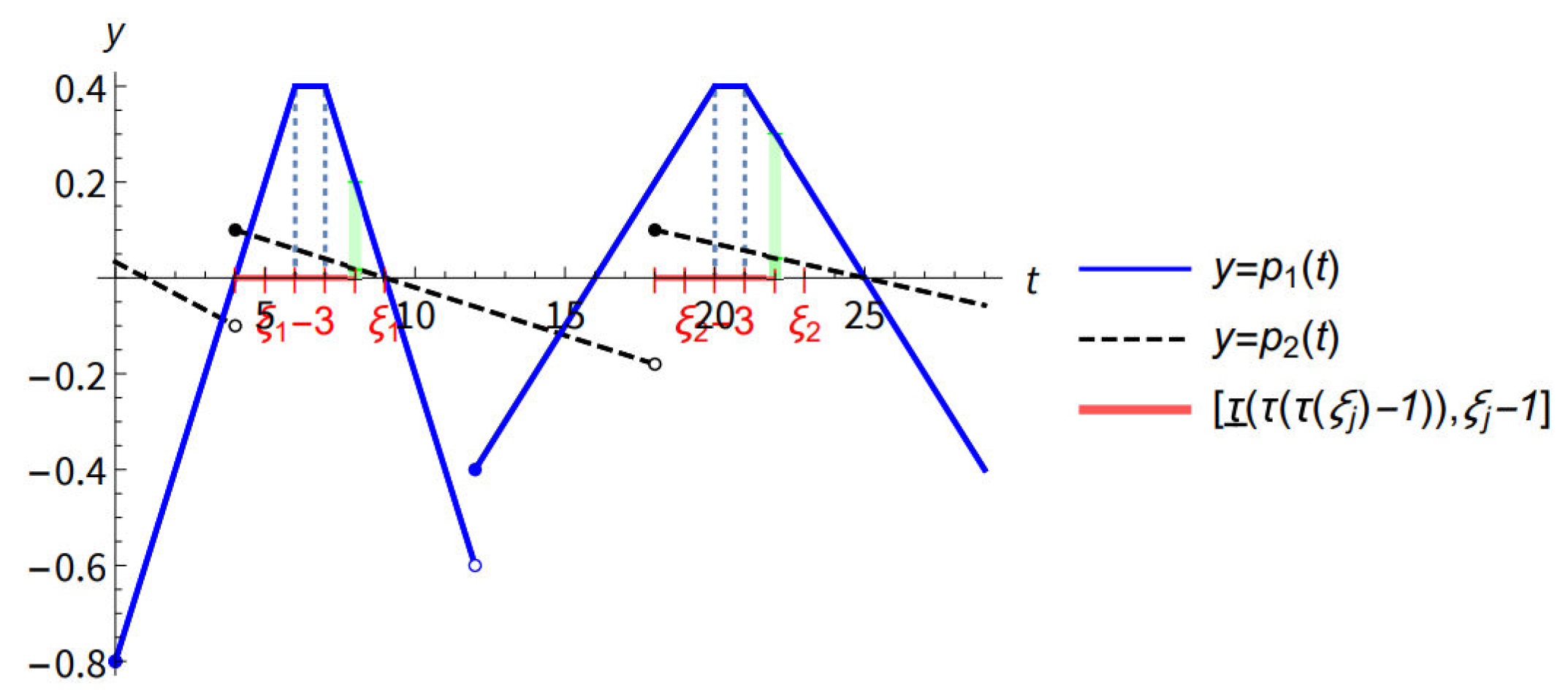
Figure 4.
The graphs of solutions of Eq. (44) with initial functions (black curve) and (red curve), .
Figure 4.
The graphs of solutions of Eq. (44) with initial functions (black curve) and (red curve), .
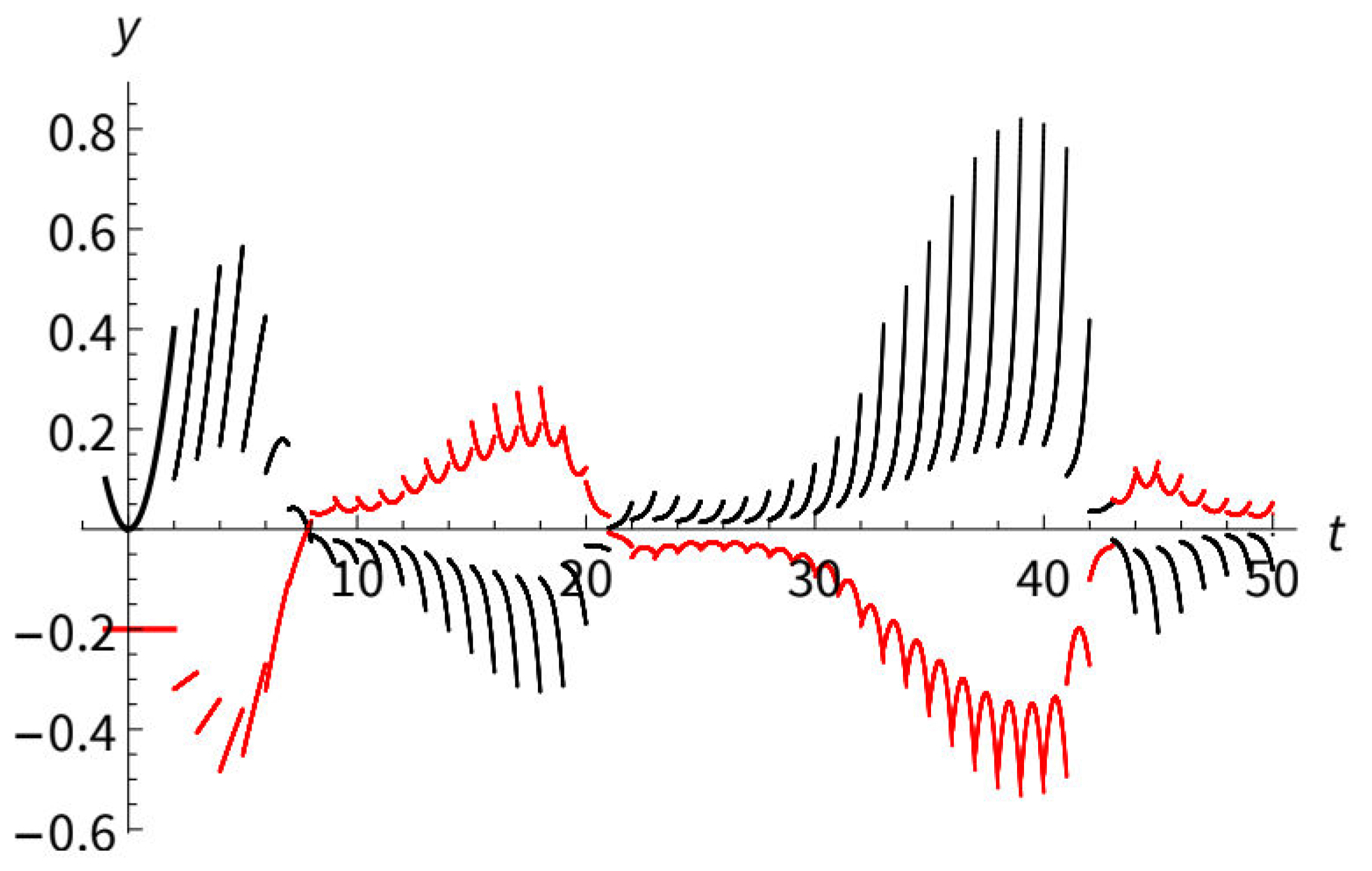
Figure 5.
The graphs of the functions and , the intervals , and the points from Example 3. The green lines represent the values in sums from condition (20).
Figure 5.
The graphs of the functions and , the intervals , and the points from Example 3. The green lines represent the values in sums from condition (20).
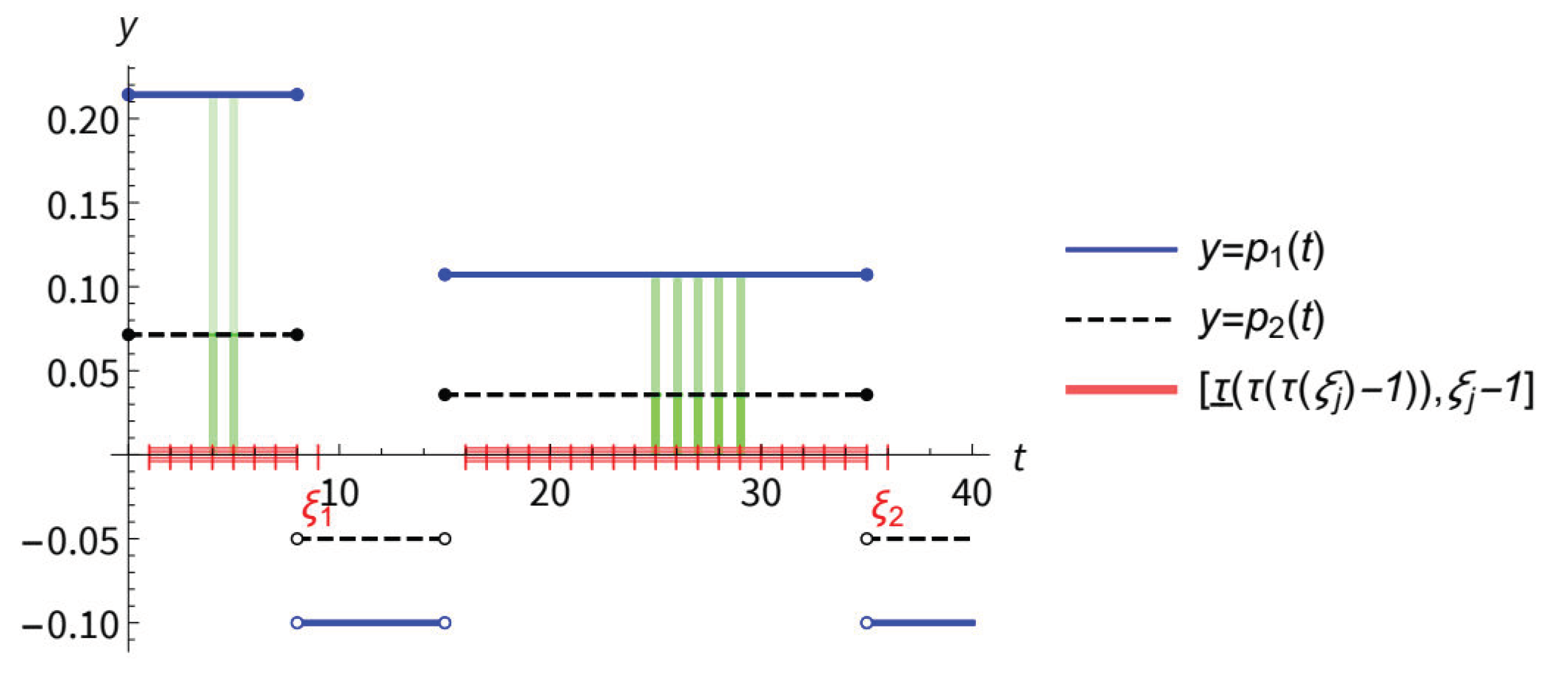
Figure 6.
The graphs of solutions of Eq. (43) with initial functions (black curve) and (red curve), .
Figure 6.
The graphs of solutions of Eq. (43) with initial functions (black curve) and (red curve), .
Disclaimer/Publisher’s Note: The statements, opinions and data contained in all publications are solely those of the individual author(s) and contributor(s) and not of MDPI and/or the editor(s). MDPI and/or the editor(s) disclaim responsibility for any injury to people or property resulting from any ideas, methods, instructions or products referred to in the content. |
© 2025 by the authors. Licensee MDPI, Basel, Switzerland. This article is an open access article distributed under the terms and conditions of the Creative Commons Attribution (CC BY) license (http://creativecommons.org/licenses/by/4.0/).
Copyright: This open access article is published under a Creative Commons CC BY 4.0 license, which permit the free download, distribution, and reuse, provided that the author and preprint are cited in any reuse.


