
Submitted:
05 March 2025
Posted:
06 March 2025
You are already at the latest version
Preprints on COVID-19 and SARS-CoV-2
Abstract
The key evolutionary step leading to the pandemic virus was the acquisition of the furin cleavage motif at the S protein S1/S2 junction. This insertion led to a gain of function for SARS-CoV-2, in which the virus's S protein became a substrate protein for human furin. The corresponding 12 nucleotide fragment inserted into the S gene in a SARS-CoV-2 precursor included the CGG-CGG genetic fingerprint coding the furin arginine pair. The arginine CGG codon was (still is) rare in the virus, even more two CGGs in a row. Afterwards the probable human origin of that motif has been proposed (BMC Genomic Data 24:71, 2023). Synonymous base substitutions or arginine codon usage bias at the CGG-CGG fingerprint was one of the evidences supporting the hypothesis. Based on 2025 SARS-CoV-2 isolates the aim of this work is follow the evolution of the furin site arginine pair code. From GISAID database 17,506 SARS-CoV-2 complete genomes were downloaded, with collection dates from January 1, 2025 to February 18, 2925. Using Perl programs the S gene sequences were retrieved. 62 out of 15,390 (0.4028%) S-protein sequences showed arginine codon usage bias at the S gene CGG-CGG fingerprint. The SARS-CoV-2 lineage distribution of the 2025 sample is shown. The XEC (44.5%) and KP.3.1.1 (13.8%) lineages were the majority. Lineage KP.3.1.1 was also the majority in CGG-CGG codon usage bias analyses, grouped into two main population groups of origin Japan and Canada. In the 2025 working sample 125 out of 1,620 (7,71%) Japan and 47 out of 4,793 (0,98%) Canada Ontario KP.3.1.1. isolates showed CGG-CGG optimization. The results shown are in agreement with previous studies, although in large samples the percentage (probability) of SARS-CoV-2 S gene furin site arginine codon optimization appears weak, it increases significantly when focusing on specific lineages or population groups.
Keywords:
SARS-CoV-2
; furin site
; arginine codon usage bias
; bioinformatics
Brief Report
The key evolutionary step leading to the pandemic virus was the acquisition of the furin cleavage motif at the S protein S1/S2 junction. In the first SARS-CoV-2 clinical isolates it was proline (P), arginine (R), arginine and alanine (A) (PRRA) [1]. The corresponding 12 nucleotide fragment inserted into the S gene in a SARS-CoV-2 precursor included the CGG-CGG genetic fingerprint coding the furin arginine pair. The arginine CGG codon was (still is) rare in the virus, even more two CGGs in a row [2,3,4,5]. Afterwards the probable human origin of that motif has been proposed [6]. Synonymous base substitutions or arginine codon usage bias at the CGG-CGG fingerprint was one of the evidences supporting the hypothesis and have been reported [6,7,8,9]. Based on 2025 SARS-CoV-2 isolates the aim of this work is follow the evolution of the furin site arginine pair code.
Furin Basics
Many proteins are synthesized as non-active precursors, which are subsequently converted to the active form. A mechanism of post-translational modification is through proteases, which are molecular scissors that cut or eliminate part of the non-active precursor to make it an active protein. In human and many organisms, furin is one of these proteases which acts in the secretory pathway. Technically, furin is a member of the subtilisin-like protein convertase family [10].
Therefore, there are many proteins (or non-active precursors) which are furin substrates, i.e., they have an active site (furin site) that allow “protein-furin” interaction. In any furin substrate protein the furin cleavage site encompasses a 20 amino acid residues fragment (aa1, …, aa20) that are designated by a specific nomenclature system (P14, P13, …, P2, P1, P1’,P2’, …, P6’) (Figure 1). The specific cleavage locus is between positions P1 and P1’. P1 is a strict conserved arginine residue. P5-P1 is the core positively charged (polybasic) motif. P14-P6 and P2’-P6’ are small and hydrophilic residues that configure flanking polar side chains providing weak interactions with furin polar surface [11].
Furin and SARS-CoV-2
The role of the human furin in the SARS-CoV-2 biology is during the S protein biosynthesis and maturation [12]. When the newly synthesized viral S protein transits through the Golgi apparatus of the infected cell and because the S-protein has the complete furin site, the human furin cuts into the S1 and S2 subunits, which remain associated. The S protein on the virus therefore consists of two non-covalently associated subunits with different functions: in the new target cell, the S1 subunit binds the ACE2 receptor and the S2 subunit anchors the S protein to the virion membrane and mediates membrane fusion [12].
With the acquisition of the furin polybasic motif the SARS-CoV-2 S-protein became a protein-substrate [13] of the human furin.
Furin Arginine Pair Codon Usage Bias in 2025 SARS-CoV-2 Isolates
Based on the GISAID database, 17,506 SARS-CoV-2 genomes were downloaded, with collection dates from January 1, 2025 to February 18, 2925. From each genome, the region covering the S gene was extracted for analysis. 15,390 out of 17.506 S gene sequences could be used used in this work. The encoded S protein sequences were complete and had no ambiguous characters at the core of the furin site (P5-P1). A a results, 62 out of 15,390 (0.4028%) S-protein sequences showed arginine codon usage bias at the S gene CGG-CGG fingerprint (Table 1).
When the SARS-CoV-2 lineages were taken into account the KP.3.1.1 lineage was the majority 42 out of 62 (67,74%) (Table 2), which was grouped into two main geographic regions: Japan and Canada. In this 2025 working sample 125 out of 1,620 (7,71%) Japan and 47 out of 4,793 (0,98%) Canada Ontario KP.3.1.1. isolates showed CGG-CGG codon usage optimization.
Table 3 shows the SARS-CoV-2 lineage distribution of viruses whose complete genomes were downloaded from the GISAID database in the initial working sample. XEC (7,792 out of 17,506 viruses; 44.5%) and KP.3.1.1 (2,414 out of 17,506; 13.8%) SARS-CoV-2 lineages were the majority.
The results shown here are in agreement with previous studies [6] that taking all together synonymous base substitutions or arginine pair codon usage bias at SARS-CoV-2 S protein furin site is strongly supported. Although in large samples the percentage (probability) of SARS-CoV-2 S gene furin site arginine codon optimization appears weak, it increases significantly when focusing on specific lineages or population groups.
Methods
The source of information was the Global Initiative on Sharing Avian Influenza Data (GISAID) database [14,15]. The reference SARS-CoV-2 spike glycoprotein sequences were retrieved from the SARS-CoV-2 reference genomes: (i) isolate Wuhan-Hu-1, GenBank: QHD43416.1 coded by MN908947.3:21563-25384; and (ii) isolate WH04, GenBank: QHR63260.2 coded by MN996528.1:21563-25384 and GISAID, EPI_ISL_406801, genome hCoV-19/Wuhan/WH04/2020: 21551-25370 [16]. A pipeline of scripts in Perl for data management has been created. The rationale of this work was based on the following tasks:
Task 1. Getting sequences. Complete SARS-CoV-2 genomes were downloaded from GISAID database. Obtaining the S gene coding region and S protein sequences required data parse by executing several chained programs. Briefly:
- To retrieve the genome region covering the S gene sequence (positions 20000-26000).
- Based on these coordinates, to retrieve the S gene region from the downloaded GISAID genome.
- To translate forward three frames of the retrieved S gene region (coding region).
- To identify the correct translation reading frame (no ambiguous characters, no stop signals).
- Based on the proper reading frame, to adjust the S gene coding sequence.
Task 2. Synonymous base substitution at the SARS-CoV-2 furin site arginine pair.
- To identify the furin site arginine pair. For each S protein sequence a 2-position RR-window was run. Using the RRAR pattern it was confirmed that the identified arginine pair corresponded to the arginine pair of the furin site.
- To identify the codon usage of the furin site argini pair. Knowing the positions of the arginine pair in the protein, multiplying by three the respective codons were extracted from the S gene sequences. The cases in which the arginine pair code was not CGG-CGG were recorded.
Competing interests
The author declares he has no competing interests.
Acknowledgement
The author acknowledges GISAID database contributors.
References
- Kristian G Andersen, Andrew Rambaut, W Ian Lipkin, Edward C Holmes, Robert F Garry. The proximal origin of SARS-CoV-2. Nat. Med. 26:450-452, 2020. [CrossRef] [PubMed]
- Murat Seyran, Damiano Pizzol, Parise Adadi, Tarek M A El-Aziz, Sk Sarif Hassan, Antonio Soares, Ramesh Kandimalla, Kenneth Lundstrom, Murtaza Tambuwala, Alaa A A Aljabali, Amos Lal, Gajendra K Azad, Pabitra P Choudhury, Vladimir N Uversky, Samendra P Sherchan, Bruce D Uhal, Nima Rezaei, Adam M Brufsky. Questions concerning the proximal origin of SARS-CoV-2. J. Med. Virol. 93(3):1204-1206, 2021. [CrossRef] [PubMed]
- Steven Quay, Richard Muller. The science suggests a Wuhan lab leak. The Wall Street Journal. Monday, June 7, 2021.
- Antonio, R. Romeu, Enric Ollé. SARS-CoV-2 and the Secret of the Furin Site. Preprints 2021, 2021020264. [CrossRef]
- Antonio, R. Romeu, Enric Ollé. The SARS-CoV-2 arginine dimers, 02 August 2021, PREPRINT (Version 1) available at Research Square. [CrossRef]
- Antonio R Romeu. Probable human origin of the SARS-CoV-2 polybasic furin cleavage motif. BMC Genom Data 24:71, 2023. [CrossRef] [PubMed]
- Antonio, R. Romeu. Synonymous base substitution in SARS-CoV-2 EE.2 lineage furin arginine CGG–CGG codons, 05 July 2023, PREPRINT (Version 1) available at Research Square. [CrossRef]
- Antonio, R. Romeu. SARS-CoV-2 CQ.1 and CQ.1.1 lineage isolates: 100% synonymous base substitution at furin arginine CGG–CGG codons, 13 July 2023, PREPRINT (Version 1) available at Research Square. [CrossRef]
- Antonio, R. Romeu. SARS-CoV-2 XBB.1.16.20 lineage study sample: 21% shows a synonymous base substitution in the S gene arginine codons CGG–CGG encoding the S protein furin cleavage site, 18 September 2023, PREPRINT (Version 1) available at Research Square. [CrossRef]
- FURIN furin, paired basic amino acid cleaving enzyme [ Homo sapiens (human) ]. NCBI. Available online: https://www.ncbi.nlm.nih.gov/gene/5045 (accessed on 1 March 2025).
- Sun Tian, Qingsheng Huang, Ying Fang, Jianhua Wu. FurinDB: A database of 20-residue furin cleavage site motifs, substrates and their associated drugs. J. Mol. Sci. 8;12(2):1060-5, 2011. [CrossRef] [PubMed]
- Cody, B. Jackson, Michael Farzan, Bing Chen, Hyeryun Choe. Mechanisms of SARS-CoV-2 entry into cells. Nat. Rev. Mol. Cell. Biol. 23(1):3-20, 2022. [CrossRef] [PubMed]
- Sergey A Shiryaev, Andrei V Chernov, Vladislav S Golubkov, Elliot R Thomsen, Eugene Chudin, Mark S Chee, Igor A Kozlov, Alex Y Strongin, Piotr Cieplak. High-resolution analysis and functional mapping of cleavage sites and substrate proteins of furin in the human proteome. PLoS One 8(1):e54290, 2013. [CrossRef] [PubMed]
- Yuelong Shu, John McCauley. GISAID: Global initiative on sharing all influenza data – from vision to reality. Euro. Surveill. 2017;22:30494, 2017. [CrossRef] [PubMed]
- Global Initiative on Sharing Avian Influenza Data (GISAID) database. Available online: https://www.gisaid.org/ (accessed on 1 March 2025).
- Andrew Rambaut, Edward C Holmes, Áine O’Toole, Verity Hill, John T McCrone, Christopher Ruis, Louis du Plessis, Oliver G Pybus. A dynamic nomenclature proposal for SARS-CoV-2 lineages to assist genomic epidemiology. Nat Microbiol. 2020;5:1403-7. [CrossRef] [PubMed]
- Zhang Z, Schwartz S, Wagner L, Miller W. A greedy algorithm for aligning DNA sequences. J. Comput. Biol. (1-2):203-14, 2000. [CrossRef] [PubMed]
- 18 NCBI BLASTn https://blast.ncbi.nlm.nih.gov/BlastAlign.cgi. Accessed March 1, 2025.
- Fábio Madeira, Young Mi Park, Joon Lee, Nicola Buso, Tamer Gur, Nandana Madhusoodanan, Prasad Basutkar, Adrian R N Tivey, Simon C Potter, Robert D Finn, Rodrigo Lopez. The EMBL-EBI search and sequence analysis tools APIs in 2019. Nucleic Acids Res. 47(W1):W636-W641, 2019. doi10.1093/nar/gkz268. [PubMed]
- EMBL-EBI. Clustal Omega. https://www.ebi.ac.uk/jdispatcher/msa/clustalo. Accessed March 1, 2025.
Figure 1.
SARS-CoV-2 S protein furin site.
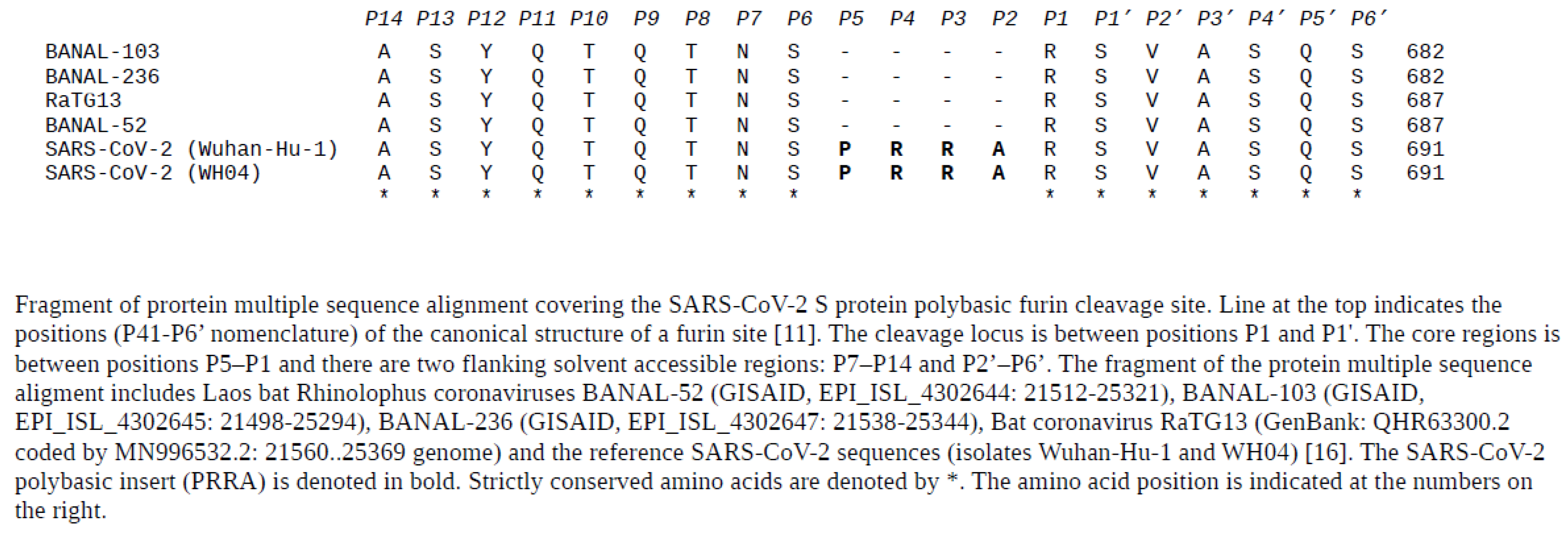

Table 1.
Synonymous base substitution (codon usage bias) at the SARS-CoV-2 arginine pair (CGG–CGG) S gene furin cleavage site.
Table 1.
Synonymous base substitution (codon usage bias) at the SARS-CoV-2 arginine pair (CGG–CGG) S gene furin cleavage site.
| |||||||||
| GISAID epi_isl id | Region | Country | Division | Length* | Lineage | Collect. Date | RR** | RR_Coding*** | Furin_Cleavage_Site** |
| NI_045512.2 (GenBank) | Asia | China | Hubei (Wuhan) | 29903 | B | 2019-12-26 | RR-683 | CGGCGG-23659 | 672-ASYQTQTNSPRRARSVASQS-691 |
| EPI_ISL_406801 | Asia | China | Hubei (Wuhan) | 29872 | A | 2020-01-30 | RR-682 | CGGCGG-23594 | 671-ASYQTQTNSPRRARSVASQS-690 |
| EPI_ISL_19679698 | North America | Canada | British Columbia | 29553 | KP.3.1.1 | 2025-01-01 | RR-672 | CGGCGT-23531 | 661-ASYQTQTKSRRRARSVASQS-680 |
| EPI_ISL_19700434 | Asia | Israel | 29401 | LF.7.1.3 | 2025-01-02 | RR-673 | CGGCGA-23252 | 662-ASYQTQTKSRRRARSVASQS-681 | |
| EPI_ISL_19684930 | Asia | Japan | Hyogo | 29749 | KP.3.1.1 | 2025-01-02 | RR-672 | CGGCGT-23531 | 661-ASYQTQTKSRRRARSVASQS-680 |
| EPI_ISL_19682951 | North America | USA | Arizona | 29721 | XEC | 2025-01-02 | RR-673 | CGGCGT-23538 | 662-ASYQTQTKSRRRARSVASQS-681 |
| EPI_ISL_19666094 | North America | USA | Illinois | 29690 | XEC | 2025-01-02 | RR-673 | AGGCGG-23516 | 662-ASYQTQTKSRRRARSVASQS-681 |
| EPI_ISL_19663311 | North America | Canada | Ontario | 29722 | KP.3.1.1 | 2025-01-04 | RR-674 | CGGCGA-23513 | 663-XXXXXQTKSRRRARSVASQS-682 |
| EPI_ISL_19682995 | North America | USA | New York | 29698 | XEC | 2025-01-04 | RR-673 | CGTCGG-23538 | 662-ASYQTQTKSRRRARSVASQS-681 |
| EPI_ISL_19681312 | Europe | Germany | North Rhine-Westphalia | 29706 | XEC | 2025-01-06 | RR-673 | CGGCGT-23510 | 662-XXXXXQTKSRRRARSVASQS-681 |
| EPI_ISL_19666768 | Asia | Singapore | 29569 | LF.7.3.1 | 2025-01-06 | RR-673 | CGACGG-23310 | 662-ASYQTXTKSRRRARSVASQS-681 | |
| EPI_ISL_19706176 | Asia | South Korea | 29795 | KP.3.1.1 | 2025-01-06 | RR-668 | CGGCGT-23569 | 657-ASYQTQTKSRRRARSVASQS-676 | |
| EPI_ISL_19675573 | North America | Canada | Ontario | 29716 | KP.3.1.1 | 2025-01-07 | RR-672 | CGGCGT-23507 | 661-XXXXXQTKSRRRARSVASQS-680 |
| EPI_ISL_19683050 | North America | USA | New York | 29698 | XEC | 2025-01-07 | RR-673 | CGTCGG-23538 | 662-ASYQTQTKSRRRARSVASQS-681 |
| EPI_ISL_19676763 | Oceania | Australia | Queensland | 29721 | XEC | 2025-01-08 | RR-673 | CGTCGG-23538 | 662-ASYQTQTKSRRRARSVASQS-681 |
| EPI_ISL_19684954 | Asia | Japan | Hokkaido | 29723 | KP.3.1.1 | 2025-01-08 | RR-672 | CGGCGT-23531 | 661-ASYQTQTKSRRRARSVASQS-680 |
| EPI_ISL_19701204 | Europe | United Kingdom | England | 29738 | JN.1.8 | 2025-01-08 | RR-672 | CGGCGT-23521 | 661-XSYQTQTKSRRRARSVASQS-680 |
| EPI_ISL_19684105 | North America | USA | Colorado | 29703 | KP.3.1 | 2025-01-08 | RR-672 | CGTCGG-23507 | 661-ASYQTQTKSRRRARSVASQS-680 |
| EPI_ISL_19691313 | North America | Canada | Ontario | 29716 | KP.3.1.1 | 2025-01-10 | RR-672 | CGGCGT-23507 | 661-XXXXXQTKSRRRARSVASQS-680 |
| EPI_ISL_19696722 | Asia | Japan | Miyagi | 29723 | LP.8.1 | 2025-01-10 | RR-672 | CGGCGA-23531 | 661-ASYQTQTKSRRRARSVASQS-680 |
| EPI_ISL_19707783 | North America | USA | Hawaii | 29703 | KP.3.1.1 | 2025-01-10 | RR-672 | CGGCGT-23507 | 661-ASYQTQTKSRRRARSVASQS-680 |
| EPI_ISL_19729037 | Asia | Japan | Toyama | 29723 | KP.3.1.1 | 2025-01-11 | RR-672 | CGGCGT-23531 | 661-ASYQTQTKSRRRARSVASQS-680 |
| EPI_ISL_19693631 | North America | Canada | Quebec | 29716 | KP.3.1.1 | 2025-01-12 | RR-672 | CGGCGT-23507 | 661-ASYQTQTKSRRRARSVASQS-680 |
| EPI_ISL_19684922 | Asia | Japan | Hyogo | 29723 | KP.3.1.1 | 2025-01-12 | RR-672 | CGGCGT-23531 | 661-ASYQTQTKSRRRARSVASQS-680 |
| EPI_ISL_19684921 | Asia | Japan | Hyogo | 29723 | KP.3.1.1 | 2025-01-12 | RR-672 | CGGCGT-23531 | 661-ASYQTQTKSRRRARSVASQS-680 |
| EPI_ISL_19691627 | North America | Canada | Ontario | 29716 | KP.3.1.1 | 2025-01-14 | RR-672 | CGGCGT-23507 | 661-XXXXXQTKSRRRARSVASQS-680 |
| EPI_ISL_19731362 | South America | Ecuador | Cotopaxi | 29830 | JN.1.11 | 2025-01-14 | RR-669 | AGGCGG-23572 | 658-ASYQTQTKSRRRARSVASQS-677 |
| EPI_ISL_19700994 | Asia | Japan | Gifu | 29723 | KP.3.1.1 | 2025-01-14 | RR-672 | CGGCGT-23531 | 661-ASYQTQTKSRRRARSVASQS-680 |
| EPI_ISL_19707721 | Asia | Japan | Saitama | 29723 | KP.3.1.1 | 2025-01-14 | RR-672 | CGGCGT-23531 | 661-ASYQTQTKSRRRARSVASQS-680 |
| EPI_ISL_19697568 | Asia | Japan | Tokushima | 29723 | KP.3.1.1 | 2025-01-14 | RR-672 | CGGCGT-23531 | 661-ASYQTQTKSRRRARSVASQS-680 |
| EPI_ISL_19712229 | Oceania | Australia | Queensland | 29721 | KP.3.3 | 2025-01-15 | RR-673 | CGGCGA-23538 | 662-ASYQTQTKSRRRARSVASQS-681 |
| EPI_ISL_19696525 | Oceania | Australia | South Australia | 29673 | KP.3.3 | 2025-01-15 | RR-672 | AGGCGG-23512 | 661-ASYQTQTKSRRRARSVASQS-680 |
| EPI_ISL_19695415 | Europe | Germany | Baden-Wurttemberg | 29703 | KP.3.1.1 | 2025-01-15 | RR-672 | AGGCGG-23507 | 661-ASYQTQTKSRRRARSVASQS-680 |
| EPI_ISL_19681098 | Asia | Japan | Kanagawa | 29723 | KP.3.1.1 | 2025-01-15 | RR-672 | CGGCGT-23531 | 661-ASYQTQTKSRRRARSVASQS-680 |
| EPI_ISL_19691828 | North America | Canada | Ontario | 29716 | KP.3.1.1 | 2025-01-16 | RR-672 | CGGCGT-23507 | 661-XXXXXQTKSRRRARSVASQS-680 |
| EPI_ISL_19691829 | North America | Canada | Ontario | 29716 | KP.3.1.1 | 2025-01-16 | RR-672 | CGGCGT-23507 | 661-XXXXXQTKSRRRARSVASQS-680 |
| EPI_ISL_19700973 | Asia | Japan | Gifu | 29723 | KP.3.1.1 | 2025-01-16 | RR-672 | CGGCGT-23531 | 661-ASYQTQTKSRRRARSVASQS-680 |
| EPI_ISL_19692038 | North America | Canada | Ontario | 29716 | KP.3.1.1 | 2025-01-17 | RR-672 | CGGCGT-23507 | 661-XXXXXQTKSRRRARSVVSQS-680 |
| EPI_ISL_19692035 | North America | Canada | Ontario | 29716 | KP.3.1.1 | 2025-01-17 | RR-672 | CGGCGT-23507 | 661-XXXXXQTKSRRRARSVVSQS-680 |
| EPI_ISL_19692037 | North America | Canada | Ontario | 29716 | KP.3.1.1 | 2025-01-17 | RR-672 | CGGCGT-23507 | 661-XXXXXQTKSRRRARSVVSQS-680 |
| EPI_ISL_19702183 | North America | Canada | Ontario | 29722 | KP.3.1.1 | 2025-01-18 | RR-674 | CGGCGT-23513 | 663-XXXXXQTKSRRRARSVVSQS-682 |
| EPI_ISL_19693229 | Asia | Hong Kong | 29706 | XDV.1 | 2025-01-18 | RR-673 | AGGCGG-23510 | 662-ASYQTQTKSRRRARSVASQS-681 | |
| EPI_ISL_19714873 | Oceania | Australia | South Australia | 29673 | KP.3.3 | 2025-01-19 | RR-672 | AGGCGG-23512 | 661-ASYQTQTKSRRRARSVASQS-680 |
| EPI_ISL_19714872 | Oceania | Australia | South Australia | 29673 | KP.3.3 | 2025-01-19 | RR-672 | AGGCGG-23512 | 661-ASYQTQTKSRRRARSVASQS-680 |
| EPI_ISL_19704613 | Asia | Japan | Hyogo | 29723 | KP.3.1.1 | 2025-01-19 | RR-672 | CGGCGT-23531 | 661-ASYQTQTKSRRRARSVASQS-680 |
| EPI_ISL_19700970 | Asia | Japan | Gifu | 29723 | KP.3.1.1 | 2025-01-20 | RR-672 | CGGCGT-23531 | 661-ASYQTQTKSRRRARSVASQS-680 |
| EPI_ISL_19696435 | Asia | Japan | Hokkaido | 29723 | KP.3.1.1 | 2025-01-20 | RR-672 | CGGCGT-23531 | 661-ASYQTQTKSRRRARSVASQS-680 |
| EPI_ISL_19697628 | Asia | Japan | Hokkaido | 29723 | KP.3.1.1 | 2025-01-20 | RR-672 | CGGCGT-23531 | 661-ASYQTQTKSRRRARSVASQS-680 |
| EPI_ISL_19729193 | Asia | Japan | Miyagi | 29723 | KP.3.1.1 | 2025-01-20 | RR-672 | CGGCGT-23531 | 661-ASYQTQTKSRRRARSVASQS-680 |
| EPI_ISL_19729288 | Asia | Japan | Saitama | 29723 | KP.3.1.1 | 2025-01-20 | RR-672 | CGTCGG-23531 | 661-ASYQTQTKSRRRARSVASQS-680 |
| EPI_ISL_19712131 | Asia | Japan | Ehime | 29723 | KP.3.1.1 | 2025-01-22 | RR-672 | CGGCGT-23531 | 661-ASYQTQTKSRRRARSVASQS-680 |
| EPI_ISL_19702323 | North America | Canada | Ontario | 29716 | JN.1.8 | 2025-01-23 | RR-674 | CGGAGG-23507 | 663-ASYQTQTKSRRRARSVASQS-682 |
| EPI_ISL_19729202 | Asia | Japan | Miyagi | 29723 | KP.3.1.1 | 2025-01-23 | RR-672 | CGGCGT-23531 | 661-ASYQTQTKSRRRARSVASQS-680 |
| EPI_ISL_19716895 | North America | USA | New Jersey | 29681 | JN.1.8 | 2025-01-24 | RR-672 | CGTCGG-23507 | 661-ASYQTQTKSRRRARSVASQS-680 |
| EPI_ISL_19724894 | Asia | Japan | Tokyo | 29749 | KP.3.1.1 | 2025-01-26 | RR-672 | CGGCGT-23531 | 661-ASYQTQTKSRRRARSVASQS-680 |
| EPI_ISL_19731882 | Europe | United Kingdom | England | 29749 | XEC | 2025-01-30 | RR-672 | CGTCGG-23530 | 661-ASYQTQTKSRRRARSVVSQS-680 |
| EPI_ISL_19718119 | North America | Canada | Ontario | 29703 | KP.3.1.1 | 2025-02-03 | RR-672 | CGGCGT-23507 | 661-ASYQTQTKSRRRARSVVSQS-680 |
| EPI_ISL_19718127 | North America | Canada | Ontario | 29703 | KP.3.1.1 | 2025-02-03 | RR-672 | CGGCGT-23507 | 661-ASYQTQTKSRRRARSVVSQS-680 |
| EPI_ISL_19718123 | North America | Canada | Ontario | 29716 | KP.3.1.1 | 2025-02-03 | RR-672 | CGGCGT-23507 | 661-XXXXXQTKSRRRARSVVSQS-680 |
| EPI_ISL_19722193 | Asia | Japan | Hokkaido | 29723 | KP.3.1.1 | 2025-02-03 | RR-672 | CGGCGT-23531 | 661-ASYQTQTKSRRRARSVASQS-680 |
| EPI_ISL_19731403 | Asia | Japan | Saitama | 29725 | KP.3.1.1 | 2025-02-03 | RR-672 | CGGCGT-23533 | 661-ASYQTQTKSRRRARSVASQS-680 |
| EPI_ISL_19718129 | North America | Canada | Ontario | 29703 | KP.3.1.1 | 2025-02-04 | RR-672 | CGGCGT-23507 | 661-ASYQTQTKSRRRARSVVSQS-680 |
| EPI_ISL_19722192 | Asia | Japan | Hokkaido | 29723 | KP.3.1.1 | 2025-02-05 | RR-672 | CGGCGT-23531 | 661-ASYQTQTKSRRRARSVASQS-680 |
| EPI_ISL_19722186 | Asia | Japan | Hokkaido | 29723 | KP.3.1.1 | 2025-02-06 | RR-672 | CGGCGT-23531 | 661-ASYQTQTKSRRRARSVASQS-680 |
Reference SARS-CoV-2 spike glycoprotein sequences [16]: the first two rows highlighted in gray. *: SARS-CoV-2 genome length. **: positions corresponding to the analyzed S protein sequence (see methods). ***: position corrspondig to the downloaded SARS-CoV-2 complte genome..
Table 2.
SARS-CoV-2 lineage distribution at the 2025 isolates with synonymous base substitution (codon usage bias) at the SARS-CoV-2 arginine pair S gene furin cleavage site.
Table 2.
SARS-CoV-2 lineage distribution at the 2025 isolates with synonymous base substitution (codon usage bias) at the SARS-CoV-2 arginine pair S gene furin cleavage site.
| ||
| Lineage | Percent | Number of Isolates |
| KP.3.1.1 | 1.74 | 42 |
| XEC | 0.09 | 7 |
| KP.3.3 | 2.07 | 4 |
| JN.1.8 | 0.64 | 3 |
| LF.7.1.3 | 6.67 | 1 |
| LF.7.3.1 | 6.25 | 1 |
| XDV.1 | 1.59 | 1 |
| KP.3.1 | 0.51 | 1 |
| JN.1.11 | 0.35 | 1 |
| LP.8.1 | 0.12 | 1 |
Table 3.
SARS-CoV-2 lineage distribution of viruses whose complete genomes were downloaded from the GISAID database in the initial 2025 working sample.
Table 3.
SARS-CoV-2 lineage distribution of viruses whose complete genomes were downloaded from the GISAID database in the initial 2025 working sample.
| ||
| Lineage | Percent | Number of Isolates |
| XEC | 44.5105 | 7792 |
| KP.3.1.1 | 13.7896 | 2414 |
| MC.1 | 5.2839 | 925 |
| LP.8.1 | 4.8783 | 854 |
| LP.8.1.1 | 4.4899 | 786 |
| JN.1.8 | 2.6962 | 472 |
| JN.1.16.1 | 2.4106 | 422 |
| JN.1.16 | 1.7365 | 304 |
| JN.1.11 | 1.6223 | 284 |
| KP.3.3.2 | 1.1882 | 208 |
| KP.3.1 | 1.1310 | 198 |
| KP.3.3 | 1.1025 | 193 |
| MC.10.1 | 0.9540 | 167 |
| JN.1.16.3 | 0.9482 | 166 |
| LF.7.2.1 | 0.7712 | 135 |
| MB.1.1 | 0.6626 | 116 |
| KP.3 | 0.5655 | 99 |
| LF.7.1 | 0.5370 | 94 |
| LP.8.1.2 | 0.5027 | 88 |
| KP.2 | 0.4913 | 86 |
| LF.7 | 0.4513 | 79 |
| XEC.1 | 0.4456 | 78 |
| MC.10.2.1 | 0.4341 | 76 |
| MC.1.2 | 0.3713 | 65 |
| XDV.1 | 0.3599 | 63 |
| XDY | 0.3427 | 60 |
| JN.1 | 0.2856 | 50 |
| KP.1.1.3 | 0.2799 | 49 |
| LF.7.3 | 0.2742 | 48 |
| MC.21.1 | 0.2399 | 42 |
| JN.1.40 | 0.2171 | 38 |
| JN.1.8.1 | 0.2114 | 37 |
| KS.1.1 | 0.2114 | 37 |
| LF.7.1.2 | 0.1942 | 34 |
| MC.13 | 0.1942 | 34 |
| KP.3.3.1 | 0.1828 | 32 |
| MC.2 | 0.1828 | 32 |
| MC.10.1.6 | 0.1599 | 28 |
| MC.1.3 | 0.1542 | 27 |
| MC.10.1.1 | 0.1485 | 26 |
| JN.11 | 0.1371 | 24 |
| MC.13.2 | 0.1257 | 22 |
| MC.1.5 | 0.1200 | 21 |
| MC.1.6 | 0.1028 | 18 |
| MC.24 | 0.1028 | 18 |
| KP.1.1 | 0.0971 | 17 |
| MC.8.1 | 0.0971 | 17 |
| LF.7.3.1 | 0.0914 | 16 |
| LP.7 | 0.0914 | 16 |
| KP.1 | 0.0857 | 15 |
| LF.7.1.3 | 0.0857 | 15 |
| LP.5 | 0.0857 | 15 |
| MC.9 | 0.0857 | 15 |
| KP.1.1.5 | 0.0800 | 14 |
| KP.3.2 | 0.0800 | 14 |
| MC.10.1.2 | 0.0800 | 14 |
| MC.10.2 | 0.0743 | 13 |
| JN.1.3 | 0.0685 | 12 |
| KP.3.1.4 | 0.0685 | 12 |
| MC.1.1 | 0.0685 | 12 |
| JN.1.18 | 0.0628 | 11 |
| KP.1.1.1 | 0.0628 | 11 |
| LF.7.2 | 0.0628 | 11 |
| MC.11 | 0.0628 | 11 |
| JN.1.13 | 0.0571 | 10 |
| BA.2.86.1 | 0.0514 | 9 |
| JN.1.37 | 0.0514 | 9 |
| LF.7.6.1 | 0.0514 | 9 |
| MC.1.4 | 0.0514 | 9 |
| MC.33.1 | 0.0514 | 9 |
| JN.1.11.1 | 0.0457 | 8 |
| JN.1.15 | 0.0457 | 8 |
| KP.2.2 | 0.0457 | 8 |
| KP.2.3.12 | 0.0457 | 8 |
| MC.10 | 0.0457 | 8 |
| MC.35 | 0.0457 | 8 |
| JN.1.18.6 | 0.0400 | 7 |
| KP.2.9 | 0.0400 | 7 |
| KP.3.3.3 | 0.0400 | 7 |
| MC.1.7 | 0.0400 | 7 |
| MC.10.1.4 | 0.0400 | 7 |
| MC.28 | 0.0400 | 7 |
| PA.1 | 0.0400 | 7 |
| XDQ | 0.0400 | 7 |
| JN.1.32 | 0.0343 | 6 |
| KP.3.1.3 | 0.0343 | 6 |
| KS.1 | 0.0343 | 6 |
| LU.2 | 0.0343 | 6 |
| MC.16 | 0.0343 | 6 |
| MC.19 | 0.0343 | 6 |
| MC.8 | 0.0343 | 6 |
| Unassigned | 0.0343 | 6 |
| BA.2.86 | 0.0286 | 5 |
| JN.1.10 | 0.0286 | 5 |
| KP.2.3 | 0.0286 | 5 |
| LB.1.1 | 0.0286 | 5 |
| LP.9 | 0.0286 | 5 |
| MB.1 | 0.0286 | 5 |
| MC.10.1.5 | 0.0286 | 5 |
| MC.13.1 | 0.0286 | 5 |
| MC.31 | 0.0286 | 5 |
| MC.4 | 0.0286 | 5 |
| BA.3 | 0.0228 | 4 |
| KP.5 | 0.0228 | 4 |
| LW.1 | 0.0228 | 4 |
| MC.13.3 | 0.0228 | 4 |
| MC.13.4 | 0.0228 | 4 |
| MC.23 | 0.0228 | 4 |
| MC.26 | 0.0228 | 4 |
| MC.34 | 0.0228 | 4 |
| JN.1.20 | 0.0171 | 3 |
| JN.1.4 | 0.0171 | 3 |
| JN.1.59 | 0.0171 | 3 |
| JN.1.9 | 0.0171 | 3 |
| JN.10 | 0.0171 | 3 |
| KP.2.3.4 | 0.0171 | 3 |
| KP.3.2.3 | 0.0171 | 3 |
| LP.8.2 | 0.0171 | 3 |
| MC.1.3.1 | 0.0171 | 3 |
| MC.10.1.3 | 0.0171 | 3 |
| MC.13.2.1 | 0.0171 | 3 |
| MC.3 | 0.0171 | 3 |
| MC.30 | 0.0171 | 3 |
| MC.6 | 0.0171 | 3 |
| ND.1.1.2 | 0.0171 | 3 |
| JN.1.13.1 | 0.0114 | 2 |
| JN.1.4.4 | 0.0114 | 2 |
| JN.1.9.2 | 0.0114 | 2 |
| KP.2.3.6 | 0.0114 | 2 |
| KP.3.5 | 0.0114 | 2 |
| MC.17.1 | 0.0114 | 2 |
| MC.19.1 | 0.0114 | 2 |
| MC.2.1 | 0.0114 | 2 |
| MC.27 | 0.0114 | 2 |
| ND.1.1 | 0.0114 | 2 |
| NT.1 | 0.0114 | 2 |
| XDQ.1 | 0.0114 | 2 |
| BA.1.1 | 0.0057 | 1 |
| BA.2 | 0.0057 | 1 |
| BQ.1.1 | 0.0057 | 1 |
| BQ.1.1.18 | 0.0057 | 1 |
| BQ.1.18 | 0.0057 | 1 |
| FL.4.2 | 0.0057 | 1 |
| HF.1.1 | 0.0057 | 1 |
| HV.1 | 0.0057 | 1 |
| JG.3 | 0.0057 | 1 |
| JN.1.18.3 | 0.0057 | 1 |
| JN.1.22 | 0.0057 | 1 |
| JN.1.4.6 | 0.0057 | 1 |
| JN.1.49 | 0.0057 | 1 |
| JN.1.49.1 | 0.0057 | 1 |
| JN.1.51 | 0.0057 | 1 |
| JN.1.52 | 0.0057 | 1 |
| JN.1.53 | 0.0057 | 1 |
| JN.1.7.3 | 0.0057 | 1 |
| KP.2.14 | 0.0057 | 1 |
| KP.2.3.10 | 0.0057 | 1 |
| KP.3.1.2 | 0.0057 | 1 |
| KP.3.2.5 | 0.0057 | 1 |
| KP.4 | 0.0057 | 1 |
| KP.4.2 | 0.0057 | 1 |
| KS.1.2 | 0.0057 | 1 |
| LB.1.3.1 | 0.0057 | 1 |
| LF.3.1 | 0.0057 | 1 |
| LF.7.4 | 0.0057 | 1 |
| LF.7.6 | 0.0057 | 1 |
| LP.10.1.1 | 0.0057 | 1 |
| LV.1 | 0.0057 | 1 |
| MA.1 | 0.0057 | 1 |
| MC.14 | 0.0057 | 1 |
| MC.17 | 0.0057 | 1 |
| MC.21 | 0.0057 | 1 |
| MC.24.1 | 0.0057 | 1 |
| MC.26.1 | 0.0057 | 1 |
| MC.28.1 | 0.0057 | 1 |
| MC.28.1.1 | 0.0057 | 1 |
| MC.32.1 | 0.0057 | 1 |
| MC.33.2 | 0.0057 | 1 |
| MC.37 | 0.0057 | 1 |
| ML.1 | 0.0057 | 1 |
| ML.2 | 0.0057 | 1 |
| MM.1 | 0.0057 | 1 |
| XDK.3 | 0.0057 | 1 |
Disclaimer/Publisher’s Note: The statements, opinions and data contained in all publications are solely those of the individual author(s) and contributor(s) and not of MDPI and/or the editor(s). MDPI and/or the editor(s) disclaim responsibility for any injury to people or property resulting from any ideas, methods, instructions or products referred to in the content. |
© 2025 by the authors. Licensee MDPI, Basel, Switzerland. This article is an open access article distributed under the terms and conditions of the Creative Commons Attribution (CC BY) license (http://creativecommons.org/licenses/by/4.0/).
Copyright: This open access article is published under a Creative Commons CC BY 4.0 license, which permit the free download, distribution, and reuse, provided that the author and preprint are cited in any reuse.


