

Submitted:
04 March 2025
Posted:
05 March 2025
You are already at the latest version
Abstract
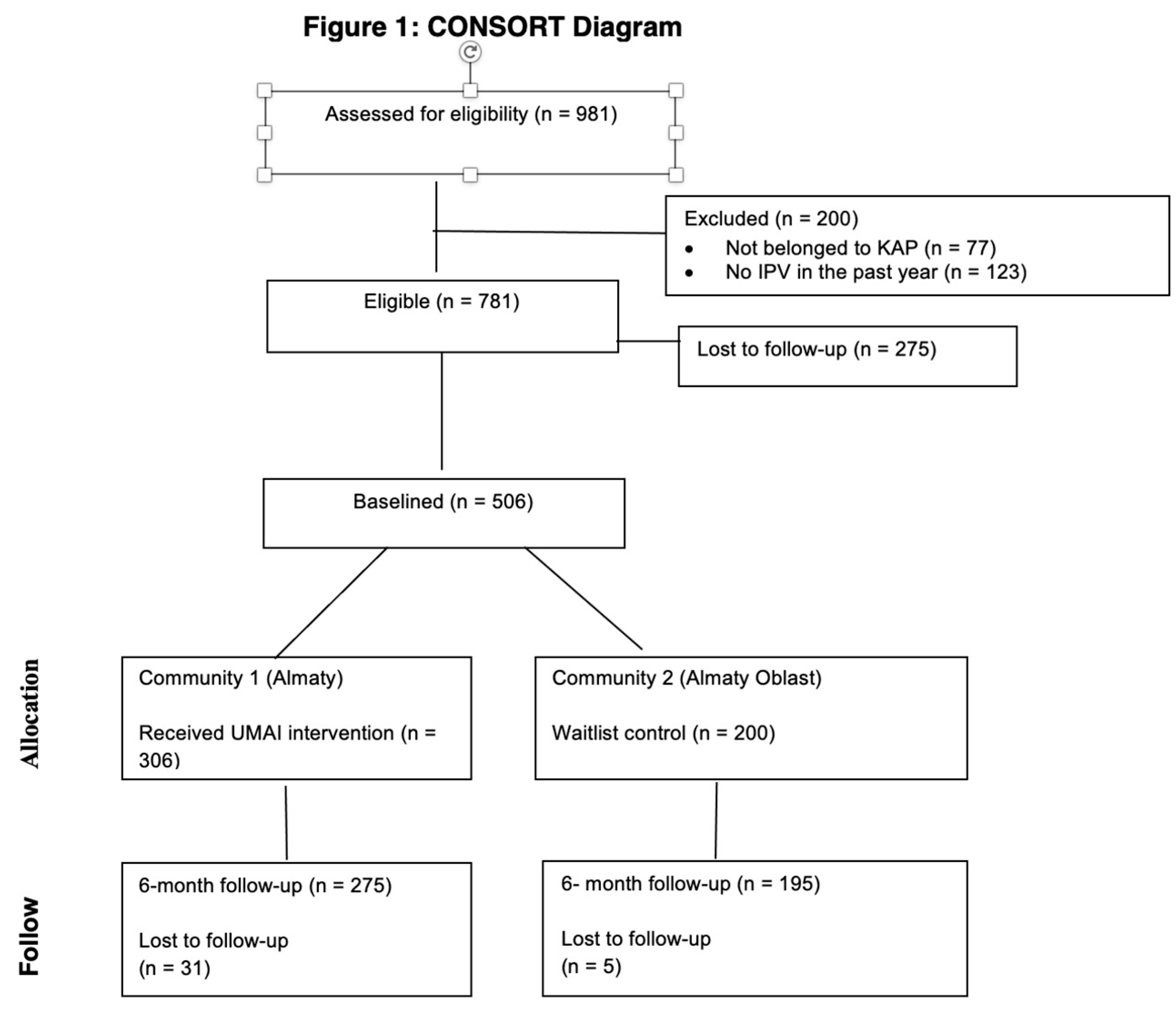
Women from key affected populations (KAPs) including women who use drugs, women who engage in sex work, and women living with HIV/AIDs in Kazakhstan experience extremely high rates of intimate partner violence (IPV) and encounter a myriad of barriers in accessing IPV services. This community-based implementation trial aimed to evaluate the acceptability, safety, and effectiveness of delivering an evidence-based self-guided mHealth IPV brief intervention tool (UMAI-WINGS) to women from KAPs in Kazakhstan using an innovative community-coordinated response model. This study enrolled 508 women from KAPs, including 306 women from the intervention community, Almaty City, and 200 women from Almaty Oblast, the waitlist control community. The primary outcomes of experiencing any physical, sexual, or psychological IPV in the past 6 months were assessed at baseline and 6 months post-intervention (N=458). After adjusting for baseline, the IPV outcome and other covariates, intervention community participants were 22.1% less likely to report psychological IPV, 23.6% less likely to report sexual IPV, and 43.9% less likely to report physical IPV at the 6-month follow-up, compared to the waitlist control community participants. These findings suggest that a community-based approach to delivering UMAI-WINGS was acceptable, safe, and effective in reducing IPV among women from KAPs in Kazakhstan.
Keywords:
1. Introduction
2. Materials and Methods
2.1. Study Design
2.2. Study Participants
2.3. Intervention
2.4. Community Engagement and Capacity Building in Intervention Trial
2.5. Measurement
2.6. Data Analysis
3. Results
3.1. Sociodemographic Characteristics
3.2. IPV Outcomes
3.3. Acceptability
3.4. Safety
4. Discussion
4.1. Limitations of the Study
4.2. Strength and Implications of the Study
5. Conclusions
Author Contributions
Funding
Institutional Review Board Statement
Informed Consent Statement
Data Availability Statement
Acknowledgments
Conflicts of Interest
References
- Abramsky, Tanya, Karen Devries, Ligia Kiss, Janet Nakuti, Nambusi Kyegombe, Elizabeth Starmann, Bonnie Cundill, et al. 2014. “Findings from the SASA! Study: A Cluster Randomized Controlled Trial to Assess the Impact of a Community Mobilization Intervention to Prevent Violence against Women and Reduce HIV Risk in Kampala, Uganda.” BMC Medicine 12 (1): 122. [CrossRef]
- Brown, J B, B Lent, G Schmidt, and G Sas. 2000. “Application of the Woman Abuse Screening Tool (WAST) and WAST-Short in the Family Practice Setting.” The Journal of Family Practice 49 (10): 896–903.
- Brown, Laura J, Hattie Lowe, Andrew Gibbs, Colette Smith, and Jenevieve Mannell. 2023. “High-Risk Contexts for Violence Against Women: Using Latent Class Analysis to Understand Structural and Contextual Drivers of Intimate Partner Violence at the National Level.” Journal of Interpersonal Violence 38 (1–2): 1007–39. [CrossRef]
- El-Bassel, Nabila, Trena I. Mukherjee, Claudia Stoicescu, Laura E. Starbird, Jamila K. Stockman, Victoria Frye, and Louisa Gilbert. 2022. “Intertwined Epidemics: Progress, Gaps, and Opportunities to Address Intimate Partner Violence and HIV among Key Populations of Women.” The Lancet HIV 9 (3): e202–13. [CrossRef]
- Gilbert, Louisa, Dawn Goddard-Eckrich, Timothy Hunt, Xin Ma, Mingway Chang, Jessica Rowe, Tara McCrimmon, et al. 2016. “Efficacy of a Computerized Intervention on HIV and Intimate Partner Violence Among Substance-Using Women in Community Corrections: A Randomized Controlled Trial.” American Journal of Public Health 106 (7): 1278–86. [CrossRef]
- Gilbert, Louisa, Tina Jiwatram-Negron, Danil Nikitin, Olga Rychkova, Tara McCrimmon, Irena Ermolaeva, Nadejda Sharonova, Aibek Mukambetov, and Timothy Hunt. 2017. “Feasibility and Preliminary Effects of a Screening, Brief Intervention and Referral to Treatment Model to Address Gender-Based Violence among Women Who Use Drugs in Kyrgyzstan: Project WINGS (Women Initiating New Goals of Safety).” Drug and Alcohol Review 36 (1): 125–33. [CrossRef]
- Gilbert, Louisa, Phillip L. Marotta, Dawn Goddard-Eckrich, Ariel Richer, Jasmine Akuffo, Timothy Hunt, Elwin Wu, and Nabila El-Bassel. 2022. “Association Between Multiple Experiences of Violence and Drug Overdose Among Black Women in Community Supervision Programs in New York City.” Journal of Interpersonal Violence 37 (23–24): NP21502–24. [CrossRef]
- Gilbert, Louisa, Anita Raj, Denise Hien, Jamila Stockman, Assel Terlikbayeva, and Gail Wyatt. 2015. “Targeting the SAVA (Substance Abuse, Violence, and AIDS) Syndemic Among Women and Girls: A Global Review of Epidemiology and Integrated Interventions.” JAIDS Journal of Acquired Immune Deficiency Syndromes 69 (June):S118. [CrossRef]
- Gilbert, Louisa, Stacey A. Shaw, Dawn Goddard-Eckrich, Mingway Chang, Jessica Rowe, Tara.
- McCrimmon, Maria Almonte, Sharun Goodwin, and Matthew Epperson. 2015. “Project WINGS (Women Initiating New Goals of Safety): A Randomised Controlled Trial of a Screening, Brief Intervention and Referral to Treatment (SBIRT) Service to Identify and Address Intimate Partner Violence Victimisation among Substance-Using Women Receiving Community Supervision.” Criminal Behaviour and Mental Health 25 (4): 314–29. [CrossRef]
- Gunarathne, Lakma, Jahar Bhowmik, Pragalathan Apputhurai, and Maja Nedeljkovic. 2023. “Factors and Consequences Associated with Intimate Partner Violence against Women in Low- and Middle-Income Countries: A Systematic Review.” PLOS ONE 18 (11): e0293295. [CrossRef]
- “HIV Status: Challenges That Women Face | United Nations Development Programme.” n.d. Accessed January 15, 2025. https://www.undp.org/kazakhstan/stories/hiv-status-challenges-women-face.
- Jiwatram-Negrón, Tina, Nabila El-Bassel, Sholpan Primbetova, and Assel Terlikbayeva. 2018. “Gender-Based Violence Among HIV-Positive Women in Kazakhstan: Prevalence, Types, and Associated Risk and Protective Factors.” Violence Against Women 24 (13): 1570–90. [CrossRef]
- “Kazakhstan: New Law to Protect Women Improved, but Incomplete | Human Rights Watch.” 2024. April 23, 2024. https://www.hrw.org/news/2024/04/23/kazakhstan-new-law-protect-women-improved-incomplete.
- “Kazakhstan’s New Domestic Violence Law Is Welcome but Further Reforms Need to Close Remaining Protection Gaps - Kazakhstan | ReliefWeb.” 2024. May 16, 2024. https://reliefweb.int/report/kazakhstan/kazakhstans-new-domestic-violence-law-welcome-further-reforms-need-close-remaining-protection-gap.
- “Kazakhstan’s Year in Review: Prevention of Domestic Abuse, Protection of Women’s & Children’s Rights - The Astana Times.” n.d. Accessed January 15, 2025. https://astanatimes.com/2024/12/kazakhstans-year-in-review-prevention-of-domestic-abuse-protection-of-womens-childrens-rights/.
- Kemelova, Fatima. 2023. “UN Reports on Anti-Gender Violence Campaign in Kazakhstan.” The Astana Times. December 14, 2023. https://astanatimes.com/2023/12/un-reports-on-anti-gender-violence-campaign-in-kazakhstan/.
- “Kazakh Senate Approves Law to Criminalize Domestic Violence.” The Astana Times. April 11, 2024. https://astanatimes.com/2024/04/kazakh-senate-approves-law-to-criminalize-domestic-violence/.
- Kurdyla, Victoria, Adam M. Messinger, and Milka Ramirez. 2021. “Transgender Intimate Partner Violence and Help-Seeking Patterns.” Journal of Interpersonal Violence 36 (19–20): NP11046–69. [CrossRef]
- Mannell, Jenevieve, Hattie Lowe, Laura Brown, Reshmi Mukerji, Delan Devakumar, Lu Gram, Henrica A. F. M. Jansen, et al. 2022. “Risk Factors for Violence against Women in High-Prevalence Settings: A Mixed-Methods Systematic Review and Meta-Synthesis.” BMJ Global Health 7 (3). [CrossRef]
- Mojahed, Amera, Judith T. Mack, Andreas Staudt, Victoria Weise, Lakshmi Shiva, Prabha Chandra, and Susan Garthus-Niegel. 2024. “Prevalence and Risk Factors of Intimate Partner Violence during the COVID-19 Pandemic: Results from the Population-Based Study DREAMCORONA.” PLOS ONE 19 (6): e0306103. [CrossRef]
- Mukherjee, Trena I, Assel Terlikbayeva, Tara McCrimmon, Sholpan Primbetova, Guakhar Mergenova, Shoshana Benjamin, Susan Witte, and Nabila El-Bassel. 2023. “Association of Gender-Based Violence with Sexual and Drug-Related HIV Risk among Female Sex Workers Who Use Drugs in Kazakhstan.” International Journal of STD & AIDS 34 (10): 666–76. [CrossRef]
- Murphy, Maureen, Mary Ellsberg, Aminat Balogun, and Claudia Garcia-Moreno. 2021. “Risk and Protective Factors for GBV among Women and Girls Living in Humanitarian Setting: Systematic Review Protocol.” Systematic Reviews 10 (1): 238. [CrossRef]
- Mussabekova, Saule A., Xeniya E. Mkhitaryan, and Khamida R. Abdikadirova. 2024. “Domestic Violence in Kazakhstan: Forensic-Medical and Medical-Social Aspects.” Forensic Science International: Reports 9 (July):100356. [CrossRef]
- Muyanga, Naume, John Bosco Isunju, Tonny Ssekamatte, Aisha Nalugya, Patience Oputan, Juliet Kiguli, Simon Peter S. Kibira, et al. 2023. “Understanding the Effect of Gender-Based Violence on Uptake and Utilisation of HIV Prevention, Treatment, and Care Services among Transgender Women: A Qualitative Study in the Greater Kampala Metropolitan Area, Uganda.” BMC Women’s Health 23 (1): 250. [CrossRef]
- Organization, World Health. 2021. Violence against Women Prevalence Estimates, 2018: Global, Regional and National Prevalence Estimates for Intimate Partner Violence against Women and Global and Regional Prevalence Estimates for Non-Partner Sexual Violence against Women. World Health Organization.
- Peitzmeier, Sarah M., Mannat Malik, Shanna K. Kattari, Elliot Marrow, Rob Stephenson, Madina Agénor, and Sari L. Reisner. 2020. “Intimate Partner Violence in Transgender Populations: Systematic Review and Meta-Analysis of Prevalence and Correlates.” American Journal of Public Health 110 (9): e1–14. [CrossRef]
- Sabri, Bushra, and Anna Marie Young. 2022. “Contextual Factors Associated with Gender-Based Violence and Related Homicides Perpetrated by Partners and in-Laws: A Study of Women Survivors in India.” Health Care for Women International 43 (7–8): 784–805. [CrossRef]
- Sprague Martinez, Linda, Bruce D. Rapkin, April Young, Bridget Freisthler, LaShawn Glasgow, Tim Hunt, Pamela J. Salsberry, et al. 2020. “Community Engagement to Implement Evidence-Based Practices in the HEALing Communities Study.” Drug and Alcohol Dependence 217 (December):108326. [CrossRef]
- STRAUS, MURRAY A., SHERRY L. HAMBY, SUE BONEY-McCOY, and DAVID B. SUGARMAN. 1996. “The Revised Conflict Tactics Scales (CTS2): Development and Preliminary Psychometric Data.” Journal of Family Issues 17 (3): 283–316. [CrossRef]
- Wagman, Jennifer A., Ronald H. Gray, Jacquelyn C. Campbell, Marie Thoma, Anthony Ndyanabo, Joseph Ssekasanvu, Fred Nalugoda, et al. 2015. “Effectiveness of an Integrated Intimate Partner Violence and HIV Prevention Intervention in Rakai, Uganda: Analysis of an Intervention in an Existing Cluster Randomised Cohort.” The Lancet Global Health 3 (1): e23–33. [CrossRef]
- “What’s Wrong with Women’s Crisis Centres in Kazakhstan? - CABAR.Asia.” n.d. Accessed January 15, 2025. https://cabar.asia/en/what-s-wrong-with-women-s-crisis-centres-in-kazakhstan.
- Witte, Susan S., Lyla Sunyoung Yang, Tara McCrimmon, Toivgoo Aira, Altantsetseg Batsukh, Assel Terlikbayeva, Sholpan Primbetova, et al. 2023. “Combination Microfinance and HIV Risk Reduction Among Women Engaged in Sex Work.” Research on Social Work Practice 33 (2): 213–29. [CrossRef]

| . | Univariable | Bivariable Comparisons | ||
|---|---|---|---|---|
| Full Sample (n =458) |
Almaty Oblast - Control (n=194) |
Almaty City - Intervention (n=264) |
P-Value | |
| Age | 36.7 (9.0) | 36.1 (9.0) | 37.0 (9.0) | 0.285 |
| Nationality | ||||
| Kazakh | 169 (36.9%) | 89 (45.9%) | 80 (30.3%) | < 0.001 |
| Russian | 142 (31.0%) | 38 (19.6%) | 104 (39.4%) | |
| Other | 147 (32.1%) | 67 (34.5%) | 80 (30.3%) | |
| Education | ||||
| 9th grade or lower | 101 (22.1%) | 37 (19.1%) | 64 (24.2%) | 0.258 |
| Secondary Education | 145 (31.7%) | 57 (29.4%) | 88 (33.3%) | |
| High School | 161 (35.2%) | 77 (39.7%) | 84 (31.8%) | |
| Bachelor’s or more | 51 (11.1%) | 23 (11.9%) | 28 (10.6%) | |
| Marital Status | ||||
| Married | 46 (10.0%) | 12 (6.2%) | 34 (12.9%) | 0.019 |
| Not married/other | 412 (89.96%) | 182 (93.8%) | 230 (87.1%) | |
| Homelessness (past-year) | 186 (40.6%) | 104 (53.6%) | 82 (31.1%) | < 0.001 |
| Food Insecurity(past-year) | 254 (55.5%) | 133 (68.6%) | 121 (45.8%) | < 0.001 |
| Income (USD) | 412.22(472.34) | 412.53 (399.91) | 411.99 (519.92) | 0.990 |
| Key Affected Population | ||||
| Sex Workers | 335 (73.1%) | 163 (84.0%) | 172 (65.2%) | < 0.001 |
| Persons who use drugs | 266 (58.1%) | 146 (75.3%) | 120 (45.5%) | < 0.001 |
| Persons living with HIV | 140 (30.6%) | 34 (17.5%) | 106 (40.2%) | < 0.001 |
| Univariable | Bivariable Comparisons | |||
|---|---|---|---|---|
| Full Sample (n =458) |
Almaty Oblast - Control (n=194) |
Almaty City - Intervention (n=264) |
Unadjusted RR (95% CI) | |
| Psychological | ||||
| Baseline | 296 (64.6%) | 127 (65.5%) | 169 (64.0%) | 0.97 (0.83, 1.15) |
| Six-month Follow-up | 256 (55.9%) | 146 (75.3%) | 110 (41.7%) | 0.56 (0.48, 0.66) |
| Sexual | ||||
| Baseline | 288 (62.9%) | 123 (63.4%) | 165 (62.5%) | 0.98 (0.84, 1.16) |
| Six-month Follow-up | 252 (55.0%) | 137 (70.6%) | 115 (43.6%) | 0.63 (0.54, 0.74) |
| Physical | ||||
| Baseline | 267 (58.3%) | 130 (67.0%) | 137 (51.9%) | 0.77 (0.66, 0.90) |
| Six-month Follow-up | 211 (46.1%) | 143 (73.7%) | 68 (25.8%) | 0.30 (0.23, 0.40) |
| Multivariable Model | ||
|---|---|---|
| aRR (95% CI) | P-Value | |
| Past 6-Month Intimate Partner Violence | ||
| Psychological | 0.77 (0.69, 0.86) | <.0001 |
| Sexual | 0.73 (0.63, 0.85) | <.0001 |
| Physical | 0.71 (0.63, 0.80) | <.0001 |
| Multivariable Model | ||
|---|---|---|
| aRR (95% CI) | P-Value | |
| Past 6-Month Psychological IPV | ||
| Persons living with HIV | 1.05 (0.79, 1.40) | 0.748 |
| Persons who use drugs | 1.23 (0.92, 1.63) | 0.160 |
| Sex Workers | 1.03 (0.78, 1.37) | 0.833 |
| Past 6-Month Sexual IPV | ||
| Persons living with HIV | 0.91 (0.71, 1.18) | 0.478 |
| Persons who use drugs | 1.07 (0.78, 1.48) | 0.678 |
| Sex Workers | 1.06 (0.79, 1.41) | 0.697 |
| Past 6-Month Physical IPV | ||
| Persons living with HIV | 1.03 (0.81, 1.32) | 0.796 |
| Persons who use drugs | 0.95 (0.74, 1.22) | 0.690 |
| Sex Workers | 0.97 (0.74, 1.28) | 0.838 |
Disclaimer/Publisher’s Note: The statements, opinions and data contained in all publications are solely those of the individual author(s) and contributor(s) and not of MDPI and/or the editor(s). MDPI and/or the editor(s) disclaim responsibility for any injury to people or property resulting from any ideas, methods, instructions or products referred to in the content. |
© 2025 by the authors. Licensee MDPI, Basel, Switzerland. This article is an open access article distributed under the terms and conditions of the Creative Commons Attribution (CC BY) license (http://creativecommons.org/licenses/by/4.0/).


