1. Introduction
Emerging research in quantum biology reveals how light and biophotons interact with biological systems, offering new insights into nutritional biochemistry and metabolic health. Understanding these interactions provides a deeper appreciation for traditional breastfeeding practices and informs modern approaches to early-life nutrition. Furthermore, the evolutionary history of lactose intolerance illustrates the dynamic interplay between genetics, diet, and microbial adaptation.
2. Method
This study employs a comprehensive literature review for the identification of new concepts pertaining to the amalgamation of quantum biology, and human physiology, for public health benefit and future personalised healthcare. Particularly pertaining to the significance of light in early-life nutrition. Sources were collected from peer-reviewed journals, textbooks, and authoritative scientific databases. Articles were selected based on relevance to quantum biology, circadian rhythms, epigenetics, and early-life nutrition.
3. Quantum Biology and Its Role in Human Physiology
Quantum biology explores the role of quantum mechanics in biological systems. Historically, physics and biology were studied separately due to their complexity, but recent research has begun to uncover their intricate connections (Lambert N, et al 2013). The field is advancing our understanding of nutritional biochemistry by exploring biological interactions at atomic and subatomic levels (Lambert N, et al 2013). Research suggests that proteins involved in cellular respiration and genetic expression exploit quantum phenomena to optimise their functions (Lambert N et al 2013). Quantum mechanisms play a crucial role in epigenetic regulation (Sedley L 2023).
The evolution of biological pathways at the cellular level has rendered early models inadequate for personalised medicine, emphasising the need for computational simulations to refine metabolic health analysis (Sedley L 2023).
3.1. Photons and Biology
A photon corresponds to the electromagnetic potential gained or lost as an electron as it moves through its orbit and may or may not be visible to the human eye (The Editors of Encyclopaedia Britannica 2021). Ultra-weak photon emissions (UPE), or biophotons, are emitted by all living organisms within the 260–800 nm range and are undetectable to the human eye due to their low emission frequency (Prasad, A et al 2014) (Popp, F. A. (2003). Many organisms use electromagnetic radiation (EMR) for communication, with microorganisms transmitting signals over long distances and through barriers (Prasad A, et al 2014).
3.2. Light and the Central Circadian Rhythm
Light is the strongest circadian stimulus (Hudec M, Dankova P et al 2020). Each cell has a unique peripheral rhythm that is distinct from the central circadian rhythm which interacts indirectly with proteins of the central circadian rhythm (Matsui M S, Pelle E et al 2016). Clock Circadian Regulator (CLOCK/NPAS2) and Basic Helix Loop Helix ARNT Like 1 (BMAL1) are the primary regulators of the circadian rhythm (Hudec M, Dankova P et al 2020). PER and CRY1 form a complex which inhibits the CLOCK-BMAL1 complex initiating the rhythmic circadian feedback mechanism (Hudec M, Dankova P et al 2020).
3.3. Chromophores
A chromophore is the atomic region of a molecule responsible for its pigment (The Editors of Encyclopaedia Britannica, 2011). The human eye perceives colour when a chromophore absorbs and transfers a specific EMR energy band (400–700 nm). (Davson, H., Perkins, E.S 2025). Cryptochromes (CRY), the photoreceptors responsible for circadian rhythm regulation, absorb UV-blue light at a peak of 420 nm, due to their two dietary-derived chromophores, flavin adenine dinucleotide (FAD) and methyltetrahydrofolate (MTHF) (Sancar A 2000).
3.4. Riboflavin and Light
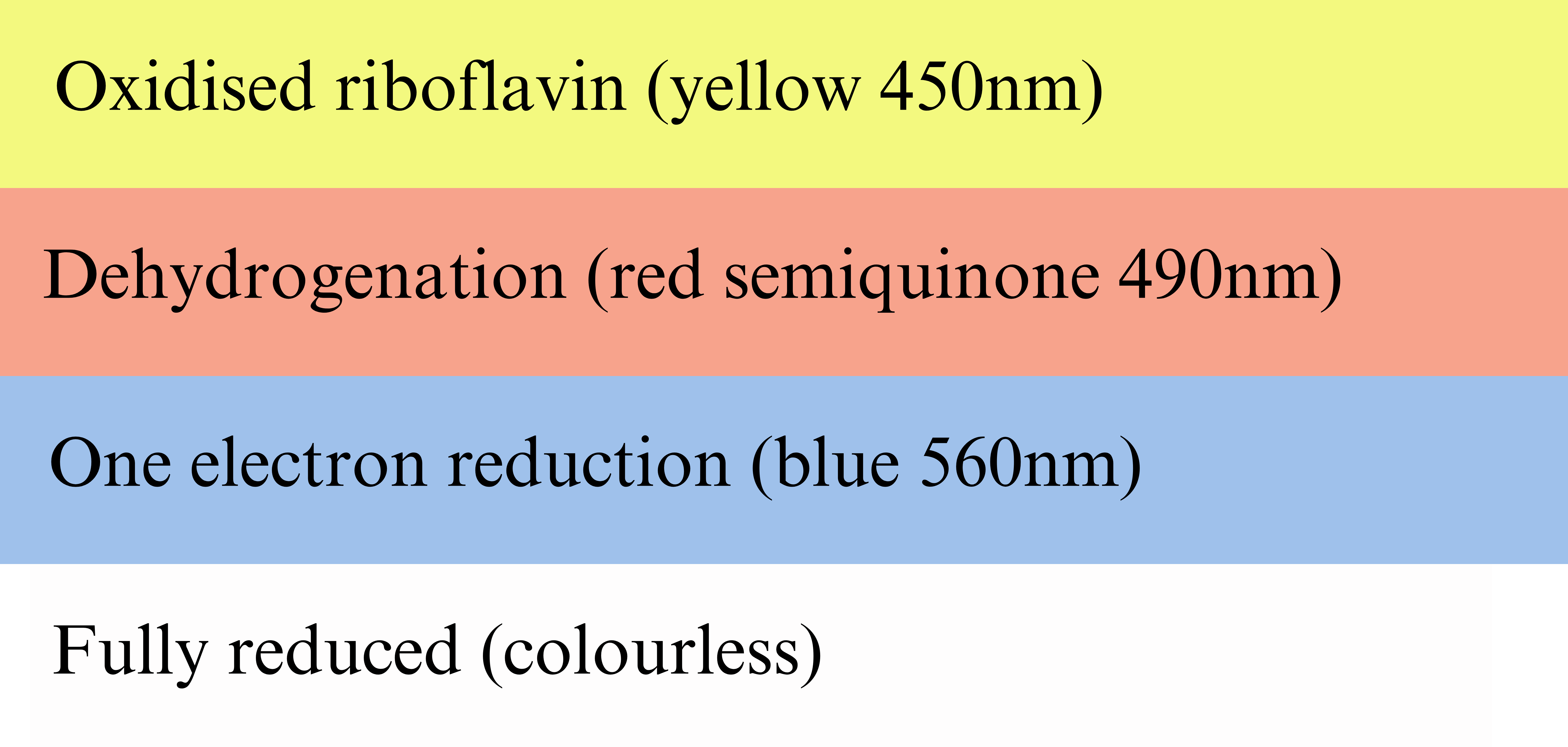
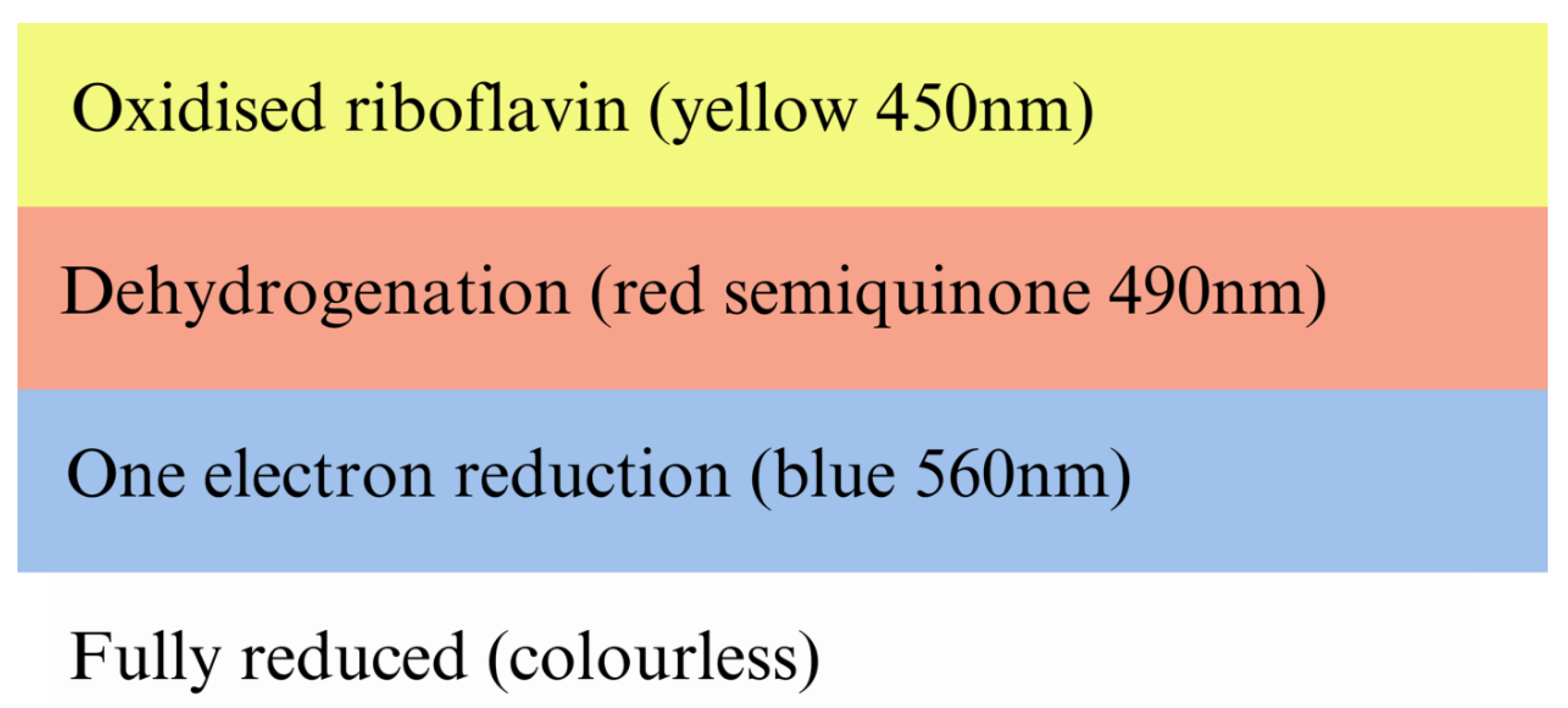
Clock gene regulator FAD contains a riboflavin cofactor, the fluorescent pigment essential for all flavoproteins involved in redox electron transport. Riboflavin and its proteins are irreversibly regulated by light. The redox state of the flavin chromophore determines both its pigment and absorption within the visual spectrum, as described in
Figure 1 (Hernan B 2022).
Humans have over 40 flavoproteins, and mutations in riboflavin transporters can lead to severe neurological diseases like Madras motor neuron disease (MND), Brown-Vialetto Van Laere, and juvenile amyotrophic lateral sclerosis. High-dose riboflavin supplementation has shown remarkable recovery in these conditions, suggesting an epigenetic influence, especially in Madras MND, which lacks known transporter mutations. (Sedley L, 2023).
Upon light exposure, riboflavin degrades into metabolites that inhibit flavoproteins, riboflavin absorption and transporters. Therefore, consumption of light-exposed dairy and plant foods can potentially negatively impact neurological conditions (Sedley L, 2023).
4. Early-Life Nutrition and Epigenetics
Nutrition in critical periods of development and early life, play a vital role in establishing epigenetic mechanisms (Verduci, E et al 2014). The importance of breast-feeding and the implications associated with animal substitutes was recognised early (Wende E 1899). Optimal gene expression early in life can have superior health benefits later in life (Bahreynian M, Feizi A et al 2020).
Some indigenous communities sustain breast feeding for several years (Picchi D, 1994). The American - Australian scientific expedition to Arnhem land in 1948 described mothers of remote indigenous communities fed their infants for up to 4 years or more, which is much longer than today’s average breast-feeding duration (Cromie EAS, Shepherd CCJ et al 2012).
Breast milk is a powerful immunomodulator, so much so that the marsupial feeds its foetus externally during development (Pharo EA 2019). Lower order primates like the orangutan feed their infants for up to 8 years, with varying degrees of milk production throughout the year which depends on the environment and the infant’s requirements (Smith TM, Austin C et al 2017).
Due to unique dietary preferences, the fatty acid composition of human breast milk differs throughout the world (Bahreynian M, Feizi A et al 2020). The nutritional composition of human breast milk also changes throughout gestation and throughout the day. This adaptation provides the infant with the appropriate inflammatory cytokines and nutrients when required (Morais TC, Honorio-França AC et al 2015).
Several studies highlight the epigenetic impact of breastfeeding on gene expression, immune function and neural development (Gialeli G et al 2023). Such findings reinforce the argument that breastfeeding is a crucial factor in shaping genetic and epigenetic health outcomes.
Human breast milk has a microbiome that carries over 800 microbial species (Notarbartolo V, Giuffre M et al 2022), and thousands of bioactive molecules that protect against inflammation, infection, and contribute to the maturation of the immune system, organs and a healthy microbiome (Ballard O, Morrow AL 2013).
5. The Role of Light in Breastfeeding
A mother's milk also changes nutritional composition throughout the feed which can be recognised by a change in colour. Colostrum also known as liquid gold; present in high concentrations in the first few days after delivery, carries orange pigments beta-carotene, and vitamin A (Milovanovic, B 2020), (World Health Organization, 2009). Foremilk has a bluish-grey colour, compared to the whiter fatty hindmilk, due to different levels bacteria, lactose, water, fat and human oligosaccharides (World Health Organization 2009). Extreme cases of blue milk can be attributed to contamination with Pseudomonas fluorescens and its pyocyanin pigment production (Bellassi, P et al 2021). A yellowish-green pigment in milk is said to be attributed to varying concentrations of flavins (Roland, C. T. 1936). The light sensitive, unique concentrations of FAD and other riboflavin proteins found in bovine and human breast milk depend on substrate concentrations and the production of their inhibitory byproducts throughout the lactation period (Roughead, Z. K et al 1990) (Dimick, P. S. (1982).
The melanopsin-dependent retinal non-visual pathway plays a crucial role in light perception beyond conscious vision. At birth, mammals are functionally blind as their rod- and cone-based visual pathways remain underdeveloped. Intrinsically photosensitive retinal ganglion cells (ipRGCs), which express melanopsin, function outside of visual awareness, contributing to perceived instinctive biological rhythms, physiological processes and provide the first light-induced signals to the brain. Unlike rods and cones, ipRGCs have extensive projections throughout the brain (Polese, D et al 2022).
Recent research suggests that a specific subset of ipRGCs react to light independently of retinal waves, enabling newborns to distinguish external light stimuli from spontaneous developmental activity. Studies have shown that premature primates and neonatal rodents (born with fused eyelids) both display early light-responsive circadian activity (Polese, D 2022).
These ipRGCs project to multiple brain regions, including the suprachiasmatic nucleus (SCN), ventrolateral preoptic area (VLPO), and limbic system, influencing circadian rhythms, sleep, cognition, and mood (Hermawati, D 2018). Neonatal light sensitivity enables behaviours like the pupillary light reflex (PLR), where pupils constrict in response to light and supports the hypothesis that the first breath may be triggered by a light-induced neural response (Polese, D et al 2022).
Fascinatingly, this research suggests that developmental processes in the womb may also be stimulated by light.
6. Light Sensitivity and Eye Contact
Light sensitivity and gaze aversion are characteristic of autism spectrum disorder. The magnitude of PLR in infancy is positively associated with disease severity (Nyström, P et al 2018).
Some studies have found increased screen-time in toddlers is associated with melanopsin-expressing neurons, and decreased gamma-aminobutyric acid (GABA) neurotransmitter, resulting in autistic like-symptoms, or what is now referred to as virtual autism, displaying developmental delay, aberrant behaviour, decreased cognition and reduced language development (Hermawati, D 2018).
Therefore, disruptions in light perception, whether due to neurological development, melanopsin signalling, CLOCK gene abnormalities due to active dietary flavin deficiencies, screen exposure, or environmental light-dark rhythm disturbances, may contribute to autism-related symptoms, including gaze aversion, sensory sensitivity, cognitive deficits, and developmental delays.
7. Instinctive Feeding Behaviour in Neonates
The areola of the breast is also pigmented, containing more eumelanin than the rest of the breast (Dean N, Haynes J et al 2005). The colours black and white have unique EMR absorption, emission and reflective properties. To gain a perspective, a black body object absorbs all wavelengths of EMR, which are non-reflective and emit sufficient black body radiation as to maintain thermal equilibrium. This contrasts with a white body which absorbs minimal light and reflects all EMR (Loudon R 2000). Melanin evolutionary advantages are attributed to its antibacterial properties and its ability to remain stable following absorption of higher energy EMR, including UV and ionising radiation (Muehlenbein MP 2010). The pigment is said to assist in the infant’s ability to recognise and latch the teat (Goren A, Kovacevic M 2017). Therefore, latching and instinctive attraction may be multifaceted. For example, human mammary epithelial cells have a distinct transcriptome with a fluctuation in CLOCK/CRY genes regulating a peripheral circadian rhythm in the breast (Maningat PD, et al 2009), which are regulated by light responsive FAD.
Due to clothing, most lactating breasts are rarely exposed to intense light for long durations, therefore evolutionary retention of the melanin in the areola may assist in providing immediate, high intensity light signalling, whilst reducing interference through its lack of reflective properties. The reduction of FAD in CRY protein, may be detected by the infant’s blue light receptors, and assist in regulation of the infant’s circadian rhythm to align with the mother.
Whether it be detection of light from CRY activation in the infant's retina and microbiological communication through biophoton emission, and or light-induced activation of ipRGCs, together these factors likely to play a role in feeding and the alignment of early circadian rhythms to establish consistent feeding patterns.
8. Lactose Intolerance and Dairy Consumption Through Evolution
Adult human milk consumption predates the neolithic period (Charlton S, Ramsøe A et al 2019) and accompanied the domestication of lactating mammals occurring over 10,000 years ago (Itan, Y et al 2018). Fermentation of dairy as a means of preservation, can be traced back to the same period (Ozen M, Dinleyici EC 2015) Evidence surrounding lactase persistence suggests that this mutation was positively selected around 4000 years ago (Mathieson I, Lazaridis I et al 2015). Many Asian populations specifically pastoral populations of Central China, are predominately non-persistent, despite significant reliance on dairy products (Segurel L, Guarino-Vignon P et al 2020) (Wang et al 1984). Neolithic humans processed raw milk with fermentation, allowing bacteria to process some of the lactose. Fermentation of rice in China predates 9000 years (Ozen M, Dinleyici EC 2015) and fermentative processing of dairy is said to be the reason for the lack of persistence in China (Segurel L, Guarino-Vignon P et al 2020).
Yet, due to epigenetic mechanisms influencing gene expression, not all who are lactase persistent are asymptomatic, and not all who are carriers of non-persistent mutations are symptomatic (Misselwitz B, Butter M et al 2019) therefore, lactose intolerance is also multifaceted.
Contrary to popular belief, non- pathogenic microbes are abundant in pasteurised dairy (Quigley L, McCarthy R et al (2013) (Fleet GH 1990). The gastrointestinal microbiome is a collective term for the 100s of trillions of bacteria, viruses, phage and archaea, that live in the gut (O'Riordan, K.J, 2023). Plants and microbiomes metabolise lactose into a variety of intermediate products (Gänzle MG, Haase G et al 2008). The identification of novel carbohydrate oxidase enzymes capable of lactose metabolism is increasing (Savino S, Fraaije MW 2021), implying lactose metabolism in the gut is a combined effect of the microbial and human enzyme activity. For example, lactobionate is a product of non-FAD dependent lactose oxidation; a prebiotic and symbiont of lactobacillus. Over production or consumption of 24g/day of lactobionate produces symptoms like lactose intolerance (Cardoso T, Marques C et al 2019), suggesting that although the pathology involves lactose, an excess of lactose is not the cause of the symptoms, but rather an excess of its metabolite, as a resulting from, perhaps, insufficient gastrointestinal lactobacillus. The requirement of FAD cofactors for downstream enzymes, has been less explored. However, light has shown to reduce nicotinamide adenine dinucleotide phosphate chromophores in bacterial species (Orlando, J.A. (1968), suggesting the bacterial specific lactose dehydrogenase which requires a NAD cofactor, may also be negatively impacted by light exposure, increasing the incidence of so-called lactose intolerance in humans.
Many carbohydrate oxidases are FAD containing and are therefore rapidly degraded by light (Savino S, Fraaije MW 2021). Due to the light reduction of flavin, only half of the flavin constituents in milk remain following only 2 hours of light exposure (Lawrence JM, Herrington BL et al 1945) (Mack M, Grill S 2006) (Sheraz MA, Kazi SH et al 2014). Therefore, again, food exposed to light can prevent the production of downstream metabolites, this time resulting in increased gastrointestinal lactose, an imbalanced ratio of metabolites, and increasing the requirement for lactase. Bacteria of soil origin which can often contaminate food, can also metabolise lactose into two FAD inhibitory products, such as lumichrome (Sheraz MA, Kazi SH et al 2014) and ribose which are both known to specifically inhibit lactase (Huber RE, Brockbank RL 1987).
These findings suggest that lactose intolerance may not solely result from lactase deficiency but also from disruptions in lactose metabolism caused by light degradation of flavins and the presence of microbial byproducts that inhibit lactase activity.
9. Results
The synthesis of quantum biological and physiological research revealed critical insights that could transform both public health strategies and the future development of personalised medical treatments.
Table 1.
Potential Clinical Applications and Future Directions.
Table 1.
Potential Clinical Applications and Future Directions.
| Optimisation of feeding schedules based on circadian biology |
| Development of light-based therapeutic interventions |
| Personalised nutrition strategies incorporating quantum biological principles |
| Dietary lactose intolerance intervention |
| Dietary therapeutic intervention for neurological disease |
| Optimisation of the microbiome for disease prevention |
| Computer simulation and deep learning models to advance quantum biology for effective personalised nutrition and disease prevention strategies. |
10. Discussion
This research underscores the significance of breastfeeding beyond basic nutrition. Breastfeeding plays in essential role in shaping the microbiome, regulating circadian rhythms, and influencing epigenetic expression. Breast milk contains bioactive compounds that influence gene expression, and processes partially governed by quantum-level interactions.
Photons (light particles) interact with molecular structures within food, altering electron configurations and triggering oxidation or degradation reactions. This phenomenon extends to human biology, where light exposure influences circadian rhythms, epigenetic regulation, instinctive behaviour and quite possibly intrauterine development.
Breastfeeding offers a unique model of optimal nutritional delivery, largely protected from photodegradation providing bioavailable nutrients in their most stable and functional forms. Unlike processed infant formulas, which undergo multiple stages of manufacturing, storage, and potential light exposure, breast milk retains its full spectrum of bioactive compounds, including immunoglobulins, hormones, and epigenetic regulators.
Prolonged breastfeeding may support a healthy gut microbiota, mitigating symptoms or the incidence of lactose intolerance later in life. The direct biochemical communication between a mother and her infant ensures optimal adaptation to environmental stressors, an advantage that formula-fed infants may not receive to the same extent.
11. Public Health Implications
Light exposure plays a crucial role in maintaining the nutritional quality of foods, yet it is often overlooked in food regulation policies. Many bioactive compounds in food, including vitamins, antioxidants, and essential fatty acids, are highly sensitive to light. For example, riboflavin (vitamin B2) and omega-3 fatty acids degrade rapidly when exposed to artificial light sources, leading to nutrient loss. Similarly, dairy products, particularly milk and grains, undergo photodegradation when stored in transparent containers or under fluorescent lighting, resulting in oxidation and the loss of other key nutrients such as vitamin D and A. Regulatory frameworks must consider these biochemical effects and implement packaging and storage guidelines that preserve food integrity.
Just as breastfeeding provides a naturally protected nutritional source, food production systems should implement better light-protective strategies to maintain the integrity of essential nutrients in dairy and other perishable items. In addition, understanding the genetic and epigenetic aspects of lactose intolerance can refine dietary guidelines, ensuring that public health strategies account for genetic, epigenetic and microbiome diversity.
12. Conclusions
This review demonstrates the profound intersection of quantum biology, circadian rhythms, and nutritional science, revealing promising avenues for personalised therapeutic and public health interventions. The evidence suggests that understanding quantum-level interactions in biological systems can significantly enhance our approach to nutritional therapy and disease prevention. The integration of light-based therapeutic interventions, particularly considering their quantum mechanical effects on circadian biology, offers novel opportunities for treating various disorders and optimising nutritional outcomes.
Future research should focus on developing practical applications of these quantum biological insights into clinical nutrition practice. Additionally, further investigation is needed to fully understand the quantum mechanisms underlying the interaction between light, cellular processes, and nutritional metabolism. The application of computational modelling in quantum biology opens new possibilities for predicting and optimising personalised nutritional strategies.
These findings represent a significant step forward in bridging the gap between quantum physics and practical nutritional medicine, potentially revolutionising our approach to personalised nutrition and therapeutic interventions. As technology advances, the integration of quantum biological principles in nutritional science may become increasingly central to developing effective, personalised treatment strategies.
References
- Bahreynian M, Feizi A et al (2020) Is fatty acid composition of breast milk different in various populations? A systematic review and meta-analysis. Int J Food Sci Nutr 71(8):909–920, . [CrossRef]
- Ballard, O. & Morrow, A.L. (2013). Human milk composition: Nutrients and bioactive factors. Pediatric Clinics of North America, 60(1), pp.49-74. [CrossRef]
- Bellassi, P., Rocchetti, G., Morelli, L., Senizza, B., Lucini, L., & Cappa, F. (2021). A milk foodomics investigation into the effect of pseudomonas fluorescens growth under cold chain conditions. Foods, 10(6), 1173. [CrossRef]
- Cardoso, T., Marques, C., Sotiles, A. R., Dagostin, J. L. A., & Masson, M. L. (2019). Characterization of lactobionic acid evidencing its potential for food industry application. Journal of Food Process Engineering, 43(1), e13277. [CrossRef]
- Cromie EAS, Shepherd CCJ et al (2012) Breastfeeding duration and residential isolation amid Aboriginal children in Western Australia. Nutrients 4(12):2020–2034. [CrossRef]
- Davson, H., Perkins, E.S. (2025, February 10). Human Eye. Encyclopedia Britannica. https://www.britannica.com/science/human-eye.
- Dean N, Haynes J et al (2005) Nipple-areolar pigmentation: Histology and potential for reconstitution in breast reconstruction. Br J Plast Surg 58(2):202–208, . [CrossRef]
- Dimick, P. S. (1982). Photochemical effects on flavor and nutrients of fluid milk. Canadian Institute of Food Science and Technology Journal, 15(4), 247-256. [CrossRef]
- Fleet GH (1990) Yeasts in dairy products. J Appl Bacteriol 68(3)199–211. https://enviromicro-journals.onlinelibrary.wiley.com/doi/10.1111/j.1365-2672.1990.tb02566.x. [CrossRef]
- Gänzle MG, Haase G et al (2008) Lactose: crystallization hydrolysis and value-added derivatives. Int Dairy J18(7):685–694. https://www.sciencedirect.com/science/article/abs/pii/S0958694608000332?via%3Dihub.
- Gialeli G, Panagopoulou O, Liosis G, Siahanidou T. (2023). Potential epigenetic effects of human milk on infants' neurodevelopment. Nutrients. Aug 17;15(16):3614. https://pubmed.ncbi.nlm.nih.gov/37630804/.
- Gomes, C., López-Matayoshi, C., Remolins, G., Gibaja, J. F., Subirà, M. E., Fondevila, M., Palomo-Díez, S., López-Parra, A. M., Labajo-González, E., Lareu, M. V., Perea-Pérez, B., & Arroyo-Pardo, E. (2025). Analysing milk and dairy consumption in ancient societies: bioarchaeological, evolutionary and human social perspectives. World, 6(1), 27. [CrossRef]
- Goren, A., Kovacevic, M., & Lotti, T. (2017). Melanin of the nipple areola complex. Journal of Biological Regulators and Homeostatic Agents, 31(1), 237-238. https://pubmed.ncbi.nlm.nih.gov/28337898/.
- Hermawati, D., Rahmadi, F. A., Sumekar, T. A., & Winarni, T. I. (2018). Early electronic screen exposure and autistic-like symptoms. Intractable & Rare Diseases Research, 7(1), 69-71. [CrossRef]
- Hernan B (2022) The Chemistry of NAD+ and FAD. Biochemistry (Jakubowski Henry) Libretexts, Accessed 22 June 2023. https://chem.libretexts.org/Courses.
- Huber RE, Brockbank RL (1987) Strong inhibitory effect of furanoses and sugar lactones on beta- galactosidase of Escherichia coli. Biochemistry 26(6):1526–1531, . [CrossRef]
- Hudec M, Dankova P et al (2020) Epigenetic regulation of circadian rhythm and its possible role in diabetes mellitus. Int J Mol Sci 21(8) . [CrossRef]
- Itan, Y., Powell, A., Beaumont, M. A., Burger, J., & Thomas, M. G. (2009). The origins of lactase persistence in Europe. PLOS Computational Biology, 5(8), e1000491. [CrossRef]
- Lambert, N., Chen, Y.N et al. (2013). Quantum biology. Nature Physics, 9(1), pp.10-18. https://www.nature.com/articles/nphys2474.
- Lawrence JM, Herrington BL et al (1945) Human milk studies XXVII, Comparative values of bovine and human milks in infant feeding. AMA Am J Dis Child 70 193–199. https://jamanetwork.com/journals/jamapediatrics/article-abstract/1180161. [CrossRef]
- Loudon, R. (2000). The quantum theory of light. Oxford University Press.
- Mack M, Grill S (2006) Riboflavin analogs and inhibitors of riboflavin biosynthesis. Appl Microbiol Biotechnol 71(3):265–275. https://pubmed.ncbi.nlm.nih.gov/16607521/. [CrossRef]
- Maningat, P. D., Sen, P., Rijnkels, M., Sunehag, A. L., Hadsell, D. L., Bray, M., & Haymond, M. W. (2009). Gene expression in the human mammary epithelium during lactation: The milk fat globule transcriptome. Physiological Genomics, 37(1), 12-22. [CrossRef]
- Mathieson I, Lazaridis I et al (2015) Genome-wide patterns of selection in 230 ancient Eurasians. Nature 528(7583):499–503 . [CrossRef]
- Matsui M S, Pelle E et al (2016) Biological rhythms in the skin. Int J Mol Sci 17(6) . [CrossRef]
- Milovanovic, B., Djekic, I., Miocinovic, J., Djordjevic, V., Lorenzo, J. M., Barba, F. J., Mörlein, D., & Tomasevic, I. (2020). What is the color of milk and dairy products and how is it measured? Foods, 9(11), 1629. [CrossRef]
- Misselwitz B, Butter M et al (2019) Update on lactose malabsorption and intolerance: Pathogenesis diagnosis and clinical management. Gut 68(11):2080–2091 . [CrossRef]
- Morais TC, Honorio-França AC et al (2015) Temporal fluctuations of cytokine concentrations in human milk. Biol Rhythm Res 46(6):811–821. [CrossRef]
- Muehlenbein M, P (2010) Human Evolutionary Biology. Cambridge University Press, Cambridge.
- Notarbartolo V, Giuffre M et al (2022) Composition of human breast milk microbiota and its role in children’s health. Pediatr Gastroenterol Hepatol Nutr 25(3):194–210. [CrossRef]
- Nyström, P., Gliga, T., Nilsson Jobs, E., Gredebäck, G., Charman, T., Johnson, M. H., Bölte, S., & Falck-Ytter, T. (2018). Enhanced pupillary light reflex in infancy is associated with autism diagnosis in toddlerhood. Nature Communications, 9, Article 1678. [CrossRef]
- O'Riordan, K.J, Schneider, E, Clarke G and Cryan J.F (2023) 'The Microbiota-Gut-Brain Axis: From Neuroscience to Clinical Applications', in Dinan, T.G. (ed.) Nutritional Psychiatry: A Primer for Clinicians. Cambridge: Cambridge University Press, pp. 15-30.
- Orlando, J.A. (1968) 'Light-dependent reduction of nicotinamide adenine dinucleotide phosphate by chromatophores of Rhodopseudomonas spheroides', Archives of Biochemistry and Biophysics, 124, pp. 413-417. https://www.sciencedirect.com/science/article/abs/pii/0003986168903457. [CrossRef]
- Ozen M, Dinleyici EC (2015) The history of probiotics: The untold story. Benef Microbes 6(2):159– 165, https://pubmed.ncbi.nlm.nih.gov/25576593/.
- Pharo EA (2019) Marsupial milk: a fluid source of nutrition and immune factors for the developing pouch young. Reproduction Fertility and Development 31(7):1252, . [CrossRef]
- Picchi D (1994) Observations about a central Brazilian indigenous population: the Bakairi. South Am Indian Stud 1994(4):37-46. https://pubmed.ncbi.nlm.nih.gov/12319065/.
- Popp, F. A. (2003). Properties of biophotons and their theoretical implications. Indian Journal of Experimental Biology, 41(5), 391-402. https://pubmed.ncbi.nlm.nih.gov/15244259/.
- Polese, D., Riccio, M. L., Fagioli, M., Mazzetta, A., Fagioli, F., Parisi, P., & Fagioli, M. (2022). The newborn's reaction to light as the determinant of the brain's activation at human birth. Frontiers in Integrative Neuroscience, 16, Article 933426. [CrossRef]
- Prasad, A., Rossi, C., Lamponi, S., Pospíšil, P., & Foletti, A. (2014). New perspective in cell communication: Potential role of ultra-weak photon emission. Journal of Photochemistry and Photobiology B: Biology, 139, 47-53. [CrossRef]
- Quigley L, McCarthy R et al (2013) The microbial content of raw and pasteurized cow milk as determined by molecular approaches. J Dairy Sci 96(8):4928–4937 . [CrossRef]
- Roland, C. T. (1936). The flavins of milk. Journal of Chemical Education, 13(10). https://pubs.acs.org/doi/pdf/10.1021/ed013p481.
- Roughead, Z. K., McCormick, D. B., & West, S. G. (1990). Flavin composition of human milk. The American Journal of Clinical Nutrition, 52(5), 854-857. https://pubmed.ncbi.nlm.nih.gov/2239760.
- Sancar, A. (2000). Cryptochrome: The second photoactive pigment in the eye and its role in circadian photoreception. Annual Review of Biochemistry, 69, 31-67. [CrossRef]
- Savino S, Fraaije MW (2021) The vast repertoire of carbohydrate oxidases: An overview. Biotechnol Adv 51, . [CrossRef]
- Sedley, L. (2023). Epigenetics. In T. G. Dinan (Ed.), Nutritional Psychiatry: A Primer for Clinicians, pp. 172-211 Cambridge University Press.
- Segurel L, Guarino-Vignon P et al (2020) Why and when was lactase persistence selected for? Insights from central Asian herders and ancient DNA. PLoS Biol 18(6) . [CrossRef]
- Sheraz MA, Kazi SH et al (2014) Photo thermal and chemical degradation of riboflavin. Beilstein J Org Chem 10 1999–2012 . [CrossRef]
- Smith, T. M., Austin, C., Hinde, K., Vogel, E. R., & Arora, M. (2017). Cyclical nursing patterns in wild orangutans. Science Advances, 3(5), e1601517. [CrossRef]
- The editors of Encyclopaedia Britannica (2022) Bohr Model. Encyclopaedia Britannica. https://www.britannica.com/science/Bohr-model. Accessed 22 June 2022.
- The Editors of Encyclopaedia Britannica (2011, December 6). Chromophore. Encyclopedia Britannica. https://www.britannica.com/science/chromophore.
- Verduci, E., Banderali, G., Barberi, S., Radaelli, G., Lops, A., Betti, F., Riva, E., & Giovannini, M. (2014). Epigenetic effects of human breast milk. Nutrients, 6(4), 1711-1724. [CrossRef]
- Wende, E (1899) Report of committee on infant mortality. Public Health Pap Rep 25 112–135 https://pubmed.ncbi.nlm.nih.gov/19600861/.
- World Health Organization. (2009). Infant and young child feeding: Model chapter for textbooks for medical students and allied health professionals. Session 2, The physiological basis of breastfeeding. https://www.ncbi.nlm.nih.gov/books/NBK148970/.
- Wang, YG, Yang, YS, Xu, JJ, DU, RF, Flatz SD, Kuhnau W, Flatz G (1984) Prevalence of primary adult lactose malabsorption in three populations of northern China. Hum Genet 67(1):103–106. https://pubmed.ncbi.nlm.nih.gov/6235167/. [CrossRef]
|
Disclaimer/Publisher’s Note: The statements, opinions and data contained in all publications are solely those of the individual author(s) and contributor(s) and not of MDPI and/or the editor(s). MDPI and/or the editor(s) disclaim responsibility for any injury to people or property resulting from any ideas, methods, instructions or products referred to in the content. |
© 2025 by the authors. Licensee MDPI, Basel, Switzerland. This article is an open access article distributed under the terms and conditions of the Creative Commons Attribution (CC BY) license (http://creativecommons.org/licenses/by/4.0/).