
Submitted:
03 March 2025
Posted:
05 March 2025
You are already at the latest version
Abstract
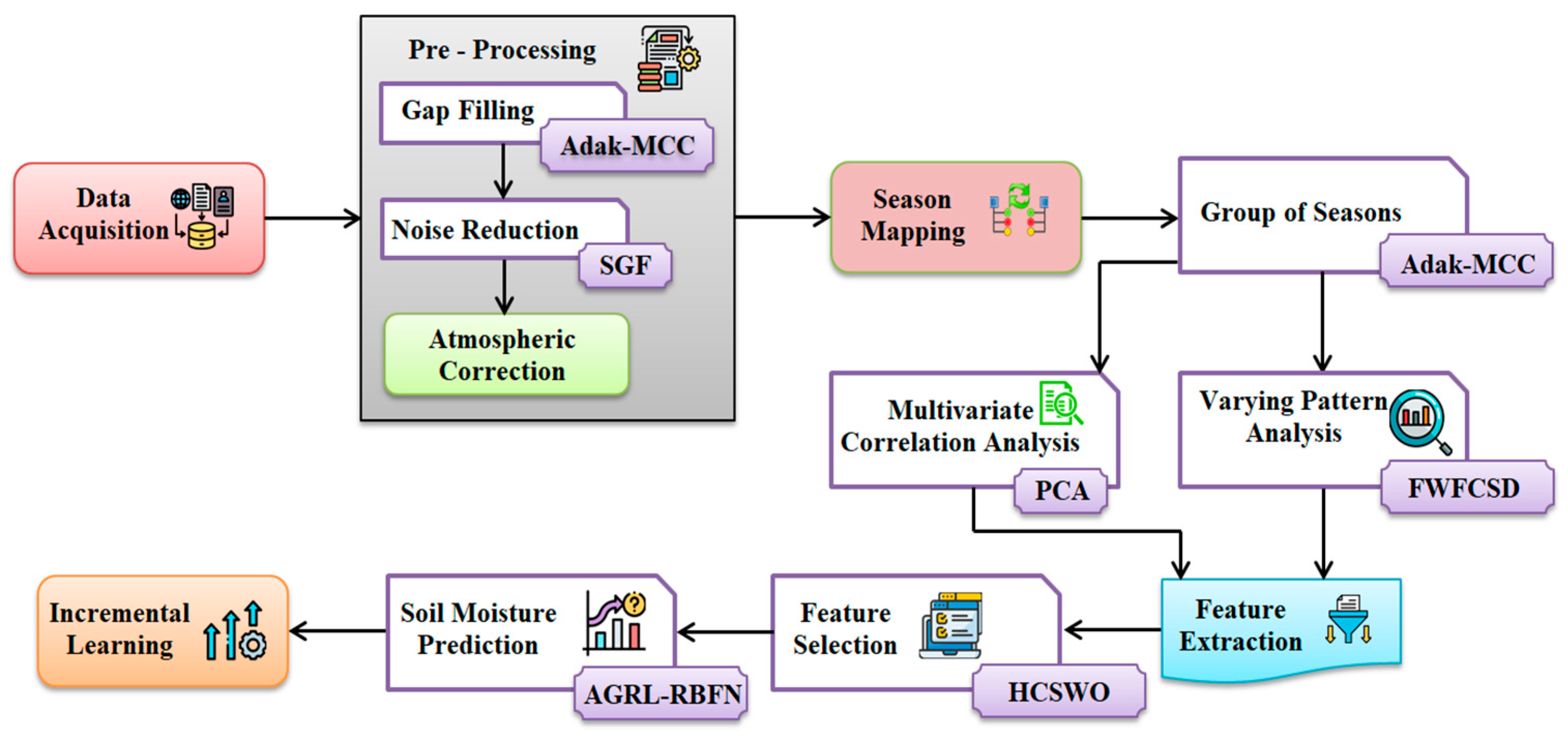
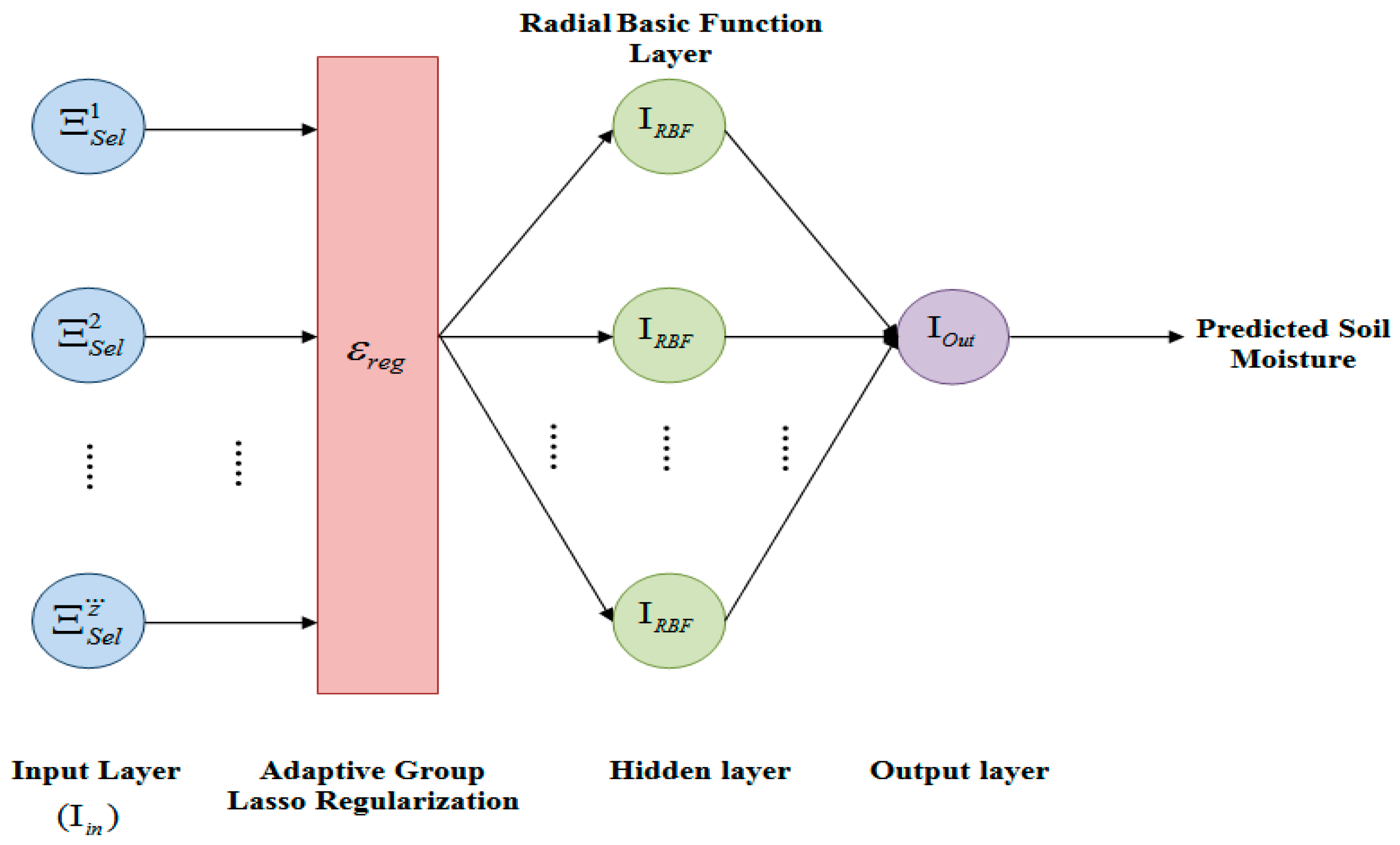
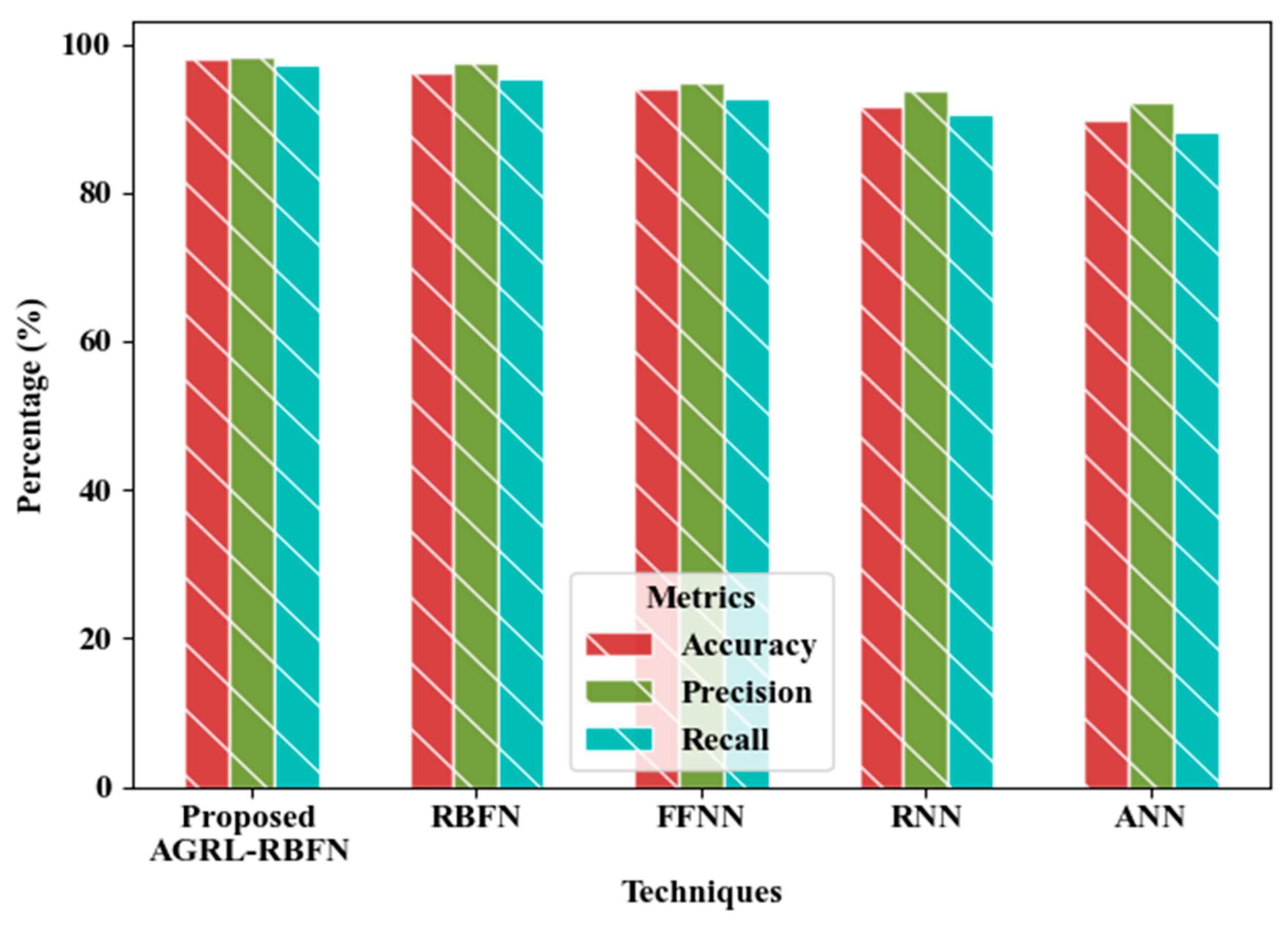
Soil moisture serves as a crucial factor in the hydrological cycle, supporting plant development, ecosystems heath and contributing to groundwater reserves. Consequently, it plays a significant role in the global climate system. Existing research has not sufficiently explored the impact of climatic changes on soil moisture patterns during monitoring, which has complicated prediction and management efforts. To tackle this issue, the proposed study employs seasonal mapping and grouping techniques to observe climatic variations and predict soil moisture utilizing the AGRL-RBFN method with IL. Initially, historical remote sensing data on soil moisture is gathered and subjected to a three-step preprocessing procedure: gaps are filled using the AdaK-MCC method, noise is minimized through the Savitzky-Golay Filter (SGF), and atmospheric interferences are corrected. Following this preprocessing phase, seasons are mapped, and the AdaK-MCC method is utilized for data grouping. A multivariate correlation analysis is subsequently conducted on the grouped data through Principal Component Analysis (PCA). The diverse patterns within the grouped data are further examined using the FWFCSD method. Features are then extracted from these patterns and correlation analyses, after which optimal features are selected via the Hierarchical Correlated Spider Wasp Optimizer (HCSWO). Ultimately, the AGRL-RBFN with IL is employed to predict soil moisture, resulting in a highly accurate prediction with an accuracy rate of 98.09%.
Keywords:
1. Introduction
2. Materials and Methods: Soil Moisture Prediction Using AGRL-RBFN with IL
2.1. Data Acquisition
2.2. Pre-Processing
2.2.1. Gap Filling
|
Pseudo code of AdaK-MCC Input: Soil Moisture Data Output: Gaps Filled Data Begin Initialize , , minimum iteration , maximum iteration While Derive # using Adaptive Momentum Coefficients Assign to data Update centroid Repeat until End while Return End |
2.2.2. Noise Reduction
2.2.3. Atmospheric Correction
2.3. Season Mapping
2.4. Group of Seasons
2.5. Varying Pattern Analysis
2.6. Multivariate Correlation Analysis
2.7. Feature Extraction
2.8. Feature Selection
2.9. Soil Moisture Prediction
|
Pseudocode of AGRL-RBFN Input: Selected Features Output: Predicted Soil Moisture Begin Initialize , For each Compute Regularize the input Evaluate Calculate End for Return End |
3. Results and Discussion
3.1. Dataset Description
3.2. Performance Analysis
3.2.1. Performance Analysis of Gap Filling
3.2.2. Performance Analysis of Clustering
3.2.3. Performance Analysis of Varying Pattern Analysis
3.2.4. Performance Analysis of Feature Selection
3.2.5. Performance Analysis of Soil Moisture Prediction
3.3. Comparison with Existing Approaches
4. Conclusions
Author Contributions
Funding
Data Availability Statement
Acknowledgments
Conflicts of Interest
References
- Abbes, A. Ben, Jarray, N., & Farah, I. R. (2024). Advances in remote sensing based soil moisture retrieval: applications, techniques, scales and challenges for combining machine learning and physical models. Artificial Intelligence Review, 57(9), 1–22. https://doi.org/10.1007/s10462-024-10734-1. [CrossRef]
- Adab, H., Morbidelli, R., Saltalippi, C., Moradian, M., & Ghalhari, G. A. F. (2020). Machine learning to estimate surface soil moisture from remote sensing data. Water (Switzerland), 12(11), 1–28. https://doi.org/10.3390/w12113223. [CrossRef]
- Babu, C. V. S., & Yadavamuthiah, K. (2024). Soil quality prediction using deep learning. Sustainable Development in AI, Blockchain, and E-Governance Applications, 171–188. https://doi.org/10.4018/979-8-3693-1722-8.ch010. [CrossRef]
- Celik, M. F., Isik, M. S., Yuzugullu, O., Fajraoui, N., & Erten, E. (2022). Soil Moisture Prediction from Remote Sensing Images Coupled with Climate, Soil Texture and Topography via Deep Learning. Remote Sensing, 14(21), 1–24. https://doi.org/10.3390/rs14215584. [CrossRef]
- Dabboor, M., Atteia, G., Meshoul, S., & Alayed, W. (2023). Deep Learning-Based Framework for Soil Moisture Content Retrieval of Bare Soil from Satellite Data. Remote Sensing, 15(7), 1–19. https://doi.org/10.3390/rs15071916. [CrossRef]
- Filipović, N., Brdar, S., Mimić, G., Marko, O., & Crnojević, V. (2022). Regional soil moisture prediction system based on Long Short-Term Memory network. Biosystems Engineering, 213, 30–38. https://doi.org/10.1016/j.biosystemseng.2021.11.019. [CrossRef]
- Hegazi, E. H., Samak, A. A., Yang, L., Huang, R., & Huang, J. (2023). Prediction of Soil Moisture Content from Sentinel-2 Images Using Convolutional Neural Network (CNN). Agronomy, 13(3), 1–18. https://doi.org/10.3390/agronomy13030656. [CrossRef]
- Jia, Y., Jin, S., Chen, H., Yan, Q., Savi, P., Jin, Y., & Yuan, Y. (2021). Temporal-Spatial Soil Moisture Estimation from CYGNSS Using Machine Learning Regression with a Preclassification Approach. IEEE Journal of Selected Topics in Applied Earth Observations and Remote Sensing, 14, 4879–4893. https://doi.org/10.1109/JSTARS.2021.3076470. [CrossRef]
- Kumar, P., Udayakumar, A., Anbarasa Kumar, A., Senthamarai Kannan, K., & Krishnan, N. (2023). Multiparameter optimization system with DCNN in precision agriculture for advanced irrigation planning and scheduling based on soil moisture estimation. Environmental Monitoring and Assessment, 195(1), 1–26. https://doi.org/10.1007/s10661-022-10529-3. [CrossRef]
- Lee, S. J., Choi, C., Kim, J., Choi, M., Cho, J., & Lee, Y. (2023). Estimation of High-Resolution Soil Moisture in Canadian Croplands Using Deep Neural Network with Sentinel-1 and Sentinel-2 Images. Remote Sensing, 15(16), 1–26. https://doi.org/10.3390/rs15164063. [CrossRef]
- Li, M., & Yan, Y. (2024). Comparative Analysis of Machine-Learning Models for Soil Moisture Estimation Using High-Resolution Remote-Sensing Data. Land, 13(8), 1–24. https://doi.org/10.3390/land13081331. [CrossRef]
- Li, Q., Wang, Z., Shangguan, W., Li, L., Yao, Y., & Yu, F. (2021). Improved daily SMAP satellite soil moisture prediction over China using deep learning model with transfer learning. Journal of Hydrology, 600, 1–14. https://doi.org/10.1016/j.jhydrol.2021.126698. [CrossRef]
- Li, Q., Zhu, Y., Shangguan, W., Wang, X., Li, L., & Yu, F. (2022). An attention-aware LSTM model for soil moisture and soil temperature prediction. Geoderma, 409, 1–17. https://doi.org/10.1016/j.geoderma.2021.115651. [CrossRef]
- Liu, J., Xu, Y., Li, H., & Guo, J. (2021). Soil moisture retrieval in farmland areas with sentinel multi-source data based on regression convolutional neural networks. Sensors (Switzerland), 21(3), 1–21. https://doi.org/10.3390/s21030877. [CrossRef]
- Liu, Q., Gu, X., Chen, X., Mumtaz, F., Liu, Y., Wang, C., Yu, T., Zhang, Y., Wang, D., & Zhan, Y. (2022). Soil Moisture Content Retrieval from Remote Sensing Data by Artificial Neural Network Based on Sample Optimization. Sensors, 22(4), 1–21. https://doi.org/10.3390/s22041611. [CrossRef]
- Liu, Q., Wu, Z., Cui, N., Jin, X., Zhu, S., Jiang, S., Zhao, L., & Gong, D. (2023). Estimation of Soil Moisture Using Multi-Source Remote Sensing and Machine Learning Algorithms in Farming Land of Northern China. Remote Sensing, 15(17), 1–22. https://doi.org/10.3390/rs15174214. [CrossRef]
- Nijaguna, G. S., Manjunath, D. R., Abouhawwash, M., Askar, S. S., Basha, D. K., & Sengupta, J. (2023). Deep Learning-Based Improved WCM Technique for Soil Moisture Retrieval with Satellite Images. Remote Sensing, 15(8), 1–17. https://doi.org/10.3390/rs15082005. [CrossRef]
- Pal, J., & Bodhe, H. (2023). Design and Implementation of Deep Learning Model For Soil Moisture Analysis . An IoT Based Soil Moisture Monitoring on Losant Platform. International Journal of Research in Engineering and Science, 11(4), 509–514.
- Patrizi, G., Bartolini, A., Ciani, L., Gallo, V., Sommella, P., & Carratu, M. (2022). A Virtual Soil Moisture Sensor for Smart Farming Using Deep Learning. IEEE Transactions on Instrumentation and Measurement, 71, 1–11. https://doi.org/10.1109/TIM.2022.3196446. [CrossRef]
- Peng, Y., Yang, Z., Zhang, Z., & Huang, J. (2024). A Machine Learning-Based High-Resolution Soil Moisture Mapping and Spatial–Temporal Analysis: The mlhrsm Package. Agronomy, 14(3), 1–23. https://doi.org/10.3390/agronomy14030421. [CrossRef]
- Roberts, T. M., Colwell, I., Chew, C., Lowe, S., & Shah, R. (2022). A Deep-Learning Approach to Soil Moisture Estimation with GNSS-R. Remote Sensing, 14(14), 1–29. https://doi.org/10.3390/rs14143299. [CrossRef]
- Shokati, H., Masha, M., Noroozi, A., & Abkar, A. A. (2024). Random Forest-Based Soil Moisture Estimation Using Sentinel-2, Landsat-8/9, and UAV-Based Hyperspectral Data. Remote Sensing, 16, 1–17.
- Singh, T., Kundroo, M., & Kim, T. (2024). WSN-Driven Advances in Soil Moisture Estimation: A Machine Learning Approach. Electronics (Switzerland), 13(8), 1–20. https://doi.org/10.3390/electronics13081590. [CrossRef]
- Uthayakumar, A., Mohan, M. P., Khoo, E. H., Jimeno, J., Siyal, M. Y., & Karim, M. F. (2022). Machine Learning Models for Enhanced Estimation of Soil Moisture Using Wideband Radar Sensor. Sensors, 22(15), 1–11. https://doi.org/10.3390/s22155810. [CrossRef]
- Wang, Y., Zhao, J., Guo, Z., Yang, H., & Li, N. (2023). Soil Moisture Inversion Based on Data Augmentation Method Using Multi-Source Remote Sensing Data. Remote Sensing, 15(7), 1–17. https://doi.org/10.3390/rs15071899. [CrossRef]
- Win, K., Sato, T., & Tsuyuki, S. (2024). Application of Multi-Source Remote Sensing Data and Machine Learning for Surface Soil Moisture Mapping in Temperate Forests of Central Japan. Information (Switzerland), 15(8), 1–25. https://doi.org/10.3390/info15080485. [CrossRef]
- Yang, Y., Li, H., Sun, M., Liu, X., & Cao, L. (2024). A Study on Hyperspectral Soil Moisture Content Pre-diction by Incorporating a Hybrid Neural Network into Stacking Ensemble Learning. Agronomy, 14(9), 1–17. https://doi.org/10.3390/agronomy14092054. [CrossRef]

| Techniques | Silhouette Score |
|---|---|
| Proposed AdaK-MCC | 0.975 |
| KMC | 0.953 |
| FCM | 0.929 |
| KNN | 0.858 |
| K-Medoid | 0.813 |
| Techniques | Dunn Index |
|---|---|
| Proposed AdaK-MCC | 4.897 |
| KMC | 2.984 |
| FCM | 2.541 |
| KNN | 1.924 |
| K-Medoid | 1.368 |
| Techniques | Execution Time (ms) |
|---|---|
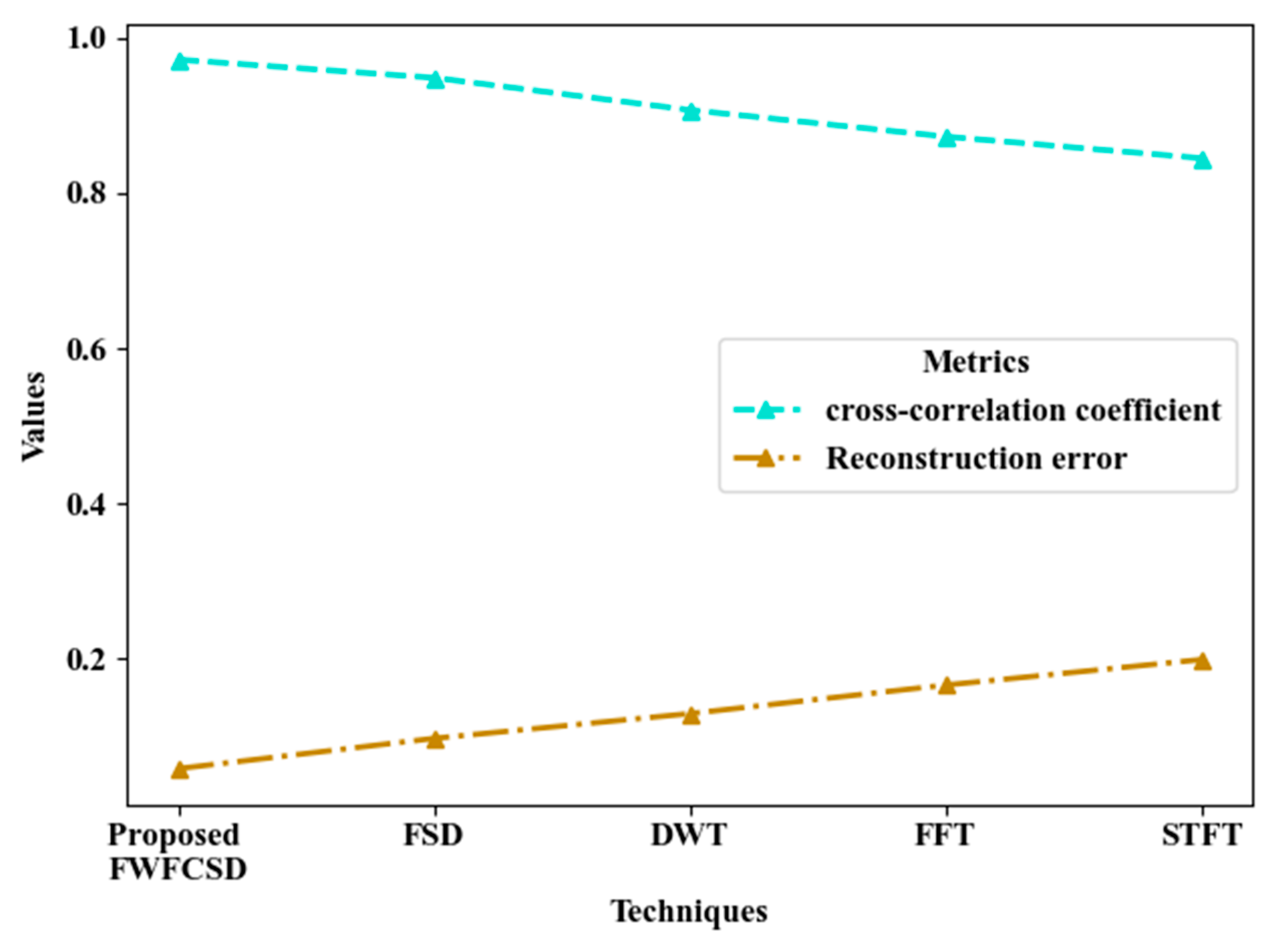
| Proposed FWFCSD | 18564 |
| FSD | 24796 |
| DFT | 28357 |
| FFT | 32497 |
| STFT | 39641 |
| Techniques | Feature Selection Time (ms) |
|---|---|
| Proposed HCSWO | 2118 |
| SWO | 2211 |
| ACO | 5178 |
| GWO | 7135 |
| CSO | 9052 |
| Techniques | FPR | FNR |
|---|---|---|
| Proposed AGRL-RBFN | 0.0248 | 0.076 |
| RBFN | 0.481 | 0.108 |
| FFNN | 0.596 | 0.257 |
| RNN | 0.723 | 0.429 |
| ANN | 0.876 | 0.571 |
| Study | Technique/Method Used | Advantages | Limitations |
|---|---|---|---|
| Proposed | AGRL-RBFN | Accurately predicts soil moistures, enabling better irrigation management | Did not indicate suitable crops for different soil moisture types. |
| (Filipović et al., 2022) | LSTM | Predicted soil moisture effectively, and worked well for irrigation scheduling | But struggled with rapidly changing weather conditions. |
| (Kumar et al., 2023) | DCNN | Estimated soil moisture with optimized water use and boosted crop yield | It required high computational power for soil moisture prediction. |
| (Li et al., 2022) | Attention-Aware LSTM | Predicted soil moisture and soil temperature | Lacks spatiotemporal prediction and interpretability |
| (Li et al., 2021) | DL with TL | Surface of the soil moisture is predicted in diverse areas | Less effective during winter and specific environmental conditions. |
| (Jia et al., 2021) | ML regression with the pre-classification strategy | Soil moisture was predicted using land-specific models from a pre-classification strategy. | Relied on accurate land type classification. |
Disclaimer/Publisher’s Note: The statements, opinions and data contained in all publications are solely those of the individual author(s) and contributor(s) and not of MDPI and/or the editor(s). MDPI and/or the editor(s) disclaim responsibility for any injury to people or property resulting from any ideas, methods, instructions or products referred to in the content. |
© 2025 by the authors. Licensee MDPI, Basel, Switzerland. This article is an open access article distributed under the terms and conditions of the Creative Commons Attribution (CC BY) license (http://creativecommons.org/licenses/by/4.0/).


