
Submitted:
28 February 2025
Posted:
03 March 2025
You are already at the latest version
Abstract
This study aims to determine the role of reward incentives in crowdfunding success in Africa. Reward incentives seem to play an essential role in the success of a crowdfunding project. Therefore, understanding how distinct types of incentives (monetary and non-monetary) influence the backer’s engagement and viability in crowdfunding campaigns is essential. Drawing from secondary cross-section data from Kickstarter and Indiegogo, this research uses the probit regression method to analyse and test the hypotheses. The findings revealed that flexible funding negatively influences a crowdfunding campaign, diminishing the probability of success. In contrast, a more significant number of backers positively affects a crowdfunding campaign, boosting its chances of success. Rewards promised to potential backers increase the probability of success. These findings influence how crowdfunding campaigns are launched, allowing them to build and achieve their financing targets. The findings provide knowledge that entrepreneurs could develop far more attractive, culturally appropriate reward schemes to boost their crowdfunding campaigns’ chances of success. It provides a valuable understanding regarding the potential of crowdfunding as an alternative tool for economic development in Africa among policymakers and development agencies. Lastly, it adds to the limited literature on crowdfunding in Africa, especially within the context of reward incentives, and provides a foundation for further studies in this area.
Keywords:
incentives rewards
; entrepreneurs
; crowdfunding success
1. Introduction
Incentive rewards in crowdfunding seem to play a significant role in the overall success of crowdfunding projects. Crowdfunding through online systems has become essential for entrepreneurs and startups to seek financial support for their innovations (Theerthaana and Manohar, 2021).The kind of reward is also crucial; on crowdfunding platforms, material rewards tend to be appreciated more than symbolic ones, but only at lower reward tiers. In the face of barriers to traditional investment sources such as banks and venture capital, financial assistance can now be raised from online communities of consumer investors, specifically backers or crowdfunders (Yasar, 2021). Crowdfunding has thus become an important alternative source of finance, especially in countries where traditional financial institutions do not serve the entire population (Ngalim and Togan Eğrican, 2023). Crowdfunding in Europe, too, has been on the rise in recent years (Baber, 2021).
Since financial inclusion is generally particularly low in Africa, crowdfunding might become a very attractive market for businesses and nonprofits (Chao et al., 2020; Ismaila, 2023; Omenguélé and Mbouolang, 2022). One of the myriad factors likely to play a role in the success of a crowdfunding campaign is the reward incentives employed. However, it is not a given that it will contribute to campaign success (Wessel et at., 2021). In general, these reward incentives are used in other contexts to attract a large number of backers, but their effectiveness in the African context has not been well-researched (Haasbroek and Ungerer, 2020; Gong et al., 2020; Wachira, 2021; Cappa et al., 2019). The fundamental problem remains. Namely how different reward motivations impact crowdfunding performance. Again, it is important – and challenging – to determine how different reward incentives influence crowdfunding campaigns' success across diverse African markets.
The existing studies on the influence of reward incentives on crowdfunding performance mainly originate from developed nations (Tian and Zhang, 2023; Regner and Crosetto, 2021; Pinkow, 2022). The studies conducted by Dos Santos Felipe et al. (2022) and Carbonara (2021), examined the role of rewards in influencing crowdfunding success. However, their studies originate from developed nations because they likely focus on different contexts, such as emerging markets or specific regions, which may have unique dynamics compared to developed nations. This difference highlights the varying factors that influence crowdfunding success across different economic and cultural environments. Therefore, this study may provide a better understanding of how rewards impact crowdfunding in diverse settings.
The effectiveness of reward incentives in crowdfunding success depends on whether the country is developed or developing and relies on differences in economic conditions, cultural acceptability, and technological infrastructure (Posch et al., 2022). Creative or reserved rewards spur backers in developed economies because they have higher disposable incomes and prefer distinctive products or experiences (Mamaro and Sibindi, 2023). Conversely, in less developed countries, supporters might trend towards utilitarian and cost-constrained incentives since they have low incomes and concerns about short-run functionality. On top of this, trust among online platforms and payment systems is likely to vary, influencing participation in crowdfunding campaigns.
In recent years, reward-based crowdfunding has emerged as an alternative financing channel for entrepreneurs, creative artists, and social projects. Besides simply asking people to donate money, project creators often offer rewards, that is, products or services promised in exchange for people pledging a certain amount. Although crowdfunding in Africa is still in its infancy, it could significantly contribute to financial inclusion and entrepreneurial support (Chao et al., 2020). It has been estimated that Sub-Saharan Africa's market can grow to approximately $2.5 billion by 2025 (Omenguélé and Mbouolang, 2022). Activities of influential stakeholders such as policymakers, industry players, and platform owners to facilitate the development of crowdfunding ecosystems must be directed towards policy formulation, innovation in technology, public sensitisation campaigns, and strategic use of incentives (Chao et al., 2020). Crowdfunding is emerging as a transformative financing method for African entrepreneurs, providing them with opportunities that traditional funding sources often fail to offer (Durojaiye et al., 2024). However, this innovative approach comes with its own set of challenges.
To explore the issue of rewards in crowdfunding, secondary data were collected from the following crowdfunding platforms: Kickstarter and Indiegogo, as well as fundraised platforms consisting of various crowdfunding projects in Africa. The study follows a unique collection method using cross-country data collection of crowdfunding projects in all categories. Practically, this study may improve understanding of the role of incentive rewards in crowdfunding performance and guide project creators in using incentives to enhance crowdfunding success. Unfortunately, there is a paucity of empirical evidence examining the role of incentive rewards in influencing the success of crowdfunding campaigns (Chen et al., 2023; Regner and Crosetto, 2021). In an attempt to help remedy this, the study examines the role of incentive rewards in crowdfunding performance and success.
- Incentives can play a varied role in crowdfunding success. Depending on the kind of campaign, they can be crucial, irrelevant, or even detrimental. The number of backers secured is the most consistent indicator of success across studies. The following questions are important: What is the impact of different kinds of incentive rewards, in other words, tangible products, exclusive experiences, and recognition, on the performance of crowdfunding campaigns in Africa? This question thus seeks to explore the relationship between various reward structures in securing backers and achieving campaign goals.
- To what extent do cultural, economic, and social factors play a role in the varying effect of incentive rewards on the performance of crowdfunding campaigns across different regions in Africa? This question addresses how regional and contextual issues affect the success of incentive-based crowdfunding strategies.
The rest of the paper is structured as follows: Section 2 provides an overview of the literature review and hypotheses development. Section 3 introduces the research hypotheses and the conceptual framework, while Section 4 and Section 5 present the research method and a discussion of the findings respectively. Section 6 is the conclusion.
2. Literature Review and the Theoretical Framework
This first section presents the theoretical background in relation to crowdfunding success.
2.1. Information Asymmetry Theory
Based on information asymmetry theory, comments can be implemented as a communication tool between backers and project creators. Supporters and/or contributors can communicate with fundraisers using comments on crowdfunding websites. This tool provides an opportunity for questions, answers, demonstrations of gratitude, and clarifications (Ho et al., 2021; Jiang et al., 2021). Comments seem to be an essential communication tool that has a positive impact on crowdfunding.
Furthermore, positive comments contribute to the success of a crowdfunding campaign (Li and Wu, 2021). According to Li and Wu (2021), entrepreneurs who emphasise factors such as verbal or non-verbal cues that can affect their project's overall appeal may be able to improve the success and efficacy of their crowdfunding campaigns. Guaranteeing investment decisions from potential sponsors may also reduce the information gap between project owners and potential sponsors (Bukhari, et al, 2020.
2.2. Signalling Theory
Signalling Theory was initially put forward by Michael Spence in 1973 as a labour market theory. According to Spence, an individual can signal his unobservable attributes (such as education or skills) to employers through observable action (such as obtaining a degree). Signalling Theory was subsequently used to describe how the parties communicate in information asymmetry situations in finance, marketing, and entrepreneurship (Connelly et al., 2011). Signalling theory assists in understanding the mechanism by which project initiators (entrepreneurs) communicate project quality and credibility to possible backers (donors or investors) as a method of avoiding information asymmetry and realising funding prospects (Zhai and Shen, 2024).
2.3. Expectancy Theory
The expectancy theory formulated by Victor Vroom in 1964 generally distinguished between extrinsic and intrinsic motivation. The model explains the association between individual effort and performance, arguing that people are motivated to act if they expect a favourable outcome. Hackman and Porter (1968) advanced the theory by including additional variables that emphasise the role of intrinsic and extrinsic rewards as motivating factors. The expectancy theory, which explains motivation in the light of the expected outcomes, is increasingly applicable to crowdfunding, and especially to reward-based models (Jiang et al., 2021). In other words, when for backers their contribution may result in meaningful rewards, it may contribute to a crowdfunding campaign’s success. In crowdfunding, backers typically evaluate projects based on three components derived from expectancy theory (Costello and Lee, 2022). First, expectancy is the belief that one's contribution will lead to rewards; second, instrumentality refers to the belief that promised rewards will actually materialise; third, valence is defined as the value placed upon those rewards (Camilleri, 2018).
Studies also highlight that backers are most likely to fund projects when they feel that their contribution makes a difference in whether the project gets funded or not (Liang et al., 2019; Sauermann et al., 2019). For instance, crowdfunding projects that establish clear, realistic funding goals and prioritise backer-oriented rewards tend to enhance backers' perceptions of expectancy (the belief that their contribution will help achieve the goal) and instrumentality (the belief that achieving the goal will lead to desired outcomes) (Aideyan, 2023; Soltani et al., 2024). On the other hand, there is a delicate balance, given that overtly complicated rewards or vague reward fulfilment processes may erode the backers’ trust and hence diminish the chances of the campaign’s success (Li et al., 2022).
2.4. Attribution Theory
One useful lens to view backer behaviour in crowdfunding has been the attribution theory, first developed by Heider in 1958 and later further by Kelley in 1973. In crowdfunding, attribution theory describes how a potential backer decides about the causes of the success or failure of a campaign and bases their decision to support the project on such judgments.
When a crowdfunding project is successful, backers often ascribe it to internal factors related to the quality of the idea itself, the competence of the creator, or even effort from their side (Shen et al., 2021). If a campaign is structured properly, potential contributors might consider the creators capable of delivering promised rewards, and thus, they could become more likely to invest. On the other hand, a campaign may be perceived to struggle due to external factors, such as poor timing, market conditions, or the lack of visibility of the platform. Suppose backers attribute a campaign's performance to external factors beyond the project creator's control. In that case, they may be less likely to pledge, perceiving the outcome as uncertain or independent of the creator's efforts.
Figure 1.
Relationship between the different crowdfunding components.
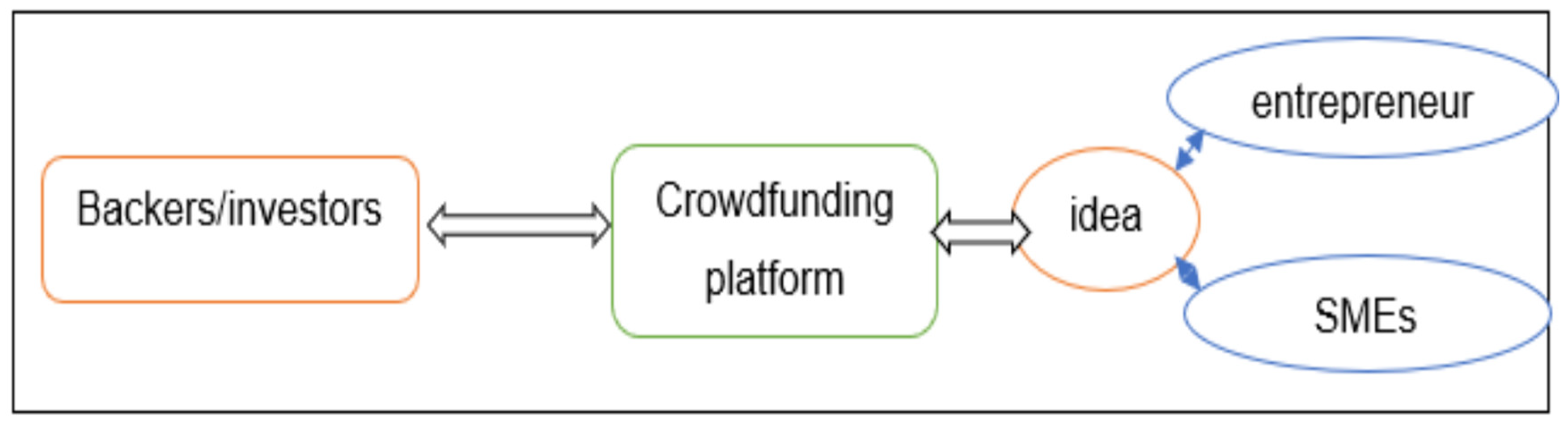
The various components of a crowdfunding project include the entrepreneur or SME’s idea, the crowdfunding platform, and potential backers (investors).
Numerous rather diverse factors play a role in the success or not of reward-based crowdfunding. For instance, team members' experience enhances their project's fundraising credibility (Huang et al., 2021). In reward-based crowdfunding, the reward scheme is an important element that can contribute to the crowdfunding performance (Cai et al., 2021). In providing information about the quantity and value of the rewards and the time of reward delivery in the reward scheme, founders seek to attract backers to choose the reward tier or product they are interested in, which in turn could make the project succeed and bring creative projects to life.
Some scholars conducted an exploratory study of existing research on how reward information influences crowdfunding performance from different perspectives. For example, Yang et al. (2020b) examined the impact of different types of scarce rewards on the performance of crowdfunding, while Posch et al., 2022, Verschoore and Araujo (2020) studied the influence of reward incentive on the backers’ decision to invest or contribute to a crowdfunding campaign. These rewards often create a stronger emotional connection and perceived value for backers, leading to higher investment levels. Several scholars investigated the influence of limited rewards or reward tiers on crowdfunding performance (e.g., Posch et al., 2022; Li and Wang, 2024; Ma et al., 2022). Petit et al., (2022) wrote that rewards might be considered incentives to attract first-time pledgers. In crowdfunding, rewards are the key to convincing first-time pledgers. Having an understanding of how incentives can work can prove to be a great assistance in turning a crowdfunding campaign into a successful one. Based on these arguments, we formulated the various research hypotheses as follows:
H1:
A reward incentive has a positive effect on a crowdfunding campaign, increasing the probability of its success,
If an entrepreneur has a good digital reputation, as measured by their social media activity and number of social media followers, it could have a positive impact on crowdfunding performance in terms of the number of investors, probability of campaign success, and funding rate (Zribi, 2022). An entrepreneur's experience and effective management of their company can also have a positive influence on the credibility of their displayed passion in equity crowdfunding campaigns (Di Pietro and Tenca, 2024). Entrepreneurial traits and preparedness, enhanced by experience, are important factors in crowdfunding success (Woods et al., 2020). Therefore, an entrepreneur's past experience, good reputation and communication skills, and overall preparedness can definitely contribute much to the success of a crowdfunding campaign. An entrepreneur’s experience is thus a signal of credibility to potential backers, which will increase the likelihood of crowdfunding success.
Several studies confirm that creator experience seems to play a significant role in crowdfunding success (Cai et al., 2021). Past creation and supporting experiences form a credible track record which bodes well for someone’s future performance in crowdfunding. Gregoriades and Themistocleous, (2025); Huang et al., 2022. Therefore, with experience earned from prior crowdfunding projects, entrepreneurs can usually accurately determine the investment threshold, investment levels, and target financing amount. Fang (2024) also suggests that entrepreneurs can invest in the crowdfunding projects of other entrepreneurs. Thus, existing project performance can majorly determine the financing performance and the crowdfunders' experience. Accordingly, it is required that crowdfunding creators learn about the role of entrepreneurial learning and serial crowdfunding interaction on financing performance when initiating new projects. The following hypothesis was thus formulated:
H2:
An entrepreneur's prior experience has a positive effect on their crowdfunding campaign, increasing the probability of its success.
Spelling mistakes usually indicate a campaign of low quality and a lack of professionalism. They are indicative of a lack of preparedness and commitment from the fundraiser and thus could result in potential backers finding the campaign not quite trustworthy (Baber, 2021; Wang et al., 2022). Fundraisers should be meticulous when it comes to the wording and careful editing and proofreading of the description of their campaign as this could have a big impact on the campaign. Thus, the researcher put the following hypothesis forward:
H3:
The presence of spelling errors in presenting a crowdfunding project has a detrimental effect on its possible success.
The presence and qualities of frequently asked questions (FAQs) can possibly make a huge difference in the success or failure of a crowdfunding campaign (Telve, 2019). FAQs are regarded as an important communication tool with the power to enhance the likelihood of trust and engagement through providing answers to some of the possible questions potential backers might have (Mosca et al., 2019; Ribeiro-Navarrete et al., 2021). FAQs can thus clarify some of the doubts and concerns potential backers might have in relation to the project. Clear and concise answers to the FAQs will reduce the information asymmetry that usually prevents potential backers from contributing to a campaign. This transparency can build trust in the campaign and make a backer more receptive to the pledge.
According to Ho et al. (2021) and Dambanemuya and Horvát (2021) stated that the presence of a well-articulated FAQs section is an indirect signal that the fundraiser has given enough thought to the needs of their audience. According to evidence from various studies by Scaife (2023) and Shneor and Vik (2020), those campaigns with thoughtful and detailed FAQs fare relatively better compared to those that do not have such FAQs. The campaigns that provide far-reaching information, including FAQs, have a tendency to acquire more backers and raise significantly higher amounts than their counterparts that don’t provide such information.
Moreover, FAQs tend to prove even more effective when they get revised with the latest information or changes in the status of the campaign. This builds donor confidence. Being better prepared can build better rapport with potential donors throughout the campaign and also raise the level of its possible success rate. Therefore, a hypothesis that could be advanced in this regard is:
H4:
Frequently asked questions have a positive impact on a crowdfunding campaign, increasing the possibility of its success.
Flexible crowdfunding, especially through such popular platforms as Indiegogo, may even have a negative influence on the outcome of the campaign, though it seems to present a lot of advantages (Silva et al., 2020; Demiray et al., 2019). The mechanism in question allows creators to retain the funds raised for the project without necessarily achieving a funding goal; this may be fraught with a number of disadvantages, touching on backer confidence and general campaign success. Flexible funding makes backers feel that it is less urgent to contribute since there is no definitive funding goal that must be reached to further the project. Since there is no deadline for achieving a specific target, fewer contributions may come through since people stop engaging. Potential backers feel less compelled to act quickly when they are assured that the campaign will still receive their money.
Knowing that they will receive funds regardless of whether they meet a specific goal may diminish the motivation for campaign creators to promote their projects or strive actively to get more funding. This can result in less effort in marketing and outreach, which are crucial for attracting backers. Projects that do not meet their goals may struggle to attract future investments or partnerships. Backers and investors often look for signs of success and viability before committing further resources; a campaign that fails to meet a specific target might be perceived as less promising, hindering future fundraising efforts (Deng et al., 2022).
Campaigns that utilise flexible funding may be viewed as less credible than those with fixed funding goals. Backers often associate a clear target with a more serious commitment from the creator. Without this benchmark, potential contributors might question the project's viability and the creator's dedication, leading to decreased trust and subsequent lower amounts of funding (Zhang et al., 2024). The following hypothesis was thus formulated:
H5:
The flexible funding mechanism has a negative effect on potential crowdfunding success.
A higher number of backers serves as a form of social proof, indicating to potential contributors that the project has garnered interest and support from others (Soublière and Gehman, 2020). This can create a bandwagon effect, encouraging more individuals to back the project as they perceive it to be popular and trustworthy (Zhang et al, 2024). Campaigns with more backers also tend to receive greater visibility on crowdfunding platforms. Many platforms use algorithms that promote popular projects, which can lead to further exposure and attract additional backers. This visibility is crucial for maintaining momentum throughout the funding period. A larger backing base enhances the perceived credibility of a campaign. As said, potential backers are more likely to invest in projects that have already received substantial support, which signals that others believe in the project's viability and possible success. Many backers also foster a sense of community around the project. This community can engage in discussions, provide feedback, and share the campaign within their networks, amplifying outreach efforts and increasing overall contributions. This research hypothesis put forward around this issue is:
H6:
A large number of backers has a significant and positive effect on a crowdfunding campaign, increasing the probability of its success.
Studies indicate that posting regular updates during a crowdfunding campaign positively impacts the number of investments and the total amount raised (Mamaro and Sibindi, 2023; Eisenbeiss et al., 2023). Specifically, campaigns that provide regular updates see a marked increase in backer participation as updates maintain interest and engagement throughout the campaign (Dehdashti et al., 2022). Updates that inform backers about new funding developments or promotional efforts are particularly impactful (Foster, 2019). In contrast, updates focused on team changes or general business information tend to have less influence on funding success (Efrat et al., 2019; Baah-Peprah and Shneor, 2022).
Empirical studies of Jáki et al (2022); Solodoha (2024) and Mamaro and Sibindi (2023) have demonstrated that the presence of any update can increase the probability of success by approximately 5%, while the absence of updates can reduce the chances of success by around 13%. This highlights the critical role of communication in fostering trust and credibility among potential backers. Thus, the presence of updates in crowdfunding projects will reduce information asymmetry and can positively influence the decision of prospective backers. Therefore, the researchers put forward the following hypothesis:
H7:
Regular updates have a significant and positive effect on the success of a crowdfunding campaign.
In the next conceptual model, Figure 2, we summarise the proposed hypotheses. To test these hypotheses, we have collected real data from the online crowdfunding platforms Indiegogo and Kickstarter and fundraised and applied logistic regression analyses to review potential key drivers of crowdfunding success.
In line with the attribution theory, an entrepreneur might share specific reasons for their commitment to completing the project (Abbasi et al., 2024). This tends to enhance the trustworthiness of both the project creator and the funding process ( Huang et al. 2022). Entrepreneurs can lessen the perceived distance from their backers by presenting themselves in a very human and personable way. Video presentation is crucial for crowdfunding success, as numerous studies have demonstrated that a video can significantly influence a campaign's fundraising effectiveness (Liang et al., 2022; Deng et al., 2022, Chen et al., 2022). Based on attribution theory and signalling theory, which describe how people perceive information and writers signal credibility, characteristics like frequent updates, reward incentives, and previous experience on a crowdfunding platform are linked with more tremendous success for crowdfunding campaigns (Jaki et al., 2022).
3. Research Method and Materials
Logistic regression is an appropriate method for measuring hypotheses because the dependent variable in this case is binary. Independent variables also include binary variables, thus logistic regression would be an appropriate method for measuring hypotheses (7). In logistic regression, it would be possible to identify what variables directly influence determining the proposed event, that is, the coefficients of regressions are odds ratios, to examine the variables' impacts and build models to predict these effects on a proposed event. The logistic regression used in this research is as follows:

Table 1.
The measurement of variables.
| Dependent variables | Measurements |
|---|---|
| Completion ratio (CR) | Ratio of the amount raised over the amount of money requested. |
| Success (SC) | The binary variable of 1 if the target amount was obtained and 0 otherwise. |
| Independent variables | |
| Reward incentive (REW) | The binary variable of 1 if a campaign provides rewards, and 0 otherwise. |
| Prior experience (EXP) | The dummy variable is 1 if the project creator has created more than two crowdfunding campaigns and 0 otherwise. |
| Spelling errors (SPR) | The dummy variable is 1 if there are spelling errors on the website and 0 otherwise. |
| Frequently ssked questions (FAQs) | Number of frequently asked questions on the project between the entrepreneur and the backers (transformed into a log). |
| Flexible funding (FXF) | The binary variable of 1 if is flexible funding and 0 if is fixed funding. |
| Regular updates (UPD) | The number of days for a campaign to raise funds (transformed into a log). |
| Large number of backers (BCK) | The number of supporters who contributed to the project (transformed into a log). |
Source: Author own compilation.
4. Research Findings and Discussion
The Table 2 below discusses a descriptive statistic which include, mean, median, standard deviation, minimum, maximum, skewness and kurtosis.
The mean completion ratio is small, 0.160476; hence, most of the data points are close to zero. The very high value for the skewness of 12.61770 and kurtosis of 216.6589 suggests that this distribution contains a few extremely high values (outliers), giving it a long right tail. The reward incentive has a mean of 0.866511, with a negative value of skewness, -2.155292, indicating that this is a left-skewed distribution with most values falling around 1. Kurtosis of 5.645282 points to some outliers on the left side. Prior experience has a mean of 0.196721, indicating that most values lie close to zero. The positive skewness 1.525854 implies that the distribution is right-skewed, given that it has a few higher values. Also, the kurtosis stands at 3.328231, adding that it is moderately highly kurtosis.
Frequently asked questions have a mean of 0.099532, meaning most values are close to zero. The large values of skewness and kurtosis, 10.55899 and 120.6652, respectively, confirm that this is a right-skewed distribution with some extreme outliers. Flexible funding has a mean value of 0.761124, but the negative value of the skew, -1.224794, indicates that it is left-skewed, with many values close to 1. It has a relatively low kurtosis value, 2.500121, indicating few extreme outliers. The large number of backers has a relatively high mean, 19.58197. However, the huge skewness value, 13.63608, and kurtosis value, 235.6418, indicate this is a highly right-skewed distribution with many significant outliers.
Spelling errors have a low mean value of 0.281030; most values are close to zero. This moderate skewness of 0.974276 and lower kurtosis of 1.949213 support that the distribution is somewhat flat, with fewer extreme outliers. The mean of updates equals 0.918033, which can be interpreted as most values closer to 1. A skewness of 5.603258 and kurtosis of 42.04372 also reveal a right-skewed distribution with very high peak and fat tails, indicating outliers or extreme values in the data. Furthermore, the study of frequent updates shows that campaigns offering frequent updates perform better because they are transparent and establish confidence among backers.
The Table 3 below explain the correlation matrix among the variables.
Table 3 presents the association of variables on a model-free basis. Though a correlation matrix is a model-free result, it also serves as a good benchmark for detecting one major econometric problem in multiple regression models, that is, multicollinearity. It is suspected that if any two independent variables are correlated above the threshold point, usually 0.80, then researchers suspect multicollinearity, proving devastating for any regression model. Multicollinearity was checked through the variance inflation factors, all of which were below the threshold of 5 recommended by Hair, Ringle and Sarstedt (2011), as presented in Table 3; hence, there were no multicollinearity issues. Firstly, the full collinearity test that Kock (2015) suggested was performed, where all factor-level VIFs were below 3.3, thus supporting no standard method bias (CMB). Second, based on Bagozzi, Yi and Phillips (1991), who suggest that issues regarding CMB are indicated when there is a correlation of more than 90 between pairs of constructs, the authors checked the correlations in Table 3, which were all below this threshold.
The R-squared is within the range of 0.10 to 0.50; hence, it is regarded as a goodness fit, which means it is acceptable to report most of the statistically significant explanatory variables (Ozili, 2023). From this model, the guidelines are that an R-squared value above 0.10-0.50 is an excellent fit for the logistic model. The current model depicted a 59% goodness fit, indicating generally the explanatory data included in the model.
The analysis of the regression results of Table 4 is as follows: The results show that reward incentives play a positive role in crowdfunding success; however, the degree of influence is insignificant (β₁ = 0.203). This seems to indicate that while reward incentives can signal value to potential backers, in accordance with the signalling theory by Spence (2002), its effect alone may not be strong enough to have an effect on a campaign's success. This concurs with previous literature that to drive contributions effectively, a signal must be both credible and contextually relevant. This would suggest that other underlying drivers may come from factors such as campaign quality, social capital, or the funding mechanism employed in determining crowdfunding success. Therefore, reward-based signals may inspire interest; however, to magnify project outcomes, it would be important to supplement them with other types of signalling or strategies in designing effective campaigns.
The project creator’s prior experience positively increases the likelihood of success (β2=0.218); however, it is also not significant. This would suggest that, although past experiences may signal competence to potential backers and, therefore, may indeed provide useful knowledge, consistent with signalling theory, it is not a sufficient condition to guarantee success. This result corroborates Shneor et al. (2023), who provide arguments that prior experience reduces uncertainty for backers but needs complementing with other relevant signals, such as high-quality campaign content or social capital. This finding would, therefore, suggest that a creator’s prior experience, while valuable, may thus be diluted in competitive crowdfunding environments in which backers weigh multiple signals, including reward structure, funding model, and social endorsements, when deciding whether to contribute. Therefore, project developers might need to trust their experience as well as supporting methodologies, which could bring up the probability of reaching funding objectives.
The frequently asked questions actually negatively affect crowdfunding success (β3=-0.035). The results reveal that the frequency of asked questions has a negative impact on crowdfunding success (β₃ = -0.035). This finding aligns with signalling theory (Spence, 2002), which emphasizes the importance of clear, unambiguous signals in reducing information asymmetry between project creators and potential backers. A higher number of questions might indicate a lack of sufficient or clear information in the campaign, raising concerns about the project’s feasibility or credibility. Consequently, such ambiguity could erode trust and discourage potential backers from contributing, thereby reducing the campaign’s likelihood of success.
Flexible funding too has a negative influence and here the results show that it significantly affects the probability of crowdfunding success (β4=0.634, p>0,01). This leads to the justification of the signalling theory, where the usage of flexible funding gives weaker signals about the commitment of the project creator and their confidence in attaining the funding goal. Fixed funding, on the other hand, requires the entire target amount to be raised, after which funds can be dispersed; in flexible funding, a creator is allowed to keep partial funds even if the target is not fully achieved, and this may make flexible funding projects seem less accountable. Such ambiguity would make the project outcome more concerning to the backers, further reducing the amount of trust and willingness to invest, leading to a lower probability of success.
A large number of backers has a positive influence and increases the probability of crowdfunding success (β5=0.030, p>0,01). This result also supports the fundamental ideas of signalling theory since a higher number of backers conveys a more credible signal concerning the value and legitimacy of the campaign. In a crowdfunding context, potential contributors may consider the presence of a large number of backers as a signal of confidence and social proof that reduce levels of uncertainty, thereby potentially raising additional investments. This result was expected since early or high backer signals tend to increase the visibility of a project and, therefore, its credibility, leading to a higher chance of success.
Spelling errors in presenting a crowdfunding campaign has a negative influence on the campaign, diminishing its chances of success (β6=-0.214). This too can be understood from the perspective of the signalling theory as developed by Spence (2002), whereby while clear, error-free communication provides a positive signal with respect to the competence, attention to detail, and professionalism of the creator, spelling errors are perceived as a negative signal, which may raise doubts over the credibility of the creator and hence the quality of the project. These spelling errors erode trust and scare away would-be supporters since it implies laziness or a lack of preparation. If these sorts of mistakes are pervasive, then, in effect, that diminishes the capability of the campaign to attract contributions, reducing the possibility of success. Regular updates on the crowdfunding campaign page increase the likelihood of success (β7=0.033). This finding also aligns with signalling theory (Spence, 2002) since regular updates are positive signals of the campaign creator's involvement, transparency, and commitment. Timely information, responses to concerns by backers, and project updates decrease uncertainty and increase trust among potential contributors. Such behaviour on the creator's part signals that they are involved and responsive, increasing perceived credibility and campaign reliability. Further support is therefore gained by regular updates, increasing the crowdfunding campaign's probability of success. Table 5 below describes the summary of the hypotheses and the decisions.
5. Implications of the Study
The study contributes three ways to the literature on the role of specific reward incentives on crowdfunding success. The study investigates the concept of crowdfunding success, focusing on the role of reward incentives and other factors that influence it, as these aspects have been underexplored in the African context.
Although considerable effort has been devoted to the determinants of crowdfunding success, much of that research focused on signalling theory and analysed the various signals that could project and convey the impression of quality to potential backers (Liu et al., Zhang, 2023; Song et al., 2019; Badrova et al., 2024; Šarić, 2021). However, the role of incentive rewards in crowdfunding success has received very little attention in Africa. Most previous studies have focused on the factors driving crowdfunding success, but they often concentrate on single platforms or primarily examine developed countries (Jaki et al, 2022; Šarić, 2021; Mamaro and Sibindi, 2023). In this study, we investigate the role of reward incentives on fundraising success in Africa using multiple theories applicable to crowdfunding. Attribution theory and expectancy theory come in handy in the context of crowdfunding in Africa. Attribution theory explains how potential backers may perceive cues about reward incentives in a crowdfunding campaign, for example, high levels of project engagement and visibility can be attributed to a project’s potential success.
Second, this research provides valuable insights into the performance of crowdfunding projects by specifically examining how project founders' strategies for designing incentives influence their success. In reward structures, there had been earlier studies; most of these, however, were limited to extrinsic versus intrinsic rewards (Verschoore and Araujo, 2020; Tian and Zhang, 2023; Jiang et al., 2021; Chen, 2023). In many instances, the results of such studies could not consider the peculiar context of reward-based crowdfunding in which, generally, the reward to the backers was non-monetary. The present study is indeed one of the very first attempts to research the influence of reward incentives on crowdfunding success in the African context. The study's findings highlight the significant roles played by reward levels and the participation of potential backers in contributing to a campaign's success. Additionally, the study makes a methodological contribution by analysing data from multiple crowdfunding platforms across all African countries, unlike previous studies that often focused on a single platform or were limited to developed nations.
The results from our study provide a practical understanding for entrepreneurs seeking to optimise reward schemes to enhance the probability of crowdfunding success. For instance, regular crowdfunding project updates may encourage backers to support those projects. In pricing rewards, founders should set moderate prices for rewards and strategically use discounts to attract more backers. The project creator must provide various levels of rewards to suit various backer interests. Adequate balance in the number of limited rewards must also be maintained to generate scarcity without frustrating prospective backers. Emphasising errors in the project presentation, such as misspellings, can be disappointing to backers. Although expanding the range and availability of reward levels can stimulate backers' motivation, bad presentation can also contribute to the collapse of a project. Crowdfunding platforms can also contribute to the success of projects by providing forums where founders can be advised on developing an effective reward scheme.
For the following study, the research approach should be immersive by actively creating, executing, and monitoring a marketing strategy in a live crowdfunding campaign to fill the knowledge gap on how reward incentives affect crowdfunding success. Therefore, close collaboration with the project founders for several months would be required to gain comprehensive insight. Monitoring participant retention as customers post the campaign would also yield valuable data regarding the long-term effects of reward-based customer acquisition in relation to resource costs for the campaign. Other future research could be done on the dynamics of seeking support from professional networks in crowdfunding and analysing the relational implications of soliciting funds from such connections. Further, given this study’s limitation to a single country and platform, there is room for exploring similar studies across multiple regions and platforms, which may provide broader insights into how reward incentives work in diverse crowdfunding contexts.
6. Conclusions
This article investigated reward incentives regarding successful crowdfunding, especially in Africa, where online crowdfunding has increasingly become popular for new ventures seeking financial support to realise their creative ideas. Whereas setting up projects remains relatively easy on these crowdfunding platforms, reaching the funding targets remains a big challenge. This places enormous pressure on project founders to establish key drivers for success. Although prior research in entrepreneurship pointed out that the role of reward incentive design could be the key to success (Chen, 2023; Ganguli, Huysentruyt and Le Coq, 2021; Kreilkamp et al., 2023; Bernardino et al., 2021), studies that specifically explore these factors within the context of crowdfunding campaigns are few, especially in African markets. Our study is among the first to test whether reward incentive design plays a role in the success of crowdfunding projects on the continent.
We used a dataset of 856 crowdfunding projects and probit regression analysis to test our model. Our results revealed a strong relationship between backers and project creators on crowdfunding success. Furthermore, the flexible funding model is seen to be weaker than the fixed funding model. While multiple levels of rewards enhance crowdfunding performance, the contribution level of the highest reward level does not bear significance to the project outcome. Also, film festival participation projects have greater contributions linked to them, and that boosts their overall performance. That is, having a project related to major events or platforms can be beneficial to its success. However, since this problem was not yet solved previously in the study, perhaps it would be something to look into more in future studies. Overall, the results confirm most of our hypotheses and thus suggest that the tactical use of reward incentives increases the chances of crowdfunding success across Africa.
Author Contributions
Conceptualization, L.P.M. and L.P.M.; methodology, L.P.M.; software, L.P.M.; validation, L.P.M. and L.P.M.; formal analysis, L.P.M.; investigation, L.P.M.; resources, L.P.M.; data curation, L.P.M.; writing—original draft preparation, L.P.M.; writing—review and editing, L.P.M.; visualization, L.P.M. and L.P.M; supervision, A.B.S.; project administration, L.P.M.; funding acquisition, L.P.M. and A.B.S. All authors have read and agreed to the published version of the manuscript.
Funding
The APC of this study was funded by the University of South Africa (funding no: BAAP200401510931). The author of this study also received funding from the University of South Africa to present the conference paper associated with this study at the International Conference in Financial Services held in Emperors Palace in Johannesburg.
Data Availability Statement
The data will be made available upon request.
Acknowledgements
We thank the attendees at the International Conference in Financial Services (University of South Africa). We also wish to thank Athenia Sibindi for his valuable input. We are also indebted to Martin Chauke for the language editing of the manuscript.
Conflicts of Interest
The authors declare no conflicts of interest.
References
- Abbasi, Davood, Omid Mahdieh, and Fateme Shahsavari. 2024. "Identifying Factors Affecting the Success of Startups: A Phenomenological Study." Journal of Entrepreneurship Development 16, (4): 187-214. [CrossRef]
- Aideyan, Sarah Nnenna2023. Reward-Based Crowdfunding in Nigeria: Exploring the Mechanism of Trust. PhD thesis, Coventry University. Available at https://pure.coventry.ac.uk/ws/portalfiles/portal/82580062/Aideyan2023PhD.pdf (accessed on 19 February 2025).
- Baah-Peprah, Prince, and Rotem Shneor. 2022. A trust-based crowdfunding campaign marketing framework: theoretical underpinnings and big-data analytics practice. International Journal of Big Data Management, 2(1), pp.1-24. [CrossRef]
- Baber, Hasnan. 2021. Modelling the acceptance of e-learning during the pandemic of COVID-19: A study of South Korea. The International Journal of Management Education, 19(2), 1-15. [CrossRef]
- Badrova, A. Badrova, A., Ņečiporuka, M. and Lublóy, Á. (2024). Success factors of real estate crowdfunding projects: Evidence from Spain. Society and Economy, 46(2), 194-217. [CrossRef]
- Bagozzi, Richard P., Youjae Yi, and Lynn W. Phillips. 1991. Assessing construct validity in organisational research. Administrative Science Quarterly, 421-458. Available at https://www.jstor.org/stable/2393203 (Accessed on 21 February 2025).
- Bernardino, Susana, J. Freitas Santos, and Silvie Oliveira 2021. Financing nascent entrepreneurs by reward-based crowdfunding: Lessons from Indiegogo campaigns. In Handbook of research on nascent entrepreneurship and creating new ventures (pp. 228-252). IGI Global. [CrossRef]
- Bukhari, Farasat Ali Shah, Sardar Muhammad Usman, Muhammad Usman, and Khalid Hussain. 2020. The effects of creator credibility and backer endorsement in donation crowdfunding campaigns success. Baltic Journal of Management 15: 215–35. [CrossRef]
- Cai, Zhigang, Pengzhu Zhang, and Xiao Han. 2021. "The inverted U-shaped relationship between crowdfunding success and reward options and the moderating effect of price differentiation." China Finance Review International 11, (2): 230-258. Doi:. [CrossRef]
- Camilleri, Tania. 2018. Expectations, Self-Determination, Reward-Seeking Behaviour and Well-Being in Malta’s Financial Services Sector. Doctoral dissertation, University of Leicester. Available at https://figshare.le.ac.uk/articles/thesis/Expectations_Self-Determination_Reward-Seeking_Behaviour_and_Well-Being_in_Malta_s_Financial_Services_Sector/10235513 (Accessed on 21 February 2025).
- Cappa, Francesco, Federica Rosso, and Darren Hayes. 2019. Monetary and social rewards for crowdsourcing. Sustainability, 11(10), 1-14. [CrossRef]
- Carbonara, Nunzia. 2021. The role of geographical clusters in the success of reward-based crowdfunding campaigns. The International Journal of Entrepreneurship and Innovation, 22(1), 18-32. [CrossRef]
- Chao, Emmanuel James, Priscilla Serwaah, Prince Baah-Peprah, and Rotem Shneor. 2020. Crowdfunding in Africa: Opportunities and challenges. Advances in Crowdfunding: Research and Practice, 319-339. [CrossRef]
- Chen, Mu-Yen, Jing-Rong Chang, Long-Sheng Chen, and En-Li Shen. 2022. "The key successful factors of video and mobile game crowdfunding projects using a lexicon-based feature selection approach." Journal of Ambient Intelligence and Humanized Computing : 1-19. [CrossRef]
- Chen, Wendy D. 2023. Crowdfunding for social ventures. Social Enterprise Journal, 19(3), 256-276. https://www.emerald.com/insight/1750-8614.htm.
- Chen, Yuangao, Shasha Zhou, Wangyan Jin, and Shenqing Chen. 2023. "Investigating the determinants of medical crowdfunding performance: a signaling theory perspective." Internet Research 33, (3): 1134-1156. Doi:. [CrossRef]
- Connelly, Brian L., S. Trevis Certo, R. Duane Ireland, and Christopher R. Reutzel. 2011. "Signaling theory: A review and assessment." Journal of management 37, (1): 39-67. [CrossRef]
- Costello, Francis Joseph, and Kun Chang Lee. 2022. Exploring investors' expectancies and its impact on project funding success likelihood in crowdfunding by using text analytics and Bayesian networks. Decision Support Systems, 154, 1-12. [CrossRef]
- Dambanemuya, Henry K., and Emőke-Ágnes Horvát. 2021."A multi-platform study of crowd signals associated with successful online fundraising." Proceedings of the ACM on Human-Computer Interaction 5, no. CSCW1: 1-19. [CrossRef]
- Dehdashti, Yashar, Aidin Namin, Brian T. Ratchford, and Lawrence B. Chonko. 2022. The unanticipated dynamics of promoting crowdfunding donation campaigns on social media. Journal of Interactive Marketing, 57(1), 1-17. [CrossRef]
- Demiray, Melek, Sebnem Burnaz, and Yonca Aslanbay. 2019. The crowdfunding market, models, platforms, and projects. In Crowdsourcing: Concepts, Methodologies, Tools, and Applications (pp. 115-151). IGI Global. [CrossRef]
- Deng, Lingfei, Qiang Ye, DaPeng Xu, Wenjun Sun, and Guangxin Jiang. 2022. "A literature review and integrated framework for the determinants of crowdfunding success." Financial Innovation 8, (1): 1-70. [CrossRef]
- Di Pietro, Francesca, and Francesca Tenca. 2024. "The role of entrepreneur’s experience and company control in influencing the credibility of passion as a signal in equity crowdfunding." Venture Capital 26, (2): 109-130. [CrossRef]
- dos Santos Felipe, Israel José, Wesley Mendes-Da-Silva, Cristiana Cerqueira Leal, and Danilo Braun Santos. 2022. Reward crowdfunding campaigns: Time-to-success analysis. Journal of Business Research, 138, 214-228. [CrossRef]
- Durojaiye, Aminat Tinuwonuola, Chikezie Paul-Mikki Ewim, and Abbey Ngochindo Igwe. 2024. "Developing a crowdfunding optimization model to bridge the financing gap for small business enterprises through data-driven strategies." International Journal of Scholarly Research and Reviews, 05(2), 052–069. [CrossRef]
- Efrat, Kalanit, Shaked Gilboa, and Arie Sherman. 2020. The role of supporter engagement in enhancing crowdfunding success. Baltic Journal of Management, 15(2), 199-213. [CrossRef]
- Eisenbeiss, Maik, Sven A. Hartmann, and Lars Hornuf. 2023. Social media marketing for equity crowdfunding: Which posts trigger investment decisions? Finance Research Letters, 52,1-9. [CrossRef]
- Fang, Xing. 2024. "Can crowdfunding creators learn from previous experiences to have a better future financing performance?." Journal of Business & Industrial Marketing 39, (2): 288-298. [CrossRef]
- Foster, Joshua. 2019. Thank you for being a friend: The roles of strong and weak social network ties in attracting backers to crowdfunded campaigns. Information Economics and Policy, 49, 1-10. [CrossRef]
- Ganguli, Ina, Marieke Huysentruyt, and Chloé Le Coq. 2021. How do nascent social entrepreneurs respond to rewards? A field experiment on motivations in a grant competition. Management Science, 67(10), 6294-6316. https://orcid.org/0000-0003-3523-6323.
- Gong, Jing, Paul A. Pavlou, and Zuyin Zheng. 2020. On the use of probabilistic uncertain rewards on crowdfunding platforms: The case of the lottery. Information Systems Research, 32(1), 115-129. [CrossRef]
- Gregoriades, Andreas, and Christos Themistocleous. 2025. "Improving Crowdfunding Decisions Using Explainable Artificial Intelligence." Sustainability 17, (4): 1-19. [CrossRef]
- Haasbroek, Francois, and Marius Ungerer. 2020. Theory versus practise: Assessing reward-based crowdfunding theory through a South African case study. South African Journal of Business Management, 51(1), 1-11. [CrossRef]
- Hackman, J. Richard, and Lyman W. Porter. 1968. "Expectancy theory predictions of work effectiveness." Organizational behavior and human performance 3, (4): 417-426. [CrossRef]
- Hair, Joseph F., Christian M. Ringle, and Marko Sarstedt. 2011. The use of partial least squares (PLS) to address marketing management topics. Journal of Marketing Theory and Practice, 19(2), 135-138. Available at https://ssrn.com/abstract=2228902 (Accessed on 21 February 2025).
- Ho, Han-Chiang, Candy Lim Chiu, Somkiat Mansumitrchai, Zhengqing Yuan, Nan Zhao, and Jiajie Zou. 2021."The influence of signals on donation crowdfunding campaign success during COVID-19 crisis." International journal of environmental research and public health 18, (14): 1-25. [CrossRef]
- Huang, Shuangfa, David Pickernell, Martina Battisti, and Thang Nguyen. 2022."Signalling entrepreneurs’ credibility and project quality for crowdfunding success: cases from the Kickstarter and Indiegogo environments." Small Business Economics : 1-21. [CrossRef]
- Huang, Zhengwei, Jing Ouyang, Xiaohong Huang, Yanni Yang, and Ling Lin. 2021. "Explaining donation behavior in medical crowdfunding in social media." Sage Open 11, (2): 1-12. [CrossRef]
- Ismaila, Bouba. 2023. The state of crowdfunding in Africa and its potential impact: a literature review. International Journal of Research in Business and Social Science (2147-4478), 12(5), 258-268. [CrossRef]
- Jáki, Erika, Gábor Csepy, and Nikolett Kovács. 2022."Conceptual framework of the crowdfunding success factors–Review of the academic literature." Acta Oeconomica 72, (3): 393-412. [CrossRef]
- Jiang, Han, Zhiyi Wang, Lusi Yang, Jia Shen, and Jungpil Hahn. 2021. How rewarding are your rewards? A value-based view of crowdfunding rewards and crowdfunding performance. Entrepreneurship Theory and Practice, 45(3), 562-599. [CrossRef]
- Katseli, Louka T., and Paraskevi Boufounou. 2020. Crowdfunding: An innovative instrument for development finance and financial inclusion. In Recent advances and applications in alternative investments (pp. 259-285). IGI Global. Available at https://www.igi-global.com/chapter/crowdfunding/250468 (Accessed on 21 February 2025).
- Kock, Ned. 2015. Common method bias in PLS-SEM: A full collinearity assessment approach. International Journal of e-Collaboration (ijec), 11(4), 1-10. [CrossRef]
- Kreilkamp, Niklas, Sascha Matanovic, Maximilian Schmidt, and Arnt Wöhrmann. 2023. How executive incentive design affects risk-taking: a literature review. Review of Managerial Science, 17(7), 2349-2374. 374. [CrossRef]
- Li, Gen, and Jing Wang. 2019. Threshold effects on backer motivations in reward-based crowdfunding. Journal of Management Information Systems, 36(2), 546-573. [CrossRef]
- Li, Qingxiang, and Nianxin Wang. 2024."Fundraiser engagement, third-party endorsement and crowdfunding performance: A configurational theory approach." Plos one 19, (8): 1-31. [CrossRef]
- Li, Yijing, Fei Liu, Wenjie Fan, Eric TK Lim, and Yong Liu. 2022. Exploring the impact of initial herd on overfunding in equity crowdfunding. Information & Management, 59(3) 546-573. [CrossRef]
- Li, Yuanqing, Nan Xiao, and Sibin Wu. 2021. "The devil is in the details: The effect of nonverbal cues on crowdfunding success." Information & Management 58, (8): 1-18. Https://doi.org/10.1016/j.im.2021.103528 Liang Yang, Meng Zhao, Miyan Liao, and Yunzhong Cao. 2022. Exploring the success determinants of crowdfunding for cultural and creative projects: An empirical study based on signal theory. Technology in Society 70: 1-13. Https://doi.org/10.1016/j.techsoc.2022.102036.
- Liang, Ting-Peng, Shelly Ping-Ju Wu, and Chih-chi Huang. 2019. Why funders invest in crowdfunding projects: Role of trust from the dual-process perspective. Information & Management, 56(1), 70-84. Doi :. [CrossRef]
- Liu, Zhunzhun, Shenglin Ben, and Ruidong Zhang. 2023. Factors affecting crowdfunding success. Journal of Computer Information Systems, 63(2), 241-256. [CrossRef]
- Mamaro, Lenny Phulong, and Athenia Bongani Sibindi. 2023."Role of Social Networks in Crowdfunding Performance During the COVID-19 Pandemic in Africa." Journal of Risk Analysis and Crisis Response 13, (3): 117-135. [CrossRef]
- Ma, Shuang, Ying Hua, Dahui Li, and Yonggui Wang. 2022. "Proposing customers economic value or relational value? A study of two stages of the crowdfunding project." Decision Sciences 53, (4): 712-749. [CrossRef]
- Mosca, Fabrizio, Serena Bianco, and Claudia Pescitelli. 2019. Integrated Communication for Start-Ups Toward an Innovative Framework. The Future of Risk Management, Volume II: Perspectives on Financial and Corporate Strategies, 361-401. [CrossRef]
- Ngalim, Lawrence, and Asli Togan. 2023. Private Equity Industry in Africa: Firm Survival and Growth.1, 1-29 Available at SSRN: https://ssrn.com/abstract=4340228 (Accesses on 16 October 2025) or. [CrossRef]
- Omenguélé, René Guy, and Yimpi Cédric Mbouolang. 2022. When the social networks and internet come to the rescue of entrepreneurs: The problematic of crowdfunding in Africa. The Journal of Entrepreneurial Finance (JEF), 24(1), 44-66. [CrossRef]
- Ozili, Peterson K. 2023. "The acceptable R-square in empirical modelling for social science research." In Social research methodology and publishing results: A guide to non-native english speakers, pp. 134-143. IGI global. [CrossRef]
- Petit, Aurélien, and Peter Wirtz. 2022."Experts in the crowd and their influence on herding in reward-based crowdfunding of cultural projects." Small Business Economics 58, (1): 419-449. [CrossRef]
- Pinkow, Felix. 2022. The impact of common success factors on overfunding in reward-based crowdfunding: An explorative study and avenues for future research. Journal of Entrepreneurship, Management and Innovation, 18(1), 131-167. [CrossRef]
- Posch, Lisa, Andreas Mladenow, and Christine Strauss. 2022. "Reward-based Crowdfunding: successful signaling from an entrepreneur." In COLINS, pp. 999-1014. Available at https://www.researchgate.net/profile/Christine-Strauss-2/publication/362861372_Reward-based_Crowdfunding_successful_signaling_from_an_entrepreneur/links/63049d57aa4b1206facf1fed/Reward-based-Crowdfunding-successful-signaling-from-an-entrepreneur.pdf (Accessed on 18 February 2025).
- Regner, Tobias, and Paolo Crosetto. "The experience matters: participation-related rewards increase the success chances of crowdfunding campaigns." Economics of Innovation and New Technology 30, (8): 843-856. [CrossRef]
- Ribeiro-Navarrete, Samuel, Daniel Palacios-Marqués, Carlos Lassala, and Klaus Ulrich. 2021. Key factors of information management for crowdfunding investor satisfaction. International Journal of Information Management, 59, 1-10. [CrossRef]
- Šamić Šarić, Marija. 2021. Determinants of crowdfunding success in Central and Eastern European countries. Management Journal of Contemporary Management Issues, 26(2), 99-113. https://www.ceeol.com/search/article-detail?id=1035415.
- Sauermann, Henry, Chiara Franzoni, and Kourosh Shafi. 2019. Crowdfunding scientific research: Descriptive insights and correlates of funding success. PloS One, 14(1),1-26. [CrossRef]
- Scaife, Wendy. 2023."Disaster fundraising: readiness matters." In Philanthropic Response to Disasters, 44-75. Policy Press,. [CrossRef]
- Shen, Feiyang, Lijun Ma, Tsan-Ming Choi, and Weili Xue. 2021."Quality and pricing decisions for reward-based crowdfunding: Effects of moral hazard." Available at SSRN 3925914. 1-31. [CrossRef]
- Shneor, Rotem, and Amy Ann Vik. 2020. Crowdfunding success: A systematic literature review 2010–2017. Baltic Journal of Management 15: 149–182. [CrossRef]
- Shneor, Rotem, Liang Zhao, and Jann Fabian Michael Goedecke. 2023. "On relationship types, their strength, and reward crowdfunding backer behavior." Journal of Business Research 154: 1-12. [CrossRef]
- Silva, Lafaiet, Nádia Félix Silva, and Thierson Rosa. 2020. Success prediction of crowdfunding campaigns: a two-phase modeling. International Journal of Web Information Systems, 16(4), 387-412. [CrossRef]
- Solodoha, Eliran. 2024."How Much Is Too Much? The Impact of Update Frequency on Crowdfunding Success." Administrative Sciences 14, (12): 1-13. [CrossRef]
- Soltani Delgosha, Mohammad, Nastaran Hajiheydari, and Hossein Olya. 2024. A person-centred view of citizen participation in civic crowdfunding platforms: A mixed-methods study of civic backers. Information Systems Journal 34:1626–1663. [CrossRef]
- Song, Yang, Ron Berger, Abraham Yosipof, and Bradley R. Barnes. 2019. Mining and investigating the factors influencing crowdfunding success. Technological Forecasting and Social Change, 148, 1-10. [CrossRef]
- Soublière, Jean-François, and Joel Gehman. 2020. The legitimacy threshold revisited: How prior successes and failures spill over to other endeavors on Kickstarter. Academy of Management Journal, 63(2), 472-502. [CrossRef]
- Spence, Michael. 2002. Signaling in retrospect and the informational structure of markets. American Economic Review, 92(3), 434-459. Available at https://www.jstor.org/stable/3083350 (Accessed on 13 January 2025).
- Telve, Linda. 2019. Building a successful crowdfunding campaign: what marketing factors do really matter for your project? Doctoral dissertation. Catolica Lisbon Business Economic. Available at https://www.proquest.com/docview/2925087173?pq-origsite=gscholar&fromopenview=true (Accessed on 21 February 2025).
- Theerthaana, P. Theerthaana P., Hansa and Lysander Manohar. 2021. "How a doer persuade a donor? Investigating the moderating effects of behavioral biases in donor acceptance of donation crowdfunding." Journal of Research in Interactive Marketing 15, (1): 243-266. [CrossRef]
- Tian, Ying, and Yao Zhang. 2023. The impact of the reward scheme design on crowdfunding performance. Technological Forecasting and Social Change, 194, 1-18. [CrossRef]
- Verschoore, Jorge R., and Mariana DM Araújo. 2020."The effect of reward strategies on the success of crowdfunding campaigns." RAM. Revista de Administração Mackenzie 21, (4): 1-25. [CrossRef]
- Wachira, Virginia Kirigo. 2021. Crowdfunding in Kenya: Factors for Successful Campaign. Public Finance Quarterly 3: 413–28. Available at http://ir.kabarak.ac.ke/handle/123456789/901 (Accessed on 21 February 2025).
- Wang, Wei, Yuting Xu, Yenchun Jim Wu, and Mark Goh. 2022."Linguistic understandability, signal observability, funding opportunities, and crowdfunding campaigns." Information & Management 59, (2): 1-11. [CrossRef]
- Wessel, Michael, Rob Gleasure, and Robert J. Kauffman. 2021. "Sustainability of rewards-based crowdfunding: A quasi-experimental analysis of funding targets and backer satisfaction." Journal of Management Information Systems 38, (3): 612-646. [CrossRef]
- Woods, Clinton, Han Yu, and Hong Huang. 2020."Predicting the success of entrepreneurial campaigns in crowdfunding: a spatio-temporal approach." Journal of Innovation and Entrepreneurship 9: 1-23. [CrossRef]
- Yang, Jialiang, Yaokuang Li, Goran Calic, and Anton Shevchenko. 2020. "How multimedia shape crowdfunding outcomes: The overshadowing effect of images and videos on text in campaign information." Journal of Business Research 117: 6-18. [CrossRef]
- Yasar, Burze. 2021. "The new investment landscape: Equity crowdfunding." Central Bank Review 21, (1): 1-16. [CrossRef]
- Zhai, Yimeng, and Wangbing Shen. 2024."Signaling theory in charity-based crowdfunding: Investigating the effects of project creator characteristics and text linguistic style on fundraising performance." Heliyon 10, (4): 1-12. [CrossRef]
- Zhang, Xing, Xinyue Wang, Durong Wang, Quan Xiao, and Zhaohua Deng. 2024. "How the linguistic style of medical crowdfunding charitable appeal influences individuals' donations." Technological Forecasting and Social Change 203: 1-12. [CrossRef]
- Zribi, Sirine. 2022. Effects of social influence on crowdfunding performance: Implications of the COVID-19 pandemic. Humanities and Social Sciences Communications 9: 192. 1-8. [CrossRef]
Figure 2.
Conceptual model of the proposed hypotheses.
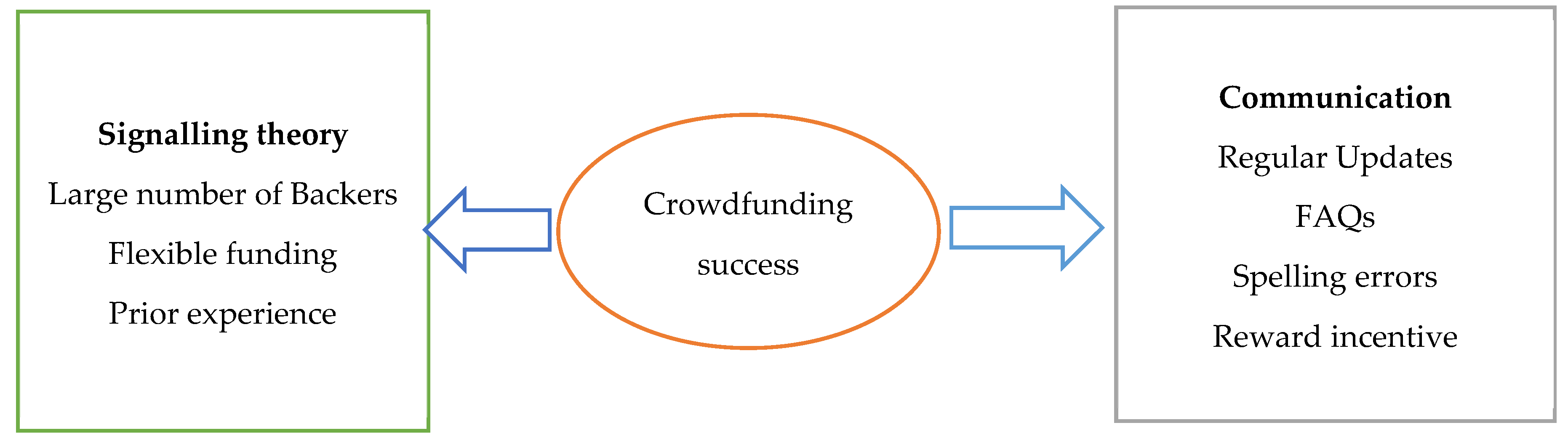
Table 2.
Descriptive statistics.
| Variables | Obs | Mean | Median | SD | Minimum | Maximum | Skewness | Kurtosis |
|---|---|---|---|---|---|---|---|---|
| Success | 854 | 0.160476 | 0.000000 | 0.733397 | 0.000000 | 14.58500 | 12.61770 | 216.6589 |
| Reward | 854 | 0.866511 | 1.000000 | 0.340302 | 0.000000 | 1.000000 | -2.15529 | 5.645282 |
| EXP | 854 | 0.196721 | 0.000000 | 0.397753 | 0.000000 | 1.000000 | 1.525854 | 3.328231 |
| FAQ | 854 | 0.099532 | 0.000000 | 0.911397 | 0.000000 | 13.00000 | 10.55899 | 120.6652 |
| FXF | 854 | 0.761124 | 1.000000 | 0.426647 | 0.000000 | 1.000000 | -1.22479 | 2.500121 |
| BCK | 854 | 19.58197 | 0.000000 | 118.2678 | 0.000000 | 2438.000 | 13.63608 | 235.6418 |
| SPR | 854 | 0.281030 | 0.000000 | 0.449766 | 0.000000 | 1.000000 | 0.974276 | 1.949213 |
| UPD | 854 | 0.918033 | 0.000000 | 3.153045 | 0.000000 | 36.00000 | 5.603258 | 42.04372 |
Source: Eviews output.
Table 3.
Correlation matrix.
| Observations | VIF | CR | REW | EXP01 | FAQ | FXF | BCK | SPR | UPD |
|---|---|---|---|---|---|---|---|---|---|
| SC | DV | 1.000 | |||||||
| REW | 1.1123 | 0.077** | 1.000 | ||||||
| EXP | 1.1077 | 0.0958** | 0.194*** | 1.000 | |||||
| FAQ | 1.0841 | 0.151*** | 0.0429 | 0.0591* | 1.000 | ||||
| FXF | 1.0910 | -0.209*** | -0.058* | -0.098*** | -0.195*** | 1.000 | |||
| BCK | 1.23132 | 0.422*** | 0.059* | 0.175*** | 0.195*** | -0.147*** | 1.000 | ||
| SPR | 1.08411 | -0.0278 | 0.245*** | 0.077** | -0.025 | 0.0936** | -0.0463 | 1.000 | |
| UPD | 1.36362 | 0.4765*** | 0.1143*** | 0.241*** | 0.296*** | -0.231*** | 0.4160*** | -0.027 | 1.000 |
Note: *** p<0.001 ** p<0.01 * p<0.05.
Table 4.
Probit regression analysis.
| Hypothesis variables | Coefficient (β) | Std. Error | Prob |
|---|---|---|---|
| : Reward incentive | 0.202971 | 0.381730 | 0.5949 |
| : Prior experience | 0.218184 | 0.218931 | 0.3190 |
| : Frequently Asked questions | -0.034899 | 0.088288 | 0.6926 |
| : Flexible funding | -0.634501 | 0.192368 | 0.0010*** |
| : Large number of backers | 0.030202 | 0.003268 | 0.0000*** |
| : Spelling errors | -0.2145 | 0.01777 | 0.3429 |
| : Regular updates | 0.033746 | 0.027196 | 0.2147 |
| C | -1.958281 | 0.372702 | 0.0000 |
| 0.586165 | |||
| Number of observations | 856 | ||
| Prob(LR statistic) | 0.00000 |
Note: *** p<0.001 ** p<0.01 * p<0.05.
Table 5.
Summary of hypothesis testing.
| Hypothesis | Support |
|---|---|
| : A reward incentive has a positive effect on a crowdfunding campaign, increasing the probability of its success. | Supported |
| : An entrepreneur's prior experience has a positive effect on their crowdfunding campaign, increasing the probability of its success. | Supported |
| : The presence of spelling errors in presenting a crowdfunding project has a detrimental effect on its possible success. | Supported |
| : Frequently asked questions have a positive impact on a crowdfunding campaign, increasing the possibility of its success. | Not supported |
| : The flexible funding mechanism has a negative effect on potential crowdfunding success. | Supported |
| : Regular updates have a significant and positive effect on the success of a crowdfunding campaign. | Supported |
| : A large number of backers has a significant and positive effect on a crowdfunding campaign, increasing the probability of its success. | Supported |
Disclaimer/Publisher’s Note: The statements, opinions and data contained in all publications are solely those of the individual author(s) and contributor(s) and not of MDPI and/or the editor(s). MDPI and/or the editor(s) disclaim responsibility for any injury to people or property resulting from any ideas, methods, instructions or products referred to in the content. |
© 2025 by the authors. Licensee MDPI, Basel, Switzerland. This article is an open access article distributed under the terms and conditions of the Creative Commons Attribution (CC BY) license (http://creativecommons.org/licenses/by/4.0/).
Copyright: This open access article is published under a Creative Commons CC BY 4.0 license, which permit the free download, distribution, and reuse, provided that the author and preprint are cited in any reuse.


