Preprint
Review

This version is not peer-reviewed.

A Survey on Architectural Approaches for 6G Networks: Implementation Challenges, Current Trends, and Future Directions

A peer-reviewed article of this preprint also exists.

Submitted:

26 February 2025

Posted:

28 February 2025

You are already at the latest version

Abstract

As the discussions on sixth generation (6G) wireless networks progress at a rapid pace, various approaches have emerged over the last years regarding new architectural concepts that can support the 6G vision. Therefore, the goal of this work is to highlight the most important technological efforts in relation to the definition of a 6G architectural concept. To this end, the primary challenges are firstly described, which can be viewed as the driving forces for the 6G architectural standardization. Afterwards, novel technological approaches are discussed to support the 6G concept, such as the introduction of artificial intelligence and machine learning for resource optimization and threat mitigation, cell-free deployments and novel physical layer techniques to leverage high data rates, open access protocols for flexible resource integration, security and privacy protection in the 6G era, as well as the digital twin concept. Finally, recent research efforts are analyzed with emphasis on the combination of the aforementioned aspects towards a unified 6G architectural approach. To this end, limitations and open issues are highlighted as well.

Keywords: 
;  ;  ;  ;  ;  ;  ;  ;  ;  

1. Introduction

The introduction of the fifth generation (5G) networks has made the deployment of new services and applications feasible. This is achieved via the support of highly demanding features such as ultra reliable low latency communications (URLLC), enhanced mobile broadband (eMBB) as well as massive machine type communications (mMTC) [1,2,3]. In this context, various novel technologies are integrated both in the physical and network layer, including millimeter wave (mmWave) transmission which leverages improved data rates over higher frequency bands [4], massive multiple input multiple output (mMIMO) deployments that increase spatial isolation among mobile stations (MSs) and provide flexible interference management [5], non-orthogonal multiple access (NOMA) that improves overall spectral efficiency [6] as well as network function virtualization (NFV) [7] and software defined networking (SDN) [8] which contribute to the decoupling of application deployment from hardware specific devices. In parallel, novel architectural approaches have been introduced as well, such as the service-based architecture (SBA) which leverages application deployment from various resources [9] as well as ultra-dense networking [10]. Hence, a variety of new applications can now be supported, including augmented and virtual reality (AR/VR), remote health care, as well as advanced fleet management in industrial environments [11,12].
However, the need for advanced services and applications has led to ongoing discussions for sixth generation (6G) networks [13,14,15]. This transition is also dictated by additional advancements in other adjacent fields, such as the internet of things (IoT). Hence, there is the need to define a new network paradigm able to interconnect a vast number of heterogeneous resources and protocols. Although there is not a concrete standardization yet, 6G concept will be based both on a number of key-enabling technologies as well as architectural concepts, such as distributed mMIMO systems and intelligent reflecting surfaces (IRSs) that can further leverage high transmission rates and improve resilience over physical layer attacks [16], software and hardware decoupling during application deployment and execution along with open access protocols [17], intent-based networking (IBN) [18] as well as the evolution of the SBA in 6G networks [19]. The ultimate goal of 6G infrastructures will be to provide ubiquitous coverage in a wide geographic range, and at the same time support multiple demanding applications both in terms of throughput and latency. Hence, there is a need for a holistic transformation of the underlying architectural design, to support more advanced and decentralized applications, such as holoportation and autonomous driving [20].
To this end, various approaches have been studied over the last years, such as cell-free (CF) systems [21], open radio access networks (O-RAN) [22], the advancement of SBA to an organic concept [23], as well as decentralized and distributed machine learning (ML) deployments [24,25]. At the same time, 6G networks should be reconfigurable, able to recover from unwanted situations and self-optimized. Therefore, various challenges should now be dealt with, such as: a) the ability to collect a vast amount of data from heterogeneous networks and environments in a secure and privacy preserving way, b) the ability to effectively train ML models for a variety of use cases and scenarios, c) dynamic network reconfiguration, as well as d) deployment of services and applications according to user needs, by properly optimizing related resources. Finally, since 6G networks will rely on the integration of heterogeneous resources, an increased number of potential attacks might now take place [26]. Hence, advanced security protocols and threat mitigation techniques are also required.
The goal of this work is to summarize all recent developments regarding the design of an architectural framework for 6G networks. In this context, the most important challenges towards the 6G vision are described, as well as the basic concepts of the most important functionalities among different layers. In the same perspective, several recent works are presented as well, while a discussion takes place that summarizes all key outcomes of this work.
The rest of this work is organized as follows: In subsection 1 of the introductory part, related survey papers are discussed along with their key contributions. The contributions of our work are mainly highlighted in subsection 1.2. In Section 2, the most important 6G key enabling technologies are highlighted. These include decentralized and distributed ML for resource optimization and threat mitigation, cell-free implementations, advanced physical layer protocols, interconnection of a vast number of heterogeneous devices with open access protocols as well as blockchain technology and digital twins (DTs).
In Section 3, various recent architectural approaches are highlighted and discussed, with respect to the aforementioned key pillars. An overall discussion takes place in Section 4, while concluding remarks are highlighted in Section 5. For illustration purposes, the paper structure is also depicted in Figure 1.

1.1. Related Surveys

In this subsection, selected recent survey papers are analyzed, in the context of 6G networks. To this end, the work in [27] focuses on Cloud RAN (CRAN), which is considered one of the major concepts in 5G/6G wireless networks since it decouples RAN software execution from specific hardware deployments. In this context, CRAN approaches can leverage efficient and dynamic network configurations, improve latency and resource allocation as well as support the connectivity of a mass number of devices, since scaling can be performed on demand. When it comes to the 6G concept, resource optimization can be a highly demanding task due to the number of devices involved and the amount of data exchanged. Therefore, the article also highlights the importance of AI/ML algorithms towards effective resource management.
The work in [28] analyzes all key aspects of machine-to-machine (M2M) communications in 6G networks. To this end, various issues are discussed, such as secure communications and power management of the devices involved, scalability, and interoperability of the connected devices. The work in [29] is focused on terahertz (THz) communications and sensing for 6G networks. Integrated Sensing and Communication (ISAC), also referred to as Joint Communication and Sensing (JCAS), is a technology candidate with promising potential. ISAC integrates sensing and spatial location of passive (not connected) objects into the mobile communication network, expanding the network's functionality beyond just communication. Hence, advanced applications can be supported, such as robotics fleet management, AR/VR and autonomous driving.
In [30], all cutting-edge technologies in the framework of 6G networks are presented, such as THz communications, ultra-massive MIMO, artificial intelligence (AI), ML, quantum communication, and reconfigurable intelligent surfaces (RISs). Emphasis is given on AI/ML technologies and their integration in 6G networks. In the same context, potential use cases are presented as well. Finally, the work in [31] summarizes all key aspects of AI/ML deployments in future 6G networks. The key outcomes of each work are also highlighted in Table 1.

1.2. Contributions

Our work mainly focuses on architectural design aspects of future 6G networks, via the integration of several key enabling technologies. Emphasis is given on the interconnection of these technologies in the considered architectural layers. Hence, unlike other works in literature, our goal is to report all recent developments towards a unified 6G framework. To summarize, the main novel points of our work are listed below:
  • Integration of various technologies and key factors towards 6G architectural design.
  • Discussion on the current trends of 6G architectural design, based on the presented works. To this end, the most important driving factors are also highlighted.
  • Identification of limitations that should also be considered in the design and deployment of 6G networks.

2. 6G Key Enabling Technologies

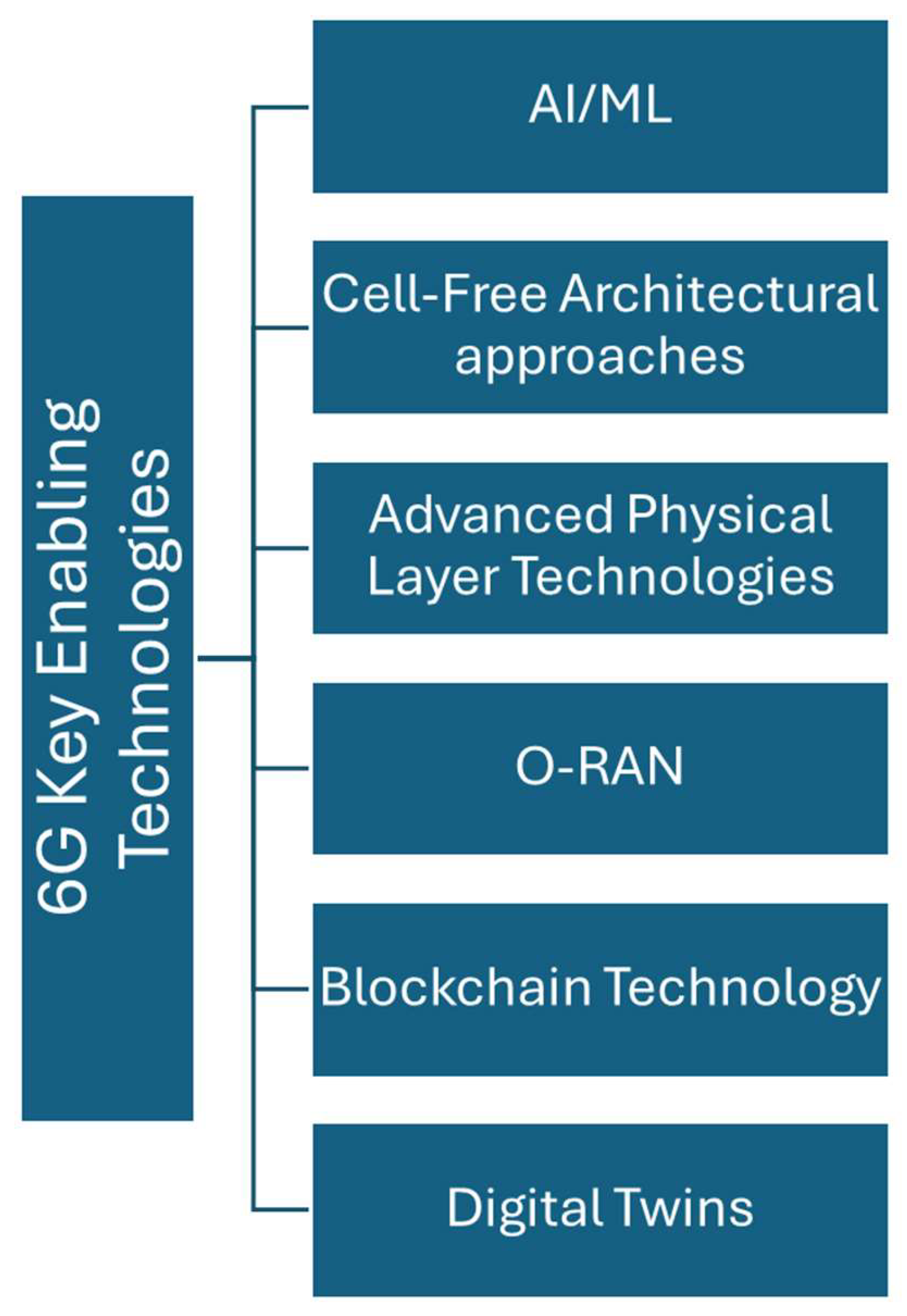
In this section the most important 6G key enabling technologies are presented and discussed. These include AI/ML, cell-free architectural approaches, advanced physical layer technologies, the O-RAN concept, blockchain technology, as well as DTs.

2.1. AI/ML

AI/ML approaches are already in use in a wide range of potential applications in 5G networks [32]. To this end, data collected directly from various network entities are used to train appropriate ML models in three ways: a) Supervised Learning, where model training takes place with the help of a labelled data set, b) Unsupervised Learning, where the goal is to extract data patterns, as well as c) Reinforcement Learning (RL). The latter case is based on the existence of a mobile agent who interacts with the environment under consideration and assigns certain rewards or penalties for specific actions. In most use cases, however, the set of potential actions-results can be quite large and look-up tables can be hardware consuming. In this case, training with the help of neural networks (NNs) is favored, a concept which is also known as deep reinforcement learning (DRL).
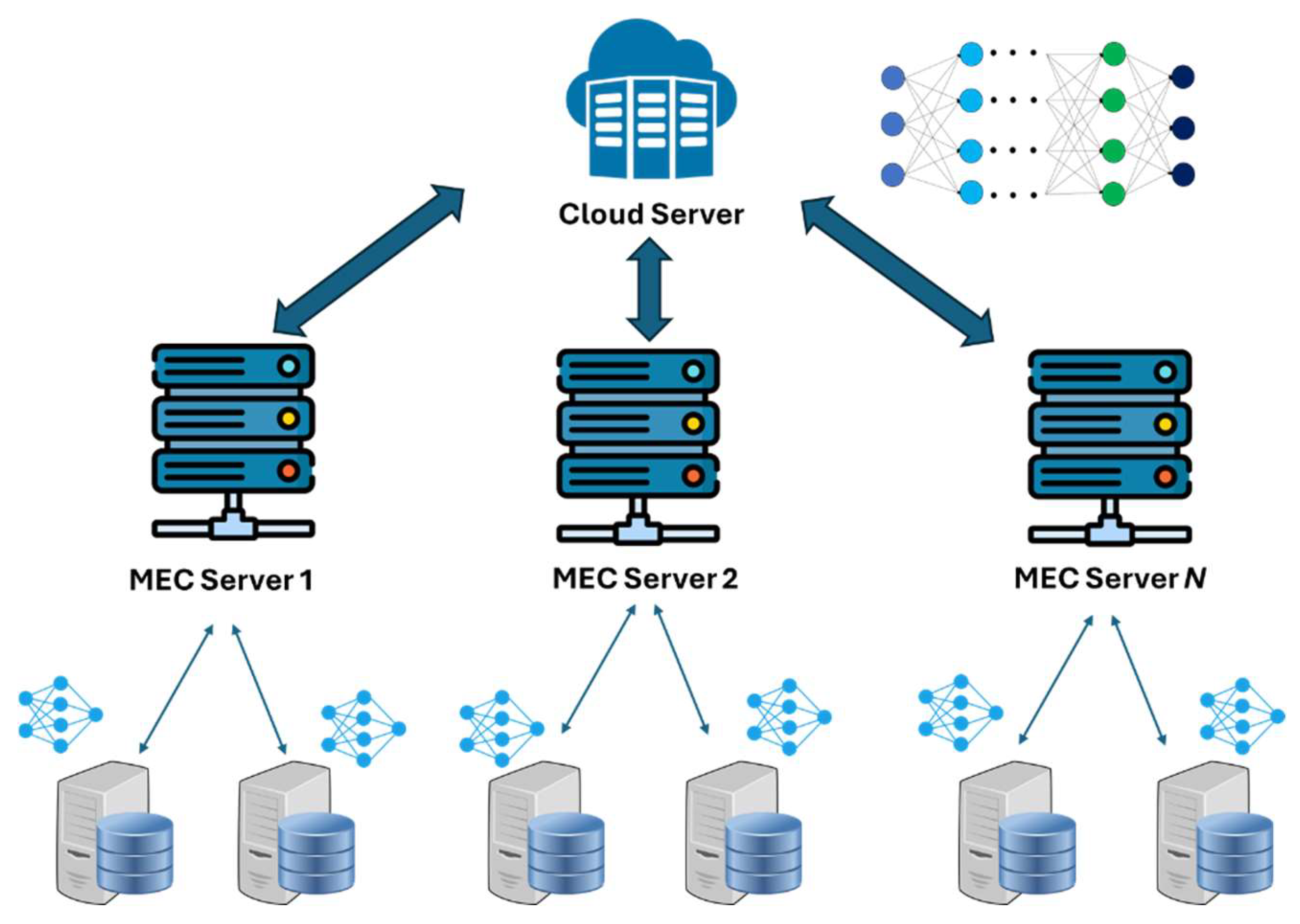
In the context of 6G networks, AI/ML can contribute to various operations, such as in security and privacy protection via the extraction of abnormal patterns [26] as well as in network reconfiguration and optimization when needed [33]. Since 6G networks are expected to integrate and process a large amount of data from heterogeneous resources, data collection and processing in a single node might significantly increase computational burden and training times. Moreover, such an approach would be prohibitive, since it results to a single point of failure. Therefore, over the last years the concept of federated learning (FL) [34] has emerged, as an alternate approach that can leverage execution times and relax computational burden. To this end, several participating nodes train locally an ML model, based on the data collected from their surrounding environment. Afterwards, ML model parameters, such as weights in case of NN training, are send to a master ML node for aggregation and update. The master node, after processing and aggregating all parameters, sends the updated weights to the participating nodes. Therefore, on one hand computational burden is divided among the participating nodes, and on the other hand no sensitive data is transmitted. Hence, privacy sensitive applications, such as e-health can now be deployed more easily. An overview of FL is depicted in Figure 2. To this end, a three-layered approach is considered, that includes training nodes, multi-access edge computing (MEC) servers as well as cloud servers. Therefore, model parameters are locally generated and then updated in MEC level. Afterwards, master model aggregation in cloud domain takes place as well. This approach can be highly beneficial when fast training times are required, since MEC servers are located closely to the participating training nodes. Consequently, model updates based on MEC processing undergo in general a short round-trip time.

2.2. Cell-Free Architectural approaches

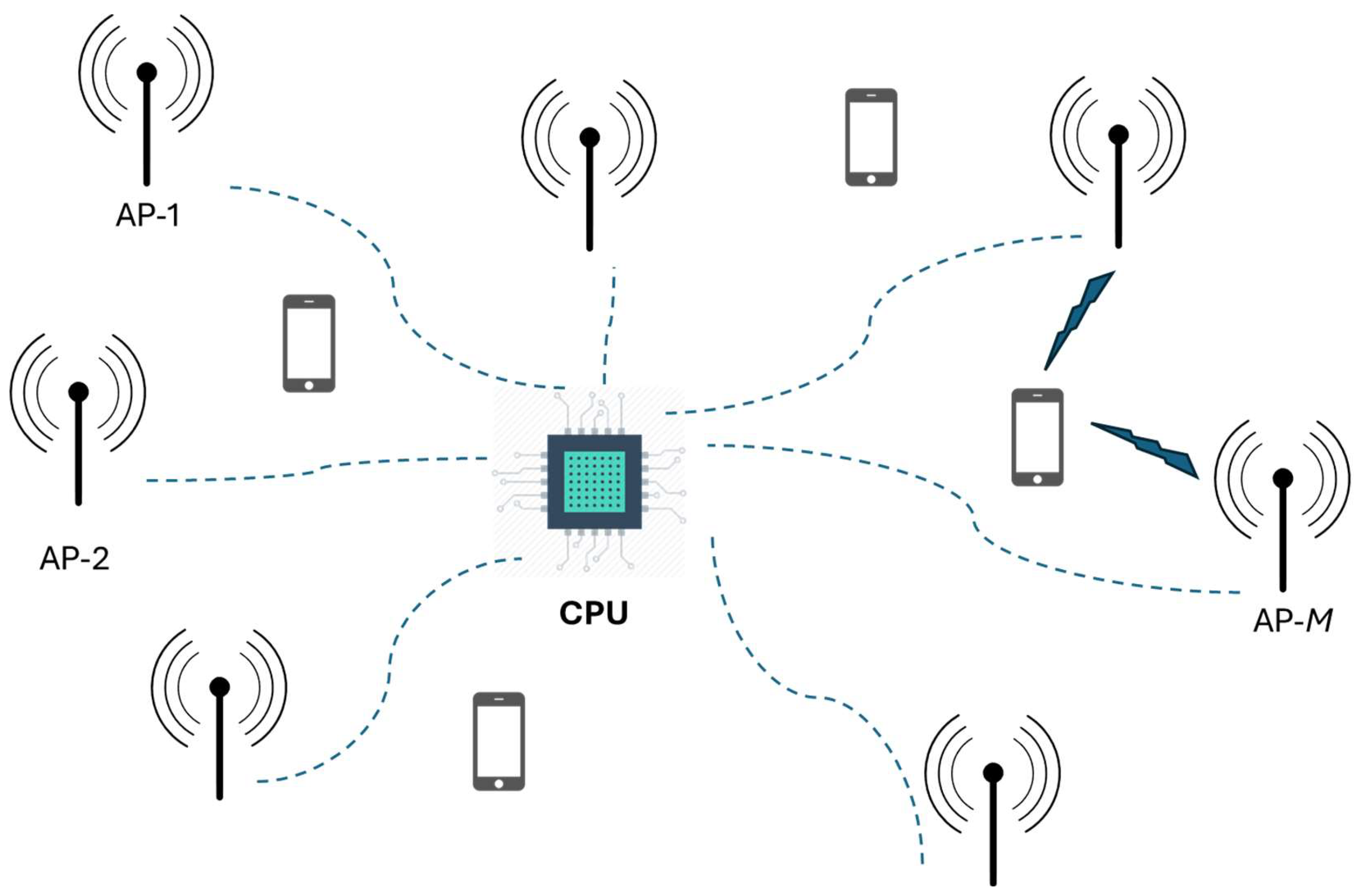
In conventional wireless networks, the traditional concept of base station (BS)-MS has been adopted in the vast majority of network deployments. Ιn this case, the cellular topology is divided into a finite number of BSs, where each BS can cover a certain geographical area according to its technical specifications. However, the interconnection of IoT devices on one hand and the need for ubiquitous connectivity with ultra-high data rates and low latency on the other hand, necessitate more flexible approaches regarding connectivity and resource allocation. Therefore, over the last decade the concept of CF networks has emerged. To this end, various access points (APs) are deployed in dense geographical areas, and a MS can be served by multiple APs. Several APs are connected to a common central processing unit (CPU), which manages connectivity issues. Hence, the handover and associated signaling burden can now be reduced.
In general, the concept of CF systems is also combined with mMIMO technology. To this end, distributed MIMO (dMIMO) antennas are located per AP that can provide connectivity in harsh propagation conditions. CF mMIMO can be considered as a potential physical layer technology for future wireless networks since it can benefit from all the advantages of distributed antenna systems (DASs) and network MIMOs, such as macro-diversity gain, high channel capacity, link reliability and in general more degrees of freedom in the wireless link [35]. An overview of CF technology is also depicted in Figure 3. As it can be observed, an arbitrary MS is served by two APs for improved signal reception. This set of serving APs changes dynamically, as the MS changes position in the wireless orientation. This feature can be particularly beneficial for highly demanding applications in terms of coverage, transmission rates and latency, such as autonomous driving. To this end, dMIMO configurations are deployed per AP that facilitate high signal diversity.

2.3. Advanced Physical Layer Technologies

A key concept in 6G networks will be advanced physical layer technologies that can support ultra-high data rates with minimum latency. The concept of mMIMO deployments has already been introduced in 5G networks. Moving forward, in 6G networks distributed mMIMO configurations are expected to play a key role in the provision of high data rate services, as also mentioned in the previous section. In the same context, NOMA as well as relay nodes (RNs) that can amplify the signal towards desired users are also of significant interest [36]. In this case, MSs can also play the role of an RN, that can relay selected information to other MSs in its area of coverage according to channel conditions. Hence, latency times can be improved. Finaly, THz communications are also a promising technology for the upcoming 6G networks. The THz band has large unused frequency areas and high spatial resolution enabled by the short signal wavelength and large bandwidth [37]. It works by leveraging the high-frequency spectrum to achieve ultra-high-speed wireless communication, surpassing the capabilities of current microwave and mmWave technologies. Consequently, highly demanding application scenarios in terms of transmission rates can be supported.

2.4. O-RAN

The concept of O-RAN allows service providers to use resources or non-proprietary subcomponents from a variety of vendors. Therefore, disaggregated services can be supported from various heterogeneous infrastructures [38]. O-RAN enables programmable, intelligent, disaggregated, virtualized, and interoperable functions. AI/ML technologies can also be deployed with the O-RAN radio intelligence controller (RIC) architecture. According to the O-RAN Alliance specifications describing the AI/ML workflow and requirements [39,40], two main entities, namely the non-real-time RAN intelligent controller (non-RT RIC) and the near-real-time RAN intelligent controller (near-RT RIC), will play a critical role in the AI/ML assistance and control loops, determining the optimization rationale of the O-RAN deployments according to the decision time-scale each of them handles (e.g., the near-RT RIC operates in order of ms, while the non-RT RIC decides above 500 ms).
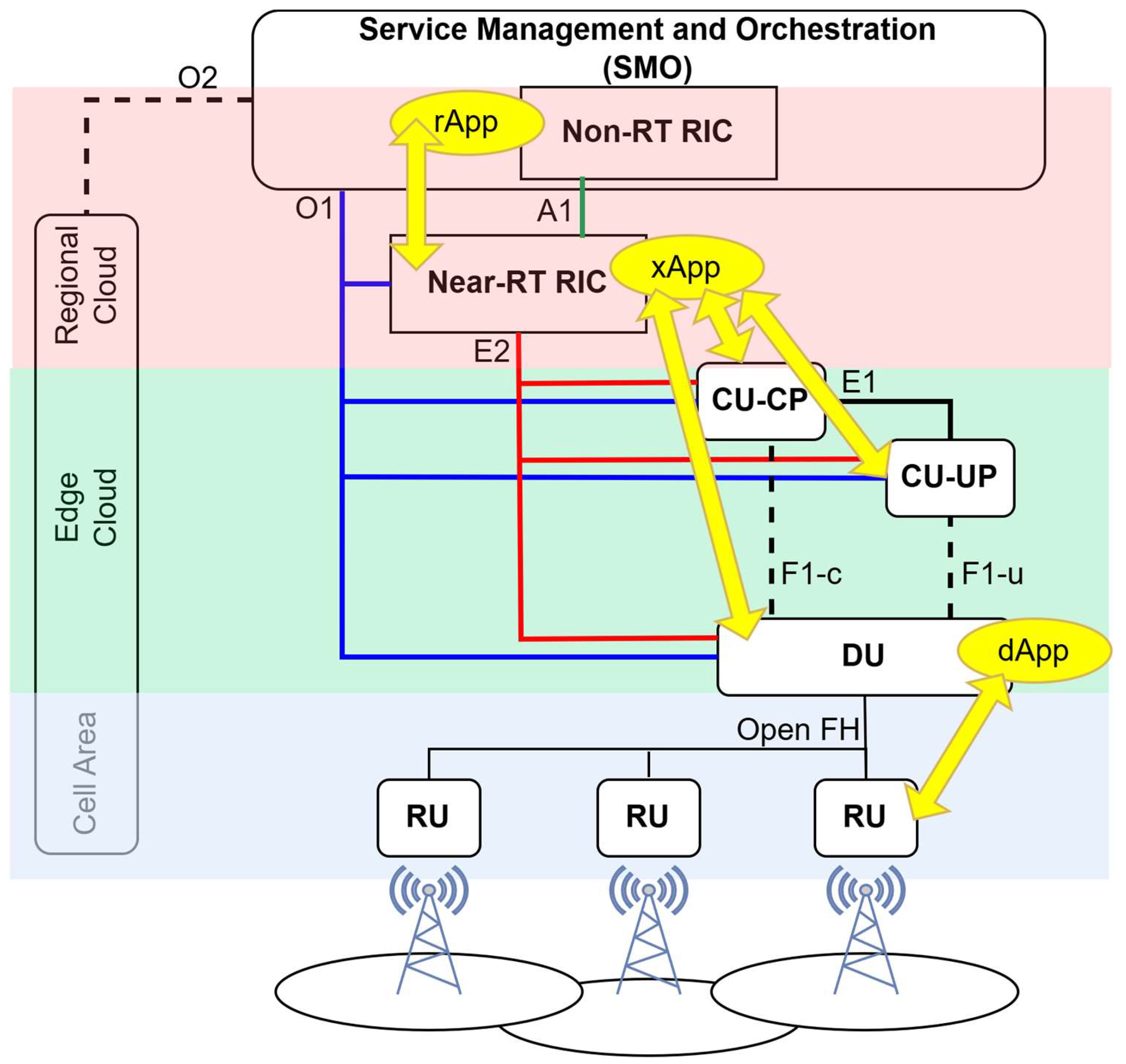
A schematic overview of O-RAN in the context of 6G networks is depicted in Figure 4. The figure illustrates the architecture of an O-RAN framework, emphasizing the interaction between different functional components across various cloud domains. The Service Management and Orchestration (SMO) layer oversees the network and interfaces with the non-RT RIC via the O1 interface. The non-RT RIC hosts rApps, which are AI/ML-driven applications that operate on a non-real-time scale (greater than one second). These applications focus on policy-driven, long-term network optimizations such as traffic forecasting, anomaly detection, energy efficiency enhancements, and capacity planning. By leveraging extensive historical data, rApps contribute to proactive and large-scale adjustments that improve overall network performance.
Below, the near-RT RIC operates within the Edge Cloud and manages network optimizations via the E2 interface. It hosts xApps, which execute real-time optimizations (10ms to 1s latency) for network elements. These xApps are responsible for functions such as dynamic resource allocation, interference management, power control, and handover optimization. By continuously analyzing network conditions and making rapid adjustments, xApps enhance user experience, minimize latency, and improve spectral efficiency. Their placement within the near-RT RIC ensures that they can make decisions quickly without the delays associated with higher-layer optimizations.
Further down in the architecture, the Centralized Unit (CU) is split into the Control Plane (CU-CP) and User Plane (CU-UP), which communicate over the E1 interface. The CU components connect with the Distributed Unit (DU) through the F1-c (control) and F1-u (user data) interfaces. The DU, in turn, interacts with the Radio Units (RUs) over an Open Fronthaul (FH) interface, enabling flexible and vendor-neutral RAN deployments. Within the DU, dApps operate as distributed applications tailored for localized and fine-grained optimizations. Unlike xApps, which function at the near-RT RIC level, dApps are deployed directly on the DU, allowing them to make ultra-low-latency optimizations at the radio access level. These applications can perform localized power management, adaptive modulation control, and beamforming adjustments, ensuring efficient and real-time operation at the edge of the network.
The Regional Cloud, Edge Cloud, and Cell Area layers visually segment the architecture, showing where different components reside. The yellow arrows indicate the interaction of AI-driven applications (rApps, xApps, and dApps) within the O-RAN architecture, contributing to intelligent RAN optimization and management. By distributing intelligence across different levels of the network, O-RAN can facilitate a flexible, efficient, and vendor-neutral approach to modern wireless communication.

2.4. Blockchain technology

Blockchain technology is well known from previous generation networks. In this context, each sensitive message is divided into a finite number of blocks, which are then connected via cryptographic hashes. Hence, message interception can be extremely difficult due to the multitude of blocks, since the identity of the next as well as the previous block in the chain is encrypted. Previous records of blockchain as well as transactions cannot be deleted or altered. A key novelty of blockchain is that the participating nodes do not have to trust each other, since they all have the capability to store local records of the blocks and transactions. Moreover, decentralization is leveraged as well, since there is no need to involve third parties and authorities. All nodes that participate in the transaction are treated as equal [41].
Blockchain can be also combined with AI/ML. As mentioned in subception 3.1, AI/ML deployments over 6G networks should follow a decentralized/distributed approach. Hence, with the help of blockchain secure data exchange among the participating nodes in ML model training can take place (Blockchain in AI) [42]. Moreover, lightweight IoT devices might not have always the capacity to process computationally intensive security protocols. Therefore, in this case, efficient task offloading that involves data exchange might take place either in edge or cloud servers, considering various factors such as the complexity of the task, the offloading time, the computational burden either in the IoT devices or in the servers, energy consumptions, etc (AI in Blockhain).

3.5. Digital Twins

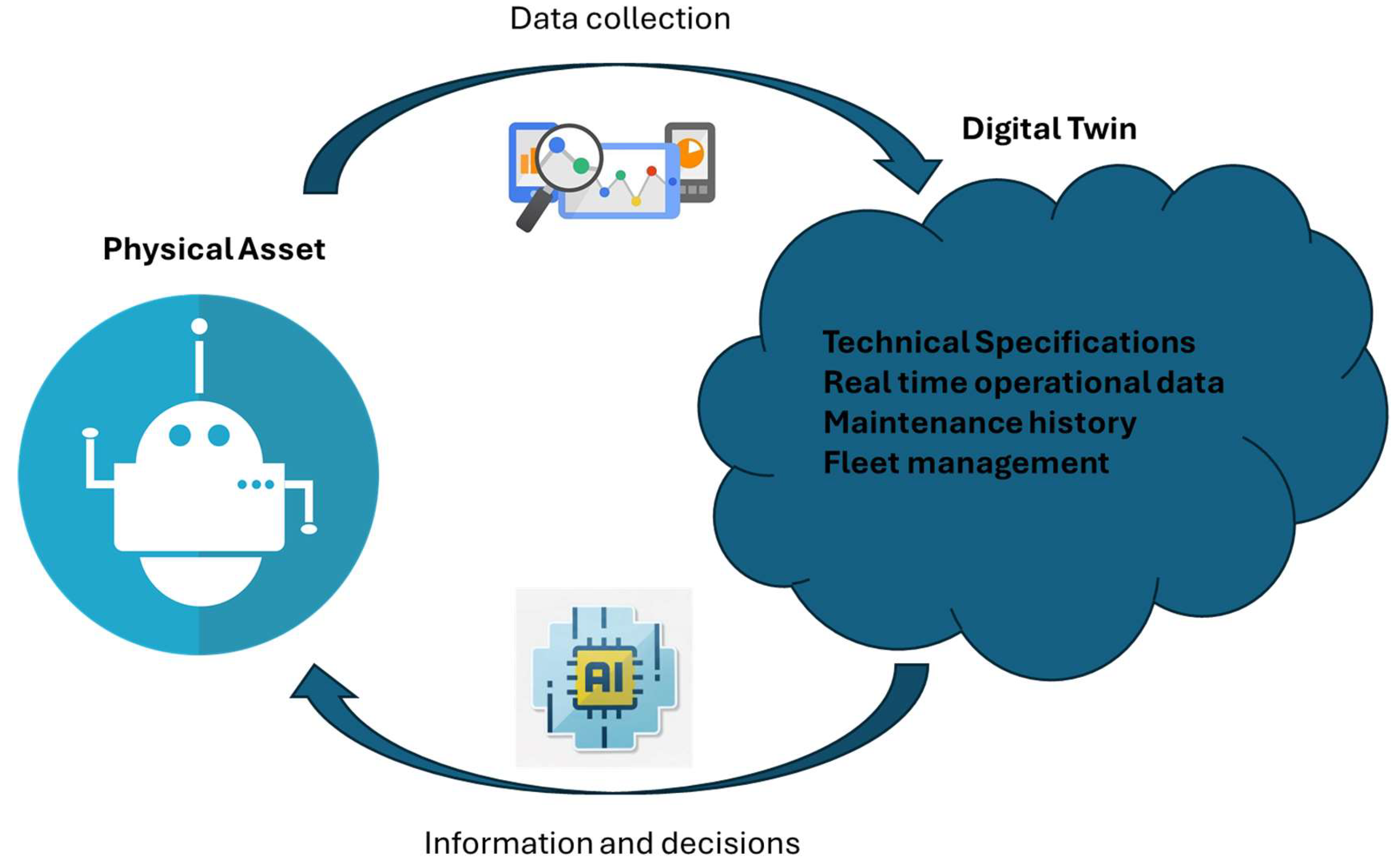
The concept of DTs enables the evaluation and optimization of various physical entities, via digital replicas [43,44]. Hence, the application of DTs in 6G wireless networks can be a quite challenging issue, due to integration of various cutting-edge technologies. 6G networks will be dynamic, with network operators being able to modify key network parameters and architecture in the time scale of minutes and hours, rather than months or years. In this case, DT is a virtual sandbox that can identify various network reconfigurations and leverage optimum decision making. In real world scenarios, for example, network failures or security attacks might not take place quite often, hence this would significantly increase the training time of DRL agents. With DTs however, various such occasions can be generated, by deliberately injecting misfunctionalities in the DT representation.
A schematic overview of the DT is depicted in Figure 5. To this end, for specific real-world physical objects, all related information is collected and digitally stored. This information is related both to the objects’ technical specifications and the way they interact with the surrounding environment. Therefore, a virtual representation can now be formulated that can accurately model the object under consideration. Data manipulation in the DT representation obviously leads to alternations in its operational behavior. All these input-output sets are used to train appropriate AI/ML models and thus provide the physical asset with a multitude of potential responses for various system configurations.
Figure 5. The Digital Twin concept.
Preprints 150610 g005
Figure 6. 6G Key Enabling Technologies.
Preprints 150610 g006
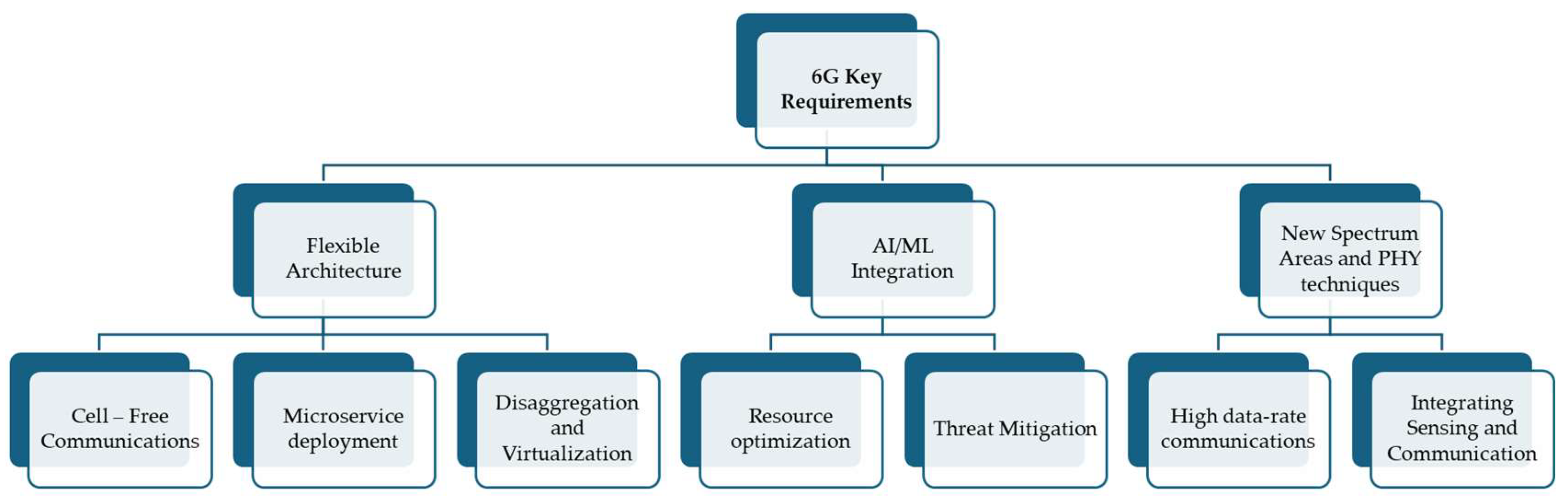
In Figure 7, the most important 6G key requirements are presented. These can be divided into three major categories: a) Flexible architecture deployments that include CF approaches as well as the extensions of the SBA in 5G, b) AI/ML integration both for threat mitigation as well as resource optimization and c) Advanced physical layer techniques that can leverage ultra-high data rates with minimum latency.
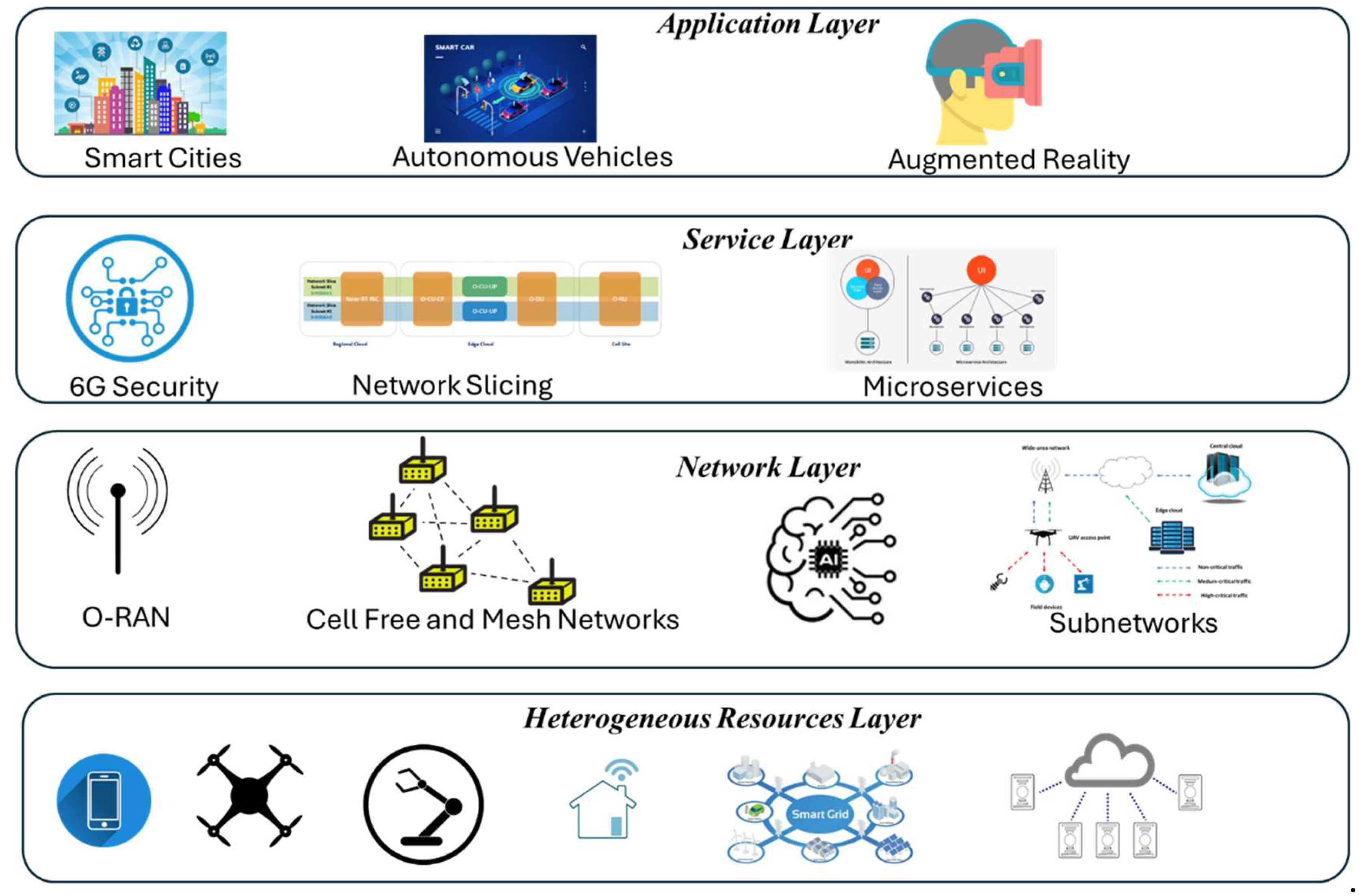
A high-level concept of 6G network architecture is depicted in Figure 8. In general, four layers can be identified a) Heterogeneous resources layer which includes the integration of all physical layer components. These include all physical resources, such as mobile phones, drones, industrial IoT equipment, industrial robots as well as indoor or smart grid equipment. This layer is also responsible for proper resource allocation and power management among the participating components, via AI/ML. The upper layer is the network layer, which is responsible for all network operations. These include the management of various network topologies, such as CF networks, the integration of ML approaches towards network management and reconfiguration, as well as open air interfaces. Finally, subnetworks are also a key driving force in current 6G trends. To this end, smaller and more flexible groups are formulated with specific 6G components [45]. Subnetworks, also referred to as in-X networks, can be particularly important in cases where the connection with the main 6G core network (CN) is lost. In this case, a device near other network entities can take the role of network controller. In the same context, subnetworks can be also beneficial in search and rescue operations where fast deployment times and minimum latency are of utmost importance.
Moving forward, in the service layer all current 6G trends will be integrated. These include 6G security, which is a key aspect of 6G networks, network slicing that allows the simultaneous execution of various services, as well as the deployment of microservices. The latter feature is extremely important, as it allows the decomposition of various applications into smaller tasks, which are known as microservices [46]. Hence, dynamic resource allocation during application execution can be achieved. Finally, the application layer includes the support of all novel applications in the 6G context, such as autonomous vehicles, smart cities, as well as AR/VR. The coexistence of these applications in certain domains can be supported by the slicing concept, as previously mentioned. As a final remark, it should be noted that although the AI/ML concept is depicted only in the network layer, its applications span across multiple domains in all other three layers.

3. Architectural approaches

In this section, the most important architectural approaches in the context of 6G networks are described. To this end, in [47], the authors introduce the concept of organic 6G network architecture, where its main core relies on the execution of all architectural protocols as web-based services. This approach tries to extend the SBA that was introduced in the 5G era, as an attempt to decouple network deployment from hardware specific and constrained devices. The organic concept moves a step forward, by allowing each functionality to be executed as a microservice. Therefore, the concept of infrastructure-free implementation can be supported. In parallel, each service requests a specific amount of network infrastructure, hence network size depends on the actual requirements of the application. In [48], a novel architectural approach is presented that can support threat prediction and mitigation as well as privacy protection in 6G networks. To this end, one of the key components of the presented approach is the distributed trustable engine (DTE) which collects real world network data and trains ML models in FL mode. This training has a dual goal: a) identify abnormal data patterns and b) identify potential security attacks. Afterwards, the intent-based interface (IBI) creates appropriate intents that are translated to specific network reconfigurations. Each such intent can be either predictive (i.e., the appropriate actions to avoid an attack) or mitigative (i.e., the set of appropriate actions for the network to recover from an attack). This architectural approach supports DTs as well, since the DTE can also work with emulated context.
In [49], various security aspects are analyzed in the context of 6G networks. This analysis includes both the physical and network layer. In the physical layer for example, potential attacks involve eavesdropping, jamming, pilot contamination attack and spoofing. In the same context, specific countermeasures are also proposed for each type of attack. The use of IRSs for example, which reflect the signal in unpredicted ways can be beneficial for attack mitigation, since the attacker will be unable to know the exact direction of the incoming signal. Moving forward, the use of network slices can partially mitigate network attacks, since inter-slice information is not transmitted. Hence, potential attacks can be limited to only a single slice.
In [50], the network slicing concept is introduced in 6G networks. To this end, a detailed approach is provided that formulates the optimization problem taking into account various performance metrics, such as resource allocation, service provisioning, and performance optimization. In the same context, the process of slice allocation firstly considers all resource requests from the various 6G layers. Afterwards, the optimization problem leads to optimum slice allocation. In [51], the concept of CF networks is introduced. As previously mentioned, various APs are placed within the wireless topology and MSs are connected to each AP according to their signal strength and channel quality. In this work, coexistence of CF approaches with current network architectures is examined, and in particular the criteria for either centralized or distributed signal processing.
In [52], various key-enabling technologies in the context of 6G networks are introduced and analysed. These technologies include AI/ML, blockchain technology for security provision, big data analytics, advanced encryption techniques, as well as cloud-edge IoT technologies. In [53], the concept of O-RAN is analysed, as also explained in the previous section. To this end, the basic principles of O-RAN are discussed, which include: (i) a disaggregated architecture with modular and standardized interfaces; (ii) cloudification, programmability and orchestration; and (iii) AI-enabled data-centric closed-loop control and automation.
In [54], a native intelligent and security architecture for 6G networks has been proposed. To this end, the concept of super network and multi-bodies is adopted. Super network includes all 6G main functionalities. The multi-bodies are separate 6G networks with a subset of central system’s functionalities that operate autonomously. The involved network functions (NFs) communicate with the NFs of the master network to achieve service collaboration and resource optimization. In the same context, in [55] a novel architectural approach is presented that is based on four (4) layers: resource layer, which is responsible for all data gathering from 6G devices, as well as power allocation. Next, we have the routing and connection layer, which connects all 6G entities. The service-based network function layer is an extension of the SBA approach of 5G networks and can support distributed deployment of services and applications. Finally, the exposure layer can invoke the APIs of other layers to obtain their capabilities.
In [56], various use cases are described, in the context of 6G networks. These include Network-Enabled Robotic and Autonomous Systems, Multi-Sensory Extended Reality, Distributed Sensing and Communications, as well as personalized user experience. In [57], the paper investigates the modelling, evaluation, and optimization of DT-based 6G network architecture. To this end, the 6G network architecture is mathematically modelled by intra-domain and inter-domain hypergraphs to characterize the complex changing rules of various elements in the network architecture and their relationships with the supply of services. The inter-domain architecture entropy is introduced to quantify the statistical characteristics of the degree of overlap between network services.
In [58], the 6G Recursive User Plane Architecture (6G-RUPA) is described, which is designed to be scalable, flexible, and energy-efficient. A key novelty of 6G networks, as previously mentioned, will be their ability to form dynamic federation of 6G network operators. Therefore, this federation will allow connected devices to roam freely across different domains with session continuity, without the need to relay traffic through external data networks such as the Internet. To this end, this study highlights the appropriate changes that must take place in the user data plane, to effectively support device to device (D2D) communications, without requiring an intermediate data network. 6G-RUPA offers multiple novelties, such as flexible number of layers, multilayer quality of service (QoS) framework, support for multiple control planes, as well as AI. In addition to simplifying the user plane network architecture, 6G-RUPA introduces significant improvements to existing verticals through enhanced features like network slicing, edge computing, and support for emerging technologies such as quantum computing and tactile internet.
In [59], various technologies are presented with respect to the 6G network, such as DT, AI, distributed ledger technology (DLT), as well as Post Quantum cryptography (PQC). In the same context, in [60], new technological enablers are described along with current requirements, e.g., new mobility components, CRAN solutions, programmability, and new architecture components for AI. In [61], a self-evolving architectural approach is presented, based on self-healing. As also mentioned in the previous section, the extension of the SBA may rely on a similar three-level hierarchical structure, where microservices compose NFs, and the NFs compose the CN. Hence, to adapt to the changing scenarios, varying microservices can compose different network functions and then CNs. Therefore, the term self-evolution refers to the capability of 6G networks to autonomously adjust and optimize their structure in response to environmental changes during the operation process. In this context, the work in [62] adopts the idea of a self-evolving agent, which constantly monitors the network via DRL and evaluates each action based on rewards and penalties. Hence, a closed loop control is formulated that adjusts the network accordingly.
In [63], a new architectural approach for 6G networks is presented, that is based on the decomposition of the 6G ecosystem into various building blocks. In this framework, four main blocks are identified: a) the platform block, which is responsible for data collection and resource management in the physical layer, b) functional block, which refers to RAN-core convergence, CF approaches, as well as application of AI/ML approaches, c) specialized block, which contains various novel services in the 6G context, such as flexible offloading, slicing and deployment of subnetworks, as well as d) orchestration block, which contains open services and closed-loop control.
In [64], a novel architectural approach is presented, based on the European project 6G-ANNA. The main 6G innovations, such as the main research directions of 6G-ANNA are described, including 6G RAN, network of networks, automation & simplification, DTs and extended reality, security, privacy and sustainability. In [65], a free-space optical (FSO) communication network in 160 Gbps is proposed and evaluated that can be used in 6G networks and related applications, such as transmission of information between drones and buildings, vehicle-to-vehicle, hospitals, and hard-to-reach areas. In [66], the work mainly deals with the slicing concept and how this can be applied to 6G networks. Various challenges are identified, such as the need for ML training over diverse datasets, dynamic spectrum sharing, as well authentication mechanisms for tenants that share the same resources. The proposed architecture embraces openness and employs ML algorithms, such as RL, deep learning (DL), FL, etc., to eliminate vendor lock-in and empower the 6G slicing framework with advanced intelligence and automation capabilities.
In [67], the key technologies for smart sustainable cities (SSC) are discussed, such as AI/ML, non-terrestrial networks, as well as ISAC. In [68], in the same context of smart cities, a potential architectural approach is presented that includes four (4) layers, and particularly the sensing layer, the transmission layer, data layer, as well as application layer. To this end, various use cases are described that are benefited from the 6G concept in smart cities, such as industrial automation and smart manufacturing, vehicle-to-everything (V2X) technology, smart health case as well as the smart grid concept, which is based on decentralized energy production from renewable energy sources. In this context, an IT infrastructure is used to interconnect the various production units of the smart grid, while data collection from various entities should also be leveraged for efficient load forecasting. In [69], the concept of nested Bee Hive is presented, which is a flexible multi-layered approach designed to meet the needs of futuristic smart cities. To this end, a nested approach is considered that contains both macroscopical cells within the smart city as well as 6G cells that are connected with fiber links. Within a 6G cell, mMIMO configurations are deployed per AP. In general, this approach consists of four (4) logical layers, and in particular the sensing layer, which consists of multiple devices and sensors within a 6G cell, the access point layer which manages advanced physical layer techniques (i.e., mMIMO, NOMA) for the connection of devices, and the distribution layer which encapsulates connection protocols as well as slicing capabilities. Finally, the cloud layer demonstrates the distributed cloud concept of Bee Hive architecture which is similar to the fog architecture of computing; each town cell device communicates with the local town cell cloud in the form of slices, then the town cloud communicates with city gateway cloud (CGC).
In [70], the paper discusses the different ongoing research activities on the 6G architecture and outlines the potential evolution of the different parts of the network. In this context, the necessity for a large-scale intent manager is highlighted, that can provide among others dynamic NF onboarding as well as optimization of network resources. Moreover, RAN low-layer split is also highlighted in 6G, which in turn would enable technologies such as CF - mMIMO that can potentially increase the user spectral efficiency when compared to other cellular RAN architectures. In [71], the PREDICT-6G framework is presented and discussed, which includes among others AI-driven network management, multi-domain service composition as well as model-driven open interfaces.
Finally, in [72], various 6G use cases are presented and discussed, such as high-performance precision agriculture, intelligent transport systems, and intelligent automation systems. In the same context, the evolution and potentials of vehicular ad hoc networks (VANETs) in 6G networks are discussed well, and the incorporation of air and space networks to ensure seamless vehicle communication across global locations. To this end, the authors highlight the importance of MEC solutions and AI/ML approaches that can leverage big data collection and analytics with minimum response times.

4. Discussion – Open Issues

In Table 2, indicative presented studies are categorized according to various 6G key-enabling technologies, and in particular AI/ML, DTs, open air interfaces, network slicing as well as CF approaches. From the discussion of the previous section, all current state-of-the-art approaches have adopted AI/ML solutions that are implemented in almost all considered architectural layers. AI/ML can contribute to various issues in the 6G context, such as resource optimization, threat prediction and mitigation. With respect to resource optimization and in conjunction with other cutting-edge technologies, such as NFV and the organic 6G concept, the appropriate number of resources can be committed during service execution which in turn leads to optimum resource management. These resources are not only related to hardware constrained nodes, but they include optimum slice selection and configuration as well.
Since 6G networks can change dynamically according to traffic conditions and overall user demands, in many of the presented works the concept of DRL was adopted. To this end, as previously mentioned, a mobile agent interacts with the surrounding environment and sends positive or negative feedback on certain decisions. In the same framework, since various potential misconfigurations can occur in 6G networks, the concept of DTs in parallel with ML has also been adopted. In this case, digital representations of the real-world environment assist in the examination of various scenarios that can be helpful for ML model training.
One other issue is the ability of the network to collect a vast amount of data from heterogeneous resources. In this case, two major assumptions have been mainly followed in the literature. In the first case, the use of open access protocols is favored. In the second case, aggregated data from heterogenous resources are sent to the data management layer for proper preprocessing prior to their manipulation from the business or functional layer. In both cases, data collection from diverse devices and entities may lead to additional security threats, since not all parts have the capability to execute advanced security protocols. In this case, the use of blockchain technology is preferred with efficient task offloading among the IoT devices and edge/cloud servers. To this end, IoT data are not directly inferred to the 6G network but are encrypted with blockchain from edge/cloud servers.
Data collection can be also leveraged with the appropriate extension of well-known 5G NFs, such as the network data analytics function (NWDAF) [73], which has already been defined in the 5G architecture from Release 15 of 3GPP. NWDAF can perform data collection from various NFs. When combined with advanced AI/ML techniques, full-scale network optimization can be supported, according to traffic demands and service requirements [74]. NWDAF can be deployed with other key enabling technologies, such as O-RAN, and support large scale data collection and optimization in a secure and trusted environment.
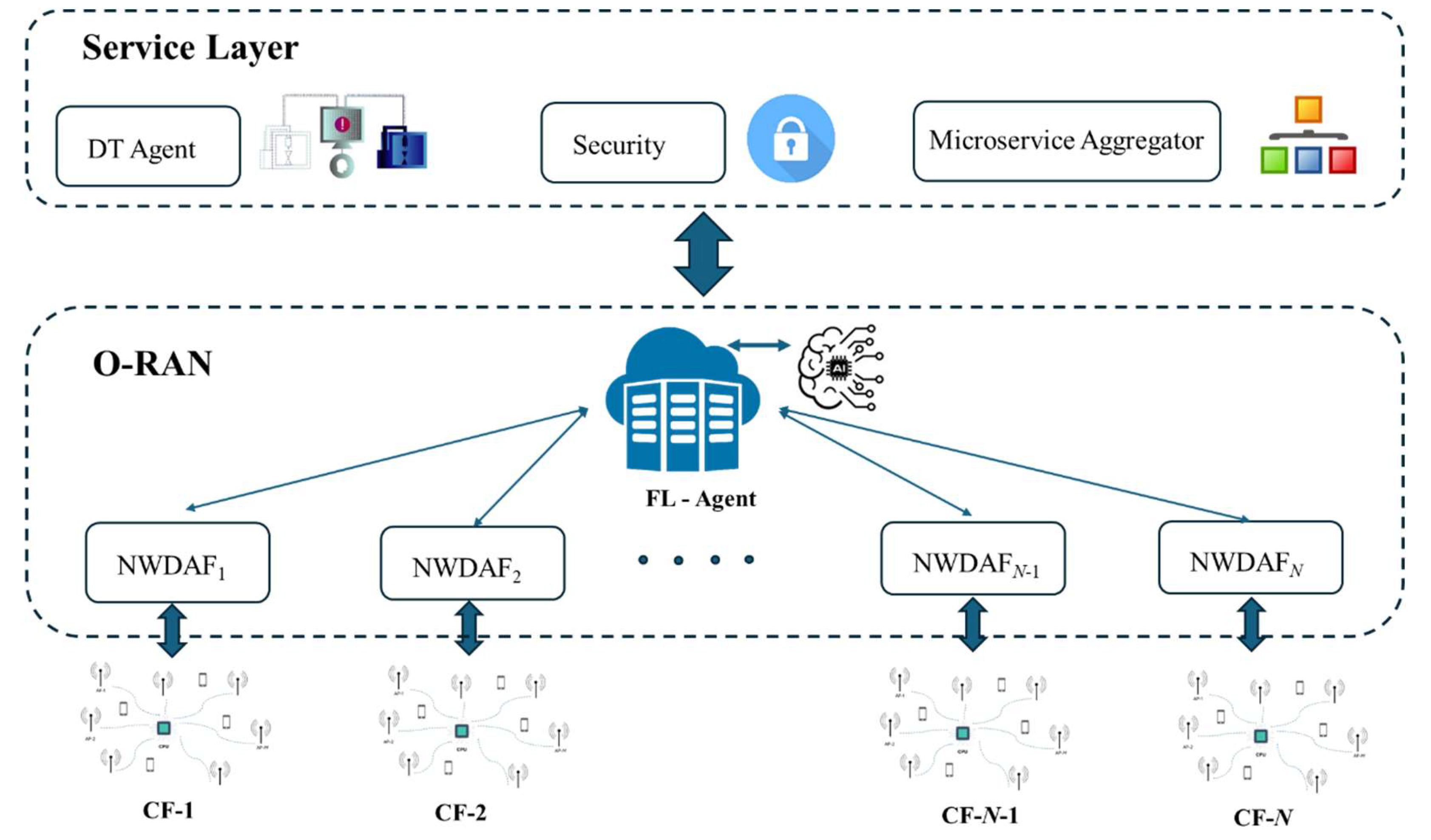
Based on the previous discussion, a conceptual 6G framework is depicted in Figure 9 (the Application layer has been omitted for illustration purposes). To this end, various CF deployments are considered in the 6G area of coverage. Each CPU is connected to a separate NWDAF instance that collects all data related to the specific deployment. The FL-agent provides full network optimization in all CF segments. Aggregated data are also used in the service layer where the DT agent executes multiple simulation scenarios to deal with various network instances and configurations, as well as in the microservice aggregator which optimizes resource usage. Finally, the security agent can perform various tasks related to threat prediction and mitigation based on the outcomes of the FL-agent, such as malicious nodes exclusion and intent-based creation for network recovery.
However, also from the analysis of the previous sections certain open issues and limitations can be identified. These are summarized below:
  • Deployment capabilities and costs throughout large geographical areas. To this end, the support of ultra-high data rates with minimum latency necessitates dense deployments that may increase the cost of 6G infrastructures.
  • In the same context, the 6G approach should be also adopted by lightweight devices that will have the capability to run light versions of the 6G architecture.
  • Although ML models are a key innovation approach in 5G/6G networks, many times improved model performance is accompanied by increased model complexity. In this context, a key innovation over the last years is the concept of explainable artificial intelligence (XAI), a field that is concerned with the development of new methods that explain and interpret ML models [75,76]. The main focus is on the reasoning behind the decisions or predictions made by the AI algorithms, to make them more understandable and transparent. Therefore, XAI assists in making ML models lead to decisions that are not based on irrelevant or otherwise unfair criteria.
  • Integration of various cutting-edge technologies. As discussed thoroughly in this article, a key concept in 6G networks will be the integration of various technologies, both in the physical and network layer. Hence, a challenging issue would be to limit overall complexity and signaling burden. For example, since 6G networks involve the collection of a vast amount of data, appropriate processing algorithms are required that can effectively manage this volume. Moreover, as also stated in this article, security by design is a prerequisite for all 6G deployments. In this new landscape, lightweight IoT devices do not have high storage or processing capabilities. In addition, as also stated in this article, data collection on single servers might result in a single point of failure. Therefore, over the last years decentralized approaches for data collection, storage and processing have been studied, such as IoT-edge-cloud architectures. To this end, MEC servers are deployed near the IoT devices that have the capability to store and process complex data and tasks. Hence, IoT devices offload certain tasks to the MEC servers. In parallel, MEC servers can offload additional tasks to cloud servers, especially in cases where huge amounts of data volumes are processed [77].
  • Coexistence with previous generations of networks. As also anticipated in the 5G era, the full transition to a new generation of networks will gradually take place. Until then, coexistence with well-established protocols is of utmost importance. In this case, one solution that has been proposed is the one in [69], where nested networks are formulated. In this context, small 6G cells can be deployed in areas with increased traffic distribution, that can communicate with large 5G cells. However, there are not many works in literature that on one hand deal with the coexistence of 5G/6G and associated issues (e.g., handover and mobility management, resource allocation, etc.) and on the other hand with interference mitigation mechanisms. To this end, the work in [78] presents an interference analysis for the coexistence of terrestrial networks with satellite services. In this work, extensive simulations have been carried out regarding cellular coexistence with low earth orbit (LEO) satellites in the 47.2-50.2 GHz band.

5. Conclusions

Ιn this work, all recent developments towards the definition of an architectural approach for 6G networks were described. In particular, 6G networks will enhance current 5G functionalities, such as service-based architecture and network function virtualization, while at the same time will introduce novel features, such as THz communications, the organic concept for flexible application deployment and reconfiguration, as well as distributed and decentralized machine learning approaches. A key concept in 6G networks will be their ability to process a large amount of data from heterogeneous resources. Therefore, open access interfaces are expected to leverage data collection and processing along with IoT-edge-cloud frameworks.
6G can be alternately viewed as a collection of networks, a network of networks, where various novel services can be integrated via flexible network slicing. Efficient mechanisms for dynamic network deployment can leverage optimum hardware utilization and green computing. Τo this end, the combination of the digital twin concept along with advanced machine learning approaches (e.g., deep reinforcement learning or explainable AI) can provide a multitude of potential responses for various network configurations and a deeper understanding of important 6G functionalities.

Author Contributions

Conceptualization, P.G. and A.G.; methodology, P.G.; software, N.N.; validation, P.T., L.S., X.M. and N.N.; formal analysis, L.S., X.M.; investigation, N.N.; resources, P.G.; data curation, P.G.; writing—original draft preparation, P.G.; writing—review and editing, X.M., L.S.; visualization, N.N.; supervision, P.G.; project administration, P.G.All authors have read and agreed to the published version of the manuscript.

Funding

This research received no external funding.

Data Availability Statement

Non-applicable.

Conflicts of Interest

The authors declare no conflicts of interest.

Abbreviations

The following abbreviations are used in this manuscript:
3GPP Third Generation Partnership Project
5G Fifth Generation
6G Sixth Generation
AI Artificial Intelligence
AP Access Point
API Application Programming Interface
AR Augmented Reality
BS Base Station
CGC City Gateway Cloud
CN Core Network
CU Centralized Unit
CP Control Plane
CPU Central Processing Unit
CRAN Cloud RAN
D2D Device to Device
DAS Distributed Antenna System
DL Deep Learning
DLT Distributed Ledger Technology
DRL Deep Reinforcement Learning
DT Digital Twin
eMBB Enhanced Mobile Broadband
FH Front Haul
FL Federated Learning
FSO Free Space Optical
IBI Intent Based Interface
IBN Intent-Based Networking
IoT Internet of Things
IRS Intelligent Reflecting Surface
ISAC Integrated Sensing and Communication
JSAC Joint Sensing and Communication
LEO Low Earth Orbit
M2M Machine to Machine
MEC Multi-access Edge Computing
MIMO Multiple Input Multiple Output
mMIMO Massive MIMO
ML Machine Learning
mMTC Massive Machine Type Communications
mmWave Millimeter Wave
MS Mobile Station
NF Network Function
NFV Network Function Virtualization
NN Neural Network
NOMA Non-Orthogonal Multiple Access
O-RAN Open Radio Access Network
PQC Post Quantum Cryptography
QoS Quality of Service
RAN Radio Access Network
RIC RAN Intelligent Controller
RIS Reconfigurable Intelligent Surface
RL Reinforcement Learning
RU Radio Unit
RUPA Recursive User Plane Architecture
SBA Service Based Architecture
SDN Software Defined Networking
SMO Service Management and Orchestration
SSC Smart Sustainable City
THz Terahertz
UDN Ultra Dense Networks
URLLC Ultra Reliable Low Latency Communications
UP User Plane
VANET Vehicular Ad Hoc Network
V2X Vehicle to Everything
VR Virtual Reality
XAI Explainable Artificial Intelligence

References

  1. Popovski, P.; Trillingsgaard, K. F.; Simeone, O.; Durisi, G. 5G Wireless Network Slicing for eMBB, URLLC, and mMTC: A Communication-Theoretic View. IEEE Access 2018, 6, 55765–55779. [Google Scholar] [CrossRef]
  2. Khan, B. S.; Jangsher, S.; Ahmed, A.; Al-Dweik, A. URLLC and eMBB in 5G Industrial IoT: A Survey. IEEE Open Journal of the Communications Society 2022, 3, 1134–1163. [Google Scholar] [CrossRef]
  3. Chaudhary, U.; Ali, M.F.; Rajkumar, S.; Jayakody, D.N.K. Sensing and Secure NOMA-Assisted mMTC Wireless Networks. Electronics 2023, 12, 2322. [Google Scholar] [CrossRef]
  4. Bang, J.; Chung, H.; Hong, J.; Seo, H.; Choi, J.; Kim, S. Millimeter-Wave Communications: Recent Developments and Challenges of Hardware and Beam Management Algorithms. IEEE Commun. Mag. 2021, 59, 86–92. [Google Scholar] [CrossRef]
  5. Lee, B. M. Massive MIMO for Massive Industrial Internet of Things Networks: Operation, Performance, and Challenges. IEEE Transactions on Cognitive Communications and Networking 2024, 10, 2119–2135. [Google Scholar] [CrossRef]
  6. Ogundokun, R.O.; Awotunde, J.B.; Imoize, A.L.; Li, C.-T.; Abdulahi, A.T.; Adelodun, A.B.; Sur, S.N.; Lee, C.-C. Non-Orthogonal Multiple Access Enabled Mobile Edge Computing in 6G Communications: A Systematic Literature Review. Sustainability 2023, 15, 7315. [Google Scholar] [CrossRef]
  7. Adoga, H.U.; Pezaros, D.P. Network Function Virtualization and Service Function Chaining Frameworks: A Comprehensive Review of Requirements, Objectives, Implementations, and Open Research Challenges. Future Internet 2022, 14, 59. [Google Scholar] [CrossRef]
  8. Hussain, M.; Shah, N.; Amin, R.; Alshamrani, S.S.; Alotaibi, A.; Raza, S.M. Software-Defined Networking: Categories, Analysis, and Future Directions. Sensors 2022, 22, 5551. [Google Scholar] [CrossRef]
  9. Zieba, M.; Natkaniec, M.; Borylo, P. Cloud-Enabled Deployment of 5G Core Network with Analytics Features. Appl. Sci. 2024, 14, 7018. [Google Scholar] [CrossRef]
  10. Stoynov, V.; Poulkov, V.; Valkova-Jarvis, Z.; Iliev, G.; Koleva, P. Ultra-Dense Networks: Taxonomy and Key Performance Indicators. Symmetry 2023, 15, 2. [Google Scholar] [CrossRef]
  11. Pons, M.; Valenzuela, E.; Rodríguez, B.; Nolazco-Flores, J.A.; Del-Valle-Soto, C. Utilization of 5G Technologies in IoT Applications: Current Limitations by Interference and Network Optimization Difficulties—A Review. Sensors 2023, 23, 3876. [Google Scholar] [CrossRef] [PubMed]
  12. Gkagkas, G.; Vergados, D.J.; Michalas, A.; Dossis, M. The Advantage of the 5G Network for Enhancing the Internet of Things and the Evolution of the 6G Network. Sensors 2024, 24, 2455. [Google Scholar] [CrossRef]
  13. Giordani, M.; Polese, M.; Mezzavilla, M.; Rangan, S.; Zorzi, M. Toward 6G Networks: Use Cases and Technologies. IEEE Commun. Mag. 2020, 58, 55–61. [Google Scholar] [CrossRef]
  14. Siddiky, M.N.A.; Rahman, M.E.; Uzzal, M.S.; Kabir, H.M.D. A Comprehensive Exploration of 6G Wireless Communication Technologies. Computers 2025, 14, 15. [Google Scholar] [CrossRef]
  15. Kamath, S.; Anand, S.; Buchke, S.; Agnihotri, K. A Review of Recent Developments in 6G Communications Systems. Eng. Proc. 2023, 59, 167. [Google Scholar] [CrossRef]
  16. Dala Pegorara Souto, V.; Dester, P.S.; Soares Pereira Facina, M.; Gomes Silva, D.; de Figueiredo, F.A.P.; Rodrigues de Lima Tejerina, G.; Silveira Santos Filho, J.C.; Silveira Ferreira, J.; Mendes, L.L.; Souza, R.D.; et al. Emerging MIMO Technologies for 6G Networks. Sensors 2023, 23, 1921. [Google Scholar] [CrossRef]
  17. Zhao, L.; Zhou, G.; Zheng, G.; I, C. -L.; You, X.; Hanzo, L. Open-Source Multi-Access Edge Computing for 6G: Opportunities and Challenges. IEEE Access 2021, 9, 158426–158439. [Google Scholar] [CrossRef]
  18. Leivadeas, A.; Falkner, M. A Survey on Intent-Based Networking. IEEE Communications Surveys & Tutorials. [CrossRef]
  19. Chen, T.; et al. Service-oriented Architecture Evolution towards 6G Networks. IEEE Conference on Standards for Communications and Networking, 2023; -14. [Google Scholar] [CrossRef]
  20. Erfanian, J.; Lister, D.; Zhao, Q.; Wikström, G.; Chen, Y. 6G Vision & Analysis of Potential Use Cases. IEEE Commun. Mag. 2023, 61, 12–14. [Google Scholar] [CrossRef]
  21. Gkonis, P. K; Lavdas, S.; Vardoulias, G.; Trakadas, P.; Sarakis, L.; Papadopoulos, K. System Level Performance Assessment of Large-Scale Cell-Free Massive MIMO Orientations with Cooperative Beamforming. IEEE Access 2024, 12, 92073–92086. [Google Scholar] [CrossRef]
  22. Ayub Khan, A.; et al. ORAN-B5G: A Next-Generation Open Radio Access Network Architecture with Machine Learning for Beyond 5G in Industrial 5.0. IEEE Transactions on Green Communications and Networking 2024, 8, 1026–1036. [Google Scholar] [CrossRef]
  23. Corici, M.-I.; et al. Organic 6G Networks: Vision, Requirements, and Research Approaches. IEEE Access, 7069. [Google Scholar] [CrossRef]
  24. Kehelwala, J.; Siriwardhana, Y.; Hewa, T.; Liyanage, M.; Ylianttila, M. Decentralized Learning for 6G Security: Open Issues and Future Directions. Joint European Conference on Networks and Communications & 6G Summit, 2024. [Google Scholar] [CrossRef]
  25. Muscinelli, E.; Shinde, S.S.; Tarchi, D. Overview of Distributed Machine Learning Techniques for 6G Networks. Algorithms 2022, 15, 210. [Google Scholar] [CrossRef]
  26. Nomikos, N.; Xylouris, G.; Patsourakis, G.; Nikolakakis, V.; Giannopoulos, A.; Mandilaris, C.; Gkonis, P.; Skianis, C.; Trakadas, P. A Distributed Trustable Framework for AI-Aided Anomaly Detection. Electronics 2025, 14, 410. [Google Scholar] [CrossRef]
  27. Ismail, S.F.; Kadhim, D.J. Towards 6G Technology: Insights into Resource Management for Cloud RAN Deployment. IoT 2024, 5, 409–448. [Google Scholar] [CrossRef]
  28. Rojek, I.; Kotlarz, P.; Dorożyński, J.; Mikołajewski, D. Sixth-Generation (6G) Networks for Improved Machine-to-Machine (M2M) Communication in Industry 4.0. Electronics 2024, 13, 1832. [Google Scholar] [CrossRef]
  29. Jiang, W.; et al. Terahertz Communications and Sensing for 6G and Beyond: A Comprehensive Review. IEEE Communications Surveys & Tutorials, 2381. [Google Scholar] [CrossRef]
  30. Chataut, R.; Nankya, M.; Akl, R. 6G Networks and the AI Revolution—Exploring Technologies, Applications, and Emerging Challenges. Sensors 2024, 24, 1888. [Google Scholar] [CrossRef]
  31. Li, L. A Survey on Intelligence-Endogenous Network: Architecture and Technologies for Future 6G. Intelligent and Converged Networks 2024, 5, 53–67. [Google Scholar] [CrossRef]
  32. Giannopoulos, A.; Spantideas, S.; Kapsalis, N.; Karkazis, P.; Trakadas, P. Deep Reinforcement Learning for Energy-Efficient Multi-Channel Transmissions in 5G Cognitive HetNets: Centralized, Decentralized and Transfer Learning Based Solutions. IEEE Access 2021, 9, 129358–129374. [Google Scholar] [CrossRef]
  33. Adeogun, R.; Berardinelli, G. Multi-Agent Dynamic Resource Allocation in 6G in-X Subnetworks with Limited Sensing Information. Sensors 2022, 22, 5062. [Google Scholar] [CrossRef]
  34. Liberti, F.; Berardi, D.; Martini, B. Federated Learning in Dynamic and Heterogeneous Environments: Advantages, Performances, and Privacy Problems. Appl. Sci. 2024, 14, 8490. [Google Scholar] [CrossRef]
  35. Kassam, J.; Castanheira, D.; Silva, A.; Dinis, R.; Gameiro, A. A Review on Cell-Free Massive MIMO Systems. Electronics 2023, 12, 1001. [Google Scholar] [CrossRef]
  36. Bartsiokas, I. A.; Gkonis, P. K.; Kaklamani, D. I.; Venieris, I. S. A DL-Enabled Relay Node Placement and Selection Framework in Multicellular Networks. IEEE Access 2023, 11, 65153–65169. [Google Scholar] [CrossRef]
  37. Farhad, A.; Pyun, J.-Y. Terahertz Meets AI: The State of the Art. Sensors 2023, 23, 5034. [Google Scholar] [CrossRef] [PubMed]
  38. Giannopoulos, A.; et al. , Supporting Intelligence in Disaggregated Open Radio Access Networks: Architectural Principles, AI/ML Workflow, and Use Cases. IEEE Access, 3958. [Google Scholar] [CrossRef]
  39. RAN AI/ML Workflow Description and Requirements Version—01.01, O-RAN Alliance, Alfter, Germany, 2020.
  40. RAN Near-Real-Time RAN Intelligent Controller Architecture & E2 General Aspects and Principles—V1.01, O-RAN Working Group 3, Alfter, Germany, 2020.
  41. Pajooh, H.H.; Demidenko, S.; Aslam, S.; Harris, M. Blockchain and 6G-Enabled IoT. Inventions 2022, 7, 109. [Google Scholar] [CrossRef]
  42. Zuo, Y.; Guo, J.; Gao, N.; Zhu, Y.; Jin, S.; Li, X. A Survey of Blockchain and Artificial Intelligence for 6G Wireless Communications. IEEE Communications Surveys & Tutorials, 2528. [Google Scholar] [CrossRef]
  43. Tao, Z.; Xu, W.; Huang, Y.; Wang, X.; You, X. Wireless Network Digital Twin for 6G: Generative AI as a Key Enabler. IEEE Wireless Communications 2024, 31, 24–31. [Google Scholar] [CrossRef]
  44. Qi, F.; Xie, W.; Liu, L.; Hong, T.; Zhou, F. UAV Digital Twin Based Wireless Channel Modeling for 6G Green IoT. Drones 2023, 7, 562. [Google Scholar] [CrossRef]
  45. Berardinelli, G.; Mogensen, P.; Adeogun, R.O. 6G subnetworks for Life-Critical Communication. In Proceedings of the 2020 2nd 6G Wireless Summit (6G SUMMIT), Levi, Finland, 17–20 March 2020; pp. 1–5. [Google Scholar]
  46. Fu, Y.; Shan, Y.; Zhu, Q.; Hung, K.; Wu, Y.; Quek, T. Q. S. A Distributed Microservice-Aware Paradigm for 6G: Challenges, Principles, and Research Opportunities. IEEE Network 2024, 38, 163–170. [Google Scholar] [CrossRef]
  47. Corici, M.; Troudt, E.; Magedanz, T. An Organic 6G Core Network Architecture. ICIN, 2022; -7. [Google Scholar] [CrossRef]
  48. Granelli, F.; Qaisi, M.; Kapsalis, P.; Gkonis, P.; Nomikos, N.; Zacarias, I.; Jukan, A.; Trakadas, P. AI/ML-Assisted Threat Detection and Mitigation in 6G Networks with Digital Twins: The HORSE Approach. IEEE 29th International Workshop on Computer Aided Modeling and Design of Communication Links and Networks (CAMAD) 2024, Athens, Greece. [Google Scholar]
  49. Tripi, G.; Iacobelli, A.; Rinieri, L.; Prandini, M. Security and Trust in the 6G Era: Risks and Mitigations. Electronics 2024, 13, 2162. [Google Scholar] [CrossRef]
  50. Alwakeel, A.M.; Alnaim, A.K. Network Slicing in 6G: A Strategic Framework for IoT in Smart Cities. Sensors 2024, 24, 4254. [Google Scholar] [CrossRef]
  51. Zong, J.; Liu, Y.; Liu, H.; Wang, Q.; Chen, P. 6G Cell-Free Network Architecture. IEEE 2nd International Conference on Electronic Technology, Communication and Information, 2022. [Google Scholar] [CrossRef]
  52. Mitra, P.; et al. , Towards 6G Communications: Architecture, Challenges, and Future Directions. 12th International Conference on Computing Communication and Networking Technologies (ICCCNT) 2021, India, 1–7. [Google Scholar] [CrossRef]
  53. Polese, M.; et al. Empowering the 6G Cellular Architecture with Open RAN. IEEE Journal on Selected Areas in Communications 2024, 42, 245–262. [Google Scholar] [CrossRef]
  54. Bao, S.; Sun, W.; Xu, H. A Native Intelligent and Security 6G Network Architecture. IEEE/CIC International Conference on Communications in China, 2022. [Google Scholar] [CrossRef]
  55. Duan, X. D.; et al. 6G Architecture Design: from Overall, Logical and Networking Perspective. IEEE Commun. Mag. 2023, 61, 158–164. [Google Scholar] [CrossRef]
  56. Vizzarri, A.; Mazzenga, F. 6G Use Cases and Scenarios: A Comparison Analysis Between ITU and Other Initiatives. Future Internet 2024, 16, 404. [Google Scholar] [CrossRef]
  57. Wang, X.; Liu, C.; He, J.; Shi, N.; Zhang, T.; Pan, X. 6G Network Architecture Based on Digital Twin: Modeling, Evaluation, and Optimization. IEEE Network 2024, 38, 15–21. [Google Scholar] [CrossRef]
  58. Giménez-Antón, S.; Grasa, E.; Perelló, J.; Cárdenas, A. 6G-RUPA: A Flexible, Scalable, and Energy-Efficient User Plane Architecture for Next-Generation Mobile Networks. Computers 2024, 13, 186. [Google Scholar] [CrossRef]
  59. An, X.; Wu, J.; Tong, W.; Zhu, P.; Chen, Y. 6G Network Architecture Vision. Joint European Conference on Networks and Communications & 6G Summit, 2021. [Google Scholar] [CrossRef]
  60. Ericson, M.; et al. 6G Architectural Trends and Enablers. IEEE 4th 5G World Forum (5GWF) 2021, Canada, 406–411. [Google Scholar] [CrossRef]
  61. Lu, L.; Liu, C.; Zhang, C.; Hu, Z.; Lin, S.; Liu, Z.; Zhang, M.; Liu, X.; Chen, J. Architecture for Self-Evolution of 6G Core Network Based on Intelligent Decision Making. Electronics 2023, 12, 3255. [Google Scholar] [CrossRef]
  62. Liu, B.; Luo, J.; Su, X. The Framework of 6G Self-Evolving Networks and the Decision-Making Scheme for Massive IoT. Appl. Sci. 2021, 11, 9353. [Google Scholar] [CrossRef]
  63. Ziegler, V.; Viswanathan, H.; Flinck, H.; Hoffmann, M.; Räisänen, V.; Hätönen, K. 6G Architecture to Connect the Worlds. IEEE Access, 1735; -20. [Google Scholar] [CrossRef]
  64. Hoffmann, M.; et al. A Secure and Resilient 6G Architecture Vision of the German Flagship Project 6G-ANNA. IEEE Access 2023, 11, 102643–102660. [Google Scholar] [CrossRef]
  65. Singh, M.; Pottoo, S.N.; Armghan, A.; Aliqab, K.; Alsharari, M.; Abd El-Mottaleb, S.A. 6G Network Architecture Using FSO-PDM/PV-OCDMA System with Weather Performance Analysis. Appl. Sci. 2022, 12, 11374. [Google Scholar] [CrossRef]
  66. Habibi, M. A.; et al. Toward an Open, Intelligent, and End-to-End Architectural Framework for Network Slicing in 6G Communication Systems. IEEE Open Journal of the Communications Society 2023, 4, 1615–1658. [Google Scholar] [CrossRef]
  67. Kim, N.; Kim, G.; Shim, S.; Jang, S.; Song, J.; Lee, B. Key Technologies for 6G-Enabled Smart Sustainable City. Electronics 2024, 13, 268. [Google Scholar] [CrossRef]
  68. Sharma, S.; Popli, R.; Singh, S.; Chhabra, G.; Saini, G.S.; Singh, M.; Sandhu, A.; Sharma, A.; Kumar, R. The Role of 6G Technologies in Advancing Smart City Applications: Opportunities and Challenges. Sustainability 2024, 16, 7039. [Google Scholar] [CrossRef]
  69. Farooq, M.S.; Nadir, R.M.; Rustam, F.; Hur, S.; Park, Y.; Ashraf, I. Nested Bee Hive: A Conceptual Multilayer Architecture for 6G in Futuristic Sustainable Smart Cities. Sensors 2022, 22, 5950. [Google Scholar] [CrossRef]
  70. Akgul, O. U.; et al. Discussion on 6G Architecture Evolution: Challenges and Emerging Technology Trends. Joint European Conference on Networks and Communications & 6G Summit, 2024. [Google Scholar] [CrossRef]
  71. Szilagyi, P.; Contreras-Murillo, L. M.; Menéndez, D. R.; Giardina, P.; De la Oliva, A. 6G Architecture for Enabling Predictable, Reliable and Deterministic Networks: the PREDICT6G Case. IEEE Wireless Communications and Networking Conference, 2024. [Google Scholar] [CrossRef]
  72. Serôdio, C.; Cunha, J.; Candela, G.; Rodriguez, S.; Sousa, X.R.; Branco, F. The 6G Ecosystem as Support for IoE and Private Networks: Vision, Requirements, and Challenges. Future Internet 2023, 15, 348. [Google Scholar] [CrossRef]
  73. Network Data Analytics Services; Release 15, Standard ETSI TS 129 520, 3GPP, 2019.
  74. Gkonis, P. K.; et al. Leveraging Network Data Analytics Function and Machine Learning for Data Collection, Resource Optimization, Security and Privacy in 6G Networks. IEEE Access, 2132. [Google Scholar] [CrossRef]
  75. Linardatos, P.; Papastefanopoulos, V.; Kotsiantis, S. Explainable AI: A Review of Machine Learning Interpretability Methods. Entropy 2021, 23, 18. [Google Scholar] [CrossRef]
  76. Hamida, S.U.; Chowdhury, M.J.M.; Chakraborty, N.R.; Biswas, K.; Sami, S.K. Exploring the Landscape of Explainable Artificial Intelligence (XAI): A Systematic Review of Techniques and Applications. Big Data Cogn. Comput. 2024, 8, 149. [Google Scholar] [CrossRef]
  77. Gkonis, P.; Giannopoulos, A.; Trakadas, P.; Masip-Bruin, X.; D’Andria, F. A Survey on IoT-Edge-Cloud Continuum Systems: Status, Challenges, Use Cases, and Open Issues. Future Internet 2023, 15, 383. [Google Scholar] [CrossRef]
  78. Lim, Β.; Vu, M. Interference Analysis for Coexistence of Terrestrial Networks With Satellite Services. IEEE Transactions on Wireless Communications 2024, 23, 3146–3161. [Google Scholar] [CrossRef]
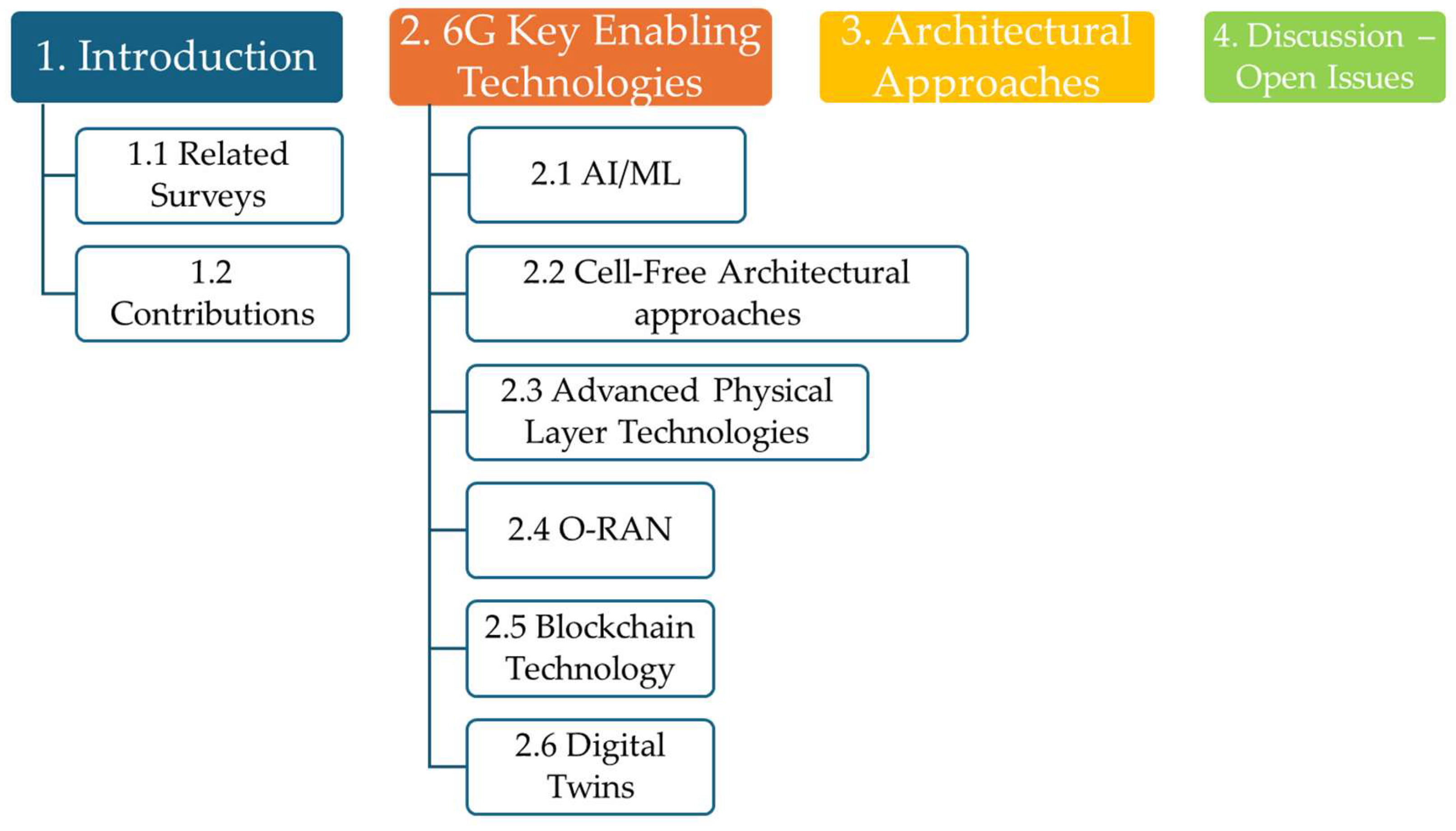
Figure 1. Paper structure.
Preprints 150610 g001
Figure 2. The concept of Federated Learning.
Preprints 150610 g002
Figure 3. The Cell-Free concept.
Preprints 150610 g003
Figure 4. O-RAN Architecture for white-box 6G Networks and the three cases of intelligence loops through rApps, xApps, and dApp.
Preprints 150610 g004
Figure 7. 6G Key Requirements.
Preprints 150610 g007
Figure 8. A high level 6G architectural approach.
Preprints 150610 g008
Figure 9. A conceptual 6G framework.
Preprints 150610 g009
Table 1. Indicative related survey papers on 6G networks.
Related Work Year Topic
[27] 2024 CRAN
[28] 2024 M2M Communications in the 6G era
[29] 2024 Joint Sensing and
Communication in the 6G era
[30] 2024 Key enabling technologies for 6G
Networks - Potentials of AI/ML
[31] 2024 AI-enabled 6G networks
Our work - Current trends in the architectural design of 6G Networks
Table 2. Categorization of indicative presented studies.
Related Work Main Concept 6G Key Enabling Technologies
AI/ML Digital Twins Open interfaces Network Slicing Cell free approaches
[47] Organic 6G networks
[48] Threat prediction and mitigation
[50] Network Slicing
[51] Cell Free Networks
[52] 6G Vision
[53] Open RAN
[54] Multi-layered architecture
[55] 6G multi-layer vision
[57] 6G architectural design based on DTs
[58] Flexible layered architecture
[59] Basic 6G trends
[61] Self-evolving 6G networks
[62] Deep reinforcement learning in 6G networks
[63] Building blocks for 6G
[64] 6G project ANNA
[66] Slicing concept in 6G
[67] 6G for smart cities
[68] 6G for smart cities
[69] 6G for smart cities
[70] Current 6G trends
[71] 6G - PREDICT
[72] Advanced 6G use cases
Disclaimer/Publisher’s Note: The statements, opinions and data contained in all publications are solely those of the individual author(s) and contributor(s) and not of MDPI and/or the editor(s). MDPI and/or the editor(s) disclaim responsibility for any injury to people or property resulting from any ideas, methods, instructions or products referred to in the content.
Copyright: This open access article is published under a Creative Commons CC BY 4.0 license, which permit the free download, distribution, and reuse, provided that the author and preprint are cited in any reuse.
Prerpints.org logo

Preprints.org is a free preprint server supported by MDPI in Basel, Switzerland.

Subscribe

Disclaimer

Terms of Use

Privacy Policy

Privacy Settings

© 2026 MDPI (Basel, Switzerland) unless otherwise stated