
Submitted:
24 February 2025
Posted:
26 February 2025
You are already at the latest version
Abstract
Rapid and precise detection of hydrogen sulfide (H2S) at trace levels is critical for industrial safety and environmental air quality monitoring, yet existing methods often struggle with cost, speed, or sensitivity. We introduce a cost-effective cavity ring-down spectroscopy (CRDS) analyzer featuring a novel digital locking circuit that enables sequential laser-cavity mode matching, achieving fast and accurate H2S detection at parts-per-billion (ppb) levels. Compared to traditional wavelength meters, our system delivers a 140-fold improvement in frequency interval precision (0.07 MHz, 0.02% relative uncertainty). Allan variance analysis under vacuum conditions demonstrates a sensitivity limit of 3×10⁻¹² cm⁻¹ at a 60-s averaging time. Validated through calibrated gas dilution tests, the analyzer detects a 4 ppb H2S absorption signal with a signal-to-noise ratio (SNR) > 6, establishing a 2 ppb detection limit (3σ criterion). This innovative approach meets stringent industrial and environmental requirements, offering a significant advancement in trace gas sensing technology.
Keywords:
cavity ringdown spectroscopy
; hydrogen sulfide
; trace gas detection
1. Introduction
Hydrogen sulfide (H₂S) is a critical trace gas with multifaceted applications spanning biomedical diagnostics, industrial safety, and energy infrastructure monitoring. Its role as a biomarker for pulmonary diseases (e.g., asthma and chronic obstructive pulmonary disease (COPD)) and as a decomposition byproduct of SF₆ insulation gas in high-voltage equipment necessitates ultrasensitive detection at parts-per-billion (ppb) levels [1]. In biomedical applications, H₂S functions as both a food spoilage biomarker via metabolic byproduct analysis and an endogenous gasotransmitter regulating cardiovascular physiology [2]. In respiratory medicine, sub-ppm H₂S concentrations in exhaled breath serve as biomarkers for early diagnosis of pulmonary diseases such as asthma and COPD [3].
The energy infrastructure sector demonstrates another crucial application of H2S monitoring. As a decomposition byproduct of SF6 insulation gas in high-voltage equipment, ppb-level H2S detection provides critical predictive maintenance capabilities. Early identification of minute H2S concentrations enables timely detection of insulation system degradation, thereby preventing catastrophic electrical failures in power transmission networks [4,5].
Industrial applications present particularly demanding challenges for H2S monitoring technology. The thermal power generation industry exemplifies these requirements, where the widespread adoption of low-NOx combustion systems and circulating fluidized bed reactors has significantly elevated ambient H2S concentrations. This heightened presence of reducing gases induces two major operational hazards: accelerated boiler coking/slagging processes and severe high-temperature sulfidation corrosion of water-cooled walls. The latter phenomenon poses particularly grave risks, as progressive wall thinning can culminate in catastrophic tube failures ("bursting"), potentially triggering major industrial accidents [6,7]. These challenges necessitate robust online monitoring systems capable of real-time, ultrasensitive H₂S detection under extreme industrial conditions.
These diverse demands have catalyzed the development of advanced sensing platforms capable of ppb-level sensitivity, high selectivity in multicomponent gas matrices, and resilience under harsh industrial conditions.
Recently, many techniques based on absorption spectroscopy of atoms and molecules in gas phase have been developed in order to achieve a sensitive and accurate measurement of H2S. Tunable diode laser absorption spectroscopy (TDLAS) techniques, including wavelength modulation and Herriot cell designs, have achieved detection limits of 140 ppb [8,9], while quantum cascade laser-based systems report 1.5 ppm sensitivity [10]. Fabry Perot (FP) interferometer is often used due to its excellent sensitivity and accuracy, and it also has been applied to detect low concentrations of H2S [11,12]. In terms of quartz enhanced photoacoustic spectroscopy (QEPAS), near-infrared QEPAS H2S sensors that can achieve ppm level H2S detection limits have been developed by some research teams [13,14,15]. Wu et al. achieved a detection limit of 142 ppb for H2S in the 1582nm band using an enhanced near infrared QEPAS sensor [16]. A detection limit of 10 ppb for H2S using double resonant photoacoustic spectroscopy with line locking has been achieved by Zhang’s group [17]. In terms of off-axis integrated cavity output spectroscopy, Tian et al and Chen et al. have achieved a detection limit of 150 ppb for H2S [18,19]. Despite advancements, existing CRDS systems face limitations in spectral acquisition speed and field-deployment robustness. For instance, Siciliani de Cumis et al. reported a 105 ppb detection limit with conventional CRDS, highlighting the need for enhanced sensitivity [20]. Jiang et al. achieved a detection limit of 4.44 ppb for H2S in SF6 gas using CRDS technology [21].
This study tackles these deficiencies by designing a miniaturized cavity ring-down spectroscopy (CRDS) system that integrates hybrid scanning algorithms and achieves sub-millikelvin (sub-mK) thermal stability, enabling parts-per-billion (ppb)-level detection of hydrogen sulfide (H₂S) in challenging and harsh environmental conditions. The proposed system overcomes limitations in sensitivity, portability, and robustness found in conventional approaches, offering a compact and efficient solution for trace gas monitoring. The structure of the paper is organized as follows: Section 2 details the instrumentation and methodology, outlining the technical framework and experimental setup; Section 3 presents the results, providing a comprehensive analysis of the system’s performance; and the final section offers a conclusion and discussion, synthesizing key findings, implications, and potential avenues for future research.
2. Experimental Setup and Method
2.1. Experimental Setup
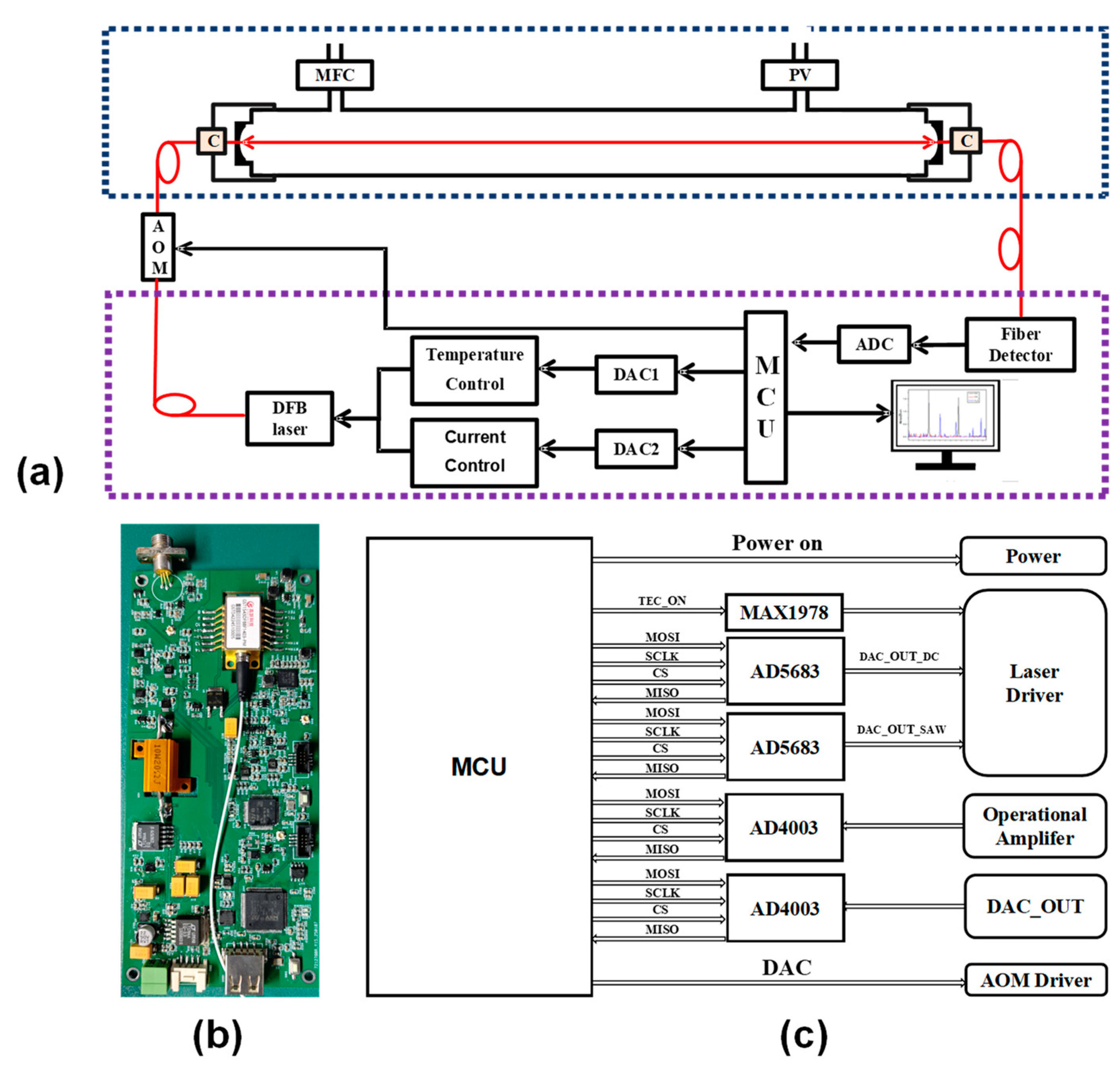
As illustrated in the schematic diagram of the cavity ring-down spectroscopy (CRDS) system, The DFB laser (GyScienTech, GST1574DFBBF1413-PM) emits a wavelength-tunable beam modulated by an acousto-optic modulator (AOM). The modulated light is coupled into a quartz ring-down cavity (effective optical path: 660 mm; baseline ring-down time: 191.5 µs at 25.0 kPa vacuum) via single-mode polarization maintaining fiber.
To ensure measurement stability, the cavity is housed in a dual-control environmental chamber: (1) A PID-controlled thermal module maintains temperature at 45.000 ± 0.005°C, and (2) a mass flow controller regulates gas flow (200 sccm ±0.01 sccm) and cavity pressure (25,000 Pa ±2 Pa).
Wavelength selection is controlled by a microcontroller unit (STM32H743) interfaced with a 16-bit digital-to-analog converter (AD5683, Analog Devices), which modulates the laser’s temperature and injection current. The amplified photodetector output is digitized using an 18-bit analog-to-digital converter (Analog Devices, AD4003) at a sampling rate of 2 MSPS, ensuring high-fidelity ring-down waveform capture. Upon threshold detection, the MCU generates a TTL signal to deactivate the AOM, ensuring optimal ring-down waveform acquisition. Following acquisition of complete ring-down waveforms, the MCU transmits spectral data to a host computer for real-time concentration inversion and graphical display via custom-developed algorithms.
Figure 1.
Schematic of the cavity ring down spectroscopy analyzer (CRDS) for H2S detection. (a~c) details of the miniaturized H2S CRDS system.
Figure 1.
Schematic of the cavity ring down spectroscopy analyzer (CRDS) for H2S detection. (a~c) details of the miniaturized H2S CRDS system.
2.2. Spectral Scan Method
The longitudinal modes of the ring-down cavity serve as precise frequency markers, with their frequencies expressed as:
where N is the mode order and FSR is the free spectral range. Enhanced FSR stability is achieved through two key measures: (1) employing low-expansion-coefficient materials (high-purity quartz in this work) and (2) implementing precision temperature control. Here, corresponds to the fundamental mode frequency (N=0) and specifies the Nth-order mode frequency.
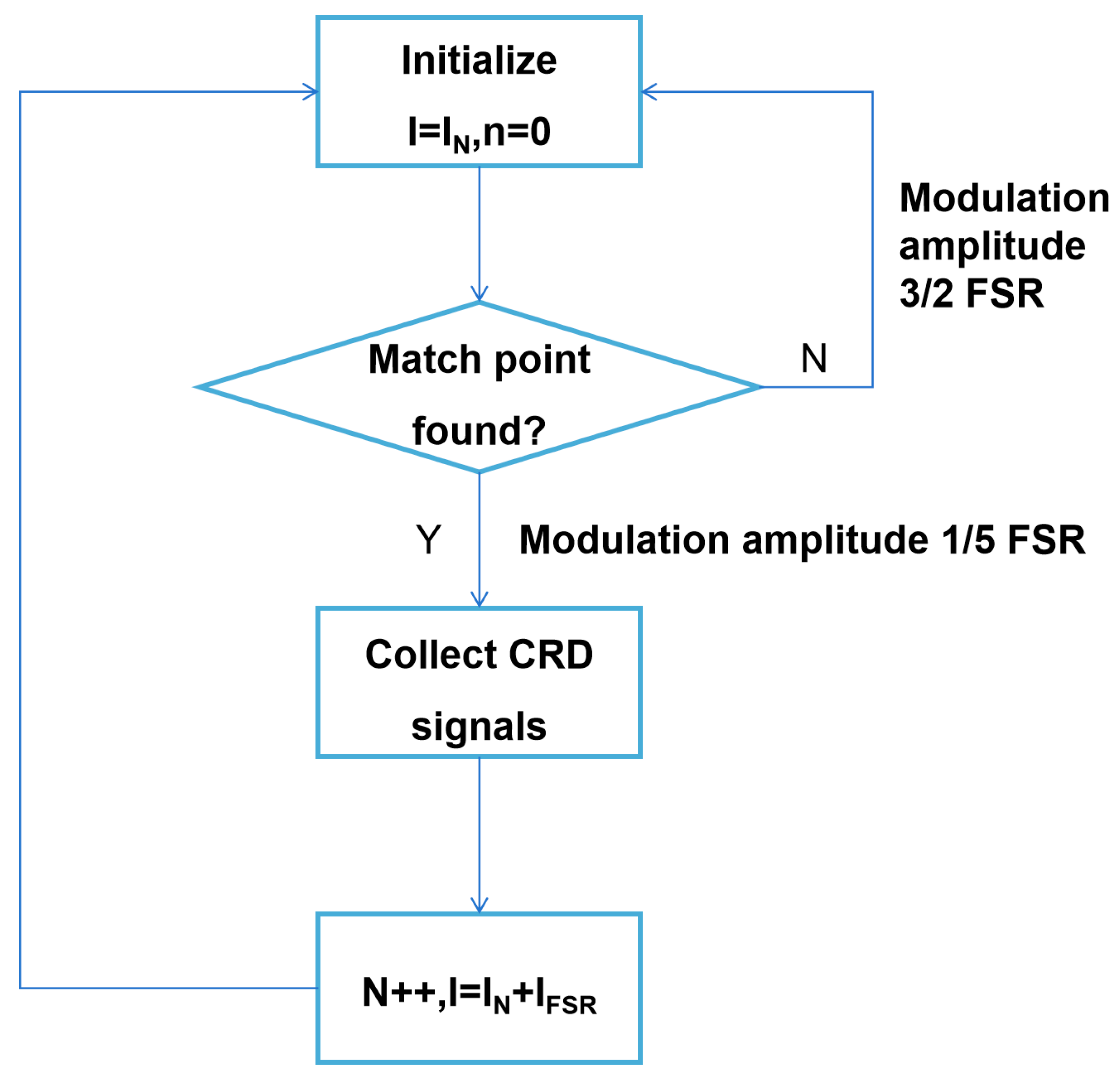
While sequential matching of cavity modes could theoretically enable complete spectral acquisition, practical limitations arise from laser current-wavelength nonlinearities and frequency instability. Our previous digital locking schemes [22,23,24,25] improved mode matching efficiency but exhibited prolonged relocking durations (>10 s) following unexpected disturbances. To address this limitation, we developed a hybrid scanning strategy combining wide-range searching (3/2 FSR span) with narrow-band locking (1/5 FSR modulation), achieving spectral acquisition within 3-5s. The operational workflow (see schematic diagram) comprises:
- Coarse Search Phase: Detect mode-matching conditions through 3/2 FSR scanning.
- Precision Locking Phase: Apply 1/5 FSR modulation for stabilized measurements.
- Fault Recovery: Reinitiate searching mode if no ring-down signal is detected within 0.1 s.
This adaptive approach maintains measurement continuity while preventing prolonged system downtime from transient disturbances.
Figure 2.
Control diagram for a strict mode-by-mode scan.
3. Results
3.1. Self-Calibration of the Spectrum
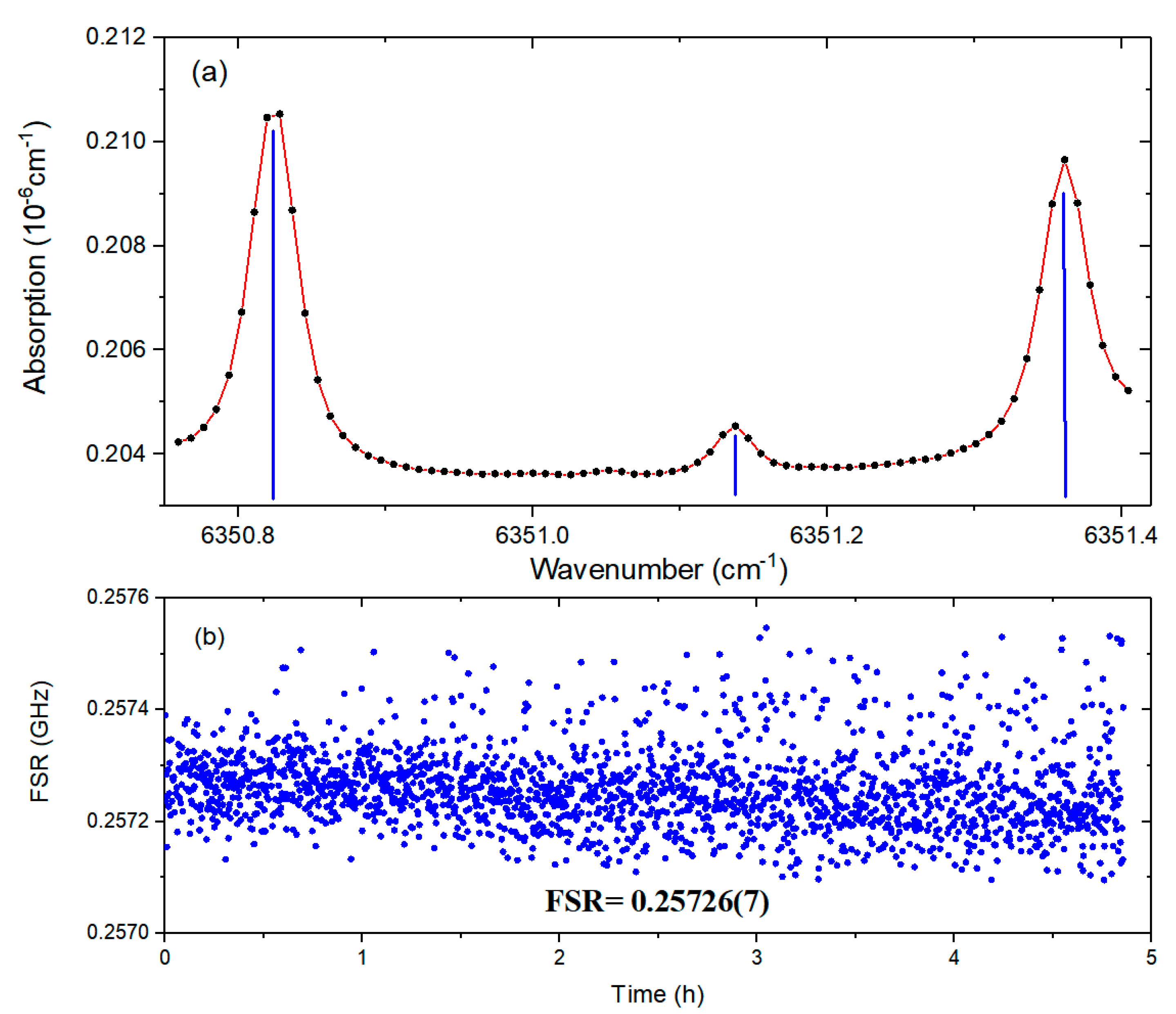
To assess the accuracy of the longitudinal mode frequency comb, we conducted continuous spectral measurements of H2S absorption features near 1574.554 nm over a 5-hour period. Through multi-peak fitting analysis, we determined the relative positions of three characteristic absorption peaks. These measured peak positions were then correlated with reference wavelengths from the HITRAN database using linear regression analysis. The slope of the fitted curve yielded the free spectral range (FSR) of 257.26 ± 0.07 MHz.
The measurement precision was further evaluated through statistical analysis of 76 discrete spectral data points. The maximum potential relative error for any individual point is theoretically 1/76 (1.31%). However, as shown in Figure 3(b), the observed maximum relative deviation was only 0.18%, demonstrating two critical findings:
- The scanning methodology achieved complete spectral coverage without missing data points.
- The measurement precision significantly exceeded the theoretical minimum requirement.
This exceptional performance validates the robustness of our hybrid scanning approach and the stability of the frequency comb reference.
Figure 3.
(a) Absorption spectrum of H₂S near 6351.0 cm⁻¹ at 250 kPa. (b) Statistical distribution of FSR measurements over 5-hour continuous measurement.
Figure 3.
(a) Absorption spectrum of H₂S near 6351.0 cm⁻¹ at 250 kPa. (b) Statistical distribution of FSR measurements over 5-hour continuous measurement.
3.2. Sensitivity, Detection Limit, and Response Time
Sensitivity, defined as the minimum resolvable concentration variation of the instrument, is governed by three critical parameters: (1) the signal-to-noise ratio (SNR) of the detection system, (2) the quality factor (Q-value) of the optical cavity, and (3) the stability of the laser source. Allan variance analysis, which evaluates the evolution of signal noise as a function of integration time, serves as a robust tool to determine the optimal integration time and derive the minimum detection limit (MDL)—the lowest H₂S concentration that can be reliably identified at a specified confidence level. Compared to conventional noise analysis methods, Allan variance provides distinct advantages:
- Noise Discrimination: Differentiates contributions from white noise, flicker noise, and other noise types.
- Detection Limit Optimization: Enables significant reduction of MDL through systematic integration time tuning.
- Long-Term Stability Quantification: Offers a quantitative framework for assessing system performance in trace gas detection applications.
To evaluate the detection capability of our system, we performed continuous measurements of cavity ring-down time variations at a fixed wavelength within the H₂S absorption band (1574.554 nm) under vacuum conditions (Figure 4a). Allan variance analysis revealed a minimum detectable absorption coefficient of 3×10⁻¹² cm⁻¹ at 60-s integration (Figure 4b), corresponding to 0.2 ppb H₂S concentration fluctuations—surpassing the sensitivity of prior CRDS systems. This performance highlights the exceptional stability and precision of the developed CRDS system.
Figure 4.
Cavity loss (1∕cτ) of an empty RD cavity (upper panel) and the Allan deviation (lower panel).
Figure 4.
Cavity loss (1∕cτ) of an empty RD cavity (upper panel) and the Allan deviation (lower panel).

To establish a controlled low-concentration H2S environment, we implemented a dynamic dilution protocol using certified 4 ppm H2S/air mixture. The experimental sequence comprised:
- Initial Conditioning: Purging the cavity with 4 ppm H2S reference gas
- Dynamic Dilution: Continuous air injection at constant flow (200 sccm) and pressure (25,000 Pa)
- Signal Processing: Application of moving average filtering (3 s per spectrum, 100-point window) for enhanced measurement precision
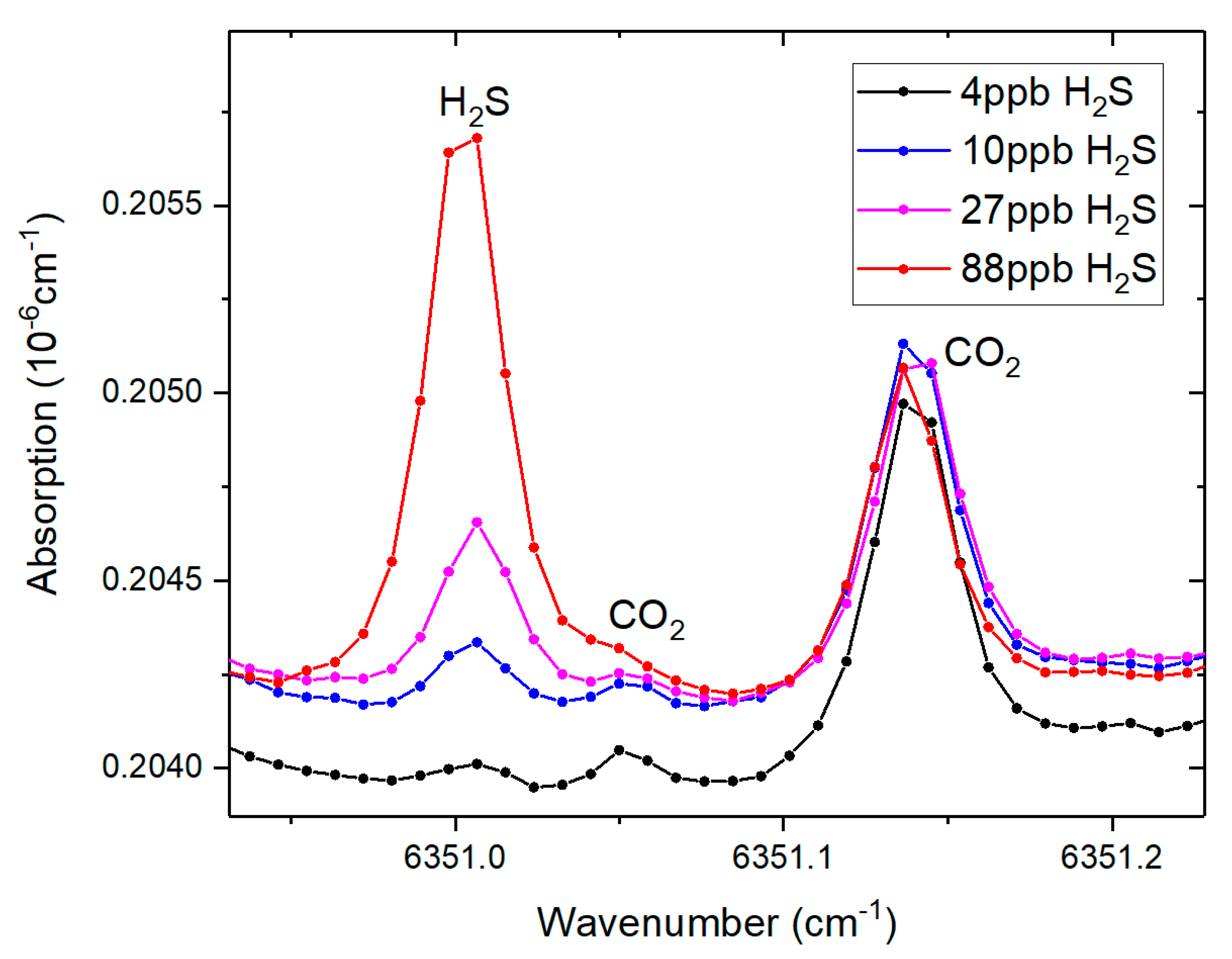
As illustrated in Figure 5, a dynamic dilution system employing purified air was utilized to systematically attenuate hydrogen sulfide (H2S) standard gas at a constant flow rate of 200 standard cubic centimeters per minute (sccm). The experimentally monitored temporal concentration profile demonstrated sequential attenuation characteristics: The H2S concentration decreased from an initial 4 ppm to 88 ppb after 10 minutes of continuous dilution, followed by subsequent reductions to 27 ppb at 20 minutes, 10 ppb at 30 minutes, and ultimately reaching 4 ppb after 45 minutes of operation.
The absorption spectra exhibited a signal-to-noise ratio (SNR) exceeding 6 across the tested concentration range (4–80 ppb), validating the system’s robustness for trace-level quantification under dynamic dilution conditions. Applying the 3σ detection criterion, the system achieves a practical detection limit of 2 ppb in ambient air, validating its capability for air trace gas monitoring applications.
Figure 5.
Temporal profile of H₂S concentration during dynamic dilution tests. The concentration decreased from 80 ppb to 4 ppb over 45 minutes, with absorption spectra recorded at each dilution step.
Figure 5.
Temporal profile of H₂S concentration during dynamic dilution tests. The concentration decreased from 80 ppb to 4 ppb over 45 minutes, with absorption spectra recorded at each dilution step.
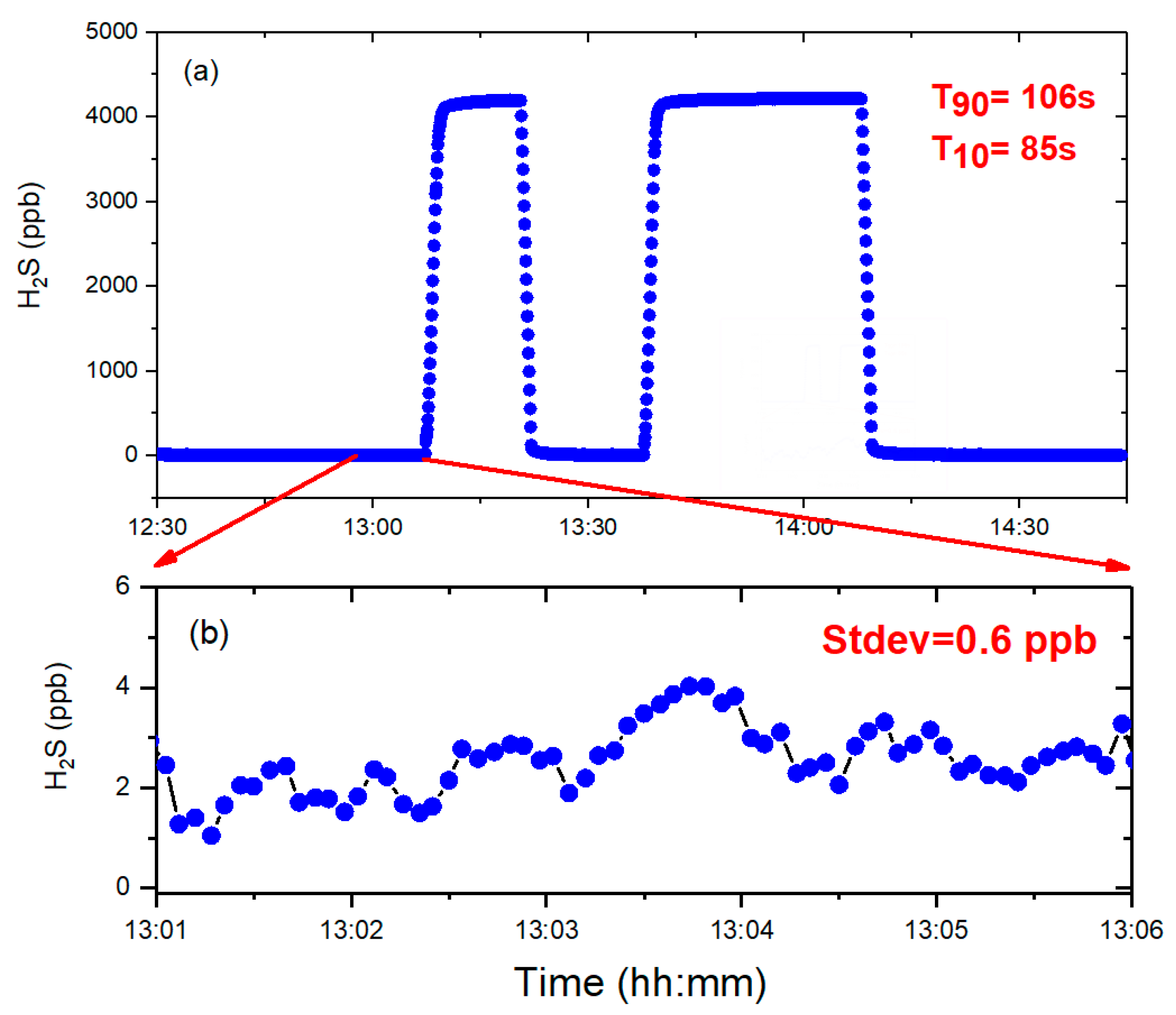
Instrument response characterization was conducted through a gas-switching methodology employing H2S standard gas and high-purity nitrogen (N2). This protocol was implemented to determine the temporal response characteristics and establish the detection limits under standardized gas conditions.
The temporal resolution was quantitatively evaluated using two critical parameters: T90 and T10 response times. Operational definitions:
- T90: Duration required for sensor output to reach 90% of nominal value during transition from high-purity N2 to calibrated H2S concentration.
- T10: Time elapsed for signal decay to 10% of initial value when switching from H2S standard gas back to high-purity N2.
As shown in Figure 6, the system exhibited a T90 response time of 106 s and a T10 recovery time of 85 s, reflecting efficient gas-switching dynamics. Subsequent statistical analysis of the baseline signal following prolonged N2 purging revealed a standard deviation of 0.6 ppb for H2S concentrations, corresponding to a measurement precision of 0.6 ppb. Using the conventional three-sigma criterion, the instrument demonstrated a detection limit of 1.8 ppb.
Figure 6.
Temporal response of the CRDS system during gas-switching cycles between 4 ppm H₂S and N₂, showing T₉₀ = 106 s and T₁₀ = 85 s.
Figure 6.
Temporal response of the CRDS system during gas-switching cycles between 4 ppm H₂S and N₂, showing T₉₀ = 106 s and T₁₀ = 85 s.
4. Conclusions and Discussion
This study introduces a low-cost, high-precision cavity ring-down spectroscopy (CRDS) analyzer tailored for trace hydrogen sulfide (H2S) detection, addressing the pressing need for sensitive, affordable, and field-deployable gas sensing technologies. The system integrates a novel digital locking circuit within a compact, embedded platform that seamlessly combines laser frequency stabilization, ring-down signal detection, amplification, data acquisition, exponential fitting, and real-time data transmission. Spectral analysis and visualization are efficiently handled by a dedicated microcomputer, streamlining the operational workflow. By adopting an all-polarization-maintaining-fiber configuration, the design eliminates free-space optical components, enhancing mechanical stability and reducing maintenance demands. The resulting analyzer, with dimensions of 48 cm × 22 cm × 95 cm and a power consumption of 70 W, offers a practical solution for both laboratory and field applications..
A standout feature of this system is its exceptional sensitivity, achieving a detection limit of 2 ppb for H2S—representing a 52.5-fold improvement over the 105 ppb limit of existing field-deployable CRDS systems [20]. This leap in performance stems from two key innovations: a hybrid scanning algorithm that optimizes laser-cavity mode alignment and a thermally stabilized cavity (±0.005 °C) that minimizes frequency drift. The detection scheme exploits the stable longitudinal modes of the ring-down cavity as an intrinsic frequency comb, paired with a novel digital locking algorithm that sequentially aligns the laser frequency to individual cavity modes with unprecedented precision. A 5-hour characterization of the free spectral range (FSR) demonstrated a frequency precision of 0.07 MHz (relative precision: 0.02%), far surpassing the ~10 MHz resolution of conventional wavelength meters. This advancement not only enhances the accuracy of H2S absorption line measurements but also sets a new benchmark for frequency stabilization in CRDS systems.
Sensitivity assessments further underscore the system’s capabilities. Allan variance analysis of cavity ring-down times under vacuum conditions revealed a minimum detectable absorption coefficient of 3×10⁻¹² cm⁻¹ at a 60-s integration time, reflecting the analyzer’s ability to detect ultra-low gas concentrations with high stability. Field deployment validated its real-world efficacy, achieving a detection limit below 2 ppb for atmospheric H2S with a T90 response time of 106 s and a signal-to-noise ratio (SNR) exceeding 6 for a 4 ppb signal. These metrics fulfill stringent requirements for industrial safety protocols and environmental air quality monitoring, where rapid and reliable detection of trace H2S is paramount.
The modular design of this CRDS analyzer enhances its versatility, positioning it as a scalable platform for monitoring multiple greenhouse gases and polar molecules beyond H2S. The incorporation of adsorption-resistant modifications—such as specialized coatings or materials—mitigates signal degradation caused by gas adhesion to cavity surfaces, a common challenge in trace gas sensing. Preliminary tests suggest that, with targeted surface modifications, the system could be adapted for real-time detection of species like ammonia (NH₃) and water vapor (H₂O) [26,27], expanding its utility in climate research, agricultural monitoring, and industrial process control. The compact footprint, low power consumption, and cost-effective architecture further distinguish this platform from bulkier, more resource-intensive alternatives, making it an attractive option for widespread deployment.
Despite these achievements, opportunities for refinement remain. The T90 response time of 106 s, while adequate for many applications, could be reduced through faster signal processing or enhanced cavity flushing mechanisms to meet the demands of dynamic, high-throughput environments. Additionally, while the current design excels in controlled settings, its performance under variable humidity, temperature, or pressure conditions warrants further investigation to ensure robustness across diverse field scenarios. Future work could also explore integrating multi-wavelength capabilities to simultaneously detect multiple gas species, amplifying the system’s analytical power.
In summary, this work demonstrates a transformative approach to CRDS-based trace gas detection, blending affordability, precision, and adaptability into a single platform. By leveraging innovative digital locking techniques and a streamlined optical design, the analyzer not only outperforms existing systems in H2S detection but also lays the groundwork for broader applications in environmental and industrial monitoring. These advancements herald a step forward in the evolution of portable, high-sensitivity spectroscopy tools, with significant potential to address emerging challenges in gas sensing technology.
Author Contributions
Conceptualization, W.X. and X.W.; methodology, W.X. and B.C.; software, J.Z.; validation, L.Z. and X.W.; formal analysis, W.X.; investigation, J.Z.; writing—original draft preparation, W.X.; writing—review and editing, B.C. All authors have read and agreed to the published version of the manuscript.
Funding
This research was funded by the National Natural Science Foundation of China (41901081).
Conflicts of Interest
The authors declare no conflict of interest.
References
- Wang, R. Physiological implications of hydrogen sulfide: a whiff exploration that blossomed. Physiol. Rev. 2012, 92, 791-896.
- Kimura, H. Hydrogen sulfide as a neuromodulator. Mol. Neurobiol. 2002, 26, 13-19.
- Suzuki, Y.; Saito, J.; Munakata, M.; Shibata, Y. Hydrogen sulfide as a novel biomarker of asthma and chronic obstructive pulmonary disease. Allergol. Int. 2021, 70, 181-189.
- Lv, H.; Zhang, X.; Jiang A.; Qian, W.; Zhang, C.; Zhang, X. Detection of SF6 decomposition components H2S and CO2 based on WDM and CRDS. IEEE Trans. Dielectr. Electr. Insul. 2024, 31, 2922-2929.
- Gao, R.; Zhu, M.; Zhang, C. The uncertainty evaluation of determining the trace H2S in SF6/N2 insulating gas mixture by cavity ring-down spectroscopy. J. Phys.: Conf. Ser. 2024, 2774, 012030.
- Sun, X.; Ning, Y.; Yang, J.; Zhao, Y.; Yang, Z.; Zhou, X. Study on high temperature corrosion mechanism of water wall tubes of 350 MW supercritical unit. Eng. Fail. Anal. 2021, 121, 105131.
- Wang, Y.; Li, L.; Wang, M.; Tan, H.; Zhang, S. Effect of ZnS/PbS deposits on high temperature corrosion of watewall tubes in reducing atmosphere. Fuel Process. Technol. 2021, 216, 106793.
- Guo, Y.; Qiu, X.; Li, N.; Feng, S.; Cheng, T.; Liu, Q.; He, Q.; Kan, R.; Yang, H.; Li, C. A portable laser-based sensor for detecting H2S in domestic natural gas. Infrared Phys. Techn. 2020, 105, 103153.
- Xia, H.; Dong, F.; Wu, B.; Zhang, Z.; Pang, T.; Sun, P.; Cui, X.; Han, L.; Wang, Y. Sensitive absorption measurements of hydrogen sulfide at 1.578 μm using wavelength modulation spectroscopy. Chinese Phys. B 2015, 24, 034204.
- Moser, H.; Genner, A.; Ofner, J.; Schwarzer, C.; Strasser, G.; Lendl, B. Application of a ring cavity surface emitting quantum cascade laser (RCSE-QCL) on the measurement of H2S in a CH4 matrix for process analytics. Opt. Express 2016, 24, 6572-6585.
- Chu, Y.; Alshammari, M.; Wang, X.; Han, M. Angle-tunable method for optimizing rear reflectance in Fabry–Perot interferometers and its application in fiber-optic ultrasound sensing. Photonics 2024, 11, 1100.
- Kitture, R.; Pawar, D.; Rao, Ch.N.; Choubey, R.K.; Kale, S.N. Nanocomposite modified optical fiber: A room temperature, selective H2S gas sensor: Studies using ZnO-PMMA. J. Alloy. Compd. 2017, 695, 2091-2096.
- Viciani, S.; Siciliani de Cumis, M.; Borri, S.; Patimisco, P.; Sampaolo, A.; Scamarcio, G.; De Natale, P.; D’Amato, F.; Spagnolo, V. A quartz-enhanced photoacoustic sensor for H2S trace-gas detection at 2.6 μm. Appl. Phys. B 2015, 119, 21-27.
- Wu, H.; Sampaolo, A.; Dong, L.; Patimisco, P.; Liu, X.; Zheng, H.; Yin, X.; Ma, W.; Zhang, L.; Yin, W.; Spagnolo, V.; Jia, S.; Tittel, F. K. Quartz enhanced photoacoustic H2S gas sensor based on a fiber-amplifier source and a custom tuning fork with large prong spacing. Appl. Phys. Lett. 2015, 107, 111104.
- Olivieri, M.; Menduni, G.; Giglio, M.; Sampaolo, A.; Patimisco, P.; Wu, H.; Dong, L.; Spagnolo, V. Characterization of H2S QEPAS detection in methane-based gas leaks dispersed into environment. Photoacoustics, 2023, 29, 100438.
- Wu, H.; Dong, L.; Zheng, H.; Liu, X.; Yin, X.; Ma, W.; Zhang, L.; Yin, W.; Jia, S.; Tittel, F. K. Enhanced near-infrared QEPAS sensor for sub-ppm level H2S detection by means of a fiber amplified 1582 nm DFB laser. Sensor. Actuat. B: Chem. 2015, 221, 666-672.
- Zhang, H.; Wang, Z.; Wang, Q.; Borri, S.; Galli, I.; Sampaolo, A.; Patimisco, P.; Spagnolo, V.L.; Natale, P.D.; Ren, W. Parts-per-billion-level detection of hydrogen sulfide based on doubly resonant photoacoustic spectroscopy with line-locking. Photoacoustics 2023, 29, 100436.
- Tian, X.; Cheng, G.; Cao, Y.; Chen, J.; Liu, K.; Gao, X. Simultaneous detection of hydrogen sulfide and carbon dioxide based on off-axis integrated cavity output spectroscopy using a near-infrared distributed feedback diode laser. Microw. Opt. Techn. Let. 2021, 63, 2074-2078.
- Chen, W.; Kosterev, A. A.; Tittel, F. K.; Gao, X.; Zhao, W. H2S trace concentration measurements using off-axis integrated cavity output spectroscopy in the near-infrared. Appl. Phys. B 2008, 90, 311-315.
- Siciliani de Cumis, M.; Viciani, S.; Galli, I.; Mazzotti, D.; Sorci, F.; Severi, M. Note: An analyzer for field detection of H2S by using cavity ring-down at 1.57 µm. Rev. Sci. Instrum. 2015, 86, 056108.
- Jiang, A.; Zhang, C.; Zhu, M.; Zhang X. Detection of characteristic component H2S in SF6 and SF6/N2 mixture using cavity ring-down spectroscopy. High Volt. 2024, 1–7.
- Chen, B.; Sun, Y. R.; Zhou, Z.; Chen, J.; Liu, A.; Hu, S. Ultrasensitive, self-calibrated cavity ring-down spectrometer for quantitative trace gas analysis. Appl. Optics 2014, 53, 7716-7723.
- Ma, G.; He, Y.; Chen, B.; Deng, H.; Liu, Y.; Wang, X.; Zhao, Z.; Kan, R. Quasi-simultaneous sensitive detection of two gas species by cavity-ringdown spectroscopy with two lasers. Sensors 2021, 21, 7622.
- Hu M.; Chen, B.; Yao, L.; Yang, C.; Chen X.; Kan, R. A fiber-integrated CRDS sensor for in-situ measurement of dissolved carbon dioxide in seawater. Sensors 2021, 21, 6436.
- Yuan, F.; Hu, M.; He, Y.; Chen, B.; Yao, L.; Xu, Z.; Kan, R. Development of an in-situ analysis system for methane dissolved in seawater based on cavity ringdown spectroscopy. Rev. Sci. Instrum. 2020, 91, 083106.
- Gadedjisso-Tossou, K.S.; Stoychev, L.I.; Mohou, M.A.; Cabrera, H.; Niemela, J.; Danailov, M.B.; Vacchi, A. Cavity ring-down spectroscopy for molecular trace gas detection using a pulsed DFB QCL emitting at 6.8 µm. Photonics 2020, 7, 74.
- Chen, B.; Kang, P.; Li, J.; He, X.; Liu, A.; Hu, S. Quantitative moisture measurement with a cavity ring-down spectrometer using telecom diode lasers. Chinese J. Chem. Phys. 2015, 28, 6-10.
Disclaimer/Publisher’s Note: The statements, opinions and data contained in all publications are solely those of the individual author(s) and contributor(s) and not of MDPI and/or the editor(s). MDPI and/or the editor(s) disclaim responsibility for any injury to people or property resulting from any ideas, methods, instructions or products referred to in the content. |
© 2025 by the authors. Licensee MDPI, Basel, Switzerland. This article is an open access article distributed under the terms and conditions of the Creative Commons Attribution (CC BY) license (http://creativecommons.org/licenses/by/4.0/).
Copyright: This open access article is published under a Creative Commons CC BY 4.0 license, which permit the free download, distribution, and reuse, provided that the author and preprint are cited in any reuse.


