
Submitted:
24 February 2025
Posted:
24 February 2025
You are already at the latest version
Abstract
The modern business world demands responsiveness and adaptability, particularly in logistics and e-commerce. Şölen, as a leading Turkish candy company, is faced with order fulfillment, tracking, customer feedback, and inventory management issues that impede its efficiency and future growth opportunities. This paper outlines a digitalization strategy for Şölen's Malaysian business unit focusing on the incorporation of e-commerce, real-time delivery tracking, automated inventory management, and customer support enhancement. Through utilizing cloud-based technology, artificial intelligence, and GPS tracking systems, the study offers solutions for optimizing logistics, improving customer satisfaction, and raising the overall efficiency in operations. Utilizing these technologies will be expected to transform Şölen as a competitive player in the evolving global market.
Keywords:
Şölen
; GPS tracking
; systems
; global
; market
Introduction
The rapid evolution of technology has transformed the way business is done worldwide. Companies that lag behind in the evolution stand to lose their market share, for instance, the demise of industry players like Blockbuster. Digital transformation is no longer optional but necessary for companies to continue enjoying a competitive edge. Particularly in the food and confectionery industry, where efficiency, customer satisfaction, and streamlined logistics play a huge role in sustaining growth[1,2].
Şölen, a Turkish confectionery company established in 1989, has managed to set up its operations in over 100 countries. Entering the Malaysian market, several operating inefficiencies have been found. Lack of an e-commerce platform, inefficient order tracking, an underdeveloped feedback system, and manual inventory tracking are major issues that impact the efficiency of the company. These issues not only impact customer experience but also cause logistic bottlenecks, limiting the scalability of the company[3,4,5,6,7,8].
In order to surmount these challenges, this study proposes a digital transformation plan for Şölen's business in Malaysia. The addition of an e-commerce website, AI-powered customer service, GPS-based tracking, and automated inventory management solutions are the key components of this plan. These solutions will enhance operational efficiency, order fulfillment simplification, and customer satisfaction.
The essay will cover the current problems of Şölen, examine current best practices in the industry, and recommend technological solutions in accordance with the firm's long-term business development objectives. By taking these actions, Şölen will be in a position to become a market leader in the confectionery industry, thus ensuring competitiveness and sustainability in an increasingly digitalized world[9].
1. Background Information
Established in Gaziantep in 1989, Şölen is a Turkish company manufacturing confectionery, primarily sweets and chocolate. With a portfolio of products encompassing snacks, children's items and gifts, Şölen has been incredibly successful in international markets, exporting its products to approximately 103 countries worldwide. Indeed, our internal business analysis of the company revealed several areas that may be impacting its performance.
Order fulfillment issues have been a contributing factor in the performance of the company. Lack of an effective tracking system has created discernment among customers and the site that is difficult to navigate has created unnecessary frustration. To ensure customer satisfaction and long-term prosperity, urgent action needs to be taken in resolving these issues[10,11,12].
2. Problem Statement
2.1. Lack of Ecommerce
In today's largely online economy, Şölen has a major disadvantage by not having an E-commerce system. Their present system of having to place orders over the phone is cumbersome and out-of-date.
The company will also find it much harder to obtain new customers. since the majority of people will likely be idle to dial the company because we are in a period of the internet where easy access is the priority. Though telephone ordering is still up to date, its usage is diminishing with more and more clients choosing the comfort of shopping online. The shift to online shopping is a reflection of how technology has evolved to become essential in today's world.[13]
Since the majority of customers favor businesses that are easily accessible online, Şölen will probably not be able to gain new potential clients without an easy-to-use ecommerce website. Time-consuming ordering processes, like the need to phone in an order, could deter potential customers and result in missed sales opportunities. An e-commerce system implementation would improve client accessibility, speed up the purchasing process, and eventually increase sales. Also, Şölen usually only sell their products Business-to-business or in bulk. Even though the company has an online shop these days, they can do both, and Business-to-business-to-customer too. If the customer orders a small quantity or bulk quantity, the products could be sent to them, which might increase the potential profit margin of the company[14,15].
2.2. Lack of a Feedback Channel
Poor communication is a major obstacle for businesses, especially when it comes to having positive client relations. Customer satisfaction can be greatly diminished by problems like insufficient contact information, hidden contact information, or trouble in contacting the appropriate department. providing them with all the information, they would need to track their parcel's status and provide them with a area to write down their feedback about the product and the service which will allow the company to keep track and fix the problems within their system, and since this company is going to launch Business-to-Consumer marketing sales, they must establish a new communication system to get in touch with their customers more effectively.
2.3. Customer Service is an Essential Aspect of Business Operations Since It Can Forestall Lost Revenue and Sales, Therefore Client Service Should Be the Primary Concern of a Successful Business. This Entails Response to Inquiries Prior to Sales, Customer Instruction by Providing Step-by-Step Instructions for Package Tracking, and a System for Customer Feedback [16]. Product Delivery
The problem it presents is a common one all retail businesses confront every day: a lack of driver location tracing and notification to clients of updated delivery status. The problem, commonly underaddressed in huge logistics companies, carries with it an array of severe risks and hazards, namely product loss to theft, litigations resultant from worker accidents, and incremental delivery costs incurred through lost orders. The company's failure to manage its fleet and recover stolen vehicles is exacerbated by a lack of tracking technologies. Developing a system that supports two-way communication which can allow the company to make any adjustment such as route change of delivery, scheduling a new pick up on the same route is also a problem that can arise.[17,18,19]
2.4. Manual Management of Goods
Shipping products of shorter shelf life to customers has caused massive losses for the company, involving loss of goods, time, and customer relationships. Secondly, failing to control expiry dates involves loss of goods since expired products have to be disposed of, which causes monetary losses and degrades the sustainability image of the company. In addition, delivering products with short shelf lives loses time, involving extra effort in replacing the products, which involves inefficiency in the logistics process. Moreover, late deliveries as a consequence of this problem can undermine customer confidence and even lead to losing precious customers, hurting the reputation of the business and causing potential breaches of contracts. The root cause of these problems is manual handling of stock and goods, where human errors such as miscounts or incorrect recording of expiry dates[20,21,22,23].
3. Proposed Methodology
In order to address the problems facing Şölen in Malaysia, this study applies a systematic approach that integrates technological instruments with process optimization. The research is implemented utilizing the mixed-methods research approach, which incorporates qualitative data from interviews with stakeholders and quantitative data from operational data[24,25,26]. An initial needs analysis will be conducted by gathering primary data through structured interviews with key stakeholders like sales and marketing managers, logistics personnel, and IT specialists. This qualitative data will provide an indication of existing operational inefficiencies, customer complaints, and logistical constraints.
This will be followed by a benchmarking study where the current practice at Şölen will be compared to industry leaders in confectionary and online business trade. Industry giants in areas such as Lindt & Sprüngli, Ferrero, and Hershey's will be explored in terms of best practices in supply chain management, electronic customer relationships, and automatic stocks. Comparative analysis will indicate best-proven best practices that can be transferred to the mode of operations at Şölen.
The technological integration and system design will be the second stage, where the solutions such as an e-commerce website, AI customer service, real-time tracking of deliveries, and an automated inventory management system will be determined. The study will develop a plan for implementation with details regarding the architecture, security, and scalability of the systems. Cloud computing solutions, with emphasis on AWS, will be investigated to host the e-commerce as well as the logistics tracking systems. Also, AI-powered chatbots[27,28,29] and feedback systems will be used to enhance customer engagement.
A pilot run will be conducted in some operational areas to confirm the testing of the effect of the suggested solutions. KPIs such as order processing time, customer satisfaction ratio, and delivery efficiency will be monitored before and after implementation. The findings will be compared to measure the effect of the digital transformation activities. Finally, cost analysis will analyze the cost implications, scalability, and ROI of proposed solutions. The research will conclude with an actionable set of recommendations, indicating phased rollout for large-scale implementation across Şölen's Malaysian operations. The methodology ensures that the proposed digital transformation is data-driven, cost-effective, and aligned with industry best practices, thus positioning Şölen for sustainable growth in the digital economy[30,31,32,33].
3. Solutions
3.1. Ensuring The Tracking and Monitoring of The Delivery Process
By placing GPS gear inside the automobiles or connecting it to the cars entertainment system, the system harnesses GPS ability. These machines use a system known as "triangulation" or "trilateration" to communicate with three or four satellites. Simply put, one of the satellites helps guess the location of the GPS unit by sending out signals in all directions until the device receives them.
Figure 2.
Diagram showing how GPS Receivers work.

After the device is located, satellite, cell network, etc. data transmission is used to send the information to a primary server or cloud interface. An intuitive mobile application for logistics accomplishes this data availability later. The technology goal is to promote customer support and logistical management by enabling real-time geo location tracking.
While using the GPS system, the delivery timings—like the ETA, routes, and deviations—would be taken into consideration. Above all, the system's flexibility would be most valued. This is possible through real-time tracking and intelligent route control, which can generate new routes in real time for any change or live adjustment in the event of poor weather, traffic, road accidents, etc.
In addition, the optimal routes that save on costs are implemented taking into consideration fuel, tolls, and road hazards. The administrator receives the latest updates from the system's real-time monitoring system and is the central recipient of alerts. The procedure has the merit of being successful in decreasing delivery delay time, discouraging idlers, and tracking the delivery personnel. Responsive to the delivery personnel, the system is presented with an integrated chronology, which easily records the deliveries made on the same day. Delivery locations on the schedule are indicated by checkpoints, and color-coding representing delivery status, green for done, red for delayed which in turn alerts managers and delivery drivers to any problems.
The GPS and timeline work together to automatically adjust the estimated time of arrival (ETA) at each checkpoint according to traffic and other road conditions. To confirm completion, proof of delivery is requested at each checkpoint. All of the stakeholders, including managers, delivery personnel, and customers, need to be authorized and authenticated to access various interfaces specific to their role. Secure password authentication secures revenue by preventing theft of delivery products and security breaches. Customers can only see the status of their deliveries, with each having an adequate level of access.
3.2. Informational and Feedback System
To address issues in our system, we can implement some software changes for customers and employees.
For customers, we can implement an easily accessible chat box that utilizes the power of Artificial Intelligence to enable direct communication with delivery teams via their delivery code or email. The chat box must include real-time tracking of parcels, i.e., current location and history, with updates being emailed to the customer. Also, we can provide estimated delivery dates and compensation in the form of discount coupons or double refund if the delivery exceeds the estimated date. Providing an introduction guide and click prompts can help customers navigate through the chat box successfully.
Figure 3.
Diagram showing how an AI Chatbot works.
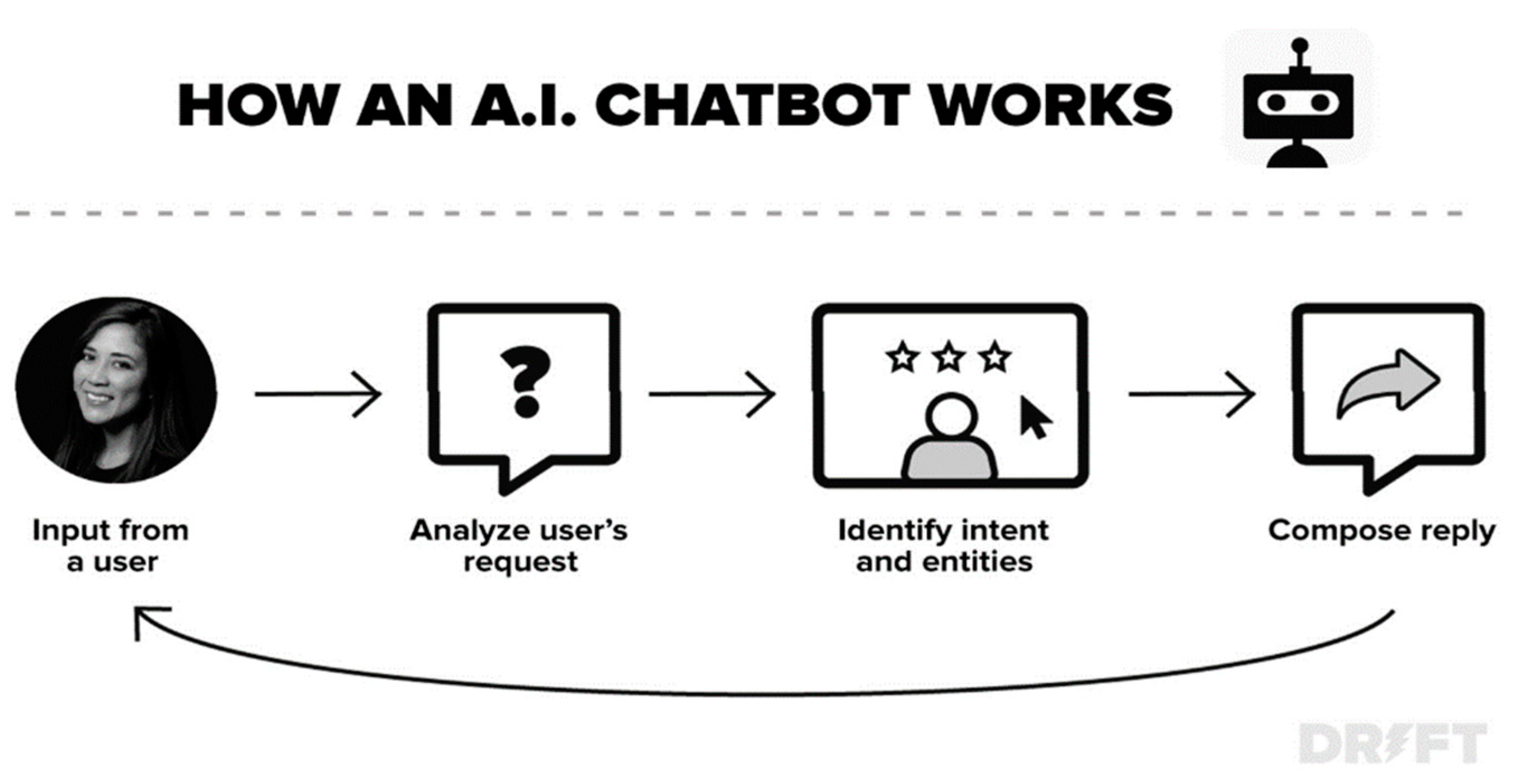
A feedback system along with the chat box can resolve any customer inconvenience during the delivery process and assist in identifying outstanding issues for continuous improvement. Categorization of feedback can motivate employees to work better and enhance training programs more efficiently. Offering incentives such as coupons on special occasions can encourage customers to provide feedback, as long as they have had a positive experience.
For the staff, providing them with a login area and giving them notifications on their dashboard can remind them of tasks and reduce errors. Incorporating system training into the employee training program and emphasizing that they need to check the dashboard daily for updates can familiarize staff with it. Some notices are prioritized via a pin facility, where critical notices are shown at the dashboard top automatically, and providing the users with a save button on critical notices allows them to refer to it afterwards[33]. All such software enhancements aim to enhance communication, expedite processes, and enhance overall productivity in both the employees and the customers within the system.
3.3. Developing an E-Commerce
A quick solution to the problems at hand is to create an online shop on the company website and oversee it through the aforementioned system. Consumers can now search for products with ease and convenience, view prices, and buy products at any time using this new system[34,35,36].
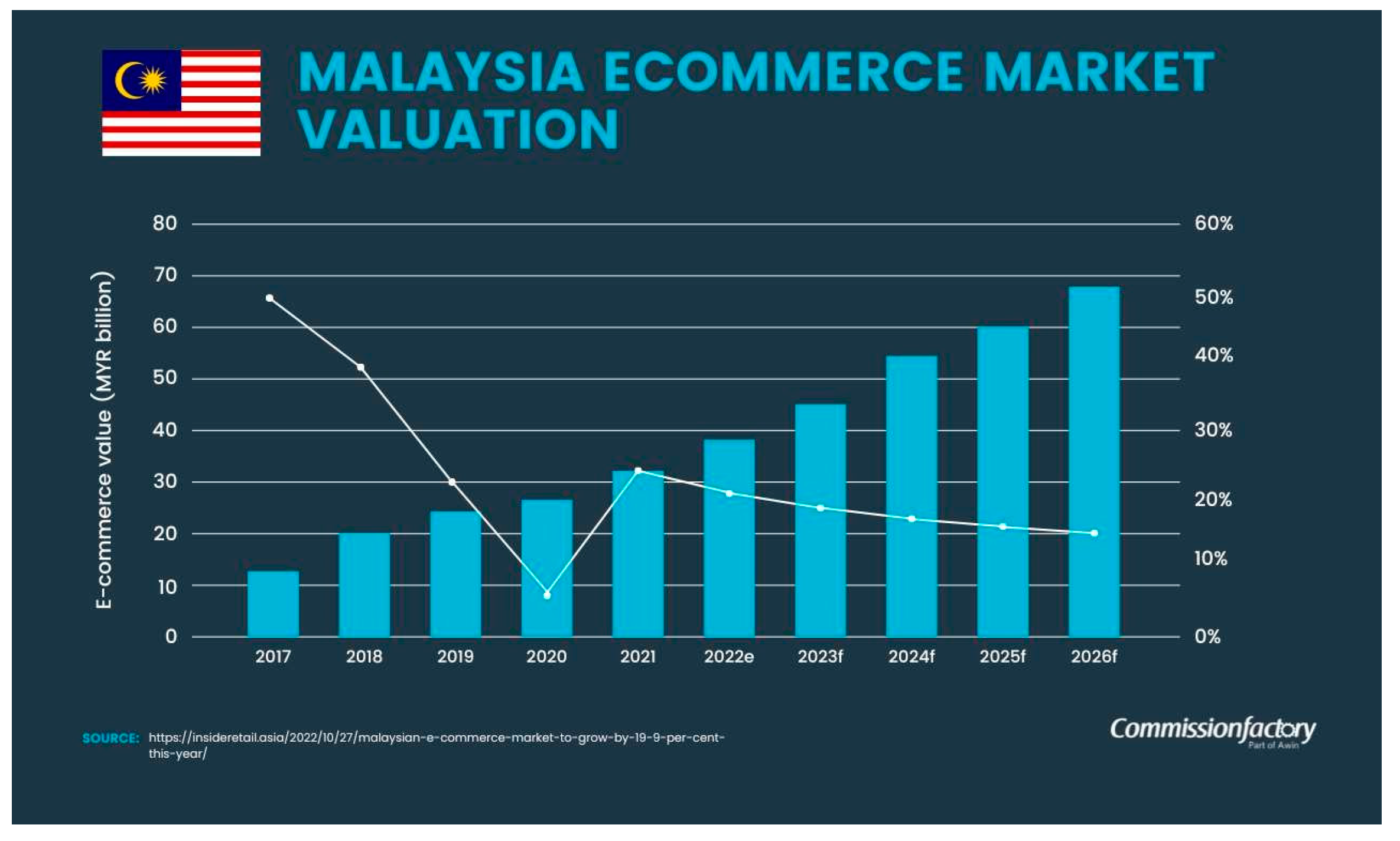
There are between 12 and 24 million internet vendors across the world, as estimated. Some are opening and some are closing every day, but it is relatively stable growth. Ecommerce revenues on a global scale will triple by the end of the decade. (Fokina, 2023).
Moreover, Şölen's shift towards offering products in large and small quantities broadens their customer base. The company can serve B2B and B2C clients with the online store, meeting the urgent shipment needs of single consumers and facilitating bulk purchases. (Herman, 2017).
The necessity of having an online presence in the modern business is also seen through the rising number of internet traders across the world. The projected tripling of global e-commerce revenues in the next few years indicates the potential for greater market share and sales through an online store.
Having an online store also increases visibility and brand awareness, Direct sales through the firm's web store increase the chances of recommendations and favorable reviews, which ultimately improve the brand's awareness and reputation. Including an internet store on the company website solves existing issues, but it also creates new ones for development and expansion into fresh B2B and B2C markets.
Figure 4.
Bar Chart showing Malaysia ecommerce market valuation.
3.3. Inventory Management System
In order to correct such difficulties, placing automatic stock control systems that account for expiry dates in the correct way and won't permit shipments of products having minimal shelf life would sufficiently support the process. The most ideal way to produce and maintain expiry dates is through an investment in automatic tools and procedures for dealing with expiry dates. This way, products would be ensured at all times as being safe and of top quality. Efficient expiration date control ensures that they always remain secure and of superior quality. We can make it a point that the process of generating and administering expiration dates becomes as optimized as possible by making an investment in automated procedures and tools (Avram, 2023).
Expiry management refers to the process of providing products before the expiry dates. What expiry management does is apply the 'The First-Expired, First-Out (FEFO)' strategy which is one that is most widely used in expiry management. Products with the nearest expiration dates are sold first because of FEFO's rule of giving preference to the selling of products by expiration dates (Williams, 2023).
In the food business, this approach is important in providing food safety, cutting down on costs, and minimizing wastage. Thus by constructing a computerized system that tracks the expiry dates and gives reminders when the products are approaching expiry, The expiry management problem is eliminated. The quantity of a product, its location of storage, and the expiration date are all captured in the stock list upon stocking of the product.Subsequently, the system automatically detects products whose expiration date has one to two months left and notifies the employees of the same through alerts on their dashboards.
4. Projected Outcome
4.1. Social Impact
Using GPS to track delivery is a systemic approach to monitoring real-time fleet locations. Using modern GPS capabilities, routes can be optimized to ensure effective delivery time that will be beneficial to consumers and minimize harm to the goods. Having a standard format of tracking simplifies scheduling for delivery personnel and building a history of the trip to be stored under easier surveillance. Time and cost can be easily minimized which makes delivering products as efficient as possible.
upgrading and making the site more user friendly is an important driver in building the relationship between the two parties. Utilizing AI technology in the guise of a chatbox allows users to get an introduction to the brand, as well as answer questions that they may have. Conversational marketing has proven to establish a more intimate connection between a brand and its users (BARIŞ, 2020). To counter any errors, a feedback channel will give users the option to complain, allowing the company to learn from and rectify repeat issues with the system. The employment of a wider communication channel will also facilitate the company in auditing complaints not only from consumers but also from employees.
Redesigning the site would be accompanied by an accessible online store for customers to browse the list of items. Allowing customers to see their items though via a screen, establishes confidence in the authenticity of the product. On the subject, exploiting the growing trend of e-commerce would be an immense leap in the correct direction. Providing this simple route of retail gives consumers the luxury of purchasing items without the hassle of going to your site. Not only does it provide a convenient method of advertising, but it also widens your market base and maximizes the chances of sales.
Automating product management is also a key, particularly for the F&B sector. There is a standardized and systematic manner of managing inventory and shelf life that takes pressure off the people to always have to keep abreast. It frees up staff to attend to other aspects that will significantly increase efficiency.
4.2. Competition
4.2.1. With a Wide scope of Competition, the Confectionery Industry Boasts Some of the Biggest Names Such as Lindt & Sprüngli, Ferrero Chocolate and Hersheys. With an Impressive List of Established Brands to Compete with, Şölen Would Stand to Gain Much from the Recommendations We Offer. Through Our SWOT Table Analysis, We Explore the Innovative Business Models of Şölen's and Those of Its Competitors, Where They Succeed and Where They Falter.Lindt & Sprüngli

Table 1.
Table for Lindt & Sprüngli SWOT analysis.
| STRENGHTS | WEAKNESS |
|---|---|
| -Massive infrastructure: The organization is connected to nations all over the world by a massive infrastructure. Lindt has multiple production factories in Europe and the USA in addition to about 20 subsidiaries across the globe. -Nations Tradition: Despite not being a big producer of cocoa, The Country has a long and rich tradition in producing top quality chocolates, which has led to its reputation as the best. For the majority of Chocolate manufacturers, including Lindt, this reputation directly correlates with their strength. Data Integrity and Accuracy: Lindt & Sprüngli upholds strict standards for data integrity and accuracy thanks to their advanced technology. This can guarantee that their system upholds or exceeds their necessary criterias. Existing Resources and Infrastructure: They have resources and an effective IT infrastructure in place to support their software systems. This infrastructure serves as a strong basis for adding improvements and switching to a more sophisticated computerized system if needed. Customer Relation Management: Having a customer relationship management system means that monitoring consumer preferences, purchasing patterns, and feedback is an added benefit to the company in this growing industry. Their constant need for improvements to the user experience means that customers can benefit greatly from this data. Supply Chain Management: Their current |
Retail Store Operations: The company’s investment in branded retail stores entails significant operational risks and costs, particularly in the face of shifting customer purchasing habits and shifting retail environments, even though it offers advantages for the brand experience. Sustainability and Ethical Issues: The chocolate business is under investigation for its ethical sourcing practices, especially with reference to cocoa. Even if Lindt has strategies in place, the brand's reputation could be impacted by any mistakes or unfavourable opinions in this area Premium Pricing:Products are positioned in the premium market category, they may not appeal to as many people as they could, particularly in price-sensitive markets or during recessions. |
| system includes a robust supply chain that helps with distribution, production scheduling, and inventory control. The importance of this area for them can save expenses and further optimize operations. |
|
| OPPURTUNITES | THREATS |
|
Partnerships & Collaborations: Strategic alliances with hotels, cafes, and other high-end businesses' systems can help them reach a wider consumer base and produce exceptional experiences. E-commerce and Digital Sales Channels: By extending e-commerce capabilities and digital sales channels, businesses can take advantage of the growing trend of online shopping and reach a larger audience while also offering convenience to consumers. Integration of Digital Marketing technologies and Analytics Platforms: Combining analytics and digital marketing technologies, This might make it possible to use customer relationship management, social media interaction, and targeted advertising campaigns to increase brand recognition and client loyalty. |
- Economic Volatility: The demand for fine chocolate and confectionery items may be greatly impacted by economic downturns and decreased consumer spending, which can have an effect on Lindt's sales and profitability. Strong Competition: There are many competitors in the candy industry, ranging from small, independent chocolatiers to big, international unions. Price pressure and the loss of market share can result in a decline in shares. Cybersecurity Risks: Customer data and business operations are at danger from cybersecurity risks as the system grows its digital presence through e-commerce and internet platforms. |
4.2.2. Ferrero
Table 2.
SWOT analysis of Ferrero Chocolate.
| STRENGHTS | WEAKNESS |
|---|---|
|
Massive Global Infrastructure: The company has a vast infrastructure across the world, including multiple production plants and subsidiaries, which provides a solid foundation for efficient production and global distribution. This broad geographical coverage increases market exposure, ensures widespread product availability, and helps mitigate single market risks, and each production facility incorporates state-of-the-art production technology and automation systems, guaranteeing high efficiency and Consistent product quality. -Specific advantages of a long manufacturing tradition and reputation:The company benefits from the rich knowledge base and skills derived from the longstanding chocolate manufacturing tradition in its home country, enabling it to produce premium chocolates with delicate textures and distinctive flavors. This historical reputation not only appeals to discerning consumers but also helps in establishing brand trust in new markets. Data Integrity and Accuracy:The Ferrero company maintains data integrity and accuracy through advanced technology, crucial for ensuring product quality, compliance with regulatory requirements, and making data-driven decisions. High standards of data management also foster efficiency and transparency, laying the foundation for continuous improvement. |
High prices:Compared with other chocolate and confectionery brands, Ferrero Rocher's products are generally priced higher, which may limit the purchasing power of certain consumer groups. Potential data overload issues: When dealing with large amounts of data, ensuring data integrity and accuracy can become complex, which can impact the ability to analyze data and make timely decisions.Data overload can also lead to information silos that hinder cross-department collaboration and communication. Limited product variety: While Ferrero Rocher is known for its iconic chocolates, its product line is relatively small compared to other competitors in the market. -Technology upgrade and maintenance costs: Continuously updating and maintaining advanced IT infrastructure and production technology requires significant capital investment. As technology advances rapidly, equipment and software systems may quickly become obsolete and require periodic replacement or upgrades. These upgrades and maintenance activities not only increase direct costs, but may also cause operational disruptions or reduced efficiency during the upgrade process. |
|
Customer Relationship Management (CRM): Through the CRM system, Ferrero can track consumer preferences, purchasing patterns and feedback in detail, which is crucial to maintaining competitive advantage and cultivating customer loyalty. This enables the company to provide more personalized services and products, thereby enhancing user experience and driving sales growth. |
|
| OPPURTUNITES | THREATS |
|
Leveraging technological advances: Adopting emerging technologies such as artificial intelligence, the Internet of Things, and blockchain can further optimize production processes, improve supply chain transparency, and enhance product traceability.The application of these technologies can not only improve efficiency and customer satisfaction, but also enable the development of new product lines and services, such as personalized chocolate or marketing campaigns with augmented reality experiences. - Expand emerging markets: Leverage the company’s global infrastructure and brand reputation to penetrate fast-growing emerging markets in Asia,Africa and Latin America,where demand for high-quality consumer products is rising.Establishing production dases or partnerships in these new markets can reduce logistics costs,improve market response speed,and increase local market share. |
- cybersecurity threats and data breaches: As reliance on digital technology increases, so do the cybersecurity threats companies face. Malware, ransomware attacks and data breaches can severely impact a company's operations, financial health and brand reputation.Ensuring cybersecurity and data protection requires ongoing monitoring, investment and training to respond to the ever-changing threat environment. -Competitive pressures for technology and business model innovation:Emerging start-ups and some traditional enterprises may subvert the existing market through innovative technologies and business models, bringing competitive pressure to Ferrero. Maintaining competitiveness requires Ferrero to continuously innovate and adapt, but excessive pursuit of innovation may also distract the company's focus and resources, affecting the stability of its core business. |
|
Digital transformation and online sales:Strengthen the e-commerce platform,optimize the online shopping experience to adapt to changes in consumer shopping habits,and leverage social media and digital marketing to increase brand awareness.Develop mobile apps or augmented reality experiences to provide personalized shopping recommendations and enhance customer interaction and brand loyalty. Enhanced data analysis and intelligent decision-making:Use big data analysis and artificial intelligence(AI) technology to gain a deep understanding of consumer behavior, market trends and operational efficiency,thereby providing more accurate business insights and supporting data-driven decisions.Develop and deploy predictive analytics models to optimize product pricing,marketing strategies,and supply chain management while identifying potential business risks and opportunities. |
4.2.3. Hershey’s Chocolate
Table 3.
SWOT analysis for Hershey’s Chocolate.
| STRENGHTS | WEAKNESS | |
|---|---|---|
| - Data analytics capabilities: With advanced data analytics tools and systems, Hershey is known for collecting and using data to improve their products. -Tech Integration: The Hershey Company plans on investing upwards of $800 million for 2023 and beyond in improving and further integrating an ERP system. |
Lack of automation in the product/supply chain. Limited online presence especially in contemporary social media giants i.e TikTok and Instagram. Furthermore, while Hershey has a digital presence in the form of online ads, modern advertising and marketing seeks to rely on organic user engagement through comments and social media posts. |
|
| OPPURTUNITES | THREATS | |
| - Online Presence: Due to its prevalence, Hershey has a good opportunity to enhance its online presence by creating engaging content. Automation and Integration: By investing in automation technologies within its product and supply chain processes, Hershey can streamline operations, reduce costs, and improve efficiency. Automation can help optimize production, inventory management, and distribution processes, leading to faster turnaround times and better customer service. |
Cybersecurity concerns: Shifting to automated solutions opens doors for bad-actors to exploit weaknesses within a tech based system possibly allowing for ransomware, employee info leaks, and other sensitive material. Over-pursuit of technological adaptations could distract the company from its actual goals and draw finances away from more important tasks. |
|
4.2.4.Şö. len
Table 4.
SWOT analysis for Şölen.
| STRENGHTS | WEAKNESS |
|---|---|
| - Strong presence in global markets. It was in the "Global Top 100" list prepared by Candy Industry magazine -Investing heavily in innovative products not available in the market by allocating 1.5% of its turnover to R&D activities. |
- Despite constructing three new factories in Gaziantep and Istanbul, computerized processes were not integrated into the production line. |
| OPPURTUNITES | THREATS |
| - E-commerce Expansion: With the growing trend of online shopping, Şölen has the opportunity to expand its e-commerce presence and reach a wider audience beyond its current approach. | Cybersecurity concerns: Shifting to automated solutions opens doors for bad-actors to exploit weaknesses within a tech based system possibly allowing for ransomware, employee info leaks, and other sensitive material. Competitors in the market have also looked to adapt similar technologies which may mean the status quo is maintained despite efforts to improve processes and increase market share as well as future prospects. |
5. Business Viability Application
The proposed solutions to their system is feasible and economically sound for an established firm like Şölen. The business and practical application of this new system has no major drawbacks and is in line with their values to be honest, sincere and fair to all business partners and consumers.
Technically, the suggested features such as expiry management system, two-way interactive communication system, real-time vehicle tracking, and e-commerce integration are all achievable with current technology. E-commerce sites, inventory management systems, GPS tracking, and chat box installations are all available and have been used successfully in many businesses. So, the technical components of the suggested solution are viable and practical to execute.
Economically, Şölen's subsidiary stands to gain a lot from the utilization of the application, from enhanced operational efficiency, enhanced customer satisfaction, to eventual increased revenue. The business can save costs that relate to inefficiencies, waste, and missed sales opportunities through the streamlining of expiry management, communication channels, online facilitation of sales, and order fulfillment processes. Moreover, the introduction of such enhancements may necessitate an upfront investment, but they can pay off in the long run by enhancing performance and competitiveness.
Even though the solution suggested is theoretical at present according to the status of the industry, it stands a good chance of being utilized commercially in the future or to certain markets. Such solutions also ought to be in growing demand as e-commerce expands worldwide and companies depend more on technology to boost customer experience and operate businesses. In addition, the particular problems that the solution aims to address like order fulfillment problems and expiry management are common in a wide range of industries, suggesting a big market for related applications. In conclusion, the application offers a technically and financially sound solution with a reasonable chance of being used commercially in the future, even though it may need to be further refined and tailored to certain market situations.
6.1. Scope
The report gives the major highlights that our System Enhancement requires, categorized into four broad sections: Inventory Management, Transport Tracking Management, E-commerce, and Customer Service Management. Each of these has a thorough description of functionalities for its intended scope.
- 1. Inventory Management
- <Real-time Inventory Level Tracking: Implement a system of real-time tracking of product quantities and activities in all warehouses to achieve open inventory management.
- Automatic Buy Order Generation: Generate automatic buy orders triggered by pre-defined minimum stock levels to prevent stockouts and provide timely restocking.
- Better Item Movement Management: Streamline stock management and quality control by tracking incoming and outgoing goods, including product expiration dates.
- 2. Transport Tracking Management
- Order Creation and Order Management: Design a user-friendly order creation and order management system, capturing customer information, product selection, and delivery dates. Include search and filter functions for enhanced clarity.
- Real-time Order Tracking: Enable customers to see their orders in real-time through linked tracking numbers and graphical display of vehicle locations on a map.
- Dynamic Delivery Scheduling: Include optimization functionality to create best possible delivery routes taking into consideration time constraints, vehicle capacity, and dynamic adjustments.
- 3. E-Commerce
- Product Catalog: Build a strong online catalog featuring all products with descriptions, high-resolution product images, and price information.
- Product Search and Filtering: Include easy-to-use search and filtering features by categories, brands, prices, and other relevant attributes.
- Shopping Cart and Checkout: Design a simple-to-use shopping cart feature with a secure payment gateway for B2B and B2C consumers.
- Order Management: Implement a system for efficient order management, including order tracking, confirmation email, and delivery alert.
- Inventory Management: Integrate with existing inventory management systems to supply up-to-date product availability and stock levels.
- 1. Customer Service Management
- Interactive Chat System: Enable immediate communication with customers using a user-friendly chat system so that they can ask questions regarding orders, learn about products, and provide feedback.
- Better Feedback Mechanisms: Employ feedback via surveys and reviews to facilitate improvement of the products and services constantly.
- 2. Prioritization & Acceptance
Must-be features in all categories are classified based on business value and practicability and each feature shall have well-written acceptance criteria to ensure successful implementation. These would include functionality, performance, and user experience facets.
- Other Features may include:
- tCRM System (Customer Relationship Management): Having a CRM system for improving customer service using interaction tracking, storing customer details in one centralized location, and making personalized offerings to them.
- Warehouse Management System (WMS): Look at the potential benefits of a WMS for further warehouse optimization and inventory management.
6.1. Functional Requirement and Nonfunctional Requirement
| ID. | Functional Requirement | Description |
|---|---|---|
| FR1 | Tracking Service | To create and manage orders with the ease of tracking these orders in real time while also being able to create delivery schedules so optimization of routes is possible. |
| FR2 | Sales Tracking Service | Capturing sales orders and invoices electronically so that the tracking of sales performance by product and customer can be documented through sales reports and contribute to the better understanding of sales analytics. |
| FR3 | Inventory Management Service | Tracking inventory levels in real time from any part of the world so that the management of product movements can be swiftly accomplished, While also generating automated purchase orders to the factory depending on the stock levels. |
| ID. | Non-Functional Requirement | Description |
|---|---|---|
| NFR1 | Performance | The systems must be responsive and able to handle high traffic volumes. |
| NFR2 | Scalability | The systems must be able to grow and adapt to increasing business demands |
| NFR3 | System safety | It must protect user data and prevent unauthorized access,for example,fingerprinting or destination must be taken. |
| NFR4 | Maintainability | The system should be easy to update and maintain. |
| NFR5 | Ease of use | The system must be easy to use and navigate among all users |
6. Architectural Overview
6.1. Preamble
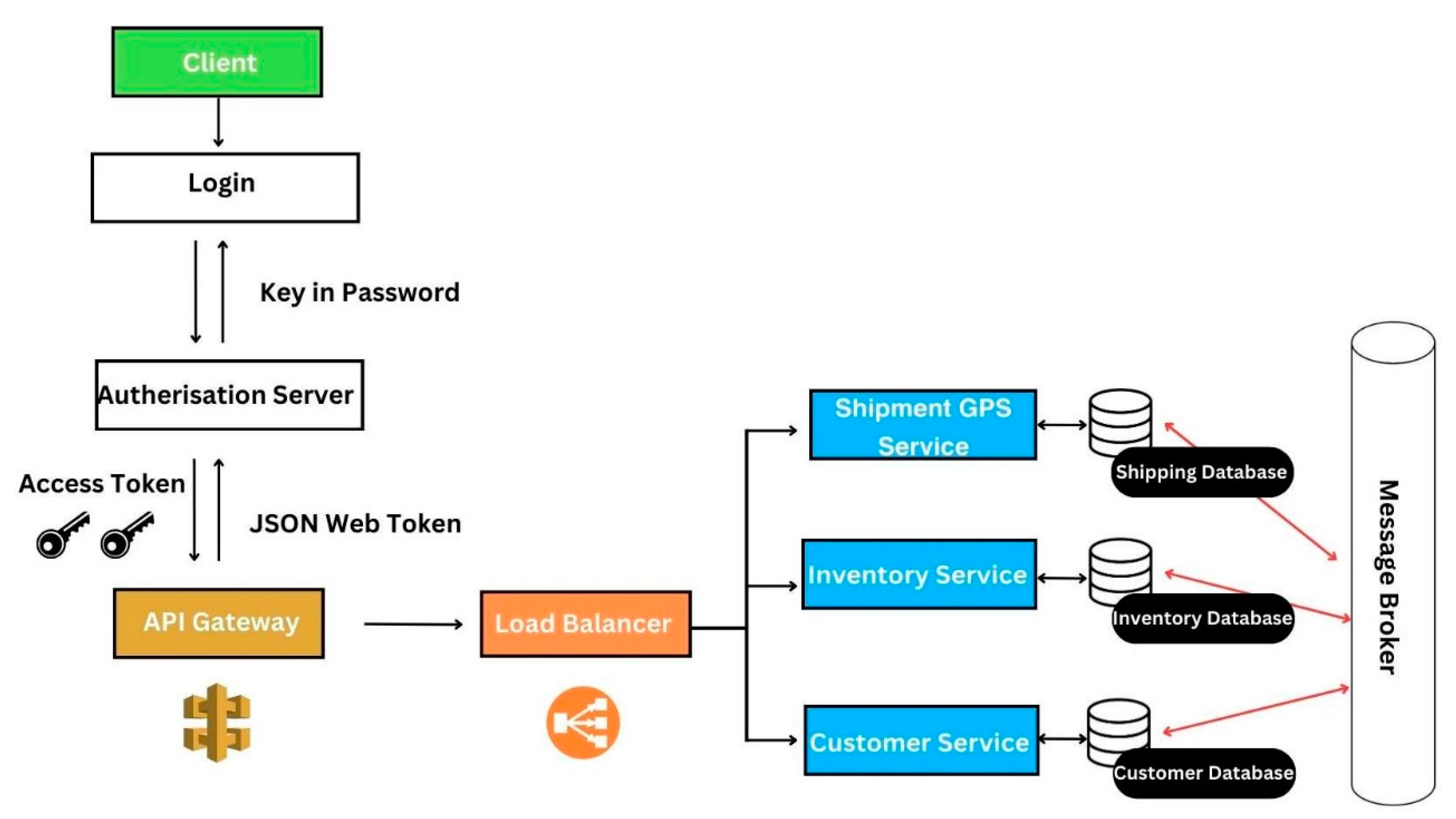
Our Şölen Enhanced System, being an integrated business management system, integrates key features such as GPS features, real-time tracking systems, inventory management, and customer communication. The selection of the design and operation platform is of crucial importance. In the first phase of system design, we completely understood that the right choice of platform is critical for the effective operation of the system. Therefore, after thorough research and careful considerations, we strongly decided to utilize AWS (Amazon Web Services) as the operating system for the Şölen Enhanced System. Now, let us observe why AWS turned out to be the ideal choice for the Şölen Enhanced System, and how the utilization of its cutting-edge cloud computing services brings unprecedented innovation and efficiency to our company.
6.2. Architecture Diagram
Figure 5.
Architecture Diagram of Our System.
7.2. Reasons for Platform Selection
7.2.1. Scalability
In logistics management life Şölen Enhanced System, scalability is the utmost priority, particularly in light of the fluctuations in volumes of deliveries. AWS offers elastic computing and storage capacities, which allow us to scale the system with ease based on business requirements so that it is always in harmony with the ever-growing volumes of deliveries.
7.2.2. Real-Time Collaboration and Communication
To facilitate effective coordination and communication throughout our Şölen Enhanced System, it is essential that every member of our team has access to the latest delivery information in real-time. Through the use of AWS's collaborative tools and real-time communication services such as Amazon Chime, becomes
becomes
critical in creating a highly interactive system. Not only does this facilitate effective team coordination, but it also significantly enhances overall work efficiency.
7.2.3. Data Security
As delivery and inventory data in logistics is sensitive, data security is of prime importance. AWS offers cutting-edge security features like data encryption, identity verification, and access control to protect our business data and avoid any data breach and security attacks.
7.2.4. <Real-Time Tracking and Route Management
With AWS's machine learning and real-time data analytics features, we can achieve real-time route management and monitoring in our logistics system. Using AWS services, we can map drivers' locations in real-time, offer estimated times of arrival, and optimize delivery routes dynamically considering variables such as traffic and weather. This yields dynamic and data-driven optimization of our logistics operations' efficiency and agility.
7.2.5. Inventory Management and Optimization
Efficient inventory control is of prime importance to our Şölen Enhanced System. AWS offers a complete database as-a-service product that allows one to create a highly effective inventory control system. With real-time visibility and updated inventory levels, we are able to optimize the use of space, prevent risk of spoilage on perishable items, and ensure timely delivery. Not only does this enhance the efficiency of our operations, but it has a significant impact on our total supply chain performance.
7.2.6. \tCost-Effectiveness
AWS follows a pay-as-you-go pricing model, which enables us to pay for resources based on actual usage, thereby leading to cost savings. This cost-saving model enhances financial flexibility for Şölen Company.
7.3. System Structure
The overall architecture of our Şölen Enhanced System combines all the essential components in a harmonious way, such as GPS integration, real-time tracking systems, inventory management, and customer communication. Partitioning the system into logical modules and blocks contributes to the organization and efficient control of individual functionalities.
The clear-cut performance is as follows:
1. GPS Integration Module (Installation and configuration of GPS device. Satellite communication module. Module to send data to the master server or cloud platform.)
2. Real-time Tracking System Module (Real-time data storage and processing. Module sending real-time notifications to managers. Route management and flexibility module.)
3.\\tInventory Management System Module (Module for real-time visibility and accuracy of inventory data. Expired product tracking and handling module. Centralized processing and control of inventory data.)
4.\\tCustomer Service Module (Generation and management of delivery schedules. Interactive and intuitive interface module. Customer feedback system and real-time communication module.)
7.4. \\tPossible Technological Improvements
We can make use of containerization technologies such as Docker in order to enhance our Şölen Enhanced system further for enforcing consistency and portability across different environments. Containerization aids in reducing the process of deployment, enhancing the portability of systems, and resource optimization. It assists in developing a more efficient and scalable system infrastructure.
7.4. Interface and Scalability
Our Şölen Enhanced System provides a series of APIs (Application Programming Interfaces) and SDKs (Software Development Kits) to ensure integration with external systems and third-party applications in an effortless manner. The interfaces permit other systems to exchange data with the A.R.M system, invoke functional modules, and have a broader set of application scenarios. With strictly defined interfaces, loose coupling is implemented between the modules so that each functional module can evolve and expand independently.
7. System Analysis and Design
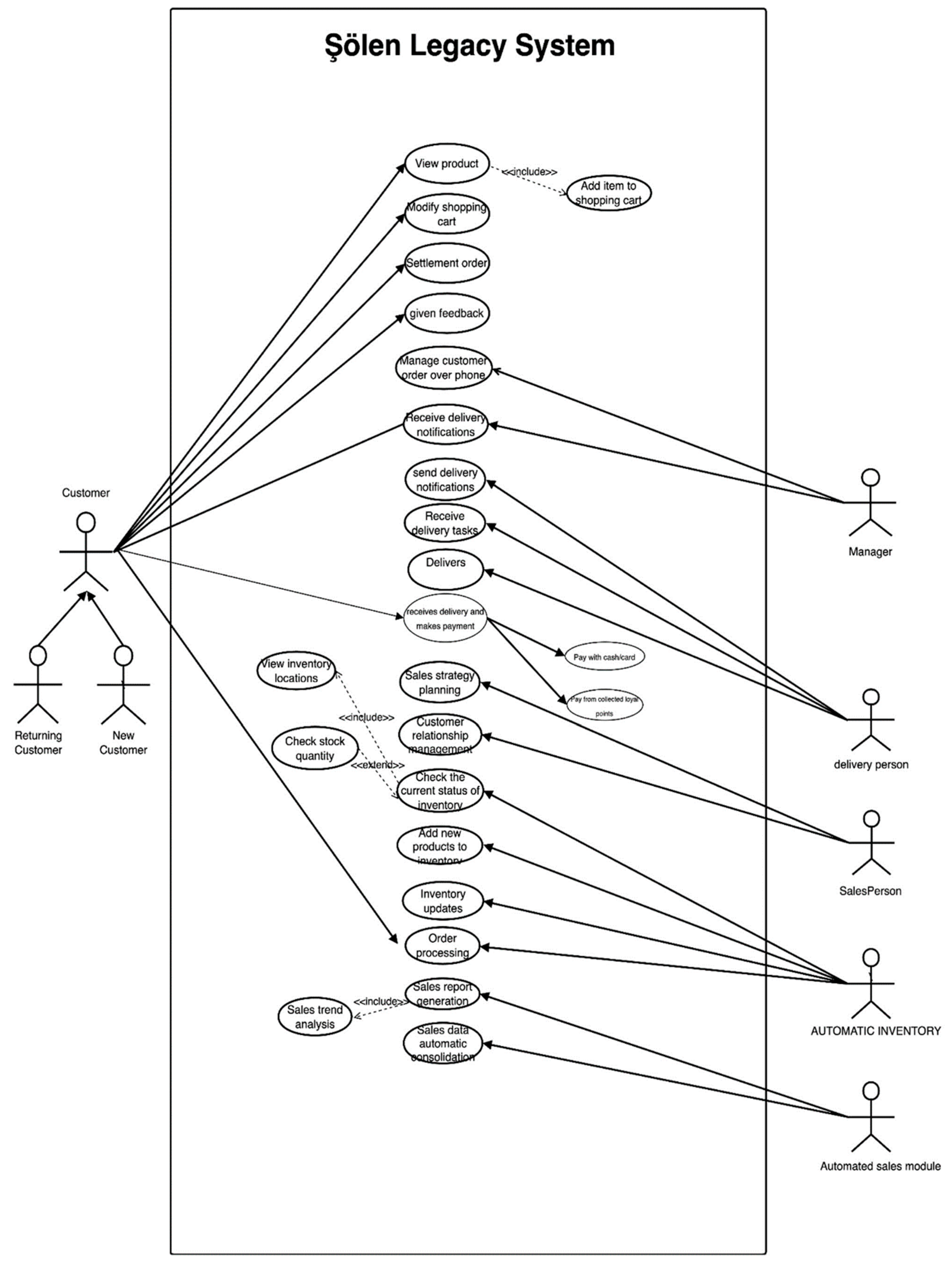
7.1. UML Use Case diagram
7.1.1. Old Şölen System
Figure 5.
UML Use Case diagram of the Legacy (current ) system.
7.1.2. Enhanced Şölen System
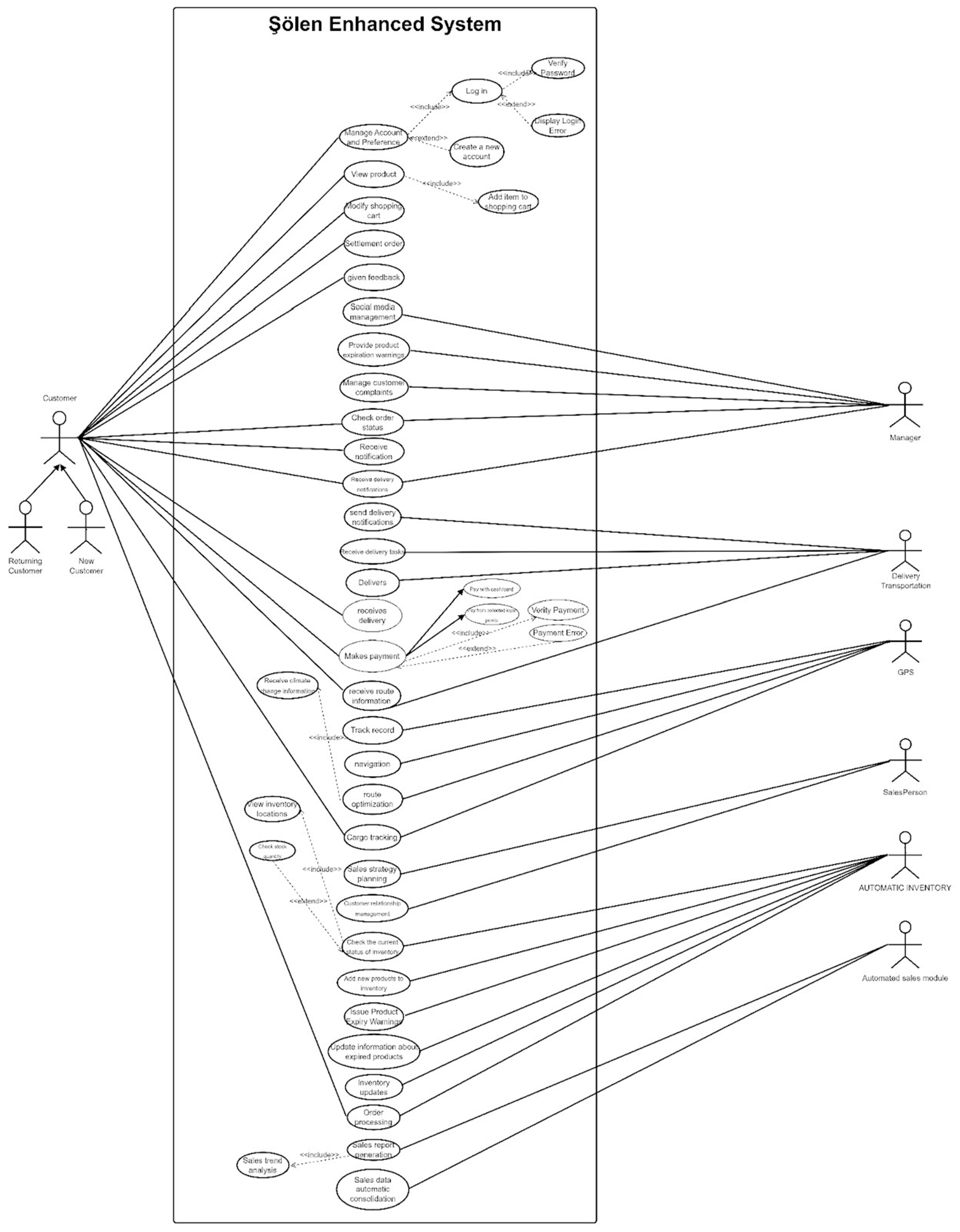
Figure 6.
UML Use Case Diagram of our improved (enhanced) system.
7.2. UML Class Diagram
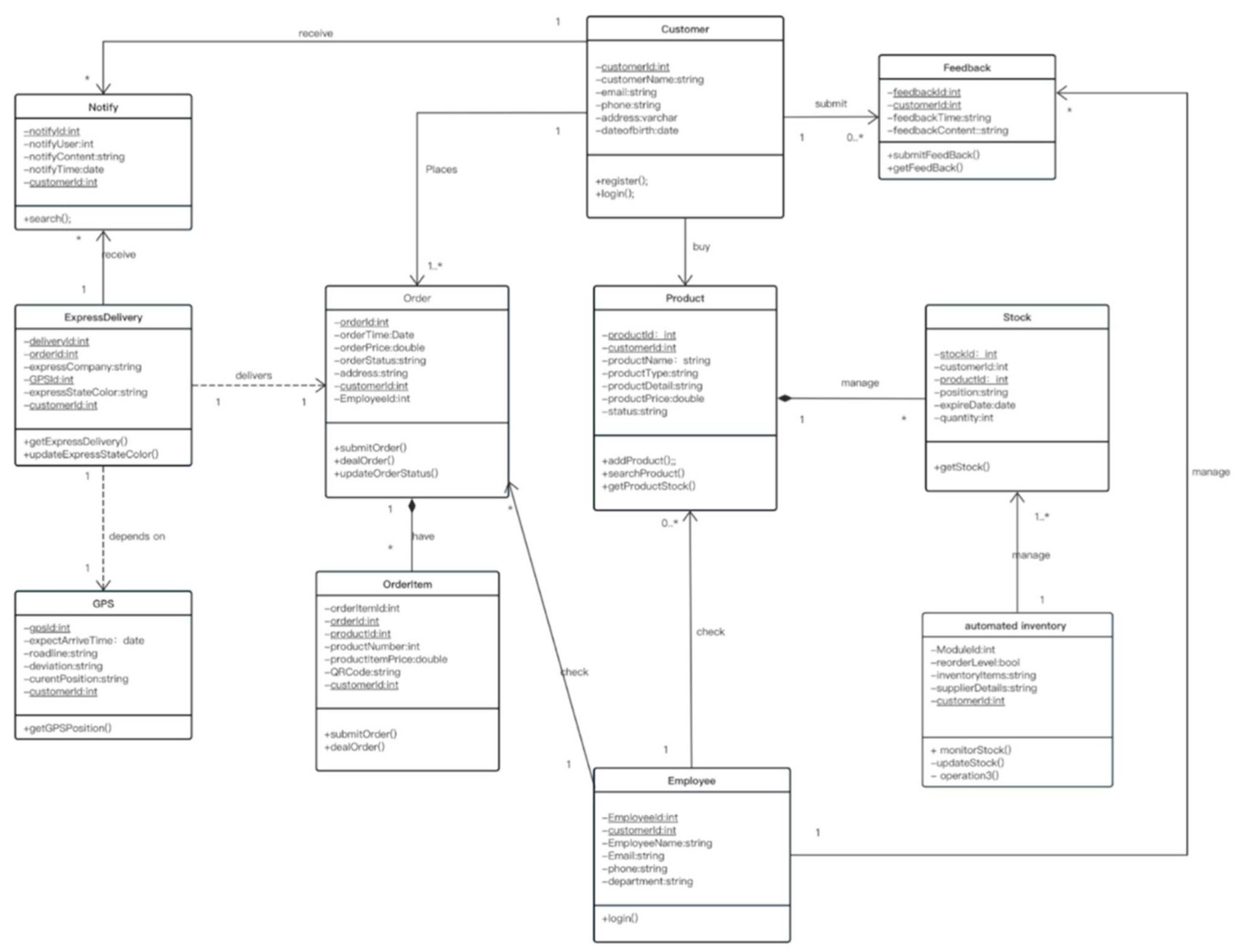
Figure 7.
UML Class Diagram for the enhanced system.
7.3. UML Object Diagram
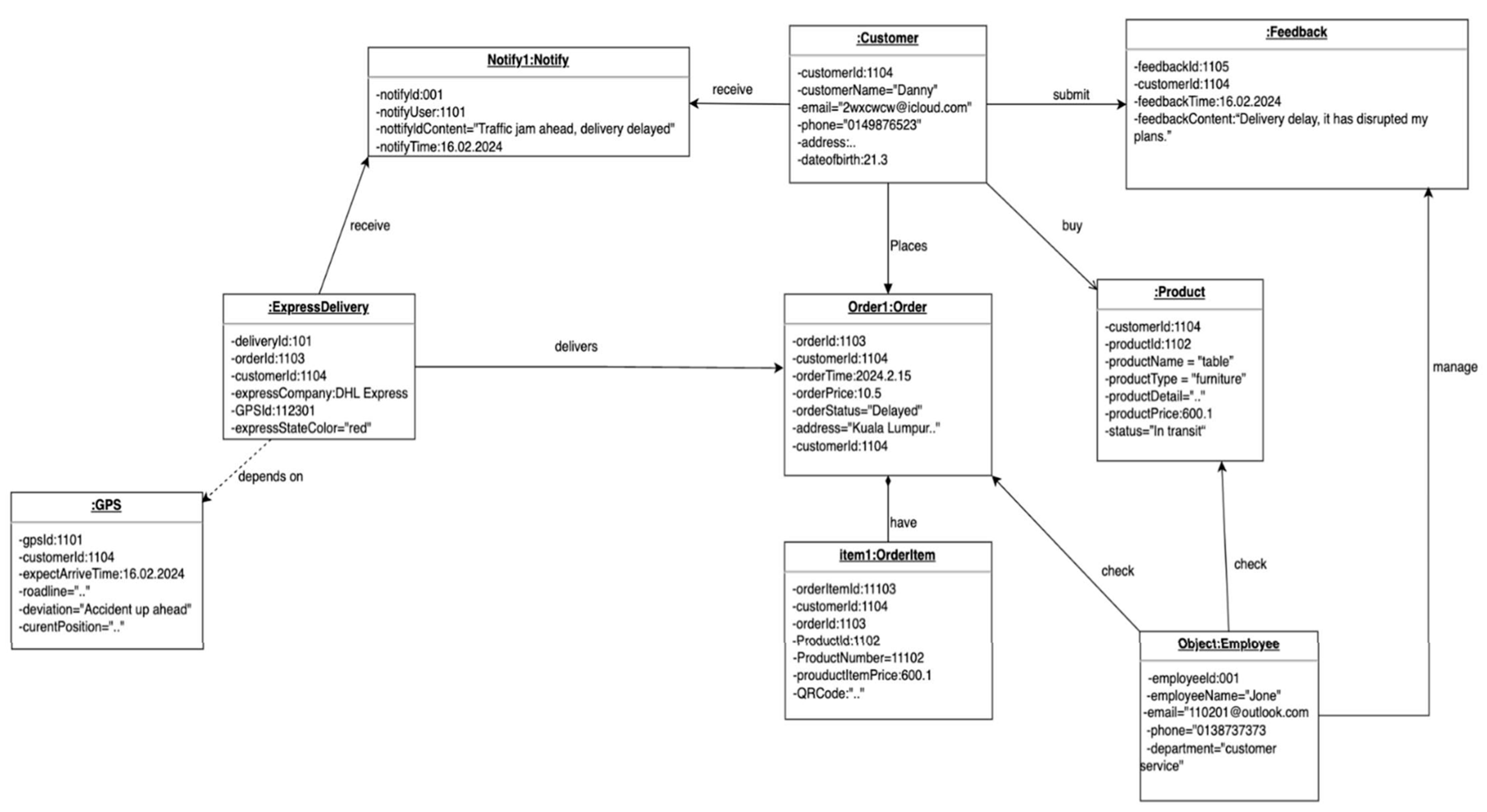
7.3.1. Unexpected Traffic Accident-Causing Delays
The following is a model of an interesting scenario. An express delivery was delayed due to a traffic jam caused by a sudden traffic accident. Although the message was sent promptly, the customer still left a negative review.
Figure 8.
Object Diagram for scenario ‘Unexpected traffic accident causing delays’.
7.3.2. Security Breach Successfully Prevented
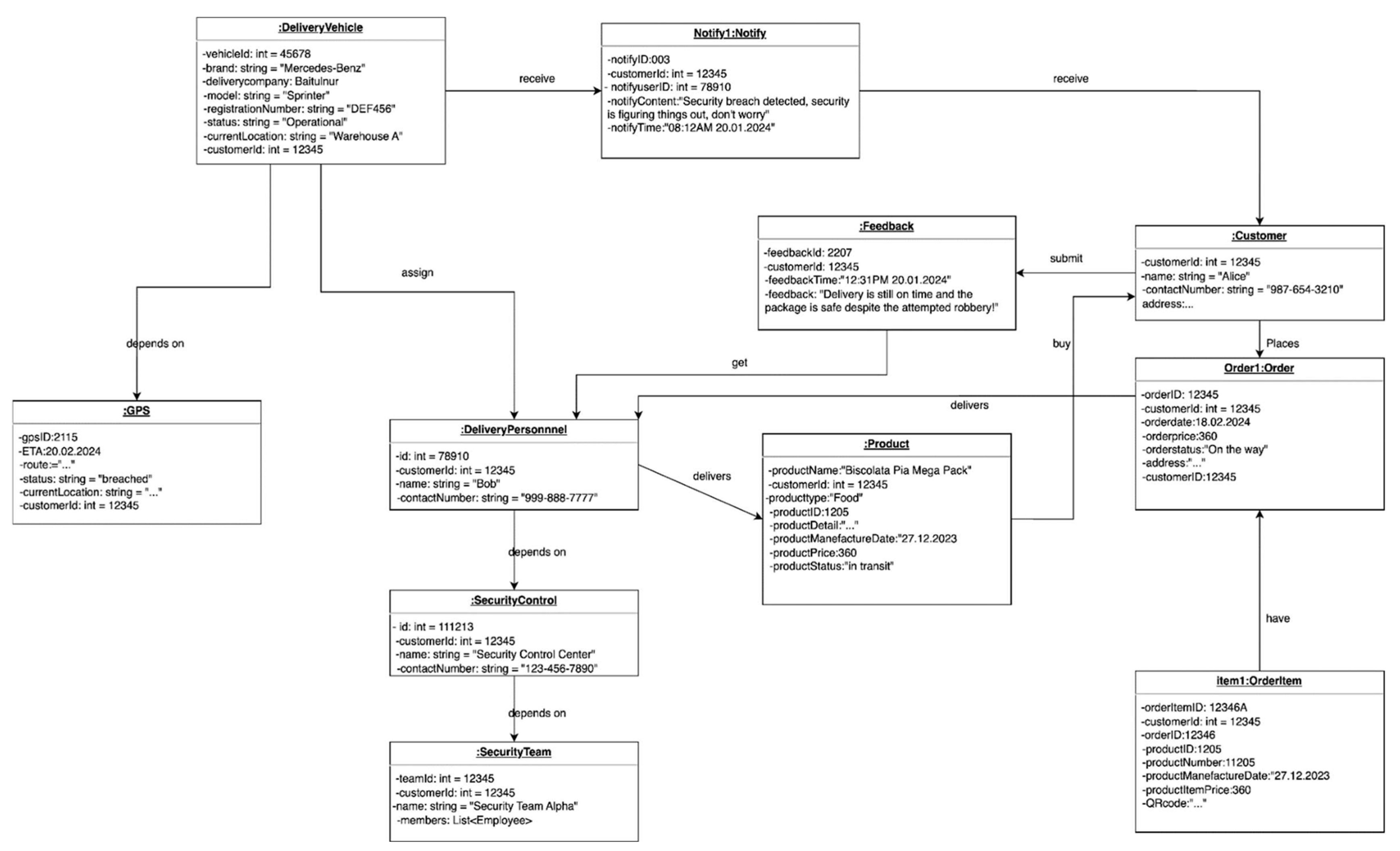
This scenario involves a number of players communicating to handle a security breach during a delivery process. As there has been a security breach while delivering one of the customer's valuable orders, the delivery personnel calls security on time, who dispatches the guards to stop theft and retrieves the package from theft, thereby the package is safe and the delivery is not delayed, thus resulting in a positive comment from a satisfied customer.
Figure 9.
UML Object Diagram for scenario ‘Security breach successfully prevented. ‘.
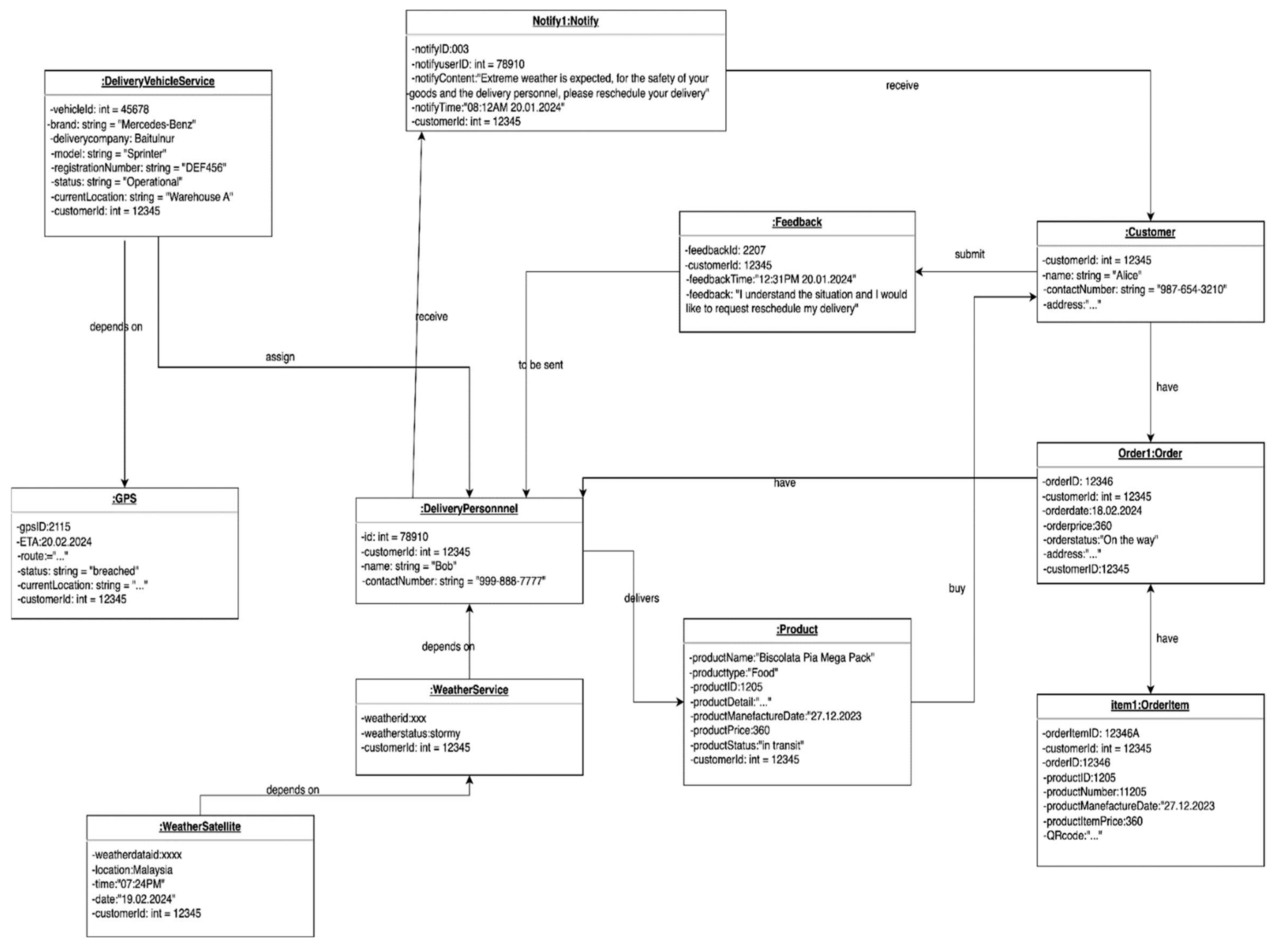
7.3.3. Delivery Rescheduling Due to Extreme Weather
This situation involves multiple actors that exchange to address inclement weather patterns in the provision of goods for re-scheduling by clients in terms of delivering increased safety and convenience. The weather system installed in the delivery vehicle receives the latest weather updates from the weather satellite indicating extreme weather conditions in the later part of the delivery, it is dangerous for the products and safety of the delivery personnel, the customer is notified by the personnel about the situation. The customer requests rescheduling of the delivery.
Figure 10.
UML Object Diagram for scenario ‘Delivery rescheduling due to extreme weather. ‘.
7.3.4. Replan the Delivery Routes
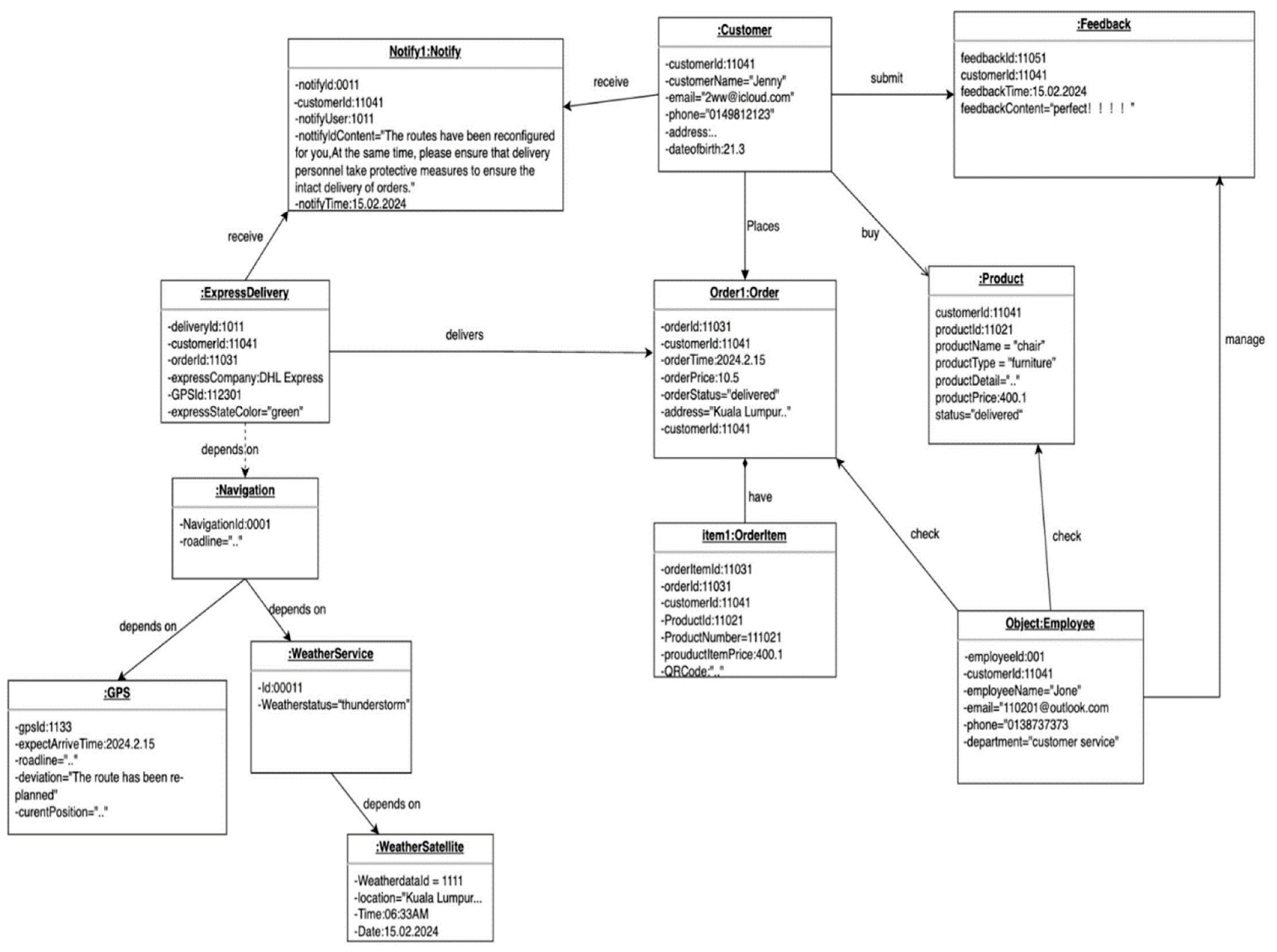
The weather conditions changed abruptly, and an unexpected thunderstorm entered the delivery area. The heavy rain and gusty winds caused traffic to come to a halt, causing some difficulties in the delivery process. However, the intelligent system immediately detected the unfavorable weather conditions and automatically adjusted the routes to avoid traffic jam points, ensuring safe delivery. At the same time, delivery personnel received notifications, reminding them to carry additional protective measures such as rain gear to ensure the intact delivery of orders. Despite facing adverse weather conditions, the combination
of intended intelligent actions by the system and expert care by the delivery team resulted in on-time deliveries, so the customers had positive remarks about the timely service.
Figure 11.
UML Object Diagram for scenario ‘Replan the delivery routes.’.
8. Conclusion:
The age of technology has rearranged man's creativity, spearheaded societal transformation and had its influence in business. Şölen was founded in Gaziantep in 1989 and is a chocolate company with exports to more than 103 countries. But its expansion into Malaysia through Baitulnur is plagued with order fulfillment issues specifically.
Retail stores like Şölen struggle with tracking drivers' locations thus risking stolen goods and failed deliveries. Customer relations and efficiency would be improved if two-way GPS communication existed. Customer relations are affected by poor communication; therefore, effective software and employee training are necessary.
In today's digital era, Şölen is faced with challenges such as lack of E-commerce system or reliance on old telephone ordering. Automated stock management is needed to provide expiration tracking in an attempt to limit losses and increase customer satisfaction. The A.R.M system is geared towards upgrading logistics management and customer services using real-time tracking and route optimization. Incorporating online stores on the website will meet market demands that are increasingly dominated by internet retailers.
The solutions offered for Şölen Company's Malaysian subsidiary are technically feasible and also commercially viable. The available technology has the capability to perform some other functions such as expiry management and real time tracking. With AWS, the A.R.M system is data secure and scalable from a data perspective. Together, these are solutions designed to position Şölen for success and growth in a highly competitive business climate.
8.1. Future Enhancements
By emphasizing technological innovation, scalability, data-driven decision-making, customer experience, supply chain optimization, employee development, and sustainability, Şölen can emerge as a market leader in the global confectionery market. Blockchain technology will ensure transparency and authenticity in supply chain management, product quality, and consumer trust, while AI-driven analytics will enhance inventory management and demand forecasting. Implementing IoT technologies such as RFID tracking will improve the productivity of warehouses, and cloud computing will provide elastic and cost-effective infrastructure for digital transformation. Modular and microservices architecture will provide seamless scalability of systems and flexibility, ensuring that future market requirements are met. Through big data analytics and predictive modeling, Şölen will be able to maximize marketing and operational efficiency, and business intelligence dashboards will provide real-time visibility into key performance indicators. Emphasizing customer interaction via personalized marketing, omnichannel alignment, and feedback processes in real time will create brand loyalty and satisfaction. Optimization of the supply chain via lean manufacturing, supplier coordination, and visibility tools will provide efficiency and cost reduction. Investment in employee training, leadership development, and cross-functional teamwork will create a high-performing workforce that will improve innovation and operational excellence. Lastly, sustainable initiatives focused on green production, carbon footprint reduction, and social responsibility will get Şölen in tune with global environmental and ethical standards further solidifying its brand position as a socially conscious market leader. Through these alignments, Şölen will not only rule the Malaysian market but also gain international recognition as a famous and top-profitable candy brand globally.
References
- Reference for Business. (n.d.). Blockbuster Inc. - Company profile, information, business description, history, background information on Blockbuster Inc. Retrieved from https://www.referenceforbusiness.com/history2/22/Blockbuster-Inc.html.
- Barış, A. A new business marketing tool: Chatbot. GSI Journals Serie B: Advancements in Business and Economics 2020, 3, 31–46. [Google Scholar] [CrossRef]
- Amazon Web Services (AWS). (2023). Amazon Web Services (AWS) - Cloud computing services. Retrieved from https://aws.amazon.com/.
- Wittig, A. , & Wittig, M. (2023). Amazon Web Services in action (3rd ed.): An in-depth guide to AWS.
- Dogra, V. , Singh, A., Verma, S., Kavita, Jhanjhi, N.Z., & Talib, M.N. (2021). Analyzing DistilBERT for sentiment classification of banking financial news. In S. L. Peng, S.Y. Hsieh, S. Gopalakrishnan, & B. Duraisamy (Eds.), Intelligent computing and innovation on data science (Vol. 248, pp. 665–675). Springer. [CrossRef]
- Gopi, R. , Sathiyamoorthi, V. , Selvakumar, S., et al. Enhanced method of ANN based model for detection of DDoS attacks on multimedia Internet of Things. Multimedia Tools and Applications 2022, 81, 26739–26757. [Google Scholar] [CrossRef]
- Chesti, I.A. , Humayun, M., Sama, N.U., & Jhanjhi, N.Z. (2020, October). Evolution, mitigation, and prevention of ransomware. In 2020 2nd International Conference on Computer and Information Sciences (ICCIS) (pp. 1–6). IEEE.
- Alkinani, M.H. , Almazroi, A. A., Jhanjhi, N.Z., & Khan, N.A. 5G and IoT based reporting and accident detection (RAD) system to deliver first aid box using unmanned aerial vehicle. Sensors 2021, 21, 6905. [Google Scholar] [PubMed]
- Babbar, H. , Rani, S. , Masud, M., Verma, S., Anand, D., & Jhanjhi, N. Load balancing algorithm for migrating switches in software-defined vehicular networks. Computational Materials and Continua 2021, 67, 1301–1316. [Google Scholar]
- Alferidah, D.K. , & Jhanjhi, N.Z. (2020, October). Cybersecurity impact over big data and IoT growth. In 2020 International Conference on Computational Intelligence (ICCI) (pp. 103–108). IEEE.
- Mathew, S. (2014). Overview of Amazon Web Services.
- Steward, D.V. The design structure system: A method for managing the design of complex systems. IEEE Transactions on Engineering Management 1981, 28, 71–74. [Google Scholar] [CrossRef]
- Shamsuzzoha, A.H.M., & Helo, P.T. (2011). Real-time tracking and tracing system: Potentials for the logistics network. Proceedings of the 2011 International Conference on Industrial Engineering and Operations Management, Kuala Lumpur, Malaysia, January 22–24, 2011. University of Vaasa, Finland.
- Dixon, T. , & Marston, A. (2005). Taking the shopping center online: New models in e-commerce. Property Management.
- Wang, C. , Atkison, T., & Park, H. (2023). Dynamic adaptive vehicle re-routing strategy for traffic congestion mitigation of grid network. International Journal of Transportation Science and Technology. [CrossRef]
- King, B. (2019). A.I. Chatbots. Retrieved from https://www.drift.com/learn/chatbot/ai-chatbots/.
- Williams, G. (n.d.). Best inventory management practices for food processors. Retrieved from https://www.winman.com/blog/best-inventory-management-practices-for-foodprocessors.
- Herman, Z. (2017, August 9). The best of both worlds: Running a B2B and B2C online business simultaneously. Forbes. Retrieved from https://www.forbes.com/sites/theyec/2017/08/09/the-best-of-both-worlds-running-a-b2b-and-b2c-online-business-simultaneously.
- Fokina, M. (2023, August 4). Online shopping statistics: Ecommerce trends for 2023. Tidio. Retrieved from https://www.tidio.com/blog/online-shopping-statistics/.
- Commission Factory. (2023). Malaysia eCommerce statistics and trends in 2022. Retrieved from https://blog.commissionfactory.com/ecommerce-marketing/malaysia-ecommerce-statistics.
- Roambee. (n.d.). Vehicle tracking systems in logistics – The ultimate guide. Retrieved from https://www.roambee.com/vehicle-tracking-systems-in-logistics-the-ultimate-guide/.
- Xoxoday. (n.d.). What is expiry management & challenges faced by businesses. Retrieved from https://www.xoxoday.com/glossary/expiry-management.
- Gartner. (n.d.). Gartner: Fueling the future of business. Retrieved from https://www.gartner.com/en.
- Lim, M. , Abdullah, A. , Jhanjhi, N.Z., Khan, M.K., & Supramaniam, M. Link prediction in time-evolving criminal network with deep reinforcement learning technique. IEEE Access 2019, 7, 184797–184807. [Google Scholar]
- Dogra, V. , Singh, A., Verma, S., Kavita, Jhanjhi, N.Z., Talib, M.N. (2021). Analyzing DistilBERT for Sentiment Classification of Banking Financial News. In: Peng, SL., Hsieh, SY., Gopalakrishnan, S., Duraisamy, B. (eds) Intelligent Computing and Innovation on Data Science. Lecture Notes in Networks and Systems, vol 248. Springer, Singapore. [CrossRef]
- Zaman, N. , Low, T.J., & Alghamdi, T. (2014, February). Energy efficient routing protocol for wireless sensor network. In 16th international conference on advanced communication technology (pp. 808–814). IEEE.
- Kok, S.H. , Abdullah, A. , Jhanjhi, N.Z., & Supramaniam, M. A review of intrusion detection system using machine learning approach. International Journal of Engineering Research and Technology 2019, 12, 8–15. [Google Scholar]
- Gopi, R. , Sathiyamoorthi, V., Selvakumar, S., Manikandan, R., Chatterjee, P., Jhanjhi, N.Z., & Luhach, A.K. Enhanced method of ANN based model for detection of DDoS attacks on multimedia internet of things. Multimedia Tools and Applications 2022, 1-19.
- Chesti, I.A. , Humayun, M., Sama, N.U., & Jhanjhi, N.Z. (2020, October). Evolution, mitigation, and prevention of ransomware. In 2020 2nd International Conference on Computer and Information Sciences (ICCIS) (pp. 1–6). IEEE.
- Alex, S.A. , Jhanjhi, N. Z., Humayun, M., Ibrahim, A.O., & Abulfaraj, A.W. Deep LSTM model for diabetes prediction with class balancing by SMOTE. Electronics 2022, 11, 2737. [Google Scholar]
- Alkinani, M.H. , Almazroi, A. A., Jhanjhi, N.Z., & Khan, N.A. 5G and IoT based reporting and accident detection (RAD) system to deliver first aid box using unmanned aerial vehicle. Sensors 2021, 21, 6905. [Google Scholar] [PubMed]
- Alferidah, D.K. , & Jhanjhi, N.Z. (2020, October). Cybersecurity impact over bigdata and iot growth. In 2020 International Conference on Computational Intelligence (ICCI) (pp. 103–108). IEEE.
- Babbar, H. , Rani, S. , Masud, M., Verma, S., Anand, D., & Jhanjhi, N. Load balancing algorithm for migrating switches in software-defined vehicular networks. Comput. Mater. Contin 2021, 67, 1301–1316. [Google Scholar]
- Jhanjhi, N.Z. , Humayun, M., & Almuayqil, S.N. (2021). Cyber security and privacy issues in industrial internet of things. Computer Systems Science & Engineering, 37(3).
- Jena, K.K. , Bhoi, S. K., Malik, T.K., Sahoo, K.S., Jhanjhi, N.Z., Bhatia, S., & Amsaad, F. E-learning course recommender system using collaborative filtering models. Electronics 2022, 12, 157. [Google Scholar]
- Aherwadi, N. , Mittal, U. , Singla, J., Jhanjhi, N.Z., Yassine, A., & Hossain, M.S. Prediction of fruit maturity, quality, and its life using deep learning algorithms. Electronics 2022, 11, 4100. [Google Scholar]
Disclaimer/Publisher’s Note: The statements, opinions and data contained in all publications are solely those of the individual author(s) and contributor(s) and not of MDPI and/or the editor(s). MDPI and/or the editor(s) disclaim responsibility for any injury to people or property resulting from any ideas, methods, instructions or products referred to in the content. |
© 2025 by the authors. Licensee MDPI, Basel, Switzerland. This article is an open access article distributed under the terms and conditions of the Creative Commons Attribution (CC BY) license (https://creativecommons.org/licenses/by/4.0/).
Copyright: This open access article is published under a Creative Commons CC BY 4.0 license, which permit the free download, distribution, and reuse, provided that the author and preprint are cited in any reuse.


