

Submitted:
20 February 2025
Posted:
21 February 2025
You are already at the latest version
Abstract
Background: This study aimed to understand how insomnia problems experienced by esports athletes affect their life satisfaction and to elucidate the mechanisms underlying these effects. It is thought that psychological factors such as mindfulness and loneliness may mediate the relationship between insomnia and life satisfaction. Understanding the insomnia experienced by esports athletes and reducing the effects of these problems is important to increase their performance and improve their health and well-being. Methods: The study data were obtained from 340 participants, 297 (87.4%) male and 43 (12.6%) female, with an average age of 18.90 (sd=2.35). The explored the serial mediating roles of mindfulness and loneliness between insomnia and life satisfaction in esports athletes and correlational research derived from quantitative methods. Furthermore, the convenience sampling method was chosen for data collection. Results: The findings illuminate a nuanced interplay among insomnia, mindfulness, loneliness, and life satisfaction in the context of esports athletes. Life satisfaction was found to be negatively correlated with both insomnia and loneliness, and positively correlated with mindfulness, indicating that higher levels of insomnia and loneliness are associated with lower life satisfaction, whereas greater mindfulness correlates with higher life satisfaction. Conclusions: This study focused on the psychological interaction of insomnia, mindfulness, loneliness, and life satisfaction in esports athletes. Its approach this study thus fills a significant gap in both the esports psychology literature and the practical management of esports athletes' mental health, positioning itself as a valuable resource for researchers, practitioners, and policymakers interested in the intersection of competitive sports.
Keywords:
Esports athletes
; ınsomnia
; life satisfaction
; loneliness
; serial mediators
1. Introduction
The digital world has changed people's interests and interaction styles day by day. Meanwhile, developments in technology have also affected digital games and sports in every field. This development, which emerged as a result of the combination of digital games and competition in sports, has created a new sport called electronic sports (esports). Esports refers to competitive computer and video games played by individuals or teams, depending on the game's genre [1]. Online digital games allow thousands of players to interact in real time, thus improving people's socialization, communication, and collaboration skills [2]. At the same time, since these games require individuals to use their cognitive skills of combining information, analyzing, critical thinking, problem-solving, decision-making, and timing they also help esports players to transfer these skills to their real lives [3,4,5,6,7].
The interest of youth in digital games is increasing day by day. The main reason for this is the identification of emotional experiences through these games with psychological structures [8]. Online games fulfill different personal desires and needs of players. In particular, it has been observed that players try to satisfy their psychological needs in the game environment by distancing themselves from reality, completing tasks, expressing themselves, and being successful [9]. Motivations related to sociability are also an important factor that directs individuals to games. Esports players increase the level of interaction between groups by socializing on online platforms [10,11,12]. In addition to the opportunity to chat with other esports players in online games, there are interactive experiences such as mutual competition, struggle, and completing common tasks [13]. In short, online games provide satisfaction not only in terms of the entertainment pleasure derived from the game itself but also in terms of both psychological and social functions.
The satisfaction and entertainment pleasure that esports players get from online games also affect their life satisfaction. Life satisfaction is defined as the satisfaction an individual experiences due to meeting their physiological and psychological needs in life [14,15]. This concept refers to the level of satisfaction an individual feel when their desires and needs are met. Therefore, life satisfaction reflects the general well-being of the individual in many ways such as pleasure, happiness, or motivation [16]. Life satisfaction is thought to increase when individuals participate in activities such as painting, exercising, social interaction, listening to music, or playing games. In this respect, the enjoyment, happiness, and interaction of esports players while playing online games is an important factor that increases their life satisfaction [17]. Therefore, it can be said that a high level of life satisfaction is important for e-sports players. Low levels of life satisfaction are linked to high anxiety sensitivity and perceived stress [18]. Another factor is healthy life skills such as healthy eating, regular sleep, and physical activity [19].
One of the most important daily life activities that affect people's quality of life is sleep [20]. Insufficient sleep can hurt the concentration, reaction time, and cognitive abilities of esports athletes. Lack of sleep affects not only performance but also psychological well-being and overall life satisfaction [21]. Research shows that insufficient sleep intake leads to a decrease in cognitive abilities [22,23,24]. This may increase the likelihood of esports players making in-game mistakes and reduce their competitive behavior. At the same time, sleep deprivation can negatively affect the mood of esports players, reducing motivation and impairing their overall sense of well-being. This can cause players to experience unhappiness and stress outside of the game and in their personal lives. In addition, individuals with insomnia often complain of fatigue, irritability, and general weakness and tend to have negative emotions such as tension and irritability [25]. Research indicates that individuals experiencing insomnia often report lower life satisfaction. For instance, a study involving older adults found that 28% of those with insomnia reported low satisfaction with life, a statistically significant observation [26]. A similar observation was made in a study conducted on community-dwelling elderly individuals in Nepal, which indicated that life satisfaction is a personal experience closely tied to overall quality of life, with insomnia contributing to diminished life satisfaction [27]. However, it seems that a single factor is insufficient to understand insomnia's effect on life satisfaction. It is believed that psychological factors like mindfulness and loneliness may mediate the relationship between insomnia and life satisfaction.
Mindfulness refers to the process of acknowledging and recognizing the present moment regardless of past experiences or future outcomes that affect the present moment [28]. This mindfulness cleanses individuals from automatic thoughts, habits, and unhealthy behavior patterns, which plays a key role in the development of conscious behavior models [29]. This process has a significant impact on an individual's well-being, happiness, and life satisfaction. Paying more attention to current situations and events and accepting them more consciously is one of the most important features of mindfulness [30]. Roberts and Danoff-Burg [31] observed that mindfulness improves sleep quality by reducing stress levels. While living in the present moment, realizing that we are not aware of that moment or experience and realizing that we are not focusing on that moment is part of mindfulness [32]. Therefore, aön increase in the sleep quality of esports players with high levels of mindfulness may also positively affect their life satisfaction.
Another factor that may influence the relationship between insomnia and life satisfaction is loneliness. Loneliness is the distressing perception or experience of not belonging to others or feeling isolated from them [33]. Research indicates that there is a positive correlation between insomnia and loneliness [34,35,36,37]. Roberts and Duong [38] discovered that insomnia is a predictor of challenges in interpersonal functioning among adolescents. Poor interpersonal functioning can also lead individuals to loneliness. Sleep is critical for processing and experiencing emotions [39]. Therefore, sleep disruption may lead to difficulties in emotion regulation and greater negative effects. Individuals with insomnia may be more prone to negative thoughts, including thoughts that they do not belong in social environments. In this respect, insomnia in esports players who have a sense of loneliness may also negatively affect the person's life satisfaction [31]. Esports is an activity that involves specializing in competitive video games and participating in competitions professionally. Athletes in this field are faced with factors such as intense training programs, competitive pressure, and constantly developing technology. This situation increases the prevalence of sleep problems such as insomnia and thus has negative effects on esports athletes' life satisfaction.
This study aimed to understand how insomnia problems experienced by athletes affect their life satisfaction and to elucidate the mechanisms underlying these effects. It is thought that psychological factors such as mindfulness and loneliness may mediate the relationship between insomnia and life satisfaction. Understanding the insomnia problems experienced by athletes and reducing the effects of these problems is important to increase their performance and improve their overall health and well-being. Therefore, in this study, the role of these factors in the relationship between insomnia and life satisfaction in esports athletes will be examined and critical points that need to be understood will be emphasized. In light of this information, the hypotheses of the research are presented below:
- H1: There is a significant relationship between insomnia, life satisfaction, mindfulness, and loneliness.
- H2: Insomnia predicts life satisfaction.
- H3: Mindfulness and loneliness mediate the relationship between insomnia and life satisfaction.
2. Materials and Methods
This study examines the mediating roles of mindfulness and loneliness between insomnia and life satisfaction. It was conducted using relational research methods and quantitative techniques. For data collection, the convenience sampling method was employed. This approach involves choosing a sample from readily available participants due to constraints of time, budget, and labor [40].
2.1. Participants
The data for the study were collected from 340 participants, 297 (87.4%) male and 43 (12.6%) female, with an average age of 18.90 (sd=2.35). The average daily playing time of esports players was 4.94 hours (sd=3.24). Of the esports players, 177 (52.1%) were high school students, 161 (47.4%) were university students and 2 (0.6%) were master/doctorate students. Ethics committee approval was obtained by the Local Ethics Committee of Dokuz Eylül University (Date: 20.10.2021, reference number: 2021/29-07). Those who were older than 15 years of age were included in the study. Consent was obtained from all participants.
2.2. Measures
2.2.1. Life Satisfaction Scale (LSS)
The Life Satisfaction Scale (LSS) was initially developed by Diener et al. [41] and later adapted into Turkish by Dağlı and Baysal [42]. The LSS consists of 5 items and is structured as a single factor. The test-retest reliability of the scale has been calculated at r = .85. Additionally, item-test correlations range between .71 and .80. The results of the Confirmatory Factor Analysis (CFA) fit indices are as follows: RMSEA = .0030, CMIN/df = 1.17, NFI = 1.00, CFI = 1.00, and GFI = .99. In the current study, the internal consistency was assessed using Cronbach's alpha, which was found to be .86.
2.2.2. Bergen Insomnia Scale (BIS)
The Bergen Insomnia Scale (BIS) was developed by Pallesen et al. [43] based on the DSM-4 diagnostic criteria. It was later adapted into Turkish by Bay and Ergün [44] in 2018. The scale's internal consistency, as measured by the Cronbach's alpha coefficient, was found to be 0.72. Confirmatory Factor Analysis yielded the following fit indices: RMSEA = 0.0030, CMIN/df = 1.17, NFI = 1.00, CFI = 1.00, and GFI = 0.99, indicating a good fit for the model. In the current study, the Cronbach's alpha internal consistency coefficient was calculated to be 0.84.
2.2.3. Mindful Attention Awareness Scale (MAAS)
The Mindful Attention Awareness Scale (MAAS) was developed by Brown and Ryan [30] and later adapted into Turkish by Özyeşil et al. [45]. The scale is designed to assess individuals' ability to focus on and be aware of present-moment experiences. It contains 15 items and has a one-factor structure. The fit indices from the Confirmatory Factor Analysis are as follows: RMSEA = 0.06, CMIN/df = 1.09, GFI = 0.93, CFI = 0.90, and AGFI = 0.91. The reliability of the scale was indicated by a Cronbach's Alpha coefficient of 0.78 in previous studies, while the current study found a Cronbach's Alpha of 0.91, demonstrating strong internal consistency.
2.2.4. UCLA Loneliness Scale (ULS8)
UCLA Loneliness Scale (ULS8) was developed by Russel et al. [46] and consists of 8 items (e.g. 'I feel excluded'). The items are scored on a four-point Likert scale. A high score means that loneliness is also high. ULS8 was adapted into Turkish by Doğan, Çötok, and Tekin [47]. The internal consistency coefficient, measured by Cronbach's alpha in the current study, was found to be .89.
2.3. Data Analysis
In this study, a mediation model was employed to investigate the mediating roles of mindfulness and loneliness. The data were analyzed using SPSS PROCESS version 25 (Model 4). Before performing the mediation analysis, it is important to assess the data for linearity, normality, and multicollinearity. From the initial 345 data points collected, five outliers that affected the normal distribution were removed, resulting in a final dataset of 340 points. The data were gathered online through Google Forms, and participation was voluntary. The analyses showed no signs of multicollinearity, and the data were normally distributed. Detailed results can be found in Table 1. The results are detailed in Table 1.
3. Results
3.1. Correlation Analysis
The Pearson correlation coefficient was used to assess the relationships among the variables, with results shown in Table 2.
As shown in Table 2, life satisfaction is negatively correlated with insomnia (r=-.128) and loneliness (r= -.233); and positively correlated with mindfulness (r=.183).
3.2. Mediation Role of Mindfulness and Loneliness
Table 3 showed that insomnia significantly predicted life satisfaction (β = -.05, 95% CI: -.09 – -.009; p< .05).
The results regarding the mediating role of mindfulness and loneliness are shown in Table 4.
Based on the mediation analysis depicted in Figure 1 and detailed in Table 4, it was concluded that life satisfaction is significantly predicted by insomnia (β = -0.37, 95% CI: -0.52 to -0.22; p < 0.001), mindfulness (β = 0.036, 95% CI: 0.004 to 0.069; p < 0.05), and loneliness (β = -0.061, 95% CI: -0.096 to -0.025; p < 0.05). When Table 4 is examined, the effect of insomnia levels of e-sportsmen on life satisfaction becomes insignificant when mindfulness and loneliness are included in the model. This shows that mindfulness and loneliness have a full mediating role (from -.05 to -.01). Similar results were found using bootstrapping analysis with 10000 resamples.
In Table 5, the indirect, total, and direct effects of mindfulness and loneliness on life satisfaction were analyzed and the results were found to be significant. The data shows that the indirect effect of mindfulness (β = -0.014, 95% CI: -0.028, -0.001; p > 0.05) and the indirect effect of loneliness (β = -0.024, 95% CI: -0.043, -0.008; p > 0.05) on life satisfaction are significant. These findings confirm that both mindfulness and loneliness have a significant mediating effect in the relationship between insomnia and life satisfaction.
4. Discussion
The present study examined the mediating role of mindfulness and loneliness between insomnia and life satisfaction. According to the study's findings, life satisfaction is negatively correlated with insomnia and loneliness but positively correlated with mindfulness. Previous research in the literature has consistently reported a negative relationship between life satisfaction and insomnia [48,49].
Unlike traditional athletes, Esports athletes are particularly susceptible to sleep-related issues due to pre-competition duration and demanding tournament schedules. Also, extended exposure to blue light—a high-energy light—causes sleep schedule delays [50]. Another negative impact of insomnia on life satisfaction can be measured with cognitive abilities. Esports involves the continuous and fast presentation of new information, and the player's success usually depends upon the ability to process this information quickly [50]. Manci et al. [5] also reported that the inability to maintain attention and focus, crucial for success in lengthy gaming sessions, becomes challenging when experiencing sleep deprivation. This difficulty in achieving essential success in games due to sleeplessness can contribute to decreased life satisfaction among players. In terms of social context, being in social relationships increases individuals’ life satisfaction. It has been reported that in esports, the more people get socialized, the more they feel satisfied [51]. Hence, the negative relationship between loneliness and life satisfaction can be explained in terms of social engagement [51,52]. Our findings show that there is also a positive correlation between life satisfaction and mindfulness.
Mindfulness is the attentive awareness of internal and external experiences as they happen [32]. The positive relationship between life satisfaction and mindfulness has been investigated [53,54]. Most of the research focused on sub-dimensions of mindfulness, such as gratitude, self-evaluation, and emotion regulation. These studies revealed that a higher level of self-acceptance leads to higher levels of life satisfaction [53,54,55]. Also, it has been reported that mindfulness fosters savoring positive experiences through gratitude [56]. A few studies have investigated the relationship between life satisfaction and mindfulness in sports players. One study investigated the life satisfaction of athletes and their level of gratitude. Their results indicated that greater levels of gratitude correlate with increased life satisfaction, especially when individuals exhibit higher mindfulness levels [57]. Another study showed that sport mindfulness training increases the mental toughness and emotional intelligence of athletes [58]. In light of these findings, it can be concluded that esports athletes who participated in this study have higher degrees of self-acceptance and emotion regulation.
The second hypothesis was whether insomnia is a significant predictor of life satisfaction. Our results revealed that insomnia significantly predicted life satisfaction. Thus, the second hypothesis was supported. In this regard, we can conclude that esports players suffering from insomnia have lower levels of life satisfaction. Although, to our knowledge, no research has investigated the relationship between insomnia and life satisfaction among esports players, there is supporting evidence that insomnia can predict life satisfaction [59,60,61,62,63].
The third and main hypothesis was whether mindfulness and loneliness have a mediatory role in the relationship between insomnia and life satisfaction. Our results confirmed the mediating effect of mindfulness and loneliness in the relationship between insomnia and life satisfaction. There are no studies in the related literature that directly confirm the results obtained in this study. Life satisfaction is reported to be linked to work-life balance. One study reported that higher satisfaction with balancing work and personal life corresponds to higher levels of life satisfaction [64]. A study indicated that sleep quality mediates the relationship between mindfulness and work-life balance [65]. These findings partially support the results of this study.
The study on the mediating roles of mindfulness and loneliness between insomnia and life satisfaction among esports athletes presents several limitations that warrant consideration. Firstly, the use of convenience sampling and the predominance of young, male participants limit the generalizability of the findings to the broader, diverse population of esports athletes. Furthermore, using self-reported measures for key variables may introduce biases, including social desirability and recall bias, which can compromise the accuracy of the collected data. The study also might not fully account for potential confounding variables that could influence the observed relationships, including physical health, stress levels, and the specific gaming practices of participants. Lastly, despite obtaining ethics committee approval, the voluntary nature of participation in such studies could introduce bias, as those experiencing certain levels of insomnia, loneliness, or dissatisfaction may be more inclined to participate. Addressing these limitations in future research through more diverse and representative sampling, longitudinal study designs, and comprehensive control for confounding variables can enhance understanding and intervention strategies for esports athletes' mental health and wellbeing.
5. Conclusions
The study's conclusion illuminates a nuanced interplay among insomnia, mindfulness, loneliness, and life satisfaction in the context of esports athletes. Life satisfaction was negatively correlated with both insomnia and loneliness, while it was positively correlated with mindfulness. This indicates that higher levels of insomnia and loneliness are associated with lower life satisfaction, whereas greater mindfulness is linked to increased life satisfaction. Crucially, mediation analysis revealed that the direct negative impact of insomnia on life satisfaction is effectively nullified when mindfulness and loneliness are included in the model, demonstrating their full mediating role. This suggests that the adverse effects of insomnia on life satisfaction can be mitigated by factors of mindfulness and loneliness, highlighting the significant indirect pathways through which mindfulness and loneliness influence the dynamic between insomnia and life satisfaction. These insights are further supported by robust bootstrapping analysis, underscoring the pivotal roles that mindfulness and loneliness play in shaping life satisfaction amid the challenges of insomnia among esports athletes. This study thus fills a significant gap in both the sports psychology literature and the practical management of esports athletes' mental health, positioning itself as a valuable resource for researchers, practitioners, and policymakers interested in the intersection of competitive sports.
Author Contributions
Conceptualization, S.B., K.D. and E.M.; methodology, S.B., H.B. and S.M.; validation, E.M., H.B., İ.E.H. and S.M.; formal analysis, E.M., H.B., İ.E.H. and S.M.; investigation, E.M., H.B., İ.E.H., S.M., K.D. and S.B.; resources, S.B., K.D., E.M., İ.E.H., and H.B.; data curation, S.B., E.M., and İ.E.H.; writing—original draft preparation, E.M., H.B., İ.E.H., S.M., K.D. and S.B.; writing—review and editing, E.M., H.B., İ.E.H., S.M., K.D. and S.B.; visualization, E.M., H.B., İ.E.H., S.M., K.D. and S.B.; supervision, E.M., H.B., İ.E.H., S.M., K.D. and S.B.; project administration, S.B. and E.M.; funding acquisition, S.M. All authors have read and agreed to the published version of the manuscript.
Funding
This research received no external funding.
Institutional Review Board Statement
The study was conducted by the Declaration of Helsinki and approved by the Ethics Committee Ethics of the Dokuz Eylül University Scientific Research Ethics Committee (Date: 20.10.2021; Decision Number: 2021/29-07).
Informed Consent Statement
Informed consent was obtained from all subjects involved in the study.
Data Availability Statement
The data presented in this study are available on request from the corresponding author.
Conflicts of Interest
Authors declare no conflicts of interest.
References
- Szillat, P.; Breuer, S.; Biermann, J. Introduction into the Global E-Sports Industry - Historic Perspectives. International Journal of Humanities, Social Sciences and Education 2020, 7. [Google Scholar] [CrossRef]
- Squire, K. From content to context: videogames as designed experience. Educational Researcher 2006, 35, 19–29. [Google Scholar] [CrossRef]
- Dickey, M. D. Game design and learning: A conjectural analysis of how massively multiple online role-playing games (MMORPGs) foster intrinsic motivation. Educational Technology Research and Development 2007, 55, 253–273. [Google Scholar] [CrossRef]
- Susaeta, H.; Jimenez, F.; Nussbaum, M.; Gajardo, I.; Andreu, J. J.; Villalta, M. From mmorpg to a classroom multiplayer presential role playing game. Educational Technology and Society 2010, 13, 257–269. Available online: https://www.jstor.org/stable/jeductechsoci.13.3.257 (accessed on 20 March 2024).
- Manci, E.; Bekir, S.; Makas, S.; Kilci, A. K.; Çakir, Y. N.; Demetrovics, Z. Investigation of life satisfaction in esports athletes in terms of mindfulness and gaming motivation. Journal of Basic and Clinical Health Sciences 2023, 7, 164–173. [Google Scholar] [CrossRef]
- Mancı, E.; Güdücü, Ç.; Günay, E.; Güvendi, G.; Campbell, M.; Bediz, C. Ş. The relationship between esports game genres and cognitive performance: A comparison between first-person shooter vs. multiplayer online battle arena games in younger adults. Entertainment Computing 50, 100640. [CrossRef]
- Mancı, E.; Gençtürk, U.; Günay, E.; Güdücü, Ç.; Herold, F.; Bediz, C. Ş. The influence of acute sprint exercise on cognition, gaming performance, and cortical hemodynamics in esports players and age-matched controls. Current Psychology 2024b, 1–12. [CrossRef]
- Batı, U. Dijital Oyunlar, Sekizinci Sanatın İnşası: Dijital Oyunlar Kesişiminde Postmodernizm, Tüketim Kültürü, Üstgerçeklik, Kimlik ve Olağan Şiddet. Derin Yayınları; İstanbul, TR, 2011.
- Adachi, P.; Willioughby, T. The effect of video game competition and violence on aggressive behaviour: which characteristic has the greatest influence? Psychology of Violence 2011, 1, 259–274. Available online: https://psycnet.apa.org/fulltext/2011-17990-001.html (accessed on 20 March 2024). [CrossRef]
- Fuster, H.; Oberst, U.; Griffiths, M.; Carbonell, X.; Chamarro, A. ., Talarn, A. Psychological motivation in online role-playing games: a study of spanish world of warcraft players. Anales de Psicología 2012, 28, 274–280. [Google Scholar]
- Kuss, D. J.; Louws, J.; Wiers, R. W. Online gaming addiction: motives predict addictive play behavior in massively multiplayer online role-playing games. Cyberpsychology, Behavior and Social Networking. [CrossRef]
- Sung, Y.; Moon, J. H.; Kang, M.; Lin, J. S.; Actual self vs avatar self: the effect of online social situation on self-expression. Journal for Virtual Worlds Research 2011, 4(1), 4-21. Available online: https://www.learntechlib.org/p/178144/ (accessed on 21 March 2024).
- Kim, M. G.; Kim, J. Cross-validation of reliability, convergent, and discriminant validity for the problematic online game use scale. Computers in Human Behavior 2010, 26, 389–398. [Google Scholar] [CrossRef]
- Makas, S. Yaşam Doyumunun Duyguları İfade Etme, Kendini Toparlama Gücü Ve Algılanan Sosyal Destek Açısından İncelenmesi. Master's Thesis, Sakarya University, Sakarya, Türkiye, 2019. [Google Scholar]
- Makas, S.; Koç, M. The mediating effect of emotional schemas in the relationship between online gaming addiction and life satisfaction. Scientific Reports 2025, 15. [Google Scholar] [CrossRef] [PubMed]
- Yiğit, R.; Dilmaç, B.; Deniz, E. İş ve yaşam doyumu: Konya Emniyet Müdürlüğü alan araştirmasi. Polis Bilimleri Dergisi 2011, 13, 1–18. Available online: https://acikerisim.selcuk.edu.tr/items/99538ceb-a680-4c69-b947-4144a6326f8c (accessed on 22 March 2024).
- Kanten, P.; Kanten, S. İş Yaşamının Kalitesinin Yaşam Doyumu Üzerindeki Etkisinde İş Doyumunun Aracılık Rolü. In Yaşam Doyumu, Editor S. Doğan; Nobel Yayıncılık, Ankara, Türkiye, 2007.
- Batmaz, H.; Çelik, E. Examining the mediating role of resilience and life satisfaction in the relationship between anxiety sensitivity and perceived stress. Psychological Reports 2024, 0. [Google Scholar] [CrossRef] [PubMed]
- Ada, G. Beş Faktörlü Kişilik Özelliklerinin Yaşam Doyumuna Etkisi ve Bir Araştırma. Master’s Thesis, Bahçeşehir Üniversitesi, İstanbul, 2021. [Google Scholar]
- Önal, G. Ş.; Hisar, K. M. Üniversite öğrencilerinde uykusuzluk şiddeti ve depresyon semptomları ilişkisi ve depresyon tedavisinin uykusuzluk şiddetine etkisi. Gümüşhane Üniversitesi Sağlık Bilimleri Dergisi 2018, 7, 125–130. Available online: https://dergipark.org.tr/en/download/article-file/446897 (accessed on 22 March 2024).
- Borodulin, K.; Evenson, K. R.; Monda, K.; Wen, F.; Herring, A. H.; Dole, N. Physical activity and sleep among pregnant women. Paediatric and perinatal epidemiology 2010, 24, 45–52. [Google Scholar] [CrossRef]
- Al-Kandari, S.; Alsalem, A.; Al-Mutairi, S.; Al-Lumai, D.; Dawoud, A.; Moussa, M. Association between sleep hygiene awareness and practice with sleep quality among Kuwait University students. Sleep health 2017, 3, 342–347. [Google Scholar] [CrossRef]
- Şenol, V.; Soyuer, F.; Akça, R. P.; Argün, M. Adolesanlarda uyku kalitesi ve etkileyen faktörler. Kocatepe Tıp Dergisi 2012, 13, 93–104. [Google Scholar] [CrossRef]
- Manci, E.; Özdalyan, F. Relationship between Young Esports Players' Chronotypes and Physical Activity Status. Akdeniz Spor Bilimleri Dergisi 2023, 6. [Google Scholar] [CrossRef]
- Bougard, C.; Gomez-Merino, D.; Rabat, A.; Arnal, P.; Van Beers, P.; Guillard, M.; Léger, D.; Sauvet, F.; Chennaoui, M. Daytime microsleeps during 7 days of sleep restriction followed by 13 days of sleep recovery in healthy young adults. Consciousness and cognition 2018, 61, 1–12. [Google Scholar] [CrossRef]
- Correa-Muñoz, E.; Retana-Ugalde, R.; Mendoza-Núñez, V. Detection of insomnia and its relationship with cognitive impairment, depression, and quality of life in older community-dwelling mexicans. Diagnostics 2023, 13(11), 1889. [Google Scholar] [CrossRef]
- Khagi, B.; Timalsina, R.; Chhantyal, A.; Shiwakoti, S.; Maharjan, M. Life satisfaction and insomnia among elderly community dwellers of lalitpur, nepal. Journal of Institute of Medicine Nepal 2019, 41, 38–51. [Google Scholar] [CrossRef]
- Bishop, S. R.; Lau, M.; Shapiro, S.; Carlson, L.; Anderson, N. D.; Carmody, J.; Segal, Z. V.; Abbey, S.; Speca, M.; Velting, D.; Devins, G. Mindfulness: A proposed operational definition. Clinical Psychology: Science and Practice 2004, 11, 230–241. [Google Scholar] [CrossRef]
- Ryan, R. M.; Deci, E. L. Self-determination theory and the facilitation of intrinsic motivation, social development, and well-being. The American Psychologist 2000, 55, 68–78. [Google Scholar] [CrossRef] [PubMed]
- Brown, K. W.; Ryan, R. M. The benefits of being present: Mindfulness and its role in psychological well-being. Journal of Personality and Social Psychology 2003, 84, 822–848. [Google Scholar] [CrossRef] [PubMed]
- Roberts, K. C.; Danoff-Burg, S. Mindfulness and health behaviors: Is paying attention good for you? Journal of American College Health 2010, 59, 165–173. [Google Scholar] [CrossRef] [PubMed]
- Brown, K. W.; Ryan, R. M.; Creswell, J. D. Mindfulness: Theoretical Foundations and Evidence for its Salutary Effects. Psychological Inquiry 2007, 18, 211–237. [Google Scholar] [CrossRef]
- Cacioppo, J. T.; Patrick, W. Loneliness: Human nature and the need for social connection. WW Norton & Company, New York, USA, 2008.
- Brisbon, N. M.; Lachman, M. E. Dispositional mindfulness and memory problems: the role of perceived stress and sleep quality. Mindfulness 2007, 8. [Google Scholar] [CrossRef]
- Fang, Y.; Kang, X.; Feng, X.; Zhao, D.; Song, D.; Li, P. Conditional effects of mindfulness on sleep quality among clinical nurses: the moderating roles of extraversion and neuroticism. Psychology, Health and Medicine 2019, 24, 481–492. [Google Scholar] [CrossRef]
- Gong, H.; Ni, C.-X.; Liu, Y.-Z.; Zhang, Y.; Su, W.-J.; Lian, Y.-J.; Jiang, C.-L. Mindfulness meditation for insomnia: A meta-analysis of randomized controlled trials. Journal of Psychosomatic Research 2016, 89, 1–6. [Google Scholar] [CrossRef]
- Simione, L.; Raffone, A.; Mirolli, M. Stress as the missing link between mindfulness, sleep quality, and well-being: A cross-sectional study. Mindfulness 2020, 11. [Google Scholar] [CrossRef]
- Roberts, R.E.; Duong, H.T. Depression and insomnia among adolescents: A prospective perspective. Journal of Affective Disorders 2013, 148, 66–71. [Google Scholar] [CrossRef] [PubMed]
- Walker, M. P. The role of sleep in cognition and emotion. Annals of the New York Academy of Sciences 2009, 1156, 168–197. [Google Scholar] [CrossRef] [PubMed]
- Büyüköztürk, Ş.; Kılıç-Çakmak, E.; Akgün, Ö.; Karadeniz, Ş. Bilimsel Araştirma Yöntemleri; Pegem Akademi, Ankara, Türkiye, 2014.
- Diener, E. D.; Emmons, R. A.; Larsen, R. J.; Griffin, S. The satisfaction with life scale. Journal of Personality Assessment 1985, 49, 71–75. [Google Scholar] [CrossRef]
- Dağlı, A.; Baysal, N. Yaşam doyumu ölçeğinin türkçe’ye uyarlanmasi: geçerlik ve güvenirlik çalişmasi. Elektronik Sosyal Bilimler Dergisi 2016, 15. [Google Scholar] [CrossRef]
- Pallesen, S.; Bjorvatn, B.; Nordhus, I. H.; Sivertsen, B.; Hjørnevik, M. A. R. I.; Morin, C. M. (2008). A new scale for measuring insomnia: the Bergen Insomnia Scale. Perceptual and motor skills 2008, 107, 691–706. [Google Scholar] [CrossRef]
- Bay, T.; Ergun, A. Validity and reliability of Bergen Insomnia Scale (BIS) among adolescents. Clinical and Experimental Health Sciences 2018, 8, 268–275. Available online: https://dergipark.org.tr/en/download/article-file/610876 (accessed on 23 March 2024).
- Özyeşil, Z.; Arslan, C.; Kesici, S.; Deniz, M. E. The validity and reliability study of Mindful Attention Awareness Scale. Egitim ve Bilim 2011, 36. Available online: https://egitimvebilim.ted.org.tr/index.php/EB/article/view/697 (accessed on 23 March 2024).
- Russell, D.; Peplau, L. A.; Ferguson, M. L. Developing a measure of loneliness. Journal of personality assessment 1978, 42, 290–294. [Google Scholar] [CrossRef] [PubMed]
- Doğan, T.; Çötok, N. A.; Tekin, E. G. Reliability and validity of the Turkish Version of the UCLA Loneliness Scale (ULS-8) among university students. Procedia-Social and Behavioral Sciences 2011, 15, 2058–2062. [Google Scholar] [CrossRef]
- Hamilton, N. A.; Gallagher, M. W.; Preacher, K. J.; Stevens, N.; Nelson, C. A.; Karlson, C.; McCurdy, D. Insomnia and well-being. Journal of consulting and clinical psychology 2007, 75. [Google Scholar] [CrossRef]
- Karlson, C. W.; Gallagher, M. W.; Olson, C. A.; Hamilton, N. A. Insomnia symptoms and well-being: Longitudinal follow-up. Health Psychology 2013, 32(3), 311–319. [Google Scholar] [CrossRef] [PubMed]
- Bonnar, D.; Castine, B.; Kakoschke, N.; Sharp, G. Sleep and performance in Eathletes: for the win! Sleep Health 2019, 5, 647–650. [Google Scholar] [CrossRef] [PubMed]
- Akel, S.; Baysal Yiğit, A.; Çorakcı Yazıcıoğlu, Z.; Özkan, Ş.; Uğurlu, Ü. A perspective at the daily routines of esports players: life balance. International Journal of Sport Culture and Science 2023, 11, 302–314. [Google Scholar] [CrossRef]
- Powdthavee, N. Putting a price tag on friends, relatives, and neighbours: Using surveys of life satisfaction to value social relationships. The Journal of Socio-Economics 2008, 37, 1459–1480. [Google Scholar] [CrossRef]
- Kong, F.; Wang, X.; Zhao, J. Dispositional mindfulness and life satisfaction: The role of core self-evaluations. Personality and Individual Differences 2014, 56, 165–169. [Google Scholar] [CrossRef]
- Stolarski, M.; Vowinckel, J.; Jankowski, K. S.; Zajenkowski, M. Mind the balance, be contented: Balanced time perspective mediates the relationship between mindfulness and life satisfaction. Personality and Individual Differences 2016, 93, 27–31. [Google Scholar] [CrossRef]
- Li, X.; Ma, L.; Li, Q. How mindfulness affects life satisfaction: based on the mindfulness-to-meaning theory. Frontiers in Psychology, 2022, 13. [Google Scholar] [CrossRef]
- Cheung, R. Y. M.; Lau, E.N.S. Is mindfulness linked to life satisfaction? testing savoring positive experiences and gratitude as mediators. Frontiers in Psychology, 2021, 12. [Google Scholar] [CrossRef]
- Chen, L. H.; Wu, C.H.; Chang, J.H. Gratitude and athletes’ life satisfaction: the moderating role of mindfulness. Journal of Happiness Studies 2017, 18, 1147–1159. [Google Scholar] [CrossRef]
- Ajilchi, B.; Amini, H. R.; Ardakani, Z. P.; Zadeh, M. M.; Kisely, S. Applying mindfulness training to enhance the mental toughness and emotional intelligence of amateur basketball players. Australasian Psychiatry 2019, 27, 291–296. [Google Scholar] [CrossRef]
- Ishak, W. W.; Bagot, K.; Thomas, S.; Magakian, N.; Bedwani, D.; Larson, D.; Brownstein, A.; Zaky, C. Quality of life in patients suffering from insomnia. Innovations in Clinical Neuroscience 2012, 9, 13–26. Available online: http://www.ncbi.nlm.nih.gov/pubmed/23198273 (accessed on 24 March 2024). [PubMed]
- LeBlanc, M.; Beaulieu-Bonneau, S.; Mérette, C.; Savard, J.; Ivers, H.; Morin, C. M. Psychological and health-related quality of life factors associated with insomnia in a population-based sample. Journal of Psychosomatic Research 2007, 63, 157–166. [Google Scholar] [CrossRef] [PubMed]
- Schlarb, A. A.; Reis, D.; Schröder, A. Sleep characteristics, sleep problems, and associations to quality of life among psychotherapists. Sleep Disorders 2012, 1–7. [Google Scholar] [CrossRef] [PubMed]
- Włodzimierz, O. The association between affective temperaments and insomnia as mediated by satisfaction with life: a cross-sectional study. Current Issues in Personality Psychology 2023, 12, 170–177. [Google Scholar] [CrossRef]
- Zammit, G. K.; Weiner, J.; Damato, N.; Sillup, G. P.; McMillan, C. A.; Quality of life in people with insomnia. Sleep 1999, 22 Suppl 2, S379-85. Available online: http://www.ncbi.nlm.nih.gov/pubmed/10394611 (accessed on 25 March 2024).
- Szücs, S.; Drobnič, S.; den Dulk, L.; Verwiebe, R. Quality of Life and Satisfaction with the Work-life Balance. In Quality of Life and Work in Europe 2011, (pp. 95–117). Palgrave Macmillan UK. [CrossRef]
- Akhondzadeh, K.; Abedini, Z.; Tehran, H. A.; Khoramirad, A. Association Between Mindfulness and Work-Life Balance in Medical Faculty: Sleep Quality as a Mediator. Strides in Development of Medical Education, 2023; 20, 96–102. [Google Scholar] [CrossRef]
Figure 1.
Mediation role of mindfulness and loneliness.
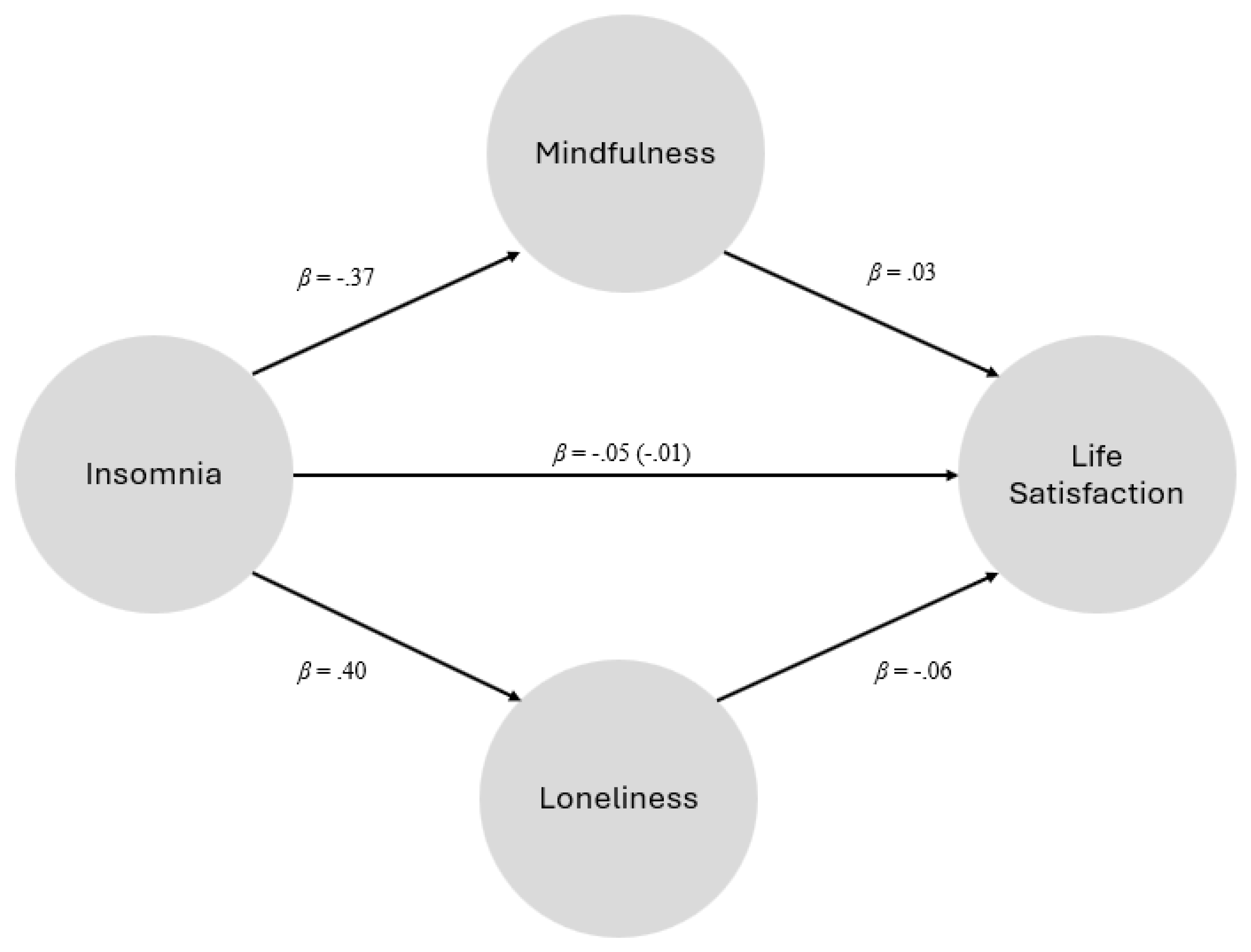

Table 1.
Descriptive statistics.
| Variables | N | Min. | Max. | Means | SD | Skew. | Kurt. | VIF | CI |
| Life satisfaction | 340 | 5.00 | 25.00 | 15.25 | 4.39 | .118 | -.265 | 1.000 | |
| Insomnia | 340 | .00 | 42.00 | 14.67 | 10.38 | .639 | -.152 | 1.146 | 3.623 |
| Mindfulness | 340 | 15.00 | 90.00 | 63.52 | 14.96 | -.653 | .178 | 1.117 | 7.576 |
| Loneliness | 340 | 26.00 | 90.00 | 51.67 | 13.67 | .261 | -.486 | 1.147 | 15.905 |
Table 2.
Results of correlation analysis.
| 1 | 2 | 3 | 4 | |
| 1 = Life satisfaction | 1 | |||
| 2 = Insomnia | -.128* | 1 | ||
| 3 = Mindfulness | .183** | -.261** | 1 | |
| 4 = Loneliness | -.233** | .304** | -.262** | 1 |
*p < 0.05, ** p < 0.01.
Table 3.
The result of the regression analysis.
| Predictor | SE | β | p | F | R | R2 |
| Constant | 16.053.41 | 16.053 | <.01 | 5.654 | .128 | .016 |
| Insomnia | .02 | -.05 | <.05 |
Table 4.
Mediational Model Coefficients.
| Mindfulness | Loneliness | Life satisfaction | |||||||
| Predictors | β | p | β | p | β | p | |||
| İnsomnia | a | -.37 | .001 | .40 | .001 | c′ | -.016 | .493 | |
| Mindfulness | ------ | ------ | ------ | ------ | b | .036 | .05 | ||
| Loneliness | ------ | ------ | ------ | ------ | -.061 | .05 | |||
| Constant | i1 | 69.04 | .001 | 45.795 | .001 | i2 | 16.318 | .001 | |
| R = .261, R2 = .068 | R = .304, R2 = .092 | R = .268; R2=.072 | |||||||
| F(1, 338) = 24.614 p <.001 | F(1, 338) = 34.371p <.001 | F(3, 336) = 8.642 p <.05 | |||||||
Table 5.
Effects of mindfulness and loneliness on life satisfaction.
| Effects | Estimates of Point β | %95 Confidence Interval | |
| The lowest The highest | |||
| Direct effect | -.016 | -.063 | .031 |
| Total effect | -.054 | -.009 | -.128 |
| Total Indirect Effect | -.038 | -.062 | -.018 |
| Indirect Effect of mindfulness | -.014 | -.028 | -.001 |
| Indirect Effect of loneliness | -.024 | -.043 | -.008 |
Disclaimer/Publisher’s Note: The statements, opinions and data contained in all publications are solely those of the individual author(s) and contributor(s) and not of MDPI and/or the editor(s). MDPI and/or the editor(s) disclaim responsibility for any injury to people or property resulting from any ideas, methods, instructions or products referred to in the content. |
© 2025 by the authors. Licensee MDPI, Basel, Switzerland. This article is an open access article distributed under the terms and conditions of the Creative Commons Attribution (CC BY) license (http://creativecommons.org/licenses/by/4.0/).
Copyright: This open access article is published under a Creative Commons CC BY 4.0 license, which permit the free download, distribution, and reuse, provided that the author and preprint are cited in any reuse.


