

Submitted:
17 February 2025
Posted:
18 February 2025
You are already at the latest version
Abstract
This paper reviews key signal processing techniques in Structural Health Monitoring (SHM), focusing on non-parametric time-frequency analysis, adaptive decomposition, and deconvolution methods. It examines the Short-Time Fourier Transform (STFT), Wavelet Transform (WT), and Wigner-Ville Distribution (WVD), highlighting their applications, advantages, and limitations in SHM. The review also explores adaptive techniques like Empirical Mode Decomposition (EMD) and its variants (EEMD, MEEMD), as well as Variational Mode Decomposition (VMD) and its improved versions (SVMD, AVMD), emphasizing their effectiveness in handling nonlinear and non-stationary signals. Additionally, deconvolution methods such as Minimum Entropy Deconvolution (MED) and Maximum Correlated Kurtosis Deconvolution (MCKD) are discussed for mechanical fault diagnosis. The paper aims to provide a comprehensive overview of these techniques, offering insights for future research in SHM signal processing.
Keywords:
signal processing techniques
; structural health monitoring
; non-Parametric time-Frequency analysis
; adaptive decomposition
; deconvolution
1. Introduction
When delving into modern and developed societies, one finds that strategically significant and intricately complete civil infrastructures and buildings constitute their core commonality. This commonality manifests broadly in their widespread application across transportation, industrial production, economic activities, and the protection of personnel and materials. Given the importance of these facilities, we cannot overlook their aging and degradation, nor can we afford the inestimable losses and harm that may result from failing to detect and take timely action. Furthermore, due to the large number and ubiquity of these structures, the majority of them are inevitably and frequently exposed to severe disaster events and continuous environmental vibrations, such as earthquakes, floods, tornadoes, and corrosion, as well as other uncertain factors like traffic loads, material aging, impacts, and environmental corrosion. Consequently, monitoring and assessing structural performance has become a fundamental requirement for enhancing structural integrity and safety.
Structural Health Monitoring (SHM) and structural damage detection methods have continuously evolved, with research gaining new life across various scientific fields such as aerospace, civil, and mechanical engineering. [1]To achieve SHM, researchers employ a variety of different sensor devices to collect signal data, including acoustic, pressure, temperature, force, and accelerometer sensors. This has given rise to the processing of multivariate signals.
The core objective of signal processing is to collect, analyze, and process multivariate signals such as vibrations, noise, temperature, and pressure generated during the operation of mechanical systems, extracting key features that reflect the system’s state, thereby enabling early fault detection, precise diagnosis, and effective prevention. In recent years, SHM researchers have dedicated themselves to integrating and fusing various cutting-edge technologies, particularly those from different information technology and engineering methodologies, to develop economical, accurate, and reliable monitoring methods. Additionally, various data mining, visualization tools, and statistical computations frequently appear in monitoring and processing solutions. Beyond traditional vibration-based monitoring, detections related to sound, temperature, and motor current are now emerging, as mentioned by Wonho Jung[2]. Moreover, changes in structural properties, such as stiffness, are significantly observable in variations of multivariate signals, and internal structural components can also be accurately represented through these signals. Therefore, it is crucial that signal processing techniques for monitoring changes in structural vibration responses are robust during the process of damage localization, quantification, and detection.
The diversity of signals requires the adoption of corresponding processing techniques based on their specific characteristics, and for a particular signal, a so-called powerful signal technique is one that is appropriately adapted. For example, linear signals satisfy the superposition principle and can thus be analyzed using linear processing techniques such as linear filters and Fourier transforms. Nonlinear signals, however, do not satisfy the superposition principle and require nonlinear processing techniques such as nonlinear filters and Hilbert-Huang transforms to reveal their complex characteristics. Directly applying a highly powerful linear signal processing model cannot guarantee perfect representation of nonlinear signals. Therefore, in the process of studying nonlinear signal processing models, new and specific technologies are often required.
In mechanical systems and structures, due to the complexity of operating conditions, external environmental interferences, and the gradual aging and damage of materials and components, the collected signals are often non-stationary and nonlinear. These non-stationary and nonlinear signals contain rich state information, such as vibrations, stresses, and strains, which can reflect the health status of mechanical systems and structures. Therefore, signal processing techniques in the field of structural health require the integration of time-domain, frequency-domain, and time-frequency-domain characteristics to provide a more comprehensive understanding of the nature of signals and improve the accuracy of diagnosis.
In recent years, researchers have made unremitting efforts to achieve precise processing of signals in the field of structural health monitoring (SHM), particularly for non-stationary and nonlinear signals. The emergence of non-parametric time-frequency analysis techniques, such as Short-Time Fourier Transform (STFT), Wavelet Transform (WT), and Wigner-Ville Distribution (WVD), has found widespread application in SHM. These techniques can simultaneously provide information about signals in both the time and frequency domains, aiding in a more comprehensive understanding of signal characteristics. However, these techniques have their limitations, such as the trade-off between time resolution and frequency resolution in STFT, the sensitivity of WT to the choice of basis functions, and the cross-term and noise sensitivity issues in WVD.
To address these issues, adaptive signal processing techniques have emerged. Empirical Mode Decomposition (EMD) and its optimized models (e.g., Ensemble EMD (EEMD), Multivariate EMD (MEEMD)) decompose signals into a series of Intrinsic Mode Functions (IMFs) through an iterative process, with each IMF representing a natural oscillation mode in the signal. This method excels in processing nonlinear and non-stationary signals but also faces challenges in practical applications, such as endpoint effects and energy non-conservation.
Furthermore, Variational Mode Decomposition (VMD) and its variants (e.g., Sparse VMD (SVMD), Adaptive VMD (AVMD)) achieve signal decomposition by minimizing a variational problem, offering higher flexibility and stability. The optimized model, Empirical Wavelet Transform, combines the adaptive decomposition concept of EMD with the compact support framework of wavelet transform theory. By decomposing the signal into multiple frequency bands and constructing wavelet functions compatible with a wavelet filter bank for each band, it achieves adaptive decomposition of the signal. This approach can capture local features of the signal and is particularly suitable for processing nonlinear and non-stationary signals.
The latest technology, deconvolution techniques such as Minimum Entropy Deconvolution (MED) and Maximum Correlated Kurtosis Deconvolution (MCKD), enhance signal fault features through filtering processing, improving diagnostic accuracy. These techniques can be regarded as a method of adaptive signal processing. In the deconvolution process, it is often necessary to estimate the Point Spread Function (PSF) or convolution kernel of the signal, a process that typically relies on adaptive algorithms like the Expectation-Maximization (EM) algorithm or blind deconvolution algorithms. These algorithms can automatically adjust parameters based on observed data and prior knowledge to optimize the deconvolution effect. The combination of deconvolution with the aforementioned adaptive and non-parametric time-frequency analyses elevates signal processing techniques to a new level.
This paper aims to review key signal processing techniques in SHM, particularly non-parametric time-frequency analysis, adaptive decomposition, and deconvolution techniques. The first part introduces non-parametric time-frequency analysis. It begins by presenting the concept, applications, advantages, and disadvantages of STFT and discussing its widespread use in SHM. It then elaborates on the basic principles of WT, application examples, and its advantages and disadvantages compared to STFT. Furthermore, this paper delves into the application of WVD in time-frequency analysis, including its definition, specific application cases in SHM, and the advantages of high time resolution and instantaneous frequency analysis, while also pointing out the limitations of cross-terms and noise sensitivity. The second part introduces adaptive time-frequency analysis, detailing the principles, applications, and advantages and disadvantages of EMD and its optimized models (e.g., EEMD, MEEMD), emphasizing EMD’s unique advantages in processing nonlinear and non-stationary signals. Additionally, it explores the concepts, applications, and comparisons with traditional methods of VMD and its variants (e.g., SVMD, AVMD), highlighting VMD’s flexibility and stability in signal decomposition. The final part discusses deconvolution techniques, examining the applications of deconvolution techniques such as MED and MCKD in machinery fault diagnosis, and analyzing their advantages and disadvantages. This paper aims to provide researchers in the SHM field with a comprehensive understanding of signal processing techniques and serve as a reference for future research.

Table 1.
Applicable scenarios and optimization methods for various signal decomposition techniques.
| Method | Applicable Scenarios | Optimization Methods |
|---|---|---|
| STFT | Preliminary analysis and signal feature extraction | Multi-window techniques, linear frequency modulation Gaussian windows |
| WT | Local signal feature analysis | Optimization of wavelet basis function selection |
| WVD | Single-component linear frequency-modulated signals | Cross-term suppression methods (e.g., DMD-WVD) |
| EMD | Complex signal analysis | Noise-assisted methods (e.g., EEMD), parameter optimization |
| EEMD | Complex signal analysis | Parameter optimization (e.g., adaptive noise bandwidth), hardware acceleration |
| MEEMD | Multi-physical field signal fusion | Parameter optimization, multi-signal synchronous processing |
| VMD | Complex signal analysis | Parameter optimization (e.g., particle swarm optimization), multi-variable signal processing |
| SVMD | Complex signal analysis | Parameter self-adaptive update, minimum bandwidth constraint |
| AVMD | Complex signal analysis | Parameter self-adaptive update, optimization algorithms (e.g., differential evolution) |
| EWT | Complex signal analysis | Optimization of filter design, multi-variable signal processing |
| EEWT | Complex signal analysis | Parameter optimization, multi-signal synchronous processing |
| EFD | Complex signal analysis | Optimization of spectral segmentation, noise suppression |
| MED | Random pulse signals | Noise suppression methods (e.g., wavelet threshold), parameter optimization |
| MCKD | Periodic fault signals | Fault cycle estimation optimization, noise suppression |
| FMD | Complex signal analysis | Parameter optimization, multi-variable signal processing |
2. Non-Parameterised Time-Frequency Analysis
2.1. Short-Time Fourier Transform
2.1.1. Definition
The Short-Time Fourier Transform (STFT) provides a local time-frequency analysis by sliding a window function over the signal and performing Fourier transforms segment by segment. The definition is as follows:
1.Continuous-Time Signal For a continuous signal , the STFT is defined as:
where: - is the time position parameter, indicating the center of the window function. - f is the frequency variable. - is the window function (such as a rectangular window or Hamming window), used to extract a local segment of the signal around time .[3]
2.Discrete-Time Signal For a discrete signal , the discrete form of the STFT is:
where: - m is the discrete time frame index. - k is the discrete frequency index. - N is the length of the window function or the number of FFT points. - is the discrete window function, which slides with m.
Key Points
- Time-Frequency Analysis: The STFT divides the signal into short segments, and each segment is transformed into the frequency domain via Fourier transform to reveal how frequency components vary over time.
- Role of the Window Function: It restricts the signal to a local time segment, balancing time resolution and frequency resolution (the narrower the window, the higher the time resolution and the lower the frequency resolution).
2.1.2. Application
In recent years, the Short-Time Fourier Transform (STFT), as a significant form of the Fourier Transform, has witnessed remarkable and rapid development in its research and application fields.
Firstly, the integration with classical models elevates their performance to a higher level while better aligning with signal characteristics. For instance, a method that first processes the signal using STFT and further integrates it with Google-Net CNN [4] has demonstrated in experimental results that this innovation not only enhances the accuracy of signal processing but also effectively reduces the false alarm rate. Another study significantly improves diagnostic accuracy by combining STFT with CNN [5]. These achievements fully showcase the unique advantages of STFT in enhancing signal processing performance.
Furthermore, significant breakthroughs have been made in optimizing the time-frequency resolution of STFT. The introduction of the ASTFT-CMGW-FVVA method [6], which cleverly employs multi-window techniques and linear frequency modulation Gaussian windows, notably improves time-frequency resolution, enabling more refined signal analysis. Meanwhile, the integration of STFT into models has played a pivotal role in bearing health assessment and enhancing the time resolution of PET detectors. An autoencoder modeling approach based on STFT and ensemble strategies [7] effectively extracts deep vibration features of bearings. Another study combines STFT with residual neural networks [8], significantly improving time-of-flight estimation and coincidence time resolution for PET detectors. These results adequately demonstrate the significant value and application potential of STFT in the era of deep learning.
STFT also plays a crucial role in sparse representation and synchrosqueezing transforms. By combining these techniques with STFT, researchers have achieved optimized signal processing and applications [9]. This innovation not only expands the application scope of STFT but also introduces new ideas and methods to the field of signal processing. Target localization algorithms represent another important area of STFT application. Researchers have proposed an improved target localization algorithm based on STFT [10], which significantly enhances the accuracy of target instantaneous frequency estimation and localization by dynamically adjusting the window function and introducing a new distribution estimator. This achievement provides robust technical support for fields such as target localization and tracking.
Beyond the aforementioned applications, STFT also plays a vital role in signal processing decomposition, linear axis misalignment diagnosis, and train wheel anomaly detection. A decomposition method based on STFT [11] improves the time and frequency resolution of signal processing. Another study, based on servo motor current data and an STFT-based linear axis misalignment diagnosis method [12], achieves sensorless fault diagnosis. Additionally, a train wheel anomaly detection method using STFT and unsupervised learning algorithms [13] effectively monitors wheel health. Furthermore, STFT is applied to analyze multi-time scale variations [14], further expanding its application scope.
Notably, researchers have also conducted innovative studies by combining STFT with fractal theory and the uncertainty principle. They have investigated the fractal uncertainty principle of STFT and Gaussian windows [15] and explored its application in discrete Gaussian Gabor multipliers. This innovation not only provides new perspectives and methods for STFT research but also brings new insights to the study of fractal theory and the uncertainty principle.
Lastly, many researchers have deeply developed and innovated the underlying algorithms of STFT. Some researchers have introduced ST-QPFT and studied the fundamental properties and uncertainty inequalities of STFT, contributing to the field of short-time quadratic phase Fourier transforms [16]. Another study proposes the FrFTSG method related to short-time fractional Fourier transforms [11], improving the time and frequency resolution of signal processing. These innovative achievements not only enrich the theoretical framework of STFT but also provide strong support for its further optimization in practical applications.
2.1.3. Strength and Weakness
- Advantages: High Resolution and Efficient Computation
- Disadvantages: Window Effect and Time-Frequency Trade-off
The Short-Time Fourier Transform (STFT) offers numerous advantages in signal processing within the field of structural health monitoring:
Firstly, STFT provides excellent time-frequency resolution, allowing signals to be represented in detail in both the time and frequency domains. This is particularly crucial for structural health monitoring, as the response signals of structures often exhibit non-stationary characteristics when subjected to external excitations or internal damages. Traditional Fourier transform methods are ineffective in processing such non-stationary signals, whereas STFT can accurately capture the temporal variations in signals, providing a solid basis for structural health assessment.
Secondly, STFT is computationally efficient. Compared to other time-frequency analysis methods, STFT has relatively low complexity, enabling it to play a significant role in real-time applications. In structural health monitoring systems, real-time performance is a key indicator, as timely and accurate detection of structural damages is vital for ensuring structural safety. The efficiency of STFT enables it to meet this requirement, providing strong support for real-time structural health monitoring.
However, the Short-Time Fourier Transform also has some limitations in signal processing within the field of structural health monitoring:
One notable drawback is the window effect. The analysis results of STFT are highly dependent on the choice and length of the window function. In structural health monitoring, different window functions and lengths may lead to variations in time-frequency resolution, thereby affecting the accuracy of damage identification. Therefore, careful consideration is needed when selecting the window function and length to ensure consistent and accurate analysis results. Another key limitation is the inherent trade-off between time and frequency resolution. Due to the Heisenberg uncertainty principle, STFT cannot achieve optimal resolution in both the time and frequency domains simultaneously. In structural health monitoring, certain damages may exhibit rapidly changing characteristics, requiring time-frequency analysis methods to capture high-frequency components of signals within short periods. However, the performance of STFT in this aspect may be limited, leading to inaccurate identification of certain rapidly changing damage features.
Furthermore, STFT struggles to accurately capture the time-frequency features of highly non-stationary signals, especially those with abrupt or transient components. In structural health monitoring, certain damages may cause abrupt or transient changes in signals, requiring time-frequency analysis methods to sensitively capture these changes. However, STFT may have deficiencies in this regard, leading to inaccurate identification of certain damage features.
To address these limitations, STFT often needs to be combined with complementary methods, such as wavelet transforms or adaptive time-frequency techniques. These methods can compensate for the shortcomings of STFT in terms of time-frequency resolution and capture of abrupt signals, improving its performance in complex signal analysis scenarios. Despite these challenges, STFT remains a fundamental and widely used time-frequency analysis tool. Owing to its advantages of simplicity, efficiency, and broad applicability, it plays a significant role in signal processing within the field of structural health monitoring.
2.2. Wavelet Transform
2.2.1. Definition
Wavelet Transform is a time-frequency analysis method used to analyze the local characteristics of non-stationary signals. Different from Fourier Transform, Wavelet Transform represents the signal through a set of scalable and shiftable wavelet functions, thereby being able to provide high-resolution analysis simultaneously in time and frequency. Wavelet Transform can be divided into Continuous Wavelet Transform (CWT) and Discrete Wavelet Transform (DWT). The former is mainly used for signal analysis, while the latter is often used in signal compression and feature extraction.
2.2.2. Application
The emergence of the Discrete Wavelet Transform (DWT) has caused a tremendous stir. The number of research papers on wavelet transform-related directions far exceeds that of similar signal processing models. Moreover, optimized models based on DWT have emerged in an endless stream. One such method is the identification of homologous acoustic emission signals based on Synchrosqueezing Wavelet Transform Coherence (SWTC). This method aims to improve the accuracy of identifying homologous acoustic emission signals in structural health monitoring, thereby enhancing the precision of damage localization [17]. Additionally, an unsupervised tunnel damage identification method based on Convolutional Variational Autoencoder (CVAE) and wavelet packet analysis has been proposed, with experimental results validating its efficiency and accuracy [18].
The integration of wavelet analysis with deep learning models has led to a new breakthrough. SWT [19] represents an innovative approach for bearing fault diagnosis, which combines wavelet packet transform with convolutional neural networks and further optimizes network parameters through a simulated annealing algorithm. The Swin Residual Network (WSRN) based on multi-level Discrete Wavelet Transform has been employed to reconstruct continuously missing data [20]. By replacing the traditional sampling layers with multi-level DWT, this approach significantly enhances the recovery of weak signals and the extraction of multi-scale features, thereby greatly improving the accuracy of data reconstruction.
In the field of structural health monitoring, DWT has proven to be a powerful tool. However, its accuracy heavily relies on the selected wavelet basis function and the number of vanishing moments, posing significant challenges in practical applications. To address this issue, a method [21] cleverly combines statistical properties with DWT, markedly improving the accuracy of steel beam crack identification.
Lastly, Generalized Morse Wavelets have found widespread application in fields such as dynamic system analysis [22]. Their unique time-frequency localization characteristics and flexible multi-scale analysis capabilities make them indispensable tools for signal processing and analysis. By adjusting parameters such as symmetry and width, Generalized Morse Wavelets can optimize the analysis of specific signals, providing more accurate signal feature extraction and diagnostic information. These wavelets demonstrate their powerful capabilities through fine time-frequency analysis of non-stationary signals in complex dynamic systems, revealing the dynamic behavior characteristics of the system across different time scales and frequency ranges. This is crucial for understanding the operational mechanism of the system, modeling and simulating the system, and ultimately optimizing system performance.
2.2.3. Strength and Weakness
- Advantages:Time-frequency localization and flexible multi-scale analysis
- Disadvantages: Challenge in selecting wavelet basis and parameters
The application of wavelet transform in the field of structural health monitoring (SHM) presents multiple advantages and disadvantages, with its strengths particularly prominent: Firstly, wavelets exhibit excellent time-frequency localization characteristics. This property enables wavelet transform to perform high-resolution analysis simultaneously in both time and frequency domains, providing a unique advantage for processing non-stationary signals. In SHM, structural responses are often influenced by various factors, resulting in non-stationary signals. Wavelet transform can therefore more accurately capture the changing features of these signals, providing strong support for structural condition assessment. Secondly, wavelets facilitate multi-scale analysis. By adjusting the scale and position of the wavelet function, signals can be decomposed at different scales, thereby extracting hierarchical features. These features can reflect damage conditions and performance changes in the structure at different scales, providing rich information for SHM and damage identification. Furthermore, the flexibility of wavelets is another significant advantage. The diversity of wavelet basis functions allows for the selection of appropriate wavelet bases for transformation based on specific signal types and requirements. In the field of SHM, different structural types and damage forms may require different wavelet bases to better represent signal characteristics, and the flexibility of wavelets satisfies this need.
Notably, the Discrete Wavelet Transform (DWT) possesses high computational efficiency. This characteristic makes wavelet transform highly potential for real-time SHM. Especially in signal compression and feature extraction, DWT can efficiently process large amounts of data, providing rapid and accurate analysis results for online monitoring and damage warning of structures.
However, the application of wavelet transform in the field of SHM also faces some challenges. Firstly, the selection of wavelet basis functions is crucial. Different wavelet basis functions have significant impacts on analysis results, necessitating professional knowledge and insight to choose appropriate ones. In practical applications, experts in the field of SHM need to make careful selections based on specific circumstances. Secondly, the choice of parameters in wavelet transform (such as scale and position) has a substantial influence on the results. However, a rigorous methodology for this process is currently lacking. This may lead to instability and inaccuracy in analysis results, necessitating further research and exploration to refine this method. Lastly, the sensitivity of wavelets to noise is also a concern in their application. In SHM, signals are often contaminated with noise due to environmental noise and measurement errors. Wavelet transform may be interfered by noise when processing these noisy signals, leading to distorted analysis results. Therefore, complementary denoising techniques need to be integrated to mitigate the impact of noise on analysis results and improve the accuracy and reliability of wavelet transform in SHM .
2.3. Wigner-Ville Distribution
2.3.1. Definition
The Wigner-Ville Distribution (WVD) is a sophisticated time-frequency analysis technique employed to examine the time-frequency properties of non-stationary signals. It offers a means to simultaneously visualize both temporal and spectral information by transforming the signal into the time-frequency domain. The WVD is formally defined as follows:
where is the input signal, * is the complex conjugation, and t and f are the time and frequency variables, respectively.
2.3.2. Application
The development of the Wigner-Ville Distribution (WVD) in the field of structural health monitoring (SHM) exhibits trends of diversification, deepening, and innovation.
The application of the WVD in SHM is becoming increasingly widespread. From traditional signal processing to the enhancement of deep learning models, and further to the integration with other advanced technologies such as Dynamic Mode Decomposition (DMD), Variational Mode Decomposition (VMD), and Convolutional Neural Networks (CNNs), the applications of the WVD in the field of structural health continue to expand. These applications not only improve the accuracy and efficiency of signal processing but also provide more comprehensive and accurate data support for SHM. Ref.[23] employs the Smoothed Pseudo Wigner-Ville Distribution (SPWVD) to enhance deep learning models. The DMD-WVD method [24] combines Dynamic Mode Decomposition with the Wigner-Ville Distribution to eliminate cross-terms.
As research deepens, the technical methods of the WVD continue to innovate. The introduction of the Quadratic Chirp-Scaled Wigner Distribution (QSWD) [25] further enhances the advantages of signal detection. In combination with other deep learning models, time-frequency analysis methods for partial discharge signals based on VMD and WVD [26] have emerged, as well as the integration of the WVD with CNNs for classification [27], specifically applied to composite material damage classification methods [28]. Additionally, there are methods based on the Polynomial Wigner-Ville Distribution [29], hybrid Wigner-Ville distributions defined in the octonion domain [30], and other innovative technical approaches that provide new ideas and methods for SHM.
The development of the WVD in the field of structural health is also reflected in the depth of theoretical research. Researchers have not only conducted in-depth studies on the WVD itself but also combined it with other mathematical and physical theories to explore its application potential in SHM. For example, the study of the uncertainty principle of the Coupled Fractional Wigner-Ville Distribution (CFrWVD) [31] helps to better understand the behavior of the WVD in complex signal analysis; the combination of the WVD with theories such as the Quaternion Linear Canonical Transform (QOLCT) [32] also provides new perspectives and methods for signal processing. The emergence of the WVD in special mathematical domains, such as the study of the interaction between the two-dimensional hypercomplex WVD and the quadratic phase Fourier transform [24], is also noteworthy.
Finally, in SHM, real-time performance and accuracy are two crucial indicators. The WVD plays a significant role in enhancing these two aspects. For instance, the proposal of the Short-Time Wigner-Ville Distribution (STWD) [33] method provides a new approach for real-time signal processing, enabling SHM to respond more promptly to changes in structural conditions.
2.3.3. Strength and Weakness
- High time-frequency resolution and energy concentration
- Precision in instantaneous frequency analysis
- Mathematical completeness and cross-term interference
The advantages of the Wigner-Ville Distribution (WVD) in structural health signal processing are evident.
Firstly, it possesses high time-frequency resolution and energy concentration [34]. The WVD directly reflects the distribution of signal energy in the time-frequency plane through the Fourier transform of the instantaneous correlation function, without the constraints of a window function, thereby breaking through the limitations of time-frequency resolution imposed by the Short-Time Fourier Transform (STFT) and wavelet transforms. For single-component linear frequency-modulated signals, such as the impulse response generated by structural damage, the time-frequency energy concentration of the WVD reaches theoretical optimality, enabling clear capture of high-frequency transient components, such as nonlinear vibrations resulting from crack propagation or bolt loosening.
Furthermore, it exhibits precision in instantaneous frequency analysis [35]. The quadratic nature of the WVD allows it to directly represent changes in the instantaneous frequency of a signal, such as the time-varying characteristics of structural modal frequencies or frequency modulation phenomena in nonlinear vibrations. Compared to linear time-frequency methods (e.g., STFT), the WVD offers higher accuracy in the analysis of frequency-hopping signals and rapid frequency changes.
Additionally, it is characterized by mathematical completeness and information richness. The WVD satisfies the marginal conditions (the integrals of time and frequency energy equal the total signal energy) and possesses phase shift invariance. The Fourier transform of its autocorrelation function can be directly used for modal parameter identification and damage localization. Moreover, the real-valued nature of the WVD simplifies the physical interpretation of the energy density distribution, making it suitable for energy decay analysis in structural health monitoring. Lastly, it demonstrates adaptability as a non-parametric method. The WVD does not require pre-assuming a signal model, making it suitable for extracting unknown damage features under complex operating conditions. For example, in composite material delamination damage monitoring, the WVD can adaptively analyze the time-frequency characteristics of nonlinear acoustic emission signals without relying on a preset damage model.
Of course, the WVD has limitations and challenges. Firstly, there is the interference of cross-terms [26]. The bilinear nature of the WVD leads to the generation of spurious cross-terms in the time-frequency distribution of multicomponent signals (such as multimode vibrations or environmental noise interference). These cross-terms can obscure real damage features, potentially leading to misjudgment, especially in the presence of multiple coexisting damages or strong noise environments. For instance, when multi-point damage signals in a bridge structure overlap, cross-terms may form pseudo-frequency peaks, interfering with damage localization [36].
Secondly, there is the issue of non-positivity of energy and ambiguity in physical meaning. Although the WVD is a real-valued distribution, its energy density may exhibit negative values, conflicting with the concept of energy in a physical sense and limiting its application in quantitative energy analysis, such as damage severity assessment.
Finally, there are limitations in computational complexity and real-time performance. The high resolution of the WVD relies on instantaneous correlation calculations over the entire data length, leading to low processing efficiency for long time-series signals (such as long-term structural monitoring data) and making it difficult to meet real-time monitoring requirements.
3. Adaptive Time-Frequency Analysis
3.1. Empirical Mode Decomposition and Optimization Models
3.1.1. Empirical Mode Decomposition
3.1.1.1. Definition
Empirical Mode Decomposition (EMD), proposed by Huang et al. [37], is an adaptive signal processing method that decomposes a signal into a set of Intrinsic Mode Functions (IMFs), each representing a natural oscillation mode in the signal. The EMD method extracts different frequency components from the signal through an iterative process based on the signal’s local characteristic time scale.
An IMF, which is the basic function obtained during the EMD decomposition process, must satisfy the following two conditions:1ïijL’Relationship between the number of extrema and the number of zero-crossings: They must be equal or differ by at most one.2ïijL’Mean of the local envelope: At any point, the mean of the envelope defined by the local maxima and minima is zero.[38] It is worth noting that IMFs are determined by the signal itself, rather than predefined kernel functions, making EMD an adaptive signal processing method.
The formula for the EMD method can be expressed as:
where: - is the original signal, - is the i-th IMF, - is the residual term, representing the part of the signal not decomposed into IMFs, - N is the number of IMFs.
3.1.1.2. Application
In recent years, researchers have applied Empirical Mode Decomposition (EMD) in conjunction with various network models.
A multitude of methods have emerged for sequence prediction by integrating EMD with neural networks. Typically, EMD is used to decompose signals into modal functions, which are then analyzed using classical networks. One approach combines EMD with Long Short-Term Memory (LSTM) neural networks to estimate the State of Health (SOH) and predict the Remaining Useful Life (RUL) of lithium-ion batteries. EMD is utilized to decompose the voltage signals of lithium-ion batteries and extract Intrinsic Mode Functions (IMFs). These IMFs are then processed by an LSTM network to predict the battery’s SOH and RUL [39]. Another method involves a model that combines EMD with Gated Recurrent Unit (GRU) neural networks. EMD is used to decompose time series data and extract IMFs, which are subsequently processed by a GRU network to enhance prediction accuracy and robustness [40]. Additionally, there is a predictive model that combines EMD with Least Squares Support Vector Regression (LSSVR). EMD is used to decompose time series data, extract IMFs and residuals, which are then individually predicted by LSSVR. The final prediction is obtained by aggregating these individual predictions [41]. Furthermore, a hybrid model that integrates three classical modelsâĂŤEMD—EMD, LSTM, and Autoregressive Integrated Moving Average (ARIMA)âĂŤis used for wind speed prediction. EMD is used to decompose wind speed data and extract IMFs, LSTM processes the time series data, and ARIMA captures the linear trends in the data. The overall model improves prediction accuracy and stability [42].
Moreover, research on noise reduction methods is also making progress. One noise reduction method combines Uniform Phase Empirical Mode Decomposition (MUPEMD) with a Genetic Algorithm-Dynamic Zero-Phase Interval Filtering algorithm (GA-DZPIF) to improve the processing efficiency of ship-radiated noise signals and mitigate modal aliasing issues. MUPEMD is used to decompose the signals, while GA-DZPIF is used to filter the single-mode components, with Structural Similarity (SSIM) used as an evaluation metric [43]. Additionally, a method based on Improved Ensemble Noise Reconstruction Empirical Mode Decomposition (IENEMD) and Adaptive Threshold Denoising (ATD) has been proposed. This method combines IENEMD and ATD to extract weak fault features of rolling bearings. IENEMD is used to decompose the signals, while ATD is used for denoising. The effectiveness and robustness of this method have been verified through simulation experiments and practical cases [44].
Furthermore, Guo Junyu et al. have proposed a hybrid scheme for rolling bearing fault prediction based on Empirical Mode Decomposition (EMD) and Kernel Principal Component Analysis (PCA). This hybrid scheme combines Complete Ensemble Empirical Mode Decomposition with Multiscale Interpolation (CEEMD-MsI) and PCA to construct a nonlinear health indicator, and uses a dual-channel transformer network and convolutional block attention module to extract multi-domain features for rolling bearing fault prediction [45].
3.1.1.3. Strength and Weakness
- without the need to preset the number of modes or frequency ranges
- capable of capturing complex patterns and transient features
Empirical Mode Decomposition (EMD) is the most classic adaptive time-frequency analysis technique. Compared with the aforementioned non-parametric dependent time-frequency analysis techniques, it can decompose signals based on their inherent characteristics without the need to preset the number of modes or frequency ranges. This method is particularly suitable for processing signals with complex nonlinear and multiscale characteristics. Furthermore, the decomposition process of EMD is driven by data iteration, based on the local maxima and minima of the signal. During this process, the signal is naturally decomposed into a series of intrinsic mode functions (IMFs) without the need for additional prior knowledge or model parameter adjustments.
Compared with traditional Fourier Transform and Wavelet Transform, the mode mixing phenomenon in EMD is reduced. Each IMF represents a local manifestation of the signal within a specific frequency range. Although they are not completely orthogonal, they ensure a certain degree of frequency-time resolution of the signal. In terms of handling boundary effects, EMD has also undergone certain optimizations. By specially processing the signal boundaries, the influence of boundary effects on the decomposition results is reduced. In contrast, the aforementioned time-frequency analysis methods may encounter issues such as reduced resolution or spectrum leakage at signal boundaries. Additionally, the IMFs obtained after EMD decomposition can be reconstructed through simple addition operations with high reconstruction accuracy. This characteristic gives EMD advantages in applications such as signal denoising, feature extraction, and pattern recognition. It is particularly noteworthy that EMD is especially suitable for processing nonlinear and non-stationary signals, capable of capturing complex patterns and transient features in the signal. In contrast, Wavelet Transform and Short-Time Fourier Transform may require more complex multiscale analysis when processing nonlinear signals.
Finally, regarding the adaptability of EMD, it can process any type of signal, including process control [46,47], modeling [48,49], surface engineering, wind speed prediction [50,51], system identification [52,53], bearing diagnosis [54], etc. This excellent adaptability makes its application versatile.
Of course, as the most basic adaptive time-frequency analysis technique, EMD still has much room for development. Its disadvantages include endpoint effects and energy non-conservation, which are inherent to the EMD algorithm itself. Since IMFs are not strictly orthogonal, the total energy of the decomposed IMFs may not match the energy of the original signal, leading to energy non-conservation in some cases. For example, in the study by Yaguo Lei [38], simulations and analyses of IMFs revealed distortions at both ends of the IMFs, with the decomposition results exhibiting distortions at both ends. Furthermore, another prominent disadvantage of EMD is the mode mixing problem, where a single IMF contains oscillations of different scales, or oscillations of similar scales are distributed across different IMFs. This is caused by the intermittency of the signal. As stated by Huang et al. [37], intermittency can lead to severe mixing of time-frequency distributions, making the physical meaning of individual IMFs ambiguous.
3.1.2. Ensemble Empirical Mode Decomposition
3.1.2.1. Definition
Ensemble Empirical Mode Decomposition (EEMD) is an improved method of Empirical Mode Decomposition designed to address the mode mixing issue that may arise when EMD processes signals. EEMD adds white noise of a certain amplitude to the signal to be analyzed and performs multiple EMD decompositions, which are then averaged to obtain more stable and accurate intrinsic mode functions. EEMD retains the adaptive characteristics of EMD, enabling decomposition based on the local characteristic time scales of the signal itself.
3.1.2.2. Application
Extensive experimental research on prediction related to Ensemble Empirical Mode Decomposition (EEMD) is being conducted. Various models for prediction have emerged. Researchers have adopted data-driven models such as EEMD-RF, EEMD-ANN, and EEMD-GBM for precise prediction and conducted sensitivity analyses to understand model behavior [55]. Another study employed a method that combines EEMD with SVM [56]. Similarly, the W-EEMD-ARIMA model achieved the same objective [57]. A method using the EEMD-ANN model for prediction has been proposed, aiming to address inherent challenges in prediction, such as difficulties in model construction, low prediction accuracy, and high computational intensity [58].
EEMD exhibits good denoising performance. The effectiveness of the EEMD-based denoising method proposed in [59] was compared with various wavelet transform-based threshold denoising methods, demonstrating the potential of EEMD in signal denoising applications. A study combined the EEMD-Independent Component Analysis (ICA) method to effectively remove artifacts [60]. Furthermore, there are other innovative models and applications. Such as a EEMD-TCN machine learning method has been utilized [61].
3.1.2.3. Strength and Weakness
- alleviates the mode mixing issue by adding Gaussian white noise
- residual noise contamination and energy non-conservation
Ensemble Empirical Mode Decomposition (EEMD), as an enhanced version of the classical Empirical Mode Decomposition (EMD), demonstrates unique application value in structural health signal processing while facing several limitations that require urgent resolution. Its core advantage lies in effectively alleviating the mode mixing issue caused by signal intermittency in traditional EMD through multiple additions of Gaussian white noise to the original signal and ensemble averaging. For instance, in the analysis of bridge vibration signals with multiple damage sources, EEMD can separate high-frequency transient components from crack propagation and low-frequency modulated signals from bolt loosening into distinct Intrinsic Mode Functions (IMFs), significantly improving the accuracy of damage feature extraction. This noise-assisted mechanism not only enhances decomposition stability but also preserves EMD’s adaptability, enabling it to process nonlinear, non-stationary signalsâĂŤsuch as acoustic emission signals from composite material delamination or dynamic structural responses under seismic excitationâĂŤwithout predefined basis functions. Furthermore, the decomposed IMFs possess clear multi-scale physical meanings: high-frequency components typically correspond to transient features of localized structural damage (e.g., impact components in early-stage gearbox faults), while low-frequency components reflect global structural vibration modes, providing reliable references for early detection of fatigue cracks in wind turbine blades.
However, the engineering application of EEMD still faces multiple challenges. First, its performance heavily depends on manually set noise intensity and decomposition iterations. Improper parameter selection may lead to signal features being obscured by noise or incomplete modal separation. For example, in rail crack monitoring, excessive noise amplitude settings could contaminate high-frequency IMFs related to damage, compromising diagnostic accuracy. Second, the algorithm’s computational complexity increases significantly, with single decomposition time approximately a hundredfold that of EMD, limiting real-time processing capabilities for massive datasets in long-term monitoring scenarios such as bridges and dams. Although boundary distortion in IMFs caused by end effects can be partially mitigated through mirror extension or local mean prediction (e.g., OFCEEMDAN algorithm), signal anomalies under extreme operating conditions may still interfere with envelope fitting precision. Additionally, residual noise contamination from repeated noise additions and energy non-conservation in IMFs might affect the reliability of quantitative damage assessment, necessitating post-processing optimization through wavelet threshold denoising or energy compensation algorithms.
To address these limitations, current research focuses on improvements from two dimensions: algorithm optimization and engineering implementation. Regarding noise-assisted strategies, Complementary Ensemble Empirical Mode Decomposition (CEEMD) reduces residual noise by 40% while preserving modal separation advantages through symmetric positive-negative noise pair addition, significantly enhancing signal-to-noise ratio. Adaptive parameter adjustment methods dynamically optimize noise amplitude based on signal entropy or energy distribution, reducing manual intervention requirements. The introduction of hardware acceleration technologies provides new pathways for real-time breakthroughsâĂŤfor instance, GPU-based parallel computing can improve long-sequence signal processing efficiency by 5-8 times, while the development of FPGA embedded modules meets low-power demands for field monitoring equipment. Multi-sensor fusion strategies further expand EEMD’s application boundaries. Multivariate EEMD achieves cross-scale feature extraction in composite damage diagnosis of wind turbine blades through joint analysis of multi-physical field data (vibration, acoustic emission, and fiber optic sensing), with false alarm rates reduced to below 3%.
Future research should prioritize three directions: First, constructing parameter self-optimization networks through deep learning, utilizing convolutional neural networks to dynamically analyze signal characteristics and generate optimal noise parameters. Second, establishing IMF energy correction models to address quantitative assessment deviations caused by modal energy leakage. Third, developing multi-physical field coupled diagnostic frameworks that incorporate environmental parameters such as temperature and strain into the EEMD decomposition process, building a time-space-frequency joint analysis system for structural health status. Through the integration of algorithmic innovation and engineering practice, EEMD is expected to achieve deeper engineering applications in fields such as aerospace composite material monitoring and super high-rise building dynamic response analysis, providing robust and precise signal processing tools for structural health monitoring.
3.1.3. Multivariate Ensemble Empirical Mode Decomposition
3.1.3.1. Definition
Modified Ensemble Empirical Mode Decomposition (MEEMD) is an improved method of empirical modal decomposition. It evenly distributes the extrema of the signal by adding pairs of positive and negative Gaussian white noise and reduces the number of spurious components through multiple trials. MEEMD not only inherits the adaptability and the ability to address mode mixing issues from Ensemble Empirical Mode Decomposition (EEMD), but also further enhances the accuracy and stability of the decomposition by introducing a median operator.
The specific steps are as follows: (1)Adding Gaussian white noise: Pairs of positive and negative Gaussian white noise are added to the original signal, ensuring that the noise has a mean of zero and equal standard deviations. (2)Empirical modal decomposition: Multiple empirical modal decompositions are performed on the noise-added signal, with each decomposition yielding a series of Intrinsic Mode Functions (IMFs) and a residual.(3)Median operation: A median operation is applied to the IMFs and residuals obtained from each decomposition to produce the final IMFs and residual.
3.1.3.2. Application
Multivariate Ensemble Empirical Mode Decomposition (MEEMD) effectively addresses the complexity and non-stationarity of signals by decomposing composite waves into distinct components, thereby facilitating the examination of their spatiotemporal heterogeneity and separation characteristics [62].
Research has also leveraged this attribute, employing MEEMD to manage the nonlinear and non-stationary nature of Normalized Difference Vegetation Index (NDVI) data, integrating MEEMD with the Geographically and Temporally Weighted Regression (GTWR) method [63].
Innovatively, MEEMD has been applied to non-destructive testing. By processing data obtained from pulsed thermography with MEEMD, signals of different frequency components can be separated. Due to the differences in thermal responses between defective and non-defective regions, the decomposition by MEEMD better highlights these discrepancies, thereby enabling non-destructive testing and enhancing the accuracy and reliability of detection [64]. A method combining MEEMD and Prony [65], wherein MEEMD decomposes the signal and introduces permutation entropy to detect randomness, followed by the reconstruction of the remaining Intrinsic Mode Function (IMF) components, has also achieved innovative progress.
Furthermore, MEEMD is extensively utilized for prediction [66]. A sequence prediction method based on the MEEMD-Long Short-Term Memory (LSTM) network model has been proposed. Another prediction approach employs a model based on MEEMD-LSTM-Multilayer Perceptron (MLP) [67]. MEEMD initially decomposes the data, LSTM handles the dynamic changes in time series, and MLP models complex nonlinear relationships. The synergy among these three enhances prediction accuracy and stability under different conditions and data characteristics. A prediction model based on improved MEEMD and Quasi-Affine Transformation (QUATRE) optimized Bidirectional Long Short-Term Memory (BILSTM) network [68] has also been developed. In this model, MEEMD processes photovoltaic output data to extract key features, QUATRE optimizes these features, and BILSTM captures forward and backward dependencies in time series data.
Simultaneously, MEEMD is applied to fault detection. A rotor fault detection method based on MEEMD energy entropy and Artificial Neural Network (ANN) has been developed. MEEMD decomposes the operational signals of the rotor and calculates energy entropy to construct a feature vector reflecting the energy distribution characteristics of the signal [69]. Another fault diagnosis method for reciprocating machinery based on improved MEEMD-SqueezeNet has also been proposed [70].
Researchers have further optimized MEEMD focusing on the crucial issue of noise in signal processing. To address the noise reduction problem in tunnel blasting vibration signals, a complete method based on MEEMD-Least Mean Squares (LMS) has been developed [71]. Additionally, a method combining MEEMD and Singular Value Decomposition (SVD) is used to remove noise from high slope deformation data. MEEMD is employed for the initial decomposition of high slope deformation data, and SVD further processes the decomposed matrix to effectively eliminate noise, fully preserving the intrinsic details of the deformation data and providing a more accurate basis for subsequent data analysis and processing [72].
3.1.3.3. Strength and Weakness
- Suppression of modal aliasing and fusion of multi-physical field signals
- Parameter sensitivity, residual noise, and endpoint effect
- algorithm generalization and Poor adaptability to extreme working conditions
On the one hand, MEEMD (Multivariate Ensemble Empirical Mode Decomposition) possesses multiple advantages. Firstly, it excels in mode mixing suppression and computational efficiency enhancement. By adopting a multivariate signal ensemble decomposition strategy and incorporating a median operator to integrate and average the decomposition results of multiple signal sets, MEEMD effectively reduces spurious components induced by the addition of random noise in EEMD (Ensemble Empirical Mode Decomposition). Secondly, it enhances multi-physical field signal fusion and robustness. The multivariate signal ensemble nature of MEEMD enables it to process multi-channel sensor data simultaneously (such as vibration, acoustic emission, and fiber optic sensing). Through joint analysis of time-frequency characteristics of signals from different physical fields, it strengthens the identification capability for complex damage patterns (such as the coexistence of composite delamination and metal fatigue). Experiments demonstrate that in the diagnosis of composite damages in wind turbine blades, MEEMD can reduce the false alarm rate to below 3%, significantly outperforming the single-channel EEMD method. Furthermore, its adaptive noise bandwidth design dynamically adjusts to different signal characteristics (such as high-frequency transients or low-frequency slow variations), avoiding the masking of signal features by fixed-bandwidth noise. Additionally, computational cost optimization and real-time performance improvement are achieved. By optimizing the ensemble averaging strategy (such as stage-wise averaging instead of global averaging), MEEMD shortens the computation time by 30%-45% while maintaining decomposition accuracy [73]. For example, for 24-hour bridge vibration monitoring data, combining MEEMD with GPU parallel computing can enhance processing efficiency by 5-8 times, meeting the requirements of real-time monitoring. This improvement is particularly suitable for long-term health monitoring scenarios, such as dam deformation analysis or aerospace structural fatigue assessment. The main technical challenges of MEEMD are as follows. Firstly, parameter sensitivity and residual noise persistence. The performance of MEEMD still relies on manually set noise bandwidth and the number of ensemble trials. If the noise bandwidth is too wide, it may introduce high-frequency artifacts; if too narrow, it may result in incomplete mode separation. For instance, in rail crack monitoring, improper noise parameter settings can contaminate damage-related high-frequency IMFs (Intrinsic Mode Functions) with noise, reducing the signal-to-noise ratio by about 20%. Moreover, multiple overlays of limited-bandwidth noise may lead to the accumulation of low-frequency residual noise, necessitating post-processing with wavelet threshold denoising or energy compensation algorithms. Secondly, endpoint effects and poor adaptability to extreme conditions. Although MEEMD partially suppresses endpoint distortions through local mean prediction (such as the OFCEEMDAN algorithm), under extreme conditions of strong impact loads or abrupt signal amplitude changes (such as building responses during earthquakes), envelope fitting errors may still cause IMF boundary frequency shifts, affecting damage localization accuracy. Experiments indicate that modal energy leakage in such cases can reach 8Thirdly, hardware resource constraints and algorithm generalization limitations. The multi-channel data processing requirements of MEEMD significantly increase memory usage, posing challenges to the hardware resources of embedded devices (such as wireless sensor nodes). For example, FPGA-implemented MEEMD modules require an additional 20% of logic units for multi-signal synchronous processing, limiting their promotion in low-power scenarios [73,74]. Furthermore, the algorithm’s generalization capability for non-stationary signals still needs verification, particularly the decomposition stability under multi-physical field coupling (such as the combined effect of temperature and strain) has not been fully investigated.
3.2. Variational Mode Decomposition and Optimization Models
3.2.1. Variational Mode Decomposition
3.2.1.1. Definition
Variational Mode Decomposition (VMD) is a signal processing method proposed by Dragomiretskiy et al. in 2013. VMD decomposes a signal into several Intrinsic Mode Functions (IMFs), each of which possesses a specific center frequency and bandwidth. The core idea of VMD is to achieve signal decomposition by minimizing the solution to a variational problem, ensuring that each IMF is as concentrated as possible within a certain frequency band[75].
3.2.1.2. Application
Variational Mode Decomposition (VMD) has demonstrated remarkable performance in machinery fault diagnosis, particularly in extracting fault features from rotating machinery such as bearings and gearboxes. By decomposing vibration signals, VMD effectively isolates fault characteristic frequencies and, when combined with methods like envelope spectrum analysis, achieves precise fault diagnosis. For instance, a method for estimating spalling size in rolling bearings based on signal processing techniques has been proposed [76]. Another example is a natural gas pipeline leak detection method based on optimized VMD and the ConvFormer model [77].
Furthermore, VMD has been applied to the prediction of structures such as bridges and buildings. For example, by decomposing the vibration response signals of structures, VMD can identify modal changes caused by damage, providing a basis for predictive assessment. To accommodate different prediction scenarios, researchers have also optimized the VMD model in various ways. One study introduced a thermal load time series decomposition and prediction model based on VMD and Fast Independent Component Analysis (FastICA) [78]. Another proposed a short-term offshore wind speed prediction method based on a hybrid VMD-PE-FCGRU model [79]. Additionally, a lithium-ion battery health state estimation method based on the MEWOA-VMD and Transformer architecture has been developed [80]. There is also a concrete dam displacement prediction model based on VMD, TSVR, and GRU [81]. In another approach, complex power load time series are decomposed into multiple relatively simple subsequences using VMD, and by combining the ICSS algorithm, abrupt and irregular changes in the time series are identified and separated. Finally, neural networks in deep learning are used to predict these subsequences, and the final prediction results are obtained through ensemble learning, significantly improving the accuracy and stability of predictions [82].
VMD is also widely applied in signal denoising and feature extraction. Thanks to its inherent proficiency in handling noise, VMD excels in these applications. Moreover, researchers are dedicated to optimizing and upgrading VMD using innovative methods. One such method is a signal preprocessing approach based on VMD technology and sample entropy. This method decomposes milling robot response signals into multiple modal components using VMD and then calculates the sample entropy of each component to assess its complexity and irregularity. By setting appropriate thresholds, modal components containing amplitude and frequency modulation (AM-FM) harmonic components can be identified and eliminated, achieving the goals of denoising and signal optimization [83]. Another method combines VMD, Empirical Wavelet Transform (EWT), and Continuous Wavelet Transform (CWT) to improve the signal-to-noise ratio of acoustic signals and accurately detect pipeline leak locations. By analyzing and processing signals in different frequency domains, noise can be effectively suppressed, and useful information can be extracted, significantly enhancing the accuracy of leak detection [84].
A joint denoising method based on VMD parameter optimization has been proposed for removing noise from acoustic signals of high-voltage shunt reactors [85]. This method integrates VMD, Complete Ensemble Empirical Mode Decomposition with Adaptive Noise (CEEMDAN), and an Improved Continuous Wavelet Transform (ICWT) structure. The combination of these three methods allows for more effective noise removal from density logging data, improving data resolution and thin-layer identification accuracy [86]. An optimized VMD algorithm based on Tunable Diode Laser Absorption Spectroscopy (TDLAS) has been developed for signal denoising [87]. A wavelet threshold function based on the combination of Grey Wolf Optimization (GWO) and VMD has been proposed to address noise interference in ultrasonic echo signals [88]. An adaptive denoising and detrending method based on an Improved Seagull Optimization Algorithm (ISOA) and VMD has been developed for processing signals from nuclear circulating water pump impellers [89]. VMD can effectively remove trend components from signals, significantly improving the signal-to-noise ratio of nuclear circulating water pump impeller signals while preserving valuable information. Additionally, a photoacoustic spectroscopy second-harmonic signal denoising method that utilizes the Sparrow Search Algorithm (SSA) to optimize VMD combined with Wavelet Threshold Denoising (WTD) technology has been proposed, which can improve the detection accuracy and real-time measurement stability of acetylene sensors [90].
To enhance the performance of VMD, researchers have proposed various parameter optimization methods, such as adaptive parameter selection methods based on Particle Swarm Optimization (PSO) and genetic algorithms. These methods automatically adjust VMD parameters, thereby improving decomposition accuracy and efficiency. A fault diagnosis method for electric valves in nuclear power plants based on a Random Forest model that integrates VMD, MDI, and ISSA has been proposed [91]. Another study introduced an ultrasonic machining vibration signal processing method based on SE-PSO-VMD, which improves signal processing efficiency by optimizing VMD parameters [92].
The pursuit of high anti-interference capability and precision in models is also a direction of model optimization. The Complex Variational Mode Decomposition (CVMD) algorithm has been proposed for analyzing complex-valued data [93]. VMD can also be used to decompose projectile signals [94], and by detecting the mathematical model of the skyscreen, the measurement accuracy of projectile muzzle velocity can be improved. Compared with traditional methods, this algorithm has significant advantages in anti-interference capability and measurement accuracy.
3.2.1.3. Strength and Weakness
- susceptible to the influences of noise and spurious components
- Stability and Noise Resistance
- Adaptability and Parameter Controllability
- Effective Mitigation of Mode Mixing
The advantages of Variational Mode Decomposition (VMD) in the realm of structural health signal processing are manifold.
Firstly, VMD demonstrates a robust capacity to mitigate mode mixing. By integrating a regularization term within a variational optimization framework, VMD effectively curtails the occurrence of mode mixing, a pervasive challenge in signal decomposition, particularly when confronting nonlinear and non-stationary signals. Traditional approaches, exemplified by Empirical Mode Decomposition (EMD), are prone to mode mixing due to the perturbations induced by local extrema points. In contrast, Variational Mode Decomposition (VMD) dissects the signal into multiple narrowband mode components through the judicious application of frequency domain constraints and bandwidth limitations, thereby significantly reducing the likelihood of mode mixing.
Secondly, VMD distinguishes itself through its adaptability and parameter controllability. It possesses the proficiency to adaptively determine the number of modes and frequency centers, obviating the necessity to rely on envelope calculations predicated on signal extrema points. This attribute endows VMD with heightened flexibility and precision in the processing of complex signals. For instance, within the context of structural health monitoring, VMD has the capability to dynamically adjust decomposition parameters in accordance with the idiosyncrasies of vibration signals, thereby facilitating the extraction of fault features with unparalleled accuracy. Moreover, while the parameters of VMD, such as the penalty factor and bandwidth constraint, necessitate manual calibration, their controllability opens up avenues for extensive optimization in signal processing.
Thirdly, the algorithm embodies stability and resilience against noise. VMD recasts the signal decomposition process as an optimization problem, and through iterative computations, arrives at the optimal solution. This mathematical framework underpins the stability of the algorithm. In the presence of noisy signals, VMD exhibits formidable noise resistance, effectively attenuating the perturbations wrought by noise on decomposition results. For example, in the domain of bearing fault diagnosis, VMD adeptly isolates fault characteristic frequencies, preserving high decomposition accuracy even amidst noisy environments.
Conversely, VMD is not without its limitations in structural health signal processing. Firstly, its efficacy is contingent upon the judicious selection of parameters. Despite its adaptive prowess, the performance of VMD is significantly influenced by the choice of parameters, including the penalty factor () and the number of modes (K). The determination of these parameters often necessitates empirical insight or refinement through optimization algorithms, thereby escalating the complexity and application challenge of the algorithm. For instance, in the analysis of acoustic emission signals emanating from centrifugal pump cavitation, inappropriate parameter configurations may engender inaccurate decomposition results, thereby impeding the extraction of fault features.
Secondly, VMD is encumbered by computational complexity and time costs. While its iterative optimization process ensures decomposition stability, it also imposes substantial computational demands. When confronted with prolonged signals or high-sampling-rate data, the computational onus of VMD escalates markedly, thereby constraining its applicability in real-time monitoring systems.
Lastly, VMD is susceptible to the influences of noise and spurious components. Notwithstanding its noise resistance, decomposition results may still be corrupted in high-noise environments. Furthermore, the decomposition process of VMD may introduce spurious components, which not only exacerbate the complexity of signal processing but may also obscure genuine fault features. For example, in the detection of looseness in threaded connections, the emergence of spurious components may precipitate misjudgments, thereby compromising the accuracy of detection outcomes.
3.2.2. Successive Variational Mode Decomposition
3.2.2.1. Definition
Successive Variational Mode Decomposition (SVMD) is a signal decomposition method proposed by Nazari and Sakhaei [95], which does not require prior knowledge of the number of modes in the signal. Through an iterative optimization process, SVMD decomposes the signal into multiple Intrinsic Mode Functions (IMFs), each representing a specific frequency component of the signal.
3.2.2.2. Application
Research on the underlying principles of Self-adaptive Variational Mode Decomposition (SVMD) exhibits a profound level of depth [96]. One such method is the self-adjusting SVMD, which adaptively updates the mode number K and penalty parameter α based on energy ratio and frequency-domain mode orthogonality, thereby addressing the issues of parameter selection and poor adaptability in the original Variational Mode Decomposition (VMD). Ref.[97] introduces a novel signal decomposition approach termed Continuous Variational Mode Decomposition (also abbreviated as SVMD in this context), which obviates the need for prior knowledge of the number of signal modes and boasts lower computational complexity and higher robustness. In terms of lateral development, SVMD has been integrated with other network models. One example is a milling chatter detection method based on SVMD and a deep attention information fusion network, which extracts chatter features from multi-channel time-series signal data for detection [98]. It can also be combined with the Instantaneous Linear Mixture Model, resulting in the SMVMD method, which adaptively extracts joint or common modes from multi-channel signals. Furthermore, SVMD has been combined with other signal processing techniques. An improved Wigner-Ville distribution method based on SVMD [99] is used for time-frequency analysis of multicomponent signals, reducing cross-terms and enhancing signal reconstruction accuracy. In [100], a new method called Narrowband Constraint Enhanced Continuous Variational Mode Decomposition (NCESVMD) is proposed, which improves signal decomposition by introducing a minimum bandwidth constraint. Given the inherent characteristics of SVMD, parameter optimization is also a crucial aspect of optimizing the model. In [101], an Ultra-Weak Fiber Bragg Grating (UWFBG) hydrophone array-enhanced Distributed Acoustic Sensing (DAS) system based on optimized SVMD and matched interference methods is proposed for noise resistance, with SVMD parameters optimized using the RIME algorithm.Ref.[102] demonstrates the combination of spatial dependency recursive sample entropy and improved wavelet thresholding for noise reduction.
In [103], researchers introduce a dual-end traveling wave fault location method based on SVMD and frequency-dependent propagation velocity. This method extracts the intrinsic mode functions of the signal through SVMD and uses the Teager energy operator to determine the arrival time of the traveling wave. Additionally, researchers have designed adaptive SVMD algorithms that dynamically adjust decomposition parameters based on signal characteristics to avoid falling into local optimal solutions.
3.2.2.3. Strength and Weakness
Unlike the traditional Variational Mode Decomposition method, SVMD (Successive Variational Mode Decomposition) extracts signals by successively implementing the variational mode decomposition technique. SVMD decomposes multicomponent signals into a series of band-limited Intrinsic Mode Functions (IMFs) in a successive manner, whereas in the VMD method, modes are extracted concurrently. This successive approach eliminates the need for prior knowledge of the number of modes to be extracted, which is a significant advantage in practical applications where the mode count may be unknown or variable[95].
Moreover, compared to VMD, SVMD reduces the computational burden, especially when dealing with complex signals. In specific applications within the field of structural health signal processing, where certain modes are considered as interference or noise and are not of interest, the concurrent implementation of VMD may lead to a wastage of computational resources. On the other hand, SVMD can extract modes one by one, skipping unnecessary modes, which significantly improves convergence speed and reduces overall computation time[95].
Furthermore, SVMD overcomes the sensitivity issue of VMD to initialization parameters. As SVMD is less sensitive to the initial values of the modal center frequencies, it can reduce the likelihood of converging to incorrect or duplicate modes, a problem that has been noted by Dragomiretskiy and Zosso in their work[70]. This robustness enhances the reliability of the decomposition results in structural health monitoring, where accurate mode identification is crucial.
However, SVMD is not without its drawbacks. In some cases, it may get trapped in local optimal solutions, particularly when dealing with signals that have highly similar modal components or when the signal-to-noise ratio is low. This can affect the decomposition effect and lead to inaccurate mode separation. Additionally, the sequential nature of SVMD may limit its parallelization potential, making it less efficient than VMD in applications requiring real-time processing. Despite these limitations, SVMD remains a promising method for structural health signal processing, offering a balance between accuracy, efficiency, and robustness.
3.2.3. Variational Mode Extraction
3.2.3.1. Definition
Variational Mode Extraction (VME) is a signal processing method, and it is a signal processing technique based on variational Bayesian inference. In VME, the modal functions of the signal are treated as latent variables, while the observed signal data are used to estimate the distributions of these latent variables. By maximizing the likelihood function, VME can find the modal function parameters that best fit the signal data.
3.2.3.2. Application
It is noteworthy that a post-processing method for structural health monitoring (SHM) data based on Variational Mode Extraction (VME) has been proposed. This method converts time lags into phase period differences through a variational mode extraction algorithm, enhancing the accuracy and automation of frequency domain analysis. Its effectiveness has been verified in the actual SHM system of the Shanghai Tower [104].
In other applications, the field of fault analysis has seen extensive use. Researchers have made various optimizations in this domain.
Firstly, deep learning networks have been integrated. For instance, an intelligent fault diagnosis method for rolling bearings based on VME and an improved one-dimensional convolutional neural network (I-1DCNN) has been proposed. By combining VME and I-1DCNN, useful features of bearing vibration signals are extracted from noisy environments, improving the accuracy and computational efficiency of fault diagnosis [105]. Another method [106] involves rolling bearing fault diagnosis based on Power Spectral Density-Variational Mode Extraction (PSD-VME), multiclass Relevance Vector Machines (mRVM), and Dempster-Shafer evidence theory. Features are extracted through PSD-VME and classified using mRVM and DS evidence theory, verifying the method’s high classification accuracy with small sample data.
Furthermore, innovations have been made while accurately grasping the advantages of VME. In the multi-fault diagnosis of rolling bearings, a variational mode extraction method based on the convergence trend of Variational Mode Decomposition (VMD) has been applied [107]. The initial center frequency is adaptively determined through the VMD convergence trend graph, and kurtosis is used as an evaluation index to optimize the balance factor, enhancing the accuracy and computational efficiency of fault feature extraction.
Additionally, parameter optimization algorithms have been employed. A parameter-adaptive variational mode extraction method based on Particle Swarm Optimization (PSO) has been proposed for bearing fault diagnosis [108]. Researchers have constructed a comprehensive index, L-KCIE, to optimize VME parameters and verified its effectiveness and superiority in fault feature extraction.
3.2.3.3. Strength and Weakness
- extract specific frequency components by setting the modal center frequencies.
Variational Mode Extraction (VME) has a series of distinct advantages and disadvantages in signal processing. Its advantages are mainly manifested in the following four aspects: Firstly, the VME method has a clear objective, enabling it to extract signals targeting specific desired modal center frequencies, thereby successfully obtaining valuable intrinsic modal functions and accurate fault characteristic frequencies. This makes VME more targeted and effective in signal processing.Secondly, VME offers high flexibility, allowing users to extract specific frequency components in signals by setting the desired modal center frequencies. This flexibility enables VME to adapt to different signal characteristics and analysis requirements. Thirdly, VME demonstrates strong robustness when processing signals containing noise. By setting parameters reasonably, it can effectively extract useful information from signals while suppressing noise interference. Lastly, compared to some traditional signal processing methods, VME may have certain advantages in computational efficiency, thanks to the optimization of its algorithm design and the simplification of the iteration process.
However, VME also has some disadvantages. Firstly, it cannot adaptively decompose multi-component signals and usually can only extract one component for a desired modal center frequency, which may require combining other methods or multiple processing steps when dealing with complex signals. Secondly, the performance of VME can be significantly affected by initialization parameters. Improper parameter settings may lead to inaccurate extraction results or convergence to incorrect modes. Thirdly, in some cases, the VME algorithm may fall into a local optimum without finding the global optimum, which can result in deviations between the extracted modes and the true signal characteristics. Finally, the VME method may not be suitable for all types of signal processing tasks. In certain specific scenarios, it may be necessary to combine other signal processing methods or adopt other algorithms to achieve better processing results.
3.2.4. Adaptive Variational Mode Decomposition
3.2.4.1. Definition
Adaptive Variational Mode Decomposition(AVMD) is a signal decomposition method based on Variational Mode Decomposition , but it possesses higher adaptability and applicability. AVMD adaptively selects the number of mode functions and the weighted average standard deviation through an online hyperparameter estimation method to minimize reconstruction error. Based on the selection results, adaptive basis functions and mode functions are computed, and signal separation is achieved.
3.2.4.2. Application
Firstly, researchers focus on the fundamental research concerning AVMD. In robotic machining, chatter detection constitutes a complex task owing to the significant yet subtle variations in system stiffness. Consequently, an Adaptive Variational Mode Decomposition (AVMD) method, grounded in kurtosis and instantaneous frequency, has been proposed. This method aims to circumvent the mode mixing issue inherent in the Variational Mode Decomposition (VMD) process and facilitate adaptive selection of decomposition parameters. The approach leverages a genetic algorithm to optimize decomposition parameters, significantly reducing optimization time by refining the discrete step size of these parameters. Approximate entropy, energy entropy, and a novel chatter feature based on entropy, termed the entropy drift coefficient, are extracted to differentiate between chatter and stable machining states [109]. Additionally, an adaptive noise reduction method based on Automatic Variational Mode Decomposition (AVMD) has been introduced for liquid pipeline leak detection [110]. This method enhances the VMD framework to effectively extract signal modes in environments with low signal-to-noise ratios.
Furthermore, numerous models employ intelligent algorithms and local optimization techniques. A Differential Evolution-based Adaptive Variational Mode Decomposition technique (DAVMD) has been proposed [111]. This technique continuously adjusts the number of decompositions and the penalty factor of VMD through the Differential Evolution (DE) algorithm, optimizing the decomposition results in terms of energy distribution, frequency characteristics, and other aspects. By optimizing the number of decompositions and the penalty factor, the performance of Variational Mode Decomposition is enhanced. Moreover, an adaptive Variational Mode Decomposition (VMD) denoising scheme based on the Whale Optimization Algorithm (WOA) has been developed for denoising Ground Penetrating Radar (GPR) data [112]. This scheme optimizes the denoising parameters of VMD using WOA, significantly improving the Signal-to-Noise Ratio (SNR).
3.2.4.3. Strength and Weakness
- AVMD adapts mode count
- AVMD has strong noise resistance
AVMD possesses unique advantages. Firstly, AVMD has the merit of adaptive determination of the number of modes, making it a model of adaptive signal processing within the realm of signal processing. Traditional Variational Mode Decomposition (VMD) is a fully non-recursive decomposition model, but it requires the predefinition of the number of modes, which limits the method’s adaptability. Deviations in the predefined number of modes can lead to mode loss or mixing, affecting the accuracy of signal decomposition. In contrast, AVMD automatically determines the number of modes by analyzing signal characteristics (such as permutation entropy and kurtosis criteria), thereby avoiding the issues of mode loss or aliasing caused by inaccurate predefined mode numbers in VMD. For example, in the processing of electromechanical oscillation signals in power systems, AVMD can adaptively select the number of modes based on the spectral distribution, significantly improving decomposition accuracy [113].
Secondly, AVMD exhibits strong noise resistance and performs exceptionally well in noisy environments, effectively separating noise components from signals. For instance, in the analysis of hydropower station signals, AVMD demonstrates greater robustness compared to traditional methods (such as EMD and EWT), accurately extracting effective modes.
Furthermore, AVMD typically possesses efficient computational capabilities. By utilizing optimization algorithms (such as fast iterative operators and energy entropy), it shortens convergence time and enhances computational efficiency. For example, in fault diagnosis of wind turbine gearboxes, AVMD combined with the Firefly Algorithm optimizes the number of modes and penalty factors, significantly reducing computation time.
Previously mentioned methods, including Empirical Mode Decomposition (EMD) and the subsequently discussed Empirical Wavelet Transform (EWT), suffer from error accumulation due to recursive decomposition and sensitivity to noise and sampling frequency, respectively. In contrast, AVMD performs well when dealing with harmonic signals with similar frequencies. Ref.[113] verifies the effectiveness of AVMD through simulated signals and actual hydropower station measurement signals, highlighting its ability to accurately separate each harmonic component, a feat not achieved by EMD and EWT.
However, AVMD also has its disadvantages. Issues unresolved by classic models have been improved but not completely eliminated. Firstly, parameter selection still poses a certain level of complexity. Although AVMD reduces the need for predefined parameters, the choice of its internal parameters (such as the penalty factor and convergence criteria) still significantly impacts the decomposition results. Improper parameter settings can lead to over- or under-decomposition of modes, affecting signal reconstruction accuracy.
Similarly, the issue of local optimal solutions requires further research. In some complex signal processing scenarios, AVMD may fall into local optimal solutions, resulting in unsatisfactory decomposition effects. Additionally, AVMD may experience mode aliasing when processing modal components with similar frequencies. Lastly, although AVMD improves computational efficiency compared to VMD, its computational complexity remains high when processing large-scale data or high-dimensional signals. In real-time structural health monitoring, AVMD may not meet the requirements for real-time processing. Therefore, it may be necessary to reduce the computational complexity of AVMD through GPU acceleration or distributed computing technologies to satisfy real-time processing demands.
3.3. Empirical Wavelet Transform and Optimization Models
3.3.1. Empirical Wavelet Transform
3.3.1.1. Definition
The Empirical Wavelet Transform (EWT) is an adaptive signal decomposition method that constructs a wavelet filter bank by analyzing the spectral characteristics of the signal. The core formulas are as follows:
1. Fourier Transform:Perform Fourier transform on the signal to obtain the spectrum :
2. Frequency Band Division:Detect the local maxima of to determine the frequency band boundaries , where and (normalized frequency).
3. Construction of Empirical Wavelet Functions: For each frequency band , construct the empirical wavelet function and scaling function , satisfying the tight frame condition:
Scaling Function (Low-pass Filter):
Wavelet Function (Band-pass Filter):
Here, is a smoothing function, for example:
which satisfies , , and has zero derivatives at the endpoints. The transition band width is usually taken as a certain proportion of the adjacent boundary spacing, such as (where ).
4. Mode Decomposition:Extract the mode components via inverse Fourier transform:
Residual (Low-frequency Part):
n- th Mode Component: Mode Component:
5. Signal Reconstruction: The signal can be reconstructed exactly as follows:
Key Points
- Adaptivity: The frequency band division is based on the local maxima of the signal spectrum, without the need for predefined basis functions.
- Compact Support: The wavelet functions have compact support and smooth transitions in the frequency domain, reducing ringing effects in the time domain.
- Perfect Reconstruction: The filter bank satisfies the condition that the sum of squares is 1, ensuring lossless signal recovery.
By combining signal-driven wavelet design with traditional wavelet theory, EWT achieves effective analysis and processing of non-stationary signals.
3.3.1.2. Application
Firstly, in combination with neural networks or high-order algorithms, researchers have proposed a novel damage detection method based on Empirical Wavelet Transform (EWT) and Artificial Neural Network (ANN) for detecting and localizing damages in steel truss bridge models [114]. Additionally, there is a time series prediction method based on EWT and Echo State Network (ESN). This method decomposes the original time series into multivariate subsequences and employs ESN for modeling and prediction. Experimental results demonstrate that this method outperforms other benchmark models on multiple public datasets [115]. Another fault diagnosis method for rolling bearings combines an Improved Adaptive Parameter-free Empirical Wavelet Transform (IAPEWT) with an Adaptive Sparse Coding Shrinkage Denoising (ASCSD) algorithm. IAPEWT automatically segments the spectrum and determines the boundaries of the filter bank, and when combined with the ASCSD algorithm, it enhances periodic impulse features, improving fault identification accuracy [116].
Furthermore, technologies that enhance the mathematical logic of EWT have also emerged. A new EWT method based on Fourier-Bessel Series Expansion (FBSE) is used for the time-frequency representation of non-stationary signals. By improving EWT through FBSE, experimental results indicate that FBSE-EWT performs better than existing EWT and Hilbert-Huang Transform (HHT) methods in representing non-stationary signals with closely adjacent frequency components [117]. A new multichannel signal processing method, called Quaternion Empirical Wavelet Transform (QEWT), is used for fault diagnosis of rolling bearings. QEWT can synchronously process multiple sets of vibration signals, achieving spectrum segmentation, fusion, and modal decomposition, thereby improving the accuracy and efficiency of fault diagnosis [118]. Similarly, an EWT method based on Fourier-Bessel Series Expansion (FBSE-EWT) [119] has also been mentioned. Moreover, in the iterative process of various optimization models, an Improved Empirical Wavelet Transform (IEWT) has emerged, leading to subsequent optimizations based on it. A hybrid model based on IEWT and Long Short-Term Memory Network (LSTM) is used to predict significant wave height. By decomposing buoy data using IEWT and combining it with LSTM for time series prediction, results show that the model exhibits higher prediction accuracy over longer prediction windows [120]. Additionally, a scheme based on IEWT, Energy Feature Vector (EFV), and Bayesian Optimized Convolutional Neural Network (BOCNN) is used to extract hydrodynamic features of hydraulic turbines and intelligently identify their flow states. By decomposing signals using IEWT and combining EFV and BOCNN for feature extraction and classification, experimental results indicate that the average recognition accuracy of this scheme reaches 99.15% [121]. Furthermore, an approach combining IEWT and a sensitive component selection method is used for bearing fault diagnosis. It enhances EWT performance through cyclic envelope spectrum segmentation and correlation-based component optimization, and extracts fault information using the Sensitive Intrinsic Mode Function Evaluation Index (SIAI) [122]. Finally, an Improved Extended Empirical Wavelet Transform (IEEWT) method is used to detect and characterize multivariate oscillations in industrial control systems. Combined with noise-reduced power spectrum and Detrended Fluctuation Analysis (DFA) techniques, the IEEWT method demonstrates higher accuracy and robustness in processing multivariate signals with high noise levels [123].
In addition, researchers have professionally implemented EWT, leading to the emergence of innovative methods and studies. An improved demodulation analysis method based on Cepstrum-assisted Empirical Wavelet Transform (CEWT) is used for fault diagnosis of planetary gearboxes. Through numerical simulation and experimental validation, this method outperforms existing signal decomposition methods in fault diagnosis performance [124]. Two other methods excel in noise reduction. A new Variable Spectrum Segmentation Empirical Wavelet Transform (VEWT) improves signal decomposition efficiency and noise resistance through selective spectrum segmentation and modal estimation based on multi-window power spectral density. Experimental results show that VEWT outperforms traditional EWT and Extended EWT (EEWT) in processing noisy signals [125]. An EWT method enhanced by Synchronous Extraction Transform (SET) is used for the identification of time-varying systems. Results indicate that this method can effectively and accurately identify the instantaneous frequency of time-varying systems in noisy environments [126]. Furthermore, several emerging models have been proposed and applied to fault diagnosis. A new vibration model and EWT method are used for compound fault diagnosis and analysis of wind turbine generator gearboxes. By decomposing signals using EWT and combining it with the vibration model for fault diagnosis, multiple faults can be effectively detected and diagnosed [127]. A weak feature enhancement method for mechanical fault diagnosis based on EWT and Improved Adaptive Bistable Stochastic Resonance (IABSR) is proposed. By combining EWT and IABSR for signal separation and fault feature enhancement, numerical simulations and case studies have verified the effectiveness and superiority of this method [128].
3.3.1.3. Strength and Weakness
The Empirical Wavelet Transform (EWT), as an adaptive signal decomposition method, demonstrates remarkable advantages in the field of structural health signal processing. Its adaptive frequency band partitioning capability effectively captures local features based on the spectral characteristics of the signal, making it particularly suitable for processing nonlinear and non-stationary signals. Furthermore, through high-resolution time-frequency analysis, EWT can simultaneously provide both temporal and frequency information of the signal, accurately capturing transient features in mechanical fault diagnosis. Additionally, EWT boasts high computational efficiency, enabling rapid processing of large-scale data, as exemplified by its integration with LSTM neural networks for efficient prediction in the processing of electromechanical oscillation signals in power systems mentioned previously.
However, EWT also exhibits certain limitations. Firstly, it is relatively sensitive to noise, which may lead to inaccurate frequency band partitioning in high-noise environments. Nevertheless, numerous studies have been conducted to optimize this limitation. Secondly, parameter selection is complex, and improper settings can trigger modal aliasing or modal loss. Lastly, the endpoint effect problem may cause decomposition distortion at the signal boundaries.
3.3.2. Ensemble Empirical Wavelet Transform
3.3.2.1. Definition
The Ensemble Empirical Wavelet TransformïijEEWTïijĽ combines the advantages of the EEMD and the EWT, aiming to improve the stability and accuracy of signal decomposition. It performs empirical wavelet transform multiple times and averages the results to reduce noise and uncertainty during the decomposition process.
1.Signal and Noise Superposition The signal and noise superposition is given by:
where is the original signal, is the i-th added Gaussian white noise, and is the signal after noise superposition.
2.EMD Decomposition Perform EMD decomposition on to obtain a series of Intrinsic Mode Functions (IMFs):
where is the j-th IMF obtained from the i-th decomposition, and is the residual term.
3.Repetition and Averaging Repeat the above process M times, adding different white noise each time, and average all the obtained IMFs:
The final obtained is the result of the EEMD decomposition.
3.3.2.2. Strength and Weakness
To begin with, an overview of the advantages of EEWT is presented.
Firstly, regarding adaptive frequency band partitioning and ensemble processing: EEWT dynamically adjusts the decomposition process based on the spectral characteristics of the signal through adaptive frequency band partitioning, thereby effectively capturing local features of the signal. Compared to the traditional EWT, EEWT introduces an ensemble processing mechanism, which significantly enhances the stability and robustness of the decomposition through multiple decompositions and averaging. For instance, in the analysis of bridge vibration signals, EEWT can effectively separate modal components of different frequencies, providing more accurate data support for structural damage identification.
Secondly, EEWT exhibits strong noise resistance. By utilizing the ensemble processing mechanism, EEWT can effectively suppress noise interference and improve the signal-to-noise ratio. In environments with high noise levels, the decomposition results of EEWT are more stable, allowing for the accurate extraction of effective modal components.
Thirdly, EEWT offers high-resolution time-frequency analysis. Through the dilation and translation of wavelet basis functions, EEWT achieves high-resolution time-frequency analysis. This enables EEWT to simultaneously provide both temporal and frequency information of the signal, making it particularly suitable for analyzing transient signals and complex vibration patterns. For example, in mechanical fault diagnosis, EEWT can accurately capture the transient features of fault signals, thereby improving the accuracy of fault detection.
Next, the disadvantages of EEWT are discussed:
Firstly, EEWT has a relatively high computational complexity. Although EEWT performs excellently in terms of decomposition accuracy and noise resistance, its computational complexity is relatively high, especially when processing large-scale or high-dimensional signals, leading to a significant increase in computation time. For example, in real-time structural health monitoring, EEWT may not meet the requirements for real-time processing.
Secondly, parameter selection remains somewhat complex. The performance of EEWT depends on the choice of parameters, such as the thresholds for frequency band partitioning, the number of ensemble iterations, and the selection of wavelet basis functions. Inappropriate parameter settings may lead to modal aliasing or modal loss, affecting the decomposition results.
Thirdly, EEWT suffers from the endpoint effect. Similar to many other signal decomposition methods, EEWT also exhibits the endpoint effect. At the boundaries of the signal, the decomposition results of EEWT may be distorted, affecting the accuracy of signal reconstruction. For example, in real-time structural health monitoring, the endpoint effect may lead to the accumulation of errors in signal analysis, reducing the reliability of the monitoring system.
3.3.3. Empirical Fourier Decomposition
3.3.3.1. Definition
Empirical Fourier DecompositionïijĹEFDïijĽ is a signal processing technique that analyzes the local frequency spectrum of a signal, identifies the main frequency components and their variation characteristics in the signal, and then decomposes the signal into several components based on this. It aims to decompose complex signals into a series of components with clear physical meaning, which are usually expressed in the form of amplitude modulation-frequency modulation (AM-FM).
3.3.3.2. Application
Many researchers have employed spectral analysis methods to optimize and implement Empirical Fourier Decomposition (EFD). A Spectral Envelope-based Adaptive Empirical Fourier Decomposition (SEAEFD) method has been proposed and applied to fault diagnosis of rolling bearings. The core of this method lies in optimizing the EFD process through spectral envelope analysis, thereby enhancing the orthogonality, correlation coefficient, and overall decomposition accuracy. By adaptively adjusting the spectral envelope analysis strategy, SEAEFD can maintain high decomposition accuracy in strong noise environments and effectively extract fault features of rolling bearings [129]. Another automatic modal identification method based on free vibration response and Enhanced Empirical Fourier Decomposition (EFD) technology has also been developed. By combining improved spectral segmentation techniques with zero-phase shift filters, this method can more accurately decompose non-stationary signals and closely spaced modal signals. Through automatic adjustment of the number of spectral segmentations, it can adapt to different signal characteristics, thereby improving the accuracy and robustness of modal identification [130]. Furthermore, a Power Spectrum Envelope Adaptive Empirical Fourier Decomposition (PSEEFD) method has been proposed for processing signals with low signal-to-noise ratios. The PSEEFD method adaptively adjusts the EFD decomposition strategy based on signal characteristics, thereby automatically selecting appropriate decomposition parameters to achieve more accurate signal decomposition under low signal-to-noise ratio conditions. Experimental results have verified the effectiveness of this method in processing vibration signals from ship stabilizing platforms [131].
The integration of EFD with algorithms, neural networks, and other classic signal processing techniques is also one of its important applications. Firstly, improved spectral segmentation techniques and the construction of zero-phase shift filters have been utilized to optimize EFD. The improved spectral segmentation techniques can more accurately identify abrupt changes in signals, thereby enhancing decomposition accuracy. The construction of zero-phase shift filters ensures that the decomposed components maintain the correct phase relationships, thus improving the reliability of the decomposition results. Numerical and experimental methods have verified the effectiveness of EFD in processing non-stationary signals and closely spaced modal signals, and comparisons have been made with other decomposition methods [132]. Additionally, a wind speed prediction model that combines Empirical Fourier Decomposition, Long Short-Term Memory Network (LSTM), and Grey Wolf Optimizer (GWO) has been proposed. The literature provides a detailed description of the working principle and implementation steps of this model, and experimental results have verified its effectiveness in wind speed prediction [133]. Lastly, due to its superiority, Empirical Fourier Decomposition has been applied to bridge health monitoring [134].
3.3.3.3. Strength and Weakness
Empirical Fourier Decomposition (EFD), as a signal processing technique, demonstrates remarkable advantages in fields such as structural health monitoring. Firstly, the components obtained through EFD decomposition typically possess clear physical meanings, reflecting the natural modes of vibration systems and the modulation characteristics of signals. This attribute renders EFD a powerful tool for understanding the essence of signals and accurately identifying structural damages or anomalous states. Secondly, EFD exhibits strong adaptability, capable of processing nonlinear and non-stationary signals, which is particularly crucial in the analysis of vibration signals in practical engineering. By conducting local spectrum analysis, EFD can better capture the instantaneous features of signals, providing accurate information for the analysis of structural dynamic behavior. Furthermore, EFD possesses excellent modal separation capability, effectively separating different modal components in signals, which is greatly beneficial for identifying the multi-modal vibration characteristics of structures.
However, EFD also has some disadvantages that cannot be ignored. Its computational complexity is relatively high, necessitating detailed analysis of the local spectrum of signals and involving complex processes of modal identification and component extraction. This may lead to prolonged computation times, especially when dealing with large-scale data or conducting real-time monitoring, where computational efficiency may become a bottleneck. Additionally, EFD is relatively sensitive to noise, with environmental or measurement noise potentially interfering with local spectrum analysis and affecting the accuracy of decomposition results. Meanwhile, the performance of EFD depends on the selection of parameters, such as the window size for local spectrum analysis, and improper parameter selection may result in unsatisfactory decomposition results, increasing the difficulty of use. Finally, in some cases, EFD may exhibit modal aliasing, where components of different modes fail to be completely separated, further reducing the accuracy of decomposition results and adversely affecting subsequent analysis and diagnosis.
4. Deconvolution
4.1. Minimum Entropy Deconvolution
4.1.1. Definition
Minimum Entropy Deconvolution (MED) is a blind deconvolution method based on signal sparsity. The basic idea is that when mechanical failure occurs, the resulting shock vibration signal usually has sparsity, that is, the energy is mainly concentrated in a few shock pulses. Therefore, MED estimates the deconvolution filter by maximizing the negative entropy of the signal, thereby enhancing the sparsity of the output signal and better highlighting the impact features. Endo[135] et al. first applied MED to the field of fault detection successfully. The core formulas are as follows:
1. Signal Model
Assume the observed signal is the result of the original impulsive signal convolved with the system response and superimposed with noise :
where * denotes the convolution operation.
2. Deconvolution Objective
Design a deconvolution filter such that the output signal approximates the original signal while minimizing the entropy:
3. Definition of Entropy
In MED, “entropy” typically refers to a measure of signal sparsity, commonly in the following two forms:
(a) Kurtosis Maximization Kurtosis measures the impulsiveness of the signal and is defined as:
where denotes the expectation. MED enhances impulsive components by maximizing kurtosis:
(b) Shannon Entropy Minimization Normalize the signal energy to a probability distribution and minimize its Shannon entropy:
where the optimization problem is:
4. Optimization Update the filter coefficients w using gradient descent or iterative methods. For example, with kurtosis maximization, the objective function is:
where the derivative is computed and w is iteratively updated until convergence.
5. Summary of Formulas The core formula of MED can be summarized as:
where .
Key Points
- Adaptivity: No prior system model is required; the method is entirely data-driven.
- Sparse Enhancement: Impulsive components are highlighted by minimizing entropy (or maximizing kurtosis).
4.1.2. Application
A new target vector has been introduced to accommodate the random impulse characteristics of planetary bearing vibrations. By adopting the Multipoint Optimal Minimum Entropy Deconvolution Adjustment (MOMEDA) method, the influence of roller slippage on the vibration signal is considered, enabling the detection of outer race, inner race, and roller faults in planetary bearings [136].
To further enhance the accuracy of fault feature extraction, Minimum Entropy Deconvolution (MED) can be utilized to improve resistance to noise. A model that incorporates MED to enhance acoustic features in rolling bearing fault diagnosis is known as the MOMEDA method. This method effectively extracts and enhances bearing fault features under complex background noise and unknown transmission paths [137]. Some researchers have also introduced an Enhanced Minimum Entropy Deconvolution method: Minimum Entropy Deconvolution with Adaptive Filter Parameters (EMED-AFP). By integrating nonlinear transformations and a sample entropy minimization strategy, this method adaptively determines optimal filter parameters and effectively extracts fault features [138]. In terms of parameter optimization, the Whale Optimization Algorithm (WOA) has been used to optimize Variational Mode Decomposition (VMD) parameters, combined with MOMEDA to enhance fault-related impulse signals [139]. The combination of other technologies has elevated the application of MED to new heights. Minimum Entropy Morphological Deconvolution (MEMD) has been proposed for bearing fault diagnosis, integrating morphological filtering into Minimum Entropy Deconvolution (MED) and determining optimal filtering results through the diagonal slice spectrum (DSS) of higher-order spectra [140]. By combining Continuous Vibration Separation (CVS) with Minimum Entropy Deconvolution (MED), the technical challenge of sun gear fault diagnosis in planetary gearboxes has been overcome, particularly excelling in signal modulation effects and weak signal detection [141].
Furthermore, Coarse-to-Fine Minimum Entropy Deconvolution (CFMED) has been introduced for rotating machinery fault detection. Through pre-iteration and discarding strategies, this method effectively extracts repetitive impulse signals related to faults and is robust to filter sizes [142]. A method to improve the accuracy of rotating machinery fault diagnosis, by combining Kernel Local Outlier Factor (KLOF) and Phase Editing (PE) with Minimum Entropy Deconvolution (MED), effectively extracts repetitive impulse signals caused by faults [143]. An improved Minimum Entropy Deconvolution method has been proposed to enhance the performance of rolling bearing fault diagnosis. Utilizing the standard Particle Swarm Optimization algorithm and Generalized Spherical Coordinate Transformation, this method effectively detects and enhances periodic impulses in rolling bearing fault signals [144]. Additionally, combining Minimum Entropy Deconvolution (MED) with the Spectral Centroid Indicator (SCI) can identify bearing states with insufficient lubrication. This model effectively identifies bearing states with insufficient lubrication at different rotational speeds [145]. Combining Time-Delayed Feedback Stochastic Resonance with Minimum Entropy Deconvolution enhances the detection of weak fault features in rolling bearings. Through simulation and experimental validation, this method outperforms traditional Minimum Entropy Deconvolution and the Fast Kurtosis Gram method in weak fault detection [146].
4.1.3. Strength and Weakness
- MED enhances signal sparsity
- MED sensitive to random pulses
- MED sensitive to parameters
In the field of structural health signal processing, Minimum Entropy Deconvolution (MED) stands out as a unique signal processing method, demonstrating distinct advantages and disadvantages.
Its advantages are mainly manifested in the following aspects: Firstly, MED can effectively enhance the sparsity of signals, which is extremely beneficial for extracting fault features in structural health monitoring. This makes the impact components or fault pulses in the signal more prominent, facilitating the identification of structural damage or anomalies. Secondly, MED exhibits high sensitivity to random pulses in the signal, a characteristic that makes it excel in detecting non-periodic or random faults, aiding in the capture of sudden damage or transient events. By adjusting the filter to make the output signal sparse, MED effectively separates noise and recovers the original impulsive features. Furthermore, MED does not rely on the periodic characteristics of faults, thus offering greater flexibility in processing complex or irregular signals and being suitable for the processing of non-periodic fault signals. Lastly, as a method based on signal processing theory, MED is not entirely data-driven and can still effectively operate in the absence of large amounts of training data, demonstrating high practicality.
However, MED also has some notable disadvantages. Firstly, it performs poorly in processing periodic fault pulses, tending to enhance the sparsity of random pulses instead. This may render it ineffective in extracting fault features for periodic faults, such as periodic impacts in bearing faults . Secondly, the performance of MED is relatively sensitive to parameter selection. Improper parameter settings can lead to unsatisfactory signal decomposition results or even introduce spurious components, requiring users to possess a certain level of experience and skill. Additionally, the computational process of MED involves iterative optimization, resulting in relatively high computational complexity, which may pose a challenge for real-time monitoring or large-scale data processing. Moreover, although MED can enhance the impact components in the signal, its robustness to noise is limited. In environments with strong noise, noise may be mistaken for fault pulses, potentially reducing the accuracy of diagnosis. Finally, the results of MED may be influenced by the initial conditions of the signal. Improper selection of initial conditions may lead to unstable or unreliable decomposition results.
4.2. Maximum Correlated Kurtosis Deconvolution
4.2.1. Definition
MED has the limitation of only deconvolving a single pulse or partial pulse, so McDonald [147] et al. proposed Maximum Correlated Kurtosis Deconvolution (MCKD), which considers the periodicity of the fault and aims to extract periodic pulse faults from machine vibration signals. It uses the correlation kurtosis as the objective function of deconvolution, and maximizes the correlation kurtosis value by finding the optimal filter parameters. By deconvolving the continuous pulse buried in noise, the correlation kurtosis value of the original signal is enhanced, making it suitable for extracting weak fault signals from continuous transient shocks.
4.2.2. Application
In recent years, researchers have pursued the development of efficient and robust methods for signal acquisition and processing in conjunction with Maximum Correlated Kurtosis Deconvolution (MCKD) technology, aiming to enhance the signal-to-noise ratio and the accuracy of feature extraction. A study presented an Improved Maximum Correlated Kurtosis Deconvolution Adjustment (IMCKDA) method for fault detection in wind turbine gears [148]. By introducing the concept of convolution adjustment and utilizing the Correlated Gini Index (CG) to guide the selection of filter length, the method improved both the signal-to-noise ratio and robustness.
The combination of customized balanced multi-wavelets with Adaptive Maximum Correlated Kurtosis Deconvolution (MCKD) has been demonstrated to be effective and feasible for the diagnosis of compound faults in rotating machinery [149]. Another approach, namely Improved Maximum Correlated Kurtosis Deconvolution (IMCKD), enhances robustness and efficiency in rolling bearing fault diagnosis by automatically estimating the iteration period and selecting the filtered signal with the maximum kurtosis [150]. Furthermore, a Maximum Correlated Kurtosis Deconvolution based on Deep Networks (MCKD-DeNet) method has been proposed for bearing fault diagnosis, integrating deep learning to optimize the deconvolution filter coefficients. This method improves the accuracy and efficiency of fault feature extraction [151].
4.2.3. Strength and Weakness
Maximum Correlated Kurtosis Deconvolution (MCKD) and Minimum Entropy Deconvolution (MED) stand out as two prominent signal processing techniques in mechanical fault diagnosis, especially for rotating machinery like rolling bearings and gears. Although both aim to enhance fault characteristics in signals, they diverge in their optimization goals and application efficacy. This analysis delves into the merits and demerits of MCKD in the realm of structural health signal processing.
MCKD boasts several advantages. Firstly, it excels at extracting periodic fault pulses, making it highly effective for identifying faults with repetitive patterns typical in rotating machinery. By maximizing the correlation kurtosis of the output signal, MCKD amplifies weak periodic fault features often obscured by noise or other signal components. Secondly, its ability to highlight these periodic fault characteristics enhances fault diagnosis accuracy, particularly for subtle or early-stage faults, proving invaluable for predictive maintenance and early fault detection in industrial settings. Lastly, unlike MED, which targets random pulse extraction and signal sparsity, MCKD’s tailored approach for periodic signals ensures fault-related periodic components are preserved and enhanced, facilitating better signal interpretability[152].
However, MCKD also presents certain disadvantages. It heavily relies on accurate fault cycle estimation, which can be challenging to obtain in industrial applications due to varying operating conditions, noise, and complex signal interactions. This dependency limits MCKD’s effectiveness when fault cycles are unknown or hard to estimate. Additionally, while adept at handling periodic faults, MCKD is less effective for non-periodic or random faults, where MED might be more suitable. Furthermore, MCKD’s iterative optimization process to maximize correlation kurtosis can be computationally intensive, hindering its use in time-sensitive or resource-constrained environments. Lastly, its performance can suffer in the presence of high noise levels or poor signal quality, necessitating preprocessing steps like noise reduction for optimal results.
In comparison to MED, MCKD is more effective for periodic faults, while MED is better suited for random fault pulses. MED’s versatility stems from its lesser reliance on fault cycle information, whereas MCKD’s performance closely ties to accurate fault cycle estimation. The two methods also differ in their optimization objectives: MED minimizes signal entropy for sparsity, while MCKD maximizes correlation kurtosis to emphasize periodic features.
In conclusion, MCKD offers significant benefits for structural health signal processing, particularly in diagnosing periodic faults in rotating machinery. Its ability to amplify weak periodic fault features makes it a potent tool for early fault detection and predictive maintenance. Nevertheless, its reliance on accurate fault cycle estimation, computational complexity, and limited applicability to non-periodic faults are notable drawbacks. When choosing between MCKD and MED, practitioners should consider the fault’s nature and the availability of fault cycle information to determine the most suitable method. Ultimately, while MCKD is a valuable technique for periodic fault diagnosis, its effectiveness hinges on the specific application context and input signal quality. Future research could aim to reduce MCKD’s dependency on fault cycle estimation and enhance its robustness to noise, broadening its industrial applicability.
4.3. Feature Model Decomposition
4.3.1. Definition
Feature mode decomposition (FMD) is a relatively new signal decomposition method that aims to decompose different modes through the design of adaptive finite impulse response (FIR) filters. FMD utilizes the superiority of correlation kurtosis, taking into account the impulsivity and periodicity of signals, and is suitable for feature extraction in mechanical fault diagnosis and other fields.
4.3.2. Method
The specific workflow of FMD includes the following steps: 1ïijĽInitialize the filter bank: First, initialize a set of evenly distributed FIR filters that cover the entire frequency band to decompose the original signal. 2ïijĽIterative updating of filters: Using Correlated Kurtosis (CK) as the objective function, iteratively update the filter bank. At the same time, the fault cycle is estimated during each filtering process. 3ïijĽScreening mode: By comparing the correlation coefficient (CC) between every two modes, we discard the mode with a lower CK. 4ïijĽTermination conditions: When the termination conditions are met, the decomposition process is ended.
Strength and Weakness
The decomposition goal of FMD is to capture the characteristics of mechanical faults, taking into comprehensive consideration the impulsivity and periodicity of signals, while exhibiting robust resistance to other interferences and noises. This method employs adaptive Finite Impulse Response (FIR) filters for signal decomposition, unconstrained by filter shape, bandwidth, or center frequency, thereby achieving a more thorough decomposition effect.
Notably, FMD can accurately decompose mechanical fault information without prior knowledge of the fault period, especially for compound faults that dominate in different frequency bands. However, the introduction of adaptive FIR filters also means that the performance of FMD is influenced to some extent by the initial parameter selection of the filter bank. Improper initial parameter settings may lead to suboptimal signal decomposition results, or even the inability to effectively extract fault features. Furthermore, the performance of FMD is highly dependent on the characteristics of the signal itself.
4.4. Other Models and Applications
- Wiener deconvolution
- Blind deconvolution
Wiener deconvolution is a deconvolution method based on the criterion of minimum mean square error. It utilizes the statistical properties of signals (such as power spectrum) to design an optimal filter for recovering the convolved signal. Wiener deconvolution performs well in processing signals containing noise.
Blind deconvolution estimates the point spread function (PSF) and the original signal through iterative algorithms when the PSF is unknown. For instance, a blind deconvolution method based on generalized Gaussian cyclostationarity (CYCBD Κ) can be used to extract bearing fault features under non-Gaussian conditions. CYCBD Κ exhibits higher robustness in the presence of strong non-Gaussian noise and can extract fault features without knowing the fault frequency [153]. When combined with spectral kurtosis, it can be applied to gear fault diagnosis. Under both constant and actual operating speeds, this method outperforms existing blind deconvolution methods, effectively enhancing fault features and improving detection accuracy [154].
To enhance adaptive performance, a method based on maximum autocorrelation kurtosis deconvolution (MACKD) has been developed for detecting abnormal noise in vehicle axles. This method identifies abnormal noise by quantifying periodic impulse components in the signal. Experiments have shown that it outperforms the MCKD and MED methods in feature extraction [155]. Similarly, an improved adaptive multi-point optimal minimum entropy deconvolution adjustment (MOMEDA) fault diagnosis method has been proposed, which improves the effectiveness of signal processing through a grid search optimization algorithm. Combining EEMD and MOMEDA techniques, it can effectively extract feature signals of complex faults in strong noise environments [156].
There is also the periodic component pursuit kurtosis deconvolution (PCPKD) method for compound fault diagnosis of rolling bearings. It excels in signal period enhancement and multi-frequency component separation, effectively extracting intrinsic periodic components [157].
In addition, optimizations in kurtosis have significantly impacted the performance of model-based methods. The combination of the maximum L-kurtosis deconvolution (MLKD) algorithm and the frequency domain filtering (FDF) algorithm has significant advantages in suppressing outliers and noise, effectively extracting fault features for bearing fault diagnosis [158]. Furthermore, maximum average kurtosis deconvolution (MAKD) is utilized to enhance impact fault features in rotating machinery. MAKD exhibits strong robustness to typical interferences and is not affected by speed variations or estimation deviations of fault characteristic frequencies [159].
The primary objective of these deconvolution techniques is to extract useful information from measured signals, recover convolved signals, or estimate unknown system parameters. Each technique is based on different mathematical principles and implementation methods, such as the criterion of minimum mean square error, iterative algorithms, spectral kurtosis, and periodic component pursuit. Although all can be applied in the field of signal processing and structural health monitoring, each technique has its specific application scenarios and advantages. For example, Wiener deconvolution is suitable for processing signals containing noise; blind deconvolution is very useful when the PSF is unknown; and MACKD is particularly suitable for detecting impact faults.
In practical applications, these techniques can complement each other and be used in combination to improve the effectiveness of signal processing and the accuracy of fault diagnosis. For instance, blind deconvolution can be used first to estimate the system’s response function and the original excitation signal, and then other techniques can be employed for fault feature extraction and diagnosis.
5. Comprehensive Discussion
The application of non-parametric dependent signal processing, adaptive signal processing, and deconvolution techniques in the mechanical field exhibits unique characteristics and entails significant advantages as well as inherent limitations. Non-parametric signal processing methods, including the Short-Time Fourier Transform (STFT) and the Wigner-Ville Distribution (WVD), have found widespread usage in mechanical fault diagnosis due to their simplicity and intuitive properties. These techniques do not necessitate prior knowledge of the signal’s statistical properties, enabling direct analysis in the time-frequency domain and effective extraction of fault characteristics. However, in complex and variable mechanical signal environments, non-parametric methods may face limitations in analysis accuracy due to insufficient prior knowledge, making it challenging to accurately capture subtle dynamic changes within the signal.
Adaptive signal processing technology achieves a high degree of adaptability to changes in signal environments by incorporating optimal criteria, such as adaptive filtering and adaptive noise cancellation techniques. These technologies can track signal characteristics in real-time, effectively addressing non-stationarity and uncertainty factors in mechanical systems. Nonetheless, when dealing with highly nonlinear mechanical signals, adaptive signal processing may encounter issues related to slow convergence speeds, particularly when signal characteristics undergo rapid changes. The algorithm may struggle to adapt promptly to the new signal environment, potentially impacting the accuracy and real-time performance of diagnosis.
As a signal recovery technique, deconvolution technology has demonstrated notable advantages in fields like mechanical image processing and vibration signal analysis. By performing deconvolution operations, the blurring effects and convolution components within the signal can be effectively removed, restoring the characteristic information of the original signal. This is particularly crucial for extracting weak fault characteristics in mechanical systems. However, in practical applications, deconvolution techniques may be significantly impacted by noise and interference. Mechanical signals are frequently contaminated with substantial background noise and interference components, which can be amplified or introduce new error sources during the deconvolution process, thereby reducing the accuracy and reliability of signal recovery.
Given these considerations, in practical applications, it is imperative to meticulously select appropriate signal processing methods based on specific requirements, or adopt a strategy that integrates multiple methods for processing. Taking mechanical fault diagnosis as an illustrative example, non-parametric dependent signal processing methods can be initially employed to conduct a preliminary time-frequency domain analysis of the signal, thereby extracting potential fault characteristics. Subsequently, adaptive signal processing technology can be utilized to further filter noise interference and enhance signal quality. Finally, deconvolution technology can be applied to recover clearer and more precise fault feature information. This strategy of integrating multiple signal processing techniques can fully exploit their respective technical advantages, significantly improving the accuracy and efficiency of mechanical fault diagnosis.
Figure 1.
Applicable scenarios of various signal decomposition methods.
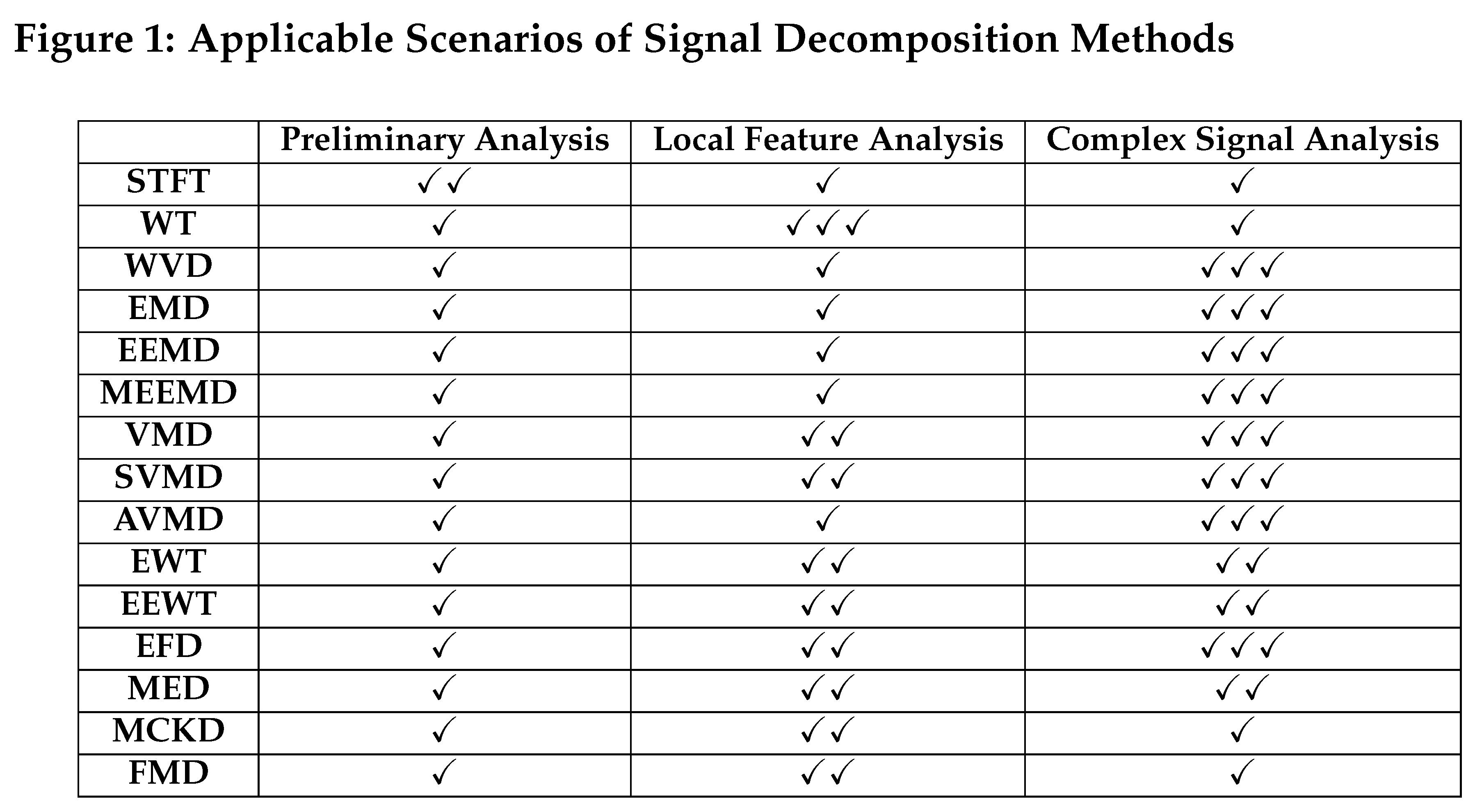
6. Conclusions
In structural health monitoring (SHM), non-parametric time-frequency analysis, adaptive time-frequency analysis, and deconvolution techniques each play pivotal roles, providing potent tools for the accurate assessment of structural health conditions.
Non-parametric time-frequency analysis techniques, such as the Short-Time Fourier Transform (STFT), Wavelet Transform (WT), and Wigner-Ville Distribution (WVD), are primarily employed to process non-stationary signals. By jointly representing signals in both the time and frequency domains, these techniques reveal how signal frequencies vary over time, thereby overcoming the limitation of the traditional Fourier Transform, which completely separates the time and frequency domains.
The STFT, which segments signals and applies the Fourier Transform to each segment, is suitable for analyzing stationary or nearly stationary signals, such as the preliminary analysis of bridge vibration signals. The WT, utilizing wavelet functions with variable windows, performs multi-resolution analysis on signals, making it adept at capturing local signal features, like transient signal analysis during crack propagation. The WVD, with its high-resolution time-frequency representation, excels in the analysis of single or pre-processed signals, such as identifying subtle damage features in structures.
The advantages of non-parametric time-frequency analysis techniques lie in their intuitiveness and ease of implementation; however, their drawbacks are also evident. The STFT cannot simultaneously achieve optimal time and frequency resolutions; the WT has high computational complexity and complex parameter selection; the WVD suffers from cross-term interference, which may obscure true signal features.
Furthermore, adaptive time-frequency analysis techniques, such as Empirical Mode Decomposition (EMD) and its variants (EEMD, MEEMD), Variational Mode Decomposition (VMD), and their improved versions (SVMD, AVMD), aim to adaptively decompose signals based on their intrinsic characteristics without presupposing a signal model. These techniques decompose signals into a series of Intrinsic Mode Functions (IMFs) through iterative processes, with each IMF representing a natural oscillation mode within the signal.
Adaptive time-frequency analysis techniques excel in processing nonlinear and non-stationary signals, particularly suitable for complex signal analysis in SHM. For instance, EMD and its variants are widely applied in the vibration signal analysis of bridges, buildings, and other structures, effectively extracting structural damage features. VMD and its improved versions achieve signal decomposition by minimizing variational problems, offering higher flexibility and stability, and are suitable for processing fault signals from complex structures like rotating machinery.
The merits of adaptive time-frequency analysis techniques reside in their adaptability and proficiency in handling nonlinear and non-stationary signals. Nevertheless, these techniques also present challenges, such as mode mixing and endpoint effects in EMD, and parameter selection and computational complexity issues in VMD.
Deconvolution technique is a method used in image processing and signal restoration. It removes blurring effects from signals through reverse convolution operations, restoring the clear features of the original signals. In SHM, deconvolution technique can be employed to eliminate noise and interference in sensor signals, enhancing signal quality for more accurate structural health assessment.
The application of deconvolution technique in SHM primarily manifests in signal preprocessing and feature extraction. For example, when using vibration signals for structural damage identification, deconvolution technique can remove environmental noise and mechanical vibration interference from signals, improving the accuracy of damage feature recognition. Additionally, deconvolution technique can be combined with other signal processing techniques to form a more powerful signal analysis tool.
The advantage of deconvolution technique lies in its ability to effectively remove blurring effects and noise interference from signals, enhancing signal quality. However, this technique also imposes certain requirements on the quality of input signals and has high computational complexity. Furthermore, the effectiveness of deconvolution technique is influenced by the choice of convolution kernels, necessitating parameter adjustments based on specific application scenarios.
Non-parametric time-frequency analysis techniques, adaptive time-frequency analysis techniques, and deconvolution technique each possess unique advantages and application scenarios in SHM. Non-parametric time-frequency analysis techniques are suitable for preliminary analysis and signal feature extraction; adaptive time-frequency analysis techniques excel in processing nonlinear, non-stationary signals, and complex structural fault signals; deconvolution technique is primarily used for noise removal in signal preprocessing and feature extraction. In practical applications, these three techniques are often used in conjunction to form a more comprehensive set of signal analysis tools.
Table 2.
Comparison of Signal Processing Techniques for Structural Health Monitoring (SHM).
| Method Abbr. | Reference | Key Feature | Advantage | Difficulty |
|---|---|---|---|---|
| STFT | [3–16] | TF Resolution | Good for Stationary | Window Sel. |
| WT | [17–22] | TF Localization | High Resolution | Basis Sel. |
| WVD | [23–54] | TF Analysis | High Resolution | Cross-term Issue |
| EMD | [55–61] | Adaptive Decomp. | Self-adaptability | Mode Mixing |
| EEMD | [62–72] | Noise Addition | Suppress Mixing | Noise Difficulty |
| VMD | [73–92] | Bandwidth Opt. | Flexibility | Parameter Sel. |
| MED | [133–144] | Signal Sparsity | Enhance Impact | Computational |
| MCKD | [145–150] | Periodic Fault | Enhance Periodic | Parameter Sens. |
Author Contributions
Each author contributed extensively to the preparation of this manuscript. writing—original draft preparation, Y.Z. investigation, Z.M. writing—review and editing, L.F. funding acquisition, L.F. All authors have read and agreed to the published version of the manuscript..
Funding
This work is supported by the National Natural Science Foundation of China under Contract No. 5247514 and No. 52005442, and the Zhejiang Provincial Natural Science Foundation of China under Contract No. LY22E050014.
Institutional Review Board Statement
Not applicable.
Data Availability Statement
No data was used for the research described in the article.
Conflicts of Interest
The authors declare no conflicts of interest.
Abbreviations
The following abbreviations are used in this manuscript:
| SHM | Structural Health Monitoring |
| STFT | Short-Time Fourier Transform |
| WT | Wavelet Transform |
| WVD | Wigner-Ville Distribution |
| EMD | Empirical Mode Decomposition |
| VMD | Variational Mode Decomposition |
| MED | Minimum Entropy Deconvolution |
| MCKD | Maximum Correlated Kurtosis Deconvolution |
| MEEMD | Modified Ensemble Empirical Mode Decomposition |
| EEMD | Ensemble Empirical Mode Decomposition |
| SVMD | Successive Variational Mode Decomposition |
| IMFs | Intrinsic Mode Functions |
| SMVMD | Successive Multivariable Variational Mode Decomposition |
| NCESVMD | Narrowband Constrained Enhanced Continuous Variational Mode Decomposition |
| AVMD | Automatic Variational Mode Decomposition |
| D-VMD | De-aliasing Variational Mode Decomposition |
| D-MVMD | De-aliasing multivariable Variational Mode Decomposition |
| I-1DCNN | improved one-dimensional convolutional neural network |
| PSD-VME | power spectral density-variational mode extraction |
| mRVM | multiclass relevance vector machines |
| DAVMD | Differential Evolution-based Adaptive Variational Mode Decomposition technique |
| WOA | Whale Optimization Algorithm |
| GPR | Ground Penetrating Radar |
| SNR | Signal-to-Noise Ratio |
| EWT | Empirical Wavelet Transform |
| IEWT | Improved Empirical Wavelet Transform |
| LSTM | Long Short-Term Memory Network |
| EFV | Energy Feature Vector |
| BOCNN | Bayesian Optimized Convolutional Neural Network |
| CEWT | Cepstrum-assisted Empirical Wavelet Transform |
| SIAI | Sensitive IMFs Assessment Index |
| IEEWT | Improved Extended Empirical Wavelet Transform |
| DFA | Detrended Fluctuation Analysis |
| FBSE | Fourier-Bessel Series Expansion |
| HHT | Hilbert-Huang Transform |
| VEWT | Variable Spectrum Segmentation Empirical Wavelet Transform |
| QEWT | Quaternion Empirical Wavelet Transform |
| IAPEWT | Improved Adaptive Parameter-free Empirical Wavelet Transform |
| ASCSD | Adaptive Sparse Coding Shrinkage Denoising |
| ESN | Echo State Network |
| IABSR | Improved Adaptive Bistable Stochastic Resonance |
| AM-FM | amplitude modulation-frequency modulation |
| MOMEDA | Minimum Entropy Deconvolution Adjustment |
| CVS | Continuous Vibration Separation |
| MEMD | Minimum Entropy Morphological Deconvolution |
| DSS | Diagonal Slice Spectrum |
| CFMED | Coarse-to-Fine Minimum Entropy Deconvolution |
| KLOF | Kernel Local Outlier Factor |
| PE | Phase Editing |
| SCI | Spectral Centroid Indicator |
| IMCKDA | Improved Maximum Correlated Kurtosis Deconvolution Adjustment |
| IMCKD | Improved Maximum Correlated Kurtosis Deconvolution |
| MCKD-DeNet | Maximum Correlated Kurtosis Deconvolution method based on Deep Networks |
| FMD | Feature mode decomposition |
| FIR | Finite Impulse Response |
| PSF | Point Spread Function |
| MACKD | Maximum Autocorrelation Kurtosis Deconvolution |
| MLKD | Maximum L-Kurtosis Deconvolution |
| FDF | Frequency Domain Filtering |
| MAKD | Maximum Average Kurtosis Deconvolution |
| UWFBG | Ultra-Weak Fiber Bragg Grating |
| DAS | Distributed Acoustic Sensing |
| SEAEFD | spectral envelope-based adaptive empirical Fourier decomposition |
| PSEEFD | power spectrum envelope adaptive empirical Fourier decomposition |
| GWO | Grey Wolf optimizer |
| EMED-AFP | enhanced minimum entropy deconvolution with adaptive filter parameters |
| CYCBD β | Generalized Gaussian Cyclostationarity |
| MOMEDA | Multipoint Optimal Minimum Entropy Deconvolution Adjusted |
| PCPKD | Periodic Component Pursuit-based Kurtosis Deconvolution |
| TF | Time-Frequency |
| NL | Non-linear signal |
| NS | Non-stationary signal |
| EFS | Early fault signal |
| CFS | Composite fault signal |
| Window Sel. | Window selection |
| Basis Sel. | Basis function selection |
| Mode Mixing | Mode mixing |
| Noise Difficulty | Noise difficulty |
| Parameter Sel. | Parameter selection |
| Computational | Computational complexity |
| Parameter Sens. | Parameter sensitivity |
References
- Amezquita-Sanchez, J.P.; Adeli, H. Signal Processing Techniques for Vibration-Based Health Monitoring of Smart Structures. ARCHIVES OF COMPUTATIONAL METHODS IN ENGINEERING 2016, 23, 1–15. [CrossRef]
- Jung, W.; Kim, S.H.; Yun, S.H.; Bae, J.; Park, Y.H. Vibration, acoustic, temperature, and motor current dataset of rotating machine under varying operating conditions for fault diagnosis. Data in Brief 2023, 48, 109049. [CrossRef]
- Lizhong, J.; Shaohui, L.; Wangbao, Z.; Jian, Y.; Kang, P.; Zhenbin, R. Evolutionary power spectral density study of the earthquake-induced dynamic irregularity based on short-time Fourier transform. Engineering Structures 2023, 296, 116901. [CrossRef]
- Shen, M.; Yang, F.; Wen, P.; Song, B.; Li, Y. A real-time epilepsy seizure detection approach based on EEG using short-time Fourier transform and Google-Net convolutional neural network. Heliyon 2024, 10, e31827. [CrossRef]
- Qi, Y.; Yang, L.; Liu, B.; Liu, L.; Liu, Y.; Zheng, Q.; Liu, D.; Luo, J. Accurate diagnosis of lung tissues for 2D Raman spectrogram by deep learning based on short-time Fourier transform. Analytica Chimica Acta 2021, 1179, 338821. [CrossRef]
- Li, B.; Zhang, Z.; Zhu, X. Multitaper adaptive short-time Fourier transform with chirp-modulated Gaussian window and multitaper extracting transform. Digital Signal Processing 2022, 126, 103472. [CrossRef]
- Hao, Y.; Zhang, C.; Lu, Y.; Zhang, L.; Lei, Z.; Li, Z. A novel autoencoder modeling method for intelligent assessment of bearing health based on Short-Time Fourier Transform and ensemble strategy. Precision Engineering 2024, 85, 89–101. [CrossRef]
- Muhashi, A.; Feng, X.; Onishi, Y.; Ota, R.; Liu, H. Enhancing Coincidence Time Resolution of PET detectors using short-time Fourier transform and residual neural network. Nuclear Instruments and Methods in Physics Research Section A: Accelerators, Spectrometers, Detectors and Associated Equipment 2024, 1065, 169540. [CrossRef]
- Amiri, M.; Aghaeinia, H.; Amindavar, H.R. Automatic epileptic seizure detection in EEG signals using sparse common spatial pattern and adaptive short-time Fourier transform-based synchrosqueezing transform. Biomedical Signal Processing and Control 2023, 79, 104022. [CrossRef]
- Tang, B.; Ding, Y.; Peng, Y.; Cao, J. Target localization algorithm based on improved short-time Fourier transform. Digital Signal Processing 2024, 155, 104734. [CrossRef]
- Tian, L. Seismic spectral decomposition using short-time fractional Fourier transform spectrograms. Journal of Applied Geophysics 2021, 192, 104400. [CrossRef]
- Mustafa, D.; Yicheng, Z.; Minjie, G.; Jonas, H.; JÃijrgen, F. Motor Current Based Misalignment Diagnosis on Linear Axes with Short- Time Fourier Transform (STFT). Procedia CIRP 2022, 106, 239–243. 9th CIRP Conference on Assembly Technology and Systems. [CrossRef]
- Wan, T.H.; Tsang, C.W.; Hui, K.; Chung, E. Anomaly detection of train wheels utilizing short-time Fourier transform and unsupervised learning algorithms. Engineering Applications of Artificial Intelligence 2023, 122, 106037. [CrossRef]
- Zhang, L.; Luo, F.; Pan, G.; Zhang, W.; Ren, G.; Zheng, Z.; Yang, Y. Elucidating the Multi-Timescale Variability of a Canopy Urban Heat Island by Using the Short-Time Fourier Transform. GEOPHYSICAL RESEARCH LETTERS 2024, 51. [CrossRef]
- Knutsen, H. A fractal uncertainty principle for the short-time Fourier transform and Gabor multipliers. Applied and Computational Harmonic Analysis 2023, 62, 365–389. [CrossRef]
- Shah, F.A.; Lone, W.Z.; Tantary, A.Y. Short-time quadratic-phase Fourier transform. Optik 2021, 245, 167689. [CrossRef]
- Wang, J.; Huo, L.; Liu, C.; Song, G. Theoretical and Experimental Study on Homologous Acoustic Emission Signal Recognition Based on Synchrosqueezed Wavelet Transform Coherence. STRUCTURAL CONTROL & HEALTH MONITORING 2023, 2023. [CrossRef]
- Zhang, Y.; Xie, X.; Li, H.; Zhou, B. An Unsupervised Tunnel Damage Identification Method Based on Convolutional Variational Auto-Encoder and Wavelet Packet Analysis. SENSORS 2022, 22. [CrossRef]
- He, F.; Ye, Q. A Bearing Fault Diagnosis Method Based on Wavelet Packet Transform and Convolutional Neural Network Optimized by Simulated Annealing Algorithm. Sensors 2022, 22. [CrossRef]
- Liu, P.; Dong, A.; Wang, C.; Zhang, C.; Zhang, J. Consecutively Missing Seismic Data Reconstruction Via Wavelet-Based Swin Residual Network. IEEE Geoscience and Remote Sensing Letters 2023, 20, 1–5. [CrossRef]
- Saadatmorad, M.; Talookolaei, R.A.J.; Pashaei, M.H.; Khatir, S.; Wahab, M.A. Pearson Correlation and Discrete Wavelet Transform for Crack Identification in Steel Beams. Mathematics 2022, 10. [CrossRef]
- Martinez-Rios, E.A.; Bustamante-Bello, R.; Navarro-Tuch, S.; Perez-Meana, H. Applications of the Generalized Morse Wavelets: A Review. IEEE Access 2023, 11, 667–688. [CrossRef]
- ÃĞelebi, M.; ÃŰztÃijrk, S.; Kaplan, K. An enhanced deep learning model based on smoothed pseudo Wigner-Ville distribution technique for emotion recognition with channel selection. Ain Shams Engineering Journal 2025, 16, 103264. [CrossRef]
- Reddy, A.S.S.; Pachori, R.B. Dynamic mode decomposition-based technique for cross-term suppression in the Wigner-Ville distribution. Digital Signal Processing 2025, 156, 104833. [CrossRef]
- Bhat, M.Y.; Dar, A.H. Quadratic-phase scaled Wigner distribution: convolution and correlation Quadratic-phase scaled Wigner distribution. SIGNAL IMAGE AND VIDEO PROCESSING 2023, 17, 2779–2788. [CrossRef]
- Yafei, J.; Yongli, Z.; Liuwang, W. Time-frequency Analysis of Partial Discharge Signal Based on VMD and Wigner-Ville Distribution. Journal of System Simulation 2018, 30, 569–78.
- Marios, C.A.; van Eijndhoven, S.; Duin, P. “Seeing Sound”: Audio Classification Using theWigner-Ville Distribution and Convolutional Neural Networks. In Proceedings of the INTELLIGENT SYSTEMS AND APPLICATIONS, VOL 1, INTELLISYS 2023; Arai, K., Ed., 2024, Vol. 822, Lecture Notes in Networks and Systems, pp. 145–155. Intelligent Systems Conference (IntelliSys), Amsterdam, NETHERLANDS, SEP 07-08, 2023. [CrossRef]
- de Carvalho Monson, P.M.; de Oliveira ConceiÃğÃčo Junior, P.; Lofrano Dotto, F.R.; de Aguiar, P.R.; Rodrigues, A.R.; David, G.A. Structural damage classification in composite materials using the Wigner-Ville distribution and convolutional neural networks. Materials Letters 2024, 369, 136734. [CrossRef]
- Rajshekhar, G.; Gorthi, S.S.; Rastogi, P. Polynomial WignerâĂŞVille distribution-based method for direct phase derivative estimation from optical fringes. Journal of Optics A: Pure and Applied Optics 2009, 11, 125402.
- Bhat, Y.A.; Sheikh, N. Special Affine WignerâĂŞVille Distribution in Octonion Domains: Theory and Applications. Optik 2023, 274, 170531. [CrossRef]
- Nur, A.T.A.; Bahri, M.; Bachtiar, N.; Rahim, A. Uncertainty principles for coupled fractional Wigner-Ville distribution. ROYAL SOCIETY OPEN SCIENCE 2024, 11. [CrossRef]
- Bhat, M.Y.; Almanjahie, I.M.; Dar, A.H.; Dar, J.G. Wigner-Ville distribution and ambiguity function associated with the quaternion offset linear canonical transform. Demonstratio Mathematica 2022, 55, 786–797. [CrossRef]
- Chen, J.Y.; Li, B.Z. The short-time WignerâĂŞVille distribution. Signal Processing 2024, 219, 109402. [CrossRef]
- Bhat, M.Y.; Dar, A.H.; Nurhidayat, I.; Pinelas, S. An Interplay of WignerâĂŞVille Distribution and 2D Hyper-Complex Quadratic-Phase Fourier Transform. Fractal and Fractional 2023, 7. [CrossRef]
- Li, B.; Zhang, Z.; Zhu, X. Multitaper adaptive short-time Fourier transform with chirp-modulated Gaussian window and multitaper extracting transform. Digital Signal Processing 2022, 126, 103472. [CrossRef]
- 郝国成.; 冯思权.; 王巍.; 凌斯奇.; 谭淞元. 基于NGWarblet-WVD的高质量时频分析方法. 自动化学报 2022, 48, 2526–2536. shu. [CrossRef]
- Huang, N.E.; Shen, Z.; Long, S.R.; Wu, M.C.; Shih, H.H.; Zheng, Q.; Yen, N.C.; Chang, C.C.; Liu, H.H. The empirical mode decomposition and the Hilbert spectrum for nonlinear and non-stationary time series analysis. Proceedings of the Royal Society of London. Series A: Mathematical, Physical and Engineering Sciences 1998, 454, 903–995.
- Lei, Y.; Lin, J.; He, Z.; Zuo, M.J. A review on empirical mode decomposition in fault diagnosis of rotating machinery. Mechanical Systems and Signal Processing 2013, 35, 108–126.
- Cheng, G.; Wang, X.; He, Y. Remaining useful life and state of health prediction for lithium batteries based on empirical mode decomposition and a long and short memory neural network. ENERGY 2021, 232. [CrossRef]
- Huang, G.; Li, X.; Zhang, B.; Ren, J. PM2.5 concentration forecasting at surface monitoring sites using GRU neural network based on empirical mode decomposition. Science of The Total Environment 2021, 768, 144516. [CrossRef]
- Zhu, B.; Han, D.; Wang, P.; Wu, Z.; Zhang, T.; Wei, Y.M. Forecasting carbon price using empirical mode decomposition and evolutionary least squares support vector regression. Applied Energy 2017, 191, 521–530. [CrossRef]
- Liu, M.D.; Ding, L.; Bai, Y.L. Application of hybrid model based on empirical mode decomposition, novel recurrent neural networks and the ARIMA to wind speed prediction. ENERGY CONVERSION AND MANAGEMENT 2021, 233. [CrossRef]
- Li, G.; Bu, W.; Yang, H. Noise reduction method for ship radiated noise signal based on modified uniform phase empirical mode decomposition. Measurement 2024, 227, 114193. [CrossRef]
- Yin, C.; Wang, Y.; Ma, G.; Wang, Y.; Sun, Y.; He, Y. Weak fault feature extraction of rolling bearings based on improved ensemble noise-reconstructed EMD and adaptive threshold denoising. MECHANICAL SYSTEMS AND SIGNAL PROCESSING 2022, 171. [CrossRef]
- Guo, J.; Wang, Z.; Li, H.; Yang, Y.; Huang, C.G.; Yazdi, M.; Kang, H.S. A hybrid prognosis scheme for rolling bearings based on a novel health indicator and nonlinear Wiener process. RELIABILITY ENGINEERING & SYSTEM SAFETY 2024, 245. [CrossRef]
- Zheng, Q.; Tian, X.; Yu, Z.; Jin, B.; Jiang, N.; Ding, Y.; Yang, M.; Elhanashi, A.; Saponara, S.; Kpalma, K. Application of complete ensemble empirical mode decomposition based multi-stream informer (CEEMD-MsI) in PM2.5 concentration long-term prediction. Expert Systems with Applications 2024, 245, 123008. [CrossRef]
- Luo, L.; Yan, Y.; Xie, P.; Sun, J.; Xu, Y.; Yuan, J. HilbertâĂŞHuang transform, Hurst and chaotic analysis based flow regime identification methods for an airlift reactor. Chemical Engineering Journal 2012, 181-182, 570–580. [CrossRef]
- Xu, G.; Tian, W.; Qian, L. EMD- and SVM-based temperature drift modeling and compensation for a dynamically tuned gyroscope (DTG). Mechanical Systems and Signal Processing 2007, 21, 3182–3188. [CrossRef]
- Tang, J.; Zhao, L.; Yue, H.; Yu, W.; Chai, T. Vibration Analysis Based on Empirical Mode Decomposition and Partial Least Square. Procedia Engineering 2011, 16, 646–652. International Workshop on Automobile, Power and Energy Engineering. [CrossRef]
- Suo, L.; Peng, T.; Song, S.; Zhang, C.; Wang, Y.; Fu, Y.; Nazir, M.S. Wind speed prediction by a swarm intelligence based deep learning model via signal decomposition and parameter optimization using improved chimp optimization algorithm. ENERGY 2023, 276. [CrossRef]
- Liu, M.D.; Ding, L.; Bai, Y.L. Application of hybrid model based on empirical mode decomposition, novel recurrent neural networks and the ARIMA to wind speed prediction. ENERGY CONVERSION AND MANAGEMENT 2021, 233. [CrossRef]
- Yang, Y.; Chang, K. Extraction of bridge frequencies from the dynamic response of a passing vehicle enhanced by the EMD technique. Journal of Sound and Vibration 2009, 322, 718–739. [CrossRef]
- Xu, C.; Huang, C.C.; Zhu, W.D. Bolt loosening detection in a jointed beam using empirical mode decompositionâĂŞbased nonlinear system identification method. International Journal of Distributed Sensor Networks 2019, 15. Bolt loosening;Damage diagnosis;Empirical Mode Decomposition;Identification procedure;Multi-scale dynamics;Non-linear system identification;Reduced order models;Underlying systems;.
- Randall, R.B.; Antoni, J. Why EMD and similar decompositions are of little benefit for bearing diagnostics. MECHANICAL SYSTEMS AND SIGNAL PROCESSING 2023, 192. [CrossRef]
- Sezen, C. Pan evaporation forecasting using empirical and ensemble empirical mode decomposition (EEMD) based data-driven models in the Euphrates sub-basin, Turkey. Earth Sci Inform 2023, 16, 3077–3095. [CrossRef]
- Rezaiy, R.; Shabri, A. Improving Drought Prediction Accuracy: A Hybrid EEMD and Support Vector Machine Approach with Standardized Precipitation Index. Water Resources Management 2024, 38, 5255–5277. [CrossRef]
- Rezaiy, R.; Shabri, A. An innovative hybrid W-EEMD-ARIMA model for drought forecasting using the standardized precipitation index. Natural Hazards 2024, 120, 13513–13542.
- Liao, S.; Wang, H.; Liu, B.; Ma, X.; Zhou, B.; Su, H. Runoff Forecast Model Based on an EEMD-ANN and Meteorological Factors Using a Multicore Parallel Algorithm. Water Resources Management. [CrossRef]
- Li, J.; Tong, Y.; Guan, L.; Wu, S.; Li, D. A UV-visible absorption spectrum denoising method based on EEMD and an improved universal threshold filter. RSC Adv. 2018, 8, 8558–8568. [CrossRef]
- Xu, J.; Jiang, W.; Wang, W.; Chen, J.; Shen, Y.; Qi, J. Removal of EOG Artifact in Electroencephalography with EEMD-ICA: A Semi-simulation Study on Identification of Artifactual Components. Springer, 2023.
- Sarkar, P.P.; Sen, M.K.; Kabir, G.; Ibne Hossain, N.U. Exploring evolutionary patterns in the teleconnections between Indian summer monsoon rainfall and Indian Ocean dipole over decades. Climate Dynamics 2024, 62, 4041–4061. [CrossRef]
- Sun, J.; Wu, Z. Isolating spatiotemporally local mixed Rossby-gravity waves using multi-dimensional ensemble empirical mode decomposition. Climate Dynamics 2020, 54, 1383–1405. [CrossRef]
- Yang, L.; Guan, Q.; Lin, J.; Tian, J.; Tan, Z.; Li, H. Evolution of NDVI secular trends and responses to climate change: A perspective from nonlinearity and nonstationarity characteristics. Remote Sensing of Environment 2021, 254, 112247. [CrossRef]
- Chang, Y.S.; Yan, Z.; Wang, K.H.; Yao, Y. Non-destructive testing of CFRP using pulsed thermography and multi-dimensional ensemble empirical mode decomposition. Journal of the Taiwan Institute of Chemical Engineers 2016, 61, 54–63. [CrossRef]
- Ahmed, S.; Huang, Y.; Tayyab, Q.; senjyu, T.; Elkholy, M. Identification of power grids low-frequency oscillations through a combined MEEMD-Prony method. Energy Reports 2024, 11, 4245–4253. [CrossRef]
- Min, Y.; Shuzhen, Z.; Wuwei, L. Carbon price prediction based on multi-factor MEEMD-LSTM model. Heliyon 2022, 8, e12562. [CrossRef]
- Yang, Q.; Yu, Y.; Dai, D.; He, Q.; Lin, Y. Can hybrid model improve the forecasting performance of stock price index amid COVID-19? Contextual evidence from the MEEMD-LSTM-MLP approach. The North American Journal of Economics and Finance 2024, 74, 102252. [CrossRef]
- 张程; 林谷青; 匡宇. 基于 MEEMD-QUATRE-BILSTM 的短期光伏出力区间预测. 太阳能学报 2023, 44, 40–54. [CrossRef]
- Yang, Z.; Kong, C.; Wang, Y.; Rong, X.; Wei, L. Fault diagnosis of mine asynchronous motor based on MEEMD energy entropy and ANN. Computers & Electrical Engineering 2021, 92, 107070. [CrossRef]
- Dragomiretskiy, K.; Zosso, D. Variational Mode Decomposition. IEEE TRANSACTIONS ON SIGNAL PROCESSING 2014, 62, 531–544. [CrossRef]
- Zhou, H.; Zhao, S.; Zhao, W.; Wang, S.; Hao, G.; Zhang, X. 基于改进的MEEMD的隧道掘进爆破振动信号去噪优化分析. 振动与冲击 2023, 42, 74–81.
- Duan, Q.; Xia, H.; Zhang, C. Noise reduction analysis of deformation data based on MEEMD-SVD modeling. In Proceedings of the Proceedings of SPIE - The International Society for Optical Engineering. SPIE, 2024, Vol. 13166, Proc SPIE Int Soc Opt Eng.
- Zhang, J.; Yan, R.; Gao, R.X.; Feng, Z. Performance enhancement of ensemble empirical mode decomposition. Mechanical Systems and Signal Processing 2010, 24, 2104–2123. Special Issue: ISMA 2010. [CrossRef]
- 沈戈.; 高德远.; 樊晓桠. 数字信号处理器(DSP)结构设计及发展趋势. 计算机工程与应用 2003, 39, 4.
- Ravi.; Taran, S. A nonlinear feature extraction approach for speech emotion recognition using VMD and TKEO. Applied Acoustics 2023, 214, 109667. [CrossRef]
- Chen, A.; Kurfess, T.R. Signal processing techniques for rolling element bearing spall size estimation. Mechanical Systems and Signal Processing 2019, 117, 16–32. [CrossRef]
- Li, K.; Chen, W.; Zou, Y.; Wang, Z.; Zhou, X.; Shi, J. Optimized PSOMV-VMD combined with ConvFormer model: A novel gas pipeline leakage detection method based on low sensitivity acoustic signals. Measurement 2025, 247, 116804. [CrossRef]
- Xue, G.; Zhang, Y.; ang Yu, S.; Song, J.; Bian, T.; Gao, Y.; Yan, W.; Guo, Y. Daily residential heat load prediction based on a hybrid model of signal processing, econometric model, and support vector regression. Thermal Science and Engineering Progress 2023, 43, 102005. [CrossRef]
- Gong, Z.; Wan, A.; Ji, Y.; AL-Bukhaiti, K.; Yao, Z. Improving short-term offshore wind speed forecast accuracy using a VMD-PE-FCGRU hybrid model. Energy 2024, 295, 131016. [CrossRef]
- Chen, Y.; Huang, X.; He, Y.; Zhang, S.; Cai, Y. EdgeâĂŞcloud collaborative estimation lithium-ion battery SOH based on MEWOA-VMD and Transformer. Journal of Energy Storage 2024, 99, 113388. [CrossRef]
- Yuan, D.; Gu, C.; Wei, B.; Qin, X.; Xu, W. A high-performance displacement prediction model of concrete dams integrating signal processing and multiple machine learning techniques. Applied Mathematical Modelling 2022, 112, 436–451. [CrossRef]
- Ma, K.; Nie, X.; Yang, J.; Zha, L.; Li, G.; Li, H. A power load forecasting method in port based on VMD-ICSS-hybrid neural network. Applied Energy 2025, 377, 124246. [CrossRef]
- Ge, X.; Wang, G.; Liu, H.; Huang, T. Removal of AM-FM harmonics using VMD technology for operational modal analysis of milling robot. Mechanical Systems and Signal Processing 2023, 200, 110475. [CrossRef]
- Ali, A.; Xinhua, W.; Razzaq, I. Optimizing acoustic signal processing for localization of precise pipeline leakage using acoustic signal decomposition and wavelet analysis. Digital Signal Processing 2025, 157, 104890. [CrossRef]
- Lei, W.; Wang, G.; Wan, B.; Min, Y.; Wu, J.; Li, B. High voltage shunt reactor acoustic signal denoising based on the combination of VMD parameters optimized by coati optimization algorithm and wavelet threshold. Measurement 2024, 224, 113854. [CrossRef]
- Zhang, H.; Wu, W.; Song, X.; Chen, Z. Improving density logging resolution by VMD-CEEMDAN-ICWT method and its application in thin layer identification. Geoenergy Science and Engineering 2024, 239, 212993. [CrossRef]
- Qi, G.; Zhao, Z.; Zhang, R.; Wang, J.; Li, M.; Shi, X.; Wang, H. Optimized VMD algorithm for signal noise reduction based on TDLAS. Journal of Quantitative Spectroscopy and Radiative Transfer 2024, 312, 108807. [CrossRef]
- Li, H.; Li, S.; Sun, J.; Huang, B.; Zhang, J.; Gao, M. Ultrasound signal processing based on joint GWO-VMD wavelet threshold functions. Measurement 2024, 226, 114143. [CrossRef]
- Cheng, W.; Zhou, Q.; Wu, S.; Xing, J.; Chen, X.; Du, S.; Xu, Z.; Zhang, R. EI-ISOA-VMD: Adaptive denoising and detrending method for nuclear circulating water pump impeller. Measurement 2025, 242, 115890. [CrossRef]
- Du, X.; Zhang, Q.; Wei, Y.; Zhang, T.; Zhang, Y.; Li, Y. Research on denoising of second harmonic signal in photoacoustic spectroscopy based on SSA-VMD-WTD method. Infrared Physics & Technology 2024, 138, 105204. [CrossRef]
- rong Gao, J.; kuo Liu, Y.; jie Duan, C.; Ding, P.; qing Song, J. Research on fault diagnosis of electric gate valve in nuclear power plant based on the VMD-MDI-ISSA-RF model. Annals of Nuclear Energy 2024, 207, 110701. [CrossRef]
- Chen, H. A vibration signal processing method based on SE-PSO-VMD for ultrasonic machining. Systems and Soft Computing 2024, 6, 200081. [CrossRef]
- Wang, Y.; Liu, F.; Jiang, Z.; He, S.; Mo, Q. Complex variational mode decomposition for signal processing applications. Mechanical Systems and Signal Processing 2017, 86, 75–85. [CrossRef]
- Li, H.; Li, M.; Ma, Y.; Zheng, Y.; Li, S. A variational mode decomposition projectile signal processing algorithm of infrared sky screen velocity measurement system and detection mathematical model of detection screen. Optik 2023, 287, 171077. [CrossRef]
- Nazari, M.; Sakhaei, S.M. Successive variational mode decomposition. Signal Processing 2020, 174, 107610. [CrossRef]
- Chen, Q.; Chen, J.; Lang, X.; Xie, L.; ur Rehman, N.; Su, H. Self-tuning variational mode decomposition. Journal of the Franklin Institute 2021, 358, 7825–7862. [CrossRef]
- Nazari, M.; Sakhaei, S.M. Successive variational mode decomposition. Signal Processing 2020, 174, 107610. [CrossRef]
- Sun, L.; Huang, X.; Zhao, J.; Wang, X.; Ma, M. An intelligent chatter detection method for high-speed milling under variable tool-workpiece systems and cutting parameters. Mechanical Systems and Signal Processing 2025, 224, 111960. [CrossRef]
- Faisal, K.N.; Sharma, R.R. Successive variational mode decomposition-based enhanced Wigner-Ville distribution for seismo-volcanic events identification. Journal of Volcanology and Geothermal Research 2023, 440, 107847. [CrossRef]
- Gao, W.; Liu, D.; Wang, Q.; Zhao, Y.; Sun, J. Narrowband constraint-enhanced successive variational mode decomposition. Biomedical Signal Processing and Control 2025, 104, 107396. [CrossRef]
- Wu, S.; Huang, J.; Liu, W.; Pang, Y.; Zhu, T. Anti-noise UWFBG hydrophone array enhanced DAS system using optimising SVMD based on matched interferometric. Optical Fiber Technology 2024, 88, 104051. [CrossRef]
- Yang, H.; Cheng, Y.; Li, G. A denoising method for ship radiated noise based on Spearman variational mode decomposition, spatial-dependence recurrence sample entropy, improved wavelet threshold denoising, and Savitzky-Golay filter. Alexandria Engineering Journal 2021, 60, 3379–3400. [CrossRef]
- Zeng, R.; Wu, Q.; Zhang, L. Two-terminal traveling wave fault location based on successive variational mode decomposition and frequency-dependent propagation velocity. Electric Power Systems Research 2022, 213, 108768. [CrossRef]
- Fu, S.; Wu, J.; Zhang, Q.; Xie, B. Robust and efficient synchronization for structural health monitoring data with arbitrary time lags. Engineering Structures 2025, 322, 119183. [CrossRef]
- Ye, M.; Yan, X.; Chen, N.; Jia, M. Intelligent fault diagnosis of rolling bearing using variational mode extraction and improved one-dimensional convolutional neural network. Applied Acoustics 2023, 202, 109143. [CrossRef]
- Feng, Z.; Zhang, Z. A small sample rolling bearing fault diagnosis based on PSD-VME and DS evidence theory enhanced mRVM. Computers and Electrical Engineering 2024, 118, 109458. [CrossRef]
- Li, C.; Liu, Y.; Liao, Y.; Wang, J. A VME method based on the convergent tendency of VMD and its application in multi-fault diagnosis of rolling bearings. Measurement 2022, 198, 111360. [CrossRef]
- Zhong, X.; Xia, T.; Mei, Q. A Parameter-Adaptive VME Method Based on Particle Swarm Optimization for Bearing Fault Diagnosis. EXPERIMENTAL TECHNIQUES 2023, 47, 435–448. [CrossRef]
- Chen, Q.; Zhang, C.; Hu, T.; Zhou, Y.; Ni, H.; Wang, T. Online chatter detection in robotic machining based on adaptive variational mode decomposition. INTERNATIONAL JOURNAL OF ADVANCED MANUFACTURING TECHNOLOGY 2021, 117, 555–577. [CrossRef]
- Lu, J.; Li, J.; Zhao, X.; Chen, Y.; Meng, L.; Yang, D.; Hou, N. Adaptive denoising method for leakage detection of liquid pipelines using automatic variational mode decomposition. Journal of the Franklin Institute 2025, 362, 107475. [CrossRef]
- Wang, Y. An Adaptive Variational Mode Decomposition Technique with Differential Evolution Algorithm and Its Application Analysis. SHOCK AND VIBRATION 2021, 2021. [CrossRef]
- Yang, D.; Persico, R.; Guo, C.; Liu, Y.; Yang, J.; Liu, H.; Bai, C.; Zhao, Q. Adaptive variational mode decomposition denoising scheme for ground penetrating radar data. In Proceedings of the Journal of Physics: Conference Series, 2024 2024, Vol. 2887, p. 012031 (4 pp.). 20th International Conference on Ground Penetrating Radar, 2024, Changchun, China.
- Lian, J.; Liu, Z.; Wang, H.; Dong, X. Adaptive variational mode decomposition method for signal processing based on mode characteristic. Mechanical Systems and Signal Processing 2018, 107, 53–77. [CrossRef]
- Mousavi, A.A.; Zhang, C.; Masri, S.F.; Gholipour, G. Damage detection and localization of a steel truss bridge model subjected to impact and white noise excitations using empirical wavelet transform neural network approach. Measurement 2021, 185, 110060. [CrossRef]
- Gao, R.; Du, L.; Duru, O.; Yuen, K.F. Time series forecasting based on echo state network and empirical wavelet transformation. Applied Soft Computing 2021, 102, 107111. [CrossRef]
- Li, J.; Wang, H.; Wang, X.; Zhang, Y. Rolling bearing fault diagnosis based on improved adaptive parameterless empirical wavelet transform and sparse denoising. Measurement 2020, 152, 107392. [CrossRef]
- Bhattacharyya, A.; Singh, L.; Pachori, R.B. FourierâĂŞBessel series expansion based empirical wavelet transform for analysis of non-stationary signals. Digital Signal Processing 2018, 78, 185–196. [CrossRef]
- Zhang, K.; Deng, Y.; Chen, P.; Ma, C.; Xu, Y. Quaternion empirical wavelet transform and its applications in rolling bearing fault diagnosis. Measurement 2022, 195, 111179. [CrossRef]
- Anuragi, A.; Singh Sisodia, D.; Bilas Pachori, R. EEG-based cross-subject emotion recognition using Fourier-Bessel series expansion based empirical wavelet transform and NCA feature selection method. Information Sciences 2022, 610, 508–524. [CrossRef]
- Wang, J.; Bethel, B.J.; Xie, W.; Dong, C. A hybrid model for significant wave height prediction based on an improved empirical wavelet transform decomposition and long-short term memory network. Ocean Modelling 2024, 189, 102367. [CrossRef]
- Zheng, X.; Li, H.; Zhang, S.; Zhang, Y.; Li, J.; Zhang, Y.; Zhao, W. Hydrodynamic feature extraction and intelligent identification of flow regimes in vaneless space of a pump turbine using improved empirical wavelet transform and Bayesian optimized convolutional neural network. Energy 2023, 282, 128705. [CrossRef]
- Liu, Q.; Yang, J.; Zhang, K. An improved empirical wavelet transform and sensitive components selecting method for bearing fault. Measurement 2022, 187, 110348. [CrossRef]
- Bounoua, W.; Aftab, M.F. Improved extended empirical wavelet transform for accurate multivariate oscillation detection and characterisation in plant-wide industrial control loops. Journal of Process Control 2024, 138, 103226. [CrossRef]
- Kim, Y.; Ha, J.M.; Na, K.; Park, J.; Youn, B.D. Cepstrum-assisted empirical wavelet transform (CEWT)-based improved demodulation analysis for fault diagnostics of planetary gearboxes. Measurement 2021, 183, 109796. [CrossRef]
- Zhang, K.; Shi, L.; Hu, Y.; Chen, P.; Xu, Y. Variable spectral segmentation empirical wavelet transform for noisy signal processing. Digital Signal Processing 2021, 117, 103151. [CrossRef]
- Xin, Y.; Hao, H.; Li, J. Time-varying system identification by enhanced Empirical Wavelet Transform based on Synchroextracting Transform. Engineering Structures 2019, 196, 109313. [CrossRef]
- Teng, W.; Ding, X.; Cheng, H.; Han, C.; Liu, Y.; Mu, H. Compound faults diagnosis and analysis for a wind turbine gearbox via a novel vibration model and empirical wavelet transform. Renewable Energy 2019, 136, 393–402. [CrossRef]
- Zhang, X.; Wang, J.; Liu, Z.; Wang, J. Weak feature enhancement in machinery fault diagnosis using empirical wavelet transform and an improved adaptive bistable stochastic resonance. ISA Transactions 2019, 84, 283–295. [CrossRef]
- Zheng, J.; Cao, S.; Pan, H.; Ni, Q. Spectral envelope-based adaptive empirical Fourier decomposition method and its application to rolling bearing fault diagnosis. ISA Transactions 2022, 129, 476–492. [CrossRef]
- Wei, P.; Li, Q.; Sun, M.; Huang, J. Modal identification of high-rise buildings by combined scheme of improved empirical wavelet transform and Hilbert transform techniques. Journal of Building Engineering 2023, 63, 105443. [CrossRef]
- Gong, W.B.; Li, A.; Wu, Z.H.; Qin, F.J. Nonlinear vibration feature extraction based on power spectrum envelope adaptive empirical Fourier decomposition. ISA Transactions 2023, 139, 660–674. [CrossRef]
- Zhou, W.; Feng, Z.; Xu, Y.; Wang, X.; Lv, H. Empirical Fourier decomposition: An accurate signal decomposition method for nonlinear and non-stationary time series analysis. Mechanical Systems and Signal Processing 2022, 163, 108155. [CrossRef]
- Kumar, B.; Yadav, N.; Sunil. A novel hybrid algorithm based on Empirical Fourier decomposition and deep learning for wind speed forecasting. Energy Conversion and Management 2024, 300, 117891. [CrossRef]
- Singh, P.; Bana, D.; Sadhu, A. Improved bridge modal identification from vibration measurements using a hybrid empirical Fourier decomposition. Journal of Sound and Vibration 2024, 590, 118598. [CrossRef]
- Endo, H.; Randall, R. Enhancement of autoregressive model based gear tooth fault detection technique by the use of minimum entropy deconvolution filter. Mechanical Systems and Signal Processing 2007, 21, 906–919. [CrossRef]
- Ma, H.; Feng, Z. Planet bearing fault diagnosis using multipoint Optimal Minimum Entropy Deconvolution Adjusted. Journal of Sound and Vibration 2019, 449, 235–273. [CrossRef]
- Hou, Y.; Zhou, C.; Tian, C.; Wang, D.; He, W.; Huang, W.; Wu, P.; Wu, D. Acoustic feature enhancement in rolling bearing fault diagnosis using sparsity-oriented multipoint optimal minimum entropy deconvolution adjusted method. Applied Acoustics 2022, 201, 109105. [CrossRef]
- Wu, L.; Zhang, X.; Wang, J.; Liu, Z.; Gong, Z. An enhanced minimum entropy deconvolution with adaptive filter parameters for gear fault diagnosis. Measurement 2023, 206, 112343. [CrossRef]
- Zhou, X.; Li, Y.; Jiang, L.; Zhou, L. Fault feature extraction for rolling bearings based on parameter-adaptive variational mode decomposition and multi-point optimal minimum entropy deconvolution. Measurement 2021, 173, 108469. [CrossRef]
- Duan, R.; Liao, Y.; Yang, L.; Xue, J.; Tang, M. Minimum entropy morphological deconvolution and its application in bearing fault diagnosis. Measurement 2021, 182, 109649. [CrossRef]
- Zhang, L.; Hu, N. Fault diagnosis of sun gear based on continuous vibration separation and minimum entropy deconvolution. Measurement 2019, 141, 332–344. [CrossRef]
- Miao, Y.; Li, C.; Zhang, B.; Lin, J. Application of a coarse-to-fine minimum entropy deconvolution method for rotating machines fault detection. Mechanical Systems and Signal Processing 2023, 198, 110431. [CrossRef]
- Shao, H.; Li, B.; Xu, X.; Shi, P.; Qiao, Z.; Li, R. Minimum entropy deconvolution enhanced by KLOF and phase editing for fault diagnosis of rotating machinery. Applied Acoustics 2023, 209, 109423. [CrossRef]
- Cheng, Y.; Zhou, N.; Zhang, W.; Wang, Z. Application of an improved minimum entropy deconvolution method for railway rolling element bearing fault diagnosis. Journal of Sound and Vibration 2018, 425, 53–69. [CrossRef]
- Xu, X.; Liao, X.; Zhou, T.; He, Z.; Hu, H. Vibration-based identification of lubrication starved bearing using spectral centroid indicator combined with minimum entropy deconvolution. Measurement 2024, 226, 114156. [CrossRef]
- Yun, X.; Mei, X.; Jiang, G. Time-delayed feedback stochastic resonance enhanced minimum entropy deconvolution for weak fault detection of rolling element bearings. Chinese Journal of Physics 2022, 76, 1–13. [CrossRef]
- McDonald, G.L.; Zhao, Q.; Zuo, M.J. Maximum correlated Kurtosis deconvolution and application on gear tooth chip fault detection. Mechanical Systems and Signal Processing 2012, 33, 237–255. [CrossRef]
- Miao, Y.; Zhao, M.; Liang, K.; Lin, J. Application of an improved MCKDA for fault detection of wind turbine gear based on encoder signal. Renewable Energy 2020, 151, 192–203. [CrossRef]
- Hong, L.; Liu, X.; Zuo, H. Compound faults diagnosis based on customized balanced multiwavelets and adaptive maximum correlated kurtosis deconvolution. Measurement 2019, 146, 87–100. [CrossRef]
- Miao, Y.; Zhao, M.; Lin, J.; Lei, Y. Application of an improved maximum correlated kurtosis deconvolution method for fault diagnosis of rolling element bearings. Mechanical Systems and Signal Processing 2017, 92, 173–195. [CrossRef]
- Miao, Y.; Li, C.; Shi, H.; Han, T. Deep network-based maximum correlated kurtosis deconvolution: A novel deep deconvolution for bearing fault diagnosis. Mechanical Systems and Signal Processing 2023, 189, 110110. [CrossRef]
- McDonald, G.L.; Zhao, Q.; Zuo, M.J. Maximum correlated Kurtosis deconvolution and application on gear tooth chip fault detection. Mechanical Systems and Signal Processing 2012, 33, 237–255. [CrossRef]
- Peng, D.; Zhu, X.; Teng, W.; Liu, Y. Use of generalized Gaussian cyclostationarity for blind deconvolution and its application to bearing fault diagnosis under non-Gaussian conditions. Mechanical Systems and Signal Processing 2023, 196, 110351. [CrossRef]
- Hashim, S.; Shakya, P. A spectral kurtosis based blind deconvolution approach for spur gear fault diagnosis. ISA Transactions 2023, 142, 492–500. [CrossRef]
- Ni, Z.; He, D.; Wang, X.; Zhang, Y. Research on the detection of axle abnormal noise based on maximum autocorrelation kurtosis deconvolution. Applied Acoustics 2023, 203, 109228. [CrossRef]
- Wang, Z.; Du, W.; Wang, J.; Zhou, J.; Han, X.; Zhang, Z.; Huang, L. Research and application of improved adaptive MOMEDA fault diagnosis method. Measurement 2019, 140, 63–75. [CrossRef]
- Pan, H.; Yin, X.; Cheng, J.; Zheng, J.; Tong, J.; Liu, T. Periodic component pursuit-based kurtosis deconvolution and its application in roller bearing compound fault diagnosis. Mechanism and Machine Theory 2023, 185, 105337. [CrossRef]
- Xu, H.; Zhou, S. Maximum L-Kurtosis deconvolution and frequency-domain filtering algorithm for bearing fault diagnosis. Mechanical Systems and Signal Processing 2025, 223, 111916. [CrossRef]
- Liang, K.; Zhao, M.; Lin, J.; Jiao, J.; Ding, C. Maximum average kurtosis deconvolution and its application for the impulsive fault feature enhancement of rotating machinery. Mechanical Systems and Signal Processing 2021, 149, 107323. [CrossRef]
Disclaimer/Publisher’s Note: The statements, opinions and data contained in all publications are solely those of the individual author(s) and contributor(s) and not of MDPI and/or the editor(s). MDPI and/or the editor(s) disclaim responsibility for any injury to people or property resulting from any ideas, methods, instructions or products referred to in the content. |
© 2025 by the authors. Licensee MDPI, Basel, Switzerland. This article is an open access article distributed under the terms and conditions of the Creative Commons Attribution (CC BY) license (http://creativecommons.org/licenses/by/4.0/).
Copyright: This open access article is published under a Creative Commons CC BY 4.0 license, which permit the free download, distribution, and reuse, provided that the author and preprint are cited in any reuse.