1. Introduction
Three-dimensional (3D) cell cultures, especially spheroids, more faithfully recapitulate the structural, biochemical, and functional attributes of native tissues than traditional two-dimensional (2D) monolayer cultures [
1,
2]. Such multilayered constructs are highly valuable for interrogating tumor microenvironment dynamics, drug responses, and intercellular communication—central topics in oncology and tissue engineering. Yet, their inherent complexity and thickness demand high-resolution, label-free imaging techniques that preserve the intrinsic state of the samples, a requirement not readily fulfilled by many conventional methods [
3,
4,
5,
6,
7,
8,
9,
10,
11,
12].
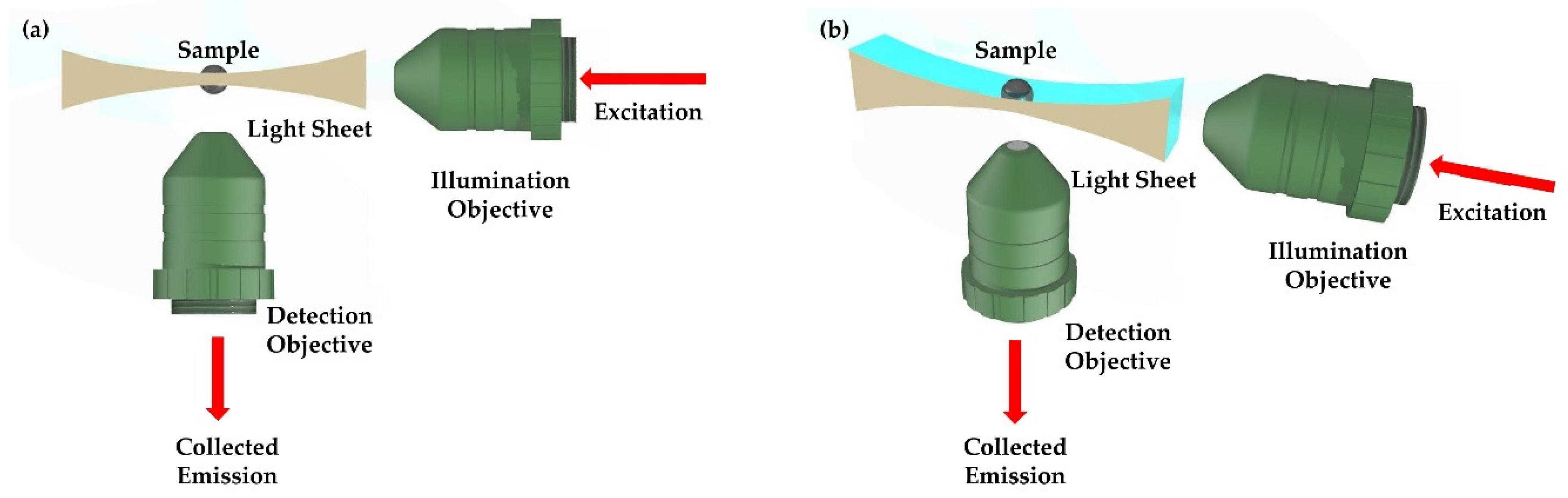
Light sheet microscopy (LSM) meets these needs by using a thin sheet of laser light to illuminate only the focal plane (
Figure 1), thereby minimizing out-of-focus excitation and reducing phototoxic effects [
13,
14,
15]. In contrast to point-scanning approaches, LSM acquires an entire image plane in a single exposure which significantly expedites volumetric data collection and lowers the risk of photo bleaching [
16]. Although fluorescence has been the primary contrast mechanism in many LSM implementations, capturing Rayleigh and Raman scattering signals within the same instrument can provide both morphological and molecular insights [
17]. Rayleigh scattering arises from refractive index discontinuities in cellular structures, while Raman scattering records the vibrational fingerprints of biomolecules, obviating the need for exogenous labels.
Despite advancements in Light Sheet Raman Microscopy (LSRM), many systems continue to rely on near-infrared (NIR) excitation wavelengths (e.g., 785 nm) to minimize autofluorescence [
18]. While effective in reducing background interference, this approach diminishes Raman scattering cross-sections and electronic sensitivities and compromises spatial resolution, limiting the quality and speed of 3D reconstructions. Addressing these limitations, A novel multi-modal 3D imaging setup was developed, utilizing visible excitation to enhance Raman scattering efficiency while suppressing background fluorescence. To optimize performance, our platform integrates acousto-optic tunable filters (AOTFs) for precise and agile spectral selection paired with advanced deep learning algorithms for image enhancement. Among these, the Deep Image Prior (DIP) algorithm has been specifically chosen for its superior performance in light sheet microscopy consistently surpassing other self-supervised and unsupervised methods such as ZS-DeconvNet, Noise2Noise, and Noise2Void. DIP effectively combines noise suppression, correction of diffraction-induced artifacts, and preservation of structural integrity resulting in artifact-free volumetric reconstructions with exceptional molecular and spatial fidelity. This integration of visible excitation with DIP establishes a transformative framework for achieving high-resolution, high-speed 3D imaging setting a new standard in the field of Light Sheet Raman Microscopy (LSRM) [
19,
20,
21,
22,
23,
24,
25,
26].
Figure 1.
Schematic representation of the principle of light sheet microscopy (a) Top View (b) Side View. The illumination and detection axes are oriented orthogonally, with the sample positioned at their intersection. A laser beam is shaped into a thin light sheet to provide selective plane illumination within the focal plane of the detection objective. The detection objective captures the illuminated plane and projects it onto the camera sensor, facilitating high-resolution imaging of the targeted section. This approach ensures efficient illumination and precise detection [
20].
Figure 1.
Schematic representation of the principle of light sheet microscopy (a) Top View (b) Side View. The illumination and detection axes are oriented orthogonally, with the sample positioned at their intersection. A laser beam is shaped into a thin light sheet to provide selective plane illumination within the focal plane of the detection objective. The detection objective captures the illuminated plane and projects it onto the camera sensor, facilitating high-resolution imaging of the targeted section. This approach ensures efficient illumination and precise detection [
20].
By integrating Rayleigh, Raman, and fluorescence signals into a single experimental workflow, newly developed system generates comprehensive hyperspectral datasets without the need of additional labels ensuring that the physiological state of spheroids remains unaltered. Critically, the shift to visible wavelengths delivers stronger Raman signals and higher imaging throughput than comparable NIR-driven modalities. Taken together, this novel Light Sheet Microscope platform builds on a conceptual microscope that included a 785 nm IR-range laser [
18]; however, Raman imaging using this laser did not yield meaningful information. Consequently, the new system overcomes the limitations of the previous design, enabling more detailed and accurate studies in tumor biology, tissue modeling, and drug discovery, while advancing the boundaries of noninvasive, high-resolution 3D molecular imaging for complex biological systems.
2. Materials and Methods
This study presents a Multi-Modal Light Sheet Microscope (LSM) designed to address the challenges of traditional Raman imaging including weak scattering efficiency, fluorescence interference, and limited spatial resolution. The LSM integrates Raman scattering, Rayleigh scattering, and fluorescence imaging modalities supported by a dual-wavelength excitation system to enhance Raman efficiency while ensuring deep tissue penetration and minimal photo damage. The detailed design, experimental setup, and protocols are provided below to ensure replicability and facilitate future advancements.
2.1. Measurement Setup Design
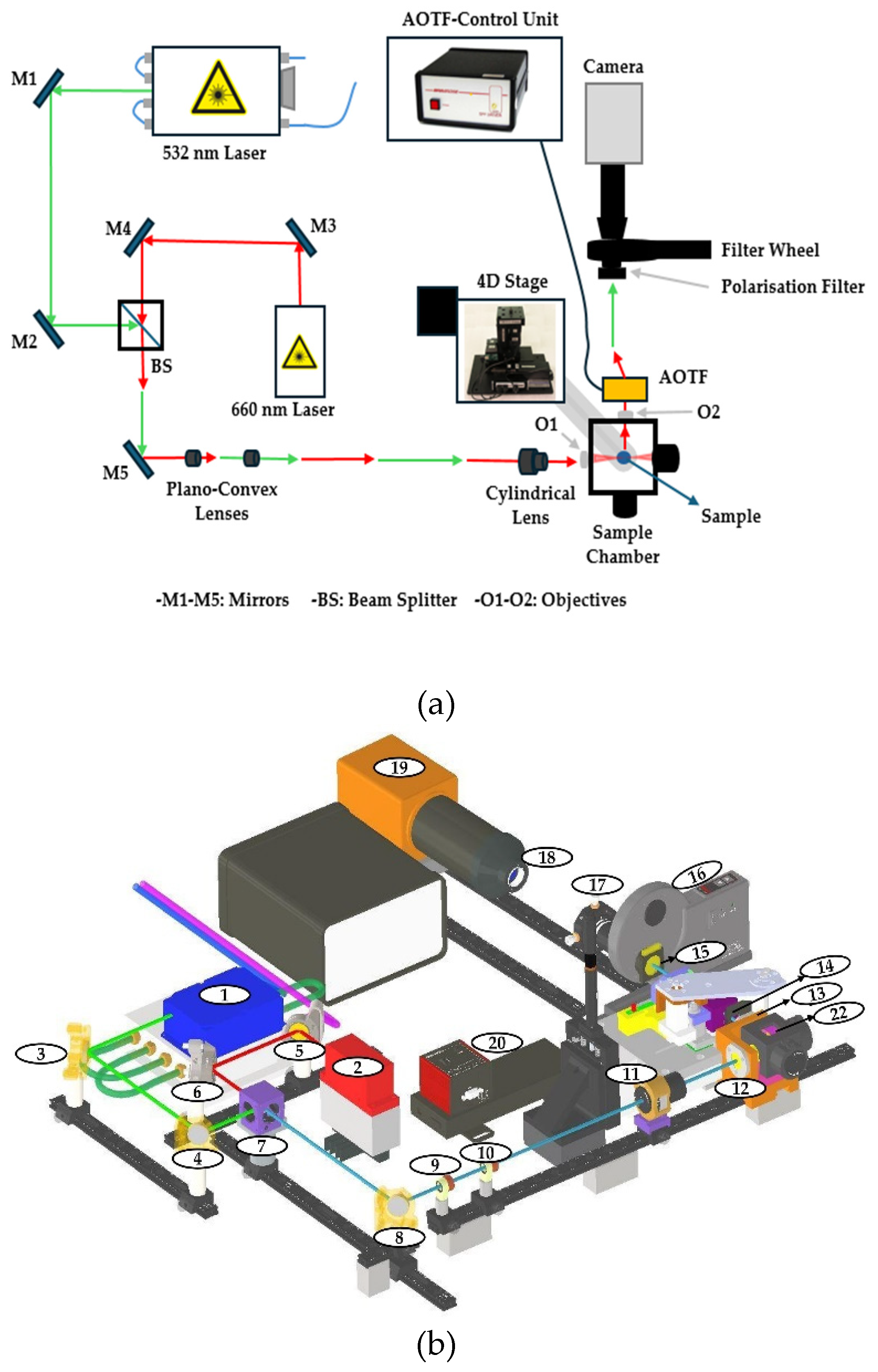
Figure 2 shows the schematic and the 3D illustration of the experimental setup used for the multi-modal light sheet microscopy.
Figure 2a depicts the optical path for both 532 nm and 660 nm lasers. The laser beams are directed through mirrors (M1-M5) and beam splitters (BS) to focus the light onto the sample using a cylindrical lens. The system is equipped with a 4D stage for precise sample movement and a camera to capture the images. The Acousto-Optic Tunable Filter (AOTF) is used for wavelength selection, while a polarization filter and filter wheel help manage light interference and background.
Figure 2b shows a detailed 3D rendering of the setup, highlighting key components, such as the lasers, optical elements, and the sample chamber. The diagram helps visualize the complex optical arrangement and how the system enables the simultaneous collection of multiple imaging modalities (Raman, Rayleigh, and fluorescence), supporting comprehensive analysis of biological samples with high precision. Also, a detailed explanation of the system components is stated in
Table 1 and their role in image acquisition can be found in the subsequent subsections of 2.1.
2.1.1. Excitation Lasers
The LSM utilizes two continuous-wave (CW) lasers operating at wavelengths of 532 nm and 660 nm (λ₁ = 532 nm, λ₂ = 660 nm). The 532 nm laser, with a power range of 0–2 W, was selected for its high Raman scattering efficiency. This efficiency is governed by the relationship:
where
is the Raman scattering cross-section,
is the excitation wavelength,
is the vibrational intensity at frequency
, and
is the polarizability tensor. The 660 nm laser, operating at 0–130 mW, was chosen to penetrate deeper tissue layers while mitigating autofluorescence. This dual-wavelength strategy enables comprehensive imaging from surface structures to deep tissue regions with high sensitivity.
2.1.2. Beam Shaping and Light Sheet Formation
The illumination system projects a vertically oriented light sheet into the sample chamber, thereby ensuring uniform illumination while minimizing scattering artifacts. The axial resolution—defined by the beam waist—was experimentally determined to be approximately 8 µm for both 532 nm and 660 nm excitation lasers using a BP209-VIS/M Scanning-Slit Optical Beam Profiler (Thorlabs Inc., Newton, MA, USA). This configuration enables high-precision optical sectioning at 10 µm increments along the optical axis, an essential capability for capturing subcellular structures in sequential imaging. Furthermore, the 635 µm × 635 µm effective field of view accommodates spheroidal samples of comparable diameter facilitating comprehensive volumetric sectioning across diverse experimental contexts. These parameters collectively ensure high-fidelity, multi-modal Raman imaging, especially when combined with reliable sample positioning that preserves accurate alignment throughout sequential acquisitions. For beam conditioning, the laser output was first collimated and expanded by a Keplerian telescope providing a magnification factor:
where
and
are the focal lengths of the input and output lenses, respectively. The expanded beam was shaped into a static light sheet using a cylindrical lens yielding a Gaussian intensity profile described by:
where
is the peak intensity,
is the beam waist radius,
is the transverse axis,
is the axial axis, and
is the Rayleigh range. The axial propagation of the beam was characterized by:
where
represents the beam width at a given axial distance z.
2.1.3. Spectral Filtering and Detection System
Modular Detection and Filtering System: The detection framework employs a high-performance scientific Complementary Metal-Oxide-Semiconductor (sCMOS) camera integrated with a versatile optical filter assembly optimized for multi-modal imaging applications. This assembly comprises an Acousto-Optic Tunable Filter (AOTF), polarization filters, and a combination of longpass, notch, and shortpass filters (
Figure 2). The AOTF facilitates precise spectral selection enabling the fine-tuning of transmitted wavelengths for Rayleigh, Raman, and fluorescence modalities without necessitating physical realignment of the optical components. The operational principle of the AOTF is described by the equation:
where
denotes the central wavelength,
is the acoustic velocity within the AOTF material,
represents the refractive index, and
is the acoustic frequency applied. This relationship allows for dynamic and accurate control of the spectral filtering properties essential for multi-modal imaging applications.
Polarization filters are employed to enhance image contrast by selectively rejecting undesired polarization states of incoming light. This selective filtering improves the signal-to-noise ratio, thereby increasing the efficiency and sensitivity of inelastic scattering detection. The integration of longpass, notch, and shortpass filters further refines the spectral filtering allowing for the isolation of specific wavelength ranges pertinent to the different imaging modalities.
This modular detection and filtering system enables rapid and precise adjustments to the spectral parameters, ensuring optimal performance across various imaging conditions. The combination of AOTF-based spectral tuning and polarization filtering minimizes background noise and optical distortions, thereby facilitating high-fidelity Raman spectroscopy and fluorescence imaging. Consequently, this configuration supports robust and reproducible multi-modal imaging essential for detailed biochemical and structural analyses in complex biological samples.
High-Resolution Detection: Scattered and emitted photons were orthogonally collected using a high numerical aperture (NA = 1.2) objective lens, thereby achieving lateral and axial resolutions as delineated by the Rayleigh criterion:
where
represents the spatial resolution and
is the detection wavelength (AOTF) of the emitted or scattered photons. The configuration achieved lateral and axial resolutions of ~250 nm and ~600 nm, respectively. The detection system employed a scientific CMOS (sCMOS) camera (Hamamatsu ORCA Flash 4.0) with a 16-bit dynamic range to capture the scattered light. The pixel pitch of 6.5 µm ensured Nyquist sampling based on the optical resolution of the system. This configuration enables precise spatial and spectral discrimination essential for detailed biochemical and structural analyses within complex biological samples.
2.1.4. Calibration and System Validation
Polystyrene microspheres (1 µm diameter) were used to validate light sheet thickness and uniformity through Gaussian intensity fitting. The effective full-width at half-maximum (FWHM) thickness was optimized to ~2 µm. The uniformity and thickness of the light sheet were assessed by imaging fluorescent beads distributed in a transparent medium. Silicon wafers () served as spectral references, with a Raman peak accuracy maintained within .
2.3. Sample Preparation and Alignment
2.3.1. Sample Preparation
Biological specimens, encompassing three-dimensional (3D) spheroids and adherent cell cultures, were meticulously prepared using standardized protocols to ensure optimal imaging fidelity and preserve cellular integrity. Spheroids were encapsulated within a low-scattering hydrogel matrix which afforded high optical clarity and maintained physiological conditions throughout the imaging process. This embedding strategy effectively reduced light scattering, thereby enhancing image quality and sustaining a supportive environment for cellular function.
For the purposes of this investigation, 3D spheroids were generated from two HPV-negative head and neck squamous cell carcinoma (HNSCC) cell lines: UMSCC-14C originating from oral cavity carcinoma. Both cell lines were cultured in Eagle’s Minimum Essential Medium (EMEM) supplemented with 10% fetal bovine serum (FBS) and 1% Penicillin/Streptomycin. Cultures were maintained under standard conditions at 37 °C in a humidified atmosphere containing 5% CO₂. Cells were detached enzymatically using Trypsin/EDTA, quantified with a Neubauer hemocytometer, and subsequently seeded into ultra-low attachment (ULA) 96-well plates at densities of 2.5 × 10⁴ or 5 × 10⁴ cells per well to promote spheroid formation. These spheroids were cultured for up to eight days, with medium replenishments on days 3, 5, and 8, ultimately achieving diameters ranging from 300 to 400 µm.
To evaluate the impact of chemotherapeutic intervention, spheroids were treated with cisplatin at a concentration of 100 µm on the fourth day of culture, whereas control spheroids received an equivalent volume of dimethyl sulfoxide (DMSO). Following a 72-hour incubation period, both treated and untreated spheroids were fixed using 4% formalin to preserve structural integrity for subsequent imaging analyses. The fixed samples were then mounted into a bespoke, 3D-printed hydrogel carrier designed to facilitate precise alignment with the light-sheet illumination and detection optics. This setup enabled multi-view imaging under physiological conditions (37 °C and 5% CO₂) ensuring the viability and structural preservation of the samples throughout extended imaging sessions.
Another spheroid, HT29 (colorectal adenocarcinoma) cells, were cultured in Dulbecco’s Modified Eagle Medium (DMEM) supplemented with 10% fetal bovine serum (FBS) and 1% Penicillin/Streptomycin. Cells were enzymatically detached, quantified, and seeded under identical conditions in ULA 96-well plates at densities of 5 × 10⁴ cells per well to generate spheroids. HT29 spheroids were cultured in the same incubation conditions as UM-SCC-14C and exhibited a compact morphology within 72 hours reaching diameters of 300–400 µm over an eight-day period.
Both UM-SCC-14C and HT29 spheroids were prepared under identical conditions for Raman Light Sheet Microscopy (RLSM) imaging ensuring uniform sample integrity across experiments.
2.3.2. Hydrogel Embedding
Fixed tumor spheroids were embedded within a low-melting-point agarose matrix to ensure positional stability during imaging procedures. This agarose gel effectively mimics the extracellular environment providing essential structural support and maintaining the integrity of the samples throughout the imaging process. By replicating physiological conditions, the agarose embedding preserves the native architecture of the spheroids facilitating high-fidelity imaging and accurate morphological assessments.
2.3.2. Positioning System
Samples were mounted within a custom-fabricated, three-dimensional (3D) printed holder engineered for enhanced stability and multi-view imaging capabilities. This holder was affixed to a precision 4D stage, which provides translational resolution of 1.5 µm along the X, Y, and Z axes and rotational adjustments with a precision of 0.5 degrees. This sophisticated configuration enabled meticulous alignment of the sample with the light sheet effectively minimizing motion artifacts and ensuring high reproducibility in imaging.
2.5. Imaging Workflow and Computational Processing
Multi-modal imaging was conducted using 532 nm and 660 nm lasers, with Raman imaging optimized at laser powers of 130 mW and 350 mW and a prolonged exposure time of 5000 ms to maximize signal quality. Rayleigh scattering images were captured at 100 ms exposure using 1 mW laser powers to ensure optimal contrast. Z-stacks were acquired at 10 µm intervals along the vertical axis for high-resolution three-dimensional reconstruction. The Acousto-Optic Tunable Filter (AOTF) provided precise spectral alignment across modalities eliminating manual realignment (
Table 2).
Raman spectra were recorded using a Tec5 spectrometer for 660 nm and a Kaiser spectrometer for 532 nm lasers. Hyperspectral Raman data were stored as spectral cubes for biochemical profiling, while structural images were saved in .tiff format for downstream processing.
Raman spectra were analyzed for key vibrational modes, and the corresponding molecular assignments are detailed in
Table 3. These features were integral for determining the biochemical changes and structural characteristics of the sample. Peak intensity ratios were analyzed to evaluate molecular alterations, such as those induced by cisplatin treatment.
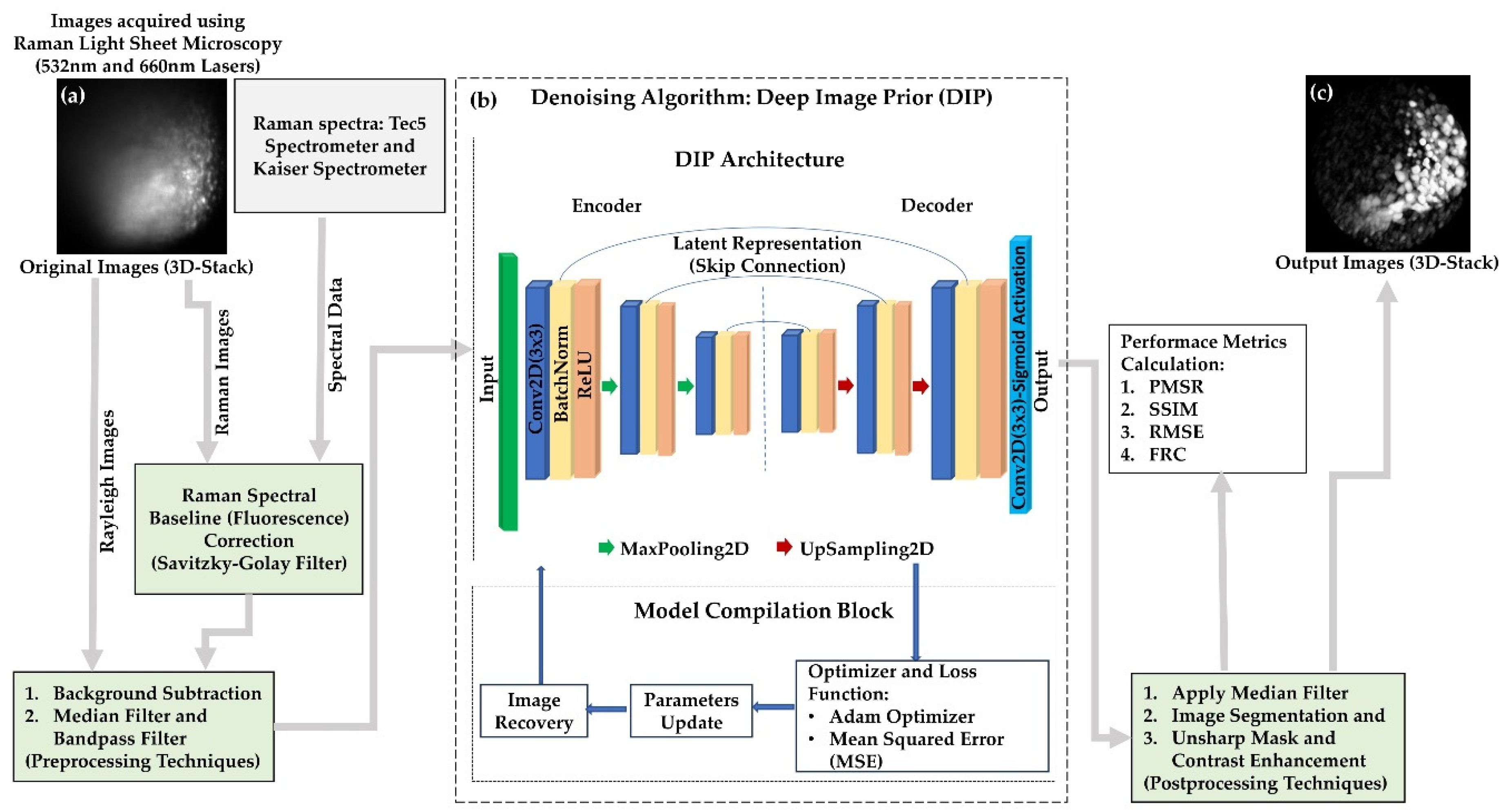
Rayleigh scattering images, which lack spectral data, were denoised using the Deep Image Prior (DIP) algorithm, an unsupervised framework leveraging convolutional neural networks (CNNs) to suppress noise while preserving spatial features. DIP aims to recover the underlying clean image
by optimizing the CNN
, where
is a fixed random input. The optimization objective is expressed as:
Here,
is the CNN with learnable weights
, and
is typically a fixed random noise input. DIP uses a fixed random noise input, with no pretraining on external datasets. Instead, it learns to denoise directly during optimization. The encoder-decoder CNN architecture incorporates skip connections to preserve fine details, while the decoder reconstructs the image from a compressed representation. A sigmoid activation constrains the output pixel values between 0 and 1
(Figure 3).
Raman spectra were baseline-corrected using the Savitzky–Golay algorithm to eliminate fluorescence artifacts ensuring accurate peak identification. The DIP algorithm was applied to both Raman images and spectral data enhancing spatial fidelity and maintaining the integrity of spectral signatures.
The efficacy of the denoising workflow was validated using quantitative metrics. The effectiveness of the denoising and image enhancement algorithms was evaluated using key quantitative metrics to ensure noise reduction and structural preservation. Peak Signal-to-Noise Ratio (PSNR) values between 30–50 dB indicated effective noise suppression, with values closer to 50 dB reflecting near-perfect image restoration suitable for resolving fine subcellular details [
30,
31,
32,
33]. Structural Similarity Index (SSIM) values in the range of 0.90–0.99 confirmed the preservation of luminance, contrast, and structural integrity in the denoised images [
34,
35,
36]. Root Mean Squared Error (RMSE) values below 0.05 demonstrated minimal pixel-wise deviations ensuring accurate reconstruction [38,39]. Fourier Ring Correlation (FRC) values between 0.7 and 1.0 highlighted the retention of high-frequency spatial details essential for sharpness and resolution [40,41].
Collectively, these metrics validated the algorithms’ ability to produce high-quality microscopy images while maintaining the accuracy of biological structures.
3. Results
3.1. Comparative Analysis of Cisplatin-Induced Structural and Molecular Alterations in Spheroids Using 660 nm and 532 nm Excitation
Light Sheet Raman Microscopy (LSRM) was employed to investigate structural and biochemical alterations in cisplatin-treated spheroids, leveraging 532 nm and 660 nm excitation for a comparative analysis of Raman scattering efficiency, penetration depth, and autofluorescence interference. The excitation wavelength in Raman light sheet microscopy directly affects these parameters influencing molecular specificity and imaging depth. 532 nm excitation enhances Raman signal intensity due to its higher scattering cross-section but introduces strong autofluorescence reducing spectral contrast and complicating molecular interpretation. Conversely, 660 nm excitation minimizes fluorescence interference improving biochemical selectivity, but exhibits lower Raman cross-section leading to decreased signal intensity and requiring longer acquisition times. These findings emphasize the trade-off between signal strength and fluorescence suppression necessitating wavelength optimization for high-fidelity volumetric Raman imaging in drug-response studies.
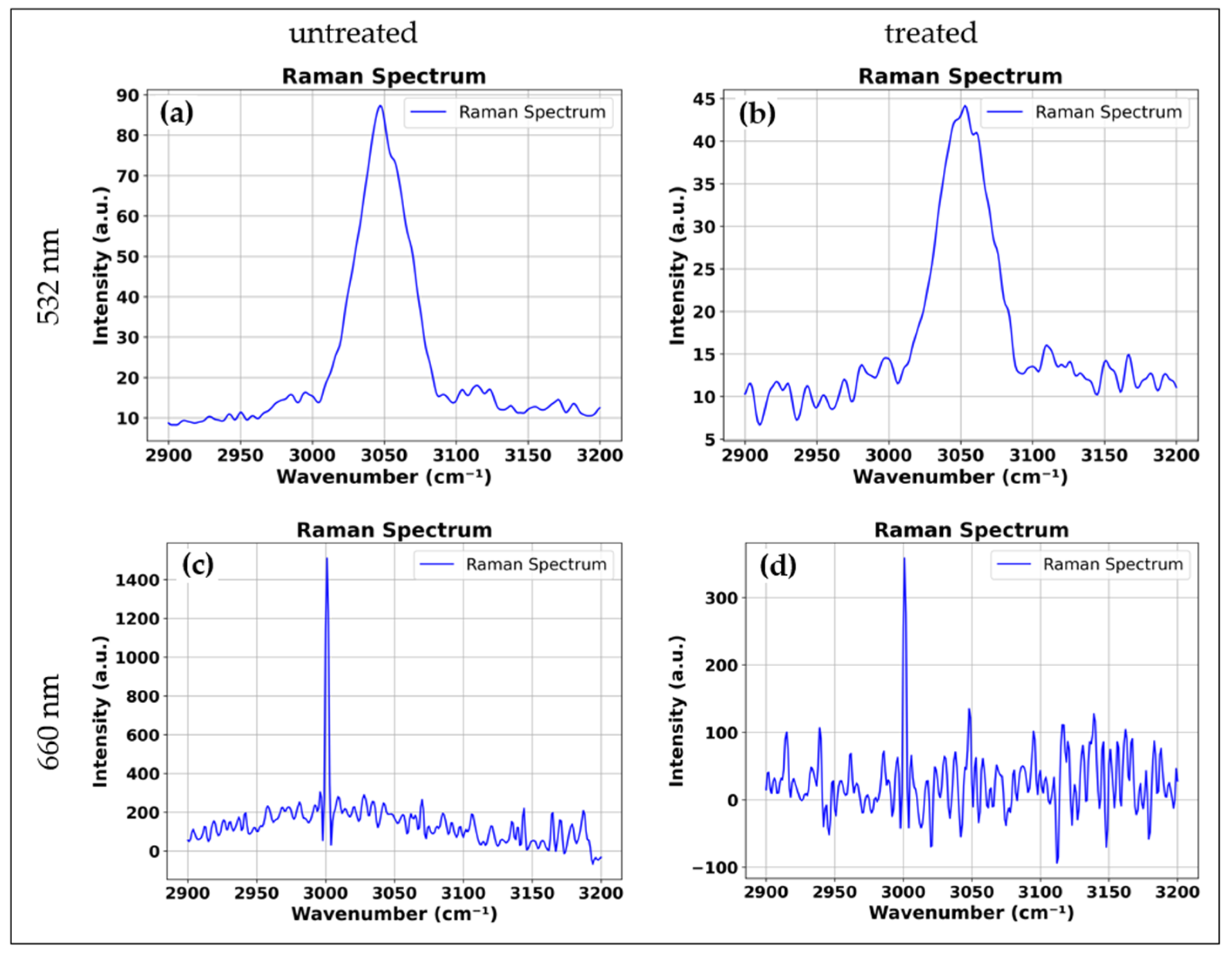
Figure 4 presents Raman spectral analysis of untreated and cisplatin-treated spheroids under 532 nm and 660 nm excitation, focusing on the 2990–3200 cm⁻¹ region corresponding to C-H stretching vibrations in lipids and proteins.
At 532 nm excitation (
Figure 4a, 4b), untreated spheroids exhibit a strong Raman signal intensity due to the higher scattering efficiency of the shorter wavelength. However, autofluorescence interference is evident, requiring spectral correction. Cisplatin-treated spheroids (
Figure 4b) show a noticeable decrease in peak intensity at 3030 cm⁻¹, indicating lipid degradation and protein denaturation, consistent with apoptosis-induced structural changes.
At 660 nm excitation (
Figure 4c, 4d), autofluorescence is significantly reduced, resulting in a higher contrast Raman spectrum despite lower overall signal intensity. Untreated spheroids (
Figure 4c) maintain distinct spectral peaks, while treated spheroids (
Figure 4d) exhibit a greater reduction in Raman intensity, reinforcing evidence of biochemical alterations post-treatment. The stronger spectral response at 532 nm confirms its higher Raman scattering efficiency, while 660 nm provides cleaner molecular contrast due to reduced fluorescence interference. These results highlight the trade-off between signal strength and fluorescence suppression in Raman light sheet microscopy.
The image (
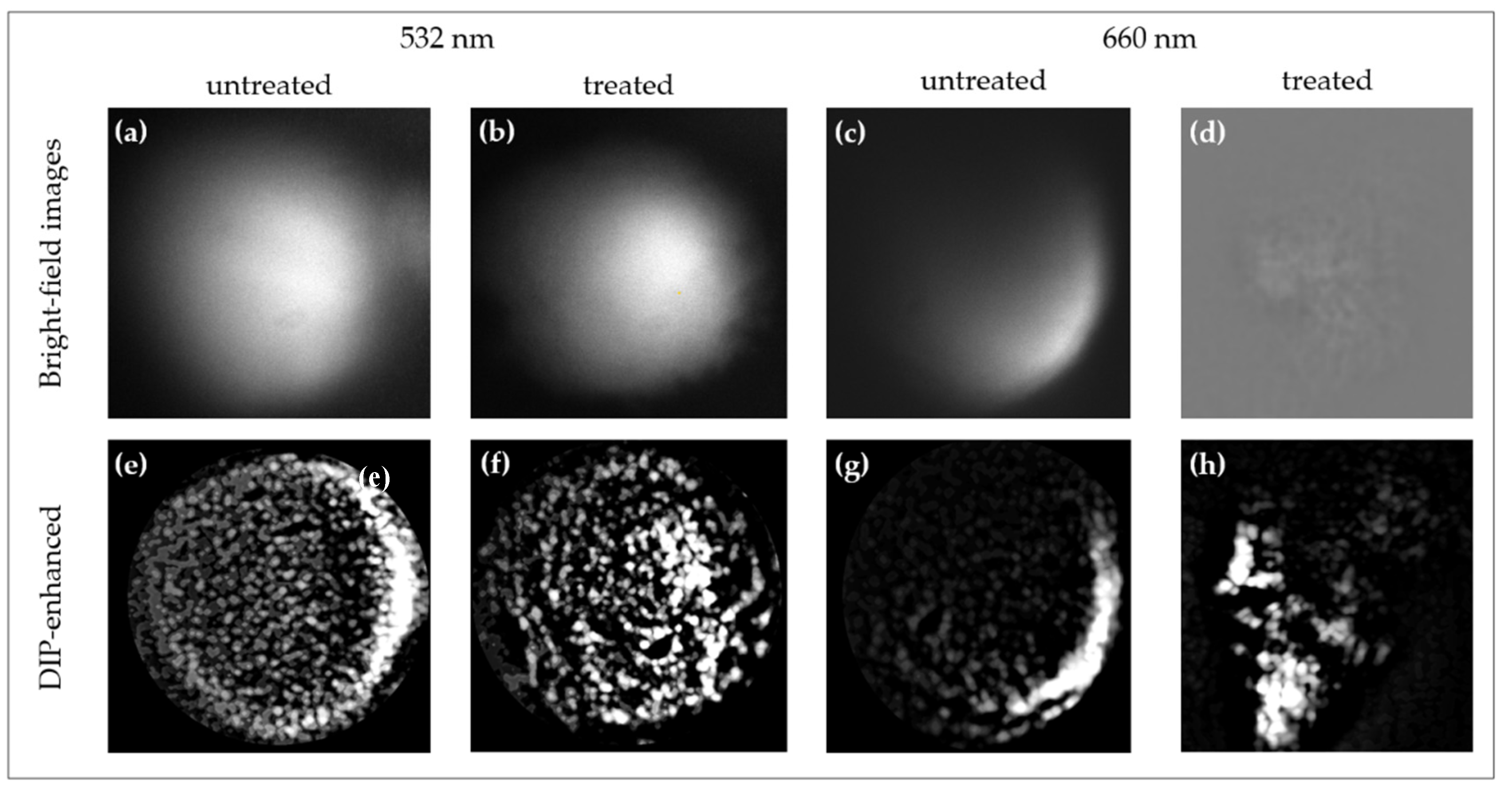
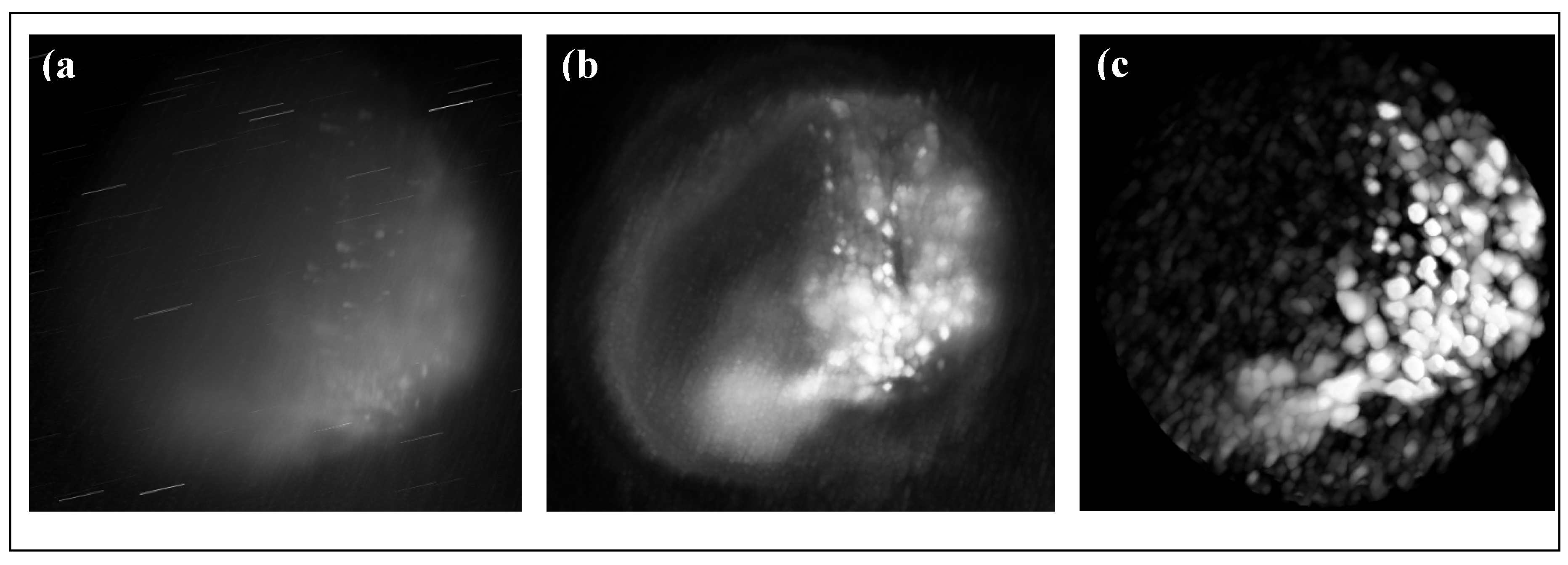
Figure 5a-h) illustrates morphological and biochemical differences in spheroids under 532 nm and 660 nm excitation for both untreated and cisplatin-treated conditions. At 532 nm, untreated spheroids maintain a near-spherical structure, while treated spheroids show contraction and peripheral degradation. At 660 nm, untreated spheroids appear more homogeneous, whereas treated spheroids exhibit increased core degradation, highlighting the deeper penetration of longer wavelengths. Raman-based imaging reveals uniform molecular distributions in untreated spheroids, while treated ones show lipid and protein degradation. Deep Image Prior (DIP) denoising significantly improves signal clarity, reducing noise and autofluorescence, particularly in the 532 nm dataset where fluorescence distortions are prominent. DIP-enhanced maps provide high-fidelity molecular gradients, recovering biochemical details lost in fluorescence-heavy Raman datasets. These findings emphasize the role of excitation wavelength and computational enhancement in achieving high-resolution, noise-free molecular imaging.
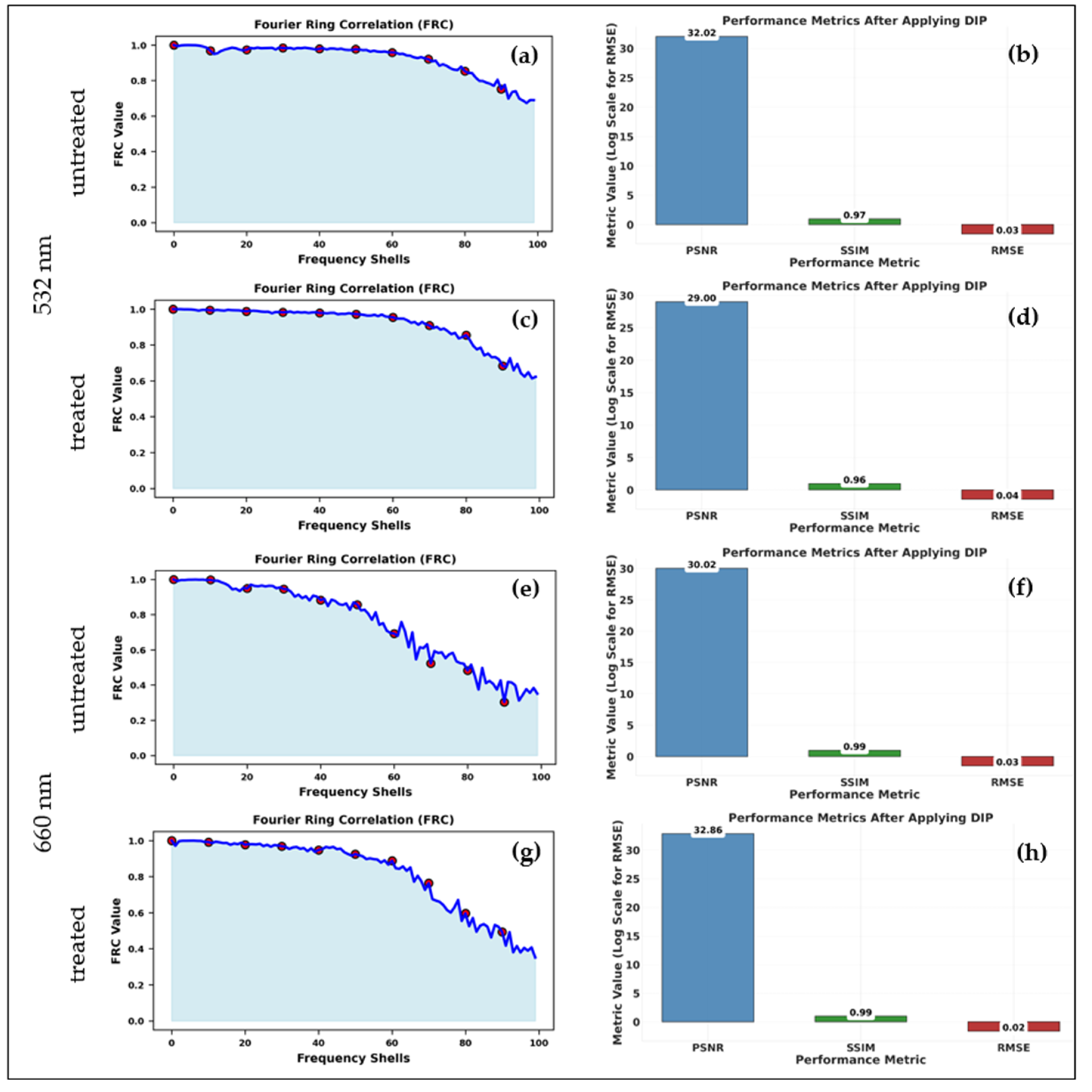
To quantitatively assess DIP’s performance, PSNR, RMSE, SSIM, and FRC analyses were conducted (
Figure 6a-h). PSNR improvements were observed in both datasets (32.02 dB for 532 nm (Untreated 14C), 30.02 dB for 660 nm (Untreated 14C)), confirming enhanced noise suppression. SSIM values increased (0.97 for 532 nm (Untreated 14C), 0.99 for 660 nm (Untreated 14C)), indicating improved structural fidelity, while FRC-based resolution gains validated DIP’s ability to recover fine molecular features. Similar improvements are observed in the treated 14C samples at 532nm and 660nm excitation wavelength, as shown in the
Figure 6a-h.
The impact of DIP was most pronounced at 532 nm, where autofluorescence suppression was essential for accurate molecular reconstruction. These results establish DIP-enhanced LSRM as a high-fidelity, noise-suppressed framework for Raman imaging in 3D biological models, demonstrating its ability to overcome visible-range autofluorescence limitations while preserving high-resolution biochemical distributions. The comparative evaluation confirms that 660 nm provides deeper penetration with reduced autofluorescence, whereas 532 nm enhances Raman scattering efficiency but requires DIP for fluorescence correction, highlighting the importance of computational enhancement techniques in high-resolution Raman imaging.
3.2. Improved 3D Molecular Imaging in Visible-Range Raman Light Sheet Microscopy
To evaluate the impact of visible-range Raman light sheet microscopy in volumetric imaging, 3D Raman models were reconstructed using 41 stacked Raman intensity images of HT29 spheroids (
Figure 7) and cisplatin-treated UMSCC-14C spheroids (
Figure 8). One of the major challenges in visible-wavelength Raman imaging is the presence of fluorescence interference, which can obscure molecular contrast and affect quantitative biochemical analysis. This study demonstrates how the combination of Raman light sheet microscopy and computational enhancement techniques minimizes fluorescence effects allowing for artifact-free molecular reconstructions in 3D cellular models.
3.2.1. Volumetric Reconstructions: Pre- and Post-DIP-Enhanced 3D Reconstruction of HT29 and UMSCC-14C Spheroids
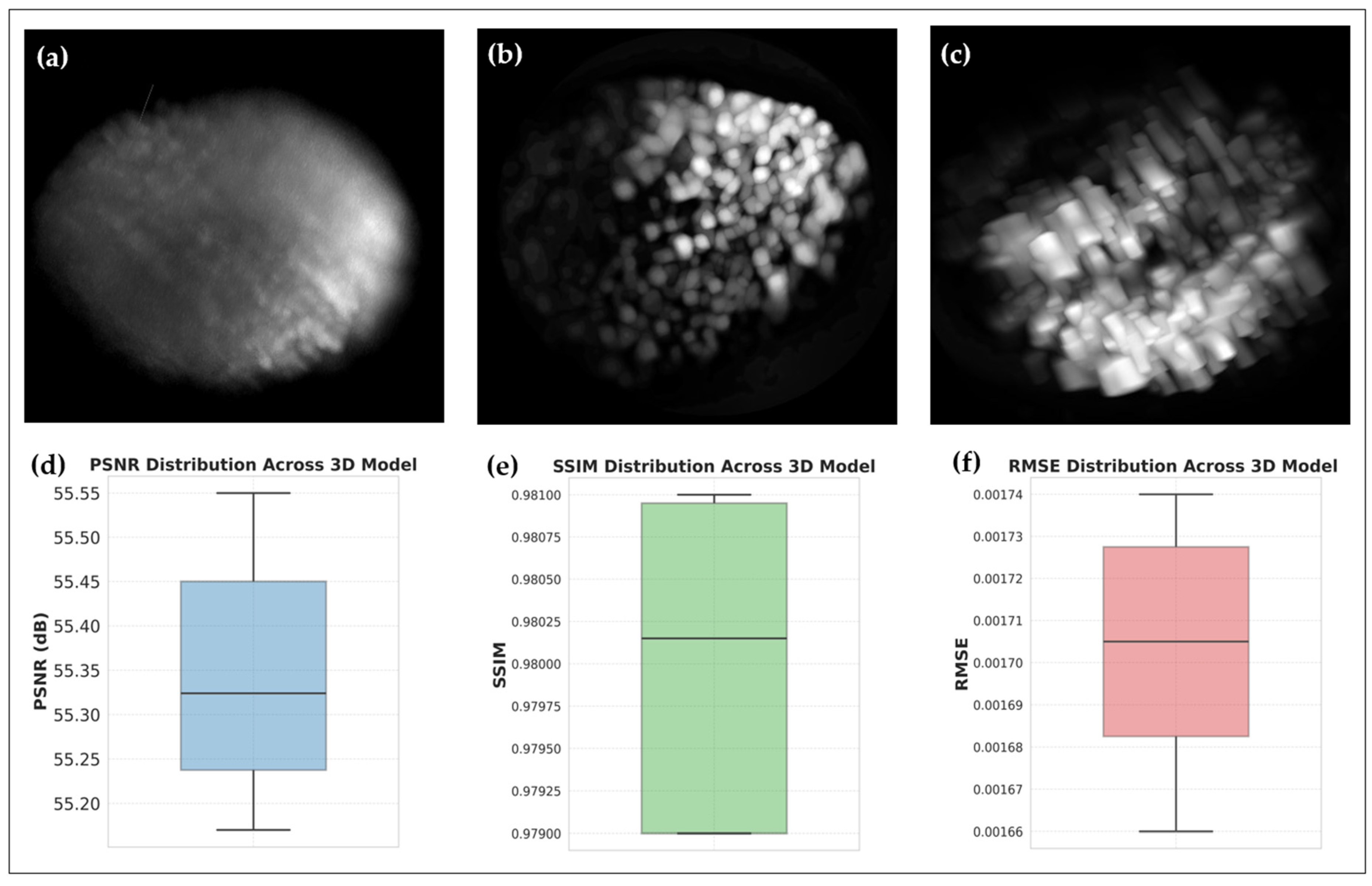
Figure 7 presents a comparative analysis of the original and fluorescence-reduced 3D Raman models of HT29 spheroids. The raw 3D reconstruction (
Figure 7a) exhibits significant autofluorescence background leading to intensity variations across layers and reducing contrast in molecular distributions. The fluorescence-corrected model (
Figure 7b) demonstrates substantial improvements in molecular uniformity, enhanced contrast, and improved feature delineation. Side-view projections (
Figure 7c) confirm that fluorescence-induced artifacts are significantly reduced ensuring spatial coherence across all layers of the spheroid.
To quantify these improvements, PSNR, SSIM, and RMSE were generated for all 41 slices (
Figure 7d-f): PSNR (
Figure 7d): higher values of PSNR indicate improved signal-to-noise ratio demonstrating the effectiveness of fluorescence suppression. SSIM (
Figure 7e): the increased structural similarity confirms that molecular features are well-preserved while reducing unwanted fluorescence artifacts. RMSE (
Figure 7f): the decrease in rmse values further validates the improved accuracy of Raman intensity reconstructions ensuring artifact-free molecular distributions.
3.2.2. Fluorescence-Reduced 3D Raman Imaging of Cisplatin-Treated UMSCC-14C Spheroids
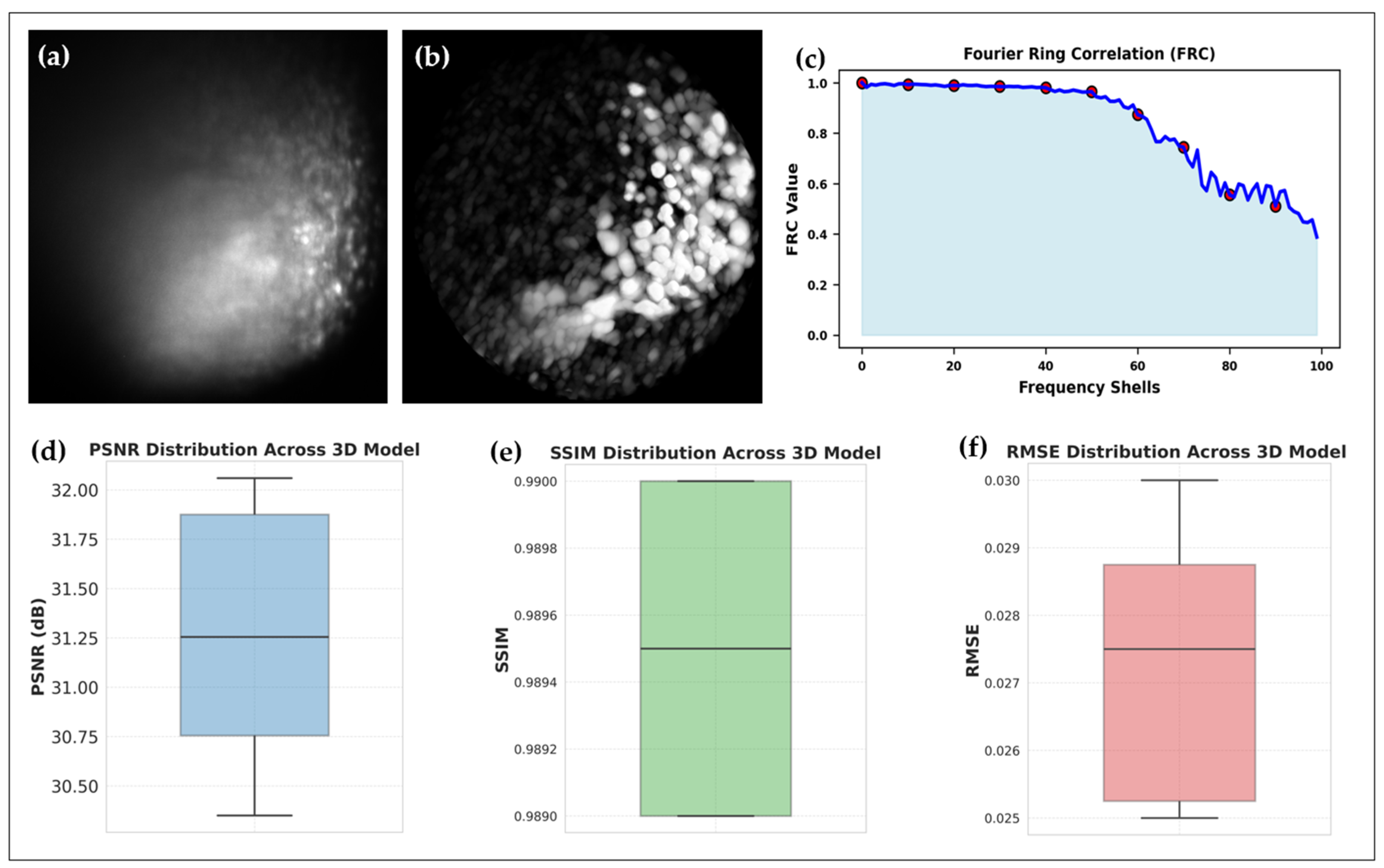
To further evaluate fluorescence suppression in Raman light sheet-based volumetric imaging, a 3D Raman model was generated for cisplatin-treated UMSCC-14C spheroids (
Figure 8). The raw 3D model (
Figure 8a) exhibits strong fluorescence interference leading to signal distortions and inconsistencies in molecular mapping. The corrected 3D model using combination of processing techniques and Dip algorithm (
Figure 8b) significantly reduces fluorescence background restoring contrast and improving biochemical precision in the volumetric dataset.
To further quantify fluorescence suppression, PSNR, SSIM, RMSE, and FRC were computed across all 41 slices (
Figure 8c-e): FRC (
Figure 8c): the FRC analysis confirms a clear enhancement in spatial resolution validating the improved fidelity of 3D Raman light sheet reconstructions. PSNR (
Figure 8d): the increase in PSNR values confirms that fluorescence artifacts have been suppressed improving overall signal clarity. SSIM (
Figure 8d): the structural similarity metric demonstrates that molecular details are preserved while fluorescence background is minimized. RMSE (
Figure 8e): a reduction in RMSE indicates improved pixel-wise accuracy ensuring precise molecular reconstructions.
These findings establish that visible-range Raman light sheet excitation, when combined with fluorescence suppression, provides high-resolution, fluorescence-free 3D molecular imaging enabling accurate structural and biochemical characterizations. This approach ensures that Raman imaging in the visible spectrum is not limited by fluorescence interference making it a reliable tool for quantitative volumetric imaging in biological models.
3.3 Evaluating the Role of Pre- and Post-processing in 3D Raman Light Sheet Reconstruction
To assess the effect of pre- and post-processing on fluorescence suppression and molecular contrast, a 3D Raman model of cisplatin-treated UMSCC-14C spheroids was reconstructed before and after pre- and post-processing prior to DIP processing (
Figure 9). In previous cases, DIP was applied after post-processing, which included median filtering and band-pass filtering, effectively minimizing fluorescence artifacts. Here, DIP was also applied without post-processing allowing a direct comparison of fluorescence effects in unprocessed Raman light sheet data.
Figure 9a shows the original 3D Raman reconstruction before any computational processing.
Figure 9b presents the model after DIP without post-processing, where fluorescence artifacts and spectral distortions remain prominent, reducing molecular contrast and structural clarity. In contrast,
Figure 9c shows the model after DIP with post-processing demonstrating reduced background noise, enhanced molecular contrast, and improved Raman-specific feature resolution.
These findings confirm that preprocessing significantly enhances the effectiveness of DIP in visible-range Raman light sheet microscopy ensuring accurate molecular imaging and artifact-free 3D reconstructions.
3.5. Complementary Modalities: Rayleigh and Fluorescence Imaging
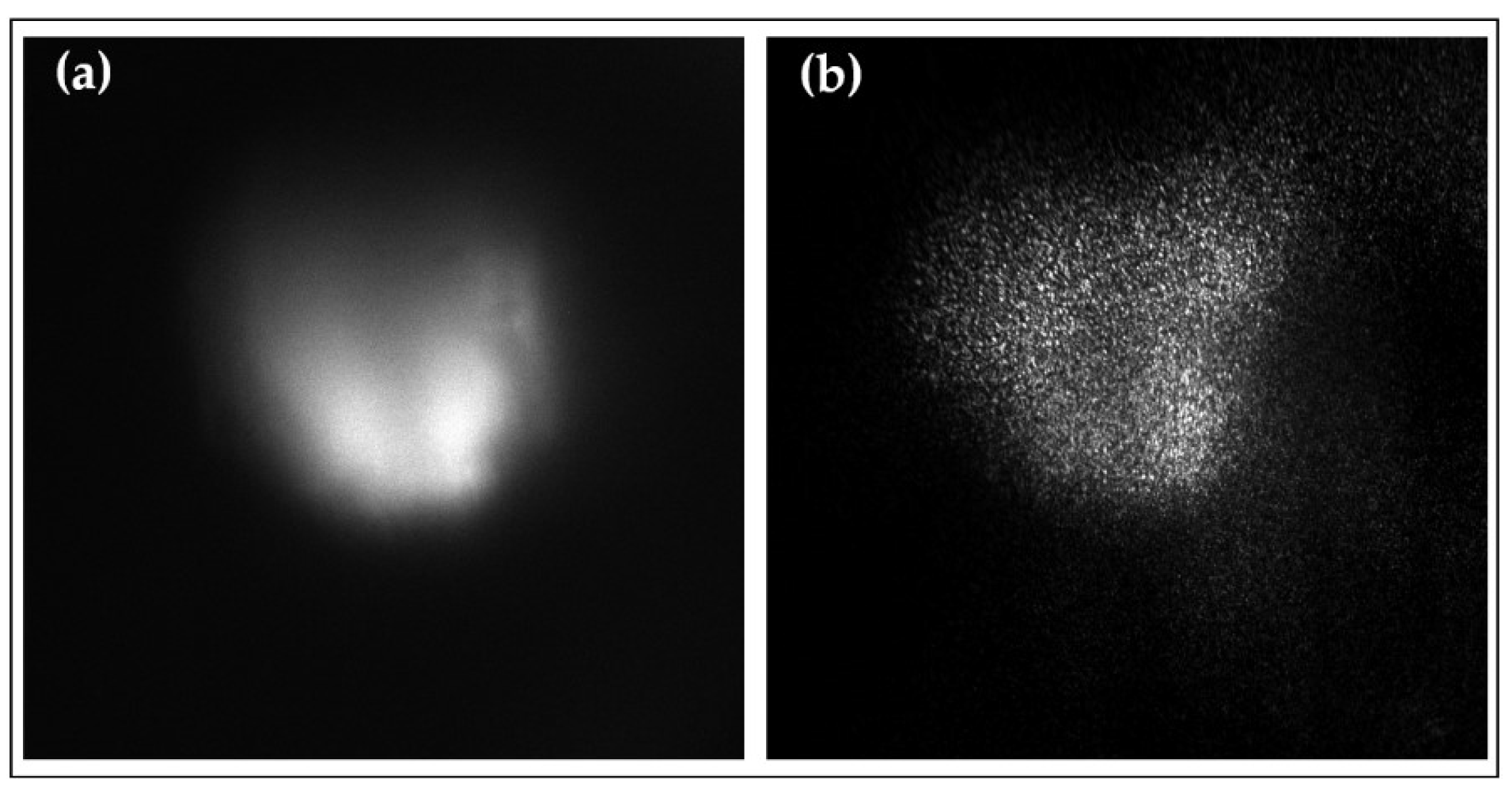
This section presents the original images captured directly from the measurement setup, highlighting the system’s capability to acquire Raman, Rayleigh, and fluorescence images. While Raman imaging remains the primary focus, the system also enables Rayleigh and fluorescence imaging, providing additional structural and viability information. Rayleigh images reveal variations in scattering intensity, correlating with Raman-identified necrotic zones, suggesting extracellular matrix degradation. An example of this multi-modal capability is shown in
Figure 10, where
Figure 10a presents a fluorescence image of a treated UM-SCC-14C spheroid, highlighting metabolic activity and structural integrity, while its corresponding Rayleigh image at 660 nm with 1 mW laser power reveals scattering-based morphological contrast. These unprocessed images provide direct insights into the optical properties of the sample, supporting the interpretation of Raman spectra and biochemical distributions. The integration of Raman, Rayleigh, and fluorescence imaging within a single experimental framework ensures a comprehensive analysis of structural and molecular alterations in 3D spheroids. The ability to capture high-resolution, artifact-free images directly from the setup establishes a robust platform for studying therapeutic effects and advancing cancer research methodologies.
4. Discussion
This study presents an optimized Light Sheet Raman Microscopy (LSRM) platform integrating visible-wavelength excitation, preprocessing, and deep learning-based enhancement for high-resolution 3D molecular imaging. By employing 532 nm and 660 nm excitation, the system balances Raman scattering efficiency, fluorescence suppression, and penetration depth allowing precise molecular characterization in spheroids including cisplatin-induced biochemical alterations.
4.1. Advancing Raman Imaging with Visible-Wavelength Excitation
Visible-wavelength lasers, such as 532 nm and 660 nm, offer significant advantages over traditional near-infrared (NIR) systems by leveraging higher Raman scattering cross-sections leading to stronger signal intensities and reduced acquisition times. This enhancement is particularly beneficial for imaging heterogeneous 3D cell cultures where high sensitivity is critical. However, visible excitation is not without limitations, such as increased autofluorescence and phototoxicity, which can obscure subtle molecular details and pose challenges for prolonged imaging sessions. These limitations were mitigated by integrating dual-wavelength excitation with precise spectral filtering via acousto-optic tunable filters (AOTFs) ensuring robust spectral acquisition. Nevertheless, achieving high-fidelity, artifact-free imaging required advanced computational solutions to address residual noise and artifacts. Additionally, acquisition times varied significantly depending on the laser source. 785 nm excitation required nearly 6 minutes to capture a full 41-image stack, whereas 532 nm excitation reduced the acquisition time to approximately 32 seconds demonstrating a significant improvement in imaging efficiency. These trade-offs highlight the need for excitation wavelength optimization to balance signal strength, fluorescence suppression, and volumetric imaging depth for high-fidelity Raman-based biochemical mapping.
4.1. DIP Algorithm: Overcoming Limitations of Visible Excitation
To mitigate the fluorescence-induced distortions associated with visible Raman excitation, a structured preprocessing pipeline including median filtering and spectral band-pass filtering was employed to improve spectral integrity. Additionally, DIP-based denoising further refined volumetric reconstructions leveraging self-supervised deep learning to suppress noise while preserving molecular contrast and spatial integrity. This approach significantly reduced background noise leading to a PSNR improvement of approximately ~50% for both 660 nm and 532 nm excitation wavelengths compared to raw images. The effectiveness of DIP was confirmed by a 10% increase in SSIM for 660 nm excitation wavelength and ~32% for 532 nm excitation wavelength and a corresponding decrease in RMSE values demonstrating its ability to restore fine structural details while maintaining biochemical specificity. Additionally, Fourier Ring Correlation (FRC) analysis further validated the enhancement in spatial resolution post-processing. A quantitative comparison of PSNR, SSIM, and RMSE values before and after DIP-based denoising is presented in
Table 2 illustrating the significant improvements achieved:
Table 4.
Quantitative Evaluation of Image Enhancement Using DIP by using an 14C Treated Spheroid Image.
Table 4.
Quantitative Evaluation of Image Enhancement Using DIP by using an 14C Treated Spheroid Image.
| Excitation Wavelength |
Pre- and Postprocessing |
PSNR (dB) |
SSIM |
RMSE |
| 532 nm (Raw) |
No |
19.56 |
0.723 |
0.105 |
| 532 nm (After DIP) |
Yes |
29.00 |
0.958 |
0.0354 |
| 660 nm (Raw) |
No |
21.08 |
0.898 |
0.088 |
| 660 nm (After DIP) |
Yes |
31.86 |
0.989 |
0.026 |
4.1. Biochemical and Structural Insights from Cisplatin-Treated Spheroids
The platform’s ability to resolve biochemical and structural alterations induced by cisplatin treatment underscores its potential for therapeutic evaluation. Raman imaging revealed decreases in lipid-associated and amide I peaks, alongside increases in phosphate backbone signals, correlating with protein degradation, membrane disruption, and DNA crosslinking—hallmarks of cisplatin cytotoxicity. Volumetric reconstructions enhanced by DIP provided spatially resolved views of necrotic gradients revealing concentric zones of drug-induced cytotoxicity. These findings were corroborated by complementary Rayleigh scattering and fluorescence imaging offering a multi-modal perspective on cellular responses.
4.1. Broader Implications and Future Directions
The proposed system offers broad applications in cancer diagnostics, tissue engineering, and drug discovery, with potential expansion to organoid and patient-derived xenograft models for translational research. While visible-wavelength excitation increases phototoxicity risks, optimized laser parameters mitigate this limitation. DIP, despite its superior denoising capabilities, remains computationally intensive necessitating GPU-based acceleration for real-time applications.
4.1. Challenges and Limitations
Visible-wavelength excitation, while advantageous for enhancing Raman scattering efficiency, increases the risk of phototoxicity during extended imaging sessions, necessitating careful optimization of laser parameters. Moreover, DIP, despite its superior denoising capabilities, is computationally intensive which may limit its real-time application. Future iterations of the platform will focus on hardware acceleration and algorithmic refinements to address these challenges ensuring scalability for high-throughput and real-time imaging workflows.
The integration of visible-wavelength Raman imaging with DIP represents a significant advancement in light sheet microscopy, enabling artifact-free, high-resolution reconstructions with exceptional molecular and spatial fidelity. While visible-range lasers present inherent challenges, the synergy with advanced computational methods like DIP makes it possible to extract meaningful information with unparalleled accuracy. This platform’s flexibility and precision redefine the standards for 3D molecular imaging paving the way for groundbreaking applications in cancer research, drug discovery, and beyond.
5. Conclusions
This study presents a multi-modal Light Sheet Raman Microscopy (LSRM) platform integrating visible-wavelength excitation, structured preprocessing, and deep learning-based enhancement for high-resolution 3D molecular imaging. By leveraging 532 nm and 660 nm excitation, the system balances Raman scattering efficiency, fluorescence suppression, and penetration depth, enabling precise biochemical characterization of cisplatin-induced alterations in spheroids.
A structured preprocessing pipeline incorporating median filtering and spectral band-pass filtering effectively mitigated autofluorescence and background noise enhancing spectral fidelity. The Deep Image Prior (DIP) algorithm further improved volumetric reconstructions by suppressing noise and diffraction artifacts while preserving structural integrity. The integration of Raman, Rayleigh, and fluorescence imaging modalities provided a multi-scale framework linking molecular-level biochemical perturbations to macroscopic structural changes in treated spheroids.
By overcoming key limitations of conventional Raman imaging, this approach establishes a scalable and high-fidelity platform for volumetric molecular imaging. The combination of excitation wavelength optimization, computational denoising, and multi-modal data fusion enhances sensitivity, spatial resolution, and biochemical specificity. These advancements position LSRM as a powerful tool for biomedical research, particularly in precision oncology, tissue engineering, and high-throughput drug screening.
Author Contributions
Conceptualization, P.K.; methodology, P.K.; software, P.K.; validation, P.K.; formal analysis, P.K.; investigation, P.K.; resources, J.K.; data curation, P.K.; writing—original draft preparation, P.K.; writing—review and editing, M.R. and P.K.; visualization, P.K.; supervision, J.K. and M.R.; project administration, P.K.; funding acquisition, M.R. CeMOS—Center for Science and Transfers designed the entire set of experiments including the setup. CeMOS—Center for Science and Transfer built the setup and conducted the experiments. Also, it analyzed the obtained images and spectra and drafted this manuscript. All coauthors contributed to discussion, interpretation, and final writing. All authors have read and agreed to the published version of the manuscript.
Funding
We would like to acknowledge funding support from the graduate program Perpharmance (BW6_07) provided by the Ministry of Science, Research, and the Arts (MWK) of Baden–Württemberg.
Institutional Review Board Statement
Not applicable.
Informed Consent Statement
Not applicable.
Data Availability Statement
The data used to support the results of this study are included within the article. In addition, some of the data in this research are supported by the references mentioned in the manuscript. If you have any queries regarding the data, the data of this research is available from the corresponding author upon request.
Acknowledgments
In this article, the authors draw on contributions from many members of the CeMOS Research and Transfer Center, especially Johann Strischakov and Shaun Keck. We also thank Emma Sohn from Universitätsklinikum Mannheim. All images and plots without source were created at the CeMOS Research and Transfer Center, University of Applied Sciences Mannheim, 68163 Mannheim, Germany.
Conflicts of Interest
The authors declare no conflicts of interest.
References
- Mikla, V.I.; Mikla, V.V. Medical Imaging Technology; Elsevier: Amsterdam, Netherlands, 2014. [Google Scholar]
- Richards-Kortum, R.; Sevick-Muraca, E. Quantitative optical spectroscopy for tissue diagnosis. Annu. Rev. Phys. Chem. 1996, 47, 555–606. [Google Scholar] [CrossRef] [PubMed]
- Procházka, M. Surface-Enhanced Raman Spectroscopy: Bioanalytical, Biomolecular, and Medical Applications; Springer: Cham, Switzerland, 2016. [Google Scholar]
- Lui, H.; Zhao, J.; McLean, D.; Zeng, H. Real-time Raman spectroscopy for in vivo skin cancer diagnosis. Cancer Res. 2012, 72, 2491–2500. [Google Scholar] [CrossRef] [PubMed]
- Zhao, J.; Lui, H.; McLean, D.I.; Zeng, H. Integrated real-time Raman system for clinical in vivo skin analysis. Skin Res. Technol. 2008, 14, 484–492. [Google Scholar] [CrossRef] [PubMed]
- Huang, Z.; Zeng, H.; Hamzavi, I.; McLean, D.I.; Lui, H. Rapid near-infrared Raman spectroscopy system for real-time in vivo skin measurements. Opt. Lett. 2001, 26, 1782–1784. [Google Scholar] [CrossRef]
- Huisken, J.; Stainier, D.Y.R. Selective plane illumination microscopy techniques in developmental biology. Development 2009, 136, 1963–1975. [Google Scholar] [CrossRef]
- Ashok, P.C.; Praveen, B.B.; Dholakia, K.; Herrington, C.S. Multi-modal approach using Raman spectroscopy and optical coherence tomography for the discrimination of colonic adenocarcinoma from normal colon. Biomed. Opt. Express 2013, 4, 2179–2186. [Google Scholar] [CrossRef]
- Tatarkovič, M.; Synytsya, A.; Setnička, V. The minimizing of Fluorescence background in Raman optical activity and Raman spectra of human blood plasma Anal. Bioanal. Chem. 2015, 407, 1335–1342. [Google Scholar] [CrossRef]
- Beier, B.D.; Berger, A.J. Method for automated background subtraction from Raman spectra containing known contaminants. The Analyst 2009, 134, 1198. [Google Scholar] [CrossRef]
- Ravi, M.; Paramesh, V.; Kaviya, S.R.; Anuradha, E.; Solomon, F.D. 3D Cell Culture Systems: Advantages and Applications. J. Cell. Physiol. 2014, 230, 16–26. [Google Scholar] [CrossRef]
- Macleod, M.; Michie, S.; Roberts, I.; Dirnagl, U.; Chalmers, I.; Ioannidis, J.; Salman, R.; Chan, A.; Glasziou, P. Biomedical reseach: increasing value, reducing waste. The Lancet 2014, 383, 101–104. [Google Scholar] [CrossRef]
- Pampaloni, F.; Chang, B.-J.; Stelzer, E. Light sheet-based fluorescence microscopy (LSFM) for the quantitative imaging of cells and tissues. Cell Tissue Res. 2015, 360, 129–141. [Google Scholar] [CrossRef] [PubMed]
- Olarte, O.; Andilla, J.; Gualda, E.; Loza-Alvarez, P. Light-sheet microscopy: A tutorial. Adv. Opt. Photonics 2018, 10, 111–179. [Google Scholar] [CrossRef]
- Girkin, J.; Carvalho, M. The light-sheet microscopy revolution. J. Opt. 2018, 20, 053002. [Google Scholar] [CrossRef]
- Weber, M.; Mickoleit, M.; Huisken, J. Chapter 11—Light sheet microscopy. Methods Cell Biol. 2014, 123, 193–215. [Google Scholar]
- Mueller, W.; Kielhorn, M.; Schmitt, M.; Popp, J.; Heintzmann, R. Light Sheet Raman micro-spectroscopy. Optica 2016, 3, 452–457. [Google Scholar] [CrossRef]
- Manser, S.; Keck, S.; Vitacolonna, M.; Wühler, F.; Rudolf, R.; Raedle, M. Innovative Imaging Techniques: A Conceptual Exploration of Multi-modal Raman Light Sheet Microscopy. Micromachines 2023, 14, 1739. [Google Scholar] [CrossRef]
- Kumari, P., Keck, S., Sohn, E., Kern, J., Raedle, M. Advanced Imaging Integration: Multi-modal Raman Light Sheet Microscopy Combined with Zero-Shot Learning for Denoising and Super-Resolution. 2024. [CrossRef]
- Kubitscheck, U., Fluorescence Microscopy: From Principles to Biological Applications: Second Edition. [CrossRef]
- Kumari, P.; Kern, J.; Raedle, M. Self-Supervised and Zero-Shot Learning in Multi-Modal Raman Light Sheet Microscopy. Sensors 2024, 24, 8143. [Google Scholar] [CrossRef]
- Meyer, L., Maier, A., Deserno, T.M., Handels, H., Maier-Hein, K., Palm, C., Tolxdorff, T., Deep Image Prior for Spatio-temporal Fluorescence Microscopy Images DECO-DIP. Bildverarbeitung für die Medizin 2024. BVM 2024. Informatik aktuell. Springer Vieweg, Wiesbaden. [CrossRef]
- Qiao, C., Zeng, Y., Meng, Q. et al. Zero-shot learning enables instant denoising and super-resolution in optical Fluorescence microscopy. Nat Commun 15, 4180 (2024). [CrossRef]
- Schermelleh, L., Ferrand, A., Huser, T. et al. Super-resolution microscopy demystified. Nat Cell Biol 21, 72–84 (2019). [CrossRef]
- Zhao, W., Zhao, S., Li, L. et al. Sparse deconvolution improves the resolution of live-cell super-resolution Fluorescence microscopy. Nat Biotechnol 40, 606–617 (2022). [CrossRef]
- Yuezhi He, Jing Yao, Lina Liu, Yufeng Gao, Jia Yu, Shiwei Ye, Hui Li, and Wei Zheng, “Self-supervised deep-learning two-photon microscopy,” Photon. Res. 11, 1-11 (2023).
- Edwards, H.G.M. Spectra–Structure Correlations in Raman Spectroscopy. 2006. [Google Scholar] [CrossRef]
- Peike, C.; Kaltenbach, T.; Weiß, K.-A.; Koehl, M. Non-destructive degradation analysis of encapsulants in PV modules by Raman Spectroscopy. Sol. Energy Mater. Sol. Cells 2011, 95, 1686–1693. [Google Scholar] [CrossRef]
- Hill, I.; Levin, I. Vibrational spectra and carbonhydrogen stretching mode assignments for a series of n-alkyl carboxylic acids. J. Chem. Phys. 1979, 70, 842–851. [Google Scholar] [CrossRef]
- Blanchet, S.; Moisan, L. An explicit sharpness index related to visual image quality. Signal Process. Image Commun. 2006, 21, 487–509. [Google Scholar]
- You, C.; Li, G.; Zhang, Y.; Zhang, X.; Shan, H.; Li, M. CT Super-resolution GAN constrained by the identical, residual, and cycle learning ensemble (GAN-CIRCLE). IEEE Trans. Med. Imaging 2020, 39, 188–203. [Google Scholar] [CrossRef] [PubMed]
- Wang, Z.; Bovik, A.C.; Sheikh, H.R.; Simoncelli, E.P. Image quality assessment: From error visibility to structural similarity. IEEE Trans. Image Process. 2004, 13, 600–612. [Google Scholar] [CrossRef] [PubMed]
- Zhang, K.; Zuo, W.; Zhang, L. FFDNet: Toward a fast and flexible solution for CNN-based image denoising. IEEE Trans. Image Process. 2018, 27, 4608–4622. [Google Scholar] [CrossRef]
- Pan, X.; Gao, J.; He, K. Deepl0ck: A deep denoising model based on self-similarity learning. Int. J. Adv. Res. Artif. Intell. 2019, 8, 48–54. [Google Scholar]
- Ronneberger, O.; Fischer, P.; Brox, T. U-Net: Convolutional Networks for Biomedical Image Segmentation. In Proceedings of the International Conference on Medical Image Computing and Computer-Assisted Intervention, Munich, Germany, 5–9 October 2015; pp. 234–241. [Google Scholar]
- Chheda, R.R.; Priyadarshi, K.; Muragodmath, S.M.; Dehalvi, F.; Kulkarni, U.; Chikkamath, S. EnhanceNet: A Deep Neural Network for Low-Light Image Enhancement with Image Restoration. In Proceedings of the 4th International Conference on Recent Trends in Machine Learning, IoT, Smart Cities and Applications. ICMISC 2023; Gunjan, V.K., Zurada, J.M., Eds.; Lecture Notes in Networks and Systems. Springer: Singapore, 2024; Volume 873. [Google Scholar]
- Pelt, D.M.; Sethian, J.A. A mixed-scale dense convolutional neural network for image analysis. Proc. Natl. Acad. Sci. USA 2018, 115, 254–259. [Google Scholar] [CrossRef]
- Ulyanov, D.; Vedaldi, A.; Lempitsky, V. Deep Image Prior. In Proceedings of the IEEE Conference on Computer Vision and Pattern Recognition, Salt Lake City, UT, USA, 18–23 June 2018; pp. 9446–9454. [Google Scholar]
- Kremer, J.R.; Mastronarde, D.N.; McIntosh, J.R. Computer visualization of three-dimensional image data using IMOD. J. Struct. Biol. 1996, 116, 71–76. [Google Scholar] [CrossRef]
- Tripathi, S.; Sharma, N. Denoising of magnetic resonance images using discriminative learning-based deep convolutional neural network. Technol. Health Care 2022, 30, 145–160. [Google Scholar] [CrossRef]
- Cheng, Y.; Grigorieff, N. FRC-based criterion for the resolution of cryo-EM maps. J. Struct. Biol. 2015, 186, 199–203. [Google Scholar]
Figure 2.
(a) Top-down schematic of the Raman light sheet microscope with 532 nm and 660 nm lasers and sCMOS camera.
(b) CAD Model of the Raman Light Sheet Microscope in Isometric View. Illumination path includes lasers, broadband mirrors, dichroic mirror, spherical (f = 25 mm, 50 mm) and cylindrical (f = 50 mm) lenses, and a 10x illumination objective. Detection path features a 20x detection objective, AOTF, polarization and filter wheels, tube lens, and sCMOS camera. The system includes a precision positioning stage and sample chamber. See
Table 1 for component details.
Figure 2.
(a) Top-down schematic of the Raman light sheet microscope with 532 nm and 660 nm lasers and sCMOS camera.
(b) CAD Model of the Raman Light Sheet Microscope in Isometric View. Illumination path includes lasers, broadband mirrors, dichroic mirror, spherical (f = 25 mm, 50 mm) and cylindrical (f = 50 mm) lenses, and a 10x illumination objective. Detection path features a 20x detection objective, AOTF, polarization and filter wheels, tube lens, and sCMOS camera. The system includes a precision positioning stage and sample chamber. See
Table 1 for component details.
Figure 3.
Denoising Workflow Using the DIP Algorithm. (a) Original images acquired with Multi-Modal Raman Light Sheet Microscopy. (b) Implementation of the DIP algorithm, including its architecture and model compilation methods, following preprocessing and postprocessing techniques. (c) Denoised outputs evaluated using quantitative metrics (PSNR, SSIM, RMSE, and FRC).
Figure 3.
Denoising Workflow Using the DIP Algorithm. (a) Original images acquired with Multi-Modal Raman Light Sheet Microscopy. (b) Implementation of the DIP algorithm, including its architecture and model compilation methods, following preprocessing and postprocessing techniques. (c) Denoised outputs evaluated using quantitative metrics (PSNR, SSIM, RMSE, and FRC).
Figure 4.
(a) Raman spectra at 532 nm untreated, (b) treated and (c) at 660 nm untreated, (d) treated.
Figure 4.
(a) Raman spectra at 532 nm untreated, (b) treated and (c) at 660 nm untreated, (d) treated.
Figure 5.
Raman Bright-field images at 532 nm untreated (a), treated (b) and at 660 nm untreated (c), treated (d). DIP-enhanced Raman intensity maps at 532 nm untreated (d), treated (e) and at 660 nm untreated (f), treated (g).
Figure 5.
Raman Bright-field images at 532 nm untreated (a), treated (b) and at 660 nm untreated (c), treated (d). DIP-enhanced Raman intensity maps at 532 nm untreated (d), treated (e) and at 660 nm untreated (f), treated (g).
Figure 6.
Quantitative evaluation of DIP performance at 532 nm, untreated using FRC metrics (a), PSNR, RMSE, SSIM (b) and treated FRC metrics (c), PSNR, RMSE, SSIM (d). Quantitative evaluation of DIP performance at 660 nm, untreated using FRC metrics (e), PSNR, RMSE, SSIM (f) and treated FRC metrics (g), PSNR, RMSE, SSIM (h).
Figure 6.
Quantitative evaluation of DIP performance at 532 nm, untreated using FRC metrics (a), PSNR, RMSE, SSIM (b) and treated FRC metrics (c), PSNR, RMSE, SSIM (d). Quantitative evaluation of DIP performance at 660 nm, untreated using FRC metrics (e), PSNR, RMSE, SSIM (f) and treated FRC metrics (g), PSNR, RMSE, SSIM (h).
Figure 7.
3D Raman reconstruction of HT29 spheroids with fluorescence suppression. (a) Original 3D stacked Raman images (41 slices) showing fluorescence artifacts and intensity variations. (b) Fluorescence-corrected 3D reconstruction demonstrating improved molecular feature resolution. (c) Side-view projection confirming reduced layer-wise fluorescence interference and enhanced structural continuity. (d-f) Quantitative evaluation of fluorescence suppression using PSNR (d), SSIM (e), and RMSE (f) validating enhanced image fidelity.
Figure 7.
3D Raman reconstruction of HT29 spheroids with fluorescence suppression. (a) Original 3D stacked Raman images (41 slices) showing fluorescence artifacts and intensity variations. (b) Fluorescence-corrected 3D reconstruction demonstrating improved molecular feature resolution. (c) Side-view projection confirming reduced layer-wise fluorescence interference and enhanced structural continuity. (d-f) Quantitative evaluation of fluorescence suppression using PSNR (d), SSIM (e), and RMSE (f) validating enhanced image fidelity.
Figure 8.
Fluorescence-reduced 3D Raman Imaging reconstruction of cisplatin-treated UMSCC-14C spheroids. (a) Original 3D stacked Raman images (41 slices) exhibiting fluorescence-related distortions. (b) Fluorescence-corrected 3D Raman reconstruction, demonstrating improved molecular feature resolution. (d-f) Quantitative evaluation of fluorescence suppression using PSNR (d), SSIM (e), and RMSE (f), confirming enhanced volumetric reconstruction. (c) FRC analysis, illustrating spatial resolution improvement and reduced fluorescence interference in the 3D dataset.
Figure 8.
Fluorescence-reduced 3D Raman Imaging reconstruction of cisplatin-treated UMSCC-14C spheroids. (a) Original 3D stacked Raman images (41 slices) exhibiting fluorescence-related distortions. (b) Fluorescence-corrected 3D Raman reconstruction, demonstrating improved molecular feature resolution. (d-f) Quantitative evaluation of fluorescence suppression using PSNR (d), SSIM (e), and RMSE (f), confirming enhanced volumetric reconstruction. (c) FRC analysis, illustrating spatial resolution improvement and reduced fluorescence interference in the 3D dataset.
Figure 9.
Impact of preprocessing on 3D Raman light sheet reconstruction of UMSCC-14C spheroids. (a) Original 3D reconstruction (b) 3D reconstruction after DIP without pre- and post-processing (c) 3D reconstruction after DIP with pre- and post-processing.
Figure 9.
Impact of preprocessing on 3D Raman light sheet reconstruction of UMSCC-14C spheroids. (a) Original 3D reconstruction (b) 3D reconstruction after DIP without pre- and post-processing (c) 3D reconstruction after DIP with pre- and post-processing.
Figure 10.
(a) Fluorescence image of 14C treated sample using 660nm excitation laser at 15mW power and AOTF at 694 nm; (b) Corresponding Rayleigh image of same 14C treated sample using 660nm excitation laser at 1mW power and AOTF at 650 nm.
Figure 10.
(a) Fluorescence image of 14C treated sample using 660nm excitation laser at 15mW power and AOTF at 694 nm; (b) Corresponding Rayleigh image of same 14C treated sample using 660nm excitation laser at 1mW power and AOTF at 650 nm.
Table 1.
Components list in Raman light sheet microscope.
Table 1.
Components list in Raman light sheet microscope.
| No. |
Component Specification |
Manufacturer |
| |
Illumination Components |
|
| 1 |
Gem Laser 532 nm, adjustable laser power 0.5 – 2000 mW |
Novanta Inc. |
| 2 |
LuxX Laser 660 nm, adjustable laser power 0.5 – 130 mW |
Omicron GmbH |
| 3,4,8 |
Broadband mirror, Ø25.4 mm, EO2 coated, mounted in
Polaris K1 Kinematic Mirror Mount |
Thorlabs GmbH
(Lübeck, Germany) |
| 5,6 |
Broadband mirror, Ø25.4 mm, EO3 coated, mounted in
Polaris K1 Kinematic Mirror Mount |
Thorlabs GmbH |
| 7 |
BrightLine laser dichroic beamsplitter, 25.2 x 36.6 mm,
reflection band 350–532 nm, transmission band 545.3 – 1200 nm |
Semrock (New York, NY, USA) |
| 9 |
Mounted achromatic doublet lens, Ø12.7 mm,
focal length 25 mm, anti-reflex coating 400 – 1100 nm |
Thorlabs GmbH |
| 10 |
Mounted achromatic doublet lens, Ø12.7 mm,
focal length 50 mm, anti-reflex coating 400 – 1100 nm |
Thorlabs GmbH |
| 11 |
Mounted cylindrical achromatic doublet lens,
Ø25.4 mm, focal length 50 mm, anti-reflex coating 350 – 700 nm |
Thorlabs GmbH |
| 12 |
UMPLFLN10XW water dipping objective, magnification 10x,
numerical aperture 0.3, working distance 3.5 mm |
Evident (Hamburg, Germany) |
| |
Detection Components |
|
| 13 |
UMPLFLN20XW water dipping objective, magnification 20x,
numerical aperture 0.5, working distance 3.5 mm |
Evident |
| 14 |
Acousto-Optic Tunable Filter (AOTF), spectral range 400–1000 nm |
Brimrose |
| 15 |
Polarization Filter |
Thorlabs GmbH |
16
16a
16b
16c
16d
16e
16f |
6-position motorized filter wheel: from position 1 to 6 in 16a-16f
Longpass filter, 660 nm
Notch filter, 660 nm
Bandpass filter, 532 nm
Shortpass filter, 660 nm
No filter
Longpass filter, 532 nm |
Thorlabs GmbH
Semrock
Semrock
Semrock
Semrock
/
Semrock |
| 17 |
Tube lens U-TLU and C-mount (U-TV0.5XC-3) |
Evident |
| 18 |
Aspheric condenser lens, Ø25 mm,
focal length 20.1 mm, anti-reflex coating |
Thorlabs GmbH |
| 19 |
sCMOS camera ORCA Flash 4.0 LT+ |
Hamamatsu (Herrsching, Germany) |
| 20 |
CXY1 two-axis translating lens mount, Ø550 µm optic fiber |
Thorlabs GmbH |
| 21 |
USB-4D stage (X, Y, Z, R) |
Picard-Industries (Albion, NY, USA) |
| 22 |
Sample chamber, aluminum mounting frame,
acrylic water chamber |
CeMOS Research and Transfer Center (Mannheim, Germany) |
| 23 |
MultiSpec®Raman spectrometer |
tec5 GmbH (Steinbach, Germany) |
| 24 |
Kaiser spectrometer |
Kaiser Optical Systems (Germany) |
Table 2.
Parameters Selection in Measurement Setup for testing.
Table 2.
Parameters Selection in Measurement Setup for testing.
Incident
Wavelength |
Modality |
Optical
Power |
Exposure
Time |
Detected Wavelength |
| 532 nm |
Rayleigh Scattering |
1 mW |
100 ms |
532 nm |
| Raman Scattering |
350 mW |
400 ms |
631.6 nm |
| 660 nm |
Rayleigh Scattering |
1 mW |
100 ms |
660 nm |
| Raman Scattering |
130 mW |
5000 ms |
815 nm |
Table 3.
Raman peak positions and vibrational modes.
Table 3.
Raman peak positions and vibrational modes.
| Peak position / cm-1 |
Vibrational mode |
References |
| 3000 – 3400 |
CH stretch |
[27] |
| 2880 – 2895 |
CH2 asymmetric stretching |
[28] |
| 2929 – 2937 |
CH3 stretching |
[29] |
|
Disclaimer/Publisher’s Note: The statements, opinions and data contained in all publications are solely those of the individual author(s) and contributor(s) and not of MDPI and/or the editor(s). MDPI and/or the editor(s) disclaim responsibility for any injury to people or property resulting from any ideas, methods, instructions or products referred to in the content. |
© 2025 by the authors. Licensee MDPI, Basel, Switzerland. This article is an open access article distributed under the terms and conditions of the Creative Commons Attribution (CC BY) license (https://creativecommons.org/licenses/by/4.0/).