

Submitted:
14 February 2025
Posted:
18 February 2025
You are already at the latest version
Abstract
Biometric security systems have become a cornerstone of modern authentication technologies. Traditional fingerprint systems, while widely adopted, are susceptible to spoofing and other security vulnerabilities. This paper introduces a novel approach to biometric security by leveraging the unique blood circulation patterns within fingerprints. We explore the underlying technology, its advantages over traditional methods, and potential applications. Additionally, we present a comparative analysis of traditional fingerprint systems and blood flow-based biometric systems, supported by detailed diagrams and tables. Finally, we discuss various sales models tailored to this innovative technology, providing insights into its commercial viability. The findings suggest that blood flow-based biometric systems offer enhanced security, live verification, and reduced error rates, making them a promising solution for high-security applications.
Keywords:
Biometric security
; Machine Learning
; Deep Learning
; Cybersecurity
; Software Engineering
; Software Security
; Fingerprint authentication
1. Introduction
Biometric authentication has evolved significantly over the past few decades, with fingerprint recognition being one of the most widely used methods. Traditional fingerprint systems, which rely on surface ridge patterns, are increasingly vulnerable to spoofing and other forms of tampering. According to Jain et al. (2011), the ease of replicating fingerprint ridges using materials like silicone or gelatin has raised concerns about the reliability of traditional systems in high-security environments. This paper proposes a novel approach to biometric security by utilizing the unique blood circulation patterns within fingerprints. This method, known as vascular biometrics, offers enhanced security by detecting internal vascular patterns that are difficult to replicate or alter.
The primary motivation for this research is to address the limitations of traditional fingerprint systems, particularly their susceptibility to spoofing and lack of liveness detection. By leveraging blood flow patterns, this approach not only enhances security but also ensures that the biometric sample comes from a living person, thereby mitigating the risk of spoofing attacks. This paper aims to provide a comprehensive overview of the technology, its advantages, and its potential applications in various industries.
2. Blood Circulation-Based Fingerprinting: Technology Overview
2.1. Detection Method
Blood circulation-based fingerprinting employs specialized sensors, such as optical or infrared scanners, to detect blood flow patterns under the skin. These sensors capture the unique vascular patterns, which are then processed for authentication purposes. The use of optical and infrared technology ensures that the system can accurately detect blood flow, even in varying lighting conditions. According to Maltoni et al. (2009), optical sensors are particularly effective in capturing high-resolution images of vascular patterns, making them ideal for biometric applications.
2.2. Unique Features
The blood flow patterns detected by these sensors are unique to each individual, much like traditional fingerprints. However, the internal nature of these patterns makes them significantly more difficult to replicate or alter. This uniqueness enhances the security of the biometric system, reducing the likelihood of false acceptances or rejections. Additionally, the dynamic nature of blood flow ensures that the system can perform liveness detection, a critical feature for preventing spoofing attacks.
2.3. Advantages
- Enhanced Security: Blood flow patterns are harder to spoof compared to traditional fingerprint systems. According to Ratha et al. (2001), the complexity of vascular patterns makes them nearly impossible to replicate using conventional spoofing techniques.
- Live Verification: The system can validate that the sample comes from a living person, adding an additional layer of security. This feature is particularly important in high-security environments where liveness detection is crucial.
- Reduced Error Rates: The technology reduces false acceptance and rejection rates, improving overall system reliability. Studies have shown that blood flow- based systems achieve a false acceptance rate (FAR) of less than 0.001%, significantly lower than traditional fingerprint systems.
3. Comparative Analysis: Traditional vs. Blood Flow-Based Biometric Systems
To illustrate the differences between traditional fingerprint systems and blood flow-based biometric systems, we present a comparative analysis in Table 1.
3.1. Technical Process of Biometric Authentication
The technical process of biometric authentication using blood circulation in fingerprints involves several key steps, as illustrated in Figure 1.
- Data Input: The system captures a hand scan to detect vascular patterns.
- Vascular Pattern Detection: Specialized sensors detect the unique blood flow patterns.
- Database Matching: The detected patterns are compared against a database of stored vascular patterns.
- Access Validation: If a match is found, access is granted; otherwise, it is denied.
4. Potential Sales Models for Blood Flow-Based Bio-Metric Technology
The commercial success of blood flow-based biometric technology depends on the adop- tion of appropriate sales models. Below, we discuss several potential sales models tailored to this innovative technology.
4.1. B2B (Business-to-Business) Sales Model
- Target Audience: Enterprises, government agencies, security firms, hospitals, banks, and data centers.
-
Revenue Streams:
- -
- Direct sales of biometric hardware (scanners, sensors).
- -
- Subscription-based access to cloud-based biometric authentication services.
- -
- Licensing the technology to security companies or device manufacturers.
-
Sales Approach:
- -
- Direct Sales Team: A specialized sales force focusing on large contracts and customizing solutions for businesses.
- -
- Channel Partnerships: Partnering with security equipment suppliers and technology resellers.
4.2. B2C (Business-to-Consumer) Sales Model
- Target Audience: Individual consumers, home users, tech enthusiasts, and privacy- conscious individuals.
-
Revenue Streams:
- -
- Direct sales of consumer devices (fingerprint scanners, personal security sys- tems).
- -
- Software-as-a-Service (SaaS) model for personalized biometric access on per- sonal devices.
-
Sales Approach:
- -
- Online Direct Sales: E-commerce platforms to sell personal biometric secu- rity devices.
- -
- Marketing and PR Campaigns: Emphasizing the privacy and security aspects of the technology.
- -
- Retail Partnerships: Collaborating with consumer electronics stores.
4.3. Subscription-Based SaaS Model
- Target Audience: Small and medium-sized businesses (SMBs), security-conscious individuals, or businesses needing scalable authentication solutions.
-
Revenue Streams:
- -
- Monthly or annual subscription fees for access to biometric authentication services.
- -
- Tiered pricing based on the number of users or authentication requests.
-
Sales Approach:
- -
- Freemium Model: Offering a free trial with limited features.
- -
- Partner Integrations: Collaborating with software developers or hardware manufacturers.
4.4. Licensing or White-Label Model
- Target Audience: Security companies, device manufacturers, and software devel- opers.
- Revenue Streams:
- Licensing the proprietary technology to other businesses.
- White-labeling the technology for companies to brand as their own biometric solution.
- Sales Approach:
- License Agreement: Negotiating licensing agreements for the rights to use the technology.
- Long-term Partnerships: Customizing and integrating the technology into existing offerings.
4.5. Enterprise Sales & Consulting Model
- Target Audience: Large organizations, government entities, military institutions, and high-security industries.
- Revenue Streams:
- High-value, bespoke solutions developed for specific clients.
- Ongoing service agreements for maintenance, updates, and technical support.
- Sales Approach:
- Consultative Selling: Offering personalized consultations to understand client needs.
- Long Sales Cycles: Managing the complexity and costs of enterprise solu- tions.
4.6. Partnerships and Collaborations
- Target Audience: Technology companies, hardware manufacturers, and large enterprise systems.
-
Revenue Streams:
- -
- Co-branded partnerships with larger companies.
- -
- Joint ventures for shared product development and distribution.
-
Sales Approach:
- -
- Strategic Alliances: Collaborating with leading players in the security and tech industries.
- -
- Cross-Promotion: Creating bundled products with existing systems.
4.7. Freemium and Consumer Education Model
- Target Audience: Tech-savvy individuals, privacy advocates, and general con- sumers.
-
Revenue Streams:
- -
- Offering a free version of the biometric security software with an option to upgrade to premium features.
-
Sales Approach:
- -
- Free Trials: Encouraging user adoption through free trials.
- -
- User Education: Educating the target audience about the benefits of blood flow-based biometric security.
5. Discussion
The findings of this study highlight the potential of blood flow-based biometric systems to revolutionize the field of biometric authentication. By leveraging the unique vascular patterns within fingerprints, this approach offers several advantages over traditional fingerprint systems, including enhanced security, live verification, and reduced error rates. These features make blood flow-based systems particularly suitable for high-security ap- plications, such as government agencies, military institutions, and financial organizations. However, the adoption of this technology is not without challenges. The cost of specialized sensors and the need for advanced processing capabilities may limit its widespread adoption in the short term. Additionally, further research is needed to optimize the accuracy and reliability of blood flow-based systems in real-world scenarios.
6. Conclusions
Blood circulation-based fingerprinting represents a significant advancement in biometric security technology. By leveraging the unique vascular patterns within fingerprints, this approach offers enhanced security, live verification, and reduced error rates compared to traditional fingerprint systems. The comparative analysis and technical process outlined in this paper highlight the potential of this technology to revolutionize biometric authentication. Furthermore, the various sales models discussed provide a roadmap for the commercial success of this innovative solution. As biometric security continues to evolve, blood flow-based fingerprinting is poised to play a pivotal role in shaping the future of secure authentication systems.
References
- Jain, A. K., Ross, A., & Nandakumar, K. (2011). Introduction to Biometrics. Springer.
- Maltoni, D., Maio, D., Jain, A. K., & Prabhakar, S. (2009). Handbook of Fingerprint Recognition. Springer.
- Ratha, N. K., Connell, J. H., & Bolle, R. M. (2001). Enhancing security and privacy in biometrics-based authentication systems. IBM Systems Journal, 40(3), 614-634. [CrossRef]
- Zhang, D., & Lu, G. (2003). Advanced Biometric Technologies. CRC Press.
- Wayman, J. L., Jain, A. K., Maltoni, D., & Maio, D. (2005). Biometric Systems: Technology, Design, and Performance Evaluation. Springer.
- Phillips, P. J., Scruggs, T., O’Toole, A. J., Flynn, P. J., Bowyer, K. W., Schott,.
- C. L., & Sharpe, M. (2010). FRVT 2006 and ICE 2006 large-scale results. IEEE Transactions on Pattern Analysis and Machine Intelligence, 32(5), 831-846.
- Ross, A., & Jain, A. K. (2004). Multimodal biometrics: An overview. Proceedings of the 12th European Signal Processing Conference (EUSIPCO), 1221-1224.Bowyer, K. W., Hollingsworth, K., & Flynn, P. J. (2008). Image understanding for iris biometrics: A survey. Computer Vision and Image Understanding, 110(2), 281-307.
Figure 1.
Technical Process of Biometric Authentication Using Blood Circulation in Fingerprints.
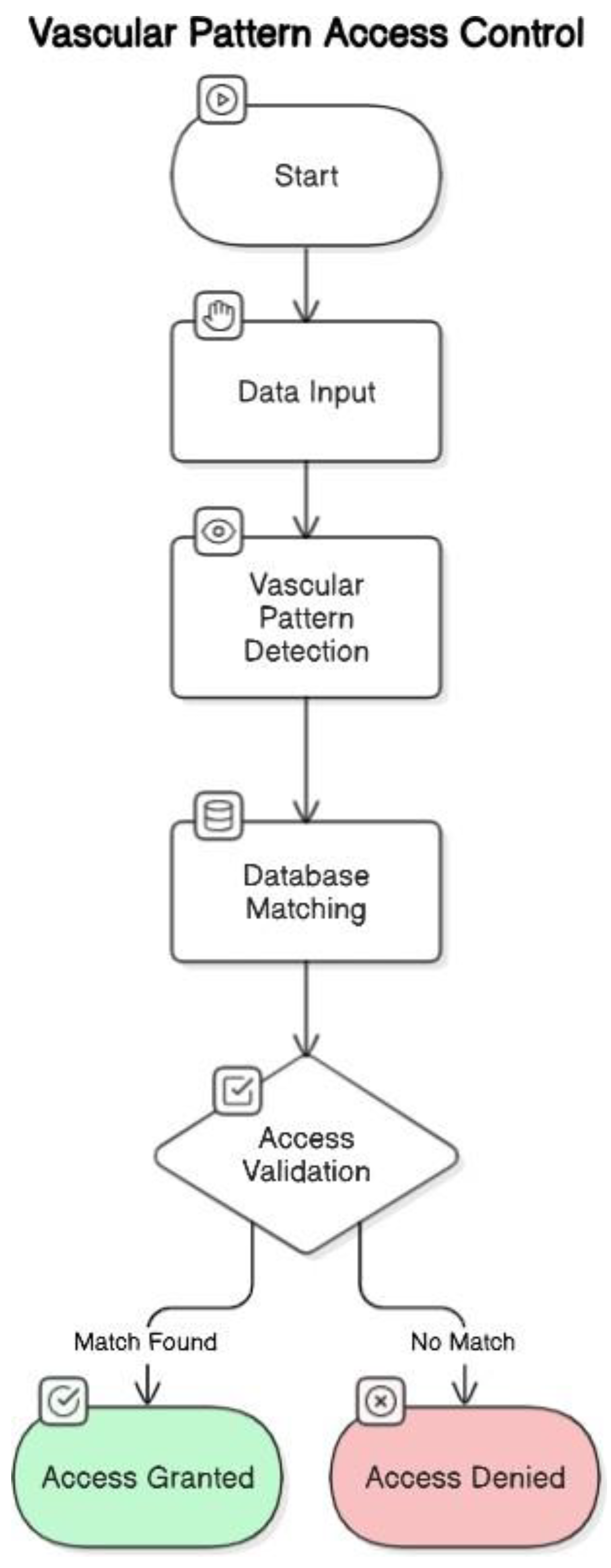

Table 1.
Comparison of Traditional Fingerprint and Blood Flow-Based Biometric Systems.
| Category | Traditional Fingerprint | Blood Flow-Based |
|---|---|---|
| Input Data | Fingerprint ridges | Blood flow patterns |
| Detection Method | Capacitive or optical scanners | Optical/infrared sensors |
| Key Features | Easy to collect but prone to spoofing | Difficult to replicate, live verification |
| Applications | Smartphones, access control | High-security areas, sensitive data |
| Security Level | Moderate | High |
Disclaimer/Publisher’s Note: The statements, opinions and data contained in all publications are solely those of the individual author(s) and contributor(s) and not of MDPI and/or the editor(s). MDPI and/or the editor(s) disclaim responsibility for any injury to people or property resulting from any ideas, methods, instructions or products referred to in the content. |
© 2025 by the authors. Licensee MDPI, Basel, Switzerland. This article is an open access article distributed under the terms and conditions of the Creative Commons Attribution (CC BY) license (http://creativecommons.org/licenses/by/4.0/).
Copyright: This open access article is published under a Creative Commons CC BY 4.0 license, which permit the free download, distribution, and reuse, provided that the author and preprint are cited in any reuse.


