

Submitted:
15 February 2025
Posted:
18 February 2025
You are already at the latest version
Abstract
This review provides an overview of the fabrication methods for Ti₃C₂Tₓ MXene-based hybrid photocatalysts and evaluates their role in degrading organic dye pollutants. Ti₃C₂Tₓ MXene has emerged as a promising material for hybrid photocatalysts due to its high metallic conductivity, excellent hydrophilicity, strong molecular adsorption, and efficient charge transfer. These properties facilitate faster charge separation and minimize electron-hole recombination, leading to exceptional photodegradation performance, long-term stability, and significant attention in dye degradation applications. Ti₃C₂Tₓ MXene-based hybrid photocatalysts significantly improve dye degradation efficiency, as evidenced by higher percentage degradation and reduced degradation time compared to conventional semiconducting materials. This review also highlights computational techniques employed to assess and enhance the performance of Ti₃C₂Tₓ MXene-based hybrid photocatalysts for dye degradation. It identifies the challenges associated with Ti₃C₂Tₓ MXene-based hybrid photocatalyst research and proposes potential solutions, outlining future research directions to address these obstacles effectively.
Keywords:
Ti3C2Tx MXene
; Dye Degradation
; Photocatalysis
; Charge Separation
1. Introduction
The fast-growing industrialization has increased the generation of highly toxic and carcinogenic wastewater[1]. Discharging untreated wastewater from textile, pharmaceutical, dying, and paper printing industries leads to increased dyes in the water sources, causing a severe threat to the environment[2]. It contains chromophores for color and auxochromes for fiber affinity, harming aquatic life by coloring water, blocking sunlight, and disrupting photosynthesis, which is crucial for ecosystems [3]. Discharged dyes are categorized into cationic dyes (e.g., methylene blue (MB), crystal violet (CV), rhodamine B (RhB)) that carry positive charges, are widely used in textiles, and pose toxicity risks. Anionic dyes (e.g., acid orange 7 (AO7), acid blue 92 (AB92), Congo red (CR)) carry negative charges, exhibit water solubility, and are challenging to remove [4]. To get rid of these dyes, various degradation approaches like membrane filtration, oxidation, adsorption, and photocatalysis have been successfully developed and demonstrated [5,6].
Photocatalysis is one of the best degradation methods because it is eco-friendly and cost-effective for degrading organic pollutants [7]. Numerous studies have focused on developing photocatalytic materials with a wide energy bandgap, abundant surface active sites, and efficient charge separation capabilities to optimize the photodegradation of dyes. [8]. Single-component semiconducting photocatalysts such as TiO2, ZnO, ZnS, SnO2, g-C3N4, and CdS have been extensively used[9,10]. However, the photocatalytic activity of these single semiconducting materials is generally limited by poor visible light absorption and utilization, as well as rapid charge recombination and low electron-hole mobility [11,12]. To improve the photocatalytic performance of these single semiconducting materials, various strategies such as the construction of heterojunction[13], doping of elements[14], and introduction of co-catalyst[14] have been proposed and explored.
The photocatalytic activity of semiconducting materials can be effectively enhanced by modifying them with a co-catalyst[15]. The presence of a co-catalyst prevents the recombination between electrons and holes, which is otherwise inevitable by facilitating the separation of the charge. Various materials such as graphene[16], carbon nanotubes[17], and carbon quantum dots[18], have been used as co-catalysts to enhance the efficiency of the photocatalytic degradation of dyes. Although significant advancements have been made with the above-mentioned co-catalysts, they are somehow limited due to the scarcity of functional groups and sufficient conductivity[19]. The lack of sufficient surface functional group restricts the strong chemical bond between photocatalyst and co-catalyst and the lower electrical conductivity impedes charge migration within the material. Both factors play a crucial role in reducing photocatalytic efficiency. Therefore, there is still a need for efficient and inexpensive co-catalysts to increase the photocatalytic efficiency of degradation of the organic dyes.
MXenes, especially Ti3C2Tx, have been considered excellent component material for the fabrication of the hybrid photocatalyst due to their lower fermi level than most studied semiconductors, the presence of abundant terminal functional groups, excellent metallic conductivity and exposed terminal metal sites[20,21,22]. MXenes are a class of two-dimensional (2D) layered materials consisting of transition metal carbides, nitrides, or carbonitrides, which are represented by a general formula, Mn+1Xn (n = 1, 2, 3), where M represents a transition metal (such as Sc, Ti, Zr, Hf, V, Nb, Ta, or Mo), and X corresponds to carbon, nitrogen, or carbonitride. The presence of abundance functional groups such as −OH, −O, and −F on Ti3C2Tx MXene facilitates the strong interfacial chemical bonding with semiconductors which enables the formation of a Schottky junction that acts as an electron trap, thereby suppressing the recombination of photoexcited electron-hole pairs[23]. The excellent metallic conductivity of Ti3C2Tx MXene ensures rapid charge carrier migration, promoting efficient separation of photogenerated electrons and holes[24]. Moreover, exposed terminal metal sites enhance reactivity compared to carbon-based materials, making Ti3C2Tx MXene a more effective co-catalyst.
Ti₃C₂Tₓ MXene has limited effectiveness as a standalone photocatalyst, as it requires doping and UV radiation to function optimally [25]. However, when incorporated into composite photocatalysts, its role extends beyond serving as a mere photogenerated charge acceptor co-catalyst. Due to its large surface area and surface functionalities, Ti₃C₂Tₓ MXene provides the superior growing platform for uniform, size-controlled, and fine dispersion of photocatalysts which exposes more surface-active sites of composite photocatalyst [26,27,28,29]. Additionally, Ti₃C₂Tₓ MXene possesses distinctive physical and chemical properties, including high electrical conductivity, excellent hydrophilicity, mechanical stability, ion intercalation ability, and tunable surface functionalization [30,31,32]. These attributes make it an ideal candidate for use in composite photocatalyst materials. The integration of Ti3C2Tx MXene with semiconducting materials has resulted in hybrid photocatalysts featuring micro/nano architectures and multi-junction nanocomposites. These hybrid photocatalyst materials leverage synergistic interactions of Ti3C2Tx MXene with conventional semiconductors, or metal nanostructures, enabling enhanced charge separation and reduced recombination rates [21,33]. These characteristics make Ti3C2Tx MXene-based hybrid photocatalysts highly effective for the photodegradation of cationic and anionic organic pollutants [34].
This review explores Ti₃C₂Tₓ MXene-based hybrid photocatalysts for the degradation of cationic and anionic organic dyes. It covers the synthesis of Ti₃C₂Tₓ MXene, its integration into hybrid photocatalysts, its role and effectiveness in dye degradation, and the associated mechanisms. Additionally, it discusses the challenges and opportunities in this area while providing insights into potential future research directions.
2. Ti₃C₂Tₓ MXene and Synthesis Methods
2.1. Introduction to Ti₃C₂Tₓ MXenes
MXenes, first synthesized by Naguib et al. in 2011, are two-dimensional crystals of transition metal carbides, nitrides, or carbonitrides[35]. These novel 2D materials are synthesized by top-down approaches beginning with their three-dimensional parent material known as MAX. MAX phases are transition metal carbides, nitrides, or carbonitrides with the general formula M(n+1)AXn, n 1, 2, or 3, where M denotes an early transitional metal such as titanium (Ti), niobium (Nb), molybdenum (Mo), tantalum (Ta), vanadium (V), or chromium (Cr), A refers to an A group element (mainly 13 and 14 group), and X represents a carbon, nitrogen, or carbonitride that intersperses the M layers[36]. When the A layers are removed from the MAX phase through chemical etching, 2D crystals are formed. However, most of the synthesis methods involve an aqueous medium, resulting in the surface termination of the M elements on the obtained 2D MXene crystals. These MXene crystals are represented by the general formula, M(n+1) XnTx , n1, 2, or 3, where Tx refers to surface terminations, mostly -OH, -O, and -F [37,38,39,40,41].
MXenes have gained considerable attention for their exceptional properties, such as hydrophilicity, high electrical conductivity, and the ability to tune their bandgaps through surface termination modifications [41,42]. Ti₃C₂Tₓ, the first member of the MXene family, remains the most widely studied due to its durability, the relatively straightforward process of etching aluminum layers from its MAX phase precursor, and outstanding physical and chemical characteristics [35,43,44]. Owing to their distinct physical and chemical properties, a variety of other MXene species have also been explored for different applications.
2.2. Synthesis of Ti₃C₂Tₓ MXenes
Hydrofluoric acid (HF) etching was the first technique developed to transform MAX phases into MXenes[35]. Due to its simplicity and ability to produce high-quality MXenes [32], it remains one of the most widely used methods. However, this technique has notable drawbacks, primarily that HF is an extremely toxic and highly corrosive acid [45]. To reduce the risks associated with handling HF directly, alternative methods, such as in-situ HF generation via a reaction between LiF and HCl, were introduced. This approach also offers the added advantage of Li⁺ cation intercalation between MXene layers [46]. A distinctive byproduct of the HF etching method is the formation of MXene layers with surface terminations, primarily -O, -OH, and -F. These functional groups provide an opportunity for surface engineering, enabling the electronic structure of MXene layers to be tuned by modifying the type and quantity of surface terminations[47]. Another modified etching method is the molten salt method that involves etching MAX phases by reacting them with a Lewis acidic molten salt at high temperatures [38]. Similar to the HF method, an intercalant is used; however, unlike HF etching, the molten salt method allows for the creation of diverse surface terminations during synthesis. For example, the electrochemical properties of Ti3C2Tx electrodes in supercapacitors are degraded by the -F terminations produced by HF etching. To remedy this, Guo et al. [48] applied a one-step LiCl-KCl-K2CO3 molten salt etch and delaminate process to replace the -F terminations of Ti3C2Tx with -O. Overall, the MXene saw a drop of -F content from 11.23 to 3.43 at% which precipitated an increase in specific capacity, capacitance retention, conductivity, and the electrochemical activity specific surface area.
The hydrothermal etching method was developed as a safer and more environmentally friendly alternative to the highly corrosive and hazardous HF etching process. This technique enables efficient exfoliation and the production of high-quality MXene flakes, offering the added advantages of larger interlayer spacing and improved delamination properties. The hydrothermal etching method utilizes high-pressure and high-temperature conditions in an aqueous MXene solution to produce high-purity multilayer MXenes [45]. For example, Peng et al. [32] employed this technique to synthesize Ti₃C₂Tₓ MXenes by reacting their respective MAX phases with HCl and HCl+NaBF₄ solutions, followed by heating in an autoclave. The resulting MXenes were delaminated using DMSO and sonication. XRD analysis revealed that the hydrothermal method was significantly more effective at removing aluminum compared to the traditional HF etching method. Furthermore, dye adsorption studies with cationic MB and anionic MO showed that hydrothermally etched Ti₃C₂Tₓ exhibited superior adsorption performance, with lower dye concentrations remaining compared to their non-hydrothermal counterparts. Some hydrothermal methods incorporate microwaves to excite reagents and reduce the temperature and time necessary for a reaction [49].
The resulting flakes were cleaned, delaminated using tetramethylammonium hydroxide, cleaned again, and then incorporated into a composite with reduced graphene oxide, which was effective at degrading dyes via photolysis [50]. A microwave hydrothermal ketal was utilized to rapidly create and oxidize Ti3C2Tx Mxene nanosheets by Cao et al[49]. After cleaning, this Ti3C2Tx was then combined with TiO2 and CdZnS once more with the aid of a hydrothermal microwave in order to synthesize a synergetic photocatalytic semiconductive heterojunction that could degrade RhB dye molecules by 29.33% in under 90 min, which is 31.17-fold that of single Ti3C2 [51]. To significantly reduce etching time (from ~23 days to just 45 minutes) and eliminate -F terminations, Latif et al. [52] applied 5 to 30 M concentrations of NaOH etchant to Ti3AlC2 in a microwave hydrothermal reaction. Higher concentrations of NaOH saw the synthesized Ti3C2Tx MXene achieve a 0.46% Al content under XRD and a semiconductive band gap energy of 1.30 to 1.60 eV.
3. Design and Fabrication of Ti₃C₂Tₓ MXene-Based Hybrid Photocatalysts
Ti₃C₂Tₓ MXene-based hybrid photocatalysts have been fabricated using various methods by integrating Ti₃C₂Tₓ MXene nanosheets with a range of other nanomaterials. Some studies have shown that TiO₂/Ti₃C₂Tₓ MXene composite photocatalysts can directly be prepared through the partial oxidation of Ti₃C₂Tₓ. Tran et al. [53] fabricated TiO2/Ti₃C₂Tₓ composites through an in-situ partial oxidation process, starting from Ti3C2Tx. This method led to the formation of microscale safflower-like structures composed of TiO2/Ti₃C₂Tₓ heterostructure nanorods. The transformation process was achieved via a sequential approach involving hydrothermal oxidation, alkalization, ion exchange, and heat treatment. Throughout these steps, the layered MXene flakes were broken into nanoparticles, from which TiO2/Ti₃C₂Tₓ nanorods grew radially. The resulting TiO2/Ti₃C₂Tₓ heterostructures exhibited exceptional photocatalytic properties. Their photocurrent was ten times higher than that of pristine MXene. Moreover, the photocatalytic degradation efficiency of RhB significantly improved, reaching 95%, compared to only 19% for MXene. Even after four cycles, the degradation efficiency remained above 95%, demonstrating excellent stability. The superior photocatalytic performance was attributed to the rapid generation of TiO2 carriers, the suppressed recombination of charge carriers, and the enhanced light absorption provided by the porous safflower-like structure. Similarly, Quyen et al. [54] used a novel synthesis approach for TiO2@ Ti₃C₂Tₓ nanoflowers with a porous 3D framework derived from 2D Ti₃C₂Tₓ MXenes via hydrothermal oxidation combined with a calcination process. This in situ transformation converts the initially conductive Ti₃C₂Tₓ MXene into a semiconductor, forming a TiO2@ Ti₃C₂Tₓ heterojunction. As compared to 36% degradation rate of pure TiO2 for RhB, the TiO2@ Ti₃C₂Tₓ composite exhibited an impressive 97% degradation within 40 minutes of light irradiation. This enhancement is attributed to the electronic structure of Ti₃C₂Tₓ, whose Fermi level is lower than that of TiO2. Upon light excitation, photoinduced electrons transfer from the conduction band (CB) of TiO2 to metallic Ti₃C₂Tₓ, leaving holes in the valence band (VB) of TiO2. The resulting Schottky barrier at the interface suppresses electron diffusion back into TiO2, thereby reducing electron-hole recombination and improving photocatalytic efficiency. Similarly, in situ solvothermal process has been used to prepare facet-exposed TiO2/Ti3C2Tx [55], since the exposed crystal plane of TiO2 can effectively capture photogenerated holes and rapidly migrate to the surface of Ti3C2Tx, the photocatalytic performance towards methyl orange was significantly better as compared to the TiO2 and Ti3C2Tx.
One of the simplest ways of preparing composites of Ti3C2Tx MXene is calcination, in which the powders of two materials are heated at higher temperatures. In one example, [56] varying amounts of Ti3C2Tx MXene powders were well-dispersed in a Zn2+ containing solution. The mixed solution was heated in an oven to evaporate the solvent. The powder was then calcined for 4 h at 550 °C with a heating rate of 5 °C/min in an ambient atmosphere to prepare ZnO/Ti3C2Tx hybrid structures. The hybrid structure has reduced photoluminescence intensity, enhanced Brunauer-Emmett-Teller (BET) surface area, and better photocatalytic degradation efficiency for the degradation of MO and RhB as compared to the pristine ZnO.
The wet impregnation method, in which one material is deposited onto a solid support, can be used to prepare Ti₃C₂Tₓ MXene composites. Nasri et al. [57] mixed powders of g-C3N4 and Ti3C2Tx MXene in different proportions of weight and sonicated until the slurry was formed. The sample was then dried overnight at the temperature of 60ºC to obtain Ti₃C₂Tₓ MXene/g-C3N4 composite photocatalyst. Figure 1 summarizes the fabrication process of Ti3C2Tx MXene/g-C3N4 composite photocatalyst. They found that 1 wt.% Ti₃C₂Tₓ MXene/g-C3N4 heterostructure achieved higher photocatalytic activity for the degradation of methylene blue as compared to pure g-C3N4. This was attributed to intimate interfacial contact as seen by FESEM analysis, smooth transfer of photo charge carriers and larger BET surface area.
An electrostatically driven self-assembly strategy is one of the facile approaches to synthesizing MXene composites, especially in the solution. Cai et al.[58] have synthesized Ag3PO4/Ti₃C₂Tₓ MXene Schottky catalyst with prominent photodegradation performance toward various organic dyes including methyl orange and 2,4-Dinitrophenol. In their work, Ti₃C₂Tₓ sheets were first dispersed into DI water with the help of sonication, and AgNO3 aqueous solution was added to the above Ti₃C₂Tₓ suspension with vigorous stirring. Na2HPO4 aqueous solution was then added dropwise to the mixture with stirring for 2 h. The precipitate was washed with DI water several times and dried in a vacuum (80 °C) overnight before its use. The apparent rate constant of 2,4-Dinitrophenol degradation with Ag3PO4/Ti₃C₂Tₓ was 2.5 times that of Ag3PO4/RGO and 10 times that of Ag3PO4. The enhanced photocatalysis activity of Ag3PO4/Ti₃C₂Tₓ was attributed to the sufficient and close interfacial contact between Ag3PO4 and Ti₃C₂Tₓ, unidirectional electron flow to be trapped by the Ti₃C₂Tₓ across the Schottky barrier, and the surface metal Ti sites on Ti₃C₂Tₓ with stronger redox reactivity.
Figure 2.
Synthesis and fabrication of MoS2/Ti₃C₂Tₓ MXene/N-doped carbon composite microspheres. Adapted from Ref[59].
Figure 2.
Synthesis and fabrication of MoS2/Ti₃C₂Tₓ MXene/N-doped carbon composite microspheres. Adapted from Ref[59].
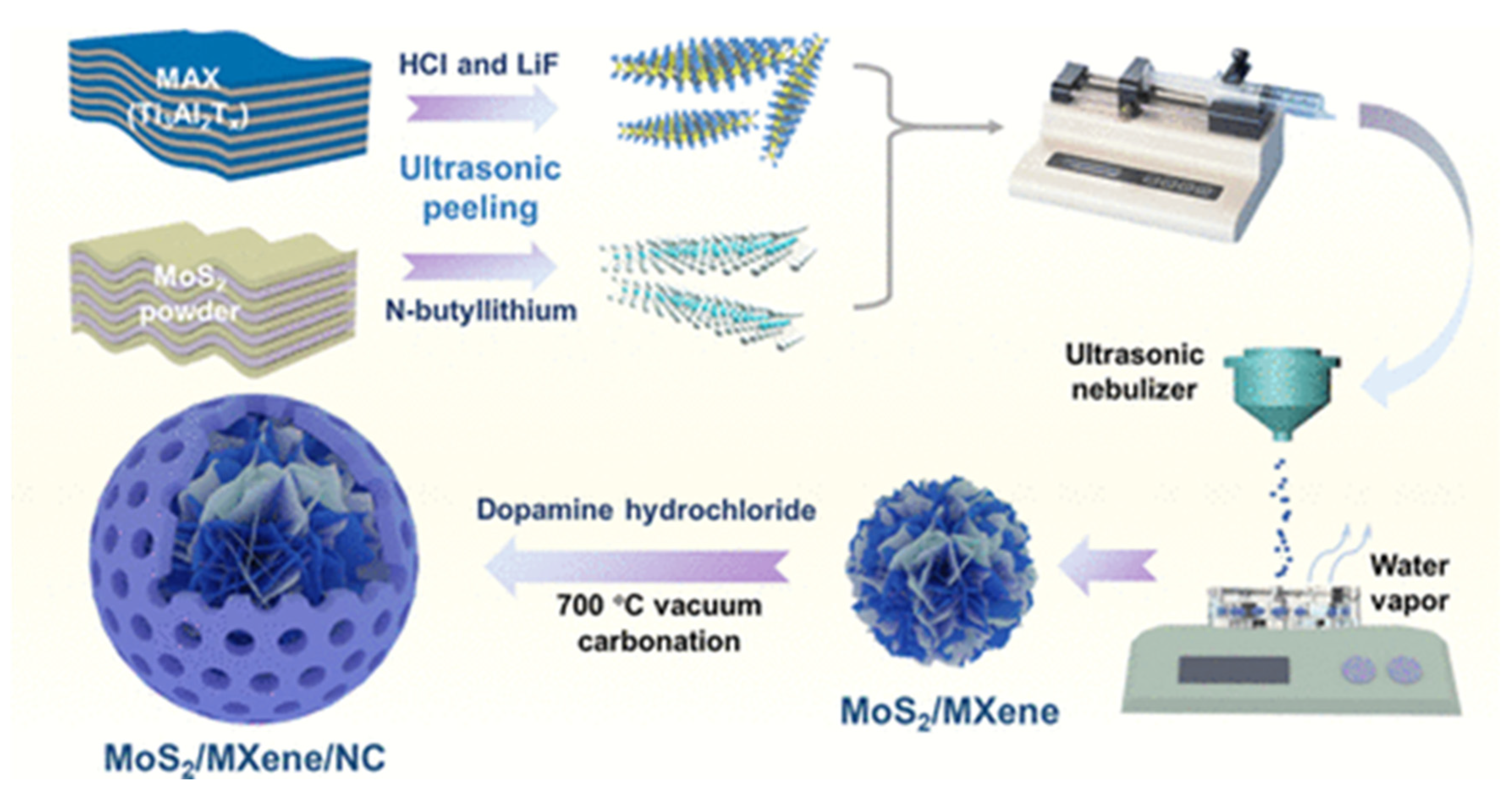
Ultrasonic forces have been utilized in the fabrication of Ti₃C₂Tₓ MXene-based composites to disrupt electrostatic attractions and van der Waals interactions. For example, Lee et al.[60] prepared the composites with heterojunctions of 2D/2D WO3/Ti₃C₂Tₓ. The WO3 nanosheets were dispersed in DI water, followed by the addition of varying amounts of Ti₃C₂Tₓ nanosheets. The resulting suspension was subjected to sonication, where cavitation bubbles generated localized high-temperature and high-pressure spots, facilitating physical and chemical interactions between WO3 and Ti₃C₂Tₓ. This process enabled the effective integration of WO3 nanosheets with Ti₃C₂Tₓ structures. The final suspension was then dried at 100 °C for 12 hours in an electric oven. The WO3/Ti₃C₂Tₓ heterojunction demonstrated significantly higher photoexcited carrier transfer and separation efficiency, leading to exceptional photocatalytic performance in MB degradation under visible light. Furthermore, the photoelectrochemical analysis of WO3/Ti₃C₂Tₓ revealed improved charge carrier mobility, effectively reducing the carrier transport barrier between WO3 and Ti₃C₂Tₓ. A similar approach has been used to synthesize Ti₃C₂Tₓ/CuFe2O4 nanohybrids[61]. A similar process has been used to prepare ZnS nanoparticles/layered MXene sheets[62]. Similarly, manganese oxide decorated 2D Ti₃C₂Tₓ MXene containing MnO2 nanopetals was also synthesized using the ultrasonic approach [63]. The synergistic effect of these two nanomaterials inhibited the electron/hole pair recombination and improved the surface activity. The nanocomposite showed high photocatalytic ability to methylene blue as about 99% of the methylene blue degraded within 30 minutes.
The sol-gel method uses metal alkoxide precursors to form gels through hydrolysis, usually at lower temperatures, followed by calcination. For example, Iqbal et al. [64] used the double-solvent solvothermal method to prepare BiFeO3 (BFO)/Ti₃C₂Tₓ nanohybrid. In their work, Ti₃C₂Tₓ MXene in DI water and the BFO nanoparticles in a mixture of acetic acid and ethylene glycol were ultrasonicated separately. Both solutions were then mixed and transferred to a Teflon-lined steel autoclave for solvothermal synthesis in which the mixture was heated at 160 ° C for 2 h. The final product was washed and then dried at 80 ° C for 3 h. The nanohybrid was found to have a high BET surface area of 147 m2 g–1, a low band gap of 1.96 eV, and a low recombination time. These properties led to a superior photocatalytic activity for Congo red as it was able to degrade Congo red only in 42 mins under visible light irradiation. A similar process was used to prepare La- and Mn-co-doped BFO nanoparticles embedded in Ti₃C₂Tₓ sheets [65].
The solvothermal process, in which reactions occur in a solvent under elevated temperature and pressure within a sealed system, has also been used to synthesize nanocomposites of MXene. This method has been used by W Zheng et al.[66] to synthesize SnO₂/Ti₃C₂Tₓ composites and by Zhou et al.[67] to prepare CeO₂/Ti₃C₂Tₓ nanocomposites from CeO2 nano-rods on Ti₃C₂Tₓ sheets. The nanocomposites exhibited enhanced photocatalytic activity for the photodegradation of Rhodamine B under UV-light irradiation as compared to pure CeO2 semiconductors and Ti₃C₂Tₓ. The enhancement of photocatalytic activity was attributed to the narrow band energy in the composite as compared to CeO2, which enhanced utilization of solar energy, both exhibiting high efficiency in pollutant degradation [67]. Similar process has been used to prepare BiVO4/Ti₃C₂Tₓ nanocomposite [68].
In another study [69], Ti₃C₂Tₓ powder was added to the ultrasonicated precursor solution of MoS₂. The mixture was heated at 200 °C for 10 hours, then cooled, centrifuged, washed with deionized water, and dried to produce the MoS₂@Ti₃C₂Tₓ nanohybrid in Figure 2. The authors found that the Schottky junction and heterojunction between Ti₃C₂Tₓ and MoS2 were instrumental in prolonging the recombination time of electron-hole pairs and widening the absorption range of visible light. As a result, nanohybrid showed higher photocatalytic activity towards methyl orange. Also, TiO2/Ti₃C₂Tₓ MXene was prepared through a hydrothermal reaction of nano-TiO2 and Ti₃C₂Tₓ MXene nanosheets [70]. The higher photocatalytic activity was attributed to the inhibition of electron-hole recombination, which promoted the accumulation of electrons and easier electron transfer from TiO2 to MXene. Similarly, AgNPs/TiO2/Ti3C2Tx composite was prepared by hydrothermal treatment of Ti3C2Tx nanosheets and AgNO3 salt at 160 °C for 12 h with the heat ramp-up of 2 °C/min [71]. They found that the photocatalytic performance of oxidized form improved significantly as compared to the pristine form. Also, superior degradation efficiency for MB and RhB was achieved for AgNPs/TiO2/Ti3C2Tx as compared to pristine MXene. A similar process has been used to prepare Bi2WO6/Ti₃C₂Tₓ by heating layered Ti₃C₂Tₓ MXene and Bi(NO3)3.5H2O at 160 ºC for 16 h.
4. Photocatalytic Degradation of Dyes Using Ti₃C₂Tₓ MXene Hybrids
Photocatalysis is a relatively safer and low-cost strategy for degrading hazardous organic pollutants[72,73,74]. Ti3C2Tx MXene, with its unique lamellar structure and remarkably high metallic conductivity, and excellent hydrophilicity has emerged as a promising member of MXene family. Its distinctive properties have enabled its use as a photocatalyst for environmental remediation [75,76] and co-catalyst for enhancing the photocatalytic degradation potential of composite photocatalysts[77,78]. Ti₃C₂Tₓ MXene-based hybrid photocatalysts have several advantages, like improved charge separation, sufficient atomic utilization, tunable bandgap, improved morphology, increased electron transfer efficiency, and improved photocatalytic activity[79,80,81]. We assess the effectiveness of Ti₃C₂Tₓ MXene-based hybrid photocatalysts by comparing them to non-hybrid photocatalysts in the degradation of both cationic and anionic dyes.

Table 1.
Selected nonhybrid photocatalysts with photocatalytic degradation performance towards cationic and anionic dyes.
Table 1.
Selected nonhybrid photocatalysts with photocatalytic degradation performance towards cationic and anionic dyes.
| Nonhybrid photocatalysts | Dyes | Type of dyes | Degradation percentage (%) | References |
|---|---|---|---|---|
| CdS | MO | Anionic | 95 (300 min) | Ref[81]. |
| δ-Bi2O3 | MO | ’’ | 98 (180 min) | Ref[82]. |
| TiO2 NPs | MO | ’’ | ~95 (~120 min) | Ref[83]. |
| ZnO | MB | Cationic | 40.88 (21h) | Ref[84]. |
| TiO2 Hollow Nanofiber | MB | ’’ | 95.2 (4h) | Ref[85]. |
| CuO | MB | ’’ | 62 (270 min) | Ref[86]. |
| Bi2S2O3 | CR | Anionic | 82 (75 min) | Ref[87]. |
| ZnO | CR | ’’ | 97.6(75 min) | Ref[88]. |
| MoSe2 | CR | ’’ | 8.44(120 min) | Ref[89]. |
| g-C3N4 | RhB | Cationic | 75 (180 min) | Ref[90]. |
| BiMnO3 | RhB | ’’ | 68 (75 min) | Ref[91]. |
Table 1. Summarizes the results on the studies of photocatalytic degradation of anionic dyes such as MO, and CR and cationic dyes, MB and RhB. Dey and Ratan Das [81] utilized CdS as a nonhybrid photocatalyst, achieving 95% degradation of MO within 300 minutes. Additionally, they employed ZnO to degrade CR, achieving 97.7% degradation in 75 minutes.[88]. In a separate study, N. N. Mohammad Jafri et al. [85] utilized TiO₂ nanofibers, achieving 95.2% degradation of the cationic dye, MB, within 240 minutes. Similarly, S. Fang et al.[90] prepared g-C₃N₄ to degrade RhB, achieving 75% degradation in 180 minutes. Additionally, the ZnO standalone photocatalyst required 21 hours (1260 minutes) to degrade 40.88% of MB [84] and while MoSe₂ took 2 hours (120 minutes) to achieve only 8.44% degradation [89]. Such prolonged durations and low efficiencies make these photocatalytic processes economically and time inefficient for the practical degradation of organic dye pollutants. Furthermore, pristine MXene photocatalysts demonstrate lower dye degradation efficiency. For instance, J. Qu et al. [115] reported that alkalized Ti₃C₂Tₓ exhibited reduced photocatalytic performance compared to Ti₃C₂Tₓ MXene-based hybrid photocatalysts. The alkalized Ti₃C₂Tₓ achieved degradation rates of only 17.3% for the cationic dye, RhB and 2.8% for the anionic dye, MO within 120 minutes.
On the other hand, Ti₃C₂Tₓ MXene-based hybrid photocatalysts have shown remarkable potential for degrading both cationic and anionic dyes under light irradiation. For example, a Ti₃C₂Tₓ MXene-based hybrid photocatalyst achieved a degradation efficiency of 99.7% for MO and 100% for RhB, as detailed in Table 2. These photocatalysts effectively break down dye molecules into less harmful degradation products, showcasing their efficiency in addressing organic dye pollutants. Such high efficiency can be attributed to the rich surface chemistry, tunable bandgap structures, high electrical conductivity, hydrophilicity, thermal stability, and large specific surface area with abundant active sites. These properties facilitate efficient dye adsorption and subsequent photocatalytic degradation. For instance, M.S.I. Nasri et al. [6] reported a 100% degradation efficiency for MB using a Ti₃C₂Tₓ/g-C₃N₄ hybrid within 180 minutes. This remarkable performance was linked to the effective charge separation and transfer capabilities of Ti₃C₂Tₓ MXene, which significantly enhanced the generation of reactive species essential for dye degradation.
Q.T.H. Ta et al. [56] demonstrated that ZnO/Ti₃C₂Tₓ achieved a degradation efficiency of 99.7% for MO, while RhB was effectively degraded by Bi₂WO₆/Ti₃C₂Tₓ with an impressive efficiency of 99.9% within 20 minutes. Similarly, Danxia Zhao and Chun Cai [92] reported comparable results (refer to Table 2 for details). This study highlights the pivotal role of MXene incorporated heterostructure, characterized by its high conductivity and ability to facilitate rapid electron transfer, which are essential for efficient photocatalysis [93]. For instance, Jun Yao and Chaoxia Wang [94] demonstrated that MB achieved a degradation efficiency of 93.3% within 160 minutes using a catalyst-to-dye ratio of 1.5:1 with standalone catalyst, TiO₂. However, the MXene-based hybrid AgNPs/TiO₂/Ti₃C₂Tₓ achieved 99% degradation in just 30 minutes with a 2.5:1 catalyst-to-dye ratio, demonstrating superior efficiency in both time and degradation rate compared to non-hybrid photocatalysts [95].
Ti₃C₂Tₓ MXene-based hybrid represents a versatile and highly effective class of photocatalysts for the degradation of both anionic and cationic dyes, making them suitable for various environmental remediation applications. For example, Ti₃C₂Tₓ MXene-based nanocomposites prepared with Mn₂O₃ were evaluated for photocatalytic dye degradation under light, demonstrating efficient photocatalysis. The 1D Mn₂O₃-Ti₃C₂Tₓ (20 wt%) nanocomposite achieved 100% degradation of MB within 25 minutes, effectively removing the dye[96], Similarly, NiMnO₃/NiMn₂O₄-Ti₃C₂Tₓ MXene nanocomposites achieved 100% degradation of MB in 50 minutes, showcasing excellent dye removal efficiency[97]. Wang et al. [98] synthesized Ti₃C₂Tₓ/Bi₄Ti₃O₁₂ heterojunction via a facile in-situ solvothermal method, demonstrating exceptional visible-light-driven photocatalytic performance by achieving 100% degradation of MO and RhB within 60 and 50 minutes, respectively (see details in Table 2). This result highlights the potential of Ti₃C₂Tₓ MXene-based hierarchical composites for water remediation, offering a sustainable approach for the degradation of anionic and cationic organic pollutant applications. In an independent study, Iqbal et al. [64] reported that the BFO/Ti₃C₂Tₓ MXene hybrid achieved 100% degradation of CR in 42 minutes, highlighting its potential for photocatalysis applications.
While we observed that factors such as the synthesis method, pH, catalyst-to-dye ratio, concentration, and structure significantly influence the functionality and effectiveness of photocatalysts, we conclude from this evaluation that Ti₃C₂Tₓ MXene-based hybrid photocatalysts exhibit superior photocatalytic performance and efficiency in the degradation of organic pollutant dyes compared to nonhybrid photocatalysts.
Table 2.
Ti₃C₂Tₓ MXene-based hybrid photocatalysts with photocatalytic degradation performance towards cationic and anionic dyes.
Table 2.
Ti₃C₂Tₓ MXene-based hybrid photocatalysts with photocatalytic degradation performance towards cationic and anionic dyes.
| MXene-based hybrid photocatalysts | Dyes | Type of dyes (Based on charge) |
Degradation Percentage/ (Time) | References |
|---|---|---|---|---|
| TiO2/Ti3C2Tx |
MO | Anionic | 92(50 min) | Ref.[55] |
| MoS2@Ti3C2 | MO | Anionic | 98(60 min) | Ref.[69] |
| Ti3C2/TiO2/CuO | MO | Anionic | 99 (80 min) | Ref.[99] |
| ZnO/Ti3C2Tx | MO | Anionic | 99.7(50 | Ref.[56] |
| Ti3C2Tx /Bi4Ti3O12 | MO | Anionic | 100(60 min) | Ref[98] |
| TiO2/Ti3C2 Mxene | MB | Cationic | 96.44(60) | Ref[100] |
| AgNPs/TiO2/Ti3C2Tx | MB | Cationic | 99 (30 min) | Ref[95] |
| Ti3C2/g-C3N4 | MB | Cationic | 100(180 min) | Ref[101] |
| NiMnO3/NiMn2O4 -Ti3C2Tx MXene | MB | Cationic | 100 (50 min) | Ref[97] |
| 1D Mn2O3-Ti3C2Tx | MB | Cationic | 100(25 min) | Ref [96] |
| Mn-codoped bismuth ferrite/Ti3C2 |
CR | Anionic | 93(30 min) | Ref[65] |
| CoFe2O4 @MXene | CR | Anionic | 98.9(30 min) | Ref[102] |
| BiVO4/Ti3C2 | CR | Anionic | 99.5(60 min) | Ref[68] |
| BGFO-20Sn/MXene | CR | Anionic | 100(120 min) | Ref[103] |
| BiFeO3/Ti3C2 | CR | Anionic | 100(42min) | Ref[64] |
| TiO2@Ti3C2 | RhB | Cationic | 97(40 min) | Ref[54] |
| BiOBr/TiO2/ Ti3C2Tx |
RhB | Cationic | 99.8(30 min) | Ref[104] |
| Bi2WO6/Ti3C2 | RhB | Cationic | 99.9(20 min) | Ref[92] |
| ZnS/MXene | RhB | Cationic | 100(100 min) | Ref [105] |
| Ti3C2Tx/Bi4Ti3O12 | RhB | Cationic | 100 (50 min) | Ref [98] |
5. Computational Studies and Simulations
The investigation of Ti3C2Tx MXene-based hybrids for photocatalytic applications benefit significantly from computational tools and techniques. These methods complement experimental approaches by providing insights into atomic-level phenomena, guiding material design, and predicting performance under varying conditions.
Chen et al.[106] investigated the electronic and optical properties of -F terminated, -O terminated, and termination-free Ti₃C₂ in a MXene nanosheet/TiO₂ composite using Density Functional Theory (DFT). Their study revealed that surface terminations reduced the density of electronic states, lowered conductivity, and enhanced stability compared to the termination-free MXene. DFT analysis also demonstrated the feasibility of electron transfer from TiO₂ to Ti₃C₂ and identified the Schottky barrier at the interface between the two materials. Furthermore, the computational modeling highlighted the synergy between the composite components, showing an extended range of light absorption, suppressed electron-hole recombination, and improved hole oxidation efficiency in the valence band of TiO₂. These factors significantly enhanced the photocatalytic performance of the Ti₃C₂/TiO₂ composite, making it a highly promising candidate for photocatalytic applications, such as treating organic pollutants like dye molecules[106]. Lemos et al. utilized a computational model to evaluate the performance of a Ti₃C₂Tₓ/TiO₂ nanocomposite hybrid for use in photocatalyzed dye-sensitized solar cells. Through DFT calculations, they discovered that the anatase potential is reduced at the nanocomposite interface and that the nanocomposite exhibits improved photocarrier separation at the interface between the nanocomposite and the dye[107]. Furthermore, Yang et al[108]. conducted computational analysis to confirm that a transition metal dichalcogenide/MXene photocatalyst hybrid, MoS₂/Ti₃C₂, functions as a Schottky barrier. A Bader charge analysis revealed that the difference in work functions between MoS₂ and Ti₃C₂, combined with a built-in electric field, facilitates the transfer of photogenerated electrons from MoS₂ to the Ti₃C₂ electron sink. This efficient electron transfer enhances photocarrier separation, resulting in longer-lasting photogenerated holes and exceptional photodegradation performance against rhodamine B dye in wastewater[108].
Several more computational techniques have been employed to assess and optimize the photocatalytic mechanisms in the MXene-based composites for dye degradation applications. Liu et al[109] developed a g-C3N4/Ti₃C₂ (CNTC) heterojunction by hybridizing 2D Ti₃C₂ MXene with 3D g-C₃N₄ for enhanced photodegradation of RhB dye. This photocatalyst exhibited a high specific surface area (85.08 m²/g) and remarkable charge migration capabilities. To evaluate its improved photocatalytic performance, the researchers utilized DFT analysis to examine the differential charge density, electron distribution, and charge transfer dynamics between g-C₃N₄ and the Ti₃C₂ sink. The study revealed that the excellent conductivity of Ti₃C₂ stemmed from the overlap between the Fermi level and conduction band in the heterojunction. This led to an understanding that these 2D/3D heterojunctions significantly promote charge transfer and separation, which are essential for efficient photocatalysis. Additionally, the combination of a high specific surface area and abundant active sites makes the CNTC particularly effective for dye photodegradation[109]. Cheng et al[110]. synthesized a self-cleaning BiOCl-polypyrrole (PPy)@Ti₃C₂Tₓ MXene composite membrane with excellent photocatalytic activity and high flux, designed for filtering and degrading pollutants. The membrane's performance was tested against various dyes. To gain deeper insight into the photocatalytic mechanisms, particularly charge separation and degradation, the researchers conducted DFT calculations. Density of States (DOS) simulations revealed that the chemisorption of oxygen into vacancies on the BiOCl surface generated superoxide radicals. These radicals enhanced the composite's photocatalytic efficiency through redox interactions with dye molecules and other pollutants [110]. Wang et al. [111] synthesized an S-scheme Pt-MnO₂/TiO₂@Ti₃C₂Tₓ composite using an electrostatically self-assembled Ti-O-Mn bond and evaluated its oxidative photodegradation performance against MB, MO, and RhB dyes. To investigate the photocatalytic mechanisms, DFT calculations were performed, revealing that the Ti-O-Mn bond induced the formation of metastable Ti atoms and electrostatically adsorbed Mn²⁺ ions. This bond facilitated the separation of photoinduced carriers and optimized their transport pathways. Additionally, the DFT analysis identified the formation of S-scheme heterojunctions between MnO₂ and TiO₂ through the Ti-O-Mn bond, driving the flow of photogenerated carriers. These factors collectively enhanced the composite's photocatalytic efficiency [111].
Density Functional Theory (DFT) has been employed in conjunction with the Finite Element Method to explore ways to enhance the photocatalytic activity and membrane permeability of a novel MXene-based composite membrane, N-doped Bi₂O₂CO₃@Ti₃C₂Tₓ/Polyethersulfone, designed for oil/water separation and dye degradation[112]. Through DFT analysis of the electron distribution and band structure of doped versus undoped Bi₂O₂CO₃, they found that N doping improved conductivity, enhanced electron transition activity, and facilitated photogenerated carrier transport (attributed to valence band dispersion), making Bi₂O₂CO₃@Ti₃C₂Tₓ/Polyethersulfone more effective for photocatalytic applications [112].
6. Other Applications of Ti3C2Tx MXene-Based Hybrid Photocatalysts
Beyond organic dye degradation, Ti₃C₂Tₓ MXene-based hybrid photocatalysts have demonstrated potential for various other applications. They have shown considerable promise in wastewater treatment, especially in degrading organic pollutants such as dyes, pharmaceuticals, and pesticides. Composite materials of Ti3C2Tx MXene with semiconductors such as TiO2 or ZnO have shown even greater photocatalytic efficiencies; the synergy between MXenes and these semiconductors results in improved light absorption and charge separation [113,114]. For instance, Ti3C2Tx/TiO2 composites exhibit enhanced photocatalytic activity under visible light due to the synergistic effects of both materials. These composites can efficiently degrade different dyes under sunlight, including RhB and MO, making them suitable for sustainable and cost-effective wastewater treatment [115]. Furthermore, doping MXenes with other elements or combining them with carbon-based materials like graphene can further enhance their photocatalytic properties. Nitrogen-doped Ti3C2Tx MXene shows improved photocatalytic degradation of antibiotics such as tetracycline under visible light, highlighting their potential in treating pharmaceutical contaminants in wastewater[116]. Ti₃C₂Tₓ MXene-based hybrid photocatalysts are also being explored for air purification applications, particularly in removing volatile organic compounds (VOCs) and other airborne pollutants. Ti3C2Tx MXene, when combined with photocatalysts like TiO2, can effectively degrade formaldehyde and toluene, common indoor air pollutants, under UV and visible light[117]. Incorporating noble metals like Au or Ag onto Ti₃C₂Tₓ MXene can further enhance their photocatalytic performance by creating localized surface plasmon resonance, increasing light absorption, and improving the degradation rates of VOCs [118]. Additionally, Z-scheme heterostructures involving Ti₃C₂Tₓ MXene have been developed to mimic natural photosynthesis, achieving efficient separation and transfer of photogenerated charge carriers and enhancing photocatalytic degradation of air pollutants [119]. The most applied technology is the Ti₃C₂Tₓ MXene-based TiO2 photocatalyst, which utilizes photocatalysis for glass cleaning, where UV or visible light activates TiO2, generating reactive oxygen species that decompose organic pollutants on the glass surface. This self-cleaning mechanism maintains transparency, reduces manual cleaning, and prevents pollutant buildup, enhancing the efficiency and durability of glass surfaces.
Beyond the degradation of dyes, the degradation of other organic pollutants, such as pharmaceutical waste and VOCs, has appeared as a challenging task that needs immediate attention[120]. In recent years, extensive studies[121] reported photocatalysis as an attractive method for the efficient degradation of organic pollutants. Properties such as surface-to-volume ratio, light interaction and mechanical stability define the photocatalytic performance of a catalyst [122]. Among the variety of materials reported so far, Ti3C2Tx MXenes gained significant attention as a photocatalytic material [123]. Further, the integration of Ti3C2Tx MXenes with other nanomaterials can significantly improve photocatalytic performance[124].
Kumar et al. [125] reported a novel photocatalyst with a composition of g-C3N4, Ti₃C₂Tₓ and Au nanoparticles for the degradation of cefixime. Figure 3a shows the degradation mechanism of cefixime decomposition under light. The composition with 3 wt% Ti₃C₂Tₓ shows the highest degradation up to 64.69% cefixime in 105 min using visible light irradiation as shown in Figure 3b and c. Similarly, Diao et al. [126] reported an efficient photocatalytic degradation of tetracycline hydrochloride using MXene-based photocatalysts comprising g-C3N4/Ti₃C₂Tₓ/TiO2. The reported ternary catalysts show superior performance, chemical and photostability with recyclability. Another MXene-based ternary photocatalyst reported by Zhou et al.[127] for photocatalytic degradation of enoxacin under visible light where Ti₃C₂Tₓ helps to improve charge separation at the interface and hence efficient degradation. Rdewi et al. [128] reported a ZnO-TiO2-MXene photocatalyst for the decomposition of carbamazepine molecules in wastewater under solar irradiation. The presented results show 99.6% removal efficiency at a pH of 7 as a result of improved charge carrier transport and reduced recombination rate due to the incorporation of TiO2-MXene with ZnO photocatalysts. The excellent photocatalytic performance also shows the reusability for multiple decomposition cycles with exceptional efficiency. Similarly, Abbas et al. [129] reported a ZnO-TiO2-MXene photocatalyst for the decomposition of ceftriaxone sodium molecules in water using simulated solar light.
Furthermore, Sukidpaneenid et al. [130] reported Ti₃C₂Tₓ/TiO2 photocatalysts for the degradation of enrofloxacin antibiotics in water. The excellent control over TiO2 amount on MX by varying hydrothermal processes played a crucial role in tuning photocatalytic properties. Further, the intercalation of sodium ions significantly improved the adsorption, and the synergetic effect of TiO2 amount and NaCl treatment led to the efficient removal of enrofloxacin. Shahzad et al. [131] demonstrated the degradation of carbamazepine (CBZ) under direct sunlight and UV light using Ti3C2Tx-based heterostructure photocatalysts with {001} TiO2. The results show Kapp value under UV irradiation was higher than under sunlight for degradation CBZ also, the effects of pH on degradation performance were taken into account. Mohanty et al.[132] reported a series of SrTiO3/Ti₃C₂Tₓ-based photocatalysts decorated with Au nanoparticles for the degradation of colorless organic pollutants such as ciprofloxacin under sunlight. The significant enhancement in photocatalytic degradation for the plasmon-mediated heterostructure catalysts is attributed to the absorption of broad solar spectrum, charge separation and charge transport. Du et al. [133] demonstrated the photocatalytic degradation of tetracycline using CeO2-Ti₃C₂Tₓ-TiO2 (CeMXT). The composite shows an excellent degradation efficiency of 94.70% for 22.19 mg/L in 104.13 minutes with 0.65 g/L of catalysts with a pH of 4.72. This excellent degradation efficiency is attributed to increased radical generation and charge separation.
Sergi et al. [134] . reported a series of TiO2-Ti3C2Tx MXene photocatalysts with controlled composition for the realization of improved photocatalytic removal of benzene. The incorporation of TiO2 with Ti₃C₂Tₓ MXene improved the optical absorption to enhance the photocatalytic performance. The report showed the potential of Ti₃C₂Tₓ MXenes for the removal of VOCs and heterostructure to enhance the photocatalysis performance. Further, Huang et al.[117] reported the degradation of HCHO (formaldehyde) and CH3COCH3 (acetone) using Bi2WO6/Ti3C2 (BT4) under light. Bi2WO6 as photocatalysts suffers from a high recombination rate, and combination with Ti3C2 can significantly improve the charge separation. Ti3C2 led charge separation caused charge transfer at the interface, significantly improving the photocatalytic performance of BT4. Further, the higher adsorption of formaldehyde and acetone at the Ti3C2 surface than at the surface of Bi2WO6 estimated from DFT simulation, synergistically tunes photocatalytic performance. By value, the degradation of formaldehyde and acetone for Bi2WO6 was 2 and 6.6 times higher for BT4, respectively. Mo et al.[135] demonstrated photocatalytic and photothermal removal of VOCs (phenol) from water using TiO2/Ti₃C₂Tₓ/C3N4/PVA (TTCP) hydrogel under sunlight. Figure 3d shows the SEM image of TTCP. The VOC removal efficiency varies from 69.4% to 100% at different concentrations of phenol (1-50 mg/L) shown in Figure 3e and f. The membrane significantly lowers the TDS and TOC. The TDS level was reduced by more than 100 times magnitude, and TOC removal efficiency was observed to be 80%.
Figure 3.
(a) Schematic representation of cefixime degradation mechanism under light. (b) Degradation kinetics of cefixime degradation (c) Histogram representation of degradation rate (%).[125] (d) SEM image of the TTCP hydrogel (e) TOC of source water under different phenol concentrations (orange column), distilled water without photocatalyst (green column) and distilled water with TTCP hydrogel (violet column). (f) TOC of distilled water with different catalysts.[135] (g) Schematic illustration of the synthesis process of the Ti₃C₂Tₓ MXene/CeO2 photocatalysts (inset SEM image). Comparative representation of the production of (h) C2H5OH and (i) CH4 under solar light illumination with different catalysts. [136].
Figure 3.
(a) Schematic representation of cefixime degradation mechanism under light. (b) Degradation kinetics of cefixime degradation (c) Histogram representation of degradation rate (%).[125] (d) SEM image of the TTCP hydrogel (e) TOC of source water under different phenol concentrations (orange column), distilled water without photocatalyst (green column) and distilled water with TTCP hydrogel (violet column). (f) TOC of distilled water with different catalysts.[135] (g) Schematic illustration of the synthesis process of the Ti₃C₂Tₓ MXene/CeO2 photocatalysts (inset SEM image). Comparative representation of the production of (h) C2H5OH and (i) CH4 under solar light illumination with different catalysts. [136].
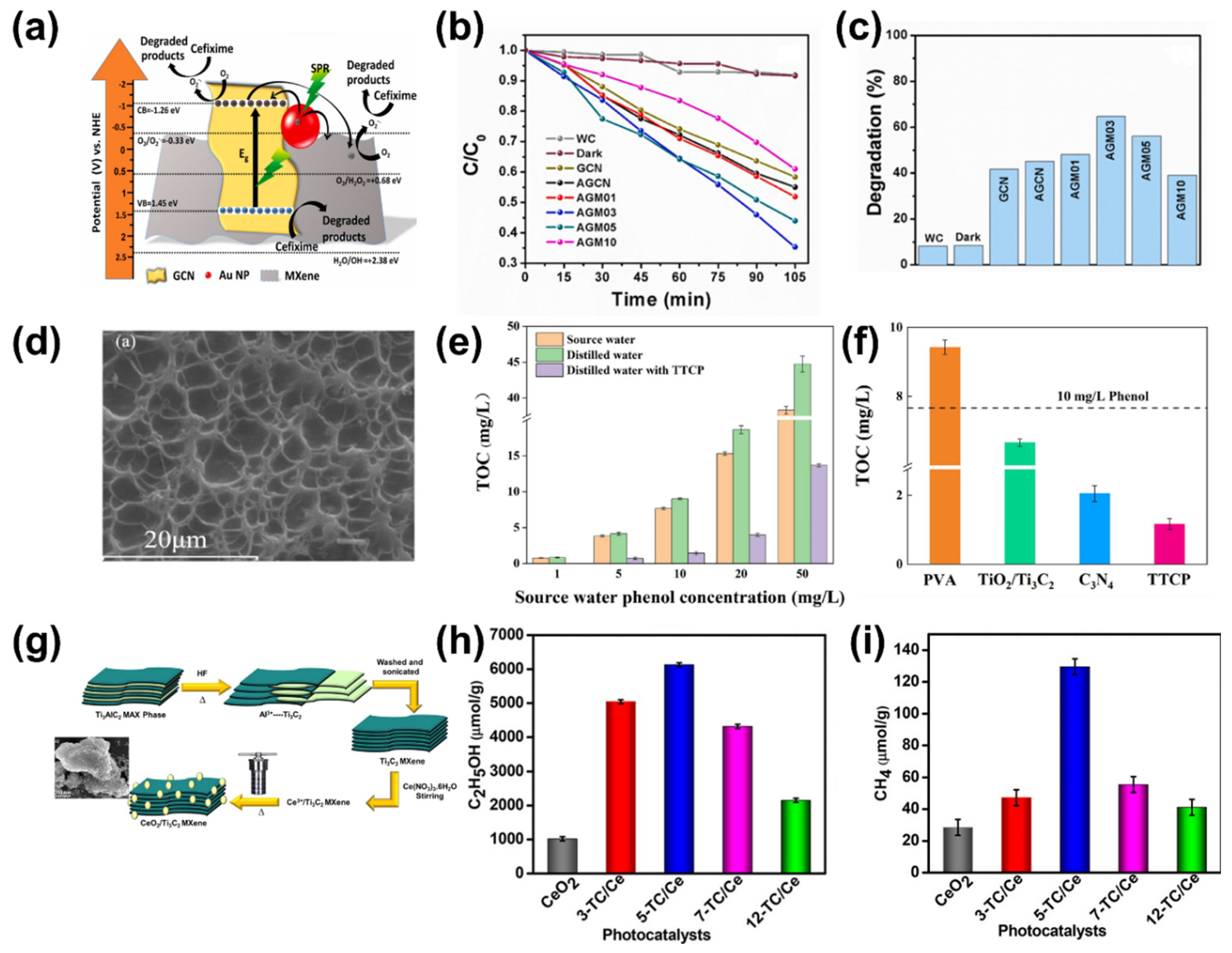
The reduction of CO2 using photocatalytic activity is another aspect of environmental remediation applications. Reducing CO2 into other useful byproducts using light-activated catalysts shows the futuristic pathway towards sustainability [90]. The excellent charge separation and slow recombination rate show the potential of Ti₃C₂Tₓ MXene as a catalytic material for CO2 reduction[137]. In this regard, Cao et al.[138] demonstrated 2D/2D ultrathin Ti₃C₂Tₓ/Bi2WO6 nanosheets prepared by in situ growth of Bi2WO6 nanosheets over Ti₃C₂Tₓ nanosheets. The proposed hybrid catalyst shows improved efficiency towards reduction of CO2 under light due to reduced charge transfer distance, improved surface-to-volume ratio, and adsorption sites. The hybrid catalyst shows improved production of CH4 and CH3OH compared to Bi2WO6. Quantitatively, the production of CH4 increased from 0.41 μmol g-1 h-1 to 1.78 μmol g-1 h-1, while the production of CH3OH increased from 0.07 μmol g-1 h-1 to 0.58 μmol g-1 h-1. Similarly, Mishra et al.[136] investigated a Ti₃C₂Tₓ-CeO2 hybrid catalyst with varying ratios of Ti₃C₂Tₓ for the photocatalytic reduction of CO2. The schematic synthesis process for hybrid catalysts shown in Figure 3g. Surprisingly, the hybrid catalyst with 5 wt% Ti₃C₂Tₓ/CeO2 shows a production of 6127.04 μmol g–1 for ethanol and 129.5 μmol g–1 for methane, way higher than CeO2 within 5 hr of time as shown in Figure 3h and i. Another report by Li et al. [139] shows the potential of Ti3C2 based hybrid catalyst comprising g-C3N4/ZnO/Ti₃C₂Tₓ for the reduction of CO2 in methane ( CH4) and carbon monoxide (CO). The hybrid framework shows a notably higher production rate of 1.41 μmol g-1h-1 towards CO increased by a factor of 2.7 and 1.7 as that of ZnO and g-C3N4.
As the literature suggests, Ti3C2Tx MXene has been extensively studied in recent years for its wide range of photocatalytic uses in environmental applications. The results reported so far show the potential of Ti3C2Tx MXene-based catalysts for the degradation of dyes, pharmaceutical wastes, VOCs along with CO2 reduction. The higher surface ratio, charge separation at the interface and excellent absorption of light plays significant roles in the photocatalytic performance of these photocatalysts.
7. Working Mechanism of Ti3C2Tx MXene-Based Hybrid Photocatalyst
The electronic structure of Ti3C2Tx MXene-based photocatalysts plays a crucial role in their ability to degrade targeted pollutants through photocatalysis. In general, an ideal photocatalyst should possess a suitable bandgap, strong absorption in the visible range, prolonged charge separation lifetimes, and adequate redox potential [105]. To enhance the efficiency of photocatalysis, co-catalysts are employed to separate photogenerated charge carriers. When materials such as ZnO, CdS, TiO₂, and Ti₃C₂ are used as co-catalysts, Schottky junctions formed with Ti3C2Tx facilitate the rapid dissociation of these charge carriers [140]. As discussed in the previous section, Ti3C2Tx MXene-based photocatalyst composites demonstrate superior photocatalytic performance compared to non-hybrid photocatalysts. This is attributed to the abundant active sites available on Ti3C2Tx MXene-based hybrids, enhanced bandgap, improved light-harvesting capability, reduced charge carrier recombination, and extended photoelectron lifetime [141].
During photocatalytic degradation, Ti3C2Tx MXene-based hybrid photocatalysts absorb visible light, causing photogenerated electrons to become excited into the CB while leaving holes in the VB [20]. The excited charge carriers are then transferred to the Ti3C2Tx MXenes at the interface, primarily due to the higher potential of Ti3C2Tx MXene. Photogenerated electrons from the Ti₃C₂Tₓ MXenes migrate to the surface and react with O2 to produce superoxide radicals (●O2-), and holes from the TiO2 react with hydroxyl ions to produce hydroxyl radicals (OH). These radicals cause the degradation of cationic and anionic dyes of organic pollutants [20,142,143].
A photocatalytic mechanism of Ti₃C₂Tₓ–TiO2 hybrid for anionic dye (e.g., MO) degradation has been presented in Figure 4a as an example. Initially, the light source provides high-energy photons, which activate the TiO₂ component, generating photoinduced electrons (e⁻) in its CB and leaving holes (h⁺) in its VB. The photoelectrons rapidly migrate from the CB of TiO₂ to the Ti₃C₂Tₓ MXene, facilitated by its high electrical conductivity [95,144]. As a result, Ti₃C₂Tₓ MXene accumulates a negative charge, while TiO₂ becomes positively charged, leading to the formation of a Schottky barrier at the Ti₃C₂Tₓ–TiO₂ interface, serving as a space-charge layer. Subsequently, the photogenerated electrons on Ti₃C₂Tₓ MXene migrate to its surface, where they react with O₂ molecules to generate superoxide radicals (●O2−) [115,145]. Meanwhile, the photogenerated holes react with adsorbed hydroxyl ions (OH⁻) to form hydroxyl radicals (●OH) [54]. These radicals play a crucial role in the degradation of MO. The photocatalytic reaction mechanism as facilitated by the MXene-based hybrid photocatalyst (TiO₂/Ti₃C₂Tₓ) is illustrated in Figure 4a [115]. The mechanism can be roughly described through the following reactions:
Ti3C2–TiO2 + hט → TiO2 (h+) + Ti3C2 (e-)
h+ + OH− → ●OH
e− + O2 → ●O2−
Dye (Anionic or cationic) + ●O2− → CO2 + H2O
Dye (Anionic or cationic) + ●OH→ CO2+H2O
For the degradation of a cationic dye like Methylene Blue (MB), superoxide radical anions (●O2− ) are produced through a reduction reaction between electrons and O₂ molecules, leading to the direct degradation of MB. Additionally, the light-induced h⁺ partially oxidizes MB and partially reacts with water to generate hydroxyl radicals, ultimately breaking down MB.[147]. It is evident from Figure 4b that ●OH and h+ are the primary reactive species in the TiO2/Ti₃C₂Tₓ MXene composite photocatalysis reaction system [146]. Ultimately, the radicals (●OH, ●O2−) possessing strong oxidizing abilities, degrade both anionic and cationic dyes, such as MO and MB molecules, directly into their oxidation products[148,149]. Therefore, a similar photocatalytic reaction mechanism occurs for both cationic and anionic dyes under light irradiation.
8. Challenges and Future Directions
Ti3C2Tx MXene-based hybrid photocatalysts have emerged as promising materials for the degradation of organic dye pollutants, demonstrating significant potential in environmental remediation. However, despite their advantages for applications in organic dye degradation, several challenges remain that must be addressed to further enhance their photocatalytic performance and facilitate their practical application.
While Ti3C2Tx MXene-based photocatalysts exhibit impressive photocatalytic activity towards dye degradation, the development of green synthesis methods is one of the biggest challenges in MXene research. Most of the current synthesis processes involves harsh and hazardous chemicals for etching and exfoliation such as hydrofluoric acid and tetramethylammonium hydroxide and tetrabutylammonium hydroxide [35]. The elimination of such chemicals from the synthesis process is highly desirable for the wide applicability of MXenes. Furthermore, the limited yield of the final MXene product during synthesis is another limiting factor. As of this date, the large-scale synthesis processes for high-quality MXenes are known to be inefficient. Hence the development of mass-production methods for high-quality and uniformly delaminated single to few-layer MXenes nanosheets is required for commercial use. Future research efforts should focus on the reaction kinetics and thermodynamics of the synthesis process for uniform and mass production of MXenes.
The long-term stability of MXenes in harsh environmental conditions such as oxygen, high humidity, and acidic or alkaline media is another concern [37].The corrosion and degradation of MXenes over time can compromise the catalytic efficiency of the composite materials and hinder their reuse. The thermal stability is also considerable challenge for MXene-based photocatalysts as the increased temperature can boost the MXene oxidation [150].
Over the years, significant efforts have been put together to address the challenges associated with MXenes-based hybrid photocatalysts. Future research efforts should focus on the reaction kinetics and thermodynamics of the synthesis process for uniform and mass production of MXene photocatalyst. Considering future developments and practical applications, the large-scale synthesis routes without the use of environmentally hazardous chemicals and the antioxidation strategies of MXenes should be explored.
For Ti3C2Tx MXene-based hybrid photocatalysts to transition from the laboratory to real-world applications, strategies to integrate them into practical systems, such as water treatment plants or portable water purification devices, should be explored. The development of easy-to-apply photocatalytic reactors or devices that utilize MXene-based hybrid materials for the degradation of organic dyes and other pollutants will help bring these materials to the forefront of environmental remediation technologies. To enhance the efficiency of Ti3C2Tx MXene-based hybrid photocatalysts, a predictive design approach leveraging modern AI and existing databases can be utilized to identify and screen suitable materials for improved performance.
9. Conclusion
In conclusion, we reviewed fabrication of Ti3C2Tx MXene-based hybrid photocatalysts and evaluated them for their role in the degradation of cationic and anionic organic dyes. Ti₃C₂Tₓ MXene has been found to exhibit exceptional physical and chemical properties, including high electrical conductivity, excellent hydrophilicity, adsorption capability, and efficient charge transfer, while also suppressing electron-hole recombination in the photocatalyst material during photocatalysis. Ti₃C₂Tₓ MXene has emerged as a promising alternative to noble metal catalysts, providing low-cost, scalable synthesis options along with exceptional catalytic performance for hybrid photocatalysts. Our evaluation demonstrated that Ti₃C₂Tₓ MXene-based hybrid photocatalysts significantly enhanced dye degradation efficiency, as reflected in both the percentage degradation and reduced degradation time, compared to nonhybrid or pure semiconducting materials. A comprehensive understanding of the dye degradation mechanisms involving Ti₃C₂Tₓ MXene-based hybrid photocatalysts has also been provided. Additionally, various computational studies and simulations have been conducted to advance research efforts in dye degradation using these photocatalysts. Lastly, the challenges associated with Ti₃C₂Tₓ MXene-based hybrid photocatalysts have been thoroughly identified, and future research directions have been suggested to address these challenges effectively.
Acknowledgments
T. L. sincerely acknowledges support for this project provided by the Faculty Research Support Fund (FRSF), UHCL (Award # $2408). F.Y. acknowledges support from the U.S. National Science Foundation (NSF) under grant #DMR-2122044 and the U.S. Army Research Office (ARO) under grant # W911NF2210109. J.P. acknowledges support from the endowed professorship in science # 45 for 2024-2025 from McNeese State University.
References
- Singh, B.J.; Chakraborty, A.; Sehgal, R. A Systematic Review of Industrial Wastewater Management: Evaluating Challenges and Enablers. J. Environ. Manage. 2023, 348, 119230. [Google Scholar] [CrossRef]
- Ahmed, J.; Thakur, A.; Goyal, A. Industrial Wastewater and Its Toxic Effects. In Biological Treatment of Industrial Wastewater; Shah, M.P., Ed.; The Royal Society of Chemistry, 2021; pp. 1–14 ISBN 978-1-83916-279-4.
- López-Ahumada, E.; Salazar-Hernández, M.; Talavera-López, A.; Solis-Marcial, O.J.; Hernández-Soto, R.; Ruelas-Leyva, J.P.; Hernández, J.A. Removal of Anionic and Cationic Dyes Present in Solution Using Biomass of Eichhornia Crassipes as Bioadsorbent. Molecules 2022, 27, 6442. [Google Scholar] [CrossRef] [PubMed]
- Salleh, M.A.M.; Mahmoud, D.K.; Karim, W.A.W.A.; Idris, A. Cationic and Anionic Dye Adsorption by Agricultural Solid Wastes: A Comprehensive Review. Desalination 2011, 280, 1–13. [Google Scholar] [CrossRef]
- Zhong, Q.; Li, Y.; Zhang, G. Two-Dimensional MXene-Based and MXene-Derived Photocatalysts: Recent Developments and Perspectives. Chem. Eng. J. 2021, 409, 128099. [Google Scholar] [CrossRef]
- Nasri, M.S.I.; Samsudin, M.F.R.; Tahir, A.A.; Sufian, S. Effect of MXene Loaded on G-C3N4 Photocatalyst for the Photocatalytic Degradation of Methylene Blue. Energies 2022, 15, 955. [Google Scholar] [CrossRef]
- Lee, Q.Y.; Li, H. Photocatalytic Degradation of Plastic Waste: A Mini Review Micromachines. 2021, 12, 907. [Google Scholar] [CrossRef]
- Khan, S.; Noor, T.; Iqbal, N.; Yaqoob, L. Photocatalytic Dye Degradation from Textile Wastewater: A Review. ACS Omega 2024, 9, 21751–21767. [Google Scholar] [CrossRef]
- Gupta, T.; Chauhan, R.P. Photocatalytic Degradation of Water Pollutants Using II-VI Semiconducting Catalysts: A Comprehensive Review. J. Environ. Chem. Eng. 2021, 9, 106734. [Google Scholar] [CrossRef]
- Rafiq, A.; Ikram, M.; Ali, S.; Niaz, F.; Khan, M.; Khan, Q.; Maqbool, M. Photocatalytic Degradation of Dyes Using Semiconductor Photocatalysts to Clean Industrial Water Pollution. J. Ind. Eng. Chem. 2021, 97, 111–128. [Google Scholar] [CrossRef]
- Guo, R.; Wang, J.; Bi, Z.; Chen, X.; Hu, X.; Pan, W. Recent Advances and Perspectives of g–C3N4–Based Materials for Photocatalytic Dyes Degradation. Chemosphere 2022, 295, 133834. [Google Scholar] [CrossRef]
- Yadav, S.; Shakya, K.; Gupta, A.; Singh, D.; Chandran, A.R.; Varayil Aanappalli, A.; Goyal, K.; Rani, N.; Saini, K. A Review on Degradation of Organic Dyes by Using Metal Oxide Semiconductors. Environ. Sci. Pollut. Res. 2022, 30, 71912–71932. [Google Scholar] [CrossRef] [PubMed]
- Wu, L.; Li, Q.; Yang, C.; Ma, X.; Zhang, Z.; Cui, X. Constructing a Novel TiO2 /γ-Graphyne Heterojunction for Enhanced Photocatalytic Hydrogen Evolution. J. Mater. Chem. A 2018, 6, 20947–20955. [Google Scholar] [CrossRef]
- Li, X.; Yu, J.; Wageh, S.; Al-Ghamdi, A.A.; Xie, J. Graphene in Photocatalysis: A Review. Small 2016, 12, 6640–6696. [Google Scholar] [CrossRef]
- Yang, J.; Wang, D.; Han, H.; Li, C. Roles of Cocatalysts in Photocatalysis and Photoelectrocatalysis. Acc. Chem. Res. 2013, 46, 1900–1909. [Google Scholar] [CrossRef]
- Ramalingam, G.; Perumal, N.; Priya, A.K.; Rajendran, S. A Review of Graphene-Based Semiconductors for Photocatalytic Degradation of Pollutants in Wastewater. Chemosphere 2022, 300, 134391. [Google Scholar] [CrossRef]
- Zhou, W.; Pan, K.; Qu, Y.; Sun, F.; Tian, C.; Ren, Z.; Tian, G.; Fu, H. Photodegradation of Organic Contamination in Wastewaters by Bonding TiO2/Single-Walled Carbon Nanotube Composites with Enhanced Photocatalytic Activity. Chemosphere 2010, 81, 555–561. [Google Scholar] [CrossRef] [PubMed]
- Sharma, S.; Dutta, V.; Singh, P.; Raizada, P.; Rahmani-Sani, A.; Hosseini-Bandegharaei, A.; Thakur, V.K. Carbon Quantum Dot Supported Semiconductor Photocatalysts for Efficient Degradation of Organic Pollutants in Water: A Review. J. Clean. Prod. 2019, 228, 755–769. [Google Scholar] [CrossRef]
- Tong, T.; Zhang, M.; Chen, W.; Huo, X.; Xu, F.; Yan, H.; Lai, C.; Wang, W.; Hu, S.; Qin, L.; et al. Recent Advances in Carbon-Based Material/Semiconductor Composite Photoelectrocatalysts: Synthesis, Improvement Strategy, and Organic Pollutant Removal. Coord. Chem. Rev. 2024, 500, 215498. [Google Scholar] [CrossRef]
- Li, X.; Bai, Y.; Shi, X.; Su, N.; Nie, G.; Zhang, R.; Nie, H.; Ye, L. Applications of MXene (Ti3 C2 Tx ) in Photocatalysis: A Review. Mater. Adv. 2021, 2, 1570–1594. [Google Scholar] [CrossRef]
- Im, J.K.; Sohn, E.J.; Kim, S.; Jang, M.; Son, A.; Zoh, K.-D.; Yoon, Y. Review of MXene-Based Nanocomposites for Photocatalysis. Chemosphere 2021, 270, 129478. [Google Scholar] [CrossRef]
- Murali, G.; Reddy Modigunta, J.K.; Park, Y.H.; Lee, J.-H.; Rawal, J.; Lee, S.-Y.; In, I.; Park, S.-J. A Review on MXene Synthesis, Stability, and Photocatalytic Applications. ACS Nano 2022, 16, 13370–13429. [Google Scholar] [CrossRef] [PubMed]
- Ning, X.; Hao, A.; Cao, Y.; Chen, R.; Xie, J.; Lu, Z.; Hu, J.; Jia, D. Construction of MXene/Bi2 WO6 Schottky Junction for Highly Efficient Piezocatalytic Hydrogen Evolution and Unraveling Mechanism. Nano Lett. 2024, 24, 3361–3368. [Google Scholar] [CrossRef]
- Sinopoli, A.; Othman, Z.; Rasool, K.; Mahmoud, K.A. Electrocatalytic/Photocatalytic Properties and Aqueous Media Applications of 2D Transition Metal Carbides (MXenes). Curr. Opin. Solid State Mater. Sci. 2019, 23, 100760. [Google Scholar] [CrossRef]
- Cui, L.; Wen, J.; Deng, Q.; Du, X.; Tang, T.; Li, M.; Xiao, J.; Jiang, L.; Hu, G.; Cao, X.; et al. Improving the Photocatalytic Activity of Ti3C2 MXene by Surface Modification of N Doped. Materials 2023, 16, 2836. [Google Scholar] [CrossRef]
- Huang, K.; Li, C.; Li, H.; Ren, G.; Wang, L.; Wang, W.; Meng, X. Photocatalytic Applications of Two-Dimensional Ti3 C2 MXenes: A Review. ACS Appl. Nano Mater. 2020, 3, 9581–9603. [Google Scholar] [CrossRef]
- Tang, R.; Xiong, S.; Gong, D.; Deng, Y.; Wang, Y.; Su, L.; Ding, C.; Yang, L.; Liao, C. Ti3 C2 2D MXene: Recent Progress and Perspectives in Photocatalysis. ACS Appl. Mater. Interfaces 2020, 12, 56663–56680. [Google Scholar] [CrossRef]
- Illahi, C.; Hutabarat, W.E.F.; Nurdini, N.; Failamani, F.; Kadja, G.T.M. Photocatalytic Degradation of Azo Dyes over MXene-Based Catalyst: Recent Developments and Future Prospects. Nanotechnol. 2024, 6, 100055. [Google Scholar] [CrossRef]
- Li, X.; Bai, Y.; Shi, X.; Su, N.; Nie, G.; Zhang, R.; Nie, H.; Ye, L. Applications of MXene (Ti3 C2 Tx ) in Photocatalysis: A Review. Mater. Adv. 2021, 2, 1570–1594. [Google Scholar] [CrossRef]
- Goel, N.; Kushwaha, A.; Kumar, M. Two-Dimensional MXenes: Recent Emerging Applications. RSC Adv. 2022, 12, 25172–25193. [Google Scholar] [CrossRef]
- Kitchamsetti, N.; De Barros, A.L.F. Recent Advances in MXenes Based Composites as Photocatalysts: Synthesis, Properties and Photocatalytic Removal of Organic Contaminants from Wastewater. ChemCatChem 2023, 15, e202300690. [Google Scholar] [CrossRef]
- Peng, C.; Zhou, T.; Wei, P.; Xu, W.; Pan, H.; Peng, F.; Jia, J.; Zhang, K.; Yu, H. Photocatalysis over MXene-Based Hybrids: Synthesis, Surface Chemistry, and Interfacial Charge Kinetics. APL Mater. 2021, 9, 070703. [Google Scholar] [CrossRef]
- Javaid, A.; Latif, S.; Imran, M.; Hussain, N.; Bilal, M.; Iqbal, H.M.N. MXene-Based Hybrid Composites as Photocatalyst for the Mitigation of Pharmaceuticals. Chemosphere 2022, 291, 133062. [Google Scholar] [CrossRef]
- Iravani, S.; Varma, R.S. MXene-Based Photocatalysts in Degradation of Organic and Pharmaceutical Pollutants. Molecules 2022, 27, 6939. [Google Scholar] [CrossRef]
- Naguib, M.; Kurtoglu, M.; Presser, V.; Lu, J.; Niu, J.; Heon, M.; Hultman, L.; Gogotsi, Y.; Barsoum, M.W. Two-Dimensional Nanocrystals Produced by Exfoliation of Ti3 AlC2. Adv. Mater. 2011, 23, 4248–4253. [Google Scholar] [CrossRef]
- Ayad, M.M.; El-Nasr, A.A. Anionic Dye (Acid Green 25) Adsorption from Water by Using Polyaniline Nanotubes Salt/Silica Composite. J. Nanostructure Chem. 2012, 3, 3. [Google Scholar] [CrossRef]
- Limbu, T.B.; Chitara, B.; Orlando, J.D.; Garcia Cervantes, M.Y.; Kumari, S.; Li, Q.; Tang, Y.; Yan, F. Green Synthesis of Reduced Ti3 C2 Tx MXene Nanosheets with Enhanced Conductivity, Oxidation Stability, and SERS Activity. J. Mater. Chem. C 2020, 8, 4722–4731. [Google Scholar] [CrossRef]
- Wang, D.; Zhou, C.; Filatov, A.S.; Cho, W.; Lagunas, F.; Wang, M.; Vaikuntanathan, S.; Liu, C.; Klie, R.F.; Talapin, D.V. Direct Synthesis and Chemical Vapor Deposition of 2D Carbide and Nitride MXenes. Science 2023, 379, 1242–1247. [Google Scholar] [CrossRef]
- Ayodhya, D. A Review of Recent Progress in 2D MXenes: Synthesis, Properties, and Applications. Diam. Relat. Mater. 2023, 132, 109634. [Google Scholar] [CrossRef]
- Lei, J.-C.; Zhang, X.; Zhou, Z. Recent Advances in MXene: Preparation, Properties, and Applications. Front. Phys. 2015, 10, 276–286. [Google Scholar] [CrossRef]
- Xu, X.; Zhang, C.; Yin, J.; Smajic, J.; Bahabri, M.; Lei, Y.; Hedhili, M.N.; Hota, M.K.; Shi, L.; Guo, T.; et al. Anisotropic Superconducting Nb2 CT x MXene Processed by Atomic Exchange at the Wafer Scale. Adv. Mater. 2024, 36, 2305326. [Google Scholar] [CrossRef]
- Kamysbayev, V.; Filatov, A.S.; Hu, H.; Rui, X.; Lagunas, F.; Wang, D.; Klie, R.F.; Talapin, D.V. Covalent Surface Modifications and Superconductivity of Two-Dimensional Metal Carbide MXenes. Science 2020, 369, 979–983. [Google Scholar] [CrossRef] [PubMed]
- Gogotsi, Y.; Anasori, B. The Rise of MXenes. ACS Nano 2019, 13, 8491–8494. [Google Scholar] [CrossRef] [PubMed]
- Verger, L.; Xu, C.; Natu, V.; Cheng, H.-M.; Ren, W.; Barsoum, M.W. Overview of the Synthesis of MXenes and Other Ultrathin 2D Transition Metal Carbides and Nitrides. Curr. Opin. Solid State Mater. Sci. 2019, 23, 149–163. [Google Scholar] [CrossRef]
- Liu, H.; Guo, H.; Gao, Z.; Pan, H.; Zhen, J.; Linghu, J.; Li, Z. Applications of Artificial Intelligence in Materials Research for Fuel Cells. AI Mater. 2025. [Google Scholar] [CrossRef]
- Alhabeb, M.; Maleski, K.; Anasori, B.; Lelyukh, P.; Clark, L.; Sin, S.; Gogotsi, Y. Guidelines for Synthesis and Processing of Two-Dimensional Titanium Carbide (Ti3 C2 Tx MXene). Chem. Mater. 2017, 29, 7633–7644. [Google Scholar] [CrossRef]
- Koh, S.W.; Rekhi, L.; Arramel; Birowosuto, M.D.; Trinh, Q.T.; Ge, J.; Yu, W.; Wee, A.T.S.; Choksi, T.S.; Li, H.Tuning the Work Function of MXene via Surface Functionalization. ACS Appl. Mater. Interfaces 2024, 16, 66826–66836. [CrossRef]
- Guo, L.; Jiang, W.-Y.; Shen, M.; Xu, C.; Ding, C.-X.; Zhao, S.-F.; Yuan, T.-T.; Wang, C.-Y.; Zhang, X.-Q.; Wang, J.-Q. High Capacitance of MXene (Ti3C2T ) through Intercalation and Surface Modification in Molten Salt. Electrochimica Acta 2022, 401, 139476. [Google Scholar] [CrossRef]
- Cao, Z.; Yin, Q.; Zhang, Y.; Li, Y.; Yu, C.; Zhang, M.; Fan, B.; Shao, G.; Wang, H.; Xu, H.; et al. Heterostructure Composites of TiO2 and CdZnS Nanoparticles Decorated on Ti3C2Tx Nanosheets and Their Enhanced Photocatalytic Performance by Microwave Hydrothermal Method. J. Alloys Compd. 2022, 918, 165681. [Google Scholar] [CrossRef]
- Purbayanto, M.A.K.; Bury, D.; Chandel, M.; Shahrak, Z.D.; Mochalin, V.N.; Wójcik, A.; Moszczyńska, D.; Wojciechowska, A.; Tabassum, A.; Naguib, M.; et al. Ambient Processed rGO/Ti3 CNTx MXene Thin Film with High Oxidation Stability, Photosensitivity, and Self-Cleaning Potential. ACS Appl. Mater. Interfaces 2023, 15, 44075–44086. [Google Scholar] [CrossRef]
- Cao, S.; Shen, B.; Tong, T.; Fu, J.; Yu, J. 2D/2D Heterojunction of Ultrathin MXene/Bi2 WO6 Nanosheets for Improved Photocatalytic CO2 Reduction. Adv. Funct. Mater. 2018, 28, 1800136. [Google Scholar] [CrossRef]
- Latif, F.E.A.; Khalid, M.; Numan, A.; Manaf, N.A.; Mubarak, N.M.; Zaharin, H.A.; Abdullah, E.C. Microwave-Assisted Hydrothermal Synthesis of Ti3C2Tx MXene: A Sustainable and Scalable Approach Using Alkaline Etchant. J. Mol. Struct. 2025, 1329, 141407. [Google Scholar] [CrossRef]
- My Tran, N.; Thanh Hoai Ta, Q.; Noh, J.-S. Unusual Synthesis of Safflower-Shaped TiO2/Ti3C2 Heterostructures Initiated from Two-Dimensional Ti3C2 MXene. Appl. Surf. Sci. 2021, 538, 148023. [Google Scholar] [CrossRef]
- Quyen, V.T.; Ha, L.T.T.; Thanh, D.M.; Le, Q.V.; Viet, N.M.; Nham, N.T.; Thang, P.Q. Advanced Synthesis of MXene-Derived Nanoflower-Shaped TiO2@Ti 3 C 2 Heterojunction to Enhance Photocatalytic Degradation of Rhodamine B. Environ. Technol. Innov. 2021, 21, 101286. [Google Scholar] [CrossRef]
- Chen, J.; Zheng, H.; Zhao, Y.; Que, M.; Lei, X.; Zhang, K.; Luo, Y. Preparation of Facet Exposed TiO2/Ti3C2T Composites with Enhanced Photocatalytic Activity. J. Phys. Chem. Solids 2020, 145, 109565. [Google Scholar] [CrossRef]
- Ta, Q.T.H.; Tran, N.M.; Noh, J.-S. Rice Crust-Like ZnO/Ti3C2Tx MXene Hybrid Structures for Improved Photocatalytic Activity. Catalysts 2020, 10, 1140. [Google Scholar] [CrossRef]
- Nasri, M.S.I.; Samsudin, M.F.R.; Tahir, A.A.; Sufian, S. Effect of MXene Loaded on G-C3N4 Photocatalyst for the Photocatalytic Degradation of Methylene Blue. Energies 2022, 15, 955. [Google Scholar] [CrossRef]
- Cai, T.; Wang, L.; Liu, Y.; Zhang, S.; Dong, W.; Chen, H.; Yi, X.; Yuan, J.; Xia, X.; Liu, C.; et al. Ag3PO4/Ti3C2 MXene Interface Materials as a Schottky Catalyst with Enhanced Photocatalytic Activities and Anti-Photocorrosion Performance. Appl. Catal. B Environ. 2018, 239, 545–554. [Google Scholar] [CrossRef]
- Fan, Y.; Liu, Z.; Li, Q.; Zhao, K.; Ahmad, M.; Liu, P.; Zhang, Q.; Zhang, B. Preparation of MoS2 /MXene/NC Porous Composite Microspheres with Wrinkled Surface and Their Microwave Absorption Performances. ACS Appl. Mater. Interfaces 2023, 15, 41720–41731. [Google Scholar] [CrossRef]
- Jin Lee, D.; Mohan Kumar, G.; Sekar, S.; Chang Jeon, H.; Young Kim, D.; Ilanchezhiyan, P. Ultrasonic Processing of WO3 Nanosheets Integrated Ti3C2 MXene 2D-2D Based Heterojunctions with Synergistic Effects for Enhanced Water Splitting and Environmental Remediation. Ultrason. Sonochem. 2023, 101, 106681. [Google Scholar] [CrossRef]
- Alsafari, I.A.; Munir, S.; Zulfiqar, S.; Saif, M.S.; Warsi, M.F.; Shahid, M. Synthesis, Characterization, Photocatalytic and Antibacterial Properties of Copper Ferrite/MXene (CuFe2O4/Ti3C2) Nanohybrids. Ceram. Int. 2021, 47, 28874–28883. [Google Scholar] [CrossRef]
- Liu, X.; Liu, Q.; Chen, C. Ultrasonic Oscillation Synthesized ZnS Nanoparticles/Layered MXene Sheet with Outstanding Photocatalytic Activity under Visible Light. Vacuum 2021, 183, 109834. [Google Scholar] [CrossRef]
- Ishfaq, M.; Rasheed, A.; Ajmal, S.; Dastgeer, G.; Naz, T.; Baig, M.M.; Lee, S.G. Synthesis and Characterization of a Novel MnO2@MXene-Based 2D/3D Hierarchical Z-Scheme for Sustainable Environmental Applications. Ceram. Int. 2024, 50, 9801–9810. [Google Scholar] [CrossRef]
- Iqbal, M.A.; Tariq, A.; Zaheer, A.; Gul, S.; Ali, S.I.; Iqbal, M.Z.; Akinwande, D.; Rizwan, S. Ti3 C2 -MXene/Bismuth Ferrite Nanohybrids for Efficient Degradation of Organic Dyes and Colorless Pollutants. ACS Omega 2019, 4, 20530–20539. [Google Scholar] [CrossRef] [PubMed]
- Iqbal, M.A.; Ali, S.I.; Amin, F.; Tariq, A.; Iqbal, M.Z.; Rizwan, S. La- and Mn-Codoped Bismuth Ferrite/Ti3 C2 MXene Composites for Efficient Photocatalytic Degradation of Congo Red Dye. ACS Omega 2019, 4, 8661–8668. [Google Scholar] [CrossRef]
- Zheng, W.; Zhang, P.; Tian, W.; Wang, Y.; Zhang, Y.; Chen, J.; Sun, Z. Microwave-Assisted Synthesis of SnO2-Ti3C2 Nanocomposite for Enhanced Supercapacitive Performance. Mater. Lett. 2017, 209, 122–125. [Google Scholar] [CrossRef]
- Zhou, W.; Zhu, J.; Wang, F.; Cao, M.; Zhao, T. One-Step Synthesis of Ceria/Ti 3C 2 Nanocomposites with Enhanced Photocatalytic Activity. Mater. Lett. 2017, 206, 237–240. [Google Scholar] [CrossRef]
- Sajid, M.M.; Khan, S.B.; Javed, Y.; Amin, N.; Zhang, Z.; Shad, N.A.; Zhai, H. Bismuth Vanadate/MXene ( BiVO4 /Ti3C2) Heterojunction Composite: Enhanced Interfacial Control Charge Transfer for Highly Efficient Visible Light Photocatalytic Activity. Environ. Sci. Pollut. Res. 2021, 28, 35911–35923. [Google Scholar] [CrossRef]
- Jiao, S.; Liu, L. Friction-Induced Enhancements for Photocatalytic Degradation of MoS2 @Ti3 C2 Nanohybrid. Ind. Eng. Chem. Res. 2019, 58, 18141–18148. [Google Scholar] [CrossRef]
- Zhang, S.; Cai, M.; Wu, J.; Wang, Z.; Lu, X.; Li, K.; Lee, J.-M.; Min, Y. Photocatalytic Degradation of TiO2 via Incorporating Ti3C2 MXene for Methylene Blue Removal from Water. Catal. Commun. 2023, 174, 106594. [Google Scholar] [CrossRef]
- Othman, Z.; Sinopoli, A.; Mackey, H.R.; Mahmoud, K.A. Efficient Photocatalytic Degradation of Organic Dyes by AgNPs/TiO2 /Ti3 C2 Tx MXene Composites under UV and Solar Light. ACS Omega 2021, 6, 33325–33338. [Google Scholar] [CrossRef]
- Ighalo, J.O.; Smith, M.L.; Mayyahi, A.A.; Amama, P.B. MXenes in Photocatalytic NOx Abatement: Current Innovations, Opportunities, and Challenges. Appl. Catal. B Environ. Energy 2024, 358, 124352. [Google Scholar] [CrossRef]
- Lei, J.-C.; Zhang, X.; Zhou, Z. Recent Advances in MXene: Preparation, Properties, and Applications. Front. Phys. 2015, 10, 276–286. [Google Scholar] [CrossRef]
- Ahmaruzzaman, Md. MXenes and MXene-Supported Nanocomposites: A Novel Materials for Aqueous Environmental Remediation. RSC Adv. 2022, 12, 34766–34789. [Google Scholar] [CrossRef] [PubMed]
- Ahmaruzzaman, Md. MXene-Based Novel Nanomaterials for Remediation of Aqueous Environmental Pollutants. Inorg. Chem. Commun. 2022, 143, 109705. [Google Scholar] [CrossRef]
- Atri, S.; Loni, E.; Zazimal, F.; Hensel, K.; Caplovicova, M.; Plesch, G.; Lu, X.; Nagarajan, R.; Naguib, M.; Monfort, O. MXene-Derived Oxide Nanoheterostructures for Photocatalytic Sulfamethoxazole Degradation. ACS Appl. Nano Mater. 2024, 7, 16506–16515. [Google Scholar] [CrossRef]
- Kumar, A.; Dixit, U.; Singh, K.; Prakash Gupta, S.; S. Jamal Beg, M. Structure and Properties of Dyes and Pigments. In Dyes and Pigments - Novel Applications and Waste Treatment; Papadakis, R., Ed.; IntechOpen, 2021 ISBN 978-1-83968-614-6.
- Javaid, A.; Latif, S.; Imran, M.; Hussain, N.; Bilal, M.; Iqbal, H.M.N. MXene-Based Hybrid Composites as Photocatalyst for the Mitigation of Pharmaceuticals. Chemosphere 2022, 291, 133062. [Google Scholar] [CrossRef]
- Wang, C.; Ye, J.; Liang, L.; Cui, X.; Kong, L.; Li, N.; Cheng, Z.; Peng, W.; Yan, B.; Chen, G. Application of MXene-Based Materials in Fenton-like Systems for Organic Wastewater Treatment: A Review. Sci. Total Environ. 2023, 862, 160539. [Google Scholar] [CrossRef]
- Amrillah, T.; Supandi, A.R.; Puspasari, V.; Hermawan, A.; Seh, Z.W. MXene-Based Photocatalysts and Electrocatalysts for CO2 Conversion to Chemicals. Trans. Tianjin Univ. 2022, 28, 307–322. [Google Scholar] [CrossRef]
- Dey, P.Ch.; Das, R. Enhanced Photocatalytic Degradation of Methyl Orange Dye on Interaction with Synthesized Ligand Free CdS Nanocrystals under Visible Light Illumination. Spectrochim. Acta. A. Mol. Biomol. Spectrosc. 2020, 231, 118122. [Google Scholar] [CrossRef]
- Medina, J.C.; Bizarro, M.; Silva-Bermudez, P.; Giorcelli, M.; Tagliaferro, A.; Rodil, S.E. Photocatalytic Discoloration of Methyl Orange Dye by δ-Bi2O3 Thin Films. Thin Solid Films 2016, 612, 72–81. [Google Scholar] [CrossRef]
- Al-Tohamy, R.; Ali, S.S.; Li, F.; Okasha, K.M.; Mahmoud, Y.A.-G.; Elsamahy, T.; Jiao, H.; Fu, Y.; Sun, J. A Critical Review on the Treatment of Dye-Containing Wastewater: Ecotoxicological and Health Concerns of Textile Dyes and Possible Remediation Approaches for Environmental Safety. Ecotoxicol. Environ. Saf. 2022, 231, 113160. [Google Scholar] [CrossRef] [PubMed]
- Srisai, J.; Muangnapoh, T.; Vas-Umnuay, P. Comparative Study on Photocatalytic Degradation of Methylene Blue Using Pristine ZnO and Ni/ZnO Composite Films. Mater. Today Proc. 2022, 66, 3168–3173. [Google Scholar] [CrossRef]
- Mohammad Jafri, N.; Jaafar, J.; Alias, N.; Samitsu, S.; Aziz, F.; Wan Salleh, W.; Mohd Yusop, M.; Othman, M.; Rahman, M.; Ismail, A.; et al. Synthesis and Characterization of Titanium Dioxide Hollow Nanofiber for Photocatalytic Degradation of Methylene Blue Dye. Membranes 2021, 11, 581. [Google Scholar] [CrossRef]
- Seling, T.R.; Katzbaer, R.R.; Thompson, K.L.; Aksoy, S.E.; Chitara, B.; Shringi, A.K.; Schaak, R.E.; Riaz, U.; Yan, F. Transition Metal-Doped CuO Nanosheets for Enhanced Visible-Light Photocatalysis. J. Photochem. Photobiol. Chem. 2024, 448, 115356. [Google Scholar] [CrossRef]
- Seling, T.R.; Kumar Shringi, A.; Wang, K.; Riaz, U.; Yan, F. Bi2O2S Nanosheets for Effective Visible Light Photocatalysis of Anionic Dye Degradation. Mater. Lett. 2024, 361, 136136. [Google Scholar] [CrossRef]
- Mary A, S.; Norbert, A.; Shaji, S.; Philip, R.R. Electrochemically Anodized Solid and Stable ZnO Nanorods as an Adsorbent/ Nanophotocatalyst: ROS Mediated Degradation of Azo Dyes Congo Red and Methyl Orange. J. Clean. Prod. 2023, 428, 139466. [Google Scholar] [CrossRef]
- Mittal, H.; Khanuja, M. Optimization of MoSe2 Nanostructure by Surface Modification Using Conducting Polymer for Degradation of Cationic and Anionic Dye: Photocatalysis Mechanism, Reaction Kinetics and Intermediate Product Study. Dyes Pigments 2020, 175, 108109. [Google Scholar] [CrossRef]
- Fang, S.; Lv, K.; Li, Q.; Ye, H.; Du, D.; Li, M. Effect of Acid on the Photocatalytic Degradation of Rhodamine B over G-C3N4. Appl. Surf. Sci. 2015, 358, 336–342. [Google Scholar] [CrossRef]
- Revathi, B.; Balakrishnan, L.; Pichaimuthu, S.; Nirmala Grace, A.; Krishna Chandar, N. Photocatalytic Degradation of Rhodamine B Using BiMnO3 Nanoparticles under UV and Visible Light Irradiation. J. Mater. Sci. Mater. Electron. 2020, 31, 22487–22497. [Google Scholar] [CrossRef]
- Zhao, D.; Cai, C. Layered Ti3 C2 MXene Modified Two-Dimensional Bi2 WO6 Composites with Enhanced Visible Light Photocatalytic Performance. Mater. Chem. Front. 2019, 3, 2521–2528. [Google Scholar] [CrossRef]
- Akbari, M.; Rasouli, J.; Rasouli, K.; Ghaedi, S.; Mohammadi, M.; Rajabi, H.; Sabbaghi, S. MXene-Based Composite Photocatalysts for Efficient Degradation of Antibiotics in Wastewater. Sci. Rep. 2024, 14, 31498. [Google Scholar] [CrossRef] [PubMed]
- Yao, J.; Wang, C. Decolorization of Methylene Blue with TiO 2 Sol via UV Irradiation Photocatalytic Degradation. Int. J. Photoenergy 2010, 2010, 1–6. [Google Scholar] [CrossRef]
- Othman, Z.; Sinopoli, A.; Mackey, H.R.; Mahmoud, K.A. Efficient Photocatalytic Degradation of Organic Dyes by AgNPs/TiO2 /Ti3 C2 Tx MXene Composites under UV and Solar Light. ACS Omega 2021, 6, 33325–33338. [Google Scholar] [CrossRef]
- Kalaiselvi, C.; Krishna Chandar, N. Accordion-like Multilayer Ti3C2Tx MXene Sheets Decorated 1D Mn2O3 Nanorods-Based Nanocomposites: An Efficient Catalyst for Swift Removal of Single and Mixed Dyes. J. Phys. Chem. Solids 2023, 182, 111591. [Google Scholar] [CrossRef]
- Chandiran, K.; Pandian, M.S.; Balakrishnan, S.; Pitchaimuthu, S.; Chen, Y.-S.; Nagamuthu Raja, K.C. Ti3C2Tx MXene Decorated with NiMnO3 / NiMn2O4 Nanoparticles for Simultaneous Photocatalytic Degradation of Mixed Cationic and Anionic Dyes. Colloids Surf. Physicochem. Eng. Asp. 2024, 692, 133888. [Google Scholar] [CrossRef]
- Wang, Y.; Chen, J.; Que, M.; Wu, Q.; Wang, X.; Zhou, Y.; Ma, Y.; Li, Y.; Yang, X. MXene-Derived Ti3C2Tx /Bi4Ti3O12 Heterojunction Photocatalyst for Enhanced Degradation of Tetracycline Hydrochloride, Rhodamine B, and Methyl Orange under Visible-Light Irradiation. Appl. Surf. Sci. 2023, 639, 158270. [Google Scholar] [CrossRef]
- Lu, Y.; Yao, M.; Zhou, A.; Hu, Q.; Wang, L. Preparation and Photocatalytic Performance of Ti3 C2 /TiO2 /CuO Ternary Nanocomposites. J. Nanomater. 2017, 2017, 1–5. [Google Scholar] [CrossRef]
- Chen, L.; Ye, X.; Chen, S.; Ma, L.; Wang, Z.; Wang, Q.; Hua, N.; Xiao, X.; Cai, S.; Liu, X. Ti3C2 MXene Nanosheet/TiO2 Composites for Efficient Visible Light Photocatalytic Activity. Ceram. Int. 2020, 46, 25895–25904. [Google Scholar] [CrossRef]
- Nasri, M.S.I.; Samsudin, M.F.R.; Tahir, A.A.; Sufian, S. Effect of MXene Loaded on G-C3N4 Photocatalyst for the Photocatalytic Degradation of Methylene Blue. Energies 2022, 15, 955. [Google Scholar] [CrossRef]
- Ayub, A.; Kim, B.; Lim, Y.; Devarayapalli, K.C.; Kim, G.; Lee, D.S. Hydrothermal Synthesis of Cobalt Ferrite-Functionalized Ti3C2Tx MXene for the Degradation of Congo Red via Peroxymonosulfate Activation System. J. Alloys Compd. 2023, 963, 171294. [Google Scholar] [CrossRef]
- Tariq, A.; Ali, S.I.; Akinwande, D.; Rizwan, S. Efficient Visible-Light Photocatalysis of 2D-MXene Nanohybrids with Gd3+ - and Sn4+ -Codoped Bismuth Ferrite. ACS Omega 2018, 3, 13828–13836. [Google Scholar] [CrossRef] [PubMed]
- Xu, T.; Wang, J.; Cong, Y.; Jiang, S.; Zhang, Q.; Zhu, H.; Li, Y.; Li, X. Ternary BiOBr/TiO2/Ti3C2T MXene Nanocomposites with Heterojunction Structure and Improved Photocatalysis Performance. Chin. Chem. Lett. 2020, 31, 1022–1025. [Google Scholar] [CrossRef]
- Liu, X.; Liu, Q.; Chen, C. Ultrasonic Oscillation Synthesized ZnS Nanoparticles/Layered MXene Sheet with Outstanding Photocatalytic Activity under Visible Light. Vacuum 2021, 183, 109834. [Google Scholar] [CrossRef]
- Chen, L.; Ye, X.; Chen, S.; Ma, L.; Wang, Z.; Wang, Q.; Hua, N.; Xiao, X.; Cai, S.; Liu, X. Ti3C2 MXene Nanosheet/TiO2 Composites for Efficient Visible Light Photocatalytic Activity. Ceram. Int. 2020, 46, 25895–25904. [Google Scholar] [CrossRef]
- Lemos, H.G.; Ronchi, R.M.; Portugal, G.R.; Rossato, J.H.H.; Selopal, G.S.; Barba, D.; Venancio, E.C.; Rosei, F.; Arantes, J.T.; F. Santos, S. Efficient Ti3 C2 Tx MXene/TiO2 Hybrid Photoanodes for Dye-Sensitized Solar Cells. ACS Appl. Energy Mater. 2022, 5, 15928–15938. [CrossRef]
- Yang, J.; Zhu, Q.; Xie, Z.; Wang, Y.; Wang, J.; Peng, Y.; Fang, Y.; Deng, L.; Xie, T.; Xu, L. Enhancement Mechanism of Photocatalytic Activity for MoS2/Ti3C2 Schottky Junction: Experiment and DFT Calculation. J. Alloys Compd. 2021, 887, 161411. [Google Scholar] [CrossRef]
- Liu, D.; Li, C.; Ge, J.; Zhao, C.; Zhao, Q.; Zhang, F.; Ni, T.; Wu, W. 3D Interconnected G-C3N4 Hybridized with 2D Ti3C2 MXene Nanosheets for Enhancing Visible Light Photocatalytic Hydrogen Evolution and Dye Contaminant Elimination. Appl. Surf. Sci. 2022, 579, 152180. [Google Scholar] [CrossRef]
- Cheng, X.; Liao, J.; Xue, Y.; Lin, Q.; Yang, Z.; Yan, G.; Zeng, G.; Sengupta, A. Ultrahigh-Flux and Self-Cleaning Composite Membrane Based on BiOCl-PPy Modified MXene Nanosheets for Contaminants Removal from Wastewater. J. Membr. Sci. 2022, 644, 120188. [Google Scholar] [CrossRef]
- Wang, B.; Lin, L.; Chen, Y.; Yang, Q.; Xiong, Y.; Zhang, L.; Dai, X.; Jiang, Y.; Zhong, C.; Liao, J.; et al. Rational Construction of S-Scheme Pt-MnO2/TiO2@Ti3C2Tx via Ti-O-Mn Bond for Distinguished Charge Transfer in Photocatalytic Wastewater Environmental Governance and Hydrogen Production. Compos. Sci. Technol. 2023, 241, 110137. [Google Scholar] [CrossRef]
- Lin, Q.; Zeng, G.; Yan, G.; Luo, J.; Cheng, X.; Zhao, Z.; Li, H. Self-Cleaning Photocatalytic MXene Composite Membrane for Synergistically Enhanced Water Treatment: Oil/Water Separation and Dyes Removal. Chem. Eng. J. 2022, 427, 131668. [Google Scholar] [CrossRef]
- Khadidja, M.F.; Fan, J.; Li, S.; Li, S.; Cui, K.; Wu, J.; Zeng, W.; Wei, H.; Jin, H.-G.; Naik, N.; et al. Hierarchical ZnO/MXene Composites and Their Photocatalytic Performances. Colloids Surf. Physicochem. Eng. Asp. 2021, 628, 127230. [Google Scholar] [CrossRef]
- Xue, H.; Yan, Q.; Chen, L.; Wang, Y.; Xie, X.; Sun, J. Ti3C2 MXene Assembled with TiO2 for Efficient Photocatalytic Mineralization of Gaseous O-Xylene. Appl. Surf. Sci. 2023, 608, 155136. [Google Scholar] [CrossRef]
- Hieu, V.Q.; Phung, T.K.; Nguyen, T.-Q.; Khan, A.; Doan, V.D.; Tran, V.A.; Le, V.T. Photocatalytic Degradation of Methyl Orange Dye by Ti3C2–TiO2 Heterojunction under Solar Light. Chemosphere 2021, 276, 130154. [Google Scholar] [CrossRef]
- Mousavi, S.M.; Mohtaram, M.S.; Rasouli, K.; Mohtaram, S.; Rajabi, H.; Sabbaghi, S. Efficient Visible-Light-Driven Photocatalytic Degradation of Antibiotics in Water by MXene-Derived TiO2-Supported SiO2 /Ti3C2 Composites: Optimisation, Mechanism and Toxicity Evaluation. Environ. Pollut. 2025, 367, 125624. [Google Scholar] [CrossRef]
- Huang, G.; Li, S.; Liu, L.; Zhu, L.; Wang, Q. Ti3C2 MXene-Modified Bi2WO6 Nanoplates for Efficient Photodegradation of Volatile Organic Compounds. Appl. Surf. Sci. 2020, 503, 144183. [Google Scholar] [CrossRef]
- Zhou, X.; Liu, G.; Yu, J.; Fan, W. Surface Plasmon Resonance-Mediated Photocatalysis by Noble Metal-Based Composites under Visible Light. J. Mater. Chem. 2012, 22, 21337. [Google Scholar] [CrossRef]
- Qin, J.; Hu, X.; Li, X.; Yin, Z.; Liu, B.; Lam, K. 0D/2D AgInS2/MXene Z-Scheme Heterojunction Nanosheets for Improved Ammonia Photosynthesis of N2. Nano Energy 2019, 61, 27–35. [Google Scholar] [CrossRef]
- Yusuf, B.O.; Umar, M.; Aliyu, M.; Alhassan, A.M.; Awad, M.M.; Taialla, O.A.; Abdullahi, A.S.; Musa, J.N.; Alhooshani, K.R.; Ganiyu, S.A. Recent Advances and Future Prospects of MXene-Based Photocatalysts in Environmental Remediations. J. Environ. Chem. Eng. 2024, 12, 114812. [Google Scholar] [CrossRef]
- Hassaan, M.A.; El-Nemr, M.A.; Elkatory, M.R.; Ragab, S.; Niculescu, V.-C.; El Nemr, A. Principles of Photocatalysts and Their Different Applications: A Review. Top. Curr. Chem. 2023, 381, 31. [Google Scholar] [CrossRef]
- Kuang, P.; Low, J.; Cheng, B.; Yu, J.; Fan, J. MXene-Based Photocatalysts. J. Mater. Sci. Technol. 2020, 56, 18–44. [Google Scholar] [CrossRef]
- Parwaiz, S.; Sohn, Y.; Khan, M.M. Insights into MXenes and MXene-Based Heterostructures for Various Photocatalytic Applications. Mater. Sci. Semicond. Process. 2025, 186, 109099. [Google Scholar] [CrossRef]
- You, Z.; Liao, Y.; Li, X.; Fan, J.; Xiang, Q. State-of-the-Art Recent Progress in MXene-Based Photocatalysts: A Comprehensive Review. Nanoscale 2021, 13, 9463–9504. [Google Scholar] [CrossRef] [PubMed]
- Kumar, A.; Majithia, P.; Choudhary, P.; Mabbett, I.; Kuehnel, M.F.; Pitchaimuthu, S.; Krishnan, V. MXene Coupled Graphitic Carbon Nitride Nanosheets Based Plasmonic Photocatalysts for Removal of Pharmaceutical Pollutant. Chemosphere 2022, 308, 136297. [Google Scholar] [CrossRef] [PubMed]
- Diao, Y.; Yan, M.; Li, X.; Zhou, C.; Peng, B.; Chen, H.; Zhang, H. In-Situ Grown of g-C3N4 /Ti3C2/TiO2 Nanotube Arrays on Ti Meshes for Efficient Degradation of Organic Pollutants under Visible Light Irradiation. Colloids Surf. Physicochem. Eng. Asp. 2020, 594, 124511. [Google Scholar] [CrossRef]
- Zhou, Y.; Yu, M.; Zhan, R.; Wang, X.; Peng, G.; Niu, J. Ti3C2 MXene-Induced Interface Electron Separation in g-C3N4/Ti3C2 MXene/MoSe2 Z-Scheme Heterojunction for Enhancing Visible Light-Irradiated Enoxacin Degradation. Sep. Purif. Technol. 2021, 275, 119194. [Google Scholar] [CrossRef]
- Rdewi, E.H.; Abbas, K.K.; AbdulkadhimAl-Ghaban, A.M.H. Removal Pharmaceutical Carbamazepine from Wastewater Using ZnO-TiO2-MXene Heterostructural Nanophotocatalyst under Solar Light Irradiation. Mater. Today Proc. 2022, 60, 1702–1711. [Google Scholar] [CrossRef]
- Abbas, K.K.; AbdulkadhimAl-Ghaban, A.M.H.; Rdewi, E.H. Synthesis of a Novel ZnO/TiO2-Nanorod MXene Heterostructured Nanophotocatalyst for the Removal Pharmaceutical Ceftriaxone Sodium from Aqueous Solution under Simulated Sunlight. J. Environ. Chem. Eng. 2022, 10, 108111. [Google Scholar] [CrossRef]
- Sukidpaneenid, S.; Chawengkijwanich, C.; Pokhum, C.; Isobe, T.; Opaprakasit, P.; Sreearunothai, P. Multi-Function Adsorbent-Photocatalyst MXene-TiO2 Composites for Removal of Enrofloxacin Antibiotic from Water. J. Environ. Sci. 2023, 124, 414–428. [Google Scholar] [CrossRef]
- Shahzad, A.; Rasool, K.; Nawaz, M.; Miran, W.; Jang, J.; Moztahida, M.; Mahmoud, K.A.; Lee, D.S. Heterostructural TiO2/Ti3C2Tx (MXene) for Photocatalytic Degradation of Antiepileptic Drug Carbamazepine. Chem. Eng. J. 2018, 349, 748–755. [Google Scholar] [CrossRef]
- Mohanty, S.; Sharma, M.; Kumar, A.; Krishnan, V. Hot Electron-Mediated Photocatalytic Degradation of Ciprofloxacin Using Au-Decorated SrTiO3 - and Ti3 C2 MXene-Based Interfacial Heterostructure Nanoarchitectonics. J. Phys. Chem. C 2023, 127, 17711–17722. [Google Scholar] [CrossRef]
- Du, X.; Ye, L.; Zhu, J.; Ye, Y.; Wang, A.; Zhang, H.; Xu, Z.; Dai, L.; Wang, Y. Novel Cerium (IV) Oxide -Ti3C2- Titanium Dioxide Heterostructure Photocatalyst for Pharmaceutical Pollutants Removal: Photocatalyst Characterization, Process Optimization and Transformation Pathways. Surf. Interfaces 2024, 46, 103892. [Google Scholar] [CrossRef]
- Sergiienko, S.A.; Tobaldi, D.M.; Lajaunie, L.; Lopes, D.V.; Constantinescu, G.; Shaula, A.L.; Shcherban, N.D.; Shkepu, V.I.; Calvino, J.J.; Frade, J.R.; et al. Correction: Photocatalytic Removal of Benzene over Ti3 C2 Tx MXene and TiO2 –MXene Composite Materials under Solar and NIR Irradiation. J. Mater. Chem. C 2023, 11, 5225–5225. [Google Scholar] [CrossRef]
- Mo, H.; Wang, Y. A Bionic Solar-Driven Interfacial Evaporation System with a Photothermal-Photocatalytic Hydrogel for VOC Removal during Solar Distillation. Water Res. 2022, 226, 119276. [Google Scholar] [CrossRef] [PubMed]
- Mishra, R.P.; Mrinalini, M.; Kumar, N.; Bastia, S.; Chaudhary, Y.S. Efficient Photocatalytic CO2 Reduction with High Selectivity for Ethanol by Synergistically Coupled MXene-Ceria and the Charge Carrier Dynamics. Langmuir 2023, 39, 14189–14203. [Google Scholar] [CrossRef]
- Sun, Y.; Meng, X.; Dall’Agnese, Y.; Dall’Agnese, C.; Duan, S.; Gao, Y.; Chen, G.; Wang, X.-F. 2D MXenes as Co-Catalysts in Photocatalysis: Synthetic Methods. Nano-Micro Lett. 2019, 11, 79. [Google Scholar] [CrossRef]
- Cao, S.; Shen, B.; Tong, T.; Fu, J.; Yu, J. 2D/2D Heterojunction of Ultrathin MXene/Bi2 WO6 Nanosheets for Improved Photocatalytic CO2 Reduction. Adv. Funct. Mater. 2018, 28, 1800136. [Google Scholar] [CrossRef]
- Li, J.; Wang, Y.; Wang, Y.; Guo, Y.; Zhang, S.; Song, H.; Li, X.; Gao, Q.; Shang, W.; Hu, S.; et al. MXene Ti3C2 Decorated G-C3N4/ZnO Photocatalysts with Improved Photocatalytic Performance for CO2 Reduction. Nano Mater. Sci. 2023, 5, 237–245. [Google Scholar] [CrossRef]
- Irfan, M.; Ahmad, I.; Shukrullah, S.; Hussain, H.; Atif, M.; Legutko, S.; Petru, J.; Hatala, M.; Naz, M.Y.; Rahman, S. Construction of 0D/2D Schottky Heterojunctions of ZnO and Ti3C2 Nanosheets with the Enriched Transfer of Interfacial Charges for Photocatalytic Hydrogen Evolution. Materials 2022, 15, 4557. [Google Scholar] [CrossRef]
- Colmenares, J.; Kuna, E. Photoactive Hybrid Catalysts Based on Natural and Synthetic Polymers: A Comparative Overview. Molecules 2017, 22, 790. [Google Scholar] [CrossRef]
- Peng, Y.; Cai, P.; Yang, L.; Liu, Y.; Zhu, L.; Zhang, Q.; Liu, J.; Huang, Z.; Yang, Y. Theoretical and Experimental Studies of Ti3 C2 MXene for Surface-Enhanced Raman Spectroscopy-Based Sensing. ACS Omega 2020, 5, 26486–26496. [Google Scholar] [CrossRef]
- Hosseini, S.F.; Seyed Dorraji, M.S.; Rasoulifard, M.H. Boosting Photo-Charge Transfer in 3D/2D TiO2@Ti3C2 MXene/Bi2S3 Schottky/Z-Scheme Heterojunction for Photocatalytic Antibiotic Degradation and H2 Evolution. Compos. Part B Eng. 2023, 262, 110820. [Google Scholar] [CrossRef]
- Hieu, V.Q.; Phung, T.K.; Nguyen, T.-Q.; Khan, A.; Doan, V.D.; Tran, V.A.; Le, V.T. Photocatalytic Degradation of Methyl Orange Dye by Ti3C2–TiO2 Heterojunction under Solar Light. Chemosphere 2021, 276, 130154. [Google Scholar] [CrossRef] [PubMed]
- Wang, D.; Zhao, L.; Song, D.; Qiu, J.; Kong, F.; Guo, L.-H. A Formation Model of Superoxide Radicals Photogenerated in Nano-TiO2 Suspensions. RSC Adv. 2019, 9, 29429–29432. [Google Scholar] [CrossRef] [PubMed]
- Zhang, S.; Cai, M.; Wu, J.; Wang, Z.; Lu, X.; Li, K.; Lee, J.-M.; Min, Y. Photocatalytic Degradation of TiO2 via Incorporating Ti3C2 MXene for Methylene Blue Removal from Water. Catal. Commun. 2023, 174, 106594. [Google Scholar] [CrossRef]
- Farghaly, A.; Maher, E.; Gad, A.; El-Bery, H. Synergistic Photocatalytic Degradation of Methylene Blue Using TiO2 Composites with Activated Carbon and Reduced Graphene Oxide: A Kinetic and Mechanistic Study. Appl. Water Sci. 2024, 14, 228. [Google Scholar] [CrossRef]
- Islam Molla, Md.A.; Tateishi, I.; Furukawa, M.; Katsumata, H.; Suzuki, T.; Kaneco, S. Evaluation of Reaction Mechanism for Photocatalytic Degradation of Dye with Self-Sensitized TiO<Sub>2</Sub> under Visible Light Irradiation. Open J. Inorg. Non-Met. Mater. 2017, 07, 1–7. [Google Scholar] [CrossRef]
- Kumar Mandal, R.; Ghosh, S.; Pal Majumder, T. Comparative Study between Degradation of Dyes (MB, MO) in Monotonous and Binary Solution Employing Synthesized Bimetallic (Fe-CdO) NPs Having Antioxidant Property. Results Chem. 2023, 5, 100788. [Google Scholar] [CrossRef]
- Cao, F.; Zhang, Y.; Wang, H.; Khan, K.; Tareen, A.K.; Qian, W.; Zhang, H.; Ågren, H. Recent Advances in Oxidation Stable Chemistry of 2D MXenes. Adv. Mater. 2022, 34, 2107554. [Google Scholar] [CrossRef]
Figure 1.
Schematic diagram of the Ti3C2Tx MXene/g-C3N4 photocatalyst synthesis process. Adapted from Ref [57].
Figure 1.
Schematic diagram of the Ti3C2Tx MXene/g-C3N4 photocatalyst synthesis process. Adapted from Ref [57].
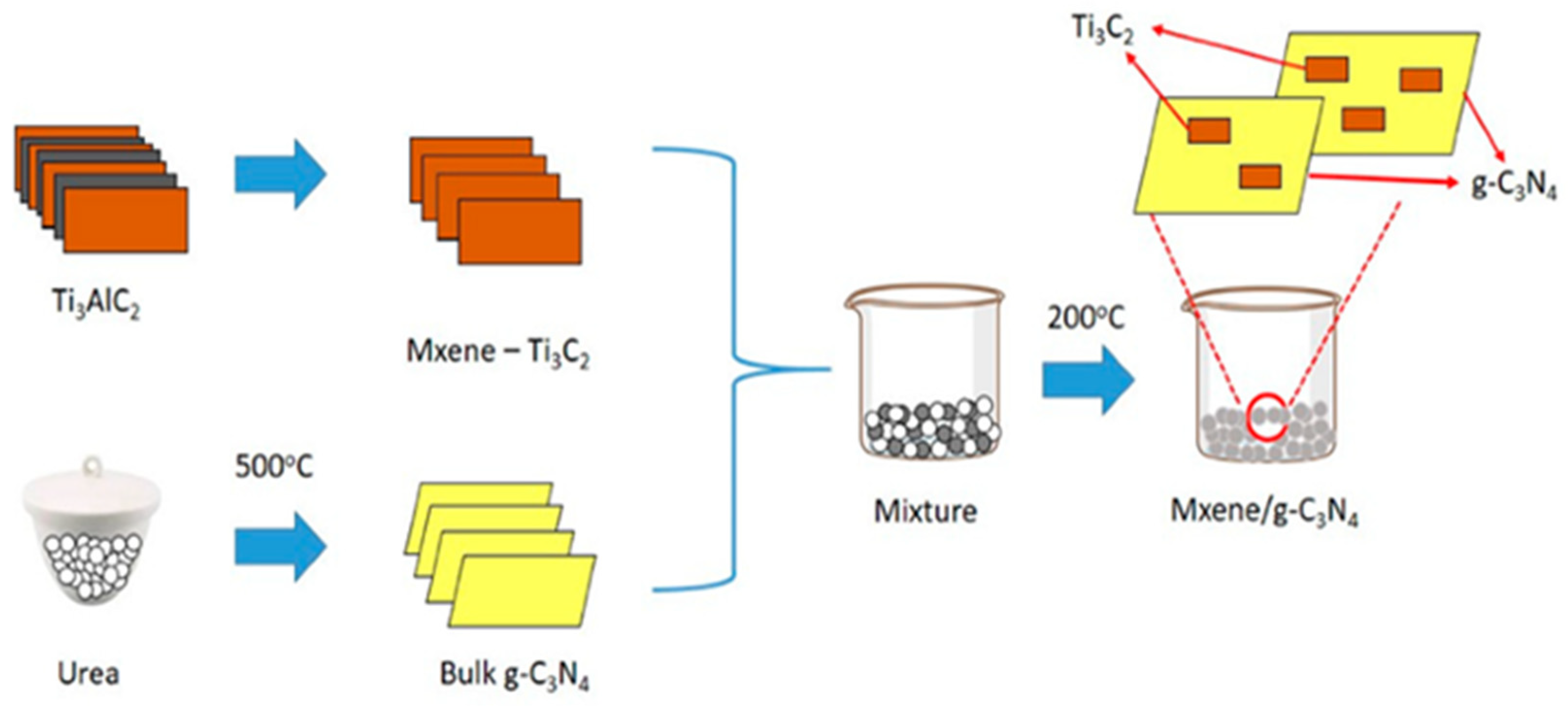
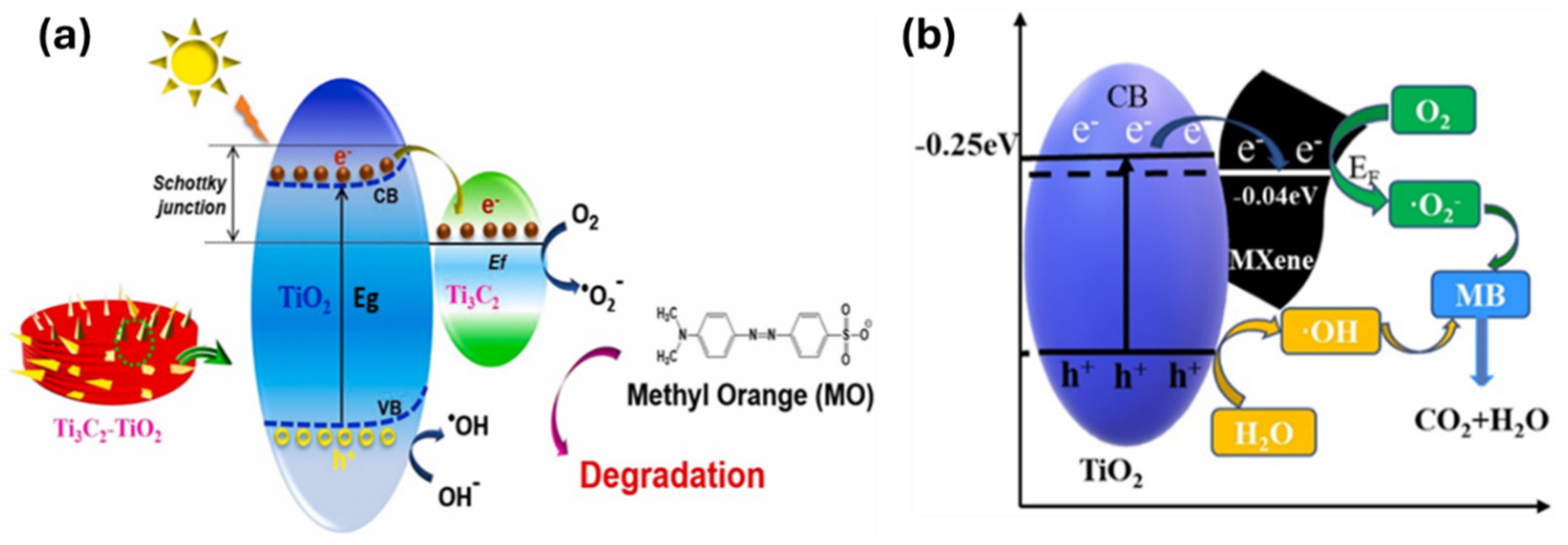
Disclaimer/Publisher’s Note: The statements, opinions and data contained in all publications are solely those of the individual author(s) and contributor(s) and not of MDPI and/or the editor(s). MDPI and/or the editor(s) disclaim responsibility for any injury to people or property resulting from any ideas, methods, instructions or products referred to in the content. |
© 2025 by the authors. Licensee MDPI, Basel, Switzerland. This article is an open access article distributed under the terms and conditions of the Creative Commons Attribution (CC BY) license (http://creativecommons.org/licenses/by/4.0/).
Copyright: This open access article is published under a Creative Commons CC BY 4.0 license, which permit the free download, distribution, and reuse, provided that the author and preprint are cited in any reuse.