
Submitted:
14 February 2025
Posted:
17 February 2025
You are already at the latest version
Abstract
In the contemporary landscape of globalization, digitalization emerges as a pivotal indicator of technological progress, profoundly influencing economic performance and contributing to GDP growth. However, this assertion necessitates further empirical validation. This study investigates the causal and cointegration relationship between socioeconomic globalization, digitalization, and their impact on economic growth, utilizing Saudi Arabia as a distinctive case study of global economic transformation from 1990 to 2022. Employing the ARDL model alongside various estimation methods, including OLS, FMOLS, DOLS, and CCR, we identified the most statistically significant factors contributing to economic growth. Our findings reveal that globalization exerts a negative and significant impact on GDP per capita at the 1 percent significance level. Conversely, the results indicate that digitalization substantially contributes to economic growth in both the short and long term. Based on these findings, this paper proposes several critical policy recommendations aimed at enhancing the economic landscape of Saudi Arabia and other developing nations.
Keywords:
economic globalization
; social globalization
; digitalization
; economic growth
; cointegration
1. Introduction
In the contemporary landscape, both policymakers in
developing and modern industrial countries encounter formidable challenges in
achieving sustainable development, especially in the context of the
multifaceted challenges posed by globalization. These challenges encompass the
environmental, financial, technical, economic, and social dimensions within the
framework of the global international system. This study aims to elucidate the
significance of digital technology and its pivotal role in promoting economic
and social equality, ultimately contributing to growth and sustainable
development.
Despite the increasing relevance of digitization,
the economic literature has yet to adequately demonstrate its role in
harnessing both economic and social globalization to propel the economies of
developing nations and expedite their economic advancement. Consequently, the
present research investigates the impact of globalization—both economic and
social—on economic growth while establishing a connection to the role that
digitization plays in this dynamic. Utilizing empirical research data from the
Saudi economy—an illustrative example of a developing country undergoing
significant structural transformations and accelerated economic and social
growth—this study aspires to examine the causal and cointegration relationships
among socioeconomic globalization, digitalization, and their collective impact
on economic growth. The analysis draws evidence from Saudi Arabia, particularly
focusing on the period from 1990 to 2022.
Saudi Arabia is endowed with abundant primary
energy resources, including crude oil, coal, and natural gas. Notably,
petroleum products account for approximately 90 percent of the country's
exports, with the oil industry contributing around 45 percent to the gross
domestic product (GDP) (Mahalik et al., 2017). The industrial and manufacturing
sectors collectively represent 52 percent of Saudi Arabia's GDP. As depicted in
Figure 1, the proportion of crude oil in
total Saudi oil exports has decreased from 95 percent in 1990 to roughly 75
percent in 2022, highlighting a trend toward diversification that has become
increasingly apparent over the past decade.
Despite its resource wealth, Saudi Arabia has
encountered economic challenges stemming from persistent declines in oil prices
in recent decades, resulting in diminished oil revenues. To alleviate its
dependency on the oil sector, the government has initiated strategies aimed at
diversifying the economy, recognizing the essential role of the financial
sector in fostering economic growth. These measures encompass the promotion of
the banking sector, the enhancement of financial markets, and the development
of the insurance sector. In alignment with this economic diversification
strategy, the government has introduced Vision 2030, underscoring the
significance of enhanced globalization. This global engagement not only
facilitates financial development but also nurtures sustainable economic growth
by bolstering the quality of the country's institutions (Shahbaz et al., 2019).
As a widespread phenomenon, globalization exerts a
profound influence on global socio-economic and political factors, facilitating
the integration of economies through trade and foreign direct investment (FDI).
However, the process of globalization is not devoid of challenges. In pursuit
of globalization, multinational corporations may compromise environmental
standards during the establishment of factories in host countries (Shahbaz et
al., 18). The structural changes in industries necessitated by globalization to
meet international demand often require additional resources, posing risks of
environmental degradation. Moreover, globalization, facilitated by trade
liberalization, promotes the free exchange of goods among nations, leading to
increased production and consumption of goods and energy (Kandil et al., 2015).
The influx of foreign firms investing in host
countries represents another dimension of globalization. Recent technological
advancements and societal trends favoring digitalization have engendered
significant global transformations. This paradigm shift necessitates
substantial adjustments. The global economy has experienced considerable
changes within the socioeconomic-educational system, especially in higher
education. These transformations include alterations in educational standards,
quality, decentralization, and the emergence of virtual and independent
learning (Mohamed Hashim et al., 2022). The strategic focus has shifted toward
students rather than exclusively on technology and learning opportunities. The
integration of digital devices and transformations has positively influenced
the learning environment, yielding promising outcomes over time (Hanelt et al.,
2021).
The rest of the paper is organized as follows. Section 2 provides a comprehensive literature
background. Section 3 presents the
empirical studies and methodology adopted in this study. Section 4 highlights the test specification,
proposed method, results discussion, and robustness of our method. Finally,
section 5 provides concluding remarks and suggestions for future research.
2. Literature Background
The Solow model (1957) posits that continual
improvements in living standards can be attributed solely to technological
progress. Subsequent growth theories, as exemplified by Sala-i-Martin &
Barro, (1995), underscore the significance of technological advancement in
economic growth. Departing from the Solow growth model, these newer theories
seek to internalize technological progress. In contrast to the Solow model,
which treats technology as exogenous, emerging growth models aim to endogenize
technological progress. Moreover, it is argued that the pace of modern
technological advancements not only influences economic growth but also exerts
wide-ranging effects on life expectancy, social levels, health outcomes,
poverty rates, and literacy, as asserted by Grossman and Helpman (1993).
Scholars such as Oliner and Sichel (1994) contend that innovation and the
enhancement of existing products act as catalysts for growth. They utilize the
neoclassical framework and incorporate information technology into the growth
model, demonstrating that the growth rate of output hinges not only on the
stock of computing equipment but also on factors including capital, labor, and
multifactor productivity. The fundamental concept behind digitization revolves
around leveraging information and communication technology (ICT) facilities to
access global resources for societal benefit. Embracing digitization is
essential in the current era to promote environmental health and safety.
Numerous organizations are actively engaged in digitizing their materials,
recognizing the enduring value of such resources for educational purposes.
Furthermore, digitization enhances the reputation of institutions, enabling
global users to be aware of institutional collections and utilize these
resources from remote locations.
Over the past three decades, the global advancement
of ICT has garnered considerable attention from economists and researchers.
Numerous studies have explored the impact of globalization and ICT diffusion on
the economic growth of both developed and developing economies. It is widely
acknowledged in the literature that globalization and ICT play a pivotal role
in fostering economic prosperity in both contexts, as highlighted by Arendt
(2015). The impacts of globalization on economic development are varied for
both developed and developing countries, yielding both positive and, at times,
negative outcomes. Notably, the benefits of globalization are not equally
distributed across countries, sectors, and individuals within the same country.
A wide range of theoretical and empirical studies investigate globalization and
its socioeconomic impacts, justifying this dual effect. Many studies confirm
the crucial role of globalization in the economy as a whole (Bhagwati, 2004;
Grossman and Helpman, 1993; Crafts, 2004; Stiglitz, 2002, 2006; Dreher, 2006;
Rahman, 2020; Shahbaz et al., 2019), among others. Bhagwati (2004), a
world-renowned economist, posits that globalization, if properly regulated, is
one of the most influential forces for social good globally. His book, *In
Defense of Globalization*, addresses criticisms related to the social effects
of economic globalization. The issues discussed include the effects on women's
rights and equality, poverty in underdeveloped nations, democracy, and the
preservation of both dominant and indigenous cultures, as well as environmental
concerns. To counter accusations that globalization leads to cultural
dominance, he argues that internationalization contributes to solutions rather
than being part of the problem. However, Stiglitz (2002) contends that the
influence of globalization depends on a country's preparedness to capitalize on
the opportunities offered by globalization to promote economic growth. Bhagwati
(2004) further asserts that, under the right conditions, globalization is
indeed the most potent force for social good in the modern world. He
illustrates that globalization frequently resolves many issues in developing
countries by rapidly decreasing child labor and raising literacy rates, as
affluent parents choose to send their children to school instead of work.
Furthermore, globalization advances women's rights globally and demonstrates
that economic expansion need not inevitably lead to higher pollution levels
when combined with sensible environmental protections. Bhagwati (2004)
persuasively argues that globalization is part of the solution, not the cause
of the issue.
Stiglitz (2006) illustrates in *Making Globalization Work* that economic globalization transcends political considerations and moral sensitivity to ensure a just and sustainable world. He emphasizes that the real work required of all countries to achieve this goal is to understand and utilize globalization correctly. Numerous influential studies assert that globalization can significantly accelerate economic growth, provided that a threshold level of institutional quality, including international openness, equal access to information in financial markets, and a favorable composition of capital inflows, is present in countries importing capital (Kose et al., 2009; Stiglitz, 2002; Wei, 2006; Daude and Stein, 2007; Uusitalo and Lavikka, 2021). The lack of empirical studies validating these propositions in the aforementioned seminal works prompts an examination of the roles of quality of governance (QoG) and foreign direct investment (FDI) as key factors influencing the impact of globalization on economic growth.
Within the economics profession, it is widely accepted that fostering international trade accelerates economic growth (Crafts, 2004; Dollar and Kraay, 2004). The rationale behind this belief varies depending on the growth theory considered. Specifically, neoclassical growth theory posits that openness facilitates a more efficient allocation of resources, thereby contributing to growth. Conversely, endogenous growth theory suggests that openness can stimulate growth through mechanisms such as the diffusion of technology, learning by doing, and the exploitation of scale economies. Shahbaz et al. (2019) affirm that the understanding of globalization is widespread when economies are tightly integrated, sharing social standards and political platforms. Additionally, Dreher (2006) asserts that globalization facilitates the opening up of economies, fostering growth and prosperity, thus suggesting potential benefits for national economic growth and development.
Hirst and Thompson (1996) provide a critical analysis of globalization and its implications. They examine the economic, political, and social dimensions of globalization and question its consequences for governance and the nation-state. They argue that globalization is not an all-encompassing, inevitable force but rather a complex and contested process. They challenge the prevailing view that globalization leads to the withering away of the nation-state, maintaining that the nation-state remains a significant actor in global affairs. Hirst and Thompson (1996) suggest that globalization should be understood as a set of interrelated processes that interact with political and social structures at various levels. They highlight the role of economic globalization in shaping the international economy, discussing the liberalization of trade and finance, the rise of multinational corporations, and the growth of global financial markets. They also address the impact of technological advancements, such as ICT, on global economic integration. Hirst and Thompson (1996) raise concerns about the consequences of globalization, arguing that it can lead to increased inequality within and between countries. They emphasize that global economic integration can exacerbate social and economic divisions, particularly in developing countries. They express apprehension regarding the potential erosion of democratic governance and the concentration of power in the hands of non-state actors, such as multinational corporations and international financial institutions.
Moreover, the authors critique the notion of a borderless world, arguing for the continued significance of borders and national institutions. They contend that the nation-state remains a crucial source of political authority and that democratic governance and accountability should be maintained at the national level. Hirst and Thompson (1996) propose the need for new forms of global governance to address the challenges posed by globalization, emphasizing the importance of democratic accountability, transparency, and social regulation in shaping global economic processes. They advocate for the establishment of international institutions capable of effectively addressing global issues while respecting democratic principles. Overall, their perspective on globalization challenges the prevailing narratives of an inevitable and all-encompassing force, emphasizing the complexities and contradictions of globalization and advocating for a more nuanced understanding of its implications for governance and societal well-being.
In fact, an increase in economic globalization may not contribute to economic development and growth in countries with limited economic opportunities. Consequently, these nations might not fully benefit from globalization in the absence of necessary prerequisites. Many scholars emphasize the structural and socioeconomic factors shaping the relationship between globalization and economic development, particularly economic growth. Consequently, globalization is often perceived as having a positive effect on economic growth, assuming a certain level of quality in structural and socioeconomic indicators across countries. Variation in a country's growth performance is attributed to policy complementarities that play a crucial role in enhancing economic growth. Policy integrations must accompany trade openness to effectively boost economic growth, making them prerequisites for such growth. Financial liberalization shows a more significant impact on output in countries where institutional quality has improved (Omoke & Opuala-Charles, 2021). However, policy complementarities in each country impose constraints on the optimal design of growth strategies in nations resistant to reform and facing unfavorable initial conditions (Calderon and Fuentes, 2006). In this context, Chang et al. (2013) discovered that reforms in banking, governance, the labor market, infrastructure, and trade influence the nexus between globalization and growth in developing countries. Similarly, research by Gu and Dong (2011) asserts that financial development and financial integration are prerequisites for effective financial globalization. They found that without improvements in the financial system, globalization can lead to volatile growth in countries. The foundational study by Samimi and Jenatabadi (2014) suggests that economic globalization and a country's structural characteristics are interdependent and complementary. In alignment with this perspective, Sirgy et al. (2004) delve into the impact of globalization on life expectancy in developing countries, highlighting the pronounced challenges these nations face, particularly regarding health outcomes. While limited studies explore the effect of globalization on human health (e.g., Sirgy et al., 2004), the majority indicate various channels through which globalization may impact middle-income countries (Shahbaz et al., 2018; Audretsch et al., 2014). Evidence also suggests that countries with more adaptable labor markets experience structural changes that are more conducive to growth.
Globalization is broadly supported by key international organizations such as the World Bank (WB), International Monetary Fund (IMF), World Trade Organization (WTO), Organization for Economic Cooperation and Development (OECD), and the United Nations Conference on Trade and Development (UNCTAD), which emphasize its positive impact on economic growth, global trade, and sustainable development for all countries.
The World Bank views globalization as a potent force for generating economic growth, reducing poverty, and improving living standards worldwide. It underscores the benefits of increased international trade, investment, and economic integration, as reflected in its publications, such as the "World Development Report" (World Bank, 2020), which focuses on globalization's role in promoting economic development and inclusive growth strategies.
Similarly, the IMF supports globalization and highlights its positive effects on global economic growth and development. The IMF advocates for policies that enhance international trade, investment, and financial integration to foster economic stability. Its reports, including the "World Economic Outlook" (IMF, 2021), often explore the benefits of trade liberalization and macroeconomic stability within a globalized framework.
UNCTAD emphasizes the development dimension of globalization, promoting inclusive and sustainable growth, particularly for developing nations. Its reports, like the "Trade and Development Report" (UNCTAD, 2022), talk about the pros and cons of globalization. They push for policies that work well together so that everyone can benefit, and they cover topics like fair trade and technology transfer.
The WTO champions principles of open trade, market access, and non-discrimination, promoting the reduction of trade barriers to facilitate global commerce. The WTO's annual "World Trade Report" (WTO, 2021) examines trade trends, the impact of trade policies, and the importance of rules-based trade governance, addressing challenges such as protectionism and the necessity for global cooperation.
Finally, the OECD perceives globalization as a catalyst for economic development, innovation, and productivity growth. It emphasizes the significance of open markets and cross-border collaboration in fostering economic integration. OECD reports, like the "OECD Economic Outlook" (OECD, 2022), look at how globalization affects many policy areas, such as trade and the environment. They also talk about problems like income inequality and the need for strategies for growth that benefit everyone.
According to Robertson (1992), globalization is not merely the spread of global economic forces, but a complex phenomenon encompassing economic, political, cultural, and social aspects. He highlights technology's role in facilitating globalization, emphasizing advances in transportation and communication technologies. Robertson (1992) asserts that globalization involves creating a shared awareness of global interconnectedness and interdependence. Baldwin (2018) provides a comprehensive analysis of information technology's impact on globalization and its implications for the global economy. Baldwin (2016) argues that the current phase of globalization, referred to as the second unbundling, differs from earlier phases, being driven by advances in ICT and leading to the fragmentation of service activities across borders. He also discusses potential consequences such as labor market polarization and rising income inequality.
Overall, Baldwin (2016) emphasizes information technology's role in driving globalization and reshaping economic interactions. The nature of the relationship between digitalization and globalization is complex and multidimensional, with both positive and negative implications. While digitalization enhances global connectivity and economic opportunities, it also exacerbates inequalities and raises governance challenges. In the digitally connected global economy, Manyika et al. (2016) highlighted how the complexities of globalization have changed, pointing out that the network of global economic connections is growing in complexity, breadth, and depth, as well as the growing cross-border data flows that now bind the global economy with the same dependability as the traditional movement of manufactured goods.
Digitalization has significantly influenced Saudi Arabia's socioeconomic landscape, driving economic growth, enhancing employment opportunities, and improving transparency (Neffati & Gouidar, 2019; Neffati & Jbir, 2024; Al-Sahli & Bardesi, 2024). The education sector, in particular, has experienced significant advancements, with digital tools revolutionizing learning behaviors and improving accessibility (Alaboudi & Alharbi, 2021). Moreover, the Vision 2030 initiative highlights the strategic importance of digitalization in diversifying Saudi Arabia’s economy, reducing oil dependency, and fostering innovation (Khan, 2019; Vision 2030 Report, 2021). However, this relationship between digitalization and globalization also presents challenges. While digitalization promotes connectivity and economic opportunities, it raises concerns about inequality, data privacy, security, and governance. Different levels of digital access and literacy can make socioeconomic differences worse. To close these gaps and make sure everyone has an equal chance to participate in the digital economy, policies are needed (Hilbert, 2016; Ragnedda & Muschert, 2013).
Research Gap
The relationship between digitalization and globalization is complex and multifaceted, offering both opportunities and challenges. Nations that effectively integrate digital technologies can leverage globalization's benefits while mitigating its adverse effects, as illustrated by Saudi Arabia’s experience in harnessing digitalization for sustainable growth and development.
In short, the Solow model is a starting point for theories of endogenous economic growth that emphasize the leading role of technological progress in economic growth and that digitalization and information and communication technologies have a significant impact on social and economic aspects. Globalization is a phenomenon with complex and dual effects, some positive and some negative, on economic development, and its benefits are distributed unevenly across regions and countries of the world.
Many factors influence the complex relationship between globalization and economic growth, including the quality of institutions, governmental structures, and foreign direct investment. Furthermore, there are diverse viewpoints on how globalization affects nation states and global governance, reflecting the multifaceted nature of this global phenomenon and its long-term consequences.
In the light of previous studies, we conclude that there are many areas that require further research, including the lack of empirical studies proving the validity of theoretical proposals on the roles of quality governance and FDI in shaping the impact of globalization on economic growth, especially in developing countries or specific industries. Perhaps the Saudi economy, which has undergone significant and accelerated transformations after the country's accession to the World Trade Organization in 2005, is one of the examples worth studying. In addition, there is a need for further exploration of the long-term effects of digitization technology on economic growth, social structures and environmental sustainability. In addition, while the importance of digitization is being discussed, there is a need to further explore the long-term effects of digital transformations on economic growth, social structures, and environmental sustainability.
3. Empirical Studies and Methodology
Several empirical studies have successfully employed the ARDL (Autoregressive Distributed Lag) model to ascertain both short-term and long-term dynamic relationships between study variables. Specifically, the ARDL model has been utilized across various disciplines to analyze long-term connections among variables. For instance, Pesaran, Shin, and Smith (2001) applied the ARDL approach to investigate the long-run relationship between inflation and money growth in the United States, providing critical insights into the stability of this long-term association. Similarly, Shahbaz et al. (2018) utilized the ARDL methodology to assess the long-term impact of financial development on stock market performance in emerging economies, revealing a positive and significant long-run relationship between these constructs. Furthermore, Banday and Aneja (2019) employed the ARDL model to explore the long-run dynamics between energy consumption (EC), economic growth as measured by GDP, and carbon dioxide emissions (CO2) in G7 countries. Their research elucidated the intricate long-run interactions among these variables. In addition, Pata et al. (2023) applied the ARDL model to examine the long-run effects of foreign direct investment (FDI) on trade in ASEAN countries, uncovering positive and significant long-run causal links between FDI and trade in the region. These studies underscore the versatile applications of the ARDL model in empirical research.
Conversely, the ARDL model is also adept at analyzing short-term dynamics among variables. For example, Kandil and Mirzaie (2016) utilized the ARDL framework to investigate the short-term effects of monetary policy on output in selected Middle Eastern and North African countries, focusing on how changes in interest rates and money supply influenced short-term output fluctuations. Similarly, Bahmani-Oskooee and Ratha (2015) explored the short-run causal relationships between exchange rate volatility and trade flows in the United States and Canada. Their findings illustrated the impact of exchange rate fluctuations on short-term trade dynamics. Additionally, Abdur Chowdhury and Mavrotas (2006) employed the ARDL model to assess the short-term effects of fiscal policy on economic growth in developing countries, examining how government spending, taxation, and public debt influenced short-term growth trajectories. Collectively, these instances highlight the adaptability of the ARDL model in scrutinizing short-term relationships across diverse fields of inquiry.
Based on the aforementioned studies and acknowledging the existence of time series that are not integrated in the same order, the ARDL model is chosen for this analysis. The prerequisite for employing the VAR model is that all series must be integrated of order 1, which does not apply to our series. The ARDL model, developed by Pesaran and Shin in 1998 (PS 1998) and further refined by Pesaran, Shin, and Smith in 2001 (PSS 2001), is particularly advantageous as it accommodates regression models with varying orders of integration, i.e., series I(0) and I(1). Moreover, it effectively captures both short-term and long-term dynamic relationships among the study variables through the bounds cointegration test, thus enhancing the precision of forecasts and informing government policy decisions. Consequently, this model aligns seamlessly with our research hypotheses.
Prior to estimating the ARDL model equation using the ordinary least squares (OLS) method, it is imperative to conduct the bounds cointegration test. Should our variables exhibit cointegration, we will refine our model by incorporating the long-term dynamic relationship via the Conditional Error Correction Model (CECM). Conversely, if the variables are not integrated, we will exclusively specify the ARDL model. The general ARDL (p, q) model is expressed as follows:
is a vector, and the variables contained in the matrix ()′ may be integrated of order 0, I(0), or integrated of order 1, I(1).
γ is the constant; i = 1, … ,k is the number of variables in the model.
δ and β are the coefficients of the variables.
p, q are the optimal orders of lags for the dependent and independent variables, respectively.
is the vector of error terms, also referred to as innovation or shocks.
3.1. The Empirical Model
To establish the right form of empirical models, we started with the traditional Cobb-Douglass production model, which uses only capital stock (K) and labor (L) to describe economic growth (Y) as follows:
we suppose the constant return to scale: , and we apply the logarithm,
We suppose that , production per capita, and , capital intensity.
we apply log then we have
The most popular metric of growth is production per capita (expressed as the ratio between the quantity produced and the number of workers required for its production, i.e. the term Y/L), which rises when capital intensity rises, as measured by an increase in the K/L ratio.
If we introduce the variables according to the object of our study especially globalization variables (GI) and digital economic variable (DI) to the equation (1) and replace Yt by real gross domestic product per capita (GDPC) we obtain the general form of estimated equation as following:
3.2. Variables and Database Sources
In this paper we investigate the relationship between; socioeconomic globalization, digitalization and economic growth. Then We will validate this relation using equation (5) in the case of Saudi Arabia. The time series data used during the period spans from 1990 to 2022. Table 1 below provides a summary of the definitions for each variable, and the sources from which they were extracted:
Our study focusses on the KOF Globalization Index which measures the economic, social and political dimensions of globalization (Dreher, (2006); Potrafke, (2015)) We use only the economic globalization index (EcGI), social globalization index (SoGI) as calculated by for all countries of the world. While for Digitalization index (DI) we use as a proxy the Digital Economy and Society Index (DESI) which calculate referring to the study of Olczyk and Kuc-Czarnecka (2022), this index was used as a suitable variable that characterizes the development level of the digital economy. Olczyk and Kuc-Czarnecka (2022) verify that DESI sub-indicators can be used to analyze the country’s digital transformation (Neffati and Jbir , 2024).
In the light of the above discussion relationship between economic growth (GDPC), socioeconomic globalization and digitalization will be studied as shown in the following equation (6):
Where,
GDPC; Gross Domestic Product per Capita,
; Capital Intensity
; Globalization index
; Social Globalization Index
; Economic Globalization index
; Digital Economy and Society Index, and
; Error terms
In order to use and analyze our time series, we will first check their stationarity over time, which is a crucial step in the study of time series.
3.3. Specification Tests
3.3.1. Stationarity Test
A time series is considered stationary when all its marginal and joint distributions do not change over time, meaning it does not contain a unit root. Let's consider the following equation:
With ∶ error term (i.i.d)
This series is considered stationary if ρ < 1. The null hypothesis and the alternative hypothesis for each of the series will be: H0: ρ = 1: the series contains a unit root. Ha: ρ < 1: the series does not contain any unit root. Several stationarity tests, such as the Phillips-Perron (PP) test, the Kwiatkowski, Phillips, Schmidt, and Shin (KPSS) test, and the Augmented Dickey-Fuller (ADF) test, can help us address these hypotheses. However, we will proceed with the Augmented Dickey-Fuller (ADF) test in Eviews.
Based on the estimation of unit root test, Table 2, all the studied variables are purely stationary into the first difference, or integrated at I(1). According to the result, we can perform the cointegration test and ARDL model to estimate the short- and long-term relationship. The ARDL model combines endogenous and exogenous variables.
As a necessary yet not sufficient condition, the ADF and PP tests are employed to identify unit root conditions. The results presented in Table 2 indicate that all series exhibit nonstationary at the levels but become stationary at first differences (I(1)) at a significance level of 0.05. Furthermore, the PP test results confirm that all selected variables can be classified under the I(1) process.
Building on the outcomes from Table 1, the next step involves proposing the Johansen rank with trace and maximum-Eigen-value test statistics to detect cointegration (Johansen, 1991).
3.3.2. Cointegration Test
The strong co-integration phenomenon was developed by Engle and Granger in 1987. Indeed, a regression derived from non-stationary time series can yield misleading correlation results, commonly referred to as "spurious correlation." Cointegration analysis allows us to distinguish regressions that have a plausible causal relationship.
Two non-stationary variables are said to be cointegrated if there is a long-term dynamic relationship between them. That is, if two variables are cointegrated of order I(1), their linear combination becomes I(0). Thus, even if they diverge in the short term, they eventually converge in the long term. One limitation of the Engle-Granger 1987 cointegration test is that it only applies to series integrated of order 1. Therefore, PS in 1998 (PS 1998) and PSS in 2001 (PSS 2001) developed the bounds cointegration test, which allows studying the short-term and long-term dynamic relationship of two variables integrated with different orders, for example, I(0) and I(1). In their respective studies, Mbarek et al. (2017, 2018), Saidi and Mbarek (2016), and Ngoma and Yang (2024) utilize cointegration estimation to explore the dynamic relationships between key economic variables over the short and long term. These estimations are essential in detecting long-run equilibrium relationships amidst short-run fluctuations, allowing the authors to assess how different economic factors co-move and influence each other over time. For instance, Mbarek et al. (2017) focus on the relationship between energy consumption and economic growth, while Saidi and Mbarek (2016) investigate environmental quality's impact on economic development.
Cointegration assumptions:
Ho: absence of cointegration relationship among the study variables.
Ha: There is one or more cointegration relationships among the study variables.
The co-integration results, as shown in Table 3, reveal the presence of two co-integration equations at the 0.05 significance level. This implies a significant long-term relationship between socioeconomic globalization, digitalization, and economic growth in Saudi Arabia. In the following phase, we will use the ARDL model, with support from FMOLS and DOLS, to investigate both the long- and short-run causal-links between all variables (dependent and independent). While theoretically, running a VECM is possible when variables are co-integrated in the first-level to determine causality between them, it is not sufficient.
4. Estimated Models
The estimated results of the OLS, FMOLS, DOLS, and CCR models are presented and reported in Table 5 by estimating the following models:
Model 1: ,
Model 2: ,
All variables were defined in heading 3.2.
4.1. Estimation Results
The output of the OLS (Ordinary Least Squares), FMOLS (Fully Modified Least Squares), DOLS (Dynamic Least Squares), and CCR (Canonical Cointegration Regression) estimation methods is summarized in Table 4, which indicates that capital intensity has a strong and statistically significant impact on GDP per capita, with significance at the 1 percent level. This finding is consistently confirmed across the different models. In contrast, the globalization index exhibits a negative and significant effect on LNGDPC at the 1 percent significance level. The second model further reveals that LNGDPC is negatively impacted by SOGI at the same significance level, a result corroborated by both OLS and FMOLS estimations. Similarly, the ECGI negatively influences LNGDPC with a significant coefficient at 1 percent. Conversely, the DESI positively affects LNGDPC, also at a 1 percent significance level.
We looked at the results of four estimation methods—OLS, FMOLS, DOLS, and CCR—with LNGDPC as the dependent variable. For all four, lnKI showed a positive and statistically significant coefficient (ranging from 0.0143 to 0.0224). This means that for every 1% increase in investment in capital intensity, there is a corresponding 0.0143 to 0.0224 increased GDP per capita. This shows how important lnKI is for driving economic growth. The overall Globalization Index (GI) shows a strong negative relationship with GDP per capita under both OLS and DOLS estimations (e.g., -0.0228 and -0.0460, respectively). This suggests that government spending that isn't used efficiently or correctly may have a negative effect on the economy.
The SOGI and ECGI, included in FMOLS, DOLS, and CCR, also exhibit negative and significant coefficients (e.g., SOGI: -0.0151 to -0.0236; ECGI: -0.0149 to -0.0189), indicating potential short-term costs or restrictive impacts associated with governance measures. The DESI consistently demonstrates a positive and significant effect across all methods (coefficients ranging from 0.0143 to 0.0272), highlighting the importance of digitalization in fostering economic growth. The constant term is significant across all methods, reflecting the baseline GDP per capita when all independent variables are zero. In terms of model performance, OLS explains 52 percent of the variance in GDP per capita (R2 = 0.52) but indicates potential positive autocorrelation in residuals (Durbin-Watson statistic = 0.865), while FMOLS (R2 = 0.69) and CCR (R2 = 0.63) address issues of endogeneity and serial correlation. DOLS demonstrates the highest explanatory power (R2 = 0.79) by incorporating lags and leads of the independent variables, thus emerging as the most robust model for elucidating the relationships between the variables. Overall, the results suggest that investments in knowledge infrastructure and digitalization positively impact economic growth, while inefficiencies in government spending and governance measures may pose significant challenges.
4.2. ARDL Model, ECM Regression, and Bounds Test
According to results presented in the accompanying table, at Lag 4, the model demonstrates the highest log-likelihood value (124.55), indicating the best fit among all lags considered. The sequential modified LR test statistic (45.219) supports the inclusion of this lag, indicating a significant improvement over Lag 3. Additionally, Lag 4 presents the lowest Final Prediction Error (FPE) at 1.22e-06, as well as the lowest values for the Akaike Information Criterion (AIC), Schwarz Information Criterion (SC), and Hannan-Quinn Criterion (HQ). These results suggest that Lag 4 provides the most accurate and parsimonious model, effectively balancing fit and complexity. Consequently, Lag 4 is selected as the optimal lag length for the VAR model based on all selection criteria.

Table 5.
VAR Lag Order Selection Criteria.
| Endogenous variables : LNGDPC LNIK ECGI SOGI DESI | ||||||
|---|---|---|---|---|---|---|
| Lag | LogL | LR | FPE | AIC | SC | HQ |
| 0 | -160.09 | NA | 0.0606 | 11.385 | 11.621 | 11.459 |
| 1 | -27.623 | 210.12 | 3.77e-05 | 3.9740 | 5.3884 | 4.4170 |
| 2 | -6.2608 | 26.519 | 5.74e-05 | 4.2248 | 6.8180 | 5.0370 |
| 3 | 42.595 | 43.801 | 1.81e-05 | 2.5796 | 6.3515 | 3.7609 |
| 4 | 124.55 | 45.218* | 1.22e-06* | -1.3485* | 3.6019* | 0.2018* |
* indicates optimal lag order selected by the criterion.
The ARDL model indicates that past values of GDP per capita, investment, economic governance, social governance, and the digital economy significantly affect current GDP per capita growth. The ECM term exhibits a strong correction mechanism toward long-term equilibrium, underscoring the model's robustness in capturing both short-term dynamics and long-term relationships. Overall, the findings indicate that governance factors and investment play pivotal roles in driving economic growth, with rapid adjustment processes in place to maintain long-term stability.
Table 6 presents the results of the ARDL and ECM Regression, evidencing significant coefficients for various lagged variables and their impact on GDP growth. The calculated F-statistic (9.5942) is significantly higher than the upper bound critical values across all conventional significance levels, confirming the presence of a long-run equilibrium relationship among the variables. The calculated t-statistic (-10.790) falls well below the lower bound critical values, further reinforcing the presence of cointegration among the variables. Table 7 presents the results of the Cointegration and Bounds tests, demonstrating a strong likelihood that the variables in the model are cointegrated. This implies that they maintain a long-term equilibrium relationship despite short-term fluctuations. The rejection of the null hypothesis of no cointegration at all tested significance levels strengthens the validity of the long-run estimations derived from the model, indicating that the variables are fundamentally linked in the context of economic analysis.
Based on the results of all the robustness tests given in Table 8 and CUSUM (Cumulative Sum Control Chart) and CUSUM of Squares in Figure 2, we can conclude that the ARDL estimated model is fitted and stable. Indeed, the Breusch-Godfrey serial correlation LM test for autocorrelation proves that the residuals obtained are free from serial correlation. The Obs*R-squared is 2.0216, and the p-value equal (0.2028) is greater than 0.05, meaning there is no serial correlation. Then, for the Jarque-Bera Test for Normality, the value is 1.9643, and a p-value of (0.3744) greater than 0.05 means a normal distribution. And finally, the Ramsey RESET Test for Specification 0.194384 (0.8276) is confirmed for Linear Data, and Functional Form.
4.3. Discussion of Results
Given Discussion of Results Given the significant interest the Kingdom attaches to globalization, it is noteworthy that there exists a negative effect on GDP per capita. Read's argument 2004 elucidates the initial adverse effects of globalization, positing that a country's readiness to capitalize on the benefits of the globalizing process determines the extent of the impact and the distributional effects. However, as globalization reaches a certain threshold of economic adjustment, it begins to positively influence economic growth. While many transitional economies may not initially harness the advantages of globalization, they have experienced substantial remittances from workers abroad and the dissemination of technology over time. Our findings resonate with Stiglitz's (2002) assertion that the intensive globalization process may not entirely surmount all social and economic challenges faced by diverse countries. Nevertheless, these economies have engaged in global markets, thereby exporting their goods and services. Consequently, numerous middle-income and transitional economies have achieved significant growth by employing globalization tools, such as trade and financial integration. Guided by the principle of comparative advantage, extensive trade liberalization amplifies international competition among firms and nations, further reinforced by World Trade Organization (WTO) regulations and technological advancements. Prior empirical studies suggest that financial globalization may not invariably yield increased economic growth, particularly in developing countries, as affirmed by Moshirian (2008) and validated by Verhoeven and Ritzen (2023). They highlight instances where foreign capital inflows have adversely affected economic growth in certain contexts, a notion supported by Prasad et al. (2007), who indicate that the Lucas Paradox has intensified over time, despite capital flows in the form of FDI seemingly aligning with theoretical predictions.
5. Conclusions
Understanding the nexus between socioeconomic globalization and digitalization is essential for policymakers, businesses, and individuals to effectively address the opportunities and challenges posed by these interconnected processes. This requires examining the impact of digitalization within a globally interconnected framework and devising strategies to foster inclusive and sustainable development in the digital age.
Existing research highlights that globalization significantly influences both developed and developing countries, generating both positive and negative outcomes. However, the benefits of globalization have been unevenly distributed across nations, sectors, and individuals within the same country.
Using the ARDL model, along with FMOLS and DOLS estimations, the findings reveal a negative and statistically significant impact of globalization indices (GI) on LNGDPC at the 1% level. Similarly, LNGDPC is negatively influenced by the social globalization index (SOGI) at the same significance level, as confirmed by both OLS and FMOLS estimations. The economic globalization index (ECGI) also negatively affects LNGDPC with a significant 1% level. However, the digital economy and society index (DESI) positively influences LNGDPC at the 1% significance level.
Future challenges include enhancing productivity and ensuring sustainable revenue generation through large-scale projects, which are critical for continued economic growth and diversification. Efforts must also focus on fostering a supportive environment for innovation and investing in workforce development to complement economic diversification plans.
This study has explored the advantages of digitalization and globalization, particularly their impacts on developing nations such as Saudi Arabia. Given the Kingdom's strong focus on globalization and digitalization, these factors are poised to play a transformative role in its economy. Moreover, existing literature emphasizes the importance of robust national institutions and legal frameworks in enabling countries to effectively leverage the benefits of globalization.
Funding
This research was funded by the Deanship of Scientific Research at Imam Mohammad Ibn Saud Islamic University (IMSIU) (grant number IMSIU-RG23110).
Conflicts of Interest
The authors declare no conflicts of interest
References
- Alaboudi, A.; Alharbi, A.S. Impact of digital technology on Saudi students. International Journal of Information Technology 2021, 13, 943–950. [Google Scholar] [CrossRef]
- Al-Sahli, S.; Bardesi, H. Al-Sahli, S.; Bardesi, H. Digital Transformation and Transparency in Saudi Arabia. Middle East Journal of Public Policy 2024. [Google Scholar]
- Arendt, L. The digital economy, ICT and economic growth in the CEE countries. Olsztyn Economic Journal 2015, 10, 247–262. [Google Scholar] [CrossRef]
- Audretsch, D.B.; Lehmann, E.E.; Wright, M. Technology transfer in a global economy. Journal of Technology Transfer 2014, 39, 301–312. [Google Scholar] [CrossRef]
- Bahmani-Oskooee, M.; Ratha, A. Exchange rate volatility and trade flows: A review article. The Journal of Economic Studies 2015, 42, 1028–1048. [Google Scholar] [CrossRef]
- Baldwin, R. The Great Convergence: Information Technology and the New Globalization. Harvard University Press, 2016.
- Baldwin, R. The great convergence: Information technology and the new globalization. In The Great Convergence. Harvard University Press, 2018.
- Banday, U.J.; Aneja, R. Energy consumption, economic growth and CO2 emissions: Evidence from G7 countries. World Journal of Science, Technology and Sustainable Development 2019, 16, 22–39. [Google Scholar] [CrossRef]
- Bhagwati, J. Anti-globalization: Why? Journal of Policy Modeling 2004, 26, 439–463. [Google Scholar] [CrossRef]
- Calderon, C.; Fuentes, R. Complementarities between institutions and openness in economic development: Evidence for a panel of countries. Cuadernos de Economía 2006, 43, 49–80. [Google Scholar] [CrossRef]
- Chang, C.P.; Berdiev, A.N.; Lee, C.C. Energy exports, globalization and economic growth: The case of South Caucasus. Economic Modelling 2013, 33, 333–346. [Google Scholar] [CrossRef]
- Chowdhury, A. , Mavrotas, G. FDI and growth: What causes what? World Economy 2006, 29, 9–19. [Google Scholar] [CrossRef]
- Crafts, N. Globalisation and economic growth: A historical perspective. World Economy 2004, 27, 45–58. [Google Scholar] [CrossRef]
- Daude, C.; Stein, E. The quality of institutions and foreign direct investment. Economics & Politics 2007, 19, 317–344. [Google Scholar]
- Dollar, D.; Kraay, A. Trade, growth, and poverty. Economic Journal 2004, 114, F22–F49. [Google Scholar] [CrossRef]
- Dreher, A. Does globalization affect growth? Evidence from a new index of globalization. Applied Economics 2006, 38, 1091–1110. [Google Scholar] [CrossRef]
- Grossman, G.M.; Helpman, E. Technology and trade. Handbook of International Economics 1995, 3, 1279–1337. [Google Scholar]
- Gu, X.; Dong, B. A theory of financial liberalisation: Why are developing countries so reluctant? World Economy 2011, 34, 1106–1123. [Google Scholar] [CrossRef]
- Hanelt, A.; Bohnsack, R.; Marz, D.; Antunes Marante, C. A systematic review of the literature on digital transformation: Insights and implications for strategy and organizational change. Journal of Management Studies 2021, 58, 1159–1197. [Google Scholar] [CrossRef]
- Hilbert, M. The Bad News is that the Digital Divide is Widening: The Good News is that the Internet Diffusion is Slowing. Telecommunications Policy 2016, 40, 567–581. [Google Scholar] [CrossRef]
- Hirst, P.; Thompson, G. Globalisation ten frequently asked questions and some surprising answers. Soundings 1996, 47–66. [Google Scholar]
- IMF World Economic Outlook. 2021. Available from: [IMF website].
- Johansen, S. Estimation and hypothesis testing of cointegration vectors in Gaussian vector autoregressive models. Econometrica 1991, 59, 1551–1580. [Google Scholar] [CrossRef]
- Kandil, M.; Mirzaie, I. The effects of monetary policy on output: Evidence from selected Middle Eastern and North African countries. The Journal of International Trade & Economic Development 2016, 25, 3–3. [Google Scholar] [CrossRef]
- Kandil, M.; Shahbaz, M.; Nasreen, S. The interaction between globalization and financial development: new evidence from panel cointegration and causality analysis. Empirical Economics 2015, 49, 1317–1339. [Google Scholar] [CrossRef]
- Khan, M. Saudi Arabia’s Vision 2030: An Overview. Middle East Policy 2019, 26, 102–116. [Google Scholar]
- Kose, M.A.; Prasad, E.; Rogoff, K.; Wei, S.J. Financial globalization: A reappraisal. IMF Staff Papers 2009, 56, 8–62. [Google Scholar] [CrossRef]
- Mahalik, M.K.; Babu, M.S.; Loganathan, N.; Shahbaz, M. Does financial development intensify energy consumption in Saudi Arabia? Renewable and Sustainable Energy Reviews 2017, 75, 1022–1034. [Google Scholar] [CrossRef]
- Manyika, J., Lund, S., Bughin, J., et al. Digital Globalization: The New Era of Global Flows. McKinsey Global Institute, 2016.
- Mbarek, M.B.; Nasreen, S.; Feki, R. The contribution of nuclear energy to economic growth in France: Short and long run. Quality & Quantity 2017, 51, 219–238. [Google Scholar] [CrossRef]
- Mbarek, M.B.; Saidi, K.; Feki, R. How effective are renewable energy in addition to economic growth and curbing CO2 emissions in the long run? A panel data analysis for four Mediterranean countries. Journal of Knowledge Economics 2018, 9, 754–766. [Google Scholar] [CrossRef]
- Mohamed Hashim, M.A.; Tlemsani, I.; Matthews, R. Higher education strategy in digital transformation. Educational Information Technology 2022, 27, 3171–3195. [Google Scholar] [CrossRef]
- Moshirian, F. Globalisation, growth and institutions. Journal of Banking & Finance 2008, 32, 472–479. [Google Scholar] [CrossRef]
- Neffati, M.; Gouidar, A. Socioeconomic impacts of digitisation in Saudi Arabia. International Journal of Economics and Financial Issues 2019, 9, 65–72. [Google Scholar] [CrossRef]
- Neffati, M.; Jbir, R. The impact of digitalization and economic diversification on economic growth: Evidence from Saudi Arabia. Technological and Economic Development of Economy 2024, 30, 1510–1532. [Google Scholar] [CrossRef]
- OECD Outlook, Annex 2. A. Assessing the impact of FDI on productivity and innovation. FDI Qualities Policy Toolkit. OECD, 2022, p. 81.
- Olczyk, M.; Kuc-Czarnecka, M. Digital transformation and economic growth: DESI improvement and implementation. Technological and Economic Development of Economy 2022, 28, 775–803. [Google Scholar] [CrossRef]
- Oliner, S.D.; Sichel, D.E.; Triplett, J.E.; Gordon, R.J. Computers and output growth revisited: How big is the puzzle? Brookings Papers on Economic Activity 1994, 273–334. [Google Scholar] [CrossRef]
- Omoke, P.C.; Opuala-Charles, S. Trade openness and economic growth nexus: Exploring the role of institutional quality in Nigeria. Cogent Economics and Finance 2021, 9, 1868686. [Google Scholar] [CrossRef]
- Pesaran, M.H.; Shin, Y.; Smith, R.J. Bounds testing approaches to the analysis of level relationships. Journal of Applied Econometrics 2001, 16, 289–326. [Google Scholar] [CrossRef]
- Potrafke, N. The evidence on globalization. World Economy 2015, 38, 509–552. [Google Scholar] [CrossRef]
- Prasad, E.S.; Rogoff, K.; Wei, S.J.; Kose, M.A. Financial globalization, growth and volatility in developing countries. In Globalization and Poverty. University of Chicago Press 2007, 457–516. [Google Scholar]
- Ragnedda, M.; Muschert, G.W. The Digital Divide: The Internet and Social Inequality in International Perspective. Routledge, 2013.
- Robertson, R. Globalization: Social Theory and Global Culture. SAGE Publications, 1992.
- Saidi, K.; Mbarek, M.B. Nuclear energy, renewable energy, CO2 emissions, and economic growth for nine developed countries: Evidence from panel Granger causality tests. Progress in Nuclear Energy 2016, 88, 364–374. [Google Scholar] [CrossRef]
- Sala-i-Martin, X.X.; Barro, R.J. Technological diffusion, convergence, and growth. Center Discussion Paper, 1995, no. 735.
- Samimi, P.; Jenatabadi, H.S. Globalization and economic growth: Empirical evidence on the role of complementarities. PLoS ONE 2014, 9, e87824. [Google Scholar] [CrossRef]
- Saudi Arabia: Selected Issues. IMF, 2017.
- Shahbaz, M.; Mahalik, M.K.; Shahzad SJ, H.; Hammoudeh, S. Testing the globalization-driven carbon emissions hypothesis: International evidence. International Economics 2019, 158, 25–38. [Google Scholar] [CrossRef]
- Shahbaz, M.; Mallick, H.; Mahalik, M.K.; Loganathan, N. Does globalization impede environmental quality in India? Ecological Indicators 2015, 52, 379–393. [Google Scholar] [CrossRef]
- Shahbaz, M.; Nasir, M.A.; Roubaud, D. Environmental degradation in France: the effects of FDI, financial development, and energy innovations. Energy Economics 2018, 74, 843–857. [Google Scholar] [CrossRef]
- Solow, R.M. A contribution to the theory of economic growth. The quarterly journal of economics 1956, 70, 65–94. [Google Scholar] [CrossRef]
- Stiglitz, J. Development policies in a world of globalization. In New International Trends for Economic Development Seminar, 2002, 1–27.
- Stiglitz, J.E. Making Globalization Work. Esri, 2006.
- UNCTAD Trade and Development Report. United Nations Conference on Trade and Development, 2022.
- Uusitalo, P.; Lavikka, R. Technology transfer in the construction industry. Journal of Technology Transfer 2021, 46, 1291–1320. [Google Scholar] [CrossRef]
- Verhoeven, L.; Ritzen, J. Globalisation and Trust in Europe between 2002 and 2018. Research in Globalization 2023, 7, 100142. [Google Scholar] [CrossRef]
- Vision 2030 Report. Saudi Vision 2030. Government of Saudi Arabia, 2021.
- Wei, S.J. Connecting two views on financial globalization: Can we make further progress? Journal of the Japanese and International Economies 2006, 20, 459–481. [Google Scholar] [CrossRef]
- World Bank. Rapport sur le développement dans le monde : Le travail en mutation. Washington, DC: World Bank, 2019. Available from: http://hdl.handle.net/10986/30435.
- World Bank. World Development Report: Trading for Development in the Age of Global Value Chains. Washington, DC: World Bank, 2020.
- WTO World Trade Report, Economic Resilience and Trade. 2021. Available online: https://www.wto.org/english/res_e/booksp_e/wtr21_e/00_wtr21_e.pdf (accessed on 13/01/2025).
Figure 1.
Fuel exports (% of merchandise exports. Source: authors elaboration data from, World Bank Database, World Development Indicators (WDI).
Figure 1.
Fuel exports (% of merchandise exports. Source: authors elaboration data from, World Bank Database, World Development Indicators (WDI).
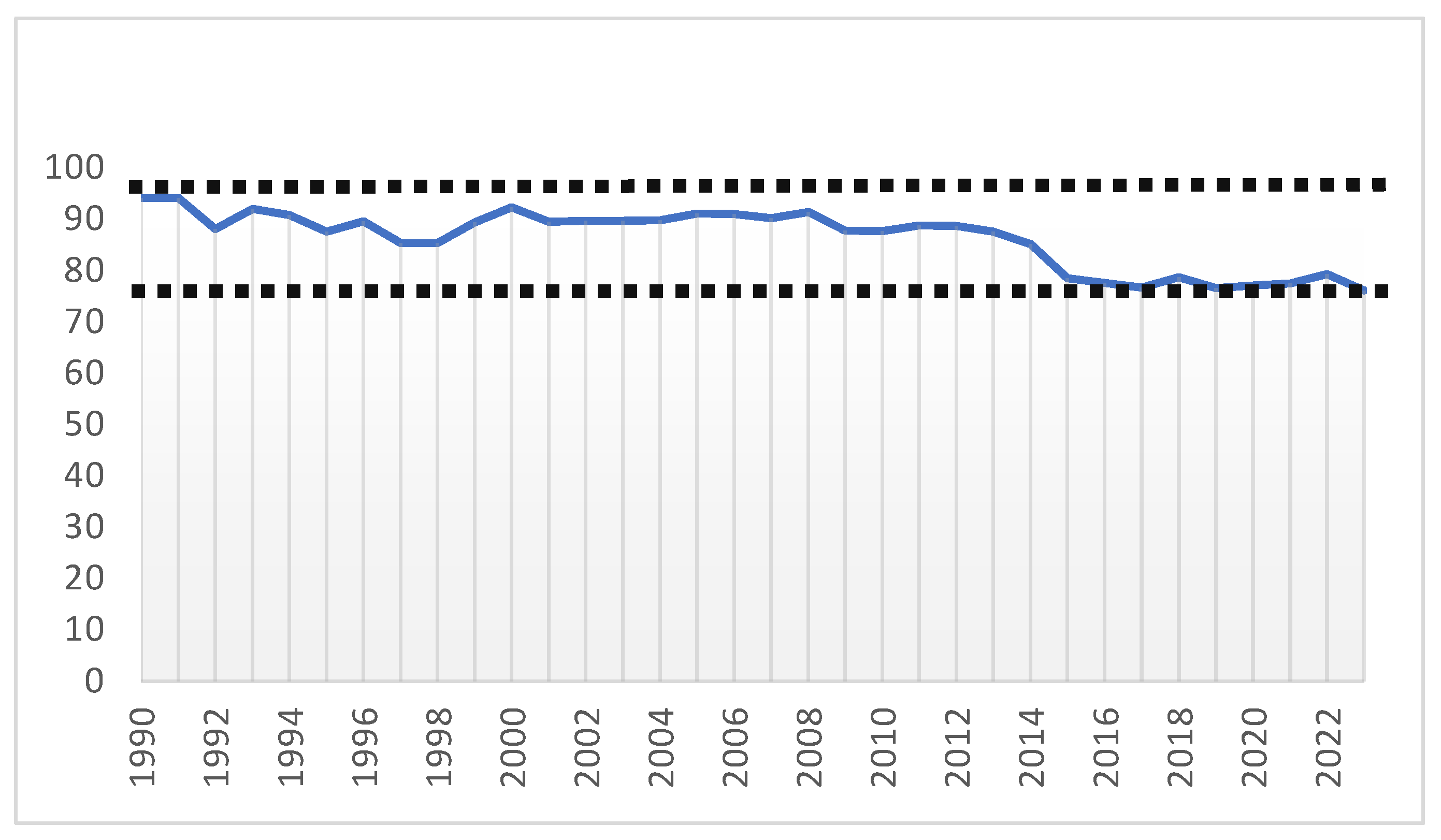
Figure 2.
CUSUM and CUSUM of Squares.
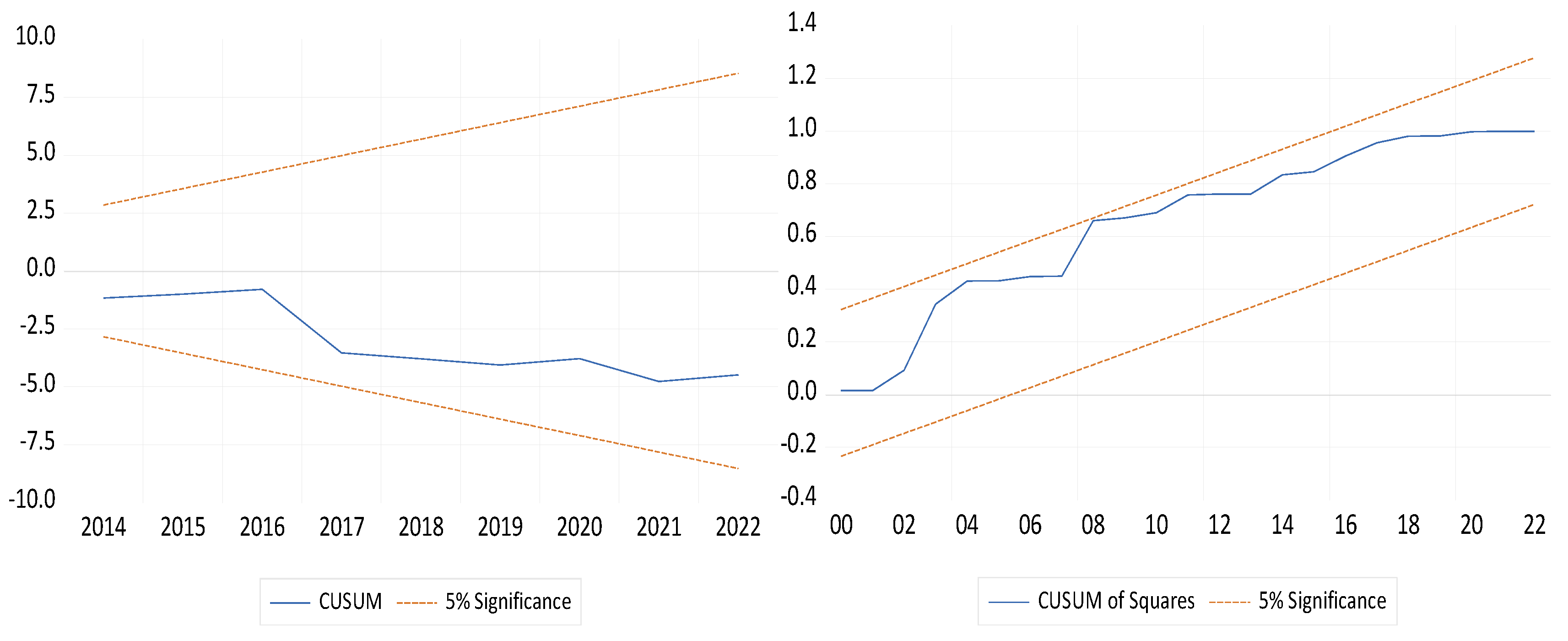
Table 1.
Variables Definitions and Data source.
| Variable Designation | Definition | Data source |
|---|---|---|
| GDPC | Gross Domestic Product per Capita | General Authority for Statistics - Kingdom of Saudi Arabia |
| KI | Capital Intensity; Gross fixed capital formation per capita | General Authority for Statistics - Kingdom of Saudi Arabia |
| DESI | Digitalization index; Digital Economy and Society Index | The European Commission, Digital Economy and Society Index (DESI) annual reports |
| GI | Globalization index | KOF Swiss Economic Institute Database |
| SOGI | Social Globalization Index | |
| ECGI | Economic Globalization index |
Table 2.
Unit Root Tests (ADF).
| Variables | Constant | Constant and trend | Order of Integration | ||
|---|---|---|---|---|---|
| ADF | |||||
| Level | First difference | Level | First Difference | ||
| LNGDPpc | 1.1646 -0.6772 |
-5.106*** -0.0002 |
-2.5845 (0.2892) | -5.305*** (0.0008) |
I(1) |
| lnKI | -0.9648 -0.7536 |
-3.8744*** (0.0061) |
-0.6044 -0.9718 |
-3.7921** (0.0311) |
I(1) |
| DESI | -0.4847 (0.8816) |
-4.6868*** (0.0007) |
-1.1907 (0.8955) |
-4.6139*** (0.0045) |
I(1) |
| GI | -1.5274 -0.5071 |
-5.610*** (0.0001) |
-1.257 (0.8800) |
-5.653*** (0.0003) |
I(1) |
| SOGI | -0.6585 (0.8431) |
-4.1075*** (0.0033) |
-0.7918 | -4.0889** | I(1) |
| -0.956 | -0.0158 | ||||
| ECGI | -1.47949 0.5309 |
-4.3615*** (0.0017) |
-1.4789 (0.8160) |
-4.3026*** (0.0096) |
I(1) |
Note: ***, **: significantly at level of 1% and 5%. Source: The authors’ estimations.
Table 3.
Johanson Cointegration Test.
| Included observations: 31 after adjustments Sample (adjusted): 1992 2022 Series: LNGDPC LNIK GI SOGI ECGI DESI | ||||
| Unrestricted Cointegration Rank Test (Trace) | ||||
| Hypothesized | Trace | 0.05 | ||
| No. of CE(s) | Eigenvalue | Statistic | Critical Value | Prob.** |
| None * | 0.675316 | 87.23589 | 69.81889 | 0.0011 |
| At most 1 * | 0.579090 | 52.36392 | 47.85613 | 0.0178 |
| At most 2 | 0.388354 | 25.53854 | 29.79707 | 0.1431 |
| At most 3 | 0.190513 | 10.29891 | 15.49471 | 0.2584 |
| At most 4 | 0.113849 | 3.746908 | 3.841465 | 0.0529 |
| * rejection of H0 and accept H1 at the 0.05 level **MacKinnon-Haug-Michelis (1999) p-values | ||||
Trace test indicates at most two cointegrating equations at the 0.05 level.
Table 4.
OLS, FMOLS, DOLS and CCR estimation methods:.
| Method: | OLS (Ordinary Least Squares) | FMOLS (Method: Fully Modified Least Squares) | |||
|---|---|---|---|---|---|
| Dependent Variable | LNGDPC | LNGDPC | |||
| Exogenous variables | Medel 1 | Model 2 | Medel 1 | Model 2 | |
| LnKI | 0.0143*** (0.0001) |
0.0184*** (0.0001) |
0.0178*** (0.0001) |
0.0224*** (0.0001) |
|
| GI | -0.0229*** (0.0012) |
-- | -0.0291*** (00011) |
-- | |
| SOGI | -- | -0.0151*** (0.0010) |
-- | -0.0167*** (0.0000) |
|
| ECGI | -- | -0.0149*** (0.0000) |
-- | -0.0189*** (0.0010) |
|
| DESI | 0.0143*** (0.0001) |
0.0184*** (0.0001) |
0.0178*** (0.0001) |
0.0224*** (0.0001) |
|
| C | 10.928*** (0.0000) |
11.304*** (0.0000) |
11.247*** (0.0000) |
11.568*** (0.0000) |
|
| R2 | 0.52 | 0.69 | 0.53 | 0.68 | |
| F-statistic (Prob) | 16.645*** (0.0000) |
22.101*** (0.0000) |
-- | -- | |
| DW | 0.865 | 1.053 | -- | -- | |
| Method: | DOLS (Dynamic Least Squares) | CCR (Method: Canonical Cointegrating Regression) | |||
| Dependent Variable | LNGDPC | LNGDPC | |||
| Exogenous variables | Medel 1 | Model 2 | Medel 1 | Model 2 | |
| lnIK | 0.0143*** (0.0001) |
0.0184*** (0.0001) |
0.0178*** (0.0001) |
0.0224 (0.0001) |
|
| GI | -0.0460*** (0.0044) |
-- | -0.0374*** (0.0044) |
-- | |
| SOGI | -- | -0.0151 (0.0072) |
-- | -0.0236*** (0.0002) |
|
| ECGI | -- | -0.0149 (0.0001) |
-- | -0.0175*** (0.0001) |
|
| DESI | 0.0256*** (0.0010) |
0.0183*** (0.0013) |
0.0172*** (0.0003) |
0.0272*** (0.0000) |
|
| C | 12.114*** (0.0000) |
11.304*** (0.0000) |
11.164*** (0.0000) |
11.812*** (0.0000) |
|
| R2 | 0.79 | 0.69 | 0.63 | ||
Notes: Estimation Methods: The table presents results from four estimation methods: - OLS (Ordinary Least Squares); - FMOLS (Fully Modified Ordinary Least Squares); - DOLS (Dynamic Ordinary Least Squares); - CCR (Canonical Cointegration Regression)
Table 6.
ARDL and ECM Regression (Selected Model: ARDL (3, 4, 4, 1, 4)).
| Dependent Variable: D(LNGDPC) | |||
|---|---|---|---|
| Variable | Coefficient | t-Statistic | Prob. |
| C | 28.92024 | 10.78790 | 0.0001 |
| D(LNGDPC(-1)) | 0.414517 | 4.008896 | 0.0102 |
| D(LNGDPC(-2)) | 0.385545 | 5.131477 | 0.0037 |
| D(LNGDPC(-3)) | 0.524571 | 7.418255 | 0.0007 |
| D(LNIK) | -0.025179 | -0.773019 | 0.4745 |
| D(LNIK(-1)) | 0.364019 | 8.250034 | 0.0004 |
| D(LNIK(-2)) | 0.251768 | 4.455195 | 0.0067 |
| D(LNIK(-3)) | -0.069628 | -1.702502 | 0.1494 |
| D(ECGI) | -0.023887 | -11.10417 | 0.0001 |
| D(ECGI(-1)) | 0.027039 | 9.388091 | 0.0002 |
| D(ECGI(-2)) | 0.023030 | 7.478702 | 0.0007 |
| D(ECGI(-3)) | 0.004861 | 3.592229 | 0.0157 |
| D(SOGI) | 0.018286 | 6.161456 | 0.0016 |
| D(SOGI(-1)) | 0.037073 | 8.426880 | 0.0004 |
| D(SOGI(-2)) | 0.044905 | 10.58820 | 0.0001 |
| D(SOGI(-3)) | 0.027894 | 6.058196 | 0.0018 |
| D(DESI) | 0.008785 | 5.156714 | 0.0036 |
| D(DESI(-1)) | -0.039971 | -9.417697 | 0.0002 |
| D(DESI(-2)) | -0.019365 | -5.319226 | 0.0031 |
| CointEq(-1)* | -2.398715 | -10.79005 | 0.0001 |
| R-squared | 0.981883 | Mean dependent var | 0.003953 |
| Sum squared resid | 0.943637 | S.D. dependent var | 0.039492 |
| Log likelihood | 111.2359 | Akaike info criterion | -6.292134 |
| F-statistic | 25.67284 | Schwarz criterion | -5.349171 |
| Prob(F-statistic) | 0.000013 | Durbin-Watson stat | 1.923511 |
Source: The authors’ estimations.
Table 7.
Cointegration and Bounds tests.
| Null Hypothesis: No levels relationship | Decision | |||||
| F-Bounds Test | Test Statistic | Statistical Value | Significant Level | Lower Bound I(0) | Upper Bound I(1) | |
| F-statistic | 9.5942 | 10% | 1.9 | 3.01 | Cointegration | |
| k | 4 | 5% | 2.26 | 3.48 | ||
| 2.5% | 2.62 | 3.9 | ||||
| 1% | 3.07 | 4.44 | ||||
| t-Bounds Test | t-statistic | -10.790 | 10% | -1.62 | -3.26 | Cointegration |
| 5% | -1.95 | -3.6 | ||||
| 2.5% | -3.58 | -4.23 | ||||
| 1% | -2.58 | -4.23 | ||||
Table 8.
ARDL Model robustness check tests.
| Tests | Value (probability) |
Test results | Decision |
|---|---|---|---|
| Breusch-Godfrey serial correlation LM test for Autocorrelation | 2.0216 (0.2028) |
No serial correlation | The estimated model is fitted and stable |
| Breusch-Pagan-Godfrey for Heteroscedasticity | 2.8408 (0.0663) |
Homoskedasticity | |
| Jarque-Bera Test for Normality | 1.9643 (0.3744) |
Normal distribution | |
| Ramsey RESET Test for Specification | 0.1944 (0.8276) |
Linear data and Functional form |
Source: The authors’ estimations.
Disclaimer/Publisher’s Note: The statements, opinions and data contained in all publications are solely those of the individual author(s) and contributor(s) and not of MDPI and/or the editor(s). MDPI and/or the editor(s) disclaim responsibility for any injury to people or property resulting from any ideas, methods, instructions or products referred to in the content. |
© 2025 by the authors. Licensee MDPI, Basel, Switzerland. This article is an open access article distributed under the terms and conditions of the Creative Commons Attribution (CC BY) license (http://creativecommons.org/licenses/by/4.0/).
Copyright: This open access article is published under a Creative Commons CC BY 4.0 license, which permit the free download, distribution, and reuse, provided that the author and preprint are cited in any reuse.


