
Submitted:
14 February 2025
Posted:
17 February 2025
You are already at the latest version
Abstract
Sustainability is a challenge for contemporary society and a potential source of innovation for organizations. This qualitative case study analyzed, through secondary data, what innovations (product, process, organizational, marketing) are developed by Dengo Chocolates (an industry in the Brazilian cocoa sector) in pursuit of the sustainability tripod. The results indicate that the company develops the four types of innovation, with an emphasis on product innovation. The environmental dimension of sustainability is more affected by its innovations, to the detriment of the economic dimension. Future studies can investigate the economic sustainability of companies with a socio-environmental purpose. Furthermore, it is suggested that additional studies be carried out on Sustainability-Oriented Innovation in small and medium-sized Brazilian companies, considering that these constitute most commercial enterprises in the country.
Keywords:
Sustainability-oriented innovation
; innovation
; cocoa sector
; Brazil
1. Introduction
The growing debates on ecological and social challenges of contemporary society, coupled with the widespread dissemination of the concept of sustainable development (SD), have led organizations to consider adopting sustainable and social practices in their strategies [1]. Companies face the challenge of not only reevaluating their role in society but also developing innovations to minimize the negative effects of economic activities and resource exploitation, whether to comply with government and regulatory pressures or to adapt to new market demands [2].
One way to minimize these effects is through Sustainability-Oriented Innovation (SOI). SOI is a subset of innovation that focuses on not just maximizing profits but also on minimizing negative consequences for the environment and society [3]. SOI focuses on developing and disseminating products, services, and processes that go beyond economic returns: it aims for environmental and social value [4,5]. It involves an intentional change in the values and philosophy of organizations [5], which can manifest through the (re)design of a product, efficient use of production resources, optimization of the supply chain, implementation of new organizational routines to improve business sustainability performance, among other possibilities [4].
Because of the need to integrate knowledge related to economic, social, and environmental dimensions [5], SOI is inherently systemic and more complex compared to traditional innovations, requiring greater interaction among different actors [6]. SOI is seen as a systematic effort by organizations to promote the role of competitiveness and human and social welfare in building environmentally friendly practices. Furthermore, SOI requires strategic sustainability behavior by implementing an integrated environmental strategy, creating an environmentally friendly culture, extending the product life cycle, and initiating an environmental management system [7].
Therefore, alliances between different agents emerge as an important tool to complement resources and acquire competencies necessary for the development of socio-environmental solutions [4,6]. Despite its importance, SOI remains underexplored in Brazilian organizations. However, a notable chocolate-producing company has stood out for its focus on sustainability and social impact: Dengo Chocolates (DC). By incorporating sustainability principles into its business model and offering a high-quality product, DC founded in 2017, has attracted attention both within and beyond the market context. It has also been the subject of academic studies in the areas of business management and sustainability [8] and geography [9]. However, no studies have yet analyzed the SOI approach adopted by the company.
This paper seeks, through a case study based on secondary data, to answer the following research question: What type of innovations (product, process, organizational, or marketing) are developed by DC in alignment with the sustainability tripod? It also aims to: (1) identify the innovations undertaken by DC, (2) classify these innovations and (3) relate them to the social, environmental, and economic dimensions of sustainability. Given that knowledge about SOI is still emerging in the field of business research and that Brazilian academic production on the subject presents significant gaps [10], the research demonstrates strong theoretical-empirical relevance. Moreover, it can promote a deeper reflection on the economic sustainability of organizations that stand out for their socio-environmental impact initiatives.
[11] defined innovation as a process of creative destruction, arising from the recombination of available production factors, which leads to new products, production methods, market expansion, access to new sources of raw materials, or even new organizational structures within industries. According to Schumpeter [12], economic development is closely linked to the introduction of innovations by entrepreneurs, who drive differentiation and competitiveness among nations.
Innovation can occur in different areas and sectors within an organization, encompassing a wide range of changes in firms’ activities [13]. There are four types of innovation:
(a) Product innovation – the introduction of a new or significantly improved good or service in the market, considering its characteristics or intended uses;
(b) Process innovation – the adoption of a new or significantly improved production or delivery method, which involves changes in techniques, equipment, and/or software;
(c) Marketing innovation – the implementation of a new marketing method, including significant transformations in product design, packaging, placement, promotion, or pricing;
(d) Organizational innovation – the adoption of a new organizational method in the firm’s business practices, workplace organization, or external relations [13].
With the increasing discussions on sustainability, many organizations are incorporating environmentally and socially responsible practices into their strategies [1,5]. In this context, innovation has been recognized as an important tool for sustainability [14,15]. Initially, SOI was related only to eco-innovations, understood as new routines, processes, or technologies designed to reduce environmental problems [4]. Gradually, the concept expanded to incorporate the social dimension [4]. However, the literature still presents a variety of terminologies to describe SOI, making a clear and standardized definition challenging [5]. In this study, we adopt the definition provided by [4,5], which conceptualizes SOI as an intentional change in organizational philosophy and values, as well as in its products, processes, and practices, with the explicit goal of creating social and environmental value, in addition to generating economic returns.
According to [4], SOI can manifest in three forms:
(a) Product innovation, related to initiatives such as the use of reusable packaging, eco-friendly design, life cycle analysis, product certification, and fair trade marketing;
(b) Process innovation, which includes concepts like clean production, eco-efficiency, waste treatment, and efficient transportation systems;
(c) Organizational innovation, associated with sustainable supply chain management, employee training and engagement in sustainability-focused activities, and redesigning internal innovation processes.
In business environments, the definitions, criteria, and expectations guiding SOI may vary considerably [14]. Companies may adopt a reactive posture focused solely on regulatory compliance, limiting themselves to incremental innovations at the process level or minor modifications in products and organizational routines [4]. Alternatively, organizations can adopt a proactive approach, integrating sustainability into their strategies and developing innovative solutions to gain a competitive advantage [5]. Ultimately, SOI has the potential to drive systemic change, transcending business boundaries and involving external agents in the creation of innovations that contribute to sustainable development [5].
2. Materials and Methods
This study aims to identify the types of innovations (product, process, organizational, and marketing) developed by Dengo Chocolates (DC) in alignment with the sustainability tripod (environmental, social, and economic dimensions). To achieve this goal, the following objectives were established: (1) Identify the innovations undertaken by DC; (2) Classify these innovations into predefined categories (product, process, organizational, and marketing); and (3) Analyze the relationship between these innovations and the three dimensions of sustainability.
Thus, this research is characterized as a qualitative, descriptive case study [16,17,18]. The qualitative approach was selected due to its suitability for exploring complex, context-dependent phenomena, where the richness of descriptions provides a deeper understanding of processes and behaviors. Qualitative research allows for the examination of meanings, patterns, and interconnections, making it an appropriate methodology for investigating how sustainability-oriented innovations manifest in an organization [16].
The case study strategy was chosen because it enables an in-depth empirical investigation of a contemporary phenomenon within its real-world context, particularly when the boundaries between the phenomenon and the context are not clearly defined [17]. This approach is especially relevant for addressing research questions such as "how" and "why", as it facilitates a holistic analysis of innovation dynamics in sustainability-focused organizations. The case study method also allows for the integration of multiple sources of evidence, strengthening the validity of the findings [18]. The research is descriptive in nature, as it seeks to systematically document and categorize the types of innovations present in DC, rather than test causal relationships or predictive models [17].
2.1. Data Collection
The study relies exclusively on secondary data sources, which include: (1) Peer-reviewed scientific articles related to sustainability-oriented innovation, the cocoa industry, and corporate sustainability strategies; (2) Institutional reports from DC, detailing their sustainability policies, supply chain practices, and innovation strategies; and (3) Magazine articles, industry reports, and publicly available documents that provide contextual insights into DC’s sustainability efforts and market positioning. The study adopts a cross-sectional temporal scope, meaning that data were collected and analyzed within a specific period, focusing on recent developments in DC’s sustainability initiatives [17].
2.2. Data Analysis
To process and interpret the collected data, content analysis was employed, following the methodological guidelines proposed by [19]. Content analysis is a systematic and replicable technique used to identify patterns, themes, and key insights within textual data, making it particularly effective for analyzing corporate strategies related to sustainability and innovation.
The analysis was structured around eight predefined thematic units, ensuring a rigorous and structured examination of the innovations developed by DC:
- Innovation – General identification of innovative practices within the company;
- Types of Innovation – Classification into product, process, organizational, and marketing innovations;
- Environmental Sustainability – Assessment of innovations aimed at reducing environmental impact;
- Social Sustainability – Identification of initiatives that contribute to social well-being and stakeholder engagement;
- Economic Sustainability – Analysis of business viability and financial resilience associated with sustainability-oriented innovations;
- Supply Chain Integration – Examination of collaborative partnerships within the cocoa production ecosystem;
- Technology and Digital Transformation – Investigation of digital tools and smart technologies used to enhance sustainable production;
- Corporate Strategy and Branding – Evaluation of how sustainability-oriented innovation is embedded into DC’s brand positioning and market strategy.
Through this structured analytical approach, the study systematically identified what types of innovations (product, process, organizational, and marketing) are developed by DC and how they contribute to the triple bottom line (environmental, social, and economic sustainability). The use of content analysis ensured a rigorous and replicable examination, strengthening the credibility of the research findings.
3. Results and Discussion
This section presents the results obtained from the analysis of Dengo Chocolates (DC) as a case study in sustainability-oriented innovation. The discussion explores the implications of the company's strategies, connecting them to broader theoretical and practical perspectives on sustainable business models.
3.1. Presentation of the Company and its Innovations Undertaken
DC is a Brazilian premium chocolate brand founded in 2017, focused on sustainability and ethical sourcing. In 2021, it received the Best Chocolate Award in the state of Rio de Janeiro [20]. Currently, the company operates 35 physical stores in six Brazilian states, a store in Paris, France, and maintains a strong online presence [21].
3.1.1. Sustainability-Oriented Production Model
One of DC’s main differentiators is its “Bean to Bar” production method, which ensures full traceability from cocoa bean cultivation to the final chocolate product. This model allows the company to monitor quality standards, ensure fair trade practices, and reduce intermediaries in the supply chain, leading to higher financial returns for cocoa producers [8].
DC’s sustainability efforts go beyond its direct economic relationships and extend to environmental and social practices. For instance, the company prioritizes ‘cabruca’ cocoa, a cultivation method in which cocoa trees grow within the Atlantic Forest under the shade of native trees. This agroforestry approach reduces deforestation, promotes biodiversity conservation, and enhances carbon sequestration, aligning with global efforts to mitigate climate change impacts in the cocoa industry [22].
Another critical aspect of DC's sustainability model is its commitment to conscious consumption. The company takes concrete actions to reduce plastic usage, develop eco-friendly packaging, and repurpose cocoa bean residues in the production of teas and nibs. Additionally, it encourages customers to purchase bulk chocolates, minimizing waste generation and reinforcing sustainability-oriented consumer behavior [23].
3.1.2. Inclusive and Ethical Supply Chain
DC operates within a fair business model, aiming to improve income distribution among small and medium-sized rural cocoa producers. From 2020 to 2023, the company and its partners conducted over 200 training sessions and technical visits to enhance agricultural knowledge and optimize production methods [26].
The company's supply network includes 160 smallholder cocoa farmers in Southern Bahia, who receive 85% higher-than-average annual payments compared to standard market rates [8]. This pricing strategy seeks to empower producers, helping them overcome financial instability, avoid reliance on volatile commodity pricing, and invest in more sustainable farming practices.
Unlike conventional chocolate companies, DC does not enforce exclusive supply contracts. Instead, it fosters an open and transparent business relationship, allowing farmers to freely negotiate prices and expand their buyer network. However, DC incentivizes loyalty by offering continuous technical support, training, and business development programs [8,24]. This approach enhances farmer autonomy, strengthens rural development, and contributes to long-term industry resilience.
3.1.3. Diversification Strategy and Expansion Beyond Chocolate
In addition to chocolate, DC has expanded into the coffee market, applying the same sustainability and fair trade principles. By sourcing coffee beans from small producers in São Paulo and Minas Gerais, the company extends its impact to other agricultural sectors, reinforcing its commitment to ethical supply chain practices [25].
DC has positioned itself as a leader in the premium sustainable food segment, improving the reputation of Brazilian cocoa and coffee internationally. This strategic branding aligns with global trends in conscious capitalism, where companies differentiate themselves by integrating purpose-driven business models with high-quality products [23].
3.1.4. Alignment with Global Sustainability Goals
DC's business operations are closely aligned with the United Nations Sustainable Development Goals (SDGs). Specifically, the company contributes to:
- SDG 12 (Responsible Consumption and Production): By minimizing waste, reducing plastic use, and promoting sustainable agriculture;
- SDG 13 (Climate Action): Through deforestation-free cocoa production and sustainable sourcing;
- SDG 8 (Decent Work and Economic Growth): By offering fair wages and supporting small-scale farmers;
- SDG 15 (Life on Land): By encouraging biodiversity through the cabruca cocoa agroforestry system [27].
Given its emphasis on sustainability, DC represents a high-impact business model that integrates profitability, environmental responsibility, and social equity. However, challenges remain in scaling this model while maintaining financial sustainability, which will be further explored in future research.
The following table presents an overview of DC’s sustainability-oriented innovations, categorized according to product, process, organizational, and marketing innovations.
3.2. Relationship Between the innovations and the dimensions of sustainability
After presenting the innovations developed by Dengo Chocolates (DC) and their classification in Table 1, this section examines how these innovations align with the three dimensions of sustainability: environmental, social, and economic. The discussion highlights both the strengths and challenges of DC’s sustainability-oriented innovation approach. To exemplify the relationship between product, process, organizational and marketing innovations with the sustainability tripod, Figure 1 was developed.
3.2.1. Environmental Dimension
One of the key aspects of DC’s environmental commitment is its partnership-driven approach to sustainability. Through collaborations with cocoa farmers and environmental organizations, DC promotes knowledge exchange on sustainable agricultural practices and biodiversity conservation. This exchange is particularly beneficial in supporting small-scale farmers, who often have deep traditional knowledge of the cabruca cultivation system but lack access to modern sustainable technologies [8].
The cabruca agroforestry system, adopted by DC and its partners, is a prime example of an environmentally sustainable innovation. Unlike conventional cocoa farming, which often contributes to deforestation and soil degradation, cabruca involves growing cocoa under the shade of native Atlantic Forest trees. This method not only preserves biodiversity but also maintains soil health, prevents erosion, and contributes to carbon sequestration [28,29]. Since its foundation, DC has contributed to the preservation of 220,337 hectares of forest [22], reinforcing its commitment to climate action (SDG 13) and life on land conservation (SDG 15).
Another major environmental initiative is DC’s waste reduction and eco-friendly packaging strategy. By prioritizing bulk sales and recyclable packaging materials, the company reduces plastic consumption and promotes circular economy principles. Additionally, DC repurposes cocoa bean by-products—such as husks and nibs—to create value-added products like teas and snacks, minimizing industrial waste [23]. These initiatives are aligned with SDG 12 (Responsible Consumption and Production), as they optimize resource efficiency and encourage sustainable consumer behavior.
Moreover, DC’s emphasis on health-conscious formulations—such as chocolates with higher cocoa content and no artificial additives—contributes to both environmental sustainability and consumer well-being. By avoiding the use of synthetic flavors and preservatives, the company reduces chemical waste in production while aligning with growing consumer demand for natural and minimally processed products [27].
3.2.2. Social Dimension
DC’s sustainability strategy also has strong social implications, particularly in fostering equitable labor conditions and rural development. One of the company's most significant contributions is its direct engagement with cocoa farmers, ensuring better income distribution and professional training.
From 2020 to 2023, DC and its partners conducted over 200 training sessions and technical visits to smallholder farms, providing knowledge on agroforestry techniques, pest management, and post-harvest processing [26]. These efforts help farmers increase productivity while maintaining eco-friendly farming practices, reducing dependence on environmentally harmful agricultural inputs.
The "Bean to Bar" model is another cornerstone of DC’s social impact. By eliminating intermediaries, the company ensures that a higher share of profits goes directly to producers. On average, DC’s cocoa suppliers receive 92% of the stock exchange value of cocoa, a rate significantly higher than industry norms [22]. This fair-trade model fosters financial stability among small farmers and helps combat exploitative labor practices that are prevalent in conventional cocoa supply chains [24].
DC also actively works to prevent child labor, informal work, and forced labor in its supply chain. The company monitors school attendance among children in cocoa-farming communities, and farms found to be non-compliant with labor standards are suspended from supplying cocoa until necessary corrections are made [8]. This initiative aligns with SDG 8 (Decent Work and Economic Growth) and reflects corporate responsibility in promoting ethical labor standards.
Another relevant aspect of DC’s social innovation strategy is its collaboration with research institutes and non-profit organizations. Partnerships with institutions such as the Innovation Center of Cocoa and the Arapyau Institute provide technical training and business development support to small-scale farmers [30]. These collaborations bridge the gap between academic research and real-world agricultural practices, ensuring that sustainability-oriented innovations reach local communities.
Furthermore, DC promotes the storytelling of rural producers on its digital platforms, highlighting the social and cultural importance of cocoa farming [25]. By incorporating producers’ life stories into its branding, DC enhances consumer awareness of the human impact behind sustainable chocolate production.
3.2.3. Economic Dimension
While DC’s environmental and social innovations demonstrate significant success, its financial sustainability remains a major challenge. The company’s rapid expansion strategy, particularly the opening of new retail stores in high-end locations, has resulted in substantial financial losses.
In 2021, DC reported a negative EBITDA margin of 60%, equivalent to R$62 million in losses [31]. Over the past three years, its accumulated losses have exceeded 80% of revenue, raising concerns about the scalability and profitability of its sustainability-driven business model. The company has yet to achieve a financial balance between sustainability investments and economic returns, which remains a key obstacle to long-term viability [31].
One of the primary factors contributing to these losses is the high operational cost of its direct-to-consumer retail model. While premium chocolate brands typically rely on third-party distribution networks, DC has invested heavily in flagship stores, which require substantial capital expenditures. The challenge lies in maintaining financial sustainability without compromising its commitment to fair trade and environmental responsibility [26].
While DC has expanded into international markets, its model must prove scalable beyond niche consumer segments. The success of sustainability-oriented products is highly dependent on consumer engagement.
Despite these financial challenges, DC continues to attract investor interest, particularly from banks and sustainability-focused investment funds. The company’s brand position as a premium sustainable chocolate producer aligns with growing consumer demand for ethically sourced, high-quality food products.
To improve its financial resilience, DC has been exploring strategies such as strengthening partnerships with retailers, expanding international distribution, and enhancing e-commerce sales. These measures aim to diversify revenue streams and optimize operational costs while preserving sustainability commitments [26].
The success of sustainability-driven brands is often dependent on consumer education and demand. Although DC promotes conscious consumption, further research is needed to understand how consumer preferences evolve regarding ethical food sourcing and premium sustainable products.
Despite its socio-environmental achievements, DC has faced profitability constraints. The company has not yet fully balanced environmental investments with financial sustainability. DC must develop strategies to balance sustainability investments with profitability. While DC has successfully expanded within Brazil and internationally, questions remain regarding how this model can be adapted and scaled to other agricultural supply chains.
4. Conclusions
This study sought to answer the following research question: What types of innovation (product, process, organizational, and marketing) are developed by Dengo Chocolates (DC) in pursuit of the sustainability tripod (environmental, social, and economic)? Through the analysis of DC’s innovation strategies, it was observed that the company has implemented multiple innovations across these categories, with particular emphasis on product, process, and organizational innovations. Each of these innovations contributes to varying degrees, to the three dimensions of sustainability. However, the environmental and social impacts of these initiatives are significantly more pronounced than their economic impact.
DC’s Sustainability-Oriented Innovation (SOI) model has led to positive transformations within its ecosystem, particularly benefiting small cocoa producers in Southern Bahia. The company has played a crucial role in preserving the Atlantic Forest through its cabruca cultivation model, promoting local development, and enhancing the autonomy and financial stability of rural producers. Furthermore, DC has advanced the principles of fair trade and responsible consumption, reinforcing its commitment to social and environmental sustainability.
Despite these accomplishments, one of the most pressing challenges for DC remains its economic sustainability. The company has yet to achieve a balance between its socio-environmental initiatives and financial performance, a critical factor for ensuring its long-term viability. The high operational costs associated with its direct-to-consumer model, combined with substantial recent financial losses, highlight the need for strategic adjustments. Future research could explore alternative business models, cost reduction strategies, and scalable approaches that would allow DC to maintain its commitment to sustainability while enhancing financial resilience.
This study represents a contribution to the theoretical-empirical framework of SOI, particularly within the context of the Brazilian business environment, where academic literature on this topic remains relatively underdeveloped. However, certain limitations must be acknowledged. First, the qualitative nature of the research restricts the generalizability of the findings beyond the case analyzed. Additionally, the reliance on secondary data sources may have constrained the depth of the analysis.
Future studies should consider conducting longitudinal analyses of financial performance and business survival metrics for companies adopting sustainability-driven models. Additionally, there is a need for empirical research on SOI in small and medium-sized Brazilian enterprises, as they represent most commercial establishments in the country and possess distinct innovation dynamics. By expanding the empirical basis of SOI research, future investigations can provide practical insights for businesses, policymakers, and academics, supporting the development of sustainable innovation ecosystems.
Ultimately, DC’s case exemplifies both the opportunities and challenges of integrating sustainability-oriented innovation into business strategy. While its environmental and social contributions are undeniable, the company must continue evolving to ensure its financial sustainability and scalability. The insights from this study can serve as a foundation for further research, helping businesses and scholars refine the best practices for aligning profitability with ethical and ecological commitments.
Author Contributions
Conceptualization, FSA; methodology, FSSF, ETF and MON; software, FSSF and FSA; validation, FSA, FSSF, ETF and MON; formal analysis, FSSF and FSA; investigation, ETF and MON; resources, FSA, FSSF, ETF and MON; data curation, FSA, FSSF, ETF and MON; writing—original draft preparation, FSSF, ETF and MON; writing—review and editing, FSA; visualization, FSA; supervision, FSA; project administration, FSA. All authors have read and agreed to the published version of the manuscript.
Institutional Review Board Statement
Not applicable
Informed Consent Statement
Not applicable
Conflicts of Interest
The authors declare no conflicts of interest.
References
- Morais-da-Silva, R. L.; Orsiolli, T. A. E.; Nobre, F. S. M. Sustainable Entrepreneurial Ventures and the Bottom of the Pyramid: Creating Sustainable Values and Opportunities. BAR 19(1) (2022). [CrossRef]
- Hansen, E. G.; Wicki, S.; Schaltegger, S. Technology exploration: managerial values, ambidextrous design, and separation drift. International Journal of Innovation and Management 26(5), 57-75 (2022).
- Harsanto, B., Mulyana, A., Faisal, Y. A., Shandy, V. M., & Alam, M. (2022). A Systematic Review on Sustainability-Oriented Innovation in the Social Enterprises. Sustainability, 14(22), 14771. [CrossRef]
- Klewitz, J.; Hansen, E. G. Sustainability -oriented innovation of SMEs: a systematic review. Journal of Cleaner Production 65, 57-75 (2014). [CrossRef]
- Adams, R.; Jeanrenaud, S.; Bessant, J.; Denyer, D.; Overy, P. Sustainability-oriented innovation: a systematic review. International Journal of Management Reviews 18, 180-205 (2016). [CrossRef]
- Calik, E.; Badurdeen, F.; Bal, A. Cooperation networks and organizational factors on sustainable innovation. Journal on Innovation and Sustainability 11(1), 94-121 (2020). [CrossRef]
- Koval, V., Arsawan, I. W. E., Suryantini, N. P. S., Kovbasenko, S., Fisunenko, N., & Aloshyna, T. (2023). Circular Economy and Sustainability-Oriented Innovation: Conceptual Framework and Energy Future Avenue. Energies, 16(1), 243. [CrossRef]
- Mello, M. H. B. de; Ferreira, G. T. C. Como o Cacau Cabruca na Bahia pode estimular o desenvolvimento rural: Um estudo de caso sobre a DENGO Chocolates. In: XXII ENGEMA, São Paulo, FEA/USP (2020).
- Xavier, L. B.; Nascimento Jr.; F. C.; Chiapetti, J. Da crise regional às novas dinâmicas de especialização da produção de cacau do sul da Bahia. Revista Caminhos de Geografia 22(79), 77-96 (2021).
- Pinsky, V.; Kruglianskas, I. Inovação tecnológica para sustentabilidade: aprendizados de sucesso e fracasso. Estudos avançados 31(90), 107-126 (2017). [CrossRef]
- Schumpeter, J. A. Teoria do desenvolvimento econômico: uma investigação sobre lucros, capital, crédito, juro e o ciclo econômico. São Paulo, Editora Abril S.A. (1982).
- Rapini, M. S.; Ruffoni, J.; Silva, L. A.; Motta e Albuquerque, E. da. Economia da ciência, tecnologia e inovação: fundamentos teóricos e a economia global. 2 ed. Belo Horizonte, FACE – UFMG (2021).
- OECD / Eurostat. Oslo Manual: Guidelines for Collecting and Interpreting Innovation Data. 3rd edn. The Measurement of Scientific and Technological Activities. Paris, OECD Publishing (2005).
- Mead, T.; Jeanrenaud, S.; Bessant, J. Sustainability oriented innovation narratives: Learning from nature inspired innovation. Journal of Cleaner Production 344 (2022). [CrossRef]
- Souto, J. E. Organizational creativity and sustainability-oriented innovation as drivers of sustainable development: overcoming firms' economic, environmental and social sustainability challenges. Journal of Manufacturing Technology Management 33(4), 805-825 (2022). [CrossRef]
- Yin, R. Estudo de caso: Planejamento e Métodos. 5. ed. Porto Alegre, Bookman (2015).
- Kumar, R. Research Methodology: a step -by-step guide for beginners. 3 ed. London, Sage (2011).
- Creswell, J. Projeto de pesquisa: métodos qualitativo, quantitativo e misto. 2. ed. Porto Alegre, Artmed (2007).
- Bardin, L. Análise de Conteúdo. São Paulo, Edições 70 (2016).
- Veja Rio Homepage, https://vejario.abril.com.br/comer-e-beber/dengo, last accessed 2023/06/15.
- CNN Brasil Homepage, https://www.cnnbrasil.com.br/viagemegastronomia/gastronomia/com-produtos-100-brasileiros-dengo-chocolates-abre-unidade-em-paris/, last accessed 2023/06/10.
- Dengo Homepage, https://dengo.com/pt/pages/impact, last accessed 2023/06/12.
- Adriano Frachetta Homepage, https://pt.linkedin.com/pulse/branding-de-sustentabilidade-dengo-e-o-chocolate-com-sabor-frachetta, last accessed 2023/06/15.
- Forbes Agro Homepage, https://forbes.com.br/forbesagro/2022/03/por-que-a-dengo-paga-mais-aos-produtores-pelo-cacau-de-seus-chocolates/, last accessed 2023/06/05.
- Pulsar Homepage, https://www.estudioroxo.com.br/blogpulsar/branding-de-sustentabilidade-dengo-e-o-chocolate-com-sabor-de-mudar-o-mundo/, last accessed 2023/06/02.
- Brazil Journal Homepage, https://braziljournal.com/dengo-a-fantastica-marca-de-chocolate-do-fundador-da-natura/, last accessed 2023/06/26.
- SEBRAE Homepage, https://sp.agenciasebrae.com.br/modelos-de-negocio/nao-e-so-chocolate-estevan-sartoreli-da-dengo-explica-como-a-marca-une-sabor-e-responsabilidade-social/, last accessed 2023/06/13.
- Santos, M. V. C., Eltz, F. L. F. Perdas de solo e água em sistemas de culturas com milho sob plantio direto. In: XIII Reunião Brasileira de manejo e conservação do solo e da água, Ilhéus, CEPLAC (2002).
- Pereira, R. G. C. A importância da produção do chocolate Bean to Bar no Brasil na busca por maior justiça social para os inseridos na cadeia produtiva do cacau. Trabalho de conclusão de curso do Programa de Pós-Graduação em Cultura e Sociobiodiversidade em Gastronomia, Instituto Federal de Santa Catarina, Florianópolis (2022).
- Arapyau Homepage, https://arapyau.org.br/estadao-chocolate-sustentavel-da-bahia-quer-ganhar-o-mundo/amp/, last accessed 2023/06/12.
- Klooks Homepage, https://www.klooks.com.br/blog/as-empresas-com-apelo-de-sustentabilidade-sao-sustentaveis-economicamente/, last accessed 2023/06/10.
Figure 1.
Innovations undertaken by DC and their relationship with the sustainability tripod.
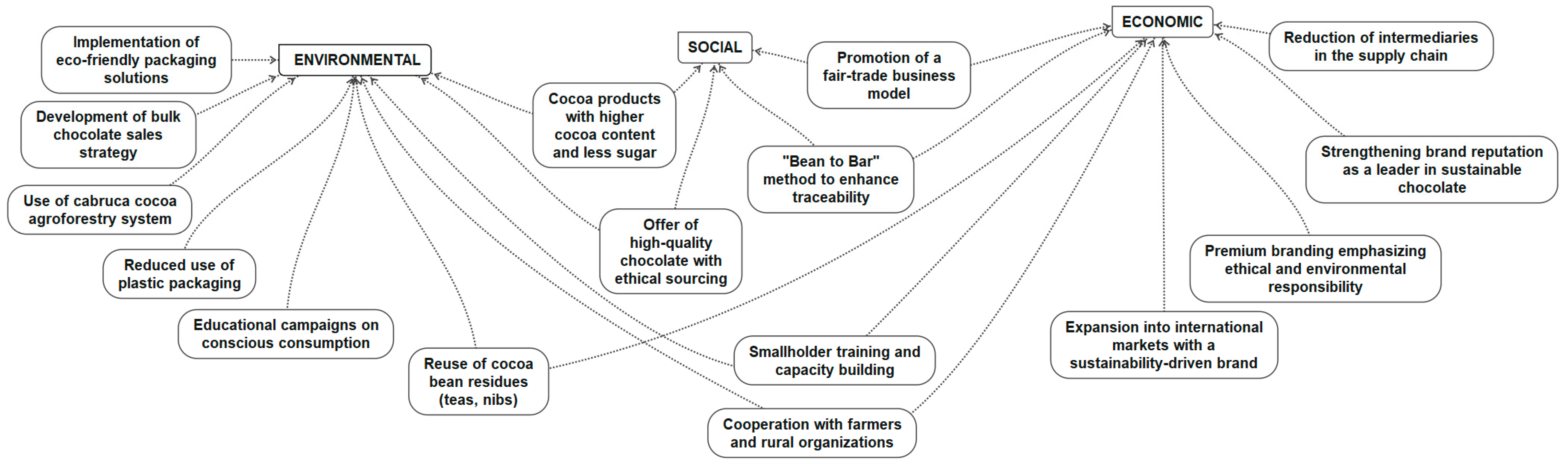

Table 1.
Innovations undertaken by DC and their classification by type
| Product Innovation | Process Innovation | Organizational Innovation | Marketing Innovation |
|---|---|---|---|
| Offer of high-quality chocolate with ethical sourcing | "Bean to Bar" method to enhance traceability | Promotion of a fair-trade business model | Strengthening brand reputation as a leader in sustainable chocolate |
| Cocoa products with higher cocoa content and less sugar | Reduced use of plastic packaging | Reduction of intermediaries in the supply chain | Educational campaigns on conscious consumption |
| Use of cabruca cocoa agroforestry system | Reuse of cocoa bean residues (teas, nibs) | Smallholder training and capacity building | Expansion into international markets with a sustainability-driven brand |
| Development of bulk chocolate sales strategy | Implementation of eco-friendly packaging solutions | Cooperation with farmers and rural organizations | Premium branding emphasizing ethical and environmental responsibility |
Disclaimer/Publisher’s Note: The statements, opinions and data contained in all publications are solely those of the individual author(s) and contributor(s) and not of MDPI and/or the editor(s). MDPI and/or the editor(s) disclaim responsibility for any injury to people or property resulting from any ideas, methods, instructions or products referred to in the content. |
© 2025 by the authors. Licensee MDPI, Basel, Switzerland. This article is an open access article distributed under the terms and conditions of the Creative Commons Attribution (CC BY) license (http://creativecommons.org/licenses/by/4.0/).
Copyright: This open access article is published under a Creative Commons CC BY 4.0 license, which permit the free download, distribution, and reuse, provided that the author and preprint are cited in any reuse.


