

Submitted:
13 February 2025
Posted:
17 February 2025
You are already at the latest version
Abstract
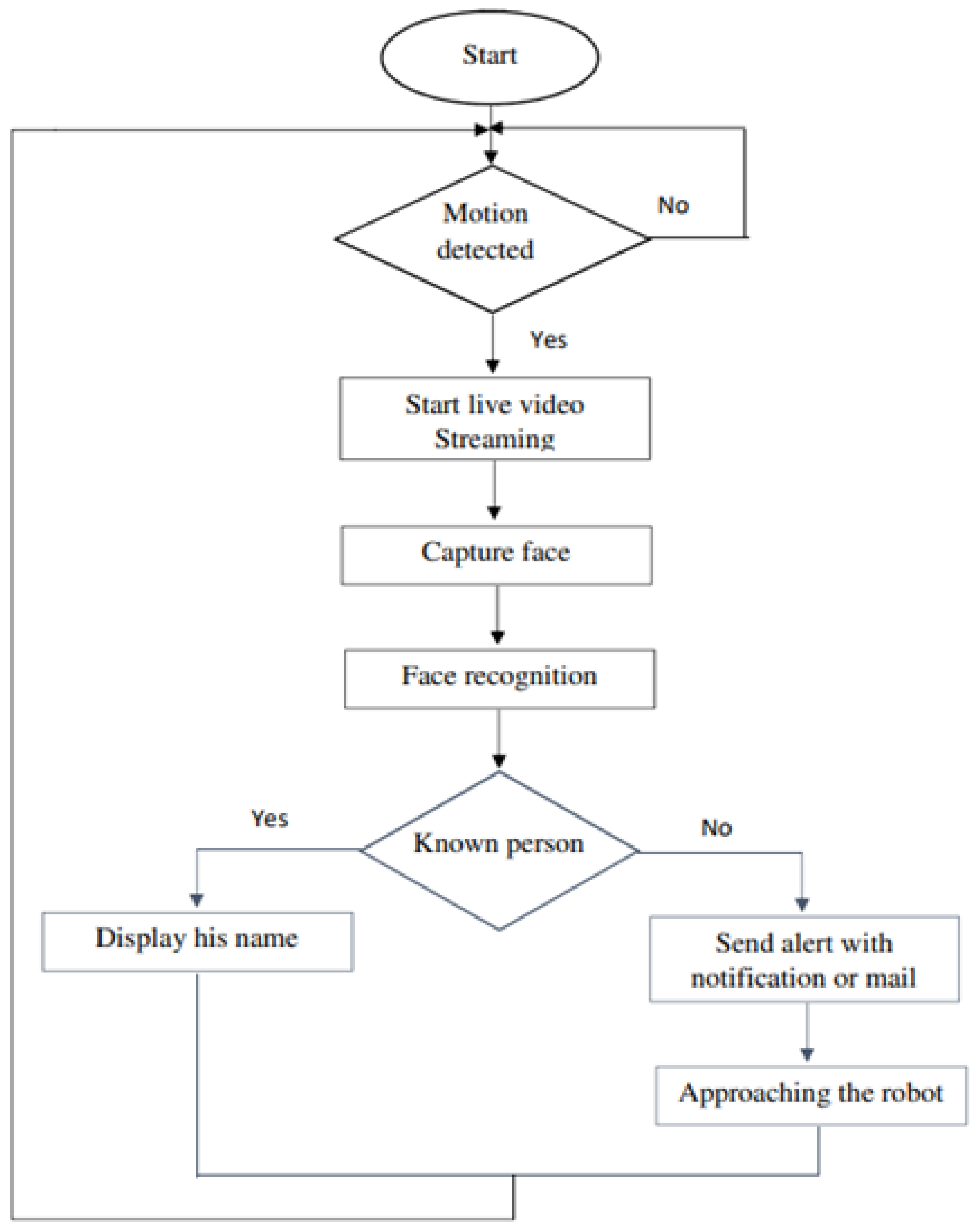
The recent advancements in technologies such as artificial intelligence (AI), computer vision (CV), and Internet of Things (IoT) have significantly extended various fields, particularly in surveillance systems. These innovations enable real-time facial recognition processing, enhancing security and ensuring safety. However, mobile robots are commonly employed in surveillance systems to handle risky tasks that are beyond human capability. In this context, we present a prototype of a cost-effective mobile surveillance robot built on the Raspberry PI 4, designed for integration into various industrial environments. This smart robot detects intruders using IoT and face recognition technology. The proposed system is equipped with passive infrared (PIR) sensor and a camera for capturing live-streaming video and photos, which are sent to the control room through IoT technology. Additionally, the system uses the face recognition algorithms to differentiate between company staff and potential intruders. The face recognition method combines high-order statistical features and evidence theory to improve facial recognition accuracy and robustness. High-order statistical features are used to capture complex patterns in facial images, enhancing discrimination between individuals. Evidence theory is employed to integrate multiple information sources, allowing for better decision-making under uncertainty. This approach effectively addresses challenges such as variations in lighting, facial expressions, and occlusions, resulting in a more reliable and accurate face recognition system. Upon detecting an unfamiliar individual, the system sends alert notifications and an email with the captured image to the control room through IoT. Additionally, a web interface was created to remotely operate the robot via a WiFi connection. The proposed method for human face recognition is evaluated, and a comparative analysis with existing techniques is conducted. Experimental results with 400 test images of 40 individuals demonstrates the effectiveness of combining various attribute images in improving human face recognition performance. Experimental results shows that the algorithm achieves an accuracy of 98.63% in identifying human faces.
Keywords:
1. Introduction
2. The Proposed Robot Surveillance System
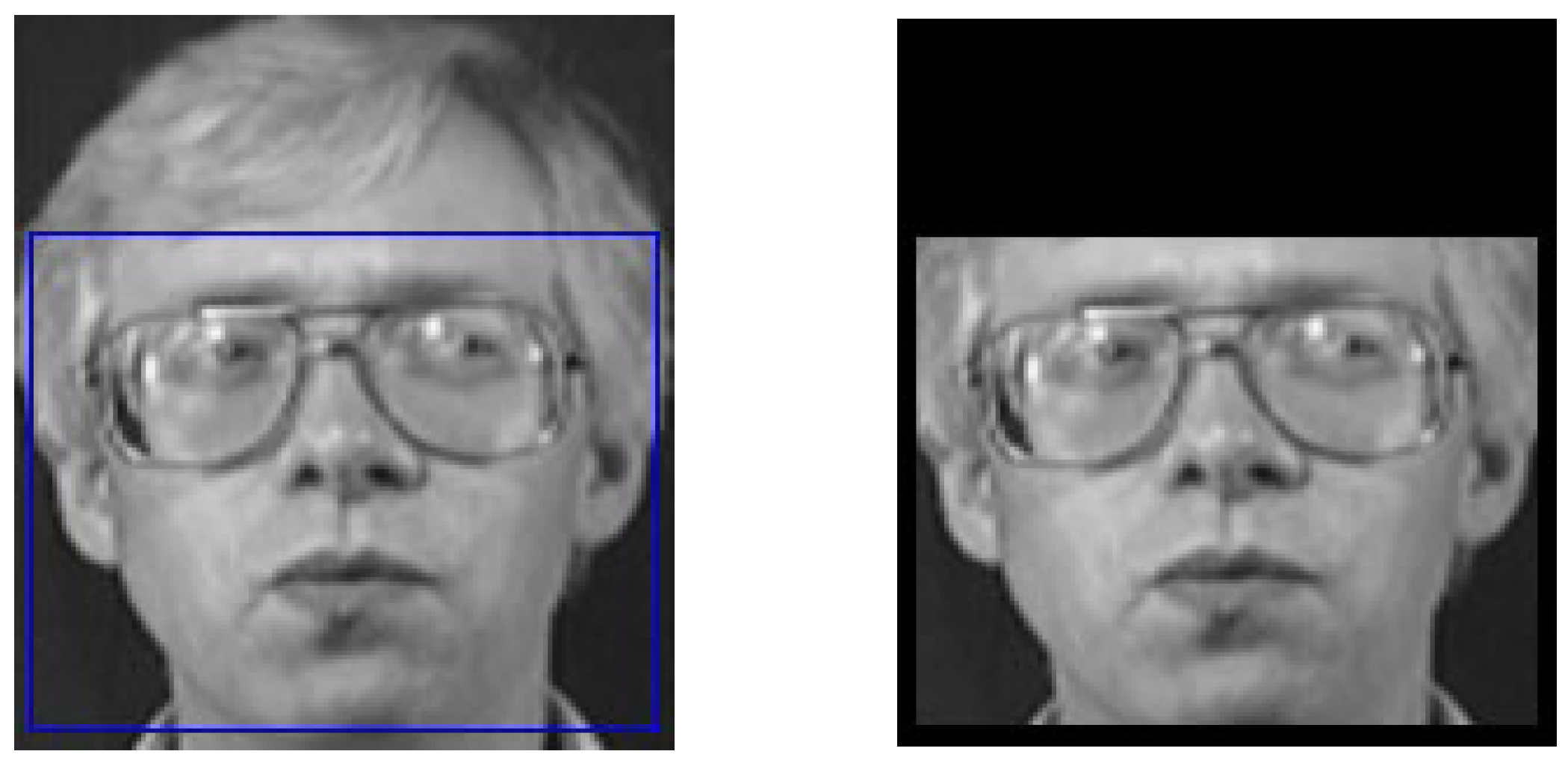
2.1. Face Detection by Dlib
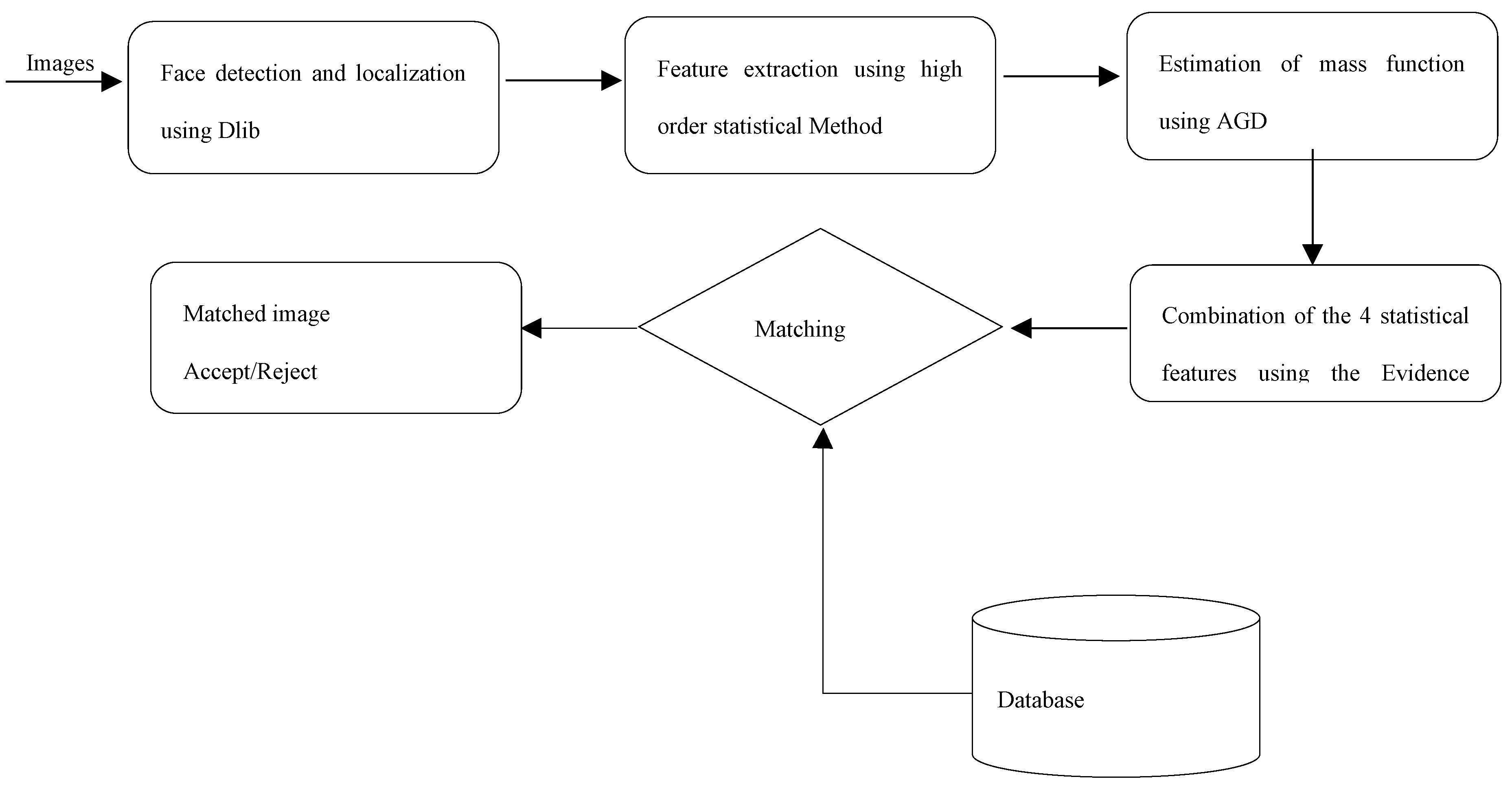
2.2. Face Recognition with High-Order Statistical Features and Evidence Theory
2.2.1. Feature Extraction
2.2.2. Use the Evidence Theory for Classification
3. Experimental Results and Discussion
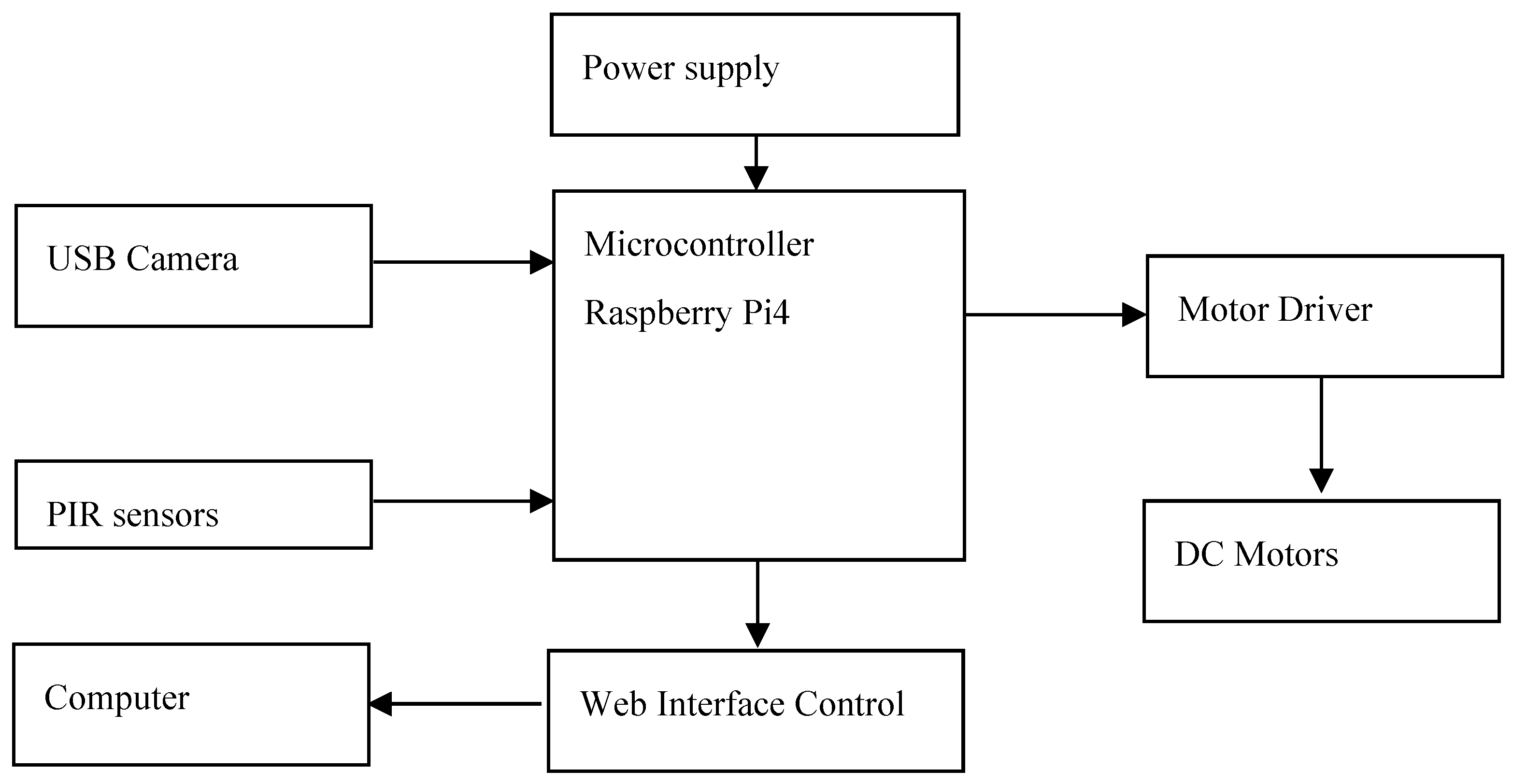
- 4 Motors: Responsible for movement, controlled with the information transmitted by the sensors.
- Dual H-Bridge Motor Driver L298N: typically used to control motor speed and rotation direction.
- PIR Sensors: used to detect human motion with a sensitivity range of about 7 meters.
- Raspberry Pi4: used to control the proposed intelligent security system.
- USB camera: used to stream live video to a user at a remote location, enabling real-time monitoring. Additionally, the camera captures images of an intruder whenever motion is detected, enhancing the system’s security functionality.
- Power Supply: Provides the necessary voltage and current to power the system. The motors are powered by a 12V battery, which delivers the necessary voltage to the motors through a motor driver, ensuring proper regulation and control of power. Additionally, a power bank is utilized to supply power to the Raspberry Pi, providing a stable and portable energy source for the microcontroller, allowing it to manage the system’s operations independently of the motor power supply.
- Wiring and Connectors: Used to connect all components and ensure communication and power distribution.
4. Conclusion
References
- Ezeji, Chiji Longinus. “Cyber policy for monitoring and regulating cyberspace and cyber security measures for combating technologically enhanced crime in South Africa.” International Journal of Business Ecosystem & Strategy (2687-2293) 6.5 (2024): 96-109. . [CrossRef]
- Dodiya, Kiranbhai Ramabhai, Sai Niveditha Varayogula, and B. V. Gohil. “Rising Threats, Silent Battles: A Deep Dive Into Cybercrime, Terrorism, and Resilient Defenses.” Cases on Forensic and Criminological Science for Criminal Detection and Avoidance. IGI Global, 2024. 123-150..
- Pham, Thanh-Nam, and Duc-Tho Mai. “A Mobile Robot Design for Home Security Systems.” Engineering, Technology & Applied Science Research 14.4 (2024): 14882-14887. . [CrossRef]
- Ullah, Inam, et al. “Mobile robot localization: Current challenges and future prospective.” Computer Science Review 53 (2024): 100651. . [CrossRef]
- Venkatesan, C., et al. “Facial Recognition Robots for Enhanced Safety and Smart Security.” 2024 Third International Conference on Smart Technologies and Systems for Next Generation Computing (ICSTSN). IEEE, 2024..
- Anurag, Aishwary, et al. “Robotic and Cyber-Attack Classification Using Artificial Intelligence and Machine Learning Techniques.” 2024 Fourth International Conference on Advances in Electrical, Computing, Communication and Sustainable Technologies (ICAECT). IEEE, 2024..
- Saba K. Naji, Muthana Hamd, ‘’Human identification based on face recognition system’’, 2021 Journal of Engineering and Sustainable Development 25(01):80-91, 2021. [CrossRef]
- M. Martin, K. Štefan, and F. J. T. L’ubor, “Biometrics Authentication of Fingerprint with Using Fingerprint Reader and Microcontroller Arduino,” TELKOMNIKA Telecommunication, Computing, Electronics and Control, vol. 16, no. 2, pp. 755-765, 2018. [CrossRef]
- Y. J and V. K. S, “Feature Extraction for Human Identification Using Local Ternary Pattern,” International Journal of Advanced Research in Electrical, Electronics and Instrumentation Engineering, vol. 7, no. 3, 2018.
- S. Humne and P. Sorte, “A Review on Face Recognition using Local Binary Pattern Algorithm,” International Research Journal of Engineering and Technology. 2018.
- Fathima AA, Ajitha S, Vaidehi V, Hemalatha M, Karthigaiveni R, Kumar R (2015) Hybrid approach for face recognition combining Gabor Wavelet and Linear Discriminant Analysis. In: Proceedings of the 2015 IEEE International Conference on Computer Graphics, Vision and Information Security (CGVIS), Bhubaneswar, India, 2–3 November 2015. IEEE, Piscataway, NJ, USA, pp. 220–225.
- Slim Ben Chaabane, · Mohammad Hijji, · Rafika Harrabi and · Hassene Seddik, ‘’Face recognition based on statistical features and SVM classifier’’, Multimedia Tools and Applications, springer journal, Volume 81, pp. 8767–8784, 2022. [CrossRef]
- P. Viola and M. J. Jones, “Robust real-time face detection”, Int. J. Comput. Vis., vol. 57, no. 2, pp. 137-154, May 2004. [CrossRef]
- N. Dalal and B. Triggs, “Histograms of oriented gradients for human detection”, Proc. IEEE Comput. Soc. Conf. Comput. Vis. Pattern Recognit. (CVPR), vol. 1, pp. 886-893, Jul. 2005. [CrossRef]
- B. Johnston and P. de Chazal, “A review of image-based automatic facial landmark identification techniques”, EURASIP J. Image Video Process., vol. 2018, no. 1, pp. 86, 2018. [CrossRef]
- O.Team, OpenCV, 2018, [online] Available: https://opencv.org/.
- D. E. King, “Dlib-ml: A machine learning toolkit”, J. Mach. Learn. Res., vol. 10, pp. 1755-1758, Jul. 2009.
- Xie, Jiahao, et al. “Unsupervised object-level representation learning from scene images.” Advances in Neural Information Processing Systems 34 (2021): 28864-28876..
- 7-Slim ben chaabane, Rafika harrabi, I. Labiedh and Hassene SEDDIK, ‘’Face Recognition using Fast Fourier Transform and SVM Techniques, ICGST Journal of Graphics, Vision and Image Processing (GVIP), Vol. 21, No.1, pp.1-9, 2021.
- Gou, J., Du, L., Zhang, Y., Xiong, T.: A new distance-weighted k- nearest neighbor classifier. J. Inf. Comput. Sci. 9(6), 1429–1436 (2012).
- S. Ben Chaabane and F. Fnaiech, “Color edges extraction using statistical features and automatic threshold technique: application to the breast cancer cells,” BioMedical Engineering OnLine, 13:4, 2014.pp 1–18. [CrossRef]
- Rafika Harrabi, Ezzedine Ben Braiek, ‘’Color Image Segmentation Using a Modified Fuzzy C-means Method and Data Fusion Techniques’’, Vol. 3, No. 2, Page: 119-134, ISSN: 2296-1739, 2014.
- S. Ben chaabane, M. Sayadi and F. Fnaiech, “Color Image Segmentation Using Homogeneity Method and Data Fusion Techniques’’, EURASIP Journal on Advances in Signal Processing, vol.5, 2010.
- R. Harrabi and E. ben braiek, “Color image segmentation using multi-level thresholding approach and data fusion techniques: Application in the breast cancer cells images,” EURASIP Journal on Image and Video Processing, 2012.
- Slim Ben Chaabane, and Anas Bushnag ‘’Color Edge Detection Using Multidirectional Sobel Filter and Fuzzy Fusion’’, Computers, Materials & Continua Journal, vol.74, no.2, pp. 2839-2852, 2023. [CrossRef]
- Zhang, Yang, et al. “Classification of incomplete data based on evidence theory and an extreme learning machine in wireless sensor networks.” Sensors 18.4 (2018): 1046. . [CrossRef]
- Feng, Tianjing, Hairong Ma, and Xinwen Cheng. “Land-cover classification of high-resolution remote sensing image based on multi-classifier fusion and the improved Dempster–Shafer evidence theory.” Journal of applied remote sensing 15.1 (2021): 014506-014506. . [CrossRef]
- Wang, Shuning, and Yongchuan Tang. “An improved approach for generation of a basic probability assignment in the evidence theory based on gaussian distribution.” Arabian Journal for Science and Engineering 47.2 (2022): 1595-1607. . [CrossRef]
- Chen, L., et al. “Evidence-theory-based reliability analysis from the perspective of focal element classification using deep learning approach.” Journal of Mechanical Design 145.7 (2023): 071702. . [CrossRef]
- Farhang, Yousef. “Face extraction from image based on K-means clustering algorithms.” International Journal of Advanced Computer Science and Applications 8.9 (2017).
- Bhangale Kishor B, Jadhav Kamal M, Shirke YR (2018) Robust pose invariant face recognition using DCP and LBP. International Journal of Management, Technology and Engineering 8(IX):1026–1034 ISSN NO: 2249–7455.
- Priya TS Vishnu, Vinitha Sanchez G, Raajan NR. Facial recognition system using local binary patterns (LBP). Int J Pure Appl Math 2018;119(15):1895–1899.
- Shen W, Surette M, Khanna R (1997) Evaluation of automated biometrics-based identification and verification systems. Proc IEEE 85(9):1464–1478. [CrossRef]

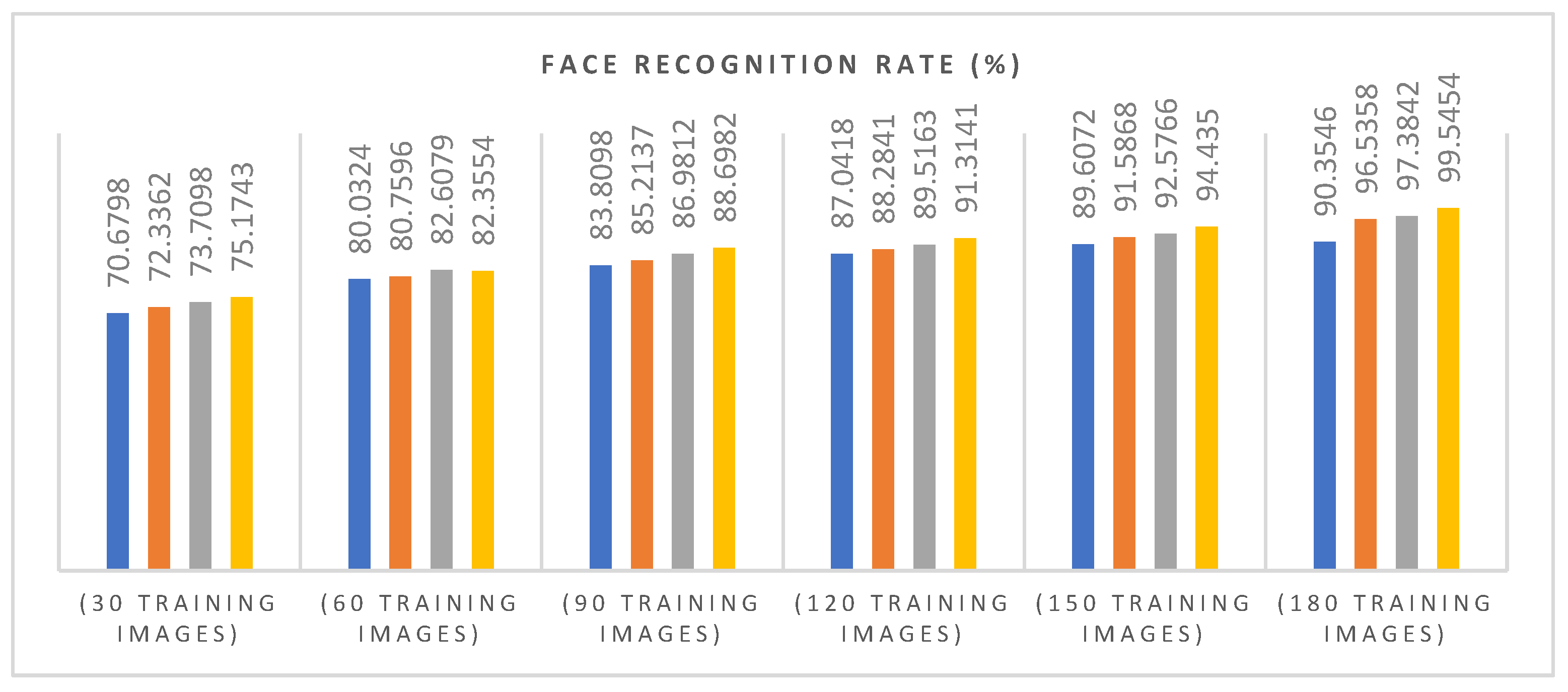

| Dimensions of Feature vectors/Pose count per individual intraining | 1 (30 training images) |
2 (60 training images) |
3 (90 training images) |
4 (120 training images) |
5 (150 training images) |
6 (180 training images) |
|---|---|---|---|---|---|---|
| 1 | 70.6798 | 80.0324 | 83.8098 | 87.0418 | 89.6072 | 90.3546 |
| 2 | 72.3362 | 80.7596 | 85.2137 | 88.2841 | 91.5868 | 96.5358 |
| 3 | 73.7098 | 82.6079 | 86.9812 | 89.5163 | 92.5766 | 97.3842 |
| 4 | 75.1743 | 82.3554 | 88.6982 | 91.3141 | 94.435 | 99.5454 |
| Total Faces | DCP and LBP method [31] | Local binary patterns (LBP) [32] | Statistical features and SVM classifier base Method [12] | Proposed Method | |
|---|---|---|---|---|---|
| True Positive | 220 | 212 | 196 | 214 | 219 |
| False Positive | 220 | 8 | 24 | 6 | 1 |
| False Negative | 220 | 71 | 42 | 59 | 29 |
| Detection Accuracy Rate |
96.3636 | 89.0909 | 97.2727 | 99.5454 |
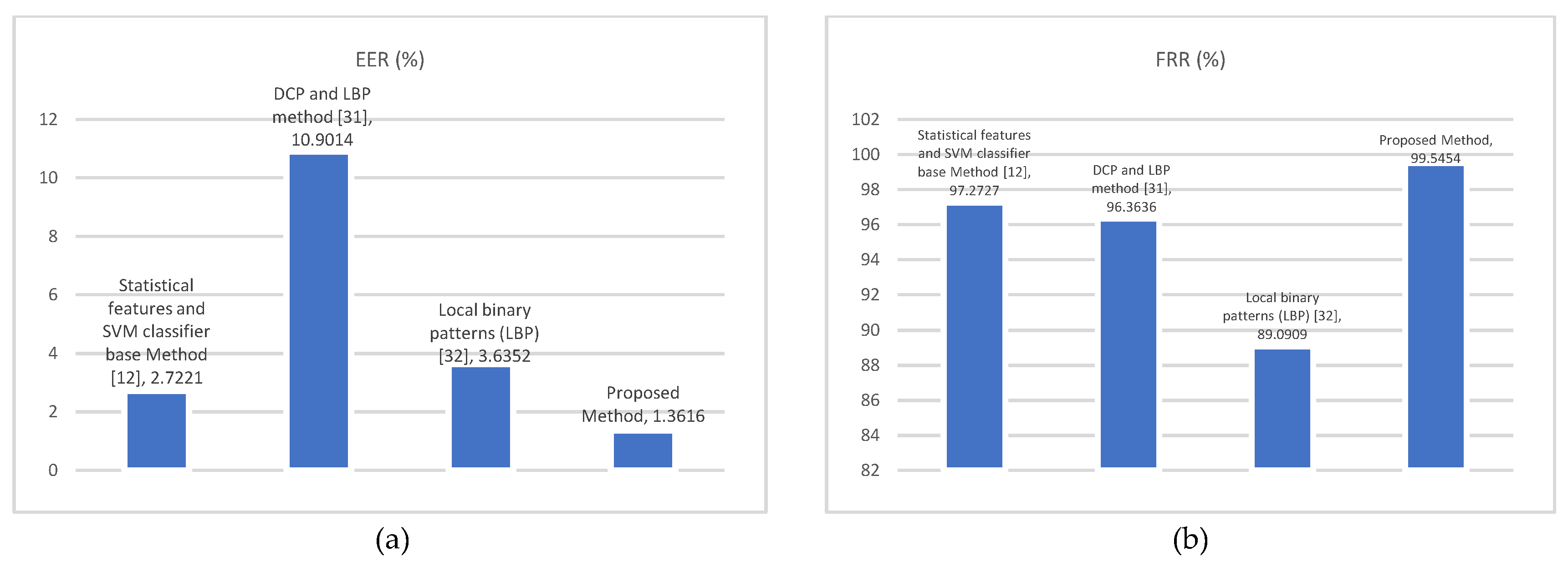
| No | Method | EER (%) | FRR (%) |
|---|---|---|---|
| 1 | Statistical features and SVM classifier base Method [12] | 2.7221 | 97.2727 |
| 2 | DCP and LBP method [31] | 10.9014 | 96.3636 |
| 3 | Local binary patterns (LBP) [32] | 3.6352 | 89.0909 |
| 4 | Proposed Method | 1.3616 | 99.5454 |
Disclaimer/Publisher’s Note: The statements, opinions and data contained in all publications are solely those of the individual author(s) and contributor(s) and not of MDPI and/or the editor(s). MDPI and/or the editor(s) disclaim responsibility for any injury to people or property resulting from any ideas, methods, instructions or products referred to in the content. |
© 2025 by the authors. Licensee MDPI, Basel, Switzerland. This article is an open access article distributed under the terms and conditions of the Creative Commons Attribution (CC BY) license (http://creativecommons.org/licenses/by/4.0/).