

Submitted:
11 February 2025
Posted:
12 February 2025
You are already at the latest version
Abstract
This paper pleads to the necessity of an international quality standard for built heritage intervention reviews. Despite the established doctrine in the wider field of conservation, the performance of built heritage management is significantly variable in different countries, and the core principles are sometimes glaringly ignored, without consequences. While the management and the corresponding legal areas are very difficult mechanisms to interfere with directly, a review system is seen here as a potentially constraining instrument, albeit indirect, towards a more coherent implementation of the agreed principles of intervention. The proposed system is based, in this preliminary form, on the principles of the Venice Charter as sources for the core evaluation criteria. The purpose is not to generate uniform, plain or unique responses to the generic bad or good question, but rather to determine where interventions can be situated on the spectrum between bad and good. A consistent case study is presented for the recent intervention on the Roman fortress Capidava, in present day Romania. The content is meant to be accessible to a wider audience with interest in built heritage.
Keywords:
Venice Charter
; Intervention Principles
; Good Practice
; Data Accessibility
; Capidava
Introduction
Almost everything today is submitted to a form of evaluation, sometimes even to unnecessary levels. This, however, was not yet formally applied on a general basis to interventions on the built heritage, not even in Europe – the traditional spearhead in the field. Surely, many of these interventions are appreciated by the interacting public, either positive, negative, mixed, or reserved. These evaluations are merely subjective and it’s natural for them to also exist as such, to the benefit of our freedom of opinion and expression. Most of the times, and for most of the people, the personal implications are also minimum – at least apparently. However, professionals should perhaps be concerned about the ethical outcomes of this lack of formal status in the field regarding the quality of the specific end-product. Hence, the following questions arise: (1) What are the examples and the models of intervention that we propose, as specialists in various aspects of built heritage? (2) How could we, as professionals, evaluate interventions as objectively as possible? and (3) Should we only promote good examples, also criticise bad ones, or just practice to our best efforts and leave the critics to the posterity? One could barely answer to the first question with sufficient certainty (for the reasons explained below); the answers to the second question would indirectly also help the former, therefore my purpose here is to start building on a possible solution to the how question. The last concern will always be open for debate, and it’s usually a matter of personal choice; in my current perspective, it has a lot to do with how much we choose to get involved – in the civic sense.
One could evaluate an intervention by its final appearance, but only limited conclusions can be drawn from this alone. Yet, the final appearance is what most people receive as the end-product, and what most mass architecture magazines provide for a significant number of historical buildings – where the presentations have the same structure and layout as for the projects of new buildings [1,2,3]. For some interventions, one can find consistent documentation in various forms, but cannot always be aware of the necessary compromises taken, unless explained by the ones who took it. Since the publication process is a complex task itself, not many interventions get to be presented by their authors, unless they also have other purposes. Proper reviews on the matter? Rarely. Then how do we know what can be accountable as bad or good and to what extent, or rather where can an intervention be situated on the spectrum between bad and good? This time, we are common people, students, emerging or even experienced specialists from the field of conservation or complementary disciplines, all beneficiaries of this heritage.
There are, indeed, relevant international competitions and a multitude of national similar events, some even dedicated exclusively to heritage – such as the Europa Nostra Awards [4]. However, these competitions usually rely on the notoriety of the invited evaluators, and not so much on the transparent evaluation of the criteria (if presented) – in the sense of demonstrating how they are met, besides sheer enumeration. They also focus on positive examples (or at least considered as such), while the lesser others flourish in the background. These competitions highlight models on the top of the scale to set the aspiring standards, but the bottom line is that they fail to satisfy our need to understand the considerable diversity of situations out there, when we return to the main questions: Are they bad, or good? and especially Why? How about the not-so-famous, the many common interventions of which overall impact in our daily landscapes is considerably greater compared to the impact of the few chosen. Therefore, the community of specialists from the built heritage fields should perhaps offer to the public a wider variety of examples, based on clear and consistently explained criteria and their evaluation. It should go beyond the traditional guidelines that approach elements of certain types, seen separately from their particular context (extremely useful, but limited in a sense). The community of specialists should, in complementarity to these guidelines, present case studies in their entire complexity, ideally adapted to different ranges of public. In fact, the Venice Charter requires this explicitly in Article 16 [5], but the effect is pale. Apparently only the archaeology applied it, where excavation reports, albeit preliminary, are a current practice for quite some time [6].
In our days dominated by the internet and the digital means, an international database for built heritage interventions could be a solution; not for awards, but for evaluations of all kinds of projects and their implementation, made preferably by professionals or trained specialists in the wide field of built heritage. These evaluations may be multiple, with divergent or convergent conclusions, and should always be open to new contributions, provided they present relevantly different arguments with consequent results. Hence, anyone interested from the public would be free to choose between these evaluations, based on her or his own understanding of the matter; however, this opinion would be grounded on something more than mere esthetical impression. It doesn’t mean that unqualified opinions will cease to exist, but there will be offered an alternative.
This is proposed from the perspective of a built heritage researcher focused mostly on Roman urban remains, with a didactical background on both history of architecture and built heritage conservation, and a limited but relevant practical experience in building documentation and intervention, and urban studies. The common denominator of all these partially overlapping activities was (and always is) the need to understand the object of study, or of the occasional discussion which can occur both in professional and non-professional contexts. Yet, some of the most frequent situations where my understanding was limited concern interventions on built heritage, especially for the of lack of relevant data. In our studio sessions, the architecture students present projects published in beautiful photographs, usually accompanied by brief and complimentary texts (most of the times largely irrelevant for the intervention itself), as grounding parallel for their own design proposal; this approach is a generalized “by default” practice, despite our efforts to explain that only specific parallels can (occasionally) be relevant. But as already mentioned, the specific details are rarely presented in most of the sources, thus the nonfunctional circle is closed. On a broader view, more distant actors of social media, blogs, magazines, or newspapers, refer to different interventions in order to express their interest for built heritage, and frequently what can, or won’t be done for it – hence for us all. In most of the mentioned cases, in the absence of relevant data and based solely on intuition, any opinion should be retained to a minimum, even by specialists. However, people need models, they need to know and discern what is good from what is bad. Therefore, in lack of proper references, it all comes down to what people consider to be important, thus a simple matter of taste. Although the doctrinal evolution sparks tendencies for such popular directions [7], if we are to preserve any professional quality on the matter of opinion, perhaps we should direct some of our focus in a dedicated direction.
Through this paper I intend to sustain, more than solely affirm, that (1) A post-intervention evaluation is necessary for all that qualifies as built heritage (at least, prioritised), and (2) The evaluation should contain a minimum set of objective criteria – i.e., the ones internationally accepted in the field. Given the thematic of the current conference, but also the exploratory character of this preliminary approach, I considered the principles formulated in the Venice Charter [5] to be an adequate starting point, and not by far sufficient. This is based on the premise of the internationally acknowledged currency of the Venice Charter, regardless of its reception as slightly overrated, waiting for updates and clarifications, or good enough [8,9,10]. It was stated in the introduction of the Venice Charter as “essential that the principles guiding the preservation and restoration of ancient buildings should be agreed and be laid down on an international basis”. Although not having the status of a convention (hence, with juridical weight), its purpose was to set the main tracks for responsible interventions on built heritage worldwide, and many of the related subsequent international documents can be considered as particularised extensions of the Venice Charter, especially the ones issued by ICOMOS [11], for which the former is considered as a “foundation stone” [10]. The Venice Charter [Re]Framed: New Heritage Challenges international conference is the most recent confirmation of this premise.
Although the Venice Charter doesn’t expressly mention the concept, nor the term ‘evaluation’, it was indirectly implied (among the many other phases in the larger planning process) when stated that “each country [is] responsible for applying the plan [to comply with the principles guiding the preservation and restoration] within the framework of its own culture and traditions” (introduction). Without verification (control) and/or final evaluation, how could one assume the desired implementation of a process? In reality, depending on the context in each country, the respective processes and/or tools may lack or be defective on any level, from the initial evaluation and classification of the built heritage, to the analysis and diagnosis, intervention approach and techniques (in both design and on site phases), while the evaluation of all these may be formal and superficial, or completely absent (e.g., post-intervention evaluation – in what extent has the project been respected, or a general evaluation of the entire process). A recent survey for Italy, Spain, and Portugal [12] is relevant in this sense for a significant part of the European landscape – thus extrapolating for countries having similar policies.
Consequently, I considered that the guiding principles stated in the Venice Charter ought to find correspondence in the evaluation criteria of interventions on built heritage, as they are perhaps the most suitable for a “starter-kit”. A dedicated section to extracting the relevant evaluation criteria, based on a conventional reading of the charter, follows a brief orientation on where we start from on the evaluation of built heritage interventions.
Brief survey on the evaluation of built heritage interventions
Not so much the evaluation of the end-product, but rather the quality of the management of interventions on built heritage was tackled relatively recent, concluding that is rather peripheral in the specialized literature compared to other aspects of the larger process [13]. As suggested forward, the same seems to be applicable to the end-product evaluation. On the other hand, voices of the wider public ask bluntly: “(…) what makes a good restoration project?” and concludes on “the razor-thin separation between success and failure in the restoration game” [14] This, however, is the public perception, where confusion is fuelled by the very absence of the professional standing in this concern. It’s quite similar when pupils describe their interaction with a teacher depending solely on their own luck: this only reflects the lack of clear criteria for evaluation. The teacher either conceals, or simply doesn’t have them.
Evaluation and standardization have so far been established for certain segments of, or elements related to the processes of built heritage intervention, especially products and techniques related to art conservation. [15] The same is implied by the four steps process borrowed from medicine, which sometimes is used to define the entire sphere of interventions on historic buildings: anamnesis, diagnosis, therapy, and control(s) [16]; however, this formula cannot actually cover all the processes related to it. For example, revealing or emphasising certain phases of a building, or setting new compartmentations for its adapted (re)use, are not part of a properly therapy process, but rather an intervention (addition or removal) controlled by other specific criteria than the ones related to degradation – many of which are discussed in the following section. One could replace therapy with treatment and convey the latter a general meaning, such as preservation, rehabilitation, restoration or reconstruction [17]; however, this only reflects a circular definition, not a precise description of the intervention. A possible explanation for this status quo could be that “the early phase of conservation theory development, which focused on fine art, only gradually added a body of literature on archaeological artefacts, decorative arts, and architecture that is not easily available to those outside the conservation profession, or even to those in other conservation disciplines” [7].
In Canada there is a great emphasis on the guidance and control before and during the intervention, a process named intervention review [18]. This, of course, is the ideal case, where the built heritage benefits of a multi-layered professional guiding, hence the outcome is the best possible in the given context; the use of a post-factum evaluation in this case is much reduced, but still significant for long term consistency. However, such a system where classified buildings have official custodes implies a very performant built heritage management and infrastructure, with a significant apparatus of professionals enrolled. It is by far not the most common case in Europe, but rather a model to pursuit, that can’t be expected to be implemented on a general basis anytime soon. Until then, adaptive measures are required.
Regarding the entire process upon project completion – which can obviously be quite varied in proportion and complexity –, it is only recently that such evaluations were recommended (notably, not imposed) for EU funded projects [19]. As we shall see in the case study presented in the second part of the paper, such evaluations should definitively be required before much more heritage is rather lost, than saved, on public European money – perhaps with predilection in certain countries. In this sense, preliminary studies should perhaps be dedicated to determining which countries have a considerable number of defective interventions on EU funds. Conversely, from a down-top perspective, the general urbanistic plans are considered as the optimal tools for control [12], however their actual functionality in the sense discussed here would depend on the same (missing) infrastructure already mentioned.
The closest evaluation system I could identify remotely resembling the one intended here is The Davos Baukultur Quality System (DBQS) [20], based on eight criteria: Governance, Functionality, Environment, Economy, Diversity, Context, Sense of place, and Beauty. While some of them are named identical or similar to the ones proposed here (see Diversity and Context), they refer to different aspects of evaluation – in the sense that the latter is focused on the quality and impact of the intervention on the built heritage, having less (but by no means lack of) interest in the overall project from an economic, social, environmental or esthetical point of view. In other words, the evaluation proposed here is a specialised version of a potentially general one comprising all the relevant criteria for a complex project, namely one focused specifically on the built heritage itself. Another essential difference is that the DBQS is focused on the process prior to the actual intervention, while this proposal concerns mainly post-implementation evaluations.
Proposed criteria and evaluation system
In a morphological approach, most of the text of the Venice Charter [5] is a mosaic of correlated and interlaced principles regarding built heritage. For the methodological purpose of this paper, eleven such principles were identified, and each of them generates corresponding evaluation criteria: (1) common value and responsibility; (2) authenticity; (3) consistent documentation; (4) diversity; (5) appropriate use; (6) context preservation; (7) expertise; (8) interpretation; (9) structural compatibility; (10) reversibility and minimal intervention; and (11) publication.
A formula of evaluation, i.e. a proportional weight, is proposed for each of the criteria thus identified, based on their overall relative relevance – which is essentially a subjective perception, briefly explained in the sections below. It is important to stress that all these proposed proportions (values) can be changed, depending on context. For example, authenticity should have a higher proportion for an ancient urban structure than for an early 20th c. industrial building, where maybe context preservation could weigh more. However, in the perspective of larger sets of evaluations, some rough intervals should be established as a standard for certain categories of built heritage an intervention type.
This preliminary formula is conceived in a top-down approach, considering a maximal level of 100 points for the evaluation. The value 100 is purely conventional and considered optimal because percentage values are intuitive enough for most of the people. (Otherwise, how numbers and proportions are chosen can be a matter for a separate debate.) Grouping criteria thematically into sections could be useful for two reasons: avoiding double evaluations for the partially overlapping and complementary criteria, and a better control of the overall proportions between the sections.
- Section I: (1) common value and responsibility, 5% - anything suitable that is not included in the other sections (see details below), to prevent double evaluation.
- Section II: (2) authenticity, (9) structural compatibility, and (10) reversibility and minimal intervention, 40%;
- Section III: (3) consistent documentation and (11) publication, 15%;
- Section IV: (4) diversity and (8) interpretation, 15%;
- Section V: (5) appropriate use and (6) context preservation, 15%;
- Section VI: (7) expertise, 10%.
Notably, there is a consistent mutual influence between all the criteria, as briefly explained below in the dedicated sections. The overall percentage do not reflect their absolute value, but rather what may be left when reducing the multiple overlapping. For example, the consistent documentation is indeed very important, especially for complex historical buildings, but the most important outcome is still preserving authenticity and the other criteria in Section II. Therefore, arguably an intervention on a simpler historical building may not require much complex documentation. On the other hand, although common value and responsibility is by far the supreme criterion – as it is practically like an umbrella for all the rest –, precisely for that reason it can only receive points (if applicable) for contributions outside the areas already covered by the other sections.
Next, it is necessary to assign the proportions of each criterion. These values should also be customizable, depending on the context, but within a standardised scheme, as already suggested.

Table 1.
The relevant criteria for the evaluation of the interventions on built heritage extracted from the Venice Charter. The sections that they are grouped by are marked with colours. A proportional weight (value) is also proposed here for each criterion; these are the maximal values for an evaluation.
Table 1.
The relevant criteria for the evaluation of the interventions on built heritage extracted from the Venice Charter. The sections that they are grouped by are marked with colours. A proportional weight (value) is also proposed here for each criterion; these are the maximal values for an evaluation.
| criteria | max. value | section value | |
|---|---|---|---|
| 1 | common value and responsibility | 10 | 10 |
| 2 | authenticity | 20 | 40 |
| 3 | consistent documentation | 10 | 15 |
| 4 | diversity | 5 | 10 |
| 5 | appropriate use | 5 | 15 |
| 6 | context preservation | 10 | |
| 7 | expertise | 10 | 10 |
| 8 | interpretation | 5 | |
| 9 | structural compatibility | 10 | |
| 10 | reversibility and minimal intervention | 10 | |
| 11 | publication | 5 | |
| TOTAL | 100 | 100 |
These eleven principles-derived criteria for the evaluation of the interventions on the built heritage* are briefly presented in the following sections. The main purpose of this presentation is to highlight the relevant articles or fragments in the Venice Charter which cover the respective criteria, granted their interpretation is considered fair, or at least improvable. The correlations and occasional comments reflect a subjective understanding based on my experience; they should be compatible with the already established interpretations of the authors I read over time and selectively quoted further in this section.
(*) Note: the Venice Charter defines the concept of “historical monument” as what “embraces not only the single architectural work but also the urban or rural setting in which is found the evidence of a particular civilization, a significant development or a historic event. This applies not only to great works of art but also to more modest works of the past which have acquired cultural significance with the passing of time.” (Art. 1) However, to avoid the varied interpretations or limitations of the term, it was replaced in the following with the more general “built heritage”, which is also consistent with the definition above and is also compatible with other proposed updates, e.g. “cultural heritage” [21] (Art. 1) – except the focus here is exclusively on built structures.
1. Common value and responsibility
The concept of the built heritage seen as common value, implying also common responsibility for ensuring its preservation in full authenticity, was rightfully the one which opened the statements of the Venice Charter in 1964. This core principle is the only one directly related to all the others, and that qualifies it to be on the top of the list. I will only comment upon the most significant relations it has with the other principles (and implicitly, evaluation criteria).
While the principle of authenticity will be briefly presented below (see point 2), it is important to note its intertwined relation with the one of common value and responsibility. If the authenticity is preserved, so is the value, hence the responsibility is honoured; if one fails to preserve authenticity, it means that also failed in their responsibility to preserve the heritage of many others, before and after them. Likewise, the responsibility is fully honoured only if the authenticity is also preserved; however, neglect can also be considered as a failure of the direct responsibility to preserve, thus passing the responsibility entirely to the future generations. In any case, neglect can’t generally be considered for evaluating an intervention, except when the time proof criteria can be applied (briefly discussed above).
Although covering all the other criteria in a broader sense, to avoid double evaluation, only specific items can be considered for this section, such as the direct involvement of the community or of the authorities, or the relation between the ones responsible for the intervention and the beneficiary community – all in the perspective of good sustainability.
2. Authenticity
This is by far the most important criterion of all, for which a dedicated charter was adopted [22] and significant documentation and literature published [11,23]. Regarding restoration, the Venice Charter states that “Its aim is to preserve and reveal the aesthetic and historic value of the monument and is based on respect for original material and authentic documents.” (m.e., Art. 9 – similar with Art. 3, referring also to conservation). Furthermore, “Replacements of missing parts must integrate harmoniously with the whole, but at the same time must be distinguishable from the original so that restoration does not falsify the artistic or historic evidence.” (Art. 12); this statement also feeds to the principle/criterion of interpretation (see point 8).
Regarding archaeological excavations, the resulted “Ruins must be maintained and measures necessary for the permanent conservation and protection of architectural features and of objects discovered must be taken. (...) All reconstruction work should however be ruled out «a priori». Only anastylosis, that is to say, the reassembling of existing but dismembered parts can be permitted.” (Art. 15)
3. Consistent documentation
“The conservation and restoration of monuments must have recourse to all the sciences and techniques which can contribute to the study and safeguarding of the architectural heritage.” (Definitions, Art. 2). More or less the same words put in another arrangement indicate a valid reciprocal: the study and safeguarding of the built heritage are integral parts (or phases) of the conservation and restoration process(es); they are supposed to be recurrent, or rather permanent processes, just like conservation. Art. 9 confirms it: “The restoration in any case must be preceded and followed by an archaeological and historical study of the monument.” (m.e.). Another relevant reference to documentation is in Art. 16: “In all works of preservation, restoration or excavation, there should always be precise documentation in the form of analytical and critical reports, illustrated with drawings and photographs. Every stage of the work of clearing, consolidation, rearrangement and integration, as well as technical and formal features identified during the course of the work, should be included.”
The documentation is also complementary to authenticity. In the discussed context, the two main qualities of built heritage are: its physical features, which may contain aesthetical, and/or technological values that can only be experienced directly in its actual presence (which is why it is so important); and the associated information, which consists of data (about size, shape, material(s), consistency, location, vicinity and spatial relations etc.), and metadata (evidence regarding absolute or relative chronology and utilization range; indirect evidence of usage etc.) – the latter frequently mediated by interpretation. Hence, whenever it is decided that physical features are to be removed, it should be mandatory for the removal to occur after documenting it as rigorous as possible; in fact, the documentation should also be considered as a necessary substantiation for the removal itself, accompanied by explanatory notes.
4. Diversity
Article 1 states, within the core definition of the historical monument / built heritage, that the former refers “not only [to] the single architectural work but also [to] the urban or rural setting”, and “not only to great works of art but also to more modest works of the past” (m.e.). While the chronological references to the past or the passing of time (also in Art. 1) are quite relative, and arguably left to be more precisely established by each country, “within the framework of its own culture and traditions”, the references to a generous interpretation of scale (ranging from object, ensemble, to urban scale) and environment (both urban, and rural – or rather territorial, for isolated buildings or ensembles) are clear and seem to have a proper coverage. However, the term “modest” requires some attention in this context.
Arguably, “modest” opens towards a wide range, similarly with the previously discussed spatial and environment criteria, in fact covering their wider scales in a great proportion. According to Collins Dictionary, “A modest house or other building is not large or expensive.” [24] This brings us to the concept of minor architecture, coined almost a century ago [25], which is valuable especially as an ensemble (e.g. an urban or rural ensemble of historical houses), but not only (e.g. a few houses left from a former ensemble, or an isolated historical manor in a rural or isolated area).
Overall, diversity seems to be an appropriate concept to integrate the aspects mentioned above. I would only add that it should also be applied to the quality assessment of the built heritage, not only to the intervention itself. For example, the early 20th century phases of an older (medieval, or ancient) ensemble or site could also be considered a valuable part of it, may it be a modest addition compared with the previous phases. Hence, if stripping monuments of their more recent evolution phases is indeed considered now a disagreeable practice, the same should apply to ensembles and sites: “The valid contributions of all periods to the building of a monument must be respected, since unity of style is not the aim of a restoration. When a building includes the superimposed work of different periods, the revealing of the underlying state can only be justified in exceptional circumstances and when what is removed is of little interest and the material which is brought to light is of great historical, archaeological or aesthetic value, and its state of preservation good enough to justify the action.” (Art. 11)
5. Appropriate use
The “appropriate use” is a wording taken from by Jukka Jokilehto [21] (Art. 5) to briefly describe what the Venice Charter states in Article 5:
“The conservation of monuments is always facilitated by making use of them for some socially useful purpose. Such use is therefore desirable but it must not change the lay-out or decoration of the building. It is within these limits only that modifications demanded by a change of function should be envisaged and may be permitted.”(m.e.)
Although the current (or present) relevance of the use is very important (primarily for the sustainability of the intervention), it is conditioned by its adequacy to the existing built heritage. It must be stressed, therefore, that it is not the desired function that dictates the use of the monument, but rather the monument dictates (through specialists’ evaluation and intervention plan) on how it can be adapted to fit new functions.
6. Context preservation
This principle applies mostly to large(r) scale intervention policies; therefore it has a significant ethical component, besides the (conclusive) interventional one:
“The conservation of a monument implies preserving a setting which is not out of scale. Wherever the traditional setting exists, it must be kept. No new construction, demolition or modification which would alter the relations of mass and colour must be allowed.”(Art. 6)
The evaluation criteria derived from this principle may, or may not be relevant for an intervention, depending on its scale and type – however, when it is relevant it is also critical [21] (Art. 6). It is important to note that frequently there are different actors responsible for the larger scale interventions, therefore it is important to asses a fair accountability in this regard.
The relocation of built heritage can also be inscribed to this principle and, subsequently, to the corresponding criteria:
“A monument is inseparable from the history to which it bears witness and from the setting in which it occurs. The moving of all or part of a monument cannot be allowed except where the safeguarding of that monument demands it or where it is justified by national or international interest of paramount importance.”(Art. 7)
Moreover, “Additions cannot be allowed except in so far as they do not detract from the interesting parts of the building, its traditional setting, the balance of its composition and its relation with its surroundings.” (Art. 13); the part referring to historic sites, seen as “sites of monuments”, hints largely on the same ideas (Art. 14).
7. Expertise
This matter is surely delicate, but also necessary to be further addressed more than it did in the Venice Charter: “The process of restoration is a highly specialized operation.” (Art. 9) Presumably, most countries require certain degrees of expertise for the evaluation of and intervention on built heritage, however limitations can occur on many registries. For example, a specialist may have a generic expertise for intervention design on built heritage, but has never worked with, nor ever studied late roman fortifications. (This type of heritage is very particular, for it is rare and frequently preserved as ruins, see the case study below.) Is any such specialist qualified to operate on such a monument? Legally, it could be the case; ethically, not quite, unless his expertise is supplemented by that of a specialist who understands the monument, and this knowledge is actually integrated in the intervention project.
Expertise also refers to the quality of the implementation (thus, of the intervention itself), which sometimes is even more difficult to assess unless properly explained and documented. Beyond this metadata of an intervention, the visible architectural implementation and the details of execution are perhaps the easiest aspects to evaluate.
8. Interpretation
This concept became doctrinal in the late 2000s, with the ICOMOS Charter for interpretation [26]. However, its roots are clearly traceable in the Venice Charter. The baseline for respecting this principle is, firstly, honouring the authenticity (see point 2). Regarding restoration, the charter states that “It must stop at the point where conjecture begins, and in this case moreover any extra work which is indispensable must be distinct from the architectural composition and must bear a contemporary stamp.” (Art. 9). For archaeological structures, while maintaining the ruined state (see point 2), “every means must be taken to facilitate the understanding of the monument and to reveal it without ever distorting its meaning. (...) The material used for [anastylosis] integration should always be recognizable, and its use should be the least that will ensure the conservation of a monument and the reinstatement of its form.” (Art. 15)
One could argue that interpretation is not a vital criterion for preserving a monument in its full authenticity, depending on each situation. For example, an archaeological ruin could be preserved without efforts to understand its architectural configuration. Nevertheless, if one counts larger ethical principles, such as common value and responsibility, where sustainability plays an important role, it turns out that the interpretative part of the intervention is perhaps the second most important, after preserving authenticity. This is the pragmatic perspective, while the scientific approach would vote instead on the consistent documentation. However, a good interpretation can only be obtained through a proper documentation, therefore the ideal chain results to be authenticity, documentation, and interpretation.
9. Structural compatibility
This criterion is indirectly implied by several of the Venice Charter articles (see Art. 3, 4, 9), but perhaps the most relevant is the one stating that:
“Where traditional techniques prove inadequate, the consolidation of a monument can be achieved by the use of any modern technique for conservation and construction, the efficacy of which has been shown by scientific data and proved by experience.”(Art. 10)
The structural capacity of the built heritage is obviously an essential element of authenticity, thus it needs to be preserved. Still, it is perhaps one of the most common problems and fragile topics in the common practice, because it interferes with present building regulation and norms, which are not always compatible with the parameters of historic buildings [15]. This situation is taken to extreme in some cases, based on the argument that structural safety prevails any other feature of the built heritage, thus requiring either incompatible materials and techniques, either exacerbated measures, or even both. The case study in this paper is an example for the latter.
10. Reversibility and minimal intervention
Although none of these terms are specified as such in the Venice Charter, reversibility and minimal intervention are implied, albeit subliminal, by many of its statements (Art. 3, 4, 5, 6, 7, 8) [10]. Perhaps the closest to the concept of minimal intervention, albeit not quite straightforward, is the following part from Article 11:
“When a building includes the superimposed work of different periods, the revealing of the underlying state can only be justified in exceptional circumstances and when what is removed is of little interest and the material which is brought to light is of great historical, archaeological or aesthetic value, and its state of preservation good enough to justify the action.”
Regarding reversibility, it may be the considerably more relevant for archaeological structures than for others, but surely not exclusively; in the former case, the material used for [anastylosis] integration “should be the least that will ensure the conservation of a monument and the reinstatement of its form.” (Art. 15)
It is fairly recognized that there is no such thing as 100% reversible intervention, therefore the purpose of this principle is to highlight on the “as much as possible” key – i.e., finding the best compromise in correlation to all the other principles, for the best interest of the built heritage. I considered it to be complementary to the minimal intervention (required) in the sense that these two principles are in fact directly proportional. Following them with priority would normally rather serve the heritage, than the other way around. The more reversible an intervention is, the more it is accountable as minimal intervention, and vice versa, the more an intervention is kept to a necessary minimum, the more reversibility is less of an issue – even if, as always, counterexamples can be found.
11. Publication
Referring to the complex documentation of the built heritage and of the corresponding interventions (see point 3), the last of the articles in the Venice Charter concludes that “This [documentation] record should be placed in the archives of a public institution and made available to research workers. It is recommended that the report should be published.” (Art. 15) Updating this idea to our days, in a transparent approach to cultural heritage, may mean that ideally the documentation could be made available online. Nevertheless, although this rough documentation would be of great value, two other types of publication would surely be very welcome for the interested public: a synthetic publication of the authors and a specialized review.
***
There are a few intrinsic principles of the proposed evaluation system, that I believe to be essential for both its applicability and sustainability:
- Simplicity: it has to be as simple and intuitive as possible, so that people outside the field could easily understand it; this principle stands for the accessibility of information and the transparency of the evaluation process, in respect for the larger public – seen as the main beneficiary of the built heritage and of all the efforts to preserve it;
- Flexibility: everything about its structure and components should be possible to adapt or even change, when necessary or opportune, based on proper argumentation: criteria, their interpretation, sub-components, percentages etc. While some core categories of these parameters should be controlled by designated specialists (e.g., criteria and interpretation), others could be customized by the various users (e.g. criteria applicability, percentages, or at least some larger intervals). Likewise, anyone should be free to use it for practice and testing hers or his own perception;
- Objectivity and diversity: the official evaluations, approved by relevant authorities in the field, should be anonymous specialists in the field (on the famous Michelin Guide model); however, non-anonymous second opinions should be allowed on behalf of other specialists, while popularity rating could also contribute to a general perception and understanding of the intervention. Notably, significant disparities between specialists, or specialists and public, should raise some questions useful for the correlated education in the field;
- Accessibility: the necessary data, the evaluation instruments and the results should be available online and free of charge.
Perhaps more important principles could be identified, and many more suggestions may be formulated for their optimal implementation, but for the preliminary level proposed here it could suffice.
***
For most of the subjects, only dedicated and detailed research could support a comprehensive understanding of the discussed structures in their historical phases, so that each intervention, and especially the most recent ones could be evaluated as objectively as possible, relative to their historical context. Thus, for the demonstrative purpose of this paper, I have chosen what could be labelled an “easy target” – for two reasons. Firstly, that the recent intervention upon it is quite obviously a bad one, despite the scarcity of available data documenting it – except for the abundance of photographs available online, published largely by the visiting public. Secondly, for I am already familiar with its history and configuration, as it was one of my PhD case studies for Late Antique urban centres [27].
Case study: the Roman fortress Capidava in Capidava, Constanța County, Romania
Today, Capidava is the archaeological site of what once was an ancient urban centre, that functioned for many centuries within the fortification system of the Roman Empire. The archaeological investigations at Capidava celebrate 100 years in 2024. The most significant architectural remain was, until recently, the robust late roman fortification, which was designed to strengthen some earlier phases. An important intervention of (allegedly) conservation / restoration had already been implemented during the 1950s (or even earlier), consisting mainly of partially completing walls, and mortar caps to cover their top. While it was not the best solution for preservation, the top-down degradation was largely prevented for many decades [28,29].
A so-called restoration project was implemented largely between 2015 and 2021, funded mainly by the European Union (Figure 1). The name of the project was “The restoration, consolidation, protection, conservation and valorisation of the archaeological site Capidava Fortresss” (in Romanian, “Restaurarea, consolidarea, protecția, conservarea și punerea în valoare a sitului arheologic Cetatea Capidava“), with a budged of about 7 million Euro [30]. Sadly, none of these describing keywords is accurate for the actual intervention; perhaps consolidation, except it wasn’t necessary – at least not everywhere, nor how it was implemented.
Most of the references to this project are online newspapers, blogs, interviews, and social media posts and comments – all in Romanian –, while very little is published by the authors themselves [33,34,35,36]. Perhaps the most relevant published material are, so far, the archaeological reports in 2015 [37], where technical aspects are presented due to the collaboration of the archaeologists with the project designers and executants. The project initially became publicly controversial for a financial fraud investigated by the authorities, subsequently being harshly criticised for the quality of the interventions [33,34,35]. On top of all, while the intervention have had already seriously altered the “authenticity and integrity” of the site, it was also in the process to be included in the broader (Romanian) Danube Limes, on the UNESCO tentative lists [35]; hence, the responsibility of maintaining consistency with this status largely fell in the hands of the project designers – however, not entirely, if we recall the principle of common value and responsibility. Despite all the interruptions and the critical evaluations, the site was definitively compromised, without legal consequences to account for the damaged cultural heritage. To the present day, no scientific dissemination of this intervention could be identified on behalf of the authors (or others), at least one to justify the questionable inclusion of Capidava Fortress, in 2020, on the UNESCO tentative lists [38]. No effort was paid to defend their intervention, not by the authors, nor by the authorities which granted it, despite the noisy discontent expressed by some specialists, echoed by a larger public, or vice versa. In fact, nobody seems to have formally asked for such a defence, not even the European Union, who funded this cultural disaster – by far, not the only one, but just among the most famous ones in Romania. In the case of Capidava, the silent treatment means that nobody took responsibility for the compromised built heritage – which is rather a reinforcement for bad practice, instead of discouraging it. There’s another good reason for choosing this case study.
Perhaps there may be more critical presentations published by specialists in a scientific framework, but for the time being I have only found one. Stefano D’Avino, an Italian restoration professor highly engaged with the reality in Romania on this field, presented a brief and largely fair evaluation for the intervention at Capidava: “a full-blown, typological reconstruction” that “betray absolute indifference to values” [39]. Besides this noteworthy professional opinion, a minimal set of illustrations and brief argumentation for each proposed criterion in the previous section are provided to support the preliminary evaluation below. No archival investigation was conducted, solely online and otherwise published material was used. Surely, a more detailed investigation would be required to clarify the blind spots of this preliminary assessment (e.g., the documentation), but for most of the criteria the evaluations presented below are not likely to change significantly.
Section I: common value and responsibility
1. Common value and responsibility. Although the initiative of this project belonged to the county administrative council, there is no indication towards a larger policy for the valorisation of the archaeological sites in the county. Conversely, the financial frauds unravelled by the authorities suggest that the archaeological site at Capidava was apparently seen as merely an opportunity to access European funds [33]. Likewise, there is no obvious evidence for the involvement of the otherwise extremely poor community in the functioning of the site, on the long term. On the contrary, a certain contrast / incompatibility may be highlighted between the newly desired function of the archaeological site as a modern open-air museum, and the traditional use of the site by the locals – e.g., livestock grazing (Figure 2). Nor was taken into consideration the opportunity to integrate, in any manner (say, modular and movable structures), the very likely future excavation activities and their results. This is, after all, an archaeological site where one can expect at least another 100 years of excavations – and, hopefully, better conservation treatments.
In conclusion, the engagement of the involved communities (local, and archaeological) and the integration of their needs weren’t apparently considered in this intervention project. Temporary employment, such as workforce during the intervention (if applicable), cannot be considered a long term, or sustainable implication of the locals, while the eventual economical benefits should be considered as indirect effect of the intervention. Conversely, if the conservation methods would have implied less invasive techniques with necessary constant maintenance (e.g. using soft capping for walls – already experimented in Romania [40]; earth binding where appropriate – a documented technique for many intra muros structures etc.), and the wider intervention process would have been approached as an opportunity to train the locals in these matters, that indeed would have been an example for long term community implication.
One point out of five was granted for this criterion, for the sole reason that the local authorities, despite their petty financial interest, presumably considered this a good initiative also for the site – hence, for the partially good intention.
Section II: authenticity, structural compatibility; minimal intervention and reversibility
Some points should be considered for 2. Authenticity, since part of the original materials is indeed preserved and possible to identify, based on comparative analysis of the available documentation (Figure 3); it is not, however, something any visitor could easily do, especially on site. Even so, the overall final aspect of the intervention and the corresponding problems of interpretation (discussed in section III), added to the loss of the authentic structural capacity (see below), indicate reduced preoccupations for meeting this criterion. Five points out of twenty were considered.
Regarding the other two criteria in this section, 9. Structural compatibility, and 10. Reversibility and minimal intervention, there is nothing positive to consider – hence, zero points for each. Outside demolition or complete incorporation in concrete, it is by far one of the most invasive interventions possible, presumably in a great proportion also unnecessary, as further argued.
For what can be interpreted from the photos during the intervention (Figure 4), the 2.5-2.7 meters wide fortification walls, originally built with two faces of interior and exterior parament attached to the emplecton [27,29,33], were heightened with modern reinforced (!) concrete faced with limestone. It is difficult to assess how deep the new reinforced concrete core is, more precisely whether the original Roman concrete core was emptied and re-filled in the process (since there is also the earlier intervention of the 20th c. to consider), but regardless of this technical aspect, it is quite clear that the authentic Roman core became inaccessible – if, by any chance, it is still preserved. Therefore, the original structural capacity, the authentic material and the surviving evidence of the building technique were definitively (or at least for a significant period of time) lost, and covered or replaced with common, culturally unvaluable material and building technique. Considering the very reduced reversibility specific for this type of intervention [41], it should be excluded a priori for historical structures built in other materials and techniques, regardless of their stability problems.
Section III: diversity; interpretation
4. Diversity. Largely, most of the archaeological information available regarding the fortification is ignored or distorted by the recent architectural intervention. First of all, most of the efforts were concentrated on the fortification (the one that less needed), while the intra muros area was approached only random – without significant improvement (if any) for the uncovered structures. Besides the late Roman phase(s) of the fortification, which was emphasised for being the last major phase and best preserved among all, there are a few other documented key-elements related to the evolution and configuration of the site [27,28,29,42] that enrich its understanding, but which have not found relevant correspondents in the architectural and landscape solution of the recent intervention:
- around the stone fortification there was an earth fortification system consisting of ditches and ramparts, which was functional for many centuries (ca. 2nd c.-late 6thth c. AD, at least), only possible to cross in the main gate area (T7) [42]. Suggesting this in the landscape, with a witness area where it was documented, would have been most welcome;
- the earlier phase(s) of the fortification (the early Roman, 2nd c. AD), which was largely overlapped / extended by the later one(s), could have been presented as special highlights in those few spots where they were archaeologically documented;
- the last major phase of the Roman fortification, that occupied the southern quarter of the Roman fortification. This was a much more friable and modest stone structure (also doubled by a ditch), that was dismounted during early excavations. This important element of configuration in the historical evolution of the site was ignored in the recent intervention. Instead, a small and isolated wood (!) tower, having nothing to do with the structures documented in situ, but a remote resemblance with the Roman temporary watchtowers, was placed precisely over the ditch of this later phase [34,37]. It is, allegedly, a belvedere point – diversity indeed, but unfortunately misleading;
- the medieval fortification, made from stone bind with earth, largely on the traces of the early Roman fortification. Only segments of it were preserved upon the first excavations, which were partially dismantled during early conservation measures (sic! – they were, at least for a while, considered impossible to preserve) [29]. Although some of these structures were still conserved before the recent major intervention [37], there is not much of them left after; instead, apparently two versions of this structure are presented (see point 8).
Without the elements described above, the visitor only receives very limited diversity of data regarding the complexity of such a site. Moreover, an erroneous implementation and display of such elements generates (among others) serious problems of interpretation (see below). There is nothing to adequately suggest, in this intervention, the inherent transformations of the fortification along the five hundred years of active role within the Roman limes, nor the medieval phases, with high relevance in the regional context of Dobruja [37]. Moreover, based on the photographs before and after the last intervention (see again Figs. 1, 3 and Figure 5), correlated with the information provided by the archaeologists [37], it appears that the segments of medieval fortification that had still been preserved until 2015 were dismantled and subsequently suggested in two variants, albeit optional. On top of the curtain G (where it was least preserved, it at all) it reconstructed in stone bind with cement mortar; on top of curtains C, D and E (where it was best preserved) it was replaced with an shapeless mound of earth and stones (similar to a green cap), while the segment on curtain F was simply “forgotten”. It is not solely a matter of interpretation, but rather sheer falsification and distortion of some elements that were still preserved until the intervention, may it be in a poor condition. These problems were in fact signalled officially by the scientific coordinator of the archaeological team before these particular interventions, based on the technical project – however without significant outcome. Preserving the medieval wall on such a length would have implied a completely different approach – not quite convenient for a project that was apparently tailored on the number of cubic meters of concrete, stone and bricks.
For the reasons pointed above, two points out of ten were considered for respecting the site’s diversity; arguably, perhaps too much.
8. Interpretation. A detailed analysis of the published archaeological reports in the past century (to which unpublished documentation could be certainly added) would probably highlight a long list of errors in the interpretation that the implemented solution allows, as already suggested. It is not the purpose of this paper to assemble such a list, however some examples could hint on some types of problems – the essential ones, from my perspective.
First, important information is missing about the main constructive phases on which the intervention actually focused on. The fortification walls and towers were not designed to help the visitors understand how their general architectural form and basic functional or structural elements were: the presumable total height (e.g., towers were probably taller than the curtains), the stairs to and the wallwalk, the crenelated parapet; the interior structure of the towers, the platforms of the towers with interior pillar(s); the interior structure of the fortification walls etc.). (By that, I don’t encourage an even more extensive and detailed massive reconstruction, but rather suggestive architectural solutions, the least invasive for the authentic built structures and most reversible as possible.) Instead, the final image hints nothing of the typical crenelated walls, displaying instead deformed mounds of concrete on top of them, which have the exclusive role of throwing the water off the top of the walls – but not so much from the faces of walls, as the degradation traces already visible and the photos taken after rain suggest. It looks like a brand new, solid ruin!
Besides the missing information, there is also potential misleading information (if not totally, on the reserve that I may be missing something). The three U-towers (two on the long side, T3 and T5, and the one recently discovered on the southern side) (see again Figure 1 and Figure 6), were each resolved differently, although their archaeological interpretation suggest that they had similar evolution: built in the late 3rd c. phase, they were dismantled in the following major phase, dated in the 4th or 5th c. [27,28,29,37], i.e. when the mixed brick and stone technique was allegedly used for the partial rebuilding of the fortification [27,28,29]. Therefore, it is difficult to understand why: (1) T5 is associated to the later “brick phase”, according to the intra muros arch above the entrance (suggesting not only that it wasn’t dismantled in this phase, but also rebuilt) (Figure 6, top); (2) the outer arch of the same tower suggests the previous constructive phase (as if the interior arch may have been destroyed and necessarily rebuilt, but not the outer one) (Figure 6, bottom); (3) the elevations of T3 and T5 are similar (about half the elevation compared to the other towers), but the one of the newly discovered tower is merely suggested on the ground, and only T5 has the entrance rebuilt (Figure 1, aerial photos). On a zoom out, note that there is no direct archaeological information regarding the entrance arches for any of these towers – all these reconstructions are concrete speculations.
Another important aspect for the architectural interpretation is the differentiation made between the original (i.e. authentic) materials and the modern interventions. Some inconsistencies can also be traced for this matter:
- missing differentiation: e.g. Tower 2, the interior (linear) side, with the (ground level) tower entrance, preserved a beautiful elevation on more than a dozen rows of small/medium rectangular blocks (Figure 7, left). This original structure was heightened with a similar parament attached to a reinforced concrete core, the tower entrance was closed with a brick arch, and the original parament was apparently cleaned (Figure 7, right). The final aspect of the wall does not differentiate between the original parament and the one recently added, thus misleading the visitor regarding the authenticity of the structure;
- faulty differentiation between the authentic material, the 20th c. intervention (after excavation), and the recent intervention: the fragment containing curtains F-G, and Tower 6 is quite clear a relevant example (Figure 3, see the comment), but perhaps similar errors could be found elsewhere on a detailed analysis.
A final thought on interpretation is that a solution can be found even for this unfortunate case of highly irreversible interventions. The missing information, the misleading architectural constructions, or the various interpretations possible, could be easily presented using on-site panels – apparently an unworthy solution for the 7 million Euro project.
One point out of five was considered for the interpretation of the fortification, judged by ignoring other criteria, simply because even partial reconstruction helps people with a better understanding. It is though necessary to mention that these architectural suggestions can be obtained with much more responsible solutions – in terms of structural compatibility, minimal intervention and reversibility.
Section IV: appropriate use; context preservation
5. Appropriate use. This comment is considered strictly from a functional perspective; in order to avoid a double (negative) evaluation, the aspects related to the (improper) location and perception of the elements mentioned here are discussed at the following criterion.
Basically, the previous uses of the site were preserved, yet arguably enhanced, although their importance was switched: the archaeological activity will continue as a secondary function, after being the primary one for a century (without significant, or dedicated improvement), while the touristic function – to which the project was actually dedicated – becomes primary. To this latter purpose, there is a new information centre / museum, there are new auto circulations and a parking area, and new metallic structures intra muros conceived as visiting corridors, besides the consolidation and heightening of the fortification walls, presented above (see again Figure 1, photos; and 5). There are no other significant changes of function, or use of the site. However, the uncontrolled access of the local livestock in the entire archaeological area (at least inside the fortification) is an aspect that can be further improved. Thus, the uses themselves do not present problems, but rather their placement, discussed below. Also, it may be debatable whether the touristic function should overcome the archaeological one, at least until the excavations are completed or suspended in different sectors. Last, but not least, it is worth mentioning that the project brought no visible change for the archaeological base, if not completely ignored it – a significant indicator of appreciation. Nevertheless, the maximum number of points were granted for this criterion, even though the functional concept of the project is less than modest; it is, however, appropriate.
5. Context preservation Depending on the perspective, the context is largely preserved as it was before the intervention, or not so much – and where applicable, the change is not necessarily positive. How the site is seen from above is perhaps less relevant, but not insignificant, since aerial views are lately used intensely for promotion: most visibly are the auto circulation for the exit of / entrance to the main road and parking, the museum, the (practically) new walls built on top of the old fortification, and the metallic structures installed inside the fortification for a predesigned route of the visitors.
The two main perspectives on site are along the county road passing by the fortress (DJ 223) [32] (see Google Street View). The one coming from the north, where the older archaeological base is located, is largely unaltered – although an improvement would have been welcome. Instead, the perception of the fortification coming from the south – which is much more spectacular compared to the one coming from the north, for having a descending approach – was significantly transformed with the building of the museum and the arrangements for the parking area and the corresponding circulations (Figure 8). I associate this image with an airport terminal…; an airport to the past, nevertheless.
Besides perception, there is also the issue of opportunity for the chosen placement of the museum, parking and circulation. This is where the extra muros Roman settlement (including the thermae) and the medieval necropolis were located [37]. The opportunity to save this area, for suggesting its historical use and perception in the landscape, was lost for a considerable period of time.
It is debatable whether a suggestion of the historical landscape with the defensive earthworks archaeologically documented (see above, Section III), albeit respecting a balance of minimum intervention and reversibility, would have been desirable. However, one may wonder if the entire intervention with new building(s) and circulations would not have been more profitable – at least for the interest of the site, obviously – to be accommodated to the north of the fortification, thus being more discrete in the landscape and integrating the existing archaeological base. A plain visibility study and a minimal approach regarding all the functional requirements of the site would have more likely suggested this solution.
Although the building of the museum / information point [36] is not a significant volume in the landscape, it is certainly visibly foreign to the latter, thus contrasting to all the surrounding: the random orientation [32] and the unusual architecture for this rural area of Dobruja – a concrete bunker with a transparent wall. Perhaps it is less contrasting to the new walls built on top of the roman fortification, but this unfortunately is neither a strength if we have in mind preserving, as much as possible, the authenticity of the landscape.
Since the impact on the landscape is an important aspect of context preservation, especially for an archaeological site, five points out of ten were granted for this criterion. In fact, on a second thought, theoretically this criterion could qualify for a significantly greater proportion than 10% within the entire evaluation scale of a non-urban archaeological site, but for now I’ll leave it as it is.
Section V: consistent documentation; publication
3. Consistent documentation. This is a rather blind evaluation, based mainly on the results of the interpretative component of the intervention (see above, Section III). Unlike other interventions, no relevant evidence of consistent documentation previous and during the intervention was found so far. Two out of ten points were considered here, on the reserve that a post factum documentation of the intervention could be assembled, at least based on the numerous images probably made by the team and certainly the ones taken by the visitors during the construction works.
11. Publication Since no relevant material has been found on behalf of the authors regarding this intervention, no points can be granted.
Section VI: expertise
7. Expertise Legally, the expertise was most probably covered (which, at least in the light of this evaluation, is an alarm signal for the local legal system). The project coordinator is an experimented architect [44], qualified as an expert by the authorities in all the relevant areas: built heritage investigation and intervention, specifically architectural restoration [45]. (Notably, this expertise theoretically covers archaeological structures as well, according to the law, even if the generic expert or the specialist never had the experience of studying an archaeological structure or ensemble.) At least another expert with largely the same qualification was responsible (de facto, if not also de iure) for the on-site interventions [37,45].
Nevertheless, at least for the works on the fortification (which has indeed the greatest impact of all), nor the architectural and technical quality of the general additions, nor the quality of the details, are congruent with the abovementioned expertise (see again Figs. 4, 7; Figure 9). There are at least two causes of this outcome. Firstly, the insufficient study (or integration of the study in the project) of the fortification system and architecture (thus, building archaeology); this was surely possible to accomplish, because the long-term architect of the site was also involved in the process [37] and certainly had the competence. It remains quite inexplicable, so far, how this involvement failed to serve the site. Secondly, the technical solution(s) chosen for the intervention: although it has the advantage of wide use and accessible workforce, it also favours poor quality work – none of these being top-criteria in built heritage interventions, especially at the level of a candidate for UNESCO. Based on this overall appearance of failing expertise, albeit legal, two out of ten points were granted.
Concluding evaluation
The conclusion of this evaluation is that the intervention at Capidava is a very poor one from a qualitative perspective, based on the quality scale and criteria proposed in the first part of this paper (Table 2).
In a sharp contrast, most of the visitors who rated their trip to Capidava on Google Maps [32] (cca. 630, in February 2024) gave it with three or more stars, while the five stars (maximum) is by far the most frequent. Surely, these evaluations include much more than the perceived quality of the intervention, for example the landscape has a significant impact. Although some of the low (and even high) ratings stress on the poor intervention and the lack of information for understanding more than just seeing some (unauthentic) walls, most of the five star reviews sound like this: “The fortress is well preserved (sic!)”; “Well maintained ruins (sic!)”; “(…) what they did get to restore looks great”; “An impressive archaeological site through organization, reconstruction, conservation and maintenance”; “The site is organized at the European level”; “Congratulations to those who contributed to the completion of this project! I remember that, many years ago, there was only a pile of stones here”; “I wish to see in Romania more fortresses rebuild like this” (all selected from the period 2021-2023). Last, but not least, a local political actor declared:
“As a member of the Parliament's Joint Commission for the relationship with UNESCO and a member of the Culture Commission of the Senate, I visited several archaeological sites in Constanţa County, including the Capidava Fortress. I think this is an example of good practice and that we should replicate what has been done here at the other sites of the Roman Limes, to conserve and restore them and to enhance them.”[46] (Remus Negoi; my translation)
So… do we need professional evaluation for interventions on built heritage, or not?
Closing remarks and future development
This paper provided what is considered by the author a minimal set of criteria necessary to evaluate an intervention on built heritage, mainly for architectural and ensemble scales. For a starter, the principles of the Venice Charter were considered here, albeit with some punctual extensions preserving its spirit (e.g., reversibility and minimal intervention). Future work could enlarge this system to integrate other relevant criteria, based on principles and their various interpretations of the immense documentation and specialised literature published before and after 1964, if they can be conventionally defined distinctively from the existing ones, or the latter adapted without significant overlapping. Likewise, the proportions of the criteria can be modified depending on the type of objective evaluated and its context.
The constant and long term critical evaluation of the interventions on built heritage is considered here to be essential in the long run of preservation policies, at least post factum if the overall local situation cannot allow similar, or even more detailed evaluations previous, and most importantly during the interventions. Last, but not least, an online corpus of interventions critically evaluated by professionals in the field would perhaps contribute not only to the education of the larger public, but also to a most desirable competition for quality in the professional area.
References
- https://www.archdaily.com/search/projects/categories/restoration.
- https://divisare.com/restored-and-reused.
- https://www.architectural-review.com/buildings/adaptive-reuse.
- https://www.europeanheritageawards.eu/.
- The Venice Charter (1964), https://www.icomos.org/images/DOCUMENTS/Charters/venice_e.pdf.
- Charter for the Protection and Management of the Archaeological Heritage (1990), Art. 5, https://www.icomos.org/en/practical-information/179-articles-en-francais/ressources/charters-and-standards/160-charter-for-the-protection-and-management-of-the-archaeological-heritage.
- Richmond, A.; Bracker, A., ‘Introduction’, Richmond & Bracker (eds.), Conservation: Principles, Dilemmas and Uncomfortable Truths, Butterworth-Heinemann & Victoria and Albert Museum London (2009), xiv-xviii.
- Ashley-Smith, J., ‘The Basis of Conservation Ethics’, Richmond & Bracker (eds.) Conservation: Principles, Dilemmas and Uncomfortable Truths, Butterworth-Heinemann & Victoria and Albert Museum London (2009), 6-24.
- Hardy, Matthew (ed.), The Venice Charter Revisited: Modernism, Conservation and Tradition in the 21st Century - Cambridge Scholars Publishing, INTBAU (2009), https://www.cambridgescholars.com/product/9781847186881.
- Petzet, M., ‘Principles of Preservation: An Introduction to the International Charters for Conservation and Restoration 40 Years after the Venice Charter’, Monuments and Sites, ICOMOS, München (2004) 7–29, https://openarchive.icomos.org/id/eprint/432/.
- https://www.icomos.org/en/resources/charters-and-texts.
- Ornelas, C.; Guedes J.M.; Breda-Vázquez I., ‘Cultural Built Heritage and Intervention Criteria: A Systematic Analysis of Building Codes and Legislation of Southern European Countries’, Journal of Cultural Heritage (2016) 725–32. [CrossRef]
- Van Roy, N.; Verstrynge E.; Van Balen K., ‘Quality Management of Interventions on Historic Buildings’, Structural Studies, Repairs and Maintenance of Heritage Architecture XIV (2015) 313-324. [CrossRef]
- https://www.worldconstructionnetwork.com/features/featureruining-a-ruin-what-makes-a-good-restoration-project-4959371/.
- Yates, T., British and European Standards for Heritage and Conservation, https://www.buildingconservation.com/articles/standards/standards.htm, reproduced from The Building Conservation Directory (2003).
- ‘Principles for the Analysis, Conservation and Structural Restoration of Architectural Heritage (2003)’, International Charters for Conservation and Restoration, Monuments and Sites (vol. I), ICOMOS, München (2004) 172-173, https://openarchive.icomos.org/id/eprint/431/.
- https://handwiki.org/wiki/Engineering:Building_restoration.
- https://parks.canada.ca/culture/patrimoine-conservation-heritage/beefp-fhbro/process/intervention.
- European Quality Principles for EU-Funded Interventions with Potential Impact upon Cultural Heritage, ICOMOS (2020), https://openarchive.icomos.org/id/eprint/2083/6/European_Quality_Principles_2019_EN_OK.pdf.
- The Davos Baukultur Quality System: Eight Criteria for a High-Quality Baukultur, Swiss Federal Office of Culture, Berne (2021), https://www.bak.admin.ch/bak/en/home/baukultur/qualitaet/davos-qualitaetssystem-baukultur.html.
- Jokilehto, J., ‘Comments on the Venice Charter with Illustrations’, ICOMOS Scientific Journal 4 (1995), 61–76, https://openarchive.icomos.org/id/eprint/2989/1/ICOMOS_Sc_J_v4_Venice_Charter_08_Jokilehto_p61-76.pdf.
- The NARA document on authenticity (1994), https://www.icomos.org/en/charters-and-texts/179-articles-en-francais/ressources/charters-and-standards/386-the-nara-document-on-authenticity-1994.
- Stanley-Price, N; King, J. (eds.), Conserving the Authentic: Essays in Honour of Jukka Jokilehto, ICCROM Conservation Studies 10 (2009), https://www.iccrom.org/publication/conserving-authentic-essays-honour-jukka-jokilehto.
- https://www.collinsdictionary.com/dictionary/english/modest.
- Giovannoni, G., Vecchie città ed edilizia nuova, Unione tipografico-editrice torinese, Torino (1931).
- The ICOMOS Charter for the Interpretation and Presentation of Cultural Heritage Sites (2008), https://www.icomos.org/images/DOCUMENTS/Charters/interpretation_e.pdf.
- Teodor, A., Configurațiile urbane și militare din provincia Scythia (Urban and military configurations in the province of Scythia), PhD dissertation, “Ion Mincu” University of Architecture and Urban Planning, Bucharest (2014), vol. II, 264-81 (Romanian only).
- https://www.capidava.ro/istoric.php (Romanian only).
- Florescu, Grigore, Radu Florescu, and Petre Diaconu. Capidava. Monografie Arheologică, Editura Academiei R. P. R., Bucureşti (1958) (Romanian only).
- Programul Operațional Regional 2007-2013, raportul final de implementare 2007-2013, Guvernul României, Ministerul Dezvoltării Regionale, Administrației Publice și Fondurilor Europene (2017), 97 (Romanian only).
- https://www.capidava.ro/galerie_foto.php (Romanian only).
- Google Maps, Capidava Fortress (photos and reviews); Google Street View https://maps.app.goo.gl/8XRfLkR6M4Fm5jj59.
- https://www.scena9.ro/article/cetatea-capidava (Romanian only).
- http://www.razvanpop.ro/2016/07/29/capidava-si-lacrimi/ (Romanian only).
- https://limesromania.ro/ro/articole/noutati/declaratia-comisiei-nationale-limes-autenticitatea-si-integritatea-cetatii-antice-capidava.html (Romanian only).
- Atanasiu A., “Punct de Informare – Sit arheologic Cetatea Capidava”, Revista Arhitectura, July 2023, https://arhitectura-1906.ro/2023/07/punct-de-informare-sit-arheologic-cetatea-capidava/ (Romanian only).
- Opriș, I. C., et al., ‘Capidava 2015 - Prezentare generală a proiectului de cercetare arheologică preventivă’, and sections 73-83, Cronica Cercetărilor Arheologice, Campania 2015 (2016) 131–57, https://www.cimec.ro/Arheologie/cronicaCA2016/Cronica-Cercetarilor-Arheologice-campania-2015.pdf (Romanian only).
- https://whc.unesco.org/en/tentativelists/6446/ (no. 24).
- D’Avino, S., ‘Restoration in Romania: Considerations about Some Recent Projects’, D’Avino (ed.), Restoration in Romania, Theory and Practice, Carsa Edizioni, Pescara (2020) 14-93 (73).
- Bâlici, Ș.; Apostol, V., ‘Observații privind protecția și conservarea monumentelor arheologice din România’, Revista Monumentelor Istorice, 1 (2001 2003) 109–17 (114), http://rmi.patrimoniu.gov.ro/?articol=56855-observatii-privind-protectia-si-conservarea-monumentelor-arheologice-in-romania (Romanian only).
- Calderini, C., ‘Use of Reinforced Concrete in Preservation of Historic Buildings: Conceptions and Misconceptions in the Early 20th Century’, International Journal of Architectural Heritage 2, 1 (6 February 2008) 25–59. [CrossRef]
- Ovidiu Ț., et al., ‘Frontiera romană din Dobrogea. O trecere în revistă și o actualizare’, Cercetări Arheologice, 26 (2019) 9-82, https://cercetari-arheologice.ro/en/the-roman-frontier-in-dobrudja-3-capidava/. [CrossRef]
- https://www.minac.ro/cetatea-capidava.html (Romanian only).
- http://www.abral.ro/despre-noi (Romanian only).
- https://patrimoniu.ro/en/articles/atestarea-specialistilor-si-expertilor, Registrul experților și verificatorilor tehnici în domeniul protejării monumentelor istorice, no. 20E and 85E (Romanian only).
- https://www.remusnegoi.ro/2021/08/19/cetatea-capidava-a-fost-introdusa-in-circuitul-turistic/ (Romanian only).
Figure 1.
Left, top: site plan (notice the names of the towers and curtains, used in the text) [27]; bottom: aerial photo taken from N, 2007, before the recent intervention [31]. Right: aerial photos taken from N (top) and S (bottom), 2021, after the recent intervention, [32] (Laurenţiu-Florin Cuţaru, 2021). Seen from above, it looks almost the same. Notice, in 2007, the presence of the narrower medieval walls on top of the Roman fortification, on curtains C-D-E-F, and the general aspect in 2021 (see section III).
Figure 1.
Left, top: site plan (notice the names of the towers and curtains, used in the text) [27]; bottom: aerial photo taken from N, 2007, before the recent intervention [31]. Right: aerial photos taken from N (top) and S (bottom), 2021, after the recent intervention, [32] (Laurenţiu-Florin Cuţaru, 2021). Seen from above, it looks almost the same. Notice, in 2007, the presence of the narrower medieval walls on top of the Roman fortification, on curtains C-D-E-F, and the general aspect in 2021 (see section III).
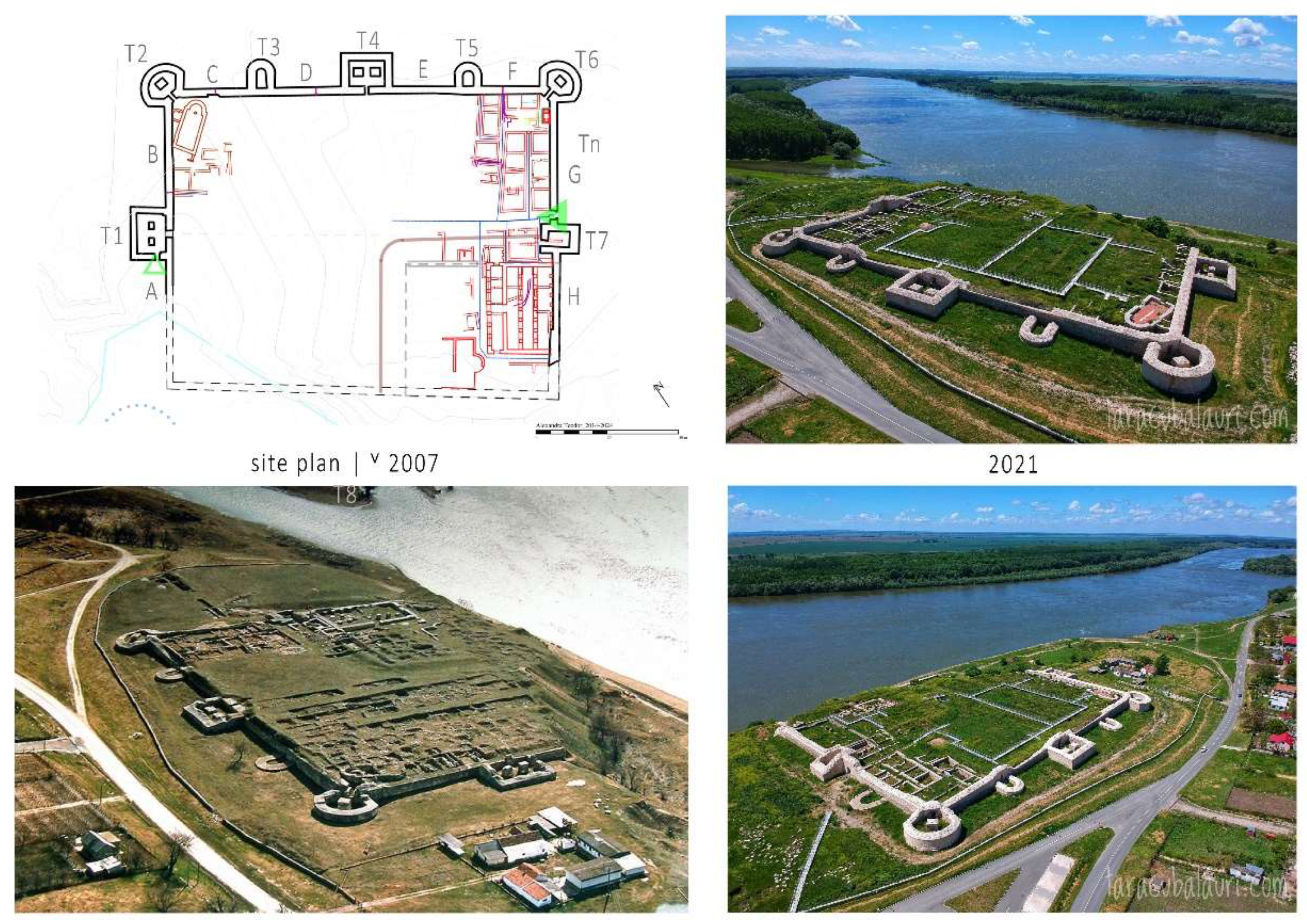
Figure 2.
. Domestic animals inside and around the fortress, after the intervention, as documented by the visitors [32] (Alina Bombita, 2023; George O., 2022). This sparks the limited understanding of the locals regarding the status of the historical monument, implicitly the lack of interest towards this minimal education on behalf of the leading actors in this project.
Figure 2.
. Domestic animals inside and around the fortress, after the intervention, as documented by the visitors [32] (Alina Bombita, 2023; George O., 2022). This sparks the limited understanding of the locals regarding the status of the historical monument, implicitly the lack of interest towards this minimal education on behalf of the leading actors in this project.
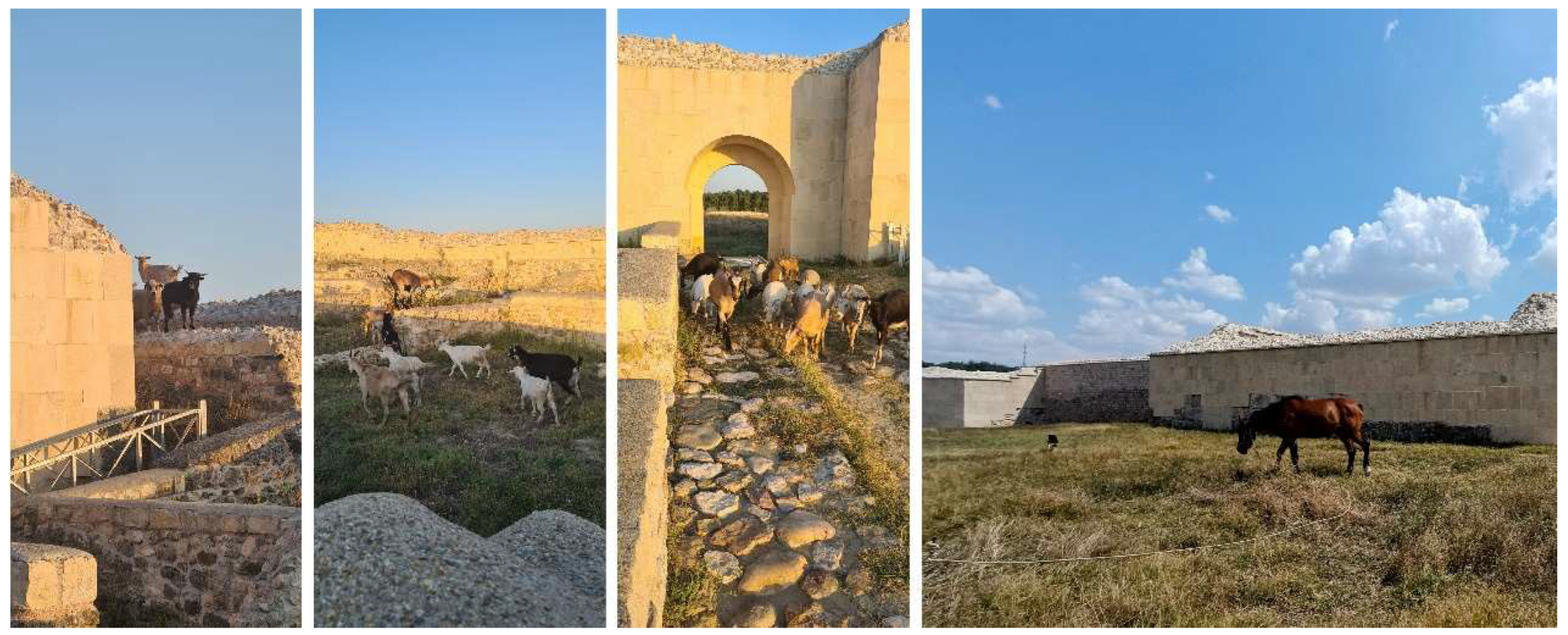
Figure 3.
Curtain G and Tower 6 after the recent intervention (top) [32] (Lana Mariana Nicoleta, 2021), and before, with the additions of the 20th c. (middle) [29] (figs. 33-4); it is obvious that the irregular parament of small blocks represents the latter, if compared to photographs upon the tower’s discovery (bottom) [31]. Therefore, the red line in the recent intervention delimitates it from the previous one of the 20th c., not from the authentic structure, as the doctrine says, thus misleading the reader. In fact, even if the red line would be missing, the most intuitive interpretation would be the same because of the high contrast, both in colour and stereotomy, between the recently added material and the others. Notice also the reconstruction of the “medieval” wall on top of the heightened Roman fortification (top); as for the photos in the middle (taken after the interventions of the half 20th c.), it is difficult to assess whether on top of the curtains there are fragments from the emplecton of the same wall, or the remains of the medieval fortification, or simply rubble.
Figure 3.
Curtain G and Tower 6 after the recent intervention (top) [32] (Lana Mariana Nicoleta, 2021), and before, with the additions of the 20th c. (middle) [29] (figs. 33-4); it is obvious that the irregular parament of small blocks represents the latter, if compared to photographs upon the tower’s discovery (bottom) [31]. Therefore, the red line in the recent intervention delimitates it from the previous one of the 20th c., not from the authentic structure, as the doctrine says, thus misleading the reader. In fact, even if the red line would be missing, the most intuitive interpretation would be the same because of the high contrast, both in colour and stereotomy, between the recently added material and the others. Notice also the reconstruction of the “medieval” wall on top of the heightened Roman fortification (top); as for the photos in the middle (taken after the interventions of the half 20th c.), it is difficult to assess whether on top of the curtains there are fragments from the emplecton of the same wall, or the remains of the medieval fortification, or simply rubble.
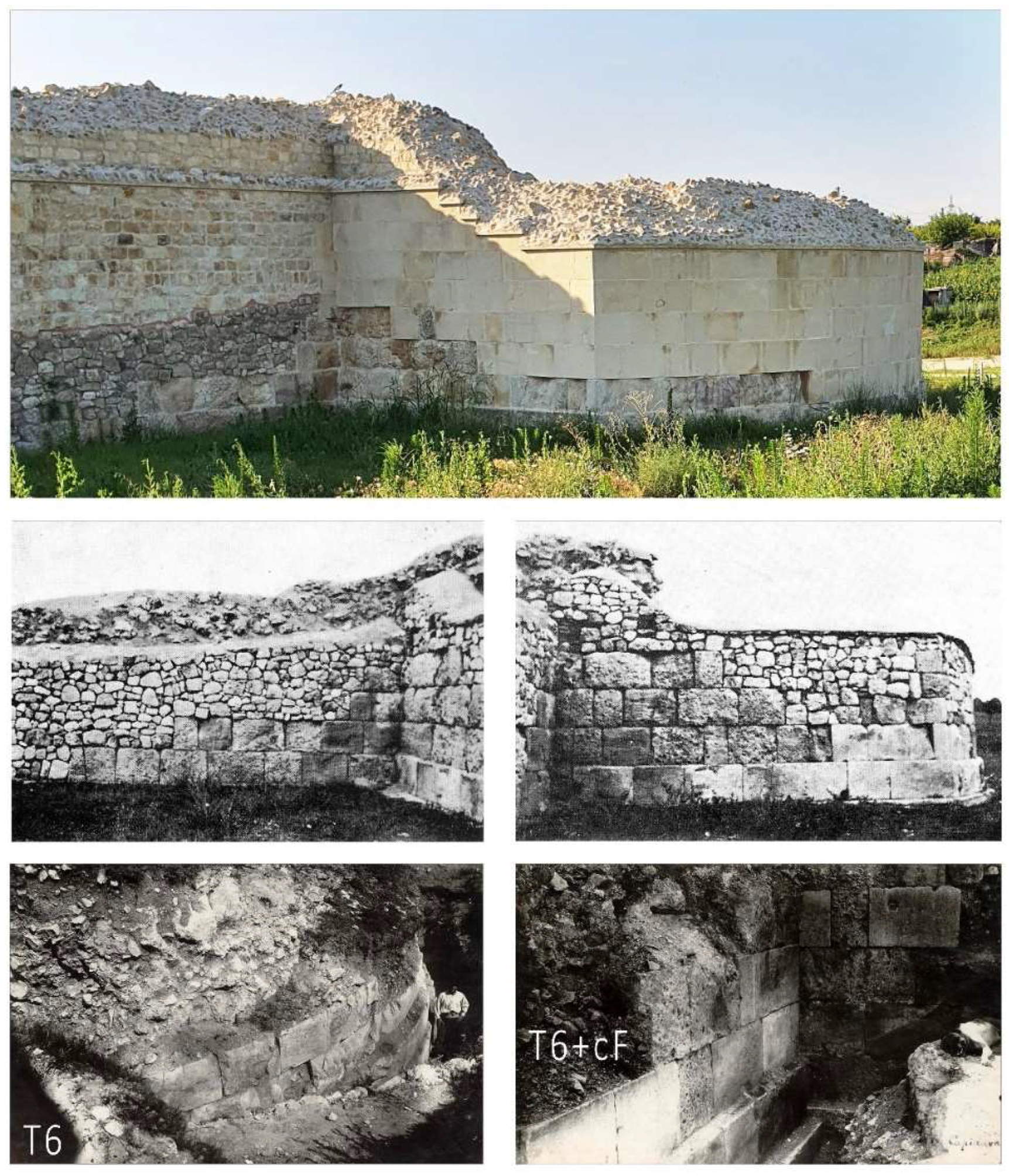
Figure 4.
Reinforced concrete used for the so-called consolidation of the original 2.5-2.7 m wide Roman fortification walls (Alexandra Teodor, Oct. 2015).
Figure 4.
Reinforced concrete used for the so-called consolidation of the original 2.5-2.7 m wide Roman fortification walls (Alexandra Teodor, Oct. 2015).
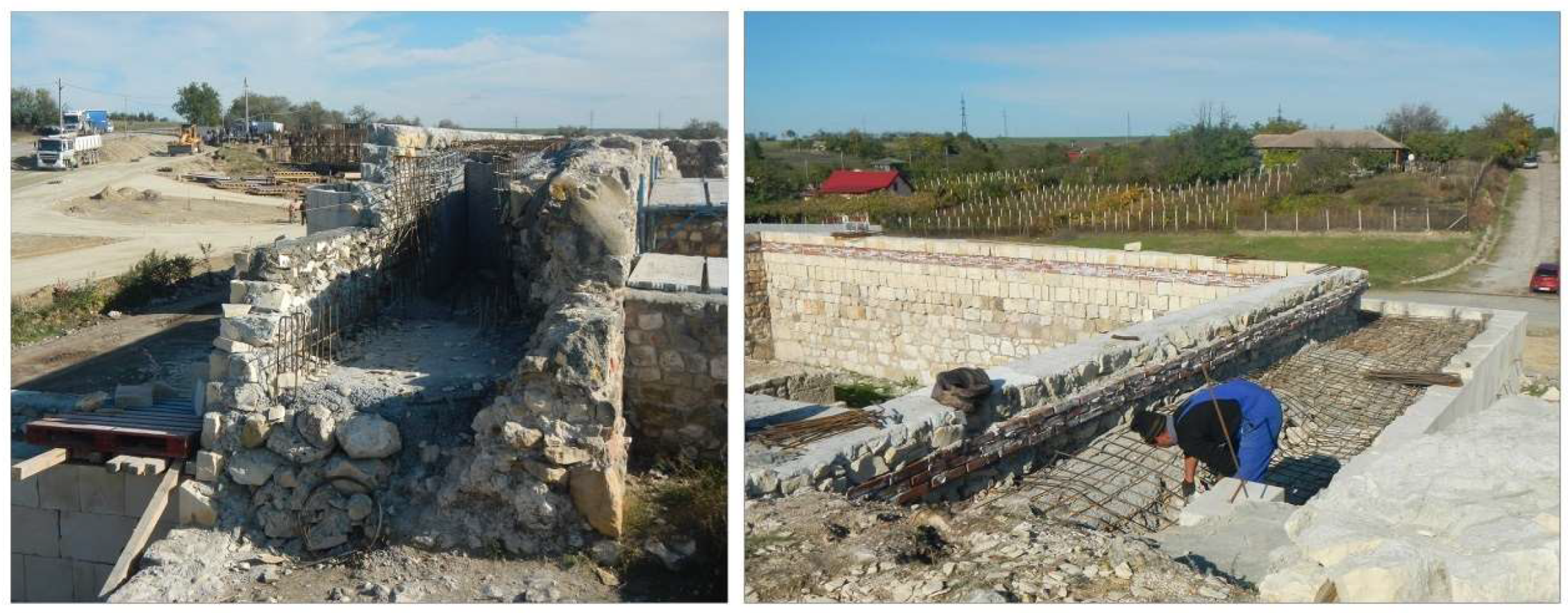
Figure 5.
Curtain F and Tower 5, before and after the last intervention [32] (Dumitru M., 2013 – top; Florin Anghel, 2023 - bottom). The medieval fortification wall can be observed on top of the Roman curtain (top); protected with cement cap and consolidated with improvised buttresses soon after the excavation, it was probably sectioned by the early excavators with the purpose to investigate the tower entrance. The recent intervention replaced the medieval curtain with by heightening the Roman wall, completely annulling the existence of the former on this segment – where it was best preserved (!) The green cap visible on curtains E and D is probably what remained visible from the original structure, which was probably hidden behind the face of the new wall.
Figure 5.
Curtain F and Tower 5, before and after the last intervention [32] (Dumitru M., 2013 – top; Florin Anghel, 2023 - bottom). The medieval fortification wall can be observed on top of the Roman curtain (top); protected with cement cap and consolidated with improvised buttresses soon after the excavation, it was probably sectioned by the early excavators with the purpose to investigate the tower entrance. The recent intervention replaced the medieval curtain with by heightening the Roman wall, completely annulling the existence of the former on this segment – where it was best preserved (!) The green cap visible on curtains E and D is probably what remained visible from the original structure, which was probably hidden behind the face of the new wall.
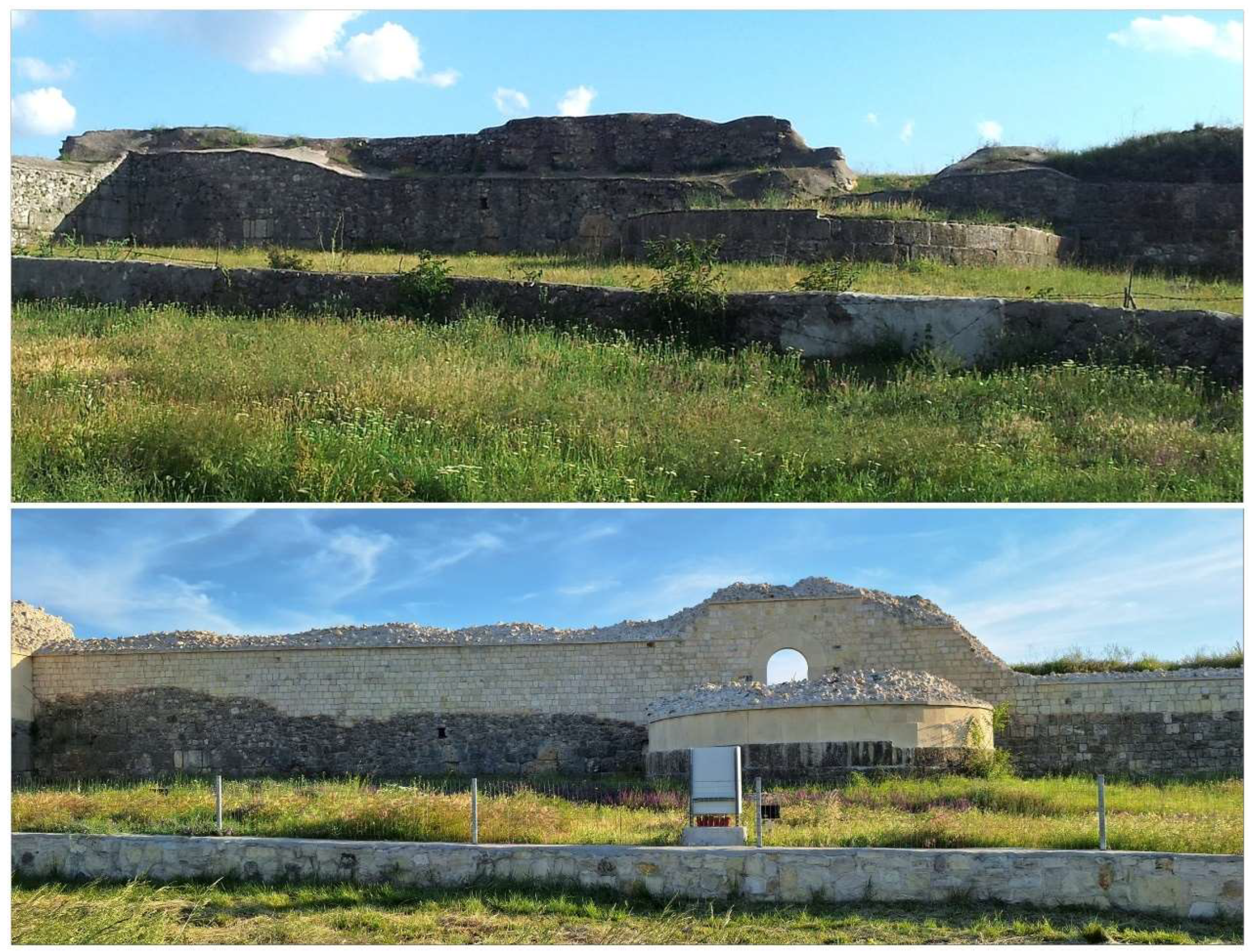
Figure 6.
Towers 5 and 6, intra muros view (top) [32] (Tiberiu Costin, 2022) and aerial view (bottom) [32] (Cosmin Bodeanu, 2021). Notice the brick arches of the entrances towards intra muros, versus brick arch (T6) and stone arch (T5) towards the interiors of the towers. Both solutions are misleading since no relevant data was preserved for the elevations at this level, while the use of both techniques indicates some sort of certainty regarding distinct phases.
Figure 6.
Towers 5 and 6, intra muros view (top) [32] (Tiberiu Costin, 2022) and aerial view (bottom) [32] (Cosmin Bodeanu, 2021). Notice the brick arches of the entrances towards intra muros, versus brick arch (T6) and stone arch (T5) towards the interiors of the towers. Both solutions are misleading since no relevant data was preserved for the elevations at this level, while the use of both techniques indicates some sort of certainty regarding distinct phases.
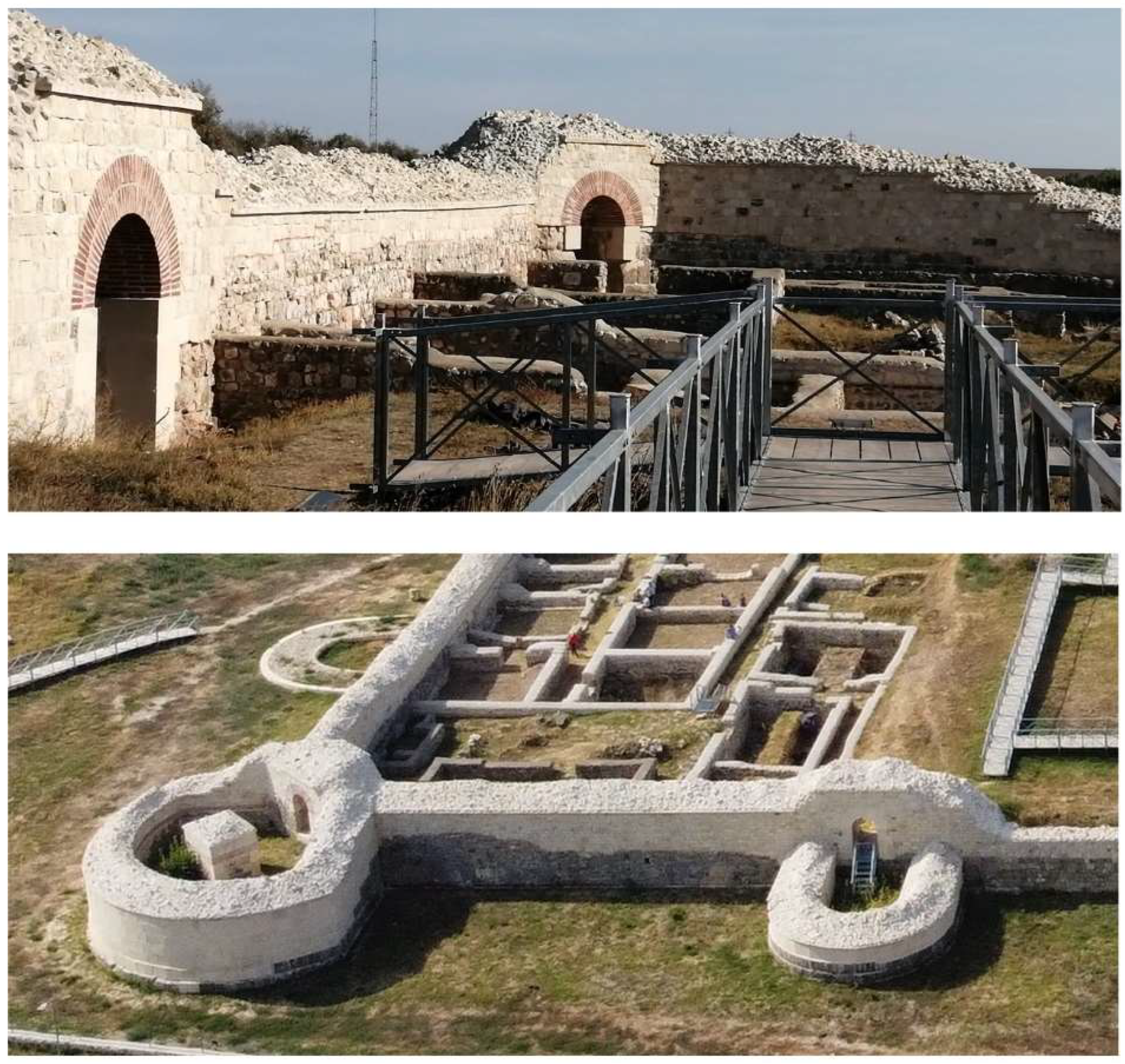
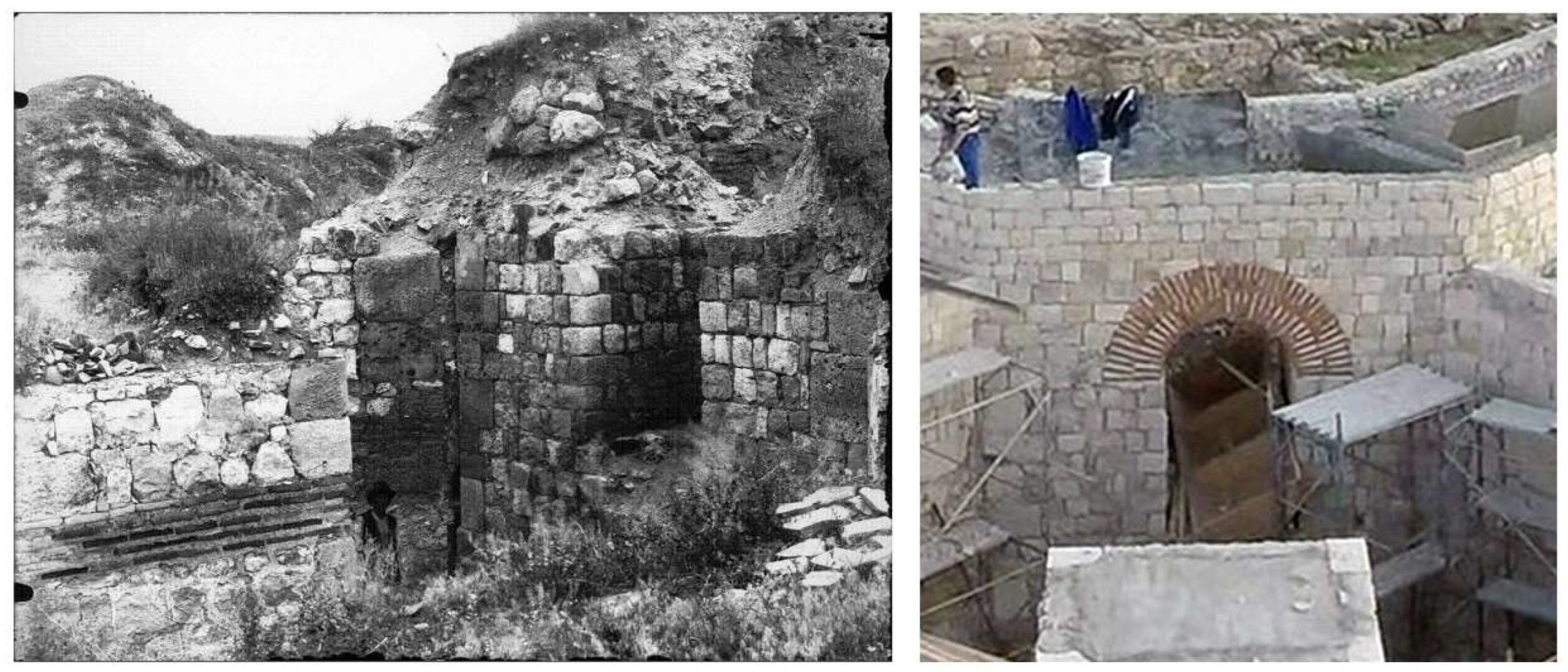
Figure 8.
The descending view towards the fortification, coming from south. Before the intervention, in 2012 (top), and after, in 2023 (bottom) [32]. Notice also the new information centre / museum in the foreground.
Figure 8.
The descending view towards the fortification, coming from south. Before the intervention, in 2012 (top), and after, in 2023 (bottom) [32]. Notice also the new information centre / museum in the foreground.
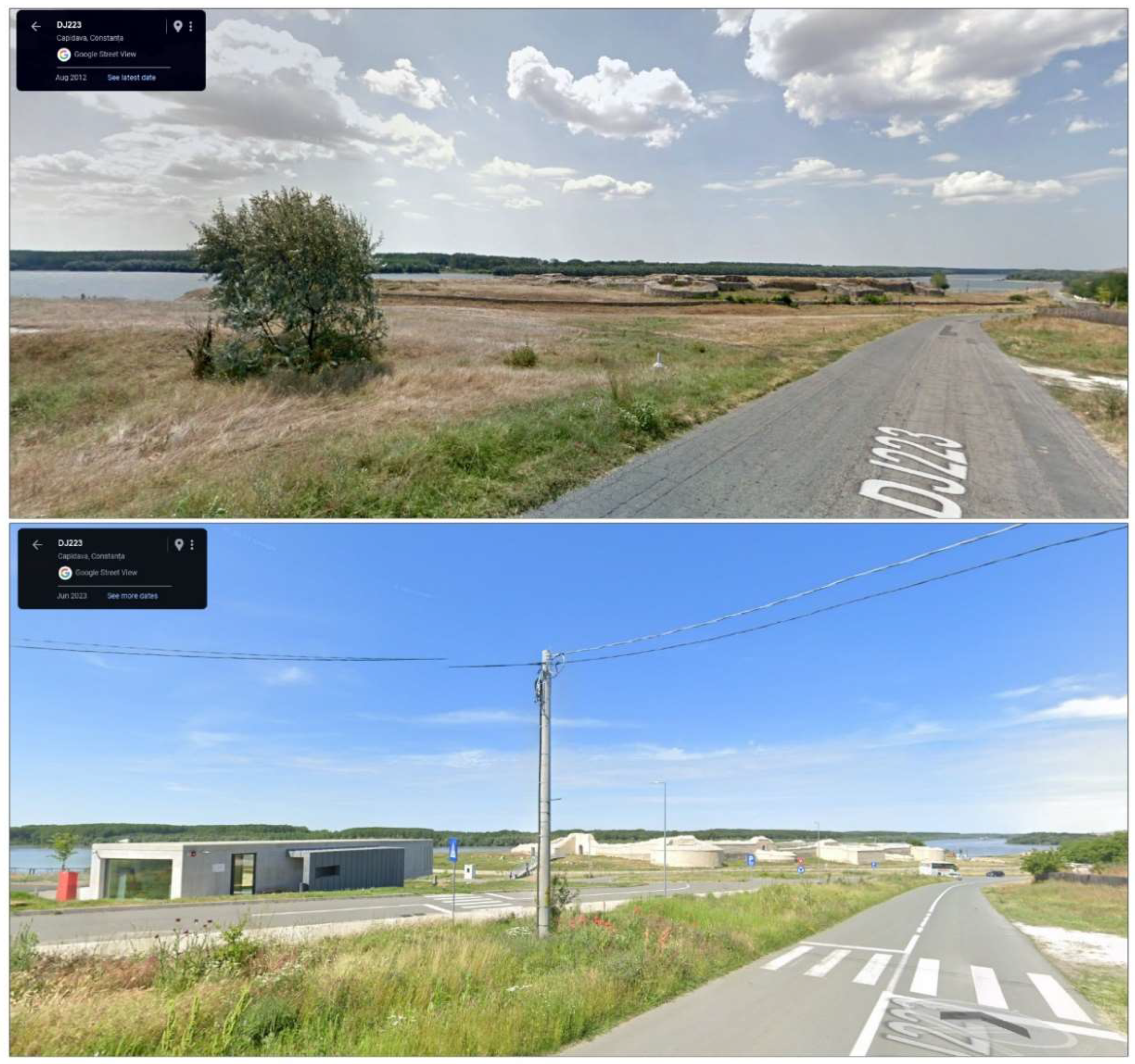
Figure 9.
Details taken during the intervention: curtains C and D (left) and Tower 1, detail (right) (Alexandra Teodor, Oct. 2015).
Figure 9.
Details taken during the intervention: curtains C and D (left) and Tower 1, detail (right) (Alexandra Teodor, Oct. 2015).
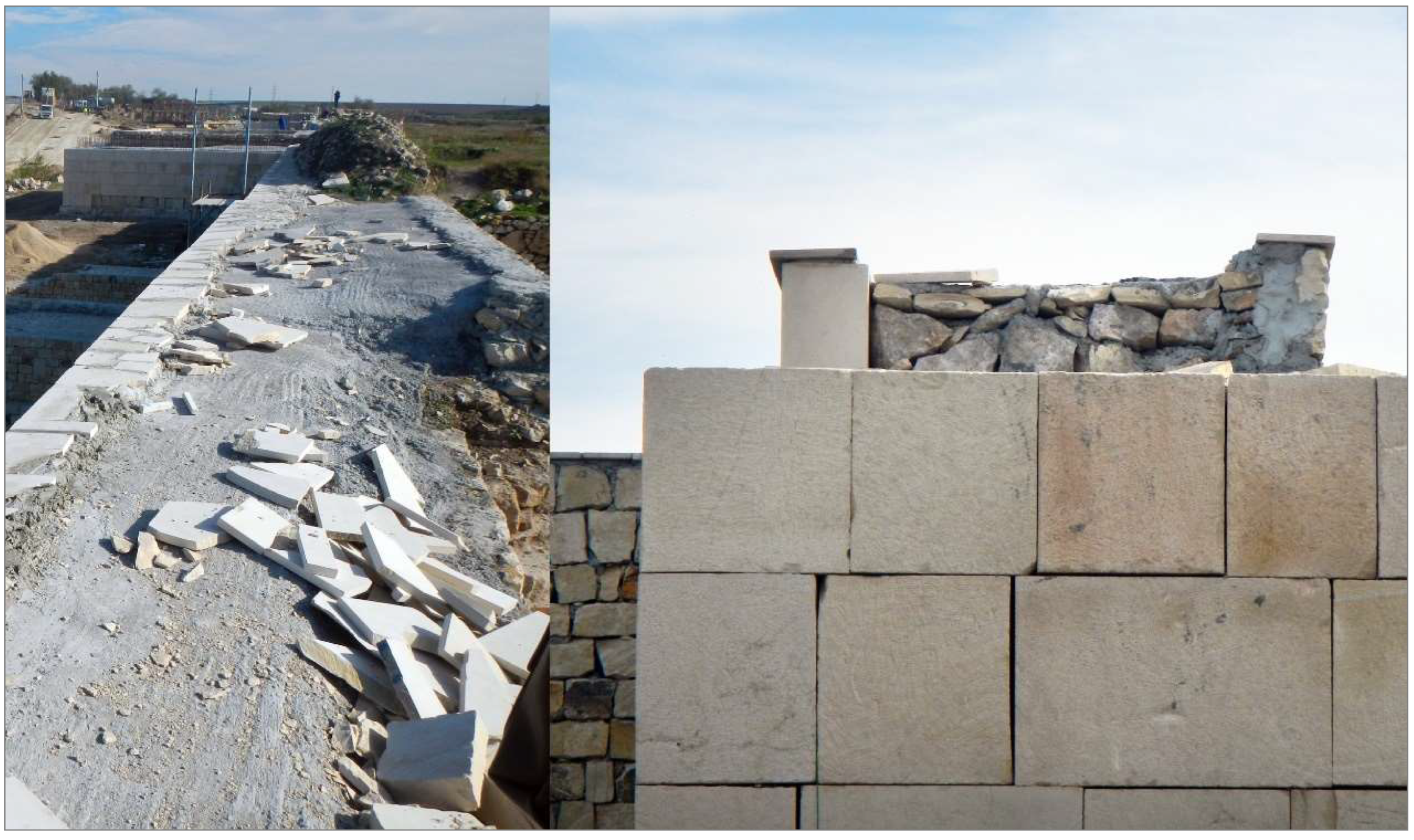
Table 2.
Evaluation proposal for the recent intervention at Capidava (2015-2021, coordinated by S.C. “Abral Art Product” S.R.L.). The result obtained, 23 out of 100 points, basically means a very poor-quality intervention. The evaluation for each criterion is explained in the text, see above.
Table 2.
Evaluation proposal for the recent intervention at Capidava (2015-2021, coordinated by S.C. “Abral Art Product” S.R.L.). The result obtained, 23 out of 100 points, basically means a very poor-quality intervention. The evaluation for each criterion is explained in the text, see above.
| The intervention in 2015-2021 at Capidava fortress, in Capidava, Romania | |||||
|---|---|---|---|---|---|
| criteria | assigned value | max. value | group value | max. group value | |
| 1 | common value and responsibility | 1 | 5 | 1 | 5 |
| 2 | authenticity | 5 | 20 | 5 | 40 |
| 3 | consistent documentation | 2 | 10 | 2 | 15 |
| 4 | diversity | 2 | 10 | 3 | 15 |
| 5 | appropriate use | 5 | 5 | 10 | 15 |
| 6 | context preservation | 5 | 10 | ||
| 7 | expertise | 2 | 10 | 2 | 10 |
| 8 | interpretation | 1 | 5 | ||
| 9 | structural compatibility | 0 | 10 | ||
| 10 | minimal intervention and reversibility | 0 | 10 | ||
| 11 | publication | 0 | 5 | ||
| TOTAL | 23 | 100 | 23 | 100 | |
Disclaimer/Publisher’s Note: The statements, opinions and data contained in all publications are solely those of the individual author(s) and contributor(s) and not of MDPI and/or the editor(s). MDPI and/or the editor(s) disclaim responsibility for any injury to people or property resulting from any ideas, methods, instructions or products referred to in the content. |
© 2025 by the authors. Licensee MDPI, Basel, Switzerland. This article is an open access article distributed under the terms and conditions of the Creative Commons Attribution (CC BY) license (http://creativecommons.org/licenses/by/4.0/).
Copyright: This open access article is published under a Creative Commons CC BY 4.0 license, which permit the free download, distribution, and reuse, provided that the author and preprint are cited in any reuse.