

Submitted:
11 February 2025
Posted:
12 February 2025
You are already at the latest version
Abstract
21st century skills are becoming increasingly important both in education systems around the world and in the labor market. In this article, it is assumed that any individual can master all the individual skills with appropriate training. Acquiring these skills while at school will enable individuals to develop them throughout their adult working lives. Skills for the 21st century do not have a strict definition, resulting in the existence of interdependent areas. This article examines the following skills: creativity, critical thinking, collaboration, adaptability, leadership, lifelong learning and problem solving. After analyzing each of them, their commonalities are identified. The ultimate goal of all of them is to find an innovative solution to a problem. Finally, each of these skills is placed on a pyramid. Moving from the bottom of the pyramid to the top, we find the skills that are prerequisites for mastering the higher level. In this way, it is clear which skills the person needs to master first in order to progress to the next level. In an educational system where skills are cultivated from childhood, it is not necessary to master all the skills at once, but to master them gradually. The pyramid can be used as a guide as to which skills should be cultivated at the initial level.
Keywords:
21st century skills
; adaptability
; creativity
; triticale thinking
; co-operation
; lifelong learning
; problem solving
1. Introduction
Skill is defined as the ability that a person acquires to do something, which can be related to either a physical or mental process [1], through the knowledge that he or she already possesses, and is ultimately able to achieve the desired goal [2]. A person who has mastered the skill understands his or her potential and possesses knowledge acquired through a training process, either through practice or experience [1]. Skills are those that help individuals to function in an environment that is constantly changing and unpredictable [2].
Skills for the 21st century are defined as those required to enable a worker to cope in the workplace, but also in the conditions of the global economy [3], a knowledge-based economy [4,5,6], interpersonal and social skills [6]. The constant changes in the prevailing conditions of the working environment require workers to have not only cognitive but also non-cognitive skills [7]. The changes brought about by the Industrial Revolution 4.0 ("Industry 4.0") are leading to a world with automated production systems and the use of digital technologies [1]. Technological development is affecting the nature of employment, mainly by reducing the number of workers needed to complete a task, as the contribution of machines is crucial in reducing the time needed to complete a task [8]. Conditions such as globalisation and migration are themselves placing a premium on the acquisition of 21st century skills [9] and are changing education to ensure that the right workers of the future are available [10].
While each worker operates locally in their own country, they must take into account changes at a global level [11]. In today's world, it is not enough for students, and later citizens, simply to have mastered literacy, reading and self-sufficiency [12]. The same applies to education, and the curriculum must take into account the specificities of each country and be in line with trends in global labour demand. The success and development of a country requires the existence of an adequate human resource capable of responding to the needs of jobs through the skills they have acquired [13]. In order to acquire the necessary skills, it is necessary to receive the appropriate education from the earliest years of life [13]. Skills acquisition must therefore be placed at the heart of education systems [2].
Analyses related to employers' views on the attributes that contribute to the recruitment of an employee relate to non-cognitive areas. More specifically, they relate to the interpersonal relationships an individual can develop, high motivation, the ability to interact with customers, problem solving and working as part of a team [6].
We will first look at the so-called 21st century skills, and since there is no precise definition and number for them, we will refer to those that are commonplace [3]:
- Creativity
- critical thinking
- Problem solving
- Lifelong learning
- leadership
- Adaptability
- Collaboration to solve a problem [14].
It is clear that the emphasis is on skills that are superior to those that machines can provide, and therefore only a human can acquire and apply them in both daily and professional life [8].
Finally, it should be noted that the acquisition of skills alone does not guarantee that individuals will behave according to the democratic framework. There are examples where creativity and flexibility have been used to achieve anti-democratic and racist goals [2]. It is therefore clear that skills need to be taught alongside humanistic values.
As 21st century skills become the focus of more and more education systems, this article shows that the ultimate purpose of all skills is to produce innovative solutions. Furthermore, accepting that skills are cultivated and developed from the earliest years of schooling, an attempt is made to classify the skills mentioned. By means of this classification, an attempt is made to explore and propose a series on the basis of which it is recommended that skills be cultivated, giving priority to those that are a prerequisite for the acquisition of the next one.
2. Creativity
2.1. Definition
Creativity is one of the skills that can be cultivated in the individual and will be treated as such in the following. Once again, the important role of the teacher is highlighted, as it is the teacher who must choose the right methods that will lead to the mastery of creative thinking [15].
Creativity is characterised as the ability of the individual to create something new on his/her own initiative [16,19], through successive thoughts and actions that lead to a solution [17], transforming the incoming information into new knowledge [3]. The derivative is original, meets the constraints set during the task and also has significant meaning in the context of the task [3,18].Throughout the task, the individual discovers new connections and successfully overcomes each challenge he/she encounters [19].
There is no strict definition of creativity, but it is associated with originality and usefulness [15,20]. It is a method of manipulating information [19] and is directly linked to a variety of academic achievements [15] and is what helps thinking take shape [17].Gong et. al. in their 2022 literature review mention creativity as one of the skills that have contributed to the advancement of human civilisation and are useful in many areas of everyday life such as education, social interactions and work [21].
2.2. Characteristics of a Creative Person
The creative person is able to solve problems and has mastered the ability of divergent thinking [15], which ensures the existence of many alternatives to the same problem [17]. It is the continuous research and the multiplicity of possible solutions that will lead to the refinement of the final solution [17], which will include all these components of creative thinking. On this basis, it can be described as the first step towards innovation when a new idea is put into practice [22].
At the level of teamwork, creative thinking is generated after interaction, exchange of opinions and also prompts among team members [23]. However, it should be noted that during a creative process there are usually periods of uncertainty and limited output [18]. Originality, in turn, is related to innovation and usefulness is related to the appropriateness [17,20] of a given proposal to solve a problem.
There are characteristics of a person's personality that are either conducive or not conducive to the development of creativity. Characteristics such as determination, having ambitions and demands, regulatory focus have a positive impact on its development [21]. Other individual characteristics that contribute include being open-minded, having empathy, being able to adapt to situations, listening carefully both to the parameters of the problem and to other team members, respect and honesty. Conversely, traits such as stability and self-interest are barriers [21].
Some of the characteristics of a creative person are
- Discipline
- Ability to face frustration and overcome obstacles
- Their judgement is not influenced by that of others
- Willingness to take risks for themselves and the team
- Facing ambiguity in a given issue
- Overcome any obstacle
- They are ready for adventure
- Able to propose alternatives
- Use unusual methods to solve problems
- They are able to defend their solution in front of an audience [16].
- Have a deep knowledge of the area in which they were able to provide a creative solution
- Combined with talent in a field
- Demonstrates a high level of expertise
- Acquires collective responsibility by working in a team [24]
- Accepting to take on tasks that do not fall into the category of typical tasks
- Rejects norms, overcomes stereotypes
- Flexibility and self-confidence [25]
- Feeling comfortable expressing opinions within the group
- Thinking outside the box
- Producing innovative concepts and solutions
- Not satisfied with existing knowledge but constantly seeking new sources of knowledge
- Adaptability [26].
- Analysis skills
- Able to carry out research
- Able to generate many ideas, so are more likely to find an innovative solution
- Focuses on the problem at hand
- They are communicative
- They develop and evolve even through mistakes and failed attempts [19].
It is clear that the concept of creativity encompasses a large number of other skills [19]. It is worth noting that these characteristics may vary from person to person, as there is also the influence of the environment. The transmission of innovative thinking from the teacher to the student is a process that is characterised as difficult. The application of creative thinking in any educational or working environment is a characteristic of success in modern times [19].
2.3. Factors Contributing to the Development of Creativity
Contributing to the development of creativity starts with the existence of an appropriate physical environment. A room with natural light, views of nature, plants, the use of relaxing, inspiring or stimulating colours on furniture and walls, and quiet or relaxing music all contribute to this [18].
An important factor that can contribute to the development of creativity is motivation. This is when the individual is enthusiastic about the task at hand and enjoys working [16].
3. Critical Thinking
3.1. Definition
Another important 21st century skill is critical thinking, which has its roots in ancient Greece [2]. It is a skill that can be taught to an individual at any age, regardless of the intelligence level of the learner, using appropriate educational methods [27,28]. In childhood, the child's innate curiosity is an ally in laying the foundation [29] for the formation of a critical thinker. While it is considered more effective to teach it through a course rather than as a separate subject, it can be cultivated through different subjects - disciplines [28].
Critical thinking is defined as the acquisition of the ability by students to follow the following course during the educational process:
- Application
- Analysis
- Composition
- Evaluation
Applying and evaluating all the information [17,28,29,30,31,32] they receive when solving a problem, making a decision or learning new concepts, demonstrating skill and active participation [33]. It is directly linked to making decisions that can be supported by arguments that have a scientific basis [3].
Analysis is that which leads from its results to research and ultimately to practical application [34] and is related to the analysis of ideas in their component parts [35]. Evaluation, on the other hand, helps to separate correct from incorrect information [36], thus differentiating the value of the data collected during research [35], and helps individuals to form their own opinions on the subject [3]. It is also directly related to decision making and which of the information received by the individual should ultimately be believed [31].
It is clear that the process of knowledge acquisition is experiential [17]. The acquisition of this skill is of paramount importance, as there are many professions that require the acquisition of each of the skills mentioned, as the information received is from different sources each time. The analysis of data provides important data that can be transformed into knowledge and information [33].
3.2. Characteristics of a Critical Thinker
By mastering and using critical thinking, an individual can evaluate the credibility of a source and avoid becoming a victim of misinformation [37]. Evaluation, in turn, involves bringing all the elements together to create an innovative outcome [35]. Once again, it is clear that 21st century skills are not one-dimensional application skills that enable individuals to meet the demands of their jobs. On the contrary, they help the individual to acquire a set of skills that help him or her to take into account factors related to the common good and the future of humanity when finding a solution to a problem. Because any proposed solution is guided by humanitarian principles.
Critical thinking is that which helps individuals to evaluate and discriminate between the information they receive [27,28,30,38], which is abundant due to the possibilities offered by the Industrial Revolution 4.0 [34]. The phenomenon of misinformation and the spread of false news, which is transmitted at extremely high speed via the Internet, cannot be ignored. A typical example of the transmission of false news was the COVID-19 pandemic, during which a large amount of information was disseminated in a short period of time [39]. This shows that critical thinking is useful not only in research, but also in everyday life. This is exactly why critical thinking is one of the necessary skills that a person should have in the 21st century.
Critical thinking enables individuals to question even their own beliefs [30] through investigative questions, thus contributing to self-improvement. Critical thinking helps individuals to make decisions and to understand scientific concepts [26], to formulate their ideas accurately and clearly [17], and it cannot be overlooked that it is the kind of thinking that is necessary not only to solve a problem, but also to draw conclusions, calculate probabilities and ultimately make a decision on an issue [28].
Mastery of critical thinking skills leads an individual to acquire other positive attributes such as insight, resourcefulness and foresight [33], which contribute to making good decisions [28,33]. It also contributes to analytical skills [34], which are important in a wide range of careers. The individual remains open-minded [17,27], works systematically and is willing to strive for the truth [27]. They are able not only to construct arguments but also to recognise their validity [17]. He also has a spirit of cooperation and communication, and is able to express his thoughts through the use of written language [17]. They are curious, honest with themselves so that they can overcome their prejudices, and willing to follow the process of checking both the data they have used and the conclusions they have reached [17,28,40]. They are able to be self-critical about whether the solution is the right one [28].
3.3. Factors Contributing to the Development of Critical Thinking
It is an extremely important skill, as it is one that distinguishes the virtuous researcher, who has not simply developed some of the faculties of the mind [17]. It is also a prerequisite for generating doubt and questioning, which are the cornerstones of all research [17]. It is inextricably linked to creativity [17]as the latter, by its very nature, is a prerequisite for the acquisition of critical thinking, which is a complex skill [17] that goes beyond the simple understanding of a complex problem [17]. In this process, it is not only the problem that is studied, but also the thinking that takes place [17].
Correctly searching, sorting, storing and sharing information is a key characteristic of a digitally literate person. Mastering these skills is an advantage in the competitive environment of the global economy [41] and also contributes to the development of critical thinking.
Information discrimination occurs after the individual has been freed from pre-existing beliefs [33] and has been sceptical about each of them [38]. It is critical thinking that helps to evaluate the accuracy of information and subsequently leads the individual to draw correct conclusions [27]. The acquisition of this skill during education is important because it enables individuals to find scientifically correct solutions to specific problems [29,30,37,42], and also to choose the best possible solution when there is more than one possible solution [34].
Prerequisites for the acquisition of critical thinking are the individual's desire to acquire more knowledge, the ability to see data from different perspectives, the desire to confirm what one already knows, the evaluation of sources, and finally the drawing of conclusions based on evidence-based reasoning [34]. An encouraging principle is the formulation of a problem and students' inherent curiosity about its solution [28]. Intrinsic qualities such as imagination and pro-behaviour [29] are conducive to the development of this skill, as they help to adapt their knowledge to give the final outcome the desired characteristics and students develop the desired skills.
4. Problem Solving
4.1. Definition
A problem usually has no specific form and is difficult to deal with [4]. The problems we face in today's world are usually characterised by great complexity. They often require a solution in a short period of time and have a global scope [4]. A typical example of such a problem is the response to the COVID-19 pandemic, which had global dimensions, increased difficulty and required a solution in a short period of time. The same can be said of the technological accident that occurred on 20 April 2010 on the Deepwater Horizon oil rig, owned by Transocean and leased by BP.
Workers in the increasingly competitive global economy will be faced with increasingly complex problems and will therefore need problem-solving skills [3,43]. A problem-solving skill is defined as a skill that helps an individual to effectively resolve a situation that is complex and has not been encountered before [3]. This process requires the individual to draw logical conclusions based on the knowledge they have acquired after processing different sources [43]. Thus, we move from the initial problem state to the desired solution state through a process in which the learner acquires new knowledge through information processing and a variety of other actions [4]. The solution must be innovative [4].
4.2. Characteristics of a Problem Solver
The person who can solve any problem encountered in daily or professional life has first mastered the necessary cognitive skills [44]. The individual must be able to define the problem, choose the strategy to solve it, search for the necessary information and select the valid and useful information. They must also be able to monitor the entire solution process [45]. He uses these cognitive skills to cope with any difficulty in solving the problem [44] They also have the ability to self-learn in order to find the missing information and achieve the desired result [44].
In order for the individual to be able to reach the solution of the problem, he/she should have mastered the skill of critical thinking [32]; as he/she should find information from reliable sources, analyse it and then apply it to the given problem. Creativity and adaptability contribute to problem solving as the individual has to deal with unpredictable situations [32].
As mentioned above, today's and tomorrow's professional is required to work in a constantly changing environment, where problems are interdisciplinary in nature. It is obvious that in order to solve a problem, the individual will most likely have to work in a team. In order to be functional and productive in the team, he/she must first have mastered the skills of collaboration and leadership.
It is clear that problem solving is the ultimate goal of 21st century skills, so the person who can cope with any problem has the characteristics of a person who is a critical thinker, creative, collaborative, has leadership skills, can adapt to changes in the environment and is a lifelong learner.
5. Cooperation- Building Team Spirit
5.1. Definition
As the problems faced by workers become more complex, a high degree of specialisation is required of a professional. One person may not have the necessary knowledge in all the required fields and will therefore need to work with professionals from other disciplines. There are many instances where an individual will need to collaborate with other individuals throughout his or her life in order to achieve his or her aspirations and goals [5]. Collaboration is one of the essential skills of the 21st century, as it is considered that it can be cultivated even in individuals who do not have it by nature [46,47]. Its importance is directly related to the fact that employers themselves rank it as one of the most important soft skills an employee should have in order to be hired [10]. In addition to high academic performance, an individual should be able to communicate with other people and interact with society [48].
As in most cases, there is no strict definition of collaborative skills. Communication is the skill that allows the individual to explain his/her thoughts and ideas, to exchange views with other members of the group and to develop feelings of solidarity through the help that can be given to each other [12]. Cooperation is the set of processes that involve collective and individual efforts [49]. At the educational level, cooperation is the skill that pupils cultivate and use when, in the school context, they form a group of at least two pupils and are asked to solve a problem, complete a task, create a product or acquire new knowledge [10]. It is also the skill that can help an individual learn how to learn from another person through social interaction [49]. According to another definition, collaboration is the process that involves at least two people who are asked to work together to achieve a result that could not be achieved by working alone [49].
5.2. Characteristics of a Person Who Mastered the Ability to Collaborate
An individual's collaboration in a group is related to the ability to share knowledge and to synthesise a creative solution that is a composite of the individual ideas of the whole group [22]. It promotes respect and makes the team more effective, while helping the individual to negotiate and make decisions taking into account the opinions of others [10].
Many of the existing modern world problems from different aspects of daily life, such as the economy, the environment, health, require teamwork between different people and also communication skills to convey them [46].
In order to achieve an optimal result, cooperation between team members is necessary [3]. Through this process, all team members benefit as they take advantage of each other's abilities to cover their own weaknesses [5], while jointly developing the ability to cooperate [12]. It is clear that the heterogeneity of the group in terms of the skills of each individual is an advantage [22]. Group members with different abilities and orientations can create the necessary conflict between social and cognitive elements, which, according to Piaget's theory, can lead to knowledge change [50]. People with different skills can contribute to the final goal by adding their own little stones to the final result, so that the set of ideas will contain the optimal solution. Within the group, members can demonstrate their cultural identity and thus exchange experiences that lead to a deeper understanding of the course.
At a professional level, the different cultural identity means working with people who are in another country and therefore requires the use of electronic media, but also the effort to recognise the way of thinking and the knowledge base of the other side. The team only becomes effective when its members share their knowledge, and in many cases the shared knowledge has to be defined from the beginning [51]. At the end of the collaborative process, team members reap the joy of achieving the goal [12]. Each member of the group appreciates the contribution of the others to the final result [12]. This skill can be acquired by people as young as school age, as most student-centred methods require students to work together in groups.
In today's context of globalised society and technological developments, individuals will have to learn to cooperate not only with people they know, see and are close to, but also with people they do not know and will have to work with at a distance [49].
An individual's ability to cooperate with the rest of the group members is essential to the achievement of the goal and the ultimate success of the group [12,47]. The goal is shared and the strategy chosen to complete the work should be acceptable to all members [49]. They should also have the confidence to externalise their ideas, share them with the plenary [52] and support them. Working together in groups is also necessary to master leadership [47]; it is no coincidence that people with cooperative and communicative skills are often chosen for high positions [12]. It also enables the participants in the group to give the necessary feedback to the other members, but also, after the evaluation, to do some repetition either in the course they have followed [8]. Therefore, it is possible to make improvements to the proposed solution [8] and finally reach the optimal solution.
5.3. Factors Contributing the Development of Cooperation
In the first stage, each team member should know his/her role and the roles should be clear [22]. A basic condition is the existence of a common goal [50] for which all team members are willing to work. It is a prerequisite that all team members know what they are going to do, so that there is successful communication between them [51], with coordination and information about everyone's actions regarding the completion of the work [50]. To achieve the final goal, students are asked to show empathy, respect and give space to all members of the group to present their ideas [22]. Rewards and positive interdependence between members can also have a positive effect [50].
Simply forming teams does not ensure the acquisition of cooperation and team spirit. Rather, team members should be actively involved in solving a specific problem [12]. Elements such as the existence of self-interest by the group and the existence of control and decisions in a hierarchical way make the group dysfunctional and not only do not contribute to the development of cooperation, but actually hinder it [51].
6. Leadership
6.1. Definition
Leadership is one of the key skills not only in the 21st century, but also in professional life, as it is required by many companies [47]. Although it is in line with other skills, as in the modern era, which is characterised by rapid technological development, leadership must be oriented towards the acquisition of knowledge, innovation, but also the continuous improvement of acquired knowledge [1]. In this competitive environment, failure or success often depends on the existence of a charismatic leader [11]. It can contribute to the development of professional life and, by extension, the global economy.
Like all the other skills mentioned, leadership is not well defined. A group leader is considered to be the person who guides the group in a certain direction [53,54] by making use of the skills and knowledge of the group members [55]. In order to become a leader, he or she must first have experience in the real world [54]. He can influence the way the group works and also the decisions it will take, but the purpose of all members is common from the beginning [11,53,56]. At the same time, he evaluates and manages the emotions of the others [55]. While he is responsible for the organisation of the team and its effectiveness [11,57] and time management [58]. He is the one who has the vision [53,56,58] to realise a project [56], which also becomes the vision of the whole group [58]. His role is to motivate the rest of the team members to improve their performance and productivity by giving them confidence that they will be able to achieve the final goal [53].
6.2. Factors Contributing to the Development of Leadership
Like a number of other skills, leadership can be taught [11,13,33,47,55] from an early age [13] and become the property of those who have been exposed to appropriate teaching methods [13] or these are either formal or informal [54].
It is recognised that leadership is developed through three stages. One is the innate leadership ability of the individual, which is acquired at birth [11]. The theory of hereditary traits was one of the first, beginning in 1840 [57]. The second is the education received during early childhood [11]. The education that the individual receives is considered important even in theories that accept leadership as an innate ability [57]. The third stage refers to the experiences the person has during their adult life [11]. Leadership can be learned, but like any kind of training, it requires an investment of time and dedication to the goal [11].
An ally in acquiring leadership skills is practical application, as seminars and leadership courses cannot help as much [1]. Having already accepted that this skill is cultivated, it is clear that in order to acquire it, a student should practice it and not just know its characteristics theoretically.
6.3. Characteristics of a Leader
The leader must be able to create an environment in which the other members of the group feel accepted [47], a skill that becomes increasingly important over time as the leader is called upon to manage cross-cultural teams [11], so he should not apply segregation in his management [57]. They should also be able to identify and apply the leadership style that best suits their team and work environment [53].
Through leadership, the individual influences the behaviour of other individuals in the group [11,47]. In order to do this, the leader must first gain the trust of the team, which requires a long period of cooperation [58]. He is there to serve and defend the interests and decisions of the group [56,58] . He must listen to the opinions of all team members, which encourages two-way communication [57,58]. While he is the one who will make the final decision, as he has the judgement and experience to distinguish now is the optimal solution [47] and the optimal way to use the technology [57].
He possesses many high-level skills and traits that will help him achieve his goals [56]. He is also characterised by responsibility [47], commitment [53], self-awareness [58], self-confidence [47,56], enthusiasm [53], empathy [57,58], high sense of duty [47,56], creativity [57], honesty [11], integrity of character [11,53], absolute control over his actions, stress tolerance [11]. We are therefore talking about an emotionally intelligent leader who is able to manage first his own emotions and then the situations he is confronted with [58]. Empathy is particularly important because it coexists with a number of other skills, such as the ability to motivate and communicate with other people [55]. It needs to take into account the conditions that exist at the moment but may change in the immediate future [57]. Focuses on the goal and motivates others in that direction [47,57]. Throughout the process of achieving the goal, the leader's behaviour must be characterised by ethics, thus becoming a model for the rest of the group [11].
The individual skills of a leader can be divided into four components. The first is cognitive, related to the understanding of patterns and the way the different models work [9,11,56] . The second is interpersonal, related to the ability to communicate and manage different behaviours [9,11,13,53]. He should be supportive of his team members but also discuss all decisions with them [53] . Thirdly, business skills related to the organisation and management of resources [9,11,55]. Finally, there are strategic skills related to the vision and the achievement of the goals set [1,56].
A leader has a number of characteristics such as
- Willingness to meet the needs of the rest of the team
- The ability to inspire through the way they handle different situations, through their actions but also through the way they communicate.
- Ability to manage
- Ability to communicate [47]
- To adapt to market data, but also to technological developments and any changes that may occur
- Continually enrich their skills according to global trends [1].
- Continuous desire to improve the results achieved by the team [11]
- Has high ambitions [56]
- Processes a large amount of information in a short period of time [57]
- Encourages others to lead [59]
In the midst of the Industrial Revolution 4.0, leaders of the coming years will need to have a number of new skills. For example, they will be asked to work in collaborative networks, but also to recognise the changes that are coming and the opportunities they will bring [1]. Every change on the global scene, whether it is economic or technological, is a challenge for the leader that can contribute to development and progress [11]. Another global change that will affect the characteristics of leaders in the coming years is the digital transformation [57]. This requires the acquisition of leadership skills not only from top management, but also from middle management [57]. At the same time, it should identify technology trends and allocate its resources in the best possible way [57].
The manager will be asked to solve many and varied problems during his term of office [56], and it is clear that he will be favoured if he has learned to do this since his student days. When solving a problem [11] of everyday life, the group works and in many cases there may be disagreements, so there should be one member of the group - student who can keep calm, think logically and communicate with the rest of the team so that the team's work continues smoothly.
Leadership skills can be manifested by any person in the group, not necessarily only by the person who has the role of leader [47]. For example, a high sense of responsibility, self-confidence and critical thinking are not only necessary for the designated leader of the team, but also for all the other members so that the outcome has the desired characteristics and the desired goals are achieved. Also, different interest groups can be led by different people each time [13] , as each person has different interests and talents. For example, tasks with a different topic and a different scientific focus can be led by a different person from the same group each time, so that all students can take on leadership roles during the school year.
7. Lifelong Learning
7.1. Definition
Another key 21st century skill that students should have acquired by the time they leave school is lifelong learning. UNESCO was the first to introduce the concept of lifelong learning in 1972, followed by the OECD in 1974 [7]. UNESCO introduced it as a means to achieve equality and equity in the workplace, while the OECD introduced it as a need to find the human capital needed [60]. Thus, despite the convergence, there is a clear difference in the motivation of the two organisations to implement lifelong learning. Differences that are to be expected given the founding objectives of each. The link between lifelong learning and the needs of the labour market has finally gained ground [61] .
It is directly related to the continuation of learning throughout an individual's adult life, but also throughout their working life, through: formal and informal forms of learning [9,60,61], school, training centres, from colleagues, trainers, social interactions [9], hobbies, work environment and all daily activities [62]. The original vision of lifelong learning was one of education without boundaries, as individuals could learn at any age and in any place [61]. This means that the acquisition of knowledge is not limited to the student years, nor to school or university. Therefore, it is not limited to a certain age or stage of the person's life, but can be achieved at any time [9]. In other words, people learn throughout their lives, through the opportunities they have throughout their lives . In other definitions, lifelong learning is that which is initiated by the individual and is not linked to formal institutions such as schools or universities [9]. It enables the individual to understand in depth all the components of sustainability and to take them into account in every decision [63].
It is considered appropriate to make it clear that lifelong learning is a central concept of applied educational and social policies, and not simply an auxiliary competence [63]. Lifelong learning is now more focused on vocational training, as there is a need for workers with new highly specialised skills over the years [62]. As reported by Loumpourdi M. in [64]states that the European Union promotes lifelong learning as a skill that can provide a solution to a variety of problems related to the educational, economic, political and social systems.
And in this case there is no precise definition. However, lifelong learning is the capacity that enables individuals to adapt to and interact with changes in their environment without difficulty or problems [65]. Lifelong learning requires education systems that can adapt to the ever-changing globalised society and prepare workers for the labour market [66]. This gives individuals the opportunity to shape their future as they wish [63].
7.2. Factors Contributing to Lifelong Learning
Technological progress is constantly changing the working environment and the tools we use. The worker must therefore be able to adapt constantly. This adaptation requires the acquisition of new knowledge, but also the application of old knowledge in new situations. Lifelong learning can thus be seen as a consequence of technological progress [60]. This is reinforced by the presence of technology in the daily lives of adults, the possibility of collecting data through technological means and the constant change in the nature of technology over time [60]. There are a number of other factors that force individuals to adapt to environmental changes such as globalisation, as well as unpredictable events such as the COVID-19 pandemic [9].
Skills that contribute to the acquisition of lifelong learning are creativity, teamwork, innovation, task sharing, leadership and adaptability [67]. These are also the skills that can help the person to take the place of the student throughout his or her life [9,68]. The self-confidence of the individual can also play a positive role in this direction [9], as can ICT, which contributes in particular to the development of informal learning [62]. Individuals, as active citizens, need to be constantly informed, having first been able to distinguish their sources of information [63]; lifelong learning contributes significantly to this. At the same time, it contributes to the recognition of the virtues of democracy and encourages individuals to participate in society [64].
The ability to adapt to environments that are constantly changing and different in economic, political and environmental terms helps individuals to find solutions to the various problems that arise during adaptation [63]. These solutions are characterised by creativity, as the environment is new and requires an innovative solution that has not been applied in the past [63]. Distance learning (e-learning) also seems to contribute positively to the development of lifelong learning, as it facilitates the participation of those interested [62].
The motivations that individuals may have for deciding to update their skills are varied. The person may acquire new skills simply to experience the joy of new knowledge [63] and the satisfaction [8,63] of curiosity, or in anticipation of obtaining a new job that they desire [63]. At other times it is guided by the individual's personal interests and goals, and in any case it is done after the individual's pursuit and is self-directed [9]. In addition, curiosity can lead a person to become better at their job, but also to acquire the desire to develop the skills they already have or to acquire new ones. The result of this process is the achievement of lifelong learning [8].
Achieving the goal of lifelong learning requires the investment of resources by both governments [61,63] and non-governmental and private organisations [63]. In addition, in order to maximise the participation of individuals in lifelong learning, a detailed analysis of the differences that exist at both group and individual levels should first be undertaken [64]. The neoliberal orientation of lifelong learning to meet the needs of the labour market greatly reduces the obligation of the state to invest resources in providing opportunities for all citizens [64]. Companies themselves also have an incentive to invest in developing the skills of their employees, as a more skilled worker can bring more profit to the company [66].
An example of the application of a measure to support lifelong learning is the establishment of a universal basic income for all citizens without exception, which can lead to an increase in participation in lifelong learning programmes [64], as people with a basic income can then invest it to acquire new skills and, as a result, a better paid job.
The existence and use of public libraries also has a positive impact on lifelong learning, as knowledge can be sought from infancy to the age of three [62].
7.3. Characteristics of the Lifelong Learner
The lifelong learner develops and adapts to the demands of his environment and work throughout his life [9]. In this way, it is the individual who must first identify the skills he or she needs and then find the appropriate way to acquire them. As can be seen, lifelong learning is not just an education system or an education policy, but something much more [63]. In essence, it is the bridge between the skills a person acquires during their basic or higher education and the skills that will ultimately be useful to them during their working life [61,64]. It is directly related to the person's desire for self-improvement [55].
Skills that every employee needs to review and renew during his or her working life are
- Interpersonal skills
- Registration
- Creativity
- critical thinking
- Problem solving skills
- Communication skills
- Adaptability
- Stress management [7].
Improving individual skills leads to improved employability [63] and helps to make societies more cohesive [9,61,63]. Beyond the narrow contexts of employability and global economic development, the concept of lifelong learning can take on another dimension and be linked to the acquisition of human values, freedom and social justice [64].
Individuals need to be able to adapt to new conditions and apply previously acquired knowledge to new problems, leading to innovative solutions [67]. In the developing global economy, the responsibility for renewing and upgrading skills lies with the individual and not with the education system of the country [60]. At this point, it should be noted that in order to give individuals responsibility for developing their skills, the state must first ensure equal access to opportunities for all vulnerable social groups [64].
Misinformation is in many cases a brake on the development of lifelong learning, as many of the videos circulating on social media are presented as educational but their content is controversial [63]. In this case, not only does the person who receives the wrong information not acquire new knowledge, but what they receive works against them. It is clear that in order for a person to be successful in acquiring knowledge through informal forms of learning such as the Internet and to become a member of lifelong learning, he or she should have the critical thinking skills to be able to separate the valid from the non-valid information.
An important advantage of lifelong learning is equality in the development of employees [60,63]. Let's say two people work in the same company, one of them has the necessary knowledge from his basic studies to get a promotion in time, the other one doesn't. With the opportunities offered by lifelong learning, the second person can fill the knowledge gap by attending a seminar or a Master’s programme. In this way, he or she is given the opportunity to assert himself or herself by restoring equality between workers. It also allows people who were previously excluded to re-enter the labour market [63]. A person who could not obtain a university degree now has the opportunity to do so through distance learning programmes and to work at the same time.
At the same time, equal access to lifelong learning for vulnerable social groups is envisaged through policy interventions, which is why many Ministries of Education have now been renamed Ministries of Education and Lifelong Learning [63]. The policies implemented in this area can be used to guide economic development [61]. The possibility of equal participation in lifelong learning of these groups (economically disadvantaged, people with disabilities, people living in remote areas) is also the main challenge of lifelong learning [9]. To achieve this goal, the state must be the main investor in lifelong learning in order not to allow further marginalisation of these groups in the prevailing neoliberal political system [64]. It is also worth mentioning that dealing with unemployment and all kinds of social inequality, whether related to economic factors or not, are extremely complex problems, so that they cannot be solved only by applying a measure such as lifelong learning [64]. Lifelong learning can make a contribution to tackling these problems, but it cannot provide the final solution.
As already mentioned, distance learning (e-learning) can contribute in this direction [62] by facilitating the participation of those interested in training. For example, it is not necessary for the person to go to an urban centre where the training is usually held, so people from remote areas can participate. We must note that the existence of equipment and an Internet connection is necessary, so a minimum of equipment is required, which requires the existence of even a small amount of capital. Therefore, we cannot claim that all social inequalities are reduced, but only some of them. Public libraries can also play a positive role in reducing inequalities, which must of course contain modern material, but also have the possibility of using ICT [62]. The family plays an important role in promoting the use of public libraries, as it is through the family that individuals acquire their first knowledge and also their social integration [62]. In this case, the problem of marginalisation due to low income is eliminated, but residents of remote areas cannot have access.
It is closely linked to the concept of sustainability, as individuals learn not only for their own benefit, but also for the benefit of society and the environment in general [63]. In addition, lifelong learning is associated with increased employability, the possibility of earning higher wages, improved individual health and a sense of satisfaction and fulfilment [9].
There are also perceptions linking lifelong learning with the commercialisation of knowledge, as it is directly linked to market demand and in many cases managed by investors [60,64]. In this context, low-skilled people, as well as those with lower levels of skill acquisition to begin with, are more likely to experience social exclusion as they find it more difficult to keep up with developments [61]. On the other hand, high-skilled employees bring more profit to companies, so the employer has an incentive to hire a person who will want to continuously develop his or her skills [66]. The liberal economic framework applied in most states around the world through practices such as lifelong learning provides superficial solutions to problems rather than structural ones that could more effectively address social phenomena such as unemployment and social exclusion [64].
From a policy perspective, lifelong learning has been promoted to provide solutions to unemployment and the poverty it causes, but also to enable workers to acquire knowledge about new technologies [64].
If we recognise lifelong learning as the acquisition of knowledge, we can accept that the individual learns every day in the workplace through the experiences he or she acquires [60] . In the work environment, the individual will come into contact with other people who have different ways of thinking and working, and will be influenced by this interaction through the adoption of good practice. Even as one moves up the hierarchy of a structure, one must first cultivate and develop leadership skills that one may not have had in the early years of one's working life.
8. Adaptability
8.1. Definition
Adaptability as an ability is a consequence of man's inability to control and predict the future [2]. It belongs to the so-called psychosocial resources [69]. This means that it is part of the set of skills, beliefs and talents that determine the way a person deals with stressful events [70]. The future is becoming unpredictable mainly due to the effect of the evolution of human society through the development of science and technology, unlike in the past when the future was unpredictable due to the effect of natural phenomena and infections [2]. In such an environment, individuals should be willing to leave behind the knowledge they have acquired that is no longer useful to them and replace it with others that will help them work in the new conditions [71].
As with other 21st century skills, there is no precise definition. Adaptability can be seen as the ability that helps students to adapt to new environments and situations and to quickly learn any other skill that is needed both during their student life and in adulthood [71]. Adaptability as a skill is that which allows the person who has recently come into contact with a work environment or group to quickly understand the limitations imposed by the material means available and also to integrate his or her thoughts and feelings into the culture and its way of working without disruption [72].
8.2. Characteristics of a Person Who Masters the Skill of Adaptability
Adaptability is one of the most basic skills that can make a person more productive and thus more employable [6]. It is directly linked to lifelong learning, as it enables individuals to face the new demands and challenges they encounter during their working life [73]. At the same time, it is a prerequisite for individuals to acquire knowledge about the new technologies brought about by the Industrial Revolution 4.0. These include the Internet of Things, robots and simulations [74], and automation, which is changing working conditions, as well as the skills that a worker needs in order to perform his or her tasks and be competitive [75]. Innovative applications play a key role in this respect [2], i.e., those that change the course of history, i.e., the way of working, but also the knowledge required. Sustainability is another factor that employees need to take into account and their every move should be in this direction [72].
Michael Sony & Nandakumar Mekoth in [74] accept the dimensions of adaptability given by Pulakos et al. and mention the following sub-competencies
- Dealing with unexpected situations that do not involve a high degree of certainty
- Emergency and crisis management
- Using creativity to solve a problem
- Managing stress
- Learning new skills, technologies and tasks
- Ability to adapt to a changing social environment
- Ability to adapt to a changing cultural environment
- Physical adaptation [74]
- Coping with uncertainty
- Acquiring the right combination of skills to use
- Updating skills through lifelong learning [2]
- Coping with change [71]
- Individual readiness to respond to changes in their work environment [69].
Innovation is at the heart of the modern world, so citizens should have the flexibility to adapt to changes imposed by the environment [2].
The changes that employees will be asked to adapt to are related to the globalisation of the economy, in which case they will have to work with people who have different cultural backgrounds, opinions and values [75]. In the same environment of frequent change, leaders will also be asked to be pioneers [71], so a leader should try to achieve his or her adaptation. Another factor related to adaptability is the unpredictable and uncertain conditions that may arise during the day [75], as partners are human beings who may react unpredictably in many cases [2]. During their working lives, people are asked to move from one situation to another, to cope with increasing tasks (developmental tasks, I am not sure about the translation), but also to overcome psychological traumas [69].
Studies have shown that an employee's adaptation to changes in the environment and working conditions depends on the training the person has received [6].
In the reality of work, the individual is asked to solve new problems of high difficulty and complexity, for which he is not always prepared when they arise, so that solving a problem becomes part of his ability to adapt to the demands of his job [75]. In order for the individual to solve the problem and adapt to the environment, he or she should display characteristics such as self-confidence, optimism, goal-orientation and persistence [69].
Elements of a person with increased ability to adapt to the environment are
- The ability to take initiatives, i.e., the person acts and thinks independently.
- Ability to cooperate - working in groups so that the person can also interact with other people around them
- Peer education, which involves the acquisition of knowledge through mentoring and advice.
- Evaluation, where the quality of a product or service can be checked
- Reasoning, creating logical arguments
- Problem solving, with all the processes required to achieve the goal
- Making decisions
- Using and processing information
- Acquisition of skills
- Intercultural skills, related to interacting with people from different cultural backgrounds [6].
8.3. Factors Influencing Adaptability
In order to master adaptability, a person must go through its four components. Starting with concern for the future, he moves on to control, where he is called upon to make decisions. Then he will go through the curiosity stage, where he will focus on putting himself into different professions. Finally, self-confidence is required, which makes them believe in themselves and helps them overcome all obstacles [69]. Worry is what helps the person prepare for what is likely to follow [69]. For example, worry about a possible earthquake may lead the person to be properly informed about what to do in the event of an earthquake, but also to take all preventive measures. Control allows the individual to shape his environment and himself in the way he wants in order to respond to what happens in the future [69]. Curiosity is what leads individuals to explore their possible reactions in different situations and thus to feel confident in themselves [69].
9. Discussion
The value of acquiring 21st century skills from the school years is significant. For this reason, this article attempts to identify the commonalities of these skills in order to clarify their objectives.
According to the bibliographic review carried out for the needs of this article, it is clear that innovation is at the centre of 21st century skills. These skills are mastered by individuals in order to be innovative in all aspects of their social and professional lives.
Figure 1.
Innovation at the heart of 21st century skills as it is a common goal.
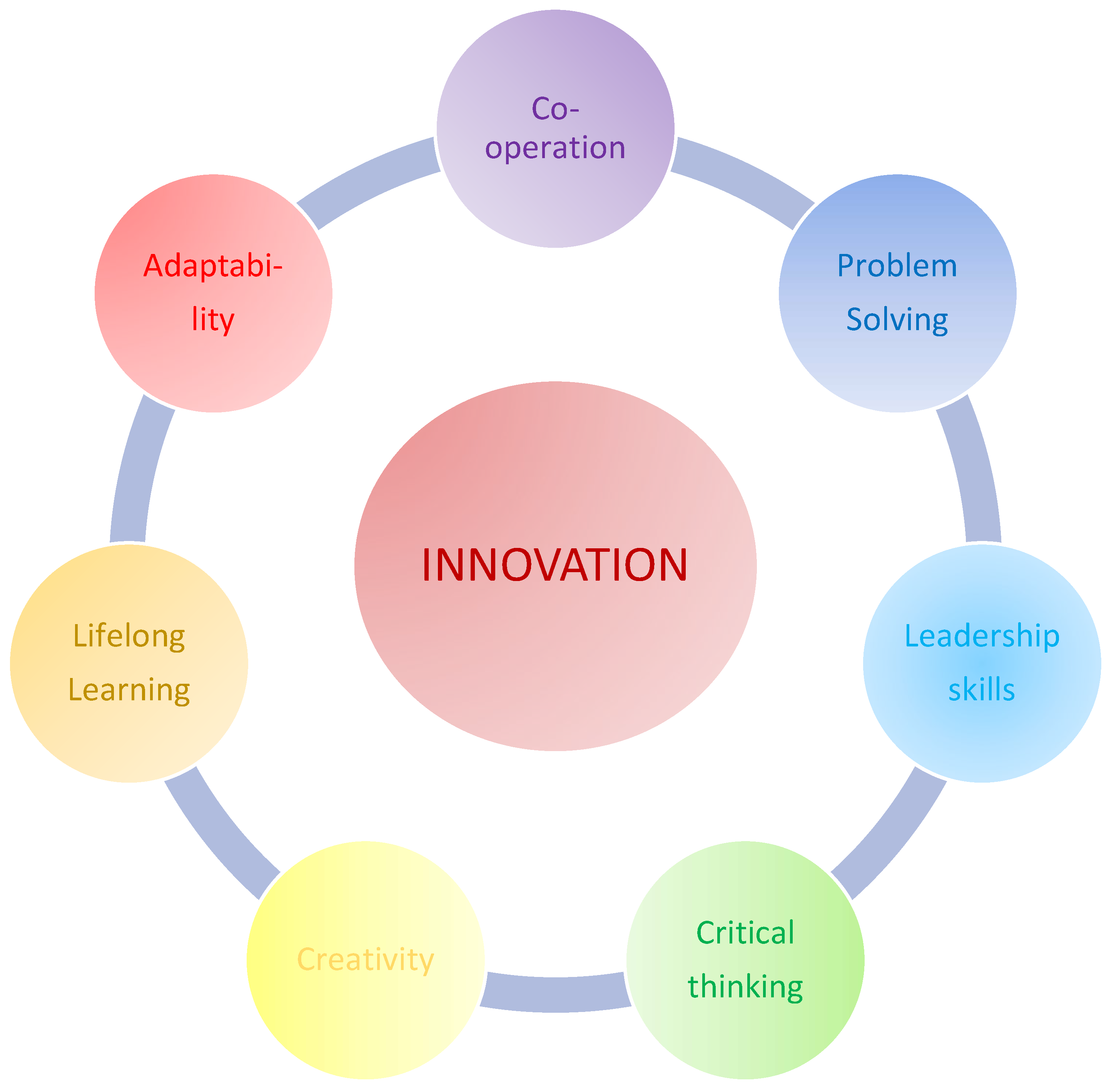
It is also clear that the cultivation of individual skills cannot lead to the achievement of the goals of creating an active citizen able to cope with the demanding environment of today and tomorrow. Some of the objectives of each skill overlap with the others, or the development of one skill is necessary before the development of another.
More specifically, solving a problem cannot be achieved if the person has not first learned to work in a group; within the group, one of the members will be asked to assume the role of coordinator-leader. During the process of solving the problem, skills such as critical thinking and creativity will be needed. In order for the team to arrive at a solution to the problem, they need to search for, process and separate the valid from the invalid information. It is obvious that the members of the group should have the ability to think critically. Creativity, on the other hand, can give the team the opportunity to find more than one solution, but also to choose the best possible one. In order to solve the problem, the members of the group should communicate, discuss and exchange arguments. Driven by respect for each point of view, for the good of the group and the common good, without putting at the centre their desire to impose their proposed solution, they choose the optimal solution. For the process to be successful, all team members must be able to work together. In addition, at least one member should have developed his or her leadership skills during the collaboration in order to manage possible disagreements and make the final decision. Finally, considering that a team has been working in a professional field for years, it should adapt to new data over time. Lifelong learning is a tool for its adaptation, as team members should be open to acquiring new knowledge and skills to cope with change.
Cooperation and leadership skills make a team functional, i.e., they give it the characteristics that allow it to work without limitations. On the other hand, critical thinking, creativity and problem solving are the skills that enable the team to achieve its goals, whether they are academic at class level or professional. Finally, adaptability and lifelong learning allow the team to remain functional regardless of environmental conditions and changes brought about by social and technological factors.
Figure 2.
Grouping skills based on how they help a team deliver desired results.
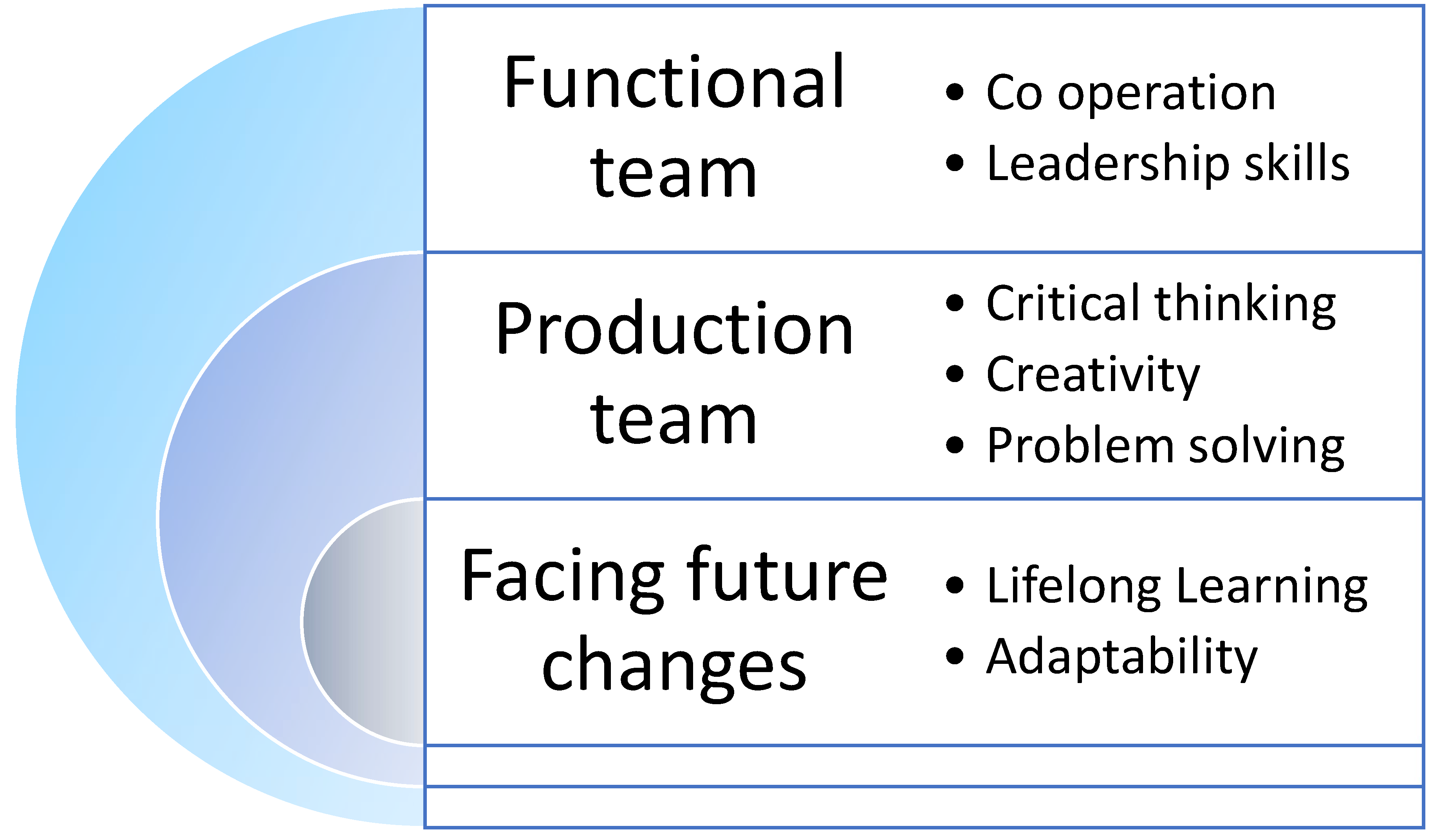
Figure 3.
Objectives and commonalities between the skills studied in the article.
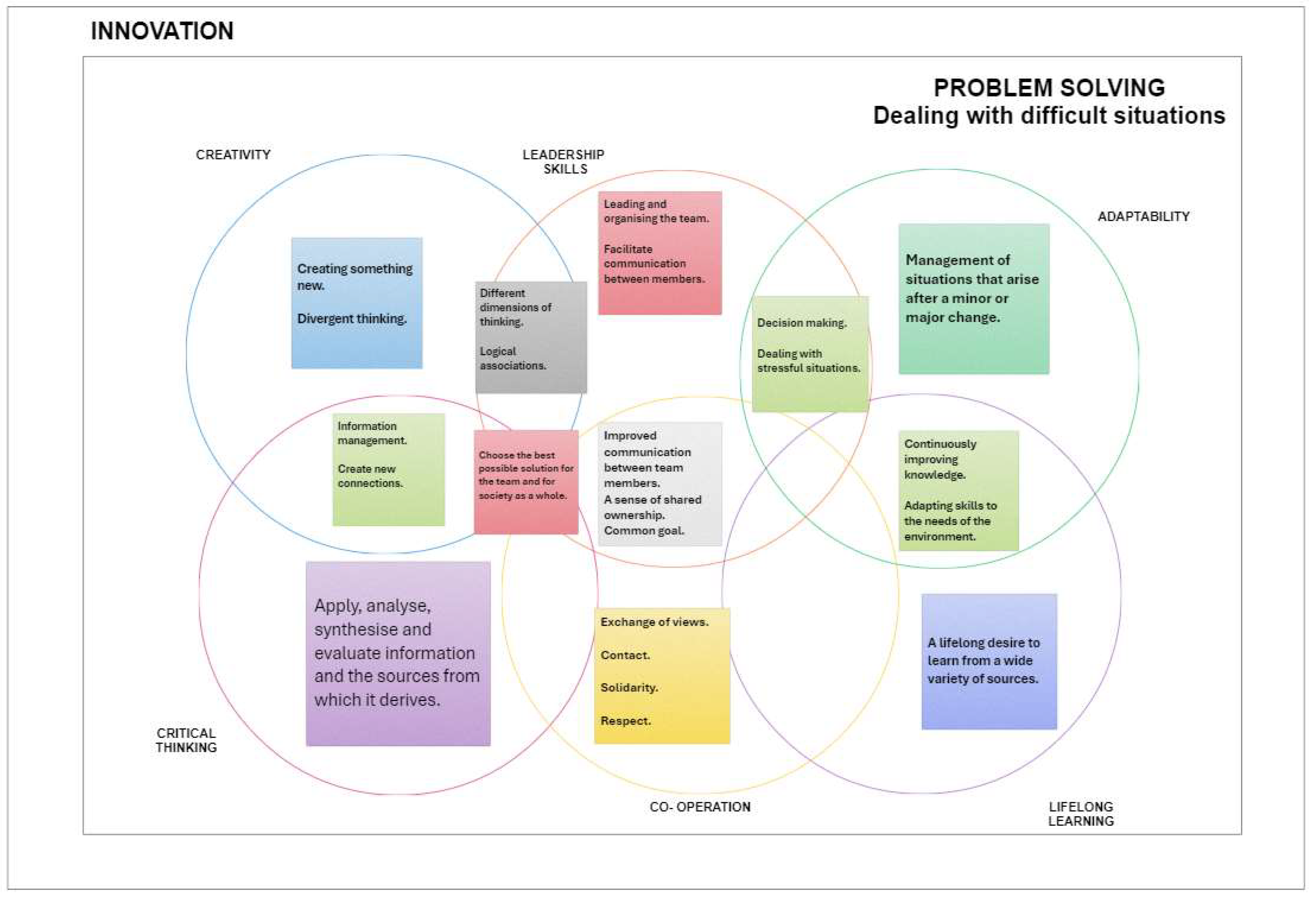
It is clear from the literature reviewed that none of the skills has a precise definition. Nor do any of the skills have clear boundaries, as there is overlap between them. The development of creativity and critical thinking is required to enable individuals to manage and use information from different sources and to recognise the links between new information and what they already know. Creativity and leadership are needed to develop different dimensions of thinking, but also to make logical connections. Choosing the best solution for the team and for society in general requires creativity, critical thinking and leadership skills. On the other hand, leadership skills, together with team spirit, lead to good communication between team members, the achievement of a common goal but the development of a sense of shared responsibility. Leadership and adaptability help to deal with stressful situations that may arise during teamwork and decision-making. Adaptability and lifelong learning contribute to the continuous improvement of the individual's knowledge and adaptation to new technological and environmental conditions. All skills have as their central purpose the solution of an everyday problem, while the solution finally chosen is characterised by innovation.
Figure 4.
21st Century Skills Pyramid. At each lower level are listed the skills that are necessary for the development of the skills at the higher levels.
Figure 4.
21st Century Skills Pyramid. At each lower level are listed the skills that are necessary for the development of the skills at the higher levels.
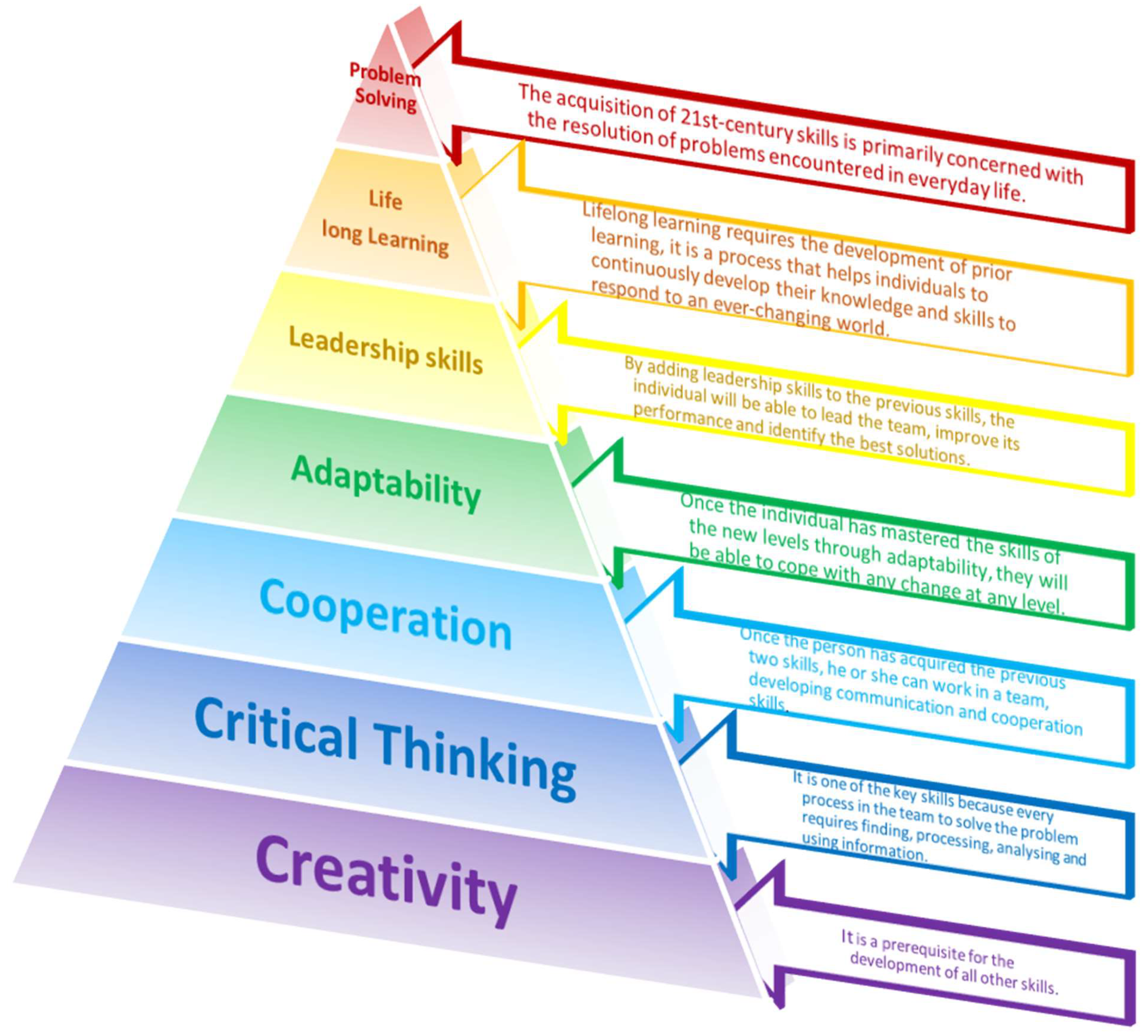
An attempt is then made to rank the 21st century skills mentioned in the article, in order to suggest an order of cultivation. In this ranking, starting from the bottom, the skills that the lower level must have already acquired in order to progress to the next level are listed. The order is based on what has already been reported in the international literature and recorded above.
Creativity is placed at the base of the pyramid as it relates to the creation of the new, but also to the individual's ability to transform any information into new knowledge. It requires information management and teamwork, while being the first step towards the main goal of innovation. A solution characterised by creativity also takes into account factors related to the common good, such as minimising environmental impact.
Next comes critical thinking, which is directly related to how the individual or group will gather the information needed to arrive at the desired solution. A prerequisite for starting to gather information is that the person wants to learn something new, in which case it is directly linked to the concept of creativity. The subsequent process of applying, analysing, synthesising and evaluating the information gathered is the beginning of solving the problem. This is why critical thinking is placed on the second level of the pyramid.
The third level is cooperation, because in the modern globalised economy individuals are required to cooperate with people from different cultural backgrounds. Similarly, many of the modern problems of everyday life require the cooperation of many experts in different fields to solve them. As it is difficult for one person to possess the necessary knowledge, the solution will come from a team of experts. Having already mastered the skills of creativity and critical thinking, the person wants to acquire new knowledge and use the given information to finally arrive at the solution of the problem. The development of the ability to cooperate is the one that, following on from the previous two levels, gives the person the opportunity to explain his or her thoughts to the group, makes him or her open to the ideas of the other members, develops his or her social skills and also strengthens his or her critical thinking.
The fourth level is adaptability, the ability of the individual and the group to adapt to any change that occurs. Whether it is a small change that affects only that day, such as the absence of a team member or the inability to connect to the Internet. It could be a change in the environment, such as a declaration of war, a political upheaval or a natural disaster. Either changes that may occur in the future and are related to technology, in which case the way the team operates will be affected. Each team member must be able to respond to any change.
The fifth level is leadership, which is the ability of the individual to lead the group to ensure that it continues to function regardless of any unforeseen conditions. In order for the team leader to meet the demands of his position, he must have stress tolerance, but also master the skills of the previous levels. At this point it is accepted that the leader of the group may be one person, but all members of the group develop leadership skills. The leader is the one who will be called upon to resolve any disagreements in the group, to coordinate its work and to make the final decision on the choice of the appropriate solution.
The sixth level is lifelong learning, which is the desire but also the ability of individuals to learn throughout their lives. The individual is constantly putting himself in the place of the student, adapting his skills to the technological requirements of his time and to the demands of the global labour market. They acquire new knowledge which they can apply to the new problems they will face. The acquisition of lifelong learning contributes to the acquisition of all previous skills. In order to remain creative and to seek the new, people should also acquire new knowledge. In order to recognise which of his new knowledge is useful, he needs to be able to think critically. In order to develop, they should also be able to work in a team. To lead the team in the acquisition of new knowledge, he should have leadership skills.
At the top of the pyramid is problem solving. It is at the top because it is the ultimate goal. The individual develops all the skills of the previous levels in order to provide an innovative solution to a problem of modern everyday life. All previous skills are developed so that teams of experts are able to solve any problem that may arise in the immediate or distant future.
10. Cconclusions
There is a consensus in the literature that 21st century skills can be cultivated during the school years. However, mastering them is a key objective for a successful professional of the future. At the heart of the skills objectives is innovation, in other words, each of the skills is developed with the aim of enabling the individual to provide innovative solutions to any problem that may arise in their everyday professional life. In the professional arena, the individual will be required to work with other professionals from different backgrounds. It is the mastery of a set of skills by team members that enables the team to function in a way that achieves the desired goals.
It is widely accepted that anyone can master 21st century skills, given the right training. The proposed set of skills is designed to enable trainees to build on the skills of the lower levels to successfully master the skills of the higher levels.
References
- E Guzmán, V.; Muschard, B.; Gerolamo, M.; Kohl, H.; Rozenfeld, H. Characteristics and Skills of Leadership in the Context of Industry 4.0. Procedia Manuf. 2020, 43, 543–550. [Google Scholar] [CrossRef]
- Dishon, G.; Gilead, T. Adaptability and its discontentsQ 21st- century skills and the preparation for an unpredictadle futer. Br. J. Educ. Stud. 2020, 1–21. [Google Scholar]
- E. van Laar, . A. J. A. M. van Deursen, J. A. G. M. van Dijk and J. de Haan, "Determinants of 21st-Century Skills and 21st-Century Digital Skills for Workers: A Systematic Literature Review.," SAGE Open, vol. 10, no. 1, 2020.
- Oon-Seng, T. , Problem-Based Learning Innovation: Using Problems to Power Learning in the 21st Century, Cengage Learning, 2023.
- BAŞAR, F.B.; Teacher, B.P.D.O.N.E.; Ada, Ş. The Relationship between eTwinning Activities and 21st Century Education and Teaching Skills. Int. J. Soc. Sci. Educ. Res. Stud. 2023, 03. [Google Scholar] [CrossRef]
- Levin, H.M. The Importance of Adaptability for the 21st Century. Society 2015, 52, 136–141. [Google Scholar] [CrossRef]
- Kim, J.; Park, C. Education, skill training, and lifelong learning in the era of technological revolution: a review. Asian-Pacific Econ. Lit. 2020, 34, 3–19. [Google Scholar] [CrossRef]
- Seevaratnam, V.; Gannaway, D.; Lodge, J. Design thinking-learning and lifelong learning for employability in the 21st century. J. Teach. Learn. Grad. Employab. 2023, 14, 167–186. [Google Scholar] [CrossRef]
- Gündüz, A.Y. The Importance of Investigating Students’ Lifelong Learning Levels and Perceptions of 21st-Century Skills. Int. e-Journal Educ. Stud. 2023, 7, 788–796. [Google Scholar] [CrossRef]
- Liebech-Lie, B.; Sjølie, E. Teachers’ conceptions and uses of student collaboration in the classroom.. Educational Research, 2020.
- Elmuti, D.; Minnis, W.; Abebe, M. Does education have a role in developing leadership skills? Manag. Decis. 2005, 43, 1018–1031. [Google Scholar] [CrossRef]
- Boyraz, S. A scale development study for one of the 21st centuryskills: Collaboration at secondary schools. African Educational Research Journal 2021, 9, 907–913. [Google Scholar] [CrossRef]
- Ab Ghani, S.; Awang, M.M.; Ajit, G.; Rani, M.A.M. Participation in Co-Curriculum Activities and Students’ Leadership Skills. J. Southwest Jiaotong Univ. 2020, 55. [Google Scholar] [CrossRef]
- Lin, K.-Y.; Yeh, Y.-F.; Hsu, Y.-S.; Wu, J.-Y.; Yang, K.-L.; Wu, H.-K. STEM education goals in the twenty-first century: Teachers’ perceptions and experiences. Int. J. Technol. Des. Educ. 2022, 33, 479–496. [Google Scholar] [CrossRef]
- Thornhill-Miller, B.; Camarda, A.; Mercier, M.; Burkhardt, J.-M.; Morisseau, T.; Bourgeois-Bougrine, S.; Vinchon, F.; El Hayek, S.; Augereau-Landais, M.; Mourey, F.; et al. Creativity, Critical Thinking, Communication, and Collaboration: Assessment, Certification, and Promotion of 21st Century Skills for the Future of Work and Education. J. Intell. 2023, 11, 54. [Google Scholar] [CrossRef] [PubMed]
- Gafour, O.W.; Gafour, W.A. Creative Thinking skills- A Review article. Jourmal of Education and e-Learning 2020. [Google Scholar]
- Hernández-Torrano, D.; Ibrayeva, L. Creativity and education: A bibliometric mapping of the research literature (1975–2019). Think. Ski. Creativity 2020, 35. [Google Scholar] [CrossRef]
- Gong, Z.; Lee, L.; Soomro, S.; Nanjappan, V.; Georgiev, G. A systematic review of virtual brainstorming from the perspective of creativity: affordances, framework, and outlook, Digital Creativity, Taylor and Francis Online 2022, 33, 96–127. [Google Scholar] [CrossRef]
- Norris, C.M.; Taylor, T.A.; Lummis, G.W. Fostering collaboration and creative thinking through extra-curricular challenges with primary and secondary students. Think. Ski. Creativity 2023, 48. [Google Scholar] [CrossRef]
- OECD, "Framework for the Assessment of Creative Thinking in PISA 2021:Third Draft. 2019.
- Saidovna, R. A Systematic Approach to the Development of Students' Creative Abilities. Eurasian Journal of Learning and Academic Teaching 2022, 14, 24–28. [Google Scholar]
- Tang, T.; Vezzani, V.; Eriksson, V. Developing critical thinking, collective creativity skills and problem solving through playful design jams. Think. Ski. Creativity 2020, 37. [Google Scholar] [CrossRef]
- Zulyusri; Elfira, E. ; Lufri; Santosa, T. Literature Study: Utilization of the PjBL Model in Science Education to Improve Creativity and Critical Thinking Skills. Journal of Research in Science Education 2023, 9, 133–143.
- Perera, T. Developing the Critical Thinking Skill of Secondary Science Students in Sri Lanka. Global Comparative EducationQ Journal of the WCCES 2022, 6, 82–88. [Google Scholar]
- Heystek, S. , The implementation of problem-based learning to foster pre-service teachers' critical thinking in education for sustainable development, North-West University, 2021.
- van der Zanden, P.J.A.C.; Denessen, E.; Cillessen, A.H.N.; Meijer, P.C. Fostering critical thinking skills in secondary education to prepare students for university: teacher perceptions and practices. Res. Post-Compulsory Educ. 2020, 25, 394–419. [Google Scholar] [CrossRef]
- Yeung, M.M.-Y.; Yuen, J.W.-M.; Chen, J.M.-T.; Lam, K.K.-L. The efficacy of team-based learning in developing the generic capability of problem-solving ability and critical thinking skills in nursing education: A systematic review. Nurse Educ. Today 2023, 122, 105704. [Google Scholar] [CrossRef] [PubMed]
- Parra, Y.J.F.; Barriga, A.M.; Díaz, R.A.L.; Cuesta, J.A.G. Teacher education and critical thinking: Systematizing theoretical perspectives and formative experiences in Latin America. Rie-Revista De Investig. Educ. 2021, 39, 149–167. [Google Scholar] [CrossRef]
- Hafni, R.N.; Herman, T.; Nurlaelah, E.; Mustikasari, L. The importance of science, technology, engineering, and mathematics (STEM) education to enhance students' critical thinking skill in facing the industry 4.0. J. Phys.: Conf. Ser., no. 1521, 2020.
- Misbah, M.; Hamidah, I.; Sriyati, S.; Samsudin, A. A bibliometric analysis: research trend of critical thinking in science education. Journal of Engineering Science and Technology 2022, 118–126. [Google Scholar]
- Duncan, R.G.; Cavera, V.L.; Chinn, C.A. The Role of Evidence Evaluation in Critical Thinking: Fostering Epistemic Vigilance. In: Puig, B., Jiménez-Aleixandre, M.P. (eds) Critical Thinking in Biology and Environmental Education. Contributions from Biology Education Research; Springer, Cham., 2022.
- Abrami, P.C.; Bernard, R.M.; Borokhovski, E.; Wade, A.; Surkes, M.A.; Tamim, R.; Zhang, D. Instructional Interventions Affecting Critical Thinking Skills and Dispositions: A Stage 1 Meta-Analysis. Rev. Educ. Res. 2008, 78, 1102–1134. [Google Scholar] [CrossRef]
- Gonzalez-Perez, L.; Ramirez-Montoya, M. Components of Education 4. 0 in 21st Century Skillw Frameworkw: Systematic Reviw. Sustainability 2022, 14, 1493. [Google Scholar]
- Sachdeva, S.; Eggen, P.-O. Learners’ Critical Thinking About Learning Mathematics. . International Electronic Journal of Mathematics Education 2021, 16. [Google Scholar] [CrossRef]
- Rubini, B.; Septian, B.; Permana, I. Enhancing critical thinking through the science learning on using interactive problem based module. J. Physics: Conf. Ser. 2019, 1157, 022001. [Google Scholar] [CrossRef]
- Ardianti, S.; Sulisworo, D.; Pramudya, Y.; Rahar, W. Ardianti; Sulisworo, PramudThe Impact of the Use of STEM Education Approach on the Blended Learning to Improve Student's Critical Thinking Skills. The Impact of the Use of STEMUniversal Journal of Educational Research 2020, 8, 24–32. [Google Scholar]
- Pohan, A.M.; Asmin, A.; Menanti, A. The Effect of Problem Based Learning and Learning Motivation of Mathematical Problem Solving Skills of Class 5 Students at SDN 0407 Mondang. Bp. Int. Res. Critics Linguistics Educ. (BirLE) J. 2020, 3, 531–539. [Google Scholar] [CrossRef]
- Aslan, A. Problem- based learning in live online classes: Learning achievement, problem-solving skill, communication skill, and interaction. Computers & Education 2021, 171. [Google Scholar]
- Norman, G. Problem- solving skills, solving problems and problem- based learning. Medical Education 1988, 22, 279–286. [Google Scholar] [CrossRef]
- Valtonen, T.; Hoang, N.; Sointu, E.; Näykki, P.; Virtanen, A.; Pöysä-Tarhonen, J.; Häkkinen, P.; Järvelä, S.; Mäkitalo, K.; Kukkonen, J. How pre-service teachers perceive their 21st-century skills and dispositions: A longitudinal perspective. Comput. Hum. Behav. 2021, 116. [Google Scholar] [CrossRef]
- Doğan, Y.; Batdı, V. Revisiting Brainstorming within an Educational Context: A Meta-Thematic Analysis. J. Learn. Dev. 2021, 8, 541–556. [Google Scholar] [CrossRef]
- Petre, G.-E. Developing Students’ Leadership Skills Through Cooperative Learning: An Action Research Case Study. International Forum 2020, 23, 143–162. [Google Scholar]
- Szewki, E.; Nussbaum, M.; Rosen and, T.; et al. Collaboration within large groups in the classroom. . Computer Supported Learning 2011, 6, 561–575. [Google Scholar] [CrossRef]
- Ghavifekr, S. Collaborative Learning: A Key To Enhance Students’ Social Interaction Skills. Malays. Online J. Educ. Sci. 2020, 8, 9–21. [Google Scholar]
- Salmons, J.; Wilson, L.A. Learning to Collaborate, Collaborating to Learn; Routledge: New York, 2019. [Google Scholar]
- Wu, T.-T.; Wu, Y.-T. Applying project-based learning and SCAMPER teaching strategies in engineering education to explore the influence of creativity on cognition, personal motivation, and personality traits,. Thinking Skills and Creativity, 2020.
- Head, G. Effective collaboration: deep collaboration as an essential element of the learning process. Journal of Educational Enquiry 2003, 4, 47–61. [Google Scholar]
- Afzal, A. Collaboration in Secondary School Classroom. Pakistan Review of Social Sciences 2020, 1, 79–92. [Google Scholar]
- Warren, L.L. The Importance of Teacher Leadership Skills in the Classroom. Educ. J. 2021, 10, 8. [Google Scholar] [CrossRef]
- Channing, J. How Can Leadership Be Taught? Implications for Leadership Educators. International Journal of Educational Leadership Preparation 2020, 15, 134–148. [Google Scholar]
- Muammar, O. Exploring students’ perceptions of leadership skills in higher education: An impact study of the leadership training program. Gift. Educ. Int. 2021, 38, 295–308. [Google Scholar] [CrossRef]
- Andreau, F.S.; Sweet, K.; Carter, D. Building Leadership Skills through High-impact Experiences. J. Leadersh. Educ. 2019, 19. [Google Scholar] [CrossRef]
- Henderikx, M.; Stoffers, J. An Exploratory Literature Study into Digital Transformation and Leadership: Toward Future-Proof Middle Managers. Sustainability 2022, 14, 687. [Google Scholar] [CrossRef]
- Gómez-Leal, R.; Holzer, A.A.; Bradley, C.; Fernández-Berrocal, P.; Patti, J. The relationship between emotional intelligence and leadership in school leaders: a systematic review. Camb. J. Educ. 2021, 52, 1–21. [Google Scholar] [CrossRef]
- Alieva, L.; Rybakova, A. Fostering Leadership Skills of Young People for Inclusion into the Labour Market. Proceedings of the 5th International Conference on Social, Economic, and Academic Leadership (ICSEALV 2019; pp. 23–28.
- Poquet, O.; de Laat, M. Developing capabilities: Lifelong learning in the age of AI. British Journal of Educational Technology, 2021. [Google Scholar]
- Kazepov, Y.; Cefalo, R.; Pot, M. A social investment perspective on lifelong learning: the role of institutional complementarities in the development of human capital and social participation. Policy Press Scholarship Online, Bristol University Press, pp. 43–62, 2019.
- Tsolaki, V.; Stathopoulou, A. , "Digital technologies in lifelong learning. Global Journal of Engineering and Technology Advance 2023, 16, 47–56. [Google Scholar] [CrossRef]
- UNESCO, Embracing a culture of lifelong learning, Germany: UNESCO Institute for Lifelong Learnin, 2020.
- Loumpourdi, M. A Critical Analysis of the European Reference Framework of Key Competences for Lifelong Learning: The Limitations of the Human Capital Theory. Scott. Educ. Rev. 2021, 53, 83–104. [Google Scholar] [CrossRef]
- Lu, K.; Grover, A.; Abbeel, P.; Mordatch, I. RESET-FREE LIFELONG LEARNING WITH SKILL-SPACE PLANNING. ICLR, 2021.
- Alt, D.; Raichel, N. Problem-based learning, self- and peer assessment in higher education: towards advancing lifelong learning skills. Res. Pap. Educ. 2020, 37, 370–394. [Google Scholar] [CrossRef]
- Beqiri, T.; Mazreku, I.; Learning, L. , Training and Development Employee’s Perspective. Journal of Educational and Social Research 2020, 10, 94–102. [Google Scholar] [CrossRef]
- Keiler, L.S. Teachers’ roles and identities in student-centered classrooms. Int. J. STEM Educ. 2018, 5, 1–20. [Google Scholar] [CrossRef]
- Savickas, M.L.; Porfeli, E.J. Career Adapt-Abilities Scale: Construction, reliability, and measurement equivalence across 13 countries. J. Vocat. Behav. 2012, 80, 661–673. [Google Scholar] [CrossRef]
- Taylor, S.E. How psychosocial resources enhance health and well-being.. Applied positive psychology: Improving everyday life, health, schools, work, and society, pp. 65–77, 2011.
- Athan, M.; Thacha, W. Online Programm to Develop Teacherw to Enhance Students' Adaptability Skills. Education Quarterly Reviews 2022, 5. [Google Scholar]
- Sirotiak, T.; Sharma, A. Problem-Based Learning for Adaptability and Management Skills. J. Prof. Issues Eng. Educ. Pr. 2019, 145. [Google Scholar] [CrossRef]
- Syamsu, N. Suhendri; Zailani; Hardivizon, "Improving Students’ Collaboration Thinking Skill Under the Implementation of the Quantum Teaching Model. International Journal of Instruction 2022, 15, 451–464. [Google Scholar]
- Lasky, D.; Yoon, S. A creative classroom for everyone: An introduction to a small ‘c’ creativity framework. Thinking Skills and Creativity 2020, 36. [Google Scholar] [CrossRef]
- Kaplan, D.E. Creativity in Education: Teaching for Creativity Development. Psychology 2019, 10, 140–147. [Google Scholar] [CrossRef]
- Li, Y.; Schoenfeld, A.H.; Disessa, A.A.; Graesser, A.C.; Benson, L.C.; English, L.D.; Duschl, R.A. Design and Design Thinking in STEM Education. J. STEM Educ. Res. 2019, 2, 93–104. [Google Scholar] [CrossRef]
- van Gog, T.; Hoogerheide, V.; van Harsel, M. The Role of Mental Effort in Fostering Self-Regulated Learning with Problem-Solving Tasks. Educ Psychol Rev 2020, 32, 1055–1072. [Google Scholar] [CrossRef]
- Wu, Z. Understanding teachers' cross-disciplinary collaboration for STEAM education: Building a digital community of practice. Think. Ski. Creativity 2022, 46. [Google Scholar] [CrossRef]
- Pasigon, C.P. Attributes Of Students Towards Problem Solving In Physics: A Step Towards Students’ Capacity Building. Journal of Positive School Psycholog 2022, 6, 531–534. [Google Scholar]
Disclaimer/Publisher’s Note: The statements, opinions and data contained in all publications are solely those of the individual author(s) and contributor(s) and not of MDPI and/or the editor(s). MDPI and/or the editor(s) disclaim responsibility for any injury to people or property resulting from any ideas, methods, instructions or products referred to in the content. |
© 2025 by the authors. Licensee MDPI, Basel, Switzerland. This article is an open access article distributed under the terms and conditions of the Creative Commons Attribution (CC BY) license (http://creativecommons.org/licenses/by/4.0/).
Copyright: This open access article is published under a Creative Commons CC BY 4.0 license, which permit the free download, distribution, and reuse, provided that the author and preprint are cited in any reuse.