Preprint
Article

This version is not peer-reviewed.

Continuity of Care for Substance Misusing Prison Leavers: A Quantitative Analysis of Service Delivery Models Within a Local Setting

Submitted:

11 February 2025

Posted:

13 February 2025

You are already at the latest version

Abstract

Introduction: This study tests our assumption that continuity-of-care from prison to community increases engagement rates and reduces treatment wait times, hypothesis one (H1). Engaging with drug treatment services may improve health and crime outcomes for this vulnerable population. The study also aims to determine whether a single service delivery model, spanning both prison and community settings, improved these metrics, hypothesis 2 (H2). Method: Over a four-year period, the instances of continuity-of-care, prison release, and treatment start dates were recorded for individuals with substance misuse issues released to a local drug recovery partnership (n=808). All participants were monitored for 365 days after their first release (H1). The same data associated with a subset of this group (n=533), released through the local adult male prison to the local drug treatment services, were compared for the two years before (n=255) and the two years after (n=278) the implementation of the single service delivery model (H2). Data were analysed using right-censored Kaplan Meier Survival Analyses. Results: There was a significant association between system-level prison-to-community continuity-of-care and higher engagement rates, as well as reduced waiting times for community drug treatment (p<.00001). The implementation of single service provision enhanced the performance of prison-to-community continuity-of-care. Specifically, treatment engagements through continuity-of-care increased from 5.4% to 12.7%, and average waiting times decreased from 97 to 67 days. However, due to the small sample size, there was insufficient statistical evidence to support H2. Conclusions: This study confirms that, within our local setting, continuity-of-care care from the prison to community drug treatment leads to higher rates continuity-of-care, treatment engagements and shorter waiting times to community drug treatment (H1 - accepted). Additionally, although not statistically proven (H2 - not accepted), our a priori decision to implement a single-service delivery model appears to have been justified given the observed improvements in these metrics.

Keywords: 
;  ;  ;  ;  ;  ;  ;  

Introduction

Continuity of care (CC), also referred to as throughcare and aftercare, is widely recognised as essential for achieving successful treatment outcomes, particularly in drug rehabilitation (National Institute for Health and Care Excellence, 2014; National Treatment Agency, 2009b). Entry into drug treatment programs has been linked with reductions in criminal activity (National Treatment Agency, 2009a, 2012a, 2012b, 2012c, 2012d). Although research on prisoner continuity of care is available (Grace et al., 2016; Lloyd & Page, 2015; Scaggs et al., 2015), there is a paucity of quantitative non-clinical studies that focus exclusively on the transition from prison to community. This gap is particularly evident in research conducted from a systems and strategic commissioning perspective. Based on the PriceWaterhouseCoopers (2008) review of prison-based drug treatment funding, the Essex Recovery Partnership proposed merging non-clinical prison and community drug treatment services into a single integrated entity. Our successful bid to the UK Government’s Drug Systems Change Pilot initiative (National Treatment Agency, 2009d) led to the launch of the 'InsideOut' service on April 1, 2010 (Westminster Drug Project, 2010).
The systematic delivery of CC within the criminal justice context, particularly for drug-affected individuals leaving prison, has long been discussed (Edwards et al., 1985; Gulland, 2010; MacDonald et al., 2012), yet remains challenging (Dyer & Biddle, 2013; The All-Party Parliamentary Drugs Misuse Group, 1998). Despite the UK's first national anti-drugs strategy in 1995 emphasizing its importance, progress was minimal by 2004 with the Reducing Re-offending National Action Plan (Home Office, 2004). Recent efforts, such as the ‘Through the Gate’ program, have also shown little impact on reducing relapse and recidivism among short-term prisoners (HM Inspectorate of Probation, 2016).
From a systems perspective, this study utilized data from the community-based National Drug Treatment Monitoring System (NDTMS) (National Treatment Agency, 2008, 2009c; North East Public Health Observatory, 2001; Public Health England, 2015) and the prison-based Drug Intervention Record Web-based (DIRWeb) (Home Office, 2007) databases to test the assumptions that continuity of care (CC) is associated with improved rates of and reduced waiting times for community drug treatment engagement. Additionally, from a strategic commissioning perspective, the hypothesis was that the introduction of an integrated, single service delivery model, replacing the separate provisions, would result in significant improvements in both measures, as reported by the locally developed and statutory counting mechanisms. Given the UK Government’s recently updated ten-year drug and alcohol strategy (UK Government, 2021), with a renewed focus on prisoner continuity-of-care (Black, 2021), this paper aims to highlight the opportunities available to local drug and alcohol systems wishing to review this key health and justice care pathway.
Conceptual Framework: This study examines prison to community continuity-of-care at the system and service levels and whether an integrated single service provision model, based on systems and strategic commissioning thinking can improve service delivery. It incorporates systems dynamics (Forrester, 1968, 1971) and soft systems methodology (Checkland, 1999, 2012). The model (Figure 1) situates the single service provision at the intersection of recovery (blue) and justice (yellow) systems within the local prison.
People caught up within the criminal justice system often face negative health and crime outcomes due to substance misuse (1). As they engage with recovery services in prison, their health and criminal behaviour begin to stabilize and improve (2). Drug treatment includes a continuity-of-care package for release, such as community drug treatment appointments, housing, and employment services, managed by integrated service practitioners (3). Continued engagement with the recovery system after release improves health outcomes and reduces criminal activities (4). Relapses may lead individuals to repeat this cycle.
Method: We conducted a data quality audit to create a model matching client identifiers (initials, date of birth in ABYYYYMMDD format) across prison and community drug treatment services. Release data came from the DIRWeb database, and community engagement data from the NDTMS. We tracked prison leavers with or without continuity-of-care for twelve months post-release. Data were analysed using a series of Kaplan-Meier Survival Analyses. The study’s reported continuity-of-care performance was compared to the Public Health Outcomes Framework indicator C20 – Adults with substance misuse treatment need who successfully engage in community-based structured treatment following release from prison.
The SQL-coded data cleansing and matching algorithm employed deterministic programming principles. Grouping queries were utilized to compare characters in the client identifier string for similarity. Suspect records underwent manual verification using the in-house prison, DIRWeb, and NDTMS systems. Final corrections were made only after confirming the record's identity through all three systems. The final matched data set included the client identifier, first release date, source of release, continuity of care status (yes/no), prison reception date, and post-release treatment start date. Instances where clients returned to prison before the treatment start date were excluded.
Utilising right-censored Kaplan-Meier Survival Analyses (Log-rank) (Statistics Kingdom, 2025), whereby individuals not engaging with the community drug treatment service were assigned a waiting time of 365 days, data were processed in three stages. Firstly, a system-level count established the outputs supporting Hypothesis 1 (H1). Secondly, a service configuration/prison referral source count identified the constituent pathways into the local drug recovery system. And lastly, to test H2, a comparative survival analysis of the single and twin types of service configurations was conducted.
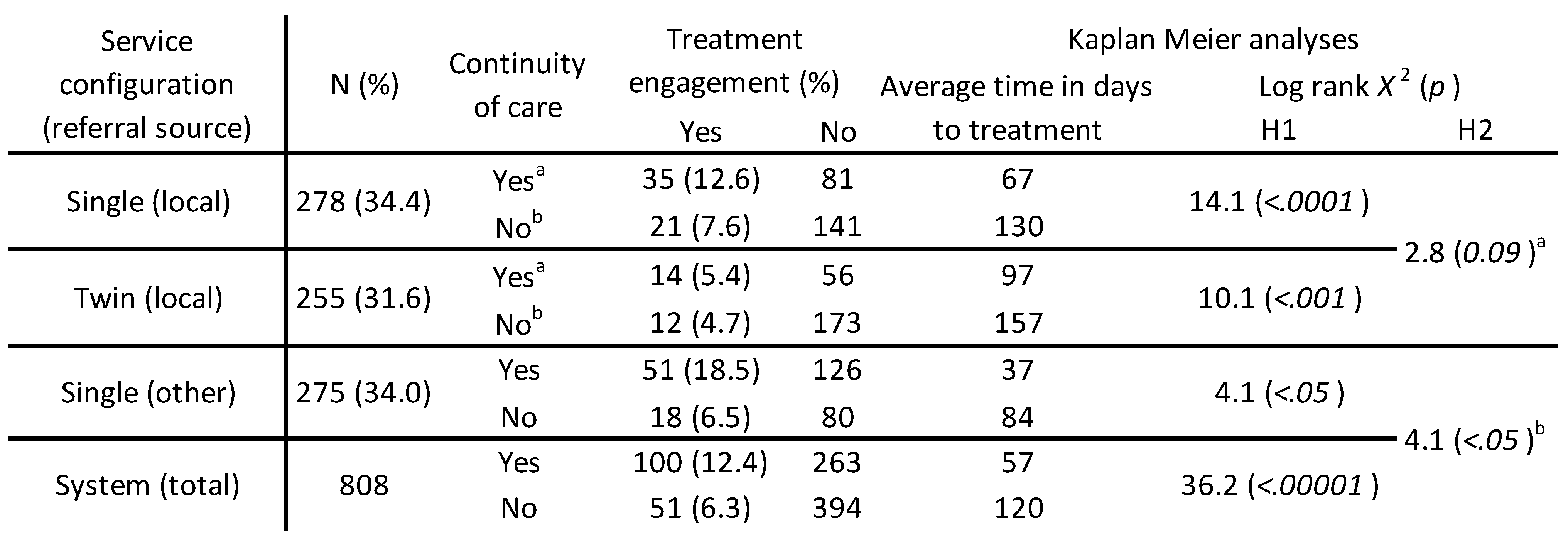
Results: A total of 808 individuals were released to the local partnership during the four-year study period. Three groups were identified: (1) 278 people (34.4%) released from the local prison with single service provision during study years three and four, (2) 255 people (31.6%) released from the local prison with twin service provision during study years one and two, and (3) 275 people (34.0%) released from prisons external to the study Recovery Partnership via the single service provision during study years three and four (see Table 1).
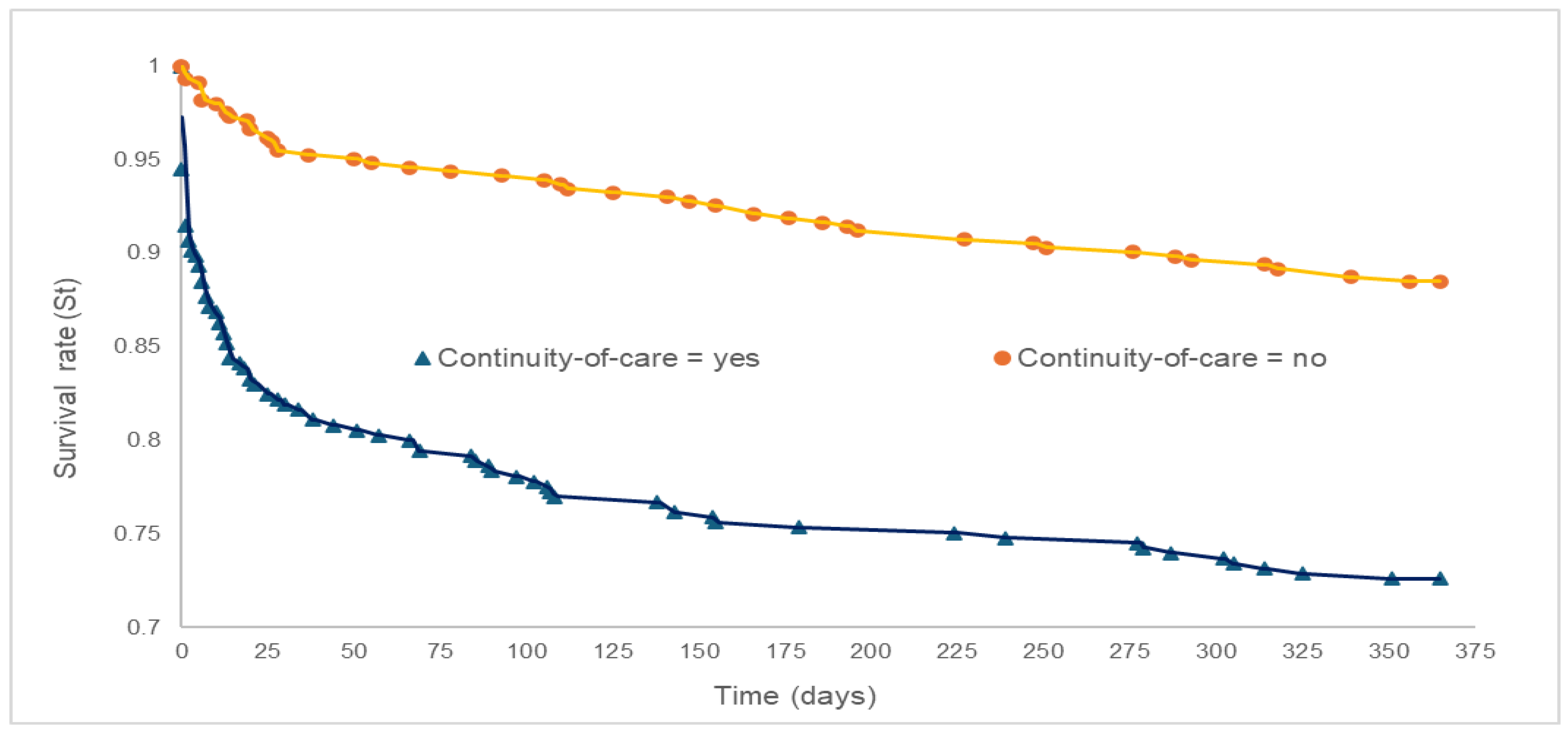
System Level H1: Of the 808 individuals, 151 (18.7%) engaged with community drug treatment services within 365 days of their initial release. Of these, 100 (12.4%) participated in a continuity-of-care intervention, and 51 (6.3%) did not. The average waiting (survival) times were 57 and 120 days, respectively. The observed frequencies and means were statistically significant compared to those expected (X2 = 36.2, p<.00001). Survival curves for both groups are presented in Figure 2.
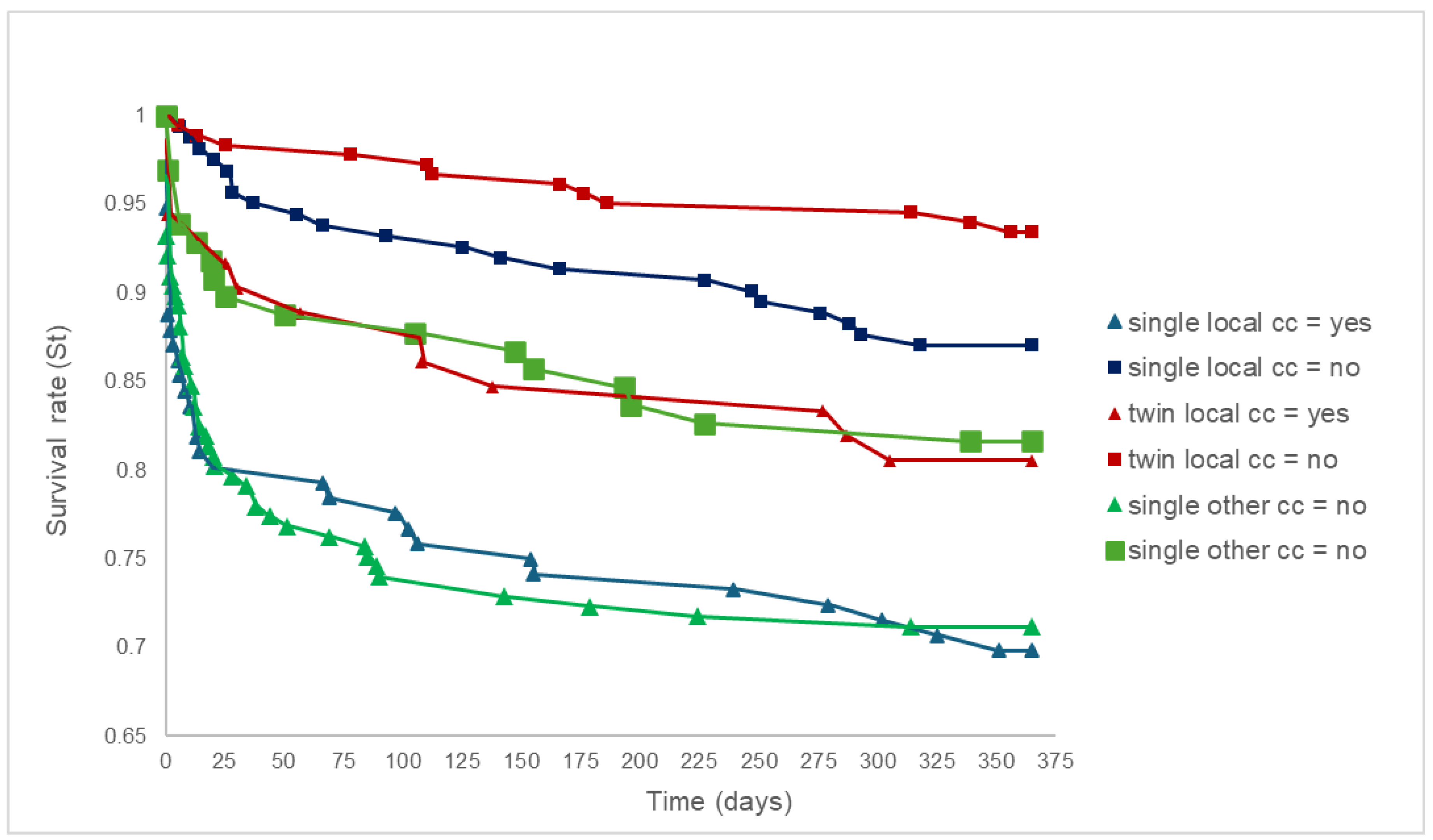
Service level – Single (local) H2: Of the 255 individuals, 56 (20.2%) engaged with community drug treatment services within 365 days of their initial release. Of these, 35 (12.6%) participated in a continuity-of-care intervention, and 21 (7.6%) did not. The average waiting (survival) times were 67 and 130 days, respectively. The observed frequencies and means were statistically significant compared to those expected (X2 = 14.1, p<.0001). Survival curves for this group are presented within in Figure 3.
Service level – Twin (local) H2: Of the 278 individuals, 26 (10.1%) engaged with community drug treatment services within 365 days of their initial release. Of these, 14 (5.4%) participated in a continuity-of-care intervention, and 12 (4.7%) did not. The average waiting (survival) times were 97 and 157 days, respectively. The observed frequencies and means were statistically significant compared to those expected (X2 = 10.1, p<.001). Survival curves for this group are presented within Figure 3.
Service level – Single (Other): Of the 275 individuals, 69 (25.0%) engaged with community drug treatment services within 365 days of their initial release. Of these, 51 (18.5%) participated in a continuity-of-care intervention, and 18 (6.5%) did not. The average waiting (survival) times were 37 and 84 days, respectively. The observed frequencies and means were statistically significant compared to those expected (X2 = 4.1, p<.05). Survival curves for this group are presented within Figure 3.
Local system performance within the national context: The performance metrics for local, matched area, and national continuity-of-care, as reported through statutory mechanisms, showed consistent improvement over the four-year study period. At the end of year one, the percentage performance returns were 27% for the study, 30% for the matched area, and 24% for the national system. By the end of year four, these figures had increased to 68%, 77%, and 47% respectively (see Table 2).

Discussion:

H1 accepted: Within our local context and perhaps not surprisingly, continuity-of-care for prison leavers was significantly associated with increased engagement with the community drug treatment services and shorter waiting times. Nearly twice the number of individuals engaged with the community drug treatment service via continuity of care, in less than half the average waiting time, compared to those who did not receive the intervention. An unexpected and welcome finding was the emergence of the successful route into our recovery partnership from prisons external to our system. This historically difficult to manage care pathway appears to have been strengthened with the introduction of the reconfigured service delivery model.
H2 rejected: While we noted a doubling in rates of continuity-of-care and treatment engagements, as well as a one-third reduction in average waiting times for community drug treatment, the small sample size prevented us from demonstrating that the introduction of the single service provision had a statistically significant impact on these measures.
Both prison and community treatments are essential for positive health and crime outcomes (Aspinall et al., 2016; Evans et al., 2016; Garnick et al., 2014; Gossop et al., 2005; Strang et al., 1997; Yang et al., 2013). While there have been continuous improvements in prisoner continuity-of-care, as documented through the PHOF Fingertips reporting system and supported by guidance from the Office for Health Improvement and Disparities (UK Government, 2018), ensuring effective continuity of care from prison to community remains a challenge for many recovery partnerships (PHOF, 2025; HM Inspectorate of Probation, 2016). The impact of austerity measures has been especially pronounced within the prison system (Chief Inspector of Prisons, 2015; The Full Fact Organisation, 2017). Additionally, focus has been partially diverted to other priorities within the prison service (BBC, 2017) and the NHS (Campbell, 2016). As a result, opportunities and incentives to advance and test the described service delivery model have been limited. Nonetheless, with the recent change in the UK's political landscape, there may be potential for national policy strategists and commissioners to re-emphasise integrated commissioning models of this nature (Bailie & Elliot, 2016).
Conclusion: While we were unable to demonstrate statistical evidence to support H2, our a priori decision to reorganise the service provision of the prison to community continuity-of-care pathway, based on strategic commissioning and systems thinking, appears justified. Importantly, our work led to the introduction of the NDTMS into the English and Welsh prison estates.

References

  1. Aspinall, E. J., Mitchell, W., Schofield, J., Cairns, A., Lamond, S., Bramley, P.,... Hutchinson, S. J. (2016). A matched comparison study of hepatitis C treatment outcomes in the prison and community setting, and an analysis of the impact of prison release or transfer during therapy. Journal of Viral Hepatitis, 23, 1009-1016. [CrossRef]
  2. Black, C. (2021). Review of drugs part two: prevention, treatment, and recovery. Retrieved from Review of drugs part two: prevention, treatment, and recovery - GOV.UK (www.gov.uk).
  3. Bailie, R., & Elliot, K. (2016). Offender Health: Partnerships for Excellence. London.
  4. BBC. (2017). Prison officers in 31 jails set for pay rises of up to £5,000. Retrieved from http://www.bbc.co.uk/news/uk-39014192.
  5. Checkland, P. (1999). Systems Thinking, Systems Practice. UK: John Wiley & Sons, Ltd.
  6. Cambell, D. (2016). NHS hospitals in England reveal £2.45bn record deficit. The Guardian. Retrieved from https://www.theguardian.com/society/2016/may/20/nhs-in-england-reveals-245bn-record deficit.
  7. Checkland, P. (Writer). (2012). On the origins of SSM. In LancasterManagement (Producer), Systems Colloquium in honour of SSM founder Peter Checkland. Lancaster: Lancaster University.
  8. Chief Inspector of Prisons. (2015). HM Chief Inspector of Prisons for England and Wales Annual Report 2014–15. Retrieved from http://www.justiceinspectorates.gov.uk/hmiprisons/wp content/uploads/sites/4/2015/07/HMIP-AR_2014-15_TSO_Final1.pdf.
  9. Dyer, W., & Biddle, P. (2013). Prison Health Discharge Planning- Evidence of an Integrated Care Pathway or the End of the Road. Social Policy and Society, 12(4), 521-532. [CrossRef]
  10. Edwards, B., Gunn, J., Kilgour, J., & Smith, R. (1985). Cooperation between the prison medical service and the NHS: a conversation. Br Med J (Clin Res Ed), 291(6510), 1698-1699. [CrossRef]
  11. Evans, C., Forrester, A., Jarrett, M., Huddy, V., Campbell, C. A., Byrne, M.,... Valmaggia, L. (2016). Early detection and early intervention in prison: improving outcomes and reducing prison returns. The Journal of Forensic Psychiatry & Psychology, 1-17. [CrossRef]
  12. Forrester, J. (1968). Principles of Systems (2nd ed.). Waltham, MA: Pegasus communications.
  13. Forrester, J. (1971). Principles of systems : text and workbook, chapters 1 through 10 (2nd preliminary ed. ed.). Cambridge, Mass.: Wright-Allen Press ; Cambridge.
  14. From Harm to Hope: A 10-year drugs plan to cut crime and save lives.
  15. Retrieved from https://www.gov.uk/government/publications/from- harm-to-hope-a-10-year-drugs-plan-to-cut-crime and-save-lives.
  16. Garnick, D. W., Horgan, C. M., Acevedo, A., Lee, M. T., Panas, L., Ritter, G. A.,... Wright, D. (2014).
  17. Criminal justice outcomes after engagement in outpatient substance abuse treatment. Journal of Substance Abuse Treatment, 46(3), 295-305. [CrossRef]
  18. Grace, S., Page, G., Lloyd, C., Templeton, L., Kougali, Z., McKeganey, N.,... Russell, C. (2016). Establishing a ‘Corstonian’ continuous care pathway for drug using female prisoners: Linking Drug Recovery Wings and Women’s Community Services. Criminology and criminal justice. [CrossRef]
  19. Gulland, A. (2010). Continuity of health care for prisoners on release in England is worsening. BMJ, 340.
  20. Gossop, M., Trakada, K., Stewart, D., & Witton, J. (2005). Reductions in criminal convictions after addiction treatment: 5-year follow-up. Drug and Alcohol Dependence, 79(3), 295-302. [CrossRef]
  21. HM Inspectorate of Probation, H. I. o. P. (2016). An Inspection of Through the Gate Resettlement Services for Short-Term Prisoners.
  22. Home Office. (2004). Reducing Re-offending: National Action Plan. London: Home Office.
  23. Home Office. (2007). Drug Interventions Record: Completion Guidelines & Business Rules for the Drug, Interventions Record suite of forms, Field by Field Guidance. Retrieved from http://webarchive.nationalarchives.gov.uk/20060919101130/http://drugs.homeoffice.gov.uk/publication-search/dip/DIR_field_by_field?view=Binary.
  24. Lloyd, C., & Page, G. (2015). Drug Recovery Wing (DRW) Pilots Evaluation. Retrieved from https://www.york.ac.uk/healthsciences/research/mental-health/projects/drugrecoverywingpilotsevaluation/#tab-3.
  25. MacDonald, M., Williams, J., & Kane, D. (2012). Barriers to implementing throughcare for problematic drug users in European prisons. International Journal of Prisoner Health, 8(2), 68-84. [CrossRef]
  26. National Institute for Health and Care Excellence. (2014). Continuity of care. Retrieved from http://www.evidence.nhs.uk/search?q=continuity%20in%20care.
  27. National Treatment Agency. (2008). Health care professionals and partners: NDTMS. Retrieved from http://www.nta.nhs.uk/ndtms.aspx.
  28. National Treatment Agency. (2009a). Breaking the Link. Retrieved from London: http://www.nta.nhs.uk/uploads/nta_criminaljustice_0809.pdf.
  29. National Treatment Agency. (2009b). Continuity of Care Guidance. In. London: The Department of Health.
  30. National Treatment Agency. (2009c). NDTMS.net. Retrieved from https://www.ndtms.net/resources/Guidance/OCU-adult_report_guidance.pdf.
  31. National Treatment Agency. (2009d). Seven Partnerships in England have been awarded Drug Systems Change Pilot status. Retrieved from http://www.nta.nhs.uk/system-change-pilot.aspx.
  32. National Treatment Agency. (2012a). Crime halved once drug addicts are on the road to recovery. Retrieved from http://www.nta.nhs.uk/news-2012-crime-halved.aspx.
  33. National Treatment Agency. (2012b). Estimating the crime reduction benefits of drug treatment and recovery. Retrieved from London: http://www.nta.nhs.uk/uploads/vfm2012.pdf.
  34. National Treatment Agency. (2012c). The impact of drug treatment on reconviction. Retrieved from London: http://www.nta.nhs.uk/uploads/theimpactoftreatmentonreconviction.pdf.
  35. National Treatment Agency. (2012d). Value for Money Presentation: Treat addiction, cut crime. London: NTA.
  36. North East Public Health Observatory. (2001). About the NDTMS. Retrieved from http://www.nepho.org.uk/ndtms/About_Us.
  37. PriceWaterhouseCoopers. (2008). Government and Public Sector Consulting. Report to the Department of Health and Ministry of Justice: Review of Prison-Based Drug Treatment Funding. Retrieved from London: http://www.parliament.uk/deposits/depositedpapers/2008/DEP2008-1539.pdf.
  38. Prisons and Drugs Misuse. Retrieved from London: UK Government. (2021).
  39. Public Health England. (2015). National Drug Treatment Monitoring System (NDTMS) Adult drug treatment business definition. Retrieved from http://www.nta.nhs.uk/uploads/adult-drug-treatment-business-definition-ndtms-data-set-m.pdf.
  40. Public Health Outcomes Framework. (2025). Public Health Outcomes Framework - Data | Fingertips | Department of Health and Social Care.
  41. Scaggs, S., Bales, W., Clark, C., Ensley, D., Coltharp, P., G., T., & Blomberg, T. (2015). An Assessment of Substance Abuse Treatment Programs in Florida’s Prisons Using a Random Assignment Experimental Design. Retrieved from US: https://www.ncjrs.gov/pdffiles1/nij/grants/249843.pdf.
  42. Statistics Kingdom. (2025). Kaplan Meier Survival Analysis: Kaplan Meier and Log Rank.
  43. Strang, J., Finch, E., Hankinson, L., Farrell, M., Taylor, C., & Gossop, M. (1997). Methadone treatment for opiate addiction: Benefits in the first month. ADDICTION RESEARCH, 5(1), 71-76. [CrossRef]
  44. The All Party Parliamentary Drugs Misuse Group. (1998). House of Commons - Home Affairs - Appendices to the Minutes of Evidence.
  45. The Full Fact Organisation. (2017). The state of prisons in England and Wales.
  46. Retrieved from https://fullfact.org/crime/state-prisons-england-and-wales/.
  47. Guidance for improving continuity of care between prison and the community (2018).
  48. Retrieved from London: UK Government. (2021) Guidance for improving continuity of care between prison and the community - GOV.UK.
  49. Westminster Drug Project (2010). “New Service to Reduce Drug Related Crime in Essex”.
  50. Retrieved from http://www.wdp-.org.uk/news.php/12/new-service-to-reduce-drug-related crime-in-essex 13th December 2011.
  51. Yang, Y., Knight, K., Joe, G. W., Rowan-Szal, G. A., Lehman, W. E. K., & Flynn, P. M. (2013). The Influence of Client Risks and Treatment Engagement on Recidivism. Journal of Offender Rehabilitation, 52(8), 544-564. [CrossRef]
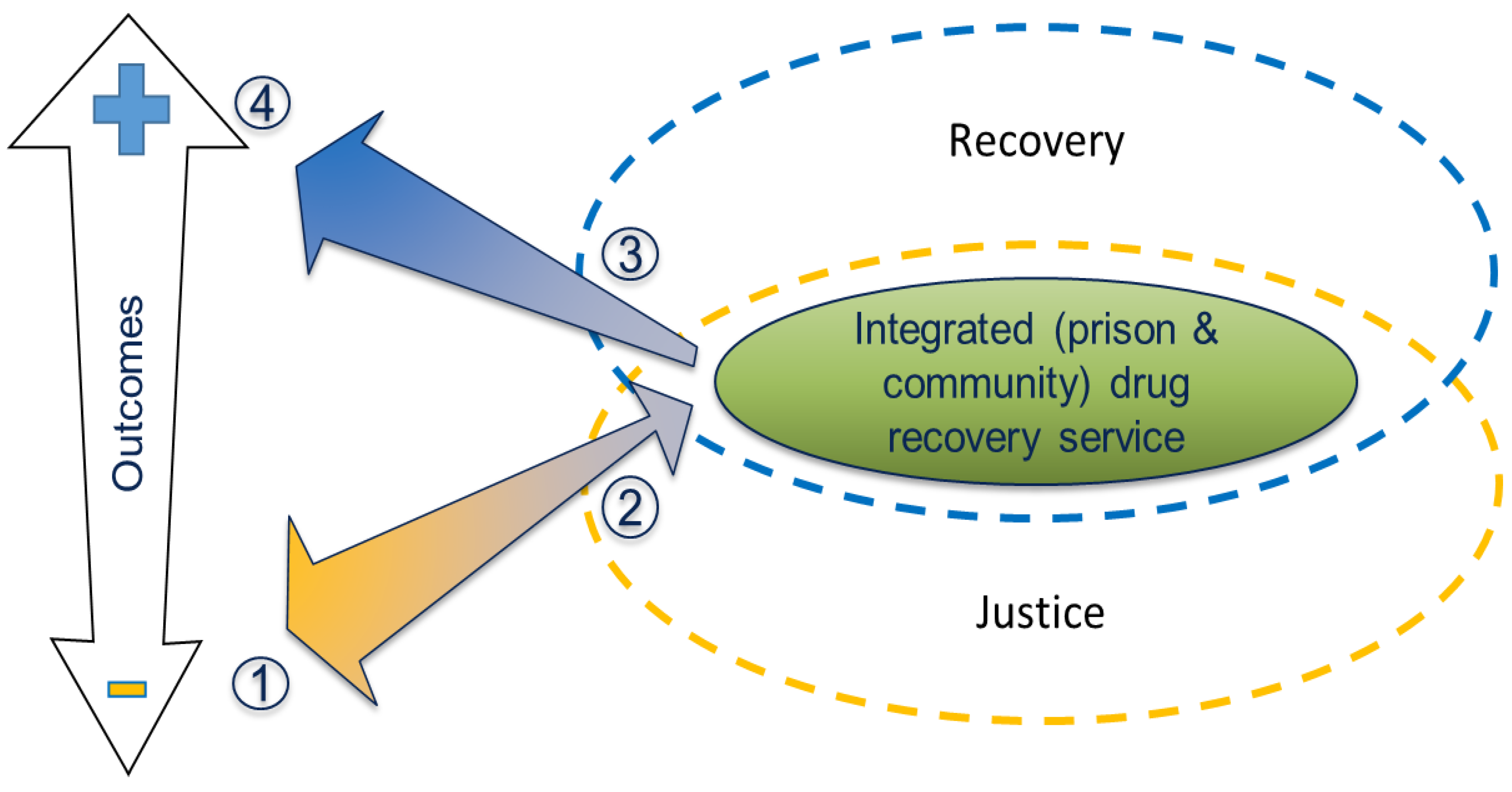
Figure 1. Drug recovery service reorganisation located within a process-linked-to-outcomes conceptual framework.
Preprints 149088 g001
Figure 2. Kapler Meier analysis describing incidence and waiting (survival) times to treatment engagement, with and without continuity-of-care. In essence, the less area under the curve the less waiting times to treatment.
Preprints 149088 g002
Figure 3. Kapler Meier Survival plots describing incidence and waiting (survival) times to treatment engagement, with and without continuity-of-care for all three sub system groups.
Preprints 149088 g003
Table 1. Kaplan Meier Survival outputs describing those leaving prison with and without continuity-of-care and engaging or otherwise with the community drug treatment services.
Preprints 149088 i001
Table 2. Local provision of prison-to-community continuity-of-care compared to the National and a similar Recovery Partnership’s statutory performance returns.
Prison type (context) Prison-to-community drug treatment engagements (%)
Year 1 Year 2 Year 3 Year 4
Local (study) 113 (27%) 171 (45%) 238 (59%) 169 (68%)
Local (matched) 99 (30%) 73 (22%) 161 (60%) 95 (77%)
National (system) 6544 (24%) 7894 (34%) 10159 (42%) 6396 (47%)
Disclaimer/Publisher’s Note: The statements, opinions and data contained in all publications are solely those of the individual author(s) and contributor(s) and not of MDPI and/or the editor(s). MDPI and/or the editor(s) disclaim responsibility for any injury to people or property resulting from any ideas, methods, instructions or products referred to in the content.
Copyright: This open access article is published under a Creative Commons CC BY 4.0 license, which permit the free download, distribution, and reuse, provided that the author and preprint are cited in any reuse.
Prerpints.org logo

Preprints.org is a free preprint server supported by MDPI in Basel, Switzerland.

Subscribe

Disclaimer

Terms of Use

Privacy Policy

Privacy Settings

© 2025 MDPI (Basel, Switzerland) unless otherwise stated