

Submitted:
11 February 2025
Posted:
11 February 2025
You are already at the latest version
Abstract
The road transport sector in China is confronted with the dual challenges of escalating demand and the critical need to mitigate greenhouse gas emissions. This situation necessitates urgently formulating a precise and comprehensive low-carbon development framework congruent with the objectives outlined in the Paris Agreement. By synthesizing pertinent national and regional policies, this analysis underscores the pivotal role of governmental interventions in promoting innovation and facilitating investment in low-carbon technologies. We propose a series of strategic public interventions essential for transitioning to low-carbon transportation systems within the forthcoming five-year period. These are anticipated to effectively counterbalance the anticipated rise in carbon emissions triggered by increasing demand. Furthermore, the present analysis encompasses a comparative assessment of various transportation technologies' benefits, drawbacks, and obstacles. This assessment focuses mainly on the developmental maturity of these technologies and the low-carbon potential inherent in electric and fuel-cell vehicles. Ultimately, this study delineates a strategic roadmap for establishing a resilient low-carbon transport system, contributing to the broader discourse on sustainable transportation. It also provides actionable recommendations for policymakers and stakeholders dedicated to fostering a greener future.
Keywords:
1. Introduction
2. An Examination of China’s Current Low-Carbon Emission Reduction Policies for the Road Transport Sector
2.1. Relevant Policies at the Central Government Level
2.2. Relevant Policies at the Megacities

| Time | Policy Act | Concrete Concept |
|---|---|---|
| 2006 (September) |
Beijing’s Plan for Energy Conservation and Climate Change during the Period of 11th Five-Year Plan |
|
| 2009 (July) |
Beijing Action Plan for Building Humanistic Transportation, Technology and Green Transportation (2009-2015) |
|
| 2011 (December) |
Energy Conservation, Consumption Reduction and Climate Change Plan of Beijing during the 12th Five-Year Plan Period |
|
| 2013 (September) |
Beijing Released a Five-Year Clean Air Action Plan (2013-2017) |
|
| 2014 (March) |
Regulations on Beijing Municipal Prevention and Control of Air Pollution |
|
| 2015 (December) |
The Energy Development Plan of Beijing Municipality during the 13th Five-Year Plan Period |
|
| 2016 (June) |
Administrative Measures for The Promotion and Application of New Energy Vehicles in Beijing Municipality |
|
| 2019 (July) |
Benchmark of Discretion of Administrative Examination and Approval Items for Motor Vehicle models and Non-road Mobile Machinery Meeting the Prescribed Emission and Energy Consumption Standards in Beijing |
|
| 2021 (December) |
Energy Development Plan of Beijing Municipality during the Period of 14th Five-Year Plan |
|
| 2022 (April) |
Beiling Transportation Development and Construction Plan during the Period of 14th Five-Year Plan |
|
| 2022 (April) |
The Action Plan for Comprehensive Transportation Management in Beijing in 2022 |
|
| 2022 (July) |
Low-carbon design standard for Urban Comprehensive Passenger Transfer Hub |
|
| 2022 (October) |
Implementation Plan of Beijing Carbon Peak |
|
| 2024 (March) |
The Beijing Municipal Comprehensive Transportation Management Action Plan for 2024 |
|
3. Potential of in-Depth Optimization of Transportation Structure for Carbon Reduction and Emission Reduction of Road Transportation
3.1. ‘Private-to-Public’ in the Field of Passenger Transport
3.2. Intelligent Management of Road Circulation
3.3. ‘Road-to-Rail’ and ‘Road-to-Water’ in the Freight Field
4. Electric Power Drive Technologies on the Emission Reduction Potential of Highways in Anticipation of New Energy
4.1. Development Level of Battery Performance for Pure Electric Vehicles
4.2. Factors Influencing Carbon Emissions in Battery Manufacturing
4.3. Indirect Effects of the Battery Charging Phase Derived from the Power System’s Structure
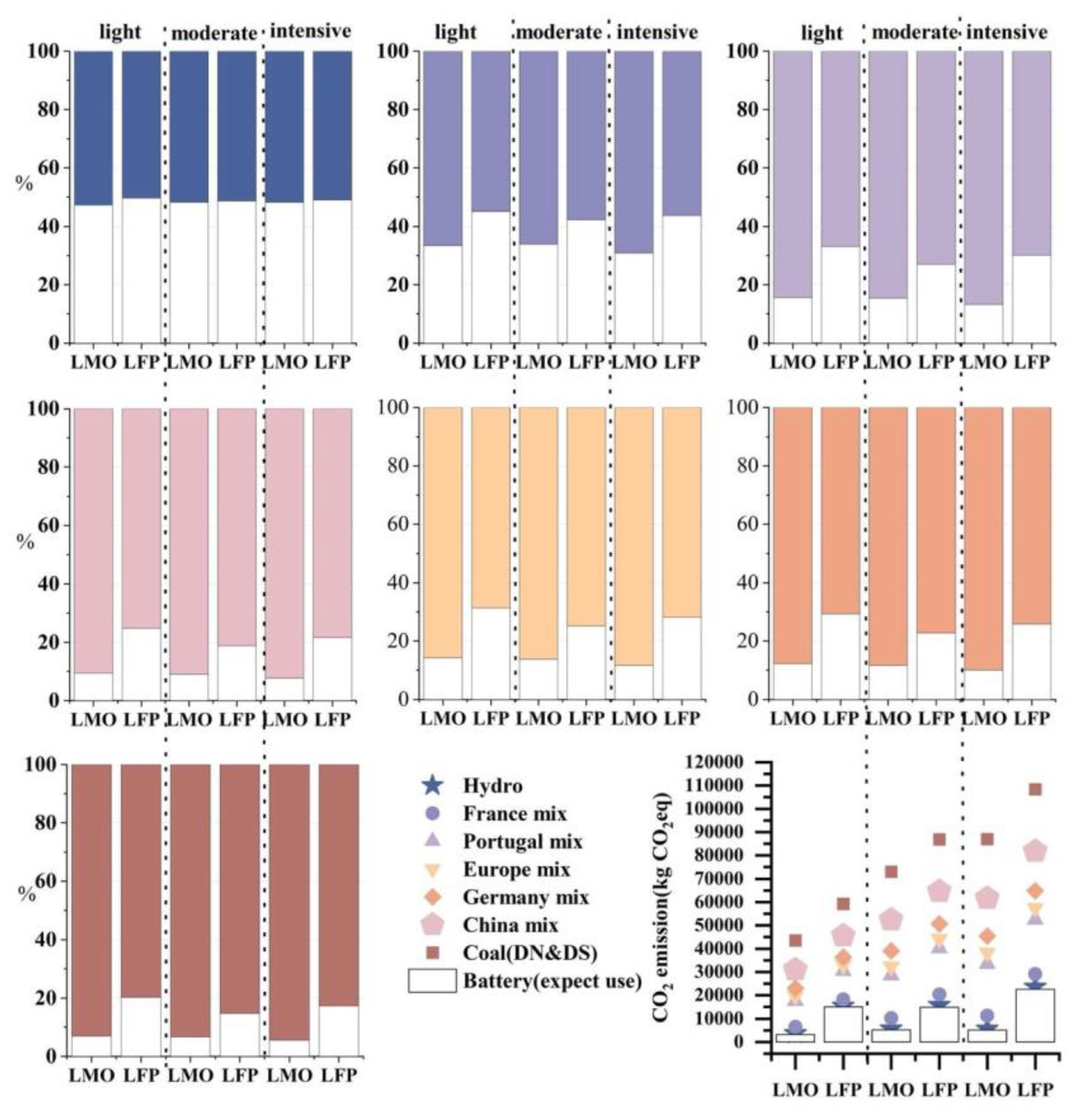
4.4. Carbon Emissions During Battery Operation
5. Potential for Carbon Reduction Through Hydrogen Fuel Cell Technology Vehicles
5.1. Potential of Carbon Reduction by Hydrogen Fuel Cell Vehicles
5.2. Indirect Effects of Hydrogen Production
5.3. Market Potential and Current Challenges of Hydrogen Fuel Cell Vehicles
6. Development Roadmap for the Transformation of Low-Carbon Road Transport in China: Future Perspectives
- In the short term, from 2025 to 2030
- 2.
- In the medium term, from 2030 to 2045
- 3.
- In the long term, from 2045
7. Conclusions
- Economic and social development (11th Five-Year Plan 2006-2010 and 13th Five-Year Plan 2016-2020) and external factors (China’s ‘Dual Carbon’ commitment at the UN in 2020) shifted policies from technology promotion to system transformation. Policies should align with regional characteristics, balancing central directives with local measures for megacities and smaller cities.
- Public transport is a crucial answer to the growing demand for transportation noted in recent years, where per unit carbon emissions are over 50 times higher than private cars. The intelligent optimization of road traffic, combined with artificial intelligence technology, can significantly reduce pollution caused by city traffic congestion. Moreover, while freight transportation in China has struck a balance among economic, social, and environmental gains, regional development disparities require additional refinements.
- Battery electric vehicles (BEVs) and their charging infrastructures are expected to grow significantly over the next decade. Sustainable raw material production is crucial for the electric vehicle sector to meet demands for better battery performance and lower carbon emissions throughout their life cycle. However, due to low carbonization in manufacturing, pressure to reduce emissions must shift towards clean transformations in power generation and improving power grid stability during operation.
- Hydrogenation vehicles can overcome the range and charging limits of electric vehicles. However, the current grey hydrogen technology fails to fully utilize its carbon reduction benefits. Ongoing technical challenges in hydrogen production, transportation, storage, and hydrogenation highlight the need for significant advancements before large-scale market adoption can occur.
- A road map proposes to outline “system transformation” in three stages. “Technology promotion” alone fails to meet short-term transportation demands; thus, a strategic framework for public intervention is crucial for transitioning to a low-carbon system. Optimizing power structures and technological advancements will likely lead to the successful adoption of pure electric vehicles by 2030-2045. Additionally, hydrogen fuel vehicles will enter the market with hydrogen technology maturation, starting with heavy-duty applications and expanding to medium and light-duty vehicles after 2045.
Author Contributions
Funding
Data Availability Statement
Acknowledgments
Conflicts of Interest
References
- Ge, R.; Xia, Y.; Ge, L.; Li, F. Knowledge Graph Analysis in Climate Action Research. Sustainability 2025, 17, 371. [Google Scholar] [CrossRef]
- IPCC. AR6 Synthesis Report: Climate Change 2023. Available online: https://www.ipcc.ch/report/ar6/syr/downloads/report/IPCC_AR6_SYR_LongerReport.pdf (accessed on 1 December 2024).
- IEA. IEA CO2 Emissions from Fuel Combustion Statistics: Greenhouse Gas Emissions from Energy. [CrossRef]
- Tostes, B.; Henriques, S.T.; Brockway, P.E.; Heun, M.K.; Domingos, T.; Sousa, T. On the right track? Energy use, carbon emissions, and intensities of world rail transportation, 1840–2020. Appl. Energ. 2024, 367, 123344. [Google Scholar] [CrossRef]
- Shang, W.; Ling, Y.; Ochieng, W.; Yang, L.; Gao, X.; Ren, Q.; Chen, Y.; Cao, M. Driving forces of CO2 emissions from the transport, storage, and postal sectors: A pathway to achieving carbon neutrality. Appl. Energ. 2024, 365, 123226. [Google Scholar] [CrossRef]
- Dragu, V.; Ruscă, A.; Roşca, M.A. The Spatial Accessibility of High-Capacity Public Transport Networks—The Premise of Sustainable Development. Sustainability 2025, 17, 343. [Google Scholar] [CrossRef]
- Pan, X.; Guo, S. Decomposition analysis of regional differences in China’s carbon emissions based on socio-economic factors. Energy 2024, 303, 131932. [Google Scholar] [CrossRef]
- The State Council of the People’s Republic of China. China unveils guidelines on developing comprehensive transport network. Available online: http://english.www.gov.cn/policies/latestreleases/202102/24/content_WS6036593dc6d0719374af9866.html (accessed on 1 December 2024).
- World Resources Institute. Decarbonizing China’s road transport sector: Strategies toward Carbon Neutrality. [CrossRef]
- Zhang, L.; Li, Z.; Jia, X.; Tan, R.R.; Wang, F. Targeting carbon emissions mitigation in the transport sector – a case study in Urumqi, China. J. Clean Prod. 2020, 259, 120811. [Google Scholar] [CrossRef]
- Wang, Y.; Liao, Z. Functional industrial policy mechanism under natural resource conflict: A case study on the Chinese new energy vehicle industry. Resour. Policy 2023, 81, 103417. [Google Scholar] [CrossRef]
- Jauregui, J.G. Chinese investments in Argentina’s lithium sector: Economic development implications amid global competition. Extract. Ind. Soc. 2024, 20, 101551. [Google Scholar] [CrossRef]
- Xu, W.; Mo, W. Institutional unlocking or technological unlocking? The logic of carbon unlocking in the new energy vehicle industry in China. Energ. Policy 2024, 195, 114369. [Google Scholar] [CrossRef]
- Peng, B.; Xu, J.; Fan, Y. Modeling uncertainty in estimation of carbon dioxide abatement costs of energy-saving technologies for passenger cars in China. Energ. Policy 2018, 113, 306–319. [Google Scholar] [CrossRef]
- Sun, R.; Yang, K.; Peng, Z.; Pan, M.; Su, D.; Zhang, M.; Ma, L.; Ma, J.; Li, T. Spatial-Temporal Evolution of Sales Volume of New Energy Vehicles in China and Analysis of Influencing Factors. Sustainability 2024, 16, 11115. [Google Scholar] [CrossRef]
- Ye, T.; Zhao, S.; Lau, C.K.M.; Chau, F. Social media sentiment of hydrogen fuel cell vehicles in China: Evidence from artificial intelligence algorithms. Energ. Econ. 2024, 133, 107564. [Google Scholar] [CrossRef]
- Sun, Z.Y. Hydrogen energy: Development prospects, current obstacles and policy suggestions under China’s ‘Dual Carbon’ goals. Chin. J. Urban Environ. Stud. 2023, 11, 2350006. [Google Scholar] [CrossRef]
- Shafique, M.; Luo, X. Environmental life cycle assessment of battery electric vehicles from the current and future energy mix perspective. J. Environ. Manage. 2022, 303, 114050. [Google Scholar] [CrossRef]
- Guilhot, L. An analysis of China’s energy policy from 1981 to 2020: Transitioning towards a diversified and low-carbon energy system. Energ. Policy 2022, 162, 112806. [Google Scholar] [CrossRef]
- Zheng, X.; Wang, J.; Chen, Y.; Tian, C.; Li, X. Potential pathways to reach energy-related CO2 emission peak in China: Analysis of different scenarios. Environ. Sci. Pollut. Res. 2023, 30, 66328–66345. [Google Scholar] [CrossRef] [PubMed]
- Kang, Y. Sustainable Development Through Energy Transition: The Role of Natural Resources and Gross Fixed Capital in China. Sustainability 2025, 17, 83. [Google Scholar] [CrossRef]
- Peng, Z.; Li, M. Carbon Emissions Intensity of the Transportation Sector in China: Spatiotemporal Differentiation, Trends Forecasting and Convergence Characteristics. Sustainability 2025, 17, 815. [Google Scholar] [CrossRef]
- Zhang, Q.; Gu, B.; Zhang, H.; Ji, Q. Emission reduction mode of China’s provincial transportation sector: Based on “Energy+” carbon efficiency evaluation. Energ. Policy 2023, 177, 113556. [Google Scholar] [CrossRef]
- Chen, J.; Zhang, Y.; Li, X.; Sun, B.; Liao, Q.; Tao, Y.; Wang, Z. Strategic integration of vehicle-to-home system with home distributed photovoltaic power generation in Shanghai. Appl. Energ. 2020, 263, 114603. [Google Scholar] [CrossRef]
- Pradhan, R.P.; Nair, M.S.; Hall, J.H.; Bennett, S.E. Planetary health issues in the developing world: Dynamics between transportation systems, sustainable economic development, and CO2 emissions. J. Clean. Prod. 2024, 449, 140842. [Google Scholar] [CrossRef]
- Ministry of Transport of the People’s Republic of China. Statistical Bulletin on the Development of Transportation Industry 2020 (in Chinese). Available online: https://xxgk.mot.gov.cn/2020/jigou/zhghs/202105/t20210517_3593412.html (accessed on 1 December 2024).
- Ministry of Transport of the People’s Republic of China. Statistical Bulletin on the Development of Transportation Industry 2021 (in Chinese). Available online: https://xxgk.mot.gov.cn/2020/jigou/zhghs/202205/t20220524_3656659.html (accessed on 1 December 2024).
- Ministry of Transport of the People’s Republic of China. Statistical Bulletin on the Development of Transportation Industry 2022 (in Chinese). Available online: https://xxgk.mot.gov.cn/2020/jigou/zhghs/202306/t20230615_3847023.html (accessed on 1 December 2024).
- Ministry of Transport of the People’s Republic of China. Statistical Bulletin on the Development of Transportation Industry 2023 (in Chinese). Available online: https://xxgk.mot.gov.cn/2020/jigou/zhghs/202406/t20240614_4142419.html (accessed on 1 December 2024).
- Ministry of Industry and Information Technology of the People’s Republic of China. China Automotive Energy Consumption Query (in Chinese). Available online: https://yhgscx.miit.gov.cn/fuel-consumption-web/mainPage (accessed on 1 December 2024).
- Sun, B.; Zhang, Q.; Mao, H.; Chen, L. Optimizing energy efficiency in intelligent vehicle-oriented road network design: A novel traffic assignment method for sustainable transportation. Sustain. Energy Techn. 2024, 69, 103928. [Google Scholar] [CrossRef]
- Sun, B.; Hu, L.; Zhang, Q.; Zou, C.; Wei, N.; Jia, Z.; Wu, Z.; Mao, H. Temporal variations in urban road network traffic performance during the early application of a cooperative vehicle infrastructure system: Evidence from the real world. Energ. Convers. Manage. 2024, 300, 117975. [Google Scholar] [CrossRef]
- Mamarikas, S.; Doulgeris, S.; Samaras, Z.; Ntziachristos, L. Traffic impacts on energy consumption of electric and conventional vehicles. Transport. Res. D-Tr. E. 2022, 105, 103231. [Google Scholar] [CrossRef]
- López-Acevedo, F.J.; Herrero, M.J.; Escavy Fernández, J.I.; González Bravo, J. Potential Reduction in Carbon Emissions in the Transport of Aggregates by Switching from Road-Only Transport to an Intermodal Rail/Road System. Sustainability 2024, 16, 9871. [Google Scholar] [CrossRef]
- Zhang, Y.; Sun, X.; Ding, Y.; Sun, P. Design of intelligent diagnosis system for ship power equipment. Chinese J. Ship Res. 2018, 13, 140–146. [Google Scholar] [CrossRef]
- Lin, Y.; Qin, Y.; Wu, J.; Xu, M. Impact of high-speed rail on road traffic and greenhouse gas emissions. Nat. Clim. Chang. 2021, 11, 952–957. [Google Scholar] [CrossRef]
- Lin, S.; Wang, J. Carbon emission reduction effect of transportation structure adjustment in China: An approach on multi-objective optimization model. Environ. Sci. Pollut. Res. 2022, 29, 6166–6183. [Google Scholar] [CrossRef] [PubMed]
- Zhang, W.; Zeng, M.; Zhang, Y.; Su, C. Reducing carbon emissions: Can high-speed railway contribute? J. Clean. Prod. 2023, 413, 137524. [Google Scholar] [CrossRef]
- Tang, B.; Li, X.; Yu, B.; Wei, Y. Sustainable development pathway for intercity passenger transport: A case study of China. Appl. Energ. 2019, 254, 113632. [Google Scholar] [CrossRef]
- Glitman, K.; Farnsworth, D.; Hildermeier, J. The role of electric vehicles in a decarbonized economy: Supporting a reliable, affordable, and efficient electric system. Electricity J. 2019, 32, 106623. [Google Scholar] [CrossRef]
- Yuan, M.; Thellufsen, J.Z.; Lund, H.; Liang, Y. The electrification of transportation in energy transition. Energy 2021, 236, 121564. [Google Scholar] [CrossRef]
- Tao, Y.; Wang, Z.; Wu, B.; Tang, Y.; Evans, S. Environmental life cycle assessment of recycling technologies for ternary lithium-ion batteries. J. Clean. Prod. 2023, 389, 136008. [Google Scholar] [CrossRef]
- Wang, Y.; Tang, B.; Shen, M.; Wu, Y.; Qu, S.; Hu, Y.; Feng, Y. Environmental impact assessment of second life and recycling for LiFePO4 power batteries in China. J. Environ. Manage. 2022, 314, 115083. [Google Scholar] [CrossRef] [PubMed]
- Natural Resources Defense Council. A study on China’s timetable for phasing-out traditional ICE-vehicles (in Chinese). Available online: http://www.nrdc.cn/Public/uploads/2019-05-20/5ce20cbfca564.pdf (accessed on 1 December 2024).
- Un-Noor, F.; Padmanaban, S.; Mihet-Popa, L.; Mollah, M.N.; Hossain, E.A. Comprehensive study of key electric vehicle (EV) components, technologies, challenges, impacts, and future direction of development. Energies 2017, 10, 1217. [Google Scholar] [CrossRef]
- Fan, E.; Li, L.; Wang, Z.; Lin, J.; Huang, Y.; Yao, Y.; Chen, R.; Wu, F. Sustainable recycling technology for Li-ion batteries and beyond: Challenges and future prospects. Chem. Rev. 2020, 120, 7020–7063. [Google Scholar] [CrossRef]
- Lai, X.; Chen, J.; Chen, Q.; Han, X.; Lu, L.; Dai, H.; Zheng, Y. Comprehensive assessment of carbon emissions and environmental impacts of sodium-ion batteries and lithium-ion batteries at the manufacturing stage. J. Clean. Prod. 2023, 423, 138674. [Google Scholar] [CrossRef]
- Accardo, A.; Dotelli, G.; Musa, M.L.; Spessa, E. Lifecycle assessment of an NMC battery for application to electric light-duty commercial vehicles and comparison with a sodium-nickel-chloride battery. Appl. Sci. 2021, 11, 1160. [Google Scholar] [CrossRef]
- Sun, X.; Luo, X.; Zhang, Z.; Meng, F.; Yang, J. Lifecycle assessment of lithium nickel cobalt manganese oxide (NCM) batteries for electric passenger vehicles. J. Clean. Prod. 2020, 273, 123006. [Google Scholar] [CrossRef]
- Wang, S.; Yu, J. A comparative lifecycle assessment on lithium-ion battery: Case study on electric vehicle battery in China considering battery evolution. Waste Manage. Res. 2021, 39, 156–164. [Google Scholar] [CrossRef] [PubMed]
- Liang, Y.; Su, J.; Xi, B.; Yu, Y.; Ji, D.; Sun, Y.; Zhu, J. Lifecycle assessment of lithium-ion batteries for greenhouse gas emissions. Resour. Conserv. Recy. 2017, 117, 285–293. [Google Scholar] [CrossRef]
- Marques, P.; Garcia, R.; Kulay, L.; Freire, F. Comparative life cycle assessment of lithium-ion batteries for electric vehicles addressing capacity fade. J. Clean. Prod. 2019, 229, 787–794. [Google Scholar] [CrossRef]
- Le Varlet, T.; Schmidt, O.; Gambhir, A.; Few, S.; Staffell, I. Comparative life cycle assessment of lithium-ion battery chemistries for residential storage. J. Energy Storage 2020, 28, 101230. [Google Scholar] [CrossRef]
- Wang, F.; Deng, Y.; Yuan, C. Life cycle assessment of lithium-oxygen battery for electric vehicles. J. Clean. Prod. 2020, 264, 121339. [Google Scholar] [CrossRef]
- Peters, J.F.; Peña Cruz, A.; Weil, M. Exploring the economic potential of sodium-ion batteries. Batteries 2019, 5, 10. [Google Scholar] [CrossRef]
- Wang, Q.; Liu, W.; Yuan, X.; Tang, H.; Tang, Y.; Wang, M.; Sun, J. Environmental impact analysis and process optimization of batteries based on lifecycle assessment. J. Clean. Prod. 2018, 174, 1262–1273. [Google Scholar] [CrossRef]
- Zackrisson, M.; Fransson, K.; Hildenbrand, J.; Lampic, G.; O’Dwyer, C. Life cycle assessment of lithium-air battery cells. J. Clean. Prod. 2016, 135, 299–311. [Google Scholar] [CrossRef]
- Kim, H.C.; Wallington, T.J.; Arsenault, R.; Bae, C.; Ahn, S.; Lee, J. Cradle-to-gate emissions from a commercial electric vehicle Li-ion battery: A comparative analysis. Environ. Sci. Techn. 2016, 50, 7715–7722. [Google Scholar] [CrossRef] [PubMed]
- Kallitsis, E.; Korre, A.; Kelsall, G.; Kupfersberger, M.; Nie, Z. Environmental lifecycle assessment of the production in China of lithium-ion batteries with nickel-cobalt-manganese cathodes utilising novel electrode chemistries. J. Clean. Prod. 2020, 254, 120067. [Google Scholar] [CrossRef]
- Wang, Y.; Yu, Y.; Huang, K.; Chen, B.; Deng, W.; Yao, Y. Quantifying the environmental impact of a Li-rich high-capacity cathode material in electric vehicles via life cycle assessment. Environ. Sci. Pollut. Res. 2017, 24, 1251–1260. [Google Scholar] [CrossRef]
- Choudhary, D.; Mahanty, R.N.; Kumar, N. A dynamic pricing strategy and charging coordination of PEV in a renewable-grid integrated charging station. Electr. Pow. Syst. Res. 2025, 238, 111105. [Google Scholar] [CrossRef]
- Chen, Q.; Lai, X.; Gu, H.; Tang, X.; Gao, F.; Han, X.; Zheng, Y. Investigating carbon footprint and carbon reduction potential using a cradle-to-cradle LCA approach on lithium-ion batteries for electric vehicles in China. J. Clean. Prod. 2022, 369, 133342. [Google Scholar] [CrossRef]
- Lai, X.; Gu, H.; Chen, Q.; Tang, X.; Zhou, Y.; Gao, F.; Han, X.; Guo, Y.; Bhagat, R.; Zheng, Y. Investigating greenhouse gas emissions and environmental impacts from the production of lithium-ion batteries in China. J. Clean Prod. 2022, 372, 133756. [Google Scholar] [CrossRef]
- Mei, Y.; Li, B.; Wang, H.; Wang, X.; Negnevitsky, M. Multi-objective optimal scheduling of microgrid with electric vehicles. Energy Rep. 2022, 8, 4512–4524. [Google Scholar] [CrossRef]
- Moghaddam, Z.; Ahmad, I.; Habibi, D.; Masoum, M.A.S. A coordinated dynamic pricing model for electric vehicle charging stations. IEEE T. Transp. Electr. 2019, 5, 226–238. [Google Scholar] [CrossRef]
- Zackrisson, M.; Avellán, L.; Orlenius, J. Life cycle assessment of lithium-ion batteries for plug-in hybrid electric vehicles – Critical issues. J. Clean. Prod. 2010, 18, 1519–1529. [Google Scholar] [CrossRef]
- Jenu, S.; Deviatkin, I.; Hentunen, A.; Myllysilta, M.; Viik, S.; Pihlatie, M. Reducing the climate change impacts of lithium-ion batteries by their cautious management through integration of stress factors and life cycle assessment. J. Energy Storage 2020, 27, 101023. [Google Scholar] [CrossRef]
- Wang, Y.; Wu, J.; Lin, N.; Liu, D.; Liu, Z.; Lin, H. Enabling stable cycling performance with rice husk silica positive additive in lead-acid battery. Energy 2023, 269, 126796. [Google Scholar] [CrossRef]
- Han, X.; Li, Y.; Nie, L.; Huang, X.; Deng, Y.; Yan, J.; Karellas, S. Comparative life cycle greenhouse gas emissions assessment of battery energy storage technologies for grid applications. J. Clean. Prod. 2023, 392, 136251. [Google Scholar] [CrossRef]
- Zhang, H.; Zhao, F.; Hao, H.; Liu, Z. Comparative analysis of life cycle greenhouse gas emission of passenger cars: A case study in China. Energy 2023, 265, 126282. [Google Scholar] [CrossRef]
- Ishaq, H.; Dincer, I. Multi-objective optimization and analysis of a solar energy driven steam and autothermal combined reforming system with natural gas. J. Nat. Gas Sci. Eng. 2019, 69, 102927. [Google Scholar] [CrossRef]
- Halder, P.; Babaie, M.; Salek, F.; Shah, K.; Stevanovic, S.; Bodisco, T.A.; Zare, A. Performance, emissions and economic analyses of hydrogen fuel cell vehicles. Renew. Sust. Energ. Rev. 2024, 199, 114543. [Google Scholar] [CrossRef]
- Shi, C.; Qin, G.; Tan, Q.; Yang, J.; Chen, X.; Liu, Q.; Zhang, T.; Kammen, D.M. Simulation of hydrogen transportation development path and carbon emission reduction path based on LEAP model - a case study of Beijing-Tianjin-Hebei region. Energ. Policy 2024, 194, 114337. [Google Scholar] [CrossRef]
- Ajanovic, A.; Glatt, A.; Haas, R. Prospects and impediments for hydrogen fuel cell buses. Energy 2021, 235, 121340. [Google Scholar] [CrossRef]
- Chen, J.; Xu, W.; Zhang, F.; Zuo, H.; E, J.; Wei, K.; Liao, G.; Fan, Y. Thermodynamic and environmental analysis of integrated supercritical water gasification of coal for power and hydrogen production. Energ. Convers. Manage. 2019, 198, 111927. [Google Scholar] [CrossRef]
- Al-Mohammedawi, H.H.; Znad, H.; Eroglu, E. Improvement of photofermentative biohydrogen production using pre-treated brewery wastewater with banana peels waste. Int. J. Hydrogen Energ. 2019, 44, 2560–2568. [Google Scholar] [CrossRef]
- Kumar, G.; Shobana, S.; Nagarajan, D.; Lee, D.J.; Lee, K.S.; Lin, C.Y.; Chang, J.S. Biomass-based hydrogen production by dark fermentation – recent trends and opportunities for greener processes. Curr. Opin. Biotech. 2018, 50, 136–145. [Google Scholar] [CrossRef] [PubMed]
- Liu, W.; Cui, Y.; Du, X.; Zhang, Z.; Chao, Z.; Deng, Y. High efficiency hydrogen evolution from native biomass electrolysis. Energ. Environ. Sci. 2016, 9, 467–472. [Google Scholar] [CrossRef]
- Achomo, M.A.; Muthukumar, P.; Peela, N.R. Hydrogen production via steam reforming of methanol using Cu/ZnO/Al2O3: Effect of catalyst synthesis method and Cu to Zn molar ratio on physico-chemical properties and catalytic performance. Int. J. Hydrogen Energ. 2024. [CrossRef]
- Liu, B.; Zheng, S.; Lai, M. Carbon emission reduction potential analysis of fuel cell vehicles in China: based on GRA-BiLSTM prediction model. Int. J. Hydrogen Energ. 2024, 66, 110–121. [Google Scholar] [CrossRef]
- Obiora, N.K.; Ujah, C.O.; Asadu, C.O.; Kolawole, F.O.; Ekwueme, B.N. Production of hydrogen energy from biomass: Prospects and challenges. Green Technologies and Sustainability 2024, 2, 100100. [Google Scholar] [CrossRef]
- Li, Y.; Ma, Z.; Hou, S.; Liu, Q.; Yan, G.; Li, X.; Yu, T.; Du, Z.; Yang, J.; Chen, Y.; You, W.; Yang, Q.; Xiang, Y.; Tang, S.; Yue, X.; Zhang, M.; Zhang, W.; Yu, J.; Huang, Y.; Sun, K. Recent progress in hydrogen: From solar to solar cell. J. Mater. Sci. Technol. 2024, 176, 236–257. [Google Scholar] [CrossRef]
- Hamlehdar, M.; Beardsmore, G.; Narsilio, G.A. Hydrogen production from low-temperature geothermal energy – a review of opportunities, challenges, and mitigating solutions. Int. J. Hydrogen Energ. 2024, 77, 742–768. [Google Scholar] [CrossRef]
- IEA. The future of hydrogen: seizing today’s opportunities. Available online: https://iea.blob.core.windows.net/assets/9e3a3493-b9a6-4b7d-b499-7ca48e357561/The_Future_of_Hydrogen.pdf (accessed on 1 December 2024).
- Hydrogen Council. Hydrogen Insights 2024. Available online: https://hydrogencouncil.com/wp-content/uploads/2024/09/Hydrogen-Insights-2024.pdf (accessed on 1 December 2024).
- IEA. An energy sector roadmap to carbon neutrality in China. Available online: https://www.iea.org/reports/an-energy-sector-roadmap-to-carbon-neutrality-in-china (accessed on 1 December 2024).
- Liu, W.; Wan, Y.; Xiong, Y.; Liu, J. Outlook of low carbon and clean hydrogen in China under the goal of “carbon peak and neutrality”. Energ. Storage Sci. Techn. 2022, 11, 635–642. [Google Scholar] [CrossRef]
- Zhang, J.; Zhang, S.; Qiao, J.; Wei, J.; Wang, L.; Li, Z.; Zhuo, J. Safety resilience evaluation of hydrogen refueling stations based on improved TOPSIS approach. Int. J. Hydrogen Energ. 2024, 66, 396–405. [Google Scholar] [CrossRef]
- Genovese, M.; Fragiacomo, P. Hydrogen refueling station: Overview of the technological status and research enhancement. J. Energy Storage 2023, 61, 106758. [Google Scholar] [CrossRef]
- Deng, W.; Wu, Q.; Jing, Y.; Cao, X.; Tan, J.; Pei, W. Operation potential evaluation of multiple hydrogen production and refueling integrated stations under DC interconnected environment. Energy Rep. 2022, 8, 269–277. [Google Scholar] [CrossRef]
- Selmi, T.; Khadhraoui, A.; Cherif, A. Fuel cell-based electric vehicles technologies and challenges. Environ. Sci. Pollut. R. 2022, 29, 78121–78131. [Google Scholar] [CrossRef] [PubMed]
- Yan, M.; Peng, S.-E.; Lai, C.S.; Chen, S.-Z.; Liu, J.; Xu, J.; Xu, F.; Lai, L.L.; Chen, G. Two-Layer Optimization Planning Model for Integrated Energy Systems in Hydrogen Refueling Original Station. Sustainability 2023, 15, 7941. [Google Scholar] [CrossRef]
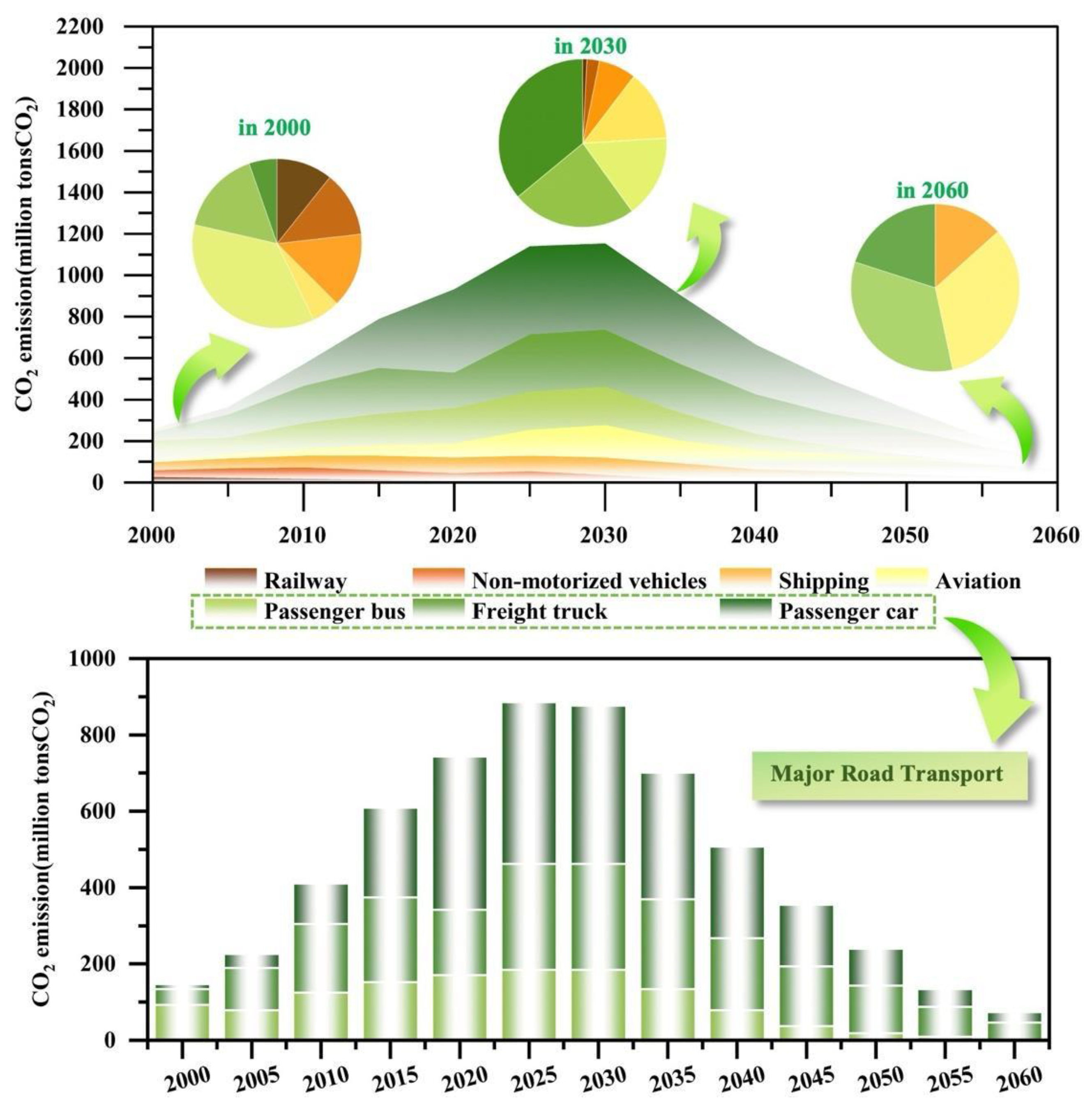
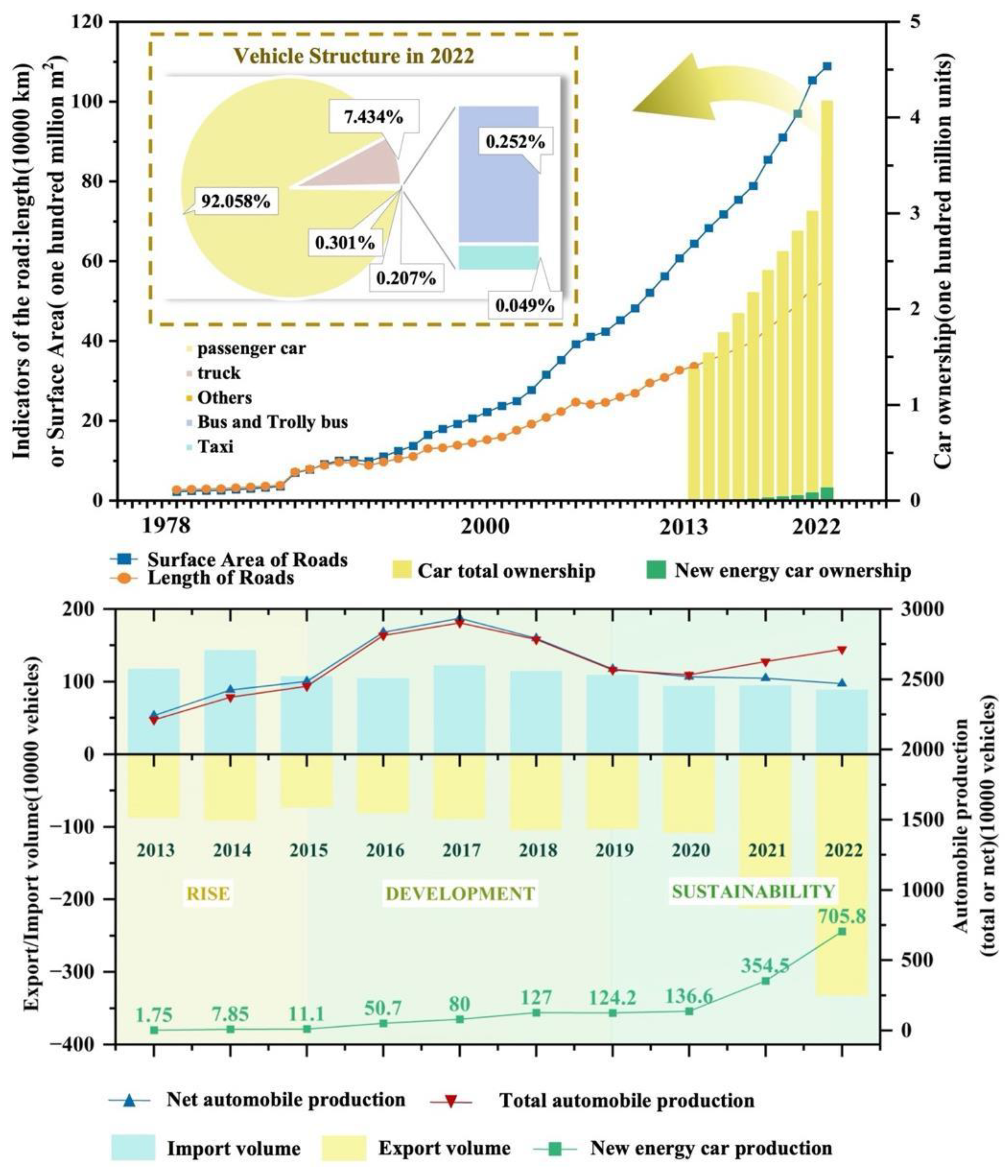
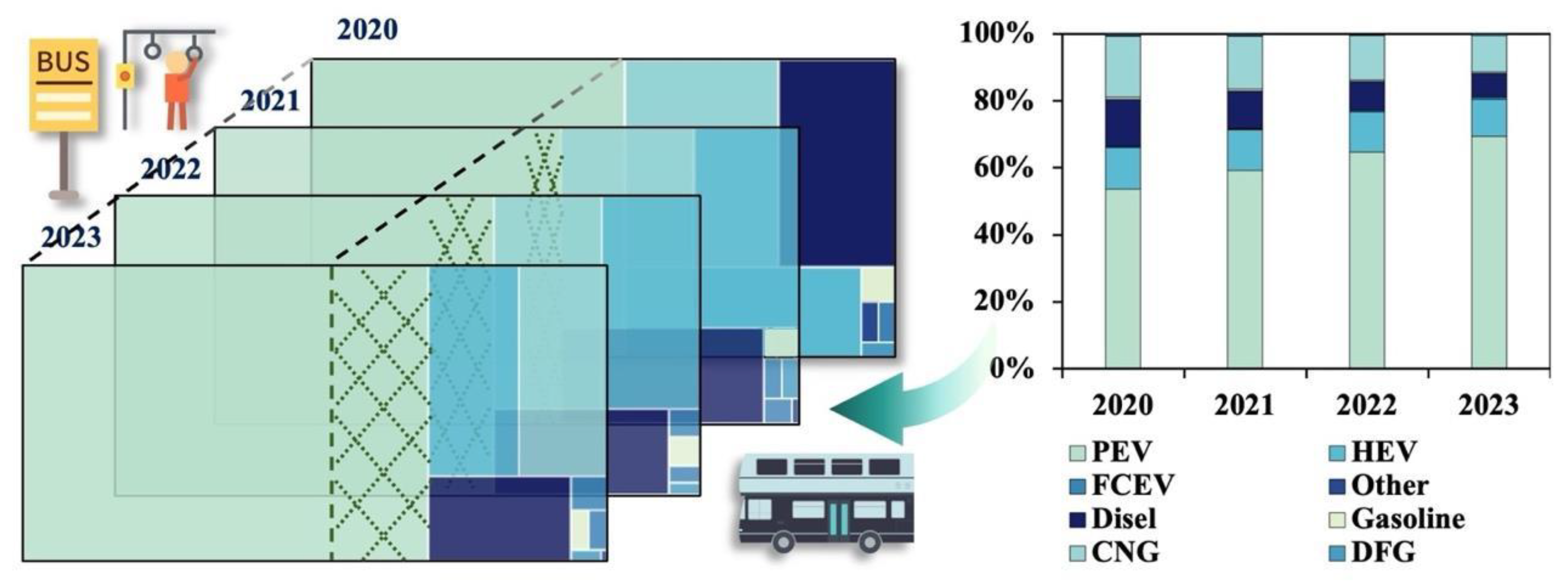
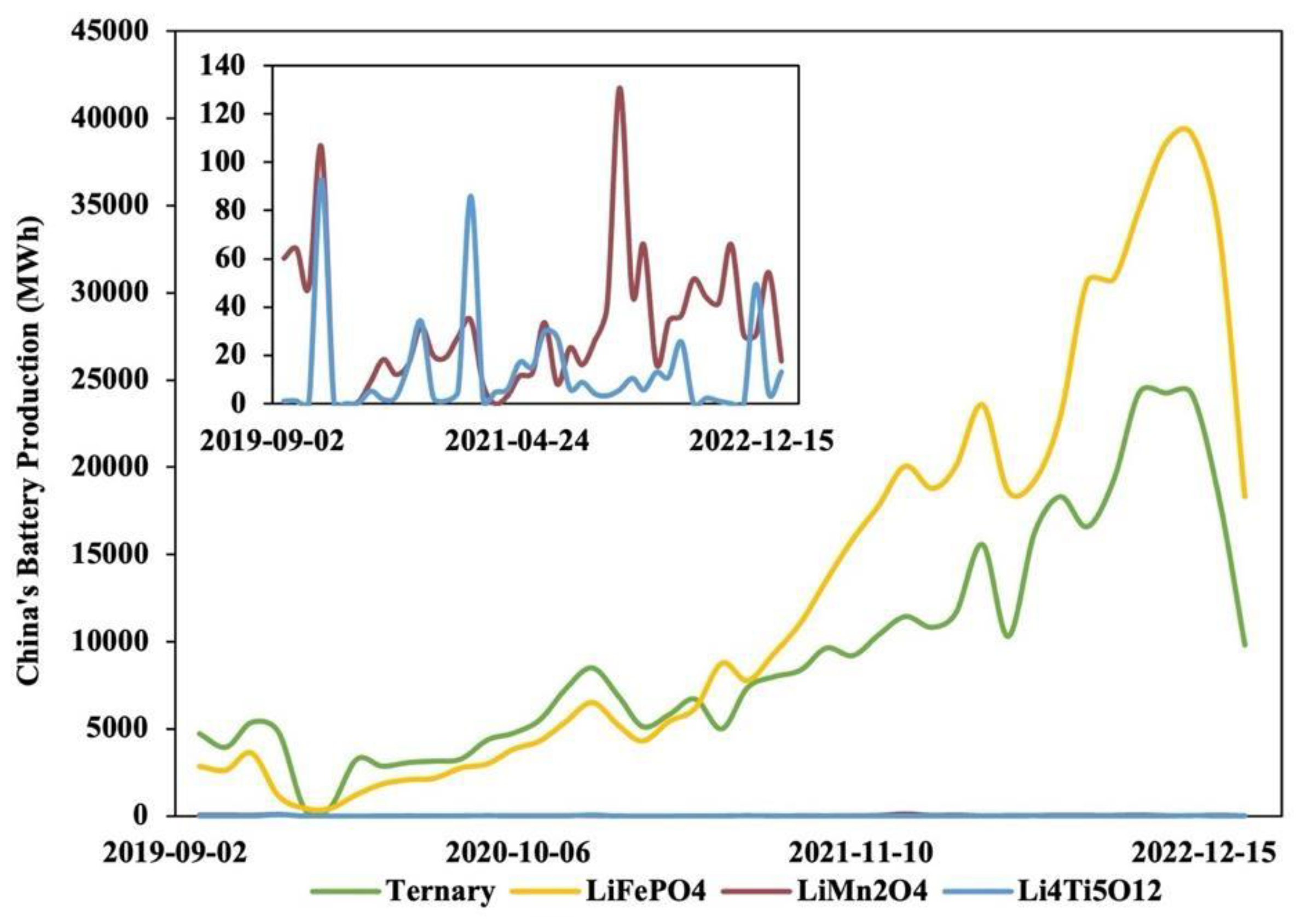
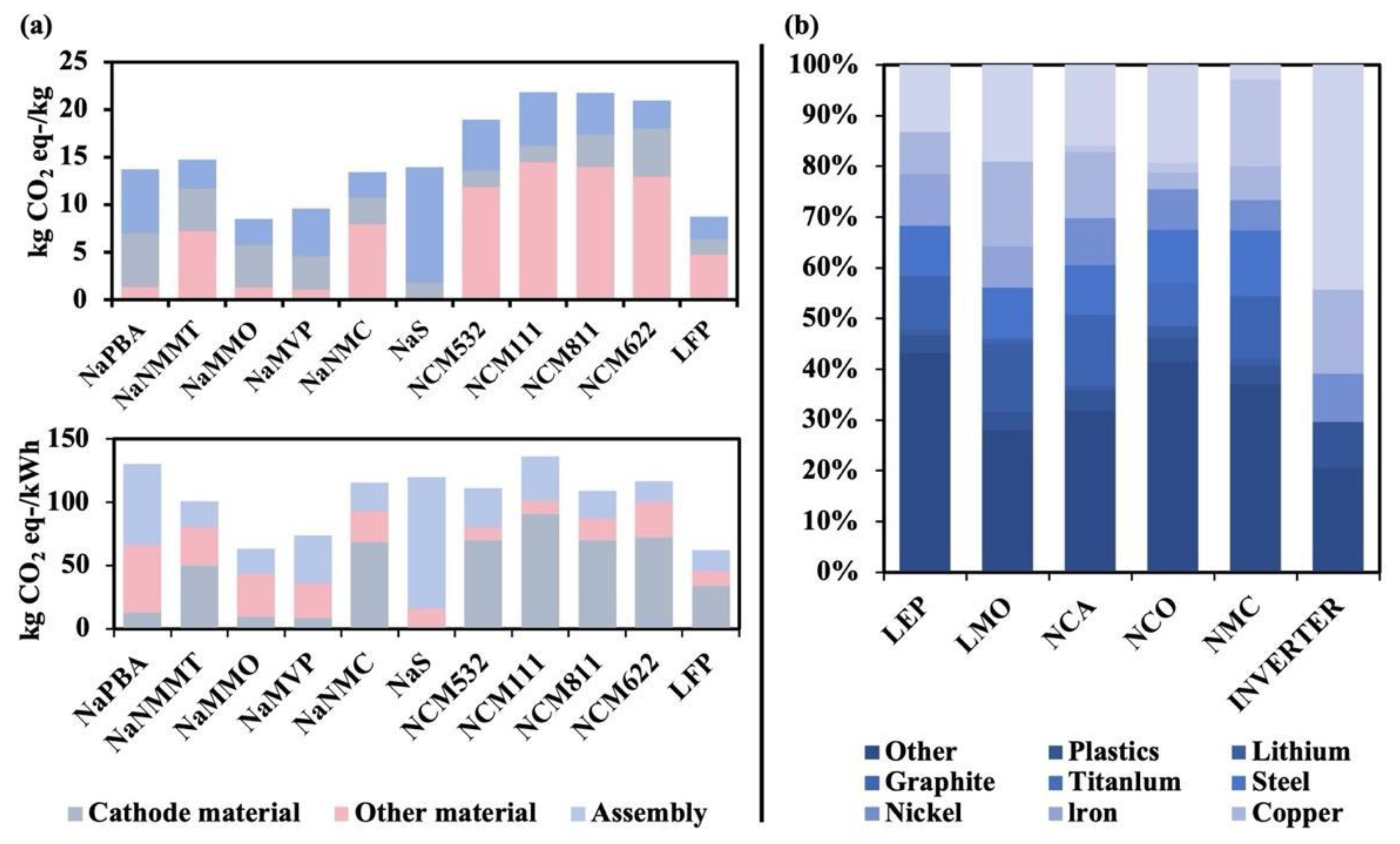
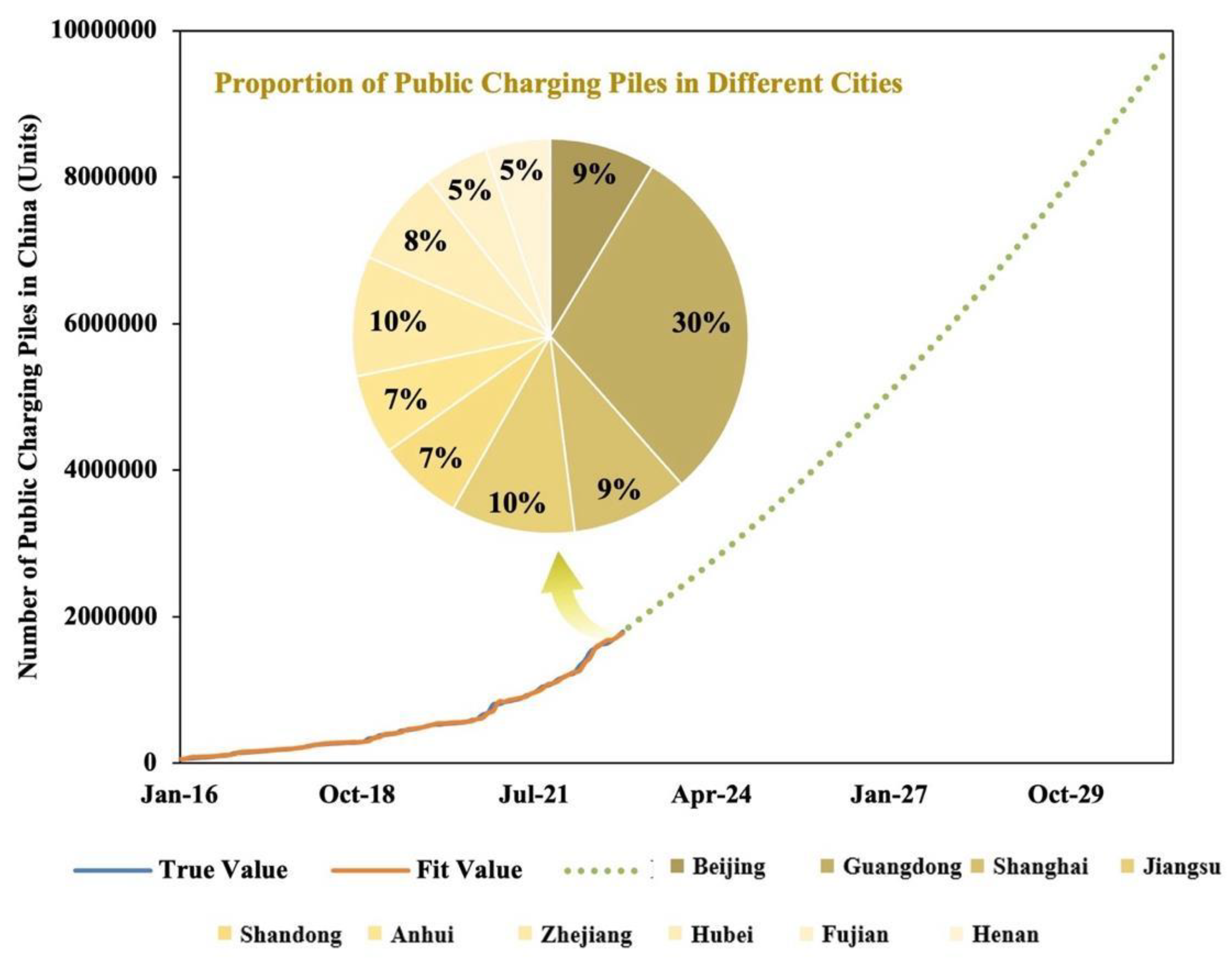
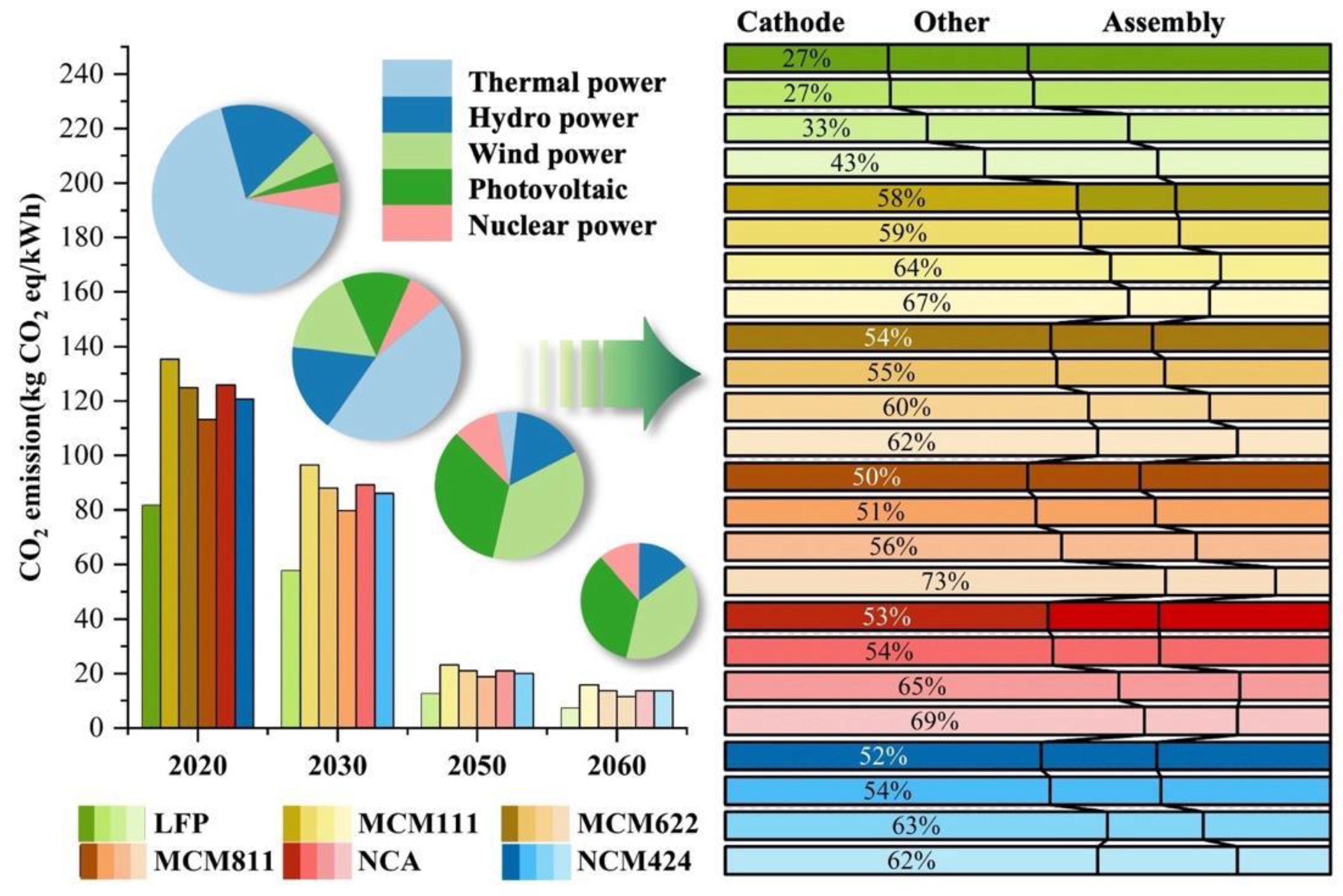
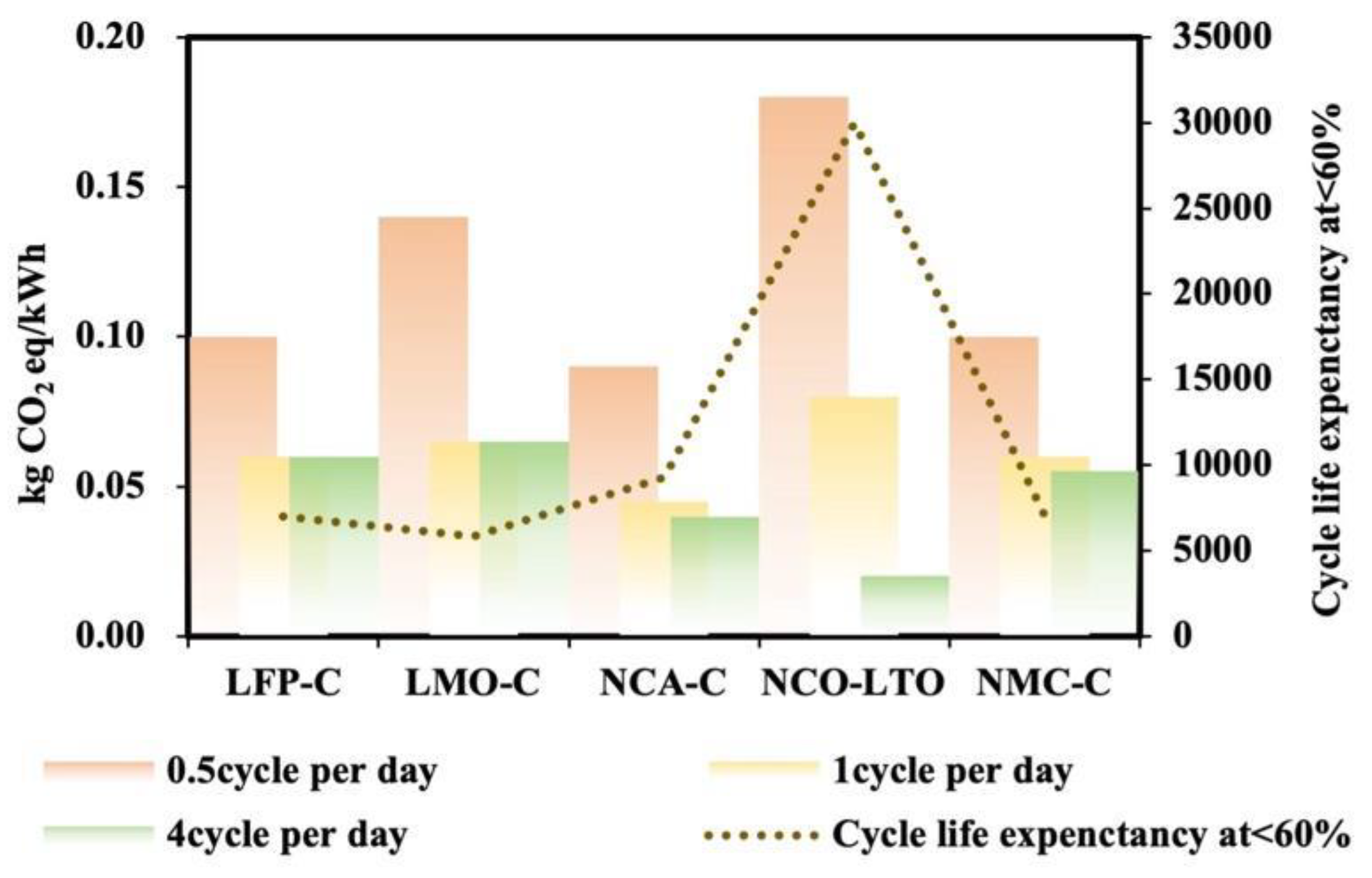
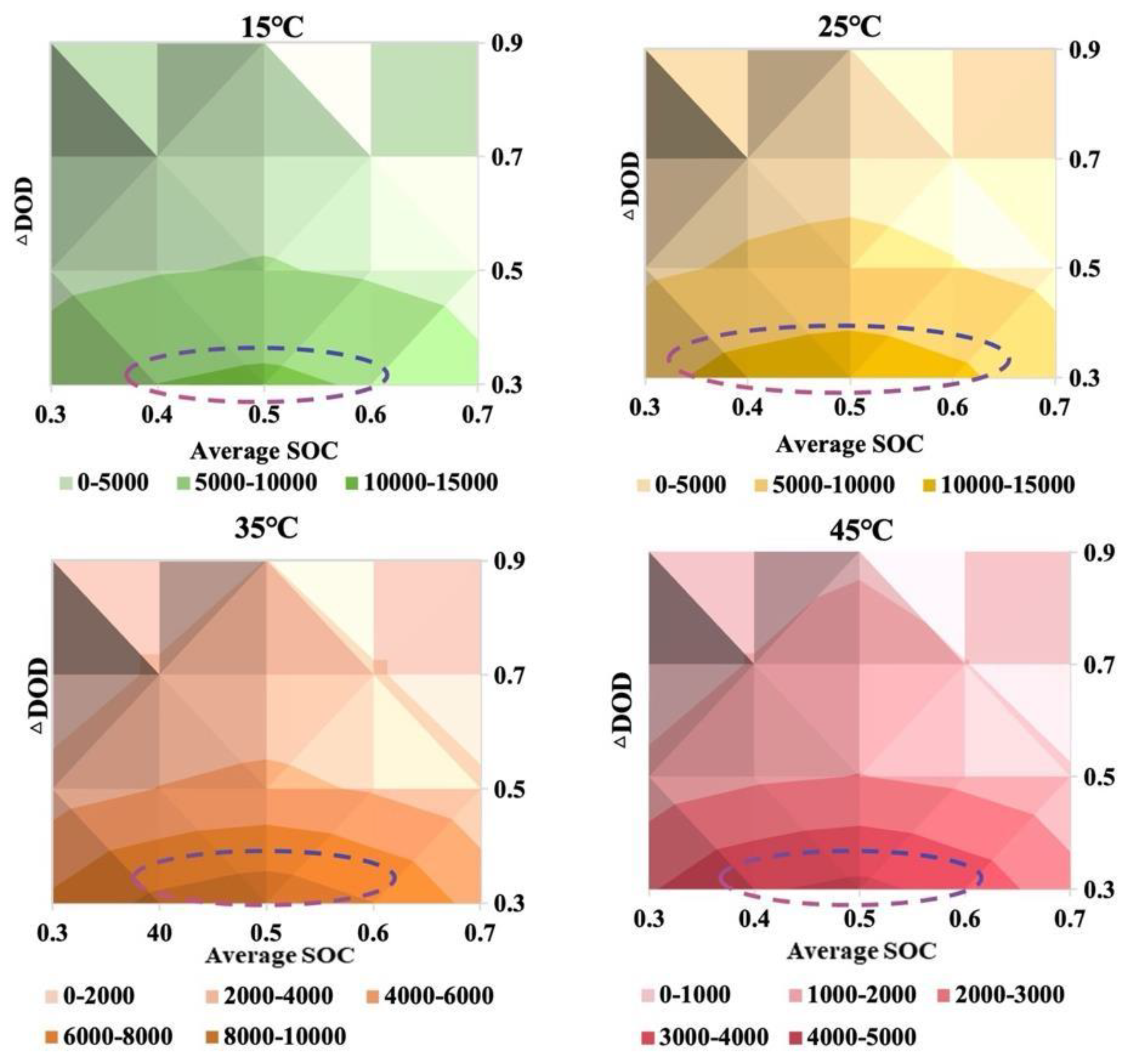
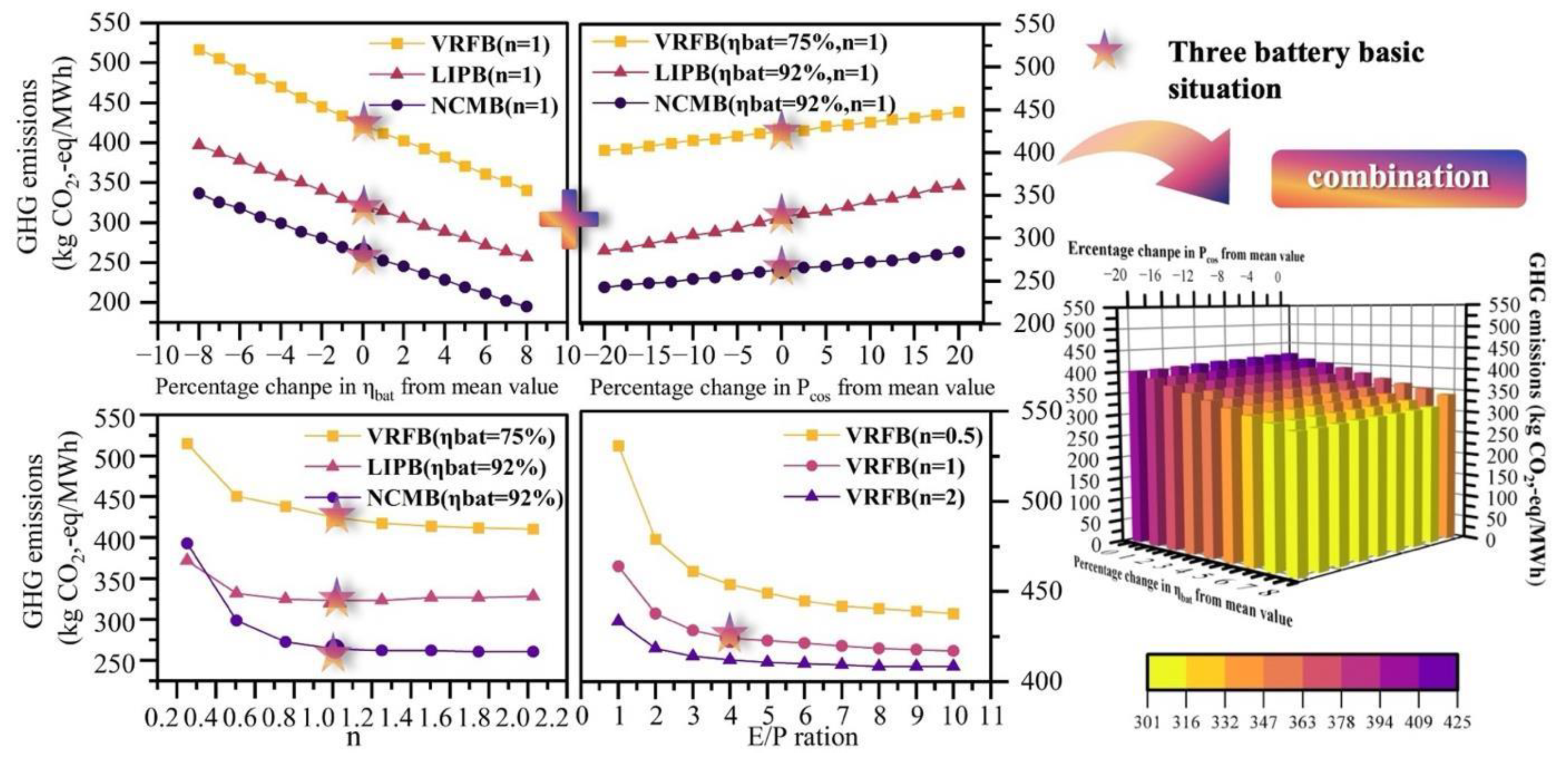
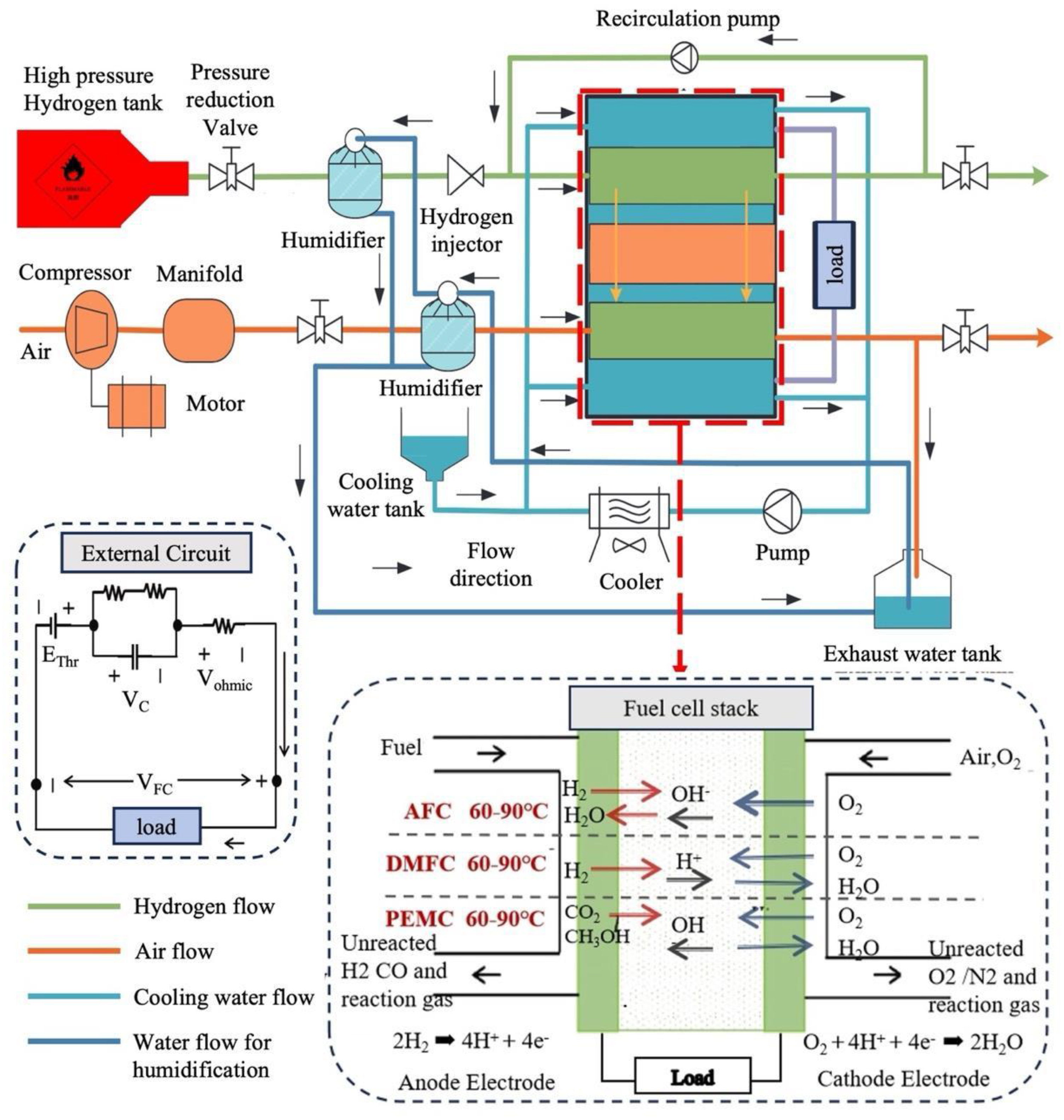
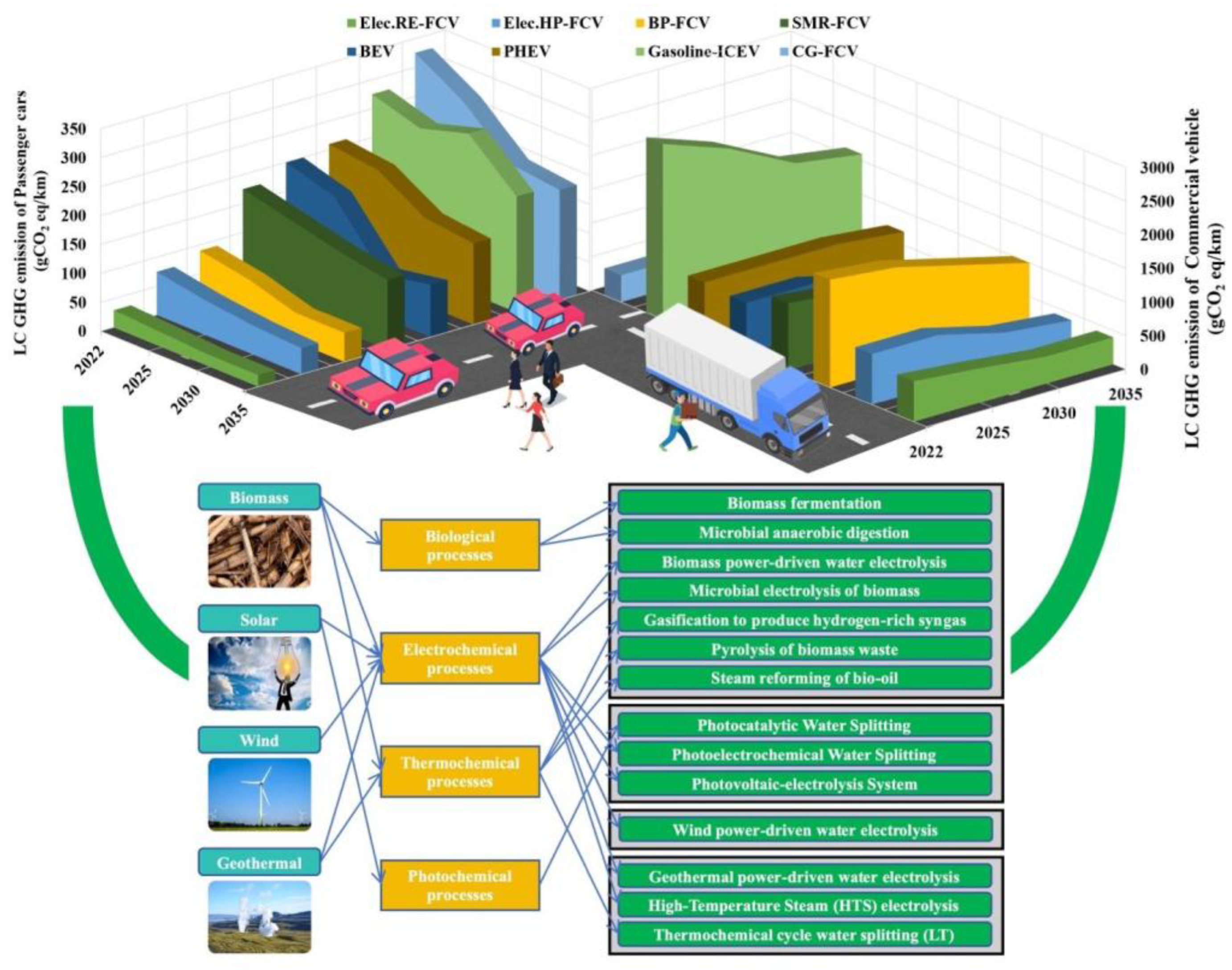
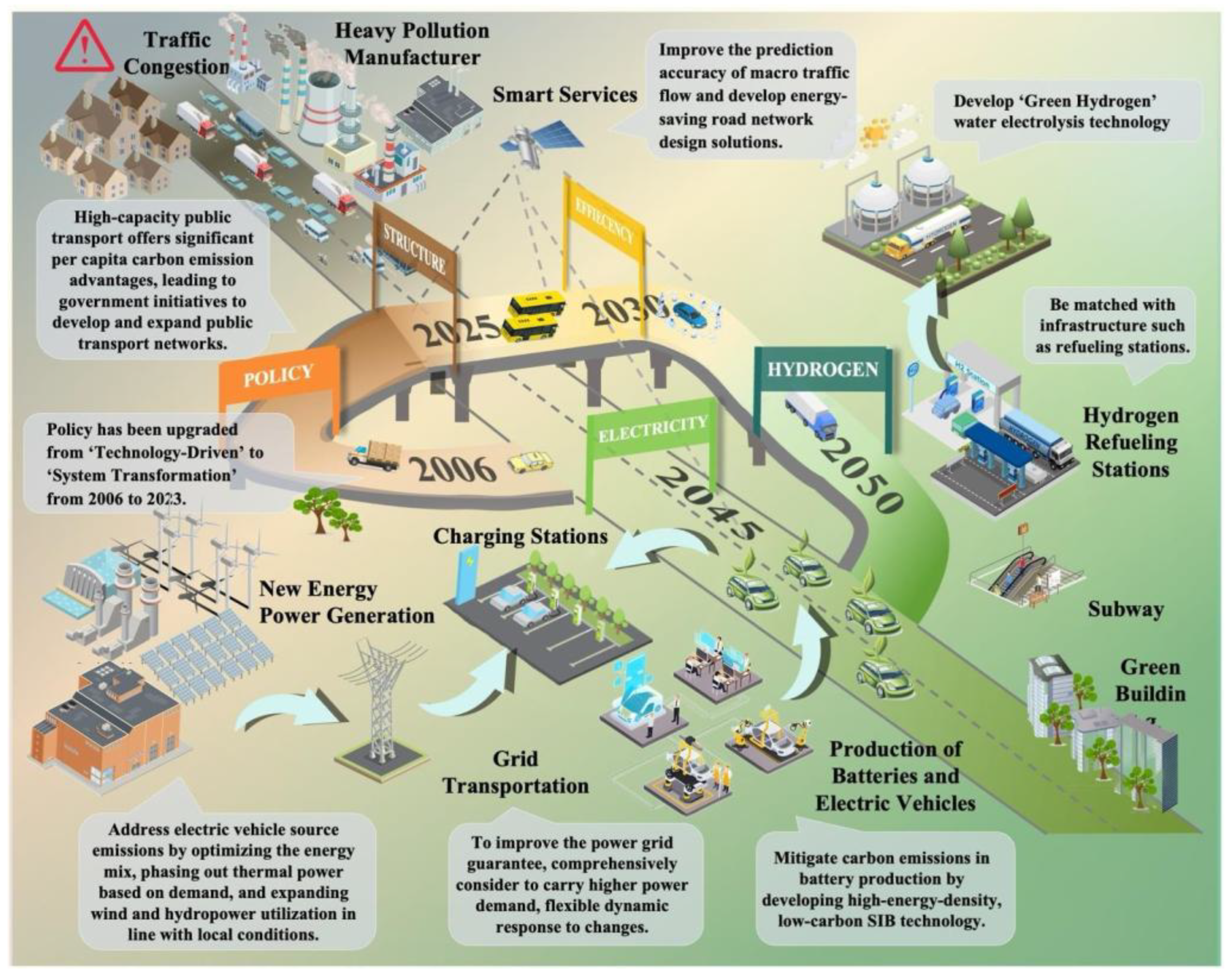
| Time | Policy Act | Concrete Concept |
|---|---|---|
| 2006 (March) |
Outline of 11th Five-Year Plan for National Economic and Social Development |
|
| 2008 (January) |
Several Opinions on Accelerating the Development of the Modern Transportation Industry |
|
| 2008 (June) |
Determine the Energy Conservation and Emission Reduction targets of the Transportation Industry during 11th Five-Year Plan |
|
| 2009 (January) |
Notice on Carrying Out the Demonstration and Promotion of Energy-saving and New Energy Vehicles |
|
| 2011 (June) |
Outline of 12th Five-Year Plan for National Economic and Social Development |
|
| 2016 (March) |
Outline of 13th Five-Year Plan for National Economic and Social Development |
|
| 2018 (July) |
Notice on the Pilot Work of Recycling and Utilization of Power Batteries for New Energy Vehicles |
|
| 2019 (April) |
Opinions on Accelerating the Transformation and Upgrading of the Road Freight Transport and Promoting High-quality Development |
|
| 2020 (December) |
China’s Energy Development in the New Era |
|
| 2021 (February) |
National Comprehensive Planning Outline of Transportation Network |
|
| 2021 (October) |
Working Guidance for Carbon Dioxide Peaking and Carbon Neutrality in Fuel and Faithful Implementation of the New Development Philosophy |
|
| 2021 (October) |
Modern Comprehensive Transportation System for 14th Five-Year Plan |
|
| 2021 (November) |
Opinions on Deeply Fighting the War on Pollution |
|
| 2021 (December) |
Work Plan for Promoting the Development of Multimodal Transport and Optimizing and Adjusting Transport Structure (2021-2025) |
|
| 2023 (April) |
Five-Year Action Planform Accelerating the Construction of a Powerful Transportation Country (2023-2027) |
|
| 2024 (October) |
China Pledges to Promote Renewable Energy Use Amid Green Transition |
|
| Time | Policy Act | Concrete Concept |
|---|---|---|
| 2012 | Shanghai’s 12th Five-Year Plan for Energy Conservation and Emission Reduction |
|
| 2013 | Shanghai Municipal Clean Air Action Plan (2013-2017) |
|
| 2014 | Implementation plan for Promotion and Application of New Energy Vehicles in Shanghai Municipality |
|
| 2016 | Shanghai Municipal Comprehensive Transportation (13th Five-Year Plan) |
|
| 2017 | Measures of Shanghai Municipality for the Administration of Special Funds for Transportation Energy Conservation and Emission Reduction |
|
| 2018 | Shanghai Municipal Clean Air Action Plan (2018-2022) |
|
| 2019 | Shanghai City Promotes the Adjustment Implementation Plan of Transportation Structure |
|
| 2019 | Action Plan for Energy Conservation and Consumption Reduction in Shanghai Transportation Industry |
|
| 2020 | Shanghai Transportation Industry Action Plan on Climate Change |
|
| 2020 (May) |
Key Work Arrangement for Energy Conservation and Emission Reduction in Shanghai Transportation Industry in 2020 |
|
| 2021 (February) |
Shanghai Municipality’s Implementation Plan to Accelerate the Development of New Energy Vehicle Industry |
|
| 2021 (June) |
14th Five-Year Plan for the Comprehensive Transportation Development of Shanghai Municipality |
|
| 2021 (July) |
Key Work Arrangements for Energy Conservation, Emission Reduction and Climate Change Response in Shanghai |
|
| 2022 (June) |
Measures of Shanghai Municipality on the Management of Special Support Funds for Transportation Energy Conservation and Emission Reduction |
|
| 2022 (October) |
White Paper on Shanghai Traffic Development |
|
| 2022 (October) |
Implementation Plan for Energy Conservation and Emission Reduction during the Period of 14th Five-Year Plan |
|
| 2023 (January) |
Implementation Plan of carbon peak in Shanghai transportation field |
|
| 2023 (June) |
Implementation Plan of Photovoltaic Promotion and Application in Shanghai Transportation Field |
|
| 2023 (July) |
Shanghai Municipal Clean Air Action Plan (2023-2025) |
|
| 2023 (September) |
Administrative Measures of Shanghai Municipality for Carbon Universal Benefit (Trial) |
|
| 2023 (September) |
Shanghai to Enliven the Automobile Circulation and Expand the Automobile-Renewal Consumption Measures |
|
| 2023 (September) |
Plan for Eco-Green Integrated Development of Yangtze Delta |
|
| 2024 (September) |
Shanghai Municipality’s Action Plan for Accelerating Green and Low-Carbon Transformation |
|
| Time | Policy Act | Concrete Concept |
|---|---|---|
| 2007 | Comprehensive Work Plan for Energy Conservation and Emission Reduction in Guangdong Province |
|
| 2011 (July) |
Implementation Opinions on Building a Low-carbon Transportation System in The Transportation Industry of Guangdong Province |
|
| 2011 (August) |
Implementation Opinions on Building a Low-carbon Transportation System in The Transportation Industry of Guangdong Province |
|
| 2012 (March) |
Comprehensive Work Plan for Energy Conservation and Emission Reduction of Guangdong Province during the 12th Five-Year Plan |
|
| 2013 | Development Plan of New Energy Automobile Industry of Guangdong Province (2013-2020) |
|
| 2014 (October) |
Notice of General Office of Guangdong Provincial People’s Government on Issuing the Action Plan for Energy Conservation, Emission-Reduction, and Low-carbon Development for 2014-2015 |
|
| 2016 | Implementation Opinions of The General Office of the Guangdong Provincial People’s Government on Accelerating the Promotion and Application of New Energy Vehicles |
|
| 2018 | Implementation Plan of Guangdong Province to Win the Battle of Blue Sky Protection (2018-2020) |
|
| 2019 | Implementation Plan of the Three-year Action Plan for Promoting Transport Structure Adjustment in Guangdong Province |
|
| 2020 | Implementation Plan for Energy Conservation and Emission Reduction during the 14th Five-Year Plan Period |
|
| 2022 (January) |
14th Five-Year Development Plan of Comprehensive Transportation System in Guangdong Province |
|
| 2022 (June) |
Implementation plan of carbon peak in Guangdong Province |
|
| 2022 (September) |
Guangdong Province’s implementation plan for energy conservation and emission reduction during 14th Five-Year Plan |
|
| 2023 (August) |
Implementation Plan of Supporting carbon Trading in Guangdong Province (2023-2030) |
|
| 2024 (September) |
Guangdong vigorously promoting the green and low-carbon development of transportation |
|
| Type | Production stage | Use phase | Abandonment phase | ||
|---|---|---|---|---|---|
| Exclude production of power batteries (kg CO2/vehicle) |
Power battery production (kg CO2/kWh) |
Characteristic parameters | Secondary usage | Reclaim | |
| ICEV | 6500 | / | The combined fuel consumption (gasoline) is 0.08015 L/km [30] | / | 580 kg CO2/vehicle |
| BEV | 8900 | 110 | Power consumption:13.4 kWh/100km | -196 kg CO2/kWh [42] | Without power battery: 510 kg CO2/vehicle; (Hydrometallurgical recovery) power battery: -69.7 kg CO2/kWh [43] |
| NCM532: 450kg,168Wh/kg | |||||
| Charge-discharge depth: 80% | |||||
| Total designed mileage: 200,000 km (about 7 years) | |||||
| 28% loss of capacity (Agreed to reduce raw capacity by 4% per year) | |||||
| Battery Kinds | Characters | Energy Density (Wh/kg) [45] | Function Unit | Carbon Emission (kg CO2-eq) |
Methods | Cycle Life |
|---|---|---|---|---|---|---|
| NCM111 | High energy, high power, low cost, environmental protection, and long life [46], but the thermal stability is poor, with NCM and LFP series as the development mainstream. | 160 | 1kg | 21.81 | LCA [47] | 1000-2000 |
| 1kWh | 136.31 | LCA [47] | ||||
| 1kWh | 130.4 | CML CED [48] | ||||
| NCM532 | 170 | 1kg | 18.91 | LCA [47] | ||
| 1kWh | 111.24 | LCA [47] | ||||
| NCM622 | 180 | 1kg | 20.97 | LCA [47] | ||
| 1kWh | 116.5 | LCA [47] | ||||
| 1kWh | 93.56 | CML-IA [49] | ||||
| 1kWh | 93.57 | ReCiPe [49] | ||||
| NCM811 | 200 | 1kg | 21.74 | LCA [47] | ||
| 1kWh | 108.7 | LCA [47] | ||||
| NMC811 NMC622 NMC523 NMC111 |
150-220 | 1kg | 8.2-9.1 | MiLCA [50] | ||
| LiFePO4 | 140 | 1000kWh | 736.35 | EPD2008 [51] | 1000-2000 | |
| 200000km | 8827 | CED CML-IA [52] | ||||
| Li4Ti5O2 | 50-80 | 1kWh | 400 | LCA [53] | 3000-7000 | |
| LiMn2O4 | 100-150 | 200000km | 1866 | CED CML-IA [52] | 300-700 | |
| LICoO2 | 150-200 | 1km | 149(g) | ReCiPe [54] | 500-1000 | |
| Lead-acid | High safety, strong recyclability, low life span, and high maintenance cost [55] | 20-35 | 1kWh | 102.76(g) | ReCiPe [56] | 250-1500 |
| Ni-MH | Long service life, environmental protection but poor stability | 60-80 | 1kWh | 1.484 | EPD2008 [51] | 800-1200 |
| Ni-Cd | 40-60 | |||||
| NaPBA | Low-temperature performance and safety characteristics, high recovery value but low energy density [55] | 105.5 | 1kg | 13.72 | LCA [47] | >3000 |
| 1kWh | 130.05 | |||||
| NaNMMT | 146.1 | 1kg | 14.76 | |||
| 1kWh | 101.03 | |||||
| NaMMO | 133.5 | 1kg | 8.47 | |||
| 1kWh | 63.45 | |||||
| NaMVP | 129.6 | 1kg | 9.55 | |||
| 1kWh | 73.69 | |||||
| NaNMC | 115.9 | 1kg | 13.4 | |||
| 1kWh | 115.62 | |||||
| NaS | 116 | 1kg | 13.9 | |||
| 1kWh | 119.83 |
| Methodology | Energy Source | Research Focus | Advantages |
|---|---|---|---|
| Coprecipitation, Hydrothermal, Sol-gel | Methanol |
|
|
| Dark Fermentation (DF), Co-precipitation, Hydrothermal, Sol-gel | Organic renewable carbon sources |
|
|
| Electrolysis using aqueous polyoxometalate (POM) | Native biomasses |
|
|
| Photo Fermentation, Pre-treatment (banana peels) | Brewery wastewater |
|
|
| Solar-driven steam-autothermal reforming (EISAR) | Solar energy, Natural gas |
|
|
| Thermodynamic analysis and life cycle assessment | Coal |
|
|
Disclaimer/Publisher’s Note: The statements, opinions and data contained in all publications are solely those of the individual author(s) and contributor(s) and not of MDPI and/or the editor(s). MDPI and/or the editor(s) disclaim responsibility for any injury to people or property resulting from any ideas, methods, instructions or products referred to in the content. |
© 2025 by the authors. Licensee MDPI, Basel, Switzerland. This article is an open access article distributed under the terms and conditions of the Creative Commons Attribution (CC BY) license (http://creativecommons.org/licenses/by/4.0/).