

Submitted:
09 February 2025
Posted:
11 February 2025
You are already at the latest version
Abstract
Line 9 of the Barcelona Metro crosses beneath the Llobregat and Besòs Rivers, requiring tunneling through soft deltaic deposits of Holocene age. The excavation was carried out using Earth Pressure Balance (EPB) Tunnel Boring Machines (TBMs), a method commonly employed in urban envi-ronments to control ground movements and minimize settlements. This study analyzes the ground response to EPB tunneling, focusing on key factors such as TBM operational parameters (face pressure, shield pressure), grouting techniques, and the influence of shaft entry/exit points, hy-perbaric stops, tool wear, and the learning curve. Additionally, secondary influences, including variations in cover depth and the presence of lightly compacted made ground, were found to ex-acerbate ground movements. Field data collected during Section 1 of Line 9 provides a detailed assessment of settlement patterns and ground behavior. Results indicate that, while EPB TBMs gener-ally maintain ground stability with minimal settlement (with average volume losses below 0.5%), certain site-specific challenges, such as inconsistent grouting and shaft transitions, led to localized volume losses and settlement. This paper contributes to re-fining predictive models of ground-structure interaction in soft ground tunneling, offering insights to optimize future EPB operations in similar geological conditions, ensuring more effective control over ground movements and settlement mitigation.
Keywords:
1. Introduction
2. Geological Conditions and Instrumentation Layout
3. Tunnelling Details
3.1. Earth Pressure Machines (EPB)
3.2. Main Factors Associated to Ground Movements due to EPB Excavation
3.3. Operational Control Parameters Used in HADES and GUSTER
4. Surface Ground Movements
4.1. Components of Ground Settlement due to EPB Tunnelling
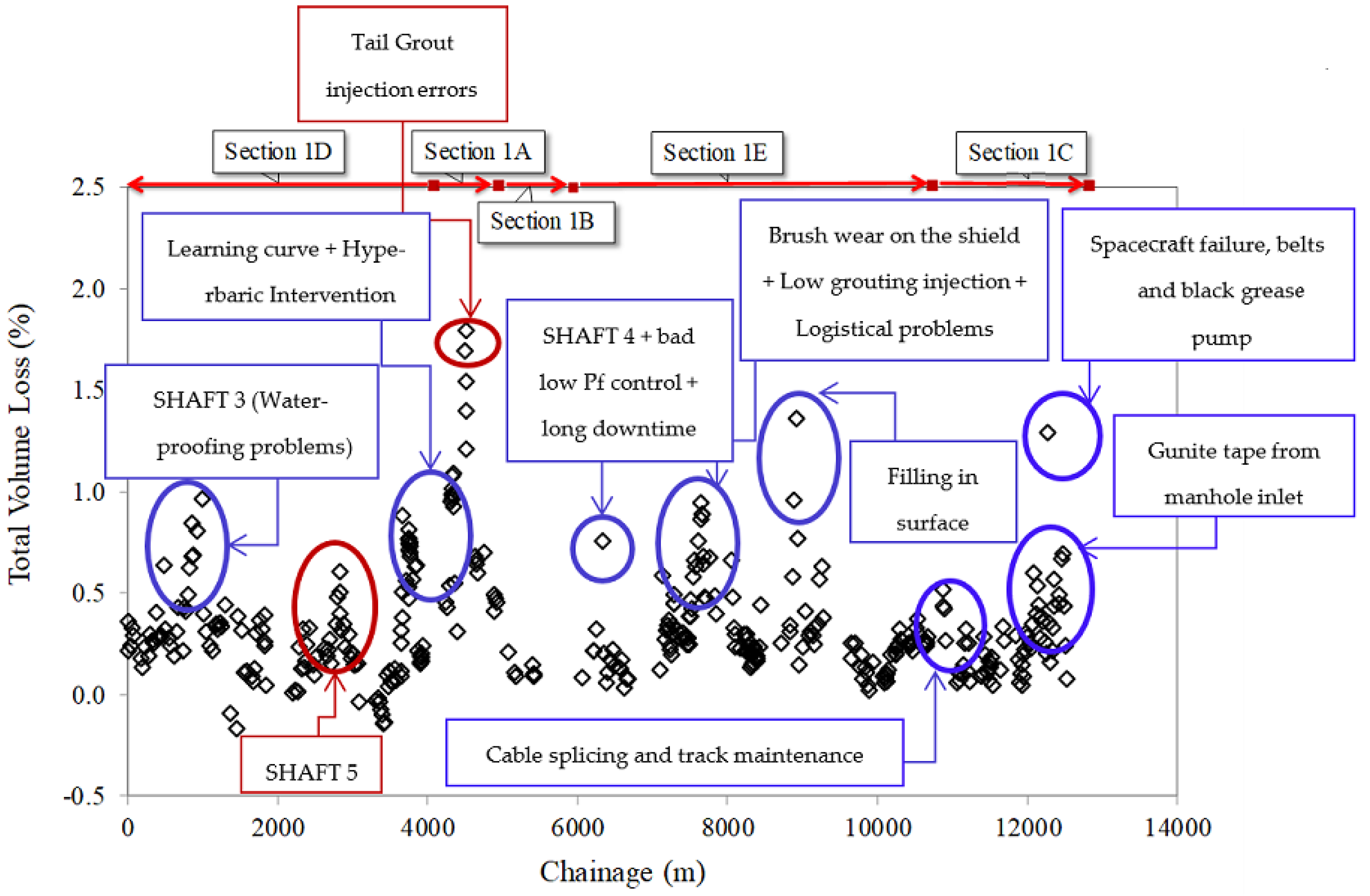
4.2. Ground Movement in Section 1
4.3. Measurement of Volume Loss Above the EPB Crown
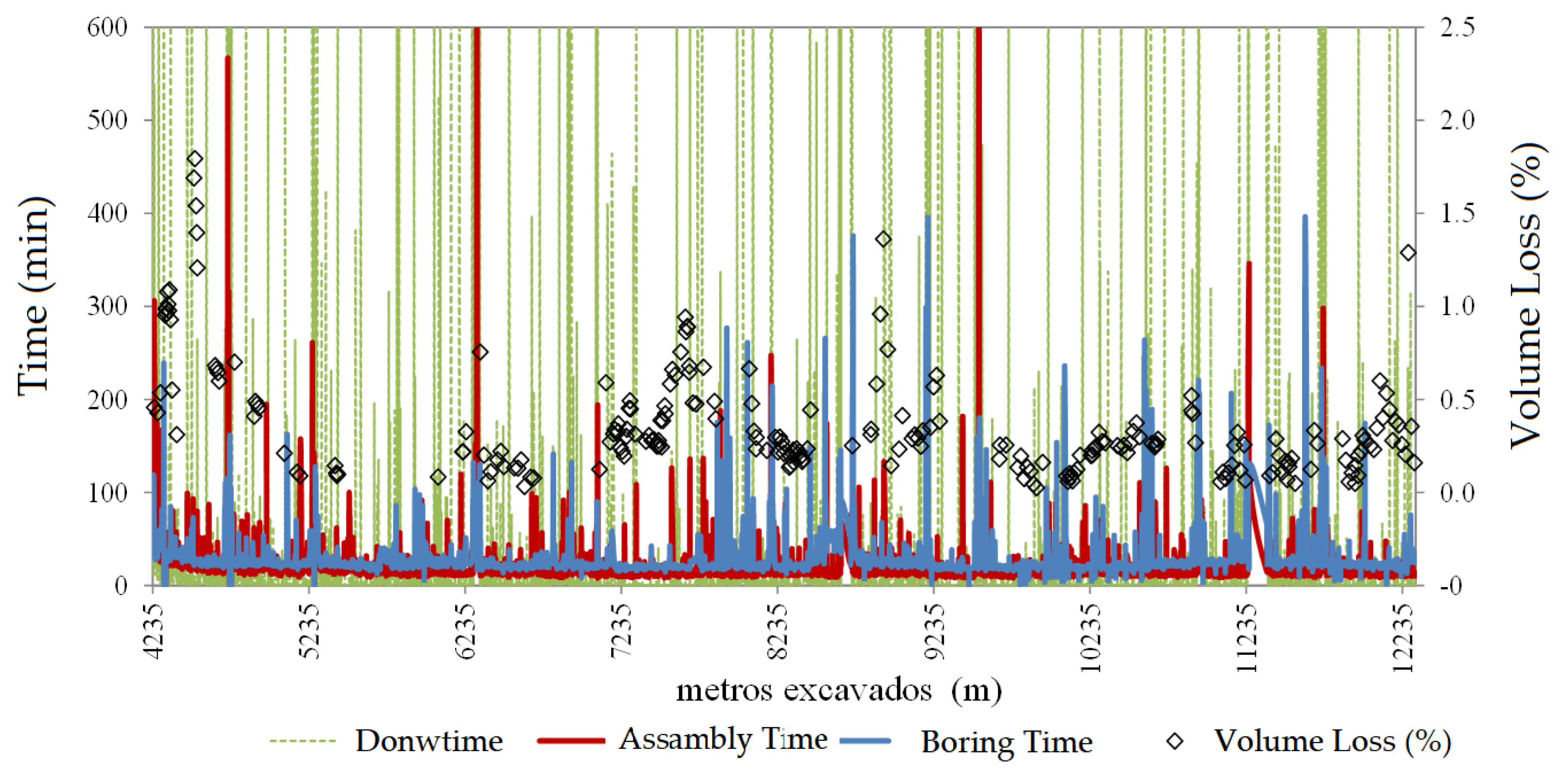
4.4. Correlation Between Ground Volume Loss and EPB Operation Variables
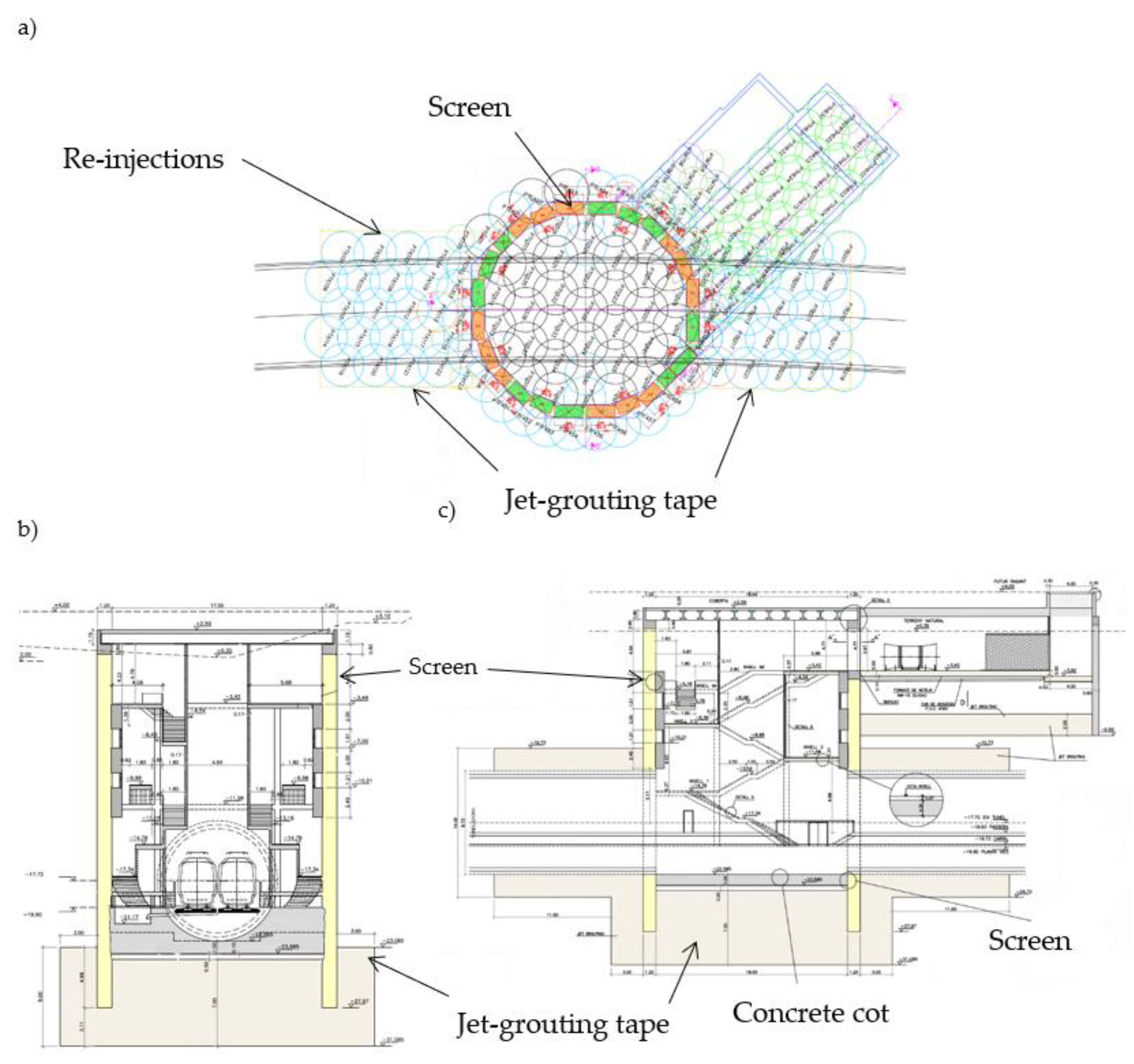
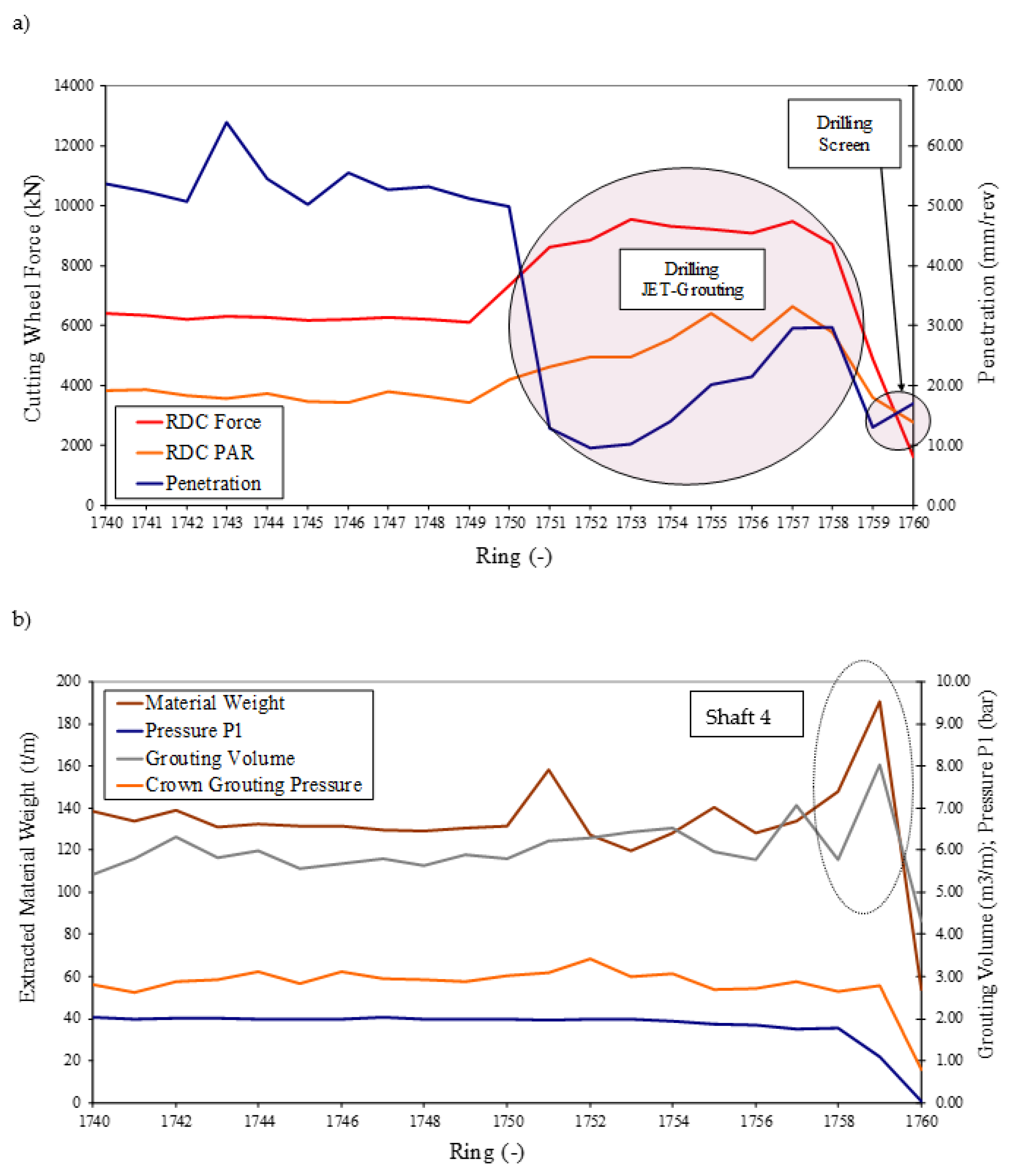
5. Study of the Singulars Points
5. Conclusions
Acknowledgments
References
- Antiga, A.; Chiorboli, M. Tunnel face stability and settlement control using earth pressure balance shield in cohesionless soil. In Geotechnical Aspects Underground Construction Soft Ground, Balkema, Shangai (China); H., Ng, Li, Eds.; Taylor & Francis Group; Shangai (China), 2009; pp. 365–371. [Google Scholar]
- Bel, J.; Branque, D.; Camus, T. Physical modelling of EPB TBM in dry sand and greenfield conditions. European Journal of Environmental and Civil Engineering 2022, 27(10), 3236–3259. [Google Scholar] [CrossRef]
- Berthoz, N.; Branque, D.; Subrin, D.; Wong, H. TBM soft ground interaction: Experimental study on a 1 g reduced-scale EPBS model. Tunnelling and Underground Space Technology 2018, 72, 189–209. [Google Scholar] [CrossRef]
- Bono, R.; et al. Surface settlement minimization in soft soil when excavating with an E.P.B.S. Jornada Técnica Túneles con EPB, UPC, Barcelona, Mayo 2008.
- Broere, W.; Brinkgreve, R. Phased simulation of a tunnel boring process in soft soil. In Numerical methods in geotechnical engineering; 2002; pp. 529–536. [Google Scholar]
- 6, Clough G.W.; Sweene, B.P.; Finno, R.J. Measured soil response to EPB shield tunnelling. ASCE J. Geotech. Eng. 1983, 109(2), 131–149. [Google Scholar]
- Cording, E. J. Control of ground movements around tunnels in soil. 2244. In Proc. 9th Pan-American Conf. Soil Mech. Found. Engng, Valparaiso; 1991; pp. 2195–2244. [Google Scholar]
- Dias, D.; Kastner, R. Movements caused by the excavation of tunnels using face pressurized shields—Analysis of monitoring and numerical modeling results. Engineering Geology 2013, 152(1), 17–25. [Google Scholar] [CrossRef]
- Dimmock, P. S. Tunnelling-Induced Ground and Building Movement on the Jubilee Line Extension; University of Cambridge, 2003. [Google Scholar]
- Do, N.A.; Dias, D.; Oreste, P.; Djeran-Maigre, I. Three-dimensional numerical simulation of a mechanized twin tunnels in soft ground. Tunnelling and Underground Space Technology 2014, 42, 40–51. [Google Scholar] [CrossRef]
- 11. Fargnoli, V.; Boldini, D.; Amorosi, A. TBM tunnelling-induced settlements in coarse-grained soils: The case of the new Milan underground line 5. Tunnelling and Underground Space Technology 2013, 38, 336–347. [Google Scholar] [CrossRef]
- Franza, A.; Marshall, A. M.; Zhou, B. Greenfield tunnelling in sands: The effects of soil density and relative depth. Geotechnique 2019, 69(4), 297–307. [Google Scholar] [CrossRef]
- Gens, A.; Mariano; Di, A.; Yubero, M. T. EPB tunneling in deltaic deposits : observations of ground movements. In book: Geotechnical Aspects of Underground Construction in Soft Ground; Viggiani, Giulia, Ed.; Publisher: Taylor & Francis Group, 2011. [Google Scholar]
- Kasper, T.; Meschke, G. A 3D finite element simulation model for TBM tunnelling in soft ground. International Journal for Numerical and Analytical Methods in Geomechanics 2004, 28(14), 1441–1460. [Google Scholar] [CrossRef]
- Kasper, T.; Meschke, G. On the influence of face pressure, grouting pressure and TBM design in soft ground tunnelling. Tunnelling and Underground Space Technology 2006, 21(2), 160–171. [Google Scholar] [CrossRef]
- Leca, E.; Leblais, Y.; Kuhnhenn, K. Underground works in soils and soft rock tunneling. International Journal on Geotechnical and Geological Engineering 2000, 1, 220–268. [Google Scholar]
- Lee, H.; Choi, H.; Choi, S.-W.; Chang, S.-H.; Kang, T.-H.; Lee, C. "Numerical Simulation of EPB Shield Tunnelling with TBM Operational Condition Control Using Coupled DEM–FDM. Applied Sciences 2021, 11(6), 2551. [Google Scholar]
- Lee, K.M.; Ji, H.W.; Shen, C.K.; Liu, J.H.; Bai, T.H. Ground response to the construction of Shanghai Metro Tunnel-Line 2. Soil and Foundations 1999, 39(3), 113–134. [Google Scholar]
- Lin, C. G.; Zhang, Z. M.; Wu, S. M.; Yu, F. Key techniques and important issues for slurry shield under-passing embankments: A case study of Hangzhou Qiantang River Tunnel. Tunnelling and Underground Space Technology 2013, 38, 306–325. [Google Scholar] [CrossRef]
- Mair, R.J.; Taylor, R. N. “Theme Lecture: Bored tunnelling inthe urban environment” Plenar Session 4. In Proc. 14th Int. Conf. on SMFE; Hamburg, 1997; Vol.4, pp. 2353–2385. [Google Scholar]
- Marshall, A. M.; Farrell, R. P.; Klar, A.; Mair, R. J. Tunnels in sands: The effect of size, depth, and volume loss on greenfield displacements. Geotechnique 2012, 62(5), 385–399. [Google Scholar] [CrossRef]
- Matsushita, Y.; Iwasaki, Y.; ashimoto, T.; Imanishi, H. Behaviour of subway tunnel driven by large slurry shield. In Underground Construction in Soft Ground; 1995; pp. 253–256. [Google Scholar]
- Medina, L. Estudio de los movimientos originados por la excavación de túneles con escudos de presión de tierras en los suelos tosquizos de Madrid. Thesis, University of La Coruña (Spain)., 2000. [Google Scholar]
- Melis, M.; Medina, L. Predicted versus measured soil movements induced by shield tunnelling in the Madrid Metro extension. Canadian Geotechnical Journal 2005, 42, 1160–1172. [Google Scholar]
- Melis, M.; Medina, L.; Rodriguez, J. M. Prediction and analysis of subsidence induced by shield tunnelling in the Madrid Metro extension. Canadian Geotechnical Journal 2002, 39(6), 1273–1287. [Google Scholar] [CrossRef]
- Mendaña, F. La construcción de túneles en terrenos mixtos con tuneladoras de gran diámetro. Experiencias recientes de algunas obras. Revista de Obras Públicas 2009, 65–78. [Google Scholar]
- Mollon, G.; Dias, D.; Soubra, A. H. Probabilistic analysis of tunneling-induced ground movements. Tunnelling and Underground Space Technology 2013, 37, 1–14. [Google Scholar]
- O´Reilly, M. P.; New, B. M. Settlements above tunnels in the U.K--their magnitude and prediction. Tunneling 1992, 82, 173–181. [Google Scholar]
- Pelizza, S.; Peila, D.; Grasso, P. TBM tunneling in difficult ground conditions. Geological Society, London, Engineering Geology Special Publications 2010, 25(1), 213–218. [Google Scholar]
- Phienwej, N.; Sirivachiraporn, A.; Timpong, S.; Tavaranum, S. Characteristics of Ground Movements from Shield. Tunnelling of the First Bangkok Subway Line, (February) 2006, (February), 319–330. [Google Scholar]
- Shirlaw, J. N.; Ong, J. C. W.; Rosser, H. B.; Tan, C. G.; Osborne, N. H.; Heslop, P. E. Local settlements and sinkholes due to EPB tunnelling. In Proceedings of the Institution of Civil Engineers, Geotechnical Engineering; 2003; 156, pp. 193–211. [Google Scholar]
- Sirivachiraporn, A.; Phienwej, N. Ground movements in EPB shield tunneling of Bangkok subway project and impacts on adjacent buildings. Tunnelling and Underground Space Technology 2012, 30, 10–24. [Google Scholar] [CrossRef]
- Suwansawat, S. Earth pressure balance (EPB) shield tunneling in Bangkok: Ground Response and Prediction of Surface Settlements Using Artificial Neural Networks; Massachusetts Institute of Technology: Cambridge, MA, 2002. [Google Scholar]
- Talmon, A.M.; Bezuijen, A. Backfill grouting research at Groene Hart Tunne. In International Symposium on Geotechnical Aspects of Undergroung Construction in Soft Ground; Ng, G. B., Huang, C.C.W., Lui, H.W., Eds.; Shanghai: Taylor & Francis Group; London, 2009; pp. 349–356. [Google Scholar]
- Yubero, M.T. Ejecución de túneles en terreno deltaico mediante tuneladora EPB. El caso de la Línea 9. PhD thesis, Universitat Politècnica de Catalunya, Barcelona, 2021. [Google Scholar]
- Yubero, M. T.; Bonet, E. Ground Surface Effect of Earth Pressure Balance Tunnelling in Deltaic Deposits: A Case Study of Line 9 of the Barcelona Metro. Sustainability 2024, 16(18), 8275. [Google Scholar] [CrossRef]
- Wongsaroj, J. Three-dimensional finite element analysis of short and long-term ground response to open-face tunnelling in stiff clay. PhD thesis, University of Cambridge, 2005. [Google Scholar]
- Wongsaroj, J.; Borghi, F.X.; Soga, K.; Mair, R.J.; Sugiyama, T.; Hagiwara, T.; Bowers, K.H. Effect of TBM driving parameters on ground surface movements. In Proceedings of the International Symposium on Geotechnical Aspects of Underground Construction in Soft Ground; 2005; pp. 5–7. [Google Scholar]
- Wongsaroj, A.; Borghi, F. X.; Soga, K.; Mair, R. J.; Sugiyama, T.; Hagiwara, T.; Bowers, K. H. Effect of TBM driving parameters on ground surface movements: Channel Tunnel Rail Link Contract 220. Geotechnique 2006, 56(9), 641–655. [Google Scholar] [CrossRef]
- Xu, Q.; Zhu, H.; Ding, W.; Ge, X. Laboratory model tests and field investigations of EPB shield machine tunneling in soft ground in Shanghai. Tunnelling and Underground Space Technology 2011, 26(1), 1–14. [Google Scholar] [CrossRef]
- Zhang, D.; Ng, C. W. W. Effects of stress-induced anisotropy and structure on undrained behavior of reconstituted and intact soft clay. Journal of Geotechnical and Geoenvironmental Engineering 2015, 141(5), 04015012. [Google Scholar]

| Excavation parameter | Average value |
|---|---|
| Pressure at the excavation face (bar) | 2.6 |
| Bentonite injection Pressure (bar) | 2.0 |
| Bentonite injection Volume (m3) | 1.0-2.5 |
| Tail Pressure (bar) | 3.1 |
| Grouting injection Volume (m3) | 8.23 |
| Machine Stops/ring (min) | 178 |
| Installation ring Time (min) | 19 |
| Drilling Time /ring (min) | 28 |
| Cycle Time /ring (min) | 225 |
| Wheel thrust Force (kN) | 6217.57 |
| Propulsion Force (kN) | 25600 |
| PAR (kNm) | 4475 |
| Ratio Advance (mm/min) | 63 |
| Penetration (mm/rpm) | 53 |
| Excavation chamber Temperature (ºC) | 29.5 |
Disclaimer/Publisher’s Note: The statements, opinions and data contained in all publications are solely those of the individual author(s) and contributor(s) and not of MDPI and/or the editor(s). MDPI and/or the editor(s) disclaim responsibility for any injury to people or property resulting from any ideas, methods, instructions or products referred to in the content. |
© 2025 by the authors. Licensee MDPI, Basel, Switzerland. This article is an open access article distributed under the terms and conditions of the Creative Commons Attribution (CC BY) license (http://creativecommons.org/licenses/by/4.0/).