

Submitted:
06 February 2025
Posted:
07 February 2025
You are already at the latest version
Abstract
Background. Knowing how Endodontics is currently being taught in undergraduate dentistry studies is of great interest to determine whether new teaching methodologies, new materials and contemporary techniques, as well as new diagnostic and therapeutic criteria, are being incorporated in the teaching of dental students. The aim of this systematic review was to analyze current undergraduate endodontic teaching worldwide. Methods. A literature search was conducted to identify articles about undergraduate endodontic teaching, using the following combinations of keywords: (Endodontics OR endodontology) AND (teaching OR training OR education OR curriculum) AND (undergraduate OR pre-graduate) AND (evaluation OR assessment) AND (dental schools OR dental faculty). Considering that the aim of the review was to analyse the current teaching of Endodontics, the inclusion criteria established were: 1) studies published in the last 10 years, 2) in which those responsible for teaching Endodontics reported some data about the undergraduate training of Endodontics, 3) in dental schools around the world. Results. The search yielded 124 articles related to the teaching of Endodontics. After applying the inclusion criteria, fourteen articles were includes in the systematic review. The data provided were extracted and organized into five sections: 1) General characteristics of teaching Endodontics in the dental curriculum, 2) Teaching methodology in endodontic training, 3) Root canal treatment protocol used in undergraduate endodontic teaching, 4) Use of contemporary materials and technologies in endodontic training, and 5) Assessment methodology in endodontic training. Conclusions. The data found in the published studies show great consistency and, compared with the data found in studies carried out decades ago, allow us to conclude that the quality of current endodontic teaching in dental schools around the world has increased substantially. However, there is stillroom for improvement in some aspects, especially the incorporation of new technologies and materials into the teaching of Endodontics at the undergraduate level. This is the case of magnification, ultrasound and CBCT. The publication by the European Society of Endodontology of the Undergraduate Curriculum Guidelines for Endodontology, with numerous recommendations on the scope of endodontic education, may be the appropriate instrument to continue improving and homogenizing undergraduate teaching of Endodontics throughout the world.
Keywords:
curriculum
; dental schools
; dentistry
; Endodontics
; survey
; teaching
; undergraduate
1. Introduction
Undergraduate university training in Endodontics is essential for students graduating from dental schools to adequately develop their profession as dentists. Dental graduates must acquire the knowledge and skills necessary to perform endodontic procedures with an adequate level of competence (Baaij et al., 2024; De Moor et al., 2013; Segura-Egea et al., 2021).
In recent decades, Endodontics has incorporated new materials and equipment, as well as technical innovations, which increasingly facilitate endodontic treatment, and contribute to better care for patients with pulpal-periapical pathology (Jiménez-Sánchez et al., 2021). In addition, in the last years there have been important changes in the diagnostic and therapeutic criteria for pulpal and periapical pathology (Duncan et al., 2019; Duncan et al., 2023; Galler et al., 2016; Jiménez-Martín et al., 2024; Segura-Egea et al., 2018). For this reason, universities have had to make a significant effort to incorporate all these changes and innovations into both theoretical and practical teaching programs (Al Raisi et al., 2019; Segura-Egea et al., 2021). However, as ESE points out in Undergraduate Curriculum Guidelines for Endodontology, it is still the 'craftsmanship' that gets the job done, highlighting the need for both knowledge and skills training in undergraduate education (Baaij et al., 2024).
Since 1992, the ESE has published curricular guidelines for the undergraduate teaching of endodontics that have served as a reference and guide for dental schools. The latest update of the ESE Undergraduate Curriculum Guidelines for Endodontology has just been published this year (Baaij et al., 2024). However, resources for delivering the endodontic curriculum vary from country to country, and even from school to school within a country (Al Raisi et al., 2019; Segura-Egea et al., 2021), so students may graduate with different levels of knowledge and experience (European Society of Endodontology, 2018).
Knowing how Endodontics is currently being taught in undergraduate dentistry studies is of great interest to determine whether new teaching methodologies, new materials and contemporary techniques, as well as new diagnostic and therapeutic criteria are being incorporated in the teaching of dental students. Therefore, the aim of this study was to analyze current undergraduate endodontic teaching worldwide.
2. Materials and Methods
This systematic review complies with the guidelines outlined by the Preferred Re-porting Items for Systematic Reviews and Meta-Analyses (PRISMA) (Page et al., 2021).
2.1. Review Question
The primary research question was as follows: What are the key components of undergraduate endodontic curricula across different dental schools worldwide? This general question was subdivided into five sub-questions: 1) What are the key characteristics of endodontic education in dental curricula worldwide?; 2) What teaching methodologies are most commonly used to instruct undergraduate dental students in endodontics?; 3) What root canal treatment protocols are taught to undergraduate dental students worldwide?; 4) How are contemporary materials and technologies incorporated into undergraduate endodontic training?; and 5) What assessment methods are commonly used to evaluate undergraduate students' competency in endodontics?.
2.2. Eligibility Criteria
Considering that the aim of the review was to analyse the current teaching of Endodontics, the inclusion criteria established were: 1) studies published in the last 10 years, 2) studies in which those responsible for teaching Endodontics reported some data about the undergraduate training of Endodontics, 3) studies in dental schools around the world. The period of ten years was decided considering that, in the last decade, there have been very important changes in the teaching of dentistry, as well as the incorporation of numerous new technologies into the practice of Endodontics (Al Raisi et al., 2019; Segura-Egea et al., 2021; Baaij et al., 2024). Additionally, the main objective of this systematic review was to analyze the current undergraduate endodontic teaching.
The exclusion criteria were as follows: 1) studies published more than 10 years ago; 2) studies in which the information is not provided by those responsible for undergraduate endodontic teaching, and 3) studies in which the data comes from student surveys.
Reviews, conference articles, letters to the editor and studies based on surveys to students or expert opinions were excluded. No language restriction was applied. Three reviewers analyzed all titles and abstracts, and in some cases the full text, of the articles found, independently and in duplicate. Articles that did not meet the inclusion criteria were excluded. In case of disagreement between reviewers, it was resolved through debate.
2.3. Search Strategy and Information Sources
A literature survey was conducted to identify articles about undergraduate endodontic teaching. The search was carried out in PubMed, SCOPUS and EMBASE, using the following combinations of keywords: (endodontic OR Endodontics OR endodontology) AND (teaching OR training OR education OR curriculum) AND (undergraduate OR pre-graduate) AND (evaluation OR assessment) AND (dental schools OR dental faculty).
Two independent reviewers (J.J.S.-E. and O.A.-E.) conducted the literature search and screened articles for eligibility. Initially, the titles and abstracts were reviewed to assess their relevance to the review. Subsequently, a thorough analysis of the full texts was carried out, evaluating them based on the pre-established inclusion and exclusion criteria. In the event of any discrepancies between the reviewers, these were resolved through direct discussion or, when necessary, by consulting a third reviewer (J.M.-G.), in order to ensure consistency and accuracy in the article selection process.
2.4. Data Extraction
One of the authors (J.J.S-E.) was responsible for data extraction, while four other reviewers (J.M-G.; D.C-B, M.L-L. and O.A-E.) checked the tabulated data to ensure the absence of errors; articles in disagreement were discussed. For each study the following data were extracted: authors and year of publication, country, number of dental schools that responded to the survey, and percentage of dental schools that responded to the survey. In addition, all possible data were collected regarding 1) General characteristics of teaching Endodontics in the dental curriculum, 2) Teach-ing methodology in endodontic training, 3) Root canal treatment protocol used in un-dergraduate endodontic teaching, 4) Use of contemporary materials and technologies in endodontic training, and 5) Assessment methodology in endodontic training.
3. Results and Discussion
A total of 176 records were initially identified, but 14 were duplicates (Fig. 1). One hundred and sixty-two studies were screened for abstract evaluation, and 135 were excluded for not meeting the inclusion criteria. In the remaining 27 articles, the full text was analyzed, discarding 9 articles published more than 10 years ago (Arbab-Chirani & Vulcain, 2004; Cruz et al., 2000; Gatley & Davies, 2009; Murray & Chandler, 2014; Petersson et al., 2002; Qualtrough & Dummer, 1997; Qualtrough et al., 1999; Sonntag et al., 2008; Tanalp et al., 2012). Three other studies were excluded because they were surveys of undergraduate students (Alim-Uysal et al., 2021; Barakat et al., 2021; Braga et al., 2021). One study was excluded because the survey had been conducted among directors of postgraduate programs in Endodontics (Rabiee et al., 2018).
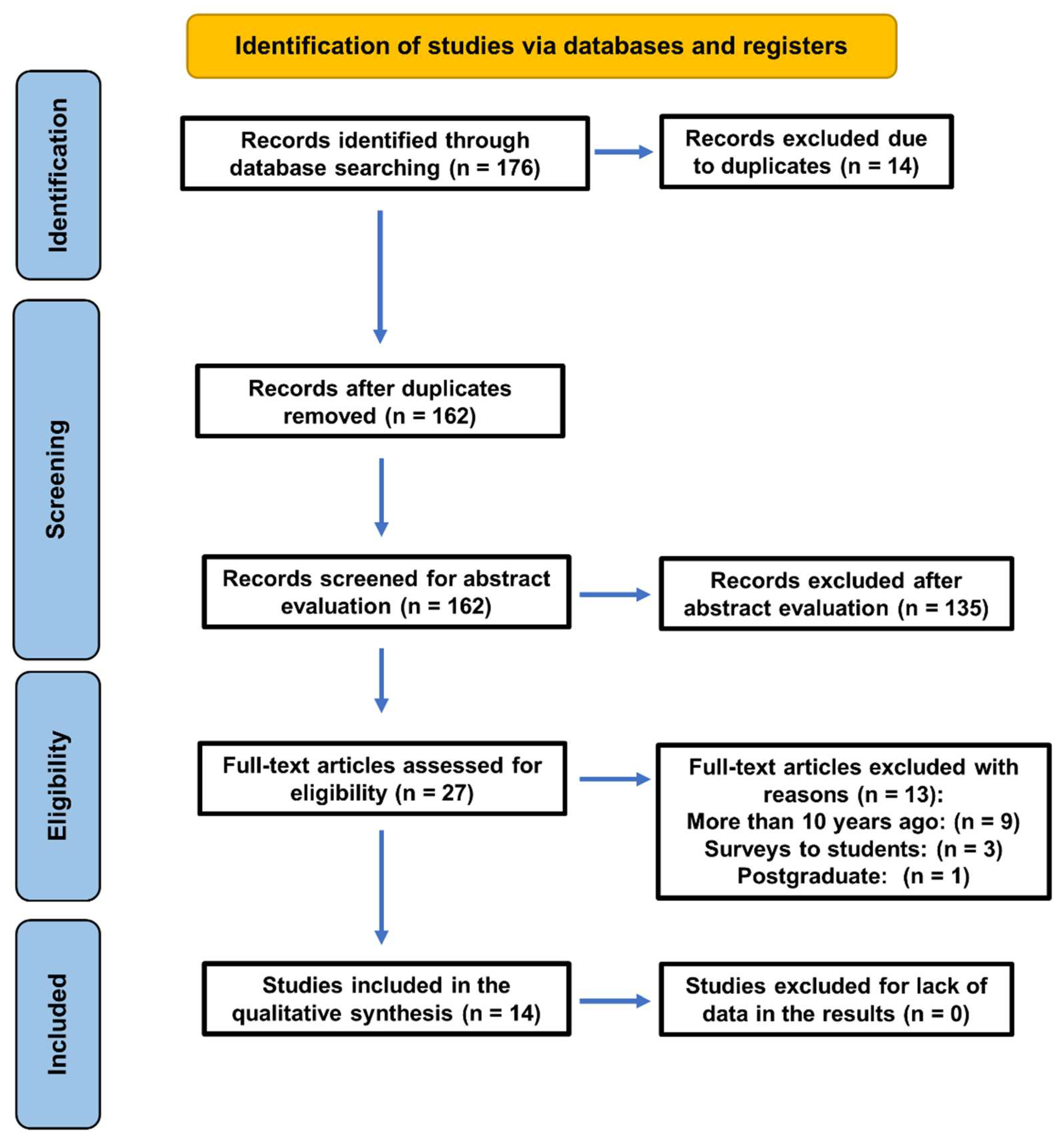
Figure 1.
Flowchart of the search strategy following the PRISMA 2020 guidelines for systematic reviews.
Figure 1.
Flowchart of the search strategy following the PRISMA 2020 guidelines for systematic reviews.
Finally, 14 articles (Table 1) in which the responsible for teaching Endodontics in dental schools responded to surveys, reporting data on undergraduate training of Endodontics, were selected and included in the review: five studies evaluated undergraduate endodontic teaching in Asian countries (Algahtani et al., 2022, 2023; Alobaid et al., 2022; Baharin & Omar, 2021; Narayanaraopeta & Al Shwaimi, 2015), five other studies analyzed the teaching of Endodontics in European countries (Al Raisi et al., 2019; Brown et al., 2020; Mergoni et., 2022; Sacha et al., 2021; Segura-Egea et al., 2021), three studies investigated different aspects of undergraduate endodontic training in Brazil (Coelho & Rios, 2023; da Costa Ferreira et al., 2021; Rech et al., 2022), and one study analyzed endodontic teaching in Canada (Goyal et al., 2024).
The number of dental schools included in each study varied between six (Narayanaraopeta & Al Shwaimi, 2015) and 41 (Rech et al., 2022). The percentage of respondents also varied greatly, from 20% (Rech et al., 2022) to 100% (Narayanaraopeta & Al Shwaimi, 2015). Taking into account that the response rate was higher than 69% in 11 studies (79%), it can be considered that the data provided are representative of the state of endodontic teaching in their respective countries.
Since the aspects of endodontic teaching assessed in the different studies were different and varied, the data provided by the included studies were extracted and organized into five sections: 1) General characteristics of teaching Endodontics in the dental curriculum, 2) Teaching methodology in endodontic training, 3) Root canal treatment protocol used in undergraduate endodontic teaching, 4) Use of contemporary materials and technologies in endodontic training, and 5) Assessment methodology in endodontic training.
3.1. General Characteristics of Teaching Endodontics in the Dental Curriculum
Ten studies (Table 2) provided data on the year in which endodontics was taught, the status of the supervising endodontic staff, and the staff: student ratio (Al Raisi et al., 2019; Algahtani et al., 2023; Alobaid et al., 2022; Baharin & Omar, 2021; Brown et al., 2020; Goyal et al., 2024; Mergoni et al., 2022; Narayanaraopeta & Al Shwaimi, 2015; Sacha et al., 2021; Segura-Egea et al., 2021). In most dental schools, Endodontics is taught in the third, fourth and fifth years of the curriculum. Theoretical teaching and preclinical practices are taught in the third and fourth years, while endodontic clinical practice is taught in the fourth, fifth and sixth years. The fourth year of the degree in dentistry is the one in which endodontic contents are most frequently taught.
In all dental schools, at least 50% of endodontics teachers are specialists. A major factor in the quality of teaching a subject lies in the level of training of the teachers and their motivation and interest (Ahlberg, 1991). Therefore, training in endodontics must be supervised by teachers with specific preparation and clinical practice in endodontics (De Moor et al., 2013). The situation shown by the surveys included in this review appears to have improved substantially since the study published in 1997 in UK (Qualtrough & Dummer, 1997) when none of the schools had supervising staff with advanced training in endodontics.
The staff: student ratio varies greatly depending on whether it is preclinical or clinical practice, being around 1:5 to 1:15 in preclinical practice (Goyal et al., 2024; Sacha et al., 2021) and 1:3 to 1:8 in clinical practice (Baharin & Omar, 2021; Goyal et al., 2024). These staff: student ratio are similar to those in prosthetics laboratory practices in Malaysian dental schools (1:12) (Daood et al., 2022) and in clinical practice of oral surgery (1:4) in British universities (Dargue et al., 2021). The great variability of the staff: student ratio corresponds to the variable number of students in the different dental schools. Dental schools with large student number tend to have a lower staff: student ratio.
3.2. Teaching Methodology in Endodontic Training
Nine studies provided data on teaching methodology (Al Raisi et al., 2019; Algahtani et al., 2022; Alobaid et al., 2022; Baharin & Omar, 2021; Goyal et al., 2024; Mergoni et al., 2022; Narayanaraopeta & Al Shwaimi, 2015; Sacha et al., 2021; Segura-Egea et al., 2021). Lectures, pre-clinical practices and clinical practices were used by almost 100% of dental schools (Table 3). Problem-based learning and seminars were used in more than 50% of schools. Seminars, video and E-learning are also widely used in teaching endodontics. These results differ substantially from those shown by the study carried out almost 30 years ago in the United Kingdom (Qualtrough & Dummer, 1997), who only identified lectures and seminars as methods of teaching theoretical content on endodontics at undergraduate level. Undoubtedly, new teaching methodologies have been incorporated into undergraduate training of endodontics.
The theoretical contents taught in the subject of endodontics are only mentioned in five of the studies, four carried out in Europe (Al Raisi et al., 2019; Mergoni et al., 2022; Sacha et al., 2021; Segura-Egea et al., 2021), and other in Canada (Goyal et al., 2024), showing that almost all dental schools included the contents indicated in the ESE Undergraduate Curriculum Guidelines for Endodontology (Baaij et al., 2024). This is a very important point, taking into account that in endodontics, students' practical skills and theoretical knowledge are significantly correlated (Haupt & Kanzow, 2023). Non-vital bleaching, that was not included in the curriculum of some schools in the UK twenty-seven years ago (Qualtrough & Dummer, 1997), now it is included in almost 100% of dental schools (Al Raisi et al., 2019; Mergoni et al., 2022; Sacha et al., 2021; Segura-Egea et al., 2021).
Preclinical endodontic practices are taught in all dental schools. This result contrasts sharply with that of a previous survey conducted in German universities (Sonntag et al., 2008), in which was found that PC endodontic training varied considerably because of differences in program design, staff and course content. Regarding the type of root canals used in pre-clinical practice, natural teeth were used in all dental schools in Spain (Segura-Egea et al., 2021), and Saudi Arabia (Narayanaraopeta & Al Shwaimi, 2015), in most dental schools in Austria, Germany, Switzerland, Italy and Malaysia (Baharin & Omar, 2021; Mergoni et al., 2022; Sacha et al., 2021), and in at least 70% of schools in the United Kingdom (Al Raisi et al., 2019) and Canada (Goyal et al., 2024). Artificial teeth, plastic teeth and canals in acrylic blocks were used in less than 50% of schools.
Few studies indicate the type of endodontic treatments that students perform in pre-clinical practices. Root canal treatment (RCT) in one-rooted and multi-rooted teeth are performed in all dental schools in Spain (Segura-Egea et al., 2021), Italy (Mergoni et al., 2022), United Kingdom (Al Raisi et al., 2019), Austria, Germany and Switzerland (Sacha et al., 2021) and Canada (Goyal et al., 2024).
Re-treatments were carried out in almost 50% of Italian dental schools (Mergoni et al., 2022), in one third of the schools in Spain (Segura-Egea et al., 2021) and Saudi Arabia (Alobaid et al., 2022), and only in 10% of Canadian dental schools (Goyal et al., 2024).
Concerning the types of endodontic treatments in clinical training, RCT in single-rooted teeth was the endodontic treatment done in more than 90% of all dental schools (Al Raisi et al., 2019; Algahtani et al., 2022; Alobaid et al., 2022; Segura-Egea et al., 2021). Vital pulp therapy was carried out by endodontic students in more than 90% of schools in Spain (Segura-Egea et al., 2021) and Saudi Arabia (Algahtani et al., 2022; Alobaid et al., 2022), and by almost 50% in Italian universities (Mergoni et al., 2022). In view of these results, the objectives set by the ESE in the Undergraduate Curriculum Guidelines for Endodontology, i.e. Students should be competent in performing good-quality root canal treatment and at preserving vital pulp functions by the implementation of vital pulp therapies, including indirect pulp capping, direct pulp capping, partial pulpotomy and full pulpotomy (Baaij et al., 2024), seems that they are being fulfilled.
Non-vital bleaching was carried out in a third of dental schools in Italy and Spain (Mergoni et al., 2022; Segura-Egea et al., 2021). Most studies show that endodontic surgery is outside of clinical endodontic practices in most countries. Endodontic surgery is probably covered in most dental schools in postgraduate endodontic teaching.
3.3. Root Canal Treatment Protocol Used in Undergraduate Endodontic Teaching
Data on RCT protocol used in undergraduate teaching were found in ten studies (Al Raisi et al., 2019; Algahtani et al., 2023; Baharin & Omar, 2021; da Costa Ferreira et al., 2021; Goyal et al., 2024; Mergoni et al., 2022; Narayanaraopeta & Al Shwaimi, 2015; Rech et al., 2022; Sacha et al., 2021; Segura-Egea et al., 2021) (Table 4), but two of them provided very few data (da Costa Ferreira et al., 2021; Rech et al., 2022), and another study only provided data about pre-clinical practices (Sacha et al., 2021).
A study carried out in Malaysia (Baharin & Omar, 2021) was the only one who provided data on the use of the rubber dam, specifying that its use was compulsory in all Malaysian dental schools. The fact that only one of the studies investigated the use of rubber dam in endodontics, probably indicates that its use is considered so routine that the possibility of teaching RCT without their use is ruled out.
For determining working length in clinical practice, electronic apex locators together with periapical radiograph are used in most of the dental schools (Al Raisi et al., 2019; Baharin & Omar, 2021; Mergoni et al., 2022; Narayanaraopeta & Al Shwaimi, 2015; Rech et al., 2022; Segura-Egea et al., 2021).
Instrumentation is taught using NiTi rotary files in almost all dental schools in Europe (Sacha et al., 2021) and Canada (Goyal et al., 2024), being Protaper Gold the system used in two thirds of dental schools (Al Raisi et al., 2019; Goyal et al., 2024; Segura-Egea et al., 2021). An earlier study carried out twenty years ago, including 16 French undergraduate dental schools (Arbab-Chirani & Vulcain, 2004), showed that rotary NiTi files were already used on endodontic teaching in 81% of French schools. However, in other countries NiTi rotary files were used only in about half of dental schools (Algahtani et al., 2023; da Costa Ferreira et al., 2021).
Sodium hypochlorite, at different concentrations, was the irrigating solution used by most schools in endodontic clinical practice. EDTA was also used in a large percentage of schools as a second irrigating solution (Al Raisi et al., 2019; Baharin & Omar, 2021; Mergoni et al., 2022; Segura-Egea et al., 2021). In PC practices some dental schools use chlorhexidine as an irrigating solution (Sacha et al., 2021).
Calcium hydroxide was the most used intracanal medicament around the world, being used as intracanal medicament in all dental schools in United Kingdom (Al Raisi et al., 2019), Spain (Segura-Egea et al., 2021), Italy (Mergoni et al., 2022) and Malaysia (Baharin & Omar, 2021), in more than 80% in Austria, Germany and Switzerland (Sacha et al., 2021) and in 60% of schools in Saudi Arabia (Algahtani et al., 2023) and Canada (Goyal et al., 2024).
Regarding the obturation technique taught, cold lateral compaction was the root-filling technique trained in most dental schools (Algahtani et al., 2023; Baharin & Omar, 2021; Narayanaraopeta & Al Shwaimi, 2015; Sacha et al., 2021; Segura-Egea et al., 2021). Warm vertical compaction was the second technique taught, being the most widely taught technique in Canadian dental schools (Goyal et al., 2024). The single cone technique is rarely taught, being used by less than 30% of schools (Al Raisi et al., 2019; Algahtani et al., 2023; Baharin & Omar, 2021; Mergoni et al., 2022; Segura-Egea et al., 2021). The data show that cold lateral compaction technique remains the standard root filling technique in most dental schools. Despite widespread commercial support for gutta-percha support systems, these are rarely used in endodontic teaching.
Taking together the results of these studies, it can be concluded that the clinical protocol followed for RCT worldwide is quite homogeneous, differing especially in the type of technique used for obturation of the root canal system. As regards European dental schools in particular, the clinical protocols for RCT followed in the countries from which data have been found, show greater convergence than that found in a previous study conducted fifteen years ago (Gatley et al., 2009).
The definitive restoration of the treated tooth was carried out interchangeably by the student himself or by another in most dental schools (Al Raisi et al., 2019; Sacha et al., 2021; Segura-Egea et al., 2021).
3.4. Use of Contemporary Materials and Technologies in Endodontic Training
The use of modern technologies and materials in endodontics teaching was addressed by ten studies (Al Raisi et al., 2019; Algahtani et al., 2023; Baharin & Omar, 2021; Brown et al., 2020; Coelho & Rios, 2023; da Costa Ferreira et al., 2021; Goyal et al., 2024; Mergoni et al., 2022; Sacha et al., 2021; Segura-Egea et al., 2021) (Table 5).
Five studies reported data on the use of calcium silicate-based cements (CSBC) (Al Raisi et al., 2019; Algahtani et al., 2023; Goyal et al., 2024; Sacha et al., 2021; Segura-Egea et al., 2021). Although the use of CSBC in preclinical practices was uncommon (Al Raisi et al., 2019; Sacha et al., 2021), probably because of its high price, in clinical practices CSBC were used in most dental schools (Al Raisi et al., 2019; Algahtani et al., 2023; Segura-Egea et al., 2021). The use of bioceramic sealers in undergraduate endodontic teaching only is reported in the study carried out in Canada (Goyal et al., 2024), being used in 20% of Canadian dental schools.
Regarding the use of cone beam computed tomography (CBCT), based on the data provided by the studies that have investigated its use in teaching endodontics (Al Raisi et al., 2019; Algahtani et al., 2023; Baharin & Omar, 2021; Coelho & Rios, 2023; Goyal et al., 2024), it can be concluded that CBCT is used in less than 50% of dental schools. This result indicates that CBCT has not yet been incorporated into the undergraduate teaching of endodontics. So, strategies must be considered to allow the integration of CBCT in clinical training use.
A study carried out in Brazil show that the minority of the dental schools (34%) owned a CBCT machine (Coelho & Rios, 2023). This result contrasts with those of dental schools in the U.S.A. and the U.K., which in 2012 already had CBCT in 89% and 63% of cases, respectively (Parashar et al., 2012). However, the same study showed that none of the dental schools surveyed in the U.K. provide training to dental students during the BDS curriculum (Parashar et al., 2012).
Magnification, and especially the use of the operating microscope, represents another addition to the practice of endodontics that has substantially improved its quality and results. However, the results of the review show that, in most countries, it has not yet been incorporated into undergraduate teaching of endodontics. Less than more than 50% of dental schools use magnification (Al Raisi et al., 2019; Algahtani et al., 2023; da Costa Ferreira et al., 2021; Goyal et al., 2024; Mergoni et al., 2022; Sacha et al., 2021; Segura-Egea et al., 2021). On the contrary, in United Kingdom and Ireland operating microscope is used in undergraduate endodontic clinical training in all dental schools (Brown et al., 2020). The high cost and lack of staff training could explain, at least in part, these results (Brown et al., 2020).
Finally, seven studies reported data about the use of ultrasonic devices in undergraduate endodontic teaching (Al Raisi et al., 2019; Algahtani et al., 2023; da Costa Ferreira et al., 2021; Goyal et al., 2024; Mergoni et al., 2022; Sacha et al., 2021; Segura-Egea et al., 2021). The results of these studies show that ultrasound is rarely used in teaching endodontics in Spain (Segura-Egea et al., 2021), Austria, Germany, and Switzerland (Sacha et al., 2021), Canada (Goyal et al., 2024) and Saudi Arabia (Algahtani et al., 2023). On the contrary, the studies carried out in the United Kingdom (Al Raisi et al., 2019) and Italy (Mergoni et al., 2022) found a high percentage of ultrasound use, around 80%, in undergraduate endodontic clinical practices. Again, these results indicate the need to review programs and increase budgets of dental schools to be able to incorporate ultrasonic devices into the undergraduate endodontics program.
3.5. Assessment Methodology in Endodontic Training
As a final point, seven studies (Al Raisi et al., 2019; Algahtani et al., 2022; Goyal et al., 2024; Mergoni et al., 2022; Narayanaraopeta & Al Shwaimi, 2015; Sacha et al., 2021; Segura-Egea et al., 2021) reported data on the methods used to evaluate the learning of undergraduate students in endodontics (Table 6). As indicated in the undergraduate curriculum guidelines for Endodontology, recently published by the ESE (Baaij et al., 2024), the competence of students to reach the correct diagnosis and perform vital pulp therapies and root canal treatment on uncomplicated anterior and posterior teeth should be formally assessed before allowing them to graduate. The assessment of theoretical content was carried out by means of short questions in half of the dental schools in Saudi Arabia and Canada (Goyal et al., 2024; Narayanaraopeta & Al Shwaimi, 2015). In contrast, in Austria, Germany and Switzerland, oral examinations are used by one third of the schools (Sacha et al., 2021).
For the evaluation of pre-clinical practices, the practical competency exam was used in Saudi Arabia (Algahtani et al., 2022) and Canada (Goyal et al., 2024). Most dental schools required a minimum number of RCT in preclinical practices (Al Raisi et al., 2019; Algahtani et al., 2022; Sacha et al., 2021; Segura-Egea et al., 2021).
Clinical training were evaluated by clinical competency exams (Algahtani et al., 2022; Goyal et al., 2024), and more than 50% of dental schools also required a minimum number of treatments (Al Raisi et al., 2019; Mergoni et al., 2022; Segura-Egea et al., 2021). However, for students to achieve the appropriate level of competence in endodontics, the evaluation of the quality and consistency of student performance is more important than the number of treatments performed.
4. Conclusions
This systematic review aimed to show the current situation of undergraduate endodontic teaching worldwide. The data found in the published studies show great consistency and, compared with the data found in studies carried out decades ago, allow us to conclude that the quality of endodontic teaching in dental schools around the world has increased substantially. However, there is still room for improvement in some aspects, especially the incorporation of new technologies and materials into the teaching of Endodontics at the undergraduate level. This is the case of magnification, ultrasound and CBCT. The publication by the European Society of Endodontology of the Undergraduate Curriculum Guidelines for Endodontology (Baaij et al., 2024), with numerous recommendations on the scope of endodontic education, may be the appropriate instrument to continue improving and homogenizing undergraduate teaching of Endodontics throughout the world.
Author Contributions
All authors have reviewed and approved the submitted version. The au-thors declare: "Conceptualization, J.M.-G, D.C.-B & J.J.S.-E; Methodology and Software, D.C.-B; P.M.-M, & J.J.S.-E; Validation, J.J.S.-E, J.M.-G, D.C.-B, & M.L.-L.; Formal Analysis, M.L.-L., I.C.-G., & D.C.-B; Investigation, M.L-L,O.A.-E., J.J.S.-M, P.M.-M, & J.J.S.-E; Data Curation, JJ.S.-E, M.L-L., J.M.-G, O.A.-E. & D.C.-B; Writing - Original Draft Preparation, J.J.S.-S, M.L.-L. & D.C.-B; Writing - Review & Editing, D.C.-B, J.M.-G, M.L.-L. & J.J.S.-E; Visualization, J.J.S.-M., I.C.-G., P.M.-M. & J.J.S.-E.; Supervision, J.J.S.E., O.A.-E. & J.M.G.
Funding
This research received no external funding.
Institutional Review Board Statement
Not applicable.
Informed Consent Statement
Not applicable.
Data Availability Statement
The data are public.
Conflicts of Interest
The authors declare no conflicts of interest.
References
- Ahlberg, K.F. Undergraduate endodontic teaching at the London Hospital Dental Institute. International Endodontic Journal 1991, 24, 155–160. [Google Scholar] [CrossRef] [PubMed]
- Al Raisi, H.; Dummer, P.M.H.; Vianna, M.E. How is Endodontics taught? A survey to evaluate undergraduate endodontic teaching in dental schools within the United Kingdom. International Endodontic Journal 2019, 52, 1077–1085. [Google Scholar] [CrossRef] [PubMed]
- Algahtani, F.N.; Barakat, R.M.; Almohareb, R.A.; Alqarni, L.; Alqabbani, A.; Almadi, E. The objectives and instructional design of undergraduate endodontic program: multicenter cross-sectional study in Saudi Arabia. BMC Medical Education 2022, 22. [Google Scholar] [CrossRef] [PubMed]
- Algahtani, F.N.; Barakat, R.M.; Alqarni, L.M.; Alqabbani, A.F.; Alkadi, M.F.; Almohareb, R.A. Undergraduate Endodontic Training and Its Relation to Contemporary Practice: Multicenter Cross-Sectional Study in Saudi Arabia. International Journal of Clinical Practice 2023, 2023. [Google Scholar] [CrossRef]
- Alim-Uysal, B.A.; Dincer, A.N.; Yurtgezen, B.; Guneser, M.B. Does the Endodontic Education Level Affect Decision-Making for Endodontically Treated Teeth With Apical Periodontitis? A Web-Based Survey. International Dental Journal 2021, 71, 477–483. [Google Scholar] [CrossRef]
- Alobaid, M.A.; Bin Hassan, S.A.; Alfarhan, A.H.; Ali, S.; Hameed, M.S.; Syed, S. A Critical Evaluation of the Undergraduate Endodontic Teaching in Dental Colleges of Saudi Arabia. International Journal of Environmental Research and Public Health 2022, 19. [Google Scholar] [CrossRef]
- Arbab-Chirani, R.; Vulcain, J.M. Undergraduate teaching and clinical use of rotary nickel-titanium endodontic instruments: A survey of French dental schools. International Endodontic Journal. Int Endod J. 2004. [Google Scholar] [CrossRef]
- Baaij, A.; Kruse, C.; Whitworth, J.; Jarad, F. EUROPEAN SOCIETY OF ENDODONTOLOGY Undergraduate Curriculum Guidelines for Endodontology. International Endodontic Journal 2024, 57, 982–995. [Google Scholar] [CrossRef]
- Baharin, S.A.; Omar, S.H. Undergraduate endodontic clinical training in Malaysia: A National survey. European Journal of Dental Education 2021, 25, 168–174. [Google Scholar] [CrossRef] [PubMed]
- Barakat, R.M.; Matoug-Elwerfelli, M.; Almohareb, R.A.; Balto, H.A. Influence of Preclinical Training on Root Canal Treatment Technical Quality and Confidence Level of Undergraduate Dental Students. International Journal of Dentistry 2021, 2021. [Google Scholar] [CrossRef] [PubMed]
- Braga, T.; Robb, N.; Love, R.M.; Amaral, R.R.; Rodrigues, V.P.; de Camargo, J.M.P.; Duarte, M.A.H. The impact of the use of magnifying dental loupes on the performance of undergraduate dental students undertaking simulated dental procedures. Journal of Dental Education 2021, 85, 418–426. [Google Scholar] [CrossRef]
- Brown, M.G.; Qualtrough, A.J.E.; McLean, W. Magnification in undergraduate endodontic teaching in the UK and Ireland: a survey of teaching leads in Endodontology. International Endodontic Journal 2020, 53, 553–561. [Google Scholar] [CrossRef] [PubMed]
- Coelho, M.S.; Rios, M.d.A. Current status of cone-beam computed tomography teaching in Brazilian undergraduate endodontic programs – A web-based survey. Journal of Dental Education 2023, 87, 358–363. [Google Scholar] [CrossRef]
- Cruz, E.V.; Jimena, M.E.M.; Puzon, E.G.; Iwaku, M. Endodontic teaching in Philippine dental schools. International Endodontic Journal 2000, 33, 427–434. [Google Scholar] [CrossRef] [PubMed]
- da Costa Ferreira, I.; da Costa Ferreira, G.; Tavares, W.L.F.; de Souza Côrtes, M.I.; Braga, T.; Amaral, R.R. Use of technology in endodontics by undergraduate dental students in a south-eastern state of Brazil. European Journal of Dental Education 2021, 25, 225–231. [Google Scholar] [CrossRef]
- Daood, U.; Sidhu, P.; Jamayet, N. Bin, Kohli, S.; Malik, N.A.; Lin, S.L.; … Wilson, N.H.F. Current and future trends in the teaching of removable partial dentures in dental schools in Malaysia: A cross sectional study. Journal of Dentistry 2022, 124. [Google Scholar] [CrossRef]
- Dargue, A.; Fyfe, E.; French, K.; Ali, K.; Bailey, E.; Bell, A.; … Varma Datla, K. The impact of wrong-site surgery on dental undergraduate teaching: a survey of UK dental schools. European Journal of Dental Education : Official Journal of the Association for Dental Education in Europe 2021, 25, 670–678. [Google Scholar] [CrossRef]
- De Moor, R.; Hülsmann, M.; Kirkevang, L.L.; Tanalp, J.; Whitworth, J. Undergraduate curriculum guidelines for endodontology. International Endodontic Journal 2013, 46, 1105–1114. [Google Scholar] [CrossRef] [PubMed]
- Duncan, H.F.; Galler, K.M.; Tomson, P.L.; Simon, S.; El-Karim, I.; Kundzina, R.; … Bjørndal, L. European Society of Endodontology position statement: Management of deep caries and the exposed pulp. International Endodontic Journal 2019, 52, 923–934. [Google Scholar] [CrossRef] [PubMed]
- Duncan, Henry F. ; Kirkevang, L.L.; Peters, O.A.; El-Karim, I.; Krastl, G.; Del Fabbro, M.; … Kebschull, M. Treatment of pulpal and apical disease: The European Society of Endodontology (ESE) S3-level clinical practice guideline. International Endodontic Journal 2023, 56, 238–295. [Google Scholar] [CrossRef] [PubMed]
- European Society of Endodontology. (2018). ESE/ADEE Position Statement Assessment of undergraduate dental students.
- Galler, K.M.; Krastl, G.; Simon, S.; Van Gorp, G.; Meschi, N.; Vahedi, B.; Lambrechts, P. European Society of Endodontology position statement: Revitalization procedures. International Endodontic Journal 2016, 49, 717–723. [Google Scholar] [CrossRef]
- Gatley, S.; Hayes, J.; Davies, C. Requirements, in terms of root canal treatment, of undergraduates in the European Union: An audit of teaching practice © 2009 British Dental Journal. British Dental Journal 2009, 207, 165–170. [Google Scholar] [CrossRef] [PubMed]
- Goyal, D.; Alghahtani, F.; Santos, J.N.; Graziotin, R.; Hieawy, A. Undergraduate endodontic curricula across Canadian Dental Schools: A cross-sectional analysis. Journal of Dental Education 2024, 1–14. [Google Scholar] [CrossRef]
- Haupt, F.; Kanzow, P. The Relation Between Students’ Theoretical Knowledge and Practical Skills in Endodontics: Retrospective Analysis. Interactive Journal of Medical Research 2023, 12, e46305. [Google Scholar] [CrossRef]
- Jiménez-Martín, C.; Martín-González, J.; Crespo-Gallardo, I.; Montero-Miralles, P.; Cabanillas-Balsera, D.; Segura-Egea, J.J. Elective full pulpotomy in mature permanent teeth diagnosed with symptomatic irreversible pulpitis: a two years retrospective study. Clinical Oral Investigations 2024, 28. [Google Scholar] [CrossRef]
- Jiménez-Sánchez, M.C.; Segura-Egea, J.J.; Zarza-Rebollo, A.; Areal-Quecuty, V.; Montero-Miralles, P.; Martín-González, J.; Cabanillas-Balsera, D. Use of contemporary technologies and new materials in undergraduate Endodontics teaching. Journal of Clinical and Experimental Dentistry 2021, 13, e383–e388. [Google Scholar] [CrossRef] [PubMed]
- Mergoni, G.; Citterio, I.; Toffoli, A.; Macaluso, G.M.; Manfredi, M. How Is Endodontics Taught in Italy? A Survey of Italian Dental Schools. Journal of Clinical Medicine 2022, 11. [Google Scholar] [CrossRef] [PubMed]
- Murray, C.M.; Chandler, N.P. Undergraduate endodontic teaching in New Zealand: Students’ experience, perceptions and self-confidence levels. Australian Endodontic Journal 2014, 40, 116–122. [Google Scholar] [CrossRef]
- Narayanaraopeta, U.; Al Shwaimi, E. Preclinical endodontic teaching: A survey of Saudi dental schools. Saudi Medical Journal 2015, 36, 94–100. [Google Scholar] [CrossRef]
- Page, M.J.; McKenzie, J.E.; Bossuyt, P.M.; Boutron, I.; Hoffmann, T.C.; Mulrow, C.D.; … Moher, D. The PRISMA 2020 statement: an updated guideline for reporting systematic reviews. Systematic Reviews 2021, 10, 1–11. [Google Scholar] [CrossRef]
- Parashar, V.; Whaites, E.; Monsour, P.; Chaudhry, J.; Geist, J.R. Cone Beam Computed Tomography in Dental Education: A Survey of U.S.; U.K.; and Australian Dental Schools. Journal of Dental Education 2012, 76, 1443–1447. [Google Scholar] [CrossRef]
- Petersson, K.; Olsson, H.; Söderström, C.; Fouilloux, I.; Jegat, N.; Lévy, G. (). Undergraduate education in endodontology at two european dental schools. European Journal of Dental Education 2002, 6, 176–181. [Google Scholar] [CrossRef] [PubMed]
- Qualtrough, A.J.E.; Dummer, P.M.H. Undergraduate endodontic teaching in the United Kingdom: an update. International Endodontic Journal 1997, 30, 234–239. [Google Scholar] [CrossRef]
- Qualtrough, A.J.E.; Whitworth, J.M.; Dummer, P.M.H. Preclinical endodontology: an international comparison. International Endodontic Journal 1999, 32, 406–414. [Google Scholar] [CrossRef] [PubMed]
- Rabiee, H.; McDonald, N.J.; Jacobs, R.; Aminlari, A.; Inglehart, M.R. Endodontics Program Directors’, Residents’, and Endodontists’ Considerations About CBCT-Related Graduate Education. Journal of Dental Education 2018, 82, 989–999. [Google Scholar] [CrossRef] [PubMed]
- Rech, L.C.; Montagner, F.; Luisi, S.B.; Melo, T.A.F.d. How is working length determination taught? A survey to assess what is recommended in undergraduate Schools of Dentistry in Brazil. European Journal of Dental Education 2022, 26, 516–522. [Google Scholar] [CrossRef] [PubMed]
- Sacha, S.R.; Sonntag, D.; Burmeister, U.; Rüttermann, S.; Gerhardt-Szép, S. A multicentric survey to evaluate preclinical education in Endodontology in German-speaking countries. International Endodontic Journal 2021, 54, 1957–1964. [Google Scholar] [CrossRef] [PubMed]
- Segura-Egea, J.J.; Gould, K.; Şen, B.H.; Jonasson, P.; Cotti, E.; Mazzoni, A.; … Dummer, P.M.H. European Society of Endodontology position statement: the use of antibiotics in endodontics. International Endodontic Journal. Blackwell Publishing Ltd., 2018. [Google Scholar] [CrossRef]
- Segura-Egea, J.J.; Zarza-Rebollo, A.; Jiménez-Sánchez, M.C.; Cabanillas-Balsera, D.; Areal-Quecuty, V.; Martín-González, J. Evaluation of undergraduate Endodontic teaching in dental schools within Spain. International Endodontic Journal 2021, 54, 454–463. [Google Scholar] [CrossRef]
- Sonntag, D.; Bärwald, R.; Hülsmann, M.; Stachniss, V. Pre-clinical endodontics: A survey amongst German dental schools. International Endodontic Journal 2008, 41, 863–868. [Google Scholar] [CrossRef] [PubMed]
- Tanalp, J.; Karapinar-Kazandag, M.; Ersev, H.; Bayirli, G. The Status of Mineral Trioxide Aggregate in Endodontics Education in Dental Schools in Turkey. Journal of Dental Education 2012, 76, 752–758. [Google Scholar] [CrossRef]

Table 1.
Studies included in the review.
| Authors | Year of publication | Country | No. of dental schools respondents |
Percentage of dental schools respondents |
| Narayanaraopeta & AlShwaimi | 2015 | Saudi Arabia | 6 | 100 |
| Al Raisi et al. | 2019 | United Kingdom | 15 | 94 |
| Brown et al. | 2020 | United Kingdom & Ireland |
15 | 83 |
| Baharin & Omar | 2021 | Malaysia | 9 | 69 |
| Costa Ferreira et al. | 2021 | Brazil | 19 | 35 |
| Sacha et al. | 2021 | Germany, Switzerland & Austria | 33 | 89 |
| Segura-Egea et al. | 2021 | Spain | 20 | 96 |
| Algahtani et al. | 2022 | Saudi Arabia | 25 | 96 |
| Alobaid et al. | 2022 | Saudi Arabia | 15 | 72 |
| Rech et al. | 2022 | Brazil | 41 | 20 |
| Mergoni et al. | 2022 | Italy | 28 | 78 |
| Algahtani et al. | 2023 | Saudi Arabia | 25 | 96 |
| Coehlo & Rios | 2023 | Brazil | 35 | 35 |
| Goyal et al. | 2024 | Canada | 10 | 100 |
Table 2.
General characteristics of teaching Endodontics in the dental curriculum in ten dental schools (DS) worlwide.
Table 2.
General characteristics of teaching Endodontics in the dental curriculum in ten dental schools (DS) worlwide.
| Authors / year / country | Year of training (% DS) |
Status of the supervising staff in preclinical practices (% DS) |
Status of the supervising Staff in clinical practices (% DS) |
Staff: student ratio in pre-clinical practices (% DS) |
Staff: student ratio in clinical practice (% DS) |
|---|---|---|---|---|---|
| Narayanaraopeta & AlShwaimi 2015 Saudi Arabia |
Fourth 83 One semester in fourth 17 |
Pre-clinical GDPs 15 Specialist 85 |
-- | 1:2 to 1:8 | -- |
| Al Raisi et al. 2019 United Kingdom |
Pre-clinical: Second / Third 40 Second / Fourth 13, Third / Fourth 20 Clinical: Fifth 100 |
Pre-clinical GDPs 80 Specialist* 60 |
Clinical GDPs 87 Specialist* 67 |
1:5 to 1:20 100 | 1:4 to 1:6 87 1:8 13 |
| Brown et al. 2020 United Kingdom & Ireland |
-- | Specialist 87 GDPs 13 |
Specialist 87 GDPs 13 |
-- | -- |
| Baharin & Omar 2021 Malaysia |
-- | Specialist* 100 Part-time specialist 56 Tutors 11 GDPs 11 |
Specialist* 100 Part-time specialist 56 Tutors 11 GDPs 11 |
Ranging 1:3 to 1:8; Average 1:7 | Ranging 1:3 to 1:8; Average 1:7 |
| Sacha et al. 2021 Austria, Germany and Switzerland |
-- | GDPs 76 Specialist 58 |
-- | Ranging 1:4 to 1:38; Average 1:15 | -- |
| Segura-Egea et al. 2021 Spain |
Pre-clinical: Second 15, Third 75, Fourth 95 Clinical: Fourth 95, Fifth 100 |
GDPs 100 Specialist* 65 |
GDPs 100 Specialist* 65 |
1:6 15 1:10 55 1:14 25 1:20 5 |
1:6 65 1:10 35 |
| Alobaid et al. 2022 Saudia Arabia |
Pre-clinical: Before fourth 13 Fourth 73, Fifth-Sixth 14 Clinical: Fourth-Sixth 26, Fifth-Sixth 73 |
Specialist* 100 | Specialist* 100 | 1:6 (median) | 1:7 (median) |
| Mergoni et al. 2022 Italy |
Third 7, Fourth 36 Fifth 82, Sixth 29 Several academics years 67 |
GDPs 50 Specialist* 50 |
GDPs 50 Specialist* 50 |
1:4 to 1:20; Average 1:9 | 1:2 to 1:20; Average 1:7 |
| Algahtani et al. 2023 Saudi Arabia |
Pre-clinical: Third Clinical: Fourth and Fifth |
Specialist 92% | Specialist 92% | 1:8 or less | 1:8 or less |
| Goyal et al. 2024 Canada |
-- | GDPs 60 Specialist* 40 |
GDPs 60 Specialist* 40 |
1:5 | 1:3 |
* Professors with specialized training in Endodontics. GDPs: General dental practitioners with private practice mainly dedicated to Endodontics.
Table 3.
Teaching methodology in endodontic training in nine dental schools (DS) worlwide.
| Authors / year / country | Teaching methodology (% of DS) |
Subjects taught (% of DS) |
Type of root canals used in PC practice (% of DS) |
Types of endodontic treatments in PC training (% of DS) | Types of endodontic treatments in clinical training (% of DS) |
|---|---|---|---|---|---|
| Narayanaraopeta & AlShwaimi 2015 Saudi Arabia |
PC lectures 100 | -- | Natural teeth 100 Artificial teeth 67 |
-- | -- |
| Al Raisi et al. 2019 United Kingdom |
Lectures 100 PC practices 100 C practices 100 PBL (cases) 80 Seminars 14 Video 60 E-learning 60 Tutorials 14 |
Pulp histology 100 Root canal anatomy 100 Endodontic microbiology 100 Pulp pathology 100 Endodontic radiology 100 Endodontic materials 93 Vital pulp therapy 100 RCT on mature teeth 100 RCT on immature teeth 100 Re-treatment 100 Regenerative endodontics 73 Endodontic surgery 100 Restoration of RFT 100 Non-vital bleaching 93 Dental traumatology 100 Endodontic emergencies 93 |
Natural teeth 73 Canals in acrylic blocks 60 Plastic teeth 73 3D printed teeth 13 Acrylic blocks with S-shaped curves 7 |
RCT (one) 100 RCT (multi) 100 |
Simple cases 100 Moderate complexity 93 Complicated cases 27 |
| Baharin & Omar 2021 Malaysia |
Lectures 100 PC practices 100 C practices 100 PBL 56 Seminars 79 Tutorials 67 |
-- | -- | -- | -- |
| Sacha et al. 2021 Austria, Germany and Switzerland |
Lectures 94 Lecture hands-Outs 82 PC practices 100 Demonstrations 94 Seminars 42 Study groups 30 E-learning 24 Tutorials 15 Inverted classroom 15 Endodontics scripty 55 |
Root canal anatomy 100 Pulp histology 100 Pulp pathology 100 Endodontic microbiology 100 Endodontic materials 100 Endodontics radiology 100 VPT 100 RCT 100 Re-treatment 100 Endodontic regeneration 100 Endodontic surgery 100 Restoration 100 Non-vital bleaching 100 Immature teeth 100 Endodontic emergencies 100 |
Natural teeth 94 Plastic teeth 15 |
RCT (one) 100 RCT (multi) 100 |
-- |
| Segura-Egea et al. 2021 Spain |
Lectures 100 PC practices 100 C practices 100 PBL 100 Seminars 80 Video 70 E-learning 50 Tutorials 15 Bibliographic sessions 5 |
Pulp histology 100 Root canal anatomy 100 Endod. microbiology 100 Pulp pathology 100 Endodontic radiology 100 Endodontic materials 100 Vital pulp therapy 100 RCT on mature teeth 100 RCT on immature teeth 100 Re-treatment 100 Regenerative endod. 100 Endod. surgery 100 Restoration of RFT 100 Non-vital bleaching 100 Dental traumatology 100 Endod. emergencies 100 |
Natural teeth 100 Canals in acrylic blocks 40 Plastic teeth 25 3D printed teeth 0 Acrylic blocks with S-shaped curves 0 |
RCT (one) 100 RCT (multi) 100 VPT 100 Immature teeth 10 Endod. Surgery 5 Pulp revascul. 5 Non-vital bleaching 30 Re-treatment 35 |
RCT (one) 90 RCT (multi) 40 VPT 90 Immature teeth 5 Endod. surgery 0 Pulp revascul. 0 Non-vital bleaching 30 Re-treatment 10 |
| Alobaid et al. 2022 Saudi Arabia |
-- | -- | Natural teeth 87 Canals in acrylic blocks 20 Plastic teeth 87 3D printed teeth 13 Acrylic blocks with S-shaped curves 13 |
RCT 80 VPT 20 Immature teeth 0 Endod. Surgery 13 Pulp revascul. 0 Re-treatment 34 |
RCT 93 VPT 93 Immature teeth 100 Endod. surgery 88 Pulp revascul. 100 Re-treatment 93 |
| Algahtani et al. 2022 Saudi Arabia |
-- | -- | Natural teeth 96 Canals in acrylic blocks 8 Plastic teeth 48 3D printed teeth 16 Acrylic blocks with S-shaped curves 0 |
-- | RCT 100 VPT 92 Immature teeth 20 Endod. surgery 0 Pulp revascul. 8 Re-treatment 68 |
| Mergoni et al. 2022 Italy |
Lectures 100 PC training 100 C training 89 PBL 21 Textbooks 89 Seminars 68 Video 64 E-learning 25 Recommended readings 71 Study groups 21 |
Biological bases of endodontics (pulp histology, endodontic microbiology, root canal anatomy and pulp pathology, and endodontic radiology). Clinical treatment of endodontic diseases. |
Natural teeth 82 Canals in acrylic blocks 39 Plastic teeth 46 3D printed teeth 18 Acrylic blocks with S-shaped curves 7 |
RCT (one) 100 RCT (multi) 96 Re-treatment 46 Endod. Surgery 19 NVB 12 VPT 8 Pulp revascul. 0 |
RCT (one) 92 RCT (multi) 79 VPT 46 Endod. surgery 13 Pulp revascul. 4 NVB 29 Re-treatment 50 Only assistants 8 |
| Goyal et al. 2024 Canada |
Lectures 100 Lab. training 100 PC training 100 E-learning 90 Videos 90 Seminars 40 Manuals 60 Reading list 60 Case-based studies 60 Clinical cases 70 PBL 50 |
Root canal anatomy 100 Pulp histology 100 Pulp pathology 100 Endod. microbiology 100 Endod. radiology 80 Endod. materials 90 VPT 100 RCT 100 RCT on immature teeth 80 Re-treatment 70 Pulp revascul. 70 Endodontic surgery 80 Restoration of RFT 80 NVB 80 Dental trauma 100 Endodontic emergency 100 Endodontic diagnosis 100 |
Natural teeth 70 Commercially available simulated teeth 70 3D-printed teeth 40 Acrylic blocks with simple curves 20 Acrylic blocks with S-shaped curves 0 |
RCT (one) 100 RCT (multi) 100 VPT 90 Re-treatment 10 |
RCT in incisors 71 RCT in premolars 57 RCT in molars 71 |
Endod: endodontic; PC: preclinical; C: clinical; NVB: non-vital bleaching; Lab: laboratory; PBL: problem based learning; RCT: root canal treatment; RFT: root filled teeth; VPT: vital pulp therapy; Revascul: revascularization.
Table 4.
Root canal treatment protocol in undergraduate endodontic teaching in ten dental schools (DS) worlwide.
Table 4.
Root canal treatment protocol in undergraduate endodontic teaching in ten dental schools (DS) worlwide.
| Authors / year / country | Working length (% of DS) |
Instrumentation (% of DS) |
Irrigation (% of DS) |
Intracanal medicament (% of DS) |
Obturation technique (% of DS) |
Sealers (% of DS) |
Final restoration (% of DS) |
|---|---|---|---|---|---|---|---|
| Narayanaraopeta & AlShwaimi 2015 Saudi Arabia |
PC practices PA radiograph 100 EAL + radiog. 83 |
PC practices NiTi files 83 Step back 100 Crown down 100 |
-- | -- | PC practices CLC 100 |
-- | -- |
| Al Raisi et al. 2019 United Kingdom | PC practices PA radiograph 53 EAL 53 Clinical practices EAL + radiograph 93 CBCT 7 Only EAL 7 |
Hand files 100 Rotary files 100 Protaper Gold 60 Protaper Next 13 Protaper 27 Reciproc 20 WaveOne Gold 13 WaveOne 7 |
PC training Water 66 SH 13 Water+SH 13 Saline 6 Clinical training SH 40 SH+EDTA 13 SH+other 7 |
CH 100 Odontopaste 7 |
PC training CLC 47 WVC 13 Single cone 20 Thermoplas. 13 CBG 27 C training CLC 40 WVC 33 Single cone 27 CBG 13 |
-- | Definitive 100 Provisional 73 |
| Baharin & Omar 2020 Malaysia |
PA radiograph 100 EAL 100 CBCT 22 |
Hand instruments Step-back 78 Crown-down 100 Rotary system 56 |
SH 100 EDTA 100 CHX 56 |
CH 100 Corticosteroid-AB 56 |
CLC 100 WVC 44 Single cone 11 |
Epoxy 100 CH sealer 11 ZOE 22 |
-- |
| Da Costa-Ferreira et al. 2021 Brazil |
-- | Rotary system 58 Reciproc system 37 |
-- | -- | WVC 21 | -- | -- |
| Sacha et al. 2021 Austria, Germany and Switzerland |
PC practices PA radiograph 58 EAL 58 |
PC practices Manual files 91 Rotary/reciprocal 82 Step-back 73 |
PC practices SH 76 CHX 42 |
CH 82 CH+CHX 6 |
PC practices CLC 85 |
PC practices Epoxy 91 |
PC practices Definitive 76 |
| Segura-Egea et al. 2021 Spain |
EAL+ radiograph. 95 Only radiography 5 |
Hand files 100 Rotary files 100 Protaper Gold 65 Protaper Next 45 Wave One Gold 10 |
SH < 3% 50 SH 3-6% 50 EDTA 60 CHX 25 |
CH 100 | CLC 100 Continuous wave 25 Single cone 20 |
-- | Definitive 70 Provisional 20 Depending 10 |
| Rech et al. 2022 Brazil |
ÈAL + radiograph 71 Only radiography 24 Only EAL 5 |
-- | -- | -- | -- | -- | -- |
| Mergoni et al. 2022 Italy |
EAL + radiograph 92 Only EAL 8 |
PC practices Hand/Rotary files 79 Only hand files 11 Only rotary files 11 Clinical practices Hand/Rotary 79 Only rotary 21 |
SH 84 EDTA 76 |
CH 100 | PC training Single cone 14 WVC 86 C training CLC 24 Single cone 44 WVC 76 Continuous wave 52 |
-- | -- |
| Algahtani et al. 2023 Saudi Arabia |
-- | Manual files 100 Rotary system 52 Step-back 76 Crown-down 16 Heat treated files 36 |
SH 36 SH + EDTA 36 SH + saline 16 |
CH 60 | CLC 92 WVC 4 Single cone 4 |
-- | Provisional Spacer+cavit 56 Cavit+GIC 44 |
| Goyal et al. 2024 Canada |
-- | Rotary system 100 Manual files 100 Reciprocating system 20 Protaper Gold 60 Hybrid technique 50 |
SH EDTA |
CH 60 Syringe-needle method |
WVC | -- | Provisional 80 Cavit + GIC 40 Definitive 30 GIC 20 |
C: clinical; CBG: Carrier-based gutta-percha; CH: calcium hydroxide; CHX: chlorhexidine; CLC: cold lateral compaction; EAL: electronic apex locator; GIC: glass-ionomer cement; PA: periapical; PC: pre-clinical; SH: sodium hypochlorite; WVC: warm vertical compaction; ZOE: zinc oxide eugenol.
Table 5.
Using contemporary materials and technologies in endodontic training in ten dental schools (DS) worlwide.
Table 5.
Using contemporary materials and technologies in endodontic training in ten dental schools (DS) worlwide.
| Authors / year / country | CSBC % of DS |
Ultrasonic % of DS |
Magnification % of DS |
CBCT % of DS |
|---|---|---|---|---|
| Al Raisi et al. 2019 United Kingdom |
Pre-clinical 40 Clinical 80 |
PC training 53 Clinical training 80 |
Not used 20 Used 33 Loupes in PC training 20 Loupes in clinical training 27 |
Used in clinical training (to determine WL) 7 |
| Brown et al. 2020 United Kingdom & Ireland |
-- | -- | PC training Loupes 13 Operating microscope 53 Clinical training Loupes 13 Operating microscope 100 |
-- |
| Baharin & Omar et al. 2020 Malaysia |
-- | -- | -- | Used 22 |
| Da Costa-Ferreira et al. 2021 Brazil |
-- | In cavity access 37 In calcified canals 47 In broken instruments 42 In retreatments 21 |
Operating microscope 30 | -- |
| Sacha et al. 2021 Austria, Germany and Switzerland | PC practice Biodentine 18 MTA 27 |
In irrigation 18 | PC training Not used 18 Operating microscope 48 |
-- |
| Segura-Egea et al. 2021 Spain |
Yes 95 Biodentine 60 MTA 40 |
Not used 70 In cavity access 25 In instrumentation 5 In irrigation 20 |
Not used 90 Loupes 10 Operating microscope 10 |
-- |
| Mergoni et al. 2022 Italy |
-- | PC training 36 Clinical training 84 |
PC training Not used 36 Operating microscope 21 Clinical training Operating microscope 32 |
-- |
| Algahtani et al. 2023 Saudi Arabia |
Used 92 |
Not used 76 Used to remove post and broken instruments 12 Used in cavity access 5 |
Operating microscope 32 | Used 44 |
| Coelho & Rios 2023 Brazil |
-- | -- | -- | Only theory 26 |
| Goyal et al. 2024 Canada |
BCS 20 MTA 50 |
In cavity access 30 | Dental loupes 50 Operating microscope 10 |
Used 20 |
BCS: bioceramic sealers; CSBC: calcium silicate based cements; CBCT: cone beam computed tomography; WL: working length; PC: pre-clinical.
Table 6.
Assessment methodology in endodontic training in seven dental schools (DS) worlwide.
| Authors / year / country | Theoretical content (% of DS) |
Preclinical practices (% of DS) |
Clinical practices (% of DS) |
Minimum no. of teeth/treatments required in PC practice (% DS) | Minimum no. of teeth / treatments required in CP (% DS) |
|---|---|---|---|---|---|
| Narayanaraopeta & AlShwaimi 2015 Saudi Arabia |
Multiple choice questions 50 Multiple choice questions & short answer questions 50 |
Orally examination 50 Instrument identification 67 Submission assignments 50 Cases presentation 17 |
-- | -- | |
| Al Raisi et al. 2019 United Kingdom |
-- | -- | -- | Yes 87 | Yes 67 |
| Sacha et al. 2021 Austria, Germany and Switzerland |
Objective Structured Oral Examination 15 Simple oral examination 33 |
Objective Structured Clinical Examination 30 | -- | Yes 100 (3-4 teeth) 32 |
-- |
| Segura-Egea et al. 2021 Spain |
-- | -- | -- | Yes 100 | Yes 60 |
| Algahtani et al. 2022 Saudi Arabia |
-- | Practical competency exam 92 |
Clinical competency test 84 |
Yes 92 | -- |
| Mergoni et al. 2022 Italy |
-- | -- | -- | Yes 39 Mean 7.5 ± 3.3 |
Yes 25 Mean 12.7 ± 9.5 |
| Goyal et al. 2024 Canada |
Essay 30 Requirements 40 Short-answer question 50 Student self-assessment 50 Portfolio (work samples) 50 |
Practical laboratory exam 90 |
Clinical competency exam 40 | -- | -- |
CP: clinical practices; PC: preclinical.
Disclaimer/Publisher’s Note: The statements, opinions and data contained in all publications are solely those of the individual author(s) and contributor(s) and not of MDPI and/or the editor(s). MDPI and/or the editor(s) disclaim responsibility for any injury to people or property resulting from any ideas, methods, instructions or products referred to in the content. |
© 2025 by the authors. Licensee MDPI, Basel, Switzerland. This article is an open access article distributed under the terms and conditions of the Creative Commons Attribution (CC BY) license (http://creativecommons.org/licenses/by/4.0/).
Copyright: This open access article is published under a Creative Commons CC BY 4.0 license, which permit the free download, distribution, and reuse, provided that the author and preprint are cited in any reuse.


