

Submitted:
05 February 2025
Posted:
06 February 2025
You are already at the latest version
Abstract
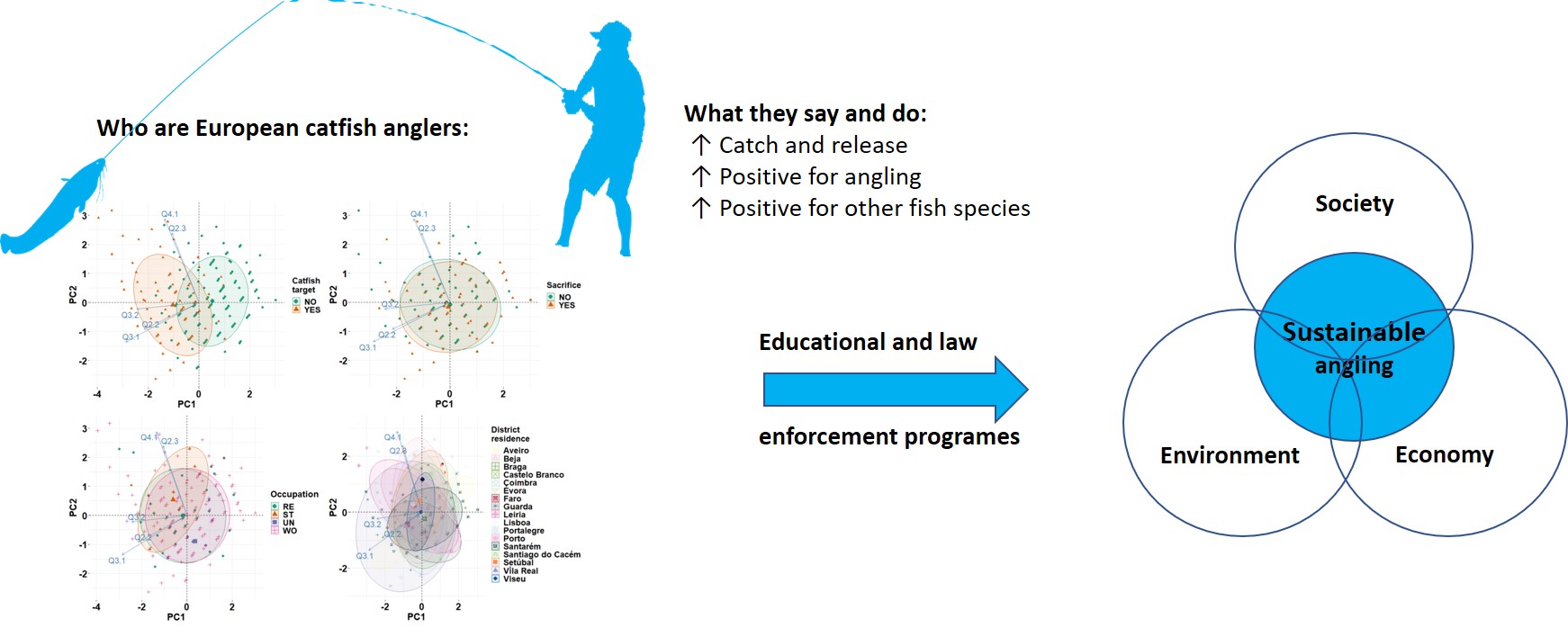
To avoid the spread and environmental impacts of the European catfish (Silurus glanis), which have arrived to Portugal around 2006, it is fundamental to understand anglers’ behaviors and perceptions. To address this need 339 Portuguese anglers were surveyed online and face-to-face and divided into two groups (catfish anglers, n=115; and non-catfish anglers, n=224). The majority of surveyed anglers were males (> 95%) who consider that catfish is not beneficial to the development of angling (>62%) and acknowledge its negative impact on other fish species (> 84%), mainly by predation (> 89%). Catfish anglers perceive the species as more positive for angling and for other fish species. Principal Component Analysis showed that anglers behaviors are mainly driven by their awareness of the impacts of European catfish and by their angling ex-perience. Regression modelling inferred the probabilities of two anglers’ behavior (targeting catfish and practice of catch & release) and one perception (catfish is benefi-cial to angling), which are considered promoters of catfish invasion, and detected strong correlations among these three variables. Therefore, it is strongly advised to implement an educational and law enforcement programme to stop illegal practices that promote dissemination of invasive fish species like European catfish.
Keywords:
inland fisheries
; survey-questionnaire
; Portuguese freshwaters
; trophy fish
; invasive fish management
1. Introduction
Sport-recreational angling (hereafter only angling) activities such as stocking can be sources of non-native freshwater fish introduction and spread globally [1,2,3] in European freshwaters [4], in the Iberian Peninsula [5,6], and in Portugal [7]. Unfortunately, this non-native ichthyofauna has been identified as a major driver of biodiversity loss and ecosystem changes with the capacity to cause increasing economic losses and deleterious effects on human health [8,9,10].
Inland anglers from the Mediterranean countries have introduced freshwater fishes to increase angling options [4,11] and a large number of invasive freshwater fish species were already introduced in Portugal due to their use for angling [12,13]. The European catfish Silurus glanis L. 1758, native to Central-Eastern Europe and Western Asia, has high angling interest due to its extreme body size. Consequently, it has been introduced into new basins throughout Europe [14,15,16], including Spain [17] and Portugal [18,19,20]. The European catfish is the largest freshwater fish in Europe, attaining 2.7 m and 130 kg [21], making it a highly appreciated trophy fish, given that body size is a key determinant of angler motivation [22]. This top predator is known to affect the entire food web [23], severely threatening Iberian freshwater fauna where high endemism of small-bodied fish species is combined with the natural absence of native piscivorous fish [14,24]. Arrival to Portugal was estimated by 2006 [18] in Tagus River where it already exhibits invasive characteristics [19,25] and is spreading to new ecosystems [13,20,26].
Angling has become a major activity in the inland waters of developing countries getting increasingly popular in some emerging countries (e.g., Argentina, Brazil, China and India) [27]. Around 11% of the European population fish recreationally [28] and Cowx [29] refers a total of almost 16 million freshwater anglers for the 21 EU Member States at that time. Some downward trend in participation seems to be occurring [29,30], but in some countries like Czech Republic, the participation rate had risen [31], probably due to globalization, higher incomes and more time for leisure [32]. In Portugal, freshwater anglers are the largest stakeholder group operating in freshwater ecosystems [33] and, according to the Portuguese State Agency “Institute for Nature Conservation and Forests” (ICNF), there were issued about 100,000 angler angling licenses in 2023.
Social aspects of angling need to be better understood and these are particularly important to outline communication strategies when there are putative conflicts between invasion species management and anglers’ preferences [34,35]. Stakeholder engagement is vital to manage non-native fishes as well. However, to effectively implement correct communication plans, policy makers need to understand and monitor stakeholder’s perceptions and behaviors [35,36], particularly towards predator species subject to ambiguous opinions. Such is the case for the European catfish in Portugal: on one hand anglers tend to prefer big predators for “catch-photo-release” [5], increasing the motivation to further spread this species and maintain its populations; but on the other hand, predation on commercial, popular/traditional consumed or endangered fish species (see for impacts [25,37]) is perceived as negative [11]. Surveys targeting anglers have already proved to be adequate methodological tools to assess their perceptions, attitudes and behaviors relative to angling [5,38,39], including European catfish angling [40].
Therefore, the purpose of this study was to have the first assessment about the habits and perceptions by the freshwater Portuguese angling community towards European catfish, particularly in relation to: its presence in Portugal, its impacts on other fish species and its angling value through the application of a survey implemented both online and face-to-face. This information is considered vital to apply effective European catfish management strategies in order to mitigate European catfish impacts and invasion risk, since it is mandatory to implement actions to deal with this invasive species in Portugal (Decree-Law no. 92/2019 of 10 July 2019, Annex II). Also, because Portuguese angling law considers illegal to return back to the water the European catfish after landing, we wanted to determine if angling practices are being compliant with such regulation.
2. Materials and Methods
We conducted a complemented survey-questionnaire with both off-site and on-site angler contact methods [41] with online and face-to-face interviews, to obtain a greater range of respondents and encompass a larger scope of opinions. The online inquiry was publicized from November 2021 to March 2022 on the popular Portuguese angling forum in Facebook “Pesca em águas interiores Portugal” (translation of “Angling in inland waters of Portugal”), which had 5,500 members at that time, provided by a small explanation of the survey aim and a Google Form link to the inquiry. Forum members were encouraged to respond to the survey and to share the survey link within other anglers. Additionally, the survey link was also publicized in the online version of two newspapers (Reconquista and Mirante). This use of angling fora seems to reach the majority of Iberian anglers and it is also a low cost, useful and practical way to obtain information on angler’s preferences [5]. All the online surveys (n= 200) were considered valid as there were no errors when filling them in and all the open answers were considered logical and acceptable.
The face-to-face inquiry was performed throughout 2022 until April 2023 and was conducted in: 1) the beginning of seven sport angling competitions; 2) angling areas by the riverbanks; 3) angling fairs by interviewing as much anglers as possible during the time of the events; 4) and in angling gear shops. It was always initially verified that face-to-face respondents had not answered to the online survey, and that it was the first time they were responding. It achieved a total of 139 valid questionnaires. In this face-to-face survey, only nine contacted anglers (i.e., 6%) declined to respond to the survey, and only in two cases the questionnaires were considered invalid because the respondents, despite agreeing to answer the survey, gave answers outside the specific context of some questions. The region around the Tagus River basin was chosen to perform these face-to-face questionnaires because is where European catfish has been occurring for longer time [13,19] and has higher abundances [42].
This choice to have two ways of questioning the sport-recreational anglers (online and face-to-face), and also targeting different kinds of anglers (sport anglers in fish competitions and recreational anglers during leisure activities) increased the scope and the sample size of the survey (n=339). To optimize both questionnaires content integrity, a pilot survey was previously applied individually to ten male anglers (20 to 55 years old) to analyze its content, discuss some language difficulties and make amendments about its content. Only few minor changes were made to the initial surveys and the mean response time was calculated to be around 10 minutes.
The questionnaire used for surveys included a list of questions (Q) grouped into different sections (Appendix A, Table A1). Firstly, some respondent’s sociodemographic features (Q1) like gender, age, occupation and the district of residence were asked. Then, the general angling profile (Q2) of the respondent was characterized by questions related with angling activity and experience, distance travelled for angling and targeted fish species. Targeted fish species were grouped according with main angling techniques and/or modalities: predators like pikeperch, largemouth bass and European catfish are mainly caught with lure angling or with live bait; feeder is the main technique for common carp and barbels; fly fishing is used for trout; several angling techniques are used in sport-fishing competitions where nases, roach, goldfish and gibel carp, bleack and black bullhead are the main species caught; and mullets are mainly targeted in recreational angling with the use of different lures and baits. Afterwards, there was a chapter focusing on European catfish angling (Q3) to evaluate the participation rate and the interest and behaviors inherent to its angling. A last group of questions estimated respondents’ opinions about European catfish impacts (either positive or negative) on other fish species (Q4).
To meet the objectives of the study the analysis of survey responses was done according with the two following groups of anglers: European catfish anglers and non-catfish anglers. Such division was based on question Q3.2 of the survey (Did you already angle for European catfish?”), where anglers who already targeted European catfish were considered catfish anglers (n=115), and the ones who responded “Never” were considered non-catfish anglers (n=224). Fromherz et al. [40] had a similar methodological approach to characterize specialist European catfish anglers in southern Germany.
The chi-square test (χ²) with p-value simulation based on Monte Carlo test (2000 replicates) was used to compare the frequencies for each response possibility with equal proportions of response categories and test the null hypothesis that frequencies did not differ among catfish and non-catfish anglers’ group.
Principal Component Analyses (PCA) were performed to reduce data dimensionality and determine the major drivers of anglers’ behaviors and perceptions regarding European catfish invasion and impacts. These were analyzed considering specific angler sociodemographic groups, namely, gender (Q1.1), age (Q1.2), occupation (Q1.3), and district of residence (Q1.4), as well as practices, such as angling experience (Q2.1), angling frequency (Q2.2), distance willing to travel on an angling trip (Q2.3), their self-awareness about the species knowledge (Q3.1), the angling activity targeting specifically the European catfish (Q3.2), the practice of catch & release (Q3.4), to what extent do anglers consider that European catfish is beneficial to the development of angling (Q3.5), and if anglers consider that European catfish has a positive impact on other fish species (Q4.1). These variables were already selected [11,43,44] as potential mensurable characteristics shaping Iberian sport-recreational anglers’ conduct and viewpoints of angling activity on freshwater ecosystems. Mean coordinates of each group in the main PCA axes were compared by variance analysis (95% confidence interval) and significant different groups ascertained using Tukey’s tests (95% confidence interval).
To better understand anglers putative risky behaviors and perceptions regarding new stockings and spread of European catfish, the questions related to what anglers do to European catfish when they catch it (Q3.4) to what extent do anglers consider that European catfish is beneficial to the development of angling (Q3.5), if anglers consider that European catfish has a positive impact on other fish species (Q4.1), and if the anglers target specifically the European catfish (Q3.2), were inferred using multivariate regression analysis, considering as initial predictor variables for the full model [except in the case of being themselves response variables] their age (Q1.2), occupation (Q1.3), time of angling practice (Q2.1), angling frequency (Q2.2), distance travelled to fishing spot (Q2.3), angling targeted to catfish (Q3.2), practice of catch & release (Q3.4), opinion about the European catfish being beneficial to the development of angling (Q3.5), and opinion about a positive impact of the European catfish on other fish species (Q4.1).
The regression models were optimized by stepwise regression with bidirectional elimination and model fit evaluated using model selection techniques adjusted R2 and Akaike information criterion (AIC) [45], a commonly used method accounting for the accuracy of the model fit [46]. Binary response variables were inferred by logistic regression models and the remaining with linear regression models. All data analyses were conducted using the packages lmtest [47], moments [48], psych [49], ResourceSelection [50], and the base installation of R programming language (v.4.1.2) in RStudio [51].
The statistical assumptions of regressions were assured [52,53,54]. In both regressions, the Harvey-Collier test did not reveal sufficient evidence of collinearity between any of the considered variables. Furthermore, the Squared Multiple Correlation (SMC) and Variation Inflation Factor (VIF) ranged, respectively, between 0.04 and 0.44, and 0.56 and 0.96, which in both cases are acceptable values to keep the considered variables [55]. The residuals vs fitted and normal QQ plots, indicate a normal distribution of the residuals. Additionally, in the linear models, skewness and kurtosis were comprehended between 0.74 and 1.17, and 5.19 and 5.47, respectively. This result showed acceptable values for both statistics [56,57]. Notwithstanding, the Shapiro-Wilk test for normality rejects the null hypothesis of data coming from a normal distribution. Nevertheless, considering that the sample size is sufficiently large (at least >140), this violation can be disregarded, according to the central limit theorem, which states that the distribution will approximate normality [58].
3. Results
3.1. Survey Responses
According to the 339 valid questionnaires it can be seen that the majority of the anglers surveyed are men (more than 90% response rate for both catfish anglers and non-catfish anglers) between 31 and 50 years old (53% and 41% response rate for catfish anglers and non-catfish anglers, respectively) and employed (92% and 78% response rate for catfish anglers and non-catfish anglers, respectively). Although there was a broad geographic coverage of the anglers surveyed which reside from north to south and coastal to interior of Portugal, there was a large proportion of anglers from Santarém district and other districts around the Tagus river basin like Castelo Branco, Portalegre and Lisbon (Table 1). Herein, some sociodemographic differences stand out between catfish and non-catfish anglers. While the former were almost exclusively employed people, the latter anglers have greater proportion of the remaining groups, namely, students, unemployed and retired. The district of residence is also significantly different, where catfish anglers are notably from the surrounding areas where the greater populations of European catfish exist in Portugal (Portuguese upstream part of the Tagus River and its main tributaries), namely, Santarém, Castelo Branco and Portalegre (Table 1).
The majority of the surveyed anglers have been angling for more than 20 years (more than 55% response rate in both anglers’ groups) with high angling frequency (at least once a week; more than 80% response rate in both anglers’ groups) (Table 2). Nevertheless, these features were similar between catfish and non-catfish anglers, in contrast to the distance willing to travel and the species mainly fished for. In these cases, catfish anglers are not willing to travel longer distances (more than 30 km) in Portugal to fish than non-catfish anglers but show greater willing to go abroad in angling trips. In relation to the target fish preferences of the anglers, the catfish anglers revealed higher preference (40%9, for “Predators”, such as pikeperch Sander lucioperca, largemouth bass Micropterus nigricans and the European catfish, being followed by “Common carp and Barbels” Cyprinus carpio and Luciobarbus sp. with 29% of the responses. This group of target fish - “Common carp and Barbels” – was instead the most popular among non-catfish anglers with 35% of the total number of answers, being followed by predators (25%) and very closely (23%) by “sport angling species” such as nases Pseudochondrostoma sp., roach Rutilus rutilus; goldfish and gibel carp Carassius sp., bleak Alburnus alburnus and black bullhead Ameiurus melas (Table 2).
About half of the surveyed anglers believe to have good knowledge about European catfish (Table 3). This fact was more evident in catfish anglers with 59% of the respondents answering to have high or good knowledge of the species. The same percentage of catfish anglers and 96% of non-catfish anglers stated to catch less than 5 catfishes per year, although a small proportion of catfish anglers (around 5%) reported having caught more than 50 individuals in a year and about one third caught between 11-50 catfishes per year (Table 3). When anglers were asked about what they do after landing an European catfish, there is a division between the two answers (sacrifice versus release to the water) with significant differences among the two groups of anglers (non-catfish anglers tend to sacrifice more than catfish anglers) (Q3.4, Table 3).
The majority of the surveyed anglers considers that the European catfish is not beneficial to the development of angling (more than 60% response rate in both anglers’ groups), but catfish anglers have a significantly different opinion (Table 3), with a greater fraction perceiving it as beneficial for angling (23% response rate for catfish anglers against 12% for non-catfish anglers). The anglers’ opinions are more divided when asked if the catfish can be considered an angling trophy but similar between catfish and non-catfish anglers, with catfish anglers agreement response of 44% and 41% disagreement, while for the non-catfish respondents, the agreement answers were 40% and disagreement answers were 44% (Table 3).
Relative to the impact of European catfish on other fish species, more than 80% of both anglers’ groups clearly answered that they disagree with the opinion that catfish has a positive impact on other fish species (Table 4). In fact, only a very small proportion of catfish anglers (3.5%) and non-catfish anglers (0.5%) responded that they agree or totally agree with the positive impact of this species. In the same way, the majority of the respondents (more than 80% response rate for both anglers’ groups) acknowledges its negative impacts on other fish species (84% of catfish anglers and 94% of non-catfish anglers). Indeed, various fish species were mentioned as being harmed by the presence of the European catfish with the higher number of mentions for “Barbels” and “Carps” in both catfish and non-catfish anglers (Table 4). When asked about the reason why European catfish harms other fish species (Q4.4, Table 4), the reference to its predatory action is predominant, with around 90% response rate for both groups of anglers. When anglers are asked about the management solutions to address the negative environmental impacts of the species, the answer option “Remove all catfish locally” was the most chosen one especially by non-catfish anglers (59% response rate), but also by catfish anglers (40% response rate) (Table 4). Nevertheless, catfish anglers diverged significantly with a more diverse opinion about the different possibilities of addressing this issue.
3.2. Principal Component Analysis
The PCA performed to the inquiries was able to explain 50% of data variability in the first two axes and 71% in the first three (Figure 1). Most correlated variables with the first axis were the anglers’ perception of the European catfish being beneficial to the development of angling (Q3.5), and the perception of the European catfish having a positive (Q4.1) impact on other species. In turn, most correlated variables with the second axis were the frequency that anglers go angling (Q2.2) and the impression about how good their knowledge was about the European catfish species (Q3.1). Accordingly, the principal axis seems to be related with an awareness of the European catfish introduction effects on freshwater ecosystems while the second axis to the respondents angling experience. The PCA showed a significant effect of the angler’s sociodemographic grouping when targeting European catfish (Q3.2; p-value<0.001) while the district of residence (Q1.4; p-value=0.0862) was barely significant. Accordingly, anglers that target European catfish have a more frequent angling activity and a self-perception of greater knowledge about the European catfish species. On the other hand, the PCA did not reveal significant patterns in the angler’s behaviour and perceptions based on their catfish sacrifice attitude or their occupation situation.
3.3. Multivariate Regression Modelling
The multivariate regression modelling approach enabled the assessment of the particular effect of specific features in the perceptions and attitudes of anglers based on the performed surveys. The anglers conduct of catch & release, and the probability of targeting specifically for the catfish during the angling trip, was inferred by means of multiple logistic regression, due to the binary characteristic of the response variable. In the case of catch & release, the best model determining its probability is composed by the predictor variables Q3.5 and Q4.1 (Equation 1). This model is significantly better than the null model, with no evidence of poor fit (Hosmer and Lemeshow goodness of fit test p-value = 0.1894; n=220) while revealing moderate fit (McFadden’s pseudo R2=0.1373) and an acceptable predictive capacity (AUC = 0.7) and accuracy (0.70). In this model, the variable coefficients show that the probability of an angler practising catch & release is related to his agreement that European catfish has a positive effect in the development of angling and that it brings positive effects to the native fish populations. That is, the more the angler agrees with these two previous statements, the higher the probability of releasing European catfish into the water again (Figure 2).
As for the probability of the angler targeting specifically for catfish, this conduct revealed to be related mainly with the variables Q1.3 and Q3.5, namely, the angler occupation, and his agreement with the statement that the European catfish has a positive effect in the development of angling (Equation 2, Figure 2). Although this model is significantly better than the null model, with no evidence of a poor fit (Hosmer and Lemeshow goodness of fit test p-value = 0.2172; n=220), the fit is considered low (McFadden’s pseudo R2=0.0919) with a mediocre predictive capacity (AUC=0.29) and poor accuracy (0.60). Nevertheless, and although the occupation variable did not reveal explanatory in the PCAs, in this model, unemployed people contribute to decrease the probability of targeting for catfish while student and working population increase the probability of targeting for this fish.
The opinion of the angler regarding the European catfish having a positive effect on the angling (Q3.5) was modelled using a multivariate linear model where best results were achieved by the predictor variables Q3.2 (angling targeting for European catfish), Q3.4 (does the angler sacrifice the catfish or practice catch & release), and Q4.1 (catfish has positive impact on other fish species). This model is significantly better than the null model (p-value = 2.2e-16; n=220) and is able to explain approximately 40% of data variability (adjusted R2 = 0.405). The model coefficients show that anglers targeting for catfish, practicing catch & release, and their agreement of catfish having positive effects on native fish populations, foster the anglers’ opinion of the catfish having a positive effect on angling. Thus, the greater the commitment to target for European catfish and the stronger the agreement with the positive effects of catfish to the native fish fauna, the stronger the feeling that catfish brings positive effects to the development of angling (Equation 3, Figure 3).
With regard to the angler’s opinion about the positive effects of catfish on native fish populations (Q4.1), the best model establishing a linear relationship between the response and predictor variables retrieved a linear model better than the null model (p-value = 2.2e-16; n=220) and explaining 36% of the data variability (adjusted R2 = 0.3606). In this model, the predictor variables with a significant effect on Q4.1 are Q3.4 and Q3.5. (Equation 4, Figure 3). The model coefficients show that the anglers’ opinion about the positive impact on native fish species (Q4.1) is related with the practice of catch & release and to the anglers’ opinion about the positive effects of European catfish to angling. This means that anglers that tend to agree more with the positive effects of catfish on native fish populations also practice more catch & release and have more the opinion that European catfish is beneficial for angling.
4. Discussion
The present study shows for the first time that the general perception of Portuguese interviewed anglers about the European catfish invasion into Portuguese inland waters is negative, acknowledging its impact on freshwater ichthyofauna, mainly by predation, and its benefit for angling is perceived as questionable or negative. However, some differences were found in habits, preferences, behaviors and perceptions across the two anglers’ groups, with direct or indirect implications for European catfish management and law compliance. Particularly, in the European catfish anglers group there is a higher proportion of anglers who consider the species as positive for angling development and this group is generally composed by employed practitioners from districts around Tagus river basin. These catfish anglers were also more inclined to believe that European catfish will bring positive and beneficial effects for angling and for other fish species. They also practice more catch & release when angling for European catfish, an illegal activity under the Portuguese law that undermine the management of this invasive fish throughout the spread into the freshwater ecosystems. This work unveils important social science data about the anglers which is key for invasive fish management and enables us to suit better communication strategies and management decisions [59,60].
In this study, the different approaches of performing the survey had the objective to reach a larger audience within the diversity of Portuguese anglers: from the more active on social media trough the online survey, to sport anglers on angling competitions and more recreational anglers interviewed on fishing grounds through the face-to-face survey. In the angling fairs and in angling stores either sport or recreational anglers were also interviewed face-to-face. Nevertheless, due to the proportion of angling practitioners surveyed [in relation to the number of angling licences issued, some cautions are recommended in generalizations to all Portuguese angler community. We also acknowledge that the use of different survey techniques can affect survey results [61]. Biases due to putative unbalanced samples among different groups of anglers, or even due to confidentiality and anonymity issues, and different levels of honesty towards illegal practices [62] could have occurred, but our goal was to capture wider diversity of opinions by increasing sample size. Nevertheless, similar sample size and similar angler age distribution are referred in Marta el al. [43] and Pérez-Bote and Rosso [44] surveys to Iberian anglers.
The fact that anglers deliberately release invasive species into freshwaters to increase their angling experience has led to the arrival of new fish species in the last decade to Iberian freshwaters to an unprecedented rate [19,63,64]. Like many other predatory fish species that have been introduced across continents for angling enhancement [65], big game angling provides satisfaction for anglers [66] and the large body size of European catfish can make it a highly prized sport fish, being this also the main reason for its illegal introduction outside its native range [15]. However, two-thirds of the interviewed Portuguese anglers (224 non-catfish anglers versus 115 catfish anglers) do not yet target for European catfish, probably due to its recent arrival (2006), still low geographic distribution in Portugal and therefore limited knowledge on its angling or gastronomic potential.
Concerning the sociodemographic features of the respondents, a dominance of male anglers was observed, similar to other studies elsewhere [26,67,68]. European catfish anglers are mainly employed and living in districts around the Tagus basin, which matches with the current invaded range of the European catfish [13,19,20].
Considering general angling activity, a similar pattern on angling experience and frequency were found between catfish anglers and non-catfish anglers but catfish anglers are more fond of predators and go abroad more times for angling. Although with lower response rate, this group of predator fish species was the second rated target for non-catfish anglers. It is known that Iberian anglers prefer predatory fish and the probability of new introductions depends on its sports value which also can enhance the active uncontrolled stocking by anglers [5,69,70]. In order to mitigate such angling interest on predators, such as European catfish, we suggest stakeholders to promote more traditional angling to native barbels and common carp (ancient non-native) once these fish species are also referred has being highly targeted by all surveyed anglers (concordant with the results of Banha et al. [11]), while performing educational campaigns alerting for the ecological risk of introducing and spreading non-native predator species. In our study, the results considering the distance travel to angle reveal that despite catfish anglers are not so willing to travel so much distances as non-catfish anglers, around 21% of catfish anglers travel more than 100 km in an angling trip and go angling abroad more frequently. Banha et al. [11] observed that travel distance was related with angling for new fish species, where anglers organized angling trips (being this situation particularly evident for Ebro River catfish anglers), and related such pattern of high interest and angling specialization among catfish anglers to probable illegal transportation and consequent risk of introduction into new areas. Banha et al. [5] also found that Iberian anglers cover great distances to fish, commonly visiting several places during consecutive days. Such visit to several catchments was also observed for British anglers [71], however going abroad for angling seems to be a less common practice in Portuguese comparing with British anglers [67].
Results from European catfish angling activity show that even with the recent arrival of this invasive fish, the majority of the catfish anglers consider to have a good knowledge about this species, most likely due to their extended angling experience focused on this species and with larger catches when compared to non-catfish anglers. Higher catch & release rates were found for catfish anglers, but were also high for non-catfish anglers (39%). Also, more than half of the respondents for both anglers’ groups disagrees that European catfish is beneficial to the development of angling, but a significant higher proportion of catfish anglers agrees with such fact. And, in spite of European catfish can reach large sizes, the question related to the consideration of European catfish being an angling trophy was equally responded by catfish and non-catfish anglers with similar proportions on all agreement’s classes. Also, in Spain, European catfish does not seem to be appreciated by the common Spanish angler, but there are economic benefits related with a great influx of trophy-oriented anglers from other countries that practice catch & release, particularly in the lower Ebro River [5,11]. Also, in France, the spread of European catfish promoted a very popular branch of big game angling in large rivers and reservoirs [30]. In Germany, Beardmore et al. [34] found that angling satisfaction was primarily determined by catch rate and fish size, but anglers also rank non-catch related motivations (e.g., experience nature, distraction, quiet) as important (see the meta-analysis of Birdsong et al. [72] about recreational angler satisfaction drivers). Although these factors of satisfaction were not assessed in this study, we believe that they may also be relevant both for the catfish and non-catfish anglers groups. Also, social and cultural values associated to native fishes, particularly migratory fish, can play a role on the anglers feeling against European catfish [73]. Motivations for angling seem to be diverse according to the specific group of anglers (e.g., more generalist or specialized in different target fish species) [40,74] and, consequently, these motivations warrant further research for the freshwater anglers in Portugal.
European catfish ecological impacts on other fish species is acknowledged by the majority of both catfish anglers and non-catfish anglers, referring that many species can be predated by this catfish. However, angling practices seems not to be in line with this awareness since an alarming illegal catch & release rate was reported, reaching more than half of surveyed catfish anglers. Fromherz et al. [40] obtained similar high catch & release practice among German catfish anglers. In fact, more work is needed to evaluate this incongruity given that the Portuguese law (Decree-Law no. 92/2019 of 10 July 2019) forbids the return of this invasive fish back to water. This lack of concordance between angler motivations and behaviors, and non-native predatory fish policy and management were also found by Banha et al. [5] for Iberian anglers. Moreover, European catfish removal from water bodies was considered the best management option by all the anglers, particularly non-catfish anglers, and such fact seems also contradictory with the practice of catch & release. Therefore, reinforcement of awareness programmes towards anglers is needed, but also, we need to understand the main difficulties in complying with the existing law. For instance, raised difficulties in handling with large fish like European catfish, in disposing the fish, animals’ rights concern or, simply, lack of knowledge of the current law are most likely probable causes that should be addressed.
Previous face-to-face surveys [43,44] also have characterized Iberian angling and despite some differences, the general anglers’ profile was similar to the one found in this study. However, both references reported shorter mean distances travelled to fish and Marta et al. [43] also detected less catch & release rate. In the meantime, the European economic growth together with the increasing tendency for catch & release practices in angling [30] may explain such differences.
Our PCA results showed that the behavior of the surveyed anglers is roughly driven by their awareness of the European catfish introduction effects on freshwater ecosystems and their angling experience. Moreover, the obtained regression models expose the deep relationship between the angling activity aiming specifically for this species, the practice of catching and releasing this species again into the water, the angler’s opinion about the catfish having a positive effect in the development of angling, and in the positive effects European catfish can bring to the native fish populations. This outcome also shows a worrying disparity between the current scientific knowledge and the anglers’ perceptions regarding invasion ecology, particularly regarding the European catfish invasion, which can even put more pressure in freshwater biodiversity. As exposed in other references [40,75], this study also shows that anglers are a diverse group with respect to their opinions, behaviors and motivations which also can be linked either to sociodemographic features and/or angling profile. Accordingly, European catfish anglers are mainly employed males living near the Tagus basin, practicing catch & release, and already believing that the angling, and even native fish communities, will benefit with catfish occurrence. Furthermore, the regression results confirm that the anglers’ opinion regarding European catfish having a positive effect on angling and their opinion about positive effects of catfish on native fish are highly related. This result also corroborates the main factors identified in the PCA and reveals an existing relationship between angling interests, like specialization in European catfish angling, and how anglers perceive river ecology, and consequently, their awareness of the catfish introduction effects on freshwater ecosystems. This highlights an imperative necessity for a national educational and awareness campaign, particularly focused on the catfish anglers’ group, in order to highlight the impact of the European catfish on native fish populations and on angling, so as to promote a decrease on the illegal catch & release practice, thus contributing to the control of this invasive fish in Portugal. Such an approach has already shown to provide a successful support in preventing and managing alien species invasions [76,77,78].
There is a predictable growing conflict among inland fisheries interests and nature conservation issues [29]. The European catfish in Portugal and in other non-native locations is a good example since it is projected to increase their angling interest with putative spread which in turn can impact freshwater ecosystems and consequently promote deleterious effects on commercial fisheries economy. Portuguese inland professional fishermen consider European catfish as a very negative species due to its predation upon more valuable fish species like the migratory ones [European eel, shads and sea lamprey] and, until now, they rarely trade European catfish due to its very low economic value (pers. obs.). Also, in Portugal there is no gastronomic tradition in European catfish consumption like it happens in more eastern European countries [79,80], but possibly valuing the species as food, together with educational programmes, can increase population control trough commercial fisheries or even trough angling [40] without the risk of spreading it to other basins, given its high spread rate [13,18]. People in general, and key target-groups operating in inland freshwater ecosystems in particular, should be educated about the impacts of invasive aquatic species to avoid introductions of new species and their spread. Such awareness is fundamental because inland fisheries management agencies actions proved so far to be inefficient to stop illegal fish introductions and the reaction measures, such as population control of invasive species, can have significant costs, higher than angling licence fees can support, as well as questionable results [81]. Therefore, sustainability must be the main goal in recreational fisheries management, with all actors involved responsibly, ensuring biodiversity conservation while maximizing the social and economic benefits to society [82,83].
5. Conclusions
The behavioral component of recreational fisheries is important for setting policies and management decisions [34]. The identified catfish angler group found in this study should be a priority in the implementation of management measures aimed at preventing the spread of the European catfish. One of such measures must be an intense education and awareness campaign because it surely improves the knowledge, perceptions and the positive behaviors towards invasive species [84,85] potentially lowering the intentional release of aquatic non-native species [5]. Additionally, stricter control schemes are needed to enforce existing regulations with law enforcement and national authorities’ control. Measures like improving human and material resources for the national police corporation in charge to monitor the compliance with angling laws, targeting social media promotion, or publicity of angling gear brands that promote angling towards this invasive fish, can be applied. Economic drivers may push future introductions and the pressure posed by anglers make it difficult to prevent further releases [86], but the strategic recommendations presented here can help to mitigate the European catfish invasion in the Portuguese territory. Furthermore, these findings for Portugal can be viewed as an important case-study with applications in the management of freshwater invasive predator fish species in other invaded countries such as Spain, France and Italy.
Author Contributions
Conceptualization, João Gago, Diogo Ribeiro, Pasul Castagné, Frédéric Santoul and Filipe Ribeiro; methodology, João Gago, Rui Rivaes, Diogo Ribeiro, Diogo Dias, Paul Castagné, Frédéric Santoul and Filipe Ribeiro; software, Rui Rivaes; validation, João Gago, Rui Rivaes, Diogo Ribeiro, Diogo Dias, Paul Castagné, Frédéric Santoul and Filipe Ribeiro; formal analysis, João Gago, Rui Rivaes and Filipe Ribeiro.; investigation, João Gago, Rui Rivaes, Diogo Ribeiro, Diogo Dias, Paul Castagné, Frédéric Santoul and Filipe Ribeiro; resources, João Gago, Frédéric Santoul and Filipe Ribeiro; data curation, João Gago, Rui Rivaes and Diogo Ribeiro; writing—original draft preparation, João Gago, Rui Rivaes and Filipe Ribeiro; writing—review and editing, João Gago, Rui Rivaes, Diogo Ribeiro, Diogo Dias, Paul Castagné, Frédéric Santoul and Filipe Ribeiro ; visualization, João Gago, Rui Rivaes and Filipe Ribeiro; supervision, João Gago, Frédéric Santoul and Filipe Ribeiro; project administration, , João Gago, Frédéric Santoul and Filipe Ribeiro; funding acquisition, João Gago and Filipe Ribeiro. All authors have read and agreed to the published version of the manuscript.
Funding
This research was funded by the Portuguese Foundation for Science and Technology (FCT), grant number PTDC/ASP-PES/4181/2021 under the project “MEGAPREDATOR – A giant on the water: from predation pressure to population control of the European catfish (Silurus glanis)” This research was also financed by the Portuguese Foundation for Science and Technology (FCT) under the projects: project UIDP/00681/2020 (https://doi.org/10.54499/UIDP/00681/2020); project UIDP/04292/2020 (https://doi.org/10.54499/UIDP/04292/2020); project UIDB/04292/2020 (https://doi.org/10.54499/UIDB/04292/2020); and through project LA/P/0069/2020 (https://doi.org/10.54499/LA/P/0069/2020), granted to the Associate Laboratory ARNET.
Data Availability Statement
The data that support the findings of this study are available from the corresponding author upon reasonable request.
Acknowledgments
The authors would also like to thank all the anglers who took the time to complete the surveys.
Conflicts of Interest
The authors declare no conflicts of interest.
Appendix A

Table A1.
Set of questions (Q) used on anglers’ survey.
| Survey questions | Type of Answer |
|---|---|
|
|
| Q1.1 Gender |
Binomial Male/Female. |
| Q1.2 Age |
5 age groups (years) <18; 18-30; 31-50; 51-70; >70. |
| Q1.3 Occupation |
4 occupation possibilities Employed; Student; Unemployed; Retired. |
| Q1.4 District of residence | Open answer |
|
|
| Q2.1 For how many years have you been angling? |
5-point scale (years) <5; 5-10; 11-20; 21-50; >50. |
| Q2.2 How often do you go angling? |
4-point scale Several times a week; At least once a week; At least once a month; Less than ten times a year. |
| Q2.3 How far do you travel to fish? |
4-point scale (Km), plus one possibility <5; 5-30; 31-100; >100; and Abroad. |
| Q2.4 What group of species do you mainly fish for? |
7 possibilities (multiple answer) Predators (pikeperch, largemouth bass and European catfish); Common carp and Barbels; Trout; Species common in sport angling (e.g., nases, roach; goldfish and gibel carp, bleak, black bullhead); Mullets; European Eel; Anadromous fish (sea lamprey and shads); Other species. |
|
|
| Q3.1 Your knowledge about European catfish (identification, biology, ecology) is good. |
5-point scale Totally agree; Agree; Neither agree or disagree; Disagree; Totally disagree. |
| Q3.2 Did you already angled for European catfish? |
2-point scale Yes; Never. |
| Q3.3 If you fish it how many European catfish do you usually catch per year? |
4-point scale <5; 5-10; 11-50;>50. |
| Q3.4. What do you do to European catfish when you catch it? |
2-point scale Sacrifice; Release back to water |
| Q3.5 European catfish is beneficial to the development of sport-recreational angling. |
5-point scale Totally agree; Agree; Neither agree or disagree; Disagree; Totally disagree. |
| Q3.6 European catfish is an angling trophy. |
5-point scale Totally agree; Agree; Neither agree or disagree; Disagree; Totally disagree. |
|
|
| Q4.1 European catfish has a positive impact on other fish species. |
5-point scale Totally agree; Agree; Neither agree or disagree; Disagree; Totally disagree. |
| Q4.2 European catfish has a negative impact on other fish species. |
5-point scale Totally agree; Agree; Neither agree or disagree; Disagree; Totally disagree. |
| Q4.3 If you agree with the previous answer, indicate which species are impacted. |
6 possibilities (multiple answer) Predators (pikeperch and largemouth bass); Common, crucian and Prussian carps; Diadromous fish (eels, shads and sea lamprey); Bleak; Barbels; Other species. |
| Q4.4 Indicate why they are impacted. | Open answer |
| Q4.5 Where European catfish may have a negative impact, what do you think needs to be done? |
7 possibilities (multiple answer) Remove all catfish locally; Remove all big catfish (>130 cm) locally; Remove all small catfish (<130 cm) locally; Scare the fish away; Finding an alternative solution, considering the specific context; No opinion; Other alternatives. |
References
- Cambray, J.A. Impact on indigenous species biodiversity caused by the globalisation of alien recreational freshwater fisheries. Hydrobiologia 2003, 500, 217–230. [Google Scholar] [CrossRef]
- Gozlan, R.; Britton, J.; Cowx, I.; Copp, G. Current knowledge on non-native freshwater fish introductions. J. Fish Biol. 2010, 76, 751–786. [Google Scholar] [CrossRef]
- Bernery, C.; Bellard, C.; Courchamp, F.; Brosse, S.; Gozlan, R.E.; Jari, I.; Teletchea, F.; Leroy, B. Freshwater Fish Invasions: A Comprehensive Review. Annu. Rev. Ecol. Evol. S. 2022, 53, 427–456. [Google Scholar] [CrossRef]
- Carpio, A.J.; De Miguel, R. J.; Oteros, J.; Hillström, L.; Tortosa, F. S. Angling as a source of non-native freshwater fish: A European review. Biol. Invasions 2019, 21, 3233–3248. [Google Scholar] [CrossRef]
- Banha, F.; Diniz, A.; Anastácio, P.M. The role of anglers’ perceptions and habits invasions: Perspectives from the Iberian Peninsula. Aquat. Conserv. 2017, 27, 51–64. [Google Scholar] [CrossRef]
- Muñoz-Mas, R.; García-Berthou, E. Alien animal introductions in Iberian inland waters: An update and analysis. Sci. Total Environ. 2020, 703, 134505. [Google Scholar] [CrossRef]
- Anastácio, P.M.; Ribeiro, F.; Capinha, C.; Banha, F.; Gama, M.; Filipe, A.F.; Rebelo, R.; Sousa, R. Non-native freshwater fauna in Portugal: A review. Sci. Total Environ. 2019, 650, 1923–1934. [Google Scholar] [CrossRef]
- Flood, P.J.; Duran, A.; Barton, M.; Mercado-Molina, A.E.; Trexler, J.C. Invasion impacts on functions and services of aquatic ecosystems. Hydrobiologia 2020, 847, 1571–1586. [Google Scholar] [CrossRef]
- Pyšek, P.; Hulme, P.E.; Simberloff, D.; Bacher, S.; Blackburn, T.M.; Carlton, J.T.; Dawson, W.; Essl, F.; Foxcroft, L.C.; Genovesi, P.; Jeschke, J.M.; Kühn, I.; Liebhold, A.M.; Mandrak, N.E.; Meyerson, L.A.; Pauchard, A.; Pergl, J.; Roy, H.E.; Seebens, H.; Kleunen, M.; Vilà, M.; Wingfield, M.J.; Richardson, D.M. Scientists’ warning on invasive alien species. Biol. Rev. 2020, 95, 1511–1534. [Google Scholar] [CrossRef]
- Haubrock, P.J.; Bernery, C.; Cuthbert, R.N.; Liu, C.; Kourantidou, M.; Leroy, B.; Turbelin, A.J.; Kramer, A.M.; Verbrugge, L.N.H.; Diagne, C.; Chourchamp, F.; Gozlan, R.E. Knowledge gaps in economic costs of invasive alien fish worldwide. Sci. Total Environ. 2022, 803, 149875. [Google Scholar] [CrossRef]
- Banha, F.; Gago, J.; Margalejo, D.; Feijão, J.; Casals, F.; Anastácio, P.M.; Ribeiro, F. Angler’s preferences, perceptions and practices regarding non-native freshwater fish. Rev. Fish Biol. Fisher. 2024, 34, 385–404. [Google Scholar] [CrossRef]
- Ribeiro, F.; Collares-Pereira, M. J.; Moyle, P. B. Non-native fish in the freshwaters of Portugal, Azores and Madeira Islands: A growing threat to aquatic biodiversity. Fisheries Manag. Ecol. 2009, 16, 255–264. [Google Scholar] [CrossRef]
- Martelo, J.; Costa, L.M.; Ribeiro, D., Gago, J.; Magalhães, M.F.; Gante, H.F.; Alves, M.J.; Cheoo, G.; Gkenas, C.; Banha, F.; Gama, M.; Ribeiro, F. Evaluating the range expansion of recreational non-native fishes in Portuguese freshwaters using scientific and citizen science data. BioInvasions Rec. 2021, 10, 378–389. https://www.reabic.net/journals/bir/2021/2/BIR_2021_Martelo_etal.pdf.
- Copp, G.H.; Britton, R.; Cucherousset, J.; García-Berthou, E.; Kirk, R.; Beeler, E.; Skaténas, S. Voracious invader or benign feline? A review of the environmental biology of European catfish Silurus glanis in its native and introduced ranges. Fish Fish. 2009, 10, 252–282. [Google Scholar] [CrossRef]
- Cucherousset, J.; Horky, P.; Slavík, O.; Ovidio, M.; Arlinghaus, R.; Boulêtreau, S.; Britton, R.; García-Berthou, E.; Santoul, F. Ecology, behaviour and management of the European catfish. Rev. Fish Biol. Fisher. 2018, 28, 177–190. [Google Scholar] [CrossRef]
- Castagné, P.; Paz-Vinas, I.;·Boulêtreau, S.; Ferriol, J.; Loot, G.; Veyssière, C.; Arlinghaus, R.; Britton, R.; Chiarello, M.; García-Berthou, E;. Horký, P.; Nicolas, D.; Nocita, A.; Nordahl, O.; Ovidio. M.; Ribeiro, F.; Slavík, O.; Vagnon, C.; Blanchet, S.; Santoul, F. Patterns of genetic variation in native and non-native populations of European catfish Silurus glanis across Europe. Biodivers. Conserv. 2023, 32, 2127–2147. [CrossRef]
- Carol, J.; Benejam, L.B.; García-Berthou, E. Growth and diet of European catfish [Silurus glanis] in early and late invasion stages. Fund. Appl. Limnol. 2009, 174, 317–328. [Google Scholar] [CrossRef]
- Gkenas, C.; Gago, J.; Mesquita, N.; Alves, M.J.; Ribeiro, F. First record of Silurus glanis Linnaeus, 1758 in Portugal (Iberian Peninsula). J. Appl. Ichthyol. 2015, 31, 756–758. [Google Scholar] [CrossRef]
- Gago, J.; Anastácio, P.; Gkenas, C.; Banha, F.; Ribeiro, F. Spatial distribution patterns of the non-native European catfish, Silurus glanis, from multiple online sources—a case study for the River Tagus (Iberian Peninsula). Fisheries Manag. Ecol. 2016, 23, 503–509. [Google Scholar] [CrossRef]
- Gkenas, C.; Martelo, J.; Ribeiro, D.; Gago, J.; Santos, G.; Dias, D.; Ribeiro, F. Westwards expansion of the European catfish Silurus glanis in the Douro River (Portugal). Limnetica 2023, 43. https://www.limnetica.com/documentos/limnetica/limnetica-43-1-01.pdf.
- Boulêtreau, S.; Santoul, F. The end of the mythical giant catfish. Ecosphere 2016, 7, e01606. [Google Scholar] [CrossRef]
- Arlinghaus, R.; Beardmore, B.; Riepe, C.; Meyerhoff, J.; Pagel, T. Species-specific preferences of German recreational anglers for freshwater angling experiences, with emphasis on the intrinsic utilities of fish stocking and wild fishes. J. Fish Biol. 2014, 85, 1843–1867. [Google Scholar] [CrossRef]
- Vejřík, L.; Vejříková, I.; Blabolil, P.; Eloranta, A.P.; Kočvara, L.; Peterka, J.;Sajdlová, Z.; Chung, S.H.D.; Šmejkal, M.; Kiljunen, M.; Čech. M. European catfish Silurus glanis] as a freshwater apex predator drives ecosystem via its diet adaptability. Sci. Rep. 2017, 7, 15970. [CrossRef]
- Almeida, D.; Ribeiro, F.; Leunda, P.M.; Vilizzi, L.; Copp, G.H. Effectiveness of FISK, an invasiveness screening tool for non-native freshwater fishes, to perform risk identification assessments in the Iberian Peninsula. Risk Anal. 2013, 33, 1404–1413. [Google Scholar] [CrossRef]
- Ferreira, M.; Gago, J.; Ribeiro, F. Diet of European catfish in a newly invaded region. Fishes 2019, 4, 58. [Google Scholar] [CrossRef]
- Gkenas, C.; Sequeira, V.; Ribeiro, D.; Gago, J.; Dias, D.; Verma, C.; Kumkar, P.; Ribeiro, F. Reproductive traits of the European catfish, Silurus glanis, during the early stages of invasion. J. Vert. Bio. 2023, accepted for publication.
- Cooke, S.J.; Arlinghaus, R.; Johnson, B.M.; Cowx I.G. Recreational fisheries in inland waters (Chapter: 4.4). In: Freshwater Fisheries Ecology; Craig, J.F., Eds.; John Wiley and Sons, Ltd., New Jersey, USA, 2016, pp.449-465.
- Arlinghaus, R.; Tillner, R.; Bork, M. Explaining participation rates in recreational angling across industrialised countries. Fisheries Manag. Ecol. 2015, 22, 45–55. [Google Scholar] [CrossRef]
- Cowx, I.G. Characterisation of inland fisheries in Europe. Fisheries Manag. Ecol. 2015, 22, 78–87. [Google Scholar] [CrossRef]
- Changeux, T.; Boisneau, P; Stolzenberg, N.; Goulon, C. A long term overview of freshwater fisheries in France. Rev. Fish Biol. Fisher. 2023, 34, 19–41. [CrossRef]
- Lyach, R.; Čech, M. A new trend in Central European recreational angling: More angling visits but lower yield and catch. Fish. Res. 2018, 201, 131–137. [Google Scholar] [CrossRef]
- Hirsch, P.E.; N’Guyen, A.; Burkhardt-Holm, P. Hobbyists acting simultaneously as anglers and aquarists: Novel pathways for non-native fish and impacts on native fish. Aquat. Conserv. 2020, 31, 1285–1296. [Google Scholar] [CrossRef]
- Collares-Pereira, M.J.; Alves, M.J.; Ribeiro, F.; Domingos, I.; Raposo de Almeida, P.; Moreira da Costa, L.D.; Gante, H.F.; Filipe, A.F.; Aboim, M.A.; Rodrigues, P.; Magalhães, M.F. Guia dos Peixes de Água Doce e Migradores de Portugal Continental. Edições Afrontamento, Porto, Portugal. 2021.
- Beardmore, B.; Hunt, L.M.; Haider, W.; Dorow, M.; Arlinghaus, R. Effectively managing angler satisfaction in recreational fisheries requires understanding the fish species and the anglers. Can. J. Fish. Aquat. Sci. 2015, 72, 500–513. [Google Scholar] [CrossRef]
- Ward, G.H.M.; Allen, M.S.; Camp, E.V.; Cole, N;, Hunt, L.M.; Matthias, B.; Post, J.R.; Wilson, K.; Arlinghaus, R. Understanding and managing social-ecological feedbacks in spatially structured recreational fisheries: The overlooked behavioural dimension. Fisheries 2016, 41, 524–535. [CrossRef]
- Banha, F.; Diniz, A.M.; Olivo del Amo, R.; Oliva-Paterna, F.J.; Anastácio, P.M. Perceptions and risk behaviours regarding biological invasions in inland aquatic ecosystems. J. Environ. Manag. 2022, 308, 114632. [Google Scholar] [CrossRef]
- Encina, L.; Rodríguez-Ruiz, A.; Orduna, C.; Cid, J.R.; Ilaria, M.; Granado-Lorencio, C. Impact of invasive European catfish (Silurus glanis) on the fish community of Torrejón reservoir (Central Spain) during a 11-year monitoring study. Biol. Invasions 2023, 26, 745–756. [Google Scholar] [CrossRef]
- Toivonen, A-L.; Roth, E.; Navrud, S.; Gudbergsson, G.; Appelblad, H.; Bengtsson, B.; Tuunainen, P. The economic value of recreational fisheries in Nordic countries. Fisheries Manag. Ecol. 2004, 11, 1–14. [CrossRef]
- Gozlan, R.E.; Burnard, D.; Andreou, D.; Britton, J.R. Understanding the threats posed by non-native species: Public vs. conservation managers. PLoS ONE 2013, 8, e53200. [Google Scholar] [CrossRef] [PubMed]
- Fromherz, M.; Baer, J.; Roch, S.; Geist, J.; Brinker, A. Characterization of specialist European catfish anglers in southern Germany: Implications for future management. Fish. Res. 2024, 279, 107144. [Google Scholar] [CrossRef]
- Pollock, K.H.; Jones, C.M.; Brown, T.L. Angler survey methods and their applications in fisheries management. American Fisheries Society Special Publication Nº. 25; American Fisheries Society, Maryland, USA, 1994.
- Ribeiro F.; Santos G.; Ribeiro D.; Dias D.; Gkenas G.; Curto M.; Gago J. Plano de Ação para o Controlo do Siluro (Silurus glanis) em Portugal, 2022, 119 pp.
- Marta, P.; Bochechas, J.; Collares-Pereira, M.J. Importance of recreational fisheries in the Guadiana River Basin in Portugal. Fisheries Manag. Ecol. 2001, 8, 345–354. [Google Scholar] [CrossRef]
- Pérez-Bote, J.L.; Roso, R. Recreational Fisheries in Rural Regions of the South-Western Iberian Peninsula: A Case Study. Turk. J. Fish. Aquat. Sc. 2014, 14, 135–144. https://www.trjfas.org/uploads/pdf_114.pdf.
- Akaike, H. A New Look at the Statistical Model Identification. In Selected Papers of Hirotugu Akaike; Parzen, E., Tanabe, K., Kitagawa, G., Eds.; Springer Series in Statistics. Springer, New York, USA, 1974, pp. 716–723. [CrossRef]
- Dytham, C. Choosing and Using Statistics: A Biologist’s Guide; Wiley: New York, USA, 2011.
- Zeileis A.; Hothorn T. Diagnostic Checking in Regression Relationships. R News 2002, 2, 7–10. https://CRAN.R-project.org/doc/Rnews/.
- Komsta, L.; Novomestky, F. _moments: Moments, Cumulants, Skewness, Kurtosis and Related Tests. R package version 0.14.1, 2022. https://CRAN.R-project.org/package=moments.
- Revelle, W. psych: Procedures for Personality and Psychological Research, version = 2.2.9, Northwestern University, Evanston, Illinois, USA, 2022. https://CRAN.R-project.org/package=psych.
- Lele, S.R.; Keim, J.L.; Solymos, P. _ResourceSelection: Resource Selection [Probability] Functions for Use-Availability Data. R package version 0.3-6., 2023. https://CRAN.R-project.org/package=ResourceSelection.
- R Core Team. R: A language and environment for statistical computing. R Foundation for Statistical Computing, Vienna, Austria, 2021. https://www.R-project.org/.
- Zuur, A. F.; Ieno, E. N.; Smith, G. M. Analysing Ecological Data; Springer: New York, USA, 2007.
- Zar, J. H. Biostatistical Analysis; Prentice Hall: New Jersey, USA, 2010.
- Hothorn, T.; Everitt, B. S. A Handbook of Statistical Analyses Using R; CRC Press: Florida, USA, 2017.
- Norman, G.R.; Streiner, D.L. Biostatistics: The Bare Essentials, 3rd ed.; B.C. Decker Inc.: Ontario, Canada, 2008.
- Byrne, B.M. Structural equation modeling with AMOS: Basic concepts, applications, and programming; Routledge: New York, USA, 2010.
- Hair, J.; Black, W. C.; Babin, B. J.; Anderson, R. E. Multivariate data analysis, 7th ed.; Pearson Educational International: New Jersey; USA, 2010.
- Dodge, Y. Central Limit Theorem. In The Concise Encyclopedia of Statistics. Springer, New York, USA, 2008, pp. 66–68. 2008.
- Cerri, J.; Ciapelli, A.; Lenuzza, A.; Zaccaroni, M.; Nocita, A. Recreational angling as a vector of freshwater invasions in Central Italy: Perceptions and prevalence of illegal fish restocking. Knowl. Manag. Aquat. Ecosyst. 2018, 419, 38. [Google Scholar] [CrossRef]
- Golebie, E.J.; van Riper, C.J.; Arlinghaus, R.; Gaddy, M.; Jang, S.; Kochalski, S.; Lu, Y.; Olden, J.D.; Stedman, R.; Suski, C. Words matter: A systematic review of communication in non-native aquatic species literature. Neobiota 2022, 74, 1–28. [Google Scholar] [CrossRef]
- Cobanoglu, C.; Moreo, P. J.; Warde, B. A comparison of mail, fax and web-based survey methods. Int. J. Market Res. 2001, 43, 1–15. [Google Scholar] [CrossRef]
- De Leeuw, E.; De Heer, W. Trends in household survey nonresponse: A longitudinal and international comparison (Chapter 3). In: Groves, R.M., Dillman, D.A., Eltinge, J.L., Little, R.J.A. Eds.; Wiley: New York, USA, 2002, pp. 41–54.
- Ribeiro, F.; Veríssimo, A. Full westward expansion of Rutilus rutilus [Linnaeus, 1758] in the Iberian Peninsula. J. Appl. Ichthyol. 2014, 30, 540–542. [Google Scholar] [CrossRef]
- Merciai, R.; Almeida, D.; Aparicio, E.; Cruset, E.; Fuentes, M.Á.; Pou-Rovira, Q.; Rocaspana, R.; Vila- Gispert, A.; García-Berthou, E. First record of the asp Leuciscus aspius introduced into the Iberian Peninsula. Limnetica 2018, 37, 341–344. https://www.limnetica.com/en/node/1268.
- Cucherousset, J.; Olden, J.D. Ecological impacts of non-native freshwater fishes. Fisheries 2011, 36, 215–230. [Google Scholar] [CrossRef]
- Matsumura, S.; Arlinghaus, R.; Dieckmann, U. Assessing evolutionary consequences of size-selective recreational angling on multiple life-history traits, with an application to northern pike [Esox lucius]. Evol. Ecol. 2011, 25, 711–735. [Google Scholar] [CrossRef]
- Smith, E.R.C.; Bennion, H.; Sayer, C.D.; Aldridge, D.C.; Owen, M. Recreational angling as a pathway for invasive non-native species spread: Awareness of biosecurity and the risk of long distance movement into Great Britain. Biol. Invasions 2020, 22, 1135–1159. [Google Scholar] [CrossRef]
- van der Hammem, T.; Chen, C. Participation rate and demographic profile in recreational angling in the Netherlands between 2009 and 2017. Fish. Res. 2020, 229, 105592. [Google Scholar] [CrossRef]
- Elvira, B.; Almodóvar, A. Freshwater fish introductions in Spain: Facts and figures at the beginning of the 21st century. J. Fish Biol. 2001, 59, 323–331. [Google Scholar] [CrossRef]
- Ribeiro, F.; Elvira, B.; Collares-Pereira M. J.; Moyle, P. B. Life-history traits of non-native fishes in Iberian watersheds across several invasion stages: A first approach. Biol. Invasions 2008, 10, 89–102. [CrossRef]
- Anderson, L.G.; White, P.C.L.; Stebbing, P.D.; Stentiford, G.D.; Dunn, A.M. Biosecurity and vector behaviour: Evaluating the potential threat posed by anglers and canoeists as pathways for the spread of invasive non-native species and pathogens. PloS ONE 2014, 9, e92788. [Google Scholar] [CrossRef]
- Birdsong, M.; Hunt, L.M.; Arlinghaus, R. Recreational angler satisfaction: What drives it? Fish Fish. 2021, 22, 682–706. [Google Scholar] [CrossRef]
- Almeida, P.R.; Arakawa, H.; Aronsuu, K.; Baker, C.; Blair, S-R.; Beaulaton, L.; Belo, A.F.; Kitson, J.; Kucheryavyy, A.; Kynard, B.; Lucas, M.C.; Moser, M.; Potaka, B.; Romakkaniemi, A.; Staponkus, R.; Tamarapa, S.; Yanai, S.; Yang, G.; Zhang, T.; Zhuang, P. Lamprey fisheries: History, trends and management. J. Great Lakes Res. 2021, 47, S159–S185. [CrossRef]
- Nolan, E.T.; Britton, J.R.; Curtin, S. Angler behaviours and motivations for exploiting invasive and native predatory fishes by catch-and-release: A case study on the river severn catchment, Western England. Hum. Dimens. Wildl. 2019, 24, 463–479. [Google Scholar] [CrossRef]
- Silwal, P.; Poudyal, N.C.; Engman, A.; Chen, X.; Cavasos, K. Catch orientation and public lake stocking preferences: A typology of freshwater anglers. Fish. Res. 2023, 257, 106500. [Google Scholar] [CrossRef]
- Novoa, A.; Dehnen-Schmutz, K.; Fried, J.; Vimercati, G. Does public awareness increase support for invasive species management? Promising evidence across taxa and landscape types. Biol. Invasions 2017, 19, 3691–3705. [Google Scholar] [CrossRef]
- Shackleton, R.T.; Richardson, D.M.; Shackleton, C.M.; Bennett, B.; Crowley, S.L.; Dehnen-Schmutz, K.; Estévez, R.A.; Fischer, A.; Kueffer, C.; Kull, C.A.; Marchante, E.; Novoa, A.; Potgieter, L.J.; Vaas, J.; Vaz, A.S.; Larson, B.M.H. Explaining people’s perceptions of invasive alien species: A conceptual framework. J. Environ. Manage. 2019, 229, 10–26. [Google Scholar] [CrossRef]
- Verbrugge, L.N.H.; Dawson, M.I.; Gettys, L.A.; Leuven, R.S.E.W.; Marchante, H.; Marchante, E.; Nummi, P.; Rutenfrans, A.H.M.; Schneider, K.; Vanderhoeven, S. Novel tools and best practices for education about invasive alien species. Manag. Biol. Invasions 2021, 12, 8–24. [Google Scholar] [CrossRef]
- Zdenek, A.; Grecu, I.; Metaxa, I.; Sabarich, L.; Blancheton, J.-P. Processing traits of European catfish [Silurus glanis Linnaeus, 1758] from outdoor flow-through and indoor recycling aquaculture units. J. Appl. Ichthyol. 2015, 31, 38–44. [Google Scholar] [CrossRef]
- Simeanu, C.; Măgdici, E.; Păsărin, B.; Avarvarei, B-V.; Simeanu, D. Quantitative and Qualitative Assessment of European Catfish [Silurus glanis] Flesh. Agriculture 2022, 12, 2144. [CrossRef]
- Rytwinski, T.; Taylor, J.J.; Donaldson, L.A.; Britton, J.R.; Browne, D.R.; Gresswell, R.E.; Lintermans, M.; Prior, K.A.; Pellatt, M.G.; Vis, C.; Cooke, S.J. The effectiveness of non-native fish removal techniques in freshwater ecosystems: A systematic review. Env. Rev. 2019, 27, 71–94. [Google Scholar] [CrossRef]
- Arlinghaus, R.; Mehner, T.; Cowx, I. G. Reconciling traditional inland fisheries management and sustainability in industrialized countries, with emphasis on Europe. Fish Fish. 2002, 3, 261–316. [Google Scholar] [CrossRef]
- Cooke, S.J.; Twardek, W.M.; Reid, A.J.; Lennox, R. J.; Danylchuk, S.C.; Brownscombe, J. W.; Bower, S.D.; Arlinghaus, R.; Hyder, K.; Danylchuk, A.J. Searching for responsible and sustainable recreational fisheries in the Anthropocene. J. Fish Biol. 2019, 94, 845–856. [Google Scholar] [CrossRef]
- Schreck Reis, C.; Marchante, H.; Freitas, H.; Marchante, E. Public Perception of Invasive Plant Species: Assessing the impact of workshop activities to promote young students’ awareness. Int. J. Sci. Educ. 2013, 35, 690–712. [Google Scholar] [CrossRef]
- Cole, E.; Keller, R.P.; Garbach, K. Risk of invasive species spread by recreational boaters remains high despite widespread adoption of conservation behaviours. J. Environ. Manage. 2019, 229, 112–119. [Google Scholar] [CrossRef] [PubMed]
- Britton, J.R.; Gozlan, R.E.; Copp, G.H. Managing non-native fish in the environment. Fish Fish. 2011, 12, 256–274. [Google Scholar] [CrossRef]
Figure 1.
Principal Component Analysis of anglers’ responses grouped by catfish/non-catfish anglers (catfish target), catfish sacrifice conduct, occupation (RE-Retired, ST-Student, UN-Unemployed, and WO-Employed), and district of residence of the anglers.
Figure 1.
Principal Component Analysis of anglers’ responses grouped by catfish/non-catfish anglers (catfish target), catfish sacrifice conduct, occupation (RE-Retired, ST-Student, UN-Unemployed, and WO-Employed), and district of residence of the anglers.
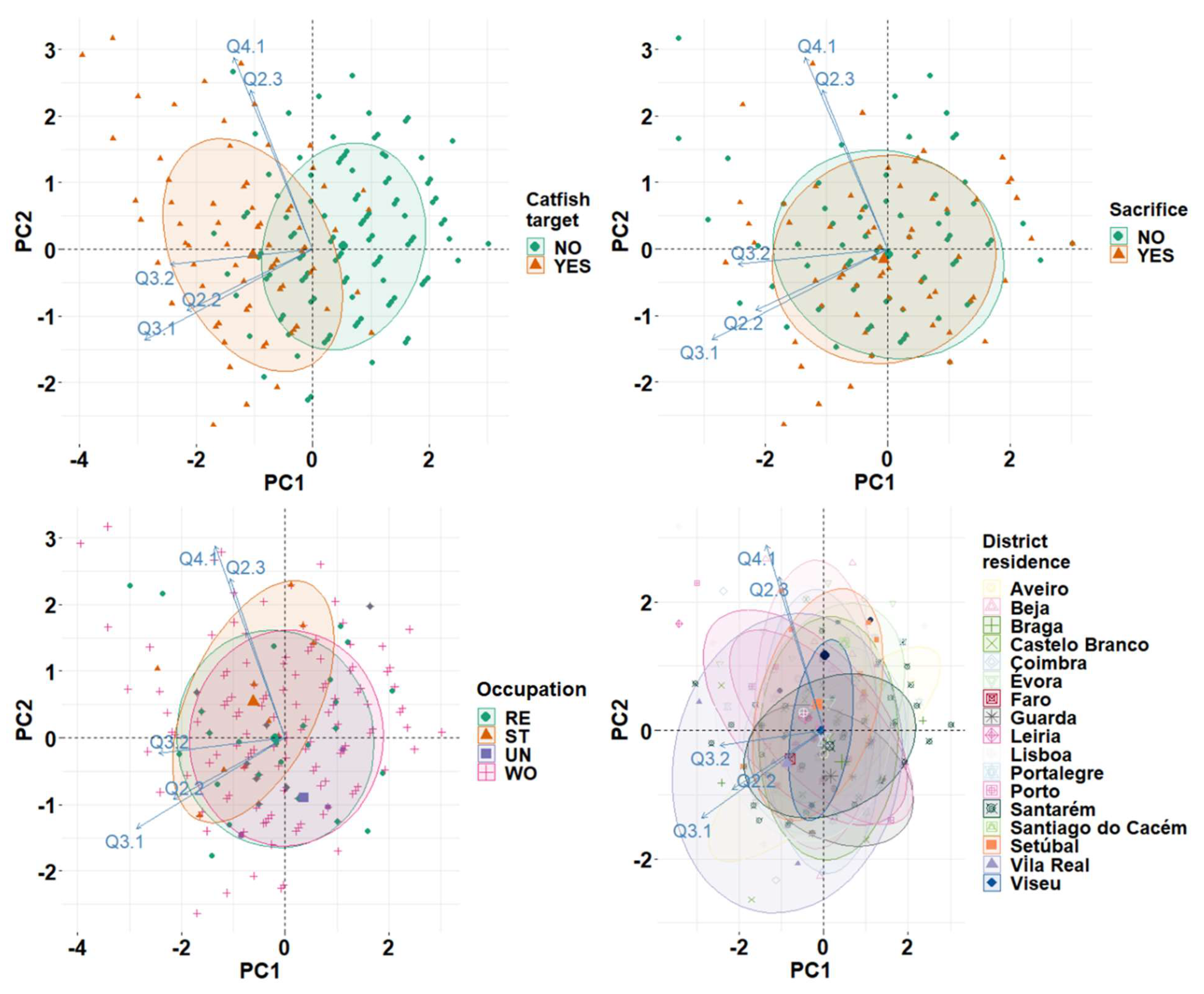
Figure 2.
Probability of the angler practice catch & release according to his/her agreement (left; -2 – totally disagree, -1 – disagree, 0 – neither agree or disagree, 1 – agree, 2 – totally agree) with the statements that catfish has a positive effect in the development of sport-recreational angling (Q3.5) and that it brings positive effects to the native fish populations (Q4.1). Probability of the angler targeting for catfish during angling according to his agreement (right; -2 – totally disagree, -1 – disagree, 0 – neither agree or disagree, 1 – agree, 2 – totally agree) that catfish has a positive effect in the development of sport-recreational angling (Q3.5), and occupation (black – retired, pink – student, green – unemployed, and blue – working).
Figure 2.
Probability of the angler practice catch & release according to his/her agreement (left; -2 – totally disagree, -1 – disagree, 0 – neither agree or disagree, 1 – agree, 2 – totally agree) with the statements that catfish has a positive effect in the development of sport-recreational angling (Q3.5) and that it brings positive effects to the native fish populations (Q4.1). Probability of the angler targeting for catfish during angling according to his agreement (right; -2 – totally disagree, -1 – disagree, 0 – neither agree or disagree, 1 – agree, 2 – totally agree) that catfish has a positive effect in the development of sport-recreational angling (Q3.5), and occupation (black – retired, pink – student, green – unemployed, and blue – working).
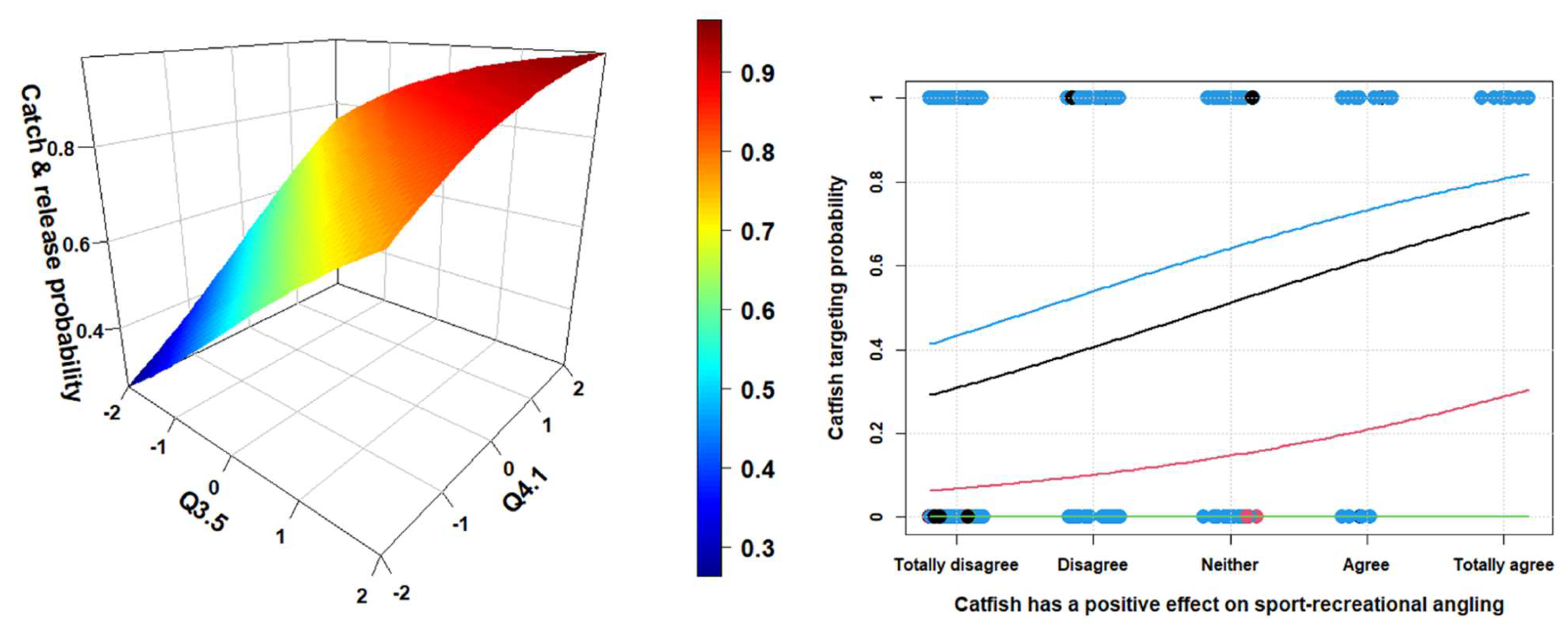
Figure 3.
Inference of the anglers opinion regarding the positive effect of catfish to sport-recreational angling (left) as a function of catfish angling frequency (Q3.2) and their opinion about the positive impact on native fish species (Q4.1); and the anglers opinion regarding the positive effect of catfish on native fish species communities (right) as a function of how many years anglers have been angling (Q2.1) and their agreement with the statement that the catfish is beneficial to the development of sport-recreational angling (Q3.5).
Figure 3.
Inference of the anglers opinion regarding the positive effect of catfish to sport-recreational angling (left) as a function of catfish angling frequency (Q3.2) and their opinion about the positive impact on native fish species (Q4.1); and the anglers opinion regarding the positive effect of catfish on native fish species communities (right) as a function of how many years anglers have been angling (Q2.1) and their agreement with the statement that the catfish is beneficial to the development of sport-recreational angling (Q3.5).
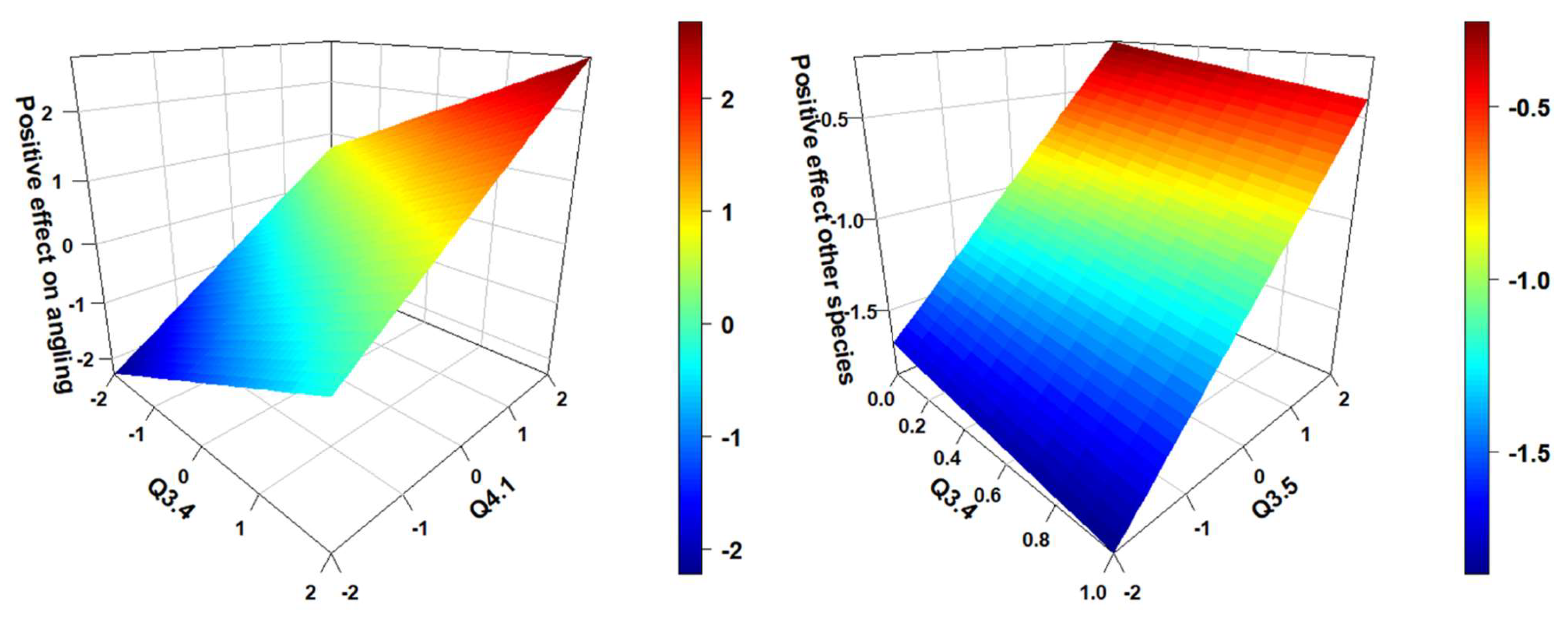
Table 1.
Response results (percentage and absolute frequency) related to anglers’ sociodemographic features between two groups of sport-recreational anglers: the ones who target European catfish (catfish anglers) and the ones who do not target European catfish (non-catfish anglers). Comparisons between these two groups tested by χ² test.
Table 1.
Response results (percentage and absolute frequency) related to anglers’ sociodemographic features between two groups of sport-recreational anglers: the ones who target European catfish (catfish anglers) and the ones who do not target European catfish (non-catfish anglers). Comparisons between these two groups tested by χ² test.
| Questions (Q) about anglers’ sociodemographic features | Catfish anglers % (n) |
Non-catfish anglers % (n) |
|---|---|---|
| Q1.1 Gender (χ² = 1.2724; p = 0.3493) | ||
| Male | 98.2 (112) | 95.9 (212) |
| Female | 1.75 (2) | 4.07 (9) |
| Q1.2 Age (years) (χ² = 11.459; p = 0.01849) | ||
| < 18 | 0.0 (0) | 0.45 (1) |
| 18-30 | 21.9 (25) | 15.8 (35) |
| 31-50 | 52.6 (60) | 41.4 (92) |
| 51-70 | 24.6 (28) | 37.4 (83) |
| >70 | 0.88 (1) | 4.95 (11) |
| Q1.3 Occupation (χ² = 11.304; p = 89.96x10⁻⁴) | ||
| Employed | 92.0 (103) | 77,9 (173) |
| Student | 0.89 (1) | 5.41 (12) |
| Unemployed | 0.0 (0) | 1.8 (4) |
| Retired | 7.14 (8) | 14.9 (33) |
|
Q1.4 District of residence (χ² = 30.164; p < 5.00x10⁻⁴) |
||
| Santarém | 29.5 (31) | 26.7 (55) |
| Lisboa | 6.67 (7) | 10.2 (21) |
| Castelo Branco | 19.0 (20) | 3.4 (7) |
| Portalegre | 10.5 (11) | 7.28 (15) |
| Coimbra | 8.57 (9) | 5.83 (12) |
| Porto | 2.86 (3) | 6.31 (13) |
| Sum of all other less responded districts | 22.9 (24) | 40.3 (83) |
Table 2.
Response results (percentage and absolute frequency) for angling activity questions between two groups of sport-recreational anglers: the ones who target European catfish (catfish anglers) and the ones who do not target European catfish (non-catfish anglers). Comparisons between these two groups tested by χ² test.
Table 2.
Response results (percentage and absolute frequency) for angling activity questions between two groups of sport-recreational anglers: the ones who target European catfish (catfish anglers) and the ones who do not target European catfish (non-catfish anglers). Comparisons between these two groups tested by χ² test.
| Questions (Q) about angling activity | Catfish anglers % (n) |
Non-catfish anglers % (n) |
|---|---|---|
| Q2.1 For how many years have you been angling? (χ² = 4.1455; p = 0.3633) | ||
| <5 | 9.56 (11) | 7.59 (17) |
| 5-10 | 10.4 (12) | 8.48 (19) |
| 11-20 | 20.0 (23) | 18.8 (42) |
| 21-50 | 53.9 (62) | 52.2 (117) |
| >50 | 6.09 (7) | 12.9 (29) |
| Q2.2 How often do you go angling? (χ² = 0.92243; p = 0.8436 | ||
| Several times a week | 17.4 (20) | 14.7 (33) |
| At least once a week | 43.5 (50) | 42.9 (96) |
| At least once a month | 29.6 (34) | 29.9 (67) |
| Less than ten times a year | 9.57 (11) | 12.5 (28) |
| Q2.3 How far do you travel to fish? (χ² = 18.189; p = 19.99x10⁻⁴) | ||
| < 5Km | 6.09 (7) | 6.25 (14) |
| 5 – 30 Km | 34.8 (40) | 24.1 (54) |
| 31 - 100 Km | 30.4 (35) | 38.8 (87) |
| > 100 Km | 20.9 (24) | 29.9 (67) |
| Abroad | 7.83 (9) | 0.89 (2) |
| Q2.4 What group of species do you mainly fish for? (χ² = 15.698; p = 64.97x10⁻⁴) | ||
| Predators (pikeperch, largemouth bass and European catfish) | 39.7 (89) | 25.4 (110) |
| Common carp and Barbels | 29.0 (65) | 35.1 (152) |
| Trout | 5.36 (12) | 7.16 (31) |
| Species common in sport angling (nases, roach; goldfish and gibel carp, bleak, black bullhead) | 16.5 (37) | 23.3 (101) |
| Mullets | 7.14 (16) | 6.70 (29) |
| Other species | 2.23 (5) | 2.31 (10) |
Table 3.
Response results (percentage and absolute frequency) for European catfish angling activity questions between two groups of sport-recreational anglers: the ones who target European catfish (catfish anglers) and the ones who do not target European catfish (non-catfish anglers). Comparisons between these two groups tested by χ² test. Question 3.2 “Did you already angle for European catfish?” is not presented since it is the grouping variable.
Table 3.
Response results (percentage and absolute frequency) for European catfish angling activity questions between two groups of sport-recreational anglers: the ones who target European catfish (catfish anglers) and the ones who do not target European catfish (non-catfish anglers). Comparisons between these two groups tested by χ² test. Question 3.2 “Did you already angle for European catfish?” is not presented since it is the grouping variable.
| Questions (Q) about European catfish angling | Catfish anglers % (n) |
Non-catfish anglers % (n) |
|---|---|---|
| Q3.1 Your knowledge about European catfish (identification, biology, ecology) is good? (χ² = 31.148; p < 5.00x10⁻⁴) | ||
| Totally agree | 21.7 (25) | 8.48 (19) |
| Agree | 37.4 (43) | 36.2 (81) |
| Neither agree or disagree | 36.5 (42) | 29.9 (67) |
| Disagree | 4.35 (5) | 13.8 (31) |
| Totally disagree | 0.00 (0) | 11.6 (26) |
| Q3.3 If you fish it how many European catfish do you usually catch per year? (χ² = 78.732; p < 5.00x10⁻⁴) | ||
| < 5 | 59.1 (68) | 96.0 (215) |
| 5 - 10 | 4.35 (5) | 1.79 (4) |
| 11 - 50 | 31.3 (36) | 1.79 (4) |
| > 50 | 5.22 (6) | 0.45 (1) |
| Q3.4 What do you do to European catfish when you catch it? (χ² = 5.7186; p = 0.02349) | ||
| Sacrifice | 45.5 (51) | 61.4 (70) |
| Release to the water | 54.5 (61) | 38.6 (44) |
| Q3.5 European catfish is beneficial to the development of sport-recreational angling. (χ² = 26.379; p < 5.00x10⁻⁴) | ||
| Totally agree | 11.3 (13) | 0.00 (0) |
| Agree | 11.3 (13) | 12.1 (27) |
| Neither agree or disagree | 14.8 (17) | 18.4 (41) |
| Disagree | 25.2 (29) | 27.4 (61) |
| Totally disagree | 37.4 (43) | 42.2 (94) |
| Q3.6 European catfish is an angling trophy. (χ² = 3.3199; p = 0.4998) | ||
| Totally agree | 21.2 (24) | 14.0 (31) |
| Agree | 23.0 (26) | 26.2 (58) |
| Neither agree or disagree | 15.0 (17) | 15.8 (35) |
| Disagree | 17.7 (20) | 21.7 (48) |
| Totally disagree | 23.0 (26) | 22.2 (49) |
Table 4.
Response results (percentage and absolute frequency) for the perceived impact of European catfish on other fish species questions between two groups of sport-recreational anglers: the ones who target European catfish (catfish anglers) and the ones who do not target European catfish (non-catfish anglers). Comparisons between these two groups tested by χ² test.
Table 4.
Response results (percentage and absolute frequency) for the perceived impact of European catfish on other fish species questions between two groups of sport-recreational anglers: the ones who target European catfish (catfish anglers) and the ones who do not target European catfish (non-catfish anglers). Comparisons between these two groups tested by χ² test.
| Questions (Q) about the impact of European catfish on other fish species | Catfish anglers % (n) |
Non-catfish anglers % (n) |
|---|---|---|
| Q4.1 European catfish has a positive impact on other fish species. (χ² = 10.058; p = 0.03148) | ||
| Totally agree | 2.63 (3) | 0.0 (0) |
| Agree | 0.88 (1) | 0.45 (1) |
| Neither agree or disagree | 12.3 (14) | 7.27 (16) |
| Disagree | 35.1 (40) | 31.8 (70) |
| Totally disagree | 49.1 (56) | 60.5 (133) |
| Q4.2 European catfish has a negative impact on other fish species. (χ² = 14.34; p = 44.98x10⁻⁴) | ||
| Totally agree | 55.3 (63) | 62.9 (139) |
| Agree | 28.9 (33) | 31.2 (69) |
| Neither agree or disagree | 8.77 (10) | 5.43 (12) |
| Disagree | 5.26 (6) | 0.45 (1) |
| Totally disagree | 1.75 (2) | 0.00 (0) |
| Q4.3 If you agree with the previous answer, indicate which species are impacted: (χ² = 4.4709; p = 0.4818) | ||
| Predators (pikeperch and largemouth bass) | 17.5 (62) | 15.8 (132) |
| Carps and goldfish and gibel carp | 22.3 (79) | 19.5 (163) |
| Diadromous fish (eels, shads and sea lamprey) | 16.6 (59) | 17.0 (142) |
| Bleak | 16.9 (60) | 16.7 (139) |
| Barbels | 19.4 (69) | 20.1 (168) |
| Other species | 7.32 (26) | 10.8 (90) |
|
Q4.4 Indicate why they are impacted? (χ² = 13.56; p = 0.7831) |
||
| Predation | 89.8 (53) | 91.4 (139) |
| Other reasons | 10.2 (6) | 8.55 (13) |
|
Q4.5 Where European catfish may have a negative impact, what do you think needs to be done? (χ² = 17.285; p = 54.97x10⁻⁴) |
||
| Remove all catfish locally | 39.5 (51) | 58.7 (138) |
| Remove all big catfish (>130 cm) locally | 10.1 (13) | 5.96 (14) |
| Remove all small catfish (<130 cm) locally | 8.53 (11) | 4.26 (10) |
| Scare the fish away | 0.0 (0) | 0.85 (2) |
| Finding an alternative solution considering the specific context | 3.88 (5) | 1.28 (3) |
| No opinion | 19.4 (25) | 17.4 (41) |
| Other alternatives | 18.6 (24) | 11.5 (27) |
Disclaimer/Publisher’s Note: The statements, opinions and data contained in all publications are solely those of the individual author(s) and contributor(s) and not of MDPI and/or the editor(s). MDPI and/or the editor(s) disclaim responsibility for any injury to people or property resulting from any ideas, methods, instructions or products referred to in the content. |
© 2025 by the authors. Licensee MDPI, Basel, Switzerland. This article is an open access article distributed under the terms and conditions of the Creative Commons Attribution (CC BY) license (http://creativecommons.org/licenses/by/4.0/).
Copyright: This open access article is published under a Creative Commons CC BY 4.0 license, which permit the free download, distribution, and reuse, provided that the author and preprint are cited in any reuse.