

Submitted:
31 January 2025
Posted:
06 February 2025
You are already at the latest version
Abstract
Early scholars such as Darwin noted that a series of similar trait changes occurred between domesticated mammals and their wild counterparts, and that similar trait changes occurred in humans. Follow-up studies in recent years have further confirmed the findings of earlier scholars. These changes are known as domestication syndrome (DS). Human DS variation occurred over thecourse of two to three hundred thousand years before and after the formation of Homo sapiens, and is thought to be the result of human self-domestication. The main way to realize human self-domestication has been an important topic in recent years. And more than theoretical explanations have been proposed. In this paper, the main methods of previous research are briefly reviewed, and some related concepts are slightly revised. For example, the attributes and efficacy of selective reproduction in silver fox domestication experiments, the approximate correspondence between DS and the reduction of sexual dimorphism, and the correlation between DS causes and sexual selection.On this basis, this paper proposes a preliminary judgment on the causes of human DS that is different from the past : according to our present knowledge (empirical facts), there are two powerful drivers of DS variation, namely,exogamy and coming-of-age ceremony in tribal institutions. These two systems existed completely before the colonization of Australian tribes. This paper usesthe early classical ethnography of Australia by Fison, Howitt, Spencer, and Gillen to analyze and summarize the basic content of these two systems (reconstructing the original state of the system before colonization). Then, its domestication function and efficacy are discussed. Based on this, it is concluded that the joint effect of exogamy and coming-of-age ceremony is the main way for human beings to achieve self-domestication. We are very fortunate to have evidence about the Australian tribes in the early stages of civilization before colonization. We can trace their origins and examine their evolution accordingly. The alliance of two multimale-multifemale(mm-mf) groups through non-violent approach is the first step in the speciation of Homo sapiens.The tribal system formed in this historical link is the initial process of human civilization and an important foundation for human prosperity to this day.
Keywords:
human self-domestication (HSD)
; Domestication syndrome (DS)
; DS formation reasons
; homo sapiens
; tribal society
; exogamy
; initiation ceremonies
; or initiation rituals
I. The Issue: The Causes of the Domestication Syndrome
Domestication and Self-Domestication
A range of morphological and behavioral phenotypic changes occur between domestic animals and their wild counterparts. There is a correlation between human selection in domestication conditions and natural selection in the wild. What Darwin proposed for biological evolution is an important basis for the theory. The first chapter of “On the origin of Species“ is“Variation in domestic conditions“ and the second chapter is “Variation in natural conditions“ . Darwinalso makes it clear that similar traits exist in humans as in domesticated animals (Darwin 1872, Chapter 7). If humans are domesticated, then who are those who domesticate? This seems to Darwin to be one contradiction that is difficult to reconcile. Therefore, he merely points out the existence of empirical facts in theinductive sense.
Follow-up studies further confirmed the findings of earlier scholars. A set of phenotypic variations in domestic mammals compared to their wild counterparts roughly speaking includes smaller body shape, thinner bones, changed fur color, smaller teeth, retracted snout and brain mass shrinkage etc., more docile temperament in terms of behavior, prolonged early childhood, decreased aggression, increased prosocial behavior, etc. (See Hemmer 1990, Clutton-Brock 1992, Kunzl and Sachser 1999, Damborenea Moreno 2020). Domestication of a set of mammals in terms of behavior, physiology and shape of the phenotypic variant of the state iscalled “domestication syndrome DS“ (see e.g. Hemmer 1990; Hare et al 2012; Sanchez-Villagra et al. 2016; Trut 1999; Wilkins et al. 2014; Zeder 2008, 2015). DS in humans has also been further confirmed in related studies (see e.g., Ashley Montagu 1955; Gould 1977; Leach 2003, 2007; Hare and Tomasello 2005; Deacon 2009,2010; Bednarik 2012; Cieri et al. 2014; Sherwood et al. 2017). This constitutes a relatively reliable empirical basis for the judgment that humans are a self-domesticated (SD) species (see for example, Wrangham 2011).
The silver fox domestication experiment pioneered by Belyaey in the 1960s is a more efficient laboratory replication of early human domestication of animals (Belyaey 1969). The experimental foxes came from farms (for obtaining fur). The 30 most docile males and 100 females were selected from thousands of farm foxes that had been in captivity for more than 50 years (Lord et al. 2020) by evaluating their aggressiveness when approached by humans. Farm foxes have been subject to conscious or unconscious artificialreproductive selection. In the experimental phase, a very strict selection methodwas used, repeatedly inserting a gloved hand into the cage and evaluating its aggressive response. Only less than 3% of males and less than 10% of females were selected to participate in the breeding of the experimental group (Belyaey 1979; Trut 1999; Trut et al. 2004; Trut et al. 2006). This constitutes a high-pressure artificial reproductive selection domestication pathway. As a result, theproportion of docile foxes in the experimental group increased rapidly, approaching 100% after about 50 generations (Bidau 2009).
The domestication syndrome of domestic animals appeared in the behavior and morphology of docile foxes. Based on this, the researchers proposed two judgments on the cause of DS in experimental foxes : one is the change of the original reproductive state before domestication (Belyaev 1979), and the other is the result of selective breeding for docile behavior (Trut et al. 2009). Here is a simple judgment that is not difficult to verify. Wild foxes have a certain degree of sexual dimorphism, which indicates that there is a certain degree of male mating competition in the wild fox population. There is a positive correlation between the participation rate and winning rate of wild male foxes in mating competition and their aggressiveness. Therefore, selective breeding for docile behavior is not a simple behavioral selection in a simple sense. The more important focal effect is sexual selection, which is the selection of weak male individuals from generation to generation (<3%), and the selective breeding of dozens of generations of losers in the mating competition of wild male foxes. This is a high-intensity reverse selection for the competitive advantage phenotype of males, which is the main cause of the high-speed variation of DS in experimental foxes. Selective breeding for docile behavior offemale foxes (<10%) is a secondary cause of the high-speed variation of DS.
Home sapiens DS variation began more than 100,000 to 200,000 years ago, andbegan to accelerate about 50,000 to 100,000 years ago (see, e.g., Cieri et al. 2014; Bednarik 2012, 2014). Because the selection pressure comes from within the species, human domestication is called self-domestication. The important opportunity for this study was the discovery that bonobos (compared to chimpanzees) also have a set of typical domestication syndromes (see e.g. Hare and Tomasello, 2005; Hare et al. 2012). Darwin distinguished two types of human domestication of plants and animals: unconscious choice and conscious choice (Darwin, 1868). In this sense, self-domestication in humans and bonobosis an unconscious choice. The causal mechanism of human self-domestication (HSD) is an important topic in evolutionary anthropology that has been studied by multiple disciplines in recent years. See Hare (2017), Wrangham (2019a) and Shilton et al. (2020) for a review of related research. The focus of this studyis the cause of human DS. This is an important way for us to positively understand the history of early humans and their evolutionary mechanisms.
Mating System and Sexual Dimorphism
Most primates have varying degrees of sexual dimorphism, which is mainly reflected in the prominent expression of male secondary sexual characteristics. Such males are larger than females and have larger canine teeth. Darwin (1871) proposed sexual selection, which includes inter-sexual selection and intrasexual mating competition, and is the main cause of sexual dimorphism generally accepted by researchers.Plavcan (2012)'s comprehensive research and literature citations can be referredto. Primate sexual selection mainly occurs in mating competition between males. Dominant males win higher mating shares (reproductive success rate) in the group, leading to the accumulation or maintenance of male dominant phenotypes, thus forming different degrees of sexual dimorphism (see, e.g., Ely and Kurland 1989; Gaulin and Sailer1984; Gordon 2006; Grueter and van Schaik 2009; Kay et al. 1988; Leutenegger and Cheverud 1982, 1985; Lindenfors and Tullberg 1998; Mitani et al. 1996; Plavcan 2001; Plavcanand vanSchaik 1992, 1997; Smith and Cheverud 2002; Lassek and Gaulin 2022).
Sexual dimorphism in modern humans is also mainly reflected in the prominentexpression of male characteristics. In terms of morphology, adult males are on average 7-8% taller than females, and males weigh about 15% more than females on average (see, e.g., Gustafsson and Lindenfors 2004; Gray and Wolfe1980; Smith and Jungers 1997). Modern humans also have highly sexually dimorphic upper body musculature and strength: males have an average of 61%more overall muscle mass and 90% more upper body strength than females (Lassek and Gaulin 2009).Modern human males have a brain volume approximately 8% larger than that of females at birth, and by adulthood, the average male brain volume is about 13% larger than that of females (see, for example, Paus 2010; Ruigrok et al. 2014). Other differences include differences in overall bone robustness, the presence or absence of beards (Darwin 1871; Muscarella and Cunningham 1996; Neave and Shields2008; Dixson et al. 2018), differences in craniofacial morphology and their robustness (such as Thornhill and Gangestad 2006; Cieri et al. 2014), differences in tooth size (such as Brace and Ryan 1980), and the pitch of male voices being much lower than that of female voices (such as Childers and Wu 1991; Puts et al. 2012).
Most of these male characteristics appear when individuals are close to sexual maturity. This indicates that there is a corresponding relationship between male characteristics and reproductive competition (see Lassek and Gaulin 2022 and references). As mentioned earlier, human sexual dimorphism has been greatly reduced since the late Pleistocene. Therefore, modern human sexual dimorphism is a remnant of the significant reduction. There are two directions of phenotypic variation: one is positive variation before domestication, and the other is reverse variation after domestication begins. Reverse variation leads to the formation of domestication syndrome, while positive variation is the main cause of pre-domestication phenotypes. Positive variation is the term used in this article for the increase or maintenance of sexual dimorphism, and the main mechanism comes from the different degrees of mating competition and reproductive skew between males within the species. By contrast, reverse variation signifies the reduction of sexual dimorphism, and its main mechanism stems from thedestruction of the original mechanism of positive variation (Belyaev 1979). DS is largely the result of the reduction of sexual dimorphism (see e.g. Hare et al. 2012; Cieri et al. 2014; Theofanopoulou et al. 2017; Puts et al. 2022; Gleeson 2020; Gleeson and Wilson 2023).
Some researchers explain the cause of DS from the perspective of changes in neural crest cell function (e.g., Wilkins et al. 2014). Such mechanisms should be an intermediate link in the causal sequence from behavioral changes to morphological responses. In Darwin's (1872) theory of species evolution, there are three main mechanisms that cause variation in domestic animals. The three mechanisms drive variation in different strengths, namely, the cumulative effect of selection, changes in living conditions, and the increased use and disuse of organs. In most cases, these three mechanisms work together in different proportions. Darwin (1872) expanded on the economizing mechanism of previous researchers (e.g., Lamarck 1809) that the increased use and disuse of organs lead to variation, and proposed a more general evolutionary mechanism: natural selection constantly tries to economize every part of the species' traits. Its scope of application is not limited to specific organs, but also includes parallel variation of multiple traits caused by economizing mechanisms. Darwin's developmental economizing mechanism is an important condition for reverse variation to occur.
Different mating systems of different species lead to different degrees of male competition and positive variation. For example, the main mating system of gorillas is a one-male-multiple-female type, in which there are very fierce physical confrontations between adult males, and it is always the strongest and most aggressive males who can win and monopolize the right to mate with multiple females. The long-term selection result of this mating system (from confrontational behavior to morphological response) is a large difference in sexual dimorphism, and the average weight of male gorillas is about twice that of females (see, e.g., Jungers and Susman 1984). For another example, the mating system of chimpanzees is a highly complex social relationship of multiple males and multiple females, and ranking disputes between males are the main way to win a larger share of mating (Wroblewski et al.,2009). The male confrontation of chimpanzees is of moderate degree,the more complex intelligence game in the coordination of male teams and ranking disputes weakens the physical confrontation (see e.g., Goodall 1986;Ghiglieri 1987;Wittig and Boesch 2005; De Waal 2007;Wilson et al.,2014), which leads to a moderate degree of sexual dimorphism, and the average weight of male chimpanzees is about 127% of that of females (see, e.g., Jungers and Susman 1984).
From the last common ancestor (LCA) of chimpanzees and humans to early humans such as Australopithecus, Homo habilis, and Homo erectus, this may be a multi-branch evolutionary process (see, for example, Antón et al. 2014; Schwartz and Tattersall 2015; Harcourt-Smith 2016; Agustí 2018; Vaneechoute 2024). Exploring the social type (mating system) of early humans through the degree of sexual dimorphism has been an important topic in related disciplines in recent years. Many scholars have concluded that early humans most likely lived in polyamorous groups similar to chimpanzees (see, e.g., Foley and Lee 1989; Ghiglieri 1987b; Lovejoy 2009; McHenry 1996; Chapais 2009, 2010, 2011, 2013; Wrangham 1987, 2019 a, 2019b; Dunbar 2005; Foley 1996). Based on relevant evidence from human male characteristics, phylogeny, palaeontology and archaeology, some researchers pointed out that the mechanism of human sexual dimorphism is the high intensity of male reproductive competition, which is the result of the phenotypic accumulation of positive variation in the mm-mf group mating system (see Hill et al. 2017; Kordsmeyer et al. 2018; Lidborg et al. 2020; see also Puts et al. 2022 and its references; Lassek and Gaulin 2022 and its references).
HSD Problem and Its Solution
The cause of human DS is a complex and highly complex field of cognition, which can be called the HSD problem. Wrangham (2019a, b) summarized nine major judgments on the mechanism of HSD: (1) Genetic Group Selection, (2) Group-Structured Culture Selection, (3) Social Selection by Female Mate Choice, (4) Social Selection by Choice of Cooperative Task Partners, which was also described by Tomasello (2016) as the "interdependence hypothesis" between individuals in the group, (5) Self-Control, (6) Cooperative Breeding, (7) Population Density selection pressure, (8) Use of Lethal Weapons, and (9) Language-Based Conspiracy.
Wrangham (2019a, b) believes that "language-based conspiracy" is the main reason for Homo sapiens to achieve self-domestication: 200,000 to 300,000 years ago (after the emergence of language), early Homo sapiens lived in mm-mf groups similar to chimpanzees, and most adult men in the group planned and killed the tyrannical leader (through private communication). This constitutes a key selection step in human evolution to reduce reactive aggression. On this basis, a relatively peaceful "elder" regime (The set of elders who would rule society) was eventually formed (led by the collective will of most adult men). This judgment is also called the execution hypothesis, and the use of lethal weapons (such as javelins) is also related to this (see Wrangham 2019a, Chapter.7-Chapter.13; 2021 for details). Its original idea comes from Darwin (1871). See, for example, the literature review and argumentation on the same research direction by Gintis et al. (2015) and Del Savio et al. (2020).
In chimpanzee groups without language, a tradition of social sanctions has been formed by most males against deviant ones (seriously threatening the normal life of the group), and the targets of sanctions are mostly overly domineering male leaders (see Boehm 2017, 2018 for specific cases). However, such sanctions have not led to the collapse of the male hierarchy within the group, nor can they change the stable existence of the social position of the male leader. Therefore, it is necessary to find a solution to the problem in a more open perspective. Gleeson and Wilson (2023) discussed the causes of a group of shared phenotypes (DS) of domesticated animals from another perspective: shared reproductive disruption. They believe that the domestication process is a destruction of the mating system before domestication, which leads to convergent variation (DS) of the original phenotypes of domesticated and self-domesticated species.
Positive variation of human brain volume (intracranial volume): From primitive humans (about 350 ml) to the emergence of Homo sapiens (about 1499 ml), human brain volume increased fourfold in five or six million years (see Tattersall 2023 and references cited therein). Reverse variation of human brain volume: Since 200,000 to 300,000 years ago, the long-term trend of human brain enlargement has suddenly reversed (started to shrink rapidly), and the brain volume of modern humans (from about 1499 ml to about 1330 ml) has shrunk by about 12.7% (ibid.). Bednarik's fossil data analysis results: The reverse variation rate of human brain volume is 37 times the previous forward variation rate (see Bednarik 2014 and references cited therein). Some researchers tend to directly explain the cause of the reverse variation of human brain volume, such as Tattersall (2018, 2023)'s review of such explanations.
Reduced brain size and thin skull are among the most representative DS variants in domesticated and self-domesticated species (see, e.g., Kruska1987, 1988, 1996; Rehkämper et al. 2008; Zeder 2012; Wright et al. 2020; Sánchez-Villagra 2022; Balcarcel et al. 2022). Various morphological variations in the human skull (such as thinning and globularization of the skull, reduced brain volume, changes in craniofacial structure, smaller teeth, etc.) are mostly related to sexual dimorphism, which began about 200,000 to 300,000 years ago (see, for example, Bergstr?m et al. 2021) and began to accelerate 50,000 to 100,000 years ago (see, for example, Brace and Ryan 1980; Hawks 2011; Lahr and Wright 1996; Leach 2003; Lieberman 1996, 2011; Cieri et al. 2014; De Caro 2024). It also includes DS behavioral variations: reduced aggression, increased submissiveness and prosociality,etc. (see, for example, Cieri et al. 2014, Hare 2017, Wrangham 2019a, 2019b, Damborenea Moreno 2020).
Human DS includes multiple sub-items. In addition to several sub-items of skullvariation, it also includes smaller body size, reduced overall bone robustness, reducedmuscle tissue and strength, etc. (see, e.g., Lassek and Gaulin 2022 and references therein). All of these sub-items can be incorporated into the evolutionary context of positive and reverse variation, from which we can obtain a relatively complete and reliable dynamic trajectory of human DS variation. As Homo sapiens walked out of Africa and successively entered Eurasia, Oceania,It also encompasses North and South America, which entered at a later stage (see, e.g., Waters 2019.Rapid reverse variation of DS occurred synchronously in this time and space. For example, in Europe, the solidity of human skulls has decreased by 10% every 10,000 years in the past 50,000 years (Bednarik 2011). Similarly, in Europe, the human brain volume has shrunk by 10% to 30% compared with 20,000 years ago (Wrangham 2019a). For example, fossil data show that the craniofacial features of late Pleistocene Australian males were more prominent, their brains were larger, theirbodies were larger, their teeth were larger, and their bones were stronger than those of contemporary Aboriginal males (Brown 1987, 1992). Since the late Pleistocene, the average brain size of Australian males has shrunk by about 10% (Brown 1987, 1992).
First, the basic trend of positive variation in the millions of years of human evolution is the increase in sexual dimorphism, which is an expression of the gradual prominence of male characteristics (it is not ruled out that there are interference and fluctuations from various factors in the meantime). Second, the reverse variation overthe past 200,000 to 300,000 years is the reduction of sexual dimorphism and the weakening of male characteristics. From the perspective of weakening male characteristics, such variation is called male "feminization"; from the perspective of delayed and early end of male characteristic development, such variation is called male "paedomorphic" and "juvenilization". Third, the driving factors of positive variation come from male mating competition and reproductive bias in mm-mf groups, and the driving factors of reverse variation come from the weakening of male competition. Fourth, DS is a collection of several morphological and behavioral sub-items, which is the result of the reduction of sexual dimorphism. Therefore, the mechanism of the reduction of sexual dimorphism is the cause of DS. Fifth, the main factor that causes the reversal of positive variation to reverse variationis the change of the original mating system. The intensity of the newly emerged selection pressure after the change determines the speed of reverse variation. Sixth, inthe sense of sexual selection, the selection effect plays a role in the mating and reproduction links.
So far, we have preliminarily found a general way to propose and solve the problem. According to our present knowledge, there are two reverse variation driving factors that directly act on the mating and reproduction links and are powerful enough. One is the coming-of-age ceremony, and the other is exogamy. The two coexist in many modern primitive ethnic tribal societies. These two systems existed relatively intact inAustralian tribes before colonization. This article illustrates the basic forms of these two systems below, and then discusses their domestication effects.
II. Australian Tribal System: Current Situation and Original State
Among modern primitive nations, the organization and institutional forms of tribal society are relatively intact in Australia. Australian aborigines are in the hunting and gathering stage (early Neolithic Age), which is equivalent to the social development level of Eurasia about 10,000 years ago. The development level of some American tribes (mid-late Neolithic Age) is higher than that of Australia. The two have not had any contact for at least 50,000 to 60,000 years, but there are some common characteristics of tribal organizations and systems. Therefore, Australian tribes have two aspects of cognitive value: tracing their origins forward and examining their evolution backward. This is the basic consensus of most scholars in early social and cultural anthropology. Before contact with European colonists, there was a distribution in Australia of five or six hundred independent tribes with their own dialects; and their organizations, institutional forms and religious concepts were similar. Each independent tribe is a social union composed of several to dozens of local groups (totem clans). The local groups have an average of about 100 people, with a strong sense of territory, and usually live a hunting and gathering life in their respective territories.
There are six major interrelated systems in Australian tribes (for related research and cited literature, see Zhang Yan 2009, 2012): (1) Elders’ ruling system: In each tribe, there is a stable power institution (Council of Elders) with old men as the core. (2) “Witchcraft cooperation system” among groups within the tribe, mainly based on the totem proliferation ceremony (Intichiuma) (on an annual cycle). (3) Regular gathering system for all tribal members (on an annual cycle). (4) Exogamy, a compulsory marriage system between the same generation of two half tribes within the tribe (on a generational cycle), including the system of living with the husband after marriage. (5) The rite of passage domestication process that every tribal member (at least males) must undergo during adolescence (on a generational cycle). (6) The soul reincarnation system with the rite of passage as the main way to achieve it (on a generational cycle). These systems and tribal religions complement each other and together maintain the stable operation of independent tribal social life.
During the colonization process after 1788, infectious diseases, killings, and land deprivation led to the death of a large number of Aboriginal people, which in turn led to the rapid and thorough destruction of the original social organization, system, and religious concepts. For field researchers in social and cultural anthropology after 1911, "the current situation" is not "the original situation". The population loss of Australian Aboriginals during the colonization process can constitute an important indicator of the degree of destruction of their original social organization, system, andreligious concepts. We need some numbers, one is the approximate population of Australian Aboriginals in 1788, and the other is the population number at the lowest point. The first number is very sensitive. Smith et al. called it "political arithmetic": the lower the estimated number, the less the population loss of Aboriginals during thecolonization process (Smith et al. 2008).
Radcliffe-Brown (1930) estimated it to be 250,000 to 300,000. In recent years, some researchers have begun to re-evaluate this number using a more objective stance and method. Butlin (1993) concluded that the number was between 1 and. and 1.5 million.This is a rather conservative estimate, given the vast size of the Australian continent and the population carrying capacity of its flora and fauna. Rowley (1978) believed that the actual number was much higher. Different researchers have estimated numbers ranging from 750,000 to 3 million (Goodall 1995). This article uses a relatively conservative number: 1.2 million. The remaining Aboriginal population in 1888 was about 60,000, but only 31,000 remained in 1911 (Day 2001; Tatz 1999). It rose back to around 100,000 in 1971 (Hugo 2001).
Peterson (1990) divided the ethnographic records and research of Australian Aboriginals by anthropology into three periods: the first is the prosperity of systematic research (1870-1925), the second is the establishment of professional anthropology (1925-1946), and the third is the rise of academic anthropology (1946-1974). As shown in Figure 1, at the beginning of the first period (1870), the population of Australian Aboriginals had lost more than nine-tenths. Before the end of this period, the Aboriginal population had dropped sharply to one-fortieth of the original population. Many tribes had become extinct before being observed. The original forms of Australian tribal organizations, systems and beliefs have been rapidly disappearing. After the population bottleneck, the original status of Australian tribes could not be restored by a population rebound. This was a rapid and irreversible process of destruction of the original status quo. 1911 was a watershed year, and the later the ethnographic records were, the less valuable they were. For the colonial government's dispossession of Aboriginal land since 1788 and its authoritarian control over the remaining Aboriginal population in "Aboriginal reserves", see McGrath (1995).
Swain and Trompf (1995) pointed out: " If we are honest, we must admit that there are very few accounts of (Australian Aboriginal)communities that were written before Western society had played havoc with ‘tradition’—although, until recently, most ethnographers downplayed, even ignored altogether, the colonial realities of their research environment. " This is a heavy academic criticism. The more specific the ethnographers after the population bottleneck introduced the colonization background of the field research subjects, the more they reduced the empirical value of the ethnographic text. This is the "ethnographic dilemma" faced by professional anthropologists in Australia after the bottleneck. Since the late 19th century, the same "ethnographic dilemma" has existed to varying degrees in field surveys in all colonies (including Africa, Australia, North and South America, and some Pacific islands, etc.).
As mentioned above, the basic consensus of early social and cultural anthropologists: Australian tribes are an extremely important reference for studying the "ancient society" of the Old World. In the late 19th century and early 20th century, there was an imbalance between the supply and demand of Australian ethnography: the demand (the strong interest of European academic circles) far exceeded the supply (the lack of data for field research). Against this background, the first batch of investigators with clear goals appeared, the first wave of large-scale systematic field surveys on Australian tribes, and the first batch of Australian ethnographic works. They generally include: Kamilaroi and Kurnai by Fison and Howitt (1880), The Native Tribes of South-East Australia by Howitt (1904), The Native Tribes of Central Australia by Spencer and Gillen (1899), and Native Tribes of the Northern Territory of Australia by Spencer (1914).
Fison, Howitt, Spencer, and Gillen did not receive professional training, but they were inspired and guided by the first generation of anthropologists (such as Morgan and Frazer), and they also followed the curiosity, dedication, and objective and rigorous academic style of Victorian naturalists. Their above-mentioned works are the results of a relatively complete survey of the last (very reluctant) original social and cultural forms of Australian tribes, which simply distinguished between the current situation and the original state. For some extinct tribes, we can only record the incomplete information provided by some elders based on their memories. After that, the original form of the field objects continued to disappear at a faster rate, including being forgotten in the memory of the second and even third generation of residual population. Field objects with higher value disappeared rapidly. As a result, most ethnographic recorders downplayed or did not mention the impact of colonization on their field objects.
The above works are the first and last batch of high-quality systematic records of Australian tribal ethnography classics. As mentioned earlier, before contact with colonists, the organizations, systems and religions of Australia's five or six hundred independent tribes were similar. We have the conditions and the need (based on the above documents) to summarize an Australian tribal social original state that encompasses all social organizations, systems and religious concepts that exist simultaneously. Exogamy and initiation ceremonies (also known as initiation rituals, etc.) are important components of the original state of Australian tribal social systems. This article will summarize the basic contents of exogamy and coming-of-age rites based mainly on the aforementioned works by Fison, Howitt, Spencer, and Gillen.
III. Overview of Australian Exogamy (Part 1)
The author has studied Australian exogamy (part of the content and diagrams below are from Zhang Yan 2006, 2008, 2009, 2012). There are two main types of Australian tribes. Radcliffe-Brown (1913) called them Type I and Type II. Type I is a two-semi-tribe structure (1+1). The patrilineal Type I that is often mentioned is the Kariera tribe, and the matrilineal Type I is the Kamilaroi tribe. Type II is a two-semi-tribe andfour-subtribe (semi-Moieties) structure (2+2). Type I is a top-downthree-level social organization: tribe, semi-tribe, local group (totem clan); Type II is afour-level social organization: tribe, semi-tribe, sub-tribe, local group (totem clan).
The marriage rules of Type I are four-class systems (Four-class Systems), and the marriage rules of Type II are eight-class systems (Eight-class Systems). Earlier researchers referred to the marriage categories of Australian tribes as "classes", "sub-classes", "Sections", "sub-sections", etc. (see, for example, Radcliffe-Brown 1913, 1918). In this paper, they are uniformly referred to as "category”. Thecategory system and its rules for intermarriage, inheritance, and kinship identification are not social organizations in themselves, but a set of artificially designed logical markers and deductive tools to regulate intermarriage, inheritance, and kinship identification between social organizations (half-tribes and sub-tribes).
Type I: Four-Category System (1+1)
The basic attributes of the four categories are to distinguish the two half-tribes A and B and the two generations A and B: (1) A half-tribe A generation; (2) A half-tribe B generation; (3) B half-tribe A generation; (4) B half-tribe B generation. The first letter is fixed in position to represent the half-tribe attribute, and the second letter is fixed in position to represent the generation attribute. The simplified expression of the four categories is: AA, AB, BA, BB. In the four-category rule, intermarriage relationships are strictly limited to categories of different half-tribes and the same generation. The following uses "=" to represent intermarriage relationships (the left side is the husband and the right side is the wife). The four intermarriage formulas between the four categories are: AA= BA, BA = AA, AB = BB, BB = AB. The husband and wife categories in these four formulas are all attribute relationships of different half-clan and the same generation. Previous researchers have used a variety of methods to express category rules. The expression method of this article is, first, to fix the letter expression position (half-clan, generation order), and second, to use (A and B) binary distinction in each expression position. Therefore, it can be simply referred to as: fixed order binary expression.
In the two inheritance systems of the four-category rule, paternal inheritance means that children inherit the half-clan and clan attributes of the father, and matrilineal inheritance means that children inherit the half-clan and clan attributes of the mother. The relationship between parents and children is represented by "→" below. The left side of "→" is parents, and the right side is children. The following are two sets of (paternal and maternal) intermarriage and inheritance formulas. Four formulas of paternal four-category intermarriage and inheritance rules: AA= BA→AB, BA = AA→BB, AB = BB→AA, BB = AB→BA. Four formulas for the four-category intermarriage and inheritance rules of the maternal line: AA = BA→BB, BA = AA→AB, AB = BB→BA, BB = AB→AA. In the first set of four formulas, the half-family attribute (A or B) of the child comes from the father; in the second set of four formulas, the half-family attribute of the child comes from the mother. The basic function of the four-category system is to classify and mark the two exogamous half-families and their two generations, and to regulate the intermarriage between the two half-families through four intermarriage and inheritance formulas. This set of classification names is used in cycles of two generations, resulting in "repeated generation of category names". This is a set of artificially designed (marking family lines and generations and regulating intermarriage and inheritance) formalized logical marking and deduction tools.
The following two sets of diagrams are used to describe the four-category intermarriage and inheritance rules of the paternal line (Figure 2 and Figure 3) and the maternal line (Figure 4 and Figure 5).The open diagrams of previous researchers used vertical (top-down) iteration, and this paper changed to horizontal (left-to-right) iteration. In the past, researchers sometimes used closed loop diagrams. Two open diagrams and two loop diagrams are given below. In the figure below, "△" represents male and "〇" represents female. The arc represents the legal marriage relationship between men and women at both ends, which is equivalent to "=" in the above formula. The straight line with an arrow (equivalent to "→" in the above formula) connects parents and children (and also indicates the intergenerational inheritance of clan affiliation). The relationship between "△" and "〇" connected by "[" is between brothers and sisters, and intermarriage is prohibited between the two. The above legends (such as =, →, [, △, 〇, etc.) are mostly the continuation of the expression conventions in previous related studies. All intermarriage, inheritance and kinship relationships here are intergroup relationships between categories. It is necessary to remember this issue at all times, otherwise it is easy to make judgment errors. "Legal intermarriage relationship" refers to the mandatory marriage object. For example, AA can only marry BA at the other end of the arc, and it is strictly forbidden to marry any other category, including the same-name category of "skip-generation duplication". In the Australian tribal "status quo", the punishment for violating the rules was usually death.
The formalized description of the rules of marriage and inheritance for the four categories above can correspond to any ethnographic case of the same type of Australian tribes. For example, Radcliffe-Brown (1913) introduced two groups of category names for the Kariera tribe: the two categories of the A half tribe are BanakaandPalyeri, and the two categories of the B half tribe are Burung and Karimera. Radcliffe-Brown also gave four formulas for the tribe's four paternal categories of marriage and inheritance: Banaka = Burung→Palyeri, Burung =Banaka→Karimera, Palyeri = Karimera→Banaka, Karimera = Palyeri→Burung. The attributes of the two half tribes Aand B are relative: if one half tribe is set as A, the other half tribe is B. The two generations of the four categories are also relative: if two categories of the same generation are set as A, the other two categories of the same generation are set as B. If Banaka is set as AA, the half tribe and generation attributes of all four categories can be derived according to the category rule. The following is the derivation result: Banaka (AA) = Burung (BA) →Palyeri (AB), Burung (BA) =Banaka (AA) →Karimera (BB), Palyeri (AB) =Karimera (BB) →Banaka (AA), Karimera (BB) = Palyeri (AB) →Burung (BA).
Take the matrilineal four-category rule of the Kamilaroi tribe (Howitt 1904 p.104) as an example. This tribe also has two half tribes and four categories. The two categories belonging to the Kupathin half tribe are Ipai and Kumbo, and the two categories belonging to the Dilbi half tribe are Murri and Kubbi. Let the Kupathin half tribe be the A half tribe and the Dilbi half tribe be the B half tribe. According to the classification rules of the Kamilaroi tribe given by Howitt (1904 p.200), the half tribe and generation attributes of the four categories of the tribe can be obtained: Ipai (AA), Kumbo (AB), Kubbi (BA), Murri (BB). The four formulas of the matrilineal marriage inheritance rules of the tribe are: Ipai (AA) = Kubbi (BA) →Murri (BB), Kumbo (AB) = Murri (BB) →Kubbi (BA), Murri (BB) = Butha (AB) →Ipai (AA), Kubbi (BA) = Ipai (AA) →Kumbo (AB). There is an important phenomenon here: in the Kamilaroicategory attributes, there is an additional level of gender distinction for the four categories. This level of distinction corresponds to the "△" (male) and "〇" (female) in the above figure (Figure 2-Figure 4).
Four-Point Eight-Category Representation
In the Kamilaroi tribe, the gender distinction for the four categories is four-point eight: AA male (Ipai), AA female (Ipatha); AB male (Kumbo), AB female (Butha); BA male (Kubbi), BA female (Kubbitha); BB male (Murri), BB female (Matha). As long as one more rank is added, the binary representation for gender can be realized (A represents male, B represents female). Three ranks can be set: left rank (A, B half tribe), middle rank (A, B generation), right rank (A, B gender). Thus, the formalized representation of four-point eight is realized: AAA, AAB, ABA, ABB, BAA, BAB, BBA, BBB. In order to distinguish it from the eight-category system discussed later, the eight-point system of four categories plus gender distinction is called "four-point eight categories" here. The matrilineal succession formula of the Kamilaroi tribe is expressed in four-eight categories: Ipai (AAA) = Kubbitha (BAB) →Murri (BBA) and Matha (BBB), Kumbo (ABA) = Matha (BBB) →Kubbi (BAA) and Kubbitha (BAB), Murri (BBA) = Butha (ABB) →Ipai (AAA) and Ipatha (AAB), Kubbi (BAA) = Ipatha (AAB) →Kumbo (ABA) and Butha (ABB). The above formula corresponds to the Kamilaroicategory rule list of Howitt (1904, p. 200).
The following is an example of the Warrai tribe’s patrilineal four-eight categories introduced by Spencer (1914 p.53-54): Adjumbitj (AAA) = Allpungerti (BAB) →Appularan (ABA) and Allpularan (ABB), Appularan (ABA) = Allinmitj (BBB) →Adjumbitj (AAA) and Alljambitj (AAB), Appungerti (BAA) = Alljambitj (AAB) →Auinmitj (BBA) and Allinmitj (BBB), Auinmitj (BBA) = Allpularan (ABB) →Appungerti (BAA) and Allpungerti (BAB). Spencer also positively introduced several other patrilineal four-eight categories in the second chapter of the book (Spencer 1914 p.42-87), such as the Yungman tribe, Maluuru tribe, Mudburra tribe, Waduman tribe, etc.
Four-division-eight-category is a more complete and accurate formalization of the four-category rule. The following is a formalization of paternal and maternal four-division-eight-category marriage and inheritance. The paternal four-division-eight-category marriage and inheritance rule: AAA= BAB→ABA and ABB, ABA = BBB→AAA and AAB, BAA= AAB→BBA and BBB, BBA = ABB→BAA and BAB.The maternal four-division-eight-category marriage and inheritance rule: AAA= BAB→BBA and BBB, ABA = BBB→BAA and BAB, BBA = ABB→AAA and AAB, BAA= AAB→ABA and ABB.
Morgan (1877) distinguished kinship systems into two types: classificatory and descriptive. This is Morgan's important contribution. In subsequent social anthropology research, the formal expressions of these two types of kinship terms are "self-centered", including the "male propositus" and "female propositus" that distinguish between genders. There are two kinship coordinates that need to be strictly distinguished. In the classification kinship system, the "society-centered" intergroup term "sociocentric" is used in the descriptive kinship terms, where "I (Ego)" is "group I". The inter-individual term "egocentric" is used in the descriptive kinship terms, which is "individual I". The expression angle of the descriptive "individual I" matches the coordinates of the nuclear family kinship terms, which is an accurate and effective way to express descriptive kinship terms. The Australian tribes’ categorical marriage rules use sociocentric intergroup terms, which are slightly different in the distinction and merging of kinship relationships. A sectionspecifically discussing this issue has been temporarily removed due to space constraints. It lists two important tables: (1) Four kinship term systems for four female "category Ego " in the four-division and eight-division categories; (2) Four kinship term systems for four male "category Ego " in the four-division and eight-division categories.
IV. Overview of Australian Exogamy (Part 2)
Type II: Eight-Category System (2+2)
The basic structure of the four-category system (Type I) is 1+1 of two half-tribes, with generational distinction, which is 2 divided into 4, and gender distinction, which is 4 divided into 8 categories. A set of four "husband = wife → children" formulas are used to regulate intermarriage and lineage inheritance between half-tribes.
The basic structure of the eight-category system (Type II) is 2+2 of two half-tribes with one more layer of sub-tribe distinction. With generational distinction, it is 4 divided into 8, and a set of eight "husband = wife → children" formulas are used to regulate intermarriage and lineage inheritance between half-tribes and sub-tribes.
Similar to the four-category system, the classification names of the eight-category system are also used in cycles of two generations (the category names are repeated every other generation). The threeexpression positions of the eight categories:Taking A (B)A as an example, the first order"A" from the left is a half-tribe marker, the second order " (B)" is a sub-tribe marker (the brackets are added here to distinguish it from the four-point eight-category symbol system), and the third order "A" is a generation marker. The other seven categories are the same. The eight category attributes synthesized from the three expression positions are: A (A)A, A (A)B, A (B)A, A (B)B, B (A)A, B (A)B, B (B)A, B (B)B. The eight maternal categories are rare or absent in Australian ethnographic cases, so this article only discusses the eight paternal categories.
Eight intermarriage and inheritance formulas for the eight paternal categories (husband=wife→children):A (A) A=B (A) A→A (A) B, A (B) A=B (B) A→A (B) B, B (A) A=A (A) A→B (A) B, B (B) A=A (B) A→B (B) B, A (A) B = B (B) B→A (A) A, A (B) B= B (A) B→A (B) A, B (A) B=A (B) B→B (A) A,B (B) B = A (A) B→B (B) A.The typical case of the eight paternal categories is the northern Arunta (or spelled Arunda, Aranda, Arrernte) tribe. The tribe's eight intermarriage and succession formulas (see Spencer and Gillen 1899 p.72):
(1) Panunga〖A (A)A〗 = Purula〖B (A)A〗→Appungerta〖A (A)B〗
(2) Uknaria〖A (B)A〗 = Ungalla〖B (B)A〗→Bulthara〖A (B)B〗
(3) Purula〖B (A)A〗 = Panunga〖A (A)A〗→Kumara〖B (A)B〗
(4) Ungalla〖B (B)A〗 = Uknaria〖A (B)A〗→Umbitchana〖B (B)B〗
(5) Appungerta〖A (A)B〗 = Umbitchana〖B (B)B〗→Panunga〖A (A)A〗
(6) Bulthara〖A (B)B〗 = Kumara〖B (A)B〗→Uknaria〖A (B)A〗
(7) Kumara〖B (A)B〗 = Bulthara〖A (B)B〗→Purula〖B (A)A〗
(8) Umbitchana〖B (B)B〗 = Appungerta〖A (A)B〗→Ungalla〖B (B)A〗
Radcliffe-Brown (1913) pointed out a feature of Type II (paternal eight categories): all men must marry their (inter-category name) " mother's mother's brother's daughter's daughter ". This feature can be seen intuitively in Figure 6. This is a kinship name with the mother's side as the identification coordinate. From Figure 6, we can also see a "husband=wife" inter-category kinship name with the father's side as the coordinate:granddaughter of the grandfather's sisters. Early documents have recorded many cases of patrilineal eight categories, such as the Ilpirra tribe in central Australia, the Kaitish tribe, the Iliaura tribe, the Waagai tribe, the Warramunga tribe, the Bingongina tribe, the Walpari tribe, etc. (see Spencer and Gillen 1899 p.90-91), and the Warrai tribe, the Waduman tribe, the Mudburra tribe, the Djauan tribe, the Yungman tribe, the Mungarai tribe, etc. in northern Australia (see Spencer 1914 p.54-59;also refer to Radcliffe-Brown 1913 and the references cited therein). In the above cases, the Warramunga tribe, the Bingongina tribe and the Walpari tribe have gender distinctions based on eight categories, which belong to the patrilineal eight-point sixteen categories.
There is an important phenomenon in the above cases: some tribal category names are the same or have similar pronunciations (see also Spencer and Gillen 1899, 1904, 1927; Howitt 1884b). This shows that these tribes have a homologous derivation relationship. Morgan (1877) also noticed the existence of similar phenomena in North American tribes (see below for details). Type I and Type II summarized by Radcliffe-Brown include at least the intermarriage inheritance rules of most Australian tribes. In Western Australia, there are also a small number of "indirect exchange" intermarriage rules, that is, one-way marriage between three or more social groups. For example, the intermarriage relationship between three social groups is: A marries his daughter to B, B marries his daughter to C, and C marries his daughter to A. This constitutes a circular intermarriage structure (with three generations as a complete cycle). Due to space limitations, this article will not discuss this issue in detail.
The four most commonly used symbols in previous studies are A, B, C and D; the eight most commonly used symbols are A1, A2, B1, B2, C1, C2, D1, D2 (see Radcliffe-Brown 1913, 1918, 1930; Elkin 1931, 1933; Dumont 1966; Thomas 2010; Denham 2012; Denham and Scholar 2014; Harvey 2018). Lévi-Strauss mentioned that Australia's categorical marriage rules and kinship system have crystalline beauty and are highly complex, and it takes mathematicians to figure out the relevant issues (Lévi-Strauss 1966). Some early ethnographic records and researchers (such as Frazer, Howitt, Fison, Spencer, Gillen) believe that Australia's categorical rules are the product of human design (Frazer 1909). In other words, there needs to be a clear intention of institutional design and a link to establish the system in society. From the inception of the system to its gradual improvement, these are some specific historical events.
From Animal Groups to Human Society
Although the Australian type I tribe contains several to dozens of local groups (clans), the 1+1 structure that these tribes still use can provide us with an extremely important clue to understanding: based on this, we can trace back to the early human beings, two independent groups with multiple males and multiple females, to form an alliance through mutual marriage. This is the beginning of civilization driven by reason and a key step from animal groups to human society (the emergence of the nuclear family coincides with this). Tylor (1889) pointed out that the external condition for the emergence of exogamy is the inter-group conflict in the small social stage: "Exogamy, by relying on the continuous combination of clans, enables a growing and expanding tribe to maintain its own consolidation, enabling it to defeat any isolated and helpless small endogamous group." He further pointed out that this is the "primary political issue" in the small social stage of human beings (ibid.). For a long time, exogamy has been considered the main way to achieve inter-group alliances (see e.g. Lévi-Strauss 1949,Chapais 2009).
The four-category system is a complex, regular and rigorous logical structure. The eight-category system is of the same nature but more complex. Spencer (1914) pointed out that the Australian category system is likely to come from the careful design of some people in tribal history who are more talented than ordinary people. Lévi-Strauss (1968) told us in a more euphemistic way that such more talented human individuals may be people with abilities similar to Plato and Einstein. After reading my related research (Zhang Yan 2006, 2008, 2012), a mathematician friend was shocked by the logical complexity, rigor and sophistication of the category rules (four-point and eight-point systems). He told me: The creator of the category rules can be called the Newton of the Stone Age.
Allen (1989a, 2008) proposed an important judgment similar to the conclusion of this article: the Australian four-category rule may have been formed before Homo sapiens left Africa. Note: Allen's Tetradic theory diagram (see Figure 1 in 1989b, Figure 5.1 in 2008) can be compared with Figure 3 and Figure 5 in this article. Genetic research has also reached a similar conclusion: intermarriage can be traced back to before Homo sapiens left Africa (Walker et al. 2011). The above two diagrams (Figure 7 and Figure 8) positively show the specific institutional establishment links (1+1 and 2+2) of the human small social stage to achieve alliance through mutual marriage. 1+1 is more important. The formation of the first relatively mature and stable 1+1 social union should be at the historical position of the early population bottleneck of Homo sapiens (Harpending et al., 1993; Ambrose 1998).
The 2+2 structure should be considered the highest achievement of human beings in mathematics and logic in the Paleolithic Age. For the creators of the eight-category rule, this is a logical problem to smoothly achieve 2+2 social integration. Before integration, the two four-category systems were independent binary marriage alliances. After integration, the two binary structures merged into one. As shown in Figure 8, this is a very sophisticated 2+2 plan. This plan ended the original endogamy of the two "two-organizations" and made them exogamy units that intermarried with each other, forming a larger-scale marriage alliance. Through the combination transformation of intermarriage in two generations and one cycle, the parallel existence of four monophyletic succession groups A (A), A (B), B (A), and B (B) was successfully realized. Accurate understanding of this empirical object requires the positive participation of contemporary competent mathematicians.
The premise for the researcher to achieve maximum simplicity of the theory is that he must complete a denser and more detailed logical deduction and construction process. Only on this basis can he simplify. Referring to Figure 6 and Figure 8, we can clearly see that in this deduction and construction process, all category attributes and the arrangement of inter-category marriage and succession relationships within at least six generations are all in his thinking. Therefore, it is necessary to carefully appreciate the entire logical connotation of Figure 6 and Figure 8, so as to understand the careful consideration of this "Stone Age mathematician" and appreciate the complexity and precision of this creative thinking process and its elegance of simplicity. This process is consistent with Tylor's judgment above, but the difficulty of implementation is beyond his expectation. In the sense of Tylor's (1889) judgment, the four categories and the eight categories are both artificially created small social alliance plans. Choosing an alliance is a political purpose, and establishing a marriage system between alliance members is a necessary way to form an alliance. It is not because of marriage that the alliance is formed, but for the sake of the alliance, the marriage is formed.
V. Ways to Reconstruct the Original Status of Australian Adulthood Ceremony
Early Australian ethnographic recorders (such as Howitt 1884a; Spencer and Gillen 1899) have pointed out that adulthood ceremonies were once common in Australian tribes, and their basic procedures were similar. Australian tribal members can be divided into three components: women, children, and adult men who have passed the adulthood ceremony. When girls grow up, they all marry into the other half of the tribe. When boys grow up, they join the adult male social group through the adulthood ceremony, thereby obtaining the right to marry, and marry and have children according to the category rules. The adult male group is the backbone of Australian tribal society, and tribal systems and religious concepts are passed on within this scope. Women and children have noright to know the confidential parts of sacred culture. The adulthood ceremony was once the most important social system and religious ceremony in the "original status" of Australian tribes.
This article summarizes the main literature on Australian tribal coming-of-age ceremonies: Spencer and Gillen, The Native Tribes of Central Australia, Chapters 7, 8, and 9 (Spencer and Gillen 1899p.212-386); The Northern Tribes of Central Australia, Chapter 11 (Spencer and Gillen 1904 p.328-374). Spencer, Native Tribes of the Northern Territory of Australia, Chapter 3 (Spencer 1914 p.89-177). Howitt, The Native Tribes of South-East Australia, Chapters 9 and 10 (Howitt 1904 p.509-677). Howitt's papers "On Some Australian Ceremonies of Initiation" (Howitt 1884a) and "The Jeraeil, or Initiation Ceremonies of the Kurnai Tribe" (Howitt 1885).
The above ethnographic records were made between the late 19th and early 20th centuries. Therefore, it is necessary to distinguish between "current situation" and "original situation". The objects of the records (Australian tribes) generally went through the following process. After the initial contact with the colonists in 1788, multiple epidemics caused a sharp decline in the population of the aborigines who had no immunity. At the same time, the colonists began to deprive the aborigines of their territory. This triggered a desperate resistance from the aborigines. Due to the huge disparity between the strength of the two sides, the colonial land deprivation was basically completed in the mid-to-late 19th century. As a result, most tribes lost their original land or were completely extinct, and the remaining population of less than one-twentieth was forced to enter settlements controlled by the colonial government or missionary institutions (some became refugees on the edge of towns). In these settlements, the remaining population came from many tribes. Thus, social integration of the remaining population of multiple tribes occurred. At this time, the original social organization could not be restored, but the marriage system of specifying intermarriage objects according to category rules was restored to a certain extent, and the previous different category names and intermarriage rules of multiple tribes were readjusted and reimplemented. The mission of the missionary agency was to force the Aboriginals to become Christians, which was another important factor that led to the rapid destruction of tribal religion and institutions.
As mentioned earlier, the inheritance of the sacred culture of Australian tribes was strictly limited to adult male groups. Before the original status quo was seriously damaged, if someone revealed secrets to women and children, the punishment was usually death. In the process of land expropriation, the hatred of the Aboriginals for the colonists was self-evident. These two factors led to the Aboriginals not revealing the sacred traditions of the tribe to the field investigators from the colonists in the early days. After the establishment of the colonial government's rule, some Aboriginals in a disadvantaged position began to cooperate with researchers' ethnographic surveys to varying degrees. This was the historical background for the first batch of important ethnographers (such as Fison and Howitt and Spencer and Gillen, etc.) to carry out field work. Prior to this, the hatred of the Aboriginals was an important obstacle to high-quality field research. After this, the Aboriginal population quickly entered a bottleneck in 1911, when it plummeted.
After that, the destruction of the original state worsened. For example, Radcliffe-Brown's field research was slightly later than this. In some of his papers on the social organization of Australian tribes (such as Radcliffe-Brown 1918, 1930-1931), he repeatedly referred to the then current situation of the research as "too late". His main field objects were in Western Australia, where the social organization of the Aboriginals had been completely destroyed. Many of his data on social organization and exogamy were collected in an isolation area (an isolated island) that specifically accommodated patients with venereal diseases (see Layton 1997). At this time, it was unlikely to observe a relatively complete Australian coming-of-age ceremony. In summary, the colonial background of Australian ethnographic observation can be divided into three stages. The first is the land deprivation period, when hatred caused communication barriers between the Aboriginals and Europeans. Second, after the colonial government established the ruling order of the indigenous people through violent conquest, the original state of tribal society had been and was being rapidly destroyed. Third, after the bottleneck of the sharp decline of the indigenous population. Since then, field workers have faced Swain and Trompf (1995)'s sincere and frank academic criticism to varying degrees.
By the end of the 19th century and the beginning of the 20 century, an irreversible “ethnographic dilemma” had occurred. Howitt's long dissertation (1885), for example, records Kurnai tribal coming-of-age rituals, which in their original state were held about once every 20 years. Colonizers occupied the area in 1842 (Howitt 1904 p.617). The remnants of the tribe's population were concentrated in settlements controlled by the colonial government and the ceremony has long since ceased. What is recorded in this article is the resumption of the rite of passage by the Aboriginal people at Howitt's request. Another example is the bar mitzvah of the Larakia tribe recorded by Spencer (1914 Chapter 3). The tribe is extinct and this case is largely from the oral account of an elderly survivor from memory. Loss of territory is another important indicator of the extent to which the original status of Australian tribes has been destroyed, and in many cases this has led to a simplification of ceremonial procedures. During this time period, many ethnographically documented Aboriginal ceremonies have transitioned from being conducted normally in their original state to being performed by tribal survivors for payment (Petch 2003).
The transition was from ceremonies better preserved in their original state but with poor communication pathways to better communication pathways but with severe damage to the original state. The dozens of cases documented in this literature vary in terms of access, narrative method, perspective, complexity, and detail, due to differences in the conditions under which they are examined, the quality of preservation of the original condition of the subject, and the degree of cooperation of the informant with the investigator. The most complete and detailed cases are the rites of passage of the Arunta and Ilpirra tribes (Spencer and Gillen 1899), which comprise more than 170 pages, and the more concise cases, such as the rites of passage of the Geawe-gal tribes, which are less than one page in length (Howitt 1904). Nonetheless, the established ethnographic record of this time period is, after all, the primary empirical basis for social anthropological reconstruction of Australian tribes as they were. Although more than a century has passed, and although the basic consensus of many Australian ethnographic fieldworkers since then has been to 'strip' the status quo of the original, the basic research into reconstructing the original status of Australian tribes on the basis of early documents seems to have been underdeveloped.
This work consists of the following steps: (1) To clarify to the maximum extent possible the temporal and spatial history of the destruction of tribal organizations in Australia after 1788, which is the basis for knowing the extent of the destruction of the original state in each case. (2) To collect all coming-of-age ritual cases in the ethnographic literature from the late 19th century to the early 20th century, and to summarize the basic procedures and main contents of the coming-of-age rituals of the Australian tribes. (3) Compare the similarities and differences among all the cases. (4) To find and summarize some screening criteria and analytical methods for reconstructing the original situation. (5) To give a relatively reliable basic form of Australian tribal rites of passage before colonization. There are some differences among the rites of passage of Australian tribes, such as some tribes only perform circumcision (circumcision), some have recircumcision (undercutting); some tribes do not practice circumcision. For example, some tribes do or do not perform the operation of knocking out the incisors during the rite of passage, and so on. The basic forms described above are therefore the result of empirical generalizations compatible with these divergent components.
The Australian tribal organization, system and religion is an important window to understand the history of early human civilization of not less than 100,000 years. As mentioned earlier, there was a basic consensus in early social anthropology that ethnographic observations and records of recent primitive peoples were the starting point of the discipline, and that comparative studies based on these ethnographic materials were an important way of reconstructing the prehistory of the Eurasian continent. Since then, most social anthropologists have abandoned this opinion and this direction of research. This has led to a disconnect between the discipline and the study of prehistory in recent years, which is summarized more objectively by Power et al. in the introduction to their book Human Origins: Contributions from Social Anthropology (Power et al. 2017).
Power et al. (2017) mention that social anthropology seems to have lost its voice in the study of prehistory. Some social anthropologists have tried to get out of this situation in recent years. However, the difficulty of understanding the research object seems to exceed the judgment of some researchers, such as the reconstruction of the Australian tribal system in its original state after the impact of colonization. High-quality completion of this work should be a prerequisite for social anthropology's participation in prehistory research. This paper's brief summary of the main elements of Australian tribal rites of passage is an initial attempt to do so. The number of documents and cases on which this paper is based should be no less than one-sixth of the higher-quality classic ethnographies of the same kind in the same period. It is an open-ended study. As this work in social anthropology unfolds in a positive way, the brief summaries in this paper can be tested, revised and refined.
VI. Coming-of-Age Ceremony of Tribes such as Arunta (Part 1)
The author has conducted positive research on Australian coming-of-age ceremonies (Zhang Yan 2009, 2012). Every boy in an Australian tribe must go through a coming-of-age ceremony to be accepted into the men's group. The aborigines themselves say that the coming-of-age ceremony is "making of young men" (Howitt 1904). The coming-of-age ceremony is both a process of instilling behavioral norms and a process of conversion to tribal religion. Teenagers are the recipients of the ceremony, adult men are the givers of the ceremony, and the tribal elders preside over the ceremony. The initial ceremony was for teenagers aged 11 or 12, and the most important ceremony was held in their twenties or thirties (Spencer and Gillen 1899). The following uses the coming-of-age ceremonies of tribes such as Arunta and Ilpirra (which have been described in the most detail) as the main case (Case 1), combined with the other 11 cases, to briefly summarize the main content of the Australian coming-of-age ceremony. The coming-of-age ceremony of tribes such as Arunta consists of three parts: the throwing ceremony (Alkirakiwuma); circumcision (Lartna) and recircumcision (Ariltha); and finally the Engwura ceremony, whose signature procedure is the "ordeals by fire".
The throwing ceremony (Spencer and Gillen 1899.p.212-218) is held when boys are 10 to 12 years old. The giver throws each recipient into the air in turn, catches them and throws them again, repeating many times. Women dance around and shout loudly. The members of the other half tribe (Umbirna) play an important role in the ceremony: patterns are painted on the back of the recipient, which are directly from the sacred ancient rock paintings. The Umbirna and the father and brother of the recipient (adult men of the half tribe) give the recipient adult ceremony training. The content is roughly as follows: This ceremony can improve your masculinity. After that, you are not allowed to play with women and girls, and you must learn to hunt bigger prey with adult men. You will undergo further initiation until you learn all the secrets of the tribal religion. At the end of the ceremony, the septum of the nasal cavity is pierced by the father or grandfather of the ceremonial recipient.
Circumcision and recircumcision (Spencer and Gillen 1899.p.218-270) are performed when the ceremonial recipient is 15 to 18 years old. The preparations for the ceremony are completed without the ceremonial recipient's knowledge. Three men suddenly grab the ceremonial recipient and take him to the main ceremony site. The women dance a dance that recreates the Alcheringa era. Alcheringa literally translates to "dream time". This is the time when all sacred things are created in the Aboriginal religious concept, and its correct meaning should be the creation time or "golden age" in the tribal cultural concept. The Council of Elders negotiates and decides all the details of the ritual procedure and the specific ritual functions of different members of the society. The Council of Elders participates in all ceremonies concerning men who have passed the initiation ceremony, and the host is the elder. The adult men of the other half of the tribe (Umbirna) play an important role in the ceremony. The recipient is taken to a secluded place and decorated (with grease, paint and feathers).
An adult male instructs the recipient on moral rules: his role in life has changed, he is no longer Ulpmerka, but Wurtja. He must then obey the elders unconditionally. The sacred things in the ceremony must be kept secret from women and children. He can only squat in a secluded place during the ceremony, not talking or looking up. He can only look up when the performer brings him out to show him. If he violates the commandment, he and his relatives will be severely punished. The initiation ceremony commandment is repeated many times in a very severe manner during the ceremony. In tribal traditions such as Arunta and Ilpirra, there is a system of class names based on the initiation ceremony procedure. Before the throwing ceremony, it is called Ambaquerka; after the throwing ceremony, it is called Ulpmerka; after the first body painting during circumcision, it is called Wurtja; after circumcision, it is called Arakurta; after recircumcision, it is called Ertwa-kurka; after passing all Engwura ceremonies, it is called Urliara. Urliara denotes a qualified man in terms of morality and faith (one of the important criteria for a good man is never to indulge in sexual pleasure).
In the ceremony, the recipient is assigned a spouse according to the category rules, and he is taught more tribal knowledge and behavioral norms. He is blindfolded and taken to the ceremony site where women and children are prohibited from approaching. Then he is asked to watch the performer perform the ritual (Quabara) of the ancestors of the founding era (Alcheringa) for him, and a special person explains the specific meaning of these ritual pantomimes tohim. Spencer and Gillen emphasized that such ritual performances are an important part of the Australian tribal coming-of-age ceremony. The recipients see for the first time the core of the tribal tradition: the totem ancestors in the ritual performance have dual attributes of half human, half animal or plant, and each performer represents a specific ancestor from the founding era. Someone explains to the recipients where these ancestors have been and what they have done, which has led to the formation of some landforms, and when they die, they leave the Churinga they carry with them in a sacred place. Churinga is an oval stone and wood piece about 8 to 15 cm long, decorated with patterns. These patterns represent the totem ancestors and the plots of their stories. Each totem clan has a sacred totem center where the Churinga is stored.
The recipient is told that the soul of the Alcheringa ancestor enters his Curing after death and begins reincarnation from generation to generation. Every woman's conception is due to the entry of an ancestor's soul into her body. After the child is born, the elders determine which ancestor has been resurrected.Those Quabara performers are the reincarnations of the ancestors they perform. Therefore, each of them has their own Quabara, in which they perform "themselves" from the founding era. Each man who passes the initiation ceremony is told that he is the reincarnation of which ancestor in which Churinga, and at the same time learns and performs those Quabaras that are exclusive to him. The singing, dancing, and pantomime performances continue for nearly ten days. Women only participate in the ceremony in rare cases. The arrangement and performance of all the ritual procedures, singing, dancing, and pantomime are very cumbersome, lengthy, and meticulous. When asked why this is necessary, the indigenous people usually explain that this is how it is done in Alcheringa. In other words, the entire ritual procedure is meticulously following the sacred traditions of the founding era of the system.
The elders' council determines the person who will perform the circumcision. The women retreat to their camps when the bullroar sounds. The bullroar is a special piece of wood (sometimes called a Churinga) tied to the end of a rope, which can make a loud noise when turned. The women and children have never seen a bullroar and have always been told that it is the sound of the great tribal god who takes the recipient away during the ceremony and makes him a man. Spencer and Gillen (1899.p.270) pointed out that this belief of women and children is common in Australian tribes. They also mentioned the specific content of this belief: the tribal god kills the recipient during the ceremony and resurrects him in the subsequent initiation ceremony (Spencer and Gillen 1904.p.343). Howitt (1885) also mentioned the prevalence of similar beliefs: the tribal god kills the recipient during the initiation ceremony and resurrects him.
The old man circumcises the recipient and shows him the bullroar for the first time. Tell him: The humming sound you hear is actually made by the bullroar, which is also the sacred Churinga. You have to carry it carefully, it can help your wound heal as soon as possible.Then he is warned not to let women see or know this secret, and to abide by a series of dietary taboos, otherwise he and his relatives will be killed. He is taken into the jungle, not allowed to speak, and lives alone in a semi-starved state (living alone during the coming-of-age ceremony) for about five to six weeks. He also has to go through an extremely painful head-biting ceremony. People bite his head hard in turn, a lot of blood flows out of the wound, and the recipient screams in pain.
After the circumcision wound heals, the equally important re-circumcision (cutting the urethra longitudinally under the penis) is held. The ceremony begins with singing and dancing and Quabara. The old man explains to the recipient and tells him which totem clans different Quabara belong to, while warning him to keep it secret. There is an important phenomenon: after the recipient undergoes re-circumcision, some Urliara who have passed the coming-of-age ceremony and are over 30 years old will take the initiative to ask for "re-circumcision (cutting the urethra deeper again)" for themselves. This is a voluntary act, and some people will take the initiative to undergo this operation twice or even three times. What beliefs drive them to stand up and willingly accept this potentially life-threatening severe pain? This is worth further investigation. This type of circumcision sometimes causes severe inflammation of the recipient's wound, or even death. After the wound heals, the recipient goes out hunting and offers the prey to the elders. The ban on speaking is lifted after the elders agree. Australian tribes also have a female coming-of-age ceremony, which is relatively simple and not as important as the male coming-of-age ceremony (see, for example, Spencer and Gillen 1899.p.269-271). Women are also reincarnations of Alcheringa ancestors, but they will never see their own Churinga in their lifetime.
VII. Coming-of-Age Ceremony of Tribes such as Arunta (Part 2)
The Engwura ceremony (Spencer and Gillen 1899.p.271-386) was attended by all members of the tribe and lasted for four months (September to January of the following year). The recipients were about 40 people (aged between 25 and 30 years old). The elders decided to hold the ceremony and sent messengers with the sacred Churinga to invite them. Fearing divine punishment, no one dared to refuse the invitation. This concept was common in the original state of Australian tribes (Howitt 1885). In order to isolate women and children, the ceremony site was chosen where the women's camp could not be seen. Some clans had to walk more than 200 miles, and other tribesmen walked even further to be invited. The southern Arunta tribe practiced the patrilineal four-category rule (Spencer and Gillen 1899.p.70 et seq.): Panunga (AA), Bulthara (AB), Purula (BA), Kumara (BB). The camp layout was based on the geographical location of the two half tribes and the clans to which they belonged. Women only participated in the ceremony at the beginning and end. There were more than 100 adult men participating in the ceremony. Several elders were responsible for arranging the ceremony procedures, and a host was a "perfect repository of tribal lore".
Spencer and Gillen (1899.p.7 et seq.) briefly introduced the background of colonization in central Australia. This case was in the second stage (of the three stages divided in the previous article): the colonial government's conquest of the aborigines had been established, and the original tribal system had been and was being destroyed. They mentioned that European immigrants had long been able to move freely and safely in the Arunta tribal territory and had regular (non-violent) exchanges with the aborigines. Based on this, it can be judged that the territory (or part of the territory) of the Arunta tribe may have been opened up as pasture by European immigrants. This issue requires further evidence toresolve. They also mentioned that due to the inconvenient transportation, dry climate and too scarce water resources in the central Australian region, only a few European immigrants entered. Therefore, there are still some tribes that are relatively well preserved in their original state. They mentioned that one clan of the Arunta tribe had become extinct, and only one person was left in another clan. Conservative estimates show that in the original state of the Arunta tribe, there would be no less than four or five hundred adult men participating in the ceremony, and no less than one or two hundred recipients. This should be the direct reason why Spencer and Gillen noticed that some ritual procedures (consulted by the elders) had changed: make do with what they had.
During the ritual period of isolating women (more than three months), the sacred Quabara ceremony of performing the deeds of ancestors was held day and night. Sometimes there were 5 to 6 ceremonies a day (every detail was meticulously refined). The Council of Elders appointed some elders to supervise the recipients and explain to them the meaning of these pantomimes (Quabara). The recipients were completely passive in obeying the instructions of the supervisors and could not do anything without permission, including not being able to speak (they could only use gestures to express urgent wishes such as wanting to drink water). Each clan brought all of their Churinga. Two storage places were set up next to the ritual site to store the Churinga of the two halves of the clan respectively. Checking the Churinga of the two halves of the clan separately is the most solemn moment of the Engwura ceremony, and people can only speak in a low voice. The clan leader (Alatunja) decorates the Churinga one by one with red ochre powder, and shows the recipient his Churinga, telling him the name and experience of the first owner of this Churinga (the Alcheringa ancestor), and that he is the reincarnation of this ancestor. The name of this ancestor becomes the most important name of the recipient from then on, and it cannot be revealed to other clan members and women for the rest of his life. When it must be mentioned in special rituals where only members of the clan are present, it can only be said in a low voice.
The recipient's self-identification is changed as a result: he is no longer the "I" that has been formed in the subject consciousness before the coming-of-age ceremony, but an ancestral "I" who leaves the Churinga and "resurrects" again in the body of his descendants. This can contribute to a more accurate understanding of the religious and psychological functions of the series of procedures of the coming-of-age ceremony: effectively realizing the other "I" in the subject consciousness of the recipient. This is the intended effect of the initiation ceremony of "making a person" and the "pseudonym" and "rebirth" of the recipient in the ceremony. Spencer and Gillen (1899) have discovered the importance of the wandering stories of ancestors in the Arunta traditional beliefs and their multiple connections with the real life of the tribe. As they said, these Alcheringa ancestral myths are monotonous and repetitive. Spencer and Gillen (1899 p.387-449) introduced such Alcheringa ancestral stories in chapters 10 and 11 of the book. In real life, the terrain created by the ancestors is the sacred mark of each clan's totem center (Oknanikilla). There is a hidden Churinga deposit (Ertnaulunga) in the totem center, which has become a sacred place for the totem clan. Each Alcheringa ancestor has his own nanja stone or nanja tree near the totem center, which is the entrance and exit of his soul through reincarnation. Spencer and Gillen (1899 p.128-166) fully introduce this concept and system in Chapter 5 of the book.
In the Arunta religious belief, the creation and initial performance of each ceremony and all its details of the coming-of-age ceremony took place in the Alcheringa era. These ritual contents that reflect the Alcheringa tradition show that the social organization (tribe, half-tribe, clan) and intermarriage rules in the reality of Australian tribes had been established in the Alcheringa era, and each Alcheringa ancestor (including his exclusive Churinga) was clearly given a marriage category attribute: Panunga (AA), Bulthara (AB), Purula (BA), Kumara (BB). After the end of the Alcheringa era, the two generations of Alcheringa people AB assisted each other through the coming-of-age ceremony procedures to realize the reincarnation of the souls of A and B cycles, and occupied the bodies of generations of descendants respectively. Hundreds of Quabara makeup pantomimes for more than 100 days have been showing the deeds of Alcheringa ancestors, and have been reinforcing the close relationship between the founding era of the system and real social life. The recipients are told which living members of the tribe are the reincarnations of which Alcheringa people. These ritual performances and concept indoctrination can constitute a powerful psychological suggestion, effectively realizing the other "I" in the consciousness of the recipient. As mentioned earlier, a clan of the Arunta tribe has become extinct, and dozens of Churinga of the clan are kept by the neighboring clan of the same half of the clan. When a reincarnated person of the extinct clan passes the adult ceremony, the clan leader in charge of custody will hand over dozens of Churinga to him and tell him the specific knowledge related to it. This reflects the self-repair function of the social organization of the Arunta tribe.
During the ceremony, the giver and the recipient cut their veins many times according to the procedure, and a large amount of blood is used for ritual (from half a pint to 5 and a half pints). The part near the end of the Engwura ceremony is the so-called "fire test". The giver covers the bonfire with branches and asks the recipients to lie naked on the branches covering the bonfire one by one. They have to lie on the fire for four or five minutes, without groaning or shouting, and cannot come down without the permission of the elders. The observers of this ceremony (Spencer and Gillen) tried to kneel on the branches covering the bonfire. Although they were wearing clothes, the burning smoke forced them to jump up immediately. It can be seen that the recipients endured unforgettable and huge pain in these four or five minutes. The same fire test was repeated twice, which was to strengthen the recipients' unconditional obedience to the elders and was also a severe test of the recipients' willpower and endurance. At the end of the ceremony, the recipients went out hunting and offered food to the elders. After getting the approval of the elders, the ban on talking and dietary restrictions was finally lifted. A "mature man (Urliara)" whowas qualified in morality and faith was "created".
VIII. Summary of Australian Coming of Age Ceremony Cases
The following are 12 cases summarized in this article (including about thirty or forty tribes): 〈Case 1〉 Coming-of-Age Ceremony of Arunta and Ilpirra tribes in Central Australia (Spencer and Gillen 1899.p.212-386). 〈Case 2〉Coming-of-age Ceremony of Five Tribes in the Southern Half of New South Wales (Wolgal, Ngarego, Theddora, Murring and Wiraijuri) (Howitt 1884a). 〈Case 3〉Coming-of-age Ceremony of Five Tribes in the North Central Region of Australia (Warramunga, Walpari, Wulmala, Tjingilli and Umbaia) (Spencer andGillen 1904 p.348-364). 〈Case 4〉Coming-of-age Ceremony of BinbingaTribein the North Central Region (Spencer and Gillen 1904 p.364-369). 〈Case 5〉Coming-of-age Ceremony of Mara and Anula Tribes in the North Central Region (Spencer and Gillen 1904 p.369-374). 〈Case 6〉 The coming-of-age ceremonies of four tribes in the Northern Territory of Australia (Worgait, Warrai, Djouan and Nullakun) (Spencer 1914 p.158-161). 〈Case 7〉 The coming-of-age ceremonies of the Djauan tribe in the Northern Territory (Spencer 1914 p.162-163). 〈Case 8〉 The coming-of-age ceremonies of several tribes including the Mungarai in the Northern Territory (Spencer 1914 p.163-169). 〈Case 9〉 The coming-of-age ceremonies of the Nullakun tribe in the Northern Territory (Spencer 1914 p.169-176). 〈Case 10〉 The coming-of-age ceremonies (Burbung rites) of the Wiradjuri tribe in southeastern Australia (Howitt 1904 p.583-588). 〈Case 11〉 The three-stage coming-of-age ceremony of some tribes in southeastern Australia: the Burbung ceremony held at about 15 years old, the Pardnappa ceremony at 16 or 17 years old, and the Wilyalkinyi ceremony at about 18 years old (Howitt 1904 p.667-671). 〈Case 12〉 The coming-of-age ceremony of the Narrinyeri tribe in southeastern Australia (Howitt 1904 p.673-675).
Below are some basic contents of the coming-of-age ceremony of Australian tribes in 12 cases (the numbers below represent the serial numbers of the 12 cases above):
◎The elders' council discussed and decided to hold the ceremony〈1〉〈2〉〈6〉〈7〉〈8〉〈9〉〈10〉.
◎Send an envoy (carrying a bull roarer, etc.) to invite the participants of the ceremony〈1〉〈2〉〈10〉, or the recipient and his guardian to invite them〈4〉〈5〉〈6〉〈8〉〈9〉.
◎The other half of the tribe members play an important role as the ritual giver〈1〉〈2〉〈3〉〈4〉〈5〉〈6〉〈7〉〈8〉〈9〉〈10〉〈11〉〈12〉.
◎Forcibly seize the recipient during the ceremony〈1〉〈3〉〈4〉〈5〉〈6〉〈7〉〈8〉〈9〉〈10〉〈11〉〈12〉.
◎ Women's strong emotional expressions (crying, wailing, and even cutting themselves) when the recipients were taken away, sent back, and circumcised〈6〉〈8〉〈9〉〈12〉.
◎ Bull roarers were used in the ceremony〈1〉〈2〉〈3〉〈4〉〈5〉〈6〉〈7〉〈8〉〈9〉〈10〉〈11〉.
◎ Women and children believed that the sound of the bull roarers was made by tribal gods〈1〉〈2〉〈4〉〈5〉〈8〉.
◎ Women and children believed that tribal gods killed the recipients during the coming-of-age ceremony〈1〉〈5〉〈6〉〈8〉〈9〉〈12〉.
◎ Bull roarers were shown to the recipients and confidentiality warnings were given〈1〉〈2〉〈3〉〈4〉〈5〉〈6〉〈7〉〈8〉.
◎Main ceremony to isolate women and children (threatening with fatal punishment)〈1〉〈2〉〈3〉〈6〉〈7〉〈8〉〈9〉〈10〉〈11〉〈12〉.
◎Body decoration for the recipients〈1〉〈2〉〈3〉〈4〉〈5〉〈6〉〈8〉〈9〉〈10〉〈11〉〈12〉.
◎Massage performances related to the Alcheringa era and pantomimes (guardians explain the mythological significance of the ritual performances to the recipients)〈1〉〈2〉〈3〉〈4〉〈5〉〈6〉〈7〉〈8〉〈9〉〈10〉〈11〉.
◎Admonitions for the coming-of-age ceremony (including not talking during the ceremony, absolute obedience to the elderly, standardized behavior, moral standards, keeping all secrets of the ceremony from women and children)〈1〉〈2〉〈3〉〈4〉〈5〉〈6〉〈7〉〈8〉〈9〉〈10〉〈11〉〈12〉.
◎The ritual reflects the reincarnation concept of the totem ancestors of the Alcheringa era〈1〉〈3〉〈5〉.
◎Inflicting pain on the recipient, type A (leaving a permanent mark), such as circumcision 〈1〉〈3〉〈4〉〈5〉〈6〉〈7〉〈8〉〈9〉〈11〉, recircumcision〈1〉〈3〉〈4〉〈5〉〈8〉, chiseling teeth (breaking or knocking out front teeth)〈10〉, cutting the body to leave specific scars〈3〉〈11〉, etc.
◎Inflicting pain on the recipient, type B (not leaving a permanent mark), such as biting the head and face 〈1〉〈3〉, beating 〈3〉〈5〉, starvation 〈12〉, only drinking dirty water 〈3〉, not being allowed to sleep 〈10〉〈12〉, pulling out hair and beards 〈12〉, test by fire 〈1〉〈2〉〈3〉.
◎ The spouse is designated in the ceremony, and the right to marry is obtained after the ceremony〈1〉〈2〉〈3〉〈6〉〈7〉〈9〉〈12〉.
◎ Long-term asceticism and solitude in the jungle during the coming-of-age ceremony (from one or two months to one or two years), during which women and children are not allowed to be seen and many food taboos are observed〈1〉〈2〉〈4〉〈6〉〈7〉〈8〉〈9〉〈10〉〈11〉〈12〉.
◎ At the end of the ceremony, the recipient offers food to the elderly and the ban on speaking is lifted. 〈1〉〈3〉〈4〉〈8〉.
◎ Life role change (the recipient changes his name before and after the coming-of-age ceremony)〈1〉〈5〉〈6〉〈7〉〈8〉〈9〉〈11〉.
Due to the differences in the quality of original preservation, access channels, emphasis, and ethnographic records of the above cases, this summary cannot contain completely accurate data. Some actual coming-of-age ceremony contents may not be mentioned by the recorders. For example, the belief among women and children that the sound of the bullroar is emitted by the tribal gods and that the tribal gods kill the recipients and revive them in the coming-of-age ceremony is present in less than 50% in the above cases. However, the actual existence of such beliefs is close to 100% (Spencer 1914 p.26; Howitt 1885). Based on the above case summary, we can start a preliminary analysis of the domestication function of the coming-of-age ceremony in Australian tribes. This work is far from complete, and there are still many difficult comparisons, analyses and judgments to be carried out.
IX. The Domestication Function and Efficacy of Exogamy and Coming of Age Ceremony
Spencer and Gillen mentioned that the Australian aborigines themselves said that the coming-of-age ceremony can give the recipients courage and wisdom, make them humble, and make them rational and morally good people (Spencer and Gillen 1899.p.271). Based on a large number of cases observed and recorded by themselves, Spencer and Gillen briefly summarized the three main purposes of the Australian coming-of-age ceremony: first, to place young people under the absolute control of the elderly and to ensure they obey them unconditionally; second, to cultivate the self-restraint and hard-workingcharacter of young people; third, to show young people the sacred secrets of tribal religion (Spencer and Gillen 1899.p.272). There is a very important institutional connection between exogamy and the coming-of-age ceremony: the elders designate spouses for the recipients in the coming-of-age ceremony according to the rules of intermarriage. Only those who are recognized by the elders and pass the coming-of-age ceremony are qualified to form a family (marry the designated spouse) and be accepted into the adult male group. On the contrary, if the coming-of-age ceremony is not passed, a very small number of unqualified people will be regarded as "children" for life and deprived of the right to marry for life. Due to the super domestication effect of the coming-of-age ceremony, the number of people who fail to pass is very small. In the original Australian tribal system, the penalty for violating exogamy was usually death (see, e.g., Spencer and Gillen 1899. p. 101, p. 496).
Howitt (1884a) accurately analyzed the domesticating effect of the Australian tribal rites of passage: “The object of the ceremonies.-It' is quite clear that these ceremonies have for their object the conferring upon the youths of the tribe the privileges,duties,and obligations of manhood. The Nature of the ceremonies,and several of the proceedings,clearly show this. At the same time that the youth is enrolled among the men he is removed from the maternal control. The ceremonies are intended also to create a gulf between the past life of the boy and the future life of the man,which can never be re-crossed. They are also intended to strengthen the authority of the elder men over the younger;Finally,the opportunity is taken of impressing upon the mind of the youth,in an indelible manner, those rules of conduct which form the moral law of the tribe. In addition to all this there is even a quasi-religious element which tends to strengthen very greatly the effect which the ceremonies are likely to have upon the mind of the youth. Taken as a whole I cannot imagine anything more calculated to impress,to awe,and even to terrify a young Australian savage than to pass ceremonies such as those I have now briefly described."
The institutional analysis and induction of this article show that: (1) The rite of passage (original state) that was once common in Australian tribes was a compulsory and efficient domestication of every teenager. Its social function is to maintain the long-term stability of the authority of the elderly, to prevent the resurgence of male mating competition in independent small-scale societies (mm-mf groups), and to ensure the smooth implementation of the inter-group marriage system. Its domestication function is to effectively suppress the aggressive tendencies of each male (before sexual maturity). (2) The exogamy system (original state) that is also common in Australian tribes is the compulsory intermarriage between all members of the two half tribes in the same tribe. Its social function is to maintain the unity of the tribal union. According to the categorical kinship system of inter-tribe marriage, all conflicts between the two half tribes occur between relatives. For example, all men of the A generation of the A half tribe call each other "brothers", and all men of the A generation of the A half tribe are the "sisters's husband" of all men of the A generation of the B half tribe (and vice versa). This institutional kinship network can effectively alleviate inter-group conflicts. The most important domestication function of exogamy (including the nuclear family) is to completely eliminate the large differences in reproductive success rates between strong and weak male individuals before human self-domestication. (3) Both systems are powerful enough to directly affect the mating and reproduction process and are driving factors of reverse variation.
Exogamy and coming-of-age ceremonies are two important components of the Australian tribal system. The human self-domestication hypothesis proposed by previous researchers is mostly speculative. In comparison, exogamy and coming-of-age ceremonies are empirical facts that are prevalent in the Australian tribal system, and their domestication effect is far more stable and powerful. As mentioned earlier, fossil evidence shows that the male characteristics of Australian Homo sapiens have undergone continuous and large-scale DS reverse variations since the late Pleistocene (Brown 1987, 1992).Based on the above research in this article, it is not difficult to draw a relatively important preliminary judgment: the combined effect of exogamy and coming-of-age ceremonies is the main way for humans to achieve self-domestication and the main driving mechanism for human DS reverse variation. Humans have domesticated animals and plants for no more than 10,000 years, and humans have been self-domesticating for no less than 100,000 years. As a result, we have evolved from "beasts" to "humans". Exogamy and coming-of-age ceremonies are important artificially created systems. For Stone Age legislators, this was a conscious process of human domestication that occurred largely independently of natural selection.
X. The First 1+1 and the Process of Early Human Civilization
In Africa 200,000 to 300,000 years ago, under the condition of relatively mature language, two mm-mf group formed an alliance through non-violent means (Zhang Yan 2009). Due to the high complexity of the tribal system, it took more than 100,000 years to finally form a relatively stable 1+1 primitive tribe from multiple unsuccessful attempts (see Figure 7 in this article).It was a long process of more than 100,000 years. It was accompanied by the reverse variation of the DS in the early Homo sapiens. After the formation of the first relatively stable "1+1" primitive tribe, its scale was twice that of the surrounding groups, and its social mobilization capacity and cooperation level were much superior to those of small independent groups.The primitive tribe thus became a dominant group withabsolute advantages in the small human society at that time. With this as the starting point, the tribe began to split and expand with the same social organization, system and cultural form.
This split expansion of tribal society still exists in modern American tribes. This is an important discovery of Morgan (1877): He noticed that there were some tribes of the same origin from the same mother tribe in North America. The signs include the use of the same dialect between tribes of the same origin, the same clan names, and the tribes calling each other brothers ("big brother" tribe, "second brother" tribe, "little brother" tribe), etc. These tribes knew each other's kinship and were "natural allies" who supported each other. Morgan (1877) believed that this kind of division and expansion was of a military colonial nature. In the early history of Europe, the city-states of ancient Greece and Rome had divided and expanded in a similar way (mother city→daughter city), which was a typical military colonization (see, for example,Herodotus 1987; Fustel de Coulanges 1864, etc.). In sub-Saharan Africa, the Bantu people, who had iron smelting technology and agricultural planting, began to expand over a large area for more than 20 centuries more than 4,000 years ago (see, for example, Bostoen 2018; Semo et al. 2019), which is also a typical military colonization. Richards (1960) edited "East African Chiefs" can provide very important empirical facts on social organization and political system for the Bantu people's division and expansion.
The sub-tribes of the original tribe first split and expanded within Africa, and then went out of Africa about 75,000 to 60,000 years ago (see, for example, Soares et al. 2012; Mellars et al. 2013; Hoffecker 2017; Bergström et al. 2021). This process was accompanied by the emergence of anatomically modern humans, then the emergence of behaviorally modern humans, and even the occurrence of the Late Paleolithic Revolution. Since all the sub-tribes of Homo sapiens out of Africa carried the two important tribal systems of exogamy and coming-of-age ceremonies, and since all tribal societies before the end of the primary civilization also carried these two systems, all modern humans out of Africa this time underwent a high-speed DS variation synchronously with modern humans in Africa after the diffusion was completed. Since the existence of monogamous nuclear families after the end of tribal society has always been far higher than 80% of the total population, the disparity in reproductive success has been stably suppressed, and the high-speed variation of the domestication syndrome in modern humans has continued to this day.
About 50,000 years ago, a few (one or two) original sub-tribes crossed the sea by boat to enter the Sahul continent during the period of low sea level (Birdsell 1977; O'Connell 2010; O’Connell et al. 2018). After the sea level rose, the Australian continent entered a long-term isolation from the outside world. Since the original sub-tribes were small in size, the speed of division and diffusion was very slow. Therefore, the progress of social civilization in the Australian "island continent" was about 10,000 years behind that of the Eurasian continent. The basic system of hundreds of tribes in Australia is similar. These tribes have experienced one or two secondary alliances based on the original sub-tribe, such as the 2+2 case (see Figure 8 in this article). On average, Australian tribes contain several to dozens of hunting and gathering groups (clans) with their own stable territories. From the first stable 1+1 in Africa to the Australian tribes, there is a process of institutional improvement accompanied by the second and even third secondary alliances.
In the further civilization process of the Old World, the original organizational system of tribal society has undergone historical changes to varying degrees. Nevertheless, in the ancient documents of the Old World and the traditional societies of the New and Old Worlds in modern times, the late remnants of adult rites and exogamy still have a wide range of common existence (see, for example, Lutkehaus and Roscoe 1995; Alcorta2006; Rossano2011; Cohen 1964; Carneiro 2002; Apostolou 2007; Walker 2011; Allen 2008). Most of the late remnants of these tribal systems have undergone diversified changes. We are very lucky that Australian tribes are still at an early stage of human civilization, so we can trace their origins and examine their changes. Although the social organization of Australian tribes and their original systems were destroyed rapidly and on a large scale after 1788, based on the existing earlier ethnography, we are still able to reconstruct the original state of the Australian tribal system before 1788. This work is extremely difficult and cannot be avoided. Once this work is completed, we can directly see a "support system" composed of religion and system, which allows tribal society to stand firm and gather for a long time.
In human social life, there are some objective but immeasurable social forces. From simple to complex societies, the different proportions of these forces have been constraining and influencing the forms and dynamics of any specific society, prosperity and decline, fairness and bullying, and conquest and killing, war and peace between independent societies (from tribes to countries). What these forces specifically include, and their size, importance and urgency seem to be objective objects that should be systematically identified in social science research. When conducting a positive study on the original state of the Australian tribal system, we will encounter some related objects of cognition. This is an important research direction to be developed.
This study is only a very preliminary starting point, and there is still a lot of work to be done on the basis of the important contributions of previous researchers. For example (1) Positive research on the mating system and social behavior of wild and captive chimpanzees. This is an important reference for us to understand the mechanism of positive variation in early humans, and it is also a mirror for us to understand "human nature". (2) Positive research on the social form and behavior of wild bonobos. Between about 870,000 years ago (Won and Hey 2005) and 2.1 million years ago (de Manuel et al. 2016), a group of chimpanzees entered the southern bank of the Congo River. This ancestral group underwent a series of important changes in social behavior, which led to the formation of a new species (the bonobo). Accurately understanding why and how this process occurred can provide an important case for the biological evolution theory since Darwin. (3) Due to the scarcity of ancient human fossil samples and the scarcity of relatively complete skeletal fossils, as well as different research methods, there are currently some contradictions in data and conclusions. Therefore, it is necessary to integrate all human DS sub-items into an evolutionary context of positive and reverse variations based on all existing fossil evidence. It is also necessary to revise it at any time based on newly discovered fossil samples. In this way, a relatively complete and reliable dynamic trajectory of human DS variation is obtained. This has been a basic work of archaeology and paleoanthropology for a long time. (4) Through the positive participation of contemporary competent mathematicians, we can fully and accurately understand the logical structure of 1+1 and 2+2 and the difficulty of their creation. We can see the objective existence of the promoters of non-violent social alliances. (5) Objectively and completely reconstruct the Australian tribal system, and based on this, accurately understand the thoughts, actions, and achievements of these Stone Age legislators. This is the first step in the formation of the Homo sapiens species, the initial process of human civilization, and an important foundation for human prosperity to date.
The history of early human civilization tribal society covers more than 100,000 to 200,000 years, and the subsequent civilization history covers about 10,000 years. The Australian tribes are our primary basis (based on the research of all relevant disciplines) for positively understanding the early human civilization process and the agents who promoted this civilisation process at that stage of human evolution. The actions of these extremely few civilization promoters were grounded in pure rationality and extraordinary wisdom. We cannot compare our situation to theirs, but we can learn a lot by accurately understanding their thoughts and actions. To choose the most important point: we are still facing the same choice today that our ancestors at the beginning of civilization had to face - to let social division lead to war or to establish peace through non-violent social integration.
References
- Agustí, J. (2018). Evolution of the ‘Homo’genus: New mysteries and perspectives. Metode Science Studies Journal: Annual Review,8, 71-77.
- Ambrose, S. H. (1998). Late Pleistocene human population bottlenecks, volcanic winter, and differentiation of modern humans. Journal of human evolution, 34 (6), 623-651. [CrossRef]
- Antón, S. C., Potts, R., & Aiello, L. C. (2014). Evolution of early Homo: an integrated biological perspective. science, 345 (6192), 1236828. [CrossRef]
- Alcorta, C.S. (2006). Religion and the life course: Is adolescence an “experience expectant”period for religious transmission? In P. McNamara (Ed.), Where God and science meet (Vol. 2,pp. 55–79). Bridgeport: Praeger Publishing.
- Allen, N. J. (1989a). Assimilation of alternate generations. Journal of the Anthropological Society of Oxford (JASO), 20 (1).
- Allen, N. J. (1989b). The evolution of kinship terminologies. Lingua, 77 (2), 173-185. [CrossRef]
- Allen, N. J. (2008). Tetradic theory and the origin of human kinship systems. Early human kinship: From sex to social reproduction, 96-112.
- Apostolou M (2007)Sexual selection under parental choice: the role of parents in the evolution of human mating. Evolution and Human Behavior 28: 403–409.
- Ashley Montagu MF (1955)Time, morphology, and neoteny in the evolution of man.AmAnthropol 57:13-27.
- Balcarcel, A. M., Geiger, M., Clauss, M., & Sánchez-Villagra, M. R. (2022). The mammalian brain under domestication: discovering patterns after a century of old and new analyses. Journal of Experimental Zoology Part B: Molecular and Developmental Evolution, 338 (8), 460-483. [CrossRef]
- Bednarik, R. G. (2011). The human condition. Springer Science & Business Media.
- Bednarik, R. G. (2012). The origins of human modernity. Humanities, 1 (1), 1-53. [CrossRef]
- Bednarik, R. G. (2014). Doing with less: hominin brain atrophy. Homo, 65 (6), 433-449. [CrossRef]
- Belyaev, D.K. (1969).Domestication of animals.Science.J.5: P.47–52.
- Belyaev, D. K. (1979). Destabilizing selection as a factor in domestication. Journal of heredity, 70 (5), 301-308. [CrossRef]
- Bergström, A., Stringer, C., Hajdinjak, M., Scerri, E. M., & Skoglund, P. (2021). Origins of modern human ancestry. Nature, 590 (7845), 229-237. [CrossRef]
- Bidau, C. J. (2009). Domestication through the centuries: Darwin’s ideas and Dmitry Belyaev’s long-term experiment in silver foxes. Gayana, 73 (1), 55-72. [CrossRef]
- Birdsell, J. B. (1977). The recalibration of a paradigm for the first peopling of Greater Australia. Sunda and Sahul: Prehistoric Studies in Southeast Asia, Melanesia, and Australia., 113-167.
- Boehm, Christopher. (2017).“Ancestral precursors, social control, and social selection in the evolution of morals.”In Chimpanzees and Human Evolution,edited by M.N.Muller, R.W.Wrangham and D.P.Pilbeam (Cambridge, Mass.: Harvard University Press).
- Boehm, C. (2018). Collective intentionality: A basic and early component of moral evolution. Philosophical Psychology, 31 (5), 680-702. [CrossRef]
- Bostoen, K. (2018). The bantu expansion. Oxford, UK: Oxford University Press.
- Brace, C. L., & Ryan, A. S. (1980). Sexual dimorphism and human tooth size differences. Journal of Human Evolution, 9 (5), 417-435. [CrossRef]
- Brown P. (1987)Pleistocene homogeneity and Holocene size reduction: the Australian human skeletal evidence. Archaeology in Oceania, 22: 41-71. [CrossRef]
- Brown P. (1992)Recent human evolution in East Asia and Aus tralasia. Philosophical Transactions of the Royal Society of London, Series B 337: 235-242.
- Butlin, N.G. (1993)Economics of the Dreamtime: A Hypothetical History (Cambridge: Cambridge University Press).
- Carneiro, R. L. (2002). The tribal village and its culture: an evolutionary stage in the history of human society. The Archaeology of Tribal Societies, International Monographs in Prehistory, Ann Arbor, MI, 34-52.
- Chapais, B. (2009). Primeval kinship: How pair-bonding gave birth to human society. Harvard University Press.
- Chapais, B. (2010).The deep structure of human society: Primate origins and evolution.InP.M.Kappeler&J.B.Silk (Eds.), Mind the gap: Tracing the origins of human universals (pp.19–51).New York: Springer.
- Chapais, B. (2011). The evolutionary history of pair-bonding and parental collaboration. In The Oxford handbook of evolutionary family psychology.
- Chapais, B. (2013). Monogamy, strongly bonded groups, and the evolution of human social structure. Evolutionary Anthropology, 22, 52–65. [CrossRef]
- Childers, D. G., & Wu, K. (1991). Gender recognition from speech. Part II: Fine analysis. The Journal of the Acoustical society of America, 90 (4), 1841-1856.
- Cieri, R. L., Churchill, S. E., Franciscus, R. G., Tan, J., & Hare, B. (2014). Craniofacial feminization, social tolerance, and the origins of behavioral modernity. Current Anthropology,55. [CrossRef]
- Clutton-Brock, J. (1992). The process of domestication. Mammal review, 22 (2), 79-85.
- Cohen, Y. A. (1964). The transition from childhood to adolescence: cross-cultural studies of initiation ceremonies, legal systems, and incest taboos.
- Damborenea Moreno, A. (2020). On human evolution by means of self-domestication: a review.
- Darwin,C. (1868).The variation of animals and plants under domestica-tion.London, United Kingdom: John Murray, Albermarle Street.
- Darwin,C. (1871).The descent of man and selection in relation to sex.JohnMurray,London.
- Darwin,C. (1872).The origin of species by means of natural selection, 6th ed.John Murray, London.
- Day, D. (2001).Claiming a continent: a new history of Australia.Harper Collins, Sydney, Australia.
- Deacon TW (2009)Relaxed selection and the role of epigenesis in the evolution of language.In: Blum- berg MS, Freeman JH, Robinson SR (eds)Oxford handbook of developmental behavioral neuroScience.Oxford University Press, Oxford, pp 730-752.
- Deacon TW (2010)A role for relaxed selection in the evolution of the language capacity.Proc Natl Acad Sci 107:9000-9006.
- Denham, W. (2012). Kinship, marriage and age in Aboriginal Australia.
- Denham, W. W., & Scholar, R. I. (2014). Residential group compositions among the Alyawarra. Mathematical Anthropology and Cultural Theory, 6 (1), 1-132.
- De Lamarck, J. B. D. M. (1809). Philosophie zoologique: ou exposition des considérations relatives à l'histoire naturelle des animaux.. (Vol. 2). Dentu.
- Del Savio, L., &Mameli, M. (2020).Human domestication and the roles of human agency in human evolution.History and Philosophy of the Life Sciences, 42, 1-25.
- De Manuel, M., Kuhlwilm, M., Frandsen, P., Sousa, V. C., Desai, T., Prado-Martinez, J.,... Marques-Bonet, T. (2016). Chimpanzee genomic diversity reveals ancient admixture with bonobos. Science, 354, 477–481. [CrossRef]
- De Waal, F.B. (2007).Chimpanzee politics: Power and sex among apes.Baltimore: Johns Hopkins University Press.
- Dixson, B. J., Sherlock, J. M., Cornwell, W. K., &Kasumovic, M. M. (2018). Contest competition and men's facial hair: beards may not provide advantages in combat. Evolution and Human Behavior, 39 (2), 147-153.
- Dumont, L. (1966). Descent or intermarriage? A relational view of Australian section systems. Southwestern Journal of Anthropology, 22 (3), 231-250. [CrossRef]
- Dunbar, R.I.M. (2005).The human story.New York: Faber and Faber.
- Elkin, A. P. (1931). The social organization of South Australian tribes. Oceania, 2 (1), 44-73. [CrossRef]
- Elkin, A. P. (1933). Marriage and descent in east Arnhem Land. Oceania, 3 (4), 412-416. [CrossRef]
- Elkin, A. P. (1950). The complexity of social organization in Arnhem Land. Southwestern Journal of Anthropology, 6 (1), 1-20. [CrossRef]
- Ely,J.,&Kurland,J.A. (1989).Spatial autocorrelation,phylogeneticconstraints,and the causes of sexual dimorphism in primates.International Journal of Primatology,10,151–171.
- Fison, L.andA.W.Howitt (1880)Kamilaroi and Kurnai (Melbourne: George Robertson).
- Foley, R.A., & Lee, P.C. (1989).Finite social space, evolutionary pathways, and reconstructing hominid behavior.Science, 243 (4893), 901-906. [CrossRef]
- Foley, R.A. (1996).An evolutionary and chronological framework for human social behaviour.In PROCEEDINGS-BRITISH ACADEMY (Vol.88, pp.95-118).OXFORD UNIVERSITY PRESS INC.
- Frazer, J. (1909).'Howitt and Fison', Folklore, Vol.20 (2): 144-180.
- Fustel de Coulanges, N. D. (1864). La citéantique:étude sur le culte, le droit, les institutions de la Grèce et de Rome.
- Gaulin,S.J.C.,&Sailer,L.D. (1984).Sexual dimorphism in weight among primates:the relative impact of allometry and sexual selection.International Journal of Primatology,5,515–535. [CrossRef]
- Gariépy, J. L., Bauer, D. J., & Cairns, R. B. (2001). Selective breeding for differential aggression in mice provides evidence for heterochrony in social behaviours. Animal Behaviour, 61 (5), 933-947.
- Gintis H, van Schaik C, Boehm C (2015)Zoon Politikon: The evolutionary origins of human political systems.CurrAnthropol 56:327-353.
- Ghiglieri, M.P. (1987a).War among the Chimps.Discover, 8 (11), 67-76.
- Ghiglieri, M.P. (1987b).Sociobiology of the great apes and the hominid ancestor.Journal of Human Evolution, 16, 319–357. [CrossRef]
- Gleeson, B. T. (2020). Masculinity and the mechanisms of human self-domestication. Adaptive Human Behavior and Physiology, 6, 1-29. [CrossRef]
- Gleeson, B. T., & Wilson, L. A. (2023). Shared reproductive disruption, not neural crest or tameness, explains the domestication syndrome. Proceedings of the Royal Society B, 290 (1995), 20222464. [CrossRef]
- Goodall, J. (1986).The chimpanzees of Gombe: Patterns of behavior.Cambridge, MA:Harvard University Press.
- Goodall, H. (1995)'New South Wales', in A.McGrath (ed.)Contested Ground, pp.55-120.Sydney: Allen & Unwin.
- Gordon,A.D. (2006).Scaling of size and dimorphism in primates II:macroevolution.International Journal of Primatology,27,63–105. [CrossRef]
- Gould, S.J. (1977)Ontogeny and phylogeny.Vol.9.Cambridge, MA: Belknap Press of Harvard University Press.
- Gray, J.P., and Wolfe, L.D. (1980).Height and sexual dimorphism of stature among human societies.Am.J.Phys.Anthropol.53, 441–456. [CrossRef]
- Grueter,C.C.,&vanSchaik,C.P. (2009).Sexual dimorphism in Asian colobines revisited.American Journal of Primatology,71,609–616.
- Gustafsson, A., &Lindenfors, P. (2004). Human size evolution: no evolutionary relationship between male and female stature. Journal of Human Evolution, 47, 253-266.
- Harcourt-Smith, W. (2016). Early hominin diversity and the emergence of the genus Homo. Journal of Anthropological Sciences, 94, 19-27.
- Hare, B., &Tomasello, M. (2005).Human-like social skills in dogs?.Trends in cognitive Sciences, 9 (9), 439-444.
- Hare, B., Wobber, V., & Wrangham, R. (2012).The self-domestication hypothesis: Evolution of bonobo psychology is due to selection against aggression.AnimalBehaviour, 83, 573-585. [CrossRef]
- Hare B (2017)Survival of the friendliest: Homo sapiens evolved via selection for prosociality.Ann Rev Psychol 68:155–186. [CrossRef]
- Harpending, H. C., Sherry, S. T., Rogers, A. R., &Stoneking, M. (1993). The genetic structure of ancient human populations. Current Anthropology, 34 (4), 483-496.
- Harvey, M. (2018). Subsection Terminologies in Northern Australia. Anthropological Linguistics, 60 (2), 110-156. [CrossRef]
- Hawks, J. (2011). Selection for smaller brains in Holocene human evolution. arXiv preprint arXiv:1102.5604.
- Hemmer, H. (1990).Domestication: The Decline of Environmental Appreciation.Cambridge, U.K.: Cambridge University Press.
- Herodotus, (1987)History Translated by David Grene. Chicago: University of Chicago Press.
- Hill, A. K., Bailey, D. H., & Puts, D. A. (2017). Gorillas in our midst? Human sexual dimorphism and contest competition in men. In On human nature (pp. 235-249). Academic Press.
- Hoffecker, J.F., (2017).Modern Humans: Their African Origin and Global Dispersal.Columbia University Press.
- Howitt, A. W. (1884a). On Some Australian Ceremonies of Initiation. The Journal of the Anthropological Institute of Great Britain and Ireland, 13, 432-459.
- Howitt, A. W. (1884b). Remarks on the Class Systems Collected by Mr. Palmer.Journal of the Anthropological Institute. 12.3.
- Howitt, A. W. (1885). The Jeraeil, or initiation ceremonies of the Kurnai tribe. The Journal of the Anthropological Institute of Great Britain and Ireland, 14, 301-325.
- Howitt, A, W. (1904).The native tribes of South-east Australia.London:Macmillan.
- Hugo, G. (2001)'A century of population change in Australia', in ABS (Ed.), Year BookAustralia.Canberra: Australian Bureau of Statistics.
- Jungers, W. L., & Susman, R. L. (1984). Body size and skeletal allometry in African apes. In The pygmy chimpanzee: Evolutionary biology and behavior (pp. 131-177). Boston, MA: Springer US.
- Kay,R.F.,Plavcan,J.M.,Glander,K.E.,&Wright,P.C. (1988).Sexual selection and canine dimorphism in New World monkeys.American Journal of Physical Anthropology,77,385–397.
- Kordsmeyer, T. L., Hunt, J., Puts, D. A., Ostner, J., &Penke, L. (2018). The relative importance of intra-and intersexual selection on human male sexually dimorphic traits. Evolution and Human Behavior, 39 (4), 424-436.
- Kruska, D. (1987).How fast can total brain size change in mammals?.Journal fur Hirnforschung, 28 (1), 59-70.
- Kruska, D. (1988). Effects of domestication on brain structure and behavior in mammals. Human Evolution, 3, 473-485. [CrossRef]
- Kruska, D. (1996).The effect of domestication on brain size and com position in the mink (Mustela vison).Journal of Zoology, 239 (4), 645-661.
- Künzl, C., & Sachser, N. (1999). The behavioral endocrinology of domestication: a comparison between the domestic guinea pig (Cavia apereaf. porcellus)and its wild ancestor, the cavy (Cavia aperea). Hormones and Behavior, 35 (1), 28-37. [CrossRef]
- Lahr, M. M., & Wright, R. V. (1996). The question of robusticity and the relationship between cranial size and shape inHomo sapiens. Journal of Human Evolution, 31 (2), 157-191.
- Lassek, W.D., &Gaulin, S.J. (2009).Costs and benefits of fat-free muscle mass in men: Relationship to mating success, dietary requirements, and native immunity.Evolution and Human Behavior, 30 (5), 322-328.
- Lassek, W. D., &Gaulin, S. J. (2022). Substantial but misunderstood human sexual dimorphism results mainly from sexual selection on males and natural selection on females. Frontiers in Psychology, 13, 859931.
- Layton, R. (1997). An introduction to theory in anthropology. Cambridge University Press. [CrossRef]
- Leach, H.M. (2003).Human Domestication reconsidered.CurrAnthropol 44:349-368. [CrossRef]
- Leach, H.M. (2007).Selection and the unforeseen consequences of Domestication.In Where the Wild Things Are Now: Domestication Reconsidered.Oxford and New York: Berg.
- Leutenegger,W.,&Cheverud,J.M. (1982).Correlates of sexual dimorphism in primates:ecological and size variables.International Journal of Primatology,3,387–402.
- Leutenegger,W.,&Cheverud,J.M. (1985).Sexual dimorphism in primates:the effects of size.InW.L.Jungers (Ed.),Size and scaling in primate biology (pp.33–50).New York:Plenum.
- Lévi-Strauss C. (1949).Les structures élémentaires de la parenté. Paris: Presses Universitaires de France.
- Lévi-Strauss, C. (1966).Lapensée sauvage (The Savage Mind), London: Weidenfeld and Nicolson.
- Lévi-Strauss, C. (1968).The concept of primitiveness.InR.B.Lee and I.DeVore (eds.),Man the hunter.Chicago: Aldine, 349-352.
- Lieberman, D. E. (1996). How and why humans grow thin skulls: experimental evidence for systemic cortical robusticity. American Journal of Physical Anthropology: The Official Publication of the American Association of Physical Anthropologists, 101 (2), 217-236.
- Lidborg, L. H., Cross, C. P., & Boothroyd, L. G. (2020). Masculinity matters (but mostly if you’re muscular): A meta-analysis of the relationships between sexually dimorphic traits in men and mating/reproductive success. BioRxiv, 2020-03.
- Lieberman, D. E. (2011). The evolution of the human head. Harvard University Press.
- Lindenfors,P.,&Tullberg,B.S. (1998).Phylogenetic analysis of primate size evolution:the consequences of sexual selection.Biological Journal of the Linnean Society,64,413–447.
- Lord, K. A., Larson, G., Coppinger, R. P., & Karlsson, E. K. (2020). The history of farm foxes undermines the animal domestication syndrome. Trends in ecology & evolution, 35 (2), 125-136. [CrossRef]
- Lovejoy, C.O. (2009).Reexamining human origins in light of Ardipithecus ramidus.Science, 326, 74. [CrossRef]
- Lutkehaus, N.C., & Roscoe, P.B. (1995). Gender rituals: Female initiation in Melanesia. London:Routledge.
- McGrath, Ann, ed. (1995)Contested Ground: Australian Aborigines Under the British Crown.Sydney: Allen and Unwin.
- McHenry, H.M. (1996).Sexual dimorphism in fossil hominids and its sociological implications.InS.Shennan&J.Steele (Eds.), Power, sex, and tradition: The archeology of human ancestry (pp.91–109).London: Routledge.
- Mellars, P., Gori, K.C., Carr, M., Soares, P.A.and Richards, M.B. (2013).Genetic and archaeological perspectives on the initial modern human colonization of southern Asia.Proceedings of the National Academy of Sciences, 110 (26), 10699-10704. [CrossRef]
- Mitani,J.,Gros-Louis,J.,&Richards,A.F. (1996).Sexual dimorphism,the operational sex ratio,and the intensity of male competition in polygynous primates.American Naturalist,147,966–980.
- Morgan, L.H. (1877).AncientSociety.NewYork. (New edition, edited with an introduction and annotations by Eleanor Burke Leacock, Cleveland and New York, 1963;new edition, edited by Leslie A.White, Cambridge, 1964.).
- Muscarella, F., & Cunningham, M. R. (1996). The evolutionary significance and social perception of male pattern baldness and facial hair. Ethology and Sociobiology, 17 (2), 99-117. [CrossRef]
- Neave, N., & Shields, K. (2008). The effects of facial hair manipulation on female perceptions of attractiveness, masculinity, and dominance in male faces. Personality and Individual Differences, 45 (5), 373-377. [CrossRef]
- O’Connell, J. F., Allen, J., & Hawkes, K. (2010). Pleistocene Sahul and the origins of seafaring. The global origins and development of seafaring, 57-68.
- O’Connell, J. F., Allen, J., Williams, M. A., Williams, A. N., Turney, C. S., Spooner, N. A.,... & Cooper, A. (2018). When did Homo sapiens first reach Southeast Asia and Sahul?. Proceedings of the National Academy of Sciences, 115 (34), 8482-8490. [CrossRef]
- Paus, T. (2010). Sex differences in the human brain: a developmental perspective. Progress in brain research, 186, 13-28.
- Petch, A. (2003).Spencer and Gillen's Work in Australia: The Interpretation of Power and Collecting in the Past.Journal of Museum Ethnography, (15), 82-93.
- Peterson, N. (1990). 'Studying man and man's nature': the history of the institutionalisation of aboriginal anthropology. Australian Aboriginal Studies, (2), 3-19.
- Plavcan,J.M.,&vanSchaik,C.P. (1992).Intrasexual competition and canine dimorphism in anthropoid primates.American Journal of Physical Anthropology,87,461–477.
- Plavcan,J.M.,&vanSchaik,C.P. (1997).Intrasexual competition and body size dimorphism in anthropoid primates.American Journal of Physical Anthropology,103,37–68.
- Plavcan,J.M. (2001).Sexual dimorphism in primate evolution.Yearbook of Physical Anthropology,44,25–53.
- Plavcan, J.M. (2012).Sexual size dimorphism, canine dimorphism, and male-male competition in primates: where do humans fit in?.Human Nature, 23, 45-67.
- Power, Camilla, Morna Finnegan, and Hilary Callan, eds. (2017).Human Origins: Contributions from Social Anthropology.Oxford: Berghahn Books.
- Puts, D. A., Apicella, C. L., & Cárdenas, R. A. (2012). Masculine voices signal men's threat potential in forager and industrial societies. Proceedings of the Royal Society B: Biological Sciences, 279 (1728), 601-609.
- Puts, D., Carrier, D., & Rogers, A. R. (2022). 317 Contest Competition for Mates and the Evolution of Human Males. In The Oxford handbook of human mating (pp. 317-377). Oxford University Press.
- Radcliffe-Brown, A.R. (1913).'Three Tribes of Western Australia', Journal of the Royal Anthropological Institute of Great Britain and Ireland, Vol.43: 143-94.
- Radcliffe-Brown, A.R. (1918). Notes on the Social Organization of Australian Tribes. The Journal of the Royal Anthropological Institute of Great Britain and Ireland, 48, 222-253.
- Radcliffe-Brown, A. R. (1927). The Regulation of Marriage in Ambrym. The Journal of the Royal Anthropological Institute of Great Britain and Ireland, 57, 343-348.
- Radcliffe-Brown, A. R. (1930a). The social organization of Australian tribes. Oceania, 1 (1), 34-63. [CrossRef]
- Radcliffe-Brown, A.R. (1930b)Former Numbers and Distribution of the Australian Aborigines.Official Yearbook of the Commonwealth of Australia (Canberra: AGPS).
- Radcliffe-Brown, A.R. (1930-1931).The social organization of Australian tribes.Oceania 1 (1-4).
- Rehkämper, G., Frahm, H. D., &Cnotka, J. (2008). Mosaic evolution and adaptive brain component alteration under domestication seen on the background of evolutionary theory. Brain, behavior and evolution, 71 (2), 115-126.
- Richards, A.I. (Ed.) (1960).East African Chiefs: A study of political development in some UgandAAnd Tanganyika Tribes.London.
- Rossano, M. J. (2011). Setting our own terms: how we used ritual to become human. In Neuroscience, consciousness and spirituality (pp. 39-55). Dordrecht: Springer Netherlands.
- Rowley, C. D. (1978). A matter of justice. Australian National University Press.
- Ruigrok, A. N., Salimi-Khorshidi, G., Lai, M. C., Baron-Cohen, S., Lombardo, M. V., Tait, R. J., & Suckling, J. (2014). A meta-analysis of sex differences in human brain structure. Neuroscience & Biobehavioral Reviews, 39, 34-50. [CrossRef]
- Sánchez-Villagra, M.R.Geiger, M.and Schneider, R.A. (2016).The taming of the neural crest: a developmental perspective on the origins of morphological covariation in domesticated mammals.Open Science, 3 (6), 160107.
- Sánchez-Villagra, M.R. (2022). The domestication process. Princeton University Press.
- Schwartz, J. H., & Tattersall, I. (2015). Defining the genus Homo. Science, 349 (6251), 931-932.
- Semo, A.Gayà-Vidal, M.Fortes-Lima, C.Alard, B.Oliveira, S.Almeida, J.… Rocha, J. (2019).Along the Indian Ocean coast: genomic variation in Mozambique provides new insights into the Bantu expansion.Molecular Biology and Evolution. [CrossRef]
- Sherwood, C. C., and Gómez-Robles, A. (2017). Brain plasticity and human evolution. Ann. Rev. Anthropol. 46, 399–419. [CrossRef]
- Shilton D, Breski M, Dor D and Jablonka E (2020)Human Social Evolution: Self-Domestication or Self-Control? Front.Psychol.11:134. [CrossRef]
- Smith, R.J., & Jungers, W.L. (1997).Body mass in comparative primatology.Journal of Human evolution, 32 (6), 523-559. [CrossRef]
- Smith,R.J.,&Cheverud,J.M. (2002).Scaling of sexual dimorphism in body mass:a phylogenetic analysis of Rensch’s rule in primates.International Journal of Primatology,23,1095–1135.
- Soares, P., Alshamali, F., Pereira, J. B., Fernandes, V., Silva, N. M., Afonso, C.,... & Pereira, L. (2012). The expansion of mtDNA haplogroup L3 within and out of Africa. Molecular biology and evolution, 29 (3), 915-927. [CrossRef]
- Spencer, B., & Gillen, F. J. (1927). The Arunta: a Stone Age People. London: MacmMlan.
- Spencer, B., & Gillen, F. J. (1899).The Native Tribes of Central Australia (London: Macmillan).
- Spencer, B., & Gillen, F. J. (1904). The northern tribes of Central Australia. London: Macmillan and Company, limited.
- Spencer, B. (1914).Native tribes of the Northern Territory of Australia.London: Macmillan.
- Swain, T.andTrompf, G. (1995).The religions of Oceania.New York: Routledge.
- Tattersall, I. (2018). Brain size and the emergence of modern human cognition.
- Tattersall, I. (2023). Endocranial volumes and human evolution. F1000Research, 12. [CrossRef]
- Tatz, C. (1999)Genocide in Australia. (Canberra: Australian Institute of Aboriginal and Torres Strait Islander Studies,).
- Theofanopoulou, C., Gastaldon, S., O’Rourke, T., Samuels, B. D., Messner, A., Martins, P. T.,... &Boeckx, C. (2017). Self-domestication in Homo sapiens: Insights from comparative genomics. PloS one, 12 (10), e0185306.
- Thomas, N. W. (2010). Kinship organisations and group marriage in Australia. Cambridge University Press.
- Thornhill, R., &Gangestad, S. W. (2006). Facial sexual dimorphism, developmental stability, and susceptibility to disease in men and women. Evolution and Human Behavior, 27 (2), 131-144.
- Trut, L. N. (1999). Early canid domestication: the farm-fox experiment: foxes bred for tamability in a 40-year experiment exhibit remarkable transformations that suggest an interplay between behavioral genetics and development. American Scientist, 87 (2), 160-169.
- Trut, L. N., Plyusnina, I. Z., &Oskina, I. N. (2004). An experiment on fox domestication and debatable issues of evolution of the dog. Russian Journal of Genetics, 40, 644-655.
- Trut LN, et al. (2006). Morphology and behavior: are they coupled at the genome level? In The dog and its genome (eds Ostrander EA, Lindblad-Toh K, Giger U), vol. 44, pp. 81-93. Cold Spring Harbor, NY: Cold Spring Harbor Laboratory Press. Cold Spring Harbor Monograph Series.
- Trut, L., Oskina, I., &Kharlamova, A. (2009). Animal evolution during domestication: the domesticated fox as a model. Bioessays, 31 (3), 349-360.
- Tylor, E. B. (1889). On a method of investigating the development of institutions; applied to laws of marriage and descent. The Journal of the Anthropological Institute of Great Britain and Ireland, 18, 245-272. [CrossRef]
- Vaneechoutte, M., Mansfield, F., Munro, S., & Verhaegen, M. (2024). Have We Been Barking up the Wrong Ancestral Tree? Australopithecines Are Probably Not Our Ancestors. Nature Anthropology, 2 (1), 10007-10007. [CrossRef]
- Walker, R. S., Hill, K. R., Flinn, M. V., & Ellsworth, R. M. (2011). Evolutionary history of hunter-gatherer marriage practices. PloS one, 6 (4), e19066. [CrossRef]
- Waters, M. R. (2019). Late Pleistocene exploration and settlement of the Americas by modern humans. Science, 365 (6449), eaat5447.
- Wilkins,A.S.Wrangham,R.W.and Tecumseh Fitch,W. (2014).The “domestication syndrome” in mammals: A unified explanation based on neural crest cell behavior and genetics.Genetics,197 (3),795–808.
- Wilson, M. L., Boesch, C., Fruth, B., Furuichi, T., Gilby, I. C., Hashimoto, C.,... & Wrangham, R. W. (2014). Lethal aggression in Pan is better explained by adaptive strategies than human impacts. Nature, 513 (7518), 414-417. [CrossRef]
- Wittig, R. M., &Boesch, C. (2005). How to repair relationships–reconciliation in wild chimpanzees (Pan troglodytes). Ethology, 111 (8), 736-763.
- Wrangham, R.W. (1987).The significance of African apes for reconstructing human social evolution.InW.G.Kinzey (Ed.), The evolution of human behavior: Primate models (pp.51–71).Albany: State University of New York Press.
- Wrangham,R.W. (2011).Chimpanzees,bonobos and the self-Domestication hypothesis.American Journal of Primatology, 73, 33-5.
- Wrangham, R.W. (2019a).The Goodness Paradox: The Strange Relationship between Virtue and Violence in Human Evolution.New York, NY: Alfred A.Knopf.
- Wrangham, R.W. (2019b).Hypotheses for the evolution of reduced reactive aggression in the context of human self-domestication.Frontiers in Psychology, 10, 473111. [CrossRef]
- Wrangham, R. W. (2021). Targeted conspiratorial killing, human self-domestication and the evolution of groupishness. Evolutionary human sciences, 3, e26. [CrossRef]
- Wroblewski, E. E., Murray, C. M., Keele, B. F., Schumacher-Stankey, J. C., Hahn, B. H., & Pusey, A. E. (2009). Male dominance rank and reproductive success in chimpanzees, Pan troglodytes schweinfurthii. Animal behaviour, 77 (4), 873-885. [CrossRef]
- Won, Y., & Hey, J. (2005). Divergence population genetics of chimpanzees. Molecular Biology and Evolution, 22, 297–307. [CrossRef]
- Wright, D., Henriksen, R., &Johnsson, M. (2020). Defining the domestication syndrome: comment on Lord et al. 2020. Trends in ecology & evolution, 35 (12), 1059-1060.
- Zeder, M.A. (2008).Domestication and early agriculture in the Mediterranean Basin: Origins, diffusion, and impact.Proceedings of the national Academy of Sciences, 105 (33), 11597-11604. [CrossRef]
- Zeder, M. A. (2012). The domestication of animals. Journal of anthropological research, 68 (2), 161-190.
- Zeder, M.A. (2015).Core questions in domestication research.Proceedings of the National Academy of Sciences, 112 (11), 3191–3198.
- Zhang Yan, "Exogamy and the Origin of Human Society", Sociological Research, 2006, No. 6.
- Zhang Yan, "Research on Social Organization and Kinship System", Sociological Research, 2008, No.1.
- Zhang Yan, "The Matter of Alliance: Tribes and Early Civilizations", Chinese Anthropology Review, vol. 12, World Book Publishing Company, 2009.
- Zhang Yan, "The Origin of Civilization: From Primitive Group to Tribal Society, Science Press, 2012.
Figure 1.
The general historical changes of the total population of Australian Aboriginals (1788-1971).The gray part of the figure represents the time span when researchers (starting from around 1870) began to systematically observe and record Australian ethnography, and this process continues to this day.
Figure 1.
The general historical changes of the total population of Australian Aboriginals (1788-1971).The gray part of the figure represents the time span when researchers (starting from around 1870) began to systematically observe and record Australian ethnography, and this process continues to this day.
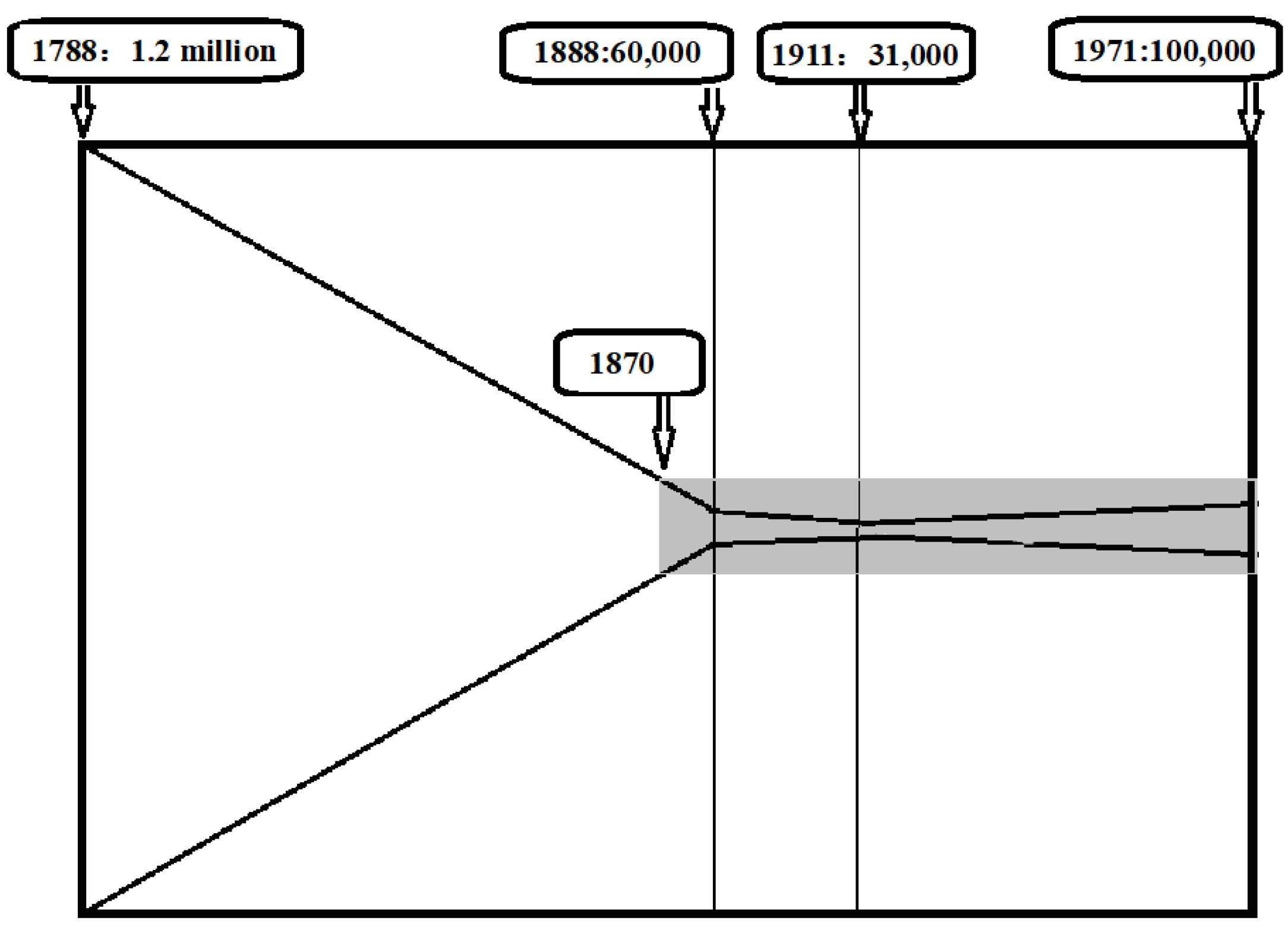
Figure 2.
Open diagram of the rules of marriage and inheritance for the four categories of the paternal line (also applicable to the four-eight categories).
Figure 2.
Open diagram of the rules of marriage and inheritance for the four categories of the paternal line (also applicable to the four-eight categories).
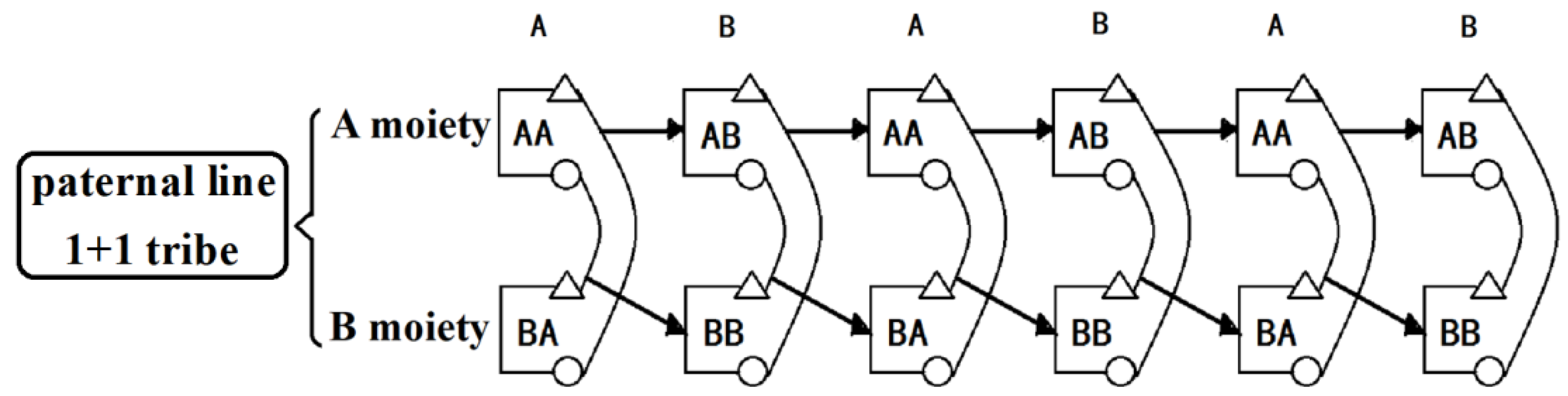
Figure 3.
Diagram of the closed cycle of the paternal line.
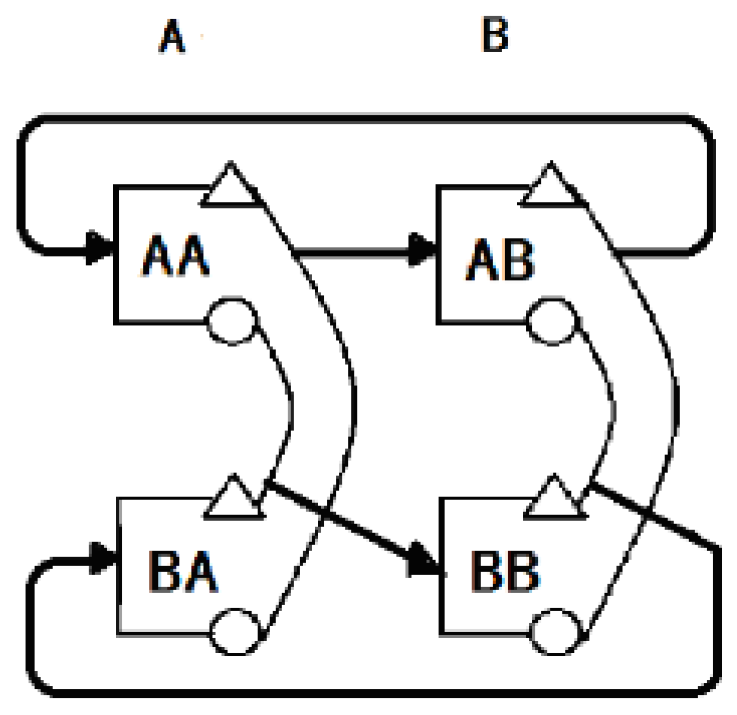
Figure 4.
Open diagram of the rules of marriage and inheritance for the four categories of the maternal line (also applicable to the four-eight categories).
Figure 4.
Open diagram of the rules of marriage and inheritance for the four categories of the maternal line (also applicable to the four-eight categories).
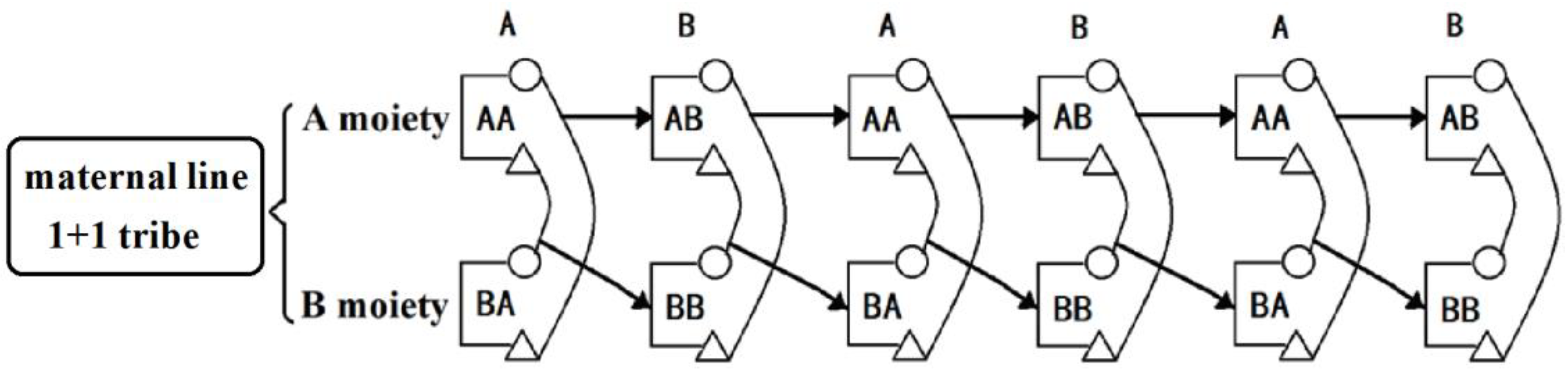
Figure 5.
Diagram of the closed cycle of the maternal line.
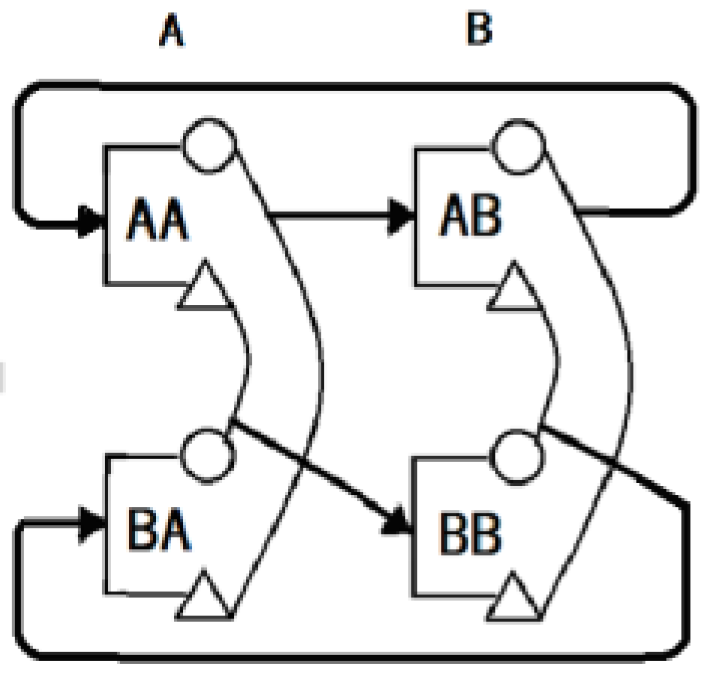
Figure 6.
Illustration of marriage and inheritance rules for the paternal eight categories (also applicable to the paternal eight-point sixteen categories) (the legend is the same as Figure 2 and Figure 5).
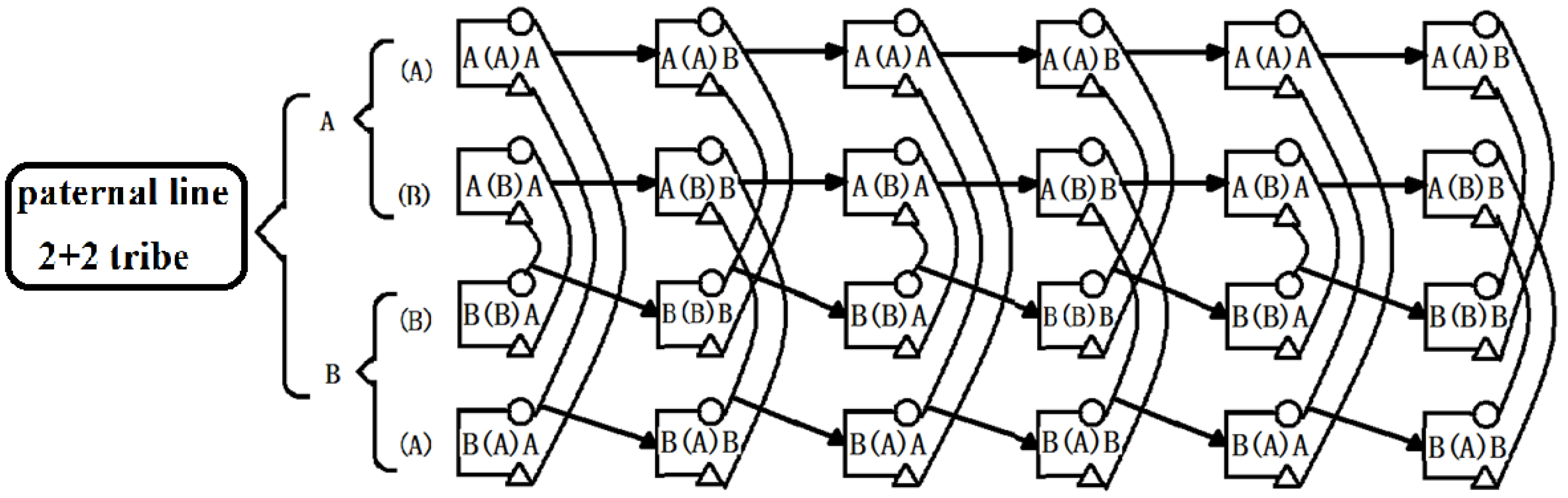
Figure 7.
Two mm-mf independent groups achieve 1+1 alliance through mutual marriage.
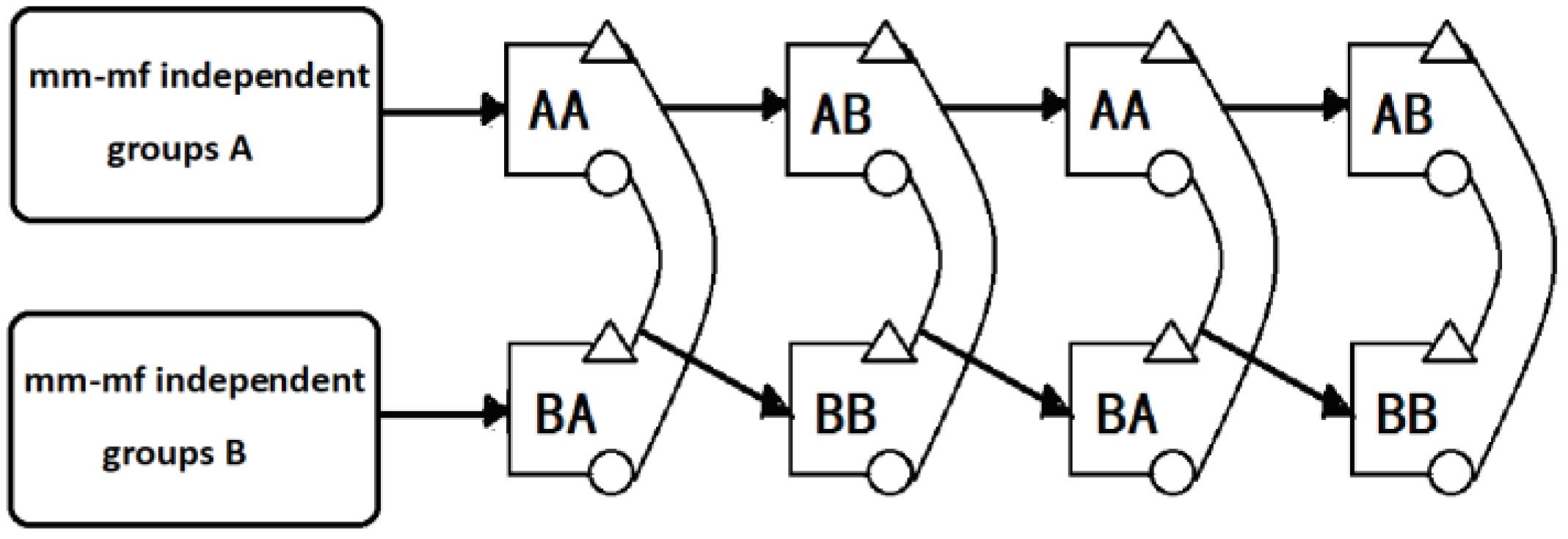
Figure 8.
Two 1+1 independent tribes achieve 2+2 alliance through mutual marriage.
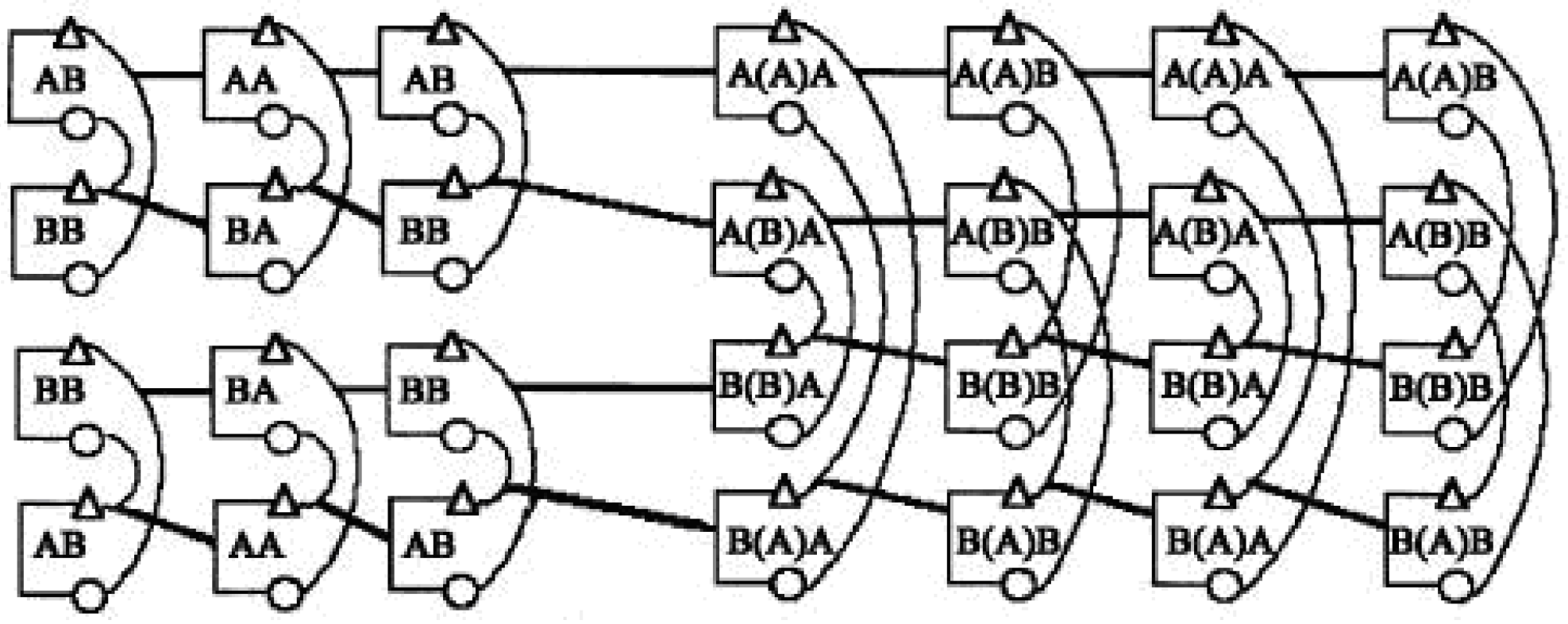
Disclaimer/Publisher’s Note: The statements, opinions and data contained in all publications are solely those of the individual author(s) and contributor(s) and not of MDPI and/or the editor(s). MDPI and/or the editor(s) disclaim responsibility for any injury to people or property resulting from any ideas, methods, instructions or products referred to in the content. |
© 2025 by the authors. Licensee MDPI, Basel, Switzerland. This article is an open access article distributed under the terms and conditions of the Creative Commons Attribution (CC BY) license (http://creativecommons.org/licenses/by/4.0/).
Copyright: This open access article is published under a Creative Commons CC BY 4.0 license, which permit the free download, distribution, and reuse, provided that the author and preprint are cited in any reuse.


