
Submitted:
05 August 2026
Posted:
06 August 2026
You are already at the latest version
Abstract
BACKGROUND: Malignant tumors remain a major threat to human health; however, the etiologies of most cancers remain elusive, highlighting the limitations of the dominant biological-reductionist and statistical paradigms in modern medicine. METHODS: To address these gaps, this study proposes a physics-informed conceptual model of the human organism from an organism-environment systems perspective. Positioned at the intersection of systems medicine and clinical oncology, the model is fundamentally immune-centric, resting on core tenets including the inherent high orderliness of living systems and the pivotal functional role of the immune system in tumorigenesis and treatment, thereby integrating biological, psychological, and environmental dimensions within a unified analytical framework. RESULTS: The model provides a coherent account of tumorigenesis, framing non-genetic tumors as a state of dysregulation in the internal environment that arises from persistent exogenous factors and compromised immune surveillance. It further delineates a comprehensive treatment framework targeting: (i) pathophysiological state correction, (ii) etiologic factor intervention, and (iii) psychosocial support. Notably, the inferences derived from this model align with the biopsychosocial model central to modern medicine and converge with the holistic imperative underpinning traditional medicine. CONCLUSION: This systems-based conceptual model bridges the gap between physics-informed reasoning and clinical practice, establishing a novel, axiomatic paradigm within clinical medicine. It offers a testable framework for future research, spanning biopsychosocial medicine to immuno-oncology and integrative oncology, and provides an intellectual scaffold to re-orient clinical practice toward etiologic diagnosis and integrated care, thereby holding considerable potential to refine cancer management.
Keywords:
systems medicine
; conceptual modeling
; physics-informed biomedicine
; immuno-oncology
; integrative oncology
; etiologic diagnosis
; homeostasis
1. Introduction
Malignant tumors are currently one of the major global public health problems. According to the International Agency for Research on Cancer (IARC), one in five people worldwide will develop cancer during their lifetime, and approximately one in nine men, and one in 12 women, will die from cancer [1]. The prevention and treatment of cancer have become a major concern for the global medical community.
The disease-centric (allopathic) model has played a significant role in the early advancement of biomedicine. The invention of antibiotics, for instance, stands as a milestone in modern medicine, as it reduced the mortality of infectious diseases and promoted the development of clinical practice. The emergence of targeted anti-tumor agents has made precision therapy possible. These agents avoid the extensive destruction of normal cells caused by traditional chemotherapy, prolong patient survival, improve quality of life, and promote the transformation of cancer management into a chronic disease. However, the limitations of this paradigm have been increasingly recognized: certain therapeutic modalities carry carcinogenic risks [2,3,4], whereas many anti-tumor agents continue to induce hematological toxicity [5,6]. Additionally, while precision medicine has achieved remarkable success in targeting tumor-specific molecular alterations, its predominantly reductionist framework tends to operate in isolation from the biopsychosocial model (BPSM) proposed by Engel [7], as well as the holistic principles of traditional medicine [8,9,10]. Consequently, interest in integrative medicine has been steadily increasing [11,12].
The biomedical system itself faces numerous challenges. First, humans are conscious beings possessing both natural and social attributes. Biomedicine is focused on the investigation of molecular pathways in order to uncover the mechanisms of cancer; however, the origins of life and consciousness remain important unsolved mysteries. Biological life is characterized by unimaginably complex networks. Without a comprehensive understanding of normal life phenomena, a complete explanation of pathology through biomedicine remains fundamentally limited. Additionally, although clinical diagnostics consistently underscores the importance of etiologic diagnoses, many internal diseases, including mental disorders, are currently diagnosed according to clinical symptoms, syndromes, and test results, rather than etiologies. To illustrate this notion, gastrointestinal hemorrhage can be diagnosed using symptoms, while nephrotic syndrome and Cushing’s diseases are diagnosed on syndromic presentation. Hypertension, diabetes, and arrhythmia are diagnosed using laboratory results, while some diseases, such as Hodgkin’s lymphoma, are named after the physicians who first described them. Currently, the etiologies of the majority of chronic diseases remain unclear. Without a clear understanding of etiologies, achieving cures for chronic diseases remains an elusive goal.
The dilemma of incorporating psychosocial studies into evidence-based medicine has been extensively documented [13,14,15]. Evidence-based medicine faces ongoing challenges, as acknowledged by its own proponents, who highlight the need for novel conceptual models and learning health systems to meet the demands of patient-centered care [16]. This prompts a fundamental epistemological inquiry: Is the current diagnostic paradigm itself conceptually adequate? The gap between the ideal of etiologic diagnosis and clinical reality has recently been re-examined by autoimmunologists, who argue that the current classification criteria for systemic lupus erythematosus (SLE) are fundamentally inadequate [17]. This raises a pivotal question for oncology: if even in SLE, a disease in which autoantibodies occupy a central role in pathogenesis, diagnosis remains anchored in classification rather than causation, how much greater is the etiologic uncertainty in cancer? A recent perspective estimates that only 30–45% of cancers are attributable to known modifiable causes, despite a theoretical preventability of 75–80% [18]. As a clinical oncologist, standing upon the cornerstone of clinical medicine, one must ask: Is the current diagnosis of cancer truly etiologic? What are the specific etiologic diagnoses for this particular patient in front of me? Does our standard assessment adequately capture the patient’s psychosocial landscape (e.g., personality traits, anxiety and depression levels, negative life events, perceived pressure, family and social relationships [19,20,21]) and behavioral profile (e.g., specific dietary habits, sugary beverage intake, frequency of takeout meals [22,23,24], exercise routines [25,26], and sleep quality [27,28]), as would be expected in a comprehensive multidisciplinary evaluation? Nonetheless, these factors remain outside the formal diagnostic coding systems that structure oncologic practice, absent from standard Tumor Node Metastasis (TNM) staging, the International Classification of Diseases (ICD) as used in oncology, and established cancer treatment protocols within the biomedical paradigm. This diagnostic impasse reflects deeper epistemological constraints within the dominant biomedical framework.
Furthermore, pathophysiologists recognize that, during disease onset and progression, particularly in conditions involving genetic predispositions, evidence-based medicine often struggles to disentangle cause from effect. Statistical heritability, for instance, cannot fully separate genetic from cultural transmission, while psychological behavior is greatly influenced by the environment. The traditional theory of polygenic diseases states that complex diseases are determined by a combination of genetic and environmental factors, emphasizing the important connection between genetic factors and diseases. Therefore, in biomedicine, much effort is devoted to genetic testing. However, statistical associations only indicate correlation, which does not prove causation [29]. From the perspective of etiologic diagnosis, conclusions may differ. For example, genetic factors strongly correlate with skin color, and the incidence of skin cancer in individuals with medium to dark skin is much lower than in those with light skin. However, ultraviolet radiation can be a fundamental cause of skin cancer [30]. Genetic factors increase tumor liability, but they are not the etiologies. Earlier genetic studies estimated the heritability of schizophrenia to be as high as 80%; however, analyses based on DNA data suggested that it is less than 3%, raising the question of “missing heritability.” [31,32] Actually, natural selection eliminates lineages with low environmental fitness. Genetic diseases of reproductive origin are relatively uncommon. Many de novo alterations in chromosome structure and number result in embryonic lethality. Monogenic diseases are uncommon [33], and digenic combinations are extremely rare [34]. Current biomedical research largely relies on inductive reasoning, as exemplified by genome-wide association studies, polygenic risk scores, and epidemiological correlations. Nevertheless, inductive reasoning can only yield probabilistic conclusions, not necessary truths. This limitation sometimes leads to the erroneous attribution of environmental effects to genes [31,35]. The complexity of multifactorial diseases such as cancer, where gene-environment interactions are highly context-dependent, may therefore stand to benefit from an alternative approach.
To address these limitations, systems medicine has emerged as a discipline extending systems thinking to clinical problems. It draws on mathematical and physical methods to integrate biological, psychological, and environmental factors into a unified explanatory framework [36,37]. This holistic perspective is essential for interpreting tumor complexity [38]. Adopting this systems perspective, the present study applies physics-informed reasoning to construct a conceptual model, offering a novel account of tumorigenesis and proposing an integrative treatment framework.
2. Methods
2.1. Theoretical and Conceptual Framework
In this study, a conceptual model of the human organism is constructed using physics-informed reasoning. This framework applies core physical principles, including logical deduction, systems thinking, abstraction, and idealized assumptions, to simplify biological complexity. The model regarded the human body as a unified system, abstracting away the complex intercellular signaling pathways by recognizing the high orderliness of living organisms. Meanwhile, it weakened the impact of biological classification of somatic cells by emphasizing the functional role of the immune system.
Given the inherent complexity of biological and psychosocial phenomena, and the current lack of precise quantitative data for many of the variables involved in this integrative framework, the present study prioritizes the development of a qualitative conceptual model over a quantitative mathematical formulation. Conceptual frameworks are increasingly recognized as a core contribution of systems medicine alongside quantitative approaches [37,39,40], providing a foundation for future quantitative modeling as empirical data accumulate. The model is therefore best characterized as “physics-informed”, drawing on the logic and systems thinking of classical physics, rather than as a quantitative physical model in the sense of modern computational physics.
2.2. Theoretical Design and Validation Statement
This is a conceptual and theoretical study that follows the classical physics tradition of deductive reasoning: starting from axiomatic assumptions that are well-established in basic science such as biophysics, modern immunology, and biology, it derives conclusions that are logically necessary if the premises hold.
This study does not aim to provide experimental evidence or causal proof in the sense of controlled clinical trials. The validity of the proposed model should be judged by its logical coherence, consistency with known facts, and heuristic value, rather than by the standards of empirical hypothesis testing. Empirical validation remains a direction for future work.
3. Model Description
3.1. Model Assumptions and Related Concepts
(i) Model boundary. There are no verifiable genetic material abnormalities of reproductive origin. This model assumes a normal genetic starting point and therefore focuses on non-syndromic tumors in the traditional sense. Inherited cancer-predisposing syndromes, arising from an abnormal genetic starting point, lie outside the primary scope of this model and are classified as genetic tumors herein. This clause defines the scope boundary.
(ii) Idealized assumption. Given a suitable microenvironment, cells can replicate and differentiate correctly; likewise, the human body can develop normally in a suitable external environment. This is an idealized assumption, analogous to Newton’s first law where friction and air resistance are ignored. This assumption corresponds to foundational principles in both cell biology and developmental biology. In reality, it is highly improbable for every cell to reside in an absolutely optimal microenvironment; therefore, spontaneous mutations are inevitable.
(iii) Idealized assumption. Abnormal clones (e.g., those driven by somatic mutations or epigenetic alterations), senescent and dead cells that arise spontaneously can be effectively eliminated by a normal immune system. This is the cornerstone of modern immunology. In this model, the immune system is treated as a functional entity without distinguishing specific cellular, or molecular subtypes. Strictly speaking, an absolutely normal immune system is an idealized state rather than a clinical reality, which cannot be empirically proven within the current biological paradigm; it serves as a conceptual baseline.
(iv) Idealized assumption. The whole organism is highly ordered prior to the impact of adverse exogenous factors. This assumption corresponds to a foundational principle of biophysics [41,42]. In the ideal state, this order is perfect: every physiological parameter is at its theoretical optimum, all regulatory loops operate with optimal efficiency, and the system exhibits ideal robustness against perturbations. Accordingly, a perfectly suitable external environment remains an elusive ideal rather than a practical reality. In the medical context, “degree of order” refers to the extent to which physiological parameters (e.g., immune cell counts, cytokine concentrations, metabolite levels) remain within established physiological reference ranges (i.e., a healthy state in which the environment is substantially suitable, the organism is physiologically normal, and the immune system is considered functionally normal in the sense of maintaining homeostatic resilience).
(v) Key model concepts are summarized in Table 1.
3.2. Model Establishment
In ecology, the environment refers to everything surrounding a given biological unit, which may be a single entity or a collective. By analogy, if each somatic cell is considered an independent entity, then the human body constitutes a complex and highly ordered multicellular society. Additionally, there are many physiological barriers inside and outside the human body. These barriers isolate the internal environment from the external one, and protect vital organs from the impact of changes in the internal environment. Based on this notion of a collection of living cells, barriers, and the environment, the human body can be partitioned into several relatively independent regions to form the conceptual model shown in Figure 1A,B.
When analyzing with this model, the following aspects should be noted: (i) Areas that communicate with the external environment, such as the lungs and intestine, or areas having barriers due to differences in cellular genotype, such as the testes and placenta, will be considered independent from the internal environment. (ii) Psychological research indicates that psychological phenomena arise from objective reality. Foundational work on sensory deprivation demonstrates that without external stimuli, the human brain cannot sustain normal psychological activity independently [43]. Social reality has a decisive constraining effect on human psychology. Therefore, this model classifies the effects of psychological and behavioral factors as exogenous, an approach analogous to that adopted in certain pathophysiological frameworks. (iii) While the thymic region is anatomically bounded by a blood-thymus barrier, it functionally serves as a critical site for immune education and maturation [44]. Hence, in the present model, the term “internal environment” excludes the central nervous system (CNS) but specifically retains the thymic microenvironment, due to its indispensable role in the immune system. Consequently, the internal environment is operationally defined as equivalent to the peripheral environment plus the thymic microenvironment in this study.
3.3. Model States
This model distinguishes an idealized state from three realized states.
3.3.1. Idealized State
Absolutely healthy state (theoretical optimum): The immune system is perfectly competent, the internal environment is ideally homeostatic, and no abnormal clones arise. This state corresponds to the theoretical ideal of model assumptions (ii)–(iv) and serves as a limiting reference point, analogous to absolute zero in thermodynamics or a frictionless surface in Newtonian mechanics.
3.3.2. Realized States
(i) Healthy state: The immune system is relatively competent, the internal environment is homeostatically regulated, and no abnormal clones persist. This is a healthy range at the level of medical application, wherein the organism functions normally and physiological parameters remain within established physiological reference ranges. In practice, the immune system is considered functionally normal as long as its capacity remains sufficient to eliminate abnormal clones, even if individual parameters deviate moderately from their theoretical optima [45].
(ii) Sub-health state: Immune surveillance is partially impaired, the internal environment shows early dysregulation, and spontaneous abnormal clones may arise but do not yet form a clinically detectable tumor. This state represents the clinically silent transition phase, which is primarily studied within the biomedical research paradigm though lacking formal nosological classification. At this early stage, the host retains multiple endogenous defense mechanisms (e.g., cell competition) to eliminate abnormal clones [46,47]. In a specific medical narrative, it corresponds to the sub-health state, often described as the Weibing (pre-disease) stage emphasized in Traditional Chinese Medicine (TCM) [48,49]. At this stage, TCM practitioners typically adopt relatively simple measures to correct mild disturbances and try to restore a healthy yin-yang balance. However, due to the lack of definitive diagnostic criteria and reliable biomarkers, biomedicine generally does not institute formal interventions at this stage.
(iii) Tumor state: Immune surveillance is severely compromised, the internal environment is persistently dysregulated, and abnormal clones have proliferated into a clinically manifest tumor mass.
The healthy state provides the reference baseline (physiological norm) for the computational model. The sub-health and tumor states are defined as deviations from the baseline, with the goal of clinical intervention being to return the system from these deviated states back to the healthy baseline.
4. Discussion
4.1. Model Analysis
4.1.1. Model Boundaries: Exclusion of Confounding Factors and Genetic Tumors
Research shows that immune responses decrease with aging, contributing to the increased incidence of chronic diseases [50]. However, aging does not necessarily imply disease, and tumors can occur at any age. In addition, immune immaturity in children should be considered in the context of exogenous pathogenic factors and is not, by itself, an etiology of childhood cancer; otherwise, it would contradict the premise of this study (model assumptions (i) and (ii)), wherein the absence of genetic anomalies and an idealized, fully suitable external environment assure successful progression through childhood to adulthood. Furthermore, modern humans exert considerable agency over their living environments, and tumors are currently regarded as chronic diseases occurring across all inhabited regions worldwide. To isolate the spatial architecture of cancer states and minimize confounding, the present study strategically excludes long-term temporal dynamics associated with periods of immune incompetence and natural environmental variations. This simplification follows a common strategy in physics: focusing on dominant factors while temporarily setting aside secondary or temporally distinct processes. Accordingly, this study does not consider age-related immune senescence, childhood immune immaturity, or routine seasonal and geographic variations in its discussion of tumorigenesis and treatment.
As correlation alone does not establish causation, only those diseases with a proven causal link to abnormalities of reproductive origin are defined as typical genetic diseases in this study. Examples of such conditions include the trisomy 21 syndrome, Huntington’s disease, hereditary breast and ovarian cancer (BRCA1/2), Lynch syndrome, which are caused by abnormalities in fertilized eggs. According to the medical genetic theory, cancers are approximately divided into two types: inherited cancer-predisposing syndromes only involve several rare cancers, while non-syndromic tumors include most common tumors. The former are termed genetic tumors, while the latter (traditionally viewed as complex diseases) are designated non-genetic tumors and will be discussed later. It is important to clarify what the term “non-genetic” means, and does not mean, in the context of this model. In this study, “non-genetic” refers to the absence of germline (reproductive-origin) genetic abnormalities as a necessary cause. It does not imply the absence of somatic mutations or epigenetic alterations; such acquired changes are expected to occur during disease progression and are part of the pathological process, rather than its root etiology. This classification is intended solely to re-examine cancer taxonomy from an etiologic standpoint within the existing biomedical diagnostic framework.
In fact, spontaneous mutations in somatic cells reflect the inherent imperfections of the internal environment (contrapositive of model assumption (ii): if the internal environment were absolutely suitable, such mutations would not arise). Extending this logic within this proposed framework, chronic exposure to a sub-optimal internal environment drives persistent endogenous accumulations, which may precipitate putative epigenetic alterations as a homeostatic adaptation. If we posit an absolutely suitable external environment, yet cumulative micro-imperfections of the internal environment were to reach a critical threshold of systemic epigenetic dysregulation [51] (a simplifying idealization adopted for analytical tractability: namely, that a perfectly suitable external environment logically entails a correspondingly ideal internal environment), or were the whole system to reach the critical point of cellular replicative senescence, their systemic manifestation, amid immunocompromise in either case, may correspond to species-specific endogenous aging [52]. This interspecies variation [53] plausibly reflects differences in baseline homeostatic [54] and cellular replication capacity [55] across taxa. Inasmuch as disentangling intrinsic from extrinsic aging remains a central conundrum in biogerontology and aging lies beyond the primary scope of the present framework, the model strategically omits the geriatric phase, focusing strictly on the pathophysiological processes in the pre-senescent phase.
4.1.2. System Input: Pathogenic Pathways of Exogenous Factors
Notably, many modifiable risk factors have been proven to cause cancer [56]. Based on known etiologies, the pathogenic pathways of exogenous factors are delineated in Figure 2A.
Barrier contact route: (i) Physicochemical factors: Coal tar, for instance, can directly cause cancer, while tobacco is the principal cause of lung cancer [1,57,58]. (ii) Biological factors: An example of this is an infection with Helicobacter pylori (Figure 2B). Chronic H. pylori infection is considered the principal cause of non-cardia gastric cancer [1,59]. Chronic inflammation may induce genomic damage, which is closely related to the occurrence and development of tumors [60].
Non-barrier contact route: (i) Physicochemical factors: Many environmental physical factors exert significant adverse effects on the immune system. For example, the DNA and nuclear membrane of cells are the prime targets of ionizing radiation, especially in the thymus. Low-dose ionizing radiation may permanently impair immune fitness and thereby accelerate immune senescence [61]. (ii) Psychosocial factors: Adverse stimulation of the nervous system can cause changes in various systems throughout the whole body by affecting the thalamus, hypothalamus, and brainstem, leading to functional disorders of the body (Figure 2C). Acute and chronic stress can significantly alter the immune response [62,63,64]. (iii) Behavioral factors: Sedentary behavior, for instance, is associated with increased body fat and parallels the increased prevalence of multiple chronic diseases [65] while adversely affecting immune function status [66]. Conversely, regular physical activity confers pleiotropic benefits, including enhanced immune surveillance and reduced chronic inflammation, that collectively mitigate cancer risk [67]. Night shift work also increases the risk for multiple chronic diseases [68], in part by adversely affecting immune function [69]. Malnutrition is the primary cause of human immune suppression, while overnutrition (e.g., obesity, high cholesterol) also exerts adverse effects on the immune system [70,71,72]. Although the consequences of adverse behavioral habits may partially overlap with adverse barrier contact (such as tobacco smoking leading to increased exposure to chemical carcinogens), this pathway primarily underscores the role of individual agency and choice.
4.1.3. Mechanistic Logic: Deciphering System-Level Tumorigenesis
Tumors are characterized by abnormal cellular proliferation and are usually clonal (a feature commonly studied in oncology).
Since normal immune surveillance eliminates abnormal clones (model assumption (iii): If A (normal immunity), then B (elimination of abnormal clones)), their persistence (observation: Not B) logically entails a concomitant failure of immune surveillance (contrapositive: therefore, Not A).
In logic, a proposition and its contrapositive are logically equivalent; thus, if assumption (iii) holds, the conclusion follows necessarily. This deduction aligns with a foundational principle in tumor immunology. The validity of this deduction depends solely on the truth of model assumption (iii) and not on any empirical laboratory measurements. Conversely, proving that a person harboring abnormal clones has absolutely normal immune function would require exhaustive validation of all known and unknown immune parameters, a task fundamentally infeasible given the current limits of biological knowledge. This also raises a critical question: what if the immune system, rather than acting as a relentless eliminator, routinely establishes immune tolerance to stochastically arising clonal expansions over an individual’s lifetime, rather than over evolutionary (species-level) time? It must be emphasized again that this study is theoretical: it starts from axiomatic assumptions and rigorously derives results through deductive reasoning. It is not an empirical investigation and does not aim to provide causal evidence in the sense of controlled clinical trials.
Within this model, which abstracts away tissues and organs, the immune system is consequently defined solely as the collective of immune cells and molecules.
Deficient immune surveillance implies abnormalities in the number or function of immune cells and/or molecules.
Immune molecules are constituents of the internal environment; thus, abnormalities in these molecules indicates a dysregulated internal environment.
As for immune cells, independently of physiological senescence and programmed cell death, abnormalities may arise from spontaneous mutations, direct cellular damage (e.g., radiation-induced injury), or a disordered immune microenvironment.
Given that:
(a) The frequency of nuclear DNA mutations is generally low, and spontaneous mutations are eliminated by normal surveillance mechanisms.
(b) the origin and differentiation sites of the principal immune cells (including the bone marrow, thymus, spleen, and lymph nodes) do not directly contact the external environment and are accessible only through bodily fluids.
It follows that, barring direct damage to immune cells, the emergence of numerous abnormal immune cells signifies dysregulation of the internal environment, irrespective of its detectability by current assays.
Hematological malignancies, which are themselves a form of immune system dysfunction, exhibit distinctions from solid malignancies; however, the fundamental driver of deranged cellular proliferation remains essentially the same.
Moreover, radiation generates both abnormal clones and aberrant immune cells; through organism-environment interactions, these entities perturb the internal environment, which in turn induce further immune dysfunction and establish a feedback loop. The carcinogenic effect of radiation typically manifests after a latent period of several years [73]. This latency is likely attributable to the robust homeostasis of the normal internal environment, which temporarily constrains the proliferative expansion of abnormal clones and the pathological remodeling of the microenvironment. This process is illustrated in Figure 3A, and a parallel logic can be applied to the analysis of intracranial tumors.
Normal living organisms are highly ordered. They adapt to their environment, possess multiple internal mediating and reparative mechanisms, and feed on negative entropy [41] (a concept that modern thermodynamics reformulates as the metabolic maintenance of low internal entropy via Gibbs free energy import and entropy export [42]). These defining attributes (e.g., order, adaptability, self-replication, and homeostasis) collectively characterize living systems [74]. The intrinsic mechanisms of living systems are directed toward maintaining homeostasis, not toward breakdown. This implies that normal living organisms (including individual cells) are unlikely to actively cause disease until they can no longer resist the universal increase in entropy, the cumulative burden of endogenous micro-imperfections, or the advent of cellular replicative senescence. If living organisms are proven to inevitably cause disease in the absence of these factors, such diseases would correspond to typical genetic diseases. The self-repairing ability of living organisms, which traditional medicine repeatedly emphasizes but modern medicine sometimes fails to acknowledge, also explains some rare self-healing phenomena [75,76,77] observed in complex diseases. These rare self-healing phenomena are similar to the reversal of reversible cell damage once the causative factor has been removed.
Taken together, the analyses yield a central deduction: adverse exogenous factors, through distinct pathways and mechanisms (Figure 2A–C), either directly disrupt the internal environment (locally or systemically) or cause cellular damage that secondarily destabilizes it, ultimately leading to immune dysfunction. While abnormal clones may arise from spontaneous mutations, epigenetic alterations, or carcinogenic exposures, all of which reflect imperfections in the internal environment, their persistence remains invariably contingent upon concurrent immune dysfunction. In essence, the persistence of abnormal clones in non-genetic tumors is predicated on immune deficiency. When aging and immune immaturity are excluded, and given that normal living organisms are fundamentally oriented towards order and repair, non-genetic tumors emerge as the toxic consequences of adverse exogenous factors. These states represent mutual pathological accommodations among abnormal clones, compromised immunity, and a dysregulated internal environment, manifesting as Darwinian evolution and selection occurring at the cellular level. This inference aligns with contemporary evolutionary theories of cancer [60]. The tumor state is characterized by the self-reinforcing pathological triad illustrated in Figure 3B,C.
The stepwise progression from the healthy state to the sub-health state and finally to the tumor state, driven by accumulating exogenous stressors, is illustrated in the thought experiment (Figure 4). In the absence of effective intervention, the system tends to progress unidirectionally from the healthy state to the tumor state. Clinical therapeutic strategies aim to reverse this progression and help patients return to a sub-health or healthy state.
4.2. Model Validation: Concordance with Clinical Observations
4.2.1. Difference Between Benign and Malignant Tumors
A tumor can be viewed as an aberrant, ectopic system within the body (Figure 3B). As such, the fundamental distinction between benign and malignant tumors lies in the pathological influence that the abnormal mass exerts on the internal environment or the organism as a whole. Consequently, key determinants of malignant potential collectively include: the number of abnormal clones, their proliferation rate, anatomical location, secretory capacity, and encapsulation status. Furthermore, the degree of tumor differentiation often reflects the severity of dysregulation in the local or systemic internal environment and is therefore strongly associated with clinical prognosis.
4.2.2. Convergence with Traditional Medicine
As both abnormal clones and aberrant immune cells adapt to a dysregulated internal environment, restoring homeostasis may suppress the proliferation of malignant clones while gradually restoring immunocompetence. This rationale provides a scientific foundation for TCM principles such as balance (Ping Heng), harmonizing yin and yang (Tiao He Yin Yang), and survival with tumor (Dai Liu Sheng Cun) [78].
4.2.3. The Challenge of Therapeutic Resistance: A Model-Based Explanation
The proposed framework directly accounts for the clinical failures of advanced cancer treatment under the prevailing reductionist paradigm. The failure lies in four interconnected gaps: (i) a treatment strategy that targets tumor clones alone while disregarding concurrent immune dysfunction, (ii) the failure to restore and maintain internal environmental homeostasis, (iii) the absence of etiologic diagnosis, and (iv) the neglect of psychological and behavioral contributory factors in individual patients (though these factors often constitute the upstream etiologic context, they are rarely translated into actionable etiologic diagnoses).
This reductive anti-tumor approach is counterproductive, as many anti-tumor therapies exert hematological toxicity, further compromising an already impaired immune system [79,80]. Consequently, even when the clinically detectable tumor is removed, the underlying pathological triad persists. Moreover, under the selective pressure of anti-tumor drugs, tumors can undergo a new round of clonal selection, screening for drug-resistant clones and even secondary tumors [81,82,83]. Compounding this is the lack of precise psychological and behavioral etiologic intervention, while the cancer diagnosis itself may induce post-traumatic stress disorder (PTSD) in patients and their families [84,85,86]. The result is a vicious cycle in which cancer patients are often unable to discontinue anti-tumor drugs, finally leading to drug resistance [87,88], cancer recurrence [89,90,91], and treatment failure.
4.3. Model Prediction: Implications for a Holistic Cancer Treatment Framework
The model implies that clinical cancer treatment should aim to disrupt the self-reinforcing pathological triad that sustains the tumor state, thereby helping patients return to a sub-health or healthy state, while also avoiding further exposure to etiologic factors. The following section integrates the pathological triad (Figure 3B,C) with pathogenic pathways of exogenous factors (Figure 2A) to propose a treatment framework for non-genetic malignant tumors (excluding intracranial tumors). This framework primarily addresses three aspects: (i) management of the resultant pathophysiological state, (ii) identification and intervention against the underlying etiologic factors, and (iii) psychosocial support implemented both before and after diagnosis as a preventive and adjuvant measure.
4.3.1. Management of the Resultant Pathophysiological State
Human medicine has developed considerable expertise in the following areas:
(i) Abnormal clone elimination: This is a well-established strength of modern medicine, such as the removal of solid masses using surgery, the induction of remission in hematological malignancies and the use of targeted drugs with minimal side effects for highly malignant tumors, including immune checkpoint inhibitors targeting PD-1/PD-L1, CTLA-4, and LAG-3 [92], monoclonal antibodies (e.g., rituximab, trastuzumab [93]) as well as bispecific antibodies (e.g., blinatumomab, mosunetuzumab [94]), and cell therapy (e.g., chimeric antigen receptor T-cell (CAR-T) therapy [95] and tumor-infiltrating lymphocytes (TILs) therapy [96]). It is worth mentioning that not all treatment methods that sound immune-related can be called immune reconstitution. Essentially, the immunotherapies described above are anti-tumor therapy (i.e., adversarial therapy) in biomedicine. Furthermore, acknowledging that the mysteries of life remain incompletely understood, the goal of tumor elimination should be balanced against the preservation of organ function whenever feasible.
(ii) Homeostatic restoration: Studies have shown that a major obstacle in the immunotherapy used against solid tumors is the immunosuppressive environment [97]. Therefore, intervention strategies for the internal environment must become an important part of treatment. These should include, but are not limited to, the regulation of whole-body balance using traditional medicine such as TCM [98], Ayurvedic medicine [99], and Unani medicine [100]. For instance, the TCM concepts of eliminating pathogens (Qu Xie), harmonizing qi and blood (Tiao He Qi Xue), and reinforcing healthy qi (Fu Zheng) correspond, respectively, to abnormal clone elimination, homeostatic restoration, and immune reconstitution in the present framework. In parallel, modern intervention strategies such as therapeutic plasma exchange (TPE) [101], lymphoplasmapheresis (LPE) [102], and semi-whole blood exchange (SWBE; i.e., partial whole blood exchange with component-specific replacement) [103] offer direct approaches to homeostatic restoration. SWBE is an emerging technology in transfusion medicine. It has shown considerable potential in treating many traditionally complex diseases and has recently been associated with remarkable clinical outcomes [104,105,106]. These findings, however, represent preliminary clinical observations of an emerging technology; robust evidence from large-scale trials are still required.
(iii) Immune reconstitution: Studies have demonstrated that effective immunotherapies can induce substantial immune perturbations alongside their anti-tumor activity, reinforcing the need for integrated immune reconstitution strategies [79,107]. Logically, patients can expect natural recovery once homeostasis has been restored. Additionally, hematopoietic stem cell transplantation (HSCT) represents a radical approach to rebuilding the core hematopoietic-derived immune components [108,109]. HSCT is primarily used in hematological malignancies and, in selected solid tumors based on recent practice recommendations [110]. It involves the infusion of healthy donor or autologous hematopoietic cells after conditioning regimens (chemo/radio/immunosuppression) to rebuild hematopoiesis and principal immune functions, leveraging the unique homing capacity of hematopoietic stem cells to the bone marrow niche [111]. This process fundamentally restores the source of primary immune cells and is conceptually distinct from peripheral immune tolerance [112]. Specifically, the present study focuses on systemic immune reconstitution as an upstream, macro-level strategy, whereas peripheral tolerance addresses a downstream, micro-level regulatory function. Notably, HSCT exerts these effects even though it does not directly restore homeostasis (conditioning regimens may even transiently disrupt physiological balance). If HSCT shows potential in the absence of homeostatic intervention, combining it with homeostatic restoration strategies (e.g., TPE, LPE, and SWBE) may offer even greater therapeutic promise, which is a possibility that warrants further investigation (NCT06177561).
(iv) Supportive care for physiological resilience: This essential component includes targeted management of cancer- and treatment-related symptoms, coupled with evidence-based nutritional support [113]. The goal is to optimize the host’s internal environment, enhance tolerance to therapies, and facilitate overall recovery.
4.3.2. Identification and Intervention Against the Underlying Etiologic Factors
From the perspective of TCM, the modulation of contributory factors (e.g., emotional disequilibrium and irregular lifestyle) are typically achieved through health preservation (Yang Sheng) [114], aimed at reinforcing healthy qi and maintaining holistic balance. This practice also aligns with the present framework’s strategies for intervening in underlying etiologic factors. Based on current medical knowledge, although many cancers are considered incurable, they are largely preventable. Nevertheless, prevention is complicated by the fact that some complex diseases may have multiple etiologies. It may be difficult for physicians to predict patient behavior; patients may conceal certain preferences; some etiologies may not be effectively identified by either doctors or patients; and some may even stem from social customs. Furthermore, sometimes patients understand the possible adverse effects of their lifestyle choices, but do not wish to implement changes. One such example is the smoking rate, which remains high despite the label “Smoking may lead to lung cancer” being clearly printed on cigarette packs. Another example includes lack of sleep and consumption of unhealthy foods. While most people know these habits are unhealthy, many remain unwilling to change their lifestyles. Curing cancer is, therefore, a more complex endeavor than can be addressed by medical interventions alone.
In addition, immune deficiency of the patients with a same type of cancer may result from different etiologies. If the focus remains solely on correcting physiological disorders without addressing the underlying specific etiologies, disease relapse is highly likely. The challenges described above require clinical oncologists to collaborate with multidisciplinary clinical experts to strengthen the etiologic diagnoses for each cancer patient, especially in terms of psychological and behavioral factors, and to precisely tailor therapies based on the underlying specific etiologies:
(i) Interventions for physicochemical and biological factors: These include treatment of chronic infectious lesions [115], and avoidance of chemical carcinogens [116] and radioactive sources [117].
(ii) Interventions for psychological and behavioral factors: These include evidence-based psychotherapies (e.g., cognitive behavioral therapy (CBT), mindfulness-based stress reduction (MBSR), and acceptance and commitment therapy (ACT) [118]), as well as lifestyle modifications [119]. The latter encompass maintaining a healthy weight by following a healthy diet [120]; avoiding smoking and alcohol consumption [121]; engaging in appropriate physical activity [122]; adhering to a regular and restorative sleep schedule [123]; managing prolonged mental stress [124]; and establishing harmonious interpersonal relationships and social support networks [125,126].
Addressing these multifaceted etiologies through integrated, multidisciplinary approaches may ultimately improve long-term outcomes by targeting the root causes of disease rather than merely managing its manifestations.
4.3.3. Psychosocial Support Implemented Both Before and After Diagnosis
Beyond biological interventions, psychosocial factors play a critical role in cancer care, as family and society constitute the core of the social environment. In the family and sociocultural models employed in abnormal psychology, psychological disturbances are not merely disorders residing within the individual, but can also represent reactions to dysfunction within the family system or broader societal pathologies. Therefore, in addition to patient evaluation, we also need to evaluate the patient’s family and even society as a whole using the following approaches:
(i) Intervention for cancer patients and their families: These include dealing with cancer-related mental disorders [127,128], avoiding PTSD [86,129], and mitigating the financial [130] and time toxicity [131] arising from cancer treatment and healthcare system engagement.
(ii) Societal-level interventions: These include optimizing the medical system [11,132], eliminating cancer-related worries and stigma [133,134], developing professionally supported networks and psychosocial oncology services [135,136], promoting healthy lifestyles [137], preventing infectious diseases [138,139], pursuing environmental health and pollution control [140], and fostering social cohesion and well-being that encompass both material and spiritual dimensions [141,142].
In the future, precise etiologic diagnosis and tailored intervention for each cancer patient should become a primary objective not only for direct care providers (e.g., physicians, clinical psychologists, nutritionists, exercise physiologists) but also for public health policymakers, patients, their families, and sociologists.
5. Conclusions: Toward a Systems-Based Holistic Integrative Framework for Etiologic Diagnosis and Integrated Care
In this study, multidisciplinary knowledge was utilized to construct a conceptual model suitable for the human body. The model reconciles the requirements of both reductionism in modern medicine and holism in traditional medicine. While modern medicine’s current strength remains rooted in reductionism, emerging fields such as systems medicine increasingly embrace holistic perspectives. This study, therefore, does not seek to contradict these paradigms but rather to integrate them.
This model provides a coherent explanation for fundamental questions in tumorigenesis and translates the holistic principles of traditional medicine into a clinically actionable framework that operates alongside modern oncological practice. It yields two integrated frameworks for cancer management. At the pathophysiological level, it proposes a tripartite strategy consisting of (i) abnormal clone elimination, (ii) homeostatic restoration, and (iii) immune reconstitution. As an overarching clinical guideline, it advocates for etiologic diagnosis and treatment based on three pillars: (a) intervention targeting the resultant pathophysiological state, (b) identification and intervention against underlying etiologic factors, and (c) psychosocial support and prevention. Together, these components address cancer not merely as a localized biological event, but as a systemic condition requiring multifaceted intervention.
Distinct from prevailing frameworks such as the evolutionary theory of cancer and the BPSM, the proposed model integrates biological, psychological, and environmental determinants into a physics-informed, systems-based, holistic perspective. More importantly, unlike conventional cancer research that centers on the tumor itself, this framework positions the immune system as the central determinant of tumorigenesis and therapeutics. It rests on core tenets including the inherent high orderliness of living systems and the pivotal functional role of the immune system in tumorigenesis and treatment. Furthermore, it explicitly situates psychosocial and behavioral factors within the broader context of immune regulation. By transcending the limitations of over-categorization in biological thought, this approach provides a coherent framework capable of bridging therapeutic concepts from both modern and traditional medicine.
Crucially, the proposed model is conceptual and qualitative in nature. While it is informed by physical principles such as abstraction and idealized assumptions, it does not currently yield quantitative predictions. This reflects a conscious choice to prioritize logical coherence and integrative scope at this stage of theory development, with the expectation that future empirical work will enable progressive quantification. Nonetheless, its graphical representation provides a robust and sufficient basis for analyzing overarching patterns of tumorigenesis and for deriving principled cancer treatment frameworks. Ultimately, the translational value and clinical efficacy of this integrative approach must await, and will depend upon, rigorous empirical validation, likely requiring progressive implementation via pilot studies, interdisciplinary training, and integration with quantitative methodologies.
Despite these considerations, under reasonable assumptions, the model is logically coherent and internally consistent. Its predictions are empirically testable and uniquely bridge modern medical research with traditional medical concepts. Additionally, the predictive and systematic treatment modalities derived from this model are fully consistent with BPSM, thereby establishing a novel, systems-based, axiomatic paradigm for clinical medicine. It is particularly noteworthy that the predictive cancer treatment framework in this study incorporates recent developments in clinical hemato-immunology into the cancer treatment plan in BPSM. These developments include emerging transfusion techniques such as SWBE, alongside LPE combined with HSCT, which are designed to rapidly restore homeostasis in the internal environment and rebuild immunity. These advances hold promise for supporting immune recovery and improving overall treatment prospects in cancer care. Although large-scale clinical validation of the entire cancer treatment framework may require considerable time, this practical constraint does not reflect a deficiency in the model itself. The proposed model offers a novel intellectual framework to refocus clinical attention on etiologic diagnosis of cancers, and may facilitate the integration of the medical treatment concepts from both modern and traditional medicine to advance cancer management worldwide, pending rigorous clinical validation.
Conflicts of Interest
The author declares that the research was conducted in the absence of any commercial or financial relationships that could be construed as a potential conflict of interest.
Acknowledgments
The author would like to thank LetPub (www.letpub.com.cn) for linguistic assistance and pre-submission expert review.
References
- Bray, F.; Laversanne, M.; Sung, H.; Ferlay, J.; Siegel, R.L.; Soerjomataram, I.; et al. Global cancer statistics 2022: GLOBOCAN estimates of incidence and mortality worldwide for 36 cancers in 185 countries. CA A Cancer J. Clin. 2024. [Google Scholar] [CrossRef] [PubMed]
- Patel, S.A.; Spiegel, J.Y.; Dahiya, S. Second Primary Cancer After Chimeric Antigen Receptor–T-Cell Therapy: A Review. JAMA Oncol. 2025, 11. [Google Scholar] [CrossRef] [PubMed]
- Tix, T.; Alhomoud, M.; Shouval, R.; Cliff, E.R.S.; Perales, M.; Santos, D.M.C.d.; et al. Second Primary Malignancies after CAR T-Cell Therapy: A Systematic Review and Meta-analysis of 5517 Lymphoma and Myeloma Patients. Clin. Cancer Res. 2024, 30. [Google Scholar] [CrossRef] [PubMed]
- Kumar, A.A.; Lam, A.K.; Gopalan, V. Risk of second primary cancers among melanoma survivors following radiotherapy: A population-based cohort study. Cancer Epidemiol. 2025, 98, 102909. [Google Scholar] [CrossRef] [PubMed]
- Rejeski, K.; Subklewe, M.; Locke, F.L. Recognizing, defining, and managing CAR-T hematologic toxicities. Hematology 2023, 2023, 198–208. [Google Scholar] [CrossRef] [PubMed]
- Tan, A.; Lu, J.; Li, C.; Liu, W.; Yan, Y.; Wang, C.; et al. Hematological toxicity of immune checkpoint inhibitors: A pharmacovigilance study. BMC Cancer 2025. [Google Scholar] [CrossRef] [PubMed]
- Engel, G.L. The Need for a New Medical Model: A Challenge for Biomedicine. Science 1977, 196, 129–136. [Google Scholar] [CrossRef] [PubMed]
- Chien, T. The Holistic Philosophy of Traditional Chinese Medicine and Conflicts With Modern Medicine. Holist. Nurs. Pract. 2022, 37, 153–160. [Google Scholar] [CrossRef] [PubMed]
- Hankey, A. The ontological status of western science and medicine. J. Ayurveda Integr. Med. 2012, 3, 119. [Google Scholar] [CrossRef] [PubMed]
- Ahmad, W.; Sofi, G.; Alam, M.A.; Zulkifle, M.; Ahmad, B. Understanding Holism in the light of principle underlying practice of Unani Medicine. Rev. Env. Health 2021, 37, 189–199. [Google Scholar] [CrossRef] [PubMed]
- Fan, D. Holistic Integrative Medicine Declaration. Front. Med. 2024, 18. [Google Scholar] [CrossRef] [PubMed]
- Světlák, M. Integrative medicine in oncology—Between science, ideology, and pragmatism. Klin. Onkol. 2025, 38. [Google Scholar] [CrossRef] [PubMed]
- Groenman, A.P.; Dijk, A.v.; Dekkers, T.J.; Hoofdakker, B.J.v.d.; Oord, S.v.d.; Luman, M.; et al. How universal quality standards in intervention meta-analyses favor evidence from medical over psychosocial studies. Eur. Child Adolesc. Psychiatry 2026. [Google Scholar] [CrossRef] [PubMed]
- Chase, L.; Mosse, D. The Moral Blind Spots of Evidence-Based Psychiatry: Learning from Britain’s Trial of “Peer-Supported Open Dialogue”. Med. Anthropol. 2025. [Google Scholar] [CrossRef] [PubMed]
- Stevens, H. Evidence-based medicine from a social science perspective. Aust. J. Gen. Pract. 2018, 47, 889–892. [Google Scholar] [CrossRef] [PubMed]
- Rajit, D.; Johnson, A.; Callander, E.; Teede, H.; Enticott, J. Learning health systems and evidence ecosystems: A perspective on the future of evidence-based medicine and evidence-based guideline development. Health Res. Policy Syst. 2024, 22. [Google Scholar] [CrossRef] [PubMed]
- Rekvig, O.P.; Tsokos, G.C. Causation-based SLE diagnostic criteria should replace advance-repressing SLE classification criteria. Autoimmun. Rev. 2026. [Google Scholar] [CrossRef] [PubMed]
- Shi, M.; Patti, G.J.; Gunter, M.J.; Govindan, R.; Lansdorp-Vogelaar, I.; Wang, T.; et al. Accelerating discovery of cancer causes for prevention in the era of rising early-onset cancers. Cell 2026. [Google Scholar] [CrossRef] [PubMed]
- Bergerot, C.D.; Lam, W.W.T.; Csaba, D.L.; Bultz, B.D. From Foundations to Innovation: Advancing Psychosocial Competency in Oncology Fellowship Training. JCO Oncol. Pract. 2025. [Google Scholar] [CrossRef] [PubMed]
- Hua, X.; Xiao, L.; Wu, L.; Chen, J.; Du, S.; Xie, D.; et al. Association between an oncology psychology course and caring ability improvements in postgraduate medical students. Front. Psychol. 2025, 16, 1714423. [Google Scholar] [CrossRef] [PubMed]
- Kreitzer, G. Teaching Psychotherapy to Medical Students: Why It Matters. Acad. Psychiatry 2025. [Google Scholar] [CrossRef] [PubMed]
- Khiri, N.; Howells, K. Nutritional Education in Medical Curricula and Clinical Practice: A Scoping Review on the Knowledge Deficit Amongst Medical Students and Doctors. J. Hum. Nutr. Diet. 2025, 38. [Google Scholar] [CrossRef] [PubMed]
- Krishnan, S.; Sytsma, T.; Wischmeyer, P.E. Addressing the Urgent Need For Clinical Nutrition Education in Post-Graduate Medical Training: New Programs and Credentialling. Adv. Nutr. 2024, 2024, 100321. [Google Scholar] [CrossRef] [PubMed]
- Felice, F.D.; Malerba, S.; Nardone, V.; Salvestrini, V.; Calomino, N.; Testini, M.; et al. Progress and Challenges in Integrating Nutritional Care into Oncology Practice: Results from a National Survey on Behalf of the NutriOnc Research Group. Nutrients 2025, 17, 188. [Google Scholar] [CrossRef] [PubMed]
- Frommeyer, T.C.; Brittain, G.V.; Wu, T.; Frommeyer, D.; Bett, E.S. Physical Activity Prescriptions: Addressing a Major Gap in Medical Education. Med. Sci. Educ. 2025. [Google Scholar] [CrossRef] [PubMed]
- Fowles, J.R.; Sasso, J.; Thomas, S.G.; Shivgulam, M.; O’Brien, M.W.; Nagpal, T.S. Exercise in Medicine: Challenges and Opportunities Integrating Qualified Exercise Professionals (QEPs) into Canadian Healthcare. Appl. Physiol. Nutr. Metab. 2025. [Google Scholar] [CrossRef] [PubMed]
- Labra, A.; Roldán-Navarro, M.; Sánchez-Narváez, F.; Ruiz-Morales, M.; Ángel-Alavez, G.; Pacheco-Aispuro, G.; et al. Sleep Medicine Education and Practice in Latin America: Current Challenges and Perspectives. Sleep Sci. 2025, 18. [Google Scholar] [CrossRef] [PubMed]
- Falloon, K.; Campos, C.; Nakatsuji, M.; Moir, F.; Wearn, A.; Bhoopatkar, H. Sleep education for medical students: A study exploring gaps and opportunities. Sleep Med. 2024, 120, 29–33. [Google Scholar] [CrossRef] [PubMed]
- Lobentanzer, S.; Rodriguez-Mier, P.; Bauer, S.; Saez-Rodriguez, J. Molecular causality in the advent of foundation models. Mol. Syst. Biol. 2024, 20, 848–858. [Google Scholar] [CrossRef] [PubMed]
- Wehner, M.R. Keratinocyte Carcinoma: A Review. JAMA 2025. [Google Scholar] [CrossRef] [PubMed]
- Conley, D.; Fletcher, J. The Genome Factor: What the Social Genomics Revolution Reveals About Ourselves, Our History, and the Future; Princeton University Press: Princeton, NJ, USA, 2017. [Google Scholar]
- Maher, B. Personal genomes: The case of the missing heritability. Nature 2008, 456, 18–21. [Google Scholar] [CrossRef] [PubMed]
- Apgar, T.L.; Sanders, C.R. Compendium of causative genes and their encoded proteins for common monogenic disorders. Protein Sci. 2021, 31, 75–91. [Google Scholar] [CrossRef] [PubMed]
- Neuhofer, C.M.; Prokisch, H. Digenic Inheritance in Rare Disorders and Mitochondrial Disease—Crossing the Frontier to a More Comprehensive Understanding of Etiology. Int. J. Mol. Sci. 2024, 25, 4602. [Google Scholar] [CrossRef] [PubMed]
- Akimova, E.T.; Breen, R.; Brazel, D.M.; Mills, M.C. Gene-environment dependencies lead to collider bias in models with polygenic scores. Sci. Rep. 2021, 11. [Google Scholar] [CrossRef] [PubMed]
- Schleidgen, S.; Fernau, S.; Fleischer, H.; Schickhardt, C.; Oßa, A.; Winkler, E.C. Applying systems biology to biomedical research and health care: A précising definition of systems medicine. BMC Health Serv. Res. 2017, 17. [Google Scholar] [CrossRef] [PubMed]
- Tretter, F.; Wolkenhauer, O.; Meyer-Hermann, M.; Dietrich, J.W.; Green, S.; Marcum, J.; et al. The Quest for System-Theoretical Medicine in the COVID-19 Era. Front. Med. 2021, 8, 640974. [Google Scholar] [CrossRef] [PubMed]
- Karimi, M.R.; Karimi, A.H.; Abolmaali, S.; Sadeghi, M.; Schmitz, U. Prospects and challenges of cancer systems medicine: From genes to disease networks. Brief. Bioinform. 2021, 23. [Google Scholar] [CrossRef] [PubMed]
- Lukyanenko, R.; Storey, V.C.; Pastor, O. Conceptual modelling for life sciences based on systemist foundations. BMC Bioinform. 2023, 23. [Google Scholar] [CrossRef] [PubMed]
- Knüpfer, C.; Beckstein, C.; Dittrich, P.; Novère, N. Structure, function, and behaviour of computational models in systems biology. BMC Syst. Biol. 2013, 7, 43. [Google Scholar] [CrossRef] [PubMed]
- Schrödinger, E. What is Life? The Physical Aspect of the Living Cell; Cambridge University Press: Cambridge, UK, 1944. [Google Scholar]
- Goldbeter, A. Dissipative structures in biological systems: Bistability, oscillations, spatial patterns and waves. Philos. Trans. R. Soc. A Math. Phys. Eng. Sci. 2018, 376, 20170376. [Google Scholar] [CrossRef] [PubMed]
- Bexton, W.H.; Heron, W.; Scott, T.H. Effects of decreased variation in the sensory environment. Can. J. Psychol. Rev. Can. Psychol. 1954, 8, 70–76. [Google Scholar] [CrossRef] [PubMed]
- Bernatz, S.; Prudente, V.; Pai, S.; Attermann, A.K.; Cao, Y.; Chen, J.; et al. Thymic health consequences in adults. Nature 2026. [Google Scholar] [CrossRef] [PubMed]
- Ahuja, S.K.; Manoharan, M.S.; Lee, G.C.; McKinnon, L.R.; Meunier, J.A.; Steri, M.; et al. Immune resilience despite inflammatory stress promotes longevity and favorable health outcomes including resistance to infection. Nat. Commun. 2023, 14. [Google Scholar] [CrossRef] [PubMed]
- Yang, D.; Sun, W.; Gao, L.; Zhao, K.; Zhuang, Q.; Cai, Y. Cell competition as an emerging mechanism and therapeutic target in cancer. Biochim. Et. Biophys. Acta (BBA) —Molecular Basis Dis. 2025, 1871, 167769. [Google Scholar] [CrossRef] [PubMed]
- Lu, Z.; Mo, S.; Xie, D.; Zhai, X.; Deng, S.; Zhou, K.; et al. Polyclonal-to-monoclonal transition in colorectal precancerous evolution. Nature 2024. [Google Scholar] [CrossRef] [PubMed]
- Sun, W.; Wang, R.; Ouyang, S.; Liang, W.; Duan, J.; Gong, W.; et al. “Weibing” in traditional Chinese medicine—Biological basis and mathematical representation of disease-susceptible state. Acta Pharm. Sin. B 2025, 15. [Google Scholar] [CrossRef] [PubMed]
- Jun, Z.; Xing, L.; Hui, Z.; Zhi-geng, L.; Nan-yue, W.; Li-min, W. Evaluation on Effectiveness and Safety of Chinese Herbs in Treatment of Sub-health: A Systematic Review and Meta-Analysis of Randomized Controlled Trials. Chin. J. Integr. Med. 2019, 25, 471–480. [Google Scholar] [CrossRef] [PubMed]
- Fu, Y.; Wang, B.; Alu, A.; Hong, W.; Lei, H.; He, X.; et al. Immunosenescence: Signaling pathways, diseases and therapeutic targets. Signal Transduct. Target Ther. 2025, 10. [Google Scholar] [CrossRef] [PubMed]
- Yücel, A.D.; Gladyshev, V.N. Systemic epigenetic dysregulation as a driver of ageing and a therapeutic target. Nat. Rev. Mol. Cell Biol. 2026. [Google Scholar] [CrossRef] [PubMed]
- Reichard, M. Evolutionary ecology of aging: Time to reconcile field and laboratory research. Ecol. Evol. 2016, 6, 2988–3000. [Google Scholar] [CrossRef] [PubMed]
- Jones, O.R.; Scheuerlein, A.; Salguero-Gómez, R.; Camarda, C.G.; Schaible, R.; Casper, B.B.; et al. Diversity of ageing across the tree of life. Nature 2013, 505, 169–173. [Google Scholar] [CrossRef] [PubMed]
- Cannon, W.B. The Wisdom of the Body; W. W. Norton & Company: New York, NY, USA, 1932. [Google Scholar]
- Hayflick, L. The limited in vitro lifetime of human diploid cell strains. Exp. Cell Res. 1965, 37, 614–636. [Google Scholar] [CrossRef] [PubMed]
- Islami, F.; Marlow, E.C.; Thomson, B.; McCullough, M.L.; Rumgay, H.; Gapstur, S.M.; et al. Proportion and number of cancer cases and deaths attributable to potentially modifiable risk factors in the United States, 2019. CA A Cancer J. Clin. 2024, 74, 405–432. [Google Scholar] [CrossRef] [PubMed]
- Lipsick, J. A History of Cancer Research: Carcinogens and Mutagens. Cold Spring Harb. Perspect. Med. 2021, 11, a035857. [Google Scholar] [CrossRef] [PubMed]
- Annareddy, S.; Ghewade, B.; Jadhav, U.; Wagh, P.; Sarkar, S. Unveiling the Long-Term Lung Consequences of Smoking and Tobacco Consumption: A Narrative Review. Cureus 2024. [Google Scholar] [CrossRef] [PubMed]
- Han, Z.; Liu, J.; Zhang, W.; Kong, Q.; Wan, M.; Lin, M.; et al. Cardia and non-cardia gastric cancer risk associated with Helicobacter pylori in East Asia and the West: A systematic review, meta-analysis, and estimation of population attributable fraction. Helicobacter 2023, 28. [Google Scholar] [CrossRef] [PubMed]
- Liu, W.; Deng, Y.; Li, Z.; Chen, Y.; Zhu, X.; Tan, X.; et al. Cancer Evo–Dev: A Theory of Inflammation-Induced Oncogenesis. Front. Immunol. 2021, 12, 768098. [Google Scholar] [CrossRef] [PubMed]
- Lumniczky, K.; Impens, N.; Armengol, G.; Candéias, S.; Georgakilas, A.G.; Hornhardt, S.; et al. Low dose ionizing radiation effects on the immune system. Env. Int. 2021, 149, 106212. [Google Scholar] [CrossRef] [PubMed]
- Obeagu, E.I. Stress, neutrophils, and immunity: A dynamic interplay. Ann. Med. Surg. 2025, 87. [Google Scholar] [CrossRef] [PubMed]
- Alotiby, A. Immunology of Stress: A Review Article. J. Clin. Med. 2024, 13, 6394. [Google Scholar] [CrossRef] [PubMed]
- Balcerowska, M.; Kwaśnik, P. The multifaceted impact of stress on immune function. Mol. Biol. Rep. 2025, 52. [Google Scholar] [CrossRef] [PubMed]
- Henson, J.; Craemer, M.D.; Yates, T. Sedentary behaviour and disease risk. BMC Public Health 2023, 23. [Google Scholar] [CrossRef] [PubMed]
- Wu, X.; Zhong, L.; Hu, Y.; Ruan, L.; Zhou, K.; Liu, H.; et al. Sedentary behavior is associated with systemic immune-inflammation index and systemic inflammation response index levels: A cross-sectional analysis of the NHANES 2011–2018. Front. Public Health 2025, 13, 1431065. [Google Scholar] [CrossRef] [PubMed]
- Bullard, B.M.; VanderVeen, B.N.; Cardaci, T.D.; Carson, J.A.; Murphy, E.A. Mechanistic Insight into Physical Activity Pleiotropy in Cancer Prevention. Exerc. Sport Mov. 2024, 2. [Google Scholar] [CrossRef] [PubMed]
- Korf, H.; Bittner, N.; Caspers, S.; Gall, C.v. Impact of artificial light at night and night shift work on brain functions and metabolism. Gen. Comp. Endocrinol. 2025, 373, 114822. [Google Scholar] [CrossRef] [PubMed]
- Szataniak, I.; Packi, K. Melatonin as the Missing Link Between Sleep Deprivation and Immune Dysregulation: A Narrative Review. Int. J. Mol. Sci. 2025, 26, 6731. [Google Scholar] [CrossRef] [PubMed]
- Morales, F.; Paz, S.M.L.; Leon, M.J.; Rivero-Pino, F. Effects of Malnutrition on the Immune System and Infection and the Role of Nutritional Strategies Regarding Improvements in Children’s Health Status: A Literature Review. Nutrients 2023, 16, 1. [Google Scholar] [CrossRef] [PubMed]
- Jiang, Z.; Tabuchi, C.; Gayer, S.G.; Bapat, S.P. Immune Dysregulation in Obesity. Annu. Rev. Pathol. Mech. Dis. 2025, 20. [Google Scholar] [CrossRef] [PubMed]
- Saad, E.E.; Michel, R.; Borahay, M.A. Cholesterol and Immune Microenvironment: Path Towards Tumorigenesis. Curr. Nutr. Rep. 2024, 13, 557–565. [Google Scholar] [CrossRef] [PubMed]
- Gopinathan, L.; Gopinathan, C. Ionizing radiation-induced cancer: Perplexities of the bystander effect. Ecancermedicalscience 2023, 17. [Google Scholar] [CrossRef] [PubMed]
- Koshland, D.E. The Seven Pillars of Life. Science 2002, 295, 2215–2216. [Google Scholar] [CrossRef] [PubMed]
- Lau, K.L.; Ferozepurwalla, Z. Spontaneous regression of head and neck squamous cell carcinoma: A systematic review and meta-analysis of case reports. J. Laryngol. Otol. 2024, 138. [Google Scholar] [CrossRef] [PubMed]
- Li, S.; Yu, F.H.; Yanfen, S. A Case of Spontaneous Remission of Non-Hodgkins Lymphoma in the Lung. Clin. Case Rep. 2025, 13, e70265. [Google Scholar] [CrossRef] [PubMed]
- Radha, G.; Lopus, M. The spontaneous remission of cancer: Current insights and therapeutic significance. Transl. Oncol. 2021, 14, 101166. [Google Scholar] [CrossRef] [PubMed]
- Fu, R.; Li, J.; Yu, H.; Zhang, Y.; Xu, Z.; Martin, C. The Yin and Yang of traditional Chinese and Western medicine. Med. Res. Rev. 2021, 41, 3182–3200. [Google Scholar] [CrossRef] [PubMed]
- Sierra-Salazar, Á.; Reyna-Juárez, Y.; Alcalá-Carmona, B.; Quintana-Tenorio, R.; Balderas-Miranda, J.T.; Camacho-Pérez, J.; et al. Role of innate immunity in the development of cancer immunotherapy immune-mediated adverse events. Front. Immunol. 2026, 17, 1774615. [Google Scholar] [CrossRef] [PubMed]
- Testa, U.; Castelli, G.; Pelosi, E.; Galli, E.; Chiusolo, P. TOXICITIES ASSOCIATED WITH CAR-T CELL THERAPIES: CAR-T Cell Toxicity. Mediterr. J. Hematol. Infect. Dis. 2025, 17. [Google Scholar] [CrossRef] [PubMed]
- Buus, T.B.; Vadivel, C.K.; Gluud, M.; Namini, M.R.; Zeng, Z.; Hedebo, S.; et al. Divergent Evolution of Malignant Subclones Maintains a Balance Between Induced Aggressiveness and Intrinsic Drug Resistance in T Cell Cancer. Cancer Discov. 2025. [Google Scholar] [CrossRef] [PubMed]
- Zhang, Y.; Wang, W. Advances in tumor subclone formation and mechanisms of growth and invasion. J. Transl. Med. 2025, 23. [Google Scholar] [CrossRef] [PubMed]
- Takahashi, K.; Nakada, D.; Goodell, M. Distinct landscape and clinical implications of therapy-related clonal hematopoiesis. J. Clin. Investig. 2024, 134. [Google Scholar] [CrossRef] [PubMed]
- Palomares-Palomares, C.B.; Rios-Garcia, E.; Hernandez-Martinez, J.; Gómez-Gloria, J.; Llamas-Alonso, L.; Hernández-Ortega, M.; et al. Cancer as trauma: Multidimensional determinants of PTSD across the disease course. A narrative integrative review. Front Psychol. 2026, 16, 1719291. [Google Scholar] [CrossRef] [PubMed]
- Al-Aqqad, S.; Alwawi, A.; Aldirawi, A.; Isleem, H.; Tmam, A.A.; Janajreh, R.; et al. Prevalence, severity, and risk factors of post-traumatic stress disorder among Palestinian women diagnosed with breast cancer: Cross-sectional study. J. Health Psychol. 2026. [Google Scholar] [CrossRef] [PubMed]
- Benedict, E.; Landa, F.; Shaykevich, A.; Patton, C.D.; Mitchell, H. A Systematic Review of Cancer-Related Trauma and Growth in Caregivers Across the Lifespan. Psychooncology 2025, 34. [Google Scholar] [CrossRef] [PubMed]
- Li, J.; Hu, J.; Yang, Y.; Zhang, H.; Liu, Y.; Fang, Y.; et al. Drug resistance in cancer: Molecular mechanisms and emerging treatment strategies. Mol. Biomed. 2025, 6. [Google Scholar] [CrossRef] [PubMed]
- Stubbs, N.M.; Roady, T.S.; Schwermann, M.P.; Eteshola, E.O.; MacDonald, W.J.; Purcell, C.; et al. Acquired resistance to molecularly targeted therapies for cancer. Cancer Drug Resist. 2025. [Google Scholar] [CrossRef] [PubMed]
- Aguiar-Ibáñez, R.; Mbous, Y.P.; Sharma, S.; Chawla, E.; Pawar, D. Clinical, humanistic and economic burden associated with recurrence among patients with early-stage cancers: A systematic literature review. Front. Oncol. 2025, 15, 1575813. [Google Scholar] [CrossRef] [PubMed]
- Demissie, L.; Birara, M.; Tolu, L.B.; Sium, A.F. Recurrent ovarian cancer in Africa: Rate and associated factors at a gynecologic oncology treatment center in Ethiopia—A cross-sectional study. Int. J. Gynaecol. Obstet. 2023, 165, 685–690. [Google Scholar] [CrossRef] [PubMed]
- Morrell, S.; Roder, D.; Currow, D.; Engel, A.; Hovey, E.; Lewis, C.R.; et al. Estimated incidence of disruptions to event-free survival from non-metastatic cancers in New South Wales, Australia—A population-wide epidemiological study of linked cancer registry and treatment data. Front. Oncol. 2024, 14, 1338754. [Google Scholar] [CrossRef] [PubMed]
- Huang, L.; Zhu, H.; Shi, Y. Immune checkpoint inhibitors for the treatment of solid tumors and lymphoma in the past 26 years (2000–2025). J. Hematol. Oncol. 2025, 18. [Google Scholar] [CrossRef] [PubMed]
- Justiz-Vaillant, A.; Pandit, B.R.; Unakal, C.; Vuma, S.; Akpaka, P.E. A Comprehensive Review About the Use of Monoclonal Antibodies in Cancer Therapy. Antibodies 2025, 14, 35. [Google Scholar] [CrossRef] [PubMed]
- Zhou, S.; Li, F.; Niu, M.; Wu, K.; Li, T.; Yi, M. Advances in the Clinical Application of Bispecific Antibodies in Cancer Therapy. iScience 2025. [Google Scholar] [CrossRef] [PubMed]
- Hernández-Idarraga, K.J.; Arias-Rozo, A.J.; Arango-Rodríguez, M.L.; Sossa, C.L.; Becerra-Bayona, S.M. CAR T Cells in Hematologic Malignancies: Advances, Challenges, and Future Directions. iScience 2026. [Google Scholar] [CrossRef] [PubMed]
- Smithy, J.W.; Schoenfeld, A.J.; Warner, A.B. The Clinical TIL Experience in Melanoma: Past, Present, Future. Transpl. Cell Ther. 2025, 31. [Google Scholar] [CrossRef] [PubMed]
- Dagar, G.; Gupta, A.; Masoodi, T.; Nisar, S.; Merhi, M.; Hashem, S.; et al. Harnessing the potential of CAR-T cell therapy: Progress, challenges, and future directions in hematological and solid tumor treatments. J. Transl. Med. 2023, 21. [Google Scholar] [CrossRef] [PubMed]
- Ji, n; Wen, Q.; Yu, e; Xiong, F.; Zheng, X.; Ruan, S. Personalized Traditional Chinese Medicine in Oncology: Bridging the Macro State with Micro Targets. Am. J. Chin. Med. 2025. [Google Scholar] [CrossRef] [PubMed]
- Sandrepogu, J.; Khandelwal, P.; Tiwari, S.K.; Jha, S.K.; Chauhan, S.; Sharma, H.; et al. A holistic paradigm for cancer care: Merging Ayurveda with contemporary oncology. Ayush J. Integr. Oncol. 2025, 2. [Google Scholar] [CrossRef] [PubMed]
- Ramamoorthy, A. Integrative Oncology in Indian Subcontinent: An Overview. J. Clin. Diagn. Res. 2015. [Google Scholar] [CrossRef] [PubMed]
- Rony, R.M.I.K.; Shokrani, A.; Malhi, N.K.; Hussey, D.; Mooney, R.; Chen, Z.B.; et al. Therapeutic Plasma Exchange: Current and Emerging Applications to Mitigate Cellular Signaling in Disease. Biomolecules 2025, 15, 1000. [Google Scholar] [CrossRef] [PubMed]
- Ryzhko, V.V.; Andreeva, N.E.; Gorodetskii, V.M.; Konovalova, V.I.; Aleksanian, M.Z.; Sinitsina, T.V. Extracorporeal methods of therapy in lymphatic tumors] [Article in Russian. Ter. Arkh 1990, 62, 59–63. [Google Scholar] [PubMed]
- Li, B. Innovative application of blood transfusion therapy in clinical difficult, critical, and rare diseases. China Med. News 2022, 37, 13. (In Chinese) [Google Scholar] [CrossRef]
- The First Affiliated Hospital of Guangxi Medical University. 2025. Available online: https://www.gxmuyfy.cn/news/newsyljs/29957.html.
- Zhejiang Provincial People’s Hospital Bijie Hospital. 2025. Available online: http://m.bjhospital.net/newscenter_lcyx/2025/7ax193by.html.
- Gansu Provincial Central Hospital. 2025. Available online: https://www.mdweekly.com.cn/m/article/detail?id=56389.
- Cheng, J.; Zhu, L.; Wu, J.; Zeng, Y.; Mao, X.; Ding, S.; et al. Efficacy and safety of autologous CD5-KO anti-CD5 CAR-T cells in relapsed/refractory CD5+ hematological malignancies. Cell Rep. Med. 2026. [Google Scholar] [CrossRef] [PubMed]
- Dai, W.; Dong, F.; Cheng, T.; Hao, S. T Cell immune reconstitution after allo-HSCT: Key factors and implications. Blood Sci. 2025, 7. [Google Scholar] [CrossRef] [PubMed]
- Pei, X.; Huang, X. The role of immune reconstitution in relapse after allogeneic hematopoietic stem cell transplantation. Expert Rev. Clin. Immunol. 2024, 20, 513–524. [Google Scholar] [CrossRef] [PubMed]
- Greco, R.; Ruggeri, A.; McLornan, D.P.; Snowden, J.A.; Alexander, T.; Angelucci, E.; et al. Indications for haematopoietic cell transplantation and CAR-T for haematological diseases, solid tumours and immune disorders: 2025 EBMT practice recommendations. Bone Marrow Transpl. 2025. [Google Scholar] [CrossRef] [PubMed]
- Razmkhah, F.; Hurwitz, S.N. From bud to stem: Dynamics of hematopoietic stem cells that drive homing and mobilization. Curr. Opin. Hematol. 2026. [Google Scholar] [CrossRef] [PubMed]
- Bluestone, J.A. The 2025 Nobel Prize in Physiology or Medicine — a bridge to peripheral immune tolerance. J. Clin. Investig. 2025, 135. [Google Scholar] [CrossRef] [PubMed]
- Hussein, M.; Mohamed, T.; Mubarak, F.A.; Morad, F.; Naser, M.; Humaira, A.; et al. Nutritional support and immunonutrition in esophageal cancer—From perioperative care to long-term survivorship: A review. Biomol. Biomed. 2025. [Google Scholar] [CrossRef] [PubMed]
- Zhang, K.; Savona-Ventura, C.; Lu, J. Shared Wisdom about Health Preservation in Traditional Maltese and Chinese Proverbs. Chin. Med. Cult. 2021, 4. [Google Scholar] [CrossRef] [PubMed]
- Ford, A.C.; Yuan, Y.; Park, J.Y.; Forman, D.; Moayyedi, P. Eradication Therapy to Prevent Gastric Cancer in Helicobacter pylori–Positive Individuals: Systematic Review and Meta-Analysis of Randomized Controlled Trials and Observational Studies. Gastroenterology 2025. [Google Scholar] [CrossRef] [PubMed]
- Abate, H.M.; Bujnowski, D.; Jowell, A.; Moylan, C.A.; Hoyo, C.; Wegermann, K. Ubiquitous Environmental Exposures and Risk of Hepatocellular Carcinoma: A Narrative Review. Dig. Dis. Sci. 2025. [Google Scholar] [CrossRef] [PubMed]
- Talapko, J.; Talapko, D.; Katalinić, D.; Kotris, I.; Erić, I.; Belić, D.; et al. Health Effects of Ionizing Radiation on the Human Body. Medicina 2024, 60, 653. [Google Scholar] [CrossRef] [PubMed]
- Paslaru, A.M.; Plesea-Condratovici, A.; Moroianu, L.; Isailă, O.; Rebegea, L.F.; Pavel, L.L.; et al. Mind over Malignancy: A Systematic Review and Meta-Analysis of Psychological Distress, Coping, and Therapeutic Interventions in Oncology. Medicina 2025, 61, 1086. [Google Scholar] [CrossRef] [PubMed]
- Hundal, J.; Peshin, S.; Ghazanfar, R.; Hayes, S.; Mansfield, S.; Sirotin, N.; et al. Implementing Lifestyle Medicine in Cancer Survivorship: A Narrative Review of Global Models. Am. J. Lifestyle Med. 2025. [Google Scholar] [CrossRef] [PubMed]
- Castro-Espin, C.; Agudo, A. The Role of Diet in Prognosis among Cancer Survivors: A Systematic Review and Meta-Analysis of Dietary Patterns and Diet Interventions. Nutrients 2022, 14, 348. [Google Scholar] [CrossRef] [PubMed]
- Marino, P.; Mininni, M.; Deiana, G.; Marino, G.; Divella, R.; Bochicchio, I.; et al. Healthy Lifestyle and Cancer Risk: Modifiable Risk Factors to Prevent Cancer. Nutrients 2024, 16, 800. [Google Scholar] [CrossRef] [PubMed]
- Zhu, C.; Ma, H.; He, A.; Li, Y.; He, C.; Xia, Y. Exercise in cancer prevention and anticancer therapy: Efficacy, molecular mechanisms and clinical information. Cancer Lett. 2022, 544, 215814. [Google Scholar] [CrossRef] [PubMed]
- Han, C.; Li, N.; Wang, X.; Zhuang, Z.; Cao, Q.; Wang, S. Sleep disorders in cancer: Interactions and intrinsic links. Front. Oncol. 2025, 15, 1535442. [Google Scholar] [CrossRef] [PubMed]
- Liu, Y.; Tian, S.; Ning, B.; Huang, T.; Li, Y.; Wei, Y. Stress and cancer: The mechanisms of immune dysregulation and management. Front. Immunol. 2022, 13, 1032294. [Google Scholar] [CrossRef] [PubMed]
- Nisiraiou, A.; Bozas, A.; Kyrou, D.; Stavrogianni, K.; Vasilopoulou, M.; Kalomoiris, G.-M.; et al. Post-Traumatic Growth in Adult Cancer Survivors: A Scoping Review of Psychological Factors, Predictors, and Interventions. Int. J. Psychol. 2025, 60. [Google Scholar] [CrossRef] [PubMed]
- Sezgin, M.G.; Bektas, H. Strength in Shared Experiences: A Meta-Synthesis of Qualitative Studies on Peer Support in Haematologic Cancer. Semin Oncol. Nurs. 2025. [Google Scholar] [CrossRef] [PubMed]
- Osmani, V.; Hörner, L.; Klug, S.J.; Tanaka, L.F. Prevalence and risk of psychological distress, anxiety and depression in adolescent and young adult (AYA) cancer survivors: A systematic review and meta-analysis. Cancer Med. 2023, 12, 18354–18367. [Google Scholar] [CrossRef] [PubMed]
- Kao, C.; Wang, D.; Pan, W.; Hou, L.; Zhou, P.; Zhang, Z.; et al. The efficacy of psychosocial interventions on anxiety and depression in cancer caregivers: A network meta-analysis. Support Care Cancer 2025, 33. [Google Scholar] [CrossRef] [PubMed]
- Buciuc, A.G.; Espinel, Z.; Weber, M.; Tran, S.; Rueda-Lara, M. Post-Traumatic Stress and Stressor-Related Disorders in Hematological Malignancies: A Review. J. Clin. Med. 2025, 14, 6132. [Google Scholar] [CrossRef] [PubMed]
- Kadambi, S.; Wang, Y.; Job, A.; Khankan, L.; Yu, T.; Patel, A.; et al. Financial Toxicity in Older Adults With Cancer and Their Caregivers. JCO Oncol. Pract. 2025, 21. [Google Scholar] [CrossRef] [PubMed]
- Jing, J.; Li, M.; Rui, Y.; Wang, D.; Zhu, Q.; Yuan, L. The weight of time: Experience of time toxicity among advanced cancer patients and their family caregivers—A qualitative study. Support Care Cancer 2025, 33. [Google Scholar] [CrossRef] [PubMed]
- Zhang, J.; Yuan, X.; Scotte, F.; Ba, Y. Integrated supportive care across the whole cancer journey: A new paradigm. Holist. Integr. Oncol. 2026, 5, 18. [Google Scholar] [CrossRef]
- Maas, A.; Westerweel, A.; Maurice-Stam, H.; Kremer, L.C.M.; Delden, A.M.v.d.A.; Zwerus, D.; et al. The Prevalence and Associated Factors of Cancer-Related Worries in Adult Survivors of Childhood Cancer: A Systematic Review. Psychooncology 2025, 34. [Google Scholar] [CrossRef] [PubMed]
- Kaur, R.; Azmi, R.A.; Nyagabona, S.K.; Schumacher-Wulf, E.; Lewis, S.; Egbase, D.; et al. Reducing stigma, isolation, and misconceptions in advanced breast cancer: A global expert review and call-to-action for 2025–2035 (Goal 8). Breast 2025. [Google Scholar] [CrossRef] [PubMed]
- Price, E.L.; Blackmon, S.H.; Jagsi, R. Connecting Through Cancer: Overcoming Distress and Isolation Together. Am. Soc. Clin. Oncol. Educ. Book 2025, 45. [Google Scholar] [CrossRef] [PubMed]
- Li, Z.; Laginha, K.; Boyle, F.; Daly, M.; Dinner, F.; Hirsch, P.; et al. Professionally led support groups for people living with advanced or metastatic cancer: A systematic scoping review of effectiveness and factors critical to implementation success within real-world healthcare and community settings. J. Cancer Surviv. 2024. [Google Scholar] [CrossRef] [PubMed]
- Zhao, H.; Zhang, X.; Li, X. Lifestyle factors in hepatocellular carcinoma: From pathogenesis to prognosis. World J. Clin. Oncol. 2025, 16. [Google Scholar] [CrossRef] [PubMed]
- Hu, Y.; Zhu, Y.; Lu, N. The management of Helicobacter pylori infection and prevention and control of gastric cancer in China. Front. Cell Infect. Microbiol. 2022, 12, 1049279. [Google Scholar] [CrossRef] [PubMed]
- Wajcman, D.I.; Nicolàs, A.; Picchio, C.A.; Selm, L.v.; Dusheiko, G.; Younossi, Z.M.; et al. Prioritising viral hepatitis elimination to prevent hepatocellular carcinoma: A public health approach for effective preventive hepatology. JHEP Rep. 2025. [Google Scholar] [CrossRef] [PubMed]
- Hoek, G.; Tongeren, M.v.; Röösli, M.; Jochems, S.H.J.; Vilahur, N.; Albin, M.; et al. European Code Against Cancer, 5th edition—Outdoor and indoor air pollution and cancer. Mol. Oncol. 2026, 20. [Google Scholar] [CrossRef] [PubMed]
- Ruzindana, K.; Anorlu, R.I. Global disparities in gynecologic cancer outcomes: A call for action. Int. J. Gynaecol. Obstet. 2025, 171. [Google Scholar] [CrossRef] [PubMed]
- Alfonsdóttir, S.Á.; Jónsdóttir, H.L.H.; Þorvaldsdóttir, G.H.; Einarsdóttir, S.E.; Torfadóttir, J.E.; Gunnarsdóttir, S. The Quality of Life of Cancer Survivors: The Role of Social Factors. Cancers 2025, 17, 3145. [Google Scholar] [CrossRef] [PubMed]
Figure 1.
A conceptual model of the human organism from an organism-environment systems perspective. The model conceptualizes the body as a bounded system containing cells and extracellular matrix. Within it, peripheral cells, the CNS, and the thymus are envisioned as distinct entities inhabiting a shared peripheral environment. The digestive tract is represented as a penetrating tube, whereas the respiratory and urogenital tracts are blind-ended tubes. Owing to the blood-brain and blood-thymus barriers, the CNS and thymus maintain distinct microenvironments. The thymus is modeled analogously to the CNS; annotations omitted for clarity. Blue arrows indicate potential neural connections. (A) Three-dimensional schematic. (B) Two-dimensional schematic.
Figure 1.
A conceptual model of the human organism from an organism-environment systems perspective. The model conceptualizes the body as a bounded system containing cells and extracellular matrix. Within it, peripheral cells, the CNS, and the thymus are envisioned as distinct entities inhabiting a shared peripheral environment. The digestive tract is represented as a penetrating tube, whereas the respiratory and urogenital tracts are blind-ended tubes. Owing to the blood-brain and blood-thymus barriers, the CNS and thymus maintain distinct microenvironments. The thymus is modeled analogously to the CNS; annotations omitted for clarity. Blue arrows indicate potential neural connections. (A) Three-dimensional schematic. (B) Two-dimensional schematic.
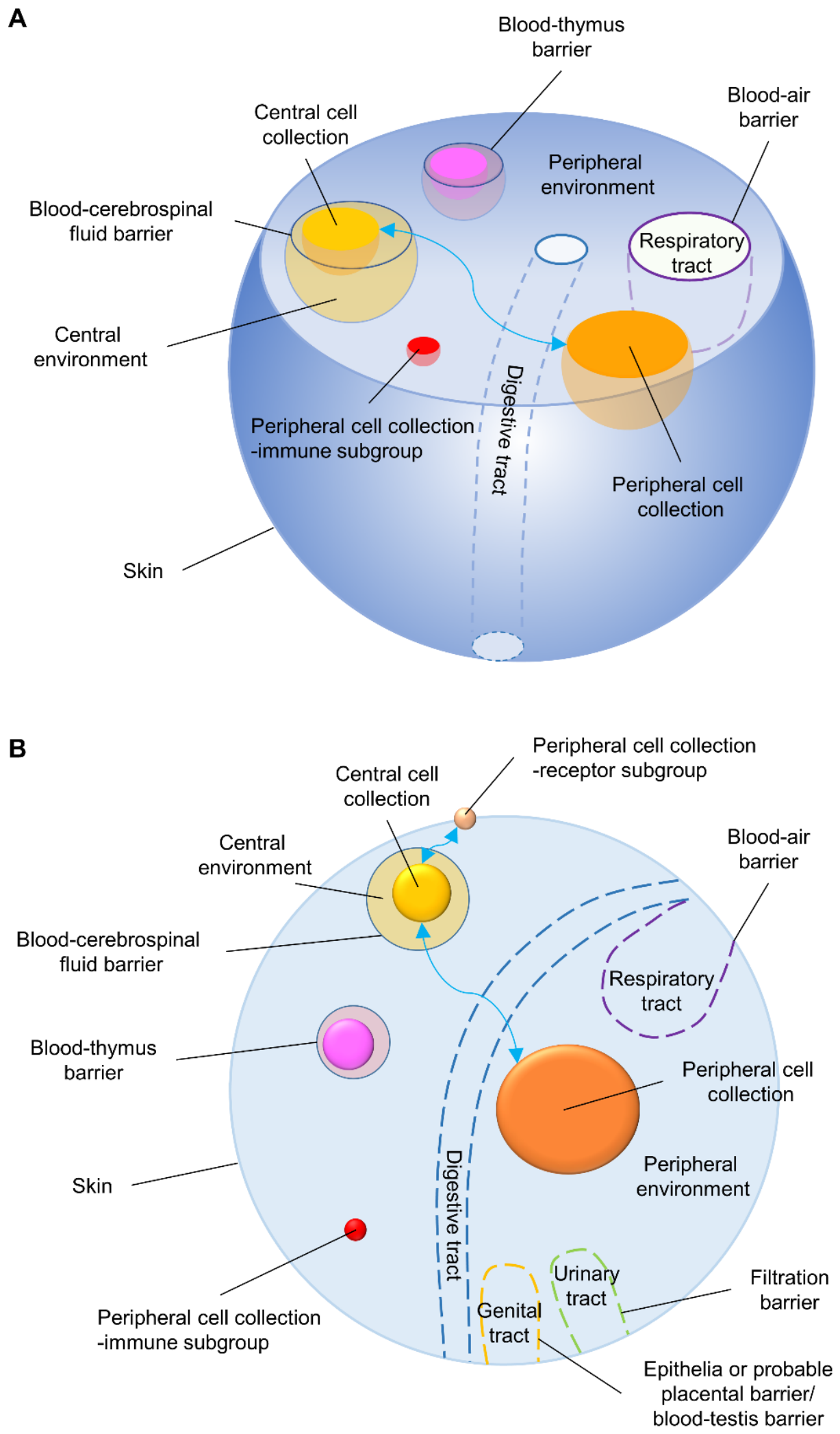
Figure 2.
Pathways of adverse exogenous factors affecting human physiology. (A) General pathways (postnatal stage): Adverse exogenous factors can disrupt local or systemic homeostasis via neurohumoral pathways. A key feature is the bidirectional interaction between local lesions and the whole-body state, each influencing the other’s progression. (B) Example: Chronic bacterial infection (H. pylori): (i) Oral entry into the digestive tract. (ii) Colonization of gastric mucosal epithelium, altering the local microenvironment to establish chronic infection. (iii) Subsequent local-systemic interaction propagating dysregulation. (C) Example: Psychosocial stress: (i) An external eliciting event triggers an emotional response. (ii) This response, mediated via the autonomic nervous system (sympathetic/parasympathetic), hypothalamic-pituitary-adrenal axis, and related pathways, affects endocrine/immune cells and the internal environment through neurohumoral signaling. (iii) The resulting dysregulation interacts with emerging abnormal cells.
Figure 2.
Pathways of adverse exogenous factors affecting human physiology. (A) General pathways (postnatal stage): Adverse exogenous factors can disrupt local or systemic homeostasis via neurohumoral pathways. A key feature is the bidirectional interaction between local lesions and the whole-body state, each influencing the other’s progression. (B) Example: Chronic bacterial infection (H. pylori): (i) Oral entry into the digestive tract. (ii) Colonization of gastric mucosal epithelium, altering the local microenvironment to establish chronic infection. (iii) Subsequent local-systemic interaction propagating dysregulation. (C) Example: Psychosocial stress: (i) An external eliciting event triggers an emotional response. (ii) This response, mediated via the autonomic nervous system (sympathetic/parasympathetic), hypothalamic-pituitary-adrenal axis, and related pathways, affects endocrine/immune cells and the internal environment through neurohumoral signaling. (iii) The resulting dysregulation interacts with emerging abnormal cells.
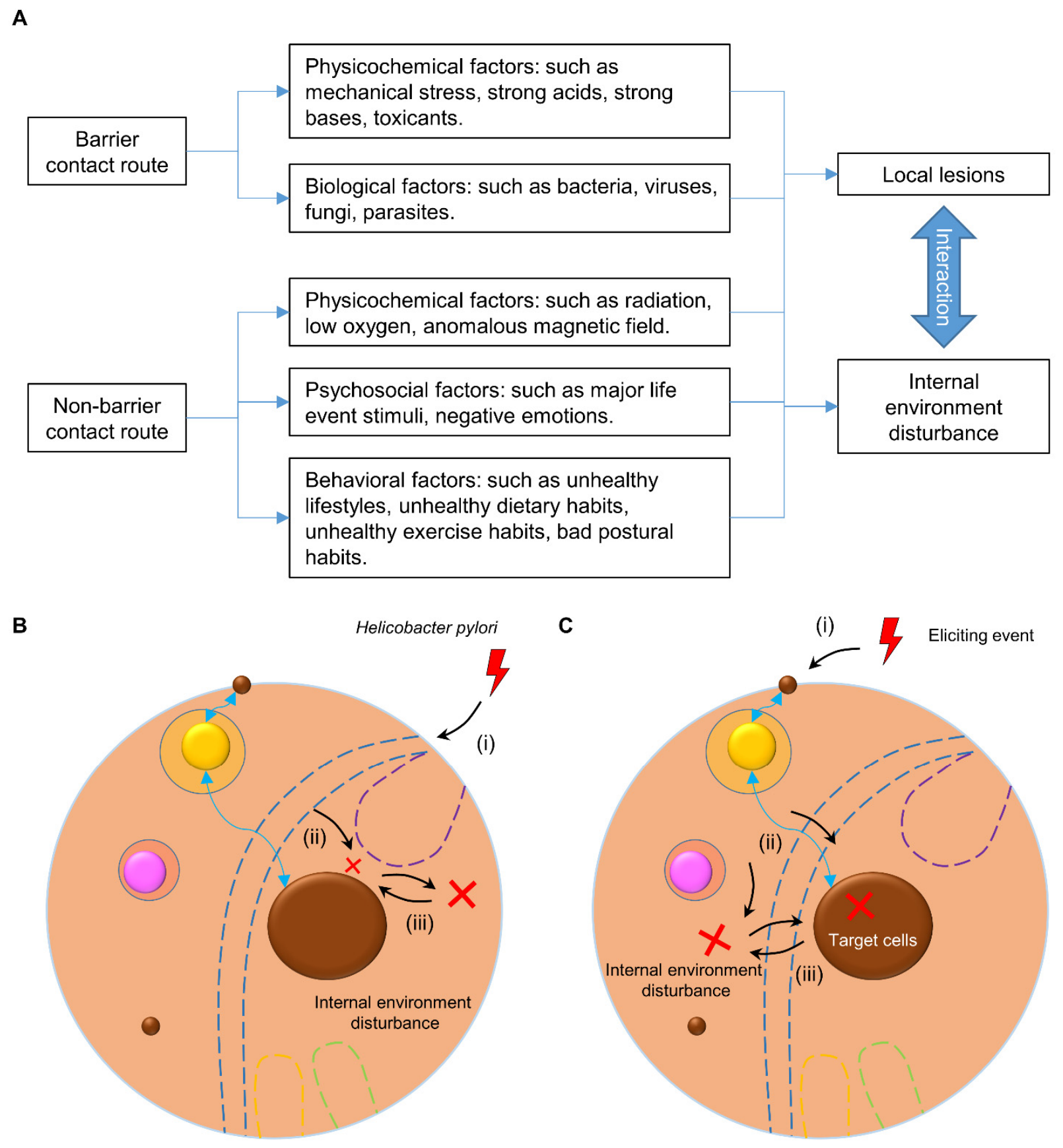
Figure 3.
The initial and established states of non-genetic tumors. (A) Initial formation: This panel illustrates the initial formation of the pathological triad with the pathological components highlighted in orange. The minus symbol (-) indicates a component in an abnormal condition. (B) Tumor state: The tumor, as an abnormal cell mass, coexists with and is sustained by impaired immune surveillance and a dysregulated internal environment. These three components interact reciprocally, establishing a self-sustaining pathological triad. (C) Pathological triad: From a systems-dynamics perspective, this pathological state can be viewed as a system of three core components with coupled feedback loops. Although the immune system encompasses immune cells and immune molecules (housed within the internal environment), it is treated as a separate functional component in this model given its central role in sustaining the pathological triad.
Figure 3.
The initial and established states of non-genetic tumors. (A) Initial formation: This panel illustrates the initial formation of the pathological triad with the pathological components highlighted in orange. The minus symbol (-) indicates a component in an abnormal condition. (B) Tumor state: The tumor, as an abnormal cell mass, coexists with and is sustained by impaired immune surveillance and a dysregulated internal environment. These three components interact reciprocally, establishing a self-sustaining pathological triad. (C) Pathological triad: From a systems-dynamics perspective, this pathological state can be viewed as a system of three core components with coupled feedback loops. Although the immune system encompasses immune cells and immune molecules (housed within the internal environment), it is treated as a separate functional component in this model given its central role in sustaining the pathological triad.
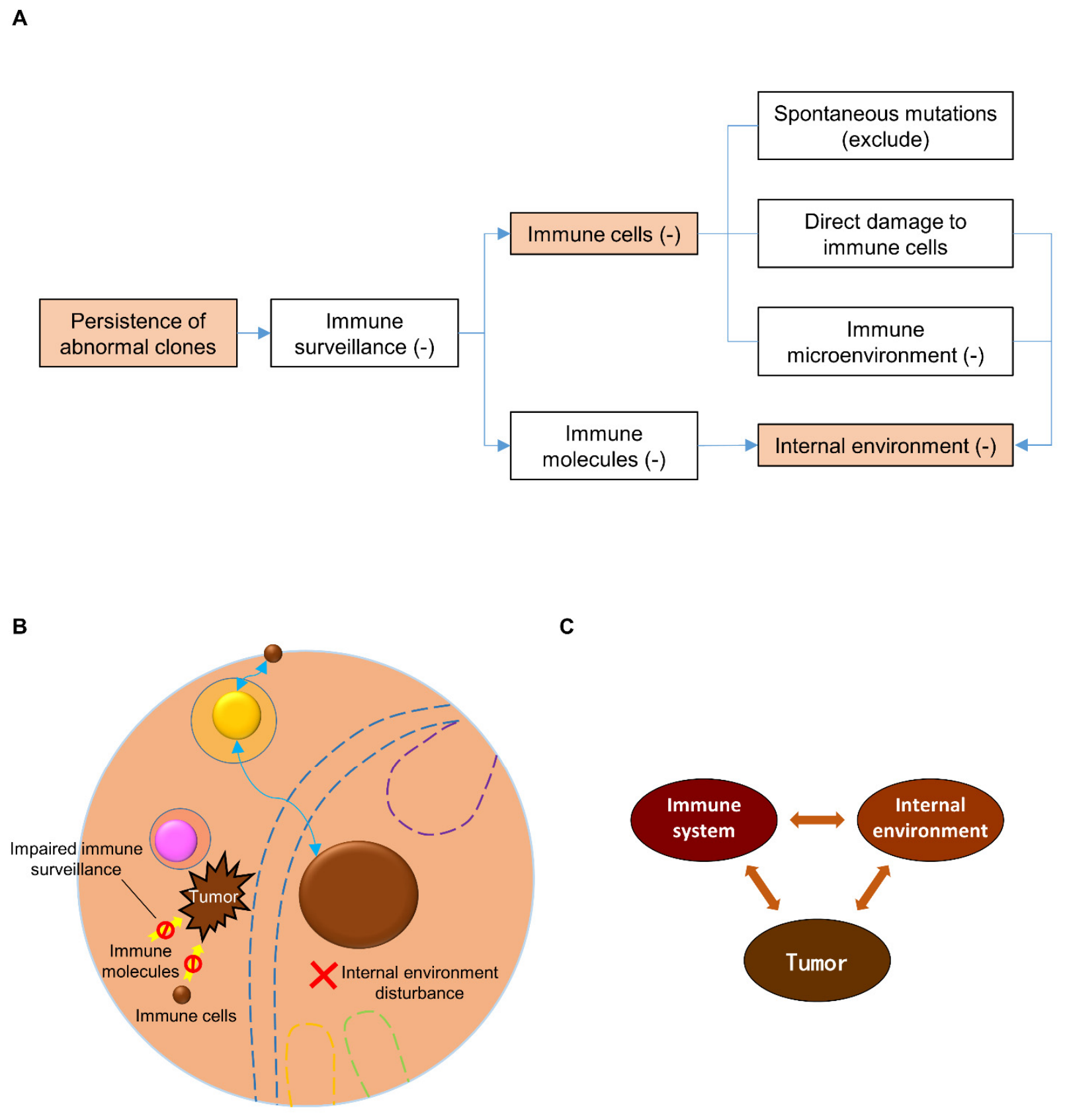
Figure 4.
Thought experiment illustrating the stepwise transition. The schematic depicts the stepwise transitions from health to disease, corresponding to the three model states (Healthy, Sub-health, Tumor). T1: Healthy state. The system exhibits a relatively competent immune system and a homeostatically regulated internal environment. T2: Sub-health state. Exogenous stressors emerge, leading to partial immune impairment and early internal environment dysregulation. T3: Return to healthy state. If exogenous stressors are effectively removed at the sub-health stage, the system can spontaneously return to the healthy state. This reversibility aligns with the TCM principle of “great physicians treat before the outbreak of an illness” (Shang Gong Zhi Wei Bing) and the organism’s inherent self-repair capacity. T4: Tumor state. With accumulated exogenous stressors and without effective intervention, the internal environment becomes persistently dysregulated, immune surveillance is severely compromised, and a clinically manifest tumor emerges. Symbol interpretation: Silhouette color indicates the status of the internal environment (blue, healthy; orange, abnormal/sub-health). Facial expressions symbolize immune competence (red smiling face, relatively competent; brown unhappy face, partially impaired; brown crying face, severely compromised). Lightning bolts represent exogenous stressors (e.g., biological, psychosocial, behavioral). The brown explosion symbol denotes a clinically manifest tumor. Model simplification: This study explicitly excludes long-term temporal dynamics such as childhood development period and the endogenous aging process, which is inherent to the species and determined by genotype.
Figure 4.
Thought experiment illustrating the stepwise transition. The schematic depicts the stepwise transitions from health to disease, corresponding to the three model states (Healthy, Sub-health, Tumor). T1: Healthy state. The system exhibits a relatively competent immune system and a homeostatically regulated internal environment. T2: Sub-health state. Exogenous stressors emerge, leading to partial immune impairment and early internal environment dysregulation. T3: Return to healthy state. If exogenous stressors are effectively removed at the sub-health stage, the system can spontaneously return to the healthy state. This reversibility aligns with the TCM principle of “great physicians treat before the outbreak of an illness” (Shang Gong Zhi Wei Bing) and the organism’s inherent self-repair capacity. T4: Tumor state. With accumulated exogenous stressors and without effective intervention, the internal environment becomes persistently dysregulated, immune surveillance is severely compromised, and a clinically manifest tumor emerges. Symbol interpretation: Silhouette color indicates the status of the internal environment (blue, healthy; orange, abnormal/sub-health). Facial expressions symbolize immune competence (red smiling face, relatively competent; brown unhappy face, partially impaired; brown crying face, severely compromised). Lightning bolts represent exogenous stressors (e.g., biological, psychosocial, behavioral). The brown explosion symbol denotes a clinically manifest tumor. Model simplification: This study explicitly excludes long-term temporal dynamics such as childhood development period and the endogenous aging process, which is inherent to the species and determined by genotype.
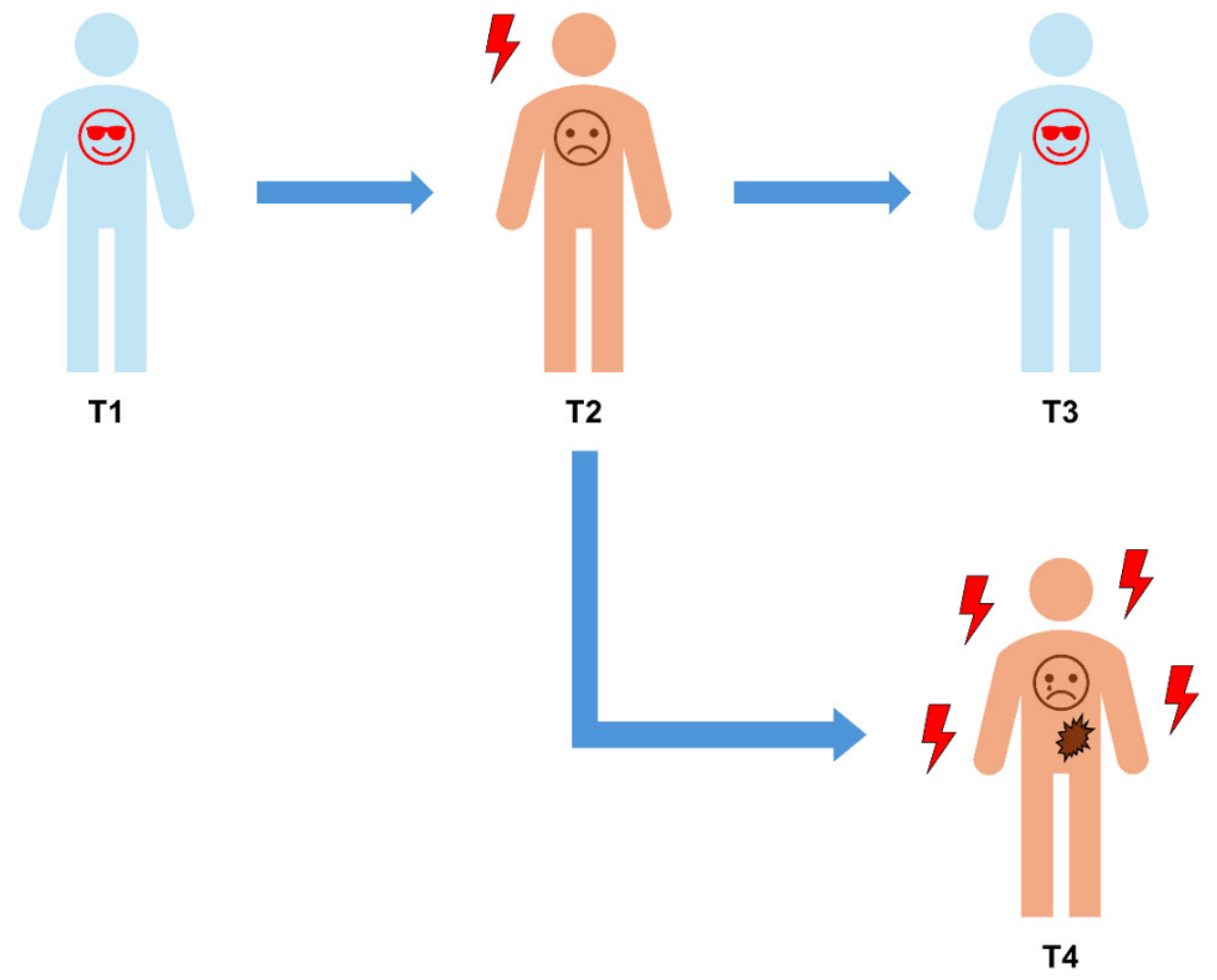

Table 1.
Key concepts and definitions for the physics-informed conceptual model.
| Concept | Definition |
|---|---|
| Protective barrier | Abbreviated as Category 1 barrier. Refers to barriers primarily located at the body surface that isolate the organism from the external environment or protect gametes/zygotes. Examples include the skin, blood-air barrier, mucous-HCO3− barrier, filtration barrier, placental barrier, and blood-testis barrier. |
| Internal barrier | Abbreviated as Category 2 barrier. Refers to barriers located within the body that protect vital organs from fluctuations in the internal environment. The principal examples are the blood-brain barrier and the blood-thymus barrier. |
| Collection of peripheral cells | Refers to the assembly of living cells situated between Category 1 and Category 2 barriers, encompassing both the cells that constitute the barriers and the cells they enclose. |
| Peripheral environment | Commonly referred to as the internal environment. It comprises all extracellular substances located between Category 1 and Category 2 barriers, including fluid components (e.g., plasma, interstitial fluid, lymph) and solid components (e.g., the fibrous elements and the ground substance of the extracellular matrix). |
| Collection of central cells | Refers to the assembly of living cells residing inside the blood-cerebrospinal fluid barrier, excluding the cells that form the barrier structure itself. |
| Central environment | Comprises all extracellular substances located inside the blood-cerebrospinal fluid barrier. |
| Collection of immune cells | Functional designation. Refers to the assembly of living cells within a given environment whose primary roles involve immune defense, surveillance, and homeostasis. This includes, but is not limited to, cell types such as granulocytes, lymphocytes, and monocytes/macrophages. Given the functional complexity and plasticity of the immune system, and the fundamental impossibility of exhaustively defining all components and interactions under current biological knowledge, this model employs an inclusive, function-oriented definition. |
| Collection of immune molecules | Functional designation. Refers to the assembly of mediators within a given environment whose primary functions involve immune signaling, regulation, and effector activities. Examples include immunoglobulins, complement proteins, cytokines, and chemokines; this list is not exhaustive. |
| Collection of receptor cells | Functional designation. Refers to the assembly of living cells within a given environment whose primary function is to detect and transduce external or internal stimuli into biological signals. Examples include photoreceptors in the retina, mechanoreceptors in the skin, and chemoreceptors in the olfactory epithelium. |
Disclaimer/Publisher’s Note: The statements, opinions and data contained in all publications are solely those of the individual author(s) and contributor(s) and not of MDPI and/or the editor(s). MDPI and/or the editor(s) disclaim responsibility for any injury to people or property resulting from any ideas, methods, instructions or products referred to in the content. |
© 2026 by the authors. Licensee MDPI, Basel, Switzerland. This article is an open access article distributed under the terms and conditions of the Creative Commons Attribution (CC BY) license (http://creativecommons.org/licenses/by/4.0/).
Copyright: This open access article is published under a Creative Commons CC BY 4.0 license, which permit the free download, distribution, and reuse, provided that the author and preprint are cited in any reuse.