Preprint
Article

This version is not peer-reviewed.

Impact Of Climate Risk On Financial Sector Stability Of The Selected Sadc Countries

A peer-reviewed article of this preprint also exists.

Submitted:

31 January 2025

Posted:

03 February 2025

You are already at the latest version

Abstract

The study investigates the impact of climate risks on the financial sector stability of the selected SADC countries in the context of Angola, Malawi, Mozambique, Madagascar, Tanzania, Eswatini, Democratic Republic of Congo, Tanzania, South Africa, Madagascar, and Zambia. Countries chosen for this study face climate-related shocks such as rising annual carbon dioxide emissions, affecting their agro-based economies and negatively impacting financial stability. The study aprovides insights into the risks and challenges associated with climate risk for the selected SADC countries. The study employed Panel-Corrected Standard Errors (PCSE) and Feasible Generalized Least Squares (FGLS) models to estimate the long-run parameters of climate risks' impact on the region's financial sector stability. The research confirms a negative and statistically significant long-run relationship between climate risk and financial sector stability in the SADC region. The research found carbon dioxide emissions to be statistically significant and have a negative impact on financial stability. The study recommends integrating climate-related risk into financial, supervision, and prudential regulations. It also recommends critical interventions in creating climate risk insurance products and availing incentives towards green investments to enhance financial sector resilience.

Keywords: 
;  ;  ;  

1. Introduction

Climate change poses one of the global catastrophic risks to humanity, which cannot be predicted with precision, and the future might even hold more serious catastrophes that are unimaginable. A collective effort to fight these symptoms of calamity must be genuine and practical. Given that climate change creates both climate risks and opportunities for the globe, this study probes climate risk and financial stability and excludes the opportunities brought by climate change. The study investigates the impact of climate risks on the financial sector stability of the selected Southern Africa Development Community (SADC) countries in the context of [1] Angola, Malawi, Mozambique, Madagascar, Tanzania, Eswatini, Democratic Republic of Congo, Tanzania, South Africa, Madagascar, Zambia. The researcher based the selection of eleven countries instead of sixteen countries on the availability of data for the primary independent variable of the study: climate risk index. According to the Governor of the Bank of England [2,3] who openly advocated for the integration of climate risk into financial and risk management [4] His speech 'Tragedy of Horizons'' became a wake-up call to governments, the insurance industry, banking sector about the risks drawing near stemming from the horizons. The talk provided three main broad channels through which climate change can affect financial stability: the physical risks -insurance liabilities, and the value of financial assets that arise from climate- and weather-related events, such as floods and storms that damage property or disrupt trade. Secondly, liability risks: thus, compensation made by those responsible in case of eventualities caused by climate change. Thirdly, the costs associated with policy changes and technology towards a low carbon dioxide economy [2,5].
Climate-induced physical and transitional risks are interconnected and destabilize the financial markets and institutions [6]. As such, financial stability is a variable to which many acute (floods, hurricanes, landslides, wildfires), chronic risks (droughts, temperature increases, unreliable precipitation, among others), and climate physical risks exert pressure. Therefore, financial and climate fragility do reinforce each other. [6,7]. Climate-related financial risks can strongly jeopardize the soundness of global or regional financial systems. [8]. Financial sector stability is essential for climate resilience and adaptability [9]. To date, no known technology can reverse climate catastrophes. [10]
The study integrates climate science, economics, and finance insights into a previously overlooked region. The study comes when research themes worldwide hover around providing tailored policy recommendations to enhance the region's financial sector's adaptability, mitigation, and resilience when faced with complicated climate shocks. The investigation was prompted by the need to address a specific knowledge gap in particular SADC regions. Several studies on global and regional scales have been done, especially on transitional and physical risks and their impact on the stability of financial systems. However, of all those studies, the researcher identified that none has quantified the effect of climate risk on SADC's financial sector [8,11,12,13,14,15,16,17,18,19,20]. The study provides a basis for pricing climate risk to markets and investors whenever financial contracts are being assessed, and the financial system is being greenened. The research ignites debate on SADC's sustainable climate financing policy as a workhorse for a smooth transition to a clean climate [9,21]. Apart from that, if the climate risk effect is quantified, bankers and insurers can delineate supervisory frameworks [10]. The study proceeds as follows: section 1: Introduction and Background, section 2: Literature Review, Section 3: Materials and Methods, section 4: results discussion and empirical results analysis, and lastly, conclusion and policy recommendations.
No region can ignore climate change's devastating effects and risks. A report by IMF (2018) delineates those hurricanes and typhoons caused damage worth USD 548 billion (constant 2010 dollars) worldwide during 2000-2014. Sixty-two million were affected by natural hazards, and 2 million were displaced, according to IMF,2018 cited in [22]. Back in Africa, the risks of climate change also pose unique challenges. Africa is particularly vulnerable to the impacts of climate change due to its dependence on rain-fed agriculture, limited adaptive capacity, and high poverty levels [1,19]. The countries chosen for the study are all agrarian economies currently battling food shortages, food inflation, malnutrition crisis, and water shortages because of the El Niño weather phenomenon. [23]. The region underwent tremendously dry conditions during the 2023/24 El Niño season, including one of the driest Februarys in over 40 years, resulting in widespread crop failure across central parts of the region reported by the (Regional Interagency Standing Committee RIASCO,2024). These impacts can disrupt economic activities and strain financial systems, potentially leading to financial instability [24]. Apart from that, Central Banks from developing countries have a more significant scope to deal with than just price stability compared to Central Banks from the developed world. Even worse, Central Banks from developing countries lack independence from government policies and political pressures, a limiting factor. That leaves central banks from the developing world with a limited mandate to venture into low-carbon transition goals and invest in a sustainable climate. [11].The African Development Bank (AfDB) has emphasized integrating climate-related considerations into financial sector policies and practices to ensure financial institutions' long-term stability and sustainability [25]. African countries have been addressing climate risks, such as developing national climate change strategies and implementing climate adaptation and mitigation measures. However, not all central banks in SADC are members of the Network for Greening Financial Systems(NGFS) launched in 2017 [26]. As of October 2024, only six of the sixteen states in SADC are members of the NGFS. Hence, it has given challenges in compilation and access to data needed for climate tests from Sub-Saharan Africa. The mandate of NGFS is to conscientize all central banks and all stakeholders on how they can incorporate climate change dynamics into their balance sheets.
The SADC region is highly vulnerable to the impacts of climate change, with sectors such as agriculture, water resources, energy and financial sector at particular risk. According to the Global Climate Index ranking 2016, of the ten most affected countries between 1997-2016, nine were from low-income countries, and only one was an upper middle income. Among the nine, Haiti, Fiji, and Zimbabwe were in the top ten, with Mozambique and Madagascar falling in the top twenty most affected, pointing to extreme vulnerabilities of the region and its financial sector [27]. Mozambique has experienced severe flooding in recent years, which has led to significant damage to infrastructure and agriculture production. The country's financial sector can be negatively affected by the increased reconstruction costs and the decline in agricultural output [27]. Similarly, Zimbabwe has faced recurring droughts, adversely affecting its agricultural sector and overall economic stability. Reduced crop yields and increased food prices can lead to inflationary pressures and strain the financial sector's stability to support affected communities adequately. Malawi was brutally hit by cyclone Freddy 2023, which destroyed significant roads, farmlands and residential infrastructure. Of late, these vast water bodies have threatened the survival of SADC countries. In most cases, they are sources of severe weather hazards, such as rampant tropical cyclones in the continent. Table 1 shows a timeline of tropical cyclones that have generally affected some SADCs over the last 20 years and their origins.
These hazards are, by and large, the product of climate shocks that triggered very high temperatures, strong winds, heavy rains and storms, and subsequent flooding. [28]pointed out that catastrophes such as cyclones cascade to financial services through bank credit, market, liquidity, and operational risks in several ways. Most SADC countries have always been on the path of these weather hazards. The impact has been severe on the already vulnerable SADC countries Malawi, Mozambique, Madagascar, Tanzania, Eswatini, Democratic Republic of Congo, Tanzania, South Africa, Madagascar, Zambia, and Zimbabwe as compared to other SADC countries. Figure 1 shows the carbon dioxide emissions, a standard indicator of climate change.
The upward trend noticed across the regions in the world can also be seen in the SADC region between 1884 and 2022. In 2022, South Africa, more of an outlier, had the most significant emissions, followed by Botswana and Namibia. The least emitters in SADC are the Democratic Republic of Congo and Malawi. As such, the share of emissions in the SADC region is relatively trivial and approximately 1.3% of the global emissions [29,30]. Nevertheless, the region remains susceptible to climate change and related risk effects. The probability of climate change events and related risks is not dependent on the level of economic development, whether from the global north or south. Nevertheless, it affects all regions regardless of their contribution to global carbon emissions. The following section delineates financial sector challenges.
SADC is among the regions that have not actively driven their financial sector systems into climate risk through regulatory requirements. Integrating climate-related risk into prudential, financial, and regulatory supervisory framework remains weak despite membership to the SADC-Development Finance Resource Centre [31].SADC countries are lagging in joining international climate-related initiatives, where very few countries are members of the Network for Greening Financial Systems(NGFS), Sustainable Banking and Finance Network(SBFN), and Net-Zero Banking Alliance (NZBA) among others [32]). The financial sector of SADC countries is not immune to these climate-related risks. Also, the fact that only South Africa in SADC is a member of the Financial Stability Board leaves the region unconnected to international institutions that provide expertise in addressing vulnerabilities of global financial systems [33].
Financial institutions face challenges in assessing and managing climate risks, including the potential for loan defaults due to climate-related disruptions, devaluation of assets, and increased insurance claims. Climate-related metrics for compensation basis are still evolving, and the study calls for concerted efforts to develop standard and transparent compensation schemes [34]. Recognizing the importance of addressing climate risks, several SADC countries have started incorporating climate change considerations into their national development plans and policies. Given this background, studying the impact of climate physical risks on financial sector stability in selected SADC countries becomes crucial. Such studies can help to quantify the impacts of climate risks on the financial systems of the selected SADC countries. Besides, that encourages the assessment of SADC's vulnerability and resilience, and this informs the development of appropriate policies and strategies to promote financial sector stability in the face of climate physical risks [35]
Climate change-related risks increasingly expose the SADC's financial sector, both physical and transitional. The extreme weather conditions perennially affecting the region are a cause of concern; these include tropical cyclones, which have a record of excessive flooding, destruction of infrastructure, crops and other agricultural products, and stagnating mining production. A perfect example is El Nino weather conditions experienced in SADC season 2023/24, which led to drought in most parts of SADC. EL Nino affected the financial system via key economic sectors such as agriculture: the food and water shortages both affected the value chain and the energy crisis. Common phenomenal outcomes were inflationary pressures, exchange rate volatilities and financial market instabilities experienced in the region. Again, risks associated with economic restructuring towards carbon neutrality cannot be underestimated [20]. The risks directly affect the financial sector via liquidity, credit availability, price changes, and exchange rate volatilities, thus affecting strategic industries. Central banks and other financial institutions in SADC have made limited progress in curbing climate-related risks. Thus, regional financial institutions lack adequate assessment models and frameworks to measure, manage and mitigate climate risks [29]
Moreover, investors are sceptical about investing in climate risk-induced catastrophes, and hence, investor confidence remains very low because of the uncertainty in climate change and its impacts; the only way to boost confidence is through developing climate risk models that help evaluate and assess investment decisions. According to [36] concur that quantitative integration of climate risks in economic and financial development planning is a requirement. The research findings highlight that the region has yet to integrate climate risks into investment, which is against the backdrop of inadequate international climate finance developed countries promised to offer developing countries [28]. Also, global financial flows for adaptation are lacking, affecting adaptation options in developing countries [35]. Again, this is aggravated by weak financial development, which has constrained financial inclusion and financial depth [37]
If policymakers do not pursue efforts to control climate risk, it may lead to financial sector instabilities that destabilize trade, mining, agriculture, and energy sectors, as well as the overall performance of the economies under study. In addition, the region lacks risk management strategies and resilience mechanisms in the face of climate shocks. Nonetheless, studies that quantify the effects of climate risks on the fragility of the financial sector are still scant, particularly in the SADC region. Whereas those carried out in SADC focused on climate change and financial stability, none investigated actual climate risk metrics [38,39].The literature on climate physical and transitional risk and financial stability is still scant in SADC, and hence, the paper opines and ignites the debate in the respective areas.
The primary goal of the research is to provide an in-depth analysis of the impact of climate risk on the financial sector's stability in the context of SADC. Furthermore, to gain more insights from the financial sector, the study investigates the impact of climate risk on bank lending activities.

2. Literature Review

The study builds on the externality theory propounded by Coase (1960) and Pigou (1920) that gave the first- and second-best solution to global problems, that is, the notion that climate change is a negative externality and can be dealt with by imposing a price on emissions through tax, cap and trade system. Also, the second-best solution incorporates social, technical, political or economic elements found to be suboptimal, especially under complex political economy to climate policy. Again, we consider the climate fragility hypothesis [7], which posits that climate fragility aggravates financial fragility. The hypothesis connects physical risk, liability, and transitional risk as the crucial mechanisms through which climate systemic risk stimulates financial crises. The key submissions were that climate systemic risks are non-idiosyncratic shocks, and as such, they call for a collective insurance approach that targets the financial sector. The hypothesis contends that isolated measures to mitigate climate risks are futile and counterproductive. Alternatively, the study is also informed by the theoretical foundations of the dismal theorem [40], which states that the impact of climate change is highly uncertain on actual timing. The theorem considers fat-tailed risks as risks that have a low probability of occurring but can have severe impacts when they do occur. However, the 21st century has seen fast-increasing frequency and extreme climate catastrophes; hence, ignoring the probabilities of the occurrence of such catastrophes is unsustainable. The theory emphasizes the importance of proactive global climate policies. As a result, delaying action against climate change makes the tail flatter, which means it could be more devastating and irreversible. Just like the climate fragility hypothesis drifts away from traditional cost-benefit analysis, so does the Weitzman theorem depart from externality theories and traditional cost-benefit analysis, citing that the value of damages from an event may be infinite and difficult to account for.
Numerous studies have been undertaken in Sub-Saharan Africa and on a global scale. In this section, the empirical review searches for the linkages between climate risk and financial stability. [8] examine climate risk and financial stress of the Economic Community of West Africa (ECOWAS). The study reflected climate risk and financial stress to display a nonlinear relationship and a multivariate threshold autoregressive vector model was implemented. While the current research considers linear relationships, it acknowledges that the data set used is small, which justifies the reliability of the results. A principal component analysis and variance equal weights were used to construct a financial stress composite variable, a much more in-depth measure of financial stress than a single proxy measuring financial stress. Climate risk was proxied by energy emissions and carbon emissions. Key insights from the study pointed out that temperatures above 28,350c negatively affect financial stability for the thresholds examined, and temperatures below 28,350c were considered sustainable. The key takeaway from the study is that a Pigouvian tax on emitters would ultimately reduce greenhouse gas emissions, climate stress testing and early warnings before the shocks could mitigate the extreme effects of climate shocks
Evidence from Sub Sahara, according to [41], indicates that the banking system is resilient to temperature shocks in the long run, whilst the banking system is negatively affected by precipitation and greenhouse gas shocks in the long run. In contrast, the banking system is only resilient to precipitation shocks in the short run. The argument could be that SSA countries are slowly diversifying their economies, thus moving away from climate-sensitive sectors, such as agriculture. On the other hand, resilience to precipitation shocks in the short run could be linked to informal economies that characterize the SSA. Hence, banks often finance properly documented farmers who already have access to irrigation, thus limiting exposure to precipitation shocks. [42],In the same domain of SSA, it was concluded that a negative association exists between climate change and financial stability in the long run compared to the short run. However, the authors pointed out that physical risks are more devastating and could be abated by incorporating consistent climate policies and regulations. Investigating SADC is crucial as it will inform the region's policies and mitigation strategies.
Ref. [20] concluded that spillover effects of environmental degradation from a rise in consumption of non-renewable and renewable energy would increase the occurrence of systemic banking crises, thus confirming the climate fragility hypothesis in SSA. Another comprehensive bibliometric analysis of trends in climate change and organizations [43]identified several research gaps. However, this study embraced the notion that Africa is understudied and that the region lacks an understanding of the manifestation of climate risk. The authors also pointed out a shortage of research on how extreme weather events impact organizational performance. Therefore, the present study bridges the gap by focusing on the magnitude of severe climate-induced shocks on financial systems in the SADC region.
Shifting the focus from SSA, the study focuses the review on the global north and south, respectively. In a study done in G20 countries by [44], no significant link was found between climate risk and financial fragility, attributed to resilience demonstrated by the advanced nations. Indeed, strong credit markets and risk insurance could contain adverse effects of climate risks. However, climate risk had a minimal impact on financial access, an attribute that shows how G20 countries have managed to protect their economies from shocks of climate risks. G20 countries should harness climate change mitigation strategies to augment financial system efficiency.
Ref. [6] using quantile regression, researchers investigated how systemic risks of US banks and insurers relate to the performance of both green and brown markets. Again, the study concluded how quickly and to what extent the US banking sector responds to an enormous climate disaster using the Wilcoxon signed rank sum test. In essence, the study fosters the adoption of climate policies capable of countering the rise in frequency and severity of extreme weather events. The study confirmed that physical risks caused by climate catastrophes grossly threaten financial stability and, therefore, the need to design policies that significantly mitigate climate risk impact.
In another similar investigation by [45], ordinary least squares with individual effects and time fixed were used. The broad objective of the study was to analyze the Non-Performing Exposures (NPEs), domestic banking groups and climate risks in Europe. The study disintegrated climate risk into physical and transitional risk—the present research combined physical and transitional risks due to the unavailability of data. Findings from the research pointed out that both physical and transitional risk adversely affect the financial stability of the European Banking institutions. Additionally, the study included macroeconomic variables such as GDP, Unemployment, and Voice of Accountability. The paper confirms that European banks are vulnerable to NPEs, and climate risk management still needs to be boosted to restrain financial instabilities.
Another relevant investigation assessed the impact of climate change on green finance and financial stability and found a negative effect of CO2 emissions on financial stability and a positive impact of green finance on financial stability, most notably through green loans. Researchers used the Z-score index to measure the financial stability of both emerging and developed countries [46].In this investigation, both emerging and developed countries exhibited an antagonistic relationship that climate change imposes on financial stability. However, the Z-score index for both emerging and developing countries could not vary, which implies that both emerging and developing countries had relatively sound financial systems.
A study by [47] investigated whether climate change fuels commercial banks' non-performing loan(NPL) ratio in 31 provinces of China. The study used a System Generalized Methods of Moments (GMM) and concluded that climate change measured by a proxy temperature fluctuation and bank's asset quality measured by non-performing loans had a significant positive impact. A fascinating insight from the paper was the transmission mechanisms of climate change to labour productivity per capita incomes and NPL. The dimension is critical in policy formulation, thus calling for labour policy to incorporate climate change effects and designing mitigation measures towards labour productivity challenges. However, green credit as a mitigation strategy for climate-related risks proved insignificant, which suggests that commercial banks in China have limited investment in green credit as a tool to curb financial instability. As for the SADC region, data on green credit is still scant, pointing to scepticism about implementing such mitigation strategies.
In another dimension, an investigation by [48], the author emphasized that climate risk is a source of financial risk, and hence, the Central Banks have the responsibility to oversee and supervise banks to attain financial stability. [49] examine the role of financial stability on climate risk and mitigation of G-5 countries, and research findings advocate the integration of global warming concerns into policies and financial risk for greening economies. On the other hand, [3] argues that it is not the responsibility of Central Banks to manage climate change risk and policy development; instead, politicians, the electorate, and international organizations should be held accountable for climate catastrophes. In that notion, the current study complements the ideas by building on quantifying the impact of climate risk on the financial system, which can be collectively used by all stakeholders in resource allocation, risk assessment, management strategies, and policy evaluation.
Overall, research conducted in the SSA has predominantly emphasized climate change by analyzing precipitation and temperature changes as the key variables measuring climatic variations ( [8,37,41,42]. The current study sought to include a climate risk index regarded as a more comprehensive measure of climate-induced risks [13,44,50]. Whilst previous studies in SSA extensively looked at climate change, it is important to incorporate climate risk, especially in discussions related to risk management and policy making. According to [43], Africa is still understudied and lacks an understanding of climate risk. Therefore, the study bridges the gap by sparking the debate from a SADC regional perspective.
  • Hypothesis 1: H0: Climate risk has no significant impact on the stability of the financial sector of SADC
  • Hypothesis 2:H0: Climate risk has no significant impact on bank lending activities of SADC

3. Materials and Methods

The study used country-based panel data models using data from 2010-2020. We employed a Panel-Corrected Standard Error (PCSE) as our primary estimation method. To ensure robustness in our analysis, we used Feasible Generalized Least Squares (FGLS) and Fixed Effects (FE), random effects (RE) and Pooled Ordinary Least Squares (POLS). Each method allows us to test the reliability of our results and confirm the impact of climate risk on the financial sector's stability within the SADC context. The availability of the leading independent variable-climate risk data determined the period under study. The study employed country-based panel data. The German Watch has data for the climate risk index from 2010- 2020. Hence, this limits our observations and keeps our sample size small. The study sample comprises eleven SADC countries (Angola, Malawi, Mozambique, Madagascar, Namibia, Tanzania, Eswatini, Democratic Republic of Congo, Tanzania, South Africa, and Zambia), and country selection was based on the availability of data for the primary independent variable of the study: climate risk index to investigate extreme weather conditions on the financial system. The study follows the empirical models [14,17,51,52] opined. The models were used to assess how globalization and energy usage influence carbon emissions in South Asia, the impact of climate risk on financial access and sector stability in G20 countries and linkages between climate change and commercial banks’ non-performing loan ratio in 31 provinces in China. The models were modified to give us the following:
1. Model of Z_score
Z _ score = f ( C R I   , C O 2 ,   A F F , N P L , I n f l , E X R ,   )  
where financial sector stability (Z_score) is expressed as a linear function of climate risk index (CRI), carbon emissions (CO2), agricultural output (AFF), Non-Performing Loans (NPL), Inflation, exchange rate (EXR)
Z _ s c o r e i t = α 0 + α 1 C R I i t + n 1 6 β n C o n t r o l n , i t + μ i + φ t   + ε i t
2. Model of Bank loans to Bank credit (bank stability)
L D R i t = α 0 + α 1 C R I i t + n 1 6 β n C o n t r o l n , i t + μ i + φ t   + ε i t
L D R i t  denotes bank lending activities (bank stability), C R I i t denote the global climate risk index and the c o n t r o l ;   i t denotes variables that influence financial stability, those related to the financial sector and macroeconomic variables that μ i - is the country’s individual effect, φ t - fixed effects, C o n t r o l n , i t - control variables

3.1. Dependent Variable

Z_score: The primary dependent variable that measures the financial sector's stability. It is calculated as Return on Asset, ROA+(equity/assets))/sd (ROA); sd (ROA) is the standard deviation of ROA, calculated for country-years with no less than five bank-level observations. Several researchers used the Z-score to measure financial system stability [14,38,44,46,50,52,53,54,55,56]. The data were sourced from the global financial development database
Bank Credit Ratio (LDR): Financial resources banks provide to the private sector. It is measured by the ratio of total bank credit to deposit balance at the end of each year. It indicates the overall lending activities of the banking sector. The higher the value, the better. On the contrary, the lower the value, the better from the perspective of risk protection [13]. The study used LDR as the dependent variable measuring bank stability. There is generally a positive relationship between bank lending activities and climate risk. Data sourced from the Financial Soundness Indicators Database (fsi.imf.org), International Monetary Fund (IMF)

3.2. Independent Variable

Climate Risk Index (CRI): The major independent variable is the climate risk index, which measures the physical risks resulting from economic costs from extreme weather conditions. The climate risk index was sourced from Germanwatch's Global Climate Risk Index (CRI). The index is constructed using data from Munich Re NatCat SERVICE and four indicators, which include the number of deaths, number of deaths per 100000 inhabitants, the sum of losses in US$ in purchasing power parity (PPP) and losses per unit of Gross Domestic Product (GDP) (Global climate risk index, 2018). A high CRI score signifies minimum impact, whereas a lower CRI score indicates very high risk. Several research employed climate risk indexes such as [14,44,50] among others
Control variables
Non-Preforming Loans to GDP(NPL): Non-Performing Loan ratio has been widely used as a proxy of financial stability [10,14,17,47,52,57,58].In the case of floods, storms, and natural disasters, the effects cascade to the financial sector through multiple challenges, including erosion of assets capital value, loan defaulters, and regional lenders facing high concentration. In other words, credit risks increase in the financial sector. The study used the Bank nonperforming loans to total gross loans are the value of nonperforming loans divided by the total value of the loan portfolio sourced from World Development Indicators (WDI)
Capital Adequacy Ratio: Also known as bank regulatory capital to risk. It ensures the bank has enough capital to absorb losses and the minimum acceptable ranges from 8% to 10.5%(source). A higher CAR signifies stability and a stronger financial position. We anticipate a negative relationship between LDR and the Capital Adequacy Ratio. The rest of the explanatory variable is given in Table 2, and the selection of variables used in the models was informed by theoretical considerations and empirical evidence.

4. Results Discussion

The metrics in Table 3 indicate statistical analysis of the whole data set, and critical importance are the dependent and major independent variables. The dependent variable Z_score, which measures the financial stability of SADC, shows that the average score for the period under investigation is 14.411, and the maximum is 27.018, with a minimum score of 4. 268. The standard deviation of 6.355 indicates a moderately high variability in the financial sector across SADC. More so, the climate risk index (CRI) shows that the average score is 68.899 and a maximum score of 132.33 with a minimum of 2.67. High values of the CRI score indicate less climate risk, whilst lower scores point to high climate risk. The standard deviation of 29.993 is high, signifying higher variabilities in the climate risk.
Table A1 depicts the results of the Pearson correlation test see Appendix 1, with explanatory variables showing noncollinearity. A slightly higher positive correlation coefficients are depicted between carbon emissions (CO2) and bank credit-to-deposit ratio (LDR) [0,768], GDP_pc and LDR (0.709), GDP_pc and CO2 (0.785). However, correlation coefficients are statistically significant at 5%. Z_score measuring financial stability is negatively affected by Inflation (Inf) and non-performing Loans (NPL) with a coefficient of -0.098 and -0.184 and is statistically significant. However, climate risk (CRI) and carbon emission (CO2), though significant at 5%, all show a positive relationship with the dependent variable, which is against the theory and prompts further investigations. Alternatively, CO2 is negatively related to agricultural productivity (AFF), non-performing loans (NPL), exchange rates (EXR), and Inflation (Infl) with the following statistically significant coefficients: 0.531, 0.301, 0.347 and 0.206, respectively.
Table 5 exhibits cross-sectional dependence test results, and the null hypothesis of cross-sectional dependence is rejected for all variables with a significance level of less than 5%. Thus, we conclude that there is substantial cross-sectional dependence in the panels, meaning that standard shocks that arise can be easily transmitted throughout the region. Once a data set indicates cross-sectional dependence, it necessitates using a second-generation unit root test [51]. Therefore, table 6 shows both first and second-generation unit root tests see Appendix 1
Table A2 displays the unit root test results for all the variables used in the two research objectives. Pesaran and Shin is a second-generation unit root test necessary when running a model with cross-sectional dependency problems. The other two first-generation tests are used just for robustness checking. Overall, logZ_score and log non-performing accepted the null that the panel contains unit root in levels1(0), which got stationary after the first difference1(1). Whereas all other variables like climate risk(logCRI), carbon emissions (logCO2), and bank credit to bank deposit (logLDR) among other variables, reject the null hypothesis that panels contain unit root in levels 1(0) and all are significant at less than 5% significance level.
Table A3 shows panel cointegration results using Kao and Westlund (see Appendix 1). Both statistics strongly reject the null hypothesis of no cointegration at a 1% significance level. Therefore, the study concludes that there is strong evidence of cointegration among Z_score, climate risk index, carbon dioxide emissions, agricultural output, bank credit to bank debt, exchange rate, and inflation. A long-run relationship exists among the variables [59]
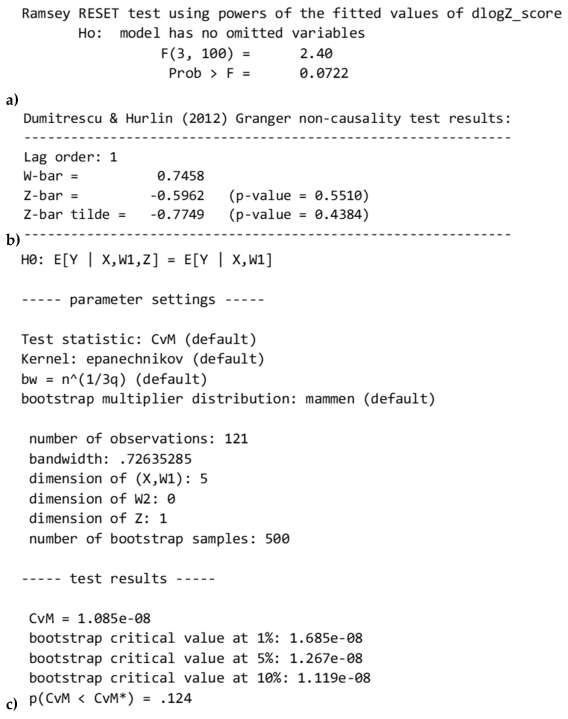
The study adopted the PCSE and FGLS methods because the data set presented heteroscedasticity and cross-sectional dependence issues. A Breusch Pagan test concluded that the data set had non-constant variance. See results in Appendix 1. According to [51], when data exhibits cross-sectional dependence and cointegration among variables, a panel-corrected standard error (PCSE) by the Prais Winsten regression model yields a reliable estimate. The method also controls heteroscedasticity and serial correlation. We also used the feasible generalized least squares (FGLS), pooled ordinary least squares (POLS), fixed effects, and random effects to check for robustness. The research employed several tests to check for the possibility of endogeneity problems, namely the omitted variable, measurement errors and reverse causality. The tests concluded that the estimated models are free from endogeneity, hence ruling out possibilities of bias, inconsistent estimates, and model misspecification. See the Ramsey set test, Delgado and Manteiga test, and Dumitrescu & Hurlin (2012) Granger non-causality test results: See results in the Appendix 1.

4.1. Analysis of Empirical Results

Table 8 represents the main model which answers hypothesis 1. The study rejects the null hypothesis that climate risk has no significant impact on the financial sector stability of SADC and accepts the alternative hypothesis at less than 10% level of significance in all models [60] and accept the alternative hypothesis: Climate risk has significant impact on financial sector stability of SADC. The financial soundness indicators drawn from the Global Financial Development database (2022) underscore key stability indicators, and the research employed the Z_score and bank credit to bank deposit percentage as the primary financial stability variables throughout the study. The results confirm a negative and statistically significant relationship between climate risk and financial stability. Both climate transitional and physical risks actively affect the SADC region. The perennial cyclones, hurricanes, high temperatures, and others are giving rise to property devaluation, which cascades into the financing of houses, banks, and the stock market [61]. As for transitional risks, failure to embrace sustainable transition has led to the obsolescence of industries, especially high emitters like coal mining and asbestos mining, which ripples into these companies' financial portfolios. A 1% increase in climate risk negatively impacts financial stability by (-2,874%; -3.455%) from columns 1-4, as shown in Table 8. Several authors also made similar conclusions from different regions [16,44,50]. The empirical evidence was confirmed internationally, in the G20, Europe, and Asia, and the current study provides similar evidence.
The study also notes that carbon emission (CO2) has a negative and statistically significant impact on financial stability, as evidenced by negative coefficients (Table 8) in columns 1-4. Climate change affects financial stability in various waves, such as credit risks, especially in the current climate adaptation drive, and the imposition of a carbon tax on high-emitting companies. As usual, a tax increases operational costs, which alone magnifies the probability of defaulting. The study established that a 1% increase in carbon emissions correlates with a deterioration in financial sector stability by significant percentages (-8.424%, -9.402%). Researchers in Asia, Europe, and other parts of the world [6,16].
Non-performing loans show a statistically significant negative correlation with financial stability. An increase in NPL will erode the financial sector's stability through several channels, some of which are credit crunch, profitability, erosion of Tier 1 capital and failure of banks to absorb losses in times of climate and other macroeconomic shocks [16]. The analysis exposes that a 1% increase in NPL weakens financial sector stability by (-2.092%) -2.028%) in columns 1-4. Hence, it is also confirmed empirically in [12,17,62].
The control variables that the research utilized are theoretically and empirically significant in explaining financial stability. Agricultural productivity (AFF), Gross Domestic Product per capita, and Exchange rate (EXR) all have statistically significant positive contributions towards the financial stability of countries in SADC. Countries in SADC have significant agricultural sectors that contribute significantly to their gross domestic product.
Table 9 represents model two, primarily designed to approve the main objective in Table 8. The second objective measures bank stability using a loan-to-deposit ratio and answers hypothesis 2: climate risk does not significantly impact SADC's bank lending activities. Results show that by running the same model using different dependent variables measuring bank stability, we reject the null hypothesis at all models at less than a 5% level of significance and accept the alternative hypothesis: Climate risk has a significant impact on the bank lending activities of SADC. In addition, climate risk and carbon emissions reinforce each other in aggravating bank lending activities. Climate risk positively influences lending activities; a 1% increase in climate risk increases the bank lending activities by (0.0512%; 0.0512%.0360%;0.0165%) at 1% and 5% significance levels in all four models. Likewise, carbon emissions, a proxy for climate change, revealed a positive and statistically significant impact on bank stability. A 1% increase in carbon emissions will increase bank lending activities by (0.191%,0.185%,0.173%) in columns 1- 4 respectively. The results indicate that climate change and the associated risks weaken financial sector stability because they increase banking sector lending activities, leaving banks with liquidity and operational risks, as suggested by [28]. Similar findings were drawn from several studies in the global north and south [28,45,63], and SADC is underexplored in this matter. Other macroeconomic variables concur with prior theoretical and empirical findings that inflation (Infl) negatively influences bank lending activities, meaning price increases in commodities directly reduce bank lending through several channels. A good example is the effect of Elnino experienced in some SADC countries in season 2023/24, with rising food inflation aggravating food security in the whole region, with an estimated 18 million experiencing food shortages [23]. In light of this, interest rates will discourage loan demand, and banks will adjust lending rates in response to the inflation outlook. A 1-unit increase in inflation decreases lending activities by (0,00107) % from column 4 in Table 9.
Notably, non-performing loans (NPL) negatively impact bank stability, which has been confirmed in Hypothesis 1. NPL erodes the bank lending activities through liquidity risk. In the event of any catastrophe, banks switch from investments in fixed assets, long-term loans, and equity investments to increasing liquidity, which forces banks to reduce lending. The result diverges from similar analyses done in G20 countries, where climate risk had a negligible effect on financial fragility owing to their advanced credit markets and well-designed insurance models [44]. However, evidence from notable research confirmed that climate risk has a detrimental effect on financial stability and fragility [12,53,64,65]. Analysis of agricultural productivity indicates a positive and statistically significant relationship in the long run, meaning that as bank lending activities increase, so does agricultural productivity. In anticipation of a bumper harvest, the agriculture sector may push for more loans for inputs, a common phenomenon from the sample under investigation because the sector contributes significantly to the gross domestic product of the SADC countries to a tune of 10-20% [66,67].
Table 10 represents the robustness results for model 2; a pooled OLS, fixed, and random effects were used to check on the robustness of the models in Table 9. Again, the hypothesis that climate risk has no significant impact on bank lending activities of SADC is rejected at less than a 10% significance level in all models columns 1-3, and results show a pooled ordinary least squares, fixed effects and random effects model, respectively. A Hausman test confirmed that the fixed effects model is the closest estimation model to estimate the impact of climate risk on bank stability measured by credit to bank deposit (bank lending activities). A Breusch and Pagan Lagrangian multiplier test for random effects test rejected random effects and POLS as the best estimation techniques. See Appendix 3. Accordingly, similar findings are noted that climate risk (CRI) has positive and statistically significant impacts on SADC bank lending activities, as indicated in columns 1-4 in Table 10. However, climate change (CO2) is insignificantly positively influencing bank lending activities.

5. Conclusions and Policy Recommendations

5.1. Conclusions

The paper investigated the impact of climate risk on SADC's financial sector stability and further explored the effect of climate risk on SADC's bank lending activities. The research used Z_score (dependent variable) to measure financial stability, and the main explanatory variables are climate risk index and carbon emissions using PSCE, where FGLS, fixed, and random effects were used as robustness checking models. Building literature and constructive debate around the matter necessitated the study. Like any region, SADC is not immune to climate physical and transition risks. Therefore, carbon industries such as mining, agriculture, heavy manufacturing, and energy production are all enormous emitters of greenhouse gases and directly linked to the financial sector, yet they contribute to the economic well-being of SADC. For this reason, the transition to low carbon is a solution to curtail climate risk; conversely, it would mean forgoing significant economic growth to achieve sustainable development. Nonetheless, a careful, informed transition is paramount for sustainable growth.
Considering the evidence provided in the research, the study concludes that climate risk negatively influences the financial sector stability of SADC in the long run. Again, climate change variables bolstered it, thus confirming a negative impact on financial stability. Nevertheless, results hint that SADC is vulnerable to climate shocks, and the study endorses climate risk, transition, and financial resilience policy considerations to be expedited. Again, non-performing loans as a control variable in the model indicated that they erode financial stability, which can be through credit crunch, profitability, erosion of Tier 1 capital, and failure of banks to absorb losses in times of climate catastrophe. The result also confirms the eligibility of SADC countries for climate funding from International Financial Institutions (World Bank and International Monetary Fund) as agreed in the COP21 [66].
The research suggests that climate-induced financial instability worsens social inequalities, particularly for vulnerable low-income populations. These groups often encounter significant barriers in accessing credit, insurance, and other essential financial services. The agro-based economies in the SADC region are particularly susceptible to unpredictable extreme weather events. Droughts can result in job losses, livestock destruction, and the spread of diseases, which disproportionately affect rural livelihoods. Consequently, rural-urban migration has become a prevalent trend in SADC. If policymakers fail to establish a financial system that is resilient to climate risks, they risk perpetuating social injustices and leaving the most vulnerable populations without support.

5.2. Policy Recommendations

The study recommends critical interventions in creating climate risk insurance products to lessen financial losses during serious physical climate risks and availing incentives towards green investments to enhance financial sector resilience. The study also advocates that SADC's Committee of Central Bank Governance (CCBG) mobilize funds for innovative green technology products aimed at significantly reducing transition risk and that ultimately contribute to reducing global physical risks [68].The research findings encourage all SADC member countries to embrace the Network for Greening Financial Systems launched in 2017. This network allows collective efforts to compile climate risk data necessary for global financial stability statistics.
Considering the results from the first main model of this research, the study further investigated a second objective using a dependent variable that measures the bank stability: loan to deposit ratio. The idea was to cement the first model, which measured the effect of climate risk on financial stability using Z_score, and indeed, the results align with both theoretical and empirical underpinnings. The findings endorse the adverse effects of climate change risks on the banking sector through a surge in lending activities. Notably, all models confirm that non-performing loans (NPL) negatively impact financial stability, models in hypotheses 1 and 2.NPL erodes the bank lending activities through liquidity risk. In the event of any catastrophe, banks switch from investments in fixed assets, long-term loans, and equity investments to increasing liquidity, which forces banks to reduce lending. The study recommends the integration of climate-related risk into other financial risks, as well as supervision and prudential regulations. Areas of further research looking into the Future of Green Financing for Small Businesses in Developing Countries.

5.3. Limitations of the Study

The study hereby acknowledges its main weaknesses. The use of climate risk index as a significant variable measuring climate risk, whereas the study could have split the climate risk into physical and transitional risk and having to run two models with separate measures of climate risk. However, the major obstacle was data availability on these climate risk variables. Notably, the dataset was small, which limited the research to a few panel data models that could accommodate a small T and N sample. As for climate risk index data, the German Watch has data from 2010- 2020 and out of sixteen countries in SADC, only eleven countries had data for climate risk from the given period, limiting the study from extending its observations further than 2020.

Author Contributions

“Conceptualization, S.M. methodology, S.M.; software, S.M; validation, S.M.; formal analysis, S.M.; investigation, S.M.; resources S.M.; data curation, S.M.; writing—original draft preparation, S.M.; writing—review and editing, visualization, S.M.; supervision, S.M.; project administration, S.M.;

Funding

Please add: "This research received no external funding."

Data Availability Statement

Data used for the research is available upon request

Conflicts of Interest

The author declares no conflicts of interest.

Appendix 1. Pearson Pairwise Correlation Results, Unit Root Results and Cointegration Results

Table A1. Pearson Pairwise Correlation Results.
Variables (1) (2) (3) (4) (5) (6) (7) (8) (9)
(1) Z_score 1.000
(2) LDR 0.480* 1.000
(0.000)
(3) CRI 0.155* 0.001 1.000
(0.010) (0.990)
(4) NPL -0.184* -0.499* 0.009 1.000
(0.043) (0.000) (0.921)
(5) CO2 0.076 0.768* -0.079 -0.301* 1.000
(0.406) (0.000) (0.388) (0.001)
(6) GDP_pc 0.222* 0.709* 0.202* -0.371* 0.785* 1.000
(0.014) (0.000) (0.026) (0.000) (0.000)
(7) EXR 0.072 -0.174 -0.248* 0.276* -0.347* -0.531* 1.000
(0.434) (0.057) (0.006) (0.002) (0.000) (0.000)
(8) Infl -0.098 -0.361* -0.098 0.281* -0.206* -0.237* 0.019 1.000
(0.286) (0.000) (0.283) (0.002) (0.023) (0.009) (0.836)
(9) AFF -0.033 -0.363* -0.368* 0.172 -0.531* -0.803* 0.673* 0.072 1.000
(0.723) (0.000) (0.000) (0.060) (0.000) (0.000) (0.000) (0.434)
Source: Author’s computation. p<0.05, *.
Table A2. First and Second-Generation Unit root tests results LLC, CIPS, Fisher.
Variables LLC CIPS Fisher
1(0) 1(1) 1(0) 1(1) 1(0) 1(1)
dlogZ_score -5.3660 *** -8.2678*** -0.4945 -1.6642** 12.7217 60.4187***
logCO2 -2.1629*** ….…. -1.9827*** ….… 60.4957*** ….…
logCRI -3.3791*** ….….. -4.5253*** ….…. 88.9748*** ….…
logAFF -4.1308*** …….. -2.3279*** …….. 36.5061 ……..
logGDP_pc -6.7612*** ….…. -1.4825** …….. 32.9765** …...
dlogNPL -2.9820*** -3.3300*** 0.5465 -1.9163* 33.6102 17.5338
Infl -8.6621*** ….….. -2.4669*** ….….. 58.0166*** ….…
logEXR -6.9615*** ….…. -1.3093*** ….….. 51.5747*** ….…..
LogCAR -9.3178*** ….…. -2.8599*** ….…. 89.9057*** ….….
logBL_basst -5.6998*** ….….. -1.9189*** ….….. 80.8102*** ….…
logLIRR -8.1089*** ….…… -1.3780** ….…. 69.0240*** ….….
logLDR -1.4201** -1.8162** 20.0369 117.4387***
Note ***, **,* represent 1%,5%and10% significance level respectively. Source: Author’s computations.
Table A3. Cointegration Test Results [Kao and Westlund].
Cointegration test MPP_t PP_t ADF-t Variance ratio
Kao -5.9457
(0.0000) ***
-5.5933
(0.0000) ***
-3.6597
(0.0001) ***
Westlund ……. 3.0984 (0.0010)***
Source: Author’s computations. Note ***,**,* represent 1%,5%and10% significance level respectively. Ho: No cointegration .

Appendix 2. Heteroscedasticity Test Results
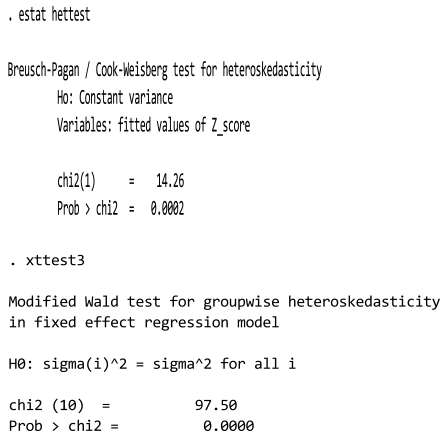
Preprints 147927 i0a1

Appendix 3. Hausman Test and Breusch Pagan Test
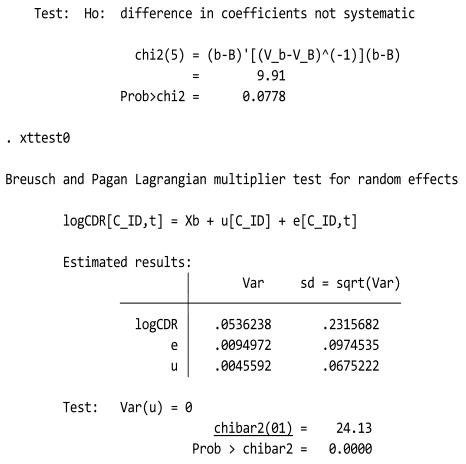
Preprints 147927 i0a2

Appendix 4 Endogeneity Test

Preprints 147927 i0a3

References

  1. Pereira, L., Climate change impacts on agriculture across Africa. Oxford research encyclopedia of environmental science, 2017.
  2. Carney, M., Resolving the climate paradox. Arthur Burns Memorial Lecture, Berlin, 2016. 22.
  3. Ozili, P.K., Managing climate change risk: A responsibility for politicians not Central Banks, in New Challenges for Future Sustainability and Wellbeing. 2021, Emerald Publishing Limited. p.
  4. Löyttyniemi, T., Integrating climate change into the financial stability framework1. Combatting Climate Change: a CEPR Collection, 2021: p. 24.
  5. Dunz, N., A. Naqvi, and I. Monasterolo, Climate transition risk, climate sentiments, and financial stability in a stock-flow consistent approach. Climate Sentiments, and Financial Stability in a Stock-Flow Consistent Approach (April 1, 2019), 2019.
  6. Curcio, D.; Gianfrancesco, I.; Vioto, D. Climate change and financial systemic risk: Evidence from US banks and insurers. J. Financial Stab. 2023, 66. [Google Scholar] [CrossRef]
  7. Aglietta, M. and É. Espagne, Climate and finance systemic risks, more than an analogy?: the climate fragility hypothesis. 2016: CEPII, Centre d'etudes prospectives et d'informations internationales.
  8. Diallo, M.N.; Bah, M.M.; Ndiaye, S.N. Climate risk and financial stress in ECOWAS. J. Clim. Finance 2023, 5. [Google Scholar] [CrossRef]
  9. Tang, L.; Zhang, B. Linking prosperity and sustainability: the economic impact of energy transition and financial stability. Econ. Chang. Restruct. 2024, 57, 1–21. [Google Scholar] [CrossRef]
  10. Fabris, N., Financial stability and climate change. Journal of Central Banking Theory and Practice, 2020. 9(3): p. 27-43.
  11. Campiglio, E.; Dafermos, Y.; Monnin, P.; Ryan-Collins, J.; Schotten, G.; Tanaka, M. Climate change challenges for central banks and financial regulators. Nat. Clim. Chang. 2018, 8, 462–468. [Google Scholar] [CrossRef]
  12. Aslan, C., et al., Does climate change affect bank lending behavior? Economics Letters, 2022. 220: p. 110859.
  13. Wu, L.; Liu, D.; Lin, T. The Impact of Climate Change on Financial Stability. Sustainability 2023, 15, 11744. [Google Scholar] [CrossRef]
  14. Liu, Z.; He, S.; Men, W.; Sun, H. Impact of climate risk on financial stability: Cross-country evidence. Int. Rev. Financial Anal. 2024, 92. [Google Scholar] [CrossRef]
  15. Brunetti, C.; Dennis, B.; Gates, D.; Hancock, D.; Ignell, D.; Kiser, E.K.; Kotta, G.; Kovner, A.; Rosen, R.J.; Tabor, N.K. Climate Change and Financial Stability. FEDS Notes 2021, 2021.0. [CrossRef]
  16. Chabot, M.; Bertrand, J.-L. Climate risks and financial stability: Evidence from the European financial system. J. Financial Stab. 2023, 69. [Google Scholar] [CrossRef]
  17. Conlon, T.; Ding, R.; Huan, X.; Zhang, Z. Climate risk and financial stability: evidence from syndicated lending. Eur. J. Finance 2024, 30, 2001–2031. [Google Scholar] [CrossRef]
  18. Mandel, A.; Tiggeloven, T.; Lincke, D.; Koks, E.; Ward, P.; Hinkel, J. Risks on global financial stability induced by climate change: the case of flood risks. Clim. Chang. 2021, 166, 1–24. [Google Scholar] [CrossRef]
  19. Debels-Lamblin, É. and L. Jacolin, The impact of climate change in Sub-Saharan Africa: vulnerabilities, resilience and finance. Bulletin de la Banque de France, 2020. 230: p. 1-12.
  20. Aloui, D.; Gaies, B.; Hchaichi, R. Exploring environmental degradation spillovers in Sub-Saharan Africa: the energy–financial instability nexus. Econ. Chang. Restruct. 2023, 56, 1699–1724. [Google Scholar] [CrossRef]
  21. Meng, Z.; Wang, X.; Ding, Y. The impact of climate change policies on financial stability of China. Front. Environ. Sci. 2023, 11, 1295951. [Google Scholar] [CrossRef]
  22. Gallagher, K., Rustomjee, and A. Arevalo, Evolution of IMF Engagement on Climate Change. IEO Background Paper No. BP/24-01/06 (Washington: International Monetary Fund), 2024.
  23. Mugiyo, H., et al., El Niño’s effects on Southern African agriculture in 2023/24 and anticipatory action strategies to reduce the impacts in Zimbabwe. Atmosphere, 2023. 14(11): p. 1692.
  24. Cashin, P.; Mohaddes, K.; Raissi, M. Fair weather or foul? The macroeconomic effects of El Niño. J. Int. Econ. 2017, 106, 37–54. [Google Scholar] [CrossRef]
  25. Abor, J.Y. and D. Ofori-Sasu, The Future of Development Banks in Africa, in Perspectives on Development Banks in Africa: Case Studies and Emerging Practices at the National and Regional Level. 2024, Springer. p. 421-451.
  26. Robins, N., S. Dikau, and U. Volz, Net-zero central banking: A new phase in greening the financial system. 2021.
  27. Eckstein, D., V. Künzel, and L. Schäfer, The global climate risk index 2021. 2021: Bonn: Germanwatch.
  28. DeMenno, M.B., Environmental sustainability and financial stability: can macroprudential stress testing measure and mitigate climate-related systemic financial risk? Journal of Banking Regulation, 2023. 24(4): p. 445-473.
  29. Gütschow, J.; Jeffery, M.L.; Günther, A.; Meinshausen, M. Country-resolved combined emission and socio-economic pathways based on the Representative Concentration Pathway (RCP) and Shared Socio-Economic Pathway (SSP) scenarios. Earth Syst. Sci. Data 2021, 13, 1005–1040. [Google Scholar] [CrossRef]
  30. Lesolle, D., SADC policy paper on climate change: assessing the policy options for SADC member states. 2012: SADC Secretariat, Policy, Planning, Resource Mobilisation Directorate.
  31. Oman, W.; Salin, M.; Svartzman, R. Three tales of central banking and financial supervision for the ecological transition. WIREs Clim. Chang. 2024, 15. [Google Scholar] [CrossRef]
  32. Canton, H. United Nations Office on Drugs and Crime—UNODC. In The Europa Directory of International Organizations 2021; Routledge: London, UK, 2021; pp. 240–244. [Google Scholar]
  33. FSB, F.S.B., 2023 Bank Failures: Preliminary lessons learnt for resolution. 2023.
  34. Campiglio, E., et al., Climate-related risks in financial assets. Journal of Economic Surveys, 2023. 37(3): p. 950-992.
  35. Lee, H., et al., IPCC, 2023: Climate Change 2023: Synthesis Report, Summary for Policymakers. Contribution of Working Groups I, II and III to the Sixth Assessment Report of the Intergovernmental Panel on Climate Change [Core Writing Team, H. Lee and J. Romero (eds.)]. IPCC, Geneva, Switzerland. 2023.
  36. Baarsch, F.; Granadillos, J.R.; Hare, W.; Knaus, M.; Krapp, M.; Schaeffer, M.; Lotze-Campen, H. The impact of climate change on incomes and convergence in Africa. World Dev. 2020, 126. [Google Scholar] [CrossRef]
  37. milie, D.-L. and J. Luc, The impact of climate change in Sub Saharan Africa: vulnerabilities, resilience and finance [Impact du changement climatique sur l’Afrique subsaharienne: vulnérabilités, résilience et financements]. Bulletin de la Banque de France, 2020(230).
  38. Battiston, S.; Dafermos, Y.; Monasterolo, I. Climate risks and financial stability. J. Financial Stab. 2021, 54. [Google Scholar] [CrossRef]
  39. Dietz, S., et al., ‘Climate value at risk’of global financial assets. Nature Climate Change, 2016. 6(7): p. 676-679.
  40. Weitzman, M.L. On Modeling and Interpreting the Economics of Catastrophic Climate Change. Rev. Econ. Stat. 2009, 91, 1–19. [Google Scholar] [CrossRef]
  41. Amo-Bediako, E.; Takawira, O.; Choga, I. The impact of climate change on the resilience of banking systems in selected Sub-Saharan economies. Int. J. Appl. Econ. Finance Account. 2023, 17, 469–482. [Google Scholar] [CrossRef]
  42. Ayele, G.M.; Fisseha, F.L. Does climate change affect the financial stability of Sub-Saharan African countries? Clim. Chang. 2024, 177, 1–22. [Google Scholar] [CrossRef]
  43. Tautiva, J.A.D.; Huaman, J.; Oliva, R.D.P. Trends in research on climate change and organizations: a bibliometric analysis (1999–2021). Manag. Rev. Q. 2022, 74, 227–261. [Google Scholar] [CrossRef]
  44. Nur, T.; Sahin, S.; Topaloglu, E.E.; Ege, I. Evaluating the Impact of Climate Risk on Financial Access and Stability in G20 Countries: A Panel Data Approach (2006-2017). J. Corp. governance, Insur. risk Manag. 2023, 10, 125–139. [Google Scholar] [CrossRef]
  45. Di Febo, E.; Angelini, E.; Le, T. European Non-Performing Exposures (NPEs) and Climate-Related Risks: Country Dimensions. Risks 2024, 12, 128. [Google Scholar] [CrossRef]
  46. Nabil, M. Assessment of the Relationship among Climate Change, Green Finance and Financial Stability: Evidence from Emerging and Developed Markets. Int. J. Econ. Finance 2024, 16, p51. [Google Scholar] [CrossRef]
  47. Fan, W.; Wang, F.; Zhang, H.; Yan, B.; Ling, R.; Jiang, H. Is climate change fueling commercial banks’ non-performing loan ratio? Empirical evidence from 31 provinces in China. Int. Rev. Econ. Finance 2024, 96. [Google Scholar] [CrossRef]
  48. Furukawa, K., H. Ichiue, and N. Shiraki, How Does Climate Change Interact with the Financial System?: A Survey. 2020: Bank of Japan Tokyo.
  49. Sun, L.; Fang, S.; Iqbal, S.; Bilal, A.R. Financial stability role on climate risks, and climate change mitigation: Implications for green economic recovery. Environ. Sci. Pollut. Res. 2022, 29, 33063–33074. [Google Scholar] [CrossRef]
  50. Le, A.-T.; Tran, T.P.; Mishra, A.V. Climate risk and bank stability: International evidence. J. Multinatl. Financial Manag. 2023, 70-71. [Google Scholar] [CrossRef]
  51. Adeleye, B.N.; Akam, D.; Inuwa, N.; James, H.T.; Basila, D. Does globalization and energy usage influence carbon emissions in South Asia? An empirical revisit of the debate. Environ. Sci. Pollut. Res. 2022, 30, 36190–36207. [Google Scholar] [CrossRef]
  52. Fan, Q.; Gao, W. Climate risk and financial stability: the mediating effect of green credit. Finance Res. Lett. 2024, 65. [Google Scholar] [CrossRef]
  53. Wang, R. and H.R. Luo, How does financial inclusion affect bank stability in emerging economies? Emerging Markets Review, 2022. 51: p. 100876.
  54. Kamran, H.W., et al., Climate change and bank stability: The moderating role of green financing and renewable energy consumption in ASEAN. 2020.
  55. Klomp, J. Financial fragility and natural disasters: An empirical analysis. J. Financial Stab. 2014, 13, 180–192. [Google Scholar] [CrossRef]
  56. Machdar, N.M., Financial inclusion, financial stability and sustainability in the banking sector: The case of Indonesia. 2020.
  57. Pointner, W. and D. Ritzberger-Grünwald, Climate change as a risk to financial stability. Financial Stability Report, 2019(38): p. 30-45.
  58. Nieto, M.J., Banks, climate risk and financial stability. Journal of Financial Regulation and Compliance, 2019. 27(2): p. 243-262.
  59. Mufandaedza, S.M., The impact of Trade Liberalisation on mining sector Total Factor Productivity change of selected countries from SADC. 2021, North-West University (South Africa).
  60. Gujarati, D.N., Basic Econometrics 4th ed. 2002.
  61. Naseer, M.M.; Guo, Y.; Bagh, T.; Zhu, X. Sustainable investments in volatile times: Nexus of climate change risk, ESG practices, and market volatility. Int. Rev. Financial Anal. 2024, 95. [Google Scholar] [CrossRef]
  62. Zhang, D.; Wu, Y.; Ji, Q.; Guo, K.; Lucey, B. Climate impacts on the loan quality of Chinese regional commercial banks. J. Int. Money Finance 2023, 140. [Google Scholar] [CrossRef]
  63. Conlona, T., et al., Climate Risk and Financial Stability: Evidence from Bank Lending. 2022, Working Paper.
  64. Nehrebecka, N. Climate Risk with Particular Emphasis on the Relationship with Credit-Risk Assessment: What We Learn from Poland. Energies 2021, 14, 8070. [Google Scholar] [CrossRef]
  65. Brik, H. Climate risk and financial stability: Assessing non-performing loans in Chinese banks. J. Risk Manag. Financial Institutions 2024, 17, 303. [Google Scholar] [CrossRef]
  66. Pretorius, O.R., Regional integration and industrialisation in the SADC. Regional Policy in the Southern African Development Community: p. 192.
  67. Garcia-Villegas, S.; Martorell, E. Climate transition risk and the role of bank capital requirements. Econ. Model. 2024, 135. [Google Scholar] [CrossRef]
  68. Michaelowa, A.; Hoch, S.; Weber, A.-K.; Kassaye, R.; Hailu, T. Mobilising private climate finance for sustainable energy access and climate change mitigation in Sub-Saharan Africa. Clim. Policy 2020, 21, 47–62. [Google Scholar] [CrossRef]
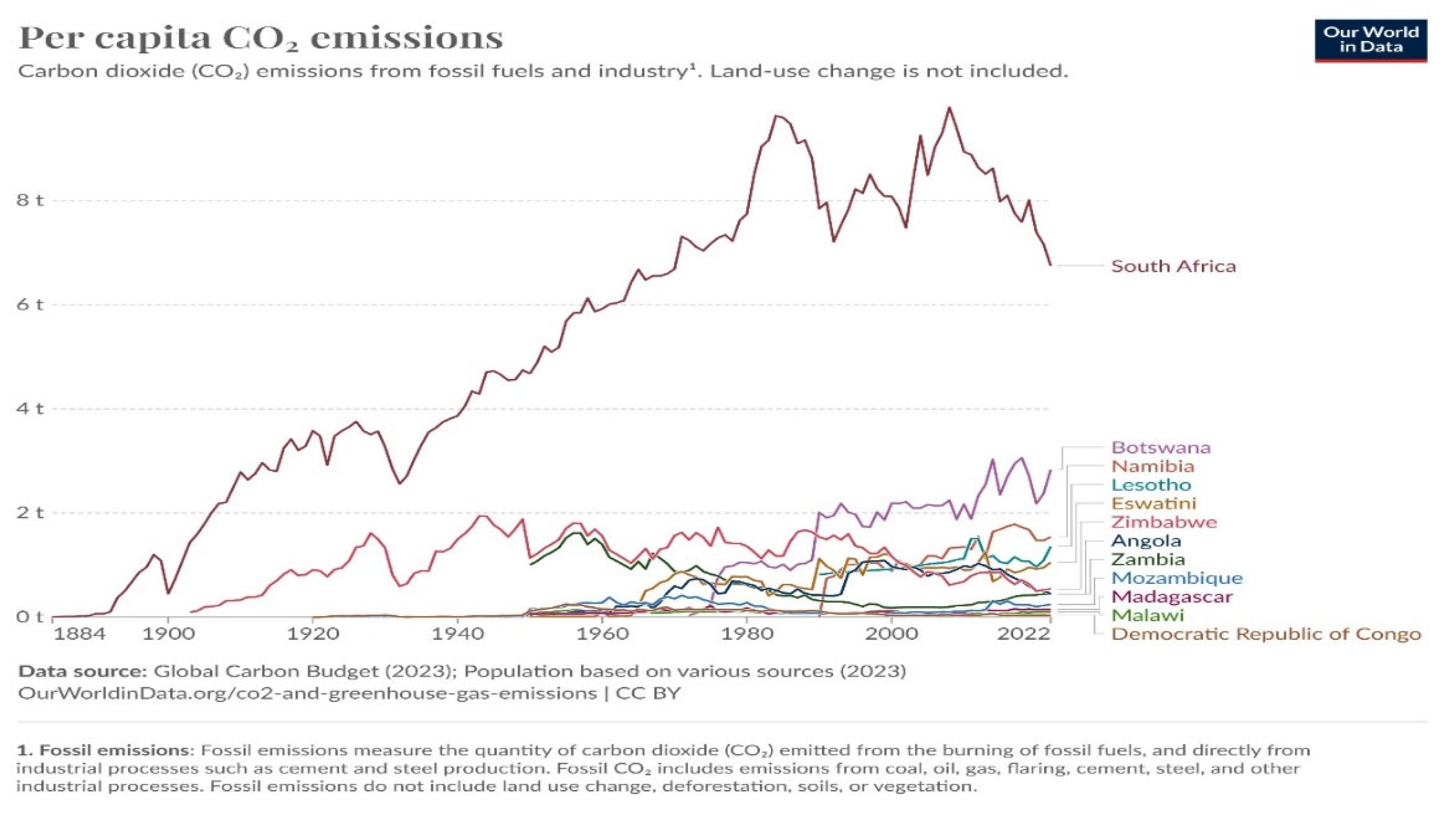
Figure 1. Carbon dioxide emissions from fossil fuel combustion and industrial processes. Sources: Our World in Data.
Preprints 147927 g001
Table 1. Timeline of tropical cyclones that have affected SADC and their source of origin.
Cyclone Source Year
Cyclone Eline Indian Ocean 2000
Cyclone Japhet Indian Ocean 2003
Cyclone Galifo Indian Ocean 2003
Cyclone Dineo Indian Ocean 2016 November 2017January
Cyclone Idai Indian Ocean 2019
Cyclone Eloise Indian Ocean 2021
Cyclone Chalane Indian Ocean 2021
Cyclone Gombe Indian Ocean 2021
Cyclone Batsirai Indian Ocean 2022
Cyclone Hermine Atlantic Ocean 2022
Cyclone Freddy Indian Ocean 2023
Cyclone Cheneso Indian Ocean 2023
Source: Author’s compilation.
Table 2. Data Sources.
Variable Description Source
Z_score Z_score -A measure of a financial system stability usually calculated as (ROA+(equity/assets))/sd(ROA); sd(ROA) is the standard deviation of ROA, calculated for country-years with no less than five bank-level observations. Bank scope (2000-14) and Orbis (2015-20), Bureau van Dijk (BvD)-Global financial development database
LDR Bank credit to bank deposit is a financial resource provided to the private sector by domestic money banks as a share of total deposits calculated as % International Financial Statistics (IFS), International Monetary Fund (IMF), World Bank (2022)
CRI Global Climate Risk Index-The index is constructed using four indicators, which include the number of deaths, number of deaths per 100000 inhabitants, the sum of losses in US$ in purchasing power parity (PPP) and losses per unit of Gross Domestic Product (GDP) (Global climate risk index, 2021). German watch Global climate risk index, MunichRe Nat CatSERVICE (2006-2021)
CO2 Carbon Emissions (metric tons per capita) Available online at: https://www.climatewatchdata.org/ghg-emissions,World Bank (2023)
AFF Agricultural Output-tones per hectare World Bank (2022)
NPL Non-performing Loans-Bank nonperforming loans to gross loans (%) Financial Soundness Indicators Database (fsi.imf.org), International Monetary Fund (IMF)
Infl Inflation International Monetary Fund, International Financial Statistics and data files
GDP_pc Gross Domestic Product per capita constant 2015 US$) World Bank (2023)
CAR Bank regulatory capital to risk-weighted assets (%) Financial Soundness Indicators Database (fsi.imf.org), International Monetary Fund (IMF)
Table 3. Summary of Descriptive Statistics.
Variable Obs Mean Std. Dev. Min Max
Z score 121 14.411 6.355 4.268 27.018
LDR 121 72.632 17.843 32.044 119.064
CRI 121 68.899 29.993 2.67 132.33
CO2 121 1.339 2.184 .03 8.218
Infl 121 8.407 7.492 -3.518 43.069
EXR 121 609.652 950.755 4.798 3787.754
GDP pc 121 2781.446 2509.495 324.828 8737.041
NPL 121 7.214 4.934 .964 25.836
CAR 121 34.792 14.323 12.301 75.434
AFF 121 14.468 9.156 1.82 29.078
Source: Author’s computations.
Table 5. Cross-sectional Dependence Test.
Variable CD-test p-value corr abs(corr)
logZ_score -1.940 0.053 -0.07 0.33
logCRI 2.61 0.009 0.11 0.31
logCO2 5.605 0.000 0.23 0.53
logAFF 3.362 0.001 0.14 0.49
logEXR 22.075 0.000 0.90 0.90
log NPL 2.495 0.013 0.10 0.47
logGDP_pc 6.757 0.000 0.27 0.52
Infl 2.965 0.003 0.12 0.29
Notes: Under the null hypothesis of cross-section independence CD ~ N(0,1).
Table 8. Main Model: The Impact of climate risk on financial sector stability of SADC.
(Z_score) (Z_score) Robustness (Z_score)
VARIABLES PCSE Model 1 PCSE Model 2 FGLS Model 1 FGLS Model 2
logCRI -3.455* -3.455** -3.455** -2.874***
(1.770) (1.559) (1.434) (0.245)
logCO2 -9.402*** -9.402*** -9.402*** -8.424***
(1.897) (1.440) (1.502) (0.414)
logNPL -2.092*** -2.092** -2.092*** -2.028***
(0.712) (0.877) (0.785) (0.142)
logAFF 4.547*** 4.547*** 4.547*** 4.832***
(0.990) (1.359) (1.570) (0.338)
logGDP_pc 20.37*** 20.37*** 20.37*** 18.44***
(3.191) (2.511) (2.431) (0.821)
logEXR 1.284*** 1.284** 1.284** 1.011***
(0.456) (0.519) (0.505) (0.195)
Infl 0.0208 0.0208 0.0208 0.0274
(0.0726) (0.0867) (0.117) (0.0209)
Constant -161.0*** -161.0*** -161.0*** -147.7***
(21.07) (18.86) (18.64) (6.309)
Observations 110 110 110 110
R-squared 0.423 0.423
Number of C_ID 10 10 10 10
Standard errors in parentheses *** p<0.01, ** p<0.05, * p<0.1.
Table 9. Model 2: Impact of climate risk on bank lending activities of SADC .
(LDR) (LDR) Robustness (LDR) (LDR)
VARIABLES PCSE 1 PCSE 2 FGLS Model 1 FGLS Model 2
logCRI 0.0512** 0.0512*** 0.0360*** 0.0165***
(0.0232) (0.0194) (0.00678) (0.00363)
logCO2 0.191*** 0.191*** 0.185*** 0.173***
(0.0102) (0.0121) (0.00454) (0.00575)
logNPL -0.0348** -0.0348*** -0.0373*** -0.0544***
(0.0137) (0.0122) (0.00466) (0.00527)
logAFF 0.163*** 0.163*** 0.163*** 0.141***
(0.0197) (0.0240) (0.00590) (0.00927)
logEXR 0.0163 0.0163** 0.0118*** 0.0112**
(0.0114) (0.00768) (0.00451) (0.00500)
Infl 0.000423 0.000423 -7.28e-05 -0.00107**
(0.00195) (0.00182) (0.000618) (0.000501)
Constant 3.773*** 3.773*** 3.862*** 3.994***
(0.125) (0.109) (0.0407) (0.0361)
Observations 110 110 110 110
R-squared 0.767 0.767
Number of C_ID 10 10 10 10
Standard errors in parentheses *** p<0.01, ** p<0.05, * p<0.1.
Table 10. Model 2: Robustness Test: The Impact of climate risk on bank lending activities.
(LDR) (LDR) (LDR)
VARIABLES POLS FE RE
logCRI 0.0493** 0.0385* 0.0493**
(0.0207) (0.0215) (0.0207)
logCO2 0.176*** 0.0488 0.176***
(0.0218) (0.0620) (0.0218)
logNPL -0.0587*** -0.0712*** -0.0587***
(0.0131) (0.0135) (0.0131)
logAFF 0.191*** 0.184*** 0.191***
(0.0393) (0.0683) (0.0393)
Infl -0.000109 -0.000721 -0.000109
(0.00176) (0.00176) (0.00176)
Constant 3.774*** 3.726*** 3.774***
9 (0.133) (0.172) (0.133)
Observations 110 110 110
R-squared 0.294
Number of C_ID 10 10 10
Standard errors in parentheses *** p<0.01, ** p<0.05, * p<0.1.
Disclaimer/Publisher’s Note: The statements, opinions and data contained in all publications are solely those of the individual author(s) and contributor(s) and not of MDPI and/or the editor(s). MDPI and/or the editor(s) disclaim responsibility for any injury to people or property resulting from any ideas, methods, instructions or products referred to in the content.
Copyright: This open access article is published under a Creative Commons CC BY 4.0 license, which permit the free download, distribution, and reuse, provided that the author and preprint are cited in any reuse.
Prerpints.org logo

Preprints.org is a free preprint server supported by MDPI in Basel, Switzerland.

Subscribe

Disclaimer

Terms of Use

Privacy Policy

Privacy Settings

© 2026 MDPI (Basel, Switzerland) unless otherwise stated