

Submitted:
02 February 2025
Posted:
03 February 2025
You are already at the latest version
Abstract
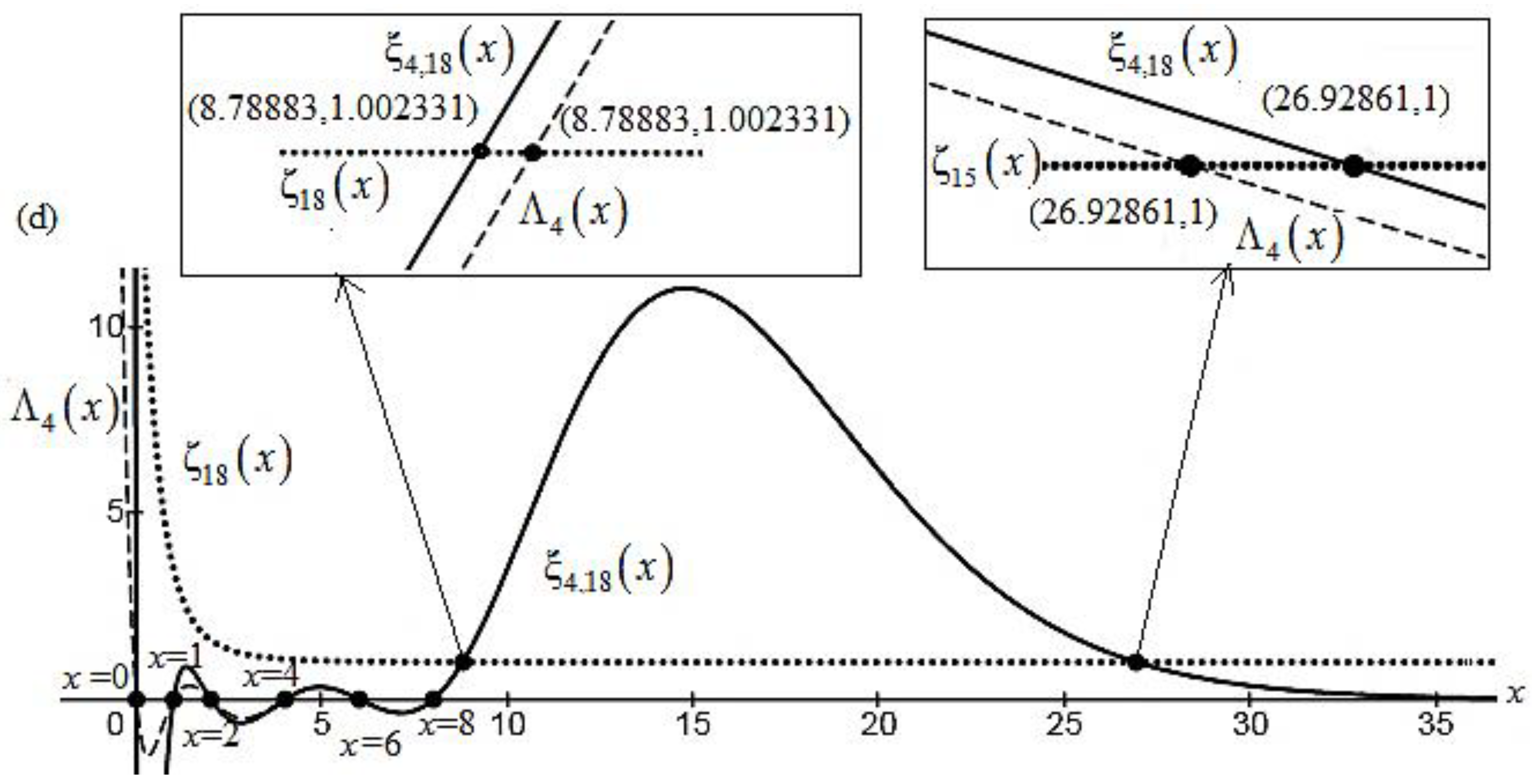
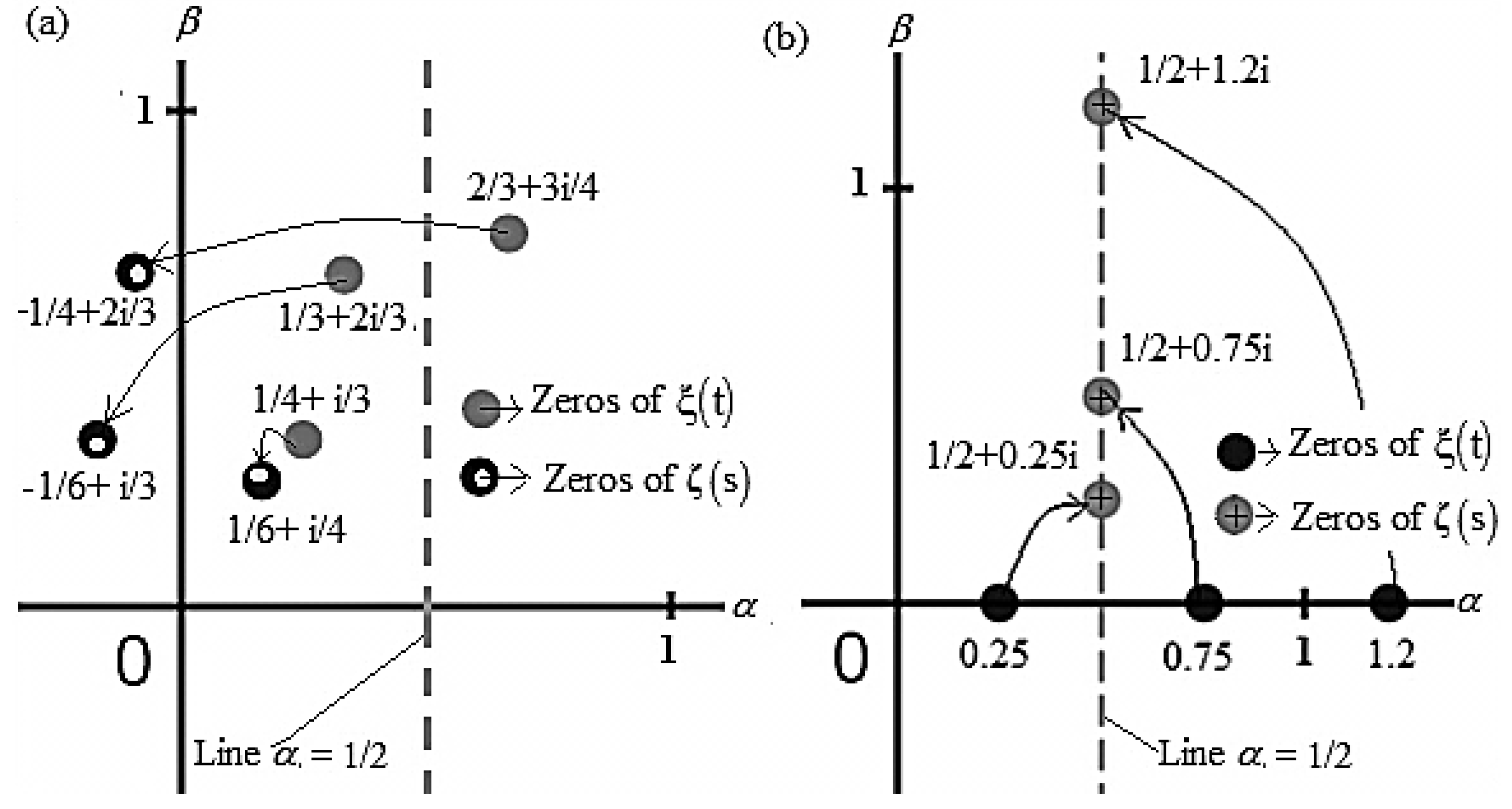
The long-standing mathematical problem, the Riemann Hypothesis, states that all nontrivial zeros of the Riemann zeta function ζ(s) lie on the line Re(s) =1/2. This study examines the computational methods used to determine nontrivial zeros, such as ½ + 14.13472514i, ½ + 21.02203964i, ½ + 25.01085758i, and others of ζ(s).The analysis finds that these methods are derived from the equation ξ(s) =(s/2) (s-1) (π)-s/2 Γ(s/2) ζ(s), by assuming that zeros of functions ζ(s) and ξ(s) are identical. However, the graphical examination of the locations of zeros of both functions, suggests this assumption is incorrect, rendering the computational methods flawed. Consequently, the widely accepted zeros computed using these methods, might not actually be zeros of ζ(s). In addition, the formula for the number of zeros N(T) on the line s=1/2 in a specific interval [0, T], based on the same assumption is also invalid. The study offers a new perspective on the Riemann Hypothesis by highlighting potential flaws in existing methods used for computing zeros of ζ(s). This finding could contribute to ongoing efforts to resolve the hypothesis.
Keywords:
1. Introduction
2. Results
3. Discussion
4. Conclusion
References
- Riemann, B. (1859), ber die Anzbahl der Primzahlen unter einer gegebenen Grӧsse Monatsberichte der Berliner Akademie, November 1859, pp. 671.
- Edwards, Harold M. (2001), Riemann’s Zeta Function, Dover ed. (2001).
- Titchmarsh, E.C. The Theory of the Riemann Zeta-Function. OUP ed. (1974).
- H. von Mangoldt, Zur Verteilung der Nullstellen der Riemannschen Funktion ξ(s), Math. Ann. 60 (1905), 1–19.
- Borwein P., Choic S.., Rooney B., Muller A.W. The Riemann Hypothesis- A Resource for the Afficionado and Virtuoso and Alike, CMS Springer-Verlag, P-21, 2008.
- J. P. Gram, Note sur les z´eros de la fonction de Riemann, Acta Math. 27 (1903), 289–304.
- R. Backlund, ¨ Uber die Nullstellen der Riemannschen Zetafunktion. (Swedish), Acta Math. 41 (1918), 345–375. [CrossRef]
- Hutchinson, J. I., On the roots of the Riemann zeta function, Trans. Amer. Math. Soc. 27 (1925), 49–60.
- E. C. Titchmarsh, The zeros of the Riemann zeta-function, Proceedings of the Royal Society of London, A - Mathematical and Physical Sciences, vol. 151, 1935, pp. 234–255.
- Turing A. M. Some calculations of the Riemann zeta-function, Proc. London Math.Soc. (3) 3 (1953), 99–117. [CrossRef]
- Lehmer D. H., On the roots of the Riemann zeta-function, Acta Math. 95 (1956), 291–298. [CrossRef]
- N. A. Meller, Computations connected with the check of Riemann’s Hypothesis. (Russian), Dokl. Akad. Nauk SSSR 123 (1958), 246–248.
- R. S. Lehman, Separation of zeros of the Riemann zeta-function, Math. Comp. 20 (1966), 523–541.
- R. P. Brent, On the zeros of the Riemann zeta function in the critical strip, Mathematics of Computation 33 (1979), no. 148, 1361–1372.
- J. van de Lune, H. J. J. te Riele, and D. T. Winter, On the zeros of the Riemann zeta function in the critical strip. IV, Math. Comp. 46 (1986), no. 174, 667–681.
- X. Gourdon, The 1013 first zeros of the Riemann zeta function and zeros computation at very large height, http://numbers.computation.free.fr/Const ants/Miscellaneouszetazeros1e13-1e24.pdf.
- Platt, D. and Trudgian, J. (2021), The Riemann Hypothesis is True up to 3×10¹². Bulletin of the London Mathematical Society, arXiv: 2004.09765.
- Odlyzko, A. M. The 1020th Zero of the Riemann Zeta Function and 70 Million of Its Neighbors. https://www-users.cse.umn.edu/~odlyzko/.
- Hardy, G. H., & Littlewood, J. E. (1916). Contributions to the theory of the Riemann zeta-function and the theory of the distribution of primes. Acta Mathematica, 41(0), 119–196. [CrossRef]
- C. L. Siegel, ¨ Uber Riemann’s Nachlass zur Analytischen Zahlentheorie, Quellenund Studien zur Geschichte der Math. Astr. Phys. 2 (1932), 275–310.

| Author | Year | Range of height (0 < t < T) | Number of zeros N(T) |
| B. Riemann [1] | 1959 | T≤ 26 | 3 |
| J.P. Gram [6] | 1903 | T≤ 50 | 10 |
| R. J. Backlund [7] | 1914 | T≤ 210 | 79 |
| J.I. Hutchinson [8] | 1925 | T≤ 300.468 | 138 |
| E.C. Titchmarsh [9] | 1935 | T≤ 1468 | 1,041 |
| A.M. Turing [10] D. H. Lehmer[11] |
1953 1956 |
T≤ 25735.93 T≤ 9878.910 |
1,104 10,000 |
| N.A. Meller [12] | 1958 | T≤ 4735 | 35,337 |
| R.S. Lehman [13] | 1966 | T≤ 170571.36 | 250,000 |
| R.P. Brent [14] | 1979 | T≤ 32,585,736.4 | 75,000,000 |
| J. van de Lune, H. J. J. te Riele, D.T. Winter [15] |
1986 |
T≤ 545439823.215 |
1,500,000,001 |
| Gourdon, Xavier [16] | 2004 | T≤ 2381374874120.45508 | 1013 |
| M. Odlyzko [17] | 1992 | T≤ 2.×1020 | 1.75×10⁸ |
| Dave Platt, Tim Trudgian [18] | 2020 | T≤ 3 000 175 332 800 | 12 363 153 437 138 |
Disclaimer/Publisher’s Note: The statements, opinions and data contained in all publications are solely those of the individual author(s) and contributor(s) and not of MDPI and/or the editor(s). MDPI and/or the editor(s) disclaim responsibility for any injury to people or property resulting from any ideas, methods, instructions or products referred to in the content. |
© 2025 by the authors. Licensee MDPI, Basel, Switzerland. This article is an open access article distributed under the terms and conditions of the Creative Commons Attribution (CC BY) license (http://creativecommons.org/licenses/by/4.0/).


