

Submitted:
31 January 2025
Posted:
03 February 2025
You are already at the latest version
Abstract
The increasing integration of variable renewable energy sources (VRES) into modern power systems presents significant challenges in ensuring operational flexibility, highlighting the need for robust methodologies to evaluate and ensure system reliability. The Insufficient Ramping Resource Expectation (IRRE) has emerged as a critical metric for quantifying the probability of ramping deficiencies in power systems. However, its traditional application, designed primarily for capacity-constrained systems, may not fully capture the operational dynamics of energy-constrained systems, such as those dominated by hydropower generation. This study critically reviews the IRRE methodology and proposes enhancements to incorporate additional constraints, including seasonal and monthly hydrological variability and operational reserve requirements, to better reflect the flexibility limitations in energy-constrained systems. A case study of the Brazilian electricity system evaluates these modifications by comparing traditional and enhanced IRRE results across varying scenarios, including higher VRES penetration. The findings reveal significant increases in ramping insufficiencies when additional constraints are considered, particularly in subsystems with constrained hydropower resources. By integrating more realistic and specific operational constraints, this study advances IRRE's applicability as a planning tool and to guide policy decisions, ensuring enhanced system reliability in the face of escalating renewable energy integration specially into energy-constrained systems.
Keywords:
power system flexibility
; power system planning
; variable renewable energy sources
; flexibility metrics
; insufficient ramping resource expectation
; energy-constrained systems
; renewable energy integration
; operational constraints
; renewable energy power systems
1. Introduction
The increasing penetration of variable generation sources, such as wind and solar photovoltaic, has introduced new operational challenges to power systems worldwide. The variability nature of these renewable energy sources requires a higher level of system flexibility to ensure that generation can reliably meet demand.
There is a debate regarding the precise definition of flexibility across different sectors, including the power sector [1]. In general, flexibility is understood as the adaptability of a system to respond to changes, whether predicted or unpredicted, while maintaining satisfactory performance levels. Although a universal definition of power system flexibility does not exist, this paper adopts the widely accepted operational definition used in power system studies. Specifically, in the context of power systems, flexibility refers to the system's ability to rapidly respond to changes in net load—the difference between total demand and available non-dispatchable generation—in a cost-efficient manner [1–3].
Even though flexibility is often defined in a straightforward manner, it encompasses various dimensions of power grid operation. These dimensions include the capacity for upward and downward regulation, energy storage capabilities, start-up and shut-down durations, and minimum required times for units to remain operational or offline. Additionally, flexibility covers power ramping capacity and duration, that are influenced by both the system’s power capacity and ramping capabilities. Each of these elements contributes to a better understanding of grid flexibility management challenges [1,4].
The analysis of flexibility must also consider various timescales. In the long term, the balance between supply and demand becomes uncertain due to the challenges in forecasting the expansion of variable renewable energy sources (VRES), shifts in consumer behavior, economic growth, and other factors. These uncertainties complicate long-term planning and necessitate a robust approach to flexibility management [5].
In the medium term (encompassing annual, monthly, weekly, and daily timescales), power system operators must manage cyclical fluctuations in net load, which is the difference between demand and VRES generation. In the short term (intra-day operations), system management becomes more complex due to uncertainties arising from unforeseen incidents and the inherent challenges in accurately forecasting both demand and VRES generation. These operational constraints demand a high level of flexibility to maintain system stability and reliability across different time horizons [5].
Traditional power system planning models have primarily focused on capacity adequacy [14,21]. However, with the increasing penetration of VRES, it has become essential to complement these analyses by evaluating system flexibility. In turn, integration studies have focused on understanding how VRES impact the daily operation of power systems and identifying the required network reinforcements by introducing production cost models. These models are effective in assessing a system's capability to handle uncertainties related to net load forecast errors in the context of short-term operational planning.
Despite those advances in short-term operational simulations, there remained a critical need to evaluate system flexibility in the context of long-term planning. To address this gap, Lannoye et al. [21] proposed the Insufficient Ramping Resource Expectation (IRRE), a metric designed to assess the long-term flexibility adequacy of a system in the context of VRES expansion, analogous to how LOLE measures the capacity adequacy of a power system.
The analysis of power system flexibility requires the definition of several key concepts. One critical aspect is the flexibility requirement, which refers to the power system's need to adjust its electricity supply to balance the net load demand within a given time interval. This requirement reflects the system's capability to compensate for rapid and unpredictable variations in renewable generation or consumption, thereby maintaining stability and reliability in power supply. Consequently, the time series of net load changes is considered a flexibility requirement for the system, as it represents the combined need for flexibility arising from both system load and variable generation [12].
On the other hand, flexibility resources refer to the assets and mechanisms available in the power system to meet flexibility requirements. These resources comprise a set of elements within the power system, which may include: (i) Dispatchable conventional generators—these are the primary providers of flexibility, consisting of units capable of rapidly adjusting their output, such as thermal power plants and hydropower plants with reservoirs; (ii) Energy storage systems—technologies such as batteries or pumped hydro storage that can store excess energy during periods of high renewable generation and release it when needed; (iii) Demand response programs—initiatives that encourage consumers to adjust their electricity consumption in response to price signals or system needs; (iv) Interconnections and energy trade—the import and export of electricity between regions or countries to address local deficits or surpluses; and (v) Distributed resources—smaller-scale generation and storage units connected to the distribution network, which can contribute locally to system balancing [14].
The interaction between flexibility requirements, driven by the variability of net load, and the available flexibility resources determines the capacity of a power system to operate efficiently and securely, particularly in scenarios characterized by a high penetration of intermittent renewable energy sources. Furthermore, the flexibility of a power system is inherently influenced by the operational policies implemented by the system operator and is therefore contingent upon the operational state of each generation resource.
A critical factor in flexibility analysis, distinct from traditional generation capacity planning, is the consideration of the time horizon. Understanding system flexibility across various time horizons, as permitted by the available data, is essential. The time horizon refers to the duration of net load variations, which may range from 15 minutes to 1 hour or even 12 hours. Each observation, in turn, corresponds to a singular data point within a time series, providing specific insights into system behavior at that moment.
Another fundamental consideration in flexibility analysis is the direction of net load changes. The magnitude and frequency of these changes, as well as the resources available to address upward and downward adjustments, exhibit inherent asymmetries. For instance, resources operating at maximum output can only contribute during periods of decreasing net load, whereas offline resources may be brought online during periods of increasing net load. This directional distinction underscores the complexity of balancing flexibility resources to maintain system reliability under dynamic conditions.
This article thus proposes a critical review of the limitations of the traditional IRRE methodology while suggesting enhancements to improve its precision and offer a more comprehensive understanding of operational flexibility, particularly in scenarios of high VRES penetration. Thus, the objective is to enhance the original IRRE to make it more able to contribute to the planning and operation of power systems capable of meeting the challenges posed by the global energy transition.
2. Review of the Literature
A variety of measures can be employed to enhance grid flexibility, spanning physical, regulatory, and market-based approaches. These strategies include expanding grid capacity and cross-border interconnections, establishing cost-effective balancing and regulation markets, and implementing demand-side response mechanisms. Additionally, increasing the share of flexible generation capacity, diversifying renewable energy resources, and improving the forecasting and modeling of natural fluctuations are crucial. Furthermore, the increased use of communication technologies to share this critical information between grid operators and markets plays a significant role in enhancing grid flexibility [1,6].
While defining flexibility is important, it is even more critical to quantify how much flexibility the power system can currently provide and how much additional flexibility is needed. Evaluating the supply of flexibility in electric power systems has become increasingly important with the rapid growth of variable renewable energy. Studies such as Dumar et al. [7] emphasize that flexibility is essential to managing the volatility of sources like wind and solar. Flexibility assessments are crucial for determining how systems can respond to unexpected fluctuations in load and generation, especially during peak demand or periods of low renewable output. Dumar et al. [7] highlighted that in the Colombian context, hydro generation provides critical flexibility during high net load ramp events, though challenges arise during periods of water scarcity [7].
A lack of sufficient flexibility in generation resources can jeopardize the economic efficiency of system operations and potentially endanger overall reliability. For example, a shortage of baseload cycling capacity arises when the net load—demand minus renewable generation—falls below the minimum stable generation level of conventional units, leading to the curtailment of renewable energy. Furthermore, integrating a high share of renewable energy into the system amplifies its volatility, which directly impacts the net load profile and necessitates greater operational flexibility [8,9].
The flexibility of a power system is often indirectly assessed by measuring the system’s degree of inflexibility. Common indicators include system imbalances, frequency deviations, area control errors, curtailments of renewable energy and load, as well as positive or negative market prices, price volatility [10–12], market price violations, challenges in maintaining load-generation balance, area balance breaches, and the reliance on interruptible load [5,13–15]. These parameters provide insight into how effectively a system can respond to variations in supply and demand.
Historically, reliability indices such as Loss-of-Load Probability (LOLP) and Expected Unserved Load (EUL) have been extensively employed to evaluate the reliability of power systems, primarily focusing on the adequacy of generation capacity [9,16]. Drawing from these traditional reliability metrics, numerous methods and indices have been developed to assess system flexibility. These metrics assist power system planners in determining the current and future flexibility requirements, providing essential insights for ensuring the system's ability to adapt to increasing variability and uncertainty.
One of the metrics for assessing system flexibility is the flexibility chart, which categorizes all physically available flexibility resources along with their reserve capacities, based on resource type. When used in conjunction with the percentage of installed capacity of each generation technology relative to peak demand, this chart provides a valuable snapshot of a system's overall flexibility [11,17]. An enhanced version of this tool is the GIVAR III flexibility scoring framework, which incorporates critical power system parameters such as generation capacity, fuel supply, potential interconnections, power markets, and grid strength [10]. This framework evaluates system's capability to integrate higher levels of renewable energy by measuring the maximum feasible renewable energy penetration [17].
Additionally, the Normalized Flexibility Index (NFI) aims to calculate the flexibility of each generation unit by considering the difference between its maximum and minimum capacities, multiplied by the average ramp-up/down rate, and then divided by twice the maximum capacity [18]. This approach enables the calculation of a total system flexibility index as a weighted average of the flexibility scores of all individual generators, providing a comprehensive measure of system-wide flexibility [18].
The Loss of Wind Estimation (LOWE) metric estimates the probability of wind curtailments occurring over a year and is a valuable tool for assessing system flexibility. It can be particularly useful for comparing the flexibility of two systems with similar levels of wind penetration or as an indicator of the maximum permissible grid-connected wind generation [18]. Another operational metric is the Lack Of Ramp Probability (LORP), which assesses the likelihood that dispatched generators may lack the necessary ramping capabilities to manage fluctuations in net load. Both upward and downward LORP calculations can be employed to offer a more comprehensive evaluation of ramping capacity [17,19].
Besides the aforementioned methods, Lannoye et al. [20] proposed a set of metrics aimed at identifying flexibility deficiencies in power systems, which include Periods of Flexibility Deficits, Insufficient Ramping Resource Expectation (IRRE), and Expected Unserved Ramping [5]. Among these, the IRRE has become particularly prominent as a metric for quantifying the risk of ramping resource shortages in power systems.
The IRRE was developed to quantify the anticipated frequency of instances in which a power system is unable to accommodate upward or downward net load ramps. This metric is determined by calculating the cumulative density function of available ramping resources, enabling system operators to pinpoint periods where ramping capacity may be insufficient. The IRRE has proven to be an effective tool in evaluating flexibility, particularly in systems with high penetration of variable VRES, offering valuable insights for both short-term operational planning and long-term system adequacy.
In the study by Lannoye et al. [21], the IRRE was employed to evaluate the flexibility of power systems with significant renewable integration. The results demonstrated the efficacy of the IRRE in identifying vulnerabilities during periods of large net load ramps, showing that inadequate flexibility planning could lead to costly emergency operations [14]. Similarly, Andrychowicz et al. [22] examined the application of IRRE in European power systems, highlighting the increasing importance of ramping capability as VRES penetration rises [22].
Abdin et al. [23] used IRRE on assessing operational flexibility in power system planning, especially as VRES penetration increases. The study suggests that metrics like IRRE are instrumental in identifying periods of flexibility shortages, helping planners to optimize both investments and operations. Liu et al. [24] used IRRE to highlight the importance of integrating flexibility metrics into capacity planning for systems with high renewable energy penetration. Without considering flexibility, power systems may face increased risks of unreliability, particularly during periods of high variability in renewable output.
Papayiannis et al. [25] investigates the flexibility and cost assessment of the Greek power system for the period between 2021 and 2025, with a focus on estimating reserve requirements. The use of the IRRE metric indicated the time horizons with the highest risks for ramping insufficiency enabling a more detailed assessment of the system's flexibility needs in the face of growing renewable integration.
Bai et al. [3] analyzed flexibility in systems with different renewable penetration rates, proposing the evaluation of “renewable energy flexibility confidence capacity,” a metric that incorporates the variability of renewables with operational reliability. Their study showed that employing IRRE and other indices can help optimize the integration of renewable energy without compromising system stability [3].
Choubineh et al. [26] argue that generation expansion planning must incorporate flexibility metrics like the IRRE to ensure that new infrastructure investments adequately account for operational requirements in systems with high VRES penetration. Their findings indicate that neglecting these requirements can lead to expansion plans that fall short of the actual demand for flexibility, increasing operational costs and necessitating curtailment of renewable generation [26].
Inspired by IRRE, other flexibility indices have been proposed to address the limitations of traditional ramping capacity assessments. Gusain et al. [27] introduced metrics such as the Expected Unserved Flexible Energy (EUFE) and the Expected Flexibility Index (EFI), which provide a more detailed view of the magnitude and duration of flexibility shortages in renewable-dominated systems [27]. These metrics complement the IRRE, offering a broader understanding of available system flexibility under different operational scenarios.
3. Materials and Methods
3.1. Rationale and Formal Definition of the Insufficient Ramping Resource Expectation
The Insufficient Ramping Resource Expectation (IRRE), as introduced by Lannoye et al. in 2012 [21], is defined as the expected number of observations during which a power system fails to meet net load changes, whether those changes are anticipated or unanticipated. The methodology is built upon principles similar to those of the Loss of Load Expectation (LOLE), but with a distinct focus. Instead of modeling the distribution of unavailable generation capacity, the IRRE framework develops a distribution of available flexibility resources for each direction and time horizon. This adaptability has led to IRRE becoming a widely accepted metric for assessing flexibility in systems with high VRES penetration, as demonstrated in various studies [24,25,28–32].
From the Available Flexibility Distribution (AFD), the probability of insufficient ramping resources is evaluated for each observation across the relevant time horizons and ramping directions. This probability is then aggregated to compute the overall IRRE metric. By extending the analysis across all selected time horizons, the IRRE methodology offers a detailed perspective on a system's capability to deploy its flexible resources effectively, ensuring its ability to respond to the variability inherent in net load dynamics.
The methodology for calculating the IRRE is structured into 11 steps, which systematically analyze the interaction between net load and available flexible resources.
Step 1 is based on time series data for production, system load, and wind generation input. This data forms the core elements for all subsequent calculations. A crucial component of the analysis involves the time series of energy production and availability for each flexible resource. These time series, which may be based on historical records or simulations, are essential for determining the flexibility limits in both upward and downward directions. Upward flexibility is constrained by the difference between the current production level and the maximum rated capacity, while downward flexibility is limited by the gap between the current output and the resource’s minimum stable generation or offline state, assuming sufficient ramp duration to reach these operational boundaries. Operational parameters, such as the maximum and minimum rated outputs, ramp rates (up and down), start-up times, forced outage probabilities, and current production levels, are required to assess the contribution of each resource to system flexibility.
In Step 2, specific time durations of interest, such as 1 hour, are selected to evaluate flexibility requirements across multiple operational timeframes. The selection of ramping duration is guided by various criteria, including the magnitude and frequency of ramping events observed within each timeframe or the operational characteristics of prevalent generation technologies in the system. They may also correspond to critical operational milestones, such as forecast update intervals, ensuring that the analysis captures the dynamic interaction between system operations and ramping requirements across meaningful temporal scales.
Step 3 involves the calculation of net load ramp time series, derived from the difference between system load and variable renewable generation. This step quantifies the changes in net load over time. Considering the time interval i, at observation t, the net load ramp (NLR) is defined mathematically in Equation (1):
where |NL| represents the number of observations in the net load time series.
In Step 4, the net load ramp series is divided into positive and negative ramps, corresponding to upward (NLRUP) and downward (NLRDN) changes in the net load. This separation is essential for assessing the directional flexibility requirements of the system and can be calculated as presented in Equations (2) and (3):
Next, Step 5 identifies the production levels of each resource at the specific observations where net load ramping occurs in the studied direction. These production levels are used to evaluate the contribution of each resource to system flexibility. The dispatch levels are categorized by the direction of net load ramps to accurately capture the relationship between available flexibility and ramping requirements.
In Step 6, the available flexibility of each resource is calculated, considering its operational state and constraints, such as ramping rates and capacity limits. Upward flexibility is limited by the resource's maximum production capacity and constrained by factors such as ramp rates and stable operating ranges, including maximum and minimum generation levels.
This way, it is possible to compare the maximum or minimum generation capacity of each power plant in each period with its dispatched generation level (in MW). The difference between these values is defined as the Ramping Reserve, expressed in MW/h. The Ramping Reserve can be classified as either Upward Ramping Reserve (RRUP), calculated by subtracting the dispatched generation from the plant’s maximum generation capacity for each period, or Downward Ramping Reserve (RRDN), obtained by subtracting the plant's minimum generation capacity from its dispatched generation for each period.
Step 7 aggregates the available flexibility series from all resources to create a unified series representing the system’s total available flexibility. The Total Upward Ramping Reserve (RRUP) is determined by summing the individual Upward Ramping Reserves of all power plants i that constitute to the system's flexibility resources, whether they are hydroelectric plants (RRHUPi), thermoelectric plants (RRTUPi) or any other flexibility resource (RRxUPi). This is mathematically represented by Equation (4) for Total Upward Ramping Reserve (RRUP):
where x refers to the type of resource and n represents the total number of plants in the system. This calculation ensures a comprehensive assessment of the flexibility resources available for upward ramping in the system.
Similarly, the Total Downward Ramping Reserve (RRDN) is determined by summing the individual Downward Ramping Reserves of all power plants i and it is mathematically expressed in Equation (5):
In Step 8, the AFD is calculated, providing a statistical representation of the probabilistic availability of flexible resources under varying system conditions. The AFD is derived from the empirical discrete cumulative distribution function of the available flexibility, calculated from the system's flexibility time series using the Kaplan-Meier estimator [33]. This method captures the cumulative probability of different levels of flexibility being available within the system.
In Step 9, the AFD is compared to the net load ramps for each direction and duration, for calculation of the insufficient ramping resource probability (IRRP). This step provides a probabilistic assessment of how well the system's flexibility resources line up with its ramping requirements. The IRRP is determined for each observation in the net load ramp time series, with calculations made separately for upward and downward directions and across the selected durations. These probabilities are based on the Ramp Balance, defined as the difference between the Ramping Reserve and the Net Load Ramp for each period. The Ramp Balance for upward ramps (RBUP) and downward ramps (RBDN) is calculated as represented in Equations (6) and (7):
This balance quantifies the available flexibility, indicating surplus or deficit at each observation, enabling a detailed evaluation of the system's capacity to meet its ramping requirements under varying conditions.
The IRRP values are aggregated in Step 10 by summing them across all observations, providing a comprehensive assessment of ramping deficiencies for each duration and direction. This step consolidates the probabilistic evaluation from previous analyses to form a clear picture of the system's overall capacity to meet its ramping requirements under varying conditions.
Based on the Ramp Balance for each interval of the analyzed period, it is necessary to determine whether there is a surplus or a deficiency in ramping capacity in a given interval. If a surplus exists, a value of 0 is assigned to that interval; otherwise, a value of 1 is assigned. These assessments define the Upward Ramping Deficiency Indicator (RDUP) and the Downward Ramping Deficiency Indicator (RDDN), which can take on values of 0 or 1 for each hour within the period under consideration.
As the 11th and final step in the IRRE methodology, the Upward Insufficient Ramping Resource Expectation (IRREUP) and the Downward Insufficient Ramping Resource Expectation (IRREDN) are calculated. These metrics represent the probability that the system is unable to meet the required upward or downward ramping capacity, respectively, through any given period. The probabilities are then summed across all hours to derive the IRREUP and IRREDN, which quantify the number of observations where the system lacks enough flexibility, either upward or downward. The dimensionless formulations for IRREUP and IRREDN are presented in Equations (8) and (9), respectively.
where: NINT represents the total number of intervals within the analysis period. For instance, for a one-year hourly analysis, NINT is 8,760.
Finally, based on the definitions of IRREUP and IRREDN, the total IRRE metric can be calculated. The total IRRE is also a dimensionless indicator, derived as the sum of these two partial metrics. The formula for the total IRRE is expressed in Equation (10):
with the condition: 0 ≤ IRRE ≤1.
This formulation provides a comprehensive measure of the system's inability to meet ramping requirements in upward and downward directions, offering a clear and quantifiable metric for evaluating system flexibility deficits.
3.2. Enhancing the IRRE Methodology: Addressing the Challenges of Energy-Constrained Power Systems
Energy-constrained power systems, such as those dominated by hydroelectric generation with significant seasonal and operational constraints, differ fundamentally from capacity-constrained systems, where the primary limitation is the instantaneous delivery of electrical power to meet demand. These distinctions highlight the need to adapt the IRRE methodology when applied to energy-constrained systems to capture their unique operational challenges and how they impact the system's flexibility.
In capacity-constrained systems, the IRRE methodology effectively evaluates ramping deficiencies by modeling the availability of flexible resources based on technical parameters such as maximum and minimum generation capacities, ramping rates, and start-up times. These systems generally assume that generation capacity is consistently available, with constraints arising mainly from equipment, grid or market limitations. The probabilistic approach employed by IRRE aligns well with the characteristics of capacity-constrained systems, addressing variability in net load ramps and the instantaneous balance of supply and demand [21].
However, energy-constrained systems introduce complexities that the traditional IRRE methodology does not fully address. In these systems, such as those dominated by hydroelectric generation, constraints are not only defined by mechanical or ramping limits but also by the total energy availability over time. Factors such as seasonal reservoir inflows, water management policies, and environmental restrictions significantly impact the operational flexibility of hydroelectric plants. For example, even with sufficient installed capacity to provide ramping, low inflows during dry periods may limit energy availability, rendering these resources less effective in responding to net load variability [21,34].
The traditional IRRE methodology assumes fixed maximum and minimum generation capacities, which can lead to inaccuracies in energy-constrained systems. This approach risks overestimating flexibility during periods of low hydrological availability or underestimating the impact of energy constraints on ramping capabilities. As noted in flexibility studies [34], incorporating variable constraints such as seasonal and monthly hydrological limits is essential for accurately evaluating flexibility in energy-constrained systems.
To address these challenges, enhancements to the IRRE methodology should include the integration of variable generation limits that account for temporal hydrological variations, operational reserve requirements tailored to energy constraints, and consideration of energy-related operational constraints. These improvements would enable the IRRE framework to reflect the temporal and operational intricacies of energy-constrained systems, offering a more accurate and actionable assessment of their flexibility needs and supporting effective planning and operational strategies.
Specifically, the proposed enhancements focus on incorporating dynamic maximum and minimum generation limits for hydropower plants, adjusted to reflect seasonal and monthly hydrological conditions. These adjustments aim to better capture the availability of flexibility resources under real-world operational scenarios. Additionally, an operational constraint is introduced to account for system reliability and unforeseen operational demands. Together, these refinements allow for a more precise evaluation of the ramping capacity of hydropower plants, the primary source of flexibility in energy-constrained systems.
Building on this premise, this study conducts a case study within the Brazilian power system, which is a prime example of an energy-constrained system due to its reliance on hydroelectric generation and the associated variability in energy availability. This study aims to evaluate whether incorporating additional constraints, such as dynamic hydrological limits and reserve requirements, significantly impacts the IRRE results and enhances the assessment of system flexibility conditions. By testing these proposed methodological improvements in a real-world energy-constrained context, the goal is to determine their relevance and effectiveness. The findings will provide valuable insights into whether such enhancements should be systematically adopted for better-informed planning and operational decisions in similar power systems.
3.3. Application of the Enhanced IRRE Methodology: Insights from the Brazilian Power System
Given the limitations identified in the previous subsection regarding the original IRRE methodology, particularly in energy-constrained systems, it becomes evident that incorporating additional restrictions is necessary to more accurately reflect the operational realities of power systems. This study focuses on constraints that directly affect the availability of power plants to provide the required flexibility on an hourly basis, specifically by introducing new maximum and minimum generation limits adjusted to hydrological conditions and inflows across different periods, as well as the consideration of a reserve margin for operational security.
The Brazilian Electricity System (SEB) offers a unique case for analysis, featuring an evolving energy matrix with significant growth in VRES. Hydropower plants play a central role in the Brazilian energy supply and, more notably, in providing the flexibility required to balance system variability, largely due to their reservoir storage capacity, which enables the regulation of water flow and the rapid adjustment of power generation to meet fluctuations in demand and variability in other energy sources.
Due to the strong correlation between ramping capacity and hydropower generation, this study considers only hydropower plants as flexibility resources. While thermal plants can provide flexibility, this role in Brazil is predominantly performed by hydropower plants, justifying the exclusion of other flexibility resources from the analysis [35].
Energy-constrained systems like the Brazilian grid face specific challenges that significantly impact their ability to meet ramping requirements, influencing both system flexibility levels and IRRE calculations. As the primary source of generation and flexibility, hydropower plants make the Brazilian electricity system highly dependent on hydrological conditions. Variability in inflows, driven by seasonal changes and climate effects, can limit water resource availability, thereby compromising the system's response capacity.
Moreover, the cascading structure of Brazilian hydropower plants impose additional operational restrictions. These plants must adhere to multi-use water policies, including human consumption, irrigation, navigation, and environmental preservation, leading to specific hydraulic constraints set by the National System Operator (ONS). These restrictions aim to balance diverse water uses while ensuring the safe and efficient operation of the electricity grid.
Another critical element is the Operational Reserve Power Requirements (ORR), representing a portion of generation capacity maintained as a safety margin by the ONS. This reserve, determined through operational and regulatory decisions, is essential to preserve the quality and security of electricity supply. The ORR ensures that a buffer of generation capacity is available to manage contingencies and unexpected variations, thereby reinforcing the reliability and stability of the Brazilian electricity system.
Within this context, the study evaluates the impact on IRRE calculations by adding various operational constraints, using historical hourly operational data from 2023. This year was chosen because the use of historical data eliminates the need for future simulations and ensures a precise representation of real system operations. Real data also implicitly incorporates the operational constraints faced by the system during the analyzed period, as it reflects the centralized dispatch managed by the ONS, resulting in outputs closely aligned with reality.
Table 1 presents an overview of the applied methodology. The analysis begins with the calculation of the original IRRE, without methodological alterations, serving as the baseline case where no additional constraints are applied. In this scenario, the IRRE is calculated as per its original formulation, following each of the steps outlined in subsection 2.1.
Subsequently, variations in maximum and minimum generation limits for each hydropower plant and the inclusion of ORR are tested to better reflect the system's real conditions. Three main variations are analyzed, as follows:
Seasonal limits: Maximum and minimum generation for each plant are adjusted to reflect their observed values for each quarter encompassing the period between 2018 to 2023, accounting for typical hydrological conditions and hydraulic restrictions of each season.
Monthly limits: Even stricter constraints are applied by using the maximum and minimum observed monthly generation for each hydropower plant, providing a more detailed representation of specific conditions for each month.
Operational Reserve Power Requirements (ORR): An additional 5% generation restriction is applied, representing the capacity reserved by the ONS to ensure system security. This reserve reduces the available generation capacity for providing ramping flexibility in response to the net load curve.
Beyond these restrictions, the study also examines the impact of VRES expansion under scenarios of 30% and 100% growth, projections aligned with expectations for the coming years in Brazil. This analysis is justified by the current planning scenario, which does not foresee significant increases in installed hydropower capacity but anticipates accelerated growth of VRES. Consequently, existing hydropower plants are expected to remain the primary providers of flexibility to address the operational complexity arising from the expansion of renewables.
Methodologically, VRES expansion is incorporated into the IRRE calculation as a direct shift in the net load observed in 2023, accentuating the positive and negative ramping requirements in system operations. For these renewable expansion scenarios, the IRRE is analyzed with the combination of adjusted monthly limits and ORR considerations. This approach aims to evaluate how hydropower plants would respond to the additional flexibility demands imposed by increased VRES penetration.
The analysis is conducted separately for each Brazilian subsystem (North, South, Northeast, and Southeast/Central-West), allowing for a detailed assessment of regional characteristics and isolating the effects of interconnections between subsystems. While transmission capacity between subsystems is a relevant factor that could impose additional constraints, this aspect is not addressed in the present study but is highlighted as a potential avenue for future research.
With this approach, the study seeks to demonstrate how incorporating more realistic restrictions into the IRRE methodology can provide a more accurate assessment of system flexibility, offering valuable insights for planning and operating energy-constrained power systems in a context of growing penetration of variable renewable energy sources. The results of these analyses are presented and discussed in the following section.
4. Results and Discussion
The application of IRRE was carried out separately for each of the Brazilian power subsystems. This approach facilitates evaluation since it isolates aspects related to the transmission capacity between subsystems, making it possible to understand how each subsystem characteristics might be impacting results. At the same time, it is a conservative analysis because it is not considering the possibility of subsystems interconnections to provide rampability.
Figure 1 shows the hourly supply and demand of negative and positive ramps by subsystem for the baseline scenario. The demand by ramp is defined based on the hourly net load variation, while the offer is associated with the reserve of ramp that hydropower plants can provide based on its minimum and maximum capacity and considering the generation output in the previous hour.
By evaluating Figure 1 it is possible to observe that Southeast (SE) and North (N) subsystem are more relaxed in terms of positive and negative ramp supply; there is no insufficiency of ramp in the first of them; in the second, ramp deficit is observed in 0.02% of the year. In the South and Northeast subsystem, the ramp supply is more constrained. There are a few more moments where demand by ramp (positive and negative) cannot be attended by hydropower plants margin capacity. It happens 15 times in the Northeast, all of them related to negative ramps, and in the South the ramp deficit occurs in 19 hours of 2023.
These occurrences are observed considering the original IRRE methodology, with no additional constraint. This work aims to explore how and whether further restrictions could impact the IRRE analysis, since, by adding more system aspects, it is possible to obtain a more accurate outcome from the applied indices, especially for power systems that increasingly need more flexibility due to higher penetration of variable renewable sources.
In that sense, the work proposal is to have a better representation of the ramp supply capability provided by hydropower plants, the generation technology considered in the case study, that can only dispatch its full capacity if there is enough water in the reservoirs.
The water availability depends on the natural inflows and on reservoirs operating strategies. The first of these follows seasonal or monthly trends that influence precipitations values and consequently inflow amount. The second is associated with the system’s operator decisions which are related to several operational constraints.
To reproduce the hydropower generation capacity considering the above variables, two elements were added to the original IRRE analysis: a seasonal and a monthly limit for minimum and maximum generation. Figure 2 shows their impacts on IRRE values for the Northeast subsystem.
A stricter constraint regarding the ramp capacity of hydropower generators increases the number of ramp insufficiency occurrences in the South and Northeast subsystems. In the second one it is where the impact is more prominent; the IRRE value escalates eight times and more than eleven times when setting the minimum and maximum hydro generation capacity based on the historical values for each season and month, respectively.
It is noteworthy that in the Northeast, in the seasonal approach, all additional deficits are caused by an insufficiency to attend negative ramps. Positive ramp deficits start to be observed in the Northeast when monthly restriction is applied, nonetheless on a marginal level: two events in a year. In the South the opposite situation happens: positive ramps were impacted by the new restrictions while the inability to provide negative ramps did not change.
In the North and in the Southeast, subsystems where the ramp offer capacity is more relaxed when compared with the ramp demand (Figure 1), the addition of restrictions to the hydropower generators capacity does not cause ramp deficits.
Since the monthly restriction is the more constrained one, the following analysis will focus solely on this case.
Besides the power generation capacity to reduce or increase its generation, hydropower plants must provide reserve to the system. Therefore, the consideration of reserve operation requirements (ORR) is important to fully understand the ramp capacity of the system.
The addition of a new constraint, by definition, will impact ramp deficits in a way that will be probably greater for the case that considers reserve when compared with the analogous case in which reserve isn´t.
The combination of reserve requirements with minimum and maximum generation capacity restrictions are the cases in which more ramp deficits are observed (Figure 3). The IRRE ORR Month in the Northeast is the one in which inability to provide ramp reaches 5.0% of a year. It is equivalent to 438 hours out of 8760. It is more than twice greater than the values obtained when reserve is not considered.
Despite the greater deficit occurring in the Northeast subsystem, the South subsystem is the one more impacted by ORR inclusion. The IRRE observations varies only from 19 to 33 occurrences by considering solely monthly generation restriction, but it steps up to 321 when combining monthly and ORR constraints.
The only subsystem not impacted by the proposed implementations is the Southeast subsystem. It is the most important subsystem of Brazilian power system; it is there where most of hydropower reservoirs are found which offer a great generation and flexibility capacity to the grid. However, the potential of other subsystems to take advantage of Southeast flexibility is constrained by transmission limits which were not evaluated in this article.
The previously analyzed values indicate the importance of including further restrictions to the IRRE methodology. The IRRE itself provides good, but myopic, insights into system capacity to deal with ramp requirements. If the original IRRE is used as an index to support power system expansion or operation planning, it can have negative consequences once some valuable elements might be hidden by not being considered by IRRE methods.
The growing penetration of variable energy sources will much likely boost the need for flexibility, including rampability requirements. Therefore, it is expected that the impact of not implementing the adequate constraints on IRRE analysis might be more harmful for ramp flexibility evaluation.
Based on that assumption two extra scenarios were developed in which the total generation of VRES expands by 30% and by 100% compared to values observed in 2023. The idea is to check if the incorporation of additional elements into the IRRE analysis becomes more important as the participation of VRES evolves.
Figure 4 is plotting the IRRE index obtained for the three different scenarios considering the monthly maximum and minimum capacity restriction combined with the ORR demand. It is possible to observe that a 30% growth in the VRES generation makes the number of ramp deficit increase much more than 30%. The 30 scenario is 56 times bigger than in the basic scenario in the North. When comparing the 100 scenarios with the basic one, the magnitude of absolute ramp deficits is even greater, reaching more than 66%, 26% and 14% of the time in the Northeast, South and North subsystems respectively.
In a scenario with twice VRES participation, even the Southeast subsystem is impacted. It becomes clearer when further restrictions are added. Figure 4 shows 418 deficits occurrences in the Southeast in the 100 scenarios, for the same scenario, the original IRRE approach indicates no ramp insufficiency.
It is also important to note that the previous values were obtained assuming that the operation strategy of 2023 would be kept. The operation management could, for sure, reduce the number of IRRE occurrences, however, despite this simplification, there is the understanding that it does not jeopardize the analysis since it is very unlikely that a modification in the dispatch could reduce this much the amount of expected IRRE cases. The addition of flexibility to the system is crucial for the maintenance of power grid stability and capacity to deal with ramp demand in a scenario with very high participation of VRES.
5. Conclusions
This study highlights the importance of incorporating additional constraints into the traditional Insufficient Ramping Resource Expectation (IRRE) methodology to more accurately reflect the operational realities of energy-constrained systems, such as the Brazilian Electricity System.
Given Brazil's reliance on hydropower as its primary source of generation and flexibility, the inclusion of seasonal, monthly, and operational reserve constraints in the IRRE analysis proved essential for capturing the unique challenges faced by this system. The Brazilian case exemplifies the relevance of these enhancements, given its complexity and energy-constrained characteristics, making it a valuable benchmark for applying the improved methodology.
The findings underscore the robustness of the proposed adaptations, as demonstrated in the Brazilian case study. These results are not only relevant to Brazil but also offer broader applicability to other energy-constrained systems globally. The analysis revealed that higher penetration of variable renewable energy sources (VRES) amplifies the demand for ramping flexibility, challenging the system's ability to reliably balance supply and demand. This highlights the critical need for accurate flexibility assessments to inform operational and expansion planning in systems undergoing significant renewable energy growth.
Moreover, the results emphasize the necessity of properly considering operational constraints in flexibility analyses. While this study focused on specific constraints, such as hydrological variability and operational reserve requirements, future research could explore additional factors, including interconnection capacity and transmission limitations, to further refine flexibility evaluations. These aspects, while outside the scope of this work, represent important areas for subsequent investigation.
The methodological enhancements proposed in this study also raise important regulatory considerations. As hydropower plants increasingly provide ramping services to accommodate the variability of VRES, their operational profiles may shift, leading to reduced capacity factors and potential economic impacts. This calls for discussions on the potential need for remuneration mechanisms for ramping services, ensuring that hydropower plants are adequately compensated for their essential role in maintaining system reliability and flexibility.
In conclusion, this study demonstrates that adapting the IRRE methodology with more realistic constraints significantly improves its ability to evaluate system flexibility, providing a robust framework for planning and operational decision-making in energy-constrained systems. These findings offer critical insights for addressing the growing challenges of renewable energy integration and ensuring the long-term reliability and stability of power systems worldwide.
Author Contributions
Conceptualization, Pedro Vardiero, Amaro Olimpio Pereira, Jr., Fabio A. Diuana and Rafael Morais; methodology, Pedro Vardiero, Amaro Olimpio Pereira, Jr., Fabio A. Diuana and Rafael Morais; formal analysis, Pedro Vardiero and Fabio A. Diuana and Rafael Morais; investigation, Pedro Vardiero and Fabio A. Diuana; data curation, Pedro Vardiero, Fabio A. Diuana and Rafael Morais; writing—original draft preparation, Pedro Vardiero and Fabio A. Diuana; writing—review and editing, Pedro Vardiero, Fabio A. Diuana, Amaro Olimpio Pereira, Jr., Rafael Morais; visualization, Pedro Vardiero and Fabio A. Diuana; supervision, Amaro Olimpio Pereira, Jr. and Rafael Morais; project administration, Amaro Olimpio Pereira, Jr.; All authors have read and agreed to the published version of the manuscript.
Funding
This work was carried out as part of the project PD-00403-0055/2022, titled "Valuation of Hydropower Plant Services and Commercial Proposals," developed under the R&D Program of ENGIE Brasil Energia and cooperating companies, as regulated by ANEEL.
Data Availability Statement
The data supporting the reported results in this study were derived from publicly available datasets provided by the National System Operator (ONS) of Brazil. These datasets include operational and generation data and can be accessed through the ONS's official website at https://www.ons.org.br.
Acknowledgments
The authors would like to express their sincere gratitude to Marciano Morozowski Filho for his invaluable contributions to this work. His extensive knowledge and expertise were instrumental in shaping the structure of the article and refining its content during the review process. His dedication and insights significantly enhanced the quality of this research, and his support is deeply appreciated.
Conflicts of Interest
The authors declare no conflicts of interest.
References
- Alizadeh, M.I.; Parsa Moghaddam, M.; Amjady, N.; Siano, P.; Sheikh-El-Eslami, M.K. Flexibility in Future Power Systems with High Renewable Penetration: A Review. Renewable and Sustainable Energy Reviews 2016, 57, 1186–1193. [Google Scholar] [CrossRef]
- Zhao, Y.; Hu, S.; Wang, Y.; Cao, L.; Yang, J. Assessing Flexibility by Ramping Factor in Power Systems with High Renewable Energy Proportion. International Journal of Electrical Power & Energy Systems 2024, 155, 109680. [Google Scholar] [CrossRef]
- Bai, X.; Fan, Y.; Hou, J.; Liu, J. Evaluation Method of Renewable Energy Flexibility Confidence Capacity under Different Penetration Rates. Energy 2023, 281, 128327. [Google Scholar] [CrossRef]
- Ulbig, A.; Andersson, G. On Operational Flexibility in Power Systems. In Proceedings of the 2012 IEEE Power and Energy Society General Meeting; IEEE: San Diego, CA, July, 2012; pp. 1–8. [Google Scholar]
- Heggarty, T.; Bourmaud, J.-Y.; Girard, R.; Kariniotakis, G. Quantifying Power System Flexibility Provision. Applied Energy 2020, 279, 115852. [Google Scholar] [CrossRef]
- International Energy Agency Variability of Wind Power and Other Renewables - Management Options and Strategies; Paris Cedex, 2005;
- González-Dumar, A.; Arango-Aramburo, S.; Correa-Posada, C.M. Quantifying Power System Flexibility for the Energy Transition in Colombia. International Journal of Electrical Power & Energy Systems 2024, 155, 109614. [Google Scholar] [CrossRef]
- Sadeghi, M.A.; Shahbazzadeh, M.J.; Abdollahi, A.; Eslami, M.; Alizadeh, M. Robust Flexibility Driven Security Constrained Unit Commitment under Wind Uncertainty Considering Demand Response and Combined-Cycle Units. International Journal of Electrical Power & Energy Systems 2022, 137, 107814. [Google Scholar] [CrossRef]
- Ma, J.; Liu, Y.; Zhang, S.; Wu, L.; Yang, Z. Comprehensive Probabilistic Assessment on Capacity Adequacy and Flexibility of Generation Resources. International Journal of Electrical Power & Energy Systems 2023, 145, 108677. [Google Scholar] [CrossRef]
- Cochran, J.; Miller, M.; Zinaman, O.; Milligan, M.; Arent, D.; Palmintier, B.; O’Malley, M.; Mueller, S.; Lannoye, E.; Tuohy, A.; et al. Flexibility in 21st Century Power Systems; 2014; p. NREL/TP--6A20-61721, 1130630;
- Sreekumar, S.; Yamujala, S.; Sharma, K.C.; Bhakar, R.; Simon, S.P.; Rana, A.S. Flexible Ramp Products: A Solution to Enhance Power System Flexibility. Renewable and Sustainable Energy Reviews 2022, 162, 112429. [Google Scholar] [CrossRef]
- Wang, Q.; Hodge, B.-M. Enhancing Power System Operational Flexibility With Flexible Ramping Products: A Review. IEEE Trans. Ind. Inf. 2017, 13, 1652–1664. [Google Scholar] [CrossRef]
- Ulbig, A.; Andersson, G. Analyzing Operational Flexibility of Electric Power Systems. International Journal of Electrical Power & Energy Systems 2015, 72, 155–164. [Google Scholar] [CrossRef]
- Lannoye, E.; Flynn, D.; O’Malley, M. Power System Flexibility Assessment — State of the Art. In Proceedings of the 2012 IEEE Power and Energy Society General Meeting; IEEE: San Diego, CA, July 2012; pp. 1–6.
- Bird, L.; Lew, D.; Milligan, M.; Carlini, E.M.; Estanqueiro, A.; Flynn, D.; Gomez-Lazaro, E.; Holttinen, H.; Menemenlis, N.; Orths, A.; et al. Wind and Solar Energy Curtailment: A Review of International Experience. Renewable and Sustainable Energy Reviews 2016, 65, 577–586. [Google Scholar] [CrossRef]
- Kamruzzaman, Md.; Bhusal, N.; Benidris, M. A Convolutional Neural Network-Based Approach to Composite Power System Reliability Evaluation. International Journal of Electrical Power & Energy Systems 2022, 135, 107468. [Google Scholar] [CrossRef]
- Mladenov, V.; Chobanov, V.; Zafeiropoulos, E.; Vita, V. Characterisation and Evaluation of Flexibility of Electrical Power System. In Proceedings of the 2018 10th Electrical Engineering Faculty Conference (BulEF); IEEE: Sozopol, Bulgaria, September 2018; pp. 1–6.
- Ma, J.; Silva, V.; Belhomme, R.; Kirschen, D.S.; Ochoa, L.F. Exploring the Use of Flexibility Indices in Low Carbon Power Systems. In Proceedings of the 2012 3rd IEEE PES Innovative Smart Grid Technologies Europe (ISGT Europe); IEEE: Berlin, Germany, October 2012; pp. 1–5.
- Thatte, A.A.; Xie, L. A Metric and Market Construct of Inter-Temporal Flexibility in Time-Coupled Economic Dispatch. IEEE Trans. Power Syst. 2016, 31, 3437–3446. [Google Scholar] [CrossRef]
- Lannoye, E.; Flynn, D.; O’Malley, M. Transmission, Variable Generation, and Power System Flexibility. IEEE Trans. Power Syst. 2015, 30, 57–66. [Google Scholar] [CrossRef]
- Lannoye, E.; Flynn, D.; O’Malley, M. Evaluation of Power System Flexibility. IEEE Trans. Power Syst. 2012, 27, 922–931. [Google Scholar] [CrossRef]
- Andrychowicz, M.; Olek, B.; Przybylski, J. Review of the Methods for Evaluation of Renewable Energy Sources Penetration and Ramping Used in the Scenario Outlook and Adequacy Forecast 2015. Case Study for Poland. Renewable and Sustainable Energy Reviews 2017, 74, 703–714. [Google Scholar] [CrossRef]
- Abdilahi, A.M.; Mustafa, M.W.; Abujarad, S.Y.; Mustapha, M. Harnessing Flexibility Potential of Flexible Carbon Capture Power Plants for Future Low Carbon Power Systems: Review. Renewable and Sustainable Energy Reviews 2018, 81, 3101–3110. [Google Scholar] [CrossRef]
- Liu, G.; Vrakopoulou, M.; Mancarella, P. Capacity Credit Evaluation Framework of Wind, Solar and Pumped Hydro Storage Considering Generation Adequacy and Flexibility. In Proceedings of the 2019 9th International Conference on Power and Energy Systems (ICPES); IEEE: Perth, Australia, December 2019; pp. 1–6.
- Krommydas, K.F.; Dikaiakos, C.N.; Papaioannou, G.P.; Stratigakos, A.C. Flexibility Study of the Greek Power System Using a Stochastic Programming Approach for Estimating Reserve Requirements. Electric Power Systems Research 2022, 213, 108620. [Google Scholar] [CrossRef]
- Choubineh, K.; Yousefi, H.; Moeini-Aghtaie, M. Developing a New Flexibility-Oriented Model for Generation Expansion Planning Studies of Renewable-Based Energy Systems. Energy Reports 2024, 11, 706–719. [Google Scholar] [CrossRef]
- Gusain, D.; Cvetković, M.; Palensky, P. Quantification of Operational Flexibility from a Portfolio of Flexible Energy Resources. International Journal of Electrical Power & Energy Systems 2022, 141, 107466. [Google Scholar] [CrossRef]
- Abdin, A.F.; Zio, E. An Integrated Framework for Operational Flexibility Assessment in Multi-Period Power System Planning with Renewable Energy Production. Applied Energy 2018, 222, 898–914. [Google Scholar] [CrossRef]
- Simoglou, C.K.; Biskas, P.N. Assessment of the Impact of the National Energy and Climate Plan on the Greek Power System Resource Adequacy and Operation. Electric Power Systems Research 2021, 194, 107113. [Google Scholar] [CrossRef]
- Papayiannis, I.; Asprou, M.; Tziovani, L.; Kyriakides, E. Enhancement of Power System Flexibility and Operating Cost Reduction Using a BESS. In Proceedings of the 2020 IEEE PES Innovative Smart Grid Technologies Europe (ISGT-Europe); IEEE: The Hague, Netherlands, October 26 2020; pp. 784–788.
- Li, J.; Liu, F.; Li, Z.; Shao, C.; Liu, X. Grid-Side Flexibility of Power Systems in Integrating Large-Scale Renewable Generations: A Critical Review on Concepts, Formulations and Solution Approaches. Renewable and Sustainable Energy Reviews 2018, 93, 272–284. [Google Scholar] [CrossRef]
- Simoglou, C.K.; Bakirtzis, E.A.; Biskas, P.N.; Bakirtzis, A.G. Probabilistic Evaluation of the Long-Term Power System Resource Adequacy: The Greek Case. Energy Policy 2018, 117, 295–306. [Google Scholar] [CrossRef]
- Kaplan, E.L.; Meier, P. Nonparametric Estimation from Incomplete Observations. Journal of the American Statistical Association 1958, 53, 457–481. [Google Scholar] [CrossRef]
- Eltohamy, M.; Moteleb, M.; Talaat, H.; Mekhemer, S.; Omran, W. Power System Flexibility Metrics Evaluation and Power Ramping Analysis for High Variable Renewable Generation Shares. EAI Endorsed Transactions on Energy Web 2018, 165282. [Google Scholar] [CrossRef]
- Empresa de Pesquisa Energética Metodologia de Estimativa de Requisitos e Recursos de Flexibilidade no SIN; EPE, 2023; p. 19;
Figure 1.
Hourly supply and demand of negative and positive ramps by subsystem for the baseline scenario.
Figure 1.
Hourly supply and demand of negative and positive ramps by subsystem for the baseline scenario.
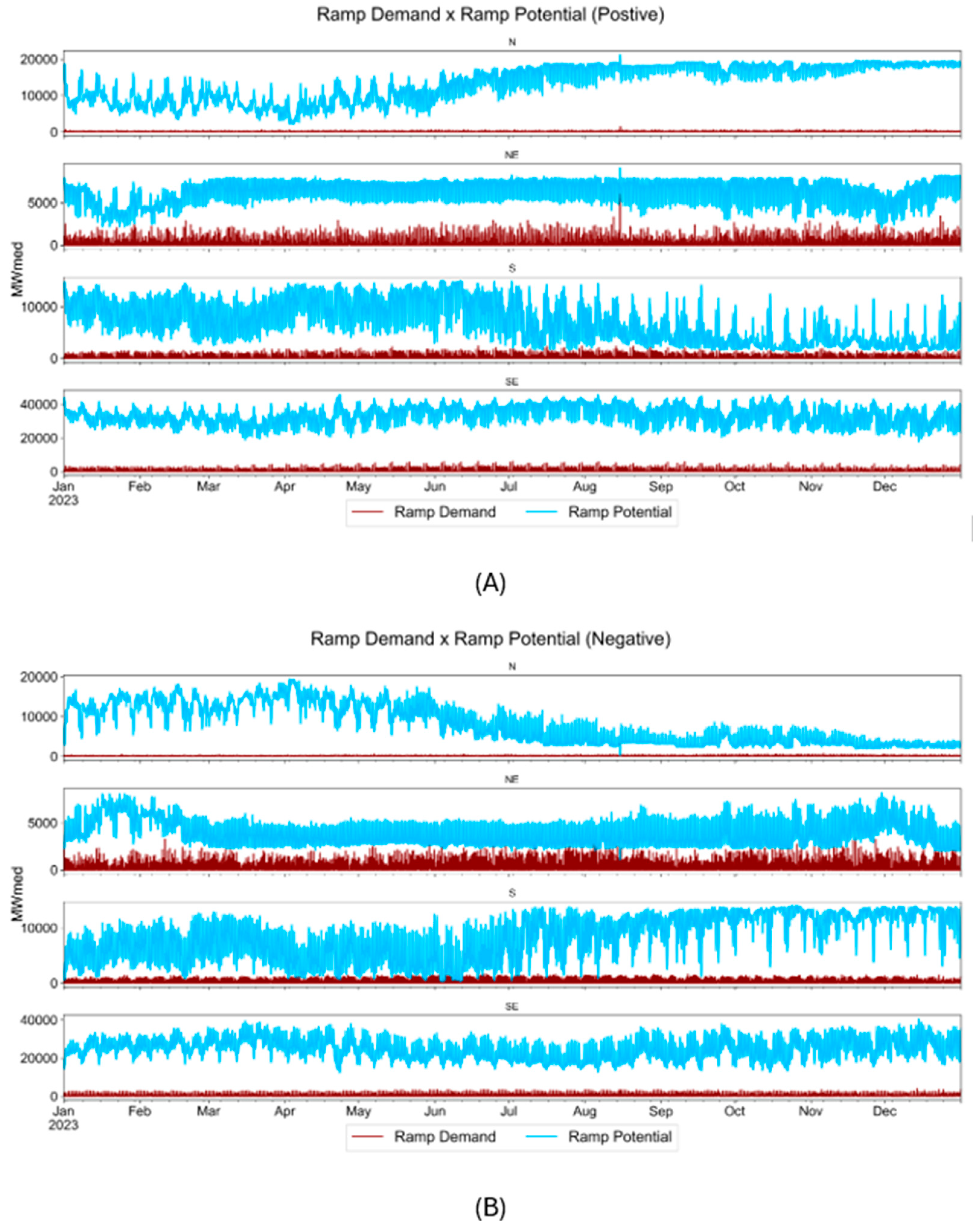
Figure 2.
Number of positive and negative ramp deficits for scenario basic.
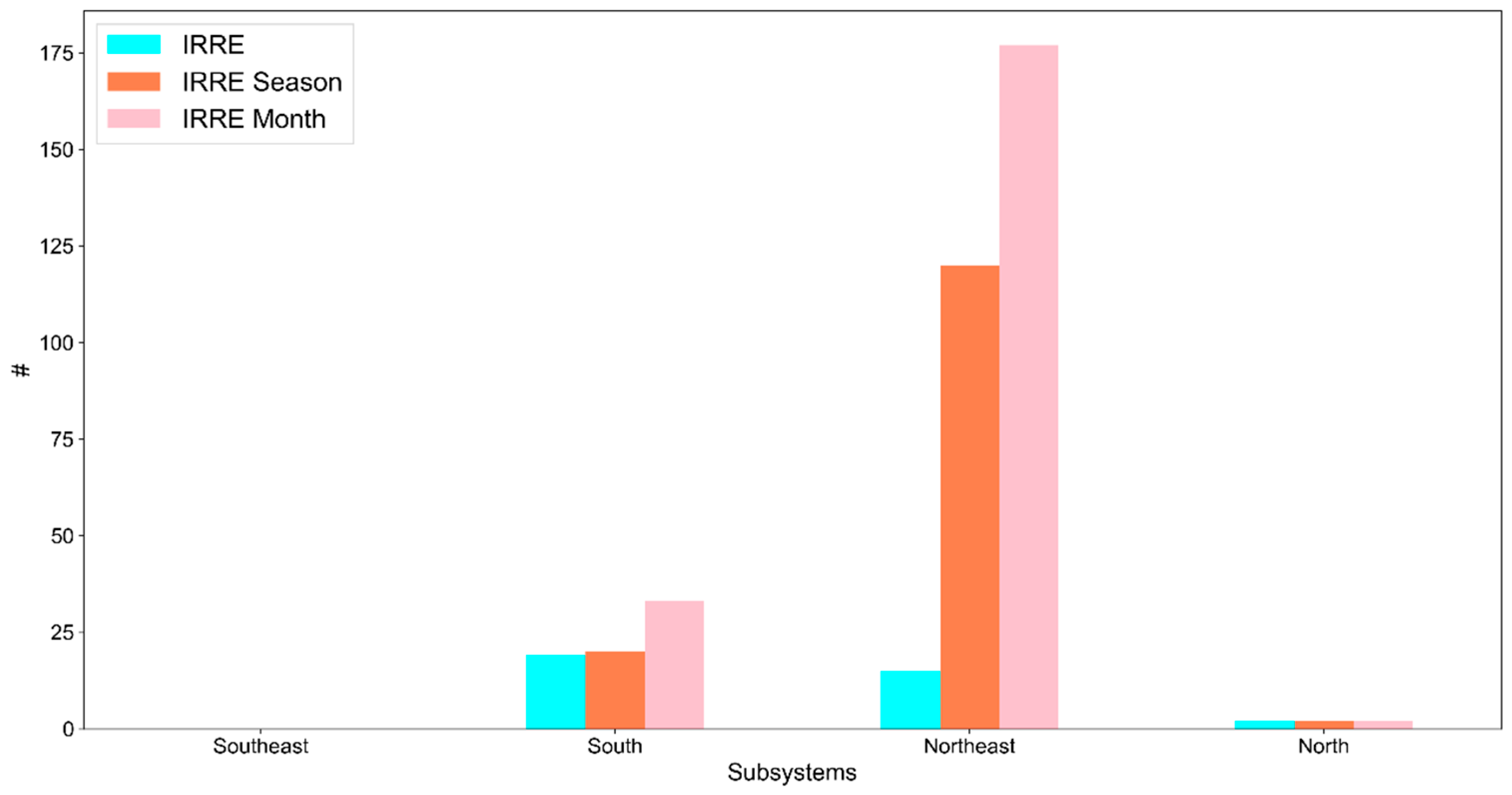
Figure 3.
Number of positive and negative ramp deficits for scenario basic.
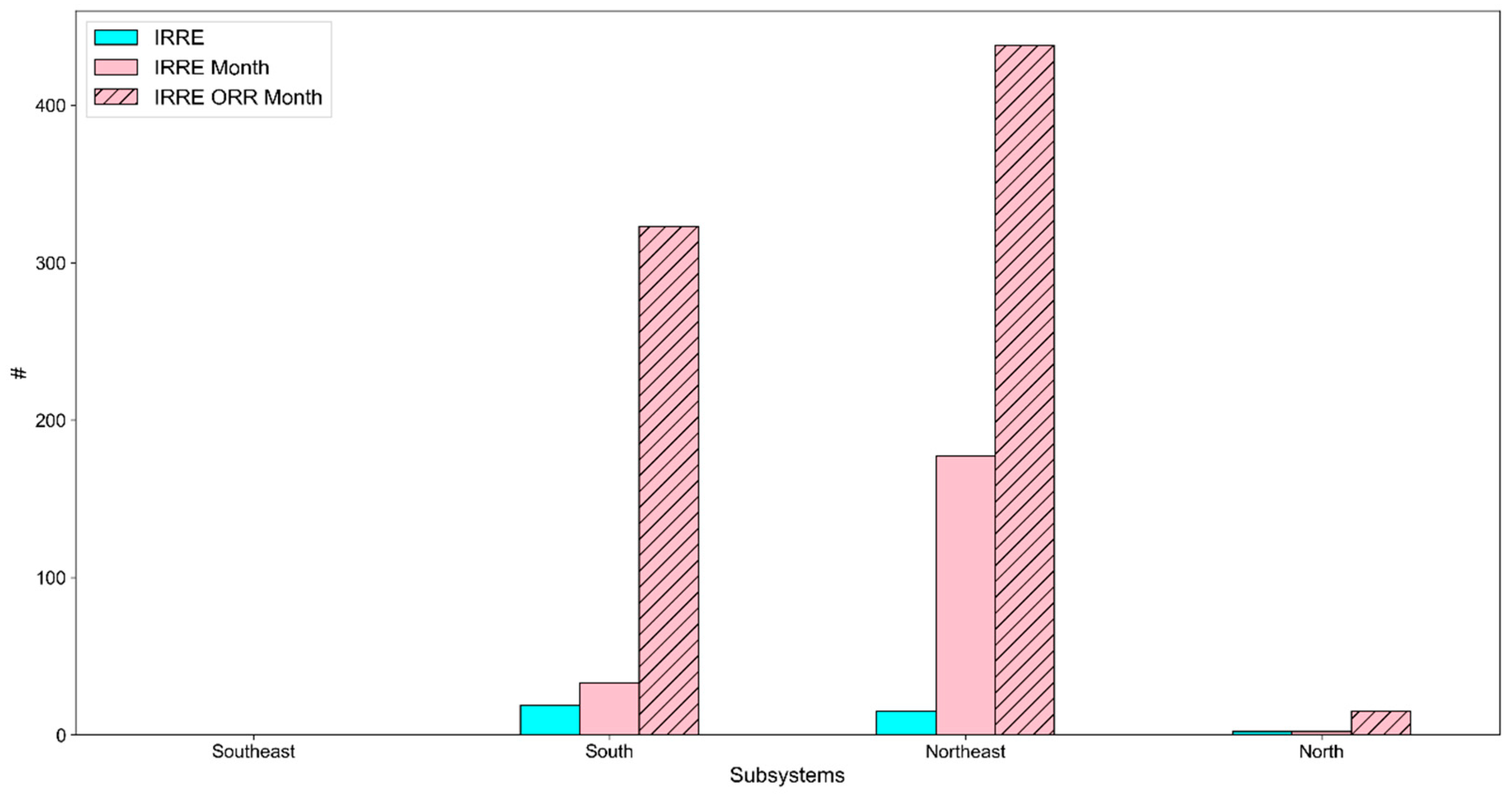
Figure 4.
Number of positive and negative ramp deficits by scenario.
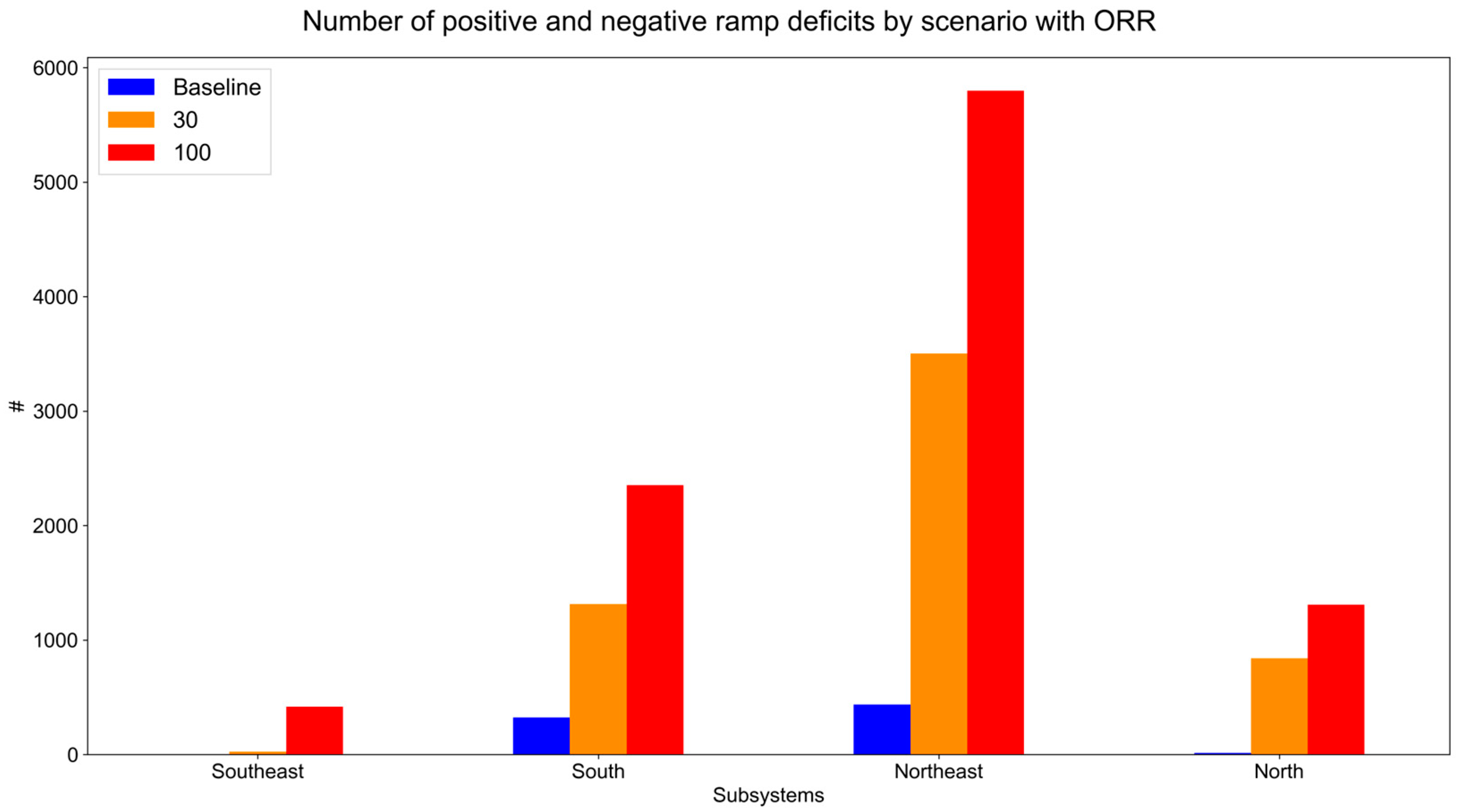

Table 1.
Description of the methodological steps applied.
| Methodology Step | Description |
|---|---|
| 1. Original IRRE Calculation | Baseline scenario without additional constraints. IRRE is calculated using its original methodology. |
| 2. Seasonal Limits | Adjust maximum/minimum generation for hydropower plants based on observed quarterly hydrological data (2018–2023). |
| 3. Monthly Limits | Apply maximum/minimum generation limits based on observed monthly data, reflecting detailed conditions for each month. |
| 4. Operational Reserve Power Requirements (ORR) | Introduce a 5% generation restriction to reserve capacity for unforeseen operational demands, ensuring system reliability. |
| 5. VRES Expansion Scenarios | Analyze impacts of 30% and 100% increases in variable renewable energy sources, reflecting future expansion scenarios. |
Disclaimer/Publisher’s Note: The statements, opinions and data contained in all publications are solely those of the individual author(s) and contributor(s) and not of MDPI and/or the editor(s). MDPI and/or the editor(s) disclaim responsibility for any injury to people or property resulting from any ideas, methods, instructions or products referred to in the content. |
© 2025 by the authors. Licensee MDPI, Basel, Switzerland. This article is an open access article distributed under the terms and conditions of the Creative Commons Attribution (CC BY) license (http://creativecommons.org/licenses/by/4.0/).
Copyright: This open access article is published under a Creative Commons CC BY 4.0 license, which permit the free download, distribution, and reuse, provided that the author and preprint are cited in any reuse.