

Submitted:
31 January 2025
Posted:
31 January 2025
Read the latest preprint version here
Abstract
Background: Therapeutic exercise and early mobilization are strategies that have demonstrated benefits in patients in intensive care units, however postsurgical patients of cardiovascular surgery present differential risks and therefore specialized interventions. Objectives: To identify the effects of therapeutic exercise in intensive care unit patients who underwent cardiac surgery as reported in the scientific literature. Methods: A scoping review was conducted using the following databases: Scopus, ScienceDirect, Physiotherapy Evidence Database, and PubMed®. There were no language restrictions, and articles published between January 1, 2018, and October 30, 2023, were included. The characteristics of the population were collected according to exercise prescription principles, frequency, intensity, time, type of activity/mode, and the benefits reported for early exercise. Results: From a 814 papers, 12 that met the inclusion criteria were selected for final analysis. Most patients were male, aged between 54 and 68 years; the rehabilitation protocol started between 2 and 8 hours after extubation, with different degrees of exercise intensity. Finally, improved exercise tolerance and functional capacity, decreased onset of delirium, improved oxygen consumption and decreased intensive care unit stay were reported. Discussion: Most studies use validated scales to determine aerobic capacity and other physical qualities in the population. However, the prescription of exercise intensity reflects variations. This difficulty could be attributed to the differential response associated with the particular conditions of each subject, which highlights the importance of trained professionals to address these interventions safely. Conclusion: Therapeutic exercise prescribed in intensive care unit patients after cardiac surgery positively affects their outcomes. However, our findings report a lack of precision in exercise intensity and heterogeneous intervention protocols.
Keywords:
therapeutic exercise
; physiotherapy
; cardiac surgery
; early mobilization
; intensive care unit (ICU)
1. Introduction
Among chronic non-communicable diseases, heart disease is the leading cause of mortality and morbidity worldwide and in the Americas [1]. Cardiac surgery (CS) is considered a therapeutic target for ischemic coronary artery disease. However, it should be performed according to specific criteria since it is a complex intervention that requires aggressive procedures such as extracorporeal circulation, anesthesia, pump time, and clamping. These procedures have been related to post-surgical complications [2,3], impacting patient outcomes. These conditions lead to prolonged hospitalization and bed rest, which adversely affects patient prognosis.
Over the years, the advantages of early mobilization (EM) and therapeutic exercise (TE) have been well-documented in critically ill patients. These include shorter hospital stays and a reduced incidence of delirium and pneumonia [4]. Equally positive effects have been reported in patients with immediate CS [5]. This resulted in the emergence of phase-1 cardiac rehabilitation programs (CRP), which involve an interdisciplinary team and include patient education on the post-surgical process, emotional support, nutrition, and TE as a pillar. The latter aims to mitigate physical deconditioning, improve functional capacity, and reduce complications associated with bed rest. In line with these findings, recent advancements in machine learning approaches have demonstrated the importance of mobility-related factors in improving daily living activities and functional capacity. These insights emphasize the need to prioritize mobility in rehabilitation protocols to optimize outcomes [6].
However, TE in patients who underwent CS should be prescribed carefully since there are potential risks when increasing oxygen consumption in a patient with a chronic cardiovascular disease, such as arrhythmias or acute infarction. For this reason, professionals should prescribe exercise in a standardized manner and consider patients’ assessment and subsequent care to ensure their safety [7].
Most of the scientific evidence in the literature focuses on rehabilitation processes in patients with cardiovascular disease in an outpatient context [8]. In recent reviews [9,10], the American College of Sports Medicine (ASCM) recommended CRPs in hospitalized patients, which should be guided by experts and include supervised daily mobilization and monitoring of adverse responses to exercise. The authors agree in their recommendations that the activity should be performed in phases, the first should be calisthenics, the second considered central phase should introduce aerobic and anaerobic exercise, and finally a return to calm, the appropriate prescription of intensity, can be monitored by the rating of perceived effort and target heart rate, estimated by formulas, or not exceed 30 bpm of the basal measurement, and in resistance training the maximum repetition value (1RM) is taken as a reference, considering for this type of patients to start between 40% of the measurement. These guidelines are summarized as follows: Minimum frequency 2 times per day, 3 to 5 times per week, or 150 min/week, the intensity is adjusted according to the perception of effort between 12 and 14 according to the Borg scale or the speech test or start with 40% of VO2 max, in terms of time per session, a minimum of 20 minutes is suggested and type of exercise: traditionally it is subdivided into aerobic and anaerobic, the first is described with movements that involve large muscle groups that allow an aerobic glycolysis metabolism and the second refers to high intensity activities that do not depend on the availability of oxygen during that time.
It should be mentioned that TE prescription is part of the role of physiotherapists and should be done based on their professional criteria to ensure safe interventions for critically ill patients in their acute phase [11]. However, there is no standardized optimal dose of exercise per day; the evidence only states that it should be progressive according to the patient’s tolerance.
Due to this, we posed the following research question:
- What are the effects of therapeutic exercise in Postoperative Cardiac Surgery Patients in Intensive Care Unit (ICU)?
- What characteristics are associated with the prescription of ET in Postoperative Cardiac Surgery Patients In ICU
- What benefits has scientific evidence documented regarding therapeutic exercise in this population?
2. Materials and Methods
2.1. Protocol and Registration
A scoping review was conducted based on the PRISMA extension for scoping reviews (PRISMA-ScR) guidelines [12]. The data to be collected was defined following the participants, concept, and context (PCC) model, as shown in Table 1. In adherence to the protocol established by the guide, which defines within its methodology the mapping of the existing literature on a particular topic, following the quality, rigor, and transparency of a review. However, this study does not present the record of the protocol, since it is not mandatory in scoping reviews according to the same PRISMA-ScR guide.
2.2. Eligibility Criteria
Controlled clinical trials, observational studies, both descriptive and analytical (cohort and case-control), responding to the PCC question were included. The exclusion criteria included studies related to pre-surgical breathing exercises and patients performing CRP phases 2 and 3.
2.3. Information Sources
The following databases were consulted to perform the search: Scopus, ScienceDirect, Physiotherapy Evidence Database (PEDro), and PubMed®. There were no language restrictions, and articles published between January 1, 2018, and October 30, 2023, were included.
2.4. Search Strategy
The search strategy comprised combinations of the health sciences descriptors and Medical Subject Headings, as well as synonyms of the following words: cardiac surgery, myocardial revascularization, coronary artery bypass, exercise therapy, early mobilization, physiotherapy, and ICU. The search equations were performed using the Boolean connectors AND, OR, and NOT.
2.5. Selection of Sources of Evidence
First, studies that met the described filters were classified in each database by A.R.P, J.Q.H, and AMB, eliminating duplicates and reviewing by title and abstract. Then, manuscripts were selected, taking into account the inclusion criteria. For this manuscript, the EndNote TM tool was used to compile the articles. If there was a discrepancy in the selection of any article regarding compliance with the selection criteria, the fourth evaluator (MRS) was assigned to make the decision.
2.6. Data Charting Process and Data Items
Data were recorded in matrix one, which included the following: title, authors, language, year of publication, type of study, purpose, and results. In the second matrix, the following was extracted: number of patients, sex, age, body mass index, hypertension, dyslipidemia length of ICU stay, length of hospital stay, mechanical ventilation time, type of surgery, and sedentary lifestyle. In matrix three, variables related to exercise prescription were included, such as mode/type of exercise, intensity, and frequency. These guidelines are established by the ASCM as orientations for the description of the exercise and are also called “FITT principles,” which define the following variables: Frequency (F) corresponds to the number of days in the week in which patients do the exercise, Intensity (I) is the level of effort exerted by patients according to the evaluation of their exercise capacity, Time (T) is the duration of each session and Type (T) of activity/mode, refers to aerobic activities, high or low resistance activities, or minimum dexterity activities [9]. Finally, matrix four incorporated the associated effects.
The findings were represented in a flow chart, according to PRISMA-ScR, to specify the findings. (Figure 1).
2.7. Synthesis of Results
The data was compiled qualitatively, this information is summarized in tables by objectives. Description of the characteristics of the sample tabla 2, the protocols used to the exercise prescription Table 3, and the benefits of the exercise in this population Table 4. These results were analyzed in a quantitatively and qualitatively way.
3. Results
In the initial search, 814 papers were identified, 124 duplicates were eliminated, and 28 papers were selected by title and abstract to be fully read. Of these, 20 were eliminated as they did not meet the eligibility criteria, resulting in a total of 12 papers selected for data description. All papers were published in English. Regarding the methodological design, 10 were clinical trials [13,14,15,16,17,18,19,20,21,22,23], 1 was a prospective observational study [23], and 1 was a prospective cohort study [24].
Regarding the sociodemographic characteristics, the most frequently observed in the 12 papers were male sex, age range between 54 and 68 years, mean body mass index between 20 and 26.7 kg/m2, and coronary artery bypass grafting as the most frequent type of surgery. Eight papers mentioned that the subjects were on mechanical ventilation in a range of 2–10 hours, and the length of stay in ICU varied from 2 to 8 days; two papers reported that the percentage of sedentary lifestyle was between 24% and 49%. Finally, dyslipidemia and hypertension often coexist in patients with elevated cardiovascular risk. (Table 2).
Therapeutic exercise is a series of physical activities and movements that are prescribed to improve function, restore muscular and skeletal function, and maintain a state of well-being. This intervention is part of the early mobilization strategies utilized in the ICU, primarily aimed at enhancing the individual’s functional capacity. Additionally, these exercise programs should outline or detail how the intervention strategies are implemented.
According to the guidelines for exercise prescription, regarding mode/type of exercise, activities such as passive and active movements were described, as well as the use of cycloergometer, bed-to-chair transfer training, supine to seated transition training, seated at the edge of the bed, seated in a chair, standing, ambulation, respiratory exercises, and tools such as virtual reality and support with mechanical ventilation devices. Intervention protocols started after extubation, from the immediate postoperative period or first postoperative day until ICU and even hospital discharge. Additionally, most protocols are conducted twice a day without a specific time. The exercise protocols are described in Table 3.

Table 3.
Analysis of exercise prescription parameters.
| Duration | Frequency | Intensity | ||||
|---|---|---|---|---|---|---|
| Authors | Exercise mode/type | Session (Minutes) | Program (Days) |
Sessions/week | IPE–aerobic capacity–MHR | MRC (Strength |
| Ribeiro BC et al. [13]. | RE–LLE–SEB–CELL–SC–PG-VR | 20 min | 1–3 days | NR | 20% MHR, moderate-high (modified Borg 4–5) | NR |
| Gama Lordello et al. [14]. | ULE–CELL+CEUL–SU–SC-PG | 10 min | 2–12 days | 2 times a day | Number of steps (pedometer) | NR |
| Shirvani et al. [15]. | SEB–PG | 15 min | 2–6 days | 2 times a day | Pulse oximetry and 20 % HR, Neecham confusion scale | NR |
| Moreira et al. [16]. | RE–BA–ULE–LLE–PG –CS | 10–30 min | 1–6 days | 2–3 times a day | 6MW; Borg modified scale; hemodynamic values: blood pressure, heart rate, and pain (4 MET of intensity) | NR |
| Han et al. [17]. | RE–TSS–SEB–SC–SU– PG | NR | 2–7 days | 2 times a day | IEP (Borg 3–4/10) - Barthel | NR |
| Cui et al. [18] | TBC–SU–SC–PG | 10–20 min | 3 days | 2–3 times a day | MHR, VO2max, (%MHR = 0.64 × %VO2max + 37; MHR = 205.8−0.685 × age; HRR = MHR−HRR; X% APMHR = HRR × X% + HRR). Everyday VO2max increased by 10% |
NR |
| Esmealy et al. [19]. | RE-ULE-LLE-SEB -SC-SU-PG | 15 min | 2 days | 2 times a day | Arterial blood gas (PaO2, PaCO2, blood pH), SpO2 | NR |
| Bano et al.[20] | ULE-LLE-CELL-PG, RE+CPAP | 20–30 min | 2–4 days | 1- 2 times a day | Mild IPE (modified Borg 3), HR 20 L/min, 6MW, 1 minute sit and stand test (measure lower limbs strength) | NR |
| Allahbakhshian et al.[21]. | RE-ULE-LLE-SEB - SC-SU-PG | 15 min | 0–1 day | 2 times a day | MMSE, VAS | NR |
| Tsuchikawa et al.[22]. | RE-ULE-LLE-PST-SEB-SU-PG | NR | 1–10 days | 2 times a day | 6MW | NR |
| Kenji Nawa et al. [23]. | ULE–LLE | 30 min | 4–8 days | 2 times a day | Dynamometry(force), Perme mobility scale (functionality), spirometry (pulmonary function), PIM, and PEM (respiratory muscle strength). | NR |
| Cordeiro et al. [24]. | TBC-PG | NR | 2–8 days | NR | MRC strength, FIM, 6MW (prepost) | NR |
Abbreviations: IPE: index of perceived exertion; MHR: maximum heart rate; MRC: Medical Research Council ; RE: respiratory exercises; ULE: upper limb exercises; LLE: lower limb exercises; SEB: Seated on the edge of the bed; CELL: cycloergometer in lower limbs; CEUL: cycloergometer in upper limbs; SC: stair climbing; PG: progressive gait; VR: virtual reality; SU: standing upright; SC: seated in chair; TSS: transition from supine to seated; TBC: transfer from bed to chair; CPAP: continuos positive airway pressure, PST: Passive Sitting; BA: balance exercises; MET: metabolic equivalent of the task; APMHR: age-predicted maximum heart rate; VO2max: maximal oxygen consumption; HRR: resting heart rate; SpO2: oxygen saturation; PaO2: arterial oxygen pressure; PaCO2: arterial carbon dioxide pressure; FIM: functional independence measure; 6MW: six-minute walk test; PIM: peak inspiratory pressure; MEP: maximum expiratory pressure; MMSE: mini mental state examination; VAS: visual analog scale; NR: not reported.
Some of the benefits reported were improved functional capacity, reflected in the distance covered in the 6-minute walk test (6MWT) at the hospital with positive results, as well as improvements in arterial oxygen saturation (SpO2) and arterial oxygen pressure (PaO2) and decrease in arterial carbon dioxide pressure (PaCO2). One paper also reported controlled postoperative delirium. In most of the studies, there was an improvement in exercise tolerance and maximal oxygen consumption (VO2max) and a reduction in ICU and hospital stays (Table 4)
Table 4.
Qualitative analysis of the benefits of therapeutic exercise.
| Authors | Test or measurement tool | Quality of life | Reduction of ICU and hospital stay | Complications | Functional and aerobic capacity |
|---|---|---|---|---|---|
| Ribeiro BC et al. [13]. | Modified Borg Scale | NR | Reduction of hospital stay, P < 0.05 (0.03). | No complications. | No Changes |
| Gama Lordello et al. [14]. | Podometer | Self-reports evidenced a significant improvement in the motivation of the control group. | No significant changes. | NR | The number of steps measured after the intervention in the intervention group was 1,126 versus 972 in the control group; the use of a cycloergometer did not show greater efficiency than other interventions at the time of comparison. |
| Shirvani et al. [15]. | Neecham confusion scale | NR | There were no significant differences in terms of hospitalization days. | No complications. | Planned EM may reduce the incidence of postoperative delirium. |
| Moreira et al. [16]. | 6MW , Borg scale , : PA, FC ,NRS, SF-36V2 | SF-36V2, there was a percentage increase in all domains, numerical pain scale. | There were no significant differences in terms of hospitalization days. | NR | 6-MW, there was improvement at the end of the study. |
| Han et al. [17]. | Barthel Test | Barthel index was significantly higher in the IGR group. | Postoperative hospital stay was statistically shorter for the IGR group. | Both the SGR and the IGR groups had significantly fewer complications. | NR |
| Cui et al. [18] | Arterial Blood gas analysis and Distance of walking (patient’s self-assessment and the experiences of rehabilitation therapists) Post-traumatic stress disorder score |
NR | PLOS in the PEA group was shorter than that in the Control group (9.04 ± 3.08 versus 10.09 ± 3.32 days. | Elderly patients subject to CABG had a higher risk of complications. | There were favorable and significant associations between PEA and clinical results such as PLOS, walking distance and psychological consequences |
| Esmealy et al. [19]. | Arterial blood gases and oxygen saturation | NR | NR | No adverse effects. | There was a significant increase of SpO2 over time (P = 0.001); PaO2 and its interaction with time had statistically significant results (P = 0.001). PaCO2 value decreased. |
| Bano et al. [20]. | Arterial blood gases | NR | ICU and hospital stays were considerably lower in the intervention group (P = 0.001). | NR | Walk distance and lower limb strength of the intervention group were statistically significant (P = 0.001). |
| Allahbakhshian et al. [21]. | Borg scale, MMSE, VAS | Improvement in pain sensation The intervention group had significantly less postoperative cognitive dysfunction. |
There was a significant difference in the length of hospital stay (P = 0.01) between groups. | NR | NR |
| Tsuchikawa et al. [22]. | 6 MW, EuroSCORE II | The estimated future risk decreased if there was an early onset of ambulation (EuroSCORE II). | NR | The Mortality rate was lower in the group that started ambulation before 3 days. | Patients in Group E showed a greater walk distance according to the 6-minute walk (368.9 m) The estimated future risk of adverse events was found to be increased day-by-day during the delay until initial ambulation. |
| Kenji Nawa et al. [23]. | 6MW - Perme Mobility Scale | NR | Perme score on days 2 and 3 was associated with hospital stay (P < 0.001). | No complications. | A 4.6-increase in Day 3 Perme Score reduced ICU stay to a day. |
| Cordeiro et al. [24]. | FIM | NR | MV time, ICU stay, and hospital stay were significantly better in the EM group (P = 0.001). | NR | Functional factors, such as functional independence and walk distance, were significantly higher in the group with EM (P = 0.001). |
Abbreviations: PEA: Precision early ambulation group; PLOS: postoperative length of hospital stay; SGR: general ward rehabilitation with routine UC; IGR: ICU rehabilitation with general education + general ward rehabilitation; ICU: intensive care unit; SpO2: oxygen saturation; PaO2: arterial oxygen pressure; PaCO2: arterial carbon dioxide pressure. MV: mechanical ventilation; EM: early mobilization. 6MW: six-minute walk test; NRS : Numeric Pain raiting scale; MMSE: Mini Mental State Examination; VAS: visual analog scale; FIM Functional Independence Measurement.
4. Discussion
The objective of this review was to describe the effects of TE in patients after CS, in addition to identifying the demographic and clinical characteristics of the population, the guidelines and tools used for exercise prescription and execution, the protocols, and the documented benefits.
Regarding sociodemographic characteristics, the results support the findings of other studies, showing male gender, elevated cholesterol, hypertension, obesity, and overweight as preponderant risk factors that affected 74% of the population requiring cardiovascular surgery [18,25,26,27,28,29].
Scientific evidence has supported EM and TE as a strategy with positive effects in ICU patients since most of them showed reduced physical abilities due to prolonged rest. This is evidenced by the fact that skeletal muscle strength decreases between 1% and 1.5% per day, directly affecting strength, with a loss of up to 40%. This, in turn, results in decreased muscle power, aerobic capacity, and balance, increasing the risk of falls. These patients also show cardiovascular and respiratory changes, altered blood flow distribution, increased cardiac workload, resting heart rate, and contractility [30,31,32].
For this reason, it is important to provide objective measurements before interventions. In our study, the 6MWT was used [16,20,22,24] as an outcome measure since this submaximal test is used to qualify the aerobic capacity reflected in individuals’ functional capacity, and it is also useful as a predictor of morbidity and mortality [33]. In the papers reviewed, the subjects who performed TE showed significant improvement about walking distance [16]. The Borg scale was also used to measure the perception of cardiopulmonary effort during exercise. This scale is useful to estimate exercise intensity, and values of 14-15, not higher than 16, are recommended [34,35]. Another tool used for muscle strength assessment is manual handgrip dynamometry [36,37], maximum inspiratory pressure, which assesses diaphragmatic strength, and maximum expiratory pressure, which measures the strength of the intercostal and abdominal muscles [38]. The latter is important when prescribing respiratory training with linear load devices [39].
Due to its ease of application, the Medical Research Council (MRC) scale is a tool used to evaluate muscle strength in the ICU area. In addition, acquired muscle weakness in the ICU can be diagnosed when its score is lower than 48 points. Despite being a highly recognized scale for evaluating functional strength in the ICU [40], we only found its use in one paper, which showed the effects of maintaining muscle strength and functionality by comparing results from admission to discharge and between the mobilized and non-mobilized groups [24]. Another scale is the Perme mobility scale in the ICU, which allows the rating of the patient’s mobility from bed to independent walking. Its score varies from 0 to 32, with a higher score indicating better mobility. It is also used to estimate possible barriers in different areas, such as physical and social barriers [41,42]. In their clinical trial, Kenji Nawa R et al. reported that the Perme score is a marker of a longer stay in those with lower mobility undergoing coronary revascularization surgery and valve replacement in the ICU [23].
Functional independence measurement and the Barthel scale [24,43] are useful for recording functional capacity and progress over time [44]. Our findings evidenced that TE helped improve functional capacity in the experimental groups, as documented using these scales [17]. Another important result is health-related quality of life, recorded with the SF-36 health questionnaire [16]. This questionnaire is useful for assessing the patient’s quality of life; due to its quality and effectiveness, it is one of the most widely implemented [43]. Another questionnaire described was the International Physical Activity Questionnaire [14,46], which measures the degree of daily physical activity and can be applied to different populations between 15 and 69 years of age [18].
Regarding exercise prescription, disparity was found in most of the protocols, and some protocols even did not follow the FITT guidelines. EM and TE type or mode varied in terms of applicability; these interventions began as soon as the patient was clinically able to tolerate the activity, which was 2 hours after extubation, until the first postoperative day, and it was prolonged until discharge. The duration of each exercise session was between 10 and 30 minutes and the frequency was daily. The findings do not specify the daily intervention schedules that the population experienced. Additionally, it is important to note that in the ICU, specific conditions such as imbalances in the cardiac cycle, endocrine disorders, and other factors can either positively or negatively impact the patient’s performance.
Exercise intensity was recorded in 4 papers based on heart rate, which was 20%. The Borg scale was also used, and it showed moderate intensity. Only one paper evidenced the progress of the activity, with increased daily VO2 max. However, this approach to the FITT attributes shows us that efforts are required for the standardization of intensity prescription, even more so in patients with cardiovascular alterations.
Among the benefits described were improved automatic cardiac modulation and reduced hospital stay [13]. However, in an experimental study, the use of a cycloergometer in the postoperative period did not show significant differences in the total number of steps and mobility between groups after the intervention, although greater motivation was observed in the intervention group [14,47]. In addition, TE is considered one of the non-pharmacological approaches to decrease the incidence of postoperative delirium with strong supporting evidence [15,48,49]. In contrast, a clinical trial recently documented how the use of a cycloergometer immediately after open valve replacement was beneficial, impacting functional capacity [50]. Another study showed that subjects receiving rehabilitation and disease education presented fewer complications and shorter hospital stays [17]. Precision early ambulation, which is performed less than 4 days after surgery and is controlled using maximum oxygen consumption (VO2 max) and maximum heart rate predicted for age, showed significant improvements in the walk distance compared to those who initiated it later [18,22]. It is important to emphasize the benefits of EM and ET, particularly in alleviating the effects of post-intensive care syndrome. (PICS) Research indicates that between 50% and 80% of ICU survivors experience a range of disabilities that persist well beyond their hospital discharge. Many of these issues are diagnosed years after leaving the ICU and can impact not only physical capabilities but also neurocognitive function and behavior. Rehabilitation is a comprehensive process that plays a crucial role in reducing the likelihood of these long-term effects [51].
In the near future, management guidelines that standardize the prescription of therapeutic exercise for patients who have recently undergone cardiovascular surgery should be established. These guidelines should be developed not only by experts in sports medicine but also by associations related to critical care, cardiovascular surgery, cardiopulmonary physiotherapy, and nutrition. This comprehensive approach aims to address documented limitations in patient care. Evaluations should be standardized, focusing primarily on the intensity of the activity using objective measurements and tools.
This scoping review allows readers to identify, in a summarised manner, the intervention protocols for the implementation of therapeutic exercise in this population, taking into account the reported benefits, and to apply them in their clinical contexts. In addition, the identified limitations are a starting point for the construction of new research and thus to enrich precision interventions. Furthermore, the role of the rehabilitator is increasingly clear in intensive care units not only as a promoter of physical activity but also as a trainer and expert in the prescription of exercise for this vulnerable population.
4.1. Study Limitations
As this was a scoping review, only descriptive data from other studies could be documented, excluding many quantitative findings that ultimately strengthen the argument for the interventions assertively. Added to this is the absence of a risk of bias assessment of the articles. On the other hand, 4 databases were used, which, although recognized for the quality of their repository, the search strategy did not yield a sufficient number of publications that, within their design, specifically compare the different types of interventions. Only one clinical trial is mapped, so the majority of observational studies identify characteristics of the population that was described and the types of exercise that were used with heterogeneity in their application. Finally, the term early mobilization is unclear in terms of the start time and is often confused with exercise, so some effects could not be directly attributed to it.
5. Conclusions
This study provides information on the beneficial effects of EM and TE interventions. Our findings suggest an effective reduction in hospital stay, improved quality of life and functional capacity, and decreased risk of complications such as postoperative delirium and subsequent cognitive impairment. However, a great variety of intervention protocols was identified, whose intensity was not prescribed in a standardized or rigorous manner. In addition, the role of physiotherapists as expert promoters is highlighted in order to establish safe interventions but also in mitigating the long-term deleterious effects, already named as PICS. This can serve as a foundation for developing standardization strategies in guideline protocols for this population, encompassing all stakeholders within the intensive care unit. This approach can facilitate the establishment of objective measurements to accurately calculate the appropriate exercise volume and intensity.
Author Contributions
A.R.P. participated in the conceptualization (support), reporting, analysis, project management, review, and editing of the final manuscript. JQH participated in the conceptualization (support), information, analysis, project management, review, and editing of the final manuscript. AMB participated in the conceptualization (support), information, analysis, project management, review, and editing of the final manuscript. MRS. Participated in the conceptualization (support), reporting, analysis, project management, review, and editing of the final manuscript. All authors participated in the drafting of this paper. All authors have read and agreed to the published version of the manuscript.
Funding
This research was funded by the General Research Directorate of Universidad Santiago de Cali under call No. 01-2024.
Institutional Review Board Statement
This review is the result of the synthesis of existing scientific publications; therefore, it does not require ethical approval.
Informed Consent Statement
Not applicable, as this scoping review did not involve human subjects or patients.
Data Availability Statement
Data sharing does not apply to this article as it is a review of existing literature.
Acknowledgments
This research was funded by the General Research Directorate of Universidad Santiago de Cali under call No. 01-2024.
Conflicts of Interest
The authors report there are no competing interests to declare
References
- Las enfermedades del corazón siguen siendo la principal causa de muerte en las Américas - OPS/OMS | Organización Panamericana de la Salud [Internet]. [cited 2024 Apr 3]. Available from: https://www.paho.org/es/noticias/29-9-2021-enfermedades-corazon-siguen-siendo-principal-causa-muerte-americas.
- Lozada-Ramos, H.; Daza-Arana, J.E.; González, M.Z.; Gallo, L.F.M.; Lanas, F. Risk factors for in-hospital mortality after coronary artery bypass grafting in Colombia. J. Cardiovasc. Surg. 2022, 63, 78–84. [Google Scholar] [CrossRef] [PubMed]
- A Rodríguez-Scarpetta, M.; Sepúlveda-Tobón, A.M.; E Daza-Arana, J.; Lozada-Ramos, H.; A Álzate-Sánchez, R. Central Oxygen Venous Saturation and Mortality in Patients Undergoing Coronary Artery Bypass Grafting. Ther. Clin. Risk Manag. 2023, 19, 447–454. [Google Scholar] [CrossRef]
- Benjamin, E.; Roddy, L.; Giuliano, K.K. Management of patient tubes and lines during early mobility in the intensive care unit. Hum. Factors Heal. 2022, 2. [Google Scholar] [CrossRef]
- Zanini, M.; Nery, R.M.; de Lima, J.B.; Buhler, R.P.; da Silveira, A.D.; Stein, R. Effects of Different Rehabilitation Protocols in Inpatient Cardiac Rehabilitation After Coronary Artery Bypass Graft Surgery. J. Cardiopulm. Rehabilitation Prev. 2019, 39, E19–E25. [Google Scholar] [CrossRef] [PubMed]
- Santilli, G.; Mangone, M.; Agostini, F.; Paoloni, M.; Bernetti, A.; Diko, A.; Tognolo, L.; Coraci, D.; Vigevano, F.; Vetrano, M.; et al. Evaluation of Rehabilitation Outcomes in Patients with Chronic Neurological Health Conditions Using a Machine Learning Approach. J. Funct. Morphol. Kinesiol. 2024, 9, 176. [Google Scholar] [CrossRef]
- A McDonagh, T.; Metra, M.; Adamo, M.; Gardner, R.S.; Baumbach, A.; Böhm, M.; Burri, H.; Butler, J.; Čelutkienė, J.; Chioncel, O.; et al. Corrigendum to: 2021 ESC Guidelines for the diagnosis and treatment of acute and chronic heart failure: Developed by the Task Force for the diagnosis and treatment of acute and chronic heart failure of the European Society of Cardiology (ESC) With the special contribution of the Heart Failure Association (HFA) of the ESC. Eur. Hear. J. 2021, 42, 4901–4901. [Google Scholar] [CrossRef]
- Virani Correction to: 2023 AHA/ACC/ACCP/ASPC/NLA/PCNA Guideline for the Management of Patients With Chronic Coronary Disease: A Report of the American Heart Association/American College of Cardiology Joint Committee on Clinical Practice Guidelines. Circulation 2023, 148, E148–E148. [CrossRef]
- Liguori, G. Prescripción de ejercicio para personas con enfermedades cardiovasculares y pulmonares. In: Wolters Kluwer Español, editor. Manual ACSM para la Valoración y Prescripción del Ejercicio. 4th ed. 2021. p. 227–31.
- Pelliccia, A.; Sharma, S.; Gati, S.; Bäck, M.; Börjesson, M.; Caselli, S.; Collet, J.-P.; Corrado, D.; Drezner, J.A.; Halle, M.; et al. 2020 ESC Guidelines on sports cardiology and exercise in patients with cardiovascular disease. Eur. Heart J. 2021, 42, 17–96. [Google Scholar] [CrossRef]
- Bäck, M.; Öberg, B.; Krevers, B. Important aspects in relation to patients’ attendance at exercise-based cardiac rehabilitation – facilitators, barriers and physiotherapist’s role: a qualitative study. BMC Cardiovasc. Disord. 2017, 17, 1–10. [Google Scholar] [CrossRef]
- Tricco, A. C.; Lillie, E.; Zarin, W.; O’Brien, K. K.; Colquhoun, H.; Levac, D.; Moher, D.; Peters, M. D. J.; Horsley, T.; Weeks, L.; et al. PRISMA Extension for Scoping Reviews (PRISMA-ScR): Checklist and Explanation. Ann Intern Med 2018, 169, 467–473. [Google Scholar] [CrossRef]
- Ribeiro, B.C.; da Poça, J.J.G.; Rocha, A.M.C.; da Cunha, C.N.S.; Cunha, K.d.C.; Falcão, L.F.M.; Torres, D.d.C.; Rocha, L.S.d.O.; Rocha, R.S.B. Different physiotherapy protocols after coronary artery bypass graft surgery: A randomized controlled trial. Physiother. Res. Int. 2020, 26, e1882. [Google Scholar] [CrossRef] [PubMed]
- Lordello, G.G.G.; Gama, G.G.G.; Rosier, G.L.; Viana, P.A.D.d.C.; Correia, L.C.; Ritt, L.E.F. Effects of cycle ergometer use in early mobilization following cardiac surgery: a randomized controlled trial. Clin. Rehabilitation 2020, 34, 450–459. [Google Scholar] [CrossRef]
- Shirvani, F.; Naji, S.A.; Davari, E.; Sedighi, M. Early mobilization reduces delirium after coronary artery bypass graft surgery. Asian Cardiovasc. Thorac. Ann. 2020, 28, 566–571. [Google Scholar] [CrossRef]
- Moreira, J.M.A.; Grilo, E.N. Quality of life after coronary artery bypass graft surgery - results of cardiac rehabilitation programme. J. Exerc. Rehabilitation 2019, 15, 715–722. [Google Scholar] [CrossRef]
- Han, P.; Yu, H.; Xie, F.; Li, M.; Chen, X.; Yu, X.; Li, J.; Liu, X.; Shao, B.; Liu, J.; et al. Effects of early rehabilitation on functional outcomes in patients after coronary artery bypass graft surgery: a randomized controlled trial. J. Int. Med Res. 2022, 50. [Google Scholar] [CrossRef]
- Cui, Z.; Li, N.; Gao, C.; Fan, Y.; Zhuang, X.; Liu, J.; Zhang, J.; Tan, Q. Precision implementation of early ambulation in elderly patients undergoing off-pump coronary artery bypass graft surgery: a randomized-controlled clinical trial. BMC Geriatr. 2020, 20, 1–10. [Google Scholar] [CrossRef] [PubMed]
- Esmealy, L.; Allahbakhshian, A.; Gholizadeh, L.; Khalili, A.F.; Sarbakhsh, P. Effects of early mobilization on pulmonary parameters and complications post coronary artery bypass graft surgery. Appl. Nurs. Res. 2022, 69, 151653. [Google Scholar] [CrossRef] [PubMed]
- Bano, A.; Aftab, A.; Sahar, W.; Haider, Z.; Rashed, M.I.; Shabbir, H.M. Combined Effects of Continuous Positive Airway Pressure and Cycle Ergometer in Early Rehabilitation of Coronary Artery Bypass Surgery Patients. J. Coll. Physicians Surg. Pak. 2023, 33, 866–871. [Google Scholar] [CrossRef]
- Allahbakhshian, A.; Khalili, A.F.; Gholizadeh, L.; Esmealy, L. Comparison of early mobilization protocols on postoperative cognitive dysfunction, pain, and length of hospital stay in patients undergoing coronary artery bypass graft surgery: A randomized controlled trial. Appl. Nurs. Res. 2023, 73, 151731. [Google Scholar] [CrossRef]
- Tsuchikawa, Y.; Tokuda, Y.; Ito, H.; Shimizu, M.; Tanaka, S.; Nishida, K.; Takagi, D.; Fukuta, A.; Takeda, N.; Yamamoto, H.; et al. Impact of Early Ambulation on the Prognosis of Coronary Artery Bypass Grafting Patients. Circ. J. 2023, 87, 306–311. [Google Scholar] [CrossRef]
- Nawa, R.K.; Dos Santos, T.D.; Real, A.A.; Matheus, S.C.; Ximenes, M.T.; Cardoso, D.M.; Albuquerque, I.M. Relationship between Perme ICU Mobility Score and length of stay in patients after cardiac surgery. Colomb. Medica 2022, 53, e2005179–e2005179. [Google Scholar] [CrossRef]
- Cordeiro, A.L.L.; Lima, A.D.S.; De Oliveira, C.M.; De Sa, J.P.; Guimaraes, A.R.F. Impact of early mobilization on clinical and functional outcomes in patients submitted to coronary artery bypass grafting. 2022, 12, 67–72.
- Alvarez CV, Obando LMG, Rendón CLA, López AL. Factores de riesgo cardiovascular y variables asociadas en personas de 20 a 79 años en Manizales, Colombia. Univ Salud. 2015 May 26;17(1):32–46.
- Félix-Redondo FJ, Baena-Díez JM, Grau M, Tormo M ángeles, Fernández-Bergés D. Prevalencia de obesidad y riesgo cardiovascular asociado en la población general de un área de salud de Extremadura. Estudio Hermex. Endocrinología y Nutrición. 2012 Mar 1;59(3):160–8.
- Aggarwal, R.; Yeh, R.W.; Maddox, K.E.J.; Wadhera, R.K. Cardiovascular Risk Factor Prevalence, Treatment, and Control in US Adults Aged 20 to 44 Years, 2009 to March 2020. JAMA 2023, 329, 899–909. [Google Scholar] [CrossRef] [PubMed]
- Prior, S.J.; Mckenzie, M.J.; Joseph, L.J.; Ivey, F.M.; Macko, R.F.; Hafer-Macko, C.E.; Ryan, A.S. Reduced Skeletal Muscle Capillarization and Glucose Intolerance. Microcirculation 2009, 16, 203–212. [Google Scholar] [CrossRef]
- Sommer, W.; Arif, R.; Kremer, J.; Al Maisary, S.; Verch, M.; Tochtermann, U.; Karck, M.; Meyer, A.L.; Warnecke, G. Temporary circulatory support with surgically implanted microaxial pumps in postcardiotomy cardiogenic shock following coronary artery bypass surgery. JTCVS Open 2023, 15, 252–260. [Google Scholar] [CrossRef] [PubMed]
- Dirkes, S.M.; Kozlowski, C. Early Mobility in the Intensive Care Unit: Evidence, Barriers, and Future Directions. Crit. Care Nurse 2019, 39, 33–42. [Google Scholar] [CrossRef]
- Salas-Flores M, Herrera-Melo J, Diaz X, Cigarroa I, Concha-Cisternas Y. Fuerza de prensión manual y calidad de vida en personas mayores autovalentes. Rev cuba med mil. 2021;e1328–e1328. Epub 01-Sep-2021. ISSN 1561-3046.
- Allen, C.; Glasziou, P.; Del Mar, C. Bed rest: a potentially harmful treatment needing more careful evaluation. Lancet 1999, 354, 1229–1233. [Google Scholar] [CrossRef] [PubMed]
- Crapo RO, Casaburi R, Coates AL, Enright PL, MacIntyre NR, McKay RT, et al. ATS Statement: Guidelines for the Six-Minute Walk Test. American Journal of Respiratory and Critical Care Medicine, 166, 111-117.
- Scherr, J.; Wolfarth, B.; Christle, J.W.; Pressler, A.; Wagenpfeil, S.; Halle, M. Associations between Borg’s rating of perceived exertion and physiological measures of exercise intensity. Eur. J. Appl. Physiol. 2012, 113, 147–155. [Google Scholar] [CrossRef]
- Barbero E, Guerassimova I, Lobato SD. Disnea aguda. Medicine - Programa de Formación Médica Continuada Acreditado. 2019 Oct 1;12(88):5147–54.
- Bragança, R.D.; Ravetti, C.G.; Barreto, L.; Ataíde, T.B.L.S.; Carneiro, R.M.; Teixeira, A.L.; Nobre, V. Use of handgrip dynamometry for diagnosis and prognosis assessment of intensive care unit acquired weakness: A prospective study. Hear. Lung 2019, 48, 532–537. [Google Scholar] [CrossRef]
- Stavrou, G.; Tzikos, G.; Menni, A.-E.; Chatziantoniou, G.; Vouchara, A.; Fyntanidou, B.; Grosomanidis, V.; Kotzampassi, K. Endothelial Damage and Muscle Wasting in Cardiac Surgery Patients. Cureus 2022, 14, e30534. [Google Scholar] [CrossRef]
- Mora-Romero UDJ, Gochicoa-Rangel L, Guerrero-Zúñiga S, Cid-Juárez S, Silva-Cerón M, Salas-Escamilla I, et al. Maximal inspiratory and expiratory pressures: Recommendations and procedure. Neumologia y Cirugia de Torax(Mexico). 2019;78(S2):S135–41.
- Cordeiro, A.L.L.; Soares, L.O.; Gomes-Neto, M.; Petto, J. Inspiratory Muscle Training in Patients in the Postoperative Phase of Cardiac Surgery: A Systematic Review and Meta-Analysis. Ann. Rehabilitation Med. 2023, 47, 162–172. [Google Scholar] [CrossRef]
- Via Clavero G, Sanjuán Naváis M, Menéndez Albuixech M, Corral Ansa L, Martínez Estalella G, Díaz-Prieto-Huidobro A. Evolución de la fuerza muscular en paciente críticos con ventilación mecánica inva-siva. Enferm Intensiva. 2013 Oct 1;24(4):155–66.
- Perme, C.; Nawa, R.K.; Winkelman, C.; Masud, F. A Tool to Assess Mobility Status in Critically Ill Patients: The Perme Intensive Care Unit Mobility Score. Methodist DeBakey Cardiovasc. J. 2014, 10, 41–9. [Google Scholar] [CrossRef] [PubMed]
- Luna, E.W.; Perme, C.; Gastaldi, A.C. Relationship between potential barriers to early mobilization in adult patients during intensive care stay using the Perme ICU Mobility score. Can. J. Respir. Ther. 2021, 57, 148–153. [Google Scholar] [CrossRef]
- Paolinelli G C, González H P, Doniez S ME, Donoso D T, Salinas R V. Clinical use and inter-rater agreement in the application of the functional independence measure. Rev Med Chil 2001 Jan;129(1):23–31. PMID: 11265202.
- Cid-Ruzafa J, Damián-Moreno J. Valoración de la discapacidad física: el indice de Barthel. Rev Esp Salud Publica 1997 71:127–37. ISSN 2173-9110.
- Wimmelmann, C.L.; Andersen, N.K.; Grønkjaer, M.S.; Hegelund, E.R.; Flensborg-Madsen, T. Satisfaction with life and SF-36 vitality predict risk of ischemic heart disease: a prospective cohort study. Scand. Cardiovasc. J. 2021, 55, 138–144. [Google Scholar] [CrossRef] [PubMed]
- Zhang-Xu, A.; Vivanco, M.; Zapata, F.; Málaga, G.; Loza, C. Actividad física global de pacientes con factores de riesgo cardiovascular aplicando el “International Physical Activity Questionaire (IPAQ). Rev. Medica Hered. 2011, 22. [Google Scholar] [CrossRef]
- Aristizábal Rivera JC, Jaramillo Londoño HN, Rico Sierra M. Pautas generales para la prescripción de la actividad física en pacientes con enfermedades cardiovasculares. Iatreia. 2005 Sep 16(3):240–53.
- Oh, S.-T.; Park, J.Y. Postoperative delirium. Korean J. Anesthesiol. 2019, 72, 4–12. [Google Scholar] [CrossRef]
- Hambrecht R, Wolf A, Gielen S, Linke A, Hofer J, Erbs S, et al. Effect of Exercise on Coronary Endothelial Function in Patients with Coronary Artery Disease. New England Journal of Medicine. 2000 Feb 17 ;342(7):454–60. [CrossRef]
- Ahmad, A.M.; Abusarea, S.A.; Fouad, B.Z.; Guirguis, S.A.; Shafie, W.A. Effect of Adding Early Bedside Cycling to Inpatient Cardiac Rehabilitation on Physical Function and Length of Stay After Heart Valve Surgery: A Randomized Controlled Trial. Arch. Phys. Med. Rehabilitation 2024, 105, 1050–1057. [Google Scholar] [CrossRef]
- Liu, K.; Tronstad, O.; Flaws, D.; Churchill, L.; Jones, A.Y.M.; Nakamura, K.; Fraser, J.F. From bedside to recovery: exercise therapy for prevention of post-intensive care syndrome. J. Intensiv. Care 2024, 12, 1–16. [Google Scholar] [CrossRef]
Figure 1.
PRISMA flow diagram. Source: Drafted by authors.
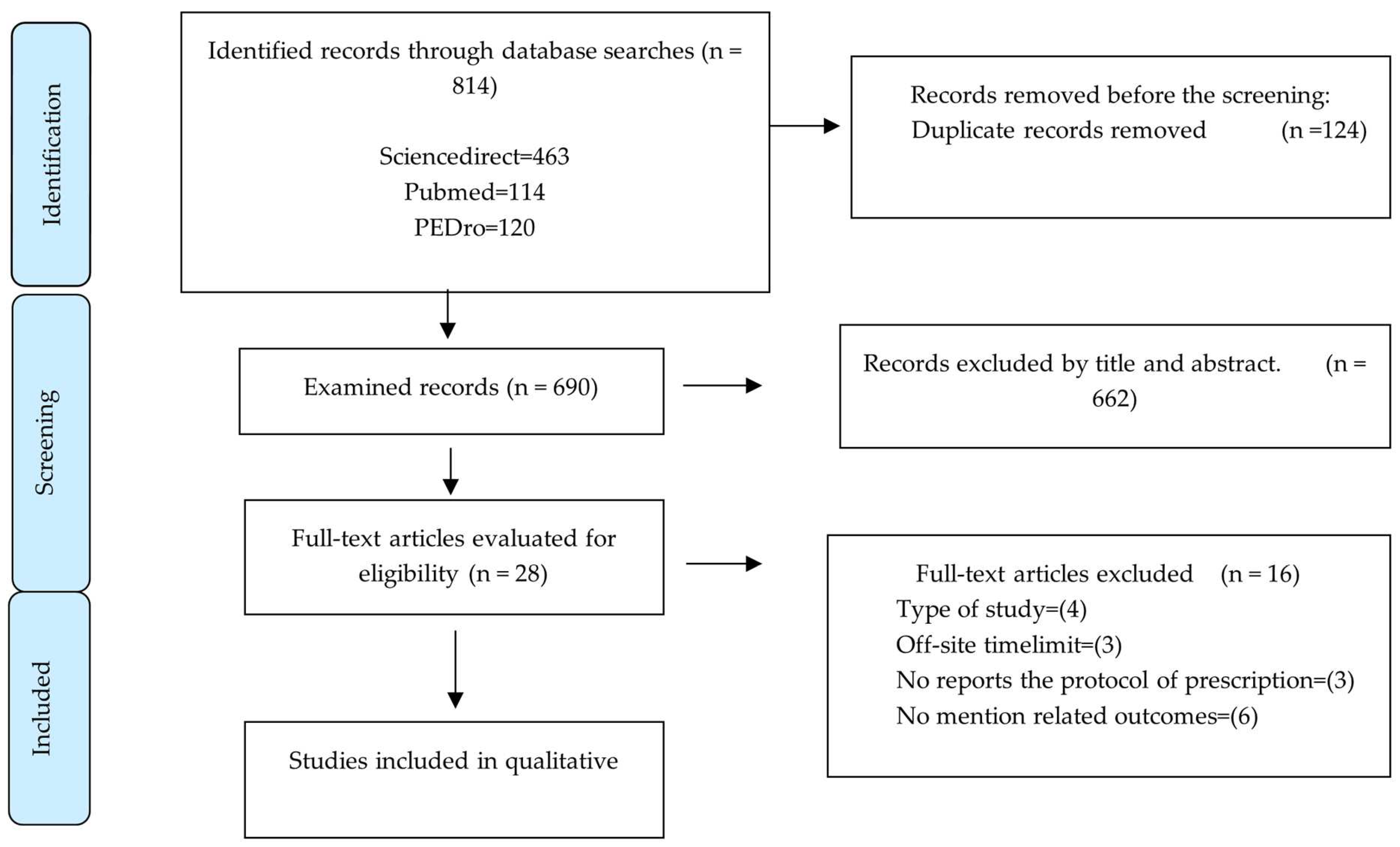
Table 1.
Participants, concept, and context model.
| P (Participants) | C (Concept) | C (Context) |
| Adults >18 who have just been subject to heart surgery |
Therapeutic exercise after heart surgery |
Intensive care unit |
Source: Drafted by authors.
Table 2.
Clinical and sociodemographic characteristics of the study populations.
| Authors Country/Year | Number of Participants | Sex | Age, years Mean-Sd |
Body Mass Index | Sedentarism | Hypertension | Dyslipidemia | Type of Surgery | Length of hospital Stay | Duration of Mechanical Ventilation |
|---|---|---|---|---|---|---|---|---|---|---|
| Ribeiro BC et al. [13] Brazil, (2021) | 48 | 34 men (70%). | 60 ± 8.3 | 20.5 | NR | 10 | 60% | CABG | 8 days ± 2 | 10 hours ± 4.8 |
| Gama Lordello et al. [15] Brazil, (2020) | 228 | 133 men (58%). | 57 | 26 | 49 % | 156 | 30% | CABG + HVS | 2 days | 5 hours |
| Shirvani et al. [15] Iran, (2020) | 92 | 74 men (82%). | 60 ± 8.72 | 26 | NR | 50 | NR | CABG | 6 days ± 1 | 10 hours ± 2.71 |
| Moreira et al. [16] Portugal, (2019) | 11 | 6 men (55%). | 54 | 30 | NR | 100 | 40 | CABG | NR | NR |
| Han et al. [17] China, (2022) | 46 | 35 men (76%). | 63.0 ± 8.7 | 24.4 | NR | 58 | 24 | CABG | 7 days ± 2 | 10 hours ± 3.6 |
| Cui et al. [18] China, (2020) | 239 | 188 men (78%). | 65.1 ± 4.6 | 25.8 | NR | 33 | 33 | MRV-WEC | 10 days ± 3 | NR |
| Esmealy et al. [19]. Iran, (2023) | 40 | 30 men (75%). | 60 | 26 | NR | 62& | 62 | CABG | NR | NR |
| Bano et al. [20] Pakistan, (2023) | 51 | 35 men (68%). | 55.62 ± 7.62 | 24.6 | NR | 80% | NR | CABG | 7 days | 9 hours |
| Allahbakhshian et al.[21]. Iran, (2023) | 40 | 30 men (75%). | 60.7 ± 4.4 | 26 | NR | 80% | NR | CABG | 7.7 ± 1 | 24 hours after surgery |
| Tsuchikawa et al.[22]. Japan, (2023) | 887 | 689 men (77%). | 68.6 ±9.1 | 23.7 | NR | NR | NR | CABG | 23.4 ± 18 days | 27.6 ± 86.0 hours |
| Kenji Nawa et al. [23] Brazil, (2022) | 44 | 28 men (63%). | 62.3 ± 10.8 | 26.7 | NR | 80% | 34 | CABG + HVS | 8 days | NR |
| Cordeiro et al. [24]. Brazil, (2022) | 55 | 31 men (56%). | 63 ± 9 | 25 | 24% | 56% | 36 | CABG | 8 ± 4 control group, 14 ± 5 intervention group | 6 ± 2 hours |
Abbreviations: CABG: coronary artery bypass grafting; HVS: heart valve surgery; MRV-WEC: myocardial revascularization without extracorporeal circulation; ICU: intensive care unit; NR: not reported. Age: mean ± standard deviation, Body Mass Index, average, sedentarism %. Hypertension % population or frequency(n), Dyslipidemia % population.
Disclaimer/Publisher’s Note: The statements, opinions and data contained in all publications are solely those of the individual author(s) and contributor(s) and not of MDPI and/or the editor(s). MDPI and/or the editor(s) disclaim responsibility for any injury to people or property resulting from any ideas, methods, instructions or products referred to in the content. |
© 2025 by the authors. Licensee MDPI, Basel, Switzerland. This article is an open access article distributed under the terms and conditions of the Creative Commons Attribution (CC BY) license (http://creativecommons.org/licenses/by/4.0/).
Copyright: This open access article is published under a Creative Commons CC BY 4.0 license, which permit the free download, distribution, and reuse, provided that the author and preprint are cited in any reuse.