

Submitted:
29 January 2025
Posted:
30 January 2025
You are already at the latest version
Abstract
In the Betic-Rif Cordilleras, recent works have evidenced the existence of well-developed Eocene (Ypresian-Bartonian) carbonate platforms rich in Larger Benthic Foraminifera (LBF). Contrarily to other sectors of the western Tethys, as the Pyrenean domain in the North Iberian Margin where these platforms started in the early Ypresian (Ilerdian), in the Betic-Rif chains the recorded Eocene platforms started in the late Ypresian (Cuisian) after a widespread gap of sedimentation covering Ilerdian time span. In this work the Aspe-Terreros Prebetic section (External Betic Zone) has been studied. An Eocene succession with gravity flow deposits consisting in terrigenous and bioclastic turbidites, as well as olistostromes with olistoliths, was detected. In one of these turbidites we have dated the middle Ilerdian based on LBF representing a vestige of a missing Illerdian carbonate platform. The microfacies of these turbidites and olistoliths rich in LBF have been described and documented in detail. The gap in the sedimentary record and absence of Ilerdian platforms in the Betic-Rif Cordillera have been related to the so called Eo-Alpine tectonics (Cretaceous to Paleogene) together with sea-level variations which developed contemporaneously to the establishment of shallow marine realms in the margins of the western Tethys due to the Eocene climatic warming.
Keywords:
Lost Ilerdian carbonate platforms
; Prebetic
; South Iberian Margin
; Eo-Alpine tectonics
; microfacies characterization
1. Introduction
In the Betic Cordillera (also in the Rif Chain), recent works [1,2,3,4,5,6] have evidenced the existence of well-developed Eocene carbonate platforms rich in Larger Benthic Foraminifera (LBF) and zooxantelate corals (z-corals) belonging to the meridional belt of platforms of the western Tethys. These platforms are usually dated as late Ypresian (Cuisian) to Lutetian or even reaching the Bartonian in few cases. In contrast to other sectors of the western Tethys, such as the Pyrenean domain in the North Iberian Margin (northern belt of platforms) where these platforms are recorded since the early Ypresian (Ilerdian), in the Betic-Rif chains the Eocene platforms started in the late Ypresian (Cuisian), corresponding the Ilerdian time span with an extended unconformity. The entire Eocene has been only registered in deep marine succession [6,7,8]. In this work, the Aspe-Terreros Prebetic section (External Betic Zone) in the Alicante province (SE, Spain) is studied in detail. This section shows a slope to deep basin sedimentary succession with gravity flow deposits interbedded. In its lower part, terrigenous and bioclastic turbidites and olistostrome deposits containing carbonate platform olistoliths were detected. The entire succession as well as the olistoliths have been dated with planktonic foraminifera and LBF. The microfacies of these olistoliths rich in LBF have been described and documented in detail. As it will be presented below, the ages obtained on the basis of LBF from turbidites indicate an unknown time interval both for the platform successions of the Betic Cordillera and of Rif Chain. These findings have important implications for the evolution of the westernmost Tethys domains during the Eocene.
2. Geological Framework
The Betic Cordillera (Figure 1A) is divided in a classic way into Internal and External Zones, with the Maghrebian Flysch Basin Units in between [7]. This cordillera belongs to the westernmost Mediterranean Alpine Belts (Figure 1B). The External Zone, the goal of this work, is in turn divided into the shallow marine Prebetic, stratigraphically continuous with the northern foreland (Iberian Meseta), and the pelagic Subbetic (southward from the Prebetic). These units have the status of tectono-paleogeographic domains and correspond to the South Iberian Margin (Figure 1B). In turn, both domains are also subdivided into several sub-domains. In the case of the Prebetic, it is divided from north to south, in the External Prebetic (shallower) and the Internal Prebetic (deeper). All the South Iberian Margin domains consist in Triassic to Cenozoic sedimentary rocks that were progressively structured during the Middle-Late Miocene, from south to north, as a nappe stack [8]. Several works have been performed in the last decades in the Cenozoic succession of the Prebetics [9,10,11,12,13,14,15,16,17,18,19,20,21,22,23,24,25,26,27] distinguishing two different sedimentation areas: one related to a shallow marine nummulite platform to the NW and a deeper one with mass flow deposits (turbidites, olistoliths and olistostromes) related to an active Paleogene tectonics [27,28]. The Paleogene stratigraphy of Prebetics was well defined by Guerrera et al. [28] who distinguished the shallow Eocene nummulite platforms in the anticlines (Miñano Fm) from deeper turbiditic sedimentation areas in the synclines (Pinoso-Rasa Fm). Recently, in a broad study of the whole Paleocene-Eocene Prebetic succession from the whole Betic Cordillera [6], there were defined three informal stratigraphic formations with diachronic boundaries among them: (1) the Paleocene to middle Lutetian lower marly-clayey fm; (2) the Cuisian to Lower Bartonian intermediate limestone-calcarenite fm; and (3) the Lutetian to Priabonian upper marly-clayey fm. For this work the Aspe-Terreros section, studied in the above-mentioned paper [6], has been revisited. This section belongs to the Internal Prebetic and is characterized by a marly deep succession rich in gravity flow deposits with resedimented material from carbonate Eocene platforms.
3. Materials and Methods
The methods used in this study are:
(1) Field analyses, including the logging and extensive sampling for microfacies analysis and for biostratigraphic studies (18 samples) of the Aspe-Terreros stratigraphic section. For the construction of a geological map, an aerial photo was performed by own drone flights (DJI air 2s) using the software dronelink. 263 photos in an area of 0.300 km2 were taken for a complete study area.
(2) Laboratory analyses concerning microfacies, biostratigraphy, and bio-chronostratigraphy based on planktonic foraminifera, calcareous nannoplankton, and LBF.
(3) Cabinet works where the data obtained were processed to elaborate our interpretations and conclusions. The photo sets obtained during the drone flights were processed with WebODM software, obtaining 260 aligned pictures used to build a 3D model for an area of about 0.3145 km2, 1,177,191 tie points, a dense point cloud of 24,805,637 points and an average Ground Sampling Distance (GSD) of 2.2 cm of resolution. The orthophotography obtained has a size of 15009 x 14425 pixels. For the Eocene biostratigraphy, the following zonations were used: (1) for planktonic formanifera [29,30,31]; (2) for LBF the Shallow Benthic Zones (SBZ) [32,33]; and (3) for calcareous nannoplankton [34].
4. Results
4.1. Lithostratigraphy of the Aspe-Terreros Section
The sedimentary succession in Aspe-Terreros is discontinuosly exposed around 150 m. It consists mainly of fine deposits, belonging to the lower and upper clayey-marly fms [6] deposited after a regional unconformity over the Upper Cretaceous Capas Blancas Fm [27,28]. In the measured section we could distinguish three different intervals belonging to the Eocene (Figure 2).
The first interval (12 m exposed) is characterized by thick units of sandstones and rudstones occurring on a poorly exposed greenish-grey mudstone background (Figure 2B-C). The sandstone unit (> 3 m thick) is made of several decimeters thick beds, with sharp lower bounding surfaces, either unstructured (with mudstone intraclasts) or having different internal structures, such as: tabular sets (cm thick) of crossed laminae, parallel laminae or convolute lamination with overturned sharp antiforms and rounded sinforms. In between the sandstone beds there were probably thin mudstone interlayers which are not preserved. The rudstone unit (ca 3 m thick) is normal graded from bioclastic rudstone to bioclastic calcarenites. Its lower bounding surface has load casts. A rough bedding can be distringuished. The bioclasts are mostly nummulitids, the biggest of them being imbricated. A sample (EP80a) was taken from the looser portion for biostratigraphic analysis and one (EP80b) for microfacies analysis (Figure 3).
The second interval (ca 30 m thick) consists of soft light grey marls with interlayers of competent dms thick marls/calcarenites (Figure 2B-C and B-E). Olistoliths of different sizes (from several decimeters to several m diameter) occur in the entire interval. Some of the competent marl beds are dismembered or contorted. Where recognizable, the disrupted bedding in this interval is different from the one of first interval and also from that of the third interval. The contact between first and second interval is sharp and the olistolits occur from 1 m upward. Both soft and coherent beds and the biggest olistolith were sampled (EP 81, 82 and 85 from fine material, EP84 from the olistolith). The coherent beds show a rough lamination and can contain nummulitids and big clasts of whitish marls, but mostly they are marls.
The third interval (ca 100 m) consist mainly in greenish-grey mudstone with some interlayers of bioclastic sandstones and rudstones with variable thickness (few cms to 60 cms) which can be followed tens of meters along the outcrop (Figure 2B-C, 3F-H). From such bioclastic units samples EP86 (thin unit) and EP93 (thickest unit) were taken for microfacies analysis. The bioclastic beds have sharp erosive lower bounding surface, the thickest bed having also loadcasts. Some interlayers of light reddish mudstone or green laminated mudstones can be observed. The mudstone were sampled (EP87-89, EP92 and EP 97 for planktonics; EP90, EP94-EP96 are collections of nummulites and alveolines).
4.2. Age of the Sedimentary Succession
Two kind of ages have been obtained in the section: (1) the age of the autochthonous deposits and the matrix of the gravity flows dated with planktonic foraminifera and calcareous nannoplankton, and (2) the age of the resedimented material making part of the olistoliths and the bioclastic turbidites dated with LBF. The age of the entire studied stratigraphic section is early-middle Lutetian to early Bartonian (Figure 4). The lowermost dated levels of the olistostrome matrix (supposed autochthonous sedimentation) in the section correspond with the samples EP81 to EP82 in the second interval of the section. In these samples the E8-E9 zones (early-middle Lutetian) have been dated by the presence of Acarinina bullbrooki, A. cuneicamerata, Morozovella aragonensis, and Morozovelloides crassatus. Also, calcareous nannoplankton has been found in these levels (Reticulonenestra umbilica, Ericsonia formosa, Chismolithus gigas) dating the Lutetian without more precision. In the third interval of the section (samples EP85 to EP89), the E9 zone (middle Lutetian) is dated by the presence of A. bullbrooki, Acarinina praetopilensis (some specimens close to Acarinina topilensis), M. aragonensis, M. crassatus, Morozovelloides coronatus, together with Subbotina eocaena and Subbotina corpulenta. Above, towards the upper part of the section (sample EP92) the E10 zone (late Lutetian) is dated based on the presence of abundant forms of Acarinina and Morozovelloides, but absence of Morozovella ones as that of the M. aragonensis group. The final part of the section (sample EP97) yields Subbotina gortani, Turborotalia pomeroli, Turborotalia cerroazulensis and the persistence of Morozovelloides, so characterizing the E11 zone of the Lutetian-Bartonian transition. The upper part of the section (EP97) is also dated with calcareous nannoplankton as NP16 zone (Lutetian-Bartonian transition) by the presence of Ericsonia formosa, Reticulofenestra umbilica, and Chiasmolithus grandis.
Both the age of olistoliths in the olistostrome and the bioclastic turbidites of the third interval are Cuisian. Not the same age is dated for the bioclastic turbidite in the first interval which provided an Ilerdian assemblage. In detail, sample EP80a is dated SBZ8 (late middle Ilerdian) by the presence of Nummulites spirectypus, N. exilis, N. atacicus, N. globulus laxiformis, Assilina canalifera, and As. ammonea ammonea (Figure 5). From sample EP80b to EP96 several SBZ11 (middle Cuisian) associations are found in the samples: EP80b (N. cf. cantabricus, N. cf. praelaevigatus/ N. aff. manfredi, Assilina placentula, As. marinellii, and Alveolina cosigena cosigena), EP84 (Ornatorotalia? granum, Granorotalia sublobata, Rotalia aff. trochidiformis, and Gyroidinella levis), EP86 (Ornatorotalia granum), EP93 (N. cf. cantabricus, A. karreri / As. aff. parva, As. marinellii, Cuvillerina cf. vallensis, and Ornatorotalia granum), EP95 (Nummulites pavloveci, N. pustulosus, N. burdigalensis pergranulatus, N. escheri, N. irregularis, N. aff. formosus, N. cf. distans, Assilina placentula, As. laxispira, As. escheri, and As. marinellii) and EP96 (Nummulites pavloveci, N. pustulosus, N. burdigalensis pergranulatus, N. irregularis, N. aff. formosus, N. distans, Assilina placentula, As. escheri, and As. marinellii).
4.3. Microfacies Description
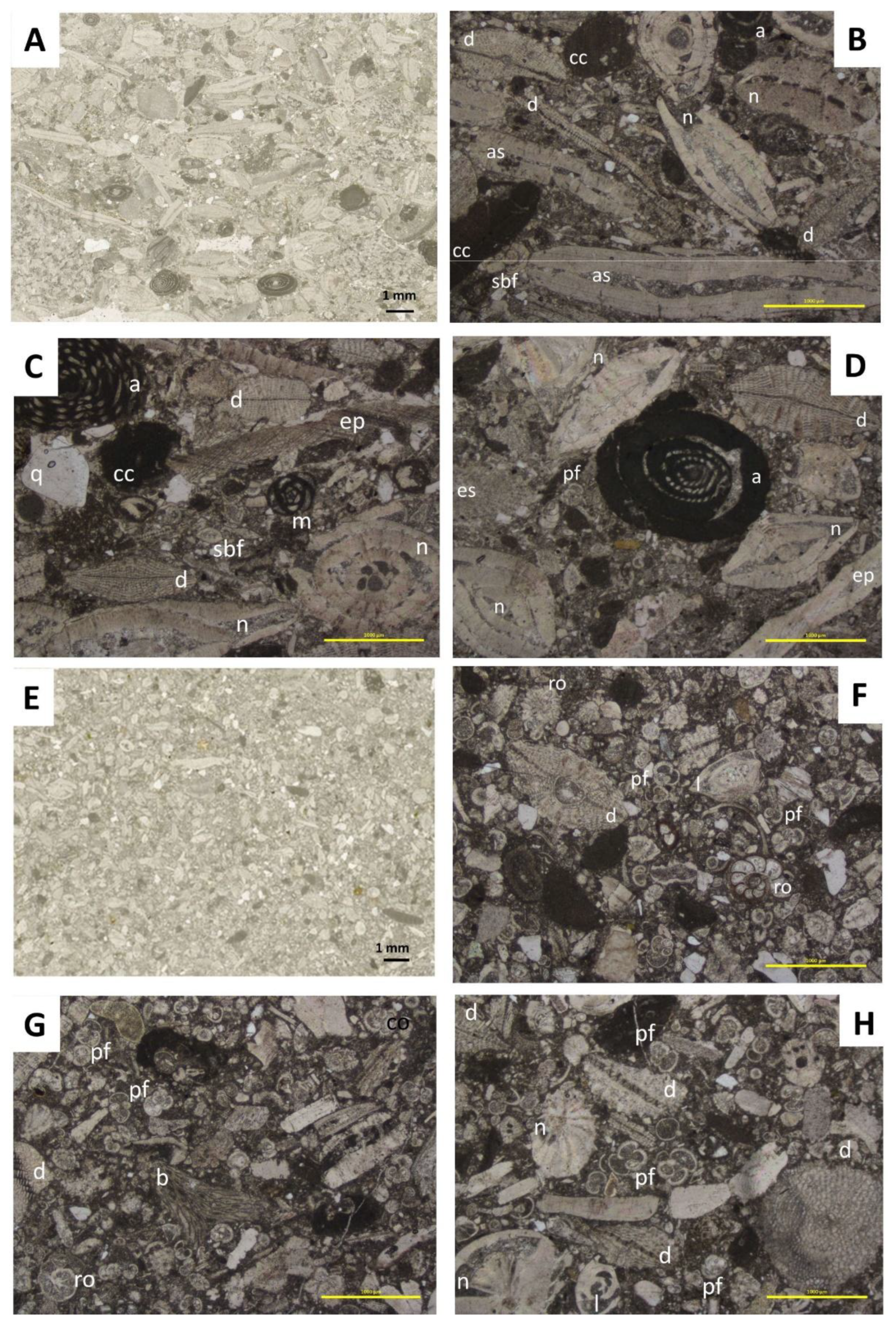
Two main microfacies (Mf1 and Mf2) indicating mid (EP80) and outer ramp/upper slope (EP84) sources (Ilerdian to Cuisian in age) for the bioclastic turbidites and olistoliths have been recognized in the first and second intervals of the studied section (Figure 6).
Microfacies 1 (Mf1) is made of packstone-grainstone of LBF reoriented tests (EP80). This microfacies has been observed in the lowermost part of the Aspe-Terreros section in the base of a bioclastic turbidite. It is a moderate to well sorted facies and presents a compact texture made up of abundant planar tests of mainly hyaline LBF but also some ones of porcelaneous wall. The LBF association is made up of Discocyclina (25-30%), flat Nummulites (15-25%), Assilina and operculiniform Assilina (10-15%), Alveolina (5-10%), and Orbitolites (5%). Other elements as rotaliids (5-10%), fragmentary remains of echinoids (5-10%) and crustose coralline algae (5%) can be common. Occasionally, scarce annelids (Dytrupa, 2-3%), planktic foraminifera (2-3%), miliolids (2-3%), textulariids (2-3%), and other unspecified small benthic foraminifera (1-2%) can be recognized. Frequently, small angular quartz grains are also observed (3-5%). The good selection of tests by size and reorientation of the biggest is consistent with reworking by unidirectional currents in deeper sedimentary environments (turbidite currents). The conspicuous presence of quartz grains allows to recognize an energetic event that affected the platform, and the low presence of planktic foraminifera suggests that the source of bioclasts was a mid-ramp sedimentary environment. In general, hyaline tests with a flattened morphology (flat Nummulites, Assilina, operculiniform Assilina, and flattened Discocyclina) predominate although the prevalence of porcellaneous elements is also observed locally. As flattened-test LBFs thrive in deeper conditions [35,36,37,38,39], it would indicate reworked material was supplied from deeper areas of the mid ramp [2,3,40,41].
Microfacies 2 (Mf2) is made of planktic foraminiferal-rich bioclastic packstone (EP 84). This microfacies has been described based on a sample taken from the biggest olistolith in the olistostrome. It is a well sorted facies constituted by fine grained sediment mainly composed by planktic (15%) and small benthic foraminifera (15%), rotaliids (10-15%), echinoid plates and spines (5%), fragmentary remains of crustose coralline algae (5%), vinculariform bryozoans (5%), and hyaline LBF tests mainly of Discocyclina (5-10%), Assilina and operculiniform Assilina (5%), Amphistegina (5%), Nummulites (5%), some agglutinated ones as textulariids (2-5%), and porcelaneous as Alveolina (2-3%). Small angular quartz grains can be also common (5-10%). The well-sorted fabric, without muddy matrix, dominated by reoriented planktic foraminifera and fragmentary remains of hyaline LBF tests (mainly of Discocyclina and Amphistegina) in reworked levels. These flat LBF tests are usually developed in low luminosity habitats in the outer ramp or upper slope environments [2,3,35,36,37,38,39]
5. Discussion
The above mentioned features of sandstone beds in the first interval of the section indicate sedimentation by high to low density turbidity currents. Turbidity current is also the process of bioclastic unit sedimentation, except the transported and sedimented material consists mainly in nummulitids. The thickness of both units, as well as the amalgamated character of the sandstone units suggest a proximal sedimentation area in the turbiditic system. The second interval containing dismembered beds and olistoliths as well as their ”discordant” position in relation both with first and third interval indicate that the entire unit is a big olistostrome with olistoliths sedimented by gravity slumping of not entirely consolidated deposits of upper slope/outer ramp. The third interval shows bioclastic turbidites sedimented on a muddy slope. The small thickness of most turbidite beds suggest a distal sedimentation area in the turbidite system. The entire section has a deepening upward trend.
In the entire section, LBFs in the bioclastic turbidites and olistoliths indicate resedimented material with ages between SBZ8 and SBZ11 (late middle Ilerdian to middle Cuisian). Sample EP80a from the bioclastic turbidite of the first interval provided a late middle Ilerdian age. The Ilerdian is an interval usually missing in the Betic Cordillera, in particular in carbonate platform deposits [1,2,3,4,5,6]. In the Internal Rif there is a paper which also described de presence of Ilerdian resedimented material into a Cuisian platform level [42]. Recently, the widespread absence of Ilerdian platforms in these domains has been attributed to early Paleogene tectonics and/or a sea-level fall with erosion [1,2,3,4,5,6,27,28], causing the subaerial exposure of platforms, followed by erosion and unconformity development before the Cuisian transgression and sedimentation resuming. Therefore, the sampled resedimented material may be one of the few known vestige of a destroyed older (Ilerdian) carbonate platform.
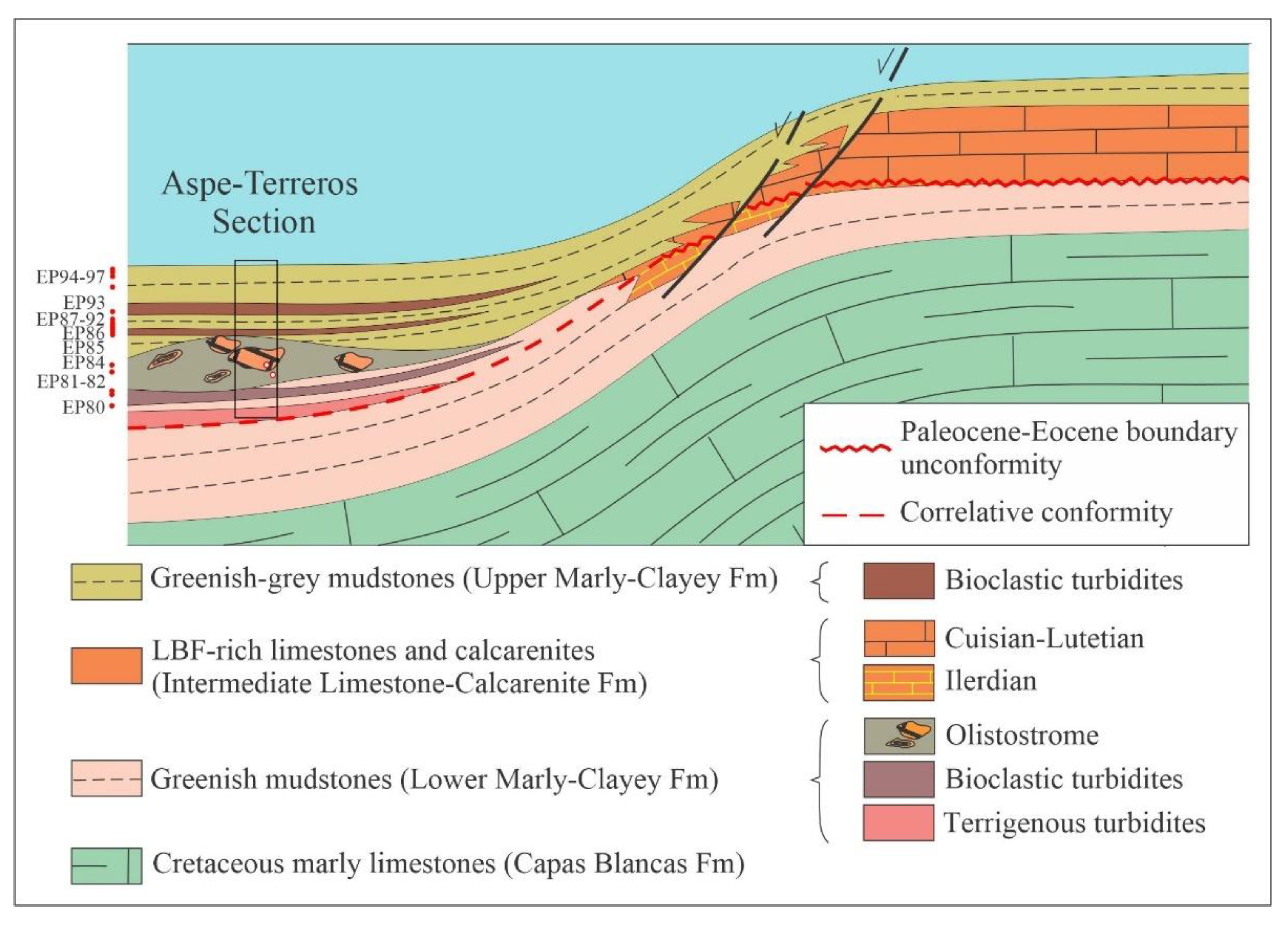
All the mentioned data and results integrated with data from literature in the region [6,25,26,27,28] allowed us to propose a scenario (Figure 7) for the way the Aspe-Terreros sedimentary succession was recorded. The background sedimentation of the area is recognized in the first and third intervals, which both indicate a muddy slope sporadically crossed by turbidity currents. The turbidity currents were supplied by different sources: one terrigenous, recognized in the lowermost part of the section, the other bioclastic. The terrigenous source (derived from the Iberian Meseta) was active in early Ypresian - early Lutetian. The interval containing these turbidite supplies was defined as the thicker Pinoso-Rasa Fm in the close westward Murcia region [28] and, recently, part of the lower marly-clayey fm in the Alicante area [6]. The novelty here is the source which supplied the bioclasts resedimented in the turbidite which were proved to be derived from an Ilerdian platform rich in LBF, which does not longer exists in any studied area of the Betic-Rif Cordilleras. As mentioned above, the Ilerdian is materialized by an unconformity covering the Paleocene-Eocene boundary time-span in the Betic-Rif platform domains, but the fossil assemblage in the sampled turbidite bed (EP80a) shows that it once supplied the deeper depositional environment. As the microfacies Mf1 indicates, the material was supplied from the mid ramp. The olistostrome ”matrix” was dated based on planktonics as lower-middle Lutetian (EP81-85), but it contains olistoliths of different age resedimented from a Cuisian outer ramp/upper slope. This Cuisian platform must have been different (or formed later) from the Ilerdian one according to the microfacies analyses presented above. The olistostrome could be the result of upper slope slumping caused rather by source platform uplifting contemporary with subsidence in the sedimentation area of Aspe-Terreros Section due to faults actuation and related to the Paleogene tectonic (Eo-Alpine phase [43]). The argument to support this proposed situation is that after the sedimentation of olistostrome, the muddy slope restored while the basin deepness increased.
6. Conclusions
The Eocene Aspe-Terreros section belonging to the Internal Prebetic in Southern Spain was studied. Three stratigraphic intervals were recognized characterized by upper slope/externalmost platform fine deposits with abundant gravity flows (even an olistostrome) and belonging to the lower and upper clayey-marly fms defined in the area.
The matrix of the gravity flows and the autochthonous sedimentation was dated with planktonic foraminifera and calcareous nannoplankton as early-middle Lutetian (E8 zone) to Lutetian-Bartonian tansition (E11 and NP16 zones). The age of the resedimented material making part of the olistoliths and the bioclastic turbidites dated with LBF provided a late middle Ilerdian (SBZ8) age for the first interval, and a middle Cuisian (SBZ11) for the other two intervals.
Two main microfacies (Mf1 and Mf2) were proposed for the bioclastic turbidites and olistoliths recognized in the first and second intervals. Mf1 indicate a source area from a mid ramp sedimentary environment for the Ilerdian material, while Mf2 is representative of the outer ramp/upper slope for the Cuisian one.
All the presented data integrated with data from literature in the region allowed us to propose a scenario for Eocene deposits in the Prebetic. The background sedimentation of the area is recognized in the first and third intervals, which both indicate a muddy slope sporadically crossed by turbidity currents supplied by different sources: one terrigenous, recognized in the lowermost part of section, the other bioclastic. The terrigenous source (derived from the Iberian Meseta) was mainly active in early Ypresian - early Lutetian.
The important novelty is the source which supplied the bioclasts resedimented in the turbidite which were proved to be derived from an Ilerdian platform rich in LBF, which does not longer exist in any studied platform section in the Betic-Rif Cordilleras since the Ilerdian is always materialized by a Paleocene-Eocene boundary unconformity in the Betic platform domains. Nevertheless, the fossil assemblage in a sampled turbidite bed of the lower interval shows that it once supplied the deeper depositional environment.
The Prebetic Ilerdian and Cuisian platforms should to be different considering the studied microfacies, and separated by a main unconformity. The Ilerdian ramp is not preserved in the exposed platforms domains of the External Prebetic.
The gravity flow deposits and the above-mentioned unconformity could be the result of upper slope slumping caused rather by source platform uplifting contemporary with subsidence due to faults actuation and related to the Paleogene tectonic (Eo-Alpine phase). After the sedimentation of the olistostrome (second interval) the muddy slope restored while the basin deepness increased indicating a relaxation in the tectonic activity.
Author Contributions
Conceptualization, J.T., M.M-M., C.M. and J.E.T-M.; methodology, all authors; investigation, all authors; data curation, J.T., M.M-M. and C.M.; writing—original draft preparation, J.T., M.M-M., C.M. and F.S.; writing—review and editing, J.T., M.M-M., C.M., J.E.T-M. and F.S.; funding acquisition, M.M-M.. All authors have read and agreed to the published version of the manuscript.
Funding
This research was funded by the Spanish Ministry of Science and Innovation, research project number PID2020-114381GB-I00, and the Research Projects of the Generalitat Valenciana number GVA-THINKINAZUL/2021/039.
Data Availability Statement
Data will be available as request.
Acknowledgments
The revision performed by two anonymous reviewers is greatly acknowledged.
Conflicts of Interest
The authors declare no conflicts of interest
References
- Martín-Martín, M.; Guerrera, F.; Tosquella, J.; Tramontana, M. Paleocene-Lower Eocene carbonate platforms of westernmost Tethys. Sedimentary Geology 2020, 404, 105674. [Google Scholar] [CrossRef]
- Martín-Martín, M.; Guerrera, F.; Tosquella, J.; Tramontana, M. Middle Eocene carbonate platforms of the westernmost Tethys. Sedimentary Geology 2021, 415, 105861. [Google Scholar] [CrossRef]
- Tosquella, J.; Martín-Martín, M.; Guerrera, F.; Serrano, F.; Tramontana, M. The Eocene carbonate platform of the central-western Malaguides (Internal Betic Zone, S Spain) and its meaning for the Cenozoic paleogeography of the westermost Tethys. Palaeogeography, Palaeoclimatology, Palaeoecology 2022, 589, 110840. [Google Scholar] [CrossRef]
- Martín-Martín, M.; Tosquella, J.; Guerrera, F.; Maaté, A.; Hlila, R.; Maaté, S.; Tramontana, M.; Le Breton, E. The Eocene carbonate platforms of the Ghomaride Domain (Internal Rif Zone, N Morocco): A segment of the westernmost Tethys. Sedimentary Geology 2023, 452, 106423. [Google Scholar] [CrossRef]
- Martín-Martín, M.; Tosquella, J.; Guerrera, F.; Maaté, A.; Martín-Algarra, A. The Eocene carbonate platforms of the westernmost Tethys: a review. International Geology Review 2024, 1–33. [Google Scholar] [CrossRef]
- Martín-Martín, M.; Miclaus, C.; Tent-Manclús, J.E.; Tosquella, J.; Serrano, F.; Samsó, J.M.; Martín-Pérez, J.A. Paleocene-Eocene evolution of the Prebetics (South Iberian Margin, South Spain) and comparison with other western Tethyan margins. Marine and Petroleum Geology 2025, 107300. [Google Scholar] [CrossRef]
- Vera, J. A. Geología de España. Sociedad Geológica de España; Instituto Geológico y Minero de España, Madrid 2004, pp. 884.
- Vera, J.A. El Terciario de la Cordillera Bética: estado actual de conocimientos. Revista de la Sociedad Geológica de España 2000, 12(2), 345-373.
- Azéma, J. Sur l’existence d’une zone intermédiaire entre Prébétique et Subbétique dans les provinces d’Alicante et de Murcie (Espagne). Comptes Rendus de l’Académiedes Sciences 1966, 260, 4020–4023. [Google Scholar]
- Azéma, J. Géologie des confins des provinces d’Alicante et de Murcia (Espagne). Bulletin Societé Géologique de France 1966, 8(7), 80-86.
- Azéma, J. Étude géologique des zones externes des Cordillères bétiques aux confins des provinces d’Alicante et de Murcie (Espagne). Doctoral dissertation, Université Pierre et Marie Curie, 1977, pp. 396.
- Dabrio, C.J. Geología del Sector del Alto Segura. Tesis Doctoral, Univ. de Granada 1972, 2 vol, pp. 388.
- Jérez-Mir L. Geología de la Zona Prebética en la Transversal Elche de la Sierra y sectores adyacentes (provincias de Albacete y Murcia). Tesis Universidad de Granada 1973, pp. 750.
- Álvarez-Suárez, R.M.; Dabrio, C.J. Análisis e interpretación sedimentaria de la Formación de Nablanca (Eoceno, Zona Prebética). Estudios geológicos 1974, 619-629.
- Rodríguez-Estrella, T. Síntesis geológica del Prebético de la provincia de Alicante. I y II. Boletín Geológico y Minero de España, Instituto Geológico y Minero de España (IGME) 1977, LXXXVIII-III, 183-214.
- Rodríguez-Estrella, T. Geología e hidrogeología del sector de Alcaraz-Liétor-Yeste (provincia de Albacete). Colecciones y Memorias del Instituto Geológico y Minero de España (IGME) 1979, 278, 290. [Google Scholar]
- García-Hernandez, M. El Jurasico terminal y el Cretacico inferior en las Sierras de Cazorla y Segura (Zona Prebetica). Ph. Thesis Univ. Granada 1978, pp. 344.
- Geel, T.; Roep, T.B.; van Hinte, J.E.; Vail, P.R. Eocene tectono-sedimentary patterns in the Alicante region (Southern Spain). In: Hardenbol. J., Thierry, J., Farley, J., Jacquin, T., De Graciansky, P.-C., Vail, P. R. (Eds.) Mesozoic and Cenozoic Sequence Stratigraphy of European Basins, SEPM Special Publication 1998, 60, pp. 289-302.
- Geel, T. Recognition of stratigraphic sequences in carbonate platform and slope deposits: empirical models based on microfacies analysis of Palaeogene deposits in southeastern Spain. Palaeogeography, Palaeoclimatology, Palaeoecology 2000, 155(3-4), 211-238. [CrossRef]
- Tent-Manclus, J.E. La estructura y estratigrafía de las sierras de Crevillente, Abanilla y Algayat: su relación con la falla de Crevillente. PhD Thesis, Universidad de Alicante 2003, pp. 1008. http://hdl.handle.net/10045/10414.
- Chacón, B.; Martín-Chivelet, J. Subdivisión litoestratigráfica de las series hemipelágicas de edad Coniaciense-Thanetiense en el Prebético oriental (SE, España). Revista de la Sociedad Geológica de España 2005, 18(1-2), 3-20.
- Pujalte, V.; Orue Etxebarria, X.; Apellaniz, E.; Baceta, J.I.; Payros, A.; Robador, A.; Tosquella, J. La Fm Puerto de La Losa (N de Granada, E de Jaén): una nueva unidad estratigráfica, paleogeográficamente significativa, del Paleógeno Inferior Prebético. Geogageta 2010, 48, 47–50. [Google Scholar]
- Martín-Martín, M.; Estévez, A.; Martín-Rojas, I.; Guerrera, F.; Alcalá, F.J.; Serrano, F.; Tramontana, M. The Agost Basin (Betic Cordillera, Alicante province, Spain): A pull-apart basin involving salt tectonics. International Journal of Earth Sciences 2018, 107, 655–671. [Google Scholar] [CrossRef]
- Martín-Martín, M.; Guerrera, F.; Alcalá, F. J.; Serrano, F.; Tramontana, M. Source areas evolution in the Neogene Agost Basin (Betic Cordillera): Implications for regional reconstructions. Italian Journal of Geosciences 2018, 137(3), 433–45. [Google Scholar] [CrossRef]
- Martín-Chivelet, J., Chacón, B. Event stratigraphy of the upper Cretaceous to lower Eocene hemipelagic sequences of the Prebetic Zone (SE Spain): Record of the onset of tectonic convergence in a passive continental margin. Sediment. Geol. 2007, 197, 141–163.
- Guerrera, F.; Martín-Martín, M. Geodynamic events reconstructed in the Betic, Maghrebian, and Apennine chains (central-western Tethys). Bulletin de la Société géologique de France 2014, 185(5), 329 341. Bulletin de la Société géologique de France. [CrossRef]
- Guerrera, F.; Estévez, A.; López-Arcos, M.; Martín-Martín, M.; Martín-Pérez, J.A.; Serrano, F. Paleogene tectono-sedimentary evolution of the Alicante Trough (External Betic Zone, SE Spain) and its bearing on the timing of the deformation of the South-Iberian Margin. Geodinamica Acta 2006, 19(2), 87–101. [Google Scholar] [CrossRef]
- Guerrera, F.; Mancheño, M. A.; Martín-Martín, M.; Raffaelli, G.; Rodríguez-Estrella, T.; Serrano, F. Paleogene evolution of the external betic zone and geodynamic implications. Geologica Acta 2014, 12, 171–192. [Google Scholar] [CrossRef]
- Olsson, R. K.; Berggren, W. A.; Hemleben, C.; Huber, B. T. Atlas of Paleocene planktonic foraminifera. Smithsonian Contributions to Paleobiology 1999, 85, pp. 252. [CrossRef]
- Pearson, P. N.; Olsson, R. K.; Huber, B. T.; Hemleben, C.; Berggren, W. A. Atlas of Eocene Planktonic Foraminifera. Cushman Foundation for Foraminiferal Research, Special Publication 2006, 41, pp. 514, Allen, Lawrence, Kans. ISBN 9781970168365$50.
- Wade, B.S.; Pearson, P.N.; Berggren, W.A.; Pälike, H. Review and revision of Cenozoic tropical planktonic foraminiferal biostratigraphy and calibration to the geomagnetic polarity and astronomical time scale. Earth-Science Reviews 2011, 104, 11–142. [Google Scholar] [CrossRef]
- Serra-Kiel, J.; Hottinger, L.; Caus, E.; Drobne, K.; Ferràndez, C.; Jauhri, A.K.; Less, G.; Pavlovec, R.; Pignatti, J.; Samsó, J.M.; Schaub, H.; Sirel, E.; Strougo, A.; Tambareau, Y.; Tosquella, J.; Zakrevskaya, E. Larger foraminiferal biostratigraphy of the Tethyan Paleocene and Eocene. Bulletin de la Societé Géologique de France 1998, 169, 281–299. [Google Scholar]
- Serra-Kiel, J.; Martín-Martín, M.; El Mamoune, B.; Martin-Algarra, A.; Martin-Perez, J.A.; Tosquella, J.; Ferrandez-Canadell, C.; Serrano, F, Biostratigraphy and lithostratigraphy of the Paleogene of the Sierra Espuna area (oriental Betic Cordillera, SE Spain); Geologica Acta 1998, 32, 1–3, 161–189.
- Martini, E. Standard Tertiary and Quaternary calcareous nannoplankton zonation. In: Farinacci, A. (Ed.), Proceedings of the 2nd Planktonic Conference, Rome 1970. Tecnoscienza 1971, 739-785.
- Hallock, P., Glenn, E.C. Larger foraminifera: a tool for paleoenvironmental analysis of Cenozoic carbonate depositional facies. Palaios 1986, 1, 55–64.
- Buxton, M.W.N., Pedley, H.M. Short Paper: a standardized model for Tethyan Tertiary carbonate ramps. J. Geol. Soc. Lond. 1989, 146, 746–748.
- Burchette, T.P.; Wright, V. P, Carbonate ramp depositional systems; Sedimentary Geology 1992, 79, 1–4, p. 3–57. [CrossRef]
- Hottinger, L, Shallow benthic foraminiferal assemblages as signals for depth of their deposition and their limitations. Bullettin de la Societe Geologique de France 1997, 168, 4, 491 505.
- Gebhardt, H., Coric, S., Darga, R., Briguglio, A., Schenk, B., Werner, W., Andersen, N., Sames, B. Middle to late Eocene paleoenvironmental changes in a marine transgressive sequence from the northern Tethyan margin (Adelholzen, Germany). Austrian Journal of Earth Sciences, 2013, 106, 45-72.
- Mateu-Vicens, G.; Pomar, L.; Ferrandez-Canadell, C. Nummulitic banks in the upper Lutetian ‘Buil level’, Ainsa Basin, South Central Pyrenean Zone: The impact of internal waves; Sedimentology 2012, 59, 2, 527–552. [CrossRef]
- Pomar, L.; Baceta, J.I.; Hallock, P.; Mateu-Vicens, G.; Basso, D. Reef building and carbonate production modes in the west-central Tethys during the Cenozoic. Marine and Petroleum Geology 2017, 83, 261–304. [Google Scholar] [CrossRef]
- Hlila, R.; Maaté, A.; Sanz de Galdeano, C.; Serra-Kiel, J.; Serrano, F.; El Kadiri, Kh. La serie paleógena de la unidad superior del Gomáride en Talembote (Rif Interno, Marruecos). Geogaceta 2007, 43, 91–94. [Google Scholar]
- Guerrera, F.; Martín-Martín, M.; Tramontana, M. Evolutionary geological models of the central-western peri-Mediterranean chains: a review. International Geology Review 2021, 63(1), 65–86. [Google Scholar] [CrossRef]
Figure 1.
(A) geological map of the Betic Cordillera (after [7]). showing the locations of the Aspe-Terreros Section; (B) Alpine Chain map of the western-central Mediterranean area (modified from [5]).
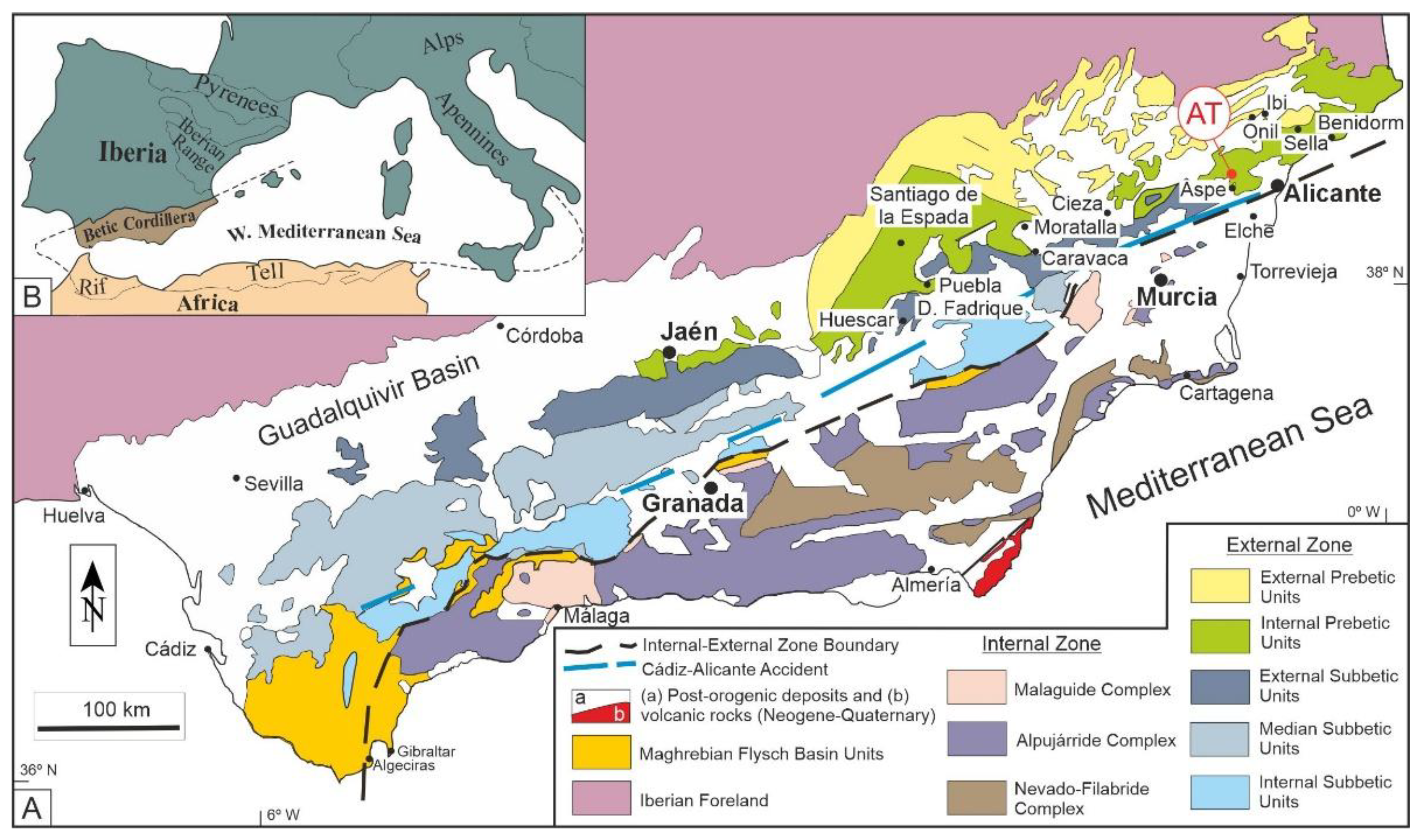
Figure 2.
(A) Geological map of the Aspe-Terreros area superimposed onto the aerial picture obtained by drone, showing the three main differentiated intervals (with location of the measured section and the taken samples); (B) Stratigraphic column of the Aspe-Terreros area showing the three main differentiated intervals, sedimentologic characteristics and sample locations; (C) Aerial picture of the Aspe-Terreros studied section obtained by drone. In (A), (B) and (C) dotted blue lines contour the second interval (olistostrome), while dotted white lines in the second interval contour the olistoliths.
Figure 2.
(A) Geological map of the Aspe-Terreros area superimposed onto the aerial picture obtained by drone, showing the three main differentiated intervals (with location of the measured section and the taken samples); (B) Stratigraphic column of the Aspe-Terreros area showing the three main differentiated intervals, sedimentologic characteristics and sample locations; (C) Aerial picture of the Aspe-Terreros studied section obtained by drone. In (A), (B) and (C) dotted blue lines contour the second interval (olistostrome), while dotted white lines in the second interval contour the olistoliths.
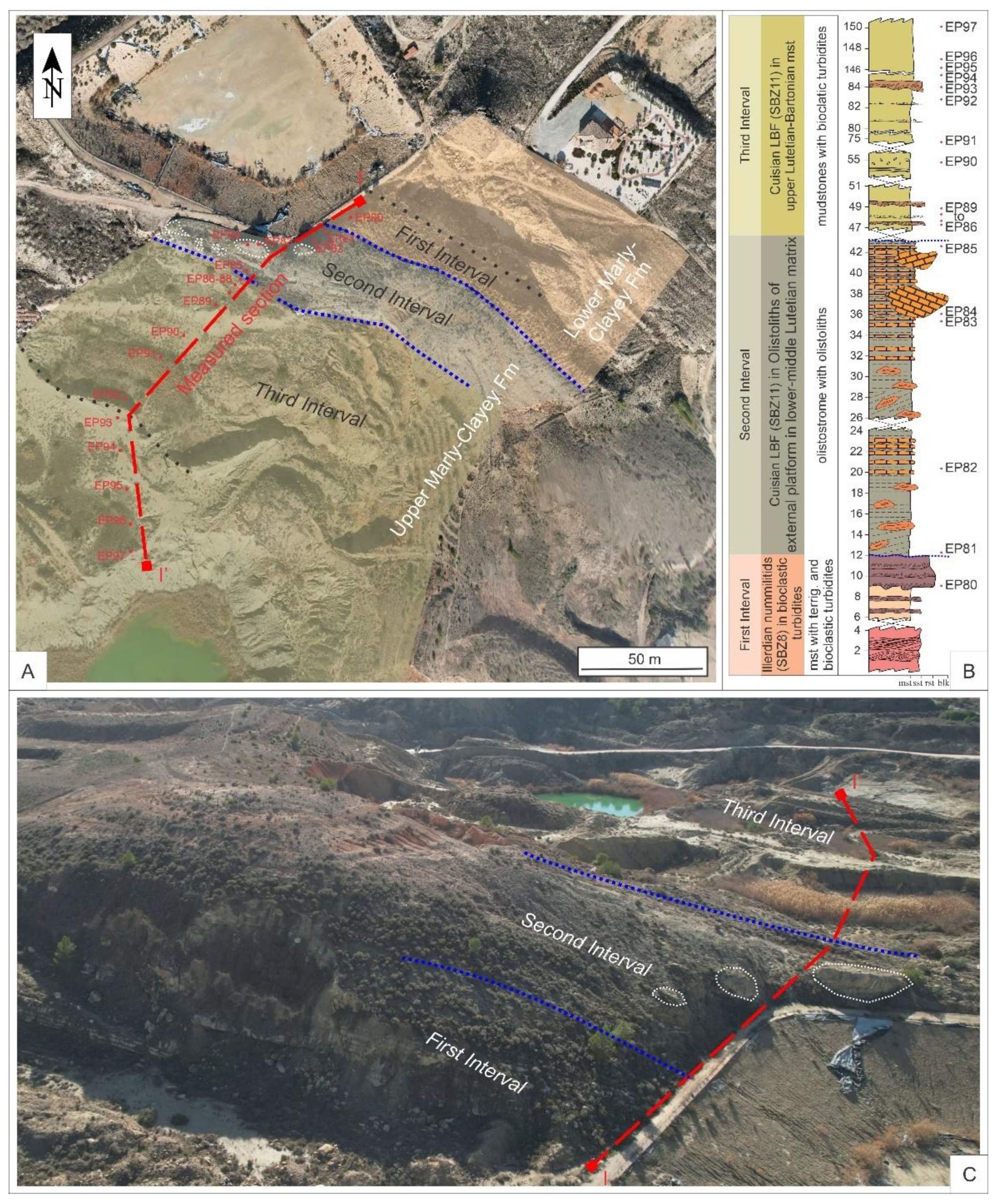
Figure 3.
Field photos of the Aspe-Terreros section (A to H from bottom to top) with location of the main samples. A) Bioclastic turbidite in the first interval of the section (samples EP80a and EP80b); B) Preserved stratification of the olistostrome in the second interval of the section (sample EP82); C-D) Olistoliths in the second interval of the section; E) Big olistoliths in the second interval of the section (samples EP83 to EP85); F) Mudstones from the third interval of the section (samples EP87 to EP89); G) Mudstones with bioclastic turbidite in the third interval of the section (samples EP92 and EP93); H) Dark greyish to greenish marls and clays in the top of the section (sample EP97).
Figure 3.
Field photos of the Aspe-Terreros section (A to H from bottom to top) with location of the main samples. A) Bioclastic turbidite in the first interval of the section (samples EP80a and EP80b); B) Preserved stratification of the olistostrome in the second interval of the section (sample EP82); C-D) Olistoliths in the second interval of the section; E) Big olistoliths in the second interval of the section (samples EP83 to EP85); F) Mudstones from the third interval of the section (samples EP87 to EP89); G) Mudstones with bioclastic turbidite in the third interval of the section (samples EP92 and EP93); H) Dark greyish to greenish marls and clays in the top of the section (sample EP97).
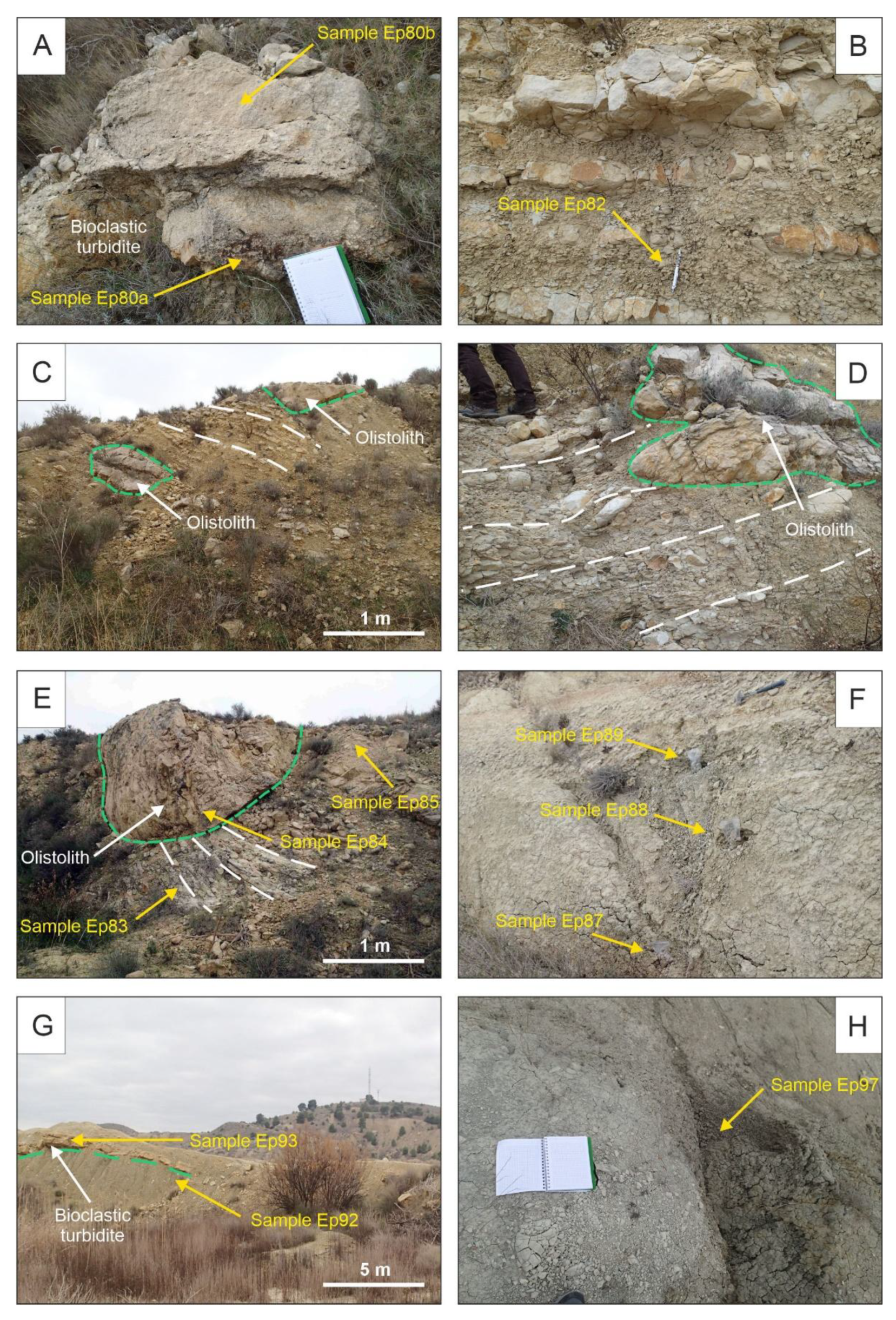
Figure 4.
Significant planktonic foraminifera from Aspe-Terreros section. Scale bar = 100 µm. 1: Acarinina bullbrooki, EP89. 2: Acarinina cuneicamerata, EP88. 3: Acarinina praetopilensis, EP87. 4: Morozovella aragonensis, EP88. 5: Morozovella crater, EP88. 6: Globigerinatheka subconglobata, EP88. 7: Morozovelloides crassatus, EP87. 8: Morozovelloides coronatus, EP97. 9: Globigerina eocaena, EP97. 10: Globigerina gortanii, EP97. 11: Igorina broedermanni, EP88. 12: Pseudohastigerina micra, EP97. 13: Turborotalia pomeroli, EP97.
Figure 4.
Significant planktonic foraminifera from Aspe-Terreros section. Scale bar = 100 µm. 1: Acarinina bullbrooki, EP89. 2: Acarinina cuneicamerata, EP88. 3: Acarinina praetopilensis, EP87. 4: Morozovella aragonensis, EP88. 5: Morozovella crater, EP88. 6: Globigerinatheka subconglobata, EP88. 7: Morozovelloides crassatus, EP87. 8: Morozovelloides coronatus, EP97. 9: Globigerina eocaena, EP97. 10: Globigerina gortanii, EP97. 11: Igorina broedermanni, EP88. 12: Pseudohastigerina micra, EP97. 13: Turborotalia pomeroli, EP97.
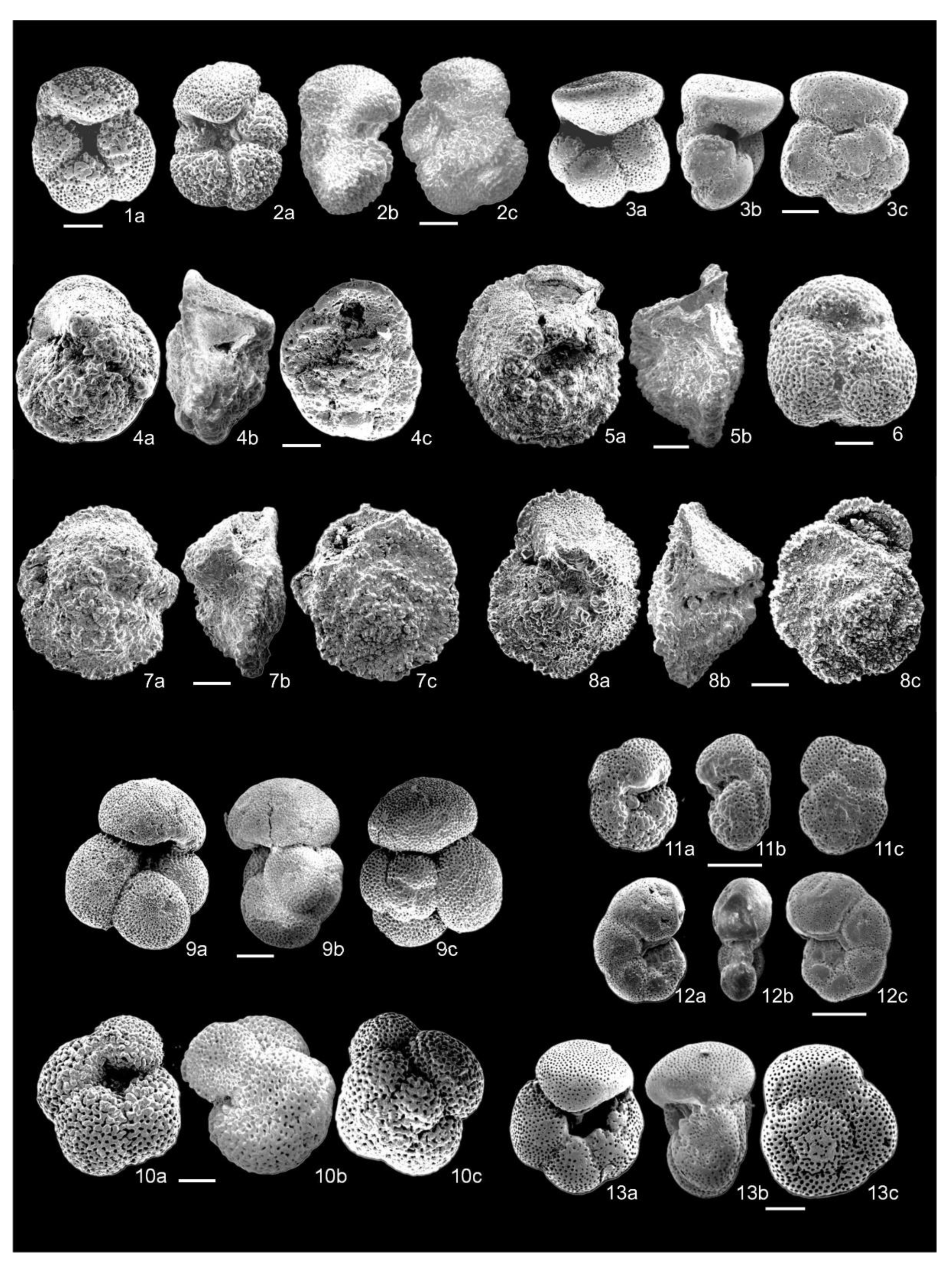
Figure 5.
Main LBF biomarker species of the late middle Ilerdian (SBZ8) into a bioclastic turbidite of the first interval of the Aspe-Terreros section (EP80a). 1-2, Nummulites spirectypus: 1a, FB internal view; 1b, FB, external view; 2, FA, internal view. 3-9, Nummulites atacicus. 3-5, FB, internal views; 6-9, FA, internal views. 10-13, Nummulites exilis: 10, 11b, FB internal views; 11a, FB external view; 12-13, FA internal views. 14-20, Nummulites globulus laxiformis: 14-17, FB internal views; 18, FA external view; 19-20, FA, internal views. 21-22, Assilina canalifera: FA external views. 23-24, Assilina ammonea ammonea: 23a, FA external view; 23b-24, FA internal views. Scale: 1mm.
Figure 5.
Main LBF biomarker species of the late middle Ilerdian (SBZ8) into a bioclastic turbidite of the first interval of the Aspe-Terreros section (EP80a). 1-2, Nummulites spirectypus: 1a, FB internal view; 1b, FB, external view; 2, FA, internal view. 3-9, Nummulites atacicus. 3-5, FB, internal views; 6-9, FA, internal views. 10-13, Nummulites exilis: 10, 11b, FB internal views; 11a, FB external view; 12-13, FA internal views. 14-20, Nummulites globulus laxiformis: 14-17, FB internal views; 18, FA external view; 19-20, FA, internal views. 21-22, Assilina canalifera: FA external views. 23-24, Assilina ammonea ammonea: 23a, FA external view; 23b-24, FA internal views. Scale: 1mm.
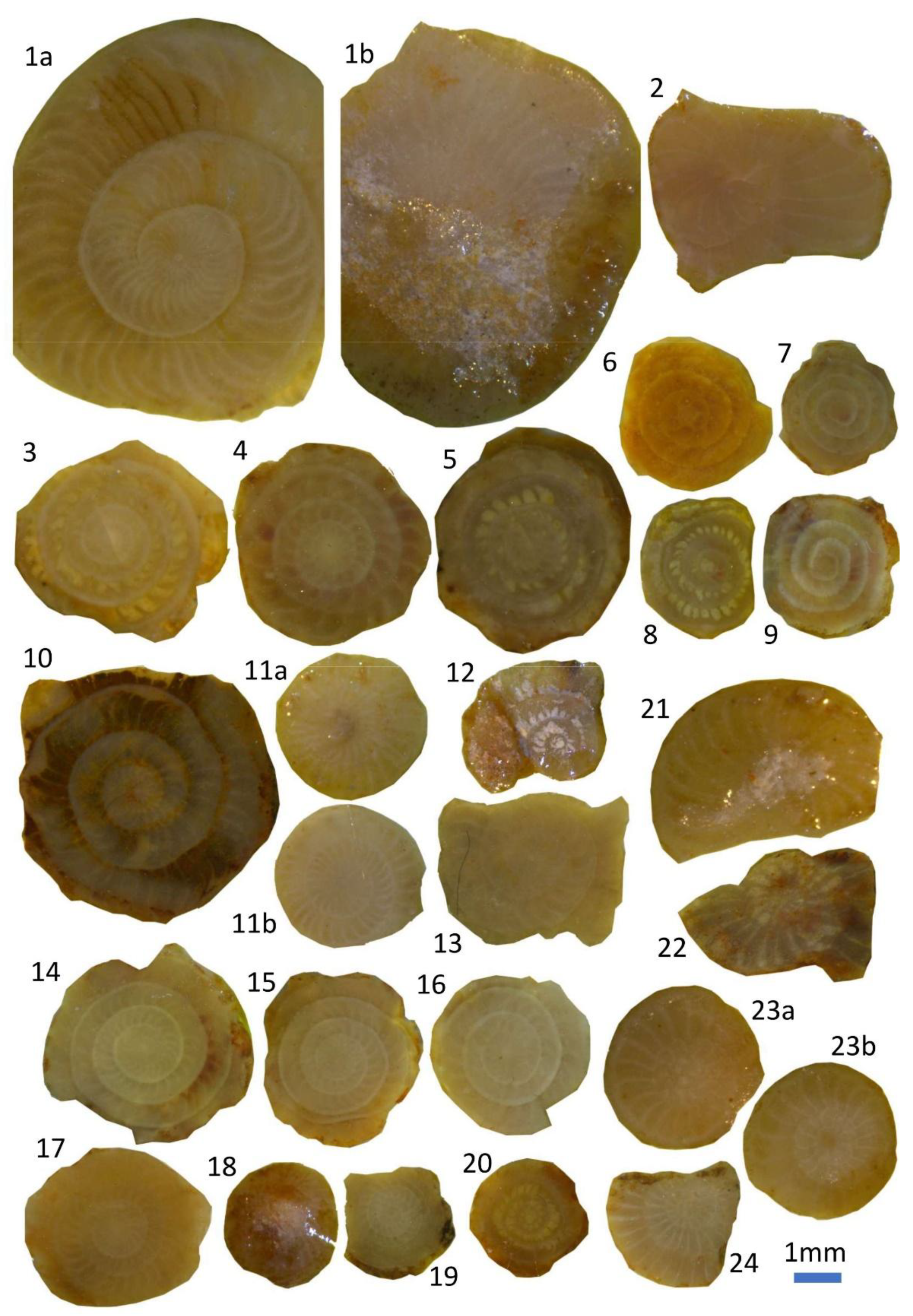
Figure 6.
Thin section photomicrographs of the microfacies recognized in the bioclastic turbidite and olistolith of the Aspe-Terreros section. A-D) Sample EP80. E-H) Sample EP84. Scale: 1,0 mm. Key: a, alveoline; as, assiline; b, bryozoan; cc, crustose coralline; d, discocycline; ep, echinoid plate; es, echinoid spine; l, lenticuline; m, miliolid; n, nummulites; pf, planktic foraminifer; q, quartz grain; ro, rotaliid; sbf, small benthic foraminífera.
Figure 6.
Thin section photomicrographs of the microfacies recognized in the bioclastic turbidite and olistolith of the Aspe-Terreros section. A-D) Sample EP80. E-H) Sample EP84. Scale: 1,0 mm. Key: a, alveoline; as, assiline; b, bryozoan; cc, crustose coralline; d, discocycline; ep, echinoid plate; es, echinoid spine; l, lenticuline; m, miliolid; n, nummulites; pf, planktic foraminifer; q, quartz grain; ro, rotaliid; sbf, small benthic foraminífera.
Disclaimer/Publisher’s Note: The statements, opinions and data contained in all publications are solely those of the individual author(s) and contributor(s) and not of MDPI and/or the editor(s). MDPI and/or the editor(s) disclaim responsibility for any injury to people or property resulting from any ideas, methods, instructions or products referred to in the content. |
© 2025 by the authors. Licensee MDPI, Basel, Switzerland. This article is an open access article distributed under the terms and conditions of the Creative Commons Attribution (CC BY) license (http://creativecommons.org/licenses/by/4.0/).
Copyright: This open access article is published under a Creative Commons CC BY 4.0 license, which permit the free download, distribution, and reuse, provided that the author and preprint are cited in any reuse.