

Submitted:
27 January 2025
Posted:
28 January 2025
You are already at the latest version
Abstract
Introduction: Access to vaccines provided by the Brazilian National Immunization Program (NIP) by populations living in floodplains and hard-to-reach areas of the Amazon is complex and conditioned by the geographic characteristics of the region. The success of vaccination campaigns requires different strategies, technologies and the involvement of professionals whose work involves going beyond standard operating procedures and vaccination protocols. Objective: To describe the specificities of access of populations living in floodplain areas and hard-to-reach areas located within the geographic perimeter of the municipality of Careiro da Várzea, in the state of Amazonas, Brazil, to vaccines made available by the Imuniza SUS Program. Methods: Case study using qualitative-descriptive techniques that combined data analysis, document analysis, and participant observation to reveal different socio-sanitary aspects of the immunization process of the Amazonian populations studied. The concepts of Street Level Bureaucracy and Social Technologies guided the analysis and description of the immunization process in the area studied. Results: The study made it possible to describe the geographic conditions, the social technologies used, and the actors involved in the immunization process of the populations of communities and villages in flooded areas of the Amazon in Brazil. The high temperatures in the region create the need for thermal control in the storage of vaccines during their transfer to the communities and villages. The local coordination of the Imuniza SUS Program acts as a strategic mediator between the different bodies, ensuring the population's access to vaccines, which means that the actions of government agents (street-level bureaucracy) are crucial to the functioning of the immunization program. Conclusion: The success of the immunization campaigns in the hard-to-reach flooded areas of the municipality is due to the existence of a virtuous cycle arising from the synergy between the different actors that make up the immunization service; there is a clear relationship between the vaccination coverage rates achieved and the municipal administration's commitment to public health; the immunization rates achieved in the municipality studied were compatible with the average established by the Brazilian Ministry of Health.
Keywords:
Vaccine
; Amazon
; floodplains
; street-level bureaucracy
; social technologies
1. Introduction
The vaccination coverage of Amazonian populations is influenced by different factors. The socioeconomic level of the population is determinant for their adherence to the immunization program, but the events supposedly attributable to vaccination or immunization (ESAVI) are also determinant, even more so when associated with low understanding of the risks related to diseases, a reality observed even in northern countries (MACEDO et al, 2024). Factors such as misinformation, lack of planning by people and families, and the fear of suffering possible side effects caused by vaccines impact the vaccination coverage of Amazonian populations.
In addition to factors related to educational, cultural, and socioeconomic aspects, another factor that directly impacts the vaccination coverage of Amazonian populations is regional geography. The access of immunization teams to floodplain lands and hard-to-reach areas is complex, and its feasibility depends on the strategies adopted to reach the flooded lands. The actions of the National Immunization Program (NIP) – the national public policy that makes vaccines, serums, and immunoglobulins available to all regions of the country through the Unified Health System (SUS) – are previously planned by health professionals who act as street-level bureaucrats within the scope of the SUS Immunization Program, at the local level. These professionals make use of certain social technologies and are willing to extrapolate standard operating procedures and vaccination protocols, and interact with users of the health system, who act in the process as directly benefited social actors, and are also the target of immunization campaigns.
A study conducted by Branco et al (2014) showed that Brazil has had important achievements in the field of childhood immunization of children in the first year of life, having significantly reduced morbidity and mortality rates in this age group. Over decades, the actions of the NIP have made it possible to eradicate smallpox, polio, hepatitis B, diphtheria, neonatal tetanus, yellow fever and tuberculosis in its severe form (BRANCO et. al, 2014). However, when it comes to the immunization process of Amazonian populations, depending on the time of year, the vaccination schedule may suffer delays that, associated with numerous other factors characteristic of the region, can result in the delay in the eradication of some diseases.
The Federal Government makes available, free of charge, in the NIP's National Vaccination Calendar, 48 immunobiologicals, 31 vaccines, 13 serums and 4 immunoglobulins. Vaccines include those indicated for groups with special clinical conditions, such as "people with HIV or individuals undergoing treatment for some diseases (cancer, kidney failure, among others), applied at the Reference Centers for Special Immunobiologicals (CRIE), and COVID-19 vaccines and others administered in specific situations" (BRASIL, 2025). Of the 31 vaccines made available by the NIP, twelve make up the mandatory annual vaccination calendar of the municipality of Careiro da Várzea, the case studied, but all vaccines are available to the population under the SUS Immunization Program, whose teams ensure that they arrive at the destination locations in ideal conditions of conservation and effectiveness.
Although the NIP offers a great contribution to raising the health levels of the Brazilian population over the years, studies show that the average maternal mortality rate in Amazonian municipalities is three times higher than the Brazilian average, and this reality is even worse in areas of difficult access and floodplain areas, where access to health services is hampered by isolation, low population density and precarious and insufficient means of transportation, factors that make the states of the Legal Amazon have the worst health conditions in the country (SANTOS et al., 2014).
The geographical singularities of the Amazon region certainly interfere in the organization and supply of Primary Health Care (PHC) health services (GARNELO, 2019; SOUSA et al, 2023). In this sense, the establishment of an exclusive format in the provision of health services for the river areas of the Amazon brought visibility so that more resources from the federal government were allocated to health care services for these populations (SOUSA et al, 2023), favoring the delivery of vaccines in floodplain areas and areas of difficult access, because, in theory, more resources mean improvements in the structure of human resources and transport in the region.
The provision of financial resources for health takes place through the management pact between the federal, state and municipal levels, a financing dynamic that guarantees the transfer of funds for the maintenance and permanence of priority programs within the scope of PHC, including the SUS Immunization Program. The River Family Health (eSFF) teams working in the Basic River Health Units (UBSF) are responsible for ensuring the population's access to vaccines in floodplain areas and hard-to-reach areas of the Amazon. In these areas, the dynamics of immunization tend to follow a pattern, however, factors such as the distance between the localities/villages/communities and the municipal headquarters that serves them, the structure of the river health units available in each municipality, and the awareness of users regarding the willingness to adhere to the vaccination process can cause variations in this dynamic.
2. Objective
The objective of this study was to investigate the specificities of the immunization process of populations inhabiting floodplain areas and areas of difficult access located in the geographic perimeter of the municipality of Careiro da Várzea, in the state of Amazonas, Brazil, detailing the theoretical and practical aspects identified in the execution of the National Immunization Program.
To this end, the geographic singularities of the region, the strategies adopted by the health professionals who make up the immunization teams, understood here as street-level bureaucrats, and the fundamental social technologies present in the execution of this public policy whose elements, practices and actors are common to the floodplain areas and hard-to-reach areas of the immense Amazon region, are detailed, explained and analyzed.
3. Methods
This study combined the techniques of document analysis and analysis of secondary data. Studies based on secondary data do not require submission to the Research Ethics Committee, according to Resolution 466/12 and 510/16 of the Ministry of Health (BRASIL, 2012; BRASIL, 2016). Furthermore, it employed participant observation, which made it possible to detail the dynamics of the immunization process in the area studied.
Participatory research consists of a modality of qualitative social research that necessarily implies the participation of the researcher in the context, group or culture in which he or she carries out his or her research, and his/her insertion with the subjects who are involved in the process. Participatory research therefore takes place in a "natural environment", that is, without the need for artificially prepared environments or situations. In the case of this study, participant observation was carried out by the nurse who coordinates the NIP in the municipality of Careiro da Várzea, who made different records of the phenomenon studied, through technical notes, photographs, videos and audios in which she described the situations considered relevant, which places her in the process as a researcher-informant. The other authors, when accessing the information collected in the field, worked on the organization, analysis and interpretation of these data, attributing meaning to them and transforming them into scientific knowledge. (Cf. SAKS and ALLSOP, 2011).
The concepts of Street Level Bureaucracy and Social Technologies guided the approach to the theme precisely because they contemplate the importance of contact between public agents and citizens/users of public policies, which should result in effective deliveries to the population, a practice identified in the performance of health professionals who operate the immunization process of populations in floodplain areas and areas of difficult access in the locations studied.
4. Results
4.1. Sociodemographic and Economic Aspects of the Study Area: Careiro da Várzea
Careiro da Várzea is an urban municipality located in a floodplain area at the merging of Negro and Solimões rivers, as its name implies. The floodplain environments of the Amazon estuary are areas that are periodically flooded due to changes in the rainfall regime of the region, and are subject to variations in the level of the rivers, twice a day and seasonally (ABREU & OLIVEIRA, 2012). The Negro and Solimões rivers, which bathe the Amazon region, have their flood period between the months of January and June, which is when the overflow of the waters invade and flood in the marginal areas occurs. These marginal areas are the floodplains, so called when periodically flooded by the waters of rivers, lakes, streams and paranás (BENATTI, 2003), and where the communities and villages contemplated in this study are located.
The municipality of Careiro da Várzea is one of the twelve that are part of the health region called "Manaus, Entorno e Alto Rio Negro", and is located at an approximate distance of 30 km from Manaus, the capital of the state of Amazonas, in a straight line, by river. Its territorial area is 2,627.474 km² (IBGE, 2023) and its population is 19,637 inhabitants, according to the 2022 Census of the Brazilian Institute of Geography and Statistics - IBGE, (IBGE, 2025). The municipality occupies the 37th position in the population index classification of municipalities in the state of Amazonas (IBGE, 2022). Its population is organized into 105 communities and 11 villages, and the demographic density is 7.47 inhabitants per km². The GDP per capita is R$ 13,140.09 (US$ 2,161 in January 2025), being the 4th highest in the health region, and the 22nd in the state of Amazonas. (IBGE, 2022). The Human Development Index- HDI of the municipality is 0.569, considered low.
The main economic activity of the municipality is agriculture, with pineapple being the most commercialized item; Cattle raising is the second main economic activity in the municipality. The period of flooding of the rivers brings difficulties to the movement of people and compromises the performance of routine activities, but, at the same time, favors the supply of fish in the communities, lowering the price of fish in these areas (SEBRAE, 2024). Among the sectors that bring together the largest number of workers are public administration, defense and social security, water transport, and retail trade (SEBRAE, 2024).
During the period of flooding of the rivers, the population of communities and villages usually migrate from one location to another in search of protection against isolation and difficulties in mobility and access to services, food and medicines. In periods of extreme flooding, houses built on stilts tend to be completely submerged, causing the total loss of furniture and equipment for domestic use. This mobility of people between the communities in the region during the flood period of the rivers is clearly perceived in the routine activities of health professionals, as there is a certain variation in the care data recorded in the e-SUS-AB System (SUS System in Primary Care), often causing inaccuracy in vaccination coverage data, for example, and in the municipality's health indicators.
4.2. Sanitary Structure of Careiro da Várzea
The public health services of the municipality of Careiro da Várzea are structured as follows: a Health Secretariat; a Basic Floating Health Unit in the municipal headquarters; fifteen Basic Family Health Units (between fixed and mobile) that serve the population of communities and villages far from the headquarters; a Health Surveillance unit; a Primary Care Pharmacy; and a State Hospital Unit, which is currently managed by the municipal sphere.
4.3. The Logistics of Immunization in the Communities and Villages of Careiro da Várzea
The immunization of the population of Careiro da Várzea is guaranteed by the National Immunization Program (PNI), of the Ministry of Health (MS), and carried out locally by health professionals from the Immuniza SUS Program. The types and quantity of vaccines designated both for the population of the Careiro da Várzea headquarters, and for the communities and villages that are far from the central area (commonly called the municipal headquarters), are sent by the State Health Department located in the capital Manaus. The logistics of transport to the seat of the municipality consists of travel by two routes, one by road and the other by river. The vaccines are transported by road to the port of the Product Supply Center (CEASA), located in the south of Manaus, and then they are sent to Careiro da Várzea, a journey of approximately 40 minutes by boat crossing the Solimões River. Upon arrival in the municipality, the packaging of the vaccines is under the care of the Municipal Health Department, where there is a cold season to ensure that the vaccines are properly preserved until the moment of their administration. The fact that the municipality is typically floodplain (95% of its area is submerged during the annual flood period) means that access by the Negro and Solimões rivers is often unfeasible. In these cases, it is necessary to travel through the border municipality of Autazes, through the Gurupá Paraná (stream), a safer route in times of great flooding of the rivers, although it takes longer.
The municipality has ten teams of the Family Health Strategy, which are responsible for organizing and coordinating the ten existing vaccination rooms. The mobile units work in the format of Basic River Health Unit (UBSF), structured to float on the river, some of which originate from boats that have been adapted to enable health actions in floodplain areas and areas of difficult access. In some communities, in addition to the UBSF, a fixed Basic Health Unit (UBS) is maintained.
The SUS Immunization Program currently serves 116 locations in the municipality of Careiro da Várzea, 105 communities and 11 villages, a very complex service when considering the difficulties of access and the low demographic density of the region. The distribution of vaccine rooms is organized as shown in table 1.
The number of vaccines made available is calculated based on data from the population registered in the e-SUS, in order to ensure the vaccination coverage of the population, and its distribution is made among the 10 vaccine rooms belonging to the municipality (1 room in the municipal headquarters and 9 in communities and villages). Each vaccination room has the permanent presence of a nurse and a nursing assistant, and these teams provide care to the communities and their surroundings, as shown in Figure 1.
When the Covid-19 pandemic challenged the organization and capacity of public health services at the global level, health teams working in the Amazon were already used to clearing the forest, facing the flood and drought of the rivers in small motor boats known in the region as "rabetas" and "voadeiras", or in larger and faster motor boats, such as the so-called "jet boats" used to travel longer distances. However, coping with the difficulties produced by the geographical characteristics of the floodplain areas is quite complex, and the health actions and policies currently being developed in the region are far from contemplating the totality of the health demands of its population. In this regard, Ribeiro, Costa and Barros (2020) state that the municipality of Careiro da Várzea "faces numerous difficulties, and has a huge need for effective, integrative and equitable public health policies, as well as professional-user interaction to achieve the qualification of self-care, promoting health and preventing diseases" (p.3).
Despite the historical underfunding of the SUS, the management of immunization campaigns in floodplain areas and hard-to-reach areas of the Amazon takes into account – not only during public health emergencies, but in the daily life of health services – the health situation in the context of each action, in addition to the financial costs involved in the process. The calculation of these costs includes transportation and the time of accommodation and stay of the immunization teams in the municipalities, communities and villages; and the time and cost of getting the vaccines to all locations without changes or damage to their immunizing capacity. The goal, in each campaign, is to vaccinate the largest number of people in the shortest possible time, and the established goal is always to vaccinate 100% of the population.
After the vaccines arrive at the municipal headquarters, the teams meet to analyze the map drawn for the immunization action or campaign. This is the moment when managers distribute professionals by teams, having recent weather information as an essential factor. Thus, they decide on the access routes to communities and villages, personal protective equipment and others, and adequate transportation. The organization of the materials on the boats is done by the crew members themselves, usually a helmsman (locally called boatman) and his assistant, with the help of the health team, which remains attentive to the thermal packaging of the vaccines and the safety of the professionals on board. The journey to the communities can take between 1 and 3 hours in normal traffic situations, but it also varies depending on the difficulties encountered in each situation, and depending on the water level of the rivers. Access to the indigenous villages of the Murutinga Pole can take much longer, as the route requires entering areas where the forest is denser and surrounded by the lakes and igapós of the Amazon.
Major health actions take place in the Amazonian municipalities once a year and involve the participation of complete teams of the Family Health Strategy: doctor, nurse, dentist, nutritionist, social worker, veterinarian, nursing technicians and community health agents who work in the area. On these occasions, the team of the Basic River Health Unit acts in the identification of possible extraordinary situations in which its intervention is required, either to solve an immediate local problem, or to provide the referral of users for procedures at a level of greater complexity within the health system. An example of this situation is the occurrence of snakebites, which are very common in floodplain areas during the flooding period of the rivers. In these emergency cases, the user receives first aid at the UBSF itself, and is then referred to a reference hospital in the capital.
In the Amazon, navigation professionals generally have extensive experience, which does not mean that there are no moments of tension during the journey to the most distant locations from the central areas. It is not uncommon for the "boatmen" to have to untangle the boat that is stuck to some root at the bottom of the river. There are also situations in which boats need to travel very slowly, depending on the movement of other vessels along the waterways. The time of arrival in communities and villages also takes into account the need for fuel refueling. The gas stations are fixed facilities distributed on river routes to meet the needs of the boats that travel there, and to curb the illegal transport of fuel inside the vessels.
In situations of major river floods, the municipal headquarters of Careiro da Várzea can be completely flooded, making access to villages and communities very difficult for health teams. The collapse of small wooden bridges that connect the access roads to certain localities is a common scene. These occurrences make it impossible for both health teams and residents of the flooded areas to travel safely, requiring creativity and determination from the teams to reach their destination. In these cases, it is necessary to find a way to communicate what happened to the municipal headquarters, making all the protocol records, but it is not always possible to wait for the bridges to be repaired or rebuilt, which can take months. A common landscape are masonry houses and stilts almost completely submerged, requiring the use of small canoes to make it possible to move within the urban area of Careiro da Várzea, as the streets become riverbeds in floodplain areas, and nothing can be done about it but wait for the water level to drop.
The health authorities of the municipalities monitor the evolution of the floods with the available meteorological services, a resource also limited by the difficulty of connecting to the internet network in these areas during periods of major river floods. In 2019, for example, Careiro da Várzea had 100% of its municipal area submerged by the flooding of the Rio Negro, making the road that leads to the municipality impassable and making it difficult to access food, inputs, medicines, and services, especially in the villages and communities farthest from the municipal headquarters. In situations like this, the maintenance of living and health conditions is affected and can only be made possible through cooperation with the state level.
The volume of water in floodplain areas tends to decrease at a slow pace, when the rains begin to cease. At this stage, the waters can be pooled along the urban and rural perimeters for several days, giving rise to other sanitary problems. A classic example is the proliferation of the Aedes Aegypti mosquito, which has caused the infection and even death of many people over the years in the Amazon. In February 2024, the NIP started to make dengue vaccines available in regions of Brazil where the disease is prevalent, but that year the administration of the vaccine was released only for the child and adolescent population. In the municipality of Careiro da Várzea, especially in the communities and villages, it was initially observed that people were hesitant to use a new vaccine, whose possible reactions are not yet fully known, a fact also captured by the participant observation technique.
Ribeiro, Costa and Barros (2020), when describing the Health Overview of the Municipality of Careiro da Várzea, recorded the prevalence of papillomavirus in adolescents aged between 13 and 17 years who were living without specialized medical follow-up, which could mean "lack of information [...] as to the form of prevention of the disease, which is worrying because it is a major risk factor for cervical cancer and can be prevented by a vaccine offered by the SUS" (p.7). In this sense, it is important to highlight the need for more – or more comprehensive – health education actions in the communities and villages of the municipality, aiming to make known the HPV vaccine, made available by the NIP for children and adolescents in the age group between 9 and 14 years. Vaccination coverage data for the period 2019 and 2024 are presented in Table 2 and Table 3.
In cases where vaccination coverage exceeds 100%, it is possible that the following situations have occurred: 1) the number of people vaccinated in a given area exceeded the expectations created from the number of people registered in the e-SUS System. In this case, it is found that human mobility in the region – due to the conditions of isolation that causes difficulties in accessing services, food and medicines, etc. – influenced the vaccination process, generating the overcoming of coverage. In the case of Table 2, for example, it is possible – and this occurs frequently in Amazonas – that female adolescents have sought vaccination care in a municipality other than the one in which they originated in the e-SUS, causing the percentage of vaccination in the municipality where the service was provided to be higher than expected based on the System's records; or 2) the registration data of the e-SUS System may be outdated and do not reflect the population growth of the municipality, a common fact in the period prior to the Demographic Census carried out by the IBGE every ten years. It is from the data generated by the Demographic Census that public health policies are established, and it is therefore unlikely that there will be, in 100% of the cases, accuracy in the relationship between the data registered in the public systems and the population found in the municipalities.
Table 4 shows the vaccination coverage obtained in the administration of mandatory vaccines in the municipality of Careiro da Várzea in the period between 2019 and 2024. Because some vaccines are administered at the same time, vaccination coverage reaches the same percentage, as is the case of Meningococcal and Hepatitis B, whose coverage level was 121.94% in 2019; the same case occurs with the Hepatitis B and Penta Valent vaccines in the years 2020, 2021, 2022, 2023 and 2024.
The Hepatitis B vaccine in newborns aged 30 days or less was the one with the lowest number of doses administered throughout the period, and this is due to the fact that there is no maternity hospital in the municipality of Careiro da Várzea, leading pregnant women to travel to the maternity hospitals in the capital, where newborns already receive the first doses of mandatory vaccines. In adulthood, Hepatitis B reached coverage of more than 100% in the years 2020, 2023 and 2024. The BCG vaccine for TB, made available to children preferably up to 12 hours after birth, also obtained low vaccination coverage in the period from 2019 to 2024, confirming vaccination in maternity hospitals in the state capital.
The vaccine against Covid-19 was widely administered throughout the state of Amazonas after its distribution by the Ministry of Health, but in floodplain areas and areas of difficult access, immunization teams faced the difficulties imposed by regional singularities. In the municipality of Careiro da Várzea, the National Health Data Network (MS, 2025) registered, until 11/01/2025, 12,975 doses administered (2nd dose), which represents 67.36% of the coverage of the entire municipality, communities and villages; and 8,717 doses (3rd dose), which is equivalent to 42.45% of the vaccination coverage of the population in this area.
5. Discussion
Street Level Bureaucracy and Social Technologies in the Vaccination Process of Populations in Floodplain Areas and Hard-to-Reach Areas
The concept of Street Level Bureaucracy was the basis for describing the interaction of public health agents with people from the communities in the implementation of the NPI with the populations that inhabit the floodplain areas and areas of difficult access located in the geographic perimeter of the Amazonian municipality of Careiro da Várzea. Associated with this concept, we sought to understand the ways in which social technologies compose the process, considering that it is a region in which geographical characteristics require health teams to appropriate specific technologies, in whose execution the participation of the community becomes indispensable.
The description of the specificities of the immunization process of the populations of these areas brought to the professionals involved in this study the challenge of developing the ability to observe life in the Amazonian environment, in order to perceive its peculiarities and, at the same time, interpret whether the professional modes and practices adopted by the health teams favor the effectiveness of the ongoing actions/campaigns. Thus, the actions of the teams are centered on people/users/citizens, the final customers of health services.
The participant observation process revealed that, within the scope of the National Immunization Program (NIP), the importance of the performance of street-level bureaucrats is undeniable. And the fact that the NIP is "an integral part of the World Health Organization Program, with partnerships established with UNICEF and contributions from Rotary International and the United Nations Development Program (UNDP)" (BRASIL, 2025), makes it a privileged locus for the action of these bureaucrats, as the interinstitutional dimension and international cooperation expand the possibilities of their action and favor protagonist in the generation of assertive deliveries to the society, while ratifying the need for its presence in the community.
Understanding the importance and scope of public policies in a society relies on the contributions of Fernandez and Guimarães (2020). For these authors, public policies are established by different individuals, groups or organizations that play a role in the political arena. The "individuals" mentioned are, objectively, the "actors" who influence the political process and exercise behaviors and interests that may vary, depending on the roles they play in the political scenario.
Pressman and Wildavsky (1973) state that the implementation stage is, among the stages of the public policy cycle, the one that puts the policy into practice, being, therefore, a complex process that involves people, powers, needs, disputes, resources, skills, knowledge and limits. Such complexity has led authors such as Hill and Hupe (2014) to consider that the implementation of public policies is not a neutral process, since the procedures and interactions inherent to their implementation influence their content and results.
Fernandez and Guimarães (2020) observed a growth in studies on street-level bureaucracy in Brazil, and understood that this is due to the interest of scholars in the processes of implementation of public policies. The authors point out that since the first decade of the 2000s, there has been an expansion of more systematic studies on the implementation of these policies in relation to different topics of academic interest.
Street-level bureaucracy is one of the levels of public administration bureaucracy (LOTTA, 2018). The role of street bureaucrats consists of direct interaction with citizens/users of a given public service, and therefore they represent the link between the State and society. For Lipsky (1980), the decisions that these bureaucrats need to make in the implementation of public policies are permeated by uncertainties and pressures inherent to the process. Such situations require great analytical skills, a challenge for street bureaucrats whose involvement with the community, coupled with important technical skills, enables them to propose effective solutions to the problems identified.
The specificities of the role played by street-level bureaucrats enable them to lead certain transformations in the process of implementing public policies, since each reality and each situation is subject to the context and social structure, among other factors, requiring the ability to act in an immediate, personal, empathetic, direct and impactful way in the lives of citizens/users (LIPSKY, 1980) and, at the same time, maintain the necessary distance to ensure the technical and professional character. In this sense, Lotta (2010) and Lotta and Santiago (2017) explain that acting to meet such needs and expectations requires great capacity for organization and categorization of demands.
Maynard-Moody and Musheno (2000, 2012, 2015) analyzed the performance of street-level bureaucrats through participant observation, among other techniques, and came to the conclusion that decisions are made considering the specificities of each case, based on the participation of peers and the moral, social, cultural values, etc., observed in the relationships that were established with the users of the policies in the process of implementation.
The field of public health finds increasing utility in street-level bureaucracy, considering the level of complexification of societies and the demand for a growing modernization of the State's structure of action, through the implementation of public policies that respond to socio-sanitary demands. This fact re-signifies the role of street bureaucrats as it opens space for the perception of new arrangements and other functions within different contexts, making it possible to contemplate the diversity of modern societies (LOTTA, 2012).
Street-level bureaucracy has been increasingly the object of academic interest among researchers who seek to identify how street bureaucrats interact with community actors in the implementation of public policies. Lotta (2010) observed a particular community insertion when studying the performance of community health agents of the Family Health Program, which she recorded as an example of the application of street-level bureaucracy in the field of public health. Another study, in this same field of knowledge, was carried out by Lima and D'Ascenzi (2017), who sought to apprehend, through qualitative research, the influence of the discretion of street bureaucracy on the National Humanization Policy in basic health units in Porto Alegre.
Street-level bureaucrats have a direct role in the decisions made institutionally around the NIP. These actors are considered central to understanding the process, its implementation, and achieving the expected results (LOTTA; SANTIAGO, 2017). In this sense, the effectiveness of the PNI is directly related to the performance of street-level bureaucrats, in their ability to mobilize people, institutions, and powers to implement the steps related to immunization everywhere in the Brazilian territory.
In the Amazon – where hydrography is a determining factor in access to vaccines when it comes to floodplain areas and hard-to-reach areas – it is necessary for health professionals to establish different strategies, who join forces with other actors in the target community to overcome local regional barriers. In the municipality of Careiro da Várzea, its communities and villages, the work of these street-level bureaucrats takes place throughout the process of immunizing the population. From the moment of communication about the vaccination campaign within communities and villages, organizing and structuring actions, involving and mobilizing people, until the completion of the vaccination process, it is possible to see their influence with the community. They are the ones who activate the key people in the communities, who, in turn, enable the waterway access of the boats that contain the vaccines, sometimes stagnant near the communities due to weather conditions. In the localities, negotiations between street-level bureaucrats and community members often guarantee certain logistical arrangements without which it would be impossible to carry out certain health actions. The community, through key people, also mobilizes the necessary communication and transportation to ensure the population's attendance at the vaccination rooms during the campaigns, positively impacting vaccination coverage in areas where access is most difficult.
The dynamics that make the population of floodplain areas access vaccines can vary in the extension of the Brazilian Amazon, interfering in this process factors such as: the distance between the municipality and the state capital; the types of access roads, whether road, waterway or air (in some locations in the Amazon, access involves the use of three types of vehicles – cars, boats and airplanes); the structure of health services and the organizational capacity of the regional health departments; the number of members of the immunization teams in each municipality; and the alignment of street-level bureaucrats with key people in the assisted community, among other factors.
The success of the work of street-level bureaucrats is directly linked to their ability to create and/or influence the use of social technologies that the process of making vaccines and immunizers accessible to the population of floodplain areas and hard-to-reach areas of the Brazilian Amazon requires. This process can be observed in situations where the creativity and inventiveness of immunization agents are required.
Christoffoli (2021) analyzes the concept of social technologies based on human actions that aim to transform nature with the aim of improving society's living conditions, a process in which man establishes a relationship of struggle and opposition with nature, but at the same time of complementation and cooperation (p. 727). This analysis seeks to substantiate, finally, the construction of the concept of social technologies which, according to Thomas (2009) would be a way of "designing, developing, implementing and managing technologies aimed at solving social and environmental problems, generating social and economic dynamics of social inclusion and sustainable development" (p.2).
An important characteristic of social technologies is the ability to include social actors who, while participating in the process of its construction, are benefited by it. In this regard, Christoffoli (2021) states: the simple replication restricted to a ST [Social Technology] can result in a process of even reducing the degree of autonomy and organization of its future beneficiaries, unless it involves them in processes of resignification of the problem and the technology that needs to be (re)appropriated by the social group (p. 729).
Zamberlan et al (2023), when analyzing the loyalty and impact of user-centered social technologies in health, define social technologies as being interactive and associative tools developed in interaction with the community and that represent effective solutions for social transformation. Social technologies portray, from this perspective, a type of inclusive solution that [aims at] the generation of shared and collegiate ideas, based on multidisciplinary groups focused on problem solving (p.2).
The creation, development, implementation and management of social technologies make use of creativity, inventiveness and other skills and resources with the central objective of responding to the demands of the users of a given public service, a process that can only be successful if there is multidisciplinary capacity to immerse itself in reality, in interaction with the target users of the policy or public action. Thus, the search for a user-centered solution adopts a participatory and transdisciplinary posture, "synthesizing technological, economic, strategic, ethical, social and environmental values [...] capable of reconciling the interests of innovation actors and protagonist users" (ZAMBERLAN et al, 2023, p.3).
The immunization actions carried out by the NIP in the floodplain and hard-to-reach areas of the municipality studied place the users of this health service at the center of decision-making, previously identifying, through the application of a situational diagnosis, the weaknesses and threats to the process, as well as the potentialities and opportunities available, increasing the reach of vaccination coverage.
It is inappropriate that important tools used to enable the vaccination of populations in floodplain areas and hard-to-reach areas of the Amazon are treated as "arrangements created to help solve certain obstacles identified in the process". In practice, the interaction between different actors, knowledge and skills promote experiences that, when carried out time and time again, are improved, making it possible to elaborate a design whose technological orientation makes it possible to create effective solutions built socially, at the local level.
The vaccination process carried out in the floodplain areas and hard-to-reach areas studied evidenced the existence of different social technologies whose validation must be attested by health professionals working in these areas. The theorists who conceptualize social technologies, some of which are mentioned above, contribute to affirm the importance of such technologies for the immunization process of the municipality studied, and clarity about them is fundamental for their validation, registration and evolution, in order to contribute to overcoming important challenges to the health of Amazonian populations.
The analysis of the data referring to the health context of the municipality studied extrapolated the objectives initially established, showing that there is a certain discontinuity in the execution of health programs, which are caused by political changes in the scope of management. Such discontinuities impact the effectiveness and guarantee of the achievement of all the established immunization goals.
The NIP's investments in the health prevention of the Brazilian population are increasing every year, but the immunization process must consider the emergence of new infectious diseases that, associated with the social diversity and geographical characteristics of a country of continental dimensions such as Brazil, challenge the immunization policy and, consequently, the health managers in the public spheres.
The prevalence of dengue in the municipality of Careiro da Várzea, and in its communities and villages, indicates the increasing need for water monitoring in floodplain areas, regardless of the time of year, whether in the dry or rainy season, since the waters that supply the population are affected by the dynamics of rainfall, causing changes in its components and affecting the health of people and animals.
6. Final Remarks
Documentary and data analysis (vaccination protocols, vaccination maps, e-SUS spreadsheets and data panels, newsletters, etc.) made it possible to understand the dynamics of the immunization process in the communities and villages of the Amazonian municipality of Careiro da Várzea. This analysis, associated with the foundation through the concept of Street Level Bureaucracy, made it possible to attribute great relevance to the participation of street-level bureaucrats in the process of immunizing the population. The participant observation technique made it possible to obtain, intentionally and systematically, information and data on the necessary actions, protocol or not, of the immunization process of the populations that inhabit areas of difficult access marked by the predominance of flooded spaces, typical of floodplain lands.
The performance of public health agents (street-level bureaucrats) is, therefore, decisive to make the different stages of the vaccination process viable. These professionals have great influence with local actors, being essential to reach health system users and obtain the agreements and participation necessary to achieve satisfactory levels of problem-solving capacity in the SUS.
The adoption of social technologies in the implementation of the immunization policy was considered very relevant, as it involves elements, practices, and actors common to the floodplain areas and hard-to-reach areas of the immense Amazon region. The immunization process demands a multiplicity of actions, with equally diverse methods and approaches, depending on the geographic location within the Brazilian territory, and the ethnic and cultural diversity found.
The local coordination of the National Immunization Program acts as a strategic mediator between the different instances to ensure people's access to vaccines. The success of immunization campaigns in floodplain areas and hard-to-reach areas of the municipality of Careiro da Várzea is due to the existence of a virtuous cycle arising from the synergy between the different actors that make up the immunization service. There is a clear relationship between the vaccination coverage achieved and the commitment of the municipal management to public health, making the immunization rates achieved compatible with the average established by the Ministry of Health.
Author Contributions
Conceptualization, J.A.d.L., A.A.N., B.d.O.R. and H.R.; Methodology, J.A.d.L., S.M.C.A. and B.d.O.R.; Software, A.A.N.; Formal analysis, J.A.d.L., B.d.O.R. and H.R.; Investigation, S.M.C.A.; Writing – original draft, A.A.N., S.M.C.A. and B.d.O.R.; Writing – review & editing, A.A.N., B.d.O.R. and H.R.
Funding
This research received no external funding.
Institutional Review Board Statement
This study combined the techniques of document analysis and analysis of second-ary data. Studies based on secondary data do not require submission to the Research Ethics Committee, according to Resolution 466/12 and 510/16 of the Ministry of Health (BRASIL, 2012; BRASIL, 2016).
Informed Consent Statement
Not applicable.
Data Availability Statement
The original contributions presented in this study are included in the article/supplementary material. Further inquiries can be directed to the corresponding author(s).
Conflicts of Interest
The authors declare no conflict of interest.
References
- ABREU, Nádia Rafaela Pereira de; OLIVEIRA, Hosana dos Santos A influência das mudanças sazonais nos aspectos naturais e sociais no careiro da várzea – AM. REVISTA GEONORTE. Edição Especial 2, v..2, n.5, p.1399 – 1408, 2012.
- BENATTI, José Heder; MCGRATH, David G.; OLIVEIRA, Ana Cristina Mendes de. Políticas Públicas e Manejo Comunitário de Recursos Naturais na Amazônia. Ambiente & Sociedade. Vol.6, n.2, p.137-154, 2003. [CrossRef]
- BRANCO, Fernando Luiz Cunha Castelo Branco et. al. [PEREIRA, Thasciany Moraes; DELFINO, Breno Matos Delfino; BRANÃ, Athos Muniz; OLIART-GUZMÁN, Humberto; MANTOVANI, Saulo Augusto Silva; MARTINS, Antonio Camargo; OLIVEIRA, Cristieli Sérgio de Menezes; RAMALHO, Alanderson Alves; CODEÇO, Claudia Torres; SILVA-NUNUES, Mônica da.]. Socioeconomic inequalities are still a barrier to full child vaccine coverage in the Brazilian Amazon: a cross-sectional study in Assis Brasil, Acre, Brazil. In: International Journal for Equity in Health 2014. 2014 13:118. Access: http://www.equityhealthj.com/content/13/1/118. Access in 01/15/2025. [CrossRef]
- BRASIL. Ministério da Saúde. Cobertura Vacinal COVID-19. Disponível em https://infoms.saude.gov.br/extensions/SEIDIGI_DEMAS_COBERTURA_COVID_RESIDENCIA/SEIDIGI_DEMAS_COBERTURA_COVID_RESIDENCIA.html Access in 0/13/2025.
- BRASIL. Ministério da Saúde. Coortes Vacinais - Papilomavírus Humano (HPV). Access: https://infoms.saude.gov.br/extensions/SEIDIGI_DEMAS_VACINACAO_HPV/SEIDIGI_DEMAS_VACINACAO_HPV.html Access in 01/ 09/2025.
- BRASIL. Ministério da Saúde. Diretrizes e normas regulamentadoras de pesquisa envolvendo seres humanos. Brasília: Ministério da Saúde; 2016.
- BRASIL. Ministério da Saúde. Diretrizes e normas regulamentadoras de pesquisa envolvendo seres humanos. Brasília: Ministério da Saúde; 2012.
- BRASIL. Ministério da Saúde. Vacinação. Available in https://www.gov.br/saude/pt-br/vacinacao. Access in 01/13/2025.
- CHRISTOFFOLI, Pedro Ivan. Tecnologias Sociais. In: DIAS, Alexandre Pessoa; STAUFFER Anakeila de Barros; MOURA, Luiz Henrique Gomes de; VARGAS, Maria Cristina. (Orgs). Dicionário de Agroecologia e Educação. Rio de Janeiro/São Paulo: Editora Fiocruz/Editora Expressão Popular, 2021, p. 727-736.
- Data MPE Brasil. Careiro da Várzea. Disponível em https://datampe.sebrae.com.br/profile/geo/careiro-da-varzea. Access in 12/ 23/2024.
- FERNANDEZ, Michelle Vieira; GUIMARÃES, Natália Cordeiro. Caminhos teórico-metodológicos para a análise da burocracia de nível de rua. In: Revista Brasileira de Ciência Política, nº 32. Brasília, maio – agosto, p. 283-322, 2020.
- GARNELO, Luiza. Especificidades e desafios das políticas públicas de saúde na Amazônia. In: Cadernos de Saúde Pública. [Editorial]. Vol. 35, n.12, p.01-05, 2019.
- IBGE. Cidades e Estados. Careiro da Várzea. Available in https://www.ibge.gov.br/cidades-e-estados/am/careiro-da-varzea.html#:~:text=Careiro%20da%20V%C3%A1rzea%20*%202.627%2C474%20km%C2%B2%20[2023],102.476.015%2C70%20R$%20[2023]%20*%2013.140%2C09%20R$%20[2021] Access in 01/10/2025.
- LIMA, Luciana Leite; D’ASCENZI, Luciano. O papel da burocracia de nível de rua na implementação e (re)formulação da Política Nacional de Humanização dos serviços de saúde de Porto Alegre (RS). In: Revista de Administração Pública. Vol. 51, n. 1, p. 46-63, 2017.
- LIPSKY, Michael. Street level bureaucracy: dilemmas of the individual in public services. New York: Russell Sage Foundation, 1980.
- LOTTA, Gabriela Spandero et al. [NUNES, Ana Carolina; CAVALCANTI, Sergio; FERREIRA, Daniela Damiati; BONAT, Juliana]. Por uma agenda brasileira de estudos sobre implementação de políticas públicas. In: Revista do Serviço Público Brasília. Vol. 69, n. 4, p. 779-810, 2018.
- LOTTA, Gabriela Spanghero. Implementação de políticas públicas: o impacto dos fatores relacionais e organizacionais sobre a atuação dos Burocratas de Nível de Rua no Programa Saúde da Família. Tese (Doutorado em Ciência Política). São Paulo: Universidade de São Paulo, 2010.
- LOTTA, Gabriela Spanghero. O papel das burocracias do nível da rua na implementação de políticas públicas: entre o controle e a discricionariedade. In: FARIA, Carlos Aurélio P. (Org.). Implementação de políticas públicas: teoria e prática, Belo Horizonte: Editora PUC Minas, 2012, p. 20-49.
- LOTTA, Gabriela; SANTIAGO, Ariadne. Autonomia e discricionariedade: matizando conceitos-chave para o estudo de burocracia. In: BIB, v. 1, n. 83, p. 776-793, 2017.
- MACEDO, Thaiane Rodrigues de Oliveira; SILVA, Ilce Ferreira da; BORGES, Maria Fernanda de Sousa Oliveira; FRANÇA, Ana Paula; MORAES, José Cássio de. Cobertura vacinal, barreiras e hesitação vacinal em crianças de até 24 meses: inquérito populacional em uma capital do oeste amazônico. In: Epidemiologia e Serviços de Saúde. 33(esp2):e20231295, 2024. Available in chrome-extension://efaidnbmnnnibpcajpcglclefindmkaj/https://sbim.org.br/images/files/po-avaaz-relatorio-antivacina.pdf. Access in 01/14/2025.
- MAYNARD-MOODY, Steven; MUSHENO, Michael. State agent or citizen agent: two narratives of discretion. In: Journal of Public Administration Research and Theory. V. 10, n. 2, p. 329-358, 2000.
- PRESSMAN, Jeffrey L.; WILDAVSKY, Aaron. Implementation: how great expectations in Washington are dashed in Oakland or, why it`s amazing that federal programs work at all, this being a saga of the Economic Development Administration as told by two sympathetic observers who seek to build morals on a foundation of ruined hopes. Berkeley: University of California Press, 1973. [CrossRef]
- RIBEIRO, Tifanny de Albuquerque; COSTA, Thaís Fernanda Nascimento da; BARROS, Francisco Railson Bispo de; Panorama da saúde do município Careiro da Várzea, Amazonas. In: Revista Eletrônica Acervo Saúde / Electronic Journal Collection Health ISSN 2178-2091. 2020.
- SAKS, Judith; ALLSOP, Mike. Pesquisa em Saúde. Métodos Qualitativos, Quantitativos e Mistos. São Paulo: Editora Roca, 2011.
- SANTOS, Daniel; CELENTANO, Danielle; ARRANIBAR, Jaime Garcia Antonio; VERÍSSIMO, Adalberto. Índice de Progresso Social na Amazônia Brasileira: IPS Amazônia 2014. Belém: Imazon, 2014.
- SOUSA, Amandia; FONSECA, Fernanda; BOUSQUAT, Aylene Emilia Moraes. Invisibilidade das singularidades amazônicas na organização e oferta de serviços de Atenção Primária à Saúde (APS): Estudo de caso na área rural ribeirinha de Manaus (AM). In: Saúde e Sociedade. V.32, n.2, art. e220612, pt [13p.], p. 01-13, 2023.
- THOMAS, Hernán. Tecnologias para la inclusion social y políticas em América Latina. 2009.
- ZAMBERLAN C, BENEDETTI FJ, SMEHA LN, Bär KA, RODRIGUES Junior LF, BACKES DS. Fidelização e impacto de tecnologias sociais em saúde centradas no usuário: nova proposta de desenvolvimento. In: Acta Paulista de Enfermagem. 2023;36:eAPE0052231. [CrossRef]
Figure 1.
Aerial image with the location of the 9 vaccination rooms in operation within the scope of the NIP in communities and villages in the municipality of Careiro da Várzea. Source: Image Google Earth georeferenced by authors.
Figure 1.
Aerial image with the location of the 9 vaccination rooms in operation within the scope of the NIP in communities and villages in the municipality of Careiro da Várzea. Source: Image Google Earth georeferenced by authors.
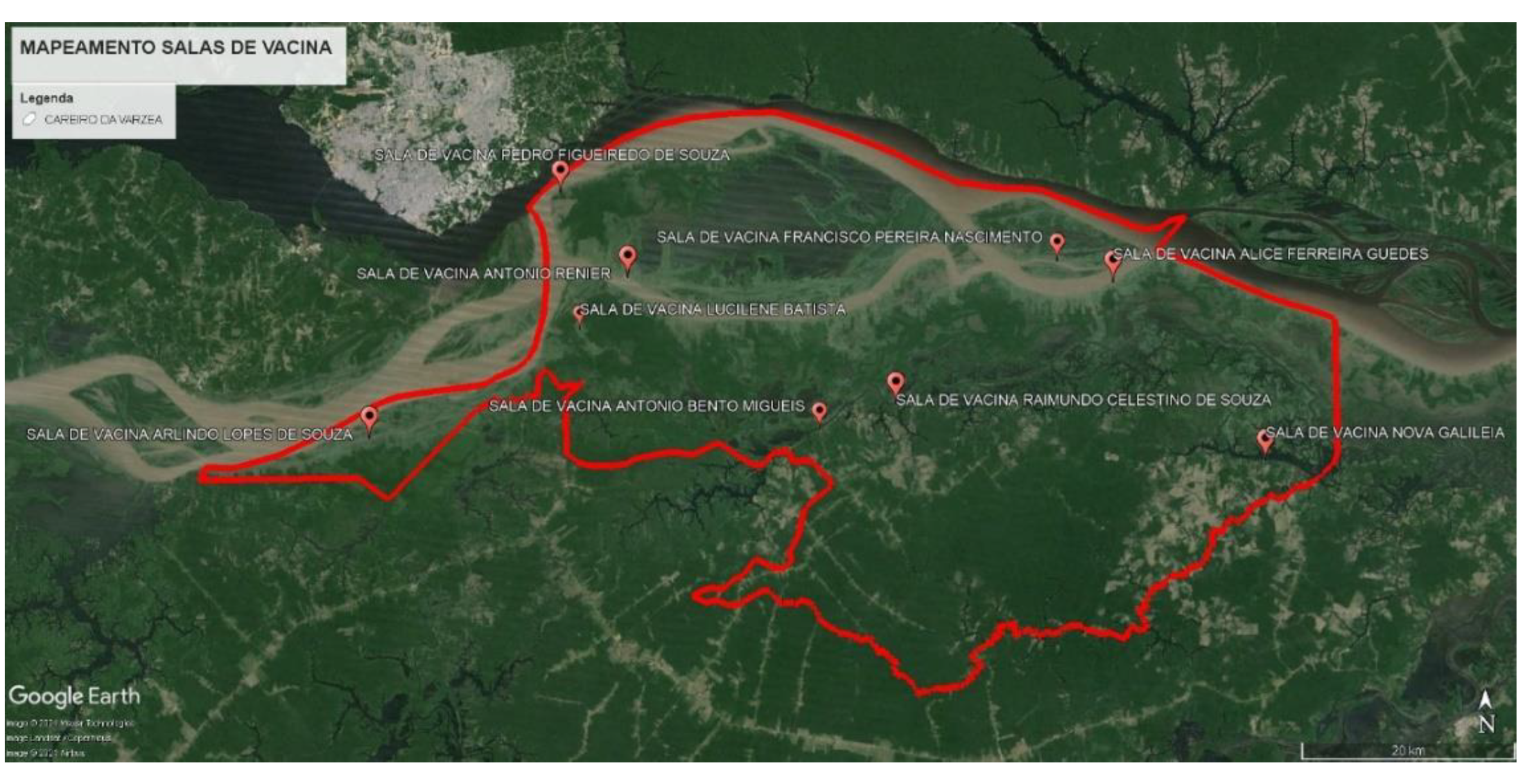

Table 1.
Vaccination rooms in activity in floodplain areas and areas of difficult access in the municipality of Careiro da Várzea, type of Health Unit (whether fixed and/or mobile), number of communities and villages served, and the types of transportation used for access .
Table 1.
Vaccination rooms in activity in floodplain areas and areas of difficult access in the municipality of Careiro da Várzea, type of Health Unit (whether fixed and/or mobile), number of communities and villages served, and the types of transportation used for access .
| Name of the Vaccination Room | Type of Ubs (Fixed/mobile) | Number of Communities and Villages | Transportation Route |
| Dr. Antônio Renier | Fixed | 05 communities | Road and river |
| Lucilene Batista | Fixed | 02 communities | Road and river |
| Alice F. Guedes | Mobile and fixed | 18 communities | River |
| Pedro Figueiredo | Mobile and fixed | 11 communities | River |
| Arlindo Lopes | Mobile | 14 communities | River |
| Francisca Pereira Nascimento | Mobile | 17 communities | River |
| Antônio Bento Migueis | Fixed | 11 communities | Road and River |
| Raimunda Celestino de Souza | Mobile and fixed | 18 communities | River |
| Nova Galileia | Mobile | 09 communities | River |
| Polo Murutinga | Mobile | 11 Indian villages | River |
| Total | 116 |
Fonte: Organizado pelos autores com base nos dados do e-SUS de 2024.
Table 2.
Vaccination coverage in females, aged between 9 and 14 years, referring to the Human Papillomavirus (HPV), in the municipality of Careiro da Várzea and its communities and villages, in the period between 2019 and 2024.
Table 2.
Vaccination coverage in females, aged between 9 and 14 years, referring to the Human Papillomavirus (HPV), in the municipality of Careiro da Várzea and its communities and villages, in the period between 2019 and 2024.
| Age group | % 2019 | % 2020 | % 2021 | % 2022 | % 2023 | % 2024 |
| 09 years | 77.84 | 30.81 | 24.86 | 40.54 | 72.97 | 67.03 |
| 10 years | 100.63 | 138.36 | 57.23 | 59.75 | 86.79 | 105.03 |
| 11 years | 79.39 | 106.06 | 142.42 | 65.45 | 69.09 | 90.30 |
| 12 years | 90.76 | 75.00 | 97.83 | 132.07 | 62.50 | 61.96 |
| 13 years | 209.04 | 92.02 | 74.47 | 97.87 | 133.51 | 62.23 |
| 14 years | 186.98 | 233.14 | 102.96 | 84.02 | 110.06 | 149.70 |
| 9 to 14 years | 88.00 | 110.19 | 82.48 | 80.67 | 89.43 | 98.39 |
Source: organized by authors based on data of Sistema e-SUS/MS.
Table 3.
Vaccination coverage in males, aged between 9 and 14 years, referring to the Human Papillomavirus (HPV), in the municipality of Careiro da Várzea and its communities and villages, in the period between 2019 and 2024.
Table 3.
Vaccination coverage in males, aged between 9 and 14 years, referring to the Human Papillomavirus (HPV), in the municipality of Careiro da Várzea and its communities and villages, in the period between 2019 and 2024.
| Age group | % 2019 | % 2020 | % 2021 | % 2022 | % 2023 | % 2024 |
| 09 years | 1,16 | 0,58 | 0,58 | 12,21 | 44,77 | 51,16 |
| 10 years | 5,77 | 1,44 | 1,44 | 9,13 | 44,71 | 58,17 |
| 11 years | 80,00 | 41,05 | 33,68 | 40,53 | 67,89 | 73,16 |
| 12 years | 99,38 | 133,95 | 67,28 | 64,20 | 86,42 | 96,91 |
| 13 years | 87,69 | 93,33 | 115,90 | 62,56 | 65,64 | 76,92 |
| 14 years | 92,11 | 96,32 | 99,47 | 122,11 | 72,63 | 71,05 |
| 9 to14 years | 60,25 | 59,44 | 53,00 | 51,48 | 63,12 | 70,73 |
Source: organized by authors based on data of Sistema e-SUS/MS.
Table 4.
Vaccination Coverage of mandatory vaccines in the Municipality of Careiro da Várzea, its communities and villages in the period comprising the years 2019 and 2024.
Table 4.
Vaccination Coverage of mandatory vaccines in the Municipality of Careiro da Várzea, its communities and villages in the period comprising the years 2019 and 2024.
| Vaccines | 2019 | 2020 | 2021 | 2022 | 2023 | 2024 |
| Hepatitis B (<=30 days of life) | 18.14% | 30.38% | 38.89% | 38.42% | 26.67% | 17.65% |
| TB – BCG | 19.83% | 35.02% | 41.92% | 49.47% | 27.62% | 20.59% |
| Rota Virus | 118.99% | 94.51% | 120.2% | 120% | 66.19% | 91.18% |
| Meningococcal | 121.94% | 95.78% | 150% | 128.95% | 65.71% | 35.29% |
| Hepatitis B | 121.94% | 87.34% | 131.82% | 128.42% | 70% | 70.59% |
| Penta Valente | 121.52% | 87.34% | 131.82% | 128.42% | 70% | 70.59% |
| Yellow Fever | 94.94% | 68.35% | 81.31% | 101.05% | 52.38% | 100% |
| Hepatitis A | 148.95% | 86.92% | 121.63% | 131.05% | 76.67% | 132.45% |
| Pneumo 10 | 120.68% | 70.69% | 130.58% | 133.16% | 70.48% | 97.06% |
| Polio VIP | 123.21% | 80.59% | 153.35% | 120% | 72.38% | 67.85% |
| Triple Viral 1st dose | 128.69% | 95.78% | 141.41% | 148.42% | 79.09% | 144.12% |
| Triple Viral 2nd dose | 162.03% | 59.92% | 59.60% | 106.84% | 30.48% | 105.88% |
Source: organized by authors based on data of Sistema e-SUS/MS.
Disclaimer/Publisher’s Note: The statements, opinions and data contained in all publications are solely those of the individual author(s) and contributor(s) and not of MDPI and/or the editor(s). MDPI and/or the editor(s) disclaim responsibility for any injury to people or property resulting from any ideas, methods, instructions or products referred to in the content. |
© 2025 by the authors. Licensee MDPI, Basel, Switzerland. This article is an open access article distributed under the terms and conditions of the Creative Commons Attribution (CC BY) license (http://creativecommons.org/licenses/by/4.0/).
Copyright: This open access article is published under a Creative Commons CC BY 4.0 license, which permit the free download, distribution, and reuse, provided that the author and preprint are cited in any reuse.


