

Submitted:
03 February 2025
Posted:
04 February 2025
You are already at the latest version
Abstract
Achieving economic growth and inclusive development for all are among policymakers' priorities. There is a growing recognition of the threat to stability posed by prolonged political grievances and a prevailing fragile state in Somaliland, often marked by serious internal conflict with the potential to destabilize the state further. This study highlights the importance of examining the determinants of state stability and leading national development goals. It aims to explain the nexus between instability and the decline of institutional factors that adversely influence economic growth and development by describing major political events in Somaliland from 2022–2023. The nexus between leading sustainable development and stability is critical because stability is a prerequisite for inclusive development, particularly in social, human, and cultural dimensions. Instability, in all its forms and levels, remains a major concern that hampers continuity and incremental progress toward economic growth, social inclusion, human development, and effective state institutions. The study concludes that institutional and structural instability, frequent cabinet reshuffles, and two composite indicators of political instability significantly influence economic growth, impacting Somaliland’s economic growth and development initiatives.
Keywords:
Instability
; Fragility
; Sustainable Development
; Governance
; Partnership
; leadership
; social cohesion
Political Context
Somaliland's political journey is marked by resilience yet underscored by persistent instability (Moreda, Kassa et al. 2024) (Idle 2024). As a fragile state, Somaliland is a low-income country characterized by weak national capacity and legislative Weakness, making citizens vulnerable to potential crises (conflicts, violence and civil war) and natural shocks (Madar 2024). The dynamics of Somaliland politics and society mean the state constantly adapts to changing circumstances (Richards 2020). Political process and governance have been unproblematic, with numerous crises that could have derailed the process (Richards 2020). Although a relatively progressing entity, Somaliland is threatened by factors that stem from its self-led state-building process (Richards 2020). However, the process has been resilient. Since its unilateral declaration of independence in 1991, Somaliland has maintained relative stability compared to Somalia (Richards 2009). Over the last three decades, Somaliland has made achievements (on peace and stability) compared with the rest of the Horn of Africa countries (Asefa 2012). Nevertheless, Somaliland's achievements and stability have not yet produced a growing inclusive and more sustainable economic development. Somaliland has been in ominous poverty and most of the young generations are unemployed (Muhumed October 2021 ). The fragility state in many various spheres followed by state instability, mainly political threatening peace and stability (Asefa 2012).
Despite political isolation and limited resources, Somaliland demonstrated resilience through its traditional governance, domestic initiatives and community-led peacebuilding (Rayale 2021). While with all challenges, these instruments form the cornerstone of Somaliland's peacebuilding, state formation, and development efforts without bilateral support (Hussein) (Abdulahi 2023).
Influenced heavily by clan structures or clan affiliation, Somaliland's political landscape is challenging, frequently creating power struggles and disputes (Yusuf 2024) (JAMA, JEMAL et al.). Somaliland's instability and fragility pose mementoes challenges to development in many ways and could be an important case study and exemplary for a similar context (Katsina 2012). Understanding the trajectories between stability and economic growth in an unstable situation is critical for fostering resilience and achieving economic development and social inclusion (Widjaja 2023). In this regard, it is vital to explore the interconnectedness of political, social, and structural instability and their impact on sustainable development in an unstable context (Nilsson, Vijge et al. 2022).
The lessons learned from Somaliland in the past three decades offer valuable insights into its futuristic political landscape and other fragile states. Effective leadership, local governance structures, and community resilience have shown that even in adverse circumstances, progress is possible (Harris and Foresti 2011). As Somaliland continues to develop, these insights may inform broader discussions on sustainable development in fragile states emphasizing the importance of governance, inclusive leadership, economic resilience, and social cohesion. Despite its self-declared independence in 1991, Somaliland remains unrecognized and faces significant challenges stemming from historical conflicts, governance issues, and regional instability (Bade (Bade 2024).
The core of instability and state fragility is a severe political phenomenon that compromises the steady progress and security at all levels. Somaliland's political landscape is considered defective and a delicate political process that couldn't balance between state capacities and social expectations (Wiuff Moe 2011). Explaining the interactions among political instability, structural instability, and sustainable development is the understanding of the interplay between political unrest and sustainable development, which is critical for fostering growth and resilience in this unique case. Somaliland is relatively stable, yet there have been potential instability factors that might threaten economic improvement (Ali 2014, Bade 2024). Somaliland's journey underscores that development, though complex in fragile contexts, can be achieved through effective leadership and local resilience (Fagioli 2024) (Schoeman 2021).
As a result, achieving sustainable development in a fragile state presents leading sustainable development in Somaliland, which presents notable challenges and opportunities molded by its unique political, economic, and social structure. Therefore, this study contributes to the literature on political instability and how it shapes development at the grassroots level. Discussing political instability is crucial because of the issue's propensity to impede economic growth. In addition, the threat posed by political instability and the fragility of Somaliland can affect governance systems and destabilizing private businesses, including increasing unemployment and social polarization in various spheres (Tsion Belay 219). These challenges significantly hinder economic growth by undermining the Somaliland government's ability to deliver essential services. This is exacerbated by escalating political and electoral disputes, deepening social polarization, persistent tensions, and entrenched clannism. Over the past three decades, Somaliland's development trajectory has been repeatedly stalled, with nearly all national discourse dominated by political issues. To address these barriers, future research should explore how these mechanisms interact and propose actionable strategies to break the cycle of stagnation. Such insights could also serve as a valuable blueprint for other regions grappling with similar challenges. By fostering inclusive governance and mobilizing community strength, Somaliland will continue to advance toward a more stable and prosperous future, which is a testament to potential progress in challenging environments.
Methods
This paper employs a systematic review methodology to examine and analyze existing literature on development leadership within fragile and unstable contexts, using Somaliland as a focal case study. Sources include academic journals, governmental and NGO reports, and publications by international organizations. The selected literature spans multiple disciplines, including political science, economics, and development studies, providing a comprehensive understanding of Somaliland's context. This method offers a clear framework to guide your review and ensures thorough coverage of available literature on leadership and development in fragile, unstable settings like Somaliland.
2. Data Collection
The data collection process was structured in two stages to ensure a comprehensive literature base on the topic:
- Database Search: A systematic search was conducted across major academic and policy databases, including JSTOR, Google Scholar, PubMed, and Web of Science, as well as relevant institutional repositories such as World Bank, UNDP, and African Development Bank databases. The search included terms like "development leadership," "fragility and instability," "Somaliland development," and "post-conflict reconstruction."
- Inclusion and Exclusion Criteria: Studies were included if they focused on development initiatives or leadership within fragile or conflict-affected areas and had relevance to Somaliland or similar contexts. Excluded studies were those with limited relevance to leadership in fragile settings or those focusing on broader development issues without reference to instability or fragility.
- Grey Literature Review: In addition to academic literature, grey literature such as NGO reports, government publications, and field research was reviewed to capture practical and policy-based insights. However, such studies were essential given the scarcity of formal academic studies on Somaliland's unique political and developmental context.
Limitations
The primary limitation of this review is the scarcity of formal academic studies focused solely on Somaliland, which required reliance on grey literature and policy reports. Additionally, the unique socio-political context of Somaliland, with its relative stability compared to neighboring regions, limits the generalizability of findings to other fragile states.
Political Instability in Somaliland: A Multifaceted Challenge
Leaders' ails are largely the reason for Africa's political turbulence and violence (Aliyu and Ibrahim 2024). Many countries in Africa do not seem to apply constitutional and legal frameworks that are supposed to govern a country. The political problems of Somaliland have always been there due to its governments and leaders. They way Somaliland conduct political affairs can be understood as a state of anxiety or chaos and most often emerges from the lack of control in the political framework, the weaknesses in the political organizations and the unstable political system, which are more common in the developing nations (Memon, Memon et al. 2011).
Political instability reflects broader discussions on the fragility of political systems, particularly in the context of evolving governmental structures and administrative changes. Writers in political and historical discourse have long examined these instabilities, linking them to weak institutions, power struggles, and economic challenges. The themes explored by Young (1986) and Akyeampong, Bates et al. (2014) highlight both historical and contemporary patterns of political instability, especially in post-colonial and developing nations, where institutional weakness, abuse of power, and poverty are key factors (Young 1986, Akyeampong, Bates et al. 2014). Additionally, political culture, leadership struggles, and ongoing power conflicts further exacerbate instability, posing significant challenges for politically fragile states (Hersi 2018).
A widely used indicator of political instability is the number of times in a year a cabinet is reshuffled; for instance, a new premier is appointed, or over fifty percent of cabinet ministers are replaced (Roe and Siegel 2011). In Somaliland, however, the average number of cabinet changes yearly stood at about one every two years within the 2017-2022. Still, this figure is an improvement from an excruciating one every three years for the average rate in the preceding years.
Electoral delays have also been an equally continuous trait of political instability in Somaliland. These issues are often experienced in Somaliland and are primarily caused by disagreements between the various political parties in power, but you can also experience other more troubling issues that fuel corruption and undermine democracy, like logistical issues (Shab’an , Pegg and Walls 2018, Abdulahi 2022).
The various governments in Somaliland have not been able to remedy the various sources of instability, such as power struggles and conflicts with regard to allocation of resources and power.(Allison 2015). Political grievances, in particular, stemming from issues of representation and allocation of resources, have wasted money that could have been used for development programs (Hussein 2023). These issues have been worsened by ongoing conflicts alongside the Laas-Anood crisis or the electoral disagreements that triggered opposition-based militias in the Gacan-Libax mountains and Awdal regions (Abdilahi 2024). Such events have turned around the political framework hugely and remain unaddressed legally and politically. Furthermore, those factors that led to the creation of the scandalous and disastrous crises ought to be regarded as potential dangers to the stability spheres of Somaliland. Undoubtedly, unresolved controversies surrounding elections have done a e considerable degree of damage across the board. The claim of exploitation and managed elections in 2017 was the cause of persistent unrest and established animosity that led to protests. In equal measure, the postponement of the 2022 presidential elections and rage-filled disputes over term extensions for the president are reinventing animosity between government and opposition forces that often ends up spilling - violence (Brooke-Holland 2023).
The various logistical and funding constraints to returning elections in Somaliland, where fairness and inclusivity are paramount, have been major contributors to the delays. Other factors have been lacking sufficient finance, technical obstacles and other challenges that make it complex to sustain transparency and inclusivity in the electoral cycle. Recently, these delays were supplemented with disputes over political decisions over the sequencing of the different elections and term extensions that seemed to worsen tensions and democratic processes (Development 2021, Abdilahi 2024). In addition to violent and conflict, we examined various forms of political instability. Conflict events derive in part, from a coalition of state forces and domestic which, when defined by Fearon & Laitin 2003 resulted in over a thousand violent deaths within a year and between 100 or more each succeeding year. (2003), involve events resulting in at least 1,000 total deaths from conflicts involving state forces, sustained at a rate of at least 100 deaths per year. A civil war is deemed to have ended when three consecutive years pass with fewer than 100 deaths annually. Based on Fearon-Laitin definitions, the war with Las'Anod was considered as a civil war, which claimed the deaths of hundreds from both warring sides. Similarly, other forms of instability, including democratic reversals, civil wars, and state collapse, are critical to understanding Somaliland's broader dimensions of political challenges. Somaliland has struggled with democratic setbacks and delays in electoral process delays, where term extensions and political disputes have often led to governance gridlocks. For example, the 2010 and 2017 elections experienced significant delays due to political and logistical challenges, impacting democratic processes. Due to the hybrid governance system, they find it difficult to govern democratically and do not have sufficient access to international funding, which aggravates the problem (Tsion Belay, Tazi et al. 2019). The reports by the Institute for Peace and Security Studies and the Academy for Peace and Development have deep insights into these challenges, regarding the historical and active political situation in Somaliland, making them the most important sources on these issues.
Economic Implications
Somaliland's self-declared independence in 1991 has not been recognized internationally, contributing to its political instability. This lack of recognition limits its ability to access international loans or engage in bilateral agreements that could strengthen institutional capacity. Somaliland has recently established a bilateral agreement with Taiwan, forming a unique and mutually beneficial relationship despite both entities having limited international recognition. Similarly, Taiwan, officially the Republic of China (ROC), operates as a separate state but faces geopolitical isolation due to pressure from the People's Republic of China (PRC), which claims Taiwan as part of its territory under the "One China" policy (Joy 2021, Samah 2022). Over its 32 years of autonomy, Somaliland has built basic governance structures, which are often weak and susceptible to inefficiencies. The National Development Plans of Somaliland are dependent on external funds from the donors and development agencies (Mudzingwa 2023). Thus, the current development plans acknowledge the need for significant financial and technical resources to improve institutional capacity and sustain development progress (Mohamed 2023).
While Somaliland has achieved relative stability compared to Somalia, the lack of international recognition limits formal partnerships and development aid opportunities (Basra 2019). Economists regard political instability as a serious malaise that is harmful to economic performance (Aisen and Veiga 2013). Despite economic progress, Somaliland's institutional capacity and political framework remain fragile. These challenges have hindered its long-term stability and self-reliance over 30 years of de facto independence . (Ahmed 2023). Political instability shortens policymakers' horizons, often leading to sub-optimal macroeconomic policies. This occurs because unstable political environments make leaders prioritize short-term objectives over long-term economic growth, fearing they may not remain in power long enough to realize the benefits of more sustainable policies. Moreover, frequent policy changes caused by instability create economic volatility, negatively impacting growth and macroeconomic stability. This relationship is well-documented in studies, including research by the IMF and other economic analysts (Aisen and Veiga 2013). Constant cabinet change, frequent political tensions, absence of recognition and recurrent electoral/political disputes negatively impacted Somaliland's economic well-being and drained all resources to internal politics. Similarly, The Geopolitics of the Horn of Africa and Its Impact on Somaliland," highlights that political events in neighboring countries significantly influence Somaliland's security, economic, political, and social well-being. It is noted that regional conflicts and instabilities have implications for Somaliland's foreign policy, security, and stability (Idle 2024). It may also lead to a more frequent changes of policies, creating volatility thus, negatively affecting macroeconomic performance. Considering its damaging repercussions on economic performance, to the extent political instability is pervasive across countries and time is quite vital to all aspects of development and state-building.
Political instability significantly hampers economic growth by creating negative investment climate, disrupting economic activities, and diverting resources from development to security efforts (Aisen and Veiga 2013). However, Somaliland also possesses growth opportunities through community resilience, diaspora remittances, and entrepreneurial initiatives (Ahmed 2000). Studies argue that instability, marked by political grievances and power struggles, has drained resources that could otherwise support development initiatives (Co-operation and Development 2011).
Addressing the root causes of instability and implementing good governance practices are essential for unlocking this potential and fostering sustainable development (UNDP March 2014 ). Electoral delays create economic instability in Somaliland, which is reliant on the international community’s funding (Abdulahi 2022). The country has a heavily informal economy, and its government relies on remittances from the diaspora and livestock exports, making it vulnerable to external economic shocks (Lindley 2007, Diriye 2015). These economic factors contribute to delays in election preparations due to insufficient government revenue, which impacts the ability to fund electoral processes on time (Abdilahi 2024). This financial instability exacerbates political tensions, as parties argue over resource allocation, with some accusing the government of misusing funds or failing to prioritize the election process (Mesfin 2009, Bank 2015).
Social Polarization and Governance Challenges
Since its official declaration of unilateral independence in 1991, the Republic of Somaliland has been a subject of diverse social fragments caused principally by clan-based politics and rivalery for power and resources. Unfortunately, Such developments have resulted a self-defeating fractures that disrupt vision for development and ensure adverse conditions. Driven by the underlying phenomenon of clan-based politics, Somaliland continues to battle negative socio-political environments that are detrimental to policy formulation and development implementation. These escalating divides continue to be a social challenge but generate a much bigger challenge to the development structure -g the country cannot afford in the long run (IDLO, 2024).
Nonetheless, this review paper is emphasizing that political and clan-related aspects of Somaliland are responsible for all types of instability based on the various literatures on instability and development. The political instability in Somaliland triggers clan destitution and erodes faith in institutions, resulting in even deeper divides and spiraling out of control. The divide among clans is due to political differences threatens social unity, especially during sensitive periods like election cycles. Political differences usually result in conflicts between caste and their respective clans leading to disruption of vital services and enormous hurdles for any attempts to build a stable state (Gordon 2023). Such challenges are compounded by unfair governance systems sometimes perceived as favoring specific clans or political elites, further deepening mistrust and resentment (Gilleard & Higgs, 2020).
These rivalries regarding clans deepen when elections are held, and, in the process, the political situation worsens while encouraging a culture of violence. Elections conducted to reinforce democratic governance often create points of contention. Moreover, there is mutual suspicion between the ruling party and opposition groups, and both accuse the other of changing electotion agendas or reforms for their own selfish purposes. As an example, the elections of 2017 and 2021 were shifted forward due to squabbles over the electoral system. The opposition claimed that the government postponed the elections for the sake of prolonging their rule, and these accusations are taken as truth by the concerned bodies. These circumstances, coupled with perceptions of electoral manipulation, hamper the public's trust in democratic institutions and stir political conflict in society. Political tensions are indeed present within the country down to the quarters surrounding the government (Cruz, Labonne, & Querubin, 2018; AMA et al., n.d.).
Beyond the immediate impacts of delayed elections, the surrounding countries and people face a broader form of tension. The competition for political power distracts and takes away attention and resources from the development plan that may be made in the future (Rothchild and Foley 2019). In many cases, development programs are ignored to cater to conflict resolution approaches that are far more reactive than proactive. Such short-sighted political adjustments continue exacerbating instability cycles by ensuring that important areas like healthcare, education, and infrastructure stay underfunded and poorly managed (IDLO, 2024).
Additionally, the previous factional systems of Somaliland make it difficult to deal with practical issues. Local grievances tend to become personalized instead of being dealt with more mainstream manner (Wiuff Moe 2011). Somaliland's traditional clan system have indeed been useful for local conflict management, but they are increasingly becoming inadequate for the demands posed by contemporary governance. The combination of old and new governance systems can sometimes worsen the situation rather than improve it; the presence of multiple, conflicting powers leads to chaos instead of orde; and more competition rather than cooperation (Gilleard & Higgs, 2020).
To understand and provide solutions to the existing instability, such this paper is proposing to reforming electoral, government institutions, and even the court systems as it is very much necessary for the betterment of the citizenry and the nation. Equally, to achieve social unity and eliminate division, the government, other political actors, and players must implement measures to foster trust among the people and between the institutions. Enhancing democracy, draft laws for the systems to ensure impartiality, inclusivity and transparency in elections would to establish a more sustainable and stable Somaliland. Similarly tackling or reducing resources and efforts committed to political rivalries during election are important steps to be taken in order to reduce both political polarization and social fragmentation (Abdilahi 2024). In addition, creating a political environment where attention is directed more towards collective objectives rather than self-serving motives is essential to realizing enduring development and social peace (Nettle, Grace et al. 2007, Mensah 2019). Somaliland is bound to remain in a state of turmoil that negates all its objectives of achieving statehood.
Path to Sustainable Development
For example, in Somaliland, violence increases due to the lack of adequate security, which in turn and poverty makes development and resources stagnate (Phillips 2013). With an economy dependent on foreign aid since its establishment, Somaliland’s per capita GDP stays as low as USD 775. Most analysts have classified these territories as being politically fragile and unstable. The WB report mentions that the government's contribution to the country's gross domestic product (GDP) is only around 10%. Major industries are telecommunications, livestock, and remittances, all privately owned. With such little government control over the economy, it can be termed as private-sector-led with no regulations (Rage, Friebel et al. 2024). According to the WB report, the government's contribution to the country's gross domestic product (GDP) is only around 10%Further, the lack of formal institutions in Somaliland's governance, where the clan customary laws are deeply informal, adds to the structural inefficiency of development (Bade 2024). These dual structures tend to create inconsistencies in the policy, governance, if they are not appropriately interlinked. In addition to hampering progress, unharmonized governance structures is recipe for instability and deters investments of development projects with long-term benefits for the economy (Dogan, Chishti et al. 2024). The government’s service delivery, which includes healthcare, education, and infrastructure maintenance, is subordinated to security and stabilization efforts (Woodward 2002, DeShazo and McLean 2009). On the other hand, stability is one of the major criteria for achieving the Sustainable Development Goals (SDGs) as it enables investments, innovations, and all-around growth (Zehri, El Amin et al. 2024).
By dealing with structural, political, and social fragility, Somaliland will be able to enhance its institutional capacity and create conditions for sustainable growth. Studies reviewed have shown that stability is crucial for poverty alleviation, equity, and economic development. These factors can only be solved using holistic approaches good governance and development-oriented policies and strategies. Tackling these root causes will bring stability to Somaliland and integrate its potential for sustainable development, creating a more resilient society for Somaliland. With the use of inclusive governance together with strengthening the Somaliland community's hope, Somaliland may make strides in economic and social stability in the future.
CONCEPTUAL FRAMEWORK FOR LEADING SUSTAINABLE DEVELOPMENT WITHIN FRAGILITY AND INSTABILITY CONTEXT
The study proposes a conceptual framework that examines the interplay between political instability, fragility, and sustainable development in Somaliland. This framework underscores how various dimensions— instability, governance challenges, and implementation barriers are interconnected and influence the National Development Goals (NDGs). It integrates three primary constraints that disrupt Somaliland's progress:
- 1
- Instability
The proposed framework emphasizes that stability is foundational for economic growth, social inclusion, and human development. Without addressing the sources of instability—such as political grievances, governance failures, and conflict—incremental progress toward national development goals will remain elusive. Somaliland consistently experiences various instability forms. Some of these experiences have led to significant conflicts during election seasons, eventually resulting in political instability. The common and most frequently occurring instability that prevails in Somaliland context could be summarized as follows:
- o
- Political instability, structural fragility, and electoral disputes.
- o
- PViolent protests, election-related delays, and unresolved conflicts that threaten stability.
- o
- PInstability That impedes growth by weakening institutional capacity, disrupting development projects, and eroding social trust.
- 2
- Governance Challenges
Governance systems are pivotal, including hybrid structures combining formal institutions and clan-based customary arrangements. However, weak governance undermines policy coherence and implementation, exacerbating socio-political divisions. This framework underscores systems thinking and policy coherence for sustainable development. Governance challenges explore how dysfunctional institutions/agencies and leadership issues hinder progress toward long-term goal prospects. Somaliland's public institutions are influenced by clan structures. Efforts to satisfy clan interest compromises institutional stability. Clan interests outweigh national aspirations, challenge existing institutions with challenges that destabilize institutional growth (structure), and weaken capacities (functions) to deliver services to the public. The proposed framework summarizes governance challenges as follows:
- o
- PFocuses on the lack of systems thinking, policy coherence, and political will to translate development programs into sustainable practices.
- o
- PExplores how dysfunctional institutions and leadership issues hinder progress toward long-term goals.
- o
- PIdentifies clan-based governance structures as both a strength (for peacebuilding) and a challenge (fostering factionalism).
- 3
- Implementation Barriers
The proposed conceptual framework highlights how Somaliland's extractive institutional design impedes good governance and effective resource utilization for both service delivery and development. Instances of corruption or inefficiency in resource allocation disrupt implementation. Implementation barriers are summarized as following:
- o
- PPoor coordination between ministries and government agencies.
- o
- PHeavy reliance on external funding creates challenges in sustainability.
- o
- PLimited systems to track and evaluate the progress of implementation.
- o
- PMismatch between development programs and local context.
These constraints, in combination, form the "triple barriers" to achieving stability and sustainable development in Somaliland. The framework posits that addressing these interrelated challenges is essential for fostering an environment conducive to growth and resilience. Instability, governance challenges, and implementation barriers are not isolated phenomena. They are deeply interconnected, meaning solutions must address these issues holistically rather than in silos. For example, electoral disputes and delayed elections do not only signal political instability but also weaken institutional credibility and disrupt development agendas.
The paper suggests a framework that illustrates the relationships among instability, governance, and implementation barriers. While the diagram isn't included in the document text, the key elements likely involve:
- Inputs (Governance, Leadership, Stability)
- Processes (Policy Coherence, Conflict Resolution, Resource Allocation)
- Outputs (Resilience, Economic Growth, Social Cohesion)
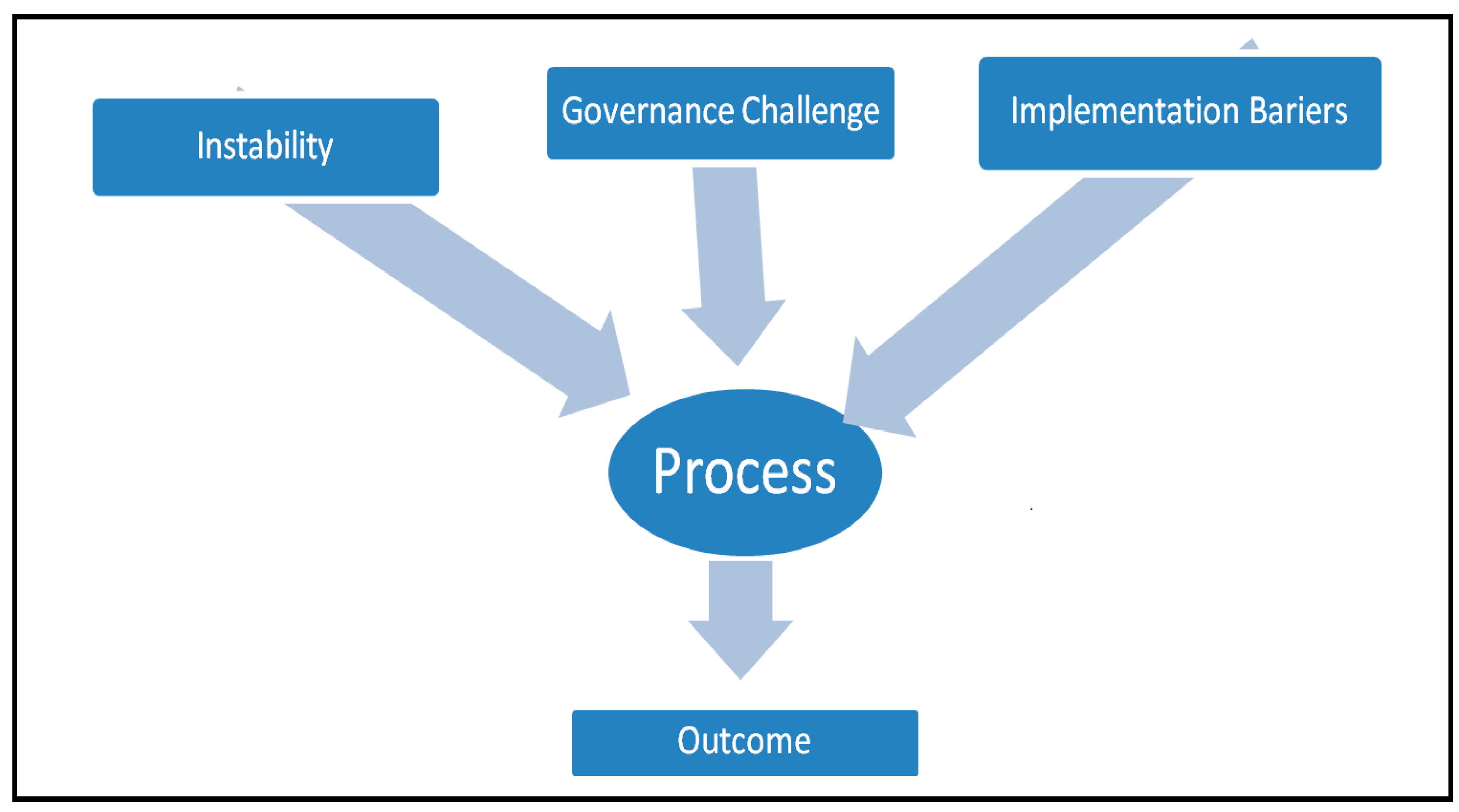
This framework is exemplifying the relationships between Instability, Governance Challenges, and Implementation Barriers leading to Processes (such as conflict resolution, policy coherence, and resource allocation), which ultimately result in Outcomes like economic growth, resilience, and social cohesion. The framework underscores the potential of grassroots initiatives, effective leadership, and external partnerships to mitigate instability and foster sustainable growth. It advocates for policies that bridge the gap between political systems and societal expectations while building institutional capacity.
Conclusions
This latter research frameworks offer an important way to interpret the challenges of leading and doing development work in fragile and unstable contexts, of which Somaliland is a robust case. Somaliland's challenges are intricately linked to the political instability, social polarization and structural fragility. This has left Somaliland with serious challenges such as international non-recognition, historical burdens, and socio-political dynamics, however, Somaliland has been able to overcome these through resilience and innovation in development.
The analysis underscores the importance of local governance structures and community engagement as critical components of Somaliland's development strategy. Clan-based systems, while often viewed as sources of division, have been instrumental in fostering stability and facilitating conflict resolution.
However, significant challenges remain, including resource constraints, environmental vulnerabilities, and ongoing political tensions. Addressing these issues is essential for ensuring sustainable development and enhancing resilience against potential shocks. The lack of formal international recognition further complicates Somaliland's access to necessary resources and support, emphasizing the need for advocacy and strategic partnerships that can bolster its development efforts.
Somaliland's experience highlights the complexity of leading development within fragility and instability. Although hindered by political isolation and limited resources, Somaliland has demonstrated resilience through its clan-based governance, grassroots initiatives, and community-led peacebuilding. These elements, while not without challenges, form the backbone of Somaliland's development efforts, proving essential in the absence of formal support.
The relationship between political instability and sustainable development in Somaliland is complex and interdependent. While political challenges can hinder development efforts, focusing on inclusive, transparent, and environmentally sustainable practices can pave the way for greater stability. By addressing the underlying causes of instability through holistic development approaches, Somaliland can work towards a more prosperous and secure future.
By fostering inclusive governance and mobilizing community strength, Somaliland continues to advance toward a more stable and prosperous future—a testament to the potential for progress in even the most challenging environments.
The framework suggests that development programs must align with local contexts, leveraging community strengths while addressing structural weaknesses. Strengthening governance, ensuring equitable resource allocation, and promoting transparency are vital for long-term success.
References
- Abdilahi, H.A. (2024). "The Causes and Consequences of Somaliland Presidential Election Delays." Available at SSRN 4896082.
- Abdulahi, H. Elections and electoral processes in Somaliland: A fading democracy. " Journal of African Elections 2022, 21, 76–99. [Google Scholar] [CrossRef]
- Abdulahi, H.I. (2023). "INTERCONNECTED MOMENTS AND ACTIONS THAT FORMED THE CURRENT IMAGE OF SOMALILAND’S SOCIAL CONTRACT.
- Ahmed, A.I. SOMALILAND’S TRADE PATTERN WITH THE REST OF THE WORLD: AN ANALYSIS OF EXPORTS AND IMPORTS." GSJ 2023, 11(3).
- Ahmed, I.I. Remittances and their economic impact in post-war Somaliland. " Disasters 2000, 24, 380–389. [Google Scholar] [CrossRef] [PubMed]
- Aisen, A. ; FJ Veiga. How does political instability affect economic growth?" European Journal of Political Economy 2013, 29, 151–167. [Google Scholar]
- Akyeampong, E. , et al. (2014). Africa's development in historical perspective, Cambridge University Press.
- Ali, N.M. Building state capacity in a post-conflict situation: the case of Somaliland. " American International Journal of Contemporary Research 2014, 4, 157–170. [Google Scholar]
- Aliyu, M.A. ; FH Ibrahim (). "REVISITING DEMOCRACY: UNRAVELING POLITICAL INSTABILITY IN AFRICA'S DEVELOPMENT NARRATIVE." Allied Journal of Political Sciences and Public Administration 2024, 12, 1–11. [Google Scholar]
- Allison, S. (2015). "Somaliland at the Crossroads Protecting a Fragile Stability.
- Asefa, S. (2012). "Challenges to Peace and Democracy in the Horn of Africa: Ethiopia, Eritrea, Somalia, and Sudan." Predicaments in the Horn of Africa: 71.
- Bade, Z.A. Dialectics of Traditional Authority and Post-Colonial Modern State: The Case of Somaliland. " European Journal of Theoretical and Applied Sciences 2024, 2, 468–479. [Google Scholar] [CrossRef]
- Bank, W. (2015). Somaliland's Private Sector at a Crossroads: Political Economy and Policy Choices For Prosperity and Job Creation, The World Bank.
- Basra, A. (2019). The Effects Of United Nations Development Programme (UNDP) Leadership Initiatives On Political Stability In Somalia, University of Nairobi.
- Brooke-Holland, B.L. (2023). "Political developments in Somaliland " House of Commons Library: 1-14.
- Co-operation, O. f. E. and Development (2011). Conflict and Fragility: from Power Struggles to Sustainable Peace: Understanding Political Settlements, OECD Publishing.
- DeShazo, P. ; P McLean (2009). Countering threats to security and stability in a failing state: lessons from Colombia, CSIS.
- Development, A. f. P. a. A VOTE FOR CHANGE: Somaliland’s Two Decades Old Electoral Democracy ": 2021, 2-29.
- Diriye, O.J. (2015). Somaliland diaspora: contribution to development, Norwegian University of Life Sciences, Ås.
- Dogan, E. , et al. (2024). "Towards global sustainable development: the role of financial innovation and technological advancements." Global Business Review: 09721509241261503.
- Fagioli, M. Complexities of State-Building in Somaliland. " International Studies Quarterly 2024, 68, sqae053. [Google Scholar] [CrossRef]
- Gordon, M. (2023). The Somaliland social covenant: an experiment in non-state coexistence, SOAS University of London.
- Harris, D. ; M Foresti (2011). "Somaliland’s progress on governance: A case of blending the old and the new." Overseas Development Institute.
- Hersi, M.F. (2018). "State fragility in Somaliland and Somalia: A contrast in peace and state building." London, London School of Economics (LSE), LSE-Oxford Commission on State Fragility, Growth and Development.
- Hussein, H. G. "Overcoming State Fragility in Somaliland: Challenges and Prospects.
- Hussein, M.R. Natural Resource Governance in Unrecognized Settings: What Are Emerging Political, Legal and Fiscal Issues Affecting “Somaliland”? " Natural Resources 2023, 14, 93–101. [Google Scholar] [CrossRef]
- Idle, A.F. The Role of Somaliland in the Horn of Africa’s Geopolitical Landscape. " International Research Journal of Management and Social Sciences 2024, 5, 649–661. [Google Scholar]
- JAMA, G. , et al. "THE IMPACT OF CLAN LEADERS ON SOMALILAND STATE SECURITY.
- Joy, J. (2021). Somaliland and Taiwan: Unrecognized Sovereignty and Patron-Client State Relations, University of Washington.
- Katsina, A.M. Nigeria’s security challenges and the crisis of development: Towards a new framework for analysis. " International Journal of developing societies 2012, 1, 107–116. [Google Scholar]
- Lindley, A. (2007). "Remittances in fragile settings: A Somali case study.
- Madar, M.J. Shaping the Paradox of Somaliland Talks with Somalia. " European Journal of Theoretical and Applied Sciences 2024, 2, 24–34. [Google Scholar] [CrossRef] [PubMed]
- Memon, A.P. Political Instability: A case study of Pakistan", J. Pol. Stud. 2011, 18: 31.
- Mensah, J. Sustainable development: Meaning, history, principles, pillars, and implications for human action: Literature review. " Cogent social sciences 2019, 5, 1653531. [Google Scholar] [CrossRef]
- Mesfin, B. The political development of Somaliland and its conflict with Puntland." Institute for Security Studies Papers 2009, 20.
- Mohamed, A. (2023). "Somaliland: A critique of International Non-Governmental Organization (INGO)-led Development.
- Moreda, F. , et al. (2024). "Resilience in changing political and social environments: the Garri pastoralists in southern frontiers of Ethiopia.
- Mudzingwa, G. T. (2023). Bandwagon of Development: Exploring the Impact of Celebrity Aid Initiative in Development Context in Somaliland, University of Agder.
- Muhumed, M.A. The Challenges and Opportunities of Good Governance in Somaliland " Somaliland Peace and Development Journal ISSN: 2707–4897(Print), 2790–7880 (Online) 2021, 5, 74–82.
- Nettle, D. , et al. Cultural diversity, economic development and societal instability." PLoS One 2007, 2, e929. [Google Scholar]
- Nilsson, M. , et al. (2022). Interlinkages, integration and coherence. The political impact of the Sustainable Development Goals: Transforming governance through global goals?, Cambridge University Press: 92-115.
- Pegg, S. ; M Walls (). "Back on track? Somaliland after its 2017 presidential election." African Affairs 2018, 117, 326–337. [Google Scholar]
- Phillips, S. (2013). "DLP.
- Rage, H. I. , et al. Global Perspective on Dialysis: Somaliland." Kidney 2024, 360, 1034067. [Google Scholar]
- Rayale, S. (2021). "Transitional Justice, Peace and Everyday Reality: Somalilands Experience with Justice and Security-Sector Reform.
- Richards, R. (2009). Challenging the Ideal?: Traditional Governance and the Modern State in Somaliland, University of Bristol.
- Richards, R. Fragility within stability: the state, the clan and political resilience in Somaliland. " Third World Quarterly 2020, 41, 1067–1083. [Google Scholar] [CrossRef]
- Roe, M.J. ; JI Siegel. Political instability: Effects on financial development, roots in the severity of economic inequality." Journal of Comparative Economics 2011, 39, 279–309. [Google Scholar]
- Rothchild, D. ; MW Foley (2019). African states and the politics of inclusive coalitions. The precarious balance, Routledge: 233-264.
- Samah, W. (2022). "Taiwan’s Overture to Somaliland." Taiwan in Africa: Seven Decades of Certainty and Uncertainties: 61.
- Schoeman, A. (2021). "Beyond the state-centric lens of the fragile state discourse: the case for hybrid political orders in Somaliland.
- Shab’an, H. Y. "Somaliland Presidential Election Processes: A Comprehensive Analysis.
- Tsion Belay, A. A. , et al. (2019). "SOMALIA CONFLICT INSIGHT." PEACE & SECURITY REPORT 1.
- Tsion Belay AA CT CH MS MS PM TK F (219), P.E.A.C.E. ; SECURITYREPORT Addis Ababa University, Institute for Peace and Security Studies. 1: 1-27.
- UNDP (14 ). Governance for Sustainable Development Integrating Governance in the Post-2015 Development Framework UNDP: 1-14. 20 March.
- Widjaja, G. Economic Development Transformation with Environmental Vision: Efforts to Create Sustainable and Inclusive Growth. " Kurdish Studies 2023, 11, 3154–3177. [Google Scholar]
- Wiuff Moe, L. Hybrid and ‘everyday’political ordering: constructing and contesting legitimacy in Somaliland. " The Journal of Legal Pluralism and Unofficial Law 2011, 43, 143–177. [Google Scholar] [CrossRef]
- Woodward, S.L. Economic priorities for successful peace implementation. " Ending civil wars: The implementation of peace agreements 2002, 183, 183. [Google Scholar]
- Young, C. (1986). "Africa's colonial legacy." Strategies for African development: 25-51.
- Yusuf, A. (2024). "Strengthening Democracy in Somaliland: Addressing Clan Influence." Available at SSRN 4933491.
- Zehri, C. , et al. Exploring the nexus of decent work, financial inclusion, and economic growth: A study aligned with SDG 8." Sustainable Futures 2024, 7, 100213. [Google Scholar]
Disclaimer/Publisher’s Note: The statements, opinions and data contained in all publications are solely those of the individual author(s) and contributor(s) and not of MDPI and/or the editor(s). MDPI and/or the editor(s) disclaim responsibility for any injury to people or property resulting from any ideas, methods, instructions or products referred to in the content. |
© 2025 by the authors. Licensee MDPI, Basel, Switzerland. This article is an open access article distributed under the terms and conditions of the Creative Commons Attribution (CC BY) license (http://creativecommons.org/licenses/by/4.0/).
Copyright: This open access article is published under a Creative Commons CC BY 4.0 license, which permit the free download, distribution, and reuse, provided that the author and preprint are cited in any reuse.


