
Submitted:
10 February 2025
Posted:
13 February 2025
You are already at the latest version
Abstract
This study aimed to shorten firefighter search times during indoor fires, allowing more people to be rescued, by enhancing disaster prevention capabilities using building technologies. In indoor fires, fatalities are often caused by the failure of firefighters to rescue individuals in a timely manner. The question of how to effectively increase the probability of survival while waiting for rescue behind closed doors warrants in-depth research and analysis. Therefore, to ensure that people live in safe environments, there is an urgent need to develop a building door panel material with an emergency call function to prevent such incidents from occurring. Utilizing the PRISMA method, we conducted a comprehensive review of the existing literature to identify the key issues and limitations associated with the current search-and-rescue techniques. Subsequently, the identified primary factors were analyzed using the TRIZ method to determine the key factors that influence the success of rescuing trapped individuals, and a notification system was designed to address this issue. Based on the premise that it is advisable to wait for rescue during a fire, we utilized a smartphone to scan a QR code and transmit the exact location information to the fire department. Through extensive participation and feedback from firefighters, we developed a rescue notification door panel and obtained a patent for it. This system can significantly reduce the time required for search-and-rescue operations in fire incidents. The experimental results show a reduction of one-third in search times.
Keywords:
1. Introduction
2. Materials and Methods
2.1. Journal Article Search Plan
- (1)
- Search Limits
- (2)
- Search Strategy
- Equipment: TIC, helmet, camera, smartphone, and robot.
- Technology: BIM, GIS, VR, AR, hybrid reality, AI, machine learning, games, and deep learning.
- Other aspects: navigation, positioning, wayfinding, and pathfinding.
- (3)
- Data Extraction
2.2. Journal Article Search Execution and Finding
- (1)
- Data Synthesis.
- (2)
- Eligibility Criteria.
- (3)
- Study Selection.
- (4)
- Risk of Bias.
- (5)
- Inclusion and Exclusion Criteria
2.3. Experimental Design
3. Experiments and Results
3.1. Implementation of Experiments
3.2. Participants
3.3. Test Research Hypotheses
3.4. Experimental Procedure
3.5. Analysis of Data and Results
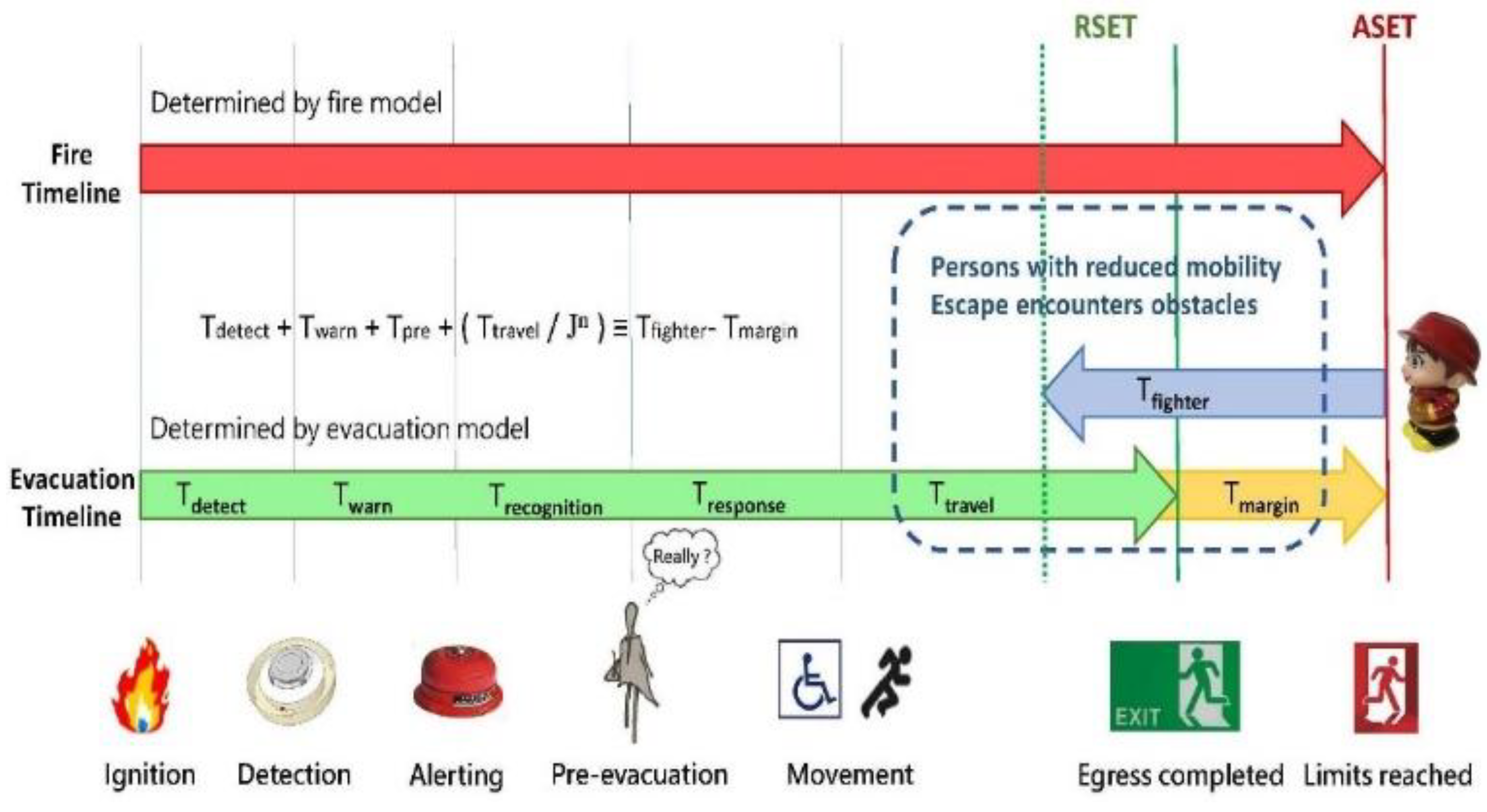
3.6. Discovery of Rescue Time
- ASET: Available safe egress time.
- RSET: Required safety escape time.
- Tfighter: Search time required for firefighters to rescue trapped victims.
- Tdetect: Fire detector detection time.
- Twarn: Fire alarm activation time (warning time).
- Tpre: Recognition time and response time (pre-evacuation time).
- Ttravel: Evacuation time (travel time).
- Tmargin: An acceptable margin of safety.
- n: Number of turn nodes on the escape path (n > 0).
- J: Correct path node direction (if correct = 1; otherwise, 0).
4. Discussion
4.1. Study Limitations and Alternatives
4.2. Implications and Application Issues of the Study
4.3. Feasibility of Practical Implementation
4.4. Status and Recommendations for Future Research
5. Conclusions
Author Contributions
Funding
Ethical Declaration Statement:
Data Availability Statement
Acknowledgments
Disclosure Statement:
Biographical Note:
Intellectual Property:
References
- Chen, J.; Li, N.; Shi, Y.; Du, J. Cross-cultural assessment of the effect of spatial information on firefighters’ wayfinding performance: A virtual reality-based study. International Journal of Disaster Risk Reduction 2023, 84, 103486. [Google Scholar] [CrossRef]
- Yang, Q.; Zhang, X.; Zhang, Z.; He, L.; Yan, X.; Na, J. Fire Scenario Zone Construction and Personnel Evacuation Planning Based on a Building Information Model and Geographical Information System. ISPRS Int. J. Geo-Inf. 2022, 11, 110. [Google Scholar] [CrossRef]
- Chen, J.; Zhang, X.; Su, G.; Chen, T. Study on fire-rescue command system and key technology of ultra high-rise building. 5th International Congress on Image and Signal Processing 2012, 6469834, 1906–1910. [Google Scholar] [CrossRef]
- Purser, D.A.; Bensilum, M. Quantification of behavior for engineering design standards and escape time calculations. Safety Science 2001, 38, 157–182. [Google Scholar] [CrossRef]
- Tai, Y.; Yu, T.-T. Using Smartphones to Locate Trapped Victims in Disasters. Sensors 2022, 22, 7502. [Google Scholar] [CrossRef]
- Li, N.; Becerik-Gerber, B.; Soibelman, L.; Krishnamachari, B. Comparative assessment of an indoor localization framework for building emergency response. Automation in Construction 2015, 57, 42–54. [Google Scholar] [CrossRef]
- Nunavath, V.; Prinz, A. Data sources handling for emergency management: Supporting information availability and accessibility for emergency responders. Lecture Notes in Computer Science (including subseries Lecture Notes in Artificial Intelligence and Lecture Notes in Bioinformatics) 2017, 10274, 240–259. [Google Scholar]
- Kuo, T.-W.; Lin, C.-Y.; Chuang, Y.-J.; Hsiao, G.L.-K. Using Smartphones for Indoor Fire Evacuation. Int. J. Environ. Res. Public Health 2022, 19, 6061. [Google Scholar] [CrossRef]
- Tsai, P.-F.; Liao, C.-H.; Yuan, S.-M. Using Deep Learning with Thermal Imaging for Human Detection in Heavy Smoke Scenarios. Sensors 2022, 22, 5351. [Google Scholar] [CrossRef]
- Kobayashi, T.; Seimiya, S.; Harada, K.; Noi, M.; Barker, Z.; Woodward, G.K.; Willig, A.; Kohno, R. Wireless technologies to as-sist search and localization of victims of wide-scale natural disasters by unmanned aerial vehicles. International Symposium on Wireless Personal Multimedia Communications 2018, pp. 404–410. [CrossRef]
- Fire, M.; Guestrin, C. Over-optimization of academic publishing metrics: observing Goodhart’s Law in action. Giga-Science 2019, 8. [Google Scholar] [CrossRef]
- Van Noorden, R.; Maher, B.; Nuzzo, R. The top 100 papers Nature explores the most-cited research of all time. Nature 2014, 514, 550–553, https://www.researchgate.net/publication/267728073_The_top_100_papers. [Google Scholar] [CrossRef] [PubMed]
- Ranasinghe, U.; Jefferies, M.; Davis, P.; Pillay, M. Conceptualising project uncertainty in the context of building refurbishment safety: A systematic review. Buildings 2021, 11, 89. [Google Scholar] [CrossRef]
- Anastasiadou, M.; Santos, V.; Dias, M.S. Machine Learning Techniques Focusing on the Energy Performance of Buildings: A Dimensions and Methods Analysis. Buildings 2022, 12, 28. [Google Scholar] [CrossRef]
- Khodadadi, A.; von Buelow, P. Design exploration by using a genetic algorithm and the Theory of Inventive Problem Solving (TRIZ). Automation in Construction 2022, 141, 104354. [Google Scholar] [CrossRef]
- Fiorineschi, L.; Frillici, F.S.; Rotini, F.; Conti, L.; Rossi, G. Adapted Use of the TRIZ System Operator. Appl. Sci. 2021, 11, 6476. [Google Scholar] [CrossRef]
- Zhang, P.; Jing, S.; Nie, Z.; Zhao, B.; Tan, R. Design and Development of Sustainable Product Service Systems Based on Design-Centric Complexity. Sustainability 2021, 13, 532. [Google Scholar] [CrossRef]
- Qiu, C.; Tan, J.; Liu, Z.; Mao, H.; Hu, W. Design Theory and Method of Complex Products: A Review. Chinese Journal of Mechanical Engineering 2022, 35, 103. [Google Scholar] [CrossRef]
- Howard, T.J.; Culley, S.; Dekoninck, E.A. Reuse of ideas and concepts for creative stimuli in engineering design. Journal of Engineering Design 2011, 22, 565–581. [Google Scholar] [CrossRef]
- Seo, D.-G.; Kim, M.-S.; Gu, S.-H.; Song, Y.-J. A Study on the Safety of Evacuation according to Evacuation Delay Time and Fire Door Openness: Based on Residence Types. Korean Institute of Fire Science & Engineering 2020, 34, 156–165. [Google Scholar] [CrossRef]
- Ng, P.K.; Prasetio, M.D.; Liew, K.W.; Salma, S.A.; Safrudin, Y.N. A TRIZ-Inspired Conceptual Development of a Roof Tile Transportation and Inspection System. Buildings 2022, 12, 1456. [Google Scholar] [CrossRef]
- Yu, X.; Fan, Z.; Wan, H.; He, Y.; Du, J.; Li, N.; Yuan, Z.; Xiao, G. Positioning, navigation, and book accessing/returning in an autonomous library robot using integrated binocular vision and QR code identification systems. Sensors 2019, 19, 783. [Google Scholar] [CrossRef] [PubMed]
- Griffin, A.L.; Reichenbacher, T.; Liao, H.; Wang, W.; Cao, Y. Cognitive issues of mobile map design and use. Journal of Location Based Services 2024. [Google Scholar] [CrossRef]
- Hsiao, G.L.-K.; Tang, C.-H.; Huang, T.-C.; Lin, C.-Y. Firefighter Wayfinding in Dark Environments Monitored by RFID. Fire Technology 2016, 52, 273–279. [Google Scholar] [CrossRef]
- Yoon, B.; Kim, H.; Youn, G.; Rhee, J. 3D Position Estimation of Objects for Inventory Management Automation Using Drones. Applied Sciences (Switzerland) 2023, 13, 10830. [Google Scholar] [CrossRef]
- Tessem, B.; Bjørnestad, S.; Chen, W.; Nyre, L. Word cloud visualisation of locative information. Journal of Location Based Services 2015, 9, 254–272. [Google Scholar] [CrossRef]
- Olsson, F.; Rantakokko, J.; Nygards, J. Cooperative localization using a foot-mounted inertial navigation system and ultrawideband ranging. International Conference on Indoor Positioning and Indoor Navigation 2014, 7275476, 122–131. [Google Scholar] [CrossRef]
- Rantakokko, J.; Strömbäck, P.; Andersson, P. Foot-and knee-mounted INS for firefighter localization. Institute of Navigation International Technical Meeting 2014, 145–153, https://www.ion.org/publications/abstract.cfm?articleID=11480. [Google Scholar]
- Lovreglio, R.; Kinateder, M. Augmented reality for pedestrian evacuation research: Promises and limitations. Safety Science 2020, 128, 104750. [Google Scholar] [CrossRef]
- Tinaburri, A. Principles for Monte Carlo agent-based evacuation simulations including occupants who need assistance. From RSET to RiSET. Fire Safety Journal 2022, 127, 103510. [Google Scholar] [CrossRef]
- Zhang, G.; Huang, D.; Zhu, G.; Yuan, G. Probabilistic model for safe evacuation under the effect of uncertain factors in fire. Safety Science 2017, 93, 222–229. [Google Scholar] [CrossRef]
- Martin, F.; Jesper, K.; Håkan, F.; Axel, M.; Daniel, N. The Variation of Pre-movement Time in Building Evacuation. Fire Technology 2019, 55, 2491–2513. [Google Scholar] [CrossRef]
- Gwynne, S.M.V.; Boyce, K.E. SFPE Handbook of Fire Protection Engineering, 5th ed.; Chapter 64 Engineering Data; National Fire Protection Association: Greenbelt, MD, USA, 2016; https://library.villanova.edu/Find/Record/1597879/TOC. [Google Scholar]
- Lin, B.S.-M.; Lin, C.-Y.; Kung, C.-W.; Lin, Y.-J.; Chou, C.-C.; Chuang, Y.-J.; Hsiao, G.L.-K. Wayfinding of Firefighters in Dark and Complex Environments. Int. J. Environ. Res. Public Health 2021, 18, 8014. [Google Scholar] [CrossRef] [PubMed]
- Siddiqui, A.A.; Ewer, J.A.; Lawrence, P.J.; Galea, E.R.; Frost, I.R. Building Information Modelling for performance-based Fire Safety Engineering analysis – A strategy for data sharing. Journal of Building Engineering 2021, 42, 102794. [Google Scholar] [CrossRef]
- Yuan, D.-J.; Jin, H.; Chen, Z.-C.; Liu, S.-N. Evacuation Experiment Study in Up and Down Escape Staircase of Underground Road. Advances in Civil Engineering 2021. [CrossRef]
- Tjolleng, A.; Chang, J.; Jeong, L.; Kim, M.; Jung, K. Ergonomic design recommendations for designing an optical fiber rescue signal to life jacket. International Journal of Industrial Engineering : Theory Applications and Practice 2020, 27, 463–472, https://www.researchgate.net/publication/344983790_Ergonomic_Design_Recommendations_for_Designing_an_Optical_Fiber_Rescue_Signal_to_Life_Jacket. [Google Scholar]
- Lee, C.-A.; Sung, Y.-C.; Lin, Y.-S.; Hsiao, G.L.-K. Evaluating the severity of building fires with the analytical hierarchy process, big data analysis, and remote sensing. Natural Hazards 2020, 103, 1843–1856. [Google Scholar] [CrossRef]
- Gewin, V. How to write a first-class paper. Nature 2018, 555, 129–130. [Google Scholar] [CrossRef]
- Kim, J.-I.; Gang, H.-S.; Pyun, J.-Y.; Kwon, G.-R. Implementation of QR Code Recognition Technology Using Smartphone Camera for Indoor Positioning. Energies 2021, 14, 2759. [Google Scholar] [CrossRef]
- Hung, H.-Y.; Chuang, Y.-J.; Lin, C.-Y. Enhancing Refuge Space Safety: Tape Application to Reduce Door Leakage during Fires. Advances in Civil Engineering 2024. [CrossRef]
- Kuo, J.-Y.; Song, X.T.; Chen, C.-H.; Patel, C.D. Fostering design thinking in transdisciplinary engineering education. Advances in Transdisciplinary Engineering 2021, 16, 63–70, https://ebooks.iospress.nl/doi/10.3233/ATDE210083. [Google Scholar]
- Semahat Merve, T.O.P. The effect of domed and hip roof coverings on mosque design in case of fire. Journal of Engineering Research 2023, 2307–1877. [Google Scholar] [CrossRef]
- Gelfert, S. Body Part Detection in Smoky Environments with Thermal Camera Using Deep Learning. International Conference on Control, Automation and Systems 2022 November, pp. 1508–1514. [CrossRef]
- Radianti, J. Experience from indoor fire search and rescue game design for technology testing. Advances in Intelligent Systems and Computing 2019, 795, 253–265. [Google Scholar] [CrossRef]
- Cope, J.; Arias, M.; Williams, D.; Bahm, C.; Ngwazini, V. Firefighters’ Strategies for Processing Spatial Information During Emergency Rescue Searches. Lecture Notes in Computer Science (including subseries Lecture Notes in Artificial Intelligence and Lecture Notes in Bioinformatics) 2019, 11420, 699–705. [Google Scholar] [CrossRef]


 |
 |
Disclaimer/Publisher’s Note: The statements, opinions and data contained in all publications are solely those of the individual author(s) and contributor(s) and not of MDPI and/or the editor(s). MDPI and/or the editor(s) disclaim responsibility for any injury to people or property resulting from any ideas, methods, instructions or products referred to in the content. |
© 2025 by the authors. Licensee MDPI, Basel, Switzerland. This article is an open access article distributed under the terms and conditions of the Creative Commons Attribution (CC BY) license (http://creativecommons.org/licenses/by/4.0/).