

Submitted:
24 January 2025
Posted:
27 January 2025
You are already at the latest version
Abstract
Cost estimation in any project is the prime concern. Early stage cost estimate plays a significant role in the success of any construction project. Cost is probably the first to be considered when it comes to construction projects. Accurate estimation of quantities and costs incurred in a construction project is a crucial factor in its achievement. Because of the complexity of the construction industry and the individuality of every project undertaking, several factors may affect the overall project cost. Several objects, such as the structural, architectural, sanitary, electrical, and air-conditioning system workings conclude the total cost of buildings. Meanwhile, the structural casing covers 25% of the total construction cost in a multistory reinforced concrete residential building. All parties involved in the construction of a project; owners, contractors, and donors need reliable information about the cost in the early stages of the project, where very limited drawings and details are available during this stage. This research aims at developing a model to estimate the cost of building construction projects with a high degree of accuracy and without the need for detailed information or drawings by using an Artificial Neural Network (ANN). ANN is a new approach that is used in cost estimation, which can learn from experience and examples and deal with non-linear problems.
Keywords:
Price
; Cost estimation
; Construction
; Artificial Neural Network
1. Introduction
Construction cost estimating is the process of forecasting the cost of building a physical structure. Of course, builders and clients both worry about the financial impact of cost overruns and failing to complete a project. Therefore, before opting to proceed with a project, they invest time and energy into assessing its cost. When contemplating major projects, clients frequently request several cost estimates, including those determined by impartial estimators and those created by contractors. Cost estimates are used by project owners to assign money and assess the viability and scope of a project. They are used by contractors to determine whether to submit a bid for a job. To make sure a project satisfies scope and financial feasibility standards, you typically create estimates with the help of engineers and architects. An accurate cost estimate helps the customer avoid overpaying and keeps the builder from losing money. It is a fundamental part of earned value management, a project management methodology that compares the actual time and cost of a project to its performance. It's always crucial to comprehend and quantify the various aspects and concepts of cost escalation so that different corrective measures can be implemented to lower expenses. (Mekonen et al., 2023).One of the construction manager's three primary challenges is cost, as a project's success is determined by its ability to meet the owner's specified quality standards, schedule on time, and budget. (Rezaian, 2011). An anticipated profit can quickly be turned into a loss due to inadequate planning, a bad budget, or inaccurate schedule forecasting. (Cheng, 2014). As a result, one of the key components of a successful construction project is accurate estimating.(Hakami, 2017). Therefore, early cost estimation is crucial to any construction project. (Samir Ayed, 1997), where it allows owners and planners to evaluate project feasibility and control costs effectively (Feng et al., 2010).Additionally, choices made in the early stages have a big impact on a building's cost. However, during every stage of the construction project, this influence diminishes.(Günaydın & Doğan, 2004).Construction managers usually use their expertise, experience, and standard estimators to estimate project costs because cost estimates are important in the early stages of a project and information is scarce during this time. As a result, intuition is crucial when making decisions. Researchers have put a lot of effort into creating cost estimation methods that optimize the usefulness of sparse data in order to increase the precision and dependability of cost estimation work, given the fundamental need of project owners and planners for a tool to aid in their early decisions. (Cheng, et al., 2010). As a result, numerous techniques—both conventional and artificial intelligence—were researched and evaluated for their applicability in project cost estimation during the conceptual phase. Artificial Neural Networks (ANNs), a new approach based on the theory of computer systems that mimic the learning effect of the human brain, have gained popularity in recent years. (Cavalieri et al., 2004). The ability of ANN to comprehend and model more complex functions than more traditional techniques like linear regression is one of its main advantages. (Weckman et al., 2010). It is also capable of adequately approximating functions without providing an explanation. As a result, output is produced in response to various input signals, and precise estimations can be produced through network training.(Verlinden et al., 2007).This research paper is my original work and has never been presented anywhere in any study
2. Methodology
The following actions will be taken in order to accomplish the goals of this study:
- ✓
- Conduct a thorough literature review, concentrating on earlier research on construction cost estimates with a particular focus on the application of artificial neural networks (ANN).Utilize quantitative and qualitative survey techniques to identify the key factors that influence the cost of building projects in the Jimma district.
- ✓
- Conduct exploratory interviews with engineering institutions to gather relevant data on building projects, which will be utilized in constructing the model.
- ✓
- Select and employ Neuro-solution software as the platform for building the neural network model.
- ✓
- Validate the adopted model by employing statistical performance measurements and conducting sensitivity analysis to assess its accuracy and reliability.
By following these steps, the study aims to enhance our understanding of construction cost estimates, particularly in relation to ANN applications, and provide valuable insights into the influential factors affecting building project costs in the Jimma district.
3. Literature Review
Since cost is one of the primary factors in decision-making at the very beginning of the building design process, cost estimation is a crucial component of construction projects. (Gunaydın & Dogan, 2004). Since cost overruns are a big issue in construction projects, especially with the current emphasis on tight budgets, estimation accuracy is crucial to the project's success. Indeed, a project may be canceled due to cost overruns. In certain situations, a project may be converted to a design-to-cost task due to a possible overrun. (Feng, et al., 2010).A construction project's cost must therefore be estimated within a certain range of accuracy. However, the biggest challenges to a cost estimate, especially in the early stages, are a lack of preliminary data and greater uncertainties resulting from engineering solutions. Therefore, cost estimation techniques are used to approximate the cost within an acceptable accuracy range in order to overcome this lack of detailed information. (Verlinden, et al., 2007). An efficient substitute for conceptually estimating construction costs is the use of cost models. But because there are a lot of variables influencing project costs, creating cost models can be difficult. For modeling, a variety of noisy data are typically available. (Sonmez, 2011).
Another use for cost estimates is to help engineers and designers understand the financial effects of their choices while they are still in the design stage. Additionally, accurate cost estimates enable management to decide which items should be redesigned and which will be profitable. (Weckman, et al., 2010).
Additionally, the cost estimate is crucial during the tendering process, as demonstrated by Carty and Winslow. (cited in((ElSawy et al., 2011))), have viewed that cost estimate as a crucial tool for landing new contracts at competitive prices, opening the door to long-term business viability. Therefore, in a construction project, where the available bid-estimation time is frequently insufficient, a precise bid price estimate is crucial to winning the project contract and making a respectable profit. (Akintoye et al., 1999).The structure of the nerve cells in the human brain serves as the inspiration for the clever technique known as an artificial neural network (ANN). An artificial neural network (ANN) is a network of interconnected nonlinear processing units. These units, also known as weights, store knowledge through adaptation in order to learn from a set of training patterns.(Rababah et al., 2019).
ANNs are one of these novel methods that can handle tasks with fuzzy or incomplete information, incomplete data sets, and extremely complex and ill-defined problems. In addition to handling non-linear problems, ANNs are capable of learning from examples. One of the unique features of ANN is its capacity to learn from examples and experience before adjusting to new circumstances. Inherently, it has a tendency to store and make accessible experiential knowledge. (Doğan, 2005).
According to (Kim, 2011), The ability of ANN to identify a good cost estimation relationship that mathematically characterizes a system's cost as a function of the variables that have the greatest impact on that system's cost makes it a viable alternative for estimating construction costs. Weckman et al. ",". (2010) observes that ANN's primary advantage is its capacity to comprehend and model complex functions, including those dimensions, attributes, and other elements. ANNs' architecture is modeled after the structure and operation of the human brain, which is made up of a collection of neurons arranged in one or more hidden layers and joined by synapse connections. The weight of a connection is the degree of electrical conductivity that may vary among synapses, which are the connections between neurons. Knowledge is stored in this network of synapses and neurons in a "distributed" fashion: information is encoded as an electrical impulse in the neurons and stored by varying the weight (i.e. E. how well the connections conduct electricity. (Cavalieri, et al., 2004).
4. Initial Cost Estimation
The first rough estimate of a project's cost is called a conceptual estimate, sometimes known as a top-down, order of magnitude, feasibility, analytical, or preliminary estimate. It is typically conducted as part of the project's feasibility analysis during the early stages. Conceptual estimates are made with limited information on the project scope and are not based on detailed design or engineering data.
A conceptual estimate's objective is to give a general idea of the project's budget.It serves as a starting point for decision-making and determining the project's financial feasibility. Since the estimate is based on incomplete information, it requires significant experience and judgment to generate a reliable approximation of the cost.
Conceptual estimates are often considered high-level assessments, helping stakeholders assess the potential viability of the project and make informed decisions regarding its advancement. As more detailed information becomes available, the estimate can be refined and adjusted accordingly.
4.1. Definition of Conceptual Cost Estimation
An estimate created by applying engineering concepts rather than counting individual parts is known as a "conceptual estimate.". As the name suggests, conceptual estimates are typically created early on in a project, frequently before construction drawings are finished. A conceptual estimate's primary purpose is to inform the owner of the expected cost, providing them with valuable information to help them consider the project's viability and future advancement. In addition, a conceptual estimate is used to establish an initial construction budget and manage construction expenses during the design phase, which is the most crucial phase. The forecast of project costs that is done before a substantial amount of information is available from detailed design and with an incomplete work scope definition is known as conceptual cost estimation. It is used as the foundation for crucial project decisions such as go/no-go and funding allocation decisions.
4.2. Conceptual Cost Evaluating Characteristics
The inexactness of the process is the first acknowledged feature of conceptual estimating, as it is of all estimating. Opinion may be the only option available for evaluating designs in the event of data and time constraints. The art and science of conceptual estimating are combined to determine the cost of previous work. The art lies in choosing comparable costs from previous projects, adapting them to new circumstances, and visualizing a project and the construction of every detail. The second feature of conceptual estimating is that the degree of information provided by the project scope has a significant impact on its validity and accuracy. The most important component for conceptual estimating is thought to be the availability of a clear, comprehensive scope definition. The fact that conceptual estimating is a resource-constrained activity is its third feature. Information, time, and money are the primary resources needed for conceptual estimating. The scope information that is available is typically limited in both detail and precision because conceptual es-timating is done early in the project. Furthermore, there are limitations on the amount of time and money available to create the estimate. Conceptual estimating is used to screen multiple alternative designs or swiftly assess a project's viability. As a result, despite its importance, the estimate cannot be given much time or resources.
4.3. Importance of Conceptual Cost Estimates
A preliminary estimate acts as the initial check against the budget, supporting the overall cost-control program. It will alert the project team to cost overruns in time for them to examine the design and consider other options. There will be a fair amount of margin for error because an initial estimate is made before a detailed design is finished. Next, the more extensive contingency ought to be implemented. The amount of design information and cost information that can be obtained from comparable projects determines the contingency.
4.4. Developing Conceptual Cost Estimates
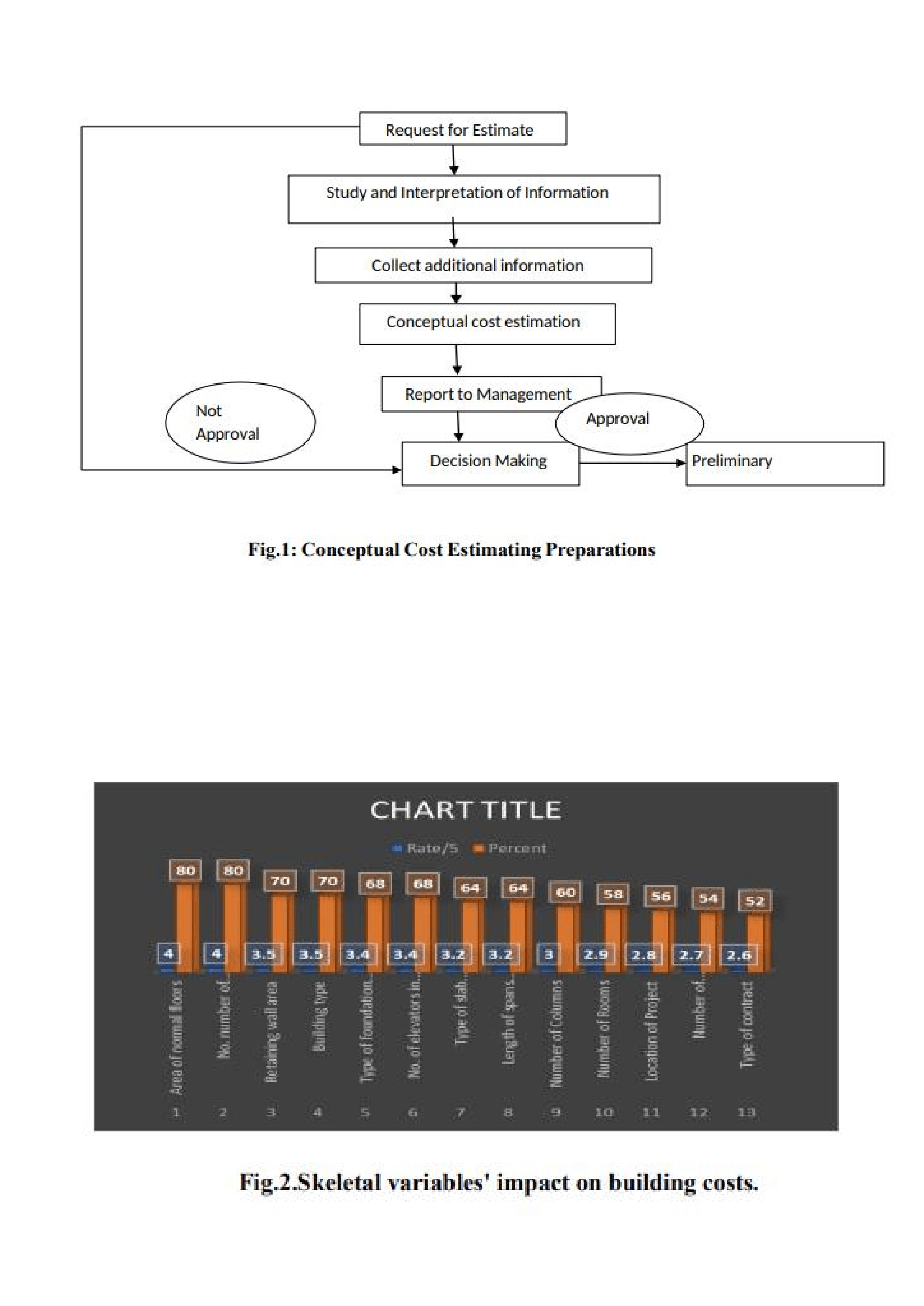
A general conceptual cost estimating preparation is depicted in Figure 1 below. The preparations start when management requests a cost estimate for a new project. The project scope is the request's most crucial component. In order to create an estimated plan, the estimator must first analyze and interpret the project scope. The next step is to gather historical information about comparable previous projects. For the estimating preparations, the selection and use of these data are essential since inaccurate information will have a detrimental impact on the estimate. This stage produces a conceptual cost estimate for the project as well as a documented estimating basis for this cost. Detailing every piece of information, assumption, modification, and process taken into account in the estimate is crucial. After creation, the conceptual cost estimate is presented to management for approval.
A cost analysis of a prior, comparable building should be gathered in order to create an elemental cost plan. Prepare the project's elevations and plans in sketch form. Describe the installation specifications and levels of services, etc. for the project that is being contemplated.
5. Result and Discussion
5.1. Variables Influencing the Building Projects' Costs
One of the most important parts of developing a neural network model is figuring out which factors actually affect construction project costs. Given the significance of this task, several meticulous techniques were employed to identify these factors specifically within the context of building projects in the Jimma district. These techniques included a comprehensive review of relevant literature studies and bill of quantities (BOQ) documents, conducting surveys through questionnaires, and utilizing the Delphi technique by engaging in expert interviews.
The literature review involved an extensive examination of previous studies and research related to building project costs, enabling the identification of key factors that consistently emerged as significant contributors. Additionally, analyzing bill of quantities documents provided valuable insights into the cost breakdowns and itemized expenses associated with various building projects.
To gather further input and perspectives, surveys were conducted through well-structured questionnaires. These surveys aimed to capture quantitative and qualitative data from stakeholders involved in building projects in the Jimma district. The responses obtained helped in identifying influential factors by considering the perspectives and experiences of those directly involved in project implementation.
Furthermore, the Delphi technique, a method involving multiple rounds of expert interviews and feedback, was utilized. Experts in the field of building projects, including professionals from engineering institutions, were consulted to obtain their insights, opinions, and expert judgment regarding the factors that significantly impact project costs in the Jimma district. This iterative approach helped in reaching a consensus and refining the identified factors based on expert consensus and collective knowledge.
By employing these rigorous techniques, the study ensured a comprehensive and robust identification of the factors with a genuine influence on building project costs in the Jimma district. The combination of literature review, bill of quantities analysis, surveys, and expert interviews allowed for a multi-faceted and well-informed selection of factors crucial to the neural network model's accuracy and effectiveness.
5.2. Questionnaire Analysis
Eighty questionnaires were distributed to various engineering institutions, where, fifty-seven questionnaires, with a response rate of 75% of the total number of questionnaires, have been correctly answered and submitted. These questionnaires were cleaned, and some of them were omitted due to incomplete or inaccurate data. More details and analysis are discussed in this section for the questionnaire results.
Type of Company
The survey findings revealed that a significant percentage of the respondents possess substantial experience in the construction field and hold advanced positions within their respective job levels. This notable level of expertise and seniority among the respondents adds a considerable degree of credibility and authenticity to the results obtained from the survey, lending them a greater sense of logic and real-world relevance.
- ➢
- Type of company

Table 1.
Questionnaire distribution is based on the type of company.
| No. | Description | % | No. |
|---|---|---|---|
| 1 | Contractor | 46 | 28 |
| 2 | Consultant | 40 | 24 |
| 3 | Owner (Municipality, Ministry,…) | 14 | 8 |
- ➢
- Job title
Table 2.
Questionnaire distribution is based on job title.
| No. | Description | Percent | Frequency |
|---|---|---|---|
| 1 | Owner | 10 | 6 |
| 2 | Project Manager | 25 | 15 |
| 3 | Site Engineer | 45 | 27 |
| 4 | Others | 20 | 12 |
- ➢
- Years of experience working on building projects.
Table 3.
Distribution of the questionnaire based on years of experience.
| Description | Percent | Frequency |
|---|---|---|
| 1-3 | 30% | 18 |
| 4-6 | 18% | 11 |
| 7-10 | 27% | 16 |
| More tha 10 | 25% | 15 |
- ➢
- Experience in Building Projects
Table 4.
Distribution of the questionnaire based on building project experience.
| No. | No. of projects | Percent | Frequency |
|---|---|---|---|
| 1 | 1-5 | 57% | 34 |
| 2 | 6-10 | 42% | 25 |
| 3 | More than 10 | 1% | 1 |
The total number of respondents=60 respondents.
5.3. Cost Considerations for the Skeleton Phase
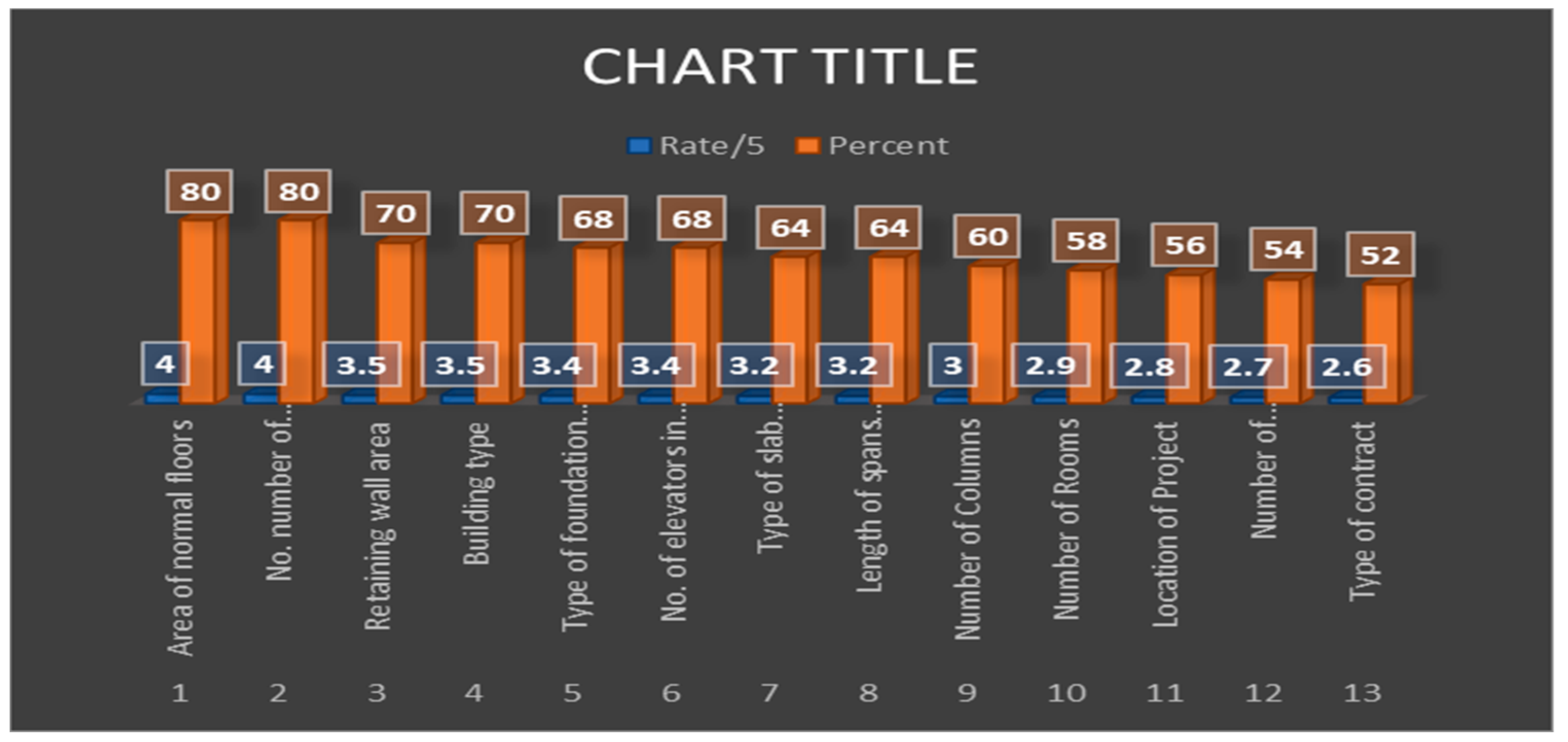
As is well known, a building project is divided into two basic phases: the skeleton phase and the finishing phase. Each of these phases has a significant impact on the overall project and cost. The majority of respondents believe that the 13 skeleton factors in the table—which include the area of a typical floor and the number of floors—have the greatest impact on building costs, while the retaining wall area, building type, foundation type, elevator count, and slab type have a moderate impact. The project cost is less affected by the remaining parameters, such as the number of rooms, the number of columns, the length of the span between columns, the location of the project, the number of staircases, and the type of contract.
Table 5.
Skeletal factors' impact on construction costs.
| No | Description | Rate/5 | Percent |
|---|---|---|---|
| 1 | Area of normal floors | 4.0 | 80 |
| 2 | No. number of floors in the structure | 4.0 | 80 |
| 3 | Retaining wall area | 3.5 | 70 |
| 4 | Building type | 3.5 | 70 |
| 5 | Type of foundation utilized inthe structure | 3.4 | 68 |
| 6 | No. of elevators in the building | 3.4 | 68 |
| 7 | Type of slab (Ribbed, Solid…) | 3.2 | 64 |
| 8 | Length of spans between columns | 3.2 | 64 |
| 9 | Number of Columns | 3.0 | 60 |
| 10 | Number of Rooms | 2.9 | 58 |
| 11 | Location of Project | 2.8 | 56 |
| 12 | Number of staircases in the building | 2.7 | 54 |
| 13 | Type of contract | 2.6 | 52 |
Figure 2.
Skeletal variables' impact on building costs.
Recommendation and Conclusion.
5.4. Conclusion
The essential objective of this ponder was to create an inventive strategy for early taken a toll estimation of building ventures within the Jimma district.
The point was to make a show that may give partners included in development ventures such as proprietors temporary workers and others with comprehesive fetched data amid the introductory stages of a venture when information is limited.
The taking after steps and methods were attempted to realize this objective
- Identification of Cost-Effective Factors: A mix of questionnaire surveys, expert interviews, and a thorough review of existing research was used to pinpoint the most significant factors influencing construction costs. Eleven essential parameters were identified, including building usage, average floor area, number of stories, foundation type, slab type, number of elevators, type of air conditioning, exterior finishing, tile type, electrical system, and plumbing type.
- Collection of historical data: Historical data on building projects executed between 2021 and 2022 in the Jimma district were gathered from government ministries, engineering institutions, contractors, and consultants. The data underwent analysis, with certain data points excluded based on predefined criteria.
- Development of the ANN Model: The creation of the Artificial Neural Network (ANN) model occurred in multiple phases. The Neurosolution 5.07 software was chosen as the modeling tool for its effectiveness and user-friendliness. The datasets were formatted and input into an MS Excel spreadsheet to train different models.
- Accuracy performance of the model: The implemented model showed an accuracy rate of 94%, indicating robust performance with only a slight discrepancy between the projected outputs and the actual budget figures. The model's average percentage error was noted at 6%, which is comfortably within the acceptable error range of 20-50% for preliminary cost estimation in construction projects.
- Validation of the Model: Several statistical performance metrics, such as Mean Absolute Error (MAE), Mean Absolute Percentage Error (MAPE), Total Mean Absolute Percentage Error (Total MAPE), and Correlation Coefficient (r), were used to verify the model's validity and reliability. The outcomes of these assessments were satisfactory, with a mean percentage error of 6% and a total mean absolute percentage error of 10%.
- Sensitivity assessment: A sensitivity assessment was conducted utilizing the Neurosolution software to explore how each chosen factor affects construction expenses. The assessment indicated that the size of a standard floor and the total floors had the greatest effect, followed by the quantity of elevators, type of sanitation, type of electricity, type of external finish, type of foundation, type of building, type of slab, and type of tile, listed in order of diminishing influence.
- Capability of the approach: The presented approach demonstrated its capability to provide accurate cost estimates for building projects during the early design phase using the eleven selected parameters.
- Beliefs and constraints: The research recognized specific beliefs and constraints grounded in the data gathered. The constraints involved limited options for each element, including a narrow spectrum of standard floor spaces (60 m2 to 1000 m2), along with various other input elements.To conclude, this research effectively created an innovative method for preliminary cost forecasting in construction initiatives, utilizing an ANN model along with eleven key factors. The findings revealed considerable precision and dependability, while sensitivity analysis highlighted the significance of each element.
5.5. Recommendations
The current study showed very promising results in predicting the cost of building projects, and this approach will continue to make impressive gains, especially in the civil engineering field. However, some recommendations should be presented for decision-makers in the construction sector and future studies to support the findings of this study; all construction parties are encouraged to be more aware of cost estimation development and pay more attention to using this developed technique in the estimation process. Government and engineering associations are recommended to establish a database for executed projects for researchers to develop a cost estimation process. For future studies, it is recommended to obtain more training data from new projects and add them to the training data. This will improve the training process and produce more input choices. Finally, Cost estimates in neural network models are related to the input costs that the model was built upon, so changing time or cost will increase the estimated error or make the model unusable. Therefore, It is recommended to link the model with price changes through the cost index technique.
Data Availability Statement
Data will be made available on reasonable request.
Acknowledgment
To start, I want to convey my heartfelt thanks to the team at Jimma Institute of Technology for their kind encouragement, assistance, and comprehensive professional advice throughout the entire journey of this research. My family also deserves recognition for their unwavering support.
References
- Akintoye, A. Akintoye, A., Fitzgerald, E., & Hardcastle, C. (1999). Risk management for local authorities’ private finance initiative projects. Glasgow Caledonian University.
- Cavalieri, S., Maccarrone, P., & Pinto, R. (2004). Parametric vs. neural network models for the estimation of production costs: A case study in the automotive industry. International Journal of Production Economics, 91(2), 165-177. [CrossRef]
- Cheng, Y.-M. (2014). An exploration into cost-influencing factors on construction projects. International journal of project management, 32(5), 850-860. [CrossRef]
- ElSawy, I., Hosny, H., & Razek, M. A. (2011). A neural network model for construction projects site overhead cost estimating in Egypt. arXiv preprint arXiv:1106.1570. arXiv:1106.1570.
- Feng, C.-W., Chen, Y.-J., & Huang, J.-R. (2010). Using the MD CAD model to develop the time–cost integrated schedule for construction projects. Automation in Construction, 19(3), 347-356. [CrossRef]
- Günaydın, H. M., & Doğan, S. Z. (2004). A neural network approach for early cost estimation of structural systems of buildings. International journal of project management, 22(7), 595-602. [CrossRef]
- Hakami, W. G. M. (2017). A Qualitative–Quantitative Model of Cost Estimate for Construction Projects in Yemen Sudan University of Science and Technology].
- Kim, S. Y. (2011). Prediction of hotel bankruptcy using support vector machine, artificial neural network, logistic regression, and multivariate discriminant analysis. The Service Industries Journal, 31(3), 441-468. [CrossRef]
- Mekonen, H., Legesse, A. M., & Ameya, F. M. (2023). Investigation of Price Escalation and Its Mitigation Mechanisms on Selected Building Construction Projects of Jimma University. Jordan Journal of Civil Engineering, 17(2).
- Rababah, A. Y., Bani-Hani, K. A., & Baraham, W. S. (2019). Adaptive neural network controller for nonlinear highway bridge benchmark. Jordan Journal of Civil Engineering, 13(2).
- Rezaian, A. (2011). Time-cost-quality-risk of construction and development projects or investment. Middle-East Journal of Scientific Research, 10(2), 218-223.
- Samir Ayed, A. (1997). Parametric cost estimating of highway projects using neural networks Memorial University of Newfoundland].
- Sonmez, M. (2011). Artificial Bee Colony algorithm for optimization of truss structures. Applied Soft Computing, 11(2), 2406-2418. [CrossRef]
- Verlinden, B., Driver, J., Samajdar, I., & Doherty, R. D. (2007). Thermo-mechanical processing of metallic materials. Elsevier.
- Weckman, G. R., Paschold, H. W., Dowler, J. D., Whiting, H. S., & Young, W. A. (2010). Using neural networks with limited data to estimate manufacturing cost.
Figure 1.
Conceptual Cost Estimating Preparations.

Disclaimer/Publisher’s Note: The statements, opinions and data contained in all publications are solely those of the individual author(s) and contributor(s) and not of MDPI and/or the editor(s). MDPI and/or the editor(s) disclaim responsibility for any injury to people or property resulting from any ideas, methods, instructions or products referred to in the content. |
© 2025 by the authors. Licensee MDPI, Basel, Switzerland. This article is an open access article distributed under the terms and conditions of the Creative Commons Attribution (CC BY) license (http://creativecommons.org/licenses/by/4.0/).
Copyright: This open access article is published under a Creative Commons CC BY 4.0 license, which permit the free download, distribution, and reuse, provided that the author and preprint are cited in any reuse.


