

Submitted:
22 January 2025
Posted:
23 January 2025
You are already at the latest version
Abstract
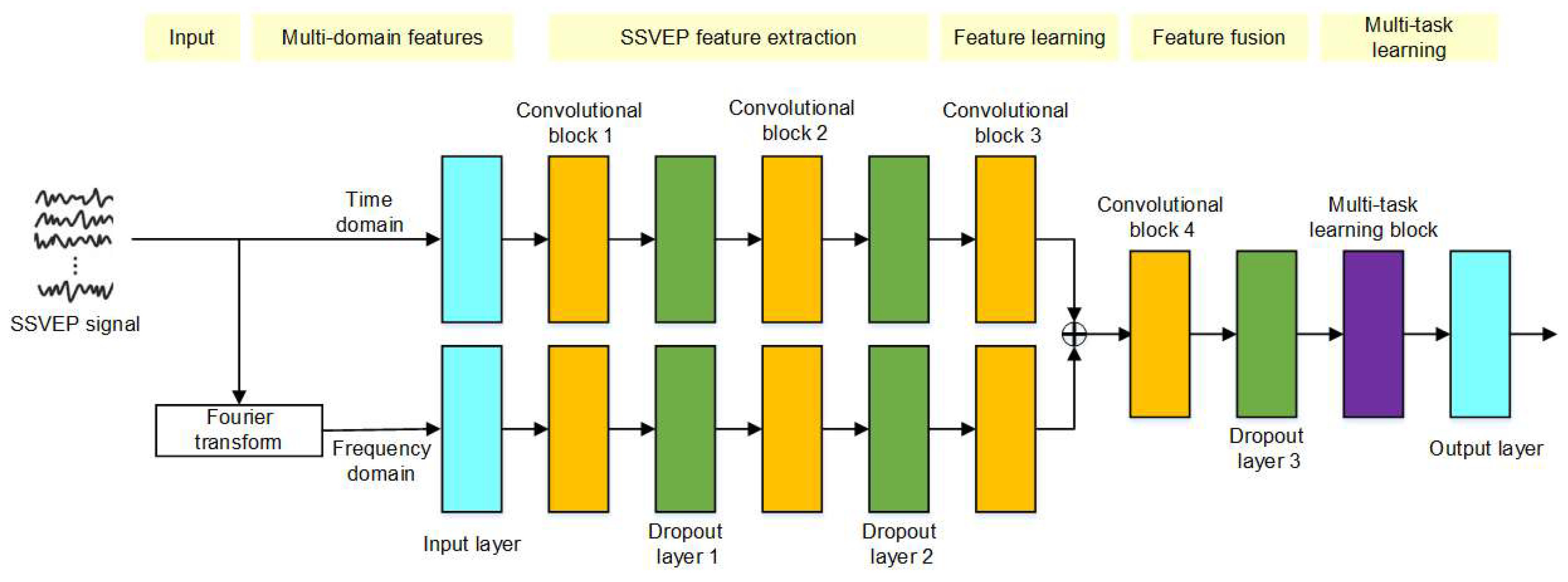
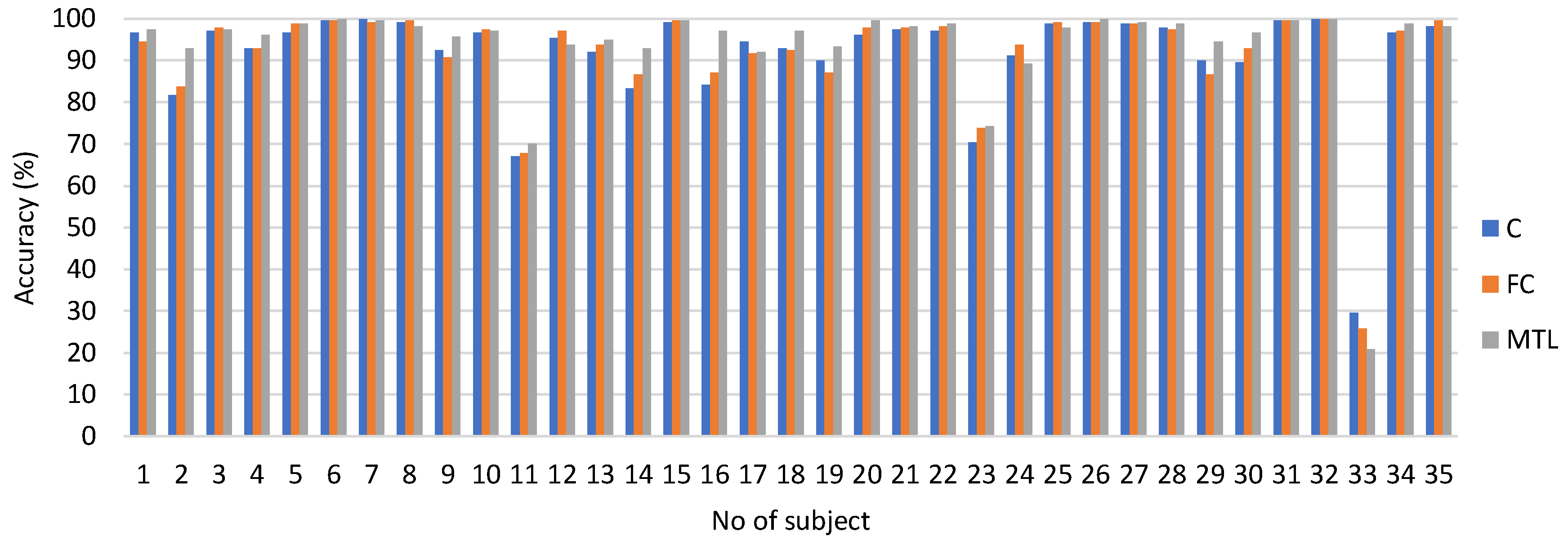
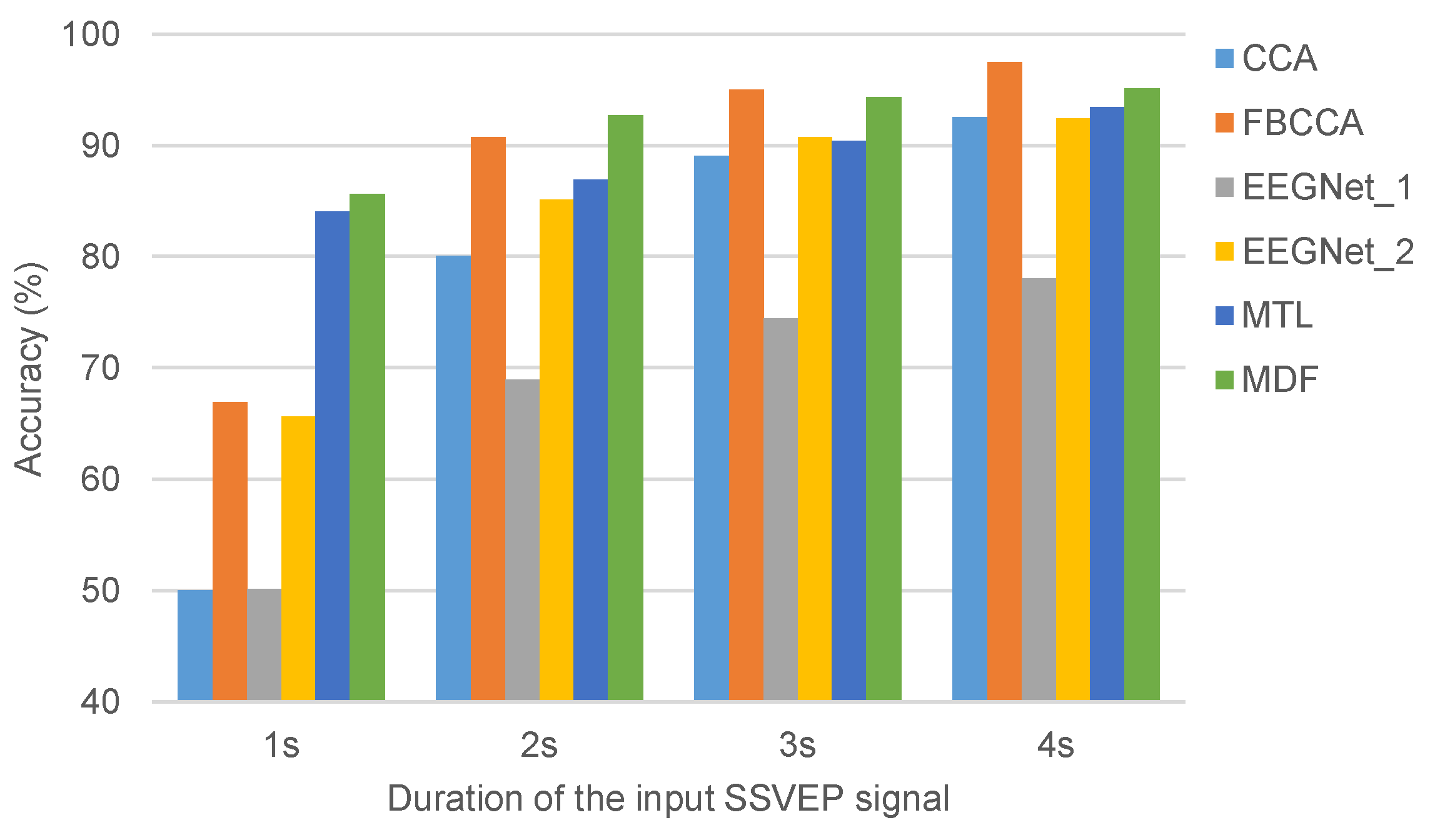
Brain-computer interfaces (BCIs) enable people to communicate with others or devices, and improving BCI performance is essential for developing real-life applications. In this study, a steady-state visual evoked potential-based BCI (SSVEP-based BCI) with multi-domain features and multi-task learning is developed. To accurately represent the characteristics of an SSVEP signal, SSVEP signals in the time and frequency domains are selected as multi-domain features. Convolutional neural networks are separately used for time and frequency domain signals to effectively extract the embedding features. An element-wise addition operation and batch normalization are applied to fuse the time and frequency domain features. A sequence of convolutional neural networks is then adopted to find discriminative embedding features for classification. Finally, multi-task learning-based neural networks are used to correctly detect the corresponding stimuli. The experimental results showed that the proposed approach outperforms EEGNet, multi-task learning-based neural networks, canonical correlation analysis (CCA), and filter bank CCA (FBCCA). Additionally, the proposed approach is more suitable for developing real-time BCIs compared to a system where the duration of an input is 4 seconds. In the future, utilizing multi-task learning to learn the characteristics of embedding features extracted from FBCCA may further improve the performance of the proposed approach.
Keywords:
1. Introduction
2. Materials and Methods
2.1. Multi-Domain Features
2.2. Neural Network Structure for Feature Extraction
2.3. Neural Network Structure for Feature Learning
2.4. Neural Network Structure for Feature Fusion
2.5. Neural Network Structure for Multi-Task Learning
3. Results and Discussion
3.1. The Ssvep Signal Dataset
3.2. The Results of Ssvep-Based Bci with Multi-Task Learning
3.3. The Results of Ssvep-Based Bci with Multi-Domain Features
3.4. The Results Compared with Other Approaches
4. Conclusions
Author Contributions
Funding
Institutional Review Board Statement
Informed Consent Statement
Data Availability Statement
Acknowledgments
Conflicts of Interest
References
- Feng, J.; Yin, E.; Jin, J.; Saab, R.; Daly, I.; Wang, X.; Hu, D.; Cichocki, A. Towards correlation-based time window selection method for motor imagery BCIs. Neural Networks 2018, 102, 87–95. [Google Scholar] [CrossRef]
- Rodrigues, P. L. C.; Jutten, C.; Congedo, M. Riemannian Procrustes Analysis: Transfer Learning for Brain–Computer Interfaces. IEEE Transactions on Biomedical Engineering, 2018, 66, 2390–2401. [Google Scholar] [CrossRef]
- Nicolás-Alonso, L. F.; Gil, J. Brain Computer Interfaces, a Review. Sensors, 2012, 12, 1211–1279. [Google Scholar] [CrossRef] [PubMed]
- Chen, Y.-J.; Chen, S.-C.; Zaeni, I. A. E.; Wu, C.-M. Fuzzy Tracking and Control Algorithm for an SSVEP-Based BCI System. Applied Sciences, 2016, 6, 270. [Google Scholar] [CrossRef]
- Jeong, J.-H.; Kwak, N.-S.; Guan, C.; Lee, S.-W. Decoding Movement-Related Cortical Potentials Based on Subject-Dependent and Section-Wise Spectral Filtering. IEEE Transactions on Neural Systems and Rehabilitation Engineering, 2020, 28, 687–698. [Google Scholar] [CrossRef] [PubMed]
- Chaisaen, R.; Autthasan, P.; Mingchinda, N.; Leelaarporn, P.; Kunaseth, N.; Tammajarung, S.; Manoonpong, P.; Mukhopadhyay, S. C.; Wilaiprasitporn, T. Decoding EEG Rhythms During Action Observation, Motor Imagery, and Execution for Standing and Sitting. IEEE Sensors Journal, 2020, 20, 13776–13786. [Google Scholar] [CrossRef]
- Chen, Y.-J.; Chen, P.-C.; Chen, S.-C.; Wu, C.-M. Denoising Autoencoder-Based Feature Extraction to Robust SSVEP-Based BCIs. Sensors, 2021, 21, 5019. [Google Scholar] [CrossRef]
- Chuang, C.-C.; Lee, C.-C.; So, E. C.; Yeng, C.-H.; Chen, Y.-J. Multi-Task Learning-Based Deep Neural Network for Steady-State Visual Evoked Potential-Based Brain–Computer Interfaces. Sensors 2022, 22, 8303. [Google Scholar] [CrossRef]
- Markovinović, I.; Vrankić, M.; Vlahinić, S.; Šverko, Z. Design considerations for the auditory brain computer interface speller. Biomedical Signal Processing and Control, 2022, 75, 103546. [Google Scholar] [CrossRef]
- Li, H.; Chen, H.; Jia, Z.; Zhang, R.; Yin, F. A parallel multi-scale time-frequency block convolutional neural network based on channel attention module for motor imagery classification. Biomedical Signal Processing and Control, 2022, 79, 104066. [Google Scholar] [CrossRef]
- Ramadan, R. A.; Vasilakos, A. V. Brain computer interface: control signals review. Neurocomputing, 2016, 223, 26–44. [Google Scholar] [CrossRef]
- Aricò, P.; Borghini, G.; Flumeri, G. D.; Sciaraffa, N.; Babiloni, F. Passive BCI beyond the lab: current trends and future directions. Physiological Measurement 2018, 39, 08TR02. [Google Scholar] [CrossRef]
- Panachakel, J. T.; Ramakrishnan, A. G. Decoding Covert Speech From EEG-A Comprehensive Review. Frontiers in Neuroscience 2021, 15. [Google Scholar] [CrossRef] [PubMed]
- Zhang, Y.; Li, Z.; Xie, S. Q.; Wang, H.; Yu, Z.; Zhang, Z. Multi-Objective Optimization-Based High-Pass Spatial Filtering for SSVEP-Based Brain–Computer Interfaces. IEEE Transactions on Instrumentation and Measurement, 2022, 71, 1–9. [Google Scholar] [CrossRef]
- Cao, L.; Fan, C.; Wang, Z.; Hou, L.; Wang, H.; Li, G. Alertness-based subject-dependent and subject-independent filter optimization for improving classification efficiency of SSVEP detection. Technology and Health Care, 2020, 28, 173–180. [Google Scholar] [CrossRef] [PubMed]
- Wang, L.; Huang, W.; Yang, Z.; Zhang, C. Temporal-spatial-frequency depth extraction of brain-computer interface based on mental tasks. Biomedical Signal Processing and Control 2020, 58, 101845. [Google Scholar] [CrossRef]
- Medhi, K.; Hoque, N.; Dutta, S. K.; Hussain, Md. I. An efficient EEG signal classification technique for Brain–Computer Interface using hybrid Deep Learning. Biomedical Signal Processing and Control, 2022, 78, 104005. [Google Scholar] [CrossRef]
- Chen, J.; Zhang, Y.; Pan, Y.; Xu, P.; Guan, C. A transformer-based deep neural network model for SSVEP classification. Neural Networks, 2023, 164, 521–534. [Google Scholar] [CrossRef] [PubMed]
- Wan, Z.; Cheng, W.; Li, M.; Zhu, R.; Duan, W. GDNet-EEG: An attention-aware deep neural network based on group depth-wise convolution for SSVEP stimulation frequency recognition. Frontiers in Neuroscience 2023, 17. [Google Scholar] [CrossRef]
- Hwang, H.-J.; Lim, J.-H.; Jung, Y.-J.; Choi, H.; Lee, S. W.; Im, C.-H. Development of an SSVEP-based BCI spelling system adopting a QWERTY-style LED keyboard. Journal of Neuroscience Methods, 2012, 208, 59–65. [Google Scholar] [CrossRef] [PubMed]
- Wang, Y.; Chen, X.; Gao, X.; Gao, S. A Benchmark Dataset for SSVEP-Based Brain–Computer Interfaces. IEEE Transactions on Neural Systems and Rehabilitation Engineering, 2016, 25, 1746–1752. [Google Scholar] [CrossRef] [PubMed]
- Kwak, N.-S.; Müller, K.-R.; Lee, S.-W. A convolutional neural network for steady state visual evoked potential classification under ambulatory environment. PLoS ONE, 2017, 12, e0172578–e0172578. [Google Scholar] [CrossRef]
- Mistry, K. S.; Pelayo, P.; Anil, D. G.; George, K. An SSVEP based brain computer interface system to control electric wheelchairs. 2018 IEEE International Instrumentation and Measurement Technology Conference (I2MTC), Houston, TX, USA, 2018; pp. 1–6. [Google Scholar] [CrossRef]
- Yu, I.-J.; Nam, S.-H.; Ahn, W.; Kwon, M.-J.; Lee, H.-K. Manipulation Classification for JPEG Images Using Multi-Domain Features. IEEE Access, 2020, 8, 210837–210854. [Google Scholar] [CrossRef]
- Chuang, C.-C.; Lee, C.-C.; Yeng, C.-H.; So, E. C.; Chen, Y.-J. Attention Mechanism-Based Convolutional Long Short-Term Memory Neural Networks to Electrocardiogram-Based Blood Pressure Estimation. Applied Sciences, 2021, 11, 12019. [Google Scholar] [CrossRef]
- Baek, S.-H.; Jang, J.-Y.; Yoon, S. End-to-End Blood Pressure Prediction via Fully Convolutional Networks. IEEE Access 2019, 7, 185458–185468. [Google Scholar] [CrossRef]
- Cao, L.; Wang, W.; Huang, C.; Xu, Z.; Wang, H.; Jia, J.; Chen, S.; Dong, Y.; Fan, C.; Albuquerque, V. H. C. d. An Effective Fusing Approach by Combining Connectivity Network Pattern and Temporal-Spatial Analysis for EEG-Based BCI Rehabilitation. IEEE Transactions on Neural Systems and Rehabilitation Engineering, 2022, 30, 2264–2274. [Google Scholar] [CrossRef] [PubMed]
- Li, Q.; Yan, C.; Wang, W.; Babiker, A.; Wu, L. Health Indicator Construction Based on MD-CUMSUM With Multi-Domain Features Selection for Rolling Element Bearing Fault Diagnosis. IEEE Access, 2019, 7, 138528–138540. [Google Scholar] [CrossRef]
- Khok, H. J.; Teck Chang Koh, V.; Guan, C. Deep Multi-Task Learning for SSVEP Detection and Visual Response Mapping. 2020 IEEE International Conference on Systems, Man, and Cybernetics (SMC), Toronto, ON, Canada, 2020; pp. 1280–1285. [Google Scholar] [CrossRef]
- Zhang, Y.; Xu, P.; Cheng, K.; Yao, D. Multivariate synchronization index for frequency recognition of SSVEP-based brain–computer interface. Journal of Neuroscience Methods, 2013, 221, 32–40. [Google Scholar] [CrossRef] [PubMed]
- Lawhern, V. J.; Solon, A. J.; Waytowich, N. R.; Gordon, S. M.; Hung, C. P.; Lance, B. J. EEGNet: a compact convolutional neural network for EEG-based brain–computer interfaces. Journal of Neural Engineering, 2018, 15, 56013. [Google Scholar] [CrossRef] [PubMed]

| Layer | Hyperparameter | Value | |
| Input layer | NS | 250(1s),500(2s),750(3s),1000(4s) | |
| Convolutional block 1 | KS, FS, DL | T:55/F:53, 4, 1 | |
| Dropout layer 1 | R | 0.5 | |
| Convolutional block 2 | KS, FS, DL | 11, 4, 1 | |
| Dropout layer 2 | R | 0.5 | |
| Convolutional block 3 | KS, FS, DL | T:35/F:19, 8, 4 | |
| Convolutional block 4 | KS, FS, DL | 35, 8, 4 | |
| Dropout layer 3 | R | 0.5 | |
| MTL block | KS | 250(1s),500(2s),750(3s),1000(4s) | |
| Output layer | NS | 40 |
| Duration | ||||
| 4s | 3s | 2s | 1s | |
| C | 91.513.2 | 89.815.2 | 84.617.8 | 69.120.5 |
| FC | 91.813.6 | 89.615.1 | 83.117.8 | 65.920.5 |
| MTL | 93.414.2 | 90.415.0 | 86.916.9 | 84.016.4 |
| Duration | ||||
| 4s | 3s | 2s | 1s | |
| C | 86.514.6 | 79.118.9 | 69.821.1 | 30.112.6 |
| FC | 85.614.7 | 77.519.2 | 64.921.5 | 26.412.4 |
| MTL | 92.710.5 | 92.211.3 | 89.212.9 | 77.615.9 |
| FO | 4s | 3s | 2s | 1s | |
| MDF1 | Con | 94.8 | 93.7 | 91.6 | 85.4 |
| Add | 95.0 | 94.3 | 92.6 | 85.5 | |
| MDF2 | Con | 95.0 | 94.1 | 92.0 | 85.0 |
| Add | 95.1 | 94.4 | 92.7 | 85.6 |
| 4s | 3s | 2s | 1s | ||
| TDF | MDF1 | 24.2 | 40.6 | 43.5 | 9.4 |
| MDF2 | 25.8 | 41.7 | 44.3 | 10.0 | |
| FDF | MDF1 | 31.5 | 26.9 | 31.5 | 35.3 |
| MDF2 | 32.9 | 28.2 | 32.4 | 35.8 |
Disclaimer/Publisher’s Note: The statements, opinions and data contained in all publications are solely those of the individual author(s) and contributor(s) and not of MDPI and/or the editor(s). MDPI and/or the editor(s) disclaim responsibility for any injury to people or property resulting from any ideas, methods, instructions or products referred to in the content. |
© 2025 by the authors. Licensee MDPI, Basel, Switzerland. This article is an open access article distributed under the terms and conditions of the Creative Commons Attribution (CC BY) license (http://creativecommons.org/licenses/by/4.0/).