

Submitted:
14 March 2025
Posted:
17 March 2025
You are already at the latest version
Abstract
Generative AI leads to designs that prioritize cognition, emotional resonance, and health, thus offering a tested alternative to current trends. In a first AI experiment, the large-language model ChatGPT-4o generated six visual environments that are expected to boost creative thinking for their occupants. The six test cases are evaluated using Christopher Alexander’s 15 Fundamental Properties of living geometry as criteria, also using ChatGPT-4o, to reveal a strong positive correlation. Living geometry is a specific type of geometry that shows coherence across scales, fractal structure, and nested symmetries to harmonize with human neurophysiology. The human need for living geometry is supported by interdisciplinary evidence from biology, environmental psychology, and neuroscience. Then, in a second AI experiment, ChatGPT-4o was asked to generate visual environments that suppress creativity, for comparison to the cases that boost creative thinking. Checking those negative examples using Alexander’s 15 fundamental properties, they are almost entirely deficient in living geometry, thus confirming the diagnostic model. Used together with generative AI, living geometry therefore offers a useful method for both creating and evaluating designs based on objective criteria. Adopting a hybrid epistemological framework of AI plus living geometry as a basis for design uncovers a flaw within contemporary architectural practice. Dominant design styles, rooted in untested aesthetic preferences, lack the empirical validation required to address fundamental questions of spatial quality responsible for human creativity.
Keywords:
AI
; architectural design
; Christopher Alexander
; creative environment
; creativity
; design theory
; epistemology
; large-language models
; living geometry
; neurodesign
1. Introduction
1.1. The Need to Change Design Thinking
Architecture and design profoundly influence human cognition, emotions, and health through the body’s visual interaction with the physical environment. A preferred set of geometrical qualities — “living geometry” — originates in life forms and natural structures and is embedded in our neural development. Its features can be derived from Christopher Alexander’s 15 fundamental properties, which integrate biological and mathematical principles to define environments that enhance human well-being [1,2]. Unlike axiomatic geometric systems in mathematics, living geometry is complex and merges design coherence, fractal hierarchies, positive space, and strong symmetries — qualities consistently linked to human neurophysiological preferences.
AI-generated designs can reveal the pitfalls and potential of prevailing architecture by highlighting visual environments with either negative or positive effects on creative thinking. Human cognitive and emotional responses identify design factors impacting creativity. This paper shows how the emerging expert system of architectural knowledge already contains the principles of living geometry. Moreover, the presence of living geometry in images generated to boost user creativity challenges the industry’s prevailing minimalist design paradigm.
Recent advances in machine learning and large-language models enable AI to analyze complex spatial relationships, and to recognize visual patterns that help human cognitive processes. The same apparatus can generate designs optimized for perceptual engagement, thus adapting spatial structures to human psycho-physiology. AI can identify underlying cognitive factors in spatial form, making architectural coherence computationally recognizable. The results from AI experiments can be synthesized into a hybrid epistemology for architectural design, in which design principles are validated through computational pattern recognition.
The AI large-language model ChatGPT is applied here to generate imaginary environments aimed at enhancing creativity, as illustrated through six visual examples. These environments embody living geometry and are suggested to improve creative output by aligning with human neurocognitive preferences, fostering positive emotional states, and reducing stress. Subsequently, ChatGPT evaluates the presence of Alexander’s 15 fundamental properties by analyzing the six images it had previously generated without any such explicit input. Therefore, AI has the capability to both generate and systematically detect living geometry.
In a second AI experiment, the contrary effect is investigated. The AI large-language model ChatGPT generated imaginary environments aimed at suppressing creativity, illustrated through four photorealistic visual examples. Those images were then analyzed for their content of living geometry, using Alexander’s 15 fundamental properties as a criterion. Unsurprisingly, they turn out to strongly violate living geometry. The two complementary AI experiments representing imaginary visual environments that either boost or hinder creative thinking reinforce each other.
The findings of this study suggest that AI is not merely a generative design tool but an epistemological instrument capable of:
- Identifying underlying spatial principles that enhance user creativity and well-being.
- Evaluating architectural coherence through hierarchical analysis and pattern recognition.
- Providing predictive insights into which design elements foster cognitive engagement and creativity.
Design specifics that lead to an environment conducive to creative thinking are of vital importance to business, educational, and research buildings. The utility of this study is to lay the groundwork for approaching the question using evidence from neuroscience and physiology, through the easily-accessible medium of AI large-language models. Robust results using AI large-language models as a research method do not need the massive funding of controlled longitudinal laboratory studies.
Therefore, in addition to specific results relevant to implementing spaces that boost creative thought, this paper introduces a method of investigation. Any reader can undertake similar experiments using generative AI to gain insight into the type of built environment that is optimal for human health and well-being. If those results happen to contradict dominant styles, this paper argues for accepting the interdisciplinary authority from multimodal interactions while rejecting the untested opinion coming from architectural “experts”.
While this study is only a preliminary step, it demonstrates that AI can serve as a bridge between emerging scientific insights and traditional design knowledge (prior to industrial modernism). By incorporating AI-driven analysis into architectural practice, designers can move beyond purely stylistic preferences and toward truly human-centered environments. The integration of AI with architectural theory represents a new hybrid design epistemology, where computational analysis and empirical validation work together to redefine how we assess and create artificial environments.
The basic hypothesis of this model is that the human body achieves healthy equilibrium with its surroundings only if those provide for specific neurological needs. Otherwise, a constant production of stress diminishes health and well-being and can lead to pathologies in the long term. Human evolution strongly determines this unconscious process. Traditional architectures intuitively achieved homeostasis between the geometry of the environment and the human body, by evolving their design methodologies through trial-and-error.
1.2. Generative AI Liberates Architecture from a Mental Hegemony
Contemporary architecture, in contrast, is guided by subjective stylistic trends and theoretical constructs divorced from empirical validation [3,4,5,6,7,8,9,10]. This paper argues that such approaches not only fail to address user needs but also actively undermine cognitive function and long-term health. The epistemological gap between these conflicting paradigms necessitates a shift toward evidence-based design frameworks rooted in living geometry. The results presented here make an argument for a human-centered approach to architectural and urban design.
There exists a serious problem because architecture increasingly provokes avoidant behavior, while the media and profession praise this unhealthy response for being “contemporary” and “innovative”. Buildings are being designed without consideration of the neurophysiological impact on the occupants. As a result, the built environment is making people anxious and is contributing to global emotional discomfort and a reduction of well-being. Architecture is influencing humanity negatively by reducing creative thought and empathetic behavior.
It is worth noting the reasons for why we find ourselves in this situation today, although providing a historical explanation is not the goal of this paper. Societal forces channel society to follow a design philosophy that does not respond to human biology. Architects operating within a narrow framework value artistic originality, formal innovation, and stylistic movements more than cognitive and emotional well-being and empathy in designs. Groundbreaking research on biophilia and environmental enrichment [11,12,13,14] therefore has difficulty penetrating this dominant system. Resistance to science is motivated by four entrenched positions:
- (a)
- Philosophical bias — dismisses evidence-based approaches as reductive and a threat to architecture as an art form.
- (b)
- Detached formality — teaches architects to see buildings as formal compositions rather than lived experiences.
- (c)
- Institutional inertia — makes architecture schools and professional organizations cling to established narratives and pedagogical models that favor abstraction over emotional engagement.
- (d)
- Market and media forces — reward iconic, provocative designs that promote “starchitect” culture instead of adaptive, human-centered ones.
Client-driven design requirements, construction processes, costs, planning, procurement processes, regulatory frameworks, etc. do affect the final product, but not the initial approach to design, which is what the present study is about. That is determined by an already-decided design aesthetic based upon ideology. Introducing a different design paradigm always faces obstacles. With the appropriate prompts, AI large-language models draw upon vast datasets of cross-disciplinary evidence for adaptive design. This ability sidesteps the usual opposition to human-centered design approaches coming from dominant style-based architecture.
1.3. A Very Partial Bibliography
Readers of the preprint version of this paper asked why the considerable literature on applying AI to generate novel designs is not referenced. The reason is that most of that mainstream work opposes the research aim of the project developed here, and is deeply flawed. Several recent books on AI in architecture and design illustrate exciting designs created by AI and announce a “new post-human design paradigm”. New journals have sprouted up to accommodate this growing topic. Nevertheless, their authors invariably overlook human biology and neurophysiological responses to built forms. In the opinion of the author, those fashionable design trends are morally irresponsible. Responsive design should be based on empathy supported by science, and neither on facile stylistic imitation nor free invention.
Within the current design paradigm, buildings and urban spaces arise from an “ideological stance” rather than data on user health or well-being. Yet architectural and urban design lacking human-scale patterns and fractal elements is known to correlate with feelings of alienation, increased stress, and even heightened risks of non-communicable diseases linked to sedentary, isolating lifestyles. The psychological toll—such as higher rates of anxiety and depression —is thoroughly documented in the literature on environmental psychology [15,16,17].
Today, AI is indeed misused to generate artistic designs that do not satisfy their function. For example, AI can generate a photorealistic depiction of an imaginary university building dedicated to creative work in fields like Computer Science, Mathematics, or Molecular Biology. Architects will present an exterior design as a striking “futuristic” blend of concrete, glass, and steel with a flowing, organic geometry that “suggests” creative processes. Walls curve and intersect in unexpected ways, evoking the idea of branching molecules, fractals, or neurons. An angular, sculpted entrance or façade incorporates diagonals and large geometric shapes to “convey” organic flow and free structure. Intricate, laser-cut metal screening on portions of the façade will suggest branching molecular structures or mathematical patterns. Subtle but eye-catching artistic flourishes—like etched patterns on the glass— evoke abstract network diagrams.
All the above design elements are inappropriate because they suggest creative notions instead of embodying human-centered techniques to elicit and nourish creative thought processes. Ignorant of how architecture influences human creativity and physiology, architects substitute irrelevant visual representations for science. They might add surface decoration onto the glass curtain-walls purely for spectacle. The dangerous flaw with such “cargo-cult” aesthetics is that current design thinking is detached from biological processes and reality. Yet dominant architectural culture has convinced itself, and gullible clients, that this totally superficial approach to design is valid.
1.4. Outline of This Paper
Section 2 introduces Christopher Alexander’s 15 fundamental properties of living geometry, such as fractal scaling, strong centers, and nested symmetries, linking them to human cognitive engagement and well-being. Living geometry selects special configurations in the environment (Section 2.1). The 15 properties provide a diagnostic and generative toolkit for adaptive design (Section 2.2). AI can be used as an effective tool in both assessing the 15 properties in existing designs and creating new designs that prioritize living geometry principles. The related topic of biophilia, which affects health and well-being directly, overlaps with living geometry and the 15 properties (Section 2.3).
Applying AI generates environments aimed at enhancing creativity, as illustrated through visual examples (Section 3). ChatGPT-4o and DALL•E 3 generated imaginary visual compositions optimized to boost creative thinking for those exposed to them (Section 3.1). These environments embody living geometry and are suggested to improve creative output by aligning with human neurocognitive preferences, fostering positive emotional states, and reducing stress. As a control and counterbalance, additional visual compositions are generated with the explicit purpose of suppressing creativity. The AI-assisted evaluation process further analyzes the content of each image according to Alexander’s 15 fundamental properties (Section 3.2).
Section 4 evaluates AI’s capability to systematically generate creative environments, producing six images for this purpose (Section 4.1). This section explains the prompts used to create them. The six images (Figure 1, Figure 2, Figure 3, Figure 4, Figure 5 and Figure 6) represent different types of creative workspaces, including general settings and specialized environments for mathematics, architecture, and interdisciplinary research. Four additional images (Figure 7, Figure 8, Figure 9 and Figure 10) are prompted by requesting visual environments that suppress creative thinking (Section 4.2). Alexander’s 15 properties are found in the first six images, even though the prompts did not ask for them (Section 4.3). ChatGPT ranked the strength of each property’s presence in each image, as listed in Table 1. By contrast, very few of Alexander’s 15 properties are found in the four negative images, listed in Table 2.
AI spontaneously produced environments that align with living geometry, without explicit instruction to do so (Section 5.1). Section 5.2 explores the computational mechanisms behind AI-generated designs: the balance between order and variability, recursive pattern formation, and the inclusion of color (which was not requested). Section 5.3 justifies using Alexander’s 15 fundamental properties as an effective evaluation framework because they are linked to cognitive science and neuroaesthetic principles. However, the software has hidden limitations because it confuses symbolic representation with functionally effective imagery (Section 5.4). It assumes, as do most designers today, that symbolizing a function will enable that function to be realized, which is only wishful thinking. In mimetic magic, the belief is that the symbol itself exerts a direct causal force on physical reality.
Section 5.5 underscores the health implications of environmental geometry, referencing research that connects coherent, fractal-rich spaces to enhanced well-being, faster recovery, and reduced stress. It argues for the measurable benefits of living geometry in physical and mental health contexts. Interdisciplinary findings in neuroscience and psychology specify which specific environments facilitate creative thinking. Section 5.6 links intelligence to living geometry, and discusses research showing that structured, information-rich environments improve learning and problem-solving abilities.
Living geometry acts as a “catalyst” for creative thinking, since the information field triggers thinking that commingles with and influences other mental processes while remaining intact after those are completed (Section 5.7). Parallels exist with the “Extended Mind Theory” of David Chalmers and Andy Clark, which reveal how cognition is distributed across brain and environment (Section 5.8). Theories of embodied cognition explain how structured environments integrate with mental processes.
Results from enhanced working environments suggest how to improve architecture’s effects on human creativity (Section 6). Empirical studies identify key environmental features that enhance creativity, such as fractal geometries, natural elements, and ornamentation. These insights are complemented by anecdotal evidence from the workspaces of creative individuals, emphasizing the positive influence of an ornamented environment on creative productivity. Gaston Bachelard recognized the importance of emotionally comfortable environments for intellectual engagement.
Section 7 advocates replacing dominant aesthetic paradigms in architecture with AI plus the scientifically-validated basis of living geometry. A human-centered epistemological framework for design aligns with human biology and fosters enriching, health-promoting environments. AI-driven evidence-based design methodologies offer a systematic way to validate spatial configurations that support creativity and well-being.
Architect Michael Imber describes his working method of sketching the natural site to absorb its atmosphere, before making any fixed decision. This immersion in nature inspires him to generate the first site drawings, a process consistent with the creative boost that living geometry gives (Section 8).
Section 9 critiques contemporary architectural practice for its reliance on abstract aesthetics and resisting empirical validation. Ideological and institutional barriers prevent the adoption of evidence-based design principles. The conclusion (Section 10) calls for embracing evidence-based principles of design. AI brings empirical research to architectural practice, shifting from aesthetics-driven design paradigms to a model rooted in biophilia, cognitive science, and living geometry.
2. Living Geometry, Christopher Alexander’s 15 Fundamental Properties, and Biophilia
2.1. Living Geometry Selects Special Configurations in the Environment
Living geometry refers to forms and patterns that reflect biological complexity, coherent organization, fractal scaling, geometrical arrangements, and multiple symmetries. Biophilia, natural fractals, and symmetry groups provide a conceptual foundation for living geometry independently of Alexander’s 15 fundamental properties [13,18]. The author gives a detailed mathematical model in [19]. Mechanisms of visual ordering intrinsic to biological and physical forms lead to harmonious and stable structures that are comfortable for the brain to process. After all, the brain is simply a data-interpretation system trained to handle precisely this type of environmental information. Living geometry’s main features could be summarized as:
- Multiscalar: Repetitive forms appear at different scales (approximate fractal scaling), creating a hierarchy of visual information.
- Symmetry-rich: Employs reflectional, rotational, translational, and spiral symmetries, as well as combinations thereof.
- Highly-connected: Elements are intertwined via alignments, coherent organizational principles, and nesting (smaller elements fit inside larger ones).
- Vertically-aligned: All intermediate and large-scale symmetries cooperate to help define the gravitational axis.
- Emergent & complex: The whole becomes more than the sum of its parts through hierarchical organization and “emergent” patterns.
The living geometry underlying both organisms and evolved human-scale architecture (such as traditional and vernacular buildings and cities) has particular and specific properties. Current research uncovers the link between the geometry of the environment and human neurophysiological responses [20,21,22,23,24]. Living geometry triggers positive-valence reactions, whereas its absence triggers negative-valence reactions. The latter situation comes from visual fields situated at opposite scales of an informational spectrum: either empty (no information, providing no clue for a survival response), or disordered (random information, which overwhelms the sensory system).
The preceding discussion helps to focus on designing visual environments that can aid the designer unconsciously. Can creative output be influenced by the setting in which a person is working? Observations answer yes; however, the architectural profession has yet to give an unambiguous response to this question. This paper presents AI experiments and data from neuroscience to support a model for design that enhances creativity.
2.2. Christopher Alexander’s 15 Fundamental Properties
Living geometry encompasses those spatial forms and relationships that resonate with human cognitive and emotional processes [1,2]. To integrate aesthetic with functional dimensions and foster a deep connection between individuals and their surroundings, designers should implement it in buildings. One approach to living geometry is through Alexander’s 15 fundamental properties, listed as follows:
- Levels of scale
- Strong centers
- Thick boundaries
- Alternating repetition
- Positive space
- Good shape
- Local symmetries
- Deep interlock and ambiguity
- Contrast
- Gradients
- Roughness
- Echoes
- The void
- Simplicity and inner calm
- Not-separateness
Alexander’s 15 fundamental properties provide a practical toolkit for creating and diagnosing living geometry. These geometrical properties act synergistically to generate environments that evoke calm, promote cognitive engagement, and reduce stress. A promising implementation is to use the 15 properties in a prompt for AI large-language models. Extended descriptions of the 15 properties available online can be attached to any design question [25,26,27]; this paper uses the Appendix from Ref. [19] included for convenience in “Supplementary Materials”, below. So far, the results from combining AI with the 15 properties are encouraging. The prompts lead the AI program directly to living geometry, without explicitly directing it.
This AI tool has two distinct applications. First, it could be used as a guide for generating new designs that adapt to human biology; and second, used as a diagnostic, AI can evaluate an image for the presence of the 15 properties. This paper will demonstrate both methods with AI experiments. Danny Raede is doing related work and has a website that analyzes an image to find the three most intense of Alexander’s 15 properties [28]. Raede uses AI together with a detailed description of the 15 properties, much like the approach of this paper. Bin Jiang is developing a “Beautimeter”, also using the 15 properties to judge objective beauty [29]. Aside from current work by close colleagues, the author is unaware of any similar studies in the literature.
Readers may be familiar with the philosophical aspect of Alexander’s theories such as the humanistic approach to analyze architecture through the lens of users. Nevertheless, Alexander was in fact among the first persons to apply computing to design, back in the 1960s. The technical limitations of the available tools at that time led him to abandon computation and turn to the phenomenological approach of design patterns and the geometrical framework he later presented in The Nature of Order [1,2].
2.3. Biophilia Affects Health and Well-Being Directly and Positively
This research topic is currently being investigated through converging cross-disciplinary techniques. Nevertheless, so far, the focus on healthy environments has been on more tangible factors causing harm such as pathogens, pollutants, noise, etc. instead of the impact of geometrical/visual information. And yet, the human body is strongly influenced by the visual field even though the effect is in large part unconscious. Data from environmental psychology, neuroscience, and public health confirm that the geometry of the physical environment significantly impacts mental and physical health.
For example, Roger Ulrich’s studies show that patients recover faster and require fewer painkillers if their hospital room looks onto natural scenes [30,31]. Environmental stress research finds that settings with biophilic features and fractal patterns reduce cortisol (stress hormone) levels and promote overall well-being [32,33]. A positive correlation between health and living geometry is well-established in the medical literature [34]. Different authors posit similar but not identical lists of the elements of biophilia [11,12,14,35]; here the author’s ten components of the biophilic healing index are listed for reference [13,36]:
- Sunlight: preferably from several directions.
- Color: variety and combinations of hues.
- Gravity: balance and equilibrium about the vertical axis.
- Fractals: things occurring on several nested scales.
- Curves: on small, medium and large scales.
- Detail: meant to attract the eye.
- Water: to be both heard and seen.
- Life: living plants, animals and other people.
- Representations of nature: naturalistic ornament, realistic paintings, reliefs and figurative sculptures—including face-like structures.
- Organized complexity: intricate yet coherent designs—extends to symmetries of abstract face-like structures.
Living geometry measured through biophilia offers a rigorous, evidence-based approach bridging aesthetic and biological needs. Findings from biophilic design, living geometry, and Christopher Alexander’s observations about his “fifteen fundamental properties” align with each other for life-enhancing design. Living geometry is not merely a stylistic preference; it represents an approach that maps onto underlying biological and cognitive processes. The experience of positive-valence information characterized by balanced symmetries, harmonious geometrical relationships, and scaling hierarchies has measurable restorative effects.
Current research consistently underscores the effect of built environments on human psycho-physiology [37]. Those studies include randomized controlled trials in hospital settings, longitudinal studies on mental health and neighborhood design, and large-scale correlational research linking nature integration with reduced stress and improved cognitive function. Rapidly accumulating evidence from multiple fields supports this paper’s results — which are derived here exclusively from generative AI.
3. Methodology: Use AI to Generate and Check Creative Environments
3.1. Experiments with an AI Large-Language Model
This pilot project wishes to challenge current architectural beliefs about how geometry affects human creativity. Standard architectural discourse does not offer practical guidelines for designing creative environments, which exposes a serious epistemological gap in architectural design. Circumventing the academic architectural literature, generative AI is brought in to resolve this question in a direct and simple manner. What can we learn, without any preconceptions, from the vast databank that ChatGPT draws upon?
In a first AI experiment carried out in January 2025, the AI program ChatGPT-4o was prompted to generate environments optimized for creativity and emotional well-being. Then, an AI image analysis validated those AI-generated environments as being conducive to human cognitive engagement and creativity. While AI-generated assessments cannot replace empirical validation, they provide a new epistemological approach to evidence-based architectural design.
Six figures (artificial paintings) were created by the large-language model ChatGPT-4o, which uses DALL•E 3 for image generation. These experiments were carried out without referring to either “architecture” or “design”, to avoid bias and preconceptions. The prompts asked the software to illustrate artificial visual environments that would enhance creative thinking unconsciously. No other instructions were given, and no supporting documents were uploaded. The sources for generating these images were entirely confined to the large-language model’s general database.
ChatGPT-4o generates different images each time the same prompt is used. To illustrate this paper, the author chose those images that best embody the concepts from among alternatives. For this reason, however, it makes little sense to analyze the details of the images, as it is the general geometrical invariants that count, and not their specifics.
In a subsequent AI experiment carried out in February 2025, ChatGPT-4o was prompted to generate environments that are expected to suppress creativity and emotional well-being. The prompt carefully avoided inputting the specifics already known to diminish creative thought of a person working there. The real value of the experiment is for the large-language model to come up with those negative design elements through discovery from open-source medical and neurological data.
The underlying hypothesis is that AI, when prompted to generate environments optimized for human creativity and well-being, will naturally converge toward living geometry principles. This would suggest that hierarchical order and spatial coherence are not just subjective aesthetic preferences, but computationally identifiable features linked to human cognitive and emotional responses.
3.2. Analyzing the Content of Each Image According to Alexander’s 15 Fundamental Properties
Once the images of imagined creative environments were generated, the same software was then used to test them for adherence to living geometry. The large-language model that generated the figures, ChatGPT-4o, was used to check their content of living geometry, using several distinct tools and methods. The images were compared with Alexander’s 15 fundamental properties, biophilia, neuroscience, the mathematical qualities of living geometry, and working environments known to enhance creativity. Each of these tests independently verifies the consistency of the results.
Checking for adherence to Alexander’s 15 fundamental properties was done by uploading a detailed description of the 15 properties (taken from a previous publication [19] and included for convenience in “Supplementary Materials” at the end of this paper) when prompting ChatGPT-4o to evaluate a picture. This analysis was performed for each of the six generated visuals corresponding to “positive” influences, as well as the four generated visuals corresponding to “negative” influences on creativity. The software was asked to comparatively rank each of the 15 properties according to their being strongly present, partially present, or negligible. This ranking revealed the weak points of each imagined environment.
Trying to analyze the specific graphical details of each visual is not useful, since those particulars result from hidden decisions made by ChatGPT. What is important, and what this paper is about, is the high degree of organized complexity that emerges from the simple prompt.
4. Results: Six Visual Settings That Are Expected to Boost Creativity, Plus Four That Are Expected to Suppress It
4.1. Asking a Large-Language Model Produces Images of Creative Environments
Six figures were created by the large-language model ChatGPT-4o. The prompts asked for visual environments that enhance creative thinking unconsciously. The first three examples are for general settings (Figure 1, Figure 2 and Figure 3), whereas the last three are supposed to specialize for creativity in different professions: mathematics (Figure 4), architecture (Figure 5), and cross-disciplinary work on AI, human biology, and neuroscience (Figure 6).
Each prompt included mostly the same wording. The same brief prompt was used for Figure 1, Figure 2 and Figure 3 without specifying the purpose any further. More detailed prompts included language identifying a specialization in generating Figure 4, Figure 5 and Figure 6. For example, the prompt used to generate Figure 5 was: “Compose a mural crafted to stimulate creativity in architectural composition. The architect is sitting in front of this mural and wishes to design a building that captures the rhythm, harmony, and complexity of the best-loved classical, traditional, and folk architecture of the past. The design to be composed will ideally touch the user and viewer emotionally in a positive way, and this result is what should be triggered by the visual environment now surrounding the designer.”
Note that ChatGPT draws upon open-source scientific data to generate the figures, so these images should not be misinterpreted simply as pretty graphics motivated by artistic interest. The crucial aspect of the epistemological framework is rigorously evidence-based, as discussed in detail below. The captions were also generated by the software and are reproduced here unedited. The figures introduce color for a positive emotional effect, whereas the discussion in this paper is limited to geometrical qualities. Color contributes an important factor to creativity, and that dimension will be analyzed in a future study.
Together, the six above figures represent a significant result for business and educational environments that accommodate creative thought. The reason is that the richly complex images challenge entrenched architectural preferences, which stipulate minimalist working environments for almost every occasion. Ornamented settings prove to enhance creative thinking, contrary to established design dogma dating back more than one century, and this finding should trigger laboratory measurements to further investigate the underlying mechanism.
4.2. Four Imagined Environments That Are Expected to Suppress Creative Thought
A parallel AI experiment was undertaken, this time to find the characteristics of environments that oppose or quash creative thought. ChatGPT-4o was asked to generate images of visual settings that hinder creativity and thwart innovative thinking, by drawing upon data from human biology and neuroscience. Four distinct figures were generated (Figure 7, Figure 8, Figure 9 and Figure 10), each one to represent a distinct factor that diminishes creativity in a user. It is the AI program that came up with this classification, and which also produced the figure captions.
The minimally-edited prompt used was: “I need photorealistic paintings of interiors that so disturb the mind that experiencing them thwarts creative thinking. Produce one image to highlight each of the possible known factors that suppress creativity through unconscious visual influences. Decide what those factors are according to the medical and neurological data. I am not specifying the negative effects and influences, and it is up to you to decide on the hostile visual influences on creative environments. Give a caption for each figure to highlight what evidence is available that it suppresses creativity in the user.”
In addition to providing images of environments that stifle creative thinking, the AI large-language model came up with four factors responsible for this effect. Each factor is represented in each of the four Figures, with the correspondence as follows:
Figure 7 — Sterile Minimalism Induces Cognitive Deprivation.
Figure 8 — Distorted, Non-Orthogonal Spaces Disorient Cognition.
Figure 9 — Absence of Living Geometry Suppresses Creativity.
Figure 10 — Sensory Overload Occurs Through Chaotic Stimuli.
The four negative cases expected to suppress creativity (Figure 7, Figure 8, Figure 9 and Figure 10) are the geometrical rejections of the six positive cases analyzed previously. These complementary AI experiments fix two opposite poles for the geometrical characteristics of creative environments. Knowing what to avoid in a design is just as important as having some idea of what to include. Architects who internalize empty minimalism (Figure 7) will always reject living geometry. Readers should be alarmed by the fact that Figure 7, Figure 8 and Figure 9 look like prize-winning commercial and educational buildings.
While visually engaging details turn out to have a positive effect, the extreme cluttering shown in Figure 10 overwhelms the cognitive system. Although the following remark is pure speculation, there is a price to pay in imposing unnatural geometries on the world. Those are going to be hated, hence neglected by their users. Since mainstream architecture has been fighting against living geometry in the built environment, tectonic forces tend to generate places that resemble Figure 10 by default.
4.3. Checking the Images of Creative Working Environments Using Criteria of Living Geometry
The large-language model that generated the six figures was subsequently used to check their content of living geometry. That is possible using several distinct tools. Biophilia, Alexander’s 15 fundamental properties, neuroscience, and the mathematical qualities of living geometry are all brought in. Tests for each of these frameworks independently verifies the results obtained from AI.
ChatGPT-4o can pick out the 15 fundamental properties in any image. It can do this by drawing upon the general data base, yet it is more accurate to include a detailed description. The prompt used was: “Analyze this figure and find which of Christopher Alexander’s 15 fundamental properties are present to a measurable extent. Use the attached description of the 15 properties to evaluate them. Give a quantitative estimate of how many properties are present, and comparatively rank each of the 15 properties according to being strongly present, partially present, or negligible.”
The Appendix to Ref. [19] contains detailed descriptions of Alexander’s 15 fundamental properties. This list was attached to the prompt for the large-language model ChatGPT-4o as an uploaded pdf file. The software analyzed the six graphics and listed which of the 15 properties were present to a notable degree. Each of the 15 properties was detected, sometimes with different intensity in each image. The results are now discussed. To illustrate the type of response obtained, here is an unedited analysis from ChatGPT-4o for how each of the 15 properties is represented in the painting shown as Figure 3:
“Levels of Scale: The artwork shows a clear hierarchy of patterns, with varying levels of detail from small intricate forms to broader, more generalized ones. These scales are distinct and harmonious, spaced in magnification factors conducive to perceptual coherence.
Strong Centers: There are multiple focal points in the painting, defined both explicitly and through the interaction of surrounding forms. These centers are reinforced by their surrounding elements, creating a nested and balanced composition.
Thick Boundaries: Borders within the artwork are proportional and help define enclosed regions. The use of thickness enhances visual focus and emphasizes the interplay between different parts of the composition.
Alternating Repetition: The painting includes rhythmically repeating patterns with variations, avoiding monotony. This alternation contributes to visual harmony and engagement.
Positive Space: Each region within the painting feels complete and well-defined. The interplay of convex and concave forms ensures that all areas contribute to the overall coherence, leaving no sense of fragmentation.
Good Shape: The shapes in the painting are cohesive and visually graspable, aligning with natural principles of compactness and aesthetic balance. These forms reduce cognitive overload and enhance perceptual clarity.
Local Symmetries: The painting contains small-scale symmetrical elements that contribute to its overall harmony. These symmetries are not rigid but flexible, enhancing a sense of order within the complexity.
Deep Interlock and Ambiguity: Interlocking patterns and transitions in the painting create a sense of interconnectedness. Elements overlap and blend into each other, enhancing the perception of unity and complexity.
Contrast: Effective use of contrast in color and texture highlights differences while maintaining unity. This ensures a dynamic but coherent composition.
Gradients: Gradual transitions in the painting’s colors and textures provide a sense of continuity and flow, avoiding abrupt disruptions.
Roughness: A degree of natural imperfection in the patterns adds character and authenticity, breaking regularity while preserving coherence.
Echoes: Repeated motifs across different scales tie the composition together, creating unity and reinforcing the painting’s cohesive structure.
The Void: Open spaces within the artwork balance denser areas, ensuring the composition feels neither cluttered nor empty. These voids provide a sense of openness and relief.
Simplicity and Inner Calm: Despite its complexity, the painting achieves a sense of calm through harmonious integration of elements. There is no unnecessary detail, which prevents distraction.
Not-Separateness: All elements of the painting feel deeply connected, with no artificial breaks. This seamless integration ensures that the artwork feels like a coherent whole.”
Repeating this exercise with the other five generated figures gives very similar results. This AI analysis distinguished strongly-present from weakly-present properties and identified properties that were either negligible or very weak. Those remaining detailed analyses are not included here; suffice it to say that ChatGPT found most of the 15 properties in each of the illustrated Figure 1, Figure 2, Figure 3, Figure 4, Figure 5 and Figure 6. For reference, the quantitative estimates of how many properties are present, and to what degree, are listed in Table 1. Most of the 15 properties were present, except for those listed under “weakness in properties”.
Note, however, that this paper introduces an epistemology based upon a practical method — employing large-language models for analysis — that enables readers to do their own AI experiments. It is not worthwhile overly analyzing the figures generated here. What is more important is to encourage designers to use ChatGPT or equivalent software to evaluate their own detailed elevations, models, and renderings. The model establishes how to approach living geometry through generative AI.
The same procedure was used to analyze the four negative cases of environments that suppress creativity, Figure 7, Figure 8, Figure 9 and Figure 10. Table 2 lists how many of Alexander’s 15 fundamental properties are embodied in each figure. Unsurprisingly, ChatGPT-4o found very few of the properties represented in these artificial environments. By estimating how intensely each property was represented, and how many of the 15 properties were missing, clearly revealed the absence of living geometry.
How accurate are these evaluations? To determine this, the six graphics would need to be judged by one or more humans who are familiar with living geometry and Alexander’s 15 fundamental properties. It is not strictly necessary to do this, since the author considers that the software is reasonably accurate in picking out the presence of the 15 properties, which is good enough for the present approximate model. General questions of how accurate a large-language model can be in detecting the 15 properties in an image are discussed in Ref. [19].
To summarize these AI experiments, the same ChatGPT-4o software generated the two sets of figures (six figures for unconsciously helping creativity, and four for hindering it), then analyzed them for their degree of living geometry by measuring Alexander’s 15 fundamental properties. What is worth noting is that the 15 properties were not inputted as part of the prompt: the question only asked the software to discover and represent imaginary visual environments either conducive or unfavorable to creative thought. The 15 properties were the output to this question, not its input.
5. Discussion
5.1. The First Six Generated Figures Embody Living Geometry Without Having Been Directed in Any Way
Generative AI used with intelligent prompts correlates living geometry to environments that boost creativity. The questions asked only about an optimal visual environment, whereas the answers contain specific geometrical qualities generated spontaneously — a result from the large-language model. The rationale for using generative AI large-language models (LLMs) is therefore threefold:
- Objectivity: AI is free from the usual architectural biases and stylistic preferences.
- Computational Identification of Patterns: AI can detect emergent organization, fractal scaling, and spatial coherence.
- Predictive Design Framework: AI-generated environments can be analyzed for their adherence to Christopher Alexander’s 15 fundamental properties.
This methodology is not intended to replace empirical validation but rather to provide a computationally rigorous framework for assessing and generating adaptive design environments. At the same time, this approach is extremely easy for any reader to use, as it requires no specialized equipment.
How appropriate would the six graphics corresponding to a positive effect (Figure 1, Figure 2, Figure 3, Figure 4, Figure 5 and Figure 6) be for decorating offices and workplaces to boost creativity? Maybe they are too distracting, or maybe not. After one century during which industrial modernism has dominated workspaces (Figure 7, Figure 8 and Figure 9), most people are not used to such lively visual stimulation, hence that revelation may be disconcerting at first. Psychedelic art of the mid-1960s, derived from the earlier Art Nouveau, was onto something. The underlying principles are rooted in human neurophysiology, yet conditioning, contextual factors, and cultural preferences influence how these results can be applied. What is certain, however, is that all these figures satisfy living geometry.
For example, the suggested visual for boosting mathematical creativity (Figure 4) embodies geometric repetition, spirals, subtle color transitions, and symmetrical patterns. Those artistic elements are grounded—in an aesthetic and intuitive sense—in known research on color psychology, fractals, and symmetry perception. Together, these elements create a visual space that might facilitate the mental conditions favorable to mathematical creativity — although this remains to be verified by rigorous experiments.
The geometry of the built environment is defined by building façades, entrances and interiors, sidewalks, street furniture, and urban settings. All these linked components create a combined information field that affects a user’s body unconsciously. The examples of 2-D visuals generated here through AI extend to influence the geometry of buildings and urban spaces on all possible scales. The implications are valid for building façades just as much as for interior walls, because the built environment acts unconsciously on the user at all scales.
Going directly to the heart of the matter — the ubiquitousness of environments that provoke avoidant behavior, despite all the medical and neurological evidence — resolves old architectural debates. Figure 7, Figure 8 and Figure 9 were produced to illustrate settings that deliberately suppress creativity. The reader should notice how those artificial images represent building exteriors and interiors that dominant architectural culture favors overwhelmingly.
5.2. What Exactly Does the Software Do to Generate the Images of Creative Environments?
The ten figures were not generated randomly, but rather through a tested methodology rooted in design cognition and neuroaesthetics. A generative AI model uses a computational script (hidden to us) to combine organic variation structured with symmetry. Even though any software such as ChatGPT is a “black box”, the images are created using multi-layered recursive computations. The logic behind the algorithm relies on cognitive and perceptual principles that define creative and stimulating architectural spaces. Delicate relationships between geometric and natural elements ensure an optimal balance between order and variability.
The resulting compositions therefore mimic the structured complexity of real-world environments known to stimulate cognitive flexibility and creative thinking. Any explanation given here about what the software did is purely conjectural. Generative AI models such as ChatGPT depend upon the data sources that they draw on. Those databases are constantly expanding, and there is every reason to be optimistic that the accuracy of using large-language models for evaluative frameworks such as the present one will improve. For this reason, the author is not concerned about the current limitations of “black box” generative AI models.
The color in Figure 1, Figure 2, Figure 3, Figure 4, Figure 5 and Figure 6 was introduced by ChatGPT, whereas this paper is concerned with the geometry alone. Importantly, Figure 7, Figure 8, Figure 9 and Figure 10 are colorless and grey — a negative correlation or predictor of creativity — even though the prompt did not mention color. The color scheme is clearly derived from cognitive and psychological models of perception. The choice of colors reflects principles of biophilic aesthetics, ensuring positive-valence stimulation and psychological comfort in the environment. Specifically, the meaning of colors in the images comes from tested precedent:
- Warm tones (golden, reddish hues) stimulate alertness and engagement.
- Cooler tones (blues, greens) introduce balance, calmness, and restorative qualities.
- Color contrast and transitions create depth and focus areas within the image.
Color gradients are known to modulate mood. Warm hues can be energizing, while cooler tones can be calming, so placing them side by side can stimulate multiple layers of engagement—both lively and reflective.
Different depth representation (relief) in the images prevents flat and uninspiring compositions. The depth variation enhances spatial hierarchy by establishing gradients of complexity. A degree of openness prevents the environment from feeling claustrophobic or isolated. This layering aligns with Gestalt perception principles, ensuring a rich and engaging spatial experience that agrees with cognitive mechanisms known to support architectural creativity. The primary research goal was to implement geometrical depth, eliminating elements that could distract from purely architectural cognition.
One question is why animals, or human figures, do not appear in these images. No explicit instruction was given to ChatGPT-4o to either exclude or include persons, so it is the software that decided this. Searching the literature reveals why this design choice deliberately avoided the additional engaging factor of social interaction. The data bank upon which all decisions were based favored only abstract and naturalistic floral and plant patterns for inducing creative thought.
Human figures in an environment create strong associations, often with positive effects on emotional well-being, engagement, and spatial bonding. Looking at human faces activates mirror neurons responsible for empathetic connection. The brain is hardwired for face recognition, therefore, faces attract immediate and selective attention and generate social-emotional engagement. This specificity directs the observer’s mind toward social relationships rather than open-ended creative thought, which might restrain the creativity that flourishes in perceptual openness.
5.3. How Do We Justify Using Alexander’s 15 Fundamental Properties as a Measure?
There exist several lists of criteria for living structure, and Alexander’s 15 properties is one of them (although the first to be formulated). Another option would be to use a list of biophilic properties as proposed by other authors; however, those apply more specifically to buildings, whereas here we wished to evaluate 2-dimensional graphics generated by AI. Of course, there is considerable overlap among all such classifications.
Alexander’s 15 fundamental properties arise from the recurring geometrical coherence found in living systems. Alexander claims that the 15 properties are not arbitrary aesthetic rules but emerge universally in settings that enhance the perceived emotional, physical, and psychological sense of “life” [1,2]. Empirical support for this comes from convergent findings in Evolutionary Design Algorithms, Fractal Geometry, Gestalt Psychology, Neuroscience of Aesthetic and Spatial Perception, and Perceived Coherence. Gestalt psychological principles suggest that the human mind seeks out coherent, organized structures, which provide ease of visual processing.
An environment that holistically “fits together” invites comfort and contemplation that foster creative cognition. In other words, humans respond favorably to geometric configurations that reduce cognitive load, a process that can also trigger creative thinking in a relaxed yet stimulating environment. Researchers in the growing field of neuroaesthetics have begun to measure how consistent, hierarchical geometries reduce neural energy expenditure. This effect has been linked to a perceived sense of “calm” and engagement—qualities that help unconsciously to free mental bandwidth for creative tasks.
While Christopher Alexander’s 15 fundamental properties arose initially from empirical observation and architectural practice, they also map onto concepts in mathematics. They correspond to iterative generation with minimal energy constraints that give rise to stable patterns under continuous transformations. A wide array of open-access interdisciplinary studies—ranging from fractal physiology research and Gestalt-based environmental psychology, to neuroaesthetics—support the idea that these properties resonate positively with human cognition and emotion. This consequently justifies their adoption as evaluative tools in architectural and design research.
Alexander’s 15 properties can also be viewed as near-inevitable outcomes of certain formal, morphogenetic, or pattern-generative processes. While this is not a “proof” in the strict sense of a formal theorem, it draws from mathematical ideas—particularly in group theory, morphogenesis, and topology —to show why these 15 properties arise spontaneously in systems that achieve high degrees of structural coherence. Certain morphological archetypes recur across natural phenomena whenever a system under continuous change moves from one stable configuration to another. From this standpoint, the 15 properties can be interpreted as stable geometric invariants under deformations that preserve coherence.
5.4. Limitations in the Software Because It Confuses Representation with Effect
This AI exercise is intended to encourage longitudinal research into which visual characteristics of physical environments help creative thought. Limitations in the above results should be recognized and overcome. The software will produce paintings that incorporate images of neurons and other organic forms that are irrelevant to the question. Instead, it is the painting that should stimulate creative thinking because its specific visual details and the overall composition trigger neural processes that catalyze creative thought. The geometry itself must be the actual driver of creative cognition and occupant well-being.
For this reason, it is not useful to place too much relevance on the artistic details in each of the six images. They are most probably influenced by symbolic instead of functionally-effective visual patterns. Yet, despite this complication, the software overcame the widespread architectural preference for fragmented and minimalist styles to produce Figure 7, Figure 8 and Figure 9 representing the negative cases.
The software gets the causality wrong because architects and interior designers mistakenly believe that images representing details of work in those fields (e.g., literal representations of creative domains such as binary code or drawings of neurons) will affect brain circuits in a positive way. This practice of wishful thinking misunderstands how the mind works. Assertions about creativity or design appear in architectural discourse but cannot be found in cognitive science or psychology journals. Architects claim that certain images “promote creative work” without objective research (e.g., cognitive or physiological data) to back it up. Conceptually-misleading ideas get repeated in professional design magazines, contaminating the data bank from which the large-language model draws upon.
But symbolism is not cause. There is a huge difference between symbolic artistic references and actual cognitive effects (e.g., measurable enhancement of creative insight or problem-solving). On the one hand we have symbolic resonance: the conceptual or emotional recognition that a pattern or shape relates to a topic of interest. On the other hand, we have cognitive stimulation: changes in the viewer’s mental state— arousal, focus, and a predisposition to think flexibly—that could lead to new insights. Although these domains can overlap, they are not synonymous.
The enduring human tendency to confuse action with symbolic representation originates in our cognitive wiring and cultural practices. People become comfortable with narratives in which images are believed to influence external reality. There is a shared belief that a symbolic architectural façade mimicking the outward trappings of a force will exert a direct physical force on reality. While deeply rooted in modes of human thinking, these impulses contradict causal mechanisms and reproducible outcomes. When architects envision that formal representations or symbols alone can affect change, they are embracing a modern form of cargo cultism.
Progress in this direction will eventually replace a cycle of unverified claims with a body of credible knowledge. Creative environments have to be empirically tested rather than ideologically asserted. AI-aided verification uses large-language models (LLMs) not merely to compile texts but to filter them according to evidence quality. LLMs can be fine-tuned to evaluate source hierarchy and objectivity. Prompts should ask an LLM to highlight contradictory data, flag claims that lack references, and identify missing references. Rather than just copying popular opinion, longitudinal datasets should build open databases on creativity metrics.
5.5. Neuroscience Corroborates What Large-Language Models Reveal
This section presents scientific evidence backing the results that generative AI came up with. Here is the factual backbone of the paper. Architects unprepared to read about clinical studies ignored this technical material and tried to suppress this paper. The aesthetics of modernist architecture lack any such documented basis, being focused on embodying “modernity” itself as an abstract idea linked to a set of images. Unproven assertions about design are typically propagated through public relations while rejecting science.
A preliminary discussion by the author indicates a link between physical environments that embody living geometry, and a person’s creative output while working in such an environment [19]. The best type of experiment is a longitudinal study in classrooms and offices whose output is supposed to be creative thought. Applying neuroscience methods (EEG, fMRI, etc.) to architectural settings holds promise for linking specific geometric attributes to brain activity and creative performance. Such studies are time-consuming; hence a shortcut provided by generative AI is most welcome.
The hypothesis that living geometry can boost design creativity is supported by observations that human beings tend to respond positively to environments with coherent, fractal, and naturalistic qualities. Interdisciplinary work and preliminary research suggest that certain geometric qualities in the built environment—particularly those derived from biological forms and processes—foster heightened cognitive engagement and creative thinking. Environments rich in coherent complexity, fractal scaling, and nested symmetries can enhance emotional well-being, lower stress, and potentially free mental capacity for creative exploration.
Studies in conceptual blending (where visual cues can serve as inputs for a process that triggers novel combinations of ideas) and priming (where visual cues activate related semantic concepts in the brain leading to new insights on a problem) show that visual cues can spark new ideas. Conversely, visual monotony reduces the incidental sparks that feed lateral thinking. Sterile environments (e.g., uniform white walls with no stimulation) do not provide enough spontaneous cues or triggers for associative thinking. This is a question of the highest importance to designers in all fields of application, which should challenge investigators to design and perform the relevant experiments.
The visual environment affects cognitive load, mood, and the subconscious processes underlying creativity. Multiple studies converge on the idea that moderate visual stimulation, nature references, and a sense of comfort and control can all boost background associative thinking. Three interrelated pathways linking creativity to living geometry can be documented.
A. Enhanced Cognitive Engagement and Reduced Mental Fatigue. Spaces with coherent complexity can promote mental restoration, a concept akin to what is observed in biophilic design. A comfortable, restorative environment correlates with improved focus and problem-solving—a key ingredient for creativity. Visual complexity with nested scales (often found in natural systems) is linked to increased interest and reduced stress. Observers unconsciously process—and feel rewarded by—the layered symmetries and “self-similar” patterns characteristic of living geometry. Key brain processes that open the door to creativity include attention restoration and stress reduction through reduced amygdala activation (the stress response center). Increased parasympathetic activity allows a “rest and digest” state conducive to creative thinking. Studies in neuroaesthetics using fMRI [38,39] have discovered reduced stress-related activity in participants viewing coherent and symmetrical designs. Lower stress and restored attention free up mental resources for creative ideation (generating new ideas). Living geometry—rich in fractal scaling, organic coherence, and symmetries—can facilitate these restorative effects. Dopamine release in the reward circuitry (ventral striatum), correlates with positive mood states. The “Broaden-and-Build” theory [40] describes how positive emotions expand cognitive scope, enabling people to see more connections (an essential creative skill).
B. Positive Emotional Resonance. Visual coherence and harmony in the environment (through balanced symmetries) can foster an emotional state conducive to exploration and imagination. Lowered “visual entropy” (or noise) frees cognitive resources for more creative tasks. Creativity thrives when cognitive load is not hijacked by stress or anxiety. “Attention Restoration” theory [41] shows that naturalistic environments (which often have fractal or coherent spatial organization) help restore depleted attentional resources. When attention is replenished, individuals perform better on creative problem-solving tasks [42]. Alpha brain waves are frequently linked to cognitive flexibility, idea generation, and “lightly focused” attention—important for contemplative and integrative thinking. When the brain encounters coherent fractal or symmetrical structures, it tends to shift into a calm-yet-engaged mode (boost in alpha waves, potential Default Mode Network (DMN) activation). This physiological state is linked to ideation and insight generation through mind wandering [43]. The DMN lights up when individuals are not actively attending to external tasks, allowing for the free-form combination of ideas that is a key process in creativity. EEG studies [44,45] found that individuals viewing fractal-based images (scaled patterns reminiscent of nature) show increases in alpha activity and higher activation-relaxation balance. Among key brain processes, alpha wave enhancement (8–12 Hz), often associated with a relaxed yet alert state, is conducive to creative insight [46]. This mental state, when restorative environments improve attention, correlates with better performance on creative tasks [47,48].
C. Alignment with Human Neurophysiology. The shape of experienced space influences human psycho-physiology [49]. Positive affective response correlates with physiological changes such as reduced stress markers (e.g., lowered cortisol) and stable heart rates. Studies by Taylor and colleagues [50,51] of fractal patterns in artwork have shown that humans exhibit physiological stress reduction (e.g., reduced skin conductance, blood pressure, heart rate) when viewing fractal geometries within a certain complexity range (linked to a median fractal dimension around 1.3–1.5). Neurological research points to our brains being “tuned” to recognize and process certain levels of fractal complexity efficiently, which may clear mental capacity for creative work. A calmer, less stressed mental state allows more cognitive “room” for divergent thinking. Coherent symmetric patterns (like those found in living geometry) lead to less neural “noise” hence are more efficient in neural pattern recognition. Work on neuroaesthetics shows that recognition of symmetrical, self-similar structures triggers faster “liking” judgments [52], thus preserving more cognitive bandwidth for creativity. The hippocampus and associated cortical regions code hierarchical spatial relationships, aiding in mapping large, complex environments. The effortless “readability” of multiscale, well-structured spaces primes the mind to see nested, overlapping relationships in ideation [53].
Filling the current research gap on this crucial question requires collaboration among designers, neuroscientists, and psychologists. Controlled experiments will involve psychological, spatial, and visual dimensions. However, it would be wise to avoid introducing architectural bias from favored mainstream styles that lead to disengagement.
Despite strong opposition coming from mainstream practice, the convergence of attention restoration research, neuroaesthetic findings, stress reduction data, and the psychology of positive affect all underscore that geometry in our environment matters—and that a coherent, biologically-rooted geometry primes the human mind for imagination and insight. Empirical research—controlled longitudinal studies of people working in settings imbued with living geometry—would help to clarify this interaction mechanism. Architects and designers could then systematically integrate these principles into healthcare facilities, schools, and workplaces to foster more creatively stimulating environments.
5.6. Living Geometry Links to Intelligence and Learning
Elsewhere, the author reviews evidence that environments embodying living geometry enhance intelligence and learning [54]. The external information field effectively integrates into our cognitive processes, creating a fundamental dynamic between the human mind and its physical surroundings. Creativity, intelligence, and learning are distinct yet interrelated cognitive processes. While they activate different regions of the brain, creativity and intelligence are positively correlated and share a common cognitive basis. All three functions are of crucial interest to architects because the built environment has the potential to either inhibit or nurture them.
Here is a summary of how these three functions together form the foundation of creative and intellectual development. (a) Creativity is the ability to generate novel and useful ideas or solutions. It relies on cognitive flexibility, divergent thinking, and ideation. Creativity enhances learning by encouraging innovative approaches and connections. (b) Intelligence helps to adapt to new situations, reason logically, and solve complex problems. It includes abstract thinking, analytical skills, and pattern recognition. (c) Learning through experience and study acquires new behaviors, knowledge, or skills. Intelligence supports learning by improving information processing and retention.
Recent studies establish that living geometry improves learning [55,56]. For example, biophilic design, which emphasizes fractal geometries, natural patterns, and spatial coherence, has been shown to boost student achievement. Changing the architecture and décor of classrooms to incorporate biophilic elements resulted in measurable academic gains, revealing a direct causal effect. These revolutionary findings will hopefully shape school design in the future. Now, educational buildings are designed more from stylistic concerns than evidence-based principles [57,58].
There exist parallels among how the brain encodes visual stimuli, how children’s brains grow, and how artificial intelligence systems learn from their environments [54]. Child-development research shows that young minds respond to rhythms, shapes, and structures in their immediate surroundings, reinforcing the idea that the ambient information field influences intellectual growth. Infants are fascinated by and preferentially seek out living geometry [59]. Living geometry stimulates problem-solving neural pathways. When an environment is monotonous or lacks these essential features, creativity and learning could languish.
5.7. Living Geometry as a Catalyst for Creative Thinking
A visually-rich environment can catalyze creativity by exposing the mind to patterns and structures that fuel innovative thinking. Like a chemical catalyst that is not consumed during a reaction, the complex geometry of a well-designed space remains intact while it triggers and shapes the flow of ideas. This highly influential effect is largely unconscious. Organized visual complexity continuously stimulates the brain’s pattern-recognition and sense-making processes. An influx of environmental information provokes associative thinking that can prime emotional or imaginative states essential for creativity. Data from the environment mix with ongoing mental activity, yielding emergent ideas that will rise to our conscious awareness only later.
We “feed” on environmental complexity of the right type, yet, in contrast to how the complexity of nutrients is broken down and metabolized to supply energy, environmental complexity remains unaltered. This anchors the catalytic analogy. Living geometry’s organic coherence keeps the visual field interesting enough to spark exploratory thoughts, but not so chaotic as to overwhelm the mechanism. The information field mingles with a person’s internal ideas, drawing out new concepts and solutions. Harnessing this effect by embedding living geometry into buildings taps humanity’s innate attraction to organized complexity.
5.8. Complementary Relationship to the Extended Mind Theory
There is an obvious parallel here with the “Extended Mind Theory” of Chalmers and Clark [60], which describes how the mind extends outside the body by utilizing physical structures to aid comprehension and memory. We shape our physical environment to help our reasoning and thinking. According to the Extended Mind Theory, the geometry of our surroundings does not merely serve as a backdrop for creativity—it actively participates in shaping our thoughts by providing a repository of organized visual cues that stimulate neural networks.
Living geometry posits a similar idea but acting in the reverse direction: the ambient information field enters the brain and commingles with thinking processes. The environment therefore actively participates in thought by “feeding into” the mind’s interpretive machinery. Embodied cognition proposes a continuous interaction mechanism, always operating beneath the threshold of conscious awareness [61,62].
This powerful interaction between the body and its environment underpins a more realistic approach to the design of buildings [1,2,19,63]. People instinctively decorate and ornament their living and working environments for a good reason, as the ambient information field constantly influences their thought processes. Ornamentation is an action that goes out from the mind to shape the environment; whereas its effect on people is an action that comes in from the environment to influence the mind. This is a classic two-way interaction characteristic of all physical forces, even though here there is no physical quantity being exchanged — only information. Surroundings rich with organized complexity effectively become part of our cognitive toolkit, enhancing our capacity to generate novel ideas and solve problems.
Dominant architectural culture favors sterile spaces devoid of ornamental elements. That austere, empty style symbolizes (but doesn’t actually guarantee) efficiency and order. Such environments, however, lack the organized complexity necessary to stimulate the appropriate neural circuits for creative thinking. By eliminating the visual stimuli that naturally feed into our creative and learning processes, minimalist environments contribute to a form of cognitive stagnation, inhibiting the spontaneous emergence of innovative ideas.
6. Implications for Architectural Design: Studies Identify the Characteristics of Creative Environments
The above conclusion — that the geometry of a space is essential for cognitive development, and should be designed according to scientific principles, not fashion — disturbs architects. Design strategies are not just about aesthetics or style; they could directly support the formation of interconnected mental maps that contribute to higher levels of creativity, intelligence, and well-being. The question is fundamentally about how built environments can work with our cognitive architecture, rather than against it.
Considering the vital importance of building environments that foster creativity, the literature on the topic is of mixed value. There are very few reference books about how to design creative environments [64,65,66], and characteristically, those come from industry and not architectural academia. However, another extensive group of texts, research monographs, and articles on applying AI to architectural design is misleading because their approach is not based on medical and neuroscience data. Instead, those publications invent abstract artistic forms — but never bother to check their effect on human psycho-physiology when those forms might be built as physical structures.
Unfortunately, the knowledge base for this topic is contaminated by architectural dogma and untested opinions, which all but ruins existing guidelines for designing creative environments. This should not be surprising, considering the outright ban of ornament, one of the key elements that help induce creative thought. Industry examples of classrooms and offices representing the latest word on creativity include anxiety-inducing architectural elements, which obviously diminish the mental bandwidth needed to think creatively. Rules for designing spaces for creative thinking also include elements that suppress it, simply because architects have assimilated them.
Is a comprehensive review, Lee and Lee [67] identify key relationships between creative thought and visual patterns in the built environment. Ordered visual complexity—such as fractal patterns, rich material textures, and variations in spatial depth—stimulates divergent thinking, which is essential for generating novel ideas. Conversely, environments with overly simplistic or sterile designs, such as industrial-minimalist styles, provide insufficient sensory input to sustain cognitive exploration and creative ideation. Spaces incorporating rounded forms (e.g., Figure 1, Figure 2, Figure 3, Figure 4, Figure 5 and Figure 6) as opposed to sharp angles (e.g., Figure 8 and Figure 9), facilitate thinking. The possibility that reflective metal surfaces might cause a low-level, chronic stress response — architecturally-induced allostasis — also needs to be further investigated [38,39].
Apparently, architectural settings play a greater role in affecting creative individuals than others [68,69]. For example, the inventor of the floppy disk, Dr. Yoshiro NakaMats, used a special “Calm Room” for creative thinking and idea generation. It contained only plants, running water, and natural materials such as stone and wood, with no concrete or metal [70]. Companies are very interested in designing working environments that boost creativity, and sponsor research in this direction. Studies identify visual factors from living geometry, such as art objects, complex visual detail, live plants, natural elements, paintings and photographs, and views of nature [71,72,73,74,75]. Figurative and representational art is found to have a better effect than abstract pieces.
Despite the immense economic value of these findings, dominant architectural culture continues to ignore them by claiming that they belong strictly to interior decoration. That message is false, because the cognitive effect (influencing how a person learns, thinks, and remembers information) comes from a building’s entire structure, including all its details, its spaces and components, and from the urban setting. Yet this denial has successfully misled both clients and the public for decades into universally accepting an industrial-minimalist style for all structures, with only minor variations.
While it would be interesting to be able to corroborate this speculation by seeing the working environments of many creative individuals, that task is best left to other investigators. It is known that different persons thrived in different settings, although we know that nature walks — the original source for living geometry — boost creative thought. This fact has been documented for some time. For indoors, an article in Canva compared creative persons’ offices, including those of Albert Einstein and Steve Jobs, and concluded that “Minimalism might be killing your creativity” [76]. Studies have indeed identified minimalistic environments as discouraging creativity [77].
The present author was privileged to work with Christopher Alexander over several decades to edit Alexander’s 4-volume book series The Nature of Order [1,2]. Alexander was a passionate lover of oriental carpets and wrote an important book on the subject [78]. His working environment was surrounded by beautiful old carpets hanging on the walls and lying on the floor. This information is relevant to the present discussion because hand-made carpets embody color together with living geometry to an astonishing degree. Alexander stated that studying the patterns on his carpets helped him in deriving the 15 fundamental properties.
A final word from the French philosopher Gaston Bachelard on interior environments conducive to mental well-being: “The house shelters daydreaming, the house protects the dreamer, the house allows one to dream in peace.” [79] (page 33). Bachelard argues that meaningful architectural spaces, rich in tactile and visual information, serve as catalysts for the imagination. His classic insight can now be understood in neuroscientific terms. Whenever architecture provides a sense of coherence and safety in a relaxed setting, it frees the mind from anxiety, allowing its self-organizing electrical activity to generate creative thoughts.
7. Synthesis: An Epistemological Framework Replaces Conventional Architectural Theory
Epistemology examines how any field—whether artistic, scientific, or otherwise—defines what constitutes legitimate knowledge: how it is acquired, how it is validated, and how it guides the practice of the discipline. In architecture, this body of ideas and methods determines how architects and theorists understand form, function, meaning, space, and the users’ responses to built environments. Architectural epistemology underpins our practical and theoretical assumptions of architectural form’s effects on people.
Yet, unlike fields such as mathematics and physics, or even cognitive science, which develop knowledge through empirical testing and systematic validation, architecture has long resisted empirical scrutiny [8,9,10,20,21,22]. It believes that its privileged sect holds absolute revealed truth. Conditioning triggers an automatic negative reaction to living geometry, with architects having no clue as to why this is occurring. But they feel it is their mission to propagate the geometry of Figure 7, Figure 8 and Figure 9while eliminating Figure 1, Figure 2, Figure 3, Figure 4, Figure 5 and Figure 6 from the world. The absence of a coherent epistemology has led to:
- (i)
- The dominance of subjective aesthetic doctrines disconnected from human cognition.
- (ii)
- The persistence of industrial-minimalist design paradigms despite their detrimental cognitive and emotional effects.
- (iii)
- A rejection of neuroaesthetic and scientific evidence of the need for empathy in design education.
- (iv)
- A resistance to integrating empirical findings from environmental psychology and human-centered design into practice.
AI contributes to architectural epistemology by enabling objective, systematic testing of design principles, thus overcoming the major limitations of standard architectural discourse. Subjective evaluation methods that dominated 20th Century architectural practice make quantifiable, testable criteria for design quality impossible. By combining human-centered neuroaesthetics and mathematical structure with AI’s computational power, a new epistemology joins architectural intuition with scientific verification. Rather than displacing an existing system, this approach provides a framework where none existed.
This paradigm shift fundamentally transforms how architectural knowledge is created and validated. AI is applied to optimize environments for cognitive engagement, creativity, and emotional well-being spontaneously generates spaces that conform to the principles of living geometry. AI’s true potential lies not in arbitrary aesthetic novelty, as some architects wrongly believe, but rather in the scientific application of spatial coherence. Unlike human-led design evaluation, which is limited by individual bias, AI allows for impartial testing of design principles.
At the heart of this computational epistemology of design is a hybrid AI-driven model that integrates three key components:
- Human biological and cognitive responses. Validated through research in neuroscience and psychology, these responses form the basis for understanding how spatial configurations impact creativity, emotional engagement, and well-being.
- Living geometry principles. Drawing on concepts such as Alexander’s 15 properties, biophilic design elements, and fractal geometry, living geometry offers a quantifiable and reproducible framework that links architectural form with natural order.
- AI-driven spatial analysis. Advanced algorithms detect, refine, and test spatial coherence, employing generative optimization to simulate how different environmental configurations affect human cognition and physiology.
Using these elements, AI does more than merely generate aesthetically pleasing forms. It provides human designers with a set of empirically-derived solutions, enabling the exploration of multiple design alternatives rather than enforcing a predetermined typology such as brutalism, deconstructivism, minimalism, parametric blobism, etc. In this process, AI mediates between computational discovery and human intuition: its objective assessments complement an architect’s creative vision, who still refines and selects designs according to how those resonate on an emotional and functional level.
The need for this paradigm shift is underscored by growing evidence that conventional architectural approaches—rooted in purely subjective aesthetic and stylistic dogmas—can have adverse effects on health and well-being. Since the built environment influences everything from healing to stress reduction, ignoring empirical data on spatial geometry is no longer a neutral choice; it is a decision that risks harming users. Living geometry, with its practical toolkit, enables designers to incorporate and validate health-based criteria in their decisions, ensuring that architecture contributes positively to everyday life.
Notably, AI-driven design evaluations consistently “speak the language” of living geometry. Even when prompts lack explicit mathematical descriptors, AI predictions about creative output and emotional impact invariably align with Alexander’s geometrical principles and biophilia. This convergence highlights the power of living geometry not only as a descriptive tool but also as an explanatory and predictive framework that connects diverse domains—from emotional responses and healing environments to human-computer interfaces and learning spaces.
8. Michael Imber on the Origins of Architectural Creativity
In a recent talk promoting his latest book [80], the San Antonio based architect Michael Imber discussed his design method. Imber is internationally-known as a traditional architect of country residences, building complexes, and campuses. Almost all his buildings are erected on virgin green sites. His method begins with visiting the natural setting and sketching the topography and vegetation for hours, using pencil and watercolors. Imber then produces the preliminary sketches that situate the future buildings so that those fit adaptively into the geography.
At the talk’s conclusion the author (who is a friend of Imber) asked him to reveal the intermediate stages between experiencing the natural setting through painting and sketching it, and drawing the buildings as visualized on the site. The answer was that sketching as an empirical process turns experiences into an emotional (even spiritual) response that then elicits a design solution (hence, the alchemy). Imber described a vision that arose as if by magic, which was transferred to paper. The detailed design then evolved from those first building sketches.
It is possible to fill in the missing steps conjecturally using the results of this paper. Intense exposure to living geometry — where a landscape of bushes, earth, rocks, and trees is the paradigmatic example — prepares the architect’s mind for creative output. The design brief, together with preliminary decisions on form language, massing, materials, and other constraints, are stored in memory and are working unconsciously. Since Imber’s intention is to situate the buildings as organically as possible on the natural site, this inspiration is ideal for a first vision of the project to take form.
Christopher Alexander, in turn, describes many instances where he walked the site of a project for hours, to absorb the ambience and existing geometry [1,2,81,82]. Only then would he try to visualize the mass of the buildings as if already sited there. He never came to a location with a pre-conceived notion. Alexander would never design a building in the studio without having gone through this essential immersion and preliminary visceral exploration on the physical setting.
9. Flaws of Contemporary Architectural Practice
Modern architectural practice lacks a coherent epistemological foundation. Its guiding principles are still unverified. This controversial statement is justified by uncovering design’s foundational links to experimentally-verifiable principles, or rather their absence. For more than one century, dominant architectural culture has implemented a set of propositions embedded in a narrative about design ideology and politics [83]. The author attempted to create an open-access database of design experiments, physiological data, and user surveys, so that claims can be quickly verified [10]. The results of the present paper are possible only because large-language models can access this distributed knowledge.
Many disciplines adopted early AI to build a verifiable knowledge base into a useful expert system. Professions that benefited from expert systems include education, finance, healthcare, industrial science, and manufacturing. Architects judged this evidence-based approach in design (except for technical decisions) to be an unacceptable constraint on their free artistic expression [10]. Designers who today enthusiastically embrace AI are driven by the same misunderstanding. With intelligent prompt engineering, however, generative AI does not need to imitate styles but instead draws upon a much wider pool of scientific data.
Contemporary designs prioritize abstraction and aesthetic novelty, often adhering to minimalism and industrial modernism without examining evidence of their impact on users [84]. Theoretical frameworks rarely incorporate findings from environmental psychology or neuroscience, which document the detrimental effects of incoherent and information-poor environments on health and cognition [23,85,86]. The profession cavalierly rejects empirical evidence, as style rules over substance. Architectural education and practice reinforce subjective stylistic preferences by dismissing scientific validation as irrelevant to design creativity [87].
Many architects and urban designers operate within a theoretical framework centered on formalistic, “invented codes”, seldom verified or tested against measurable human health outcomes. Practice shuns direct testing or validation. Invention without verification has become accepted as normal. As a result, the built environment often alienates users, generating disconnection and stress rather than fostering emotional and physical comfort and well-being. This now standard approach to design constitutes contemporary architecture’s invented theoretical constructs.
A conspicuous epistemological gap remains where a rigorous comparison between the dominant narrative and empirically-confirmed design principles should occur. But instead of bridging this gap, dominant architectural culture suppresses scientific findings, so they do not enter practice. By institutionalizing a philosophical basis separated from evidence-based validation, architecture has split into parallel domains. Consequently, even when research confirms strong correlations between health outcomes and specific spatial patterns, the mainstream overlooks or rejects this input.
10. Conclusions
Using large-language models (LLMs) and AI image-generation tools helps to understand environments rich in living geometry. As a pilot project, ChatGPT generated six imaginary environments that are suggested to boost creativity for those working in them, and four that are expected to thwart creativity. These examples demonstrated the use of AI in a scientifically-validated approach. ChatGPT checked the six positive and four negative images by discovering Christopher Alexander’s 15 fundamental properties in them. It turns out that the six positive environments largely incorporate them, whereas the four negative examples do not. Correlational evidence linking living geometry to enhanced cognition is a first step: establishing causality between specific patterns and creative output awaits further verification.
While the analyses performed by ChatGPT-4o for this paper are reasonably accurate — certainly enough to demonstrate the idea — they still have room for improvement. The current limitations of using AI large-language models for evaluating environments are fixed by the database. That informational source is constantly expanding and improving. Parallel progress is also achieved as large-language models enhance their logical reasoning capabilities to process data. Newer versions incorporate a chain-of-thought mechanism and better contextual synthesis.
Through the visual analysis of AI-generated environments, this study demonstrated that designs embodying living geometry not only align with human cognitive and emotional processes, but are also profoundly supportive of human creativity and life. These findings affirm that AI, when properly guided, can create adaptive designs rooted in living geometry, bypassing the stylistic biases entrenched in current architectural discourse. Corporations invest in creativity-boosting environments because those directly impact innovation and productivity. Yet conventional architecture continues to promote minimalist and self-referential buildings.
Discussing the results obtained here in relation to the existing literature is problematic. There is complete agreement with documented results from neuroscience, physiology, and psychology. But academic architecture mostly ignores this data, instead generating artistically innovative designs based upon their look alone. Consequently, there exists a deep contradiction between distinct approaches to design, which is exposed when AI-generated images of oppressive environments look just like award-winning buildings.
This paper proposed AI plus living geometry as a hybrid scientifically-grounded epistemological framework for architectural and design practice. Studies on biophilia and environmental enrichment demonstrate that environments rich in coherent symmetries and fractal patterns enhance cognitive engagement, promote healing, and reduce stress. By contrast, stylistically-driven prevailing approaches are detached from human biological and cognitive needs. The architectural discipline’s existing epistemological framework is deeply flawed because it disregards evidence of how built environments affect human health.
The importance of these results lies in their potential to redefine how environments are designed from now on. Evidence from environmental psychology and neuroscience supports the argument that living geometry is crucial for both mental and physical well-being. The AI-driven analysis further highlights the practical feasibility of incorporating empirically-validated principles into real-world applications. Ultimately, this research advocates for a paradigm shift in design education and practice, replacing dominant but still untested models with evidence-based methods. Failing to do so misses an opportunity to enhance well-being and arguably constitutes a disservice to public health.
In what is either a remarkable coincidence or uncanny prediction, the American political philosopher Russell Kirk expected an architectural revolution to come from entirely unexpected directions: “A reinvigoration of architecture and of urban planning conceivably may come about from causes which at present no one guesses. The architectural and artistic charlatan, leagued with the spoilsman and the bureaucrat, may be thrust aside, rather abruptly, by a new breed of architects and artists endowed with the moral imagination.” [88]. The joining of AI with living geometry may well represent such an unexpected innovation towards healthier architecture.
Supplementary Materials
A detailed list of Alexander’s 15 fundamental properties for use with large-language models is available online at: Preprints.org.
Funding
This research received no external funding.
Acknowledgments
ChatGPT-4o and ChatGPT o1 were asked questions whose answers are quoted in the text. The ten figures were drawn by ChatGPT-4o, which also generated their captions.
Conflicts of Interest
The author declares no conflicts of interest.
Abbreviations
| AI | Artificial intelligence |
| LLM | Large-language model |
| DMN | Default Mode Network in the brain |
| EEG | Electroencephalogram |
References
- Alexander, C. The Nature of Order, Book 1: The Phenomenon of Life. Center for Environmental Structure: Berkeley, CA, USA, 2001.
- Alexander, C. (2002). The Nature of Order. Book 2: The Process of Creating Life. Center for Environmental Structure, Berkeley, CA, USA.
- Salama, A.M. Spatial Design Education: New Directions for Pedagogy in Architecture and Beyond, Routledge: London, UK, 2017.
- Buday, R.; The Confused and Impoverished State of Architectural Research. Common Edge, 27 July 2017. Available online: https://commonedge.org/the-confused-and-impoverished-state-of-architectural-research/ (accessed on 26 January 2024).
- Dickinson, D.; Everything Is Changing: But Not Architecture’s “Deep State”. Archinect, 28 June 2018. Available online: https://archinect.com/features/article/150070952/everything-is-changing-but-not-architecture-s-deep-state (accessed on 26 January 2024).
- Tzonis, A. Architectural education at the crossroads. Frontiers of Architectural Research 2014, 3, 76–78. [Google Scholar] [CrossRef]
- Groat, L.N.; Wang, D. Architectural Research Methods, 2nd Ed., New York, NY: Wiley & Sons, 2013.
- Mitrović, B. Architectural Principles in the Age of Fraud. Oro Editions: Novato, CA, USA, 2022.
- Pedersen, M.C.; Orfield, S.J. A Top Building Researcher Asks: Why is Architecture Afraid of Science? Common Edge, 24 September 2017. Available online: https://commonedge.org/a-top-building-researcher-asks-why-is-architecture-afraid-of-science/ (accessed on 3 November 2024).
- Salingaros, N. A. Architectural Knowledge: Lacking a Knowledge System, the Profession Rejects Healing Environments That Promote Health and Well-being. New Design Ideas 2024, 8, 261–299. [Google Scholar] [CrossRef]
- Kellert, S.R.; Heerwagen, J.; Mador, M. Biophilic Design: The Theory, Science and Practice of Bringing Buildings to Life. John Wiley: New York, USA, 2008.
- Joye, Y. Architectural lessons from environmental psychology: The case of biophilic architecture. Review of General Psychology 2007, 11, 305–328. [Google Scholar] [CrossRef]
- Salingaros, N.A. The biophilic healing index predicts effects of the built environment on our wellbeing. Journal of Biourbanism 2019, 8, 13–34. Available online: http://www.biourbanism.org/the-biophilic-healing-index-predicts-effects-of-the-built-environment-on-our-wellbeing/ (accessed on 26 October 2024).
- Kellert, S.R. (2018). Nature by Design. New Haven, Connecticut, USA: Yale University Press.
- Evans, G.W. The built environment and mental health. J. Urban Health 2003, 80, 536–55. [Google Scholar] [CrossRef] [PubMed]
- Frumkin, H. Beyond toxicity: human health and the natural environment. Am. J. Prev. Med. 2001, 20, 234–40. [Google Scholar] [CrossRef]
- Xu, J.; Liu, N.; Polemiti, E.; Garcia-Mondragon, L.; Tang, J.; Liu, X.; Lett, T.; Yu, L.; Nöthen, M.M.; Feng, J.; Yu, C.; Marquand, A.; Schumann, G. Effects of urban living environments on mental health in adults. Nature Medicine 2023, 29, 1456–1467. [Google Scholar] [CrossRef] [PubMed]
- Salingaros, N.A. Symmetry gives meaning to architecture, Symmetry: Culture and Science 2020, 31, 231–260. [CrossRef]
- Salingaros, N.A. Living geometry, AI tools, and Alexander’s 15 fundamental properties, Frontiers of Architectural Research, in press, 2025. Available online: https://www.sciencedirect.com/science/article/pii/S209526352500007X.
- Sussman, A.; Hollander, J.B. Cognitive Architecture: Designing for How We Respond to the Built Environment (2nd ed.). Routledge: Oxfordshire, UK, 2021.
- Zeki, S. Beauty in Architecture: Not a Luxury—Only a Necessity. Special Issue: Beauty Matters: Human Judgement and the Pursuit of New Beauties in Post-Digital Architecture. Archit. Des. 2019, 89, 14–19. [Google Scholar] [CrossRef]
- Ruggles, D.H. Beauty, Neuroscience, and Architecture: Timeless Patterns and Their Impact on Our Well-Being; Fibonacci Press: Denver, CO, USA, 2017. [Google Scholar]
- Valentine, C. Architectural Allostatic Overloading: Exploring a Connection between Architectural Form and Allostatic Overloading. Int. J. Environ. Res. Public Health 2023, 20, 5637. [Google Scholar] [CrossRef]
- de Paiva, A. Neuroscience for Architecture: How Building Design Can Influence Behaviors and Performance. J. Civil Engineering and Architecture 2018, 12, 132–138. [Google Scholar] [CrossRef]
- Mehaffy, M. The Impacts of Symmetry in Architecture and Urbanism: Toward a New Research Agenda. Buildings 2020, 10, 249. [Google Scholar] [CrossRef]
- Gabriel, R.P.; Quillien, J. A search for beauty/A struggle with complexity: Christopher Alexander. Urban Sci. 2019, 3, 64. [Google Scholar] [CrossRef]
- Salingaros, N.A. Christopher Alexander’s 15 Fundamental Properties, Architexturez. Chapter from Unified Architectural Theory: Form, Language, Complexity. Sustasis Press, Portland, Oregon, USA, 2013. Available online: https://patterns.architexturez.net/doc/az-cf-172521 (accessed on 17 January 2025).
- Raede, D. 15 fundamental properties of wholeness analyzer. GitHub, 2024. Available online: https://15properties.dannyraede.com (accessed on 5 January 2025).
- Jiang, B. Beautimeter: Harnessing GPT for Assessing Architectural and Urban Beauty based on the 15 Properties of Living Structure. Arxiv.org, 2025. Available online: https://arxiv.org/pdf/2411.19094 (accessed on 18 February 2025).
- Ulrich, R.S. (2008). Biophilic Theory of Research for Healthcare Design, Chapter 6 of: Kellert, S.R.; Heerwagen, J.; Mador, M. Biophilic Design: The Theory, Science and Practice of Bringing Buildings to Life. John Wiley: New York, USA, 2008, 87–106.
- Ulrich, R.; Quan, X.; Joseph, A. Choudhary, R.; Zimring, C. (2004). The Role of the Physical Environment in the Hospital of the 21st Century: A Once-in-a-Lifetime Opportunity. The Center for Health Design, Concord, California, USA, 1–69.
- Bratman, G.N.; Hamilton, J.P.; Daily, G.C. The impacts of nature experience on human cognitive function and mental health. Ann. NY Acad. Sci. 2012, 1249, 118–36. [Google Scholar] [CrossRef]
- Hunter, M.R.; Gillespie, B.W.; Chen, S.Y. Urban nature experiences reduce stress in the context of daily life based on salivary biomarkers. Frontiers in Psychology, 2019, 10, Article 72. [Google Scholar] [CrossRef]
- Taylor, R.P. The Potential of Biophilic Fractal Designs to Promote Health and Performance: A Review of Experiments and Applications. Sustainability 2021, 13, 823. [Google Scholar] [CrossRef]
- Browning, W.; Ryan, C.O.; Clancy, J. ; Terrapin Bright Green LLC: New York, NY, USA, 2014. Available online: https://api.semanticscholar.org/CorpusID:198347522 (accessed on 12 January 2025).
- Salingaros, N.A. Neuroscience experiments to verify the geometry of healing environments: Proposing a biophilic healing index of design and architecture, Chapter 4 in: Justin Hollander and Ann Sussman, Editors, Urban Experience and Design: Contemporary Perspectives on Improving the Public Realm, Routledge, New York and London, 2020, pages 58-72.
- Ramm, T.M.; Werwie, M.; Otto, T.; Gloor, P.A.; Salingaros, N.A. Artificial Intelligence Evaluates How Humans Connect to the Built Environment: A Pilot Study of Two Experiments in Biophilia. Sustainability 2024, 16, 868. [Google Scholar] [CrossRef]
- Coburn, A.; Vartanian, O.; Kenett, Y.N.; Nadal, M.; Hartung, F.; Hayn-Leichsenring, G.; Navarrete, G.; González-Mora, J.; Chatterjee, A. Psychological and neural responses to architectural interiors. Cortex 2020, 126, 217–241. [Google Scholar] [CrossRef] [PubMed]
- Coburn, A.; Weinberger, A.; Chatterjee, A. (2023). How architectural design influences emotions, physiology, and behavior. In M. Skov & M. Nadal (Eds.), The Routledge international handbook of neuroaesthetics (pp. 194–217). Routledge, UK.
- Fredrickson, B.L. The role of positive emotions in positive psychology: The broaden-and-build theory of positive emotions. Am. Psychol. 2001, 56, 218–26. [Google Scholar] [CrossRef]
- Kaplan, R.; Kaplan, S. (1989). The Experience of Nature: A Psychological Perspective. Cambridge University Press.
- Atchley, R.A.; Strayer, D.L.; Atchley, P. Creativity in the wild: improving creative reasoning through immersion in natural settings. PLoS One. 2012, 7, e51474. [Google Scholar] [CrossRef]
- Fox, K.C.; Spreng, R.N.; Ellamil, M.; Andrews-Hanna, J.R.; Christoff, K. The wandering brain: meta-analysis of functional neuroimaging studies of mind-wandering and related spontaneous thought processes. Neuroimage. 2015, 111, 611–21. [Google Scholar] [CrossRef]
- Hagerhall, C.M.; Laike, T.; Taylor, R.P.; Küller, M.; Küller, R.; Martin, T.P. Investigations of human EEG response to viewing fractal patterns, Perception 2008, 37, 1488–1494. 37. [CrossRef]
- Hägerhäll, C.M.; Purcell, T.; Taylor, R.P. Fractal dimension of landscape silhouette outlines as a predictor of landscape preference, Journal of Environmental Psychology 2004, 24, 247–255. [CrossRef]
- Fink, A.; Benedek, M. EEG alpha power and creative ideation. Neurosci. Biobehav. Rev. 2014, 44, 111–23. [Google Scholar] [CrossRef] [PubMed]
- Berto, R. The role of nature in coping with psycho-physiological stress: a literature review on restorativeness. Behav. Sci. 2014, 4, 394–409. [Google Scholar] [CrossRef] [PubMed]
- Berto, R. Exposure to restorative environments helps restore attentional capacity, Journal of Environmental Psychology, 2005, 25, 249–259. [CrossRef]
- Vartanian, O.; Navarrete, G.; Chatterjee, A.; Fich, L.B.; Leder, H.; Modroño, C.; Nadal, M.; Rostrup, N.; Skov, M. Impact of contour on aesthetic judgments and approach-avoidance decisions in architecture, Proc. Natl. Acad. Sci. U.S.A. 2013, 110 (supplement 2), 10446–10453. [Google Scholar] [CrossRef] [PubMed]
- Taylor, R. P.; Juliani, A. W.; Bies, A. J.; Spehar, B.; Sereno, M. E. The implications of fractal fluency for bioinspired architecture. J. Biourbanism, 2017, 6, 23–40. Available online: https://api.semanticscholar.org/CorpusID:85513025 (accessed on 28 October 2024).
- Taylor, R.P. Reduction of physiological stress using fractal art and architecture. Leonardo 2006, 39, 245–251. [Google Scholar] [CrossRef]
- Jacobsen, T.; Höfel, L. Aesthetic judgments of novel graphic patterns: analyses of individual judgments. Percept. Mot. Skills, 2002, 95(3-Pt1), 755–766. [CrossRef]
- Mikiten, T.M.; Salingaros, N.A.; Yu, H.S. Pavements as Embodiments of Meaning for a Fractal Mind. Nexus Network Journal 2 (2000), 63–74. Reprinted as Chapter 7 of A Theory of Architecture, 2nd Edition, Sustasis Press, Portland, Oregon, USA, 2014.
- Salingaros, N.A. How Architecture Builds Intelligence: Lessons from AI, Multimodal Technologies and Interaction, 2025, 9, 2. [CrossRef]
- Determan, J.; Akers, M.A.; Albright, T.; Browning, B.; Martin-Dunlop, C.; Archibald, P.; Caruolo, V. The impact of biophilic learning spaces on student success, American Institute of Architects, Building Research Information Knowledgebase: Washington, DC, USA, 2019. Available online: https://www.hcm2.com/wp-content/uploads/AIA-Biophilic-Design-Research_The-Impact-of-Biophilic-Learning-Spaces-on-Student-Success.pdf (accessed on 26 January 2025).
- Browning, W.; Determan, J. Outcomes of Biophilic Design for Schools, Architecture, 2024, 4, 479–492. [CrossRef]
- Lippman, P.C. Evidence-Based Design of Elementary and Secondary Schools. Hoboken, New Jersey: John Wiley, 2010.
- Mehaffy, M.W.; Salingaros, N.A.; Lavdas, A.A. The “Modern” Campus: Case Study in (Un)Sustainable Urbanism. Sustainability 2023, 15, 16427. [Google Scholar] [CrossRef]
- McAdams, P.; Svobodova, S.; Newman, T-J. ; Terry, K.; Mather, G.; Skelton, A. et al. The edge orientation entropy of natural scenes is associated with infant visual preferences and adult aesthetic judgements. PLoS ONE 2025, 20, e0316555. [Google Scholar] [CrossRef]
- Clark, A.; Chalmers, D. The extended mind. Analysis, 1998, 58, 7–19. Available online: https://era.ed.ac.uk/bitstream/handle/1842/1312/TheExtendedMind.pdf?sequence=1&isAllowed=y (accessed on 17 January 2025). [CrossRef]
- Greif, H. What is the extension of the extended mind? Synthese. 2017, 194, 4311–4336. [Google Scholar] [CrossRef]
- Lebert, A.; Vilarroya, O. The links between experiential learning and 4E cognition. Ann. NY Acad. Sci. 2024, 1541, 37–52. [Google Scholar] [CrossRef]
- Salingaros, N.A. Connecting to the World: Christopher Alexander’s Tool for Human-Centered Design, She Ji: The Journal of Design, Economics, and Innovation, 2020, 6, 455–481. [CrossRef]
- Kohlert, C.; Cooper, S. Space for Creative Thinking: Design Principles for Work and Learning Environments. Callwey Verlag, Munich, Germany, 2017.
- Rattner, D. My Creative Space: How to Design Your Home to Stimulate Ideas and Spark Innovation. Skyhorse Publishers, New York, USA, 2019.
- Martin, L.; Wilson, N. (Eds.) The Palgrave Handbook of Creativity at Work, Palgrave Macmillan, London, UK, 2018.
- Lee, J.H.; Lee, S. Relationships between physical environments and creativity: A scoping review, Thinking Skills and Creativity 2023, 48, 101276. [CrossRef]
- Meusburger, P. Meusburger, P. Milieus of Creativity: The Role of Places, Environments, and Spatial Contexts. Chapter 6 in: Meusburger, P.; Funke, J.; Wunder, E. (eds) Milieus of Creativity: Knowledge and Space, vol 2. 2009, 97–153. Springer: Dordrecht, Holland. [CrossRef]
- Malinin, L. H. Creative Practices Embodied, Embedded, and Enacted in Architectural Settings: Toward an Ecological Model of Creativity, Front. Psychol., 2016, 6, 1978. [Google Scholar] [CrossRef] [PubMed]
- Thompson, C.; Inventor Dr. Nakamats on Developing Genius and Creativity, Creativity at Work, 29 April 1990. Available online: https://www.creativityatwork.com/interview-with-inventor-dr-nakamatsu/ (accessed on 27 January 2025).
- Thoring, K.; Gonçalves, M.; Mueller, R.M.; Desmet, P.; Badke-Schaub, P. The Architecture of Creativity: Toward a Causal Theory of Creative Workspace Design, International Journal of Design, 2021, 15. 17–36.
- Spence, D. 8 Ways to Boost Creativity in your Space, Pure Alchemy, 23 May 2018. Available online: https://purealchemydesign.com/8-ways-boost-creativity-space/ (accessed on 27 January 2025).
- Yeh, C.W.; Hung, S.H.; Chang, C.Y. The influence of natural environments on creativity. Front. Psychiatry. 2022, 13, 895213. [Google Scholar] [CrossRef] [PubMed]
- Smith, R. Art in the Workplace: Why You Need It and How to Choose It, Work Design Magazine, 18 October 2016. Available online: https://www.workdesign.com/2016/10/art-workplace-need-choose/ (accessed on 27 January 2025).
- McCoy, J.M.; Evans, G.W. The Potential Role of the Physical Environment in Fostering Creativity. Creativity Research Journal, 2002; 14, 409–426. [Google Scholar] [CrossRef]
- Tate, A. The famous creatives that a had messy desk and why you should too, Canva, 17 June 2015. Available online: https://www.canva.com/learn/creative-desks/ (accessed on 17 January 2025).
- Vohs, K.D.; Redden, J.P.; Rahinel, R. Physical Order Produces Healthy Choices, Generosity, and Conventionality, Whereas Disorder Produces Creativity. Psychological Science, 2013, 24, 1860–1867. [Google Scholar] [CrossRef] [PubMed]
- Alexander, C. A Foreshadowing of 21st Century Art: The Color and Geometry of Very Early Turkish Carpets, Oxford University Press, Oxford, UK, 1993. Available online: https://archive.org/details/AForeshadowingOf21stCenturyArt/page/n9/mode/2up (accessed on 17 January 2025).
- Bachelard, G. The Poetics of Space. New York: Penguin Books, 2014.
- Imber, M.G. The Art of the Architect. Triglyph Books, East Sussex, UK, 2023.
- Alexander, C. The Nature of Order, Book 3: A Vision of a Living World, Center for Environmental Structure: Berkeley, CA, USA, 2005.
- Alexander, C. The Nature of Order, Book 4: The Luminous Ground, Center for Environmental Structure: Berkeley, CA, USA, 2004.
- Buras, N.H.; Katona, V.; Mehaffy, M.W.; Salingaros, N.A. A critical history of architectural modernism, Journal of Architecture and Urbanism, 2025, 49, 23–36. [CrossRef]
- Curl, J. S. (2018). Making Dystopia: The Strange Rise and Survival of Architectural Barbarism. Oxford University Press.
- Valentine, C. The impact of architectural form on physiological stress: a systematic review. Frontiers In Computer Sci. 2024, 5, 1237531. [Google Scholar] [CrossRef]
- Valentine, C.; Mitcheltree, H.; Sjövall, I.; Khalil, M. Architecturally Mediated Allostasis and Neurosustainability: A Proposed Theoretical Framework for the Impact of the Built Environment on Neurocognitive Health. Brain Sci. 2025, 15, 201. [Google Scholar] [CrossRef]
- Valentine, C.; Mitcheltree, H. Architecture and bioethics: investigating the ethical implications of recent advances in the field of neuroarchitecture, Intelligent Buildings International, 2024, 16, 3–9. [CrossRef]
- Kirk, R.; The Architecture of Servitude and Boredom. Modern Age, Spring 1982. Available online: https://modernagejournal.com/the-architecture-of-servitude-and-boredom-2/228970/ (accessed on 17 January 2025).
Figure 1.
A visual representation of an environment designed to foster creativity, based on experimental findings on neural engagement. The patterns, colors, and textures aim to stimulate creative thinking by promoting neural combinations conducive to innovation. Figure and caption by ChatGPT-4o, prompted by the author.
Figure 1.
A visual representation of an environment designed to foster creativity, based on experimental findings on neural engagement. The patterns, colors, and textures aim to stimulate creative thinking by promoting neural combinations conducive to innovation. Figure and caption by ChatGPT-4o, prompted by the author.
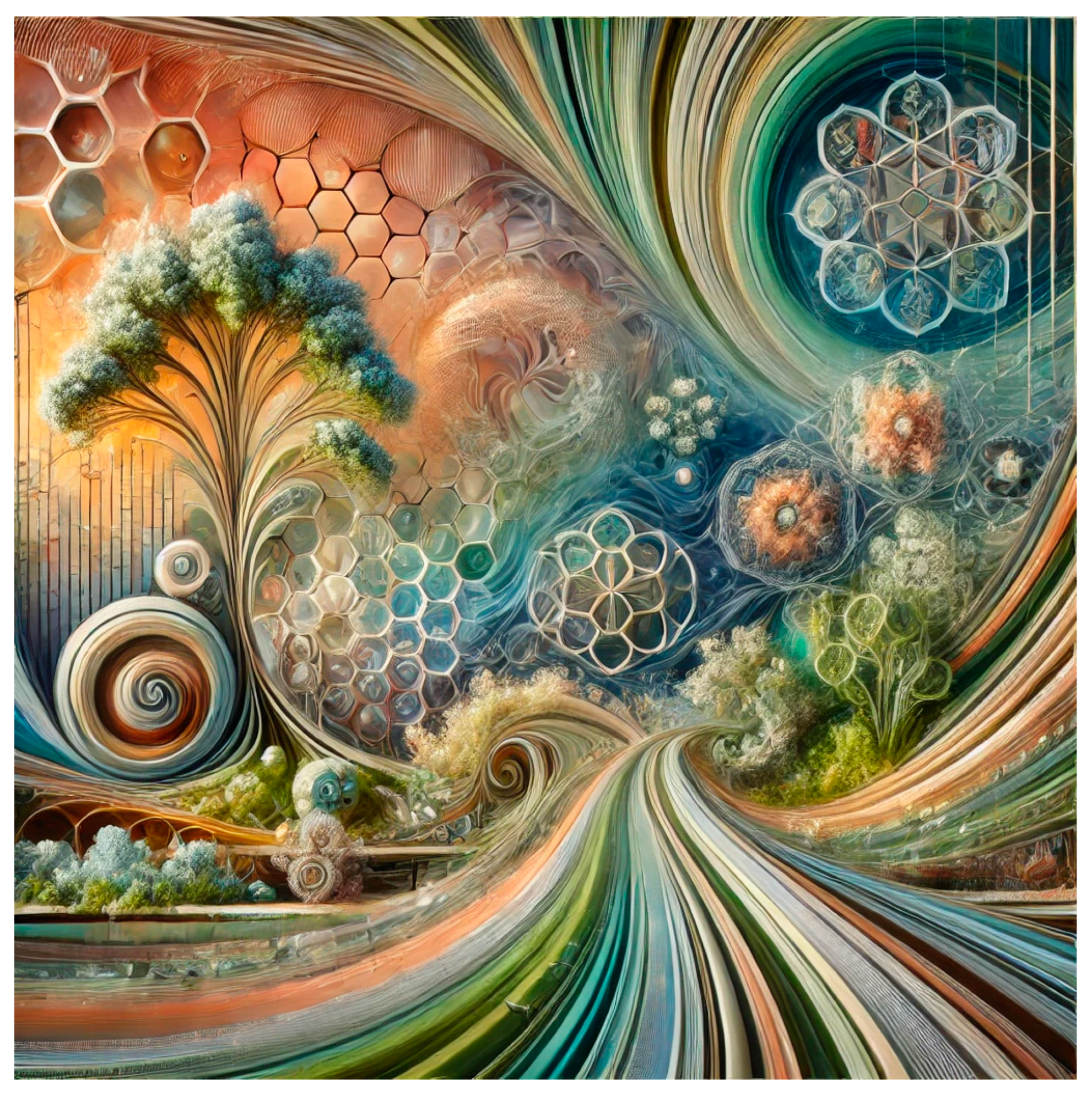
Figure 2.
An abstract mural representation designed to encourage creative thought subconsciously. Its dynamic patterns, harmonious colors, and natural forms are crafted to subtly inspire and energize those working nearby. Figure and caption by ChatGPT-4o, prompted by the author.
Figure 2.
An abstract mural representation designed to encourage creative thought subconsciously. Its dynamic patterns, harmonious colors, and natural forms are crafted to subtly inspire and energize those working nearby. Figure and caption by ChatGPT-4o, prompted by the author.
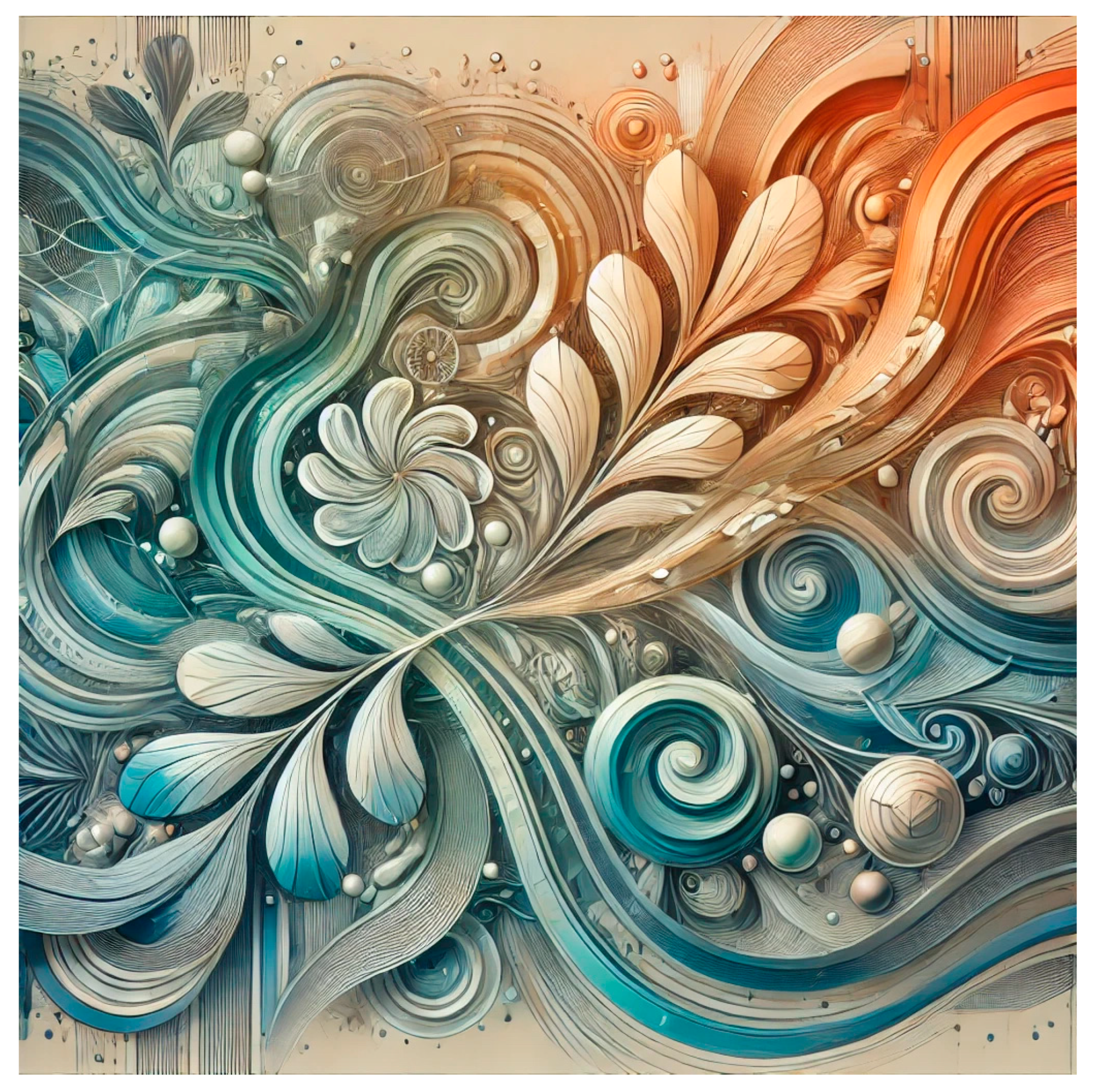
Figure 3.
Here is an abstract painting designed to catalyze creative thought by engaging the viewer’s neural circuits in a positive way. This work avoids representational imagery and instead relies on harmonious patterns, subtle asymmetries, and dynamic color interplay to evoke curiosity, exploration, and mental clarity. Figure and caption by ChatGPT-4o, prompted by the author.
Figure 3.
Here is an abstract painting designed to catalyze creative thought by engaging the viewer’s neural circuits in a positive way. This work avoids representational imagery and instead relies on harmonious patterns, subtle asymmetries, and dynamic color interplay to evoke curiosity, exploration, and mental clarity. Figure and caption by ChatGPT-4o, prompted by the author.
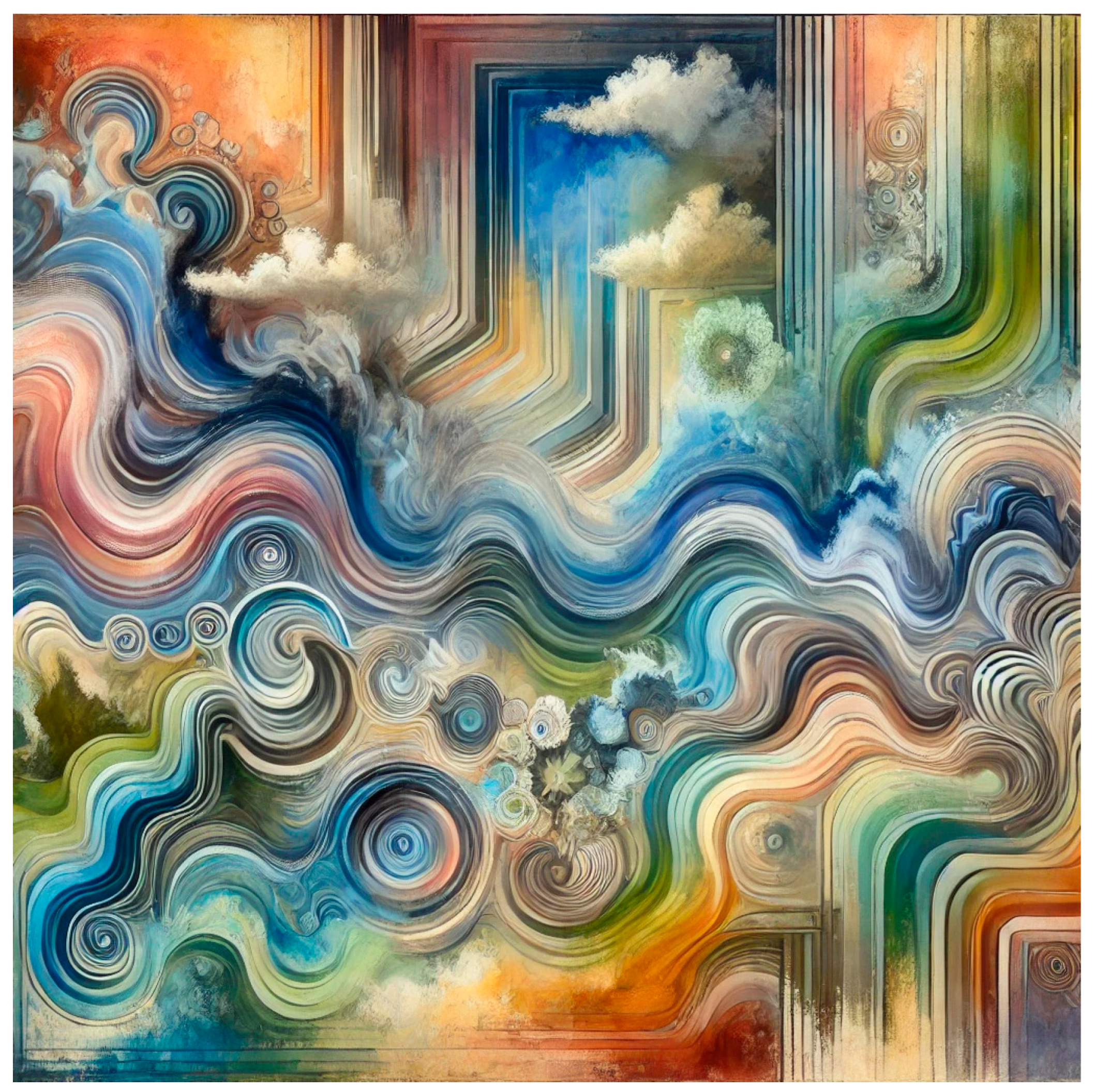
Figure 4.
Here is a mural crafted to stimulate mathematical creativity and cross-disciplinary problem-solving. The design integrates geometric and organic patterns with mathematical elements, encouraging innovative and non-traditional thinking. Figure and caption by ChatGPT-4o, prompted by the author.
Figure 4.
Here is a mural crafted to stimulate mathematical creativity and cross-disciplinary problem-solving. The design integrates geometric and organic patterns with mathematical elements, encouraging innovative and non-traditional thinking. Figure and caption by ChatGPT-4o, prompted by the author.
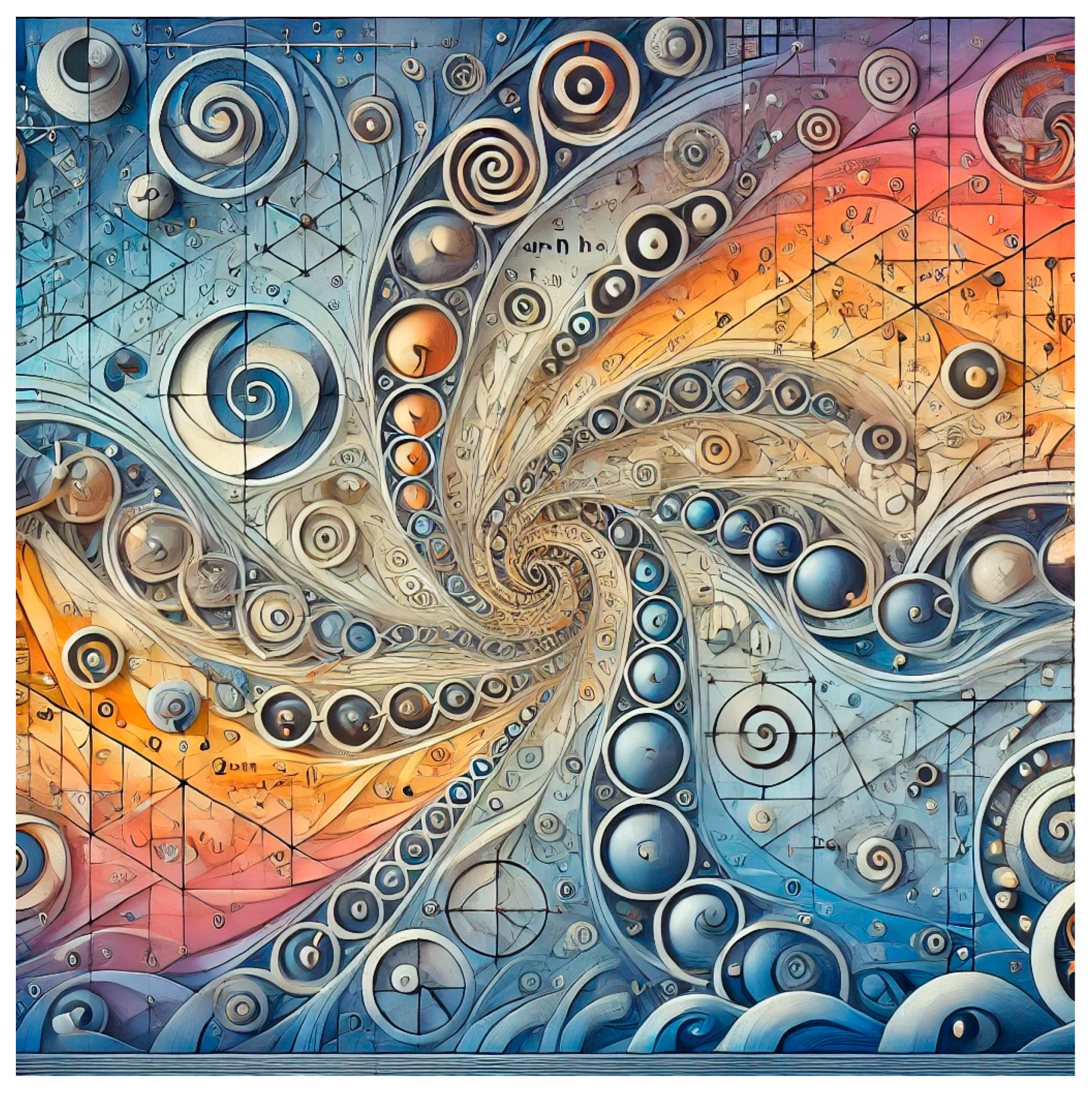
Figure 5.
Here is a mural designed to inspire architectural creativity, capturing the rhythm, harmony, and complexity of classical, traditional, and folk architecture. It emphasizes intricate patterns, organic forms, and a warm, inviting palette to evoke emotional connection and encourage human-centered architectural designs. Figure and caption by ChatGPT-4o, prompted by the author.
Figure 5.
Here is a mural designed to inspire architectural creativity, capturing the rhythm, harmony, and complexity of classical, traditional, and folk architecture. It emphasizes intricate patterns, organic forms, and a warm, inviting palette to evoke emotional connection and encourage human-centered architectural designs. Figure and caption by ChatGPT-4o, prompted by the author.
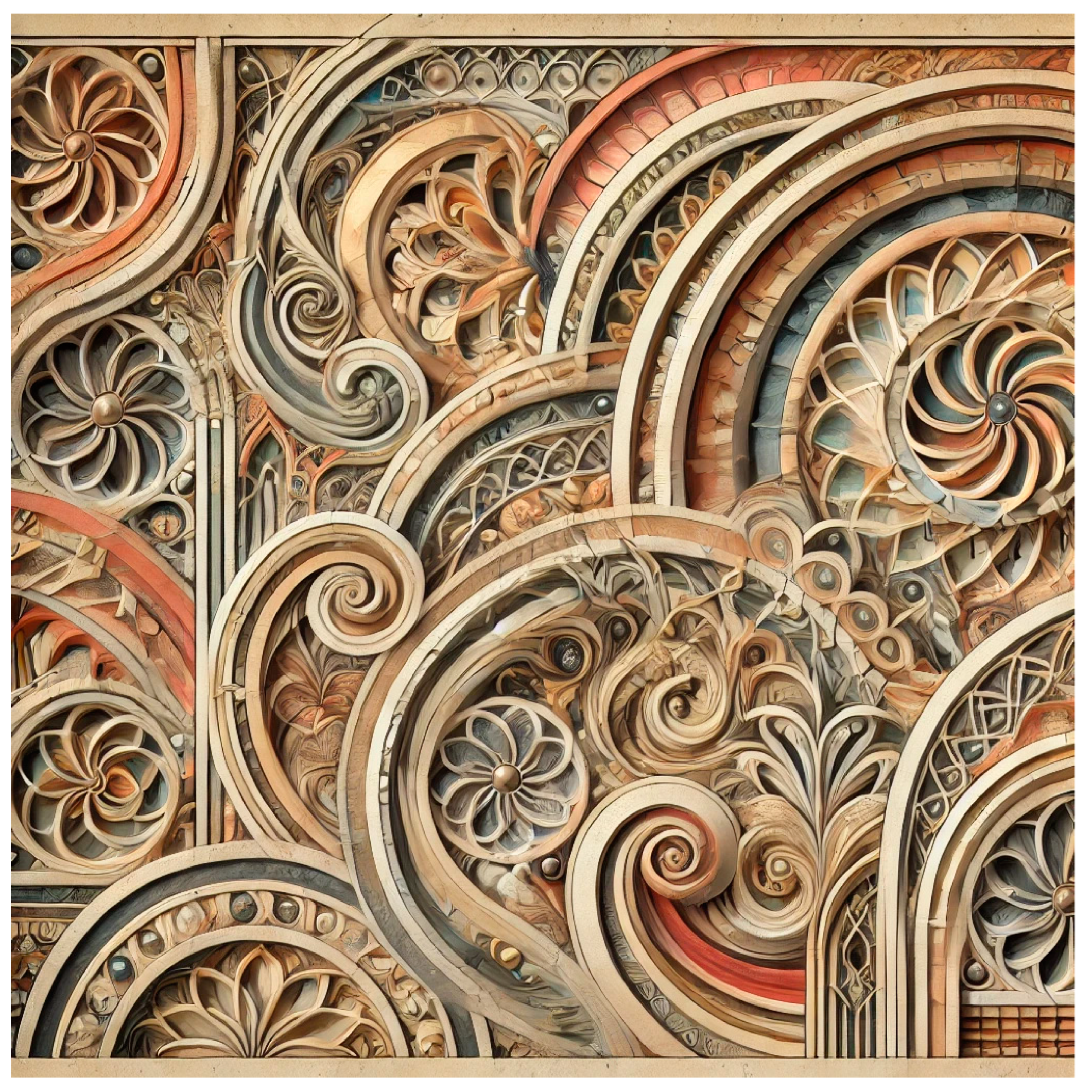
Figure 6.
Here is an abstract painting designed to evoke creativity and inspire innovative thinking by blending elements of AI, neuroscience, and human biology. It incorporates flowing organic forms, vibrant colors, and intricate details that align with the prompts. Figure and caption by ChatGPT-4o, prompted by the author.
Figure 6.
Here is an abstract painting designed to evoke creativity and inspire innovative thinking by blending elements of AI, neuroscience, and human biology. It incorporates flowing organic forms, vibrant colors, and intricate details that align with the prompts. Figure and caption by ChatGPT-4o, prompted by the author.
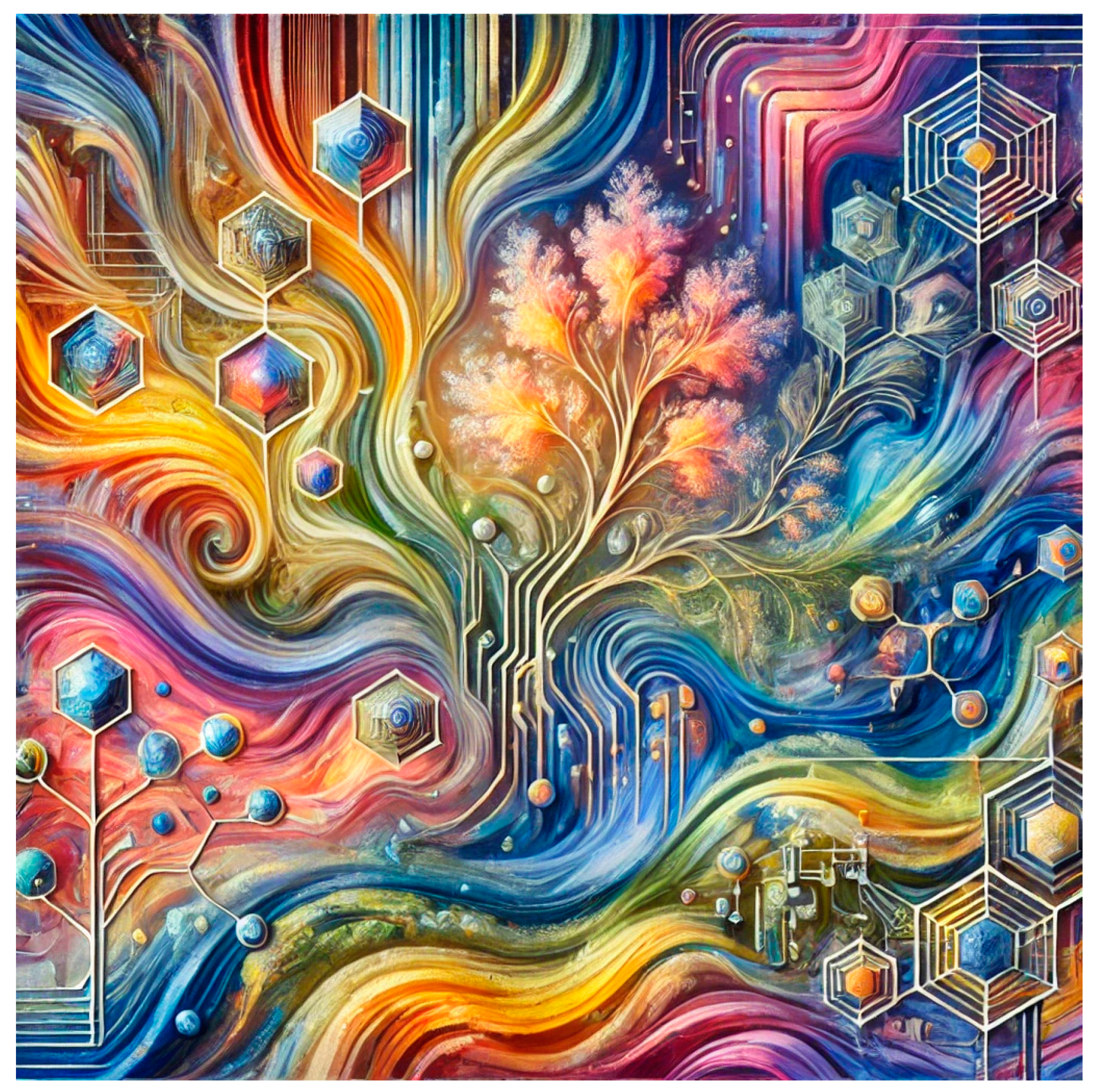
Figure 7.
A completely white, featureless room with smooth walls, a plain floor, and an absence of detail. The lighting is uniform and cold, offering no shadows or contrast to engage the mind. The lack of visual input dulls cognitive function and dampens imaginative engagement. Studies show that barren, minimalist environments devoid of complexity fail to stimulate the brain’s associative networks, leading to lower idea generation. A lack of visual complexity impairs neuroplasticity and deep cognitive engagement. Figure and caption by ChatGPT-4o, prompted by the author.
Figure 7.
A completely white, featureless room with smooth walls, a plain floor, and an absence of detail. The lighting is uniform and cold, offering no shadows or contrast to engage the mind. The lack of visual input dulls cognitive function and dampens imaginative engagement. Studies show that barren, minimalist environments devoid of complexity fail to stimulate the brain’s associative networks, leading to lower idea generation. A lack of visual complexity impairs neuroplasticity and deep cognitive engagement. Figure and caption by ChatGPT-4o, prompted by the author.
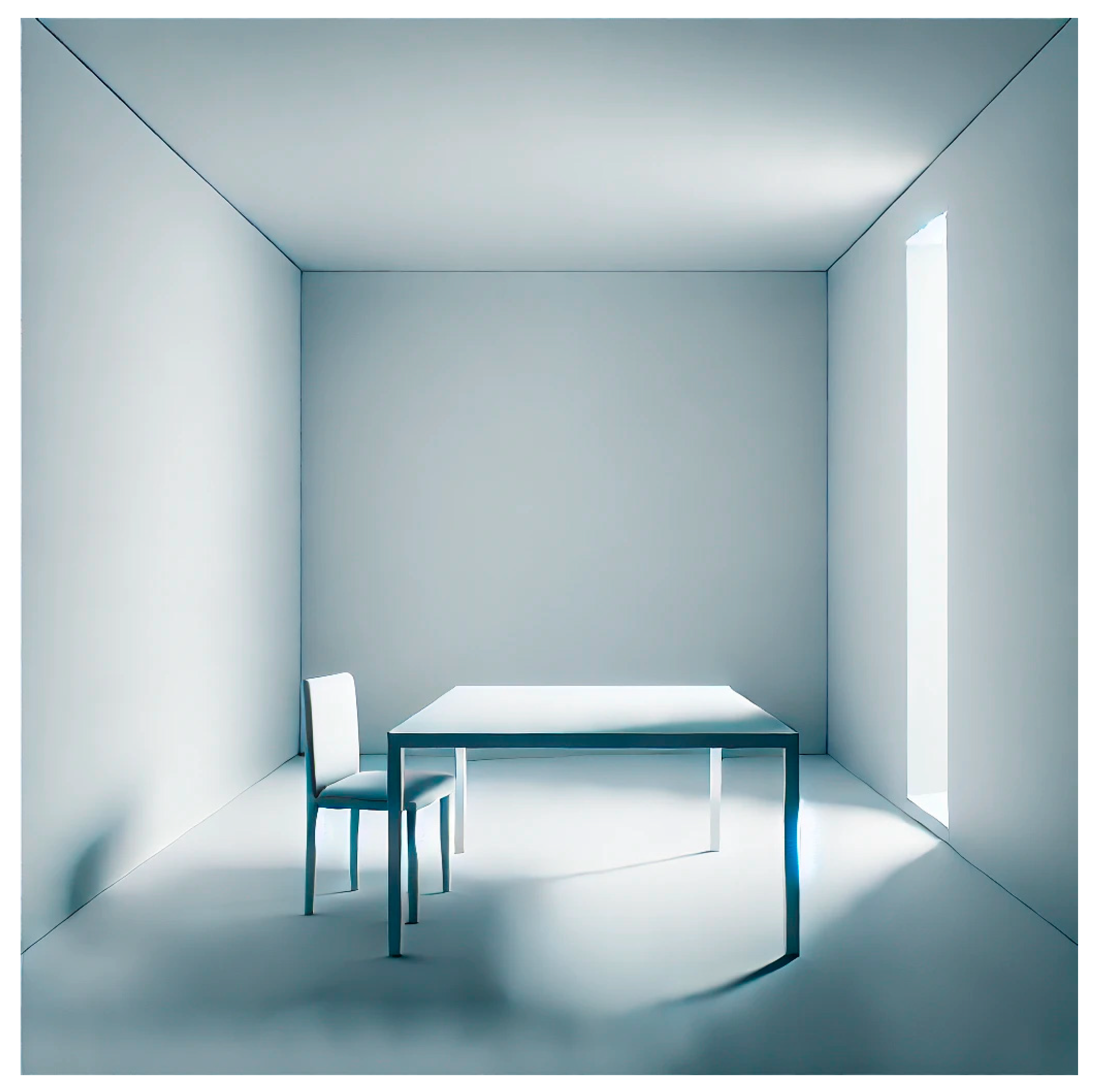
Figure 8.
A harshly angular space filled with pointed, slanted walls and forms that jut out aggressively. There are no soft, organic forms. The lighting creates stark contrasts that make the angles even more severe, evoking discomfort. Research on environmental psychology indicates that sharp, jagged, and aggressive angles activate the amygdala, which is responsible for processing threats. Spaces dominated by these features induce stress and vigilance, reducing cognitive flexibility and making creative problem-solving nearly impossible. Figure and caption by ChatGPT-4o, prompted by the author.
Figure 8.
A harshly angular space filled with pointed, slanted walls and forms that jut out aggressively. There are no soft, organic forms. The lighting creates stark contrasts that make the angles even more severe, evoking discomfort. Research on environmental psychology indicates that sharp, jagged, and aggressive angles activate the amygdala, which is responsible for processing threats. Spaces dominated by these features induce stress and vigilance, reducing cognitive flexibility and making creative problem-solving nearly impossible. Figure and caption by ChatGPT-4o, prompted by the author.
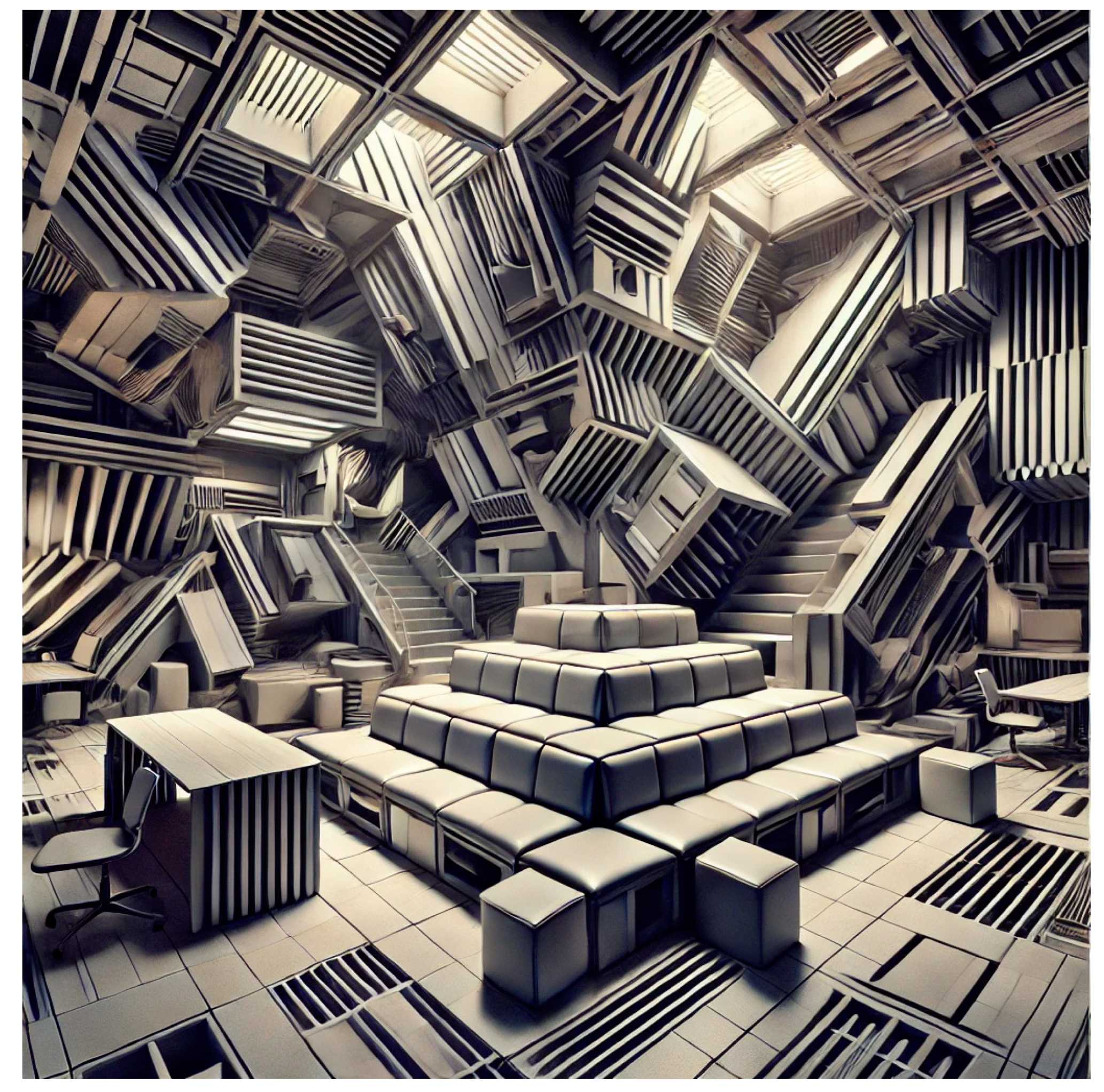
Figure 9.
The rigid, mechanical lines and sterile artificial materials fail to engage the brain’s associative and problem-solving networks, leading to mental stagnation. Studies on biophilic design show that natural forms and patterns enhance cognition, creative engagement, and mood, while their absence results in emotional detachment and impaired ideation. Neuroscientific research confirms that spaces devoid of biophilic elements, natural textures, and organic curves lead to higher stress levels, reduced cognitive well-being, and suppressed creativity. Figure and caption by ChatGPT-4o, prompted by the author.
Figure 9.
The rigid, mechanical lines and sterile artificial materials fail to engage the brain’s associative and problem-solving networks, leading to mental stagnation. Studies on biophilic design show that natural forms and patterns enhance cognition, creative engagement, and mood, while their absence results in emotional detachment and impaired ideation. Neuroscientific research confirms that spaces devoid of biophilic elements, natural textures, and organic curves lead to higher stress levels, reduced cognitive well-being, and suppressed creativity. Figure and caption by ChatGPT-4o, prompted by the author.
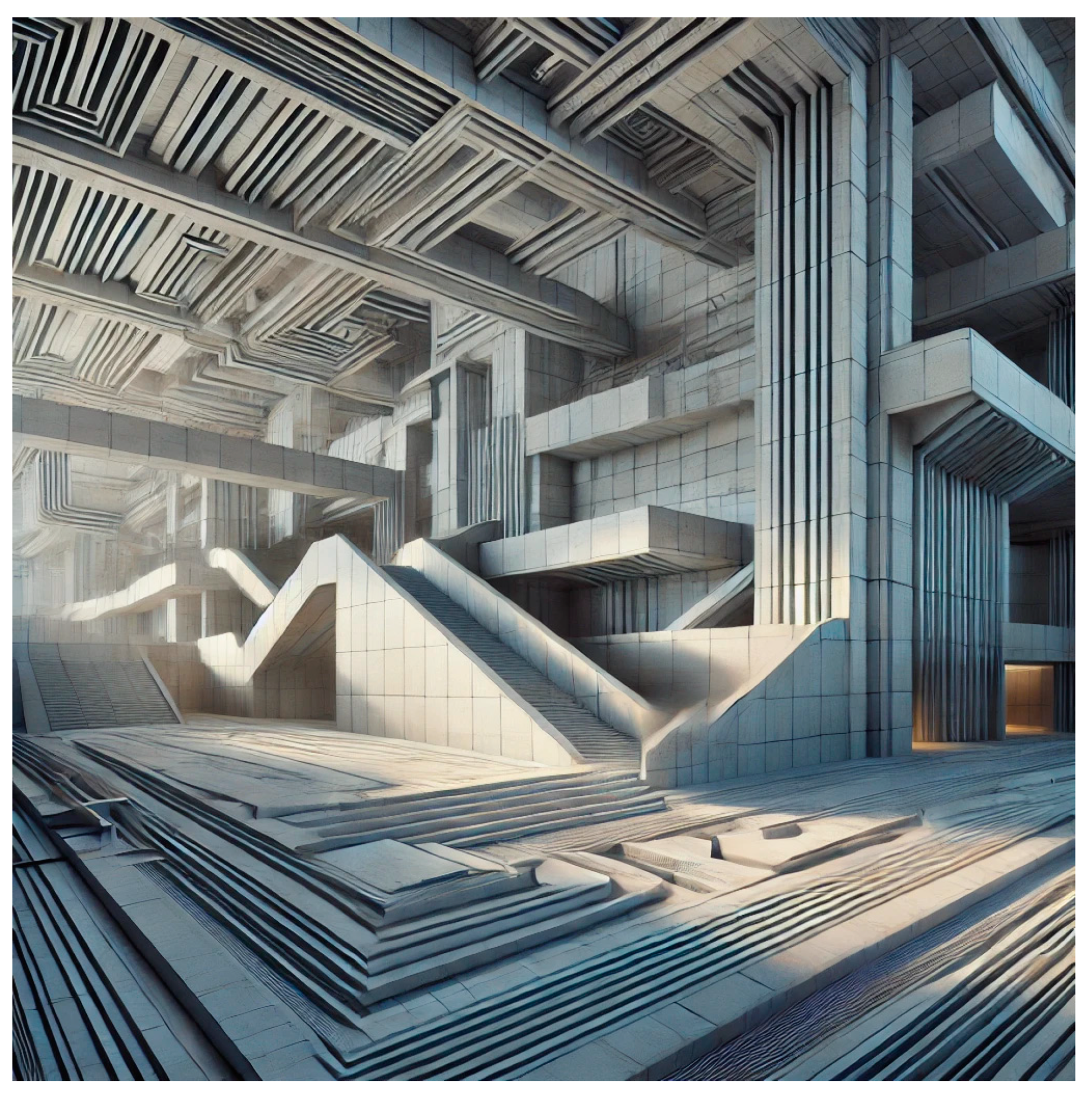
Figure 10.
An interior space filled with clashing, excessive, fragmented shapes, and an overwhelming amount of visual detail with no coherent structure. The chaotic scene forces the eye to jump erratically, preventing focus and deep thought. Research on cognitive load suggests that excessive, unstructured stimuli overwhelm working memory, reducing the brain’s ability to generate new ideas. Incoherent and overstimulating environments impair the prefrontal cortex, which is responsible for higher-order creative thinking. Figure and caption by ChatGPT-4o, prompted by the author.
Figure 10.
An interior space filled with clashing, excessive, fragmented shapes, and an overwhelming amount of visual detail with no coherent structure. The chaotic scene forces the eye to jump erratically, preventing focus and deep thought. Research on cognitive load suggests that excessive, unstructured stimuli overwhelm working memory, reducing the brain’s ability to generate new ideas. Incoherent and overstimulating environments impair the prefrontal cortex, which is responsible for higher-order creative thinking. Figure and caption by ChatGPT-4o, prompted by the author.
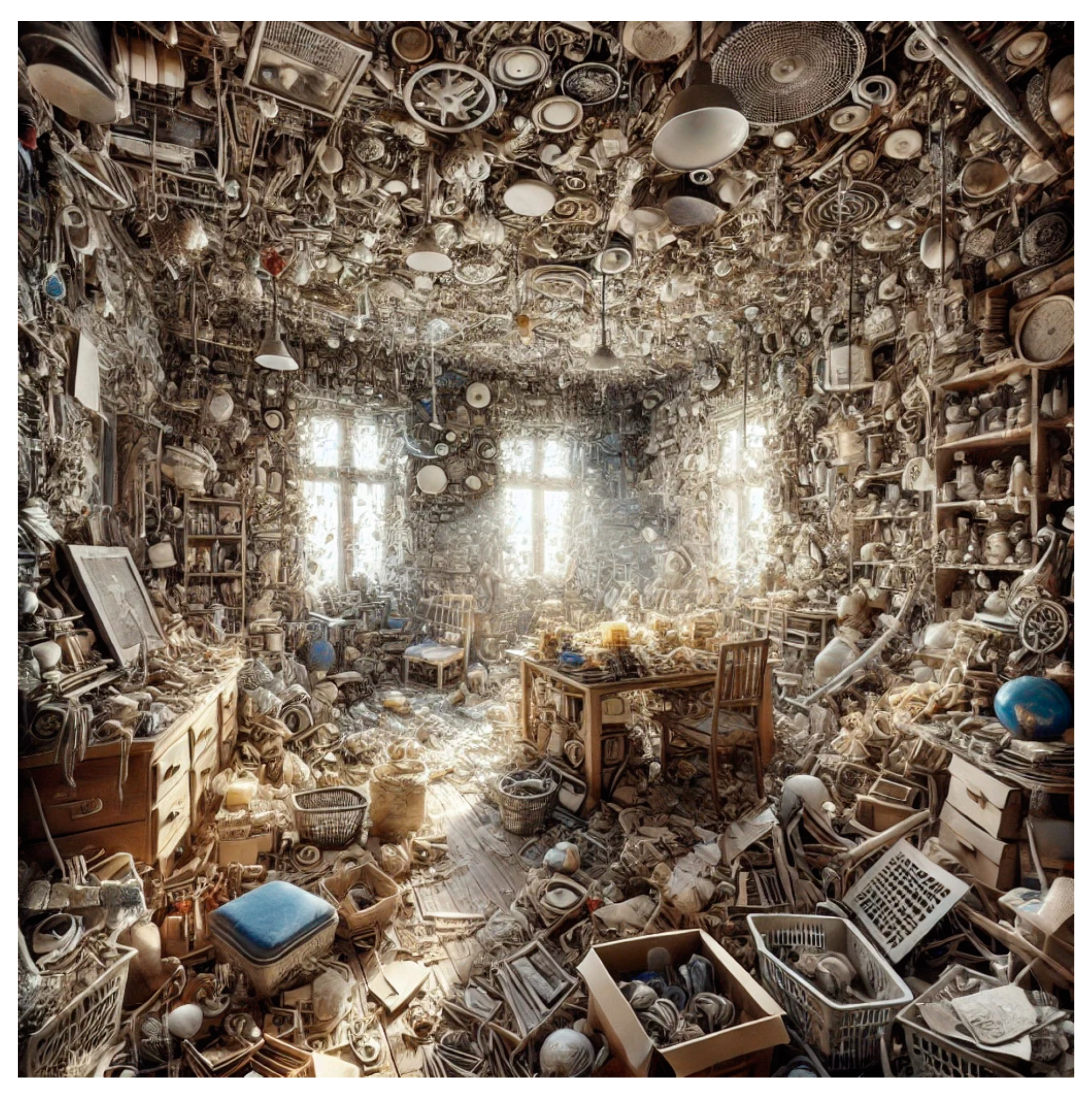

Table 1.
Comparative evaluation of how many of Alexander’s 15 Fundamental Properties are illustrated in each of the first six Figures. ChatGPT-4o found anywhere from 11 to 13 of the properties strongly represented in every image. It was further able to estimate how intensely each property was represented in each image, and especially if any of the 15 was missing altogether — listed as “weakness in properties”.
Table 1.
Comparative evaluation of how many of Alexander’s 15 Fundamental Properties are illustrated in each of the first six Figures. ChatGPT-4o found anywhere from 11 to 13 of the properties strongly represented in every image. It was further able to estimate how intensely each property was represented in each image, and especially if any of the 15 was missing altogether — listed as “weakness in properties”.
| Figure | Strongly present | Partially present | Weakness in properties or lacking altogether |
|---|---|---|---|
| Figure 1 | 12 | 3 | Thick Boundaries |
| Figure 2 | 11 | 4 | Alternating Repetition |
| Figure 3 | 12 | 3 | Thick Boundaries |
| Figure 4 | 12 | 3 | Roughness |
| Figure 5 | 12 | 3 | Gradients, The Void |
| Figure 6 | 13 | 2 | Roughness, The Void |
Table 2.
Comparative evaluation of how few of Alexander’s 15 Fundamental Properties are found in Figures 7 to 10.
Disclaimer/Publisher’s Note: The statements, opinions and data contained in all publications are solely those of the individual author(s) and contributor(s) and not of MDPI and/or the editor(s). MDPI and/or the editor(s) disclaim responsibility for any injury to people or property resulting from any ideas, methods, instructions or products referred to in the content. |
© 2025 by the authors. Licensee MDPI, Basel, Switzerland. This article is an open access article distributed under the terms and conditions of the Creative Commons Attribution (CC BY) license (http://creativecommons.org/licenses/by/4.0/).
Copyright: This open access article is published under a Creative Commons CC BY 4.0 license, which permit the free download, distribution, and reuse, provided that the author and preprint are cited in any reuse.


